
Skip to main content Accessibility help
×
  • Cited by 3
    • Show more authors
    • You may already have access via personal or institutional login
    • Select format
    • Publisher:
      Cambridge University Press
      Publication date:
      03 March 2022
      24 March 2022
      ISBN:
      9781009093095
      9781009098403
      9781009096263
      Dimensions:
      (229 x 152 mm)
      Weight & Pages:
      0.34kg, 142 Pages
      Dimensions:
      (229 x 152 mm)
      Weight & Pages:
      0.24kg, 144 Pages
    You may already have access via personal or institutional login
  • Selected: Digital
    Add to cart View cart Buy from Cambridge.org

    Book description

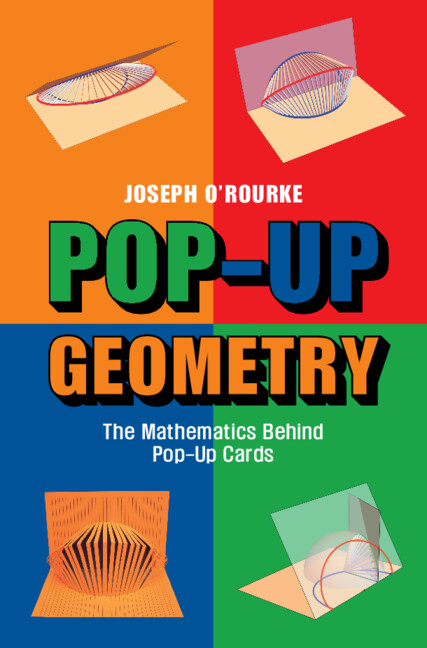
    Anyone browsing at the stationery store will see an incredible array of pop-up cards available for any occasion. The workings of pop-up cards and pop-up books can be remarkably intricate. Behind such designs lies beautiful geometry involving the intersection of circles, cones, and spheres, the movements of linkages, and other constructions. The geometry can be modelled by algebraic equations, whose solutions explain the dynamics. For example, several pop-up motions rely on the intersection of three spheres, a computation made every second for GPS location. Connecting the motions of the card structures with the algebra and geometry reveals abstract mathematics performing tangible calculations. Beginning with the nephroid in the 19th-century, the mathematics of pop-up design is now at the frontiers of rigid origami and algorithmic computational complexity. All topics are accessible to those familiar with high-school mathematics; no calculus required. Explanations are supplemented by 140+ figures and 20 animations.

    Reviews

    'What a delight! Finally, a book that explains the geometry behind pop-up cards in a simple and straight-forward way with loads of illustrations and web animations to help. I look forward to sharing this gem with my own students.'

    Thomas Hull - Western New England University

    'Pop-Up Geometry is a beautifully written book. This book focuses on the aspect of pop-up structures of computational origami, a recent trend in computational geometry. Once you flip the pages, you will find various colorful figures. These figures nicely give you inspirations of paper art and ideas of the mathematical background of pop-up paper sculptures.'

    Ryuhei Uehara - Japan Advanced Institute of Science and Technology

    'There are many books about pop-ups, but only one about the mathematics of how they work. From analyzing standard pop-up mechanisms to advanced computational design, geometry master O'Rourke gives an excellent tour of this wonderful world.'

    Erik Demaine - Massachusetts Institute of Technology

    ‘This text can readily be used as a supplement to a geometry course. I also see this book serving as a foundation for a multi-disciplined extracurricular activity called ‘Pop-Up Card Design’. This activity would encourage students interested in enhancing their skills in English, Mathematics, and Art as they work together in a cooperative effort to produce Pop-Up cards or Pop-Up books.’

    Tom French Source: MAA Reviews

    'Complete with vibrantly colored graphics, companion animations that depict the motion described in the book, and templates for the reader to make the pop-up creations the book is analyzing, this book makes it easy for the reader to engage with the material they are learning.'

    Katelynn Kochalski Source: Notices of the American Mathematical Society

    ‘I can envision using this book as a text for a one-semester undergraduate interdisciplinary course that interweaves theory with physical constructions. Students would leave the course with a heightened sense of three-dimensional geometry, an appreciation of the creative potential of mathematics, and a portfolio of pop-ups to boot … This short (129 pages) book is engaging and inspiring, and it opens up a world of possibilities. It may even suggest a fresh and largely unexplored mathematical field: pop-up design and theory. It is going to generate a lot of activity, research, and design.’

    Richard H. Hammack Source: The Mathematical Intelligencer

    ‘A thought-provoking treasure trove of fun and intellectually challenging revelations that is accessible for a large mathematical audience.’

    Source: Physics Book Reviews

    ‘Using an engaging and conversational tone, O’Rourke strikes a nice balance between rigor and informality. It’s easy to follow the details in the elementary material, yet also get the big picture for the more advanced topics. The book includes ample exercises, ranging from mathematical computations to card constructions, along with solutions. Whether you are a casual reader or a serious student of pop-ups, you will come away with new insights. This book will open a world of possibilities. Get it and get to work. Happy folding!’

    Richard H. Hammack Source: Math Horizons

    Refine List

    Actions for selected content:

    Select all | Deselect all
    • View selected items
    • Export citations
    • Download PDF (zip)
    • Save to Kindle
    • Save to Dropbox
    • Save to Google Drive

    Save Search

    You can save your searches here and later view and run them again in "My saved searches".

    Please provide a title, maximum of 40 characters.
    ×

    Contents

    Metrics

    Altmetric attention score

    Full text views

    Total number of HTML views: 0
    Total number of PDF views: 0 *
    Loading metrics...

    Book summary page views

    Total views: 0 *
    Loading metrics...

    * Views captured on Cambridge Core between #date#. This data will be updated every 24 hours.

    Usage data cannot currently be displayed.

    Accessibility standard: Unknown

    Why this information is here

    This section outlines the accessibility features of this content - including support for screen readers, full keyboard navigation and high-contrast display options. This may not be relevant for you.

    Accessibility Information

    Accessibility compliance for the PDF of this book is currently unknown and may be updated in the future.
