
Skip to main content Accessibility help
×
  • Cited by 2
    • Show more authors
    • You may already have access via personal or institutional login
    • Select format
    • Publisher:
      Cambridge University Press
      Publication date:
      March 2022
      March 2022
      ISBN:
      9781009099974
      Dimensions:
      Weight & Pages:
      Dimensions:
      Weight & Pages:
    You may already have access via personal or institutional login
  • Selected: Digital
    Add to cart View cart Buy from Cambridge.org

    Book description

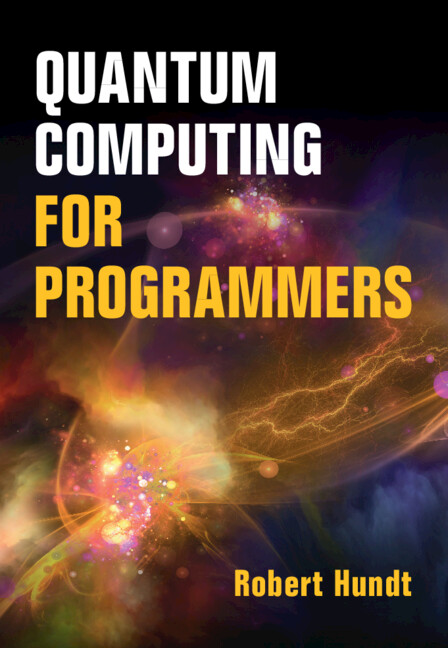
    This introduction to quantum computing from a classical programmer's perspective is meant for students and practitioners alike. Over 25 fundamental algorithms are explained with full mathematical derivations and classical code for simulation, using an open-source code base developed from the ground up in Python and C++. After presenting the basics of quantum computing, the author focuses on algorithms and the infrastructure to simulate them efficiently, beginning with quantum teleportation, superdense coding, and Deutsch-Jozsa. Coverage of advanced algorithms includes the quantum supremacy experiment, quantum Fourier transform, phase estimation, Shor's algorithm, Grover's algorithm with derivatives, quantum random walks, and the Solovay–Kitaev algorithm for gate approximation. Quantum simulation is explored with the variational quantum eigensolver, quantum approximate optimization, and the Max-Cut and Subset-Sum algorithms. The book also discusses issues around programmer productivity, quantum noise, error correction, and challenges for quantum programming languages, compilers, and tools, with a final section on compiler techniques for transpilation.

    Reviews

    'There is a great deal of interest in quantum computing today. What many would like is a book that explains quantum computing to people who already know how to program conventional computers. This book successfully fills that need.'

    David Patterson - 2017 ACM A.M. Turing Award Laureate

    'There is a critical need for quantum software engineers in the emerging quantum computing industry. Robert Hundt is a classical software engineer who presents quantum computing as simply as possible to others with a similar background. This book could be the perfect vehicle for many interested in this emerging area.'

    Fred Chong - Seymour Goodman Professor, University of Chicago

    'Quantum mechanics, the century old theory underlying modern physics and chemistry, has a reputation for being incomprehensible. Professional physicists have a standard approach to this conundrum: 'Shut up and calculate!'. This book provides an alternative much better suited to the programmers of the XXI century interested in quantum computing: 'Shut up and program!'.'

    Sergio Boixo - Google

    'This book strikes just the right balance between theory and practice. Exploring quantum computing from the perspective of a classical programmer, using software and simulators to explain all concepts and algorithms, leads to an intuitive, accessible, yet deep learning experience. I highly recommend this book!'

    Kunle Olukotun - Cadence Design Professor, Stanford University

    'This book takes a unique approach of introducing quantum computing with a combination of precise but manageable mathematics, open-source code, and detailed derivations of many core quantum algorithms, which makes it an ideal learning resource for the community of software programmers, including both students and professionals, to explore the fascinating land of quantum computing.'

    Jason Cong - Volgenau Chair for Engineering Excellence, UCLA

    Refine List

    Actions for selected content:

    Select all | Deselect all
    • View selected items
    • Export citations
    • Download PDF (zip)
    • Save to Kindle
    • Save to Dropbox
    • Save to Google Drive

    Save Search

    You can save your searches here and later view and run them again in "My saved searches".

    Please provide a title, maximum of 40 characters.
    ×

    Contents

    Metrics

    Altmetric attention score

    Full text views

    Total number of HTML views: 0
    Total number of PDF views: 0 *
    Loading metrics...

    Book summary page views

    Total views: 0 *
    Loading metrics...

    * Views captured on Cambridge Core between #date#. This data will be updated every 24 hours.

    Usage data cannot currently be displayed.

    Accessibility standard: Unknown

    Why this information is here

    This section outlines the accessibility features of this content - including support for screen readers, full keyboard navigation and high-contrast display options. This may not be relevant for you.

    Accessibility Information

    Accessibility compliance for the PDF of this book is currently unknown and may be updated in the future.
