
Skip to main content Accessibility help
×
  • Cited by 24
    • The digital format of this book is no longer available to purchase from Cambridge Core. Other formats may be available.
    • Please contact Liverpool University Press for availability about this product

      https://www.liverpooluniversitypress.co.uk/

    • Show more authors
    • You may already have access via personal or institutional login
    • Select format
    • Publisher:
      Liverpool University Press
      Publication date:
      Invalid date
      April 2010
      ISBN:
      9781846312373
      Dimensions:
      Weight & Pages:
      00kg,
      Dimensions:
      Weight & Pages:
    You may already have access via personal or institutional login
    Selected: Digital
    Add to cart View cart Buy from Cambridge.org

    Book description

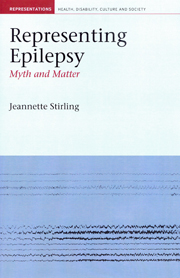
    At least 50 million people worldwide have epilepsy. Representing Epilepsy, the latest volume in LUP’s acclaimed Representations series, seeks to understand the epileptic body as a literary or figurative device intelligible beyond a medical framework. Jeannette Stirling argues that neurological discourse from the late-nineteenth century through to the mid-twentieth century is as much forged by the cultural conditions and representational politics of the times as it is by the science of western medicine. Along the way she explores narratives of epilepsy depicting ideas of social disorder, tainted bloodlines, sexual deviance, spiritualism and criminality in works as diverse as David Copperfield and The X Files. This path-breaking book will be required reading for cultural disability studies scholars and for anyone seeking greater understanding of this common condition. ‘Representing Epilepsy offers a clever exploration of the cultural history of this condition, based on an effective interdisciplinary approach. It will be of particular interest to scholars and students in the field of Medical Humanities, as well as to all those involved in the care of people with epilepsy, who wish to improve their understanding of the socio-cultural repercussions of the condition.’ Maria Vaccarella, King’s College London

    Reviews

    Stirling's book will certainly appeal to a wide-ranging readership. An essential reading for scholars and students in the field of medical humanities, it will also attract literary, disability, and media scholars, historians of medicine, as well as health professionals who wish to expand their understanding of the sociocultural aspects of epilepsy.'

    Maria Vaccarella Source: Epilepsy & Behavior

    Stirling's book will certainly appeal to a wide-ranging readership. An essential reading for scholars and students in the field of medical humanities, it will also attract literary, disability, and media scholars, historians of medicine, as well as health professionals who wish to expand their understanding of the sociocultural aspects of epilepsy.

    Maria Vaccarella Source: Epilepsy & Behavior

    Refine List

    Actions for selected content:

    Select all | Deselect all
    • View selected items
    • Export citations
    • Download PDF (zip)
    • Save to Kindle
    • Save to Dropbox
    • Save to Google Drive

    Save Search

    You can save your searches here and later view and run them again in "My saved searches".

    Please provide a title, maximum of 40 characters.
    ×

    Contents

    Metrics

    Altmetric attention score

    Full text views

    Total number of HTML views: 0
    Total number of PDF views: 0 *
    Loading metrics...

    Book summary page views

    Total views: 0 *
    Loading metrics...

    * Views captured on Cambridge Core between #date#. This data will be updated every 24 hours.

    Usage data cannot currently be displayed.

    Accessibility standard: Unknown

    Why this information is here

    This section outlines the accessibility features of this content - including support for screen readers, full keyboard navigation and high-contrast display options. This may not be relevant for you.

    Accessibility Information

    Accessibility compliance for the PDF of this book is currently unknown and may be updated in the future.
