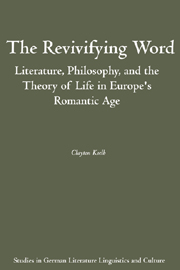
The Revivifying Word

-
Select format
-
- Publisher:
- Boydell & Brewer
- Publication date:
- 05 February 2013
- 01 October 2008
- ISBN:
- 9781571138040
- 9781571133885
- Dimensions:
- Weight & Pages:
- 00kg,
- Dimensions:
- Weight & Pages:
You may already have access via personal or institutional login- Subjects:
- Philosophy: General Interest, Philosophy
Show more authors 
You may already have access via personal or institutional login
Book description
'What is not 'Life' that really is?' asked Coleridge, struggling, like many poets, philosophers, and scientists of Europe's Romantic age, to formulate a theory of life that explained the mysterious relation between dead material bodies and living, animate beings. Romantic intellectuals found a key to this mystery surprisingly close at hand: the process by which dead matter could come to life must be something like the process of reading. 'The Revivifying Word' examines the reanimating acts of reading that became a central focus of attention for Romantic writers. German theorists, building on the Apostle Paul's assertion that the dead letter can be revivified by the living spirit, proposed a permeable, legible boundary between the living and the dead. This inaugurated a revolution in European aesthetics, implanting the germ of an extraordinarily productive narrative idea that enriched Romantic literature for decades. Poets and novelists created a large cast of characters who crossed the boundary between death and life with the help of some form of reading: figures like Keats's Glaucus, Kleist's Elizabeth Kohlhaas, Shelley's Frankenstein (and the monster he creates), Maturin's Melmoth, Poe's Madeline Usher, and Gautier's Spirite. Clayton Koelb demonstrates that such fictions offer a nuanced consideration of the most urgent question facing any theory of life: how do material bodies come to acquire, to lose, and then perhaps to regain the immaterial intellectual/spiritual quality that defines animate beings? Clayton Koelb is Guy B. Johnson Professor of German, English, and Comparative Literature and Chair of the Department of Germanic Languages and Literatures at the University of North Carolina, Chapel Hill.
Contents
Contents
Metrics
Full text views
Full text views helpTotal number of HTML views: 0
Total number of PDF views: 0 *
 Loading metrics...
* Views captured on Cambridge Core between #date#. This data will be updated every 24 hours.
Usage data cannot currently be displayed.
Accessibility standard: Unknown
Why this information is here
This section outlines the accessibility features of this content - including support for screen readers, full keyboard navigation and high-contrast display options. This may not be relevant for you.
Accessibility Information
Accessibility compliance for the PDF of this book is currently unknown and may be updated in the future.