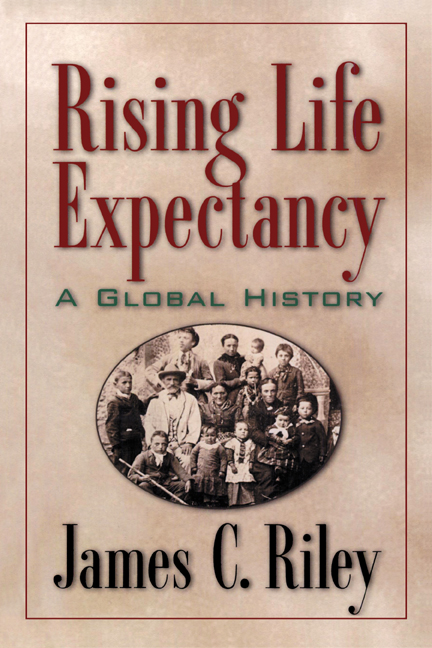
Rising Life Expectancy

-
Select format
-
- Publisher:
- Cambridge University Press
- Publication date:
- 05 February 2015
- 04 June 2001
- ISBN:
- 9781316036495
- 9780521002813
- Dimensions:
- Weight & Pages:
- Dimensions:
- (228 x 152 mm)
- Weight & Pages:
- 0.358kg, 256 Pages
You may already have access via personal or institutional login
Show more authors 
You may already have access via personal or institutional login
Book description
Between 1800 and 2000 life expectancy at birth rose from about 30 years to a global average of 67 years, and to more than 75 years in favored countries. This dramatic change, called the health transition, is characterized by a transition both in how long people expected to live, and how they expected to die. The most common age at death jumped from infancy to old age. Most people lived to know their children as adults, and most children became acquainted with their grandparents. Whereas earlier people died chiefly from infectious diseases with a short course, by later decades they died from chronic diseases, often with a protracted course. The ranks of people living in their most economically productive years filled out, and the old became commonplace figures everywhere. Rising Life Expectancy: A Global History examines the way humans reduced risks to their survival, both regionally and globally, to promote world population growth and population aging.
Reviews
‘This impressive book should find a place on the shelves of scientists from a broad range of disciplines who wish to learn more about the history behind the dramatic extension of life that most of us experience today. This book will also inform coursework in such areas a epidemiology and human mortality and the history of public health.’
Source: Population and Development Review
'… highly readable … lucidity and clarity that Riley has brought to bear on a topic … a standard introductory text in undergraduate history courses concerned with the evolution of human health. It is also probable that Riley's contribution will find for itself a profitable market in the field of global history. One of the book's strengths is the way in which it pays far more than lip service to international comparisons.
Source: Medical History
Contents
Contents
Metrics
Altmetric attention score
Full text views
Full text views helpTotal number of HTML views: 0
Total number of PDF views: 0 *
 Loading metrics...
* Views captured on Cambridge Core between #date#. This data will be updated every 24 hours.
Usage data cannot currently be displayed.
Accessibility standard: Unknown
Why this information is here
This section outlines the accessibility features of this content - including support for screen readers, full keyboard navigation and high-contrast display options. This may not be relevant for you.
Accessibility Information
Accessibility compliance for the PDF of this book is currently unknown and may be updated in the future.