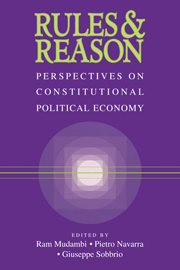

Polarization in Western democracies and the collapse of centrally planned economies have led to calls for a redefinition of the state's core functions. This volume explores shifting conceptions of constitutional political economy anchoring the state from the viewpoints of theory, systems, and applications. It suggests why changes may be desirable and how these might be implemented. Part I addresses the writing of constitutions, the dynamic between constitutional order and civil society, the struggle between competitive and protectionist interests, the conflict between protecting expectations and moral evolution, and the role of cultural explanations of constitutional development patterns. Part II explores the interplay between electoral systems and constitutional engineering, the internal costs of political coalitions, and campaigns in pluralistic elections. Part III investigates the quest for stable, dynamic federal states with particular attention to opportunities and pitfalls in Europe. With a foreword and contributions from Nobel Laureate James M. Buchanan.
‘Undoubtedly the book is a valuable tool for researchers who strive to deepen their understanding of constitutional political economy. It should also be very useful for policymakers who are currently debating these important constitutional issues in Europe and elsewhere.’
Source: Public Choice
‘… a significant scholarly contribution …’.
Source: Political Studies Review
Loading metrics...
* Views captured on Cambridge Core between #date#. This data will be updated every 24 hours.
Usage data cannot currently be displayed.
This section outlines the accessibility features of this content - including support for screen readers, full keyboard navigation and high-contrast display options. This may not be relevant for you.
Accessibility compliance for the PDF of this book is currently unknown and may be updated in the future.
