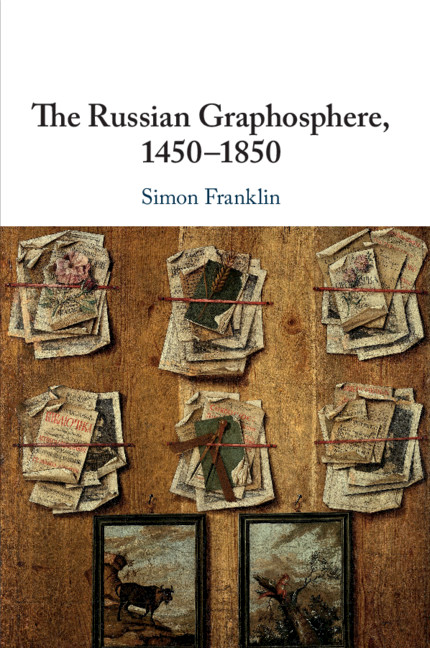

The 'graphosphere' is the dynamic space of visible words. Graphospheres mutate, they are reconfigured with changes in technology, in modes of production, in social structures, in fashion and taste. The graphospheric environment can be public or private, monumental or ephemeral. This book explores a new approach to the study of writing, with a focus on Russia during its 'long early modernity' from the late fifteenth century to the early nineteenth century. Taking an inclusive approach, it charts unmapped territory, uncovers sources that have almost entirely escaped attention and therefore provides, in the first instance, a unique reference guide to cultures of writing in Russia over four hundred years. Besides generating fresh insights into distinctive features of Russian culture, this outward-looking and accessible book offers a pioneering case study for the wider comparative exploration of the significance of technologies of the word.
Winner, ASEEES USC Book Prize in Literary and Cultural Studies
Honourable Mention, Eighteenth-Century Russian Studies Association Mark Raeff Book Prize
'Recommended for libraries supporting Slavic, East European, and Central Eurasian graduate studies. Includes a most extensive bibliography.'
B. K. Beynen Source: Choice
'… insightful … Franklin takes the reader into a world where writing and reading signalled something very different from what they do today.'
Marshall Poe Source: The Times Literary Supplement
‘Franklin has written an important book, one that inspires readers to reevaluate past assumptions about the history of material texts, categories of writing and the institutions that determine their value. His is a work whose implications extend beyond the chronological and geographical indicators of its title and that has the potential to establish a new branch of literary and cultural studies beyond the boundaries of our field.’
‘Franklin introduces the term [graphosphere] as a 'near neologism,' and with it, inaugurates an entire field. Now that he has done so, readers have cause to celebrate. This is a rare book that opens eyes and reveals new vistas for thought, imagination, and scholarship. It is as electrifying in its novelty as it is dazzling in its erudition … The cumulative force of the book allows us to see the concept of the graphosphere emerge out of a haze and solidify as a real and important way to look at the world, to think about culture and history, to unearth new information and gain new perspectives by cutting across familiar categories in unexpected ways.’
Valerie A. Kivelson Source: Canadian-American Slavic Studies
Loading metrics...
* Views captured on Cambridge Core between #date#. This data will be updated every 24 hours.
Usage data cannot currently be displayed.
This section outlines the accessibility features of this content - including support for screen readers, full keyboard navigation and high-contrast display options. This may not be relevant for you.
Accessibility compliance for the PDF of this book is currently unknown and may be updated in the future.
