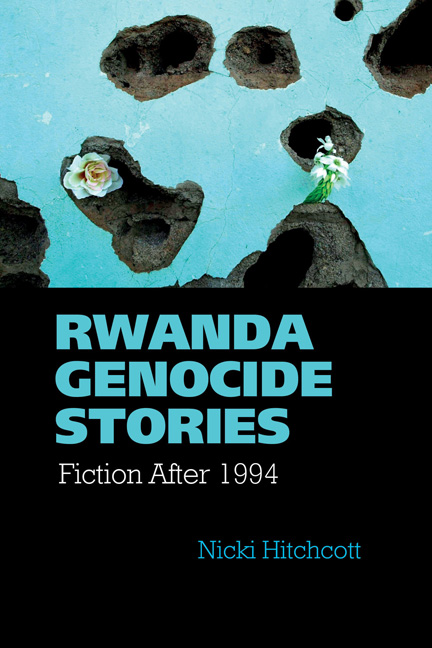
Rwanda Genocide Stories

-
The digital format of this book is no longer available to purchase from Cambridge Core. Other formats may be available.
-
Select format
-
- Publisher:
- Liverpool University Press
- Publication date:
- 25 July 2017
- 31 December 2015
- ISBN:
- 9781781384824
- 9781781381946
- Dimensions:
- Weight & Pages:
- Dimensions:
- Weight & Pages:
You may already have access via personal or institutional login
Show more authors 
You may already have access via personal or institutional login
Book description
During what has become officially known as the genocide against the Tutsi, as many as one million Rwandan people were brutally massacred between April and July 1994. This book presents a critical study of fictional responses by authors inside and outside Rwanda to the 1994 genocide. Focusing on a large and original corpus of creative writing by African authors, including writers from Rwanda, Rwanda Genocide Stories: Fiction After 1994 examines the positionality of authors and their texts in relation to the genocide. How do issues of ‘ethnicity’, nationality, geographical location and family history affect the ways in which creative writers respond to what happened in 1994? And how do such factors lead to authors and their texts being positioned by others? The book is organized around the principal subject positions created by the genocide, categories that have particular connotations and have become fraught with political tension and ambiguity in the context of post-genocide Rwanda. Through analysis of the figures of tourists, witnesses, survivors, victims and perpetrators, the book identifies the ways in which readers of genocide stories are compelled to reevaluate their knowledge of Rwanda and take an active role in commemorative processes: as self-critical tourists, ethical witnesses, judges or culpable bystanders, we are encouraged to acknowledge and assume our own responsibility for what happened in 1994.
Reviews
Rwanda Genocide Stories is an excellent vehicle for bringing a group of largely overlooked writers with varied, complex perspectives on genocide to an English-speaking, academic audience.
David Whitehouse Source: Francospheres
“Insightful, thoroughly researched, and exceptionallyengaging [...] Hitchcott’s Rwanda Genocide Stories offers so much in additionto the excellent literary analysis it presents. The book is replete with richhistorical and contextual detail, compellingly argued and stronglyinterdisciplinary.”
Ayala Maurer-Prager, Bulletin of Francophone Postcolonial Studies
Contents
Contents
Metrics
Altmetric attention score
Full text views
Full text views helpTotal number of HTML views: 0
Total number of PDF views: 0 *
 Loading metrics...
* Views captured on Cambridge Core between #date#. This data will be updated every 24 hours.
Usage data cannot currently be displayed.
Accessibility standard: Unknown
Why this information is here
This section outlines the accessibility features of this content - including support for screen readers, full keyboard navigation and high-contrast display options. This may not be relevant for you.
Accessibility Information
Accessibility compliance for the PDF of this book is currently unknown and may be updated in the future.