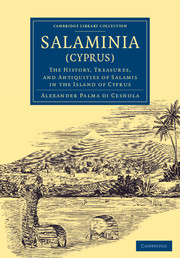

Alessandro Palma Di Cesnola (1839–1914) travelled to Cyprus in 1873 to take up an honorary post secured by his brother Luigi, who was the American consul there and also an amateur archaeologist. Obtaining funding from the British financier Edwin Lawrence, Alessandro carried out his own excavations, chiefly around Salamis. Replete with more than 700 illustrations, this 1882 publication records the most notable artefacts from the Lawrence–Cesnola collection, including gold jewellery, ivory objects, engraved gems, coins, and terracotta statuettes. The book sheds considerable light on the ancient Egyptian, Phoenician, Greek and Roman influences that shaped Cypriot art over the centuries. Di Cesnola's activities generated controversy, however, as he had flouted regulations in removing these artefacts. After the British Museum declined to acquire the whole collection, the bulk of it was sold at auction. His brother's finds were recorded in Cyprus: Its Ancient Cities, Tombs, and Temples (1877), which is also reissued in this series.
Loading metrics...
* Views captured on Cambridge Core between #date#. This data will be updated every 24 hours.
Usage data cannot currently be displayed.
This section outlines the accessibility features of this content - including support for screen readers, full keyboard navigation and high-contrast display options. This may not be relevant for you.
Accessibility compliance for the PDF of this book is currently unknown and may be updated in the future.
