
Skip to main content Accessibility help
×
  • Cited by 1
    • Solutions to end of chapter problems are available from the authors on request (dsandwell@ucsd.edu).
    • Show more authors
    • Open Access
      You have digital access to this book
    • Select format
    • Publisher:
      Cambridge University Press
      Publication date:
      13 September 2025
      04 September 2025
      ISBN:
      9781009606226
      9781009606233
      Creative Commons:
      Creative Common License - CC Creative Common License - BY Creative Common License - NC Creative Common License - ND
      This content is Open Access and distributed under the terms of the Creative Commons Attribution licence CC-BY-NC-ND 4.0.
      https://creativecommons.org/creativelicenses
      Dimensions:
      (244 x 170 mm)
      Weight & Pages:
      0.54kg, 212 Pages
      Dimensions:
      Weight & Pages:
    Open Access
    You have digital access to this book
    Selected: Digital
    View content
    Add to cart View cart Buy from Cambridge.org

    Book description

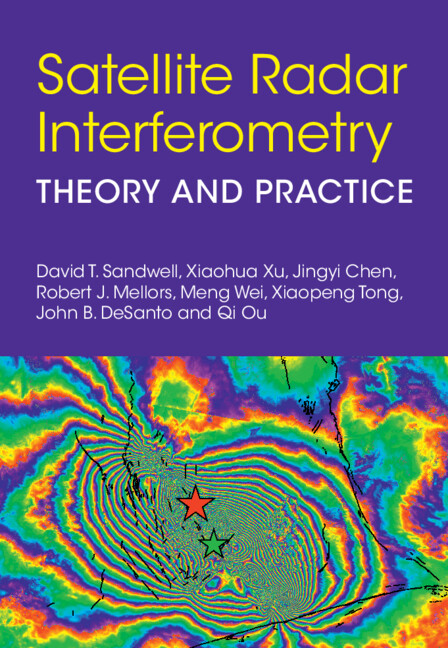
    Synthetic Aperture Radar Interferometry (InSAR) is an active remote sensing method that uses repeated radar scans of the Earth's solid surface to measure relative deformation at centimeter precision over a wide swath. It has revolutionized our understanding of the earthquake cycle, volcanic eruptions, landslides, glacier flow, ice grounding lines, ground fluid injection/withdrawal, underground nuclear tests, and other applications requiring high spatial resolution measurements of ground deformation. This book examines the theory behind and the applications of InSAR for measuring surface deformation. The most recent generation of InSAR satellites have transformed the method from investigating 10's to 100's of SAR images to processing 1000's and 10,000's of images using a wide range of computer facilities. This book is intended for students and researchers in the physical sciences, particularly for those working in geophysics, natural hazards, space geodesy, and remote sensing. This title is also available as Open Access on Cambridge Core.

    Refine List

    Actions for selected content:

    Select all | Deselect all
    • View selected items
    • Export citations
    • Download PDF (zip)
    • Save to Kindle
    • Save to Dropbox
    • Save to Google Drive

    Save Search

    You can save your searches here and later view and run them again in "My saved searches".

    Please provide a title, maximum of 40 characters.
    ×

    Contents

    Full book PDF
    • Frontmatter
      pp i-iv
    • Contents
      pp v-viii
    • Preface
      pp ix-xii
    • 1 - Introduction
      pp 1-7
    • 2 - Principles of Synthetic Aperture Radar
      pp 8-18
    • 3 - Satellite Orbits
      pp 19-40
    • 4 - SAR Image Formation
      pp 41-59
    • 5 - Interferometric Processing
      pp 60-72
    • 6 - Coherence, Filtering, and Phase Gradient
      pp 73-83
    • 7 - Phase Unwrapping
      pp 84-100
    • 8 - SAR Modes
      pp 101-121
    • 9 - Troposphere, Ionosphere, and Tide Corrections
      pp 122-146
    • 10 - Complementary Approaches and Time Series
      pp 147-165
    • 11 - Integration of InSAR and GNSS
      pp 166-183
    • References
      pp 184-194
    • Index
      pp 195-198

    Metrics

    Altmetric attention score

    Full text views

    Total number of HTML views: 0
    Total number of PDF views: 0 *
    Loading metrics...

    Book summary page views

    Total views: 0 *
    Loading metrics...

    * Views captured on Cambridge Core between #date#. This data will be updated every 24 hours.

    Usage data cannot currently be displayed.

    Accessibility standard: Unknown

    Why this information is here

    This section outlines the accessibility features of this content - including support for screen readers, full keyboard navigation and high-contrast display options. This may not be relevant for you.

    Accessibility Information

    Accessibility compliance for the PDF of this book is currently unknown and may be updated in the future.
