
Skip to main content Accessibility help
×
  • Cited by 29
    • Show more authors
    • You may already have access via personal or institutional login
    • Select format
    • Publisher:
      Cambridge University Press
      Publication date:
      21 September 2018
      04 October 2018
      ISBN:
      9781108571494
      9781108469005
      Dimensions:
      Weight & Pages:
      Dimensions:
      (229 x 152 mm)
      Weight & Pages:
      0.16kg, 92 Pages
    You may already have access via personal or institutional login
  • Selected: Digital
    Add to cart View cart Buy from Cambridge.org

    Book description

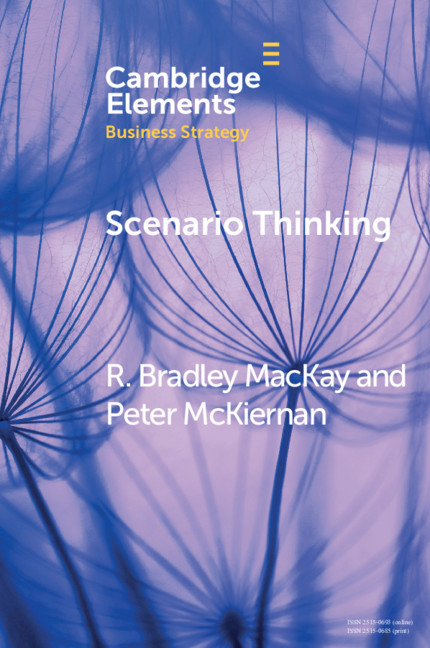
    This Element infuses established scenario planning routines with an exploration of cognitive reasoning, by contextualising scenario thinking within the wider human endeavour of grappling with future uncertainties. A study of ancient civilisations shows that scenario thinking is not new, but has evolved significantly since ancient times. By de-coupling scenario thinking from scenario planning, it is elevated as the essential ingredient in managerial foresight projects. The historical theme continues, focussing on the evolution of modern scenario planning, by way of the French and Anglo-American schools of thought, using the intuitive logics methodology. Archival research has discovered early contributions in the UK around the development and use of scenario thinking in public policy, which has been overlooked in many received histories. Finally, the usefulness of scenario thinking for strategic management is challenged here and the argument that it is a heuristic device for overcoming cognitive biases and making better strategic decisions is refined.

    Bibliography

    Abrahamson, E. 1991. Managerial fads and fashions. Academy of Management Review, 16, 586612.
    Abrams, M. 1966. Personal Papers. Cambridge: Churchill College Cambridge.
    Ackoff, R. 1983. Beyond prediction and preparation. Journal of Management Studies, 20, 1, 5969.
    Addis, D. R., Pan, L., Vu, M. A., Laiser, N. & Schacter, D. 2009. Constructive episodic simulation of the future and the past: Distinct subsystems of a core brain network mediate imagining and remembering. Neuropsychologia, 47, 22222238.
    Addis, D. R., Wong, A. T. & Schacter, D. L. 2008. Age-related changes in the episodic simulation of future events. Psychological Science, 19, 3341.
    Allen, T. B. 1987. War Games: Inside the Secret World of the Men Who Play at World War III. London: Heinemann.
    Amabile, R. 1995. Scenario planning. Sloan Management Review, 36, 77.
    Amer, M., Daim, T. U. & Jetter, A. 2013. A review of scenario planning. Futures, 46, 2340.
    Anderson, R. J. 2012. Imagining novel futures: The roles of event plausibility and familiarity. Memory, 20, 443451.
    Anderson, R. J. & Schooler, L. J. 2012. Reflections of the environment in memory. Psychological Science, 2, 396408.10.1111/j.1467-9280.1991.tb00174.x
    Anikeeva, E., Plotnikov, G., Andguladze, O. & Halivopulo, I. 2016. Developing critical thinking skills in continuing nursing education through visual simulation scenarios. European Journal of Cardiovascular Nursing, 15, S81S81.
    Ansoff, H. I. 1975. Managing strategic surprise by response to weak signals. California Management Review, 18, 2133.
    Argenti, J. 1968. Corporate Planning: A Practical Guide. London: Allen & Unwin.
    Argenti, J. 1974. Systematic Corporate Planning. London: Nelson.
    Arkes, H., Wortmann, R., Saville, P. D. & Harkness, A. 1981. The hindsight bias among physicians weighing the likelihood of diagnoses. Journal of Applied Psychology, 66, 252254.
    Ashby, W. R. 1956. An Introduction to Cybernetics. London: Chapman & Hall.
    Ashby, W. R. 1958. Requisite variety and its implications for the control of complex systems. Cybernetica (Namur), 1, 2, 8399.
    Atherton, A. 2005. A future for small business? Prospective scenarios for the development of the economy based on current policy thinking and counterfactual reasoning. Futures, 37, 777794.
    Ayres, R. 2000. On forecasting discontinuities. Technological Forecasting and Social Change, 65, 8197.
    Bain, D. & Roubelat, F. 1994. Profutures: The birth of the Strategic Prospective and Futures Studies International Network for Applied Methodology. Futures, 26, 345349.
    Barr, P. S., Stimpert, J. L. & Huff, A. S. 1992. Cognitive change, strategic action, and organizational renewal. Strategic Management Journal, 13, 1536.
    Bartlett, F. C. 1932. Remembering: A Study in Experimental and Social Psychology. Cambridge: Cambridge University Press.
    Baskin-Sommers, A. R., Curtin, J. J., Larson, C. L., Stout, D., Kiehl, K. A. & Newman, J. P. 2012. Characterising the anomalous cognition–emotion interactions in externalizing. Biological Psychology, 91, 4858.
    Bazerman, M. H. & Watkins, M. 2004. Predictable Surprises: The Disasters You Should Have Seen Coming, and How to Prevent Them. Boston, MA: Harvard Business School.
    Behrens, T. E., Woolrich, M. W, Walton, M. E. & Rushworth, M. F. 2007. Learning the value of information in an uncertain world. Nature Neuroscience, 10, 12141221.
    Bell, D. G. & Graubard, S. R. (eds.) 1967. Towards the Year 2000: Work in Progress. Cambridge, MA: MIT Press.
    Bennett, M. R. & Hacker, P. M. S. 2003. Philosophical Foundations of Neuroscience. Malden, MA: Blackwell Publishing.
    Berger, G. 1964. Phenomenologie du temps et prospective. Paris: Presses Universitaires de France.
    Bernarde, M. A. 1973. Our Precarious Habitat. New York, NY: W. W. Norton & Company.
    Bettis, R. & Prahalad, C.-K. 1995. The dominant logic: Retrospective and extension. Strategic Management Journal, 16, 514.
    Bezold, C. 1996. On futures thinking: Trends, scenarios, visions, and strategies. Quality Progress, 29, 8183.
    Boje, D. M. 1991. Consulting and change in the storytelling organisation. Journal of Organisational Change Management, 4, 717.
    Boot, M. 2006. War Made New: Technology, Warfare, and the Course of History, 1500 to Today. London: Gotham Books.
    Botzung, A., Denkova, E. & Manning, L. 2008. Experiencing past and future personal events: Functional neuroimaging evidence on the neural bases of mental time travel. Brain and Cognition, 66, 202212.
    Bowman, G., MacKay, R., Masrani, S. & McKiernan, P. 2013. Storytelling and the scenario process: Understanding success and failure. Technological Forecasting and Social Change, 80, 735748.
    Bradfield, R., Derbyshire, J. & Wright, G. 2016. The critical role of history in scenario thinking: Augmenting causal analysis within the intuitive logics scenario development methodology. Futures, 77, 5666.
    Bradfield, R., Wright, G., Burt, G., Cairns, G. & van der Heijden, K. 2005. The origins and evolution of scenario techniques in long range business planning. Futures, 37, 795812.
    Brews, P. J. H. & Hunt, M. R. 1999. Learning to plan and planning to learn: Resolving the planning/learning school debate. Strategic Management Journal, 20, 889913.10.1002/(SICI)1097-0266(199910)20:10<889::AID-SMJ60>3.0.CO;2-F
    Broadbent, D. E. 1958. Perception and Communication. London: Pergamon Press.
    Broadbent, D. E. & Broadbent, M. H. P. 1987. From detection to identification: Response to multiple targets in rapid serial visual presentation. Perception & Psychophysics, 42, 105113.
    Brown, S. 1968. Scenarios in systems analysis. In Quade, E. S. & Boucher, W. I. (eds.) Systems Analysis and Policy Planning: Applications in Defence. New York, NY: American Elsevier Publishing Company.
    Builder, C. 1996. 50th Project Air Force: 1946–1996. Washington, DC: RAND Corporation.
    Burt, G. & van der Heijden, K. 2003. First steps: Towards purposeful activities in scenario thinking and future studies. Futures, 35, 10111026.
    Buur, J. L., Schmidt, P., Smylie, D., Irizarry, K., Crocker, C., Tyler, J. & Barr, M. 2012. Validation of a scenario-based assessment of critical thinking using an externally validated tool. Journal of Veterinary Medical Education, 39, 276282.
    Caffrey, M. 2000. History of war games: Towards a history-based doctrine for wargaming. Aerospace Power Journal, Fall, 3356.
    Cairns, G., Wright, G. & Fairbrother, P. 2016. Promoting articulated action from diverse stakeholders in response to public policy scenarios: A case study of the use of ‘scenario improvisation’ method. Technological Forecasting and Social Change, 103, 97108.
    Cairns, G., Wright, G., van der Heijden, K., Bradfield, R. & Burt, G. 2006. Enhancing foresight between multiple agencies: Issues in the use of scenario thinking to overcome fragmentation. Futures, 38, 10101025.
    Carroll, J. S. 1978. The effect of imagining an event on expectations for the event: An interpretation in terms of the availability heuristic. Journal of Experimental Social Psychology, 14, 8896.10.1016/0022-1031(78)90062-8
    Cazes, B. 2008. Histoire des futurs: les figures de l’avenir de saint Augustin au XXIe siècle. Paris: L’Harmattan.
    Checkland, P. 1981. Systems Thinking, Systems Practice. Chichester: Wiley.
    Chermack, T. J. 2011. Scenario Planning in Organizations: How to Create, Use, and Assess Scenarios. San Francisco, CA: Berrett-Koehler.
    Chiang, Y. 1936. The Chinese Eye. London: Methuen & Company Ltd.
    Clegg, S. & Bailey, J. R. (eds.) 2008. International Encyclopedia of Organization Studies, Vol. 1. London: Sage.
    Courtney, H., Kirkland, J. & Viguerie, P. 1997. Strategy under uncertainty. Harvard Business Review, 75, 6679.
    Cummings, S. & Daellenbach, U. 2009. A guide to the future of strategy? The history of long range planning. Long Range Planning, 42, 234263.
    Curnow, T. 2004. The Oracles of the Ancient World: A Complete Guide. London: Duckworth.
    Daft, R. L. & Weick, K. E. 1984. Toward a model of organizations as interpretation systems. Academy of Management Review, 9, 284295.
    de Jouvenal, B. 1964. L’Art de la conjecture. Monaco.
    de Jouvenal, B. 1967. The Art of Conjecture. New York, NY: Basic Books.
    de Jouvenal, B. 1972. Du Principat: et autres reflexions politiques [S.l.]. Hachette.
    de Molina, L. 1988. On Divine Foreknowledge (Part IV of the Concordia). Ithaca, NY: Cornell University Press.
    Decety, J. & Sommerville, J. A. 2003. Shared representations between self and other: A social cognitive neuroscience view. TRENDS in Cognitive Science, 7, 527533.
    Derbyshire, J. & Wright, G. 2014. Preparing for the future: Development of an ‘antifragile’ methodology that compliments scenario planning by omitting causation. Technological Forecasting and Social Change, 82, 215225.10.1016/j.techfore.2013.07.001
    Douglas, M. 1986. How Institutions Think. London: Routledge & Kegan Paul.
    Douglas, M. & Wildavsky, A. B. 1982. Risk and Culture: An Essay on the Selection of Technical and Environmental Dangers. Berkeley, CA: University of California Press.
    Drucker, P. F. 1999. Management Challenges for the 21st Century. Oxford: Butterworth-Heinemann.
    Durance, P. & Godet, M. 2010. Scenario building: Uses and abuses. Technological Forecasting and Social Change, 77, 9, 14881492.
    Ehlert, H., Epkenhans, M. & Gross, G. P. (eds.) 2014. International Perspectives on the German Strategy for World War 1. Lexington, KY: University Press of Kentucky.
    Eidinow, E. 2007. Oracles, Curses, and Risk among the Ancient Greeks. Oxford: Oxford University Press.10.1093/acprof:oso/9780199277780.001.0001
    Elsbach, K. D., Barr, P. S. & Hargadon, A. B. 2005. Identifying situated cognition in organizations. Organization Science, 16, 422433.10.1287/orsc.1050.0138
    Emory, F. E. & Trist, E. L. 1965. The causal texture of organizational environments. Human Relations, 18, 2132.
    Eser, Z., Isin, F. B. & Tolon, M. 2011. Perceptions of marketing academics, neurologists and marketing professionals about neuromarketing. Journal of Marketing Management, 27, 854868.
    Fahey, L. R. & Randall, R. M. 1998. Learning from the Future: Competitive Foresight Scenarios. New York, NY: Chichester, Wiley.
    Fang, T. 1986. The Chinese View of Life: The Philosophy of Comprehensive Harmony. Taipei: Linking Publishing Company.
    Fisher, R. P. & Geiselman, R. E. 1992. Memory Enhancing Techniques for Investigative Interviewing: The Cognitive Interview. Springfield, IL: Charles C. Thomas Books.
    Freddosso, A. J. 1988. Introduction to Luis de Molina. Ithaca, NY: Cornell University Press.
    Galinsky, A. & Moskowitz, G. 2000. Counterfactuals as behavioural primes: Priming the simulation heuristic and consideration of alternatives. Journal of Experimental Social Psychology, 36, 384409.10.1006/jesp.1999.1409
    Geiselman, R. E., Fisher, R. P., MacKinnon, D. P. & Holland, H. L. 1985. Eyewitness memory enhancement in the police interview: Cognitive retrieval mnemonics versus hypnosis. Journal of Applied Psychology, 70, 401412.
    Geus, A. D. 1997. The Living Company: Growth, Learning and Longevity in Business. London: Nicholas Brealey.
    Gilbert, D. T. & Wilson, T. D. 2007. Prospection: Experiencing the future. Science, 317, 13511354.
    Gill, J. & Whittle, S. 1993. Management by panacea: Accounting for intransience. Journal of Management Studies, 30, 281295.
    Gioia, D. A. & Chittipeddi, K. 1991. Sensemaking and sensegiving in strategic change initiation. Strategic Management Journal, 12, 433448.
    Godet, M. 1982. From forecasting to la ‘prospective’: A new way of looking at futures. Journal of Forecasting, 1, 293302.
    Godet, M. 1987. Scenarios and Strategic Management. London: Butterworths.
    Godet, M. 1990. Integration of scenarios and strategic management: Using relevant, consistent and likely scenarios. Futures, 22, 730739.
    Godet, M. 2001. Creating Futures: Scenario Planning as a Strategic Management Tool. London: Economica.
    Godet, M. & Roubelat, F. 1996. Creating the future: The use and misuse of scenarios. Long Range Planning, 29, 164171.
    Goerlitz, W. 1953. History of the German General Staff 1657–1945. New York, NY: Frederick A Praeger.
    Goleman, R. D. 1996. Vital Lies, Simple Truths: The Psychology of Self-Deception. New York, NY: Simon and Schuster.
    Goleman, D. 1998. Vital Lies, Simple Truths: The Psychology of Self-Deception. London: Bloomsbury.
    Goodwin, P. & Wright, G. 2001. Enhancing strategy evaluation in scenario planning: A role for decision analysis. Journal of Management Studies, 38, 116.
    Gordon, T. J. & Glenn, J. C. 1994. An introduction to the Millennium Project. Technological Forecasting and Social Change, 47, 147170.
    Griffith, S. B. 1963. The Art of War. Oxford: Oxford University Press.
    Grinyer, P. H., Mayes, D. G. & McKiernan, P. 1988. Sharpbenders: The Secrets of Unleashing Corporate Potential. Oxford: Basil Blackwell.
    Gunn, R. & Williams, W. 2007. Strategic tools: An empirical investigation into strategy in practice in the UK. Strategic Change, 16, 201216.
    Hambrick, D. C. & Finkelstein, S. 1995. The effects of ownership structure on conditions at the top: The case of CEO pay rises. Strategic Management Journal, 16, 175193.
    Hansson, S. O. 2015. Science and pseudo-science. In Zalta, E. N. (ed.) The Stanford Encyclopedia of Philosophy. Stanford, CA: Stanford University Press.
    Harries, C. 2003. Correspondence to what? Coherence to what? What is good scenario-based decision making? Technological Forecasting and Social Change, 70, 797817.
    Hart-Rudman Commission. 1999. New World Coming: American Security in the 21st Century. Washington, DC: US Government Printing Office.
    Hartung, A. 2009. A Key to a Successful Business Plan [Online]. Available: www.forbes.com/2009/12/07/scenario-planning-strategy-leadership-managing-plan.html#52c68173f20 [Accessed].
    Hassabis, D. & Maguire, E. A. 2007. Deconstructing episodic memory with construction. Trends in Cognitive Sciences, 11, 299306.
    Hassabis, D., Spreng, R. N., Rusu, A. A., Robbins, C. A., Mar, R. A. & Schacter, D. L. 2013. Imagine all the people: How the brain creates and uses personality models to predict behavior. Cerebral Cortex, 24, 299306.
    Helmer, O. 1972. On the Future State of the Union. Palo Alto, CA: Institute for the Future.
    Hodgkinson, G. P. 1997. The cognitive analysis of competitive structures: A review and critique. Human Relations, 50, 625654.
    Hodgkinson, G. & Healy, M. 2008. Toward a (pragmatic) science of strategic intervention: Design propositions for scenario planning. Organization Studies, 29, 435457.10.1177/0170840607088022
    Hodgkinson, G. & Healy, M. 2011. Psychological foundations of dynamic capabilities. Strategic Management Journal, 32, 15001516.
    Hodgkinson, G. P. & Wright, G. 2002. Confronting strategic inertia in a top management team: Learning from failure. Organization Studies, 23, 949977.10.1177/0170840602236014
    Hogarth, R. M. 2001. To what are we trying to generalize? Behavioural and Brain Sciences, 24, 416417.10.1017/S0140525X01374149
    Huff, A. S. 1982. Industry influences on strategy reformulation. Strategic Management Journal, 3, 119131.
    Huizinga, H. 1955. Homo ludens: A Study of the Play-Element in Culture. Boston, MA: Bacon Press.
    Hume, D. 2007/1748. An Enquiry Concerning Human Understanding. Oxford: Oxford University Press.
    Huss, W. R. & Honton, E. J. 1987. Scenario planning: What style should you use? Long Range Planning, 20, 2129.
    Ingvar, D. H. 1979. Hyperfrontal distribution of the cerebral grey matter flow in resting wakefulness: On the functional anatomy of the conscious state. Acta Neurologica Scandinavica, 60, 1225.
    Ingvar, D. H. 1985. Memory of the future: An essay on the temporal organization of conscious awareness. Human Neurobiology, 4, 127136.
    Irish, M., Addis, D. R., Hodges, J. R. & Piguet, O. 2012. Considering the role of semantic memory in episodic future thinking: Evidence from semantic dementia. Brain, 135, 21782191.
    James, E. W. & Grim, P. 1982. On Dismissing Astrology and Other Irrationalities. Albany, NY: State University of New York Press.
    Janis, I. L. 1982. Groupthink: Psychological Studies of Policy Decisions and Fiascoes. Boston, MA: Houghton Mifflin.
    Janis, I. L. & Mann, L. 1979. Decision Making: A Psychological Analysis of Conflict, Choice, and Commitment. New York, NY: Free Press; London: Collier Macmillan.
    Janssen, O. 2003. Innovative behaviour and job involvement at the price of conflict and less satisfactory relations with co-workers. Journal of Occupational and Organizational Psychology, 76, 347364.
    Janssen, O. 2004. How fairness perceptions make innovative behavior more or less stressful. Journal of Organizational Behavior, 25, 201215.
    Jefferson, M. 2012. Shell scenarios: What really happened in the 1970s and what may be learned for current world prospects. Technological Forecasting and Social Change, 79, 201215.
    Johnson, G. 1987. Strategic Change and the Management Process. Oxford: Basil Blackwell.
    Jung, C. G. 1968. Analytical Psychology: Its Theory and Practice. London: Routledge & Kegan Paul.
    Jung, C. G. 1989. I Ching or Book of Changes: The Richard Wilhelm Translation. London: Penguin Books.
    Kahn, H. 1960. On Thermonuclear War. Princeton, NJ: Princeton University Press.
    Kahn, H. 1962. Thinking about the Unthinkable. New York, NY: Horizon Press.
    Kahn, H. W. & Wiener, A. J. 1967. The next thirty-three years: A framework for speculation. In Bell, D. G. & Graubard, S. R. (eds.) Toward the Year 2000: Work in Progress. Cambridge, MA: MIT Press.
    Kahneman, D. 2003. A perspective on judgement and choice: Mapping bounded rationality. American Psychologist, 58, 697720.
    Kahneman, D., Lovallo, D. & Sibony, O. 2011. Before you make that big decision … Harvard Business Review, April, 4953.
    Kahneman, D. & Tversky, A. 1973. On the psychology of prediction. Psychological Review, 80, 237251.
    Kaplan, S. 2008. Cognition, capabilities and incentives: Assessing firm response to the fibre optic revolution. Academy of Management Journal, 51, 672695.
    Kasparov, G. 2005. Strategic intensity: A conversation with world chess champion Garry Kasparov. Harvard Business Review, April, 4953.
    Kitchen, M. 1975. A Military History of Germany from the Eighteenth Century to the Present Day. London: Weidenfeld and Nicolson.
    Klein, H. E., & Linneman, R. K. 1981. The use of scenarios in corporate planning: Eight case histories. Long Range Planning, 15, 5, 6977.10.1016/0024-6301(81)90010-8
    Klein, S. 2013. Making the case that episodic recollection is attributable to operations occurring at retrieval rather than to content stored in a dedicated subsystem of long term memory. Frontiers in Behavioural Neurology, 7, 114.
    Kleiner, A. 1996. The Age of Heretics: Heroes, Outlaws and the Forerunners of Corporate Change. London: Nicholas Brealey Publishing.
    Koch-Westenholz, U. 1995. Mesopotamian Astrology. Copenhagen: Museum Tusculum Press.
    Koriat, A., Lichtenstein, S. & Fischhoff, B. 1980. Reasons for confidence. Journal of Experimental Psychology: Human Learning and Memory 6, 107118.
    Kosslyn, S. M. & Rosenberg, R. S. 2006. Psychology in Context. Boston, MA: Allyn and Bacon.
    Kuhn, K. M. & Sniezek, J. A. 1996. Confidence and uncertainty in judgmental forecasting: Differential effects of scenario presentation. Journal of Behavioral Decision Making, 9, 231247.
    Kuhn, S., Strelow, E. & Gallinat, J. 2016. Multiple ‘buy buttons’ in the brain: Forecasting chocolate sales at point-of-sale based on functional brain activation using fMRI. NeuroImage, 136, 122128.
    Kuhn, T. S. 1970. Reflections on My Critics: Criticism and the Growth of Knowledge. Cambridge: Cambridge University Press.
    Laing, R. D. 1970. Knots. London: Tavistock Publications.
    Larrick, R. 2004. Debiasing. In Koehler, D. J. & Harvey, N. (eds.) Blackwell Handbook of Judgment and Decision Making. Oxford: Blackwell.
    Laureiro-Martinez, D., Brusoni, S., Canessa, N. & Zollo, M. 2015. Understanding the Exploration-Exploitation Dilemma: An fMRI study of attention control and decision-making performance. Strategic Management Journal, 36, 319338.
    Levinthal, D. & Rerup, C. 2006. Crossing an apparent chasm: Bridging mindful and less-mindful perspectives on organizational learning. Organizational Science, 17, 502513.
    Lindgren, M. & Bandhold, H. 2009. Scenario Planning: The Link between Future and Strategy. 2nd edn. Basingstoke: Palgrave Macmillan.
    Linneman, R. K. & Klein, H. E. 1983. The use of multiple scenarios by US industrial companies: A comparison study, 1977–1981. Long Range Planning, 16, 94101.10.1016/0024-6301(83)90013-4
    Livingstone, L. P., Nelson, D. L. & Barr, S. H. 1997. Person-environment fit and creativity: An examination of supply-value and demand-ability versions of fit. Journal of Management, 23, 119146.10.1177/014920639702300202
    Lock, A. & Strong, T. 2010. Social Constructionism: Sources and Stirrings in Theory and Practice. Cambridge: Cambridge University Press.
    Logothetis, N. K. 2008. What we can do and what we cannot do with fMRI. Nature, 453, 869878.
    Long, A. A. 2005. Astrology: Arguments pro and contra. In Barbes, J. & Brunschwig, J. (eds.) Science and Speculation. Cambridge: Cambridge University Press.
    Loveridge, D. 2009. Foresight: The Art and Science of Anticipating the Future London: Routledge.
    Lusk, J. L., Crespi, J. M., Cherry, J. B. C., McFadden, B. R., Martin, L. E. & Bruce, A. S. 2015. An fMRI investigation of consumer choice regarding controversial food technologies. Food Quality and Preference, 40, 209222.
    MacKay, B. & Chia, R. 2013. Choice, chance and unintended consequences in strategic change: A process understanding of the rise and fall of NorthCo automotive. Academy of Management Journal, 56, 208230.
    MacKay, B. & McKiernan, P. 2010. Creativity and dysfunction in strategic processes: The case of scenario planning. Futures, 42, 271281.
    MacKay, R. B. 2009. Strategic foresight: Counterfactual and prospective sensemaking in enacted environments. In Costanzo, L. A. & MacKay, R. B. (eds.) Handbook of Research in Strategy and Foresight. Cheltenham: Edward Elgar.
    MacKay, R. & McKiernan, P. 2004. Exploring strategy context with foresight. European Management Review, 1, 6977.
    MacKay, R. B. & Stoyanova, V. 2017. Scenario planning with a sociological eye: Augmenting the intuitive logics approach to understanding the future of Scotland and the UK. Technological Forecasting and Social Change, 124, 88100.
    Madore, K. P., Gaesser, B. & Schacter, D. L. 2014. Constructive episodic simulation: Dissociable effects of a specificity induction on remembering, imagining and describing in young and older adults. Journal of Experimental Psychology: Learning, Memory and Cognition, 40, 609622.
    Makridakis, S. 1990. Forecasting, Planning and Strategy for the 21st Century. London: Free Press.
    Malaska, P. 1985. Multiple scenario approach and strategic behaviour in European companies. Strategic Management Journal, 6, 339355.
    Malaska, P., Malmivirta, M., Meristo, T. & Hansen, S. O. 1984. Scenarios in Europe: Who uses them and why? Long Range Planning, 17, 4549.
    Malaska, P. & Virtanen, I. 2005. Theory of futuribles. Futura, 2, 1028.
    March, J. G. & Simon, H. A. 1958. Organizations. New York, NY: Wiley.
    Marcus, A. A. 2009. Strategic Foresight: A New Look at Scenarios. Basingstoke: Palgrave Macmillan.
    Martelli, A. 2001. Scenario building and scenario planning: State of the art and prospects for evolution. Futures Research Quarterly, Summer.
    Martin, M. 1988. The Jesuits: The Society of Jesus and the Betrayal of the Roman Catholic Church. New York, NY; London: Simon and Schuster,
    Mason, D. H. 1994. Scenario-based planning: Decision models for the learning organisation. Planning Review, March–April, 712.
    Masukawa, K. 2016. The origins of board games and ancient board games. In Toshiyuki, K., Hidehiko, K., Yusuke, T. & Paola, R. (eds.) Simulation and Gaming in the Network Society. Singapore: Springer.
    McClean, C. V. M. 1929. Babylonian Astrology and Its Relation to the Old Testament. Toronto: United Church Publishing.
    McClure, S. M., Li, J., Tomlin, D., Cypert, K. S., Montague, L. M. & Montague, P. R. 2004. Neural correlates of behavioural preference for culturally familiar drinks. Neuron, 44, 379387.
    McGee, J. & Thomas, H. 1986. Strategic groups: Theory, research and taxonomy. Strategic Management Journal, 7, 141160.
    McElwee, W. 1974. The Art of War: Waterloo to Mons. London: Weidenfeld and Nicolson.
    McKiernan, P. 1997. Strategy past; strategy futures. Long Range Planning, 30, 790798.
    McKiernan, P. 2008. Scenario planning. In Clegg, S. R. & Bailey, J. R. (eds.) International Encyclopedia of Organization Studies. London: Sage.
    McKiernan, P. 2017. Prospective thinking: Scenario planning meets neuroscience. Technological Forecasting and Social Change, 124, 6676.
    McLelland, V. C., Devitt, A. L., Schacter, D. L. & Addis, D. R. 2015. Making the future memorable: The phenomenology of remembered future events. Memory, October, 19.
    Meissner, P. & Wulf, T. 2013. Cognitive benefits of scenario planning: Its impact on biases and decision quality. Technological Forecasting and Social Change, 80, 801814.
    Meri, J. W. 2005. Medieval Islamic Civilization: An Encyclopedia. Oxford: Routledge.
    Miles, L. K., Christian, B. M., Masilamani, N., Volpi, L. & MacRae, C. N. 2014. Not so close encounters of the third kind: Visual perspective and imagined social interaction. Social Psychology and Personality Science, 5, 558565.
    Mill, J. S. 1865. Auguste Comte and Positivism. [S.l.] Trubner.
    Mill, J. S. 1973/1865. System of Logic, Ratiocinative and Inductive: Being a Connected View of the Principles of Evidence and the Methods of Scientific Investigation. Toronto: Toronto University Press.
    Miller, D. & Friesen, P. H. 1980. Momentum and revolution in organizational adaptation. Academy of Management Journal, 23, 591614.
    Milliken, F. J. 1990. Perceiving and interpreting environmental change: An examination of college administrators’ interpretation of changing demographics. Academy of Management Journal, 33, 4263.
    Mintzberg, H. 1994. The Rise and Fall of Strategic Planning. New York, NY: Free Press.
    Mintzberg, H., Ahlstrand, B. & Lampel, J. 2008. The Strategy Safari: A Tour through the Wilds of Strategic Management. New York, NY: Free Press.
    Miron, E., Erez, M. & Naveh, E. 2004. Do personal characteristics and cultural values that promote innovation, quality, and efficiency compete or complement each other? Journal of Organizational Behavior, 25, 175199.
    Mitchell, D. 1980. The Jesuits: A History. London: Macdonald.
    Murray, H. J. R. 1952. A History of Board Games Other Than Chess. Oxford: Clarendon Press.
    Nassar, M. R., Rumsey, K. M., Wilson, R. C., Parikh, K., Heasly, B. & Gold, J. I. 2012. Rational regulation of learning dynamics by pupil-linked arousal systems. Nature Neuroscience, 15, 10401046.
    Nassar, M. R., Wilson, R. C., Heasly, B. & Gold, J. I. 2010. An approximately Bayesian delta-rule model explains the dynamics of belief updating in a changing environment. Journal of Neuroscience, 30, 1236612378.10.1523/JNEUROSCI.0822-10.2010
    Nickerson, R. S. 1998. Confirmation bias: A ubiquitous phenomenon in many guises. Review of General Psychology, 2, 175190.
    O’Brien, F. A. & Meadows, M. 2013. Scenario orientation and use to support strategy development. Technological Forecasting and Social Change, 80, 643656.
    O’Brien, F. A., Meadows, M. & Murtland, M. 2007. Creating and using scenarios. In O’Brien, F. A. & Dyson, R. G. (eds.) Supporting Strategy: Frameworks, Methods and Models. Chichester: Wiley.
    Ocasio, W. 1997. Towards an attention-based view of the firm. Strategic Management Journal, 18, 187206.
    Ocasio, W. 2011. Attention to attention. Organization Science, 22, 12861296.10.1287/orsc.1100.0602
    Ogburn, W. F. 1934. Studies in prediction and the distortion of reality. Social Forces, 13, 224229.
    Ogburn, W. F. 1935. Prospecting for the future. Social Frontier, 1, 2022.
    Ogburn, W. F. & American Library Association. 1933. Living with Machines. Chicago, IL: American Library Association.
    Oppenheim, A. L. & Reiner, E. 1977. Ancient Mesopotamia: Portrait of a Dead Civilization. Chicago, IL; London: University of Chicago Press.
    Pagani, M. 2009. Roadmapping 3G mobile TV: Strategic thinking and scenario planning through repeated cross-impact handling. Technological Forecasting and Social Change, 76, 382395.
    Patel, A. 2016. Gaining insight: Re-thinking at the edge. Technological Forecasting and Social Change, 107, 141153.10.1016/j.techfore.2015.12.002
    Phadnis, S., Caplice, C., Sheffi, Y. & Singh, M. Effect of scenario planning on field experts’ judgment of long-range investment decisions. Strategic Management Journal, 36, 14011411.
    Pighin, S., Byrne, R. M., Ferrante, D., Gonzelez, M. & Girotto, V. 2011. Counterfactual thoughts about experienced, observed and narrated events. Thinking & Reasoning, 17, 197211.
    Poincare, H. 1913. The Foundations of Science. Lancaster, PA: Science Press.
    Popper, K. 2002/1959. The Logic of Scientific Discovery. London: Routledge.
    Popper, K. 2004. Conjectures and Refutations: The Growth of Scientific Knowledge London: Routledge.
    Posner, M. I. & Rothbart, M. K. 2007. Research on attention networks as a model for the integration of psychological science. Annual Review of Psychology, 2007, 123.
    Powell, T. C. 2011. Neuroscience. Strategic Management Journal, 32, 14841499.
    Ramirez, R., Osterman, R. & Gronquist, D. 2013. Scenarios and early warnings as dynamic capabilities to frame managerial attention. Technological Forecasting and Social Change, 80, 825838.
    Reisswitz, B. v. 1824. Instructions for the Representation of Tactical Maneuvers under the Guise of a Wargame. Berlin.
    Reisswitz, B. v. & Leeson, B. 1983. Kriegsspiel: Instructions for the Representation of Military Manoeuvres with the Kriegsspiel Apparatus. Hemel Hempstead: B. Leeson.
    Rendell, P. G., Bailey, P. E., Henry, J. D., Phillips, L. H., Gaskin, S. & Kliegel, M. 2012. Older adults have greater difficulty imagining future rather than atemporal experiences. Psychology and Aging, 27, 10891098.10.1037/a0029748
    Rigby, D. & Bilodeau, B. 2005. Management Tools and Trends. Online. Boston, MA: Bain & Company. Available at www.bain.com/publications/articles/management-tools-and-trends-2015.aspx.
    Ringland, G. 2002a. Scenarios in Public Policy. Chichester: Wiley.
    Ringland, G. 2002b. Scenarios in Business. Chichester: Wiley.
    Ringland, G., Sparrow, O., & Lustig, P. 2010. Beyond Crisis: Achieving Renewal in a Turbulent World. Chichester: Wiley.
    Rochberg, F. 2004. The Heavenly Writing: Divination, Horoscopy and Astronomy in Mesopotamian Culture. Cambridge: Cambridge University Press.10.1017/CBO9780511617409
    Rochberg, F. 2013. Foresight in ancient Mesopotamia. In Feller, D. A. (ed.) Foresight. Cambridge: Cambridge University Press.
    Samples, R. 1976. The Metaphoric Mind: A Celebration of Creative Consciousness. Reading: MA, Addison-Wesley.
    Sanna, L. J. & Schwarz, N. 2003. Debiasing the hindsight bias: The role of accessibility experiences and (mis)attributions. Journal of Experimental Social Psychology, 39, 287295.
    Schacter, D. L. 1999. The Seven Sins of Memory: Insights from psychological and cognitive neuroscience. American Psychologist, 54, 182203.
    Schacter, D. L., Benoit, R. G., de Brigard, F. & Szpunar, K. K. 2015. Episodic future thinking and episodic counterfactual thinking: Intersections between memory and decisions. Neurobiology of Learning and Memory, 117, 1421.
    Schacter, D. L., Gaesser, B. & Addis, D. R. 2013. Remembering the past and imagining the future in the elderly. Gerontology, 59, 143151.
    Schacter, D. L. & Madore, K. P. 2016. Remembering the past and imagining the future: Identifying and enhancing the contribution of episodic memory. Memory Studies, 9, 245255.
    Schoemaker, P. J. H. 1991. When and how to use scenario planning – a heuristic approach with illustration. Journal of Forecasting, 10, 549564.
    Schoemaker, P. J. H. 1993. Multiple scenario development – its conceptual and behavioral foundation. Strategic Management Journal, 14, 193213.
    Schoemaker, P. J. H. 1995. Scenario planning – a tool for strategic thinking. Sloan Management Review, 36, 2540.
    Schoemaker, P. J. H. 1997. Disciplined imagination: From scenarios to strategic options. International Studies of Management and Organization, 27, 4370.
    Schoemaker, P. J. H. 2004. Forecasting and scenario planning: The challenges of uncertainty and complexity. In Koehler, D. J. & Harvey, N. (eds.) Blackwell Handbook of Judgment and Decision Making. Oxford: Blackwell.
    Schoemaker, P. J. H. & van der Heijden, C. A. J. M. 1992. Integrating scenarios into strategic planning at Royal Dutch Shell. Strategy and Leadership, 20, 4146.
    Schwartz, P. 1991. The Art of the Long View. New York, NY: Doubleday/Currency.
    Seidl, D. 2004. The concept of ‘weak signals’ revisited: A re-description from a constructivist perspective. In Tsoukas, H. & Shepherd, J. (eds.) Managing the Future: Foresight in the Knowledge Economy. Oxford: Blackwell.
    Seligman, M. R. P., Baumeister, R. & Sripada, C. 2013. Navigating into the future or driven by the past: Prospection as an organizing principle of mind. Perspectives on Psychological Science, 8, 119141.
    Selin, C. 2007. Professional dreamers: The future in the past of scenario planning. In Sharpe, B. & van der Heijden., K. (eds.) Scenarios for Success. New York, NY: Wiley.
    Shotwell, P. 2008. The Game of Go: Speculations on Its Origins and Symbolism in Ancient China. Online. New York, NY: American Go Association. Available at www.usgo.org/resources/downloads/originsofgo.pdf.
    Simons, D. J. & Chabris, C. F. 1999. Gorillas in our midst: Sustained inattentional blindness for dynamic events. Perception, 28, 10591074.
    Simpson, D. G. 1992. Key lessons for adopting scenario planning in diversified companies. Planning Review, 20, 1017.
    Simpson, S. J. 2007. The earliest board games in the Middle East. In Finkel, I. L. E. (ed.) Ancient Board Games in Perspective. London: British Museum Press.
    Spender, J.-C. 1989. Industry Recipes: An Enquiry into the Nature and Sources of Managerial Judgement. Oxford: Wiley-Blackwell.
    Steiner, G. A. 1979. Strategic Planning: What Every Manager Must Know. New York, NY: Free Press; London: Collier Macmillan.
    Stout, D. 1998. Use and abuse of scenarios. Business Strategy Review, 9, 2, 2736.
    Suddendorf, T. & Corballis, M. C. 1997. Mental time travel and the evolution of the human mind. Genetic, Social and General Psychology Monographs, 123, 133167.
    Suomala, J., Palokangas, L., Leminen, S., Westerlund, M., Heinonen, J. & Numminen, J. 2012. Neuromarketing: Understanding customers’ subconscious responses to marketing. Technology Innovation Management Review, 2, 1221.
    Sutcliffe, K. M. 1994. What executives notice: Accurate perceptions in top management teams. Academy of Management Journal, 37, 13601378.
    Szpunar, K. K. & Schacter, D. L. 2013. Get real: Effects of repeated simulation and emotion on the perceived plausibility of future experiences. Journal of Experimental Psychology, 142, 323.10.1037/a0028877
    Szpunar, K. K., Spreng, R. N. & Schacter, D. L. 2014. A taxonomy of prospection: Introducing an organizational framework for future-oriented cognition. Proceedings of the National Academy of Sciences, 111, 1841418421.
    Taleb, N. 2007. The Black Swan. London: Penguin Books.
    Tetlock, P. E. 2005. Expert Political Judgment. Princeton, NJ: Princeton University Press.
    Thagard, P. R. 1978. Why astrology is a pseudoscience. PSA: Proceedings of the Biennial Meeting of the Philosophy of Science Association. JSTOR, 223234.
    Thakral, P. P., Madore, K. P. & Schacter, D. L. 2017. A role for the left angular gyrus in episodic simulation and memory. Journal of Neuroscience, 37, 81428149.
    Tsoukas, H. & Shepherd, J. (eds.) 2004. Managing the Future: Foresight in the Knowledge Economy. Oxford: Blackwell.
    Tuchman, B. W. 1966. The Proud Tower: A Portrait of the World before the War, 1890–1914. London: Hamish Hamilton.
    Tucker, P. 2007. The scenario planning handbook: Developing strategies in uncertain times. Futurist, 41, 50-50.
    Turner, B. 1976. The organizational and interorganizational development of disasters. Administrative Science Quarterly, 1, 378397.
    Tversky, A., & Kahneman, D. 1974. Judgement under uncertainty: Heuristics and biases. Science, 185, 11241134.
    Twist, E. 1968. Future of the Social Sciences. London: Social Science Research Council.
    van der Heijden, K. 1996. Scenarios: The Art of Strategic Conversation. Chichester: Wiley.
    van der Heijden, K., Bradfield, R., Burt, G., Cairns, G., Wright, G. 2002. The Sixth Sense: Accelerating Organizational Learning with Scenarios. Chichester: Wiley.
    van Mulukom, V., Schacter, D. L., Corballis, M. C. &Addis, D. R. 2016. The degree of disparateness of event details modulates future simulation construction, plausibility and recall. Quarterly Journal of Experimental Psychology, 69, 234242.
    van Klooster, S. A. & van Asselt, M. B. A. 2006. Practicing the Scenario Axis Technique. Futures, 38, 1530.10.1016/j.futures.2005.04.019
    van Vught, F. A. 1987. Pitfalls of forecasting: Fundamental problems for the methodology of forecasting from the philosophy of science. Futures, 19, 184196.
    Varum, C. & Melo, C. 2010. Directions in scenario planning literature – a review of the past decades. Futures, 42, 355369.
    Volkov, Y. G. 2016. Scenario thinking in the context of sociological diagnostics. Sotsiologicheskie Issledovaniya, 13.
    von Hilgers, P. 2012. War Games: A History of War on Paper. Cambridge, MA: MIT Press.
    von Karman, T. 1945. Towards New Horizons. Los Angeles, CA: Army Air Force Scientific Advisory Group.
    Wack, P. 1985a. Unchartered waters ahead. Harvard Business Review, September–October 7389.
    Wack, P. 1985b. Scenarios: Shooting the rapids. Harvard Business Review, November–December, 139150.
    Walsh, J. P. 1995. Managerial and organizational cognition: Notes from a trip down memory lane. Organization Science, 6, 280321.
    Warren, C. M. & Holroyd, C. B. 2012. The impact of deliberative strategy dissociates ERP components related to conflict processing vs. reinforcement learning. Frontiers in Neuroscience, 6, 117.
    Warren, C. M., Murphy, P. R. & Nieuwenhuis, S. 2016. Cognitive control, dynamic salience and the imperative toward computational accounts of neuromodulatory function. Behavioral and Brain Sciences, 39.10.1017/S0140525X15001983
    , M. & Bazerman, M. 2003. Predictable surprises: The disasters you should have seen coming, and how to prevent them. Harvard Business Review, 81, 7280.
    Weisberg, R. W. 1993. Beyond the Myth of Genius. New York, NY: Freeman.
    Wells, H. G. 1932 (1987). Wanted: Professors of foresight! Futures Research Quarterly, 3, 8991.
    Whittington, R. 2006. Completing the practice turn in strategy research. Organization Studies, 27, 613634.
    Wilensky, H. L. 1967. Organizational Intelligence. New York, NY: Basic Books.
    Wilkinson, A. 2009. Scenarios practices: in search of theory. Journal of Futures Studies, 13, 107114.
    Wilkinson, A. & Kupers, R. 2014. The Essence of Scenarios: Learning from the Shell Experience. Amsterdam: Amsterdam University Press.
    Willmore, J. 2001. Scenario planning: Creating strategy for uncertain times. Information Outlook, 5, 2339
    Wilson, I. 2000. From scenario thinking to strategic action. Technological Forecasting and Social Change, 65, 2329.10.1016/S0040-1625(99)00122-5
    Wiltbank, R., Dew, N., Read, S. & Sarasvthy, S. 2006. What to do next? The case for non predictive strategy. Strategic Management Journal, 27, 981998.
    Wolf, R. C., Carpenter, R. W., Warren, C. M., Zeier, J. D., Baskin-Sommers, A. R. & Newman, J. P. 2011. Reduced susceptibility to the attentional blink in psychopathic offenders: Implications for the attentional bottleneck hypothesis. Neuropsychology, 26, 102109.
    Wood, C. 1970. Chaucer and the Country of the Stars: Poetical Uses of Astrological Imagery. Princeton, NJ: Princeton University Press.
    Wright, G., Bradfield, R., & Cairns, G. 2013. Does the intuitive logics method – and its recent enhancements – produce effective scenarios? Technological Forecasting and Social Change, 80, 631642.
    Wright, G. & Cairns, G. 2011. Scenario Thinking: Practical Approaches to the Future. Basingstoke: Palgrave Macmillan.10.1057/9780230306899
    Wright, G., Cairns, G. & Goodwin, P. 2009. Teaching scenario planning: Lessons from practice in academe and business. European Journal of Operational Research, 194, 323335.
    Wright, G. & Goodwin, P. 2002. Eliminating a framing bias by using simple instructions to ‘think harder’ and respondents with managerial experience: Comment on ‘breaking the frame’. Strategic Management Journal, 23, 10591067.
    Wright, G. & Goodwin, P. 2009. Decision making and planning under low levels of predictability: Enhancing the scenario method. International Journal of Forecasting, 25 , 813825.
    Wright, G., van der Heijden, K., Burt, G., Bradfield, R. & Cairns, G. 2008. Scenario planning interventions in organizations: An analysis of the causes of success and failure. Futures, 40, 218236.10.1016/j.futures.2007.08.019
    Wyman, A. J. & Vyse, S. 2008. Science versus the stars: A double-blind test of the validity of the NEO five-factor inventory and computer-generated astrological natal charts. Journal of General Psychology, 135, 287300.
    Young, M. D. 1958. The Rise of the Meritocracy, 1870-2033: An Essay on Education and Equality. London: Thames & Hudson.
    Zajac, E. & Bazerman, M. 1991. Blind spots in industry and competitor analysis: Implications of interfirm (mis)perceptions for strategic decisions. Academy of Management Review, 16, 3756.10.2307/258606
    Zhou, J. & George, J. M. 2001. When job dissatisfaction leads to creativity: Encouraging the expression of voice. Academy of Management Journal, 44, 682696.
    Zuber, T. 2004. German War Planning, 1891–1914: Sources and Interpretations. Woodbridge and Rochester, NY: Boydell Press.

    Metrics

    Full text views

    Total number of HTML views: 0
    Total number of PDF views: 0 *
    Loading metrics...

    Book summary page views

    Total views: 0 *
    Loading metrics...

    * Views captured on Cambridge Core between #date#. This data will be updated every 24 hours.

    Usage data cannot currently be displayed.

    Accessibility standard: Unknown

    Why this information is here

    This section outlines the accessibility features of this content - including support for screen readers, full keyboard navigation and high-contrast display options. This may not be relevant for you.

    Accessibility Information

    Accessibility compliance for the PDF of this book is currently unknown and may be updated in the future.
