Skip to main content Accessibility help
×
  • Cited by 14
    • Show more authors
    • You may already have access via personal or institutional login
    • Select format
    • Publisher:
      Cambridge University Press
      Publication date:
      April 2022
      May 2022
      ISBN:
      9781009128117
      9781009123112
      Dimensions:
      (229 x 152 mm)
      Weight & Pages:
      0.59kg, 306 Pages
      Dimensions:
      Weight & Pages:
    You may already have access via personal or institutional login
  • Selected: Digital
    Add to cart View cart Buy from Cambridge.org

    Book description

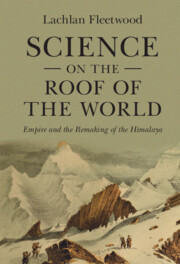
    When, how, and why did the Himalaya become the highest mountains in the world? In 1800, Chimborazo in South America was believed to be the world's highest mountain, only succeeded by Mount Everest in 1856. Science on the Roof of the World tells the story of this shift, and the scientific, imaginative, and political remaking needed to fit the Himalaya into a new global scientific and environmental order. Lachlan Fleetwood traces untold stories of scientific measurement and collecting, indigenous labour and expertise, and frontier-making to provide the first comprehensive account of the East India Company's imperial entanglements with the Himalaya. To make the Himalaya knowable and globally comparable, he demonstrates that it was necessary to erase both dependence on indigenous networks and scientific uncertainties, offering an innovative way of understanding science's global history, and showing how geographical features like mountains can serve as scales for new histories of empire.

    Awards

    Long-listed, 2024 John Pickstone Prize, The British Society for the History of Science

    Reviews

    ‘This book outlines the ways in which the imaginative geography of the Himalayas was constituted by western scientific knowledge, indigenous cosmologies and labour in the nineteenth century contributing to a global science of mountains. Here East India Company surveyors and naturalists jostle with Bhotiya and Tatar mountain guides, their multiple narratives framed through an interdisciplinary lens of botany, biogeography, glaciology, and anthropology. This is environmental history at its best.’

    Vinita Damodaran - University of Sussex

    ‘… [the book] will fascinate anyone interested in how a complex mix of scientific and human acumen, applied against the Himalayan natural history, led to a modern understanding of the 'roof of the world.' … Highly recommended.’

    J. W. Dauben Source: Choice

    ‘This is an unusual and interesting multi disciplinary study of imperial expansion, exploration and scientific achievement showing how the world came to see itself in vertical as well as in horizontal terms. Beautifully illustrated and well ordered, it will be an important contribution to the field as well as an absorbing read for the non scientist.’

    Wendy Palace Source: Asian Affairs

    ‘Science on the Roof of the World is a compelling interrogation of scale, agency, and mobility in the imperial making of putatively global sciences. It deserves the attention of historians of science interested in the interplay of colonial and indigenous knowledge systems, the impact of terrain on scientific technologies and techniques, and the ways in which European empires haphazardly but enduringly reshaped the modern world.’

    Thomas Simpson Source: Isis, a journal of the History of Science Society

    ‘This book will be of keen interest to students and scholars of imperial history, the history of science and the environment, and historical geography.'

    Katherine Arnold Source: British Journal for the History of Science

    ‘The book provides an interesting case study of how science and empire evolved in one particular ‘frontier,’ and its strength is certainly the extent to which Fleetwood recovers Indigenous participation from the archive. Finally, [it] also provides a timely reminder that the questions we ask about our world, the ways that we attempt to answer them, and the manner in which we organize knowledge are inescapably shaped by our political context.’

    Amanda Perry Source: H-Net Reviews

    Refine List

    Actions for selected content:

    Select all | Deselect all
    • View selected items
    • Export citations
    • Download PDF (zip)
    • Save to Kindle
    • Save to Dropbox
    • Save to Google Drive

    Save Search

    You can save your searches here and later view and run them again in "My saved searches".

    Please provide a title, maximum of 40 characters.
    ×

    Contents

    Metrics

    Altmetric attention score

    Full text views

    Total number of HTML views: 0
    Total number of PDF views: 0 *
    Loading metrics...

    Book summary page views

    Total views: 0 *
    Loading metrics...

    * Views captured on Cambridge Core between #date#. This data will be updated every 24 hours.

    Usage data cannot currently be displayed.

    Accessibility standard: Unknown

    Why this information is here

    This section outlines the accessibility features of this content - including support for screen readers, full keyboard navigation and high-contrast display options. This may not be relevant for you.

    Accessibility Information

    Accessibility compliance for the PDF of this book is currently unknown and may be updated in the future.