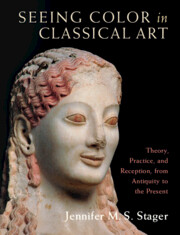

The remains of ancient Mediterranean art and architecture that have survived over the centuries present the modern viewer with images of white, the color of the stone often used for sculpture. Antiquarian debates and recent scholarship, however, have challenged this aspect of ancient sculpture. There is now a consensus that sculpture produced in the ancient Mediterranean world, as well as art objects in other media, were, in fact, polychromatic. Color has consequently become one of the most important issues in the study of classical art. Jennifer Stager's landmark book makes a vital contribution to this discussion. Analyzing the dyes, pigments, stones, earth, and metals found in ancient art works, along with the language that writers in antiquity used to describe color, she examines the traces of color in a variety of media. Stager also discusses the significance of a reception history that has emphasized whiteness, revealing how ancient artistic practice and ancient philosophies of color significantly influenced one another.
‘…Seeing Color in Classical Art will be welcomed by the increasingly receptive audience for color and pigment studies in the wider Mediterranean world. I applaud the author for recasting the color debate in new and creative ways and for assembling a group of wonderful images.’
Ada Cohen - Professor of Art History and Israel Evans Professor in Oratory and Belles Lettres, Dartmouth College
‘Seeing Color in Classical Art stands to make a much-needed intervention in the field due to the author’s ability to bring the study of material traces of color in Greek art into conversation not only with literary and philosophical models of color perception in antiquity, but also to frame this recovery of ancient color in thought and practice within the complex theoretical, political, and historiographical reception of classicism. This is a high wire act that the book admirably pulls off, thanks to the sophistication of Stager’s intellectual approach and her command of the art-historical landscape.’
Verity Platt - Department Chair of Classics and Professor of Classics and History of Art, Cornell University
‘Teaching around statues and art in the Classical world has changed significantly, and while the discussion of colour and pigment in art has become increasingly important, it still lacks in-depth analysis of the effect that colour has on our interpretation of art. This book does a very effective job on this and provides a helpful overview of how colour in art changes the story that an object can tell.’
Timothy Adelani Source: The Journal of Classics Teaching
‘… far-reaching and novel … By drawing our attention to the ways in which simple descriptions of color - of marble as white, for instance - shape our conceptual frameworks, Stager’s book might be taken as the starting point for a broader reassessment of how we study Greek art.’
Seth Estrin Source: West 86th: A Journal of Decorative Arts, Design History and Material Culture
Loading metrics...
* Views captured on Cambridge Core between #date#. This data will be updated every 24 hours.
Usage data cannot currently be displayed.
This section outlines the accessibility features of this content - including support for screen readers, full keyboard navigation and high-contrast display options. This may not be relevant for you.
Accessibility compliance for the PDF of this book is currently unknown and may be updated in the future.
