
Skip to main content Accessibility help
×
  • Cited by 33
    • Show more authors
    • You may already have access via personal or institutional login
    • Select format
    • Publisher:
      Cambridge University Press
      Publication date:
      05 June 2012
      20 December 2004
      ISBN:
      9780511614286
      9780521844529
      9780521606271
      Dimensions:
      (228 x 152 mm)
      Weight & Pages:
      0.44kg, 238 Pages
      Dimensions:
      (228 x 152 mm)
      Weight & Pages:
      0.325kg, 240 Pages
    You may already have access via personal or institutional login
  • Selected: Digital
    Add to cart View cart Buy from Cambridge.org

    Book description

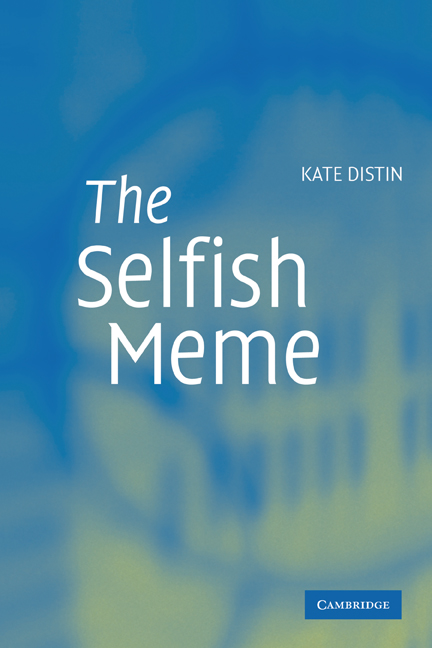
    Culture is a unique and fascinating aspect of the human species. How did it emerge and how does it develop? Richard Dawkins suggested culture evolves and that memes are cultural replicators, subject to variation and selection in the same way as genes are in the biological world. Thus human culture is the product of a mindless evolutionary algorithm. Does this imply, as some have argued, that we are mere meme machines and that the conscious self is an illusion? This highly readable and accessible book extends Dawkins's theory, presenting for the first time a fully developed concept of cultural DNA. Distin argues that culture's development can be seen as the result of memetic evolution and as the product of human creativity. Memetic evolution is perfectly compatible with the view of humans as conscious and intelligent. This book should find a wide readership amongst philosophers, psychologists, sociologists and non-academic readers.

    Reviews

    ‘Distin‘s discussion is even-handed and informative for those wishing to update themselves on the current state of play in the field.‘

    Source: Scientific and Medical Network Review

    ‘A model of clarity, the book‘s appeal is wide - from philosophers to sociologists, anyone interested in how cultures change will benefit from reading The Selfish Meme. Her rigorous approach makes her theory more palatable than other theories of cultural evolution.‘

    Source: Philosophy Today

    The Selfish Meme is a very readable and thought provoking book, and I would have no hesitation in recommending it to open-minded students and scholars in any biological, anthropological or sociological field.'

    Source: Cambridge (the Magazine of the Cambridge Society)

    Refine List

    Actions for selected content:

    Select all | Deselect all
    • View selected items
    • Export citations
    • Download PDF (zip)
    • Save to Kindle
    • Save to Dropbox
    • Save to Google Drive

    Save Search

    You can save your searches here and later view and run them again in "My saved searches".

    Please provide a title, maximum of 40 characters.
    ×

    Contents

    Bibliography
    Bibliography
    Agar, Nicholas (1993) What do frogs really believe?Australasian Journal of Philosophy 71:1–12
    Alp, R. (1993) Meat eating and ant dipping by wild chimpanzees in Sierra Leone, Primates 34:463–8
    Andreski, S., ed. (1971) Herbert Spencer, Nelson
    Antilla, R. (1972) An introduction to historical and comparative linguistics, Macmillan
    Aunger, Robert (1999) Culture vultures, The Sciences 39 (5):36–42
    Aunger, Robert, ed. (2000) Darwinizing culture – the status of memetics as a science, Oxford University Press
    Aunger, Robert (2002) The electric meme: a new theory of how we think, Free Press
    Avers, C. J. (1989) Process and pattern in evolution, Oxford University Press
    Ball, J. A. (1984) Memes as replicators, Ethology and Sociobiology 5:145–61
    Barkhow, Jeremy H. (1989) The elastic between genes and culture, Ethology and Sociobiology 10:111–26
    Barnett, S. M., ed. (1962) A century of Darwinism, Mercury
    Bayne, Rowan; Horton, Ian; Merry, Tony; Noyes, Elizabeth; & McMahon, Gladeana (1999) The counsellor's handbook – a practical A-Z guide to professional and clinical practice, Stanley Thorne
    Beer, Francis A. (1999) Memetic meanings – a commentary on Rose's paper: Controversies in meme theory, Journal of Memetics – Evolutionary Models of Information Transmission [Internet] 3 (1), June 1999. Available from: 〈http://jom-emit.cfpm.org/1999/vol3/beer_fa.html〉
    Benzon, William L. (2002) Colorless green homunculi, Human Nature Review 2:454–62
    Bickerton, Derek (1990) Language and species, University of Chicago Press
    Blackmore, Susan (1999) The meme machine, Oxford University Press
    Blackmore, Susan (2000) The power of memes, Scientific American 283 (4):52–61
    Bonjour, Laurence (1985) The structure of empirical knowledge, Harvard University Press
    Botterill, George (1993) “Functions and functional explanation”. Unpublished manuscript
    Botterill, George (1994) Personal communication
    Botterill, George (1995) “How can we learn anything from thought experiments?” Unpublished manuscript
    Botterill, George, & Carruthers, P. (1999) The philosophy of psychology, Cambridge University Press
    Bowker, John (1995) Is God a virus? Genes, culture and religion, SPCK
    Boyd, Gary (2001) The human agency of meme machines, An extended review of “The meme machine” by Susan Blackmore, Journal of Memetics – Evolutionary Models of Information Transmission [Internet] 5 (1), March 2001. Available from: 〈http://jom-emit.cfpm.org/2001/vol5/boyd_g.html〉
    Boyd, R., & Richerson, P. J. (1985) Culture and the evolutionary process, University of Chicago Press
    Brodick, A. H. (1960) Man and his ancestry, Scientific Book Club
    Bryson, Bill. (1990) Mother tongue, Penguin Books
    Burhoe, Ralph Wendell (1979) Religion's role in human evolution: the missing link between ape-man's selfish genes and civilized altruism, Zygon 14: 135–62
    Byrne, Richard W., & Russon, Anne E. (1998) Learning by imitation: a hierarchical approach, Behavioural and Brain Sciences 21 (5):667–84
    Carruthers, Peter (1992) Human knowledge and human nature, Oxford University Press
    Carruthers, Peter (1994) “Prolegomena to a project: the natural involvement of language in thought”. Unpublished manuscript
    Carruthers, Peter (1995) Language, thought and consciousness, Cambridge University Press
    Cavalli-Sforza, L. L., & Feldman, M. (1981) Cultural transmission and evolution: a quantitative approach, Princeton University Press
    Christians in Science, Proceedings of the Conference on Creation and evolution, 1993, Regent's College London (1993), conference chairman Oliver Barclay
    Clark, Andy (1995) Language: the ultimate artifact, unpublished first draft of chapter 10 in Andy Clark (1997) Being there: putting brain, body and world together again, MIT Press
    Clark, S. R. L. (1993) Minds, memes and rhetoric, Inquiry 36:3–16
    Cloak, F. T. (1975) Is a cultural ethology possible?Human Ecology 3:161–82
    Critchlow, P. (1982) Mastering chemistry, Macmillan
    Dahlbom, B., ed. (1993) Dennett and his critics, Blackwell
    Dainow, Sheila (1995) Uncovering a TA script with pictures, Counselling 6: 291–3
    Darden, C., & Cain, J. A. (1989) Selection type theories, Philosophy of Science 56: 106–29
    Darton, Mike, & Clark, John O. E. (1994) The Dent dictionary of measurement, J. M. Dent
    Darwin, Charles (1859) The origin of species, Penguin 1968 edition
    Darwin, Charles (1887) Autobiographical chapter in Darwin, F., ed., Life and letters, vols. 1–3, third edition, London
    Dawkins, Richard (1976) Hierarchical organisation: a candidate principle for ethology, in P. P. G. Bateson & R. A. Hinde, eds (1976) Growing points in ethology, Cambridge Universty Press, pp. 7–54
    Dawkins, Richard (1978) Reply to Fix and Greene, Contemporary Sociobiology 7
    Dawkins, Richard (1982) The extended phenotype, Oxford University Press
    Dawkins, Richard (1986) The blind watchmaker, Penguin Books
    Dawkins, Richard (1989) The selfish gene, revised edition, Oxford University Press
    Dawkins, Richard (1993a) Viruses of the mind, in B. Dahlbom, ed. (1993) Dennett and his critics, Blackwell, pp. 13–27
    Dawkins, Richard (1993b) Is religion just a disease? Daily Telegraph, 15 December, p. 18
    Dawkins, Richard (1995a) A reply to Poole, Science and Christian Belief 7:45–50
    Dawkins, Richard (1995b) River out of Eden, Weidenfeld and Nicolson
    Deacon, Terence (1997) The symbolic species – the co-evolution of language and the human brain, Allen Lane, The Penguin Press
    Delfgaauw, Bernard (1961) The theory of Teilhard de Chardin, Collins (Fontana)
    Dennett, Daniel C. (1990) Memes and the exploitation of imagination, Journal of Aesthetics and Art Criticism 48
    Dennett, Daniel C. (1991) Consciousness explained, Penguin Books
    Dennett, Daniel C. (1993) Living on the edge, Inquiry 36:135–8
    Dennett, Daniel C. (1995) Darwin's dangerous idea – evolution and the meanings of life, Allen Lane, Penguin Press
    Dennett, Daniel C. (1999) The evolution of culture, Charles Simonyi Lecture at Oxford University, February 17 1999 [Internet] Available from: 〈http://www.edge.org/3rd_culture/dennett/dennett_p1.html〉
    Desmond, A., & Moore, J. (1991) Darwin, Michael Joseph
    Distin, K. E. (1997) Cultural evolution – the meme hypothesis, in Proceedings of the Conference on Evolution, or How did we get here? 1997, Westminster College Oxford, Christ and the Cosmos
    Distin, K. E. (1999): Interfaith issues in Religious Education: a response to Lat Blaylock, REsource 21 (3):16–18
    Distin, K. E., & Distin, K. W. (1996) Human design methods, in Proceedings of the Conference on Design in Nature?, Birmingham 1996, conference chairman Colin Russell, Christians in Science
    Donald, Merlin (1993) Reply to Plotkin, Behavioural and Brain Science 16:782–3
    Dretske, F. (1988) Explaining behaviour, MIT Press
    Durham, , W. H. (1990) Advances in evolutionary culture theory, Annual Review of Anthropology 19:187–210
    Durkheim, Émile (1938) The rules of sociological method, University of Chicago Press
    Ettlinger, G. (1987) Cross-modal sensory integration, in Richard L. Gregory, The Oxford companion to the mind, Oxford University Press, pp. 173–4
    Flew, Anthony, ed. (1979) Dictionary of philosophy, Pan Books
    Fodor, J. A. (1987) Psychosemantics, MIT Press
    Fodor, J. A. (1990) A theory of content and other essays, MIT Press
    Fregmen, A., & Fay, D. (1980) Over-extensions in production and comprehension: methodological clarification, Journal of Child Language 7:205–11
    Gabora, Liane (1997) The origin and evolution of culture and creativity, Journal of Memetics – Evolutionary Models of Information Transmission [Internet] 1 (1), May 1997. Available from 〈http://jom-emit.cfpm.org/1997/vol1/gabora_l.html〉
    Gabora, Liane (1999) A review of “The Meme Machine” by Susan Blackmore, The Journal of Artificial Societies and Social Simulation [Internet] 2 (2), March 1999. Available from: 〈http://jasss.soc.surrey.ac.uk/2/2/review2.html〉
    Gatherer, Derek (1999) A plea for methodological Darwinism – a commentary on Rose's paper: Controversies in meme theory, Journal of Memetics – Evolutionary Models of Information Transmission [Internet] 3 (1), June 1999. Available from: 〈http://jom-emit.cfpm.org/1999/vol3/gatherer_dg2.html〉
    Goswami, Usha (1990) “Developmental psychology”. Cambridge University NST 1B lecture notes
    Gregory, Richard L. (1987) The Oxford companion to the mind, Oxford University Press
    Griffiths, P. E. (1993) Functional analysis and proper functions, British Journal for the Philosophy of Science 44:409–22
    Gross, John (1991) The Oxford book of essays, Oxford University Press
    Gunderson, V. W. (1983) Development of cross-modal recognition in infant pigtail monkeys (Macaca Nemestrina), Developmental Psychology 19:389–404
    Hacking, I. (1983) Representing and intervening, Cambridge University Press
    Heylighen, Francis (1998) What makes a meme successful? Selection criteria for cultural evolution, in Symposium on memetics, 15th International Congress on Cybernetics, Namur (1998), symposium chairmen Francis Heylighen & Mario Vaneechoutte. Available from:〈http://pespmc1.vub.ac.be/papers/MemeticsNamur.html〉
    Hofstadter, Richard (1944) Social Darwinism in American thought, 1959 edition, George Braziller
    Honderich, Ted, ed. (1995) The Oxford companion to philosophy, Oxford University Press
    Hull, David L. (1988) A mechanism and its metaphysics: an evolutionary account of the social and conceptual development of science, Biology and Philosophy 3:123–55
    Hull, David L. (1999) Strategies in meme theory – a commentary on Rose's paper: Controversies in meme theory, Journal of Memetics – Evolutionary Models of Information Transmission [Internet] 3 (1), June 1999. Available from 〈http://jom-emit.cfpm.org/1999/vol3/hull_dl.html〉
    Jones, B. E. M. (1995) “Is there a role for syntax/parsing in NLP?” Unpublished manuscript
    Kandel, Eric R., & Schwartz, James H., eds. (1981) Principles of neural science, Edward Arnold
    Karmiloff-Smith, Annette (1992) Beyond modularity – a developmental perspective on cognitive science, MIT Press
    Kenny, A. (1989) The metaphysics of mind, Clarendon Press
    Kirk, Robert (1993) “The best set of tools”? Dennett's metaphors and the mind-body problem, The Philosophical Quarterly 43:335–43
    Koestler, Arthur (1964) The act of creation, Hutchinson
    Koestler, Arthur (1978) Janus – a summing up, Hutchinson
    Kolenda, K. (1979) Introduction in Gilbert Ryle, On thinking, Blackwell
    Leakey, R., & Lewin, R. (1992) Origins reconsidered, Little, Brown & Co
    Levi, Primo (1992) The periodic table, Abacus
    Lewis, C. S. (1941) Bulverism, in Walter Hooper ed. (1996) Compelling reason, Fount, pp. 17–21
    Lewis, D. (1983) Philosophical papers, vol. 1, Oxford University Press
    Line, Christina: personal communication
    Lukes, Steven (1975) Émile Durkheim – his life and work: a historical and critical study, Peregrine
    Lycan, W. ed. (1990) Mind and cognition: a reader, Blackwell
    Lynch, A. et al. (1989) A model of cultural evolution of chaffinch song derived with the meme concept, American Naturalist 133:634–53
    Lynch, A. et al. (1993) A population memetics approach to cultural evolution in chaffinch song, American Naturalist 141:597–620
    McCrone, J. (1990) The ape that spoke, Picador
    McGinn, C. (1989) Mental content, Blackwell
    Magee, Bryan (1975) Popper, Collins (Fontana)
    Malthus, T. R. (1826) An essay on the principle of population, John Murray
    Mason, Kelby (1998) Thoughts as tools: the meme in Daniel Dennett's work, in Symposium on memetics, 15th International Congress on Cybernetics, Namur (1998), symposium chairmen Francis Heylighen & Mario Vaneechoutte. Available from: 〈http://pespmc1.vub.ac.be/Conf/MemePap/Mason.html〉
    Masters, R. D. (1970) Genes, language and evolution, Semiotica 2:295–320
    Medawar, Peter (1990): The threat and the glory, Oxford University Press
    Meltzoff, A. N., & Borton, R. W. (1979) Intermodal matching by human neonates, Nature 282:403–4
    Meyer, Albert R., & Lehman, Eric (2002) Random variables: Expectation, Mathematics for Computer Science Handouts and Course Notes Week 12 (Fall 2002). Available from 〈http://theory.lcs.mit.edu/classes/6.042/fall02/handouts/#week12〉
    Midgley, M. (1979) Juggling genes, Philosophy 54:439
    Millikan, Ruth G. (1984) Language, thought, and other biological categories, MIT Press
    Millikan, Ruth G. (1990) Compare and contrast Dretske, Fodor, and Millikan on teleosemantics, Philosophical Topics 18 (2):151–61
    Modelski, George (1999) An evolutionary theory of culture? – a commentary on Rose's paper: Controversies in meme theory, Journal of Memetics – Evolutionary Models of Information Transmission [Internet] 3 (1), June 1999. Available from: 〈http://jom-emit.cfpm.org/1999/vol3/modelski_g.html〉
    Morris, Desmond (1968) The naked ape, Corgi
    National Association for Gifted Children, Education and Research Sub-Committee (1998) Help with bright children, NAGC
    Oldroyd, D. R. (1983) Darwinian impacts, Open University Press
    Papineau, D. (1993) “The teleological theory of representation”. Seminar delivered to Sheffield University Philosophy Department
    Pinker, Steven (1994) The language instinct – the new science of language and mind, Penguin Books
    Plotkin, H. C. (1993) Hunting memes, Behavioural and Brain Science 16:768–9
    Poole, Michael (1994) A critique of aspects of the philosophy and theology of Richard Dawkins, Science and Christian Belief 6:41–59
    Poole, Michael (1995) A response to Dawkins, Science and Christian Belief 7:51–8
    Poole, Michael, ed. (1997) God and the scientists, CPO – Design and Print
    Popper, Karl R. (1972) Objective knowledge – an evolutionary approach, Oxford University Press
    Porter, Roy (1987) Man masters nature, BBC
    Price, If (1999) Steps towards the memetic self – a commentary on Rose's paper: Controversies in meme theory, Journal of Memetics – Evolutionary Models of Information Transmission [Internet] 3 (1), June 1999. Available from: 〈http://jom-emit.cfpm.org/1999/vol3/price_if.html〉
    Research Scientists' Christian Fellowship, Proceedings of the Conference on Evolution, 1974, Bedford College London (1974), conference chairman Duncan Vere
    Robbins, T. W., & Cooper, P. J. (1988) Psychology for medicine, Edward Arnold
    Roberts, K. (1998) The academic and emotional needs of gifted children – a personal case study, Gifted and Talented 2:32–8
    Rose, Nick (1998) Controversies in meme theory, Journal of Memetics – Evolutionary Models of Information Transmission [Internet] 2 (1), June 1998. Available from: 〈http://jom-emit.cfpm.org/1998/vol2/rose_n.html〉
    Rose, Nick (1999a) Rationale for commentary on Rose's paper: Controversies in meme theory, Journal of Memetics – Evolutionary Models of Information Transmission [Internet] 3 (1), June 1999. Available from 〈http://jom-emit.cfpm.org/1999/vol3/rose_n_case_for_commentary.html〉
    Rose, Nick (1999b) Okay, but exactly “who” would escape the tyranny of the replicators? – reply to the commentaries on the author's paper: Controversies in meme theory, Journal of Memetics – Evolutionary Models of Information Transmission [Internet] 3 (1), June 1999. Available from: 〈http://jom-emit.cfpm.org/1999/vol3/rose_n.html〉
    Ruse, Michael (1982) Darwinism defended, Addison-Wesley
    Ruse, Michael, ed. (1989) Philosophy of biology, Macmillan
    Russell, Bertrand (1927) Why I am not a Christian, in Paul Edwards, ed. (1957) Why I am not a Christian, 1996 edition, Routledge, pp. 13–26
    Ryle, Gilbert (1963) The concept of mind, Penguin Books
    Ryle, Gilbert (1979) On thinking, Blackwell
    Schull, J. (1990) Are species intelligent?Behavioural and Brain Sciences 13
    Searle, John (1989) Minds, brains and science, Pelican
    Shafto, Michael, ed. (1985) How we know, Harper and Row
    Shrader, Douglas (1980) The evolutionary development of science, Review of Metaphysics 34:273–96
    Simon, Herbert (1962) The architecture of complexity, Proceedings of the American Philosophical Society 106:6, December 1962, pp 467–482
    Singer, Peter ed. (1986) Applied ethics, Oxford University Press
    Sluckin, W. (1954) Minds and machines, Pelican
    Smith, George (1976) How to defend atheism, Speech delivered to the Society of Separationists [Internet]. Available from: 〈http://www.infidels.org/library/modern/george_smith/defending.html〉
    Sober, Elliott (1993) Philosophy of biology, Oxford University Press
    Spencer, Herbert (1862) First principles, 1900 edition, Williams & Norgate
    Sperber, Dan (1996) Explaining culture – a naturalistic approach, Blackwell
    Sperber, Dan (2000) Metarepresentations in an evolutionary perspective, in Dan Sperber, ed., Metarepresentations: a multidisciplinary approach, Oxford University Press, pp. 117–37
    Sperber, Dan, & Wilson, Deirdre (1986) Relevance: communication and cognition, Blackwell
    Steen, E. B. (1971) Dictionary of biology, Barnes and Noble
    Steinbeck, John (1979) A life in letters, Pan Books
    Sykes, J. B. (1982) The concise Oxford dictionary, seventh edition, Oxford University Press
    Tomasello, M. & Farrar, M. J. (1986) Object permanence and relational words: a training study, Journal of Child Language 13:495–505
    Vaneechoutte, Mario (1998) The replicator: a misnomer. Conceptual implications for genetics and memetics, in Symposium on Memetics, 15th International Congress on Cybernetics, Namur (1998), symposium chairmen Francis Heylighen & Mario Vaneechoutte. Available from 〈http://pespmc1.vub.ac.be/Conf/MemePap/Vaneechoutte.html〉
    Wallace, A. R. (1895) Natural selection and tropical nature, Macmillan
    Wallace, K. M. (1989) An introduction to the design process, Cambridge University Engineering Department
    Wilkins, John (1999): On choosing to evolve: strategies without a strategist – a commentary on Rose's paper: Controversies in meme theory, Journal of Memetics – Evolutionary Models of Information Transmission [Internet] 3 (1), June 1999. Available from: 〈http://jom-emit.cfpm.org/1999/vol3/wilkins_j2.html〉
    Young, R. M. (1985) Darwin's metaphor, Cambridge University Press

    Metrics

    Altmetric attention score

    Full text views

    Total number of HTML views: 0
    Total number of PDF views: 0 *
    Loading metrics...

    Book summary page views

    Total views: 0 *
    Loading metrics...

    * Views captured on Cambridge Core between #date#. This data will be updated every 24 hours.

    Usage data cannot currently be displayed.

    Accessibility standard: Unknown

    Why this information is here

    This section outlines the accessibility features of this content - including support for screen readers, full keyboard navigation and high-contrast display options. This may not be relevant for you.

    Accessibility Information

    Accessibility compliance for the PDF of this book is currently unknown and may be updated in the future.
