
- Coming soon
- Publisher:
- Cambridge University Press
- Expected online publication date:
- November 2025
- Print publication year:
- 2025
- Online ISBN:
- 9781108595063
- Subjects:
- Legal History, Law, British History after 1450, History
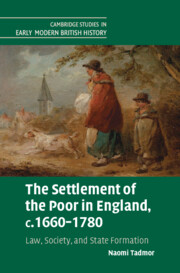
In 1662, in the aftermath of the Restoration, parliament passed new legislation for the settlement and removal of the poor. Important provisions were finalised in no more than a few days. But once the settlement of the poor was set in law it became an agent of historical change that affected society, state formation, and the lives of millions in Britain and beyond for centuries to come. Within a few decades, practices of local government were transformed. In towns and villages hierarchies of social status and gender were affected. The rising empire employed the settlement administration to mobilise forces for large-scale international wars and to deal with soldiers' wives and children left behind. The huge number of bureaucratic forms generated following the new policies made a lasting impact on administrative culture. The Settlement of the Poor in England is about social change and about history's unintended consequences. It is also about the struggles and experiences of individuals and communities. It reminds us how the settlement legislation still resonates today. This title is part of the Flip it Open Programme and may also be available Open Access. Check our website Cambridge Core for details.
 Loading metrics...
* Views captured on Cambridge Core between #date#. This data will be updated every 24 hours.
Usage data cannot currently be displayed.
Accessibility compliance for the PDF of this book is currently unknown and may be updated in the future.