Metrics
Full text views
Full text views help
Loading metrics...
* Views captured on Cambridge Core between #date#. This data will be updated every 24 hours.
Usage data cannot currently be displayed.
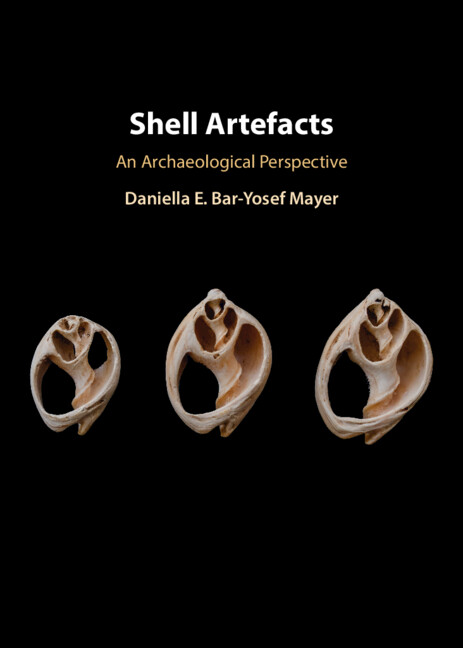
Shells were an important product in the prehistoric and ancient worlds. Dating back to the Palaeolithic period, shells are among the earliest symbolic artefacts and are a key indicator of human cognitive evolution. In this volume, Daniella E. Bar-Yosef Mayer offers a multi-disciplinary, global survey of shell artefacts in human history. Integrating approaches from biomineralogy, palaeontology, and geoarchaeology, she shows how humans exploited shells as fundamental components of material culture, alongside lithics and ceramics. Bar-Yosef Mayer traces how the transition to farming was accompanied by technological advances and innovations as reflected in new artefact types, including decorative objects, such as pendants and bangles, as well as tools and vessels, such as containers and fish-hooks. Her study also considers the use of shell money as currency in historical periods. Featuring examples of shell technology from around the world, this volume serves as an introduction to the topic and is suitable for use in courses on human prehistory and early civilizations.
Loading metrics...
* Views captured on Cambridge Core between #date#. This data will be updated every 24 hours.
Usage data cannot currently be displayed.
This section outlines the accessibility features of this content - including support for screen readers, full keyboard navigation and high-contrast display options. This may not be relevant for you.
The PDF of this book complies with version 2.2 of the Web Content Accessibility Guidelines (WCAG), offering more comprehensive accessibility measures for a broad range of users and attains the highest (AAA) level of WCAG compliance, optimising the user experience by meeting the most extensive accessibility guidelines.
Allows you to navigate directly to chapters, sections, or non‐text items through a linked table of contents, reducing the need for extensive scrolling.
Provides an interactive index, letting you go straight to where a term or subject appears in the text without manual searching.
You will encounter all content (including footnotes, captions, etc.) in a clear, sequential flow, making it easier to follow with assistive tools like screen readers.
You get concise descriptions (for images, charts, or media clips), ensuring you do not miss crucial information when visual or audio elements are not accessible.
You get more than just short alt text: you have comprehensive text equivalents, transcripts, captions, or audio descriptions for substantial non‐text content, which is especially helpful for complex visuals or multimedia.
You can access graphs or charts in a text or tabular format, so you are not excluded if you cannot process visual displays.
You will still understand key ideas or prompts without relying solely on colour, which is especially helpful if you have colour vision deficiencies.
You benefit from high‐contrast text, which improves legibility if you have low vision or if you are reading in less‐than‐ideal lighting conditions.
