
Skip to main content Accessibility help
×
  • Cited by 7
    • Show more authors
    • You may already have access via personal or institutional login
    • Select format
    • Publisher:
      Cambridge University Press
      Publication date:
      August 2021
      September 2021
      ISBN:
      9781108565080
      9781108429351
      Dimensions:
      (228 x 152 mm)
      Weight & Pages:
      0.61kg, 344 Pages
      Dimensions:
      Weight & Pages:
    You may already have access via personal or institutional login
  • Selected: Digital
    Add to cart View cart Buy from Cambridge.org

    Book description

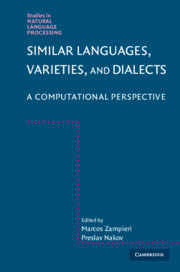
    Language resources and computational models are becoming increasingly important for the study of language variation. A main challenge of this interdisciplinary field is that linguistics researchers may not be familiar with these helpful computational tools and many NLP researchers are often not familiar with language variation phenomena. This essential reference introduces researchers to the necessary computational models for processing similar languages, varieties, and dialects. In this book, leading experts tackle the inherent challenges of the field by balancing a thorough discussion of the theoretical background with a meaningful overview of state-of-the-art language technology. The book can be used in a graduate course, or as a supplementary text for courses on language variation, dialectology, and sociolinguistics or on computational linguistics and NLP. Part 1 covers the linguistic fundamentals of the field such as the question of status and language variation. Part 2 discusses data collection and pre-processing methods. Finally, Part 3 presents NLP applications such as speech processing, machine translation, and language-specific issues in Arabic and Chinese.

    Reviews

    ‘Variation is a key aspect of human language, and yet it has been too often overlooked in computational linguistics. The book edited by Marcos Zampieri and Preslav Nakov is an important step towards filling this gap with top-level contributions that offer a new alliance between natural language processing and linguistic theory to understand this complex phenomenon and its impact on applications.'

    Alessandro Lenci - University of Pisa

    Refine List

    Actions for selected content:

    Select all | Deselect all
    • View selected items
    • Export citations
    • Download PDF (zip)
    • Save to Kindle
    • Save to Dropbox
    • Save to Google Drive

    Save Search

    You can save your searches here and later view and run them again in "My saved searches".

    Please provide a title, maximum of 40 characters.
    ×

    Contents

    Metrics

    Altmetric attention score

    Full text views

    Total number of HTML views: 0
    Total number of PDF views: 0 *
    Loading metrics...

    Book summary page views

    Total views: 0 *
    Loading metrics...

    * Views captured on Cambridge Core between #date#. This data will be updated every 24 hours.

    Usage data cannot currently be displayed.

    Accessibility standard: Unknown

    Why this information is here

    This section outlines the accessibility features of this content - including support for screen readers, full keyboard navigation and high-contrast display options. This may not be relevant for you.

    Accessibility Information

    Accessibility compliance for the PDF of this book is currently unknown and may be updated in the future.
