Slavery, Freedom, and Development

-
Select format
-
- Publisher:
- Cambridge University Press
- Publication date:
- 29 January 2026
- 19 January 2026
- ISBN:
- 9781009407151
- 9781009407144
- Dimensions:
- (229 x 152 mm)
- Weight & Pages:
- 0.509kg, 258 Pages
- Dimensions:
- Weight & Pages:
- Subjects:
- Area Studies, African Studies, History, African History, Economic History
You may already have access via personal or institutional login- Subjects:
- Area Studies, African Studies, History, African History, Economic History
Show more authors 
You may already have access via personal or institutional login
Book description
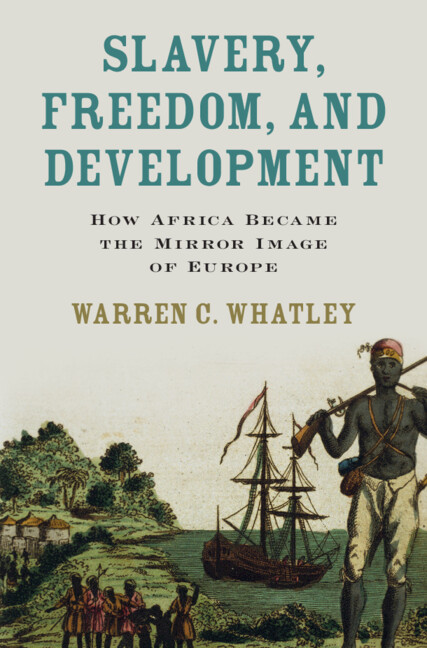
In this innovative reinterpretation of the economic history of Africa and Europe, Warren C. Whatley argues that freedom from Western-style slavery is the origin of modern Western economic growth. Such freedom was achieved around the 13th century in Western European Christendom by making enslavement among European Christians a sin but still a recognized property right and form of wealth. After 1500, the triangular trade in the North Atlantic integrates the slave and free sectors of expanding European Empires, spreading freedom and development in Europe and slavery and underdevelopment in Africa. Whatley documents when the slave and/or free sectors drove the expansion of Empire, and how exposure to slave trades in Africa spread institutions and norms better suited to capturing and trading people – slavery, polygyny, ethnic stratification and inherited aristocracies – some of the mechanisms through which the past is still felt in Africa today.
Reviews
‘A bold and data-rich reinterpretation of African and European economic divergence. By placing slavery and freedom at the center of the story, Whatley offers a provocative account of how the two regions became mirror images of each other; an argument that will challenge readers and energize debate across disciplines.’
Marlous van Waijenburg - author of Financing the African Colonial State
‘Warren Whatley has given us a sweeping interpretation of interactions between European and African development, with slavery and freedom at the center of the historical narrative. The results are stunning. Highly recommended to readers of all backgrounds.’
Gavin Wright - author of Slavery and American Economic Development
Contents
Contents
References
Metrics
Altmetric attention score
Full text views
Full text views helpTotal number of HTML views: 0
Total number of PDF views: 0 *
 Loading metrics...
* Views captured on Cambridge Core between #date#. This data will be updated every 24 hours.
Usage data cannot currently be displayed.
Accessibility standard: WCAG 2.0 A
Why this information is here
This section outlines the accessibility features of this content - including support for screen readers, full keyboard navigation and high-contrast display options. This may not be relevant for you.
Accessibility Information
The HTML of this book conforms to version 2.0 of the Web Content Accessibility Guidelines (WCAG), ensuring core accessibility principles are addressed and meets the basic (A) level of WCAG compliance, addressing essential accessibility barriers.
Content Navigation
Table of contents navigation
Allows you to navigate directly to chapters, sections, or non‐text items through a linked table of contents, reducing the need for extensive scrolling.
Index navigation
Provides an interactive index, letting you go straight to where a term or subject appears in the text without manual searching.
Reading Order and Textual Equivalents
Single logical reading order
You will encounter all content (including footnotes, captions, etc.) in a clear, sequential flow, making it easier to follow with assistive tools like screen readers.
Short alternative textual descriptions
You get concise descriptions (for images, charts, or media clips), ensuring you do not miss crucial information when visual or audio elements are not accessible.
Full alternative textual descriptions
You get more than just short alt text: you have comprehensive text equivalents, transcripts, captions, or audio descriptions for substantial non‐text content, which is especially helpful for complex visuals or multimedia.
Structural and Technical Features
ARIA roles provided
You gain clarity from ARIA (Accessible Rich Internet Applications) roles and attributes, as they help assistive technologies interpret how each part of the content functions.