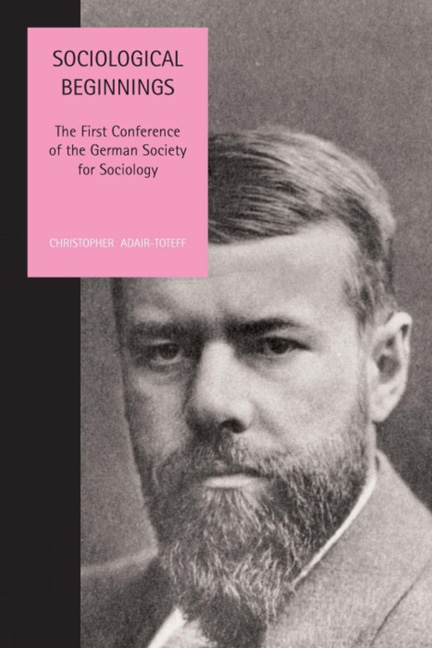
Sociological Beginnings

-
The digital format of this book is no longer available to purchase from Cambridge Core. Other formats may be available.
-
Select format
-
- Publisher:
- Liverpool University Press
- Publication date:
- 04 July 2017
- 31 December 2005
- ISBN:
- 9781846314100
- 9780853237990
- Dimensions:
- Weight & Pages:
- Dimensions:
- Weight & Pages:
- Subjects:
- Sociology: General Interest, Sociology
You may already have access via personal or institutional login- Subjects:
- Sociology: General Interest, Sociology
Show more authors 
You may already have access via personal or institutional login
Book description
This is a translated edition of five of the nine papers and the responses presented at the first conference of the Deutsche Gesellschaft für Soziologie (DGS) that was held in 1910. These are seminal contributions by some of the founders of classical German sociology and social theory, including Max Weber, Georg Simmel, Ferdinand Tönnies, Ernst Troeltsch, and Werner Sombart. A substantial introduction discusses the lives and works of the five thinkers, placing them in the context of Germany in the early twentieth century and discussing their personal and societal connections. The papers, none of which has ever appeared in English, are a remarkable testament to the developing thought of key scholars. The year 1910 was a defining year for German sociology. There were still no sociology schools, departments, or even professorships, but a significant number of important thinkers had published crucial sociological works. Through such publications Ferdinand Tönnies, Georg Simmel, Max Weber, Werner Sombart and Ernst Troeltsch had founded considerable reputations, and by 1909 the first three had banded together with other scholars to form the DGS. The papers show German sociology at a decisive moment, when these thinkers were at their prime and were engaged in building a new society devoted to investigation of social reality based upon sound scholarly principles and free from biased social dogmatics. The topics continue to have relevance and the exchanges provide a lively dimension, one that is not found simply by reading the books of these five founders of sociological thinking.
Contents
Contents
Metrics
Full text views
Full text views helpTotal number of HTML views: 0
Total number of PDF views: 0 *
 Loading metrics...
* Views captured on Cambridge Core between #date#. This data will be updated every 24 hours.
Usage data cannot currently be displayed.
Accessibility standard: Unknown
Why this information is here
This section outlines the accessibility features of this content - including support for screen readers, full keyboard navigation and high-contrast display options. This may not be relevant for you.
Accessibility Information
Accessibility compliance for the PDF of this book is currently unknown and may be updated in the future.