
Skip to main content Accessibility help
×
  • Cited by 25
    • Show more authors
    • You may already have access via personal or institutional login
    • Select format
    • Publisher:
      Cambridge University Press
      Publication date:
      05 October 2015
      09 October 2015
      ISBN:
      9781316401248
      9781107123304
      9781107558472
      Dimensions:
      (228 x 152 mm)
      Weight & Pages:
      0.56kg, 294 Pages
      Dimensions:
      (229 x 152 mm)
      Weight & Pages:
      0.45kg, 294 Pages
    You may already have access via personal or institutional login
  • Selected: Digital
    Add to cart View cart Buy from Cambridge.org

    Book description

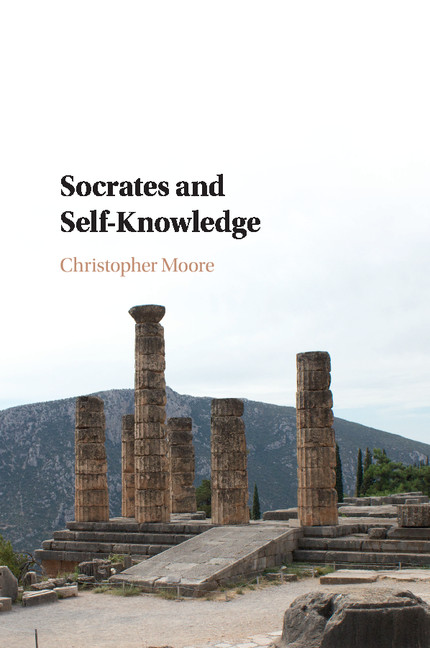
    In this book, the first systematic study of Socrates' reflections on self-knowledge, Christopher Moore examines the ancient precept 'Know yourself' and, drawing on Plato, Aristophanes, Xenophon, and others, reconstructs and reassesses the arguments about self-examination, personal ideals, and moral maturity at the heart of the Socratic project. What has been thought to be a purely epistemological or metaphysical inquiry turns out to be deeply ethical, intellectual, and social. Knowing yourself is more than attending to your beliefs, discerning the structure of your soul, or recognizing your ignorance - it is constituting yourself as a self who can be guided by knowledge toward the good life. This is neither a wholly introspective nor a completely isolated pursuit: we know and constitute ourselves best through dialogue with friends and critics. This rich and original study will be of interest to researchers in the philosophy of Socrates, selfhood, and ancient thought.

    Reviews

    ‘Christopher Moore presents a new and insightful perspective on [an] old philosophical theme. He invites his readers to rethink the Socratic concept of self-knowledge and the Delphic oracle to know thyself. The upshot of his analysis is an original and important interpretation of the ancient philosophical and literary sources on these topics, especially the Platonic dialogues.'

    Paul Schollmeier - University of Nevada, Las Vegas

    Refine List

    Actions for selected content:

    Select all | Deselect all
    • View selected items
    • Export citations
    • Download PDF (zip)
    • Save to Kindle
    • Save to Dropbox
    • Save to Google Drive

    Save Search

    You can save your searches here and later view and run them again in "My saved searches".

    Please provide a title, maximum of 40 characters.
    ×

    Contents

    Bibliography

    Agard, Walter, 1966. “Boreas at Athens.” Classical Journal 61: 241246
    Allen, R.E., 1962. “Note on Alcibiades I, 129B 1.” American Journal of Philology 83: 187190
    Ambury, James, 2013. “The Failed Seduction: Alcibiades, Socrates, and the Epithumetic Comportment.” Epoché 17: 257274
    Anastasiadis, V.I., 2004. “Idealized ΣΧΟΛΗ and Disdain for Work: Aspects of Philosophy and Politics in Ancient Democracy.” Classical Quarterly 54: 5879
    Annas, Julia, 1985. “Self-Knowledge in Early Plato.” In O’Meara, Dominic (ed.), Platonic Investigations. Washington DC: Catholic University of America Press, pp. 121138
    Annas, Julia, 1999. Platonic Ethics, Old and New. Ithaca, NY: Cornell University Press
    Austin, Emily, 2012. “Fools and Malicious Pleasure in Plato’s Philebus.” History of Philosophy Quarterly 29: 125139
    Avnon, D., 1995. “‘Know Thyself’: Socratic Companionship and Platonic Community.” Political Theory 23: 304329
    Babbitt, Frank Cole, 1936. Plutarch’s Moralia. Volume V. Loeb Classical Library. Cambridge, MA: Harvard University Press
    Ballard, Edward, 1965. Socratic Ignorance: An Essay on Platonic Self-Knowledge. The Hague: Martinus Nijhoff
    Barnes, Jonathan, 1982. The Presocratic Philosophers. Rev. edn. London: Routledge and Kegan Paul
    Bartsch, Shadi, 2006. The Mirror of the Self: Sexuality, Self-Knowledge, and the Gaze in the Early Roman Empire. University of Chicago Press
    Belfiore, Elizabeth, 2006. “Dancing with the Gods: The Myth of the Chariot in Plato’s Phaedrus.” American Journal of Philology 127: 185217
    Belfiore, Elizabeth, 2012. Socrates’ Daimonic Art: Love for Wisdom in Four Platonic Dialogues. Cambridge University Press
    Benardete, Seth, 1986. “On Interpreting Plato’s Charmides.” Graduate Faculty Philosophy Journal 11: 936
    Benardete, Seth, 1993. The Tragedy and Comedy of Life: Plato’s Philebus. University of Chicago Press
    Benson, Hugh, 2003. “A Note on Socratic Self-Knowledge in the Charmides.” Ancient Philosophy 23: 3147
    Bilgrami, Akeel, 2006. Self-Knowledge and Resentment. Cambridge, MA: Harvard University Press
    Blakely, Sandra, 2009. “Herodoros (31).” Brill’s New Jacoby, Editor-in-Chief Ian Worthington. Brill Online. http://brillonline.nl/brill-s-new-jacoby/herodorus-31-a31.
    Bloom, Allan, 1987. “On the Hipparchus.” In Pangle, Thomas (ed.), The Roots of Political Philosophy: Ten Forgotten Socratic Dialogues. Ithaca, NY: Cornell University Press, pp. 3252
    Bluck, R.S., 1953. “The Origin of the Greater Alcibiades.” Classical Quarterly 3: 4652
    Bollack, Jean, and Wismann, Heinz (eds.), 1972. Héraclite ou la séparation. Paris: Les Editions de Minuit
    Bowden, Hugh, 2005. Classical Athens and the Delphic Oracle: Divination and Democracy. Cambridge University Press
    Bradley, Marshell, 2012. Who Is Phaedrus? Keys to Plato’s Dyad Masterpiece. Eugene, OR: Pickwick
    Bratman, Michael, 2000. “Reflection, Planning, and Temporally Extended Agency.” Philosophical Review 109: 3561
    Broad, William, 2007. The Oracle: Ancient Delphi and the Science behind Its Lost Secrets. New York: Penguin Books
    Brouwer, Rene, 2008. “Hellenistic Philosophers on Phaedrus 229b–30a.” Cambridge Classical Journal 54: 3048
    Bruell, Christopher, 1977. “Socratic Politics and Self-Knowledge: An Interpretation of Plato’s Charmides.” Interpretation 6: 141203
    Bruell, Christopher, 1987. “On the Original Meaning of Political Philosophy: An Interpretation of Plato’s Lovers.” In Pangle, Thomas (ed.), The Roots of Political Philosophy: Ten Forgotten Socratic Dialogues. Ithaca, NY: Cornell University Press, pp. 91110
    Bruell, Christopher, 1999. On the Socratic Education: An Introduction to the Shorter Platonic Dialogues. Lanham, MD: Rowman & Littlefield
    Bryan, Jenny, 2012. Likeness and Likelihood in the Presocratics and Plato. Cambridge University Press
    Burger, Ronna, 1980. Plato’s Phaedrus: A Defense of a Philosophic Art of Writing. Tuscaloosa: University of Alabama Press
    Burger, Ronna, 1981. “Belief, Knowledge, and Socratic Knowledge of Ignorance.” Tulane Studies in Philosophy 30: 123
    Burkert, Walter, 1981. Greek Religion. Cambridge, MA: Harvard University Press
    Burnet, John, 1903. Platonis Opera. Volume III. Oxford Classical Texts. Oxford: Clarendon Press
    Burnyeat, Myles, 1977. “Socratic Midwifery, Platonic Inspiration.” Bulletin of the Institute of Classical Studies 24: 716
    Burnyeat, Myles, 2003. Apology 30b2–4: Socrates, Money, and the Grammar of ΓΙΓΝΕΣΘΑΙ.” Journal of Hellenic Studies 123: 125
    Bywater, Ingram (ed.), 1877. Heracliti Ephesii Reliquiae. Oxford University Press
    Calder, William, 1961. “Socrates at Amphipolis (Ap. 28e).” Phronesis 6: 8385
    Carlini, Antonio (ed.), 1964. Platone: Alcibiades, Alcibiades Secondo, Ipparco, Rivali. Turin: Boringhieri
    Carone, Gabriella, 1998. “Socrates’ Human Wisdom and Sôphrosunê in Charmides 164cff.” Ancient Philosophy 18: 267286
    Cassam, Quassim, 2014. Self-Knowledge for Humans. Oxford University Press
    Caston, Victor, 2002. “Aristotle on Consciousness.” Mind 111: 751815
    Chen, Chung-Hwan, 1978. “On Plato’s Charmides 165c4–175d5.” Apeiron 12: 1328
    Childs, William, 1993. “Herodotos, Archaic Chronology, and the Temple of Apollo at Delphi.” Jahrbuch des Deutschen Archäologischen Instituts 108: 399441
    Chroust, Anton-Hermann, 1975. “A Tentative Outline for a Possible Reconstruction of Aristotle’s Lost Dialogue On Philosophy.” L’Antiquité Classique 44:2: 553569
    Clay, Diskin, 1979. “Socrates’ Prayer to Pan.” In Bowersock, G.W., Burkert, W., and Putnam, M.C.J. (eds.), Arktouros: Hellenic Studies Presented to B. M. W. Knox. Berlin: De Gruyter, pp. 345353
    Clay, Jenny Strauss, 2003. Hesiod’s Cosmos. Cambridge University Press
    Cohen, Beth, 2000. Not the Classical Ideal: Athens and the Construction of the Other in Greek Art. Leiden: Brill
    Collard, Christopher (ed.), 2009. Aeschylus: Persians and Other Plays. Oxford University Press
    Conacher, D.J., 1980. Aeschylus’ Prometheus Bound: A Literary Commentary. University of Toronto Press
    Cook, A., 1976. “Herodotus: The Act of Inquiry as a Liberation from Myth.” Helios 3: 2366
    Coolidge, Francis, 1993. “The Relation of Philosophy to Sôphrosunê: Zalmoxian Medicine in Plato’s Charmides.” Ancient Philosophy 13: 2331
    Cooper, John, 1977. “Plato’s Theory of Human Good in the Philebus.” Journal of Philosophy 74: 714730
    Cooper, John, 2012. Pursuits of Wisdom: Six Ways of Life in Ancient Philosophy from Socrates to Plotinus. Princeton University Press
    Cooper, John (ed.), 1997. Plato: Complete Works. Indianapolis: Hackett
    Courcelle, Pierre, 1974. Connais-toi toi-même de Socrate à Saint Bernard. Paris: Etudes Augustiniennes
    Croiset, Alfred (ed.), 2002. Platon: Oeuvres complètes. Volume I. Paris: Les Belles Lettres
    Daniel Parra, José, 2010. “Political Psychology in Plato’s Alcibiades I.” Praxis Filosófica 31: 2544
    Darwall, Stephen, 1995. The British Moralists and the Internal “Ought,” 1640–1740. Cambridge University Press
    Davis, Michael, 1980. “Socrates’ Pre-Socratism: Some Remarks on the Structure of Plato’s Phaedo.” Review of Metaphysics 33: 559577
    Davis, Michael, 2006. “Making Something from Nothing: On Plato’s Hipparchus.” Review of Politics 68: 547563
    Davison, J.A., 1955. “Peisistratus and Homer.” Transactions and Proceedings of the American Philological Association 86: 121
    de Sélincourt, Aubrey, 1996. Herodotus: The Histories. New edn. New York: Penguin Books
    de Vries, G.J., 1969. A Commentary on the Phaedrus of Plato. Amsterdam: Adolf M. Hakkert
    Decleva Caizzi, Fernanda, 1980. “Τῦφος: Contributo alla storia di un concetto.” Sandalion 3: 5366
    Defradas, Jean, 1954. Les thèmes de la propagande delphique. Paris: Klinksieck
    Denyer, Nicholas, 2001. Plato: Alcibiades. Cambridge University Press
    Denyer, Nicholas, 2008. Plato: Protagoras. Cambridge University Press
    Dilcher, Roman, 1995. Studies in Heraclitus. Hildesheim: Georg Olms Verlag
    Dillon, John, 1994. “A Platonist Ars Amatoria.” Classical Quarterly 44: 387392
    Dittenberger, Wilhelm (ed.), 1915–1923. Sylloge Inscriptionum Graecarum. Leipzig: S. Hirzel
    Dorion, Louis-André, 2004. “Qu’est-ce que vivre en fonction de sa dunamis? Les deux réponses de Socrate dans les Mémorables.” In Les études philosophiques: les écrits socratiques de Xénophon. Paris: Presses Universitaires de France, pp. 235252
    Dorion, Louis-André, 2006. “Xenophon’s Socrates.” In Ahbel-Rappe, Sara and Kamtekar, Rachana (eds.), A Companion to Socrates. Oxford: Blackwell, pp. 93109
    Dover, K.J. (ed.), 1968. Aristophanes Clouds. Oxford University Press
    Dusanic, Slobodan, 2000. “Critias in the Charmides.” Aevum 74: 5363
    Einarson, Benedict and De Lacy, Phillip (eds.), 1967. Plutarch: Moralia. Volume XIV. Cambridge, MA: Harvard University Press
    Eisenstadt, Michael, 1981. “A Note on Charmides 168e9–169a1.” Hermes 109: 126128
    Evans, Dale, 1976. “Plato’s Minos, Hipparchus, Theages and Lovers: A Philosophical Interpretation.” PhD dissertation. The Pennsylvania State University
    Evans, Gareth, 1982. The Varieties of Reference. Oxford University Press
    Evans, Matthew, 2007. “Plato’s Rejection of Thoughtless and Pleasureless Lives.” Phronesis 52: 337363
    Ferrari, G.R.F., 1987. Listening to the Cicadas: A Study of Plato’s Phaedrus. Cambridge University Press
    Fine, Gail, 2008. “Does Socrates Claim to Know that He Knows Nothing?” Oxford Studies in Ancient Philosophy 35: 4985
    Finkelstein, David, 2003. Expression of the Inner. Cambridge, MA: Harvard University Press
    Finlay, John, 1994. “The Night of Alcibiades.” Hudson Review 47: 5779
    Fletcher, Richard, 2007. “Legwork: Ion’s Socrates.” In Jennings, Victoria and Katsaros, Andrea (eds.) The World of Ion of Chios. Leiden: Brill, pp. 319330
    Fontenrose, Joseph, 1978. The Delphic Oracle: Its Responses and Operations, with a Catalog of Responses. Berkeley: University of California Press
    Ford, Andrew, 2002. The Origins of Criticism: Literary Culture and Poetic Theory in Classical Greece. Princeton University Press
    Forster, Michael, 2007. “Socratic Ignorance.” Oxford Studies in Ancient Philosophy 32: 135
    Foucault, Michel, 2006. The Hermeneutics of the Subject: Lectures at the Collège de France, 1981–1982. ed. Gros, Frédéric. New York: Picador
    Frankfurt, Harry, 1988. The Importance of What We Care About: Philosophical Essays. Cambridge University Press
    Frankfurt, Harry, 2006. The Reasons of Love. Princeton University Press
    Frede, Dorothea, 1993. Plato: Philebus. Indianapolis: Hackett
    Frede, Dorothea, 2000. “The Hedonist’s Conversion: The Role of Socrates in the Philebus.” In Gill, Christopher and McCabe, M.M. (eds.) Form and Argument in Late Plato. Oxford University Press, pp. 213248
    Freese, J.H., 1926. Aristotle: Art of Rhetoric. Loeb Classical Library 193. Cambridge, MA: Harvard University Press
    Gadamer, Hans-Georg, 1986. The Idea of the Good in Platonic-Aristotelian Philosophy. New Haven: Yale University Press
    Gadamer, Hans-Georg, 1991. Plato’s Dialectical Ethics: Phenomenological Interpretations Relating to the Philebus. New Haven: Yale University Press
    Gagarin, Michael, and Woodruff, Paul (eds.), 1995. Early Greek Political Thought from Homer to the Sophists. Cambridge University Press
    Gehrke, Hans-Joachim, 2011. “Myth, History, Politics – Ancient and Modern.” In Marincola, John (ed.) Greek and Roman Historiography. Oxford University Press, pp. 4071
    Gerson, Lloyd, 2003. Knowing Persons: A Study in Plato. Oxford University Press
    Gerson, Lloyd, 2008. Review of: J.-F. Pradeau, Etudes platoniciennes IV. Les puissances de l’âme selon Platon. Bryn Mawr Classical Review. http://bmcr.brynmawr.edu/2014/2014-01-43.html
    Gertler, Brie, 2011. Self-Knowledge. London: Routledge
    Gill, Christopher, 2007. “Self-Knowledge in Plato’s Alcibiades.” In Stern-Gillet, Suzanne and Corrigan, Kevin (eds.), Reading Ancient Texts: Volume I: Presocratics and Plato. Essays in Honour of Denis O’Brien. Leiden: Brill, pp. 97112
    Goldman, Harvey, 2004. “Reexamining the ‘Examined Life’ in Plato’s Apology of Socrates.” Philosophical Forum 35: 133
    González, Francisco, 1998. Dialectic and Dialogue: Plato’s Practice of Philosophical Inquiry. Evanston, IL: Northwestern University Press
    Gordon, Jill, 2003. “Eros and Philosophical Seduction in Alcibiades I.” Ancient Philosophy 23: 1130
    Goslin, Owen, 2010. “Hesiod’s Typhonomachy and the Ordering of Sound.” Transactions of the American Philological Association 140: 351373
    Gosling, J.C.B., 1973. “Knowledge as Vision.” In Plato. London: Routledge and Kegan Paul, pp. 120139
    Gosling, J.C.B., 1975. Plato: Philebus. Oxford University Press
    Graham, Daniel, 1997. “What Socrates Knew.” Apeiron 30: 2536
    Graham, Daniel, 2008. “Socrates on Samos.” Classical Quarterly 58: 308313
    Graham, Daniel, 2010. The Texts of Early Greek Philosophy: The Complete Fragments and Selected Testimonies of the Major Presocratics. Cambridge University Press
    Granger, Herbert, 2004. “Argumentation and Heraclitus’ Book.” Oxford Studies in Ancient Philosophy 26: 117
    Griffith, Mark, 2006. “Horsepower and Donkeywork: Equids and the Ancient Greek Imagination.” Classical Philology 101: 185246, 307358
    Griffiths, J. Gwyn, 1955. “The Delphic E: A New Approach.” Hermes 83: 237245
    Griswold, Charles, 1986. Self-Knowledge in Plato’s Phaedrus. New Haven: Yale University Press
    Guthrie, William, 1971. Socrates. Cambridge University Press
    Guthrie, William, 1986. A History of Greek Philosophy: Volume V, The Later Plato and the Academy. Cambridge University Press
    Hackforth, Reginald, 1913. The Authorship of the Platonic Epistles. University of Manchester Press
    Hackforth, Reginald, 1952. Plato’s Phaedrus. Cambridge University Press
    Hadot, Pierre, 2004. What Is Ancient Philosophy? Cambridge, MA: Harvard University Press
    Halper, Edward, 2000. “Is Knowledge of Knowledge Possible? Charmides 167a–169d.” In Robinson, Thomas and Brisson, Luc (eds.), Plato: Euthydemus, Lysis, Charmides. Proceedings of the Fifth Symposium Platonicum. Sankt Augustin: Akademia Verlag, pp. 309316
    Hampton, Cynthia, 1990. Pleasure, Knowledge, and Being: An Analysis of Plato’s Philebus. Albany: State University of New York Press
    Harte, Verity, 2014. “The Life of Protarchus’ Choosing: Plato Philebus 20b–22c.” In Lee, Mi-Kyoung (ed.), Strategies of Argument: Essays in Ancient Ethics, Epistemology, and Logic. Oxford University Press, pp. 320
    Hasluck, Frederick, 1907. “Inscriptions from the Cyzicus District, 1906.” Journal of Hellenic Studies 27: 6167
    Hatzimoysis, Anthony, 2011. Self-Knowledge. Oxford University Press
    Havelock, Eric, 1972. “The Socratic Self as It Is Parodied in Aristophanes’ Clouds.” Yale Classical Studies 22: 118
    Heidel, W.H., 1896. “Pseudo-Platonica.” PhD dissertation. University of Chicago
    Heidel, W.H., 1913. “On Certain Fragments of the Pre-Socratics: Critical Notes and Elucidations.” Proceedings of the American Academy of Arts and Sciences 4:19: 681734
    Hornblower, Simon, 1997. A Commentary on Thucydides: Volume I: Books I–III. Oxford University Press
    Hunter, Richard, 2012. Plato and the Traditions of Ancient Literature. Cambridge University Press
    Ioppolo, Anna, 1995. “Socrate nelle tradizioni accademico-scettica e pirroniana.” In Giannantoni, Gabriele (ed.), La tradizione socratica. Naples: Bibliopolis, pp. 89123
    Irby-Massie, Georgia, 2008. “Prometheus Bound and Contemporary Trends in Greek Natural Philosophy.” Greek, Roman, and Byzantine Studies 48: 133157
    Jacoby, Felix, 1947. “Some Remarks on Ion of Chios.” Classical Quarterly 41: 117
    Jeremiah, Edward, 2012. The Emergence of Reflexivity in Greek Language and Thought: From Homer to Plato and Beyond. Leiden: Brill
    Jirsa, Jakub, 2009. “Authenticity of the Alcibiades I: Some Reflections.” Listy filologické 132: 225244
    Johnson, David, 1999. “God as the True Self: Plato’s Alcibiades I.” Ancient Philosophy 19: 119
    Johnson, David, 2005. “Xenophon at His Most Socratic (Memorabilia 4.2).” Oxford Studies in Ancient Philosophy 29: 3973
    Johnston, Richard and Mulroy, David, 2004. “Simonides’ Use of the Term Tetragonos.” Arethusa 37: 110
    Joosse, Albert, 2014. “Dialectic and Who We Are in the Alcibiades.” Phronesis 59: 121
    Joyal, Mark, 2003. Review of Nicholas Denyer, Plato: Alcibiades. Bryn Mawr Classical Review. http://bmcr.brynmawr.edu/2003/2003-01-28.html
    Kaempf-Dimitriadou, Sophia, 1979. Die Liebe der Götter in der Attischen Kunst des 5. Jahrhunderts V. Chr. Bern: Hrsg. von der Vereinigung der Freunde antiker Kunst
    Kahn, Charles, 1979. The Art and Thought of Heraclitus. Cambridge University Press
    Kahn, Charles, 1996. Plato and the Socratic Dialogue: The Philosophical Use of a Literary Form. Cambridge University Press
    Kantzios, Ippokratis, 2005. “Tyranny and the Symposion of Anacreon.” Classical Journal 100: 227245
    Kaufmann, Walter, 1979. Tragedy and Philosophy. Princeton University Press
    Kechagia, Eleni, 2011. Plutarch against Colotes: A Lesson in History of Philosophy. Oxford University Press
    Ketchum, R., 1991. “Plato on the Uselessness of Epistemology: Charmides 166e–172a.” Apeiron 24: 8198
    Keuls, Eva, 1993. The Reign of the Phallus: Sexual Politics in Ancient Athens. Berkeley: University of California Press
    Kirk, G.S., 1962. Heraclitus: The Cosmic Fragments. Cambridge University Press
    Kleve, Knut, 1983. “Scurra Atticus: The Epicurean View of Socrates.” In Carratelli, G.P. (ed.) Syzêtêsis, studi sull’epicureismo greco e romano efferti a Marcello Gigante. Naples: G. Macchiaroli, pp. 227253
    Kolb, David, 1983. “Pythagoras Bound: Limit and Unlimited in Plato’s Philebus.” Journal of the History of Philosophy 21: 497511
    Korsgaard, Christine, 1999. “Self-Constitution in the Ethics of Plato and Kant.” Journal of Ethics 3: 129
    Korsgaard, Christine, 2009. Self-Constitution: Agency, Identity, and Integrity. Oxford University Press
    Kosman, Aryeh, 1975. “Perceiving that We Perceive: On the Soul III, 2.” Philosophical Review 84: 499519
    Kosman, Aryeh, 1983. “Charmides’ First Definition: Sophrosyne as Quietness.” In Anton, John and Preus, Anthony (eds.) Essays in Ancient Greek Philosophy. Albany: State University of New York Press, pp. 203216
    Kurihara, Yuji, 2012. “Socratic Ignorance, or the Place of Alcibiades I in Plato’s Early Works.” In Johnson, Marguerite and Tarrant, Harold (eds.) Alcibiades and the Socratic Lover-Educator. London: Bloomsbury, pp. 7789
    Kurke, Leslie, 2011. Aesopic Conversations: Popular Tradition, Cultural Dialogue, and the Invention of Greek Prose. Princeton University Press
    Lamb, W.R.M. (ed.), 1927. Plato VIII: Charmides, Alcibiades I and II, Hipparchus, The Lovers, Theages, Minos, Epinomis. Loeb Classical Library, New York: G.P. Putnam’s Sons
    Lampert, Laurence, 2010. How Philosophy Became Socratic: A Study of Plato’s Protagoras, Charmides, and Republic. University of Chicago Press
    Landy, Tucker, 1999. “Limitations of Political Philosophy: An Interpretation of Plato’s Charmides.” Interpretation 26: 183199
    Lane, Nicholas, 2005. “Plato, Apology 26d6–e2.” Illinois Classical Studies 30: 2329
    Larmore, Charles, 2010. The Practices of the Self. University of Chicago Press
    Lattimore, Steven, 1998. Thucydides: The Peloponnesian War. Indianapolis: Hackett
    Lauriello, Christopher, 2010. “Political Science and the Irrational: Plato’s Alcibiades.” Interpretation 37: 237258
    Lear, Jonathan, 1988. Aristotle: The Desire to Understand. Cambridge University Press
    Lenfant, Dominique, 1999. “Monsters in Greek Ethnography and Society in the Fifth and Fourth Centuries BCE.” In Buxton, Richard (ed.), From Myth to Reason? Studies in the Development of Greek Thought. Oxford University Press, pp. 198214
    Lesher, James, 1987. “Socrates’ Disavowal of Knowledge.” Journal of the History of Philosophy 25: 275288
    Lipsey, Roger, 2001. Have You Been to Delphi? Tales of the Ancient Oracle for Modern Minds. Albany: State University of New York Press
    Liu, JeeLoo and Perry, John (eds.), 2012. Consciousness and the Self: New Essays. Cambridge University Press
    Long, Anthony, 1978. “Timon of Phlius: Pyrrhonist and Satirist.” Cambridge Classical Journal 24: 6891
    Long, Anthony, 1988. “Socrates in Hellenistic Philosophy.” Classical Quarterly 38: 150171
    Long, Anthony, 2001. “Ancient Philosophy’s Hardest Question: What to Make of Oneself?” Representations 74: 1936
    Long, Anthony, 2009. “Heraclitus on Measure and the Explicit Emergence of Rationality.” In Frede, Dorothea and Reis, Burkhard (eds.), Body and Soul in Ancient Philosophy. Berlin: De Gruyter, pp. 87110
    Long, Anthony, 2014. Greek Models of Mind and Self. Cambridge, MA: Harvard University Press
    Long, Herbert, 1958. “Notes on Aeschylus’ Prometheus Bound.” Proceedings of the American Philosophical Association 102: 229280
    Loraux, Nicole, 2006. The Invention of Athens: The Funeral Oration in the Classical City. New York: Zone Books
    Lovibond, Sabina, 2002. Ethical Formation. Cambridge, MA: Harvard University Press
    Lyons, John, 1963. Structural Semantics: An Analysis of Part of the Vocabulary of Plato. Oxford: Blackwell
    Mackenzie, M.M., 1988a. “Heraclitus and the Art of Paradox.” Oxford Studies in Ancient Philosophy 6: 137
    Mackenzie, M.M., 1988b. “The Virtues of Socratic Ignorance.” Classical Quarterly 38: 331350
    MacLachlan, Bonnie, 1993. The Age of Grace: Charis in Early Greek Poetry. Princeton University Press
    Mahoney, Timothy, 1996. “The Charmides: Socratic Sôphrosunê, Human Sôphrosunê.” Southern Journal of Philosophy 34: 183198
    Marcovich, M., 1967. Heraclitus: Greek Text. Santiago: Los Andes University Press
    Matthews, Gareth, 2003. Socratic Perplexity and the Nature of Philosophy. Oxford University Press
    McAvoy, Martin, 1996. “Carnal Knowledge in the Charmides.” Apeiron 29: 63103
    McCabe, M.M., 1994. Plato’s Individuals. Princeton University Press
    McCabe, M.M., 2007a. “Looking Inside Charmides’ Cloak: Seeing Others and Oneself in Plato’s Charmides.” In Scott, Dominic (ed.), Maieusis: Essays on Ancient Philosophy in Honor of Myles Burnyeat. Oxford University Press, pp. 119
    McCabe, M.M., 2007b. “Perceiving that We See and Hear: Aristotle on Plato on Judgment and Reflection.” In McCabe, M.M. and Textor, Markus (eds.), Perspectives on Perception. Frankfurt: Ontos Verlag, pp. 143177
    McCabe, M.M., 2009. “Escaping One’s Own Notice Knowing: Meno’s Paradox Again.” Proceedings of the Aristotelian Society 109: 233256
    McCabe, M.M., 2010. “Banana Skins and Custard Pies: Plato on Comedy and Self-Knowledge.” In Dillon, John M. and Brisson, Luc (eds.). Plato’s Philebus: Selected Papers from the Eighth Symposium Platonicum. Sankt Augustin: Academia Verlag, pp. 194203
    McCabe, M.M., 2011. “‘It Goes Deep with Me’: Plato’s Charmides on Knowledge, Self-Knowledge and Integrity.” In Cordner, Christopher (ed.), Philosophy, Ethics and a Common Humanity: Essays in Honour of Raimond Gaita. London: Routledge, pp. 161180
    McCabe, M.M., 2013. “Waving or Drowning? Socrates and the Sophists on Self-Knowledge in the Euthydemus.” In Boys-Stones, G., Gill, C., and el Murr, D. (eds), The Platonic Art of Philosophy: Festschrift for Christopher Rowe. Cambridge University Press, pp. 130149
    McCoy, Marina, 2005. “Philosophy, Elenchus, and Charmides’ Definitions of Σωφροσυνη.” Arethusa 38: 133159
    McInerney, Jay, 2004. “‘Do You See What I See?’ Plutarch and Pausanias at Delphi.” In De Blois, Lukas (ed.), The Statesman in Plutarch’s Works: Proceedings of the Sixth International Conference of the International Plutarch Society. Leiden: Brill, pp. 4355
    McKim, Richard, 1985. “Socratic Self-Knowledge and ‘Knowledge of Knowledge’ in Plato’s Charmides.” Transactions of the American Philological Association 115: 5977
    McKirahan, Richard, 1994. Philosophy Before Socrates. Indianapolis: Hackett
    Meinwald, Constance, 2008. “The Philebus.” In Fine, Gail (ed.) Oxford Handbook to Plato. Oxford University Press, pp. 484503
    Michelini, Ann, 1998. “ΠΟΛΛΗ ΑΓΡΟΙΚΙΑ: Rudeness and Irony in Plato’s Gorgias.” Classical Philology 93: 5059
    Mikalson, Jon, 2010. Greek Popular Religion in Greek Philosophy. Oxford University Press
    Miller, Mitchell, 2008. “The Pleasures of the Comic and of Socratic Inquiry: Aporetic Reflections on Philebus 48A–50B.” Arethusa 41: 263289
    Moore, Christopher, 2012a. “Socrates and Clitophon in the Platonic Clitophon.” Ancient Philosophy 32: 257278
    Moore, Christopher, 2012b. “The Myth of Theuth in the Phaedrus.” In Collobert, Catherine, Destrée, Pierre, and González, Francisco (eds.), Plato and Myths. Leiden: Brill, pp. 279304
    Moore, Christopher, 2013a. “Chaerephon the Socratic.” Phoenix 67: 284300
    Moore, Christopher, 2013b. “Socrates Psychagogos (Birds 1555, Phaedrus 261a7).” In Stavru, Alessandro and de Luisa, Fulvia (eds.), Socratica III: Studies on Socrates, the Socratics, and the Ancient Socratic Literature. Sankt Augustin: Akademie Verlag, pp. 4155
    Moore, Christopher, 2013c. “Deception and Knowledge in the Phaedrus.” Ancient Philosophy 33: 97110
    Moore, Christopher, 2013d. “Socrates among the Mythographers.” Polis 30: 106117
    Moore, Christopher, 2014a. “Arguing for the Immortality of the Soul in the Palinode of Plato’s Phaedrus.” Philosophy & Rhetoric 47: 179208
    Moore, Christopher, 2014b. “Pindar’s Charioteer in Plato’s Phaedrus.” Classical Quarterly 64: 525532
    Moore, Christopher, 2015a “Socrates and Self-Knowledge in Aristophanes’ Clouds.” Classical Quarterly 65: 2
    Moore, Christopher, 2015b. “Self-Knowledge in Xenophon’s Memorabilia 4.2,” Classical Journal 110:4: 397417
    Moore, Christopher, 2016. “Spartan Philosophy and Sage Wisdom in Plato’s Protagoras,” Epochê 20: 2
    Moore, G.E., 1903. Principia Ethica. Cambridge University Press
    Moran, Richard, 2001. Authority and Estrangement: An Essay on Self-Knowledge. Princeton University Press
    Morgan, Kathryn, 2000. Myth and Philosophy from the Presocratics to Plato. Cambridge University Press
    Morris, T.F., 1989. “Knowledge of Knowledge and Lack of Knowledge in the Charmides.” International Studies in Philosophy 21: 4961
    Morrison, Donald, 1994. “Xenophon’s Socrates as Teacher.” In Waerdt, Paul Vander (ed.), The Socratic Movement. Ithaca, NY: Cornell University Press, pp. 181208
    Mouraviev, Serge, 1999. Héraclite d’Ephèse, édition critique complète des témoignages sur la vie et l’œuvre d’Héraclite d’Ephèse et des vestiges de son livre. Sankt Augustin: Academia Verlag
    Mueller, Gustav, 1957. “Unity of the Phaedrus.” Classical Bulletin 33: 5053
    Mulroy, David, 2007. “The Concealed Artistry of the Minos and the Hipparchus.” Transactions of the American Philological Association 137: 115131
    Munn, Mark, 2000. The School of History: Athens in the Age of Socrates. Berkeley: University of California Press
    Murphy, David, 2007. “Critical Notes on Plato’s Charmides.” Mnemosyne 60: 213234
    Neer, Richard, 2007. “Delphi, Olympia, and the Art of Politics.” In Shapiro, H.A. (ed.), The Cambridge Companion to Archaic Greece. Cambridge University Press, pp. 225264
    Nichols, James, 1998. Plato: Phaedrus. Ithaca, NY: Cornell University Press
    Nicholson, Graeme, 1999. Plato’s Phaedrus: The Philosophy of Love. West Lafayette, IN: Purdue University Press
    Nightingale, Andrea, 2010. “Plato on Aporia and Self-Knowledge.” In Nightingale, Andrea and Sedley, David (eds.), Ancient Models of Mind: Studies in Human and Divine Rationality. Cambridge University Press, pp. 826
    Nilsson, Martin, 1948. Greek Piety. Oxford University Press
    North, Helen, 1966. Sôphrosunê: Self-Knowledge and Self-Restraint in Greek Literature. Ithaca, NY: Cornell University Press
    Nussbaum, Martha, 2001. Upheavals of Thought: The Intelligence of Emotions. Cambridge University Press
    Ogden, Daniel, 2013. Drakon: Dragōn Myth and Serpent Cult in the Greek and Roman Worlds. Oxford University Press
    Oikonomides, A.N., 1980. “The Lost Delphic Inscription with the Commandments of the Seven and P. Univ. Athen 2782.” Zeitschrift für Papyrologie und Epigraphik 37: 179183
    Oikonomides, A.N., 1987. “Records of ‘The Commandments of the Seven Wise Men’ in the 3rd century B.C.: The Revered ‘Greek Reading-Book’ of the Hellenistic World.” Classical Bulletin 63: 6776
    Oldfather, C.H. (tr.), 1989. Diodorus Siculus: The Library of History, Volume IV: Books IX–XII.40. Cambridge, MA: Harvard University Press
    O’Neill, William (ed.), 1971. Proclus: Alcibiades I. 2nd edn. The Hague: Martinus Nijhoff
    Osborne, Catherine, 1983. “Aristotle, De Anima 3.2: How Do We Perceive That We See and Hear?” Classical Quarterly 33: 401411
    Owens, Ron, 2010. Solon of Athens: Poet, Philosopher, Soldier, Statesman. Portland, OR: Sussex Academic Press
    Page, Denys, 1972. Aeschyli: Septem quae Supersunt Tragoedias. Oxford University Press
    Parke, Herbert and Wormell, Donald, 1956. The Delphic Oracle. Oxford: Blackwell
    Pearson, Lionel, 1939. Early Ionian Historians. Oxford University Press
    Peterson, Sandra, 2011. Socrates and Philosophy in the Dialogues of Plato. Cambridge University Press
    Phillips, John, 1989. “Xenophon’s Memorabilia 4.2.” Hermes 117: 366370
    Plax, Martin, 2005. “Profit and Envy: The Hipparchus.” Polis 22: 85108
    Podlecki, Anthony, 1969. “Reciprocity in Prometheus Bound.” Greek, Roman, and Byzantine Studies 10: 287292
    Podlecki, Anthony, 2005. Aeschylus: Prometheus Bound. Oxford: Aris & Phillips
    Politis, Vasilis, 2007. “The Aporia in the Charmides about Reflexive Knowledge, and the Contribution to Its Solution in the Sun-Analogy of the Republic.” In Cairns, Douglas, Herrmann, Fritz-Gregor, and Penner, Terry (eds.), Pursuing the Good: Ethics and Metaphysics in Plato’s Republic. Edinburgh University Press, pp. 231250
    Politis, Vasilis, 2008. “The Place of aporia in Plato’s Charmides.” Phronesis 53: 134
    Pradeau, J.-F. (ed.), 2002. Héraclite: Fragments. Paris: Flammarion
    Press, Gerald, 2002. “The Elenchos in the Charmides, 162–175.” In Scott, Gary Alan (ed.), Does Socrates Have a Method? Rethinking the Elenchus. University Park: Pennsylvania State University Press, pp. 252265
    Race, William, 1982. “Aspects of Rhetoric and Form in Greek Hymns.” Greek, Roman, and Byzantine Studies 23: 514
    Rademaker, Adriaan, 2005. Sophrosyne and the Rhetoric of Self-Restraint: Polysemy and Persuasive Use of an Ancient Greek Value Term. Leiden: Brill
    Rapp, Jennifer, 2014. Ordinary Oblivion and the Self Unmoored: Reading Plato’s Phaedrus and Writing the Soul. New York: Fordham University Press
    Rappe, Sara, 1995. “Socrates and Self-Knowledge.” Apeiron 28: 124
    Reece, Andrew, 1998. “Drama, Narrative, and Socratic Eros in Plato’s Charmides.” Interpretation 26: 6576
    Reeve, C.D.C., 2013. Blindness and Reorientation: Problems in Plato’s Republic. Oxford University Press
    Rider, Benjamin, 2011. “Self-Care, Self-Knowledge, and Politics in the Alcibiades I.” Epoché 15: 395413
    Riegel, Nicholas, 2011. “Beauty, To Kalon, and Its Relation to the Good in the Works of Plato.” PhD dissertation. University of Toronto
    Riley, Mark, 1980. “The Epicurean Criticism of Socrates.” Phoenix 34: 5568
    Rinella, M.A., 2000. “Supplementing the Ecstatic: Plato, the Eleusinian Mysteries and the Phaedrus.” Polis 17: 6178
    Rives, James, 2004. “Aristotle, Antisthenes of Rhodes, and the Magikos.” Rheinisches Museum für Philologie 147: 3554
    Robert, Louis, 1968. “De Delphes à l’Oxus: Inscriptions grecques nouvelles de la Bactriane.” Comptes rendus des scéances l’Academie des Inscriptions et Belles Lettres 112: 416457
    Robinson, T.M., 1987. Heraclitus: Fragments. University of Toronto Press
    Roochnik, David, 2002. “Self-Recognition in the Theaetetus.” Ancient Philosophy 22: 3751
    Roscher, W.H., 1900. “Die Bedeutung des E zu Delphi und die übrigen Grammata Delphika.” Philologus 59: 2141
    Roscher, W.H., 1901. “Weiteres über die Bedeutung des E zu Delphi und die übrigen Grammata Delphika.” Philologus 60: 81102
    Rose, H.J., 1940. “Some Herodotean Rationalisms.” Classical Quarterly 34: 7884
    Rosivach, Vincent, 1977. “Earthborns and Olympians: The Parodos of the Ion.” Classical Quarterly 27: 284294
    Ross, W.D., 1952. The Works of Aristotle: Selected Fragments. Volume XII. Oxford: Clarendon Press
    Rossetti, Livio, 2011. “L’Euthydème de Xénophon.” In Le dialogue socratique. Paris: Encre Marine/Les Belles Lettres, pp. 5599
    Rouse, W.H.D., 1902. The Votive Offerings. Cambridge University Press
    Rowe, Christopher, 1986. Plato Phaedrus. Warminster: Aris & Phillips
    Rowe, Christopher, 2005. Plato Phaedrus. New York: Penguin Books
    Rowe, Christopher, 2011. “Self-Examination.” In Morrison, Donald (ed.), The Cambridge Companion to Socrates. Cambridge University Press, pp. 201214
    Russell, D., 2005. Plato on Pleasure and the Good Life. Oxford University Press
    Rutherford, Ian, 2001. Pindar’s Paeans: A Reading of the Fragments with a Survey of the Genre. Oxford University Press
    Ryan, Paul, 2012. Plato’s Phaedrus: A Commentary for Greek Readers. Norman: University of Oklahoma Press
    Samad, Joy, 2010. “Is Greed Good? An Interpretation of Plato’s Hipparchus.” Polis 27: 2537
    Sanders, Kirk, 2011. “Don’t Blame Socrates (Xen. Mem. 1.2.40–46).” Classical Philology 106: 349356
    Santas, Gerasimos, 1973. “Socrates at Work on Virtue and Knowledge in Plato’s Charmides.” In Lee, E.N., Mourelatos, A.P.D., and Rorty, R.M. (eds.), Exegesis and Argument: Essays in Honor of Gregory Vlastos. Assen, the Netherlands: Van Gorcum, 105132
    Schapiro, Tamar, 1999. “What Is a Child?” Ethics 109: 715738
    Schefer, Christina, 2003. “Rhetoric as Part of an Initiation into the Mysteries: A New Interpretation of the Platonic Phaedrus.” In Michelini, Ann (ed.), Plato as Author: The Rhetoric of Philosophy. Leiden: Brill, 175196
    Schleiermacher, Friedrich, 1836. Introductions to the Dialogues of Plato. Cambridge: Deighton
    Schmid, Walter, 1998. Plato’s Charmides and the Socratic Ideal of Rationality. Albany: State University of New York Press
    Schwitzgebel, Eric, 2011. “Knowing Your Own Beliefs.” Canadian Journal of Philosophy 35: 4162
    Scott, Dominic, 2011. “Philosophy and Madness in the Phaedrus.” Oxford Studies in Ancient Philosophy 41: 169200
    Scott, William, 1981. Aeschylus’ Prometheus Bound. 2nd edn. Bryn Mawr College, Department of Greek
    Searby, Denis M., 1998. Aristotle in the Greek Gnomological Tradition. Uppsala Universitet
    Segonds, A. Ph. (ed.), 2003. Proclus: sur le premier Alcibiade de Platon. 2nd edn. Paris: Les Belles Lettres
    Shoemaker, Sydney, 1963. Self-Knowledge and Self-Identity. Ithaca, NY: Cornell University Press
    Slings, S.R., 1999. Plato, Clitophon. Cambridge University Press
    Smith, Joel, 2012. Review of Liu and Perry 2012. Notre Dame Philosophical Reviews. http://ndpr.nd.edu/news/32138-consciousness-and-the-self-new-essays/
    Smith, Nicholas, 2004. “Did Plato Write the Alcibiades I?” Apeiron 37: 93108
    Steinbock, Bernd, 2012. Social Memory in Athenian Public Discourse: Uses and Meanings of the Past. Ann Arbor: University of Michigan Press
    Stern, Jacob, 1989. “Demythologization in Herodotus 5.92.” Eranos 87: 1320
    Stern, Jacob, 1996. Palaephatus: On Unbelievable Tales. Mundelein, IL: Bolchazy-Carducci Publishers
    Stern, Jacob, 2003. “Heraclitus the Paradoxographer: Περὶ Ἀπίστων, On Unbelievable Tales.” Transactions of the American Philological Association 133: 5197
    Stern, Paul, 1999. “Tyranny and Self-Knowledge: Critias and Socrates in Plato’s Charmides.” American Political Science Review 9:2: 399412
    Strauss, Leo, 1966. Socrates and Aristophanes. University of Chicago Press
    Tarrant, Harold, 2000a. “Naming Socratic Interrogation in the Charmides.” In Robinson, Thomas and Brisson, Luc (eds.), Plato: Euthydemus, Lysis, Charmides. Proceedings of the Fifth Symposium Platonicum. Sankt Augustin: Academia Verlag, pp. 251258
    Tarrant, Harold, 2000b. Plato’s First Interpreters. Ithaca, NY: Cornell University Press
    Tarrant, Harold, 2007. “Olympiodorus and Proclus on the Climax of the Alcibiades.” International Journal of the Platonic Tradition 1: 329
    Taylor, A.E., 1911. “The Phrontisterion.” In Varia Socratica, first series. Oxford: J. Parker, pp. 129177
    Taylor, A.E., 1927. Plato, the Man and His Work. London: Methuen
    Tell, Håkan, 2010. Plato’s Counterfeit Sophists. Washington DC: Center for Hellenic Studies
    Thein, Karel, 2011. “L’âme, l’homme et la connaissance de soi dans le Premier Alcibiade.” Chôra 910: 171202
    Thesleff, Holger, 1982. Studies in Platonic Chronology. Helsinki: Societas Scientiarum Fennica
    Thomas, C.J., 2006. “Plato’s Prometheanism.” Oxford Studies in Ancient Philosophy 31: 203231
    Thompson, W.H., 1868. The Phaedrus of Plato, with English Notes and Dissertations. London: Whittaker
    Tipton, James, 1998. “Love of Gain, Philosophy and Tyranny: A Commentary on Plato’s Hipparchus.” Interpretation 26: 201216
    Tonelli, Angelo (ed.), 1993. Eraclito: Dell’origine. Milan: Feltrinelli
    Too, Yun Lee, 1998. Krisis and Agôn: The Etymology of Criticism.” In The Idea of Ancient Literary Criticism. Oxford University Press, pp. 1850
    Tortzen, Chr. Gorm, 2002. “Know Thyself – A Note on the Success of a Delphic Saying.” In Amden, Bettina, Flensted-Jensen, Pernille, Nielsen, Thomas Heine, Schwartz, Adam, and Tortzen, Chr. Gorm (eds.), Noctes Atticae. Copenhagen: Museum Tusculanum Press, pp. 214
    Tränkle, H., 1985. “Gnothi seauton. Zu Ursprung und Deutungsgeschichte des delphischen Spruchs.” Würzburger Jahrbücher für die Altertumswissenschaft 11: 1931
    Trypanis, C.A., 1951. “The Epigrams of Anacreon on Hermae.” Classical Quarterly 1: 3134
    Tsouna, Voula, 2001. “Socrate et la connaissance de soi: quelques interprétations.” In Laks, André and Narcy, Michel (eds.), Figures de Socrate, Villeneuve d’Ascq: Presses Universitaires du Septentrion, pp. 3764
    Tuckey, T.G., 1951. Plato’s Charmides. Cambridge University Press
    Tulli, Mauro, 2010. “Weak Ignorance: The Γελοῖον from the Scenes of Aristophanes to the Dialogue of Plato.” In Dillon, John and Brisson, Luc (eds.), Plato’s Philebus: Selected Papers from the Eighth Symposium Platonicum. Sankt Augustin: Academia Verlag, pp. 194203
    Tuozzo, Thomas, 1996. “The General Account of Pleasure in Plato’s Philebus.” Journal of the History of Philosophy 34: 495513
    Tuozzo, Thomas, 2000. “Greetings from Apollo: Charmides 164c–165b, Epistle III, and the Structure of the Charmides.” In Robinson, Thomas and Brisson, Luc (eds.), Plato: Euthydemus, Lysis, Charmides. Proceedings of the Fifth Symposium Platonicum. Sankt Augustin: Academia Verlag, pp. 296305
    Tuozzo, Thomas, 2011. Plato’s Charmides: Positive Elenchus in a “Socratic” Dialogue. Cambridge University Press
    Usacheva, Anna, 2010. “Concerning the Date of Plato’s Phaedrus.” Hermathena 189: 5370
    Van der Ben, N., 1985. The Charmides of Plato: Problems and Interpretations. Amsterdam: B.R. Grüner
    Vander Waerdt, Paul, 1989. “Colotes and the Epicurean Refutation of Skepticism.” Greek, Roman, and Byzantine Studies 30: 225267
    Vander Waerdt, Paul, 1993. “Socratic Justice and Self-Sufficiency: The Story of the Delphic Oracle in Xenophon’s Apology of Socrates.” Oxford Studies in Ancient Philosophy 11: 148
    Veith, Jerome, 2013. “Concerned with Oneself as One Person: Self-Knowledge in Phronesis.” Epoché 18: 1727
    Velleman, J. David, 1989. Practical Reflection. Princeton University Press
    Verdenius, W.J., 1955. “Notes on Plato’s Phaedrus.” Mnemosyne 8: 265289
    Warnek, Peter, 2005. Descent of Socrates: Self-Knowledge and Cryptic Nature in the Platonic Dialogues. Bloomington: Indiana University Press
    Warren, James, 2002. “Socratic Skepticism in Plutarch’s Adversus Colotem.” Elenchos 23: 333356
    Waterfield, Robin (ed.), 2002. Plato: Phaedrus. Oxford University Press
    Węowski, Marek, 2009. “Hippias of Elis (6).” Brill’s New Jacoby. Editor-in-Chief Ian Worthington. Brill Online. http://brillonline.nl/brill-s-new-jacoby/hippias-of-elis-6-a6
    Wellman, R.R., 1964. “The Question Posed at Charmides 165a–166c.” Phronesis 9: 107113
    Werner, Daniel, 2012. Myth and Philosophy in Plato’s Phaedrus. Cambridge University Press
    Werner, Daniel, 2013. “The Self-Seeing Soul in the Alcibiades I.” Ancient Philosophy 33:15
    West, Martin, 1999. “The Invention of Homer.” Classical Quarterly 49: 364382
    West, Martin (ed.), 1966. Hesiod: Theogony. Oxford University Press
    West, T.G., and West, G.S., 1986. Plato: Charmides. Indianapolis: Hackett
    Westra, Laura, 1992. “Knowing the Self in Plato, Plotinus and Avicenna.” In Morewedge, Parviz (ed.), Neoplatonism and Islamic Thought. Albany: State University of New York Press, pp. 89110
    White, David, 1993. Rhetoric and Reality in Plato’s Phaedrus. Albany: State University of New York Press
    Wilkins, Eliza, 1917. “Know Thyself” in Greek and Latin Literature. PhD Dissertation. University of Chicago
    Wilkins, Eliza, 1929. The Delphic Maxims in Literature. University of Chicago Press
    Witte, Bernd, 1970. Die Wissenschaft von Guten und Bosen: Interpretationen zu Platons Charmides. Berlin: de Gruyter
    Wohl, Victoria, 2012. “The Eye of the Beloved: Opsis and Eros in Socratic Pedagogy.” In Johnson, Marguerite and Tarrant, Harold (eds.), Alcibiades and the Socratic Lover-Educator. London: Bloomsbury, pp. 7789
    Wolfsdorf, David, 1997. “The Dramatic Date of Plato’s Protagoras.” Rheinisches Museum für Philologie 140: 223230
    Wollheim, Richard, 1984. The Tread of Life. New Haven: Yale University Press
    Wood, James, 2007. “Comedy, Malice, and Philosophy in Plato’s Philebus.” Ancient Philosophy 27: 7794
    Woodbury, Leonard, 1971. “Socrates and Archelaus.” Phoenix 25: 299309
    Woolf, Raphael, 2008. “Socratic Authority.” Archiv für Geschichte der Philosophie 90: 138
    Worthington, Ian. 2006. Demosthenes: Speeches 60 and 61, Prologues, Letters. Austin: University of Texas Press
    Yunis, Harvey, 2011. Plato: Phaedrus. Cambridge University Press
    Zacharia, Katerina, 2003. Converging Truths: Euripides’ Ion and the Athenian Quest for Self-Definition. Leiden: Brill
    Zuckert, Catherine, 1998. “Plato’s Parmenides: A Dramatic Reading.” Review of Metaphysics 51: 875906
    Zuckert, Catherine, 2004. “The Socratic Turn.” History of Political Thought 25: 189219
    Zuckert, Catherine, 2009. Plato’s Philosophers: The Coherence of the Dialogues. University of Chicago Press

    Metrics

    Altmetric attention score

    Full text views

    Total number of HTML views: 0
    Total number of PDF views: 0 *
    Loading metrics...

    Book summary page views

    Total views: 0 *
    Loading metrics...

    * Views captured on Cambridge Core between #date#. This data will be updated every 24 hours.

    Usage data cannot currently be displayed.

    Accessibility standard: Unknown

    Why this information is here

    This section outlines the accessibility features of this content - including support for screen readers, full keyboard navigation and high-contrast display options. This may not be relevant for you.

    Accessibility Information

    Accessibility compliance for the PDF of this book is currently unknown and may be updated in the future.
