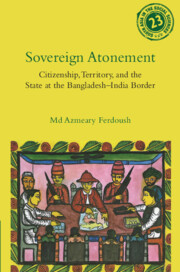
The former border enclaves of Bangladesh and India existed as extra-territorial spaces since 1947. They were finally exchanged and merged as host state territories in 2015. Sovereign Atonement focuses on the protracted territorial exchange and experiences of the newly accepted Bangladeshi citizens. It grapples with one broad question: why did the state assume an active role in smoothing the once excluded population's experiences into their inclusion within the sovereign project? The book dives deep into an ethnographic and historical reading of the everyday state, land and territory, informality, (non)state actors, and performance of sovereignty. Furthermore, it troubles the often taken-for-granted understanding of exception, governance, and citizenship. As such, Ferdoush offers a retake on the two seemingly contradictory concepts -'sovereign' and 'atonement'- to demonstrate that bridged together these concepts as sovereign atonement enables a novel way of appreciating geopolitical narratives, political geographies, and nationalistic discourse in South Asia and beyond.
‘Sovereign Atonement spans time and borders to tell the fascinating story of the India-Bangladesh enclaves, their exchange, and their afterlives. Addressing the question of what territorial exchange means from the perspective of those most directly affected, Azmeary Ferdoush pushes us to rethink sovereignty, territory, and processes of redress from the ground up.’
Jason Cons - author of Sensitive Space: Fragmented Territory at the India-Bangladesh Border
‘This is a fantastic book about the untold story of the exchange of the border enclaves in India and Bangladesh. Based on extensive on-the-ground research and written in a lively and engaging manner, Ferdoush announces himself as a key theorist of borders, sovereignty, and the state in South Asia and globally.’
Reece Jones - author of Violent Borders: Refugees and the Right to Move
‘Azmeary Ferdoush’s inquiry into contentious territorialities is an innovative intervention into a variety of disciplinary issues: theories of sovereignty, alternative cartographies, global temporalities, and contemporary South Asian politics. It is essential reading for political theorists, geographers, international relations scholars, and area specialists.’
Michael J. Shapiro - author of Punctuations: How the Arts Think the Political
Loading metrics...
* Views captured on Cambridge Core between #date#. This data will be updated every 24 hours.
Usage data cannot currently be displayed.
This section outlines the accessibility features of this content - including support for screen readers, full keyboard navigation and high-contrast display options. This may not be relevant for you.
Accessibility compliance for the PDF of this book is currently unknown and may be updated in the future.

