
Skip to main content Accessibility help
×
  • Cited by 135
    • Show more authors
    • You may already have access via personal or institutional login
    • Select format
    • Publisher:
      Cambridge University Press
      Publication date:
      24 November 2009
      15 September 2005
      ISBN:
      9780511614866
      9780521604970
      Dimensions:
      Weight & Pages:
      Dimensions:
      (228 x 152 mm)
      Weight & Pages:
      0.326kg, 200 Pages
    You may already have access via personal or institutional login
  • Selected: Digital
    Add to cart View cart Buy from Cambridge.org

    Book description

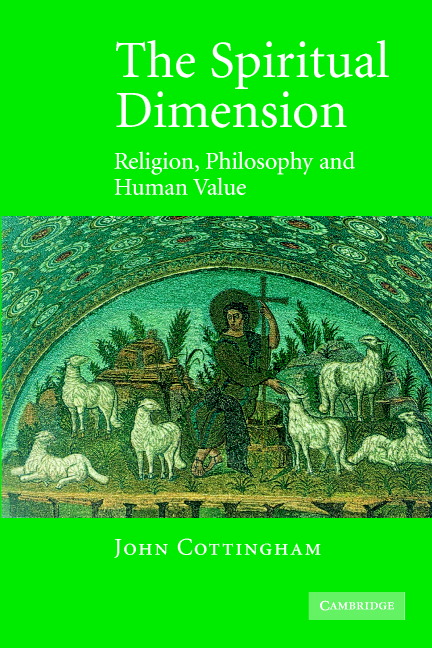
    The Spiritual Dimension offers a new model for the philosophy of religion, bringing together emotional and intellectual aspects of our human experience, and embracing practical as well as theoretical concerns. It shows how a religious worldview is best understood not as an isolated set of doctrines, but as intimately related to spiritual praxis and to the search for self-understanding and moral growth. It argues that the religious quest requires a certain emotional openness, but can be pursued without sacrificing our philosophical integrity. Touching on many important debates in contemporary philosophy and theology, but accessible to general readers, The Spiritual Dimension covers a range of central topics in the philosophy of religion, including scientific cosmology and the problem of evil; ethical theory and the objectivity of goodness; psychoanalytic thought, self-discovery and virtue; the multi-layered nature of religious discourse; and the relation between faith and evidence.

    Reviews

    '… beautifully written and beautifully produced …'

    Source: The Tablet

    'I've been telling everyone enthusiastically about … [Cottingham's] … new book The Spiritual Dimension … not because I agree with everything in it, but because it so compellingly articulates matters of the first importance …'

    Source: Daily Telegraph

    'John Cottingham has followed up his excellent On the Meaning of Life with this equally fine book. … let me end by strongly recommending anyone interested in religion to read this human, wide-ranging, judicious, and highly suggestive book.'

    Source: The Philosophical Quarterly

    ‘He (Cottingham) has worked hard to make the book accessible to a non-specialist audience … The tone is at all times reasonable, generous, and fair. … it will be welcome to all those who have to engage their atheist or agnostic friends, and who want to do so away from the clichés and cheap put-downs that informs so much of this kind of debate. Humane and generous, it is a fine example of faith seeking understanding.’

    Source: Church Times

    'His book will engage anyone who thinks spirituality is worth talking about - theist, atheist or agnostic. Clearly and humanely, he lays out the ground upon which any truly interesting philosophy of religion must be done.'

    Source: The Philosophers' Magazine

    'This book can be highly recommended as an important contribution to the philosophy of religion from the perspective emphasizing praxis and participation rather than the atomistic analysis of beliefs.'

    Source: Theology, Ethics and Philosophy

    'As efforts to re-contextualise spirituality within technology and religion are increasing, Cottingham's scholarly and aptly titled work makes a most useful contribution to these endeavours … Beautifully written … remarkably clear, this is an indispensable and timely study … A particular attraction of this study is the way in which Cottingham appeals to reason to justify his concern with spirituality … A broadly conceived book, it has much to recommend. It is rich, laden with insight, and bears careful study.'

    Source: Journal of Contemporary Religion

    'Cottingham's effort in this book is an example of how philosophy can be supportive to religion, enlisting psychology as an ally in the process …'

    Source: Journal of Religious Studies

    '… this is an original and stimulating work, which will profit specialist and general readers alike. It is highly recommended.'

    Source: Philosophical Investigations

    '… a very recommendable book. It is rich in analysis, observations and reflections, and it is clear in argument. It is not only for professional philosophers, but for theologians and students as well. … by introducing themes close to psychology like dependency, vulnerability, personal growth and self-insight as part of the repertoire of philosophy of religion, he advances a position that is in content very similar to parts of the continental (and phenomenological) philosophy of religion, but nevertheless his is an understanding of religion firmly based in the post-Wittgensteinian, Anglo-Saxon tradition. As such, this book could be seen as a bridge-builder between different traditions and academic disciplines.'

    Source: Ars Disputandi

    Refine List

    Actions for selected content:

    Select all | Deselect all
    • View selected items
    • Export citations
    • Download PDF (zip)
    • Save to Kindle
    • Save to Dropbox
    • Save to Google Drive

    Save Search

    You can save your searches here and later view and run them again in "My saved searches".

    Please provide a title, maximum of 40 characters.
    ×

    Contents

    Metrics

    Altmetric attention score

    Full text views

    Total number of HTML views: 0
    Total number of PDF views: 0 *
    Loading metrics...

    Book summary page views

    Total views: 0 *
    Loading metrics...

    * Views captured on Cambridge Core between #date#. This data will be updated every 24 hours.

    Usage data cannot currently be displayed.

    Accessibility standard: Unknown

    Why this information is here

    This section outlines the accessibility features of this content - including support for screen readers, full keyboard navigation and high-contrast display options. This may not be relevant for you.

    Accessibility Information

    Accessibility compliance for the PDF of this book is currently unknown and may be updated in the future.
