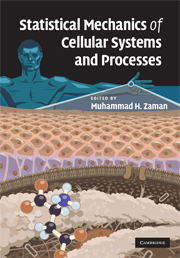

Cells are complex objects, representing a multitude of structures and processes. In order to understand the organization, interaction and hierarchy of these structures and processes, a quantitative understanding is absolutely critical. Traditionally, statistical mechanics-based treatment of biological systems has focused on the molecular level, with larger systems being ignored. This book integrates understanding from the molecular to the cellular and multi-cellular level in a quantitative framework that will benefit a wide audience engaged in biological, biochemical, biophysical and clinical research. It will build new bridges of quantitative understanding that link fundamental physical principles governing cellular structure and function with implications in clinical and biomedical contexts.
Loading metrics...
* Views captured on Cambridge Core between #date#. This data will be updated every 24 hours.
Usage data cannot currently be displayed.
This section outlines the accessibility features of this content - including support for screen readers, full keyboard navigation and high-contrast display options. This may not be relevant for you.
Accessibility compliance for the PDF of this book is currently unknown and may be updated in the future.
