Technocrats in Turmoil

-
Select format
-
- Publisher:
- Cambridge University Press
- Publication date:
- 20 February 2026
- 19 February 2026
- ISBN:
- 9781009727488
- 9781009727440
- 9781009727457
- Dimensions:
- (229 x 152 mm)
- Weight & Pages:
- 0.482kg, 248 Pages
- Dimensions:
- (229 x 152 mm)
- Weight & Pages:
- 0.4kg, 248 Pages
You may already have access via personal or institutional login
Show more authors 
You may already have access via personal or institutional login
Book description
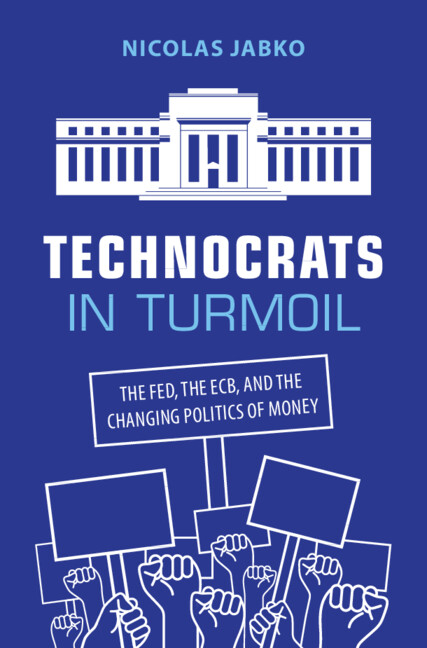
As the economy became more financialized, the politics of money considerably changed after the late 1970s. American and European central bankers first allied with conservative forces to fight inflation in the 1980s; then, that alliance unravelled after the 2008 financial crisis. Many observers gloss over this change because they see central bankers either as stewards of financialization, or as economists dedicated to economic stability. Nicolas Jabko shows how changing alliances between central bankers, economists, and politicians led to momentous shifts in monetary regimes. He argues that central bankers are technocrats who navigate and powerfully shape three overlapping arenas – their own internal monetary policy committees; the economics profession; and the broader public arena. Steeped in a machine-assisted analysis of central bank archives, Technocrats in Turmoil thus reveals the key role that the Fed and the ECB played in the waxing and waning of technocratic neoliberalism.
Reviews
‘Monetary orthodoxies are not set in stone. In times of crisis, technocrats need to adjust their beliefs – sometimes much faster than they ever imagined. This will happen again. A great book, a must-read.’
Thomas Piketty - Paris School of Economics
‘A brilliant guide to the strange politics born from the Great Financial Crisis. Drawing on untapped central bank archives, Jabko reveals how every appearance of consensus masks fierce internal battles – and how history moves in staggers, not smooth waves.’
Quinn Slobodian - Boston University
‘This book examines why central bankers, once the darlings of New Right politicians, have come under attack from conservatives. Jabko’s insightful analysis of monetary technocrats is a must-read for scholars of political economy, history and economics interested in understanding the changing shape of economic power today.’
Jacqueline Best - University of Ottawa
'Jabko locates the politics of money at the intersection of central banking, economics, and everyday political debate. That approach transforms the Fed and the ECB from impenetrable facades for power into three-dimensional spaces of decision. A path-breaking study that redefines neoliberalism and its change over time.’
Christine Desan - Harvard Law School
‘Nicolas Jabko’s compelling new book shows how independent central bankers at the Federal Reserve and the European Central Bank changed tactics dramatically after adopting neoliberal austerity to tame inflation in the 1980s. Jabko tells the story through central bankers’ internal deliberations, with both a riveting narrative and rigorous machine learning. A tour de force!’
Frank Dobbin - Harvard University
Contents
References
Metrics
Altmetric attention score
Full text views
Full text views helpTotal number of HTML views: 0
Total number of PDF views: 0 *
 Loading metrics...
* Views captured on Cambridge Core between #date#. This data will be updated every 24 hours.
Usage data cannot currently be displayed.
Accessibility standard: WCAG 2.2 AAA
Why this information is here
This section outlines the accessibility features of this content - including support for screen readers, full keyboard navigation and high-contrast display options. This may not be relevant for you.
Accessibility Information
The HTML of this book complies with version 2.2 of the Web Content Accessibility Guidelines (WCAG), offering more comprehensive accessibility measures for a broad range of users and attains the highest (AAA) level of WCAG compliance, optimising the user experience by meeting the most extensive accessibility guidelines.
Content Navigation
Table of contents navigation
Allows you to navigate directly to chapters, sections, or non‐text items through a linked table of contents, reducing the need for extensive scrolling.
Index navigation
Provides an interactive index, letting you go straight to where a term or subject appears in the text without manual searching.
Reading Order and Textual Equivalents
Single logical reading order
You will encounter all content (including footnotes, captions, etc.) in a clear, sequential flow, making it easier to follow with assistive tools like screen readers.
Short alternative textual descriptions
You get concise descriptions (for images, charts, or media clips), ensuring you do not miss crucial information when visual or audio elements are not accessible.
Full alternative textual descriptions
You get more than just short alt text: you have comprehensive text equivalents, transcripts, captions, or audio descriptions for substantial non‐text content, which is especially helpful for complex visuals or multimedia.
Visualised data also available as non‐graphical data
You can access graphs or charts in a text or tabular format, so you are not excluded if you cannot process visual displays.
Visual Accessibility
Use of high contrast between text and background colour
You benefit from high‐contrast text, which improves legibility if you have low vision or if you are reading in less‐than‐ideal lighting conditions.