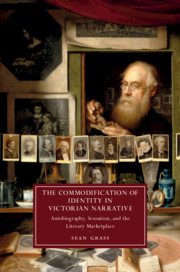

In the first half of the nineteenth century autobiography became, for the first time, an explicitly commercial genre. Drawing together quantitative data on the Victorian book market, insights from the business ledgers of Victorian publishers and close readings of mid-century novels, Sean Grass demonstrates the close links between these genres and broader Victorian textual and material cultures. This book offers fresh perspectives on major works by Charles Dickens, George Eliot, Mary Elizabeth Braddon, Wilkie Collins and Charles Reade, while also featuring archival research that reveals the volume, diversity, and marketability of Victorian autobiographical texts for the first time. Grass presents life-writing not as a stand-alone genre, but as an integral part of a broader movement of literary, cultural, legal and economic practices through which the Victorians transformed identity into a textual object of capitalist exchange.
‘This thoroughly researched and carefully documented work will be of interest to students of Victorian literature, history, publishing, and economics.’
J. D. Vann Source: Choice
‘The Commodification of Identity offers us new ways of conceiving the relationship between the dissolution of identity and the explosion of commercial life-writing in the Victorian era … It is part of a distinguished series of monographs on Victorian literature, the Cambridge Studies in Nineteenth-Century Literature and Culture.’
Robert L. Patten Source: Dickens Quarterly
‘Grass’s readings of mid-to-late-century fiction are precise, multi-dimensional and persuasive, and the unusual collocation of texts works well.’
Trev Broughton Source: Journal of Victorian Culture
‘… offering both a concrete representation of the ‘literary market’ and an expansive sense of what might be included in the category of the economic, Grass’s account is full of fascinating detail and revelatory analyses. In tracing how identity came to be conceived as textual, transactional, and exchangeable … Grass offers new frameworks for understanding Victorian life writing, fiction, and the period’s innovative economic and bureaucratic cultures …The Commodification of Identity in Victorian Narrative … challenge[s] us to keep imagining terms that capture the flexibility of Victorian economic life and its narrative situations.’
Aeron Hunt Source: Nineteenth-Century Literature
‘The Commodification of Identity in Victorian Narrative is a bravura performance, resting on extensive bibliographical research and a conceptually rigorous reading of a group of 3476 novels which Grass claims constitute a turning point in the modern representation of personal development over time. In every sense it is immersed in texts, both as constituents of a critical phase of book history, and as the means by which identity was structured and understood in mid-Victorian England.’
David Vincent Source: Victorian Studies
Loading metrics...
* Views captured on Cambridge Core between #date#. This data will be updated every 24 hours.
Usage data cannot currently be displayed.
This section outlines the accessibility features of this content - including support for screen readers, full keyboard navigation and high-contrast display options. This may not be relevant for you.
Accessibility compliance for the PDF of this book is currently unknown and may be updated in the future.
