
Skip to main content Accessibility help
×
  • Cited by 8
    • This textbook will transition to Cambridge Core on 6 July 2026. Please take a moment to export any annotations you may have created on the eTextbook before the move.
    • Show more authors
    • You may already have access via personal or institutional login
    • Select format
    • Publisher:
      Cambridge University Press
      Publication date:
      15 June 2019
      20 September 2018
      ISBN:
      9781139050616
      9780521862738
      Dimensions:
      (246 x 189 mm)
      Weight & Pages:
      1.28kg, 420 Pages
      Dimensions:
      Weight & Pages:

    Resources available

    Unlock the full potential of this textbook with additional resources.

    Explore resources
    You may already have access via personal or institutional login
  • Selected: Digital
    Add to cart View cart Buy from Cambridge.org

    Book description

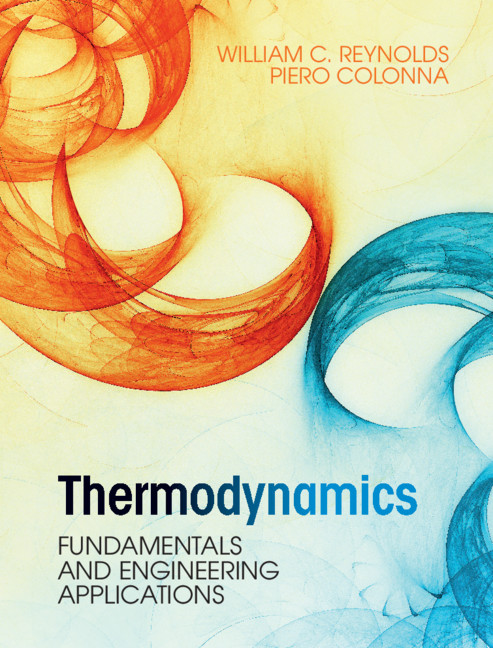
    This concise text provides an essential treatment of thermodynamics and a discussion of the basic principles built on an intuitive description of the microscopic behavior of matter. Aimed at a range of courses in mechanical and aerospace engineering, the presentation explains the foundations valid at the macroscopic level in relation to what happens at the microscopic level, relying on intuitive and visual explanations which are presented with engaging cases. With ad hoc, real-word examples related also to current and future renewable energy conversion technologies and two well-known programs used for thermodynamic calculations, FluidProp and StanJan, this text provides students with a rich and engaging learning experience.

    Reviews

    'This is a comprehensive and clearly written text that is organized in such a way that it may be used in both undergraduate and graduate courses in engineering thermodynamics.'

    Craig T. Bowman - Stanford University, California

    'This book takes you on a journey through the fundamentals of thermodynamics, featuring scientific formality and comprehensive explanations of every concept, all focused on an engineering approach. A basic text for any course in applied thermodynamics and related areas, and for professionals in the need to revisit the fundamentals.'

    David Sánchez - Universidad de Sevilla

    'Building on Bill Reynolds’ classic book, Engineering Thermodynamics, this textbook offers a unique approach to teaching thermodynamics based on the understanding of simple physical principles. It will be of great benefit to future engineers tackling tough problems in energy.'

    Tim Lieuwen - Georgia Institute of Technology

    'An excellent textbook for undergraduate and graduate students, and good reference for practicing mechanical engineers. The book’s strength is in its simplification of the science of thermodynamics and the listing of its practical applications.'

    Hany Moustapha - Université du Québec

    'A textbook that could be entitled 'Lean Thermodynamics' because it explains the core of this science by employing an effective and essential language and providing the fundamental concepts as they are needed. It focuses on topics and applications that are indispensable in facing today’s challenges in energy, mechanical and aerospace engineering.'

    Gianluca Valenti - Politecnico di Milano

    'This book is a must-have for students, academics and engineers working with thermodynamics. The authors present the foundations of thermodynamics by linking the beautiful formality of primary laws to a sharp description of the underlying microscopic world. Thermodynamics professionals and enthusiasts will keep this book within reach as an insightful reference.'

    Alberto Guardone - Politecnico di Milano

    'The authors have taken care in clearly articulating the requisite topics for engineering students in a very engaging manner. The book will be an important resource for students in the classroom as well as into the future as they become practicing engineers.'

    Karen A. Thole - Pennsylvania State University

    'The authors of this superb text have set out to present 'the very few concepts of classical thermodynamics, in a much more essential treatment'. Not overburdened with the inclusion of numerous repetitive examples, this book presents the basic concepts of energy and entropy in a simple equation form. The text is eminently suited for engineering undergraduate and first-year graduate level courses.'

    Lee S. Langston - University of Connecticut

    'This comprehensive textbook of thermodynamics is strongly backed by plentiful educational experiences of the authors. It realizes that the fundamental concepts naturally connect to the practical consideration and understanding of real thermal systems, including modern engineering applications.'

    Toshinori Watanabe - University of Tokyo

    ‘This textbook aligns well with the current needs of undergraduate students, who need to grasp fundamental concepts and make connections between interdisciplinary subjects to find innovative solutions.’

    Esra Sorguven Source: The Aeronautical Journal

    Refine List

    Actions for selected content:

    Select all | Deselect all
    • View selected items
    • Export citations

    Save Search

    You can save your searches here and later view and run them again in "My saved searches".

    Please provide a title, maximum of 40 characters.
    ×

    Contents

    Metrics

    Altmetric attention score

    Full text views

    Total number of HTML views: 0
    Total number of PDF views: 0 *
    Loading metrics...

    Book summary page views

    Total views: 0 *
    Loading metrics...

    * Views captured on Cambridge Core between #date#. This data will be updated every 24 hours.

    Usage data cannot currently be displayed.

    Accessibility standard: Unknown

    Why this information is here

    This section outlines the accessibility features of this content - including support for screen readers, full keyboard navigation and high-contrast display options. This may not be relevant for you.

    Accessibility Information

    Accessibility compliance for the PDF of this book is currently unknown and may be updated in the future.
