Skip to main content Accessibility help
×
  • Cited by 3
    • Show more authors
    • Open Access
      You have digital access to this book
    • Select format
    • Publisher:
      Cambridge University Press
      Publication date:
      06 April 2023
      13 April 2023
      ISBN:
      9781009322638
      9781009322591
      9781009322614
      Creative Commons:
      Creative Common License - CC Creative Common License - BY Creative Common License - NC Creative Common License - ND
      This content is Open Access and distributed under the terms of the Creative Commons Attribution licence CC-BY-NC-ND 4.0.
      https://creativecommons.org/creativelicenses
      Dimensions:
      (216 x 140 mm)
      Weight & Pages:
      0.51kg, 306 Pages
      Dimensions:
      (216 x 140 mm)
      Weight & Pages:
      0.39kg, 306 Pages
    Open Access
    You have digital access to this book
    Selected: Digital
    View content
    Add to cart View cart Buy from Cambridge.org

    Book description

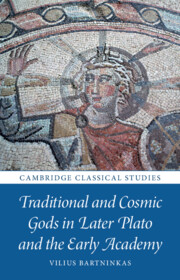
    This book sheds new light on Plato's cosmology in relation to Greek religion by examining the contested distinction between the traditional and cosmic gods. A close reading of the later dialogues shows that the two families of gods are routinely deployed to organise and structure Plato's accounts of the origins of the universe and of humanity and its social institutions, and to illuminate the moral and political ideals of philosophical utopias. Vilius Bartninkas argues that the presence of the two kinds of gods creates a dynamic, yet productive, tension in Plato's thinking which is unmistakable and which is not resolved until the works of his students. Thus the book closes by exploring how the cosmological and religious ideas of Plato's later dialogues resurfaced in the Early Academy and how the debates initiated there ultimately led to the collapse of this theological distinction.

    Awards

    Winner, 2024 Manfred Lautenschlaeger Award for Theological Promise, Heidelberg University

    Refine List

    Actions for selected content:

    Select all | Deselect all
    • View selected items
    • Export citations
    • Download PDF (zip)
    • Save to Kindle
    • Save to Dropbox
    • Save to Google Drive

    Save Search

    You can save your searches here and later view and run them again in "My saved searches".

    Please provide a title, maximum of 40 characters.
    ×

    Contents

    Full book PDF
    • Traditional and Cosmic Gods in Later Plato and the Early Academy
      pp i-i
    • Cambridge Classical Studies - Series page
      pp ii-ii
    • Traditional and Cosmic Gods in Later Plato and the Early Academy - Title page
      pp iii-iii
    • Copyright page
      pp iv-iv
    • Dedication
      pp v-vi
    • Contents
      pp vii-viii
    • Figures and Tables
      pp ix-x
    • Preface and Acknowledgements
      pp xi-xiii
    • Abbreviations
      pp xiv-xviii
    • Introduction
      pp 1-27
    • Chapter 1 - Plato’s Theogony
      pp 28-86
    • Chapter 2 - Plato’s Anthropogony and Politogony
      pp 87-141
    • Chapter 3 - Plato on Divinity and Morality
      pp 142-206
    • Chapter 4 - Cosmic Religion in the Early Academy
      pp 207-248
    • Conclusions
      pp 249-252
    • References
      pp 253-267
    • Index Locorum
      pp 268-282
    • Subject Index
      pp 283-286

    Metrics

    Altmetric attention score

    Full text views

    Total number of HTML views: 0
    Total number of PDF views: 0 *
    Loading metrics...

    Book summary page views

    Total views: 0 *
    Loading metrics...

    * Views captured on Cambridge Core between #date#. This data will be updated every 24 hours.

    Usage data cannot currently be displayed.

    Accessibility standard: Unknown

    Why this information is here

    This section outlines the accessibility features of this content - including support for screen readers, full keyboard navigation and high-contrast display options. This may not be relevant for you.

    Accessibility Information

    Accessibility compliance for the PDF of this book is currently unknown and may be updated in the future.

