
Skip to main content Accessibility help
×
  • Cited by 6
    • Show more authors
    • You may already have access via personal or institutional login
    • Select format
    • Publisher:
      Cambridge University Press
      Publication date:
      05 August 2012
      29 April 2010
      ISBN:
      9780511840449
      9780521197465
      9780521147095
      Dimensions:
      (247 x 174 mm)
      Weight & Pages:
      0.67kg, 290 Pages
      Dimensions:
      (247 x 174 mm)
      Weight & Pages:
      0.53kg, 290 Pages
    You may already have access via personal or institutional login
  • Selected: Digital
    Add to cart View cart Buy from Cambridge.org

    Book description

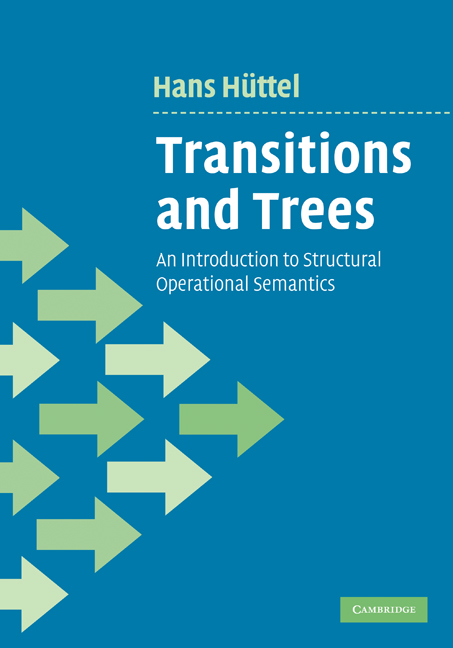
    Structural operational semantics is a simple, yet powerful mathematical theory for describing the behaviour of programs in an implementation-independent manner. This book provides a self-contained introduction to structural operational semantics, featuring semantic definitions using big-step and small-step semantics of many standard programming language constructs, including control structures, structured declarations and objects, parameter mechanisms and procedural abstraction, concurrency, nondeterminism and the features of functional programming languages. Along the way, the text introduces and applies the relevant proof techniques, including forms of induction and notions of semantic equivalence (including bisimilarity). Thoroughly class-tested, this book has evolved from lecture notes used by the author over a 10-year period at Aalborg University to teach undergraduate and graduate students. The result is a thorough introduction that makes the subject clear to students and computing professionals without sacrificing its rigour. No experience with any specific programming language is required.

    Reviews

    ‘This book explains how programming languages actually work, with a wealth of examples. It shows convincingly that these languages go hand-in-hand with the simplest kind of logic. I would enjoy teaching from it.’

    Robin Milner - University of Cambridge

    ‘A useful and thorough introduction to the structural operational semantics of programming languages.’

    Gordon Plotkin - University of Edinburgh

    ‘This book is an excellent introduction to the theory of structured operational semantics, an ideal choice for a first course on semantics for students in computer science. The book covers the theory all the way from a few simple mathematical preliminaries to advanced examples of its use in describing and reasoning about modern programming language features. The presentation is a result of the author’s experience in teaching the material over more than ten years, and it is unique in its pedagogical approach, guiding the reader gently via illustrative examples and exercises, as well as several invitations to the reader to pause and reflect: a moment's thought.’

    Mogens Nielsen - Aarhus University

    Refine List

    Actions for selected content:

    Select all | Deselect all
    • View selected items
    • Export citations
    • Download PDF (zip)
    • Save to Kindle
    • Save to Dropbox
    • Save to Google Drive

    Save Search

    You can save your searches here and later view and run them again in "My saved searches".

    Please provide a title, maximum of 40 characters.
    ×

    Contents

    Metrics

    Full text views

    Total number of HTML views: 0
    Total number of PDF views: 0 *
    Loading metrics...

    Book summary page views

    Total views: 0 *
    Loading metrics...

    * Views captured on Cambridge Core between #date#. This data will be updated every 24 hours.

    Usage data cannot currently be displayed.

    Accessibility standard: Unknown

    Why this information is here

    This section outlines the accessibility features of this content - including support for screen readers, full keyboard navigation and high-contrast display options. This may not be relevant for you.

    Accessibility Information

    Accessibility compliance for the PDF of this book is currently unknown and may be updated in the future.
