
Skip to main content Accessibility help
×
  • Cited by 13
    • Show more authors
    • Open Access
      You have digital access to this book
    • Select format
    • Publisher:
      Cambridge University Press
      Publication date:
      21 July 2022
      28 July 2022
      ISBN:
      9781108917292
      9781108932950
      Creative Commons:
      Creative Common License - CC Creative Common License - BY Creative Common License - NC Creative Common License - ND
      This content is Open Access and distributed under the terms of the Creative Commons Attribution licence CC-BY-NC-ND 4.0.
      https://creativecommons.org/creativelicenses
      Dimensions:
      Weight & Pages:
      Dimensions:
      (229 x 152 mm)
      Weight & Pages:
      0.12kg, 88 Pages
    Open Access
    You have digital access to this book
    Selected: Digital
    View content
    Add to cart View cart Buy from Cambridge.org

    Book description

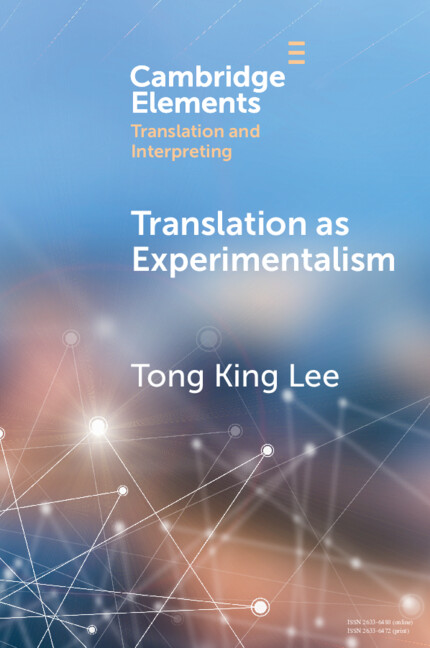
    This Element argues for a perspective on literary translation based around the idea of ludification, using concrete poetry as a test case. Unlike rational-scientific models of translating, ludic translation downplays the linear transmission of meaning from one language into another. It foregrounds instead the open-ended, ergodic nature of translation, where the translator engages with and responds to an original work in an experimental and experiential manner. Focusing on memes rather than signs, ludic translation challenges us to adopt an oblique lens on literary texts and deploy verbal as well as nonverbal resources to add value to an original work. Such an approach is especially amenable to negotiating apparently untranslatable writing like concrete poems across languages, modes, and media. This Element questions assumptions about translatability and opens the discursive space of literary writing to transgressive articulation and multimodal performance. This title is also available as Open Access on Cambridge Core.

    References

    Aarseth, E. 1997. Cybertext: Perspectives on Ergodic Literature. Baltimore, MD: Johns Hopkins University Press.
    Aarseth, E. 2017. Just games. Game Studies 17(1). http://gamestudies.org/1701/articles/justgames
    Appiah, A. A. 1993. Thick translation. Callaloo 16(4): 808–19.
    Apter, E. 2013. Against World Literature: On the Politics of Untranslatability. London: Verso.
    Baker, M. 2018. In Other Words: A Coursebook on Translation. Third edition. Abingdon: Routledge.
    Baker, M. 2020. Translation and solidarity in the century with no future: prefiguration vs. aspirational translation. Palgrave Communications 6. https://doi.org/10.1057/s41599-020-0400-0
    Bassnett, S., ed. 2019. Translation and World Literature. Abingdon: Routledge.
    Bassnett, S. 2020. Concrete poetry, playfulness and translation. In Corbett, J. and Huang, T., eds., The Translation and Transmission of Concrete Poetry. Abingdon: Routledge, pp. 920.
    Bassnett, S. and Bush, P., eds. 2007. The Translator as Writer. London: Continuum.
    Baynham, M. and Lee, T. K. 2019. Translation and Translanguaging. Abingdon: Routledge.
    Bhabha, H. 1994. The Location of Culture. London: Routledge.
    Boase-Beier, J., Fisher, L., and Furukawa, H., eds. 2018. The Palgrave Handbook of Literary Translation. London: Palgrave.
    Bolter, J. D. and Grusin, R. 1999. Remediation: Understanding New Media. Cambridge, MA: MIT Press.
    Bruno, C. 2012. Words by the look: issues in translating Chinese visual poetry. In St André, J. and Peng, H., eds., China and Its Others: Knowledge Transfer through Translation, 1829–2010. Amsterdam: Rodopi, pp. 245–76.
    Campbell, M. and Vidal, R., eds. 2019. Translating across Sensory and Linguistic Borders: Intersemiotic Journeys between Media. London: Palgrave.
    Cassin, B., ed. 2014. Introduction. In Cassin, B., Apter, E., Lezra, J., and Wood, M., eds., Dictionary of Untranslatables: A Philosophical Lexicon. Princeton, NJ: Princeton University Press, pp. xviixx.
    Chan, T. H. 2020. Western Theory in East Asian Contexts: Translation and Transtextual Rewriting. London: Bloomsbury.
    Chang, F.- l. 2014. Translator’s introduction. In Li, C., The Edge of the Island: Poems of Chen Li. Trans. Chang F.-l. Taipei: Bookman, pp. 1123.
    Chen, L. (2014). The Edge of the Island: Poems of Chen Li. Trans. Chang F.-l. Taipei: Bookman.
    Chen, L. (2020). Writing and translating concrete poetry in Chinese characters. In Corbett, J. and Huang, T., eds., The Translation and Transmission of Concrete Poetry. Abingdon: Routledge, pp. 5670.
    Chiu, K.- f. 2018. ‘Worlding’ world literature from the literary periphery: four Taiwanese models. Modern Chinese Literature and Culture 30(1): 1341.
    Conway, K. 2019. Cultural translation. In Baker, M. and Saldanha, G., eds., Routledge Encyclopedia of Translation Studies, Abingdon: Routledge, pp. 129–33.
    Corbett, J. 2020. Introduction. In Corbett, J. and Huang, T., eds., The Translation and Transmission of Concrete Poetry. Abingdon: Routledge, pp. 18.
    Cowley, S. 2021. Reading: skilled linguistic action. Language Sciences 84. https://doi.org/10.1016/j.langsci.2021.101364
    Dawkins, R. 2006. The Selfish Gene. 30th anniversary edition. New York: Oxford University Press.
    DeLanda, M. 2016. Assemblage Theory. Edinburgh: Edinburgh University Press.
    Deleuze, G. and Guattari, F. 1987. A Thousand Plateaus: Capitalism and Schizophrenia. Trans. B. Massumi. Minneapolis, MN: University of Minnesota Press.
    Deterding, S. 2012. Gamification: designing for motivation. Interactions 19(4): 1417.
    Deterding, S., Dixon, D., Khaled, R., and Nacke, L. 2011. From game design elements to gamefulness: defining gamification. In Proceedings of the 15th International Academic MindTrek Conference: Envisioning Future Media Environments. New York: ACM, pp. 915.
    Eagleton, T. 2019. Humour. New Haven, CT: Yale University Press.
    Ensslin, A. 2014. Literary Gaming. Cambridge, MA: MIT Press.
    Frissen, V., Lammes, S., de Lange, M., de Mul, J., and Raessens, J., eds. 2015. Homo ludens 2.0: play, media, and identity. In Frissen, V., Lammes, S., de Lange, M., de Mul, J., and Raessens, J., eds., Playful Identities: The Ludification of Digital Media Cultures. Amsterdam: Amsterdam University Press, pp. 950.
    Genette, G. 1997[1982]. Palimpsests: Literature in the Second Degree. Trans. C. Newman and C. Doubinsky. Lincoln, IN: University of Nebraska Press.
    Hayles, K. 2005. My Mother Was a Computer: Digital Subjects and Literary Texts. Chicago, IL: University of Chicago Press.
    Hayles, K. 2006. Revealing and transforming: how literature revalues computational practice. Performance Research 11(4): 516.
    Ho, G. 2004. Translating advertisements across heterogeneous cultures. The Translator 10(2): 221–43.
    Huizinga, J. 1955[1938]. Homo Ludens: A Study of the Play-Element in Culture. Boston, MA: The Beacon Press.
    Huotari, K. and Hamari, J. 2017. A definition for gamification: anchoring gamification in the service marketing literature. Electron Markets 27: 2131.
    Hutcheon, L. 2013. A Theory of Adaptation. Abingdon: Routledge.
    Jackson, K. D. 2020. Transcreation without borders. In Corbett, J. and Huang, T., eds., The Translation and Transmission of Concrete Poetry. Abingdon: Routledge, pp. 97111.
    Jenkins, H. 2006. Convergence Culture: Where Old and New Media Collide. New York: New York University Press.
    Kress, G. and van Leeuwen, T. 2021. Reading Images: The Grammar of Visual Design. Third edition. Abingdon: Routledge.
    Larsen, L. J. 2019. Play and gameful movies: the ludification of modern cinema. Games and Culture 14(5): 455–77.
    Lecercle, J.-J. 1990. The Violence of Language. London: Routledge.
    Lee, J. W. 2022. Translanguaging research methodologies. Research Methods in Applied Linguistics.
    Lee, T. K. 2017. The Chinese cybertext. Modern Chinese Literature and Culture 29(1): 173203.
    Lewis, P. E. 1985. The measure of translation effects. In Graham, J., ed., Difference in Translation. Ithaca, NY: Cornell University Press, pp. 3162.
    Li, W. 2016. New Chinglish and the post-multilingualism challenge: translanguaging ELF in China. Journal of English as a Lingua Franca 5(1): 125.
    Malmkjær, K. 1987. Translating concrete poetry. Ilha do Desterro 17: 3346.
    Malmkjær, K. 2020. Translation and Creativity. Abingdon: Routledge.
    McGann, J. 1990. How to read a book. In Oliphant, D. and Bradford, R., eds., New Directions in Textual Studies. Austin, TX: Harry Ransom Humanities Research Center and the University of Texas, pp. 1337.
    Montfort, N. 2001. Cybertext killed the hypertext star. electronic book review. www.altx.com/ebr/ebr11/11mon/index.html
    Nida, E. 1964. Towards a Science of Translating, with Special Reference to Principles and Procedures Involved in Bible Translating. Leiden: Brill.
    Nord, C. 2018. Translating as a Purposeful Activity: Functionalist Approaches Explained. Second edition. Abingdon: Routledge.
    O’Neill, P. 2014. Transforming Kafka: Translation Effects. Toronto: University of Toronto Press.
    O’Neill, S. 2014. Shakespeare and YouTube: New Media Forms of the Bard. London: Bloomsbury.
    Perteghella, M. and Loffredo, E., eds. 2006. Translation and Creativity: Perspectives on Creative Writing and Translation Studies. London: Continuum.
    Raessens, J. 2006. Playful identities, or the ludification of culture. Games and Culture 1(1): 52–7.
    Raessens, J. 2014. The ludification of culture. In Fuchs, M., Fizek, S., Ruffino, P., and Schrape, N., eds., Rethinking Gamification. Lüneburg: Meson Press, pp. 91114.
    Rafael, V. L. 2016. Motherless Tongues: The Insurgency of Language amid Wars of Translation. Durham, NC: Duke University Press.
    Raley, R. 2016. Algorithmic translations. CR: The New Centennial Review 16(1): 115–37.
    Salovaara, P. and Statler, M. 2019. Always already playing: hermeneutics and the gamification of existence. Journal of Management Inquiry 28(2): 149–52.
    Sanders, J. 2016. Adaptation and Appropriation. Second edition. Abingdon: Routledge.
    Scott, C. 2011a. From the intermedial to the synaesthetic: literary translation as centrifugal practice. Comparative Critical Studies 8(1): 3959.
    Scott, C. 2011b. The translation of reading: a phenomenological approach. Translation Studies 4(2): 213–29.
    Scott, C. 2012. Literary Translation and the Rediscovery of Reading. Cambridge: Cambridge University Press.
    Scott, C. 2018. The Work of Translation. Cambridge: Cambridge University Press.
    Scott, C. 2019. Synaesthesia and intersemiosis: competing principles in literary translation. In Campbell, M. and Vidal, R., eds., Translating across Sensory and Linguistic Borders: Intersemiotic Journeys between Media. London: Palgrave, pp. 87111.
    Scott, C. 2020. Apollinaire’s octosyllabic quatrain, translation and zoopoetics. In Kay, S. and Mathews, T., eds., The Modernist Bestiary: Translating Animals and the Arts through Guillaume Apollinaire, Raoul Dufy and Graham Sutherland. London: UCL Press, pp. 7491.
    Shen, C.-S. and Wu, Y.-P. 2012. Translating beyond languages: the challenges of rendering Taiwan’s visual concrete poems in English. The AALITRA Review 5: 1530.
    Solon, O. 2013. Richard Dawkins on the Internet’s hijacking of the word ‘meme’. Wired (20 June). https://web.archive.org/web/20130709152558if_/http://www.wired.co.uk/news/archive/2013-06/20/richard-dawkins-memes/viewgallery/305430
    Tymoczko, M. 2014. Enlarging Translation, Empowering Translators. Abingdon: Routledge.
    Van Leeuwen, T. 2022. Multimodality and Identity. Abingdon: Routledge.
    Varis, P. and Blommaert, J. 2015. Conviviality and collectives on social media: virality, memes, and new social structures. Multilingual Margins 2(1): 3145.
    Venuti, L. 2003. Translating Derrida on translation: relevance and disciplinary resistance. The Yale Journal of Criticism 16(2): 237–62.
    Venuti, L. 2013. Translation Changes Everything. Abingdon: Routledge.
    Venuti, L. 2019. Contra Instrumentalism: A Translation Polemic. Lincoln, NE: University of Nebraska Press.
    Vidal, A. 2022. Translating Outwards with Contemporary Art. Abingdon: Routledge.
    Vidal, R. and Carter, H. 2021. Some speculations on asemic writing and the productive embrace of uncertainty. https://experientialtranslation.net/2021/07/28/asemic-writing/
    Žižek, S. 2018. Marx reads object-oriented ontology. In Žižek, S., Ruda, F. and Hamza, A., Reading Marx. London: Polity, pp. 1761.

    Metrics

    Altmetric attention score

    Full text views

    Total number of HTML views: 0
    Total number of PDF views: 0 *
    Loading metrics...

    Book summary page views

    Total views: 0 *
    Loading metrics...

    * Views captured on Cambridge Core between #date#. This data will be updated every 24 hours.

    Usage data cannot currently be displayed.

    Accessibility standard: Unknown

    Why this information is here

    This section outlines the accessibility features of this content - including support for screen readers, full keyboard navigation and high-contrast display options. This may not be relevant for you.

    Accessibility Information

    Accessibility compliance for the PDF of this book is currently unknown and may be updated in the future.
