
Skip to main content Accessibility help
×
  • Cited by 42
    • Show more authors
    • You may already have access via personal or institutional login
    • Select format
    • Publisher:
      Cambridge University Press
      Publication date:
      15 July 2009
      28 July 2003
      ISBN:
      9780511497735
      9780521813280
      Dimensions:
      (228 x 152 mm)
      Weight & Pages:
      0.61kg, 296 Pages
      Dimensions:
      Weight & Pages:
    You may already have access via personal or institutional login
  • Selected: Digital
    Add to cart View cart Buy from Cambridge.org

    Book description

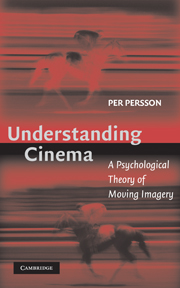
    Understanding Cinema, first published in 2003, analyzes the moving imagery of film and television from a psychological perspective. Per Persson argues that spectators perceive, think, apply knowledge, infer, interpret, feel and make use of knowledge, assumptions, expectations and prejudices when viewing and making sense of film. Drawing psychology and anthropology, he explains how close-ups, editing conventions, character psychology and other cinematic techniques work, and how and why they affect the spectator. This study integrates psychological and culturalist approaches to meanings and reception. Anchoring the discussion in concrete examples from early and contemporary cinema, Understanding Cinema also analyzes the design of cinema conventions and their stylistic transformations through the evolution of film.

    Refine List

    Actions for selected content:

    Select all | Deselect all
    • View selected items
    • Export citations
    • Download PDF (zip)
    • Save to Kindle
    • Save to Dropbox
    • Save to Google Drive

    Save Search

    You can save your searches here and later view and run them again in "My saved searches".

    Please provide a title, maximum of 40 characters.
    ×

    Contents

    References
    Abbott, Valerie, Black, John B. & Smith, Edward E. (1985). “The Representation of Scripts in Memory,” Journal of Memory and Language 24, 179–99
    Abel, Richard (1994). The Ciné Goes to Town. French Cinema 1896–1914, Berkeley: University of California Press
    Aiello, John R. (1987). “Human Spatial Behavior” in Altman, Irwin & Stokols, Daniel (eds.), Handbook of Environmental Psychology, New York: Wiley, Vol. 1, pp. 389–504
    Allen, Richard (1993). “Representation, Illusion, and the Cinema,” Cinema Journal, 32, 2, 21–48
    Allen, Richard & Smith, Murray (eds.) (1997). Film Theory and Philosophy, New York: Oxford University Press
    Allen, Robert (1980). Vaudeville and Film 1895–1915: A Study in Media Interaction, New York: Arno
    Allen, Robert & Gomery, Douglas (1985). Film History: Theory and Practice, New York: Knopf
    Andersen, S. & Klatzky, R. (1987). “Traits and Social Stereotypes: Levels of Categorization in Person Perception,” Journal of Personality and Social Psychology, 53, 235–46
    Anderson, Joseph (1996). The Reality of Illusion: An Ecological Approach to Cognitive Film Theory, Carbondale: Southern Illinois University Press
    Anderson, Joseph & Anderson, Barbara (1993). “The Myth of Persistence of Vision Revisited,” Journal of Film and Video, 45, 1, 3–12
    Arnheim, Rudolf (1974). Art and Visual Perception. A Psychology of the Creative Eye, Berkeley: University of California Press. Originally published 1954
    Astington, Janet (1990). “Narrative and the Child's Theory of Mind,” in Britton, B. & Pellegrini, A. D. (eds.), Narrative Thought and Narrative Language, Hillsdale, NJ: Lawrence Erlbaum Associates, pp. 151–71
    Astington, Janet W., Harris, Paul L. & Olson, David R. (eds.) (1988). Developing Theories of Mind, Cambridge: Cambridge University Press.
    Augoustinos, Martha & Walker, Ian (1995). Social Cognition. An Integrated Introduction, London: Sage
    Avis, Jeremy & Harris, Paul (1991). “Belief–Desire Reasoning among Baka Children: Evidence for a Universal Conception of the Mind,” Child Development, 62, 460–7
    Bal, Mieke (1985). Narratology. Introduction to the Theory of Narrative, van Boheemen, Christine (trans.), Toronto: University of Toronto Press
    Ball, William & Tronich, Edward (1971). “Infant Responses to Impending Collision: Optical and Real,” Science, 171, 818–20
    Barkow, J., Cosmides, L. & Tooby, J. (eds.) (1992). The Adapted Mind. Evolutionary Psychology and the Generation of Culture, New York: Oxford University Press
    Baron-Cohen, Simon (1991a). “Precursors to a Theory of Mind: Understanding Attention in Others,” in Whiten, Andrew (ed.), Natural Theories of Mind. Evolution, Development and Simulation of Everyday Mindreading, Oxford: Blackwell, pp. 233–51
    Baron-Cohen, Simon (1991b). “Do People with Autism Understand What Causes Emotion?Child Development, 62, 385–95
    Baron-Cohen, Simon & Cross, Pippa (1992). “Reading the Eyes: Evidence for the Role of Perception in the Development of a Theory of Mind,” Mind & Language, 7, 1–2, 172–86
    Barthes, Roland (1966). “Introduction à l'analyse structurale des récits,” Communications, Vol. 8. Translated as “Introduction to the Structural Analysis of Narratives” by Heath, Stephen (ed.), and reprinted in Image Music Text, London: Fontana, 1977, pp. 79–124
    Barthes, Roland (1977). Image Music Text, London: Fontana. Essays selected and translated by Stephen Heath
    Bartsch, Karen & Wellman, Henry M. (1995). Children Talk about the Mind, Oxford: Oxford University Press
    Bazin, André (1967). What is Cinema?, Berkeley: University of California Press. Essays selected and translated by Hugh Gray
    Bellour, Raymond (1975). “Le blocage symbolique,” Communications, 23, 235–350
    Biederman, I. (1987). “Recognition-by-Components: A Theory of Human Image Understanding,” Psychological Review, 94, 2, 115–47
    Biederman, I., Mezzanotte, R. & Rabinowitz, J. (1982). “Scene Perception: Detecting and Judging Objects Undergoing Relational Violations,” Cognitive Psychology, 14, 143–77
    Bordwell, David (1981). “Textual Analysis, etc.,” Enclitic, 10–11, Fall 1981/Spring 1982, 125–36
    Bordwell, David (1985). Narration in the Fiction Film, London: Methuen
    Bordwell, David (1989a). “A Case for Cognitivism,” Iris, No. 9 (Spring), 11–40
    Bordwell, David (1989b). Making Meaning. Inference and Rhetoric in the Interpretation of Cinema, Cambridge, MA: Harvard University Press
    Bordwell, David (1996a). “Convention, Construction, and Cinematic Vision,” in Bordwell, David & Carroll, Noël (eds.), Post-Theory. Reconstructing Film Studies, Madison: University of Wisconsin Press, pp. 87–107
    Bordwell, David (1996b). “Contemporary Film Studies and the Vicissitudes of Grand Theory,” in Bordwell, D. & Carroll, N. (eds.), Post-Theory. Reconstructing Film Studies, Madison: University of Wisconsin Press, pp. 3–36
    Bordwell, David & Carroll, Noël (eds.) (1996). Post-Theory. Reconstructing Film Studies, Madison: University of Wisconsin Press
    Bordwell, David, Staiger, Janet & Thompson, Kristin (1985). The Classical Hollywood Cinema. Film Style & Mode of Production to 1960, New York: Columbia University Press
    Bordwell, David & Thompson, Kristin (1993). Film Art – An Introduction, New York: McGraw-Hill
    Bourg, T. & Stephenson, S. (1997). “Comprehending Characters’ Emotions: The Role of Event Categories and Causal Connectivity,” in van den Broek, P., Bauer, P. & Bourg, T. (eds.), Developmental Spans in Event Comprehension and Representation. Bridging Fictional and Actual Events, Mahwah, NJ: Lawrence Erlbaum Associates, pp. 295–319
    Bower, G., Black, J. & Turner, T. (1979). “Scripts in Memory for Texts,” Cognitive Psychology, No. 11, 177–220
    Branigan, Edward R. (1984). Point of View in the Cinema. A Theory of Narration and Subjectivity in Classical Film, Berlin: Mouton
    Branigan, Edward (1992). Narrative Comprehension and Film, London: Routledge
    Braudy, Leo (1976). The World in a Frame. What We See in Films, Garden City, NY: Anchor
    Bremmer, Jan (1983). The Early Greek Concept of the Soul, Princeton, NJ: Princeton University Press
    Brewer, W. & Lichtenstein, E. (1982). “Stories Are to Entertain: A Structural-Affect Theory of Stories,” Journal of Pragmatics, 6, 473–86
    Brewster, Ben (1982). “A Scene at the ‘Movies,’Screen, 23 (August), 4–15
    Brewster, Ben (1990). “Deep Staging in French Films 1900–1914,” In Elsaesser, T. (ed.), Early Cinema: Space – Frame – Narrative, London: BFI, pp. 45–55
    Brewster, Ben & Jacobs, Lea (1998). “Pictorial Styles of Film Acting in Europe in the 1910s,” in Fullerton, John (ed.), Celebrating 1895. The Centenary of Cinema, Sydney: Libbey, pp. 253–63
    Briggs, R. & Haviland, V. J. (eds.) (1974). The Fairy Tale Treasure, Harmondsworth, England: Puffin
    Britton, B. & Pellegrini, A. D. (eds.) (1990). Narrative Thought and Narrative Language, Hillsdale, NJ: Lawrence Erlbaum Associates
    Britton, B. & Graesser, A. (eds.) (1996). Models of Understanding Text, Mahwah, NJ: Lawrence Erlbaum Associates
    Brody, Nathan (1994). “Traits,” in Encyclopedia of Human Behavior, New York: Academic, 4, pp. 419–25
    Browne, Nick (1982). The Rhetoric of Filmic Narration, Ann Arbor, MI: University of Michigan Research Press
    Bruce, V., Green, P. & Georgeson, M. (1996). Visual Perception. Physiology, Psychology, and Ecology, Hove, England: Psychological Press
    Bruner, Jerome (1981). “Review and Prospectus,” in Lloyd, Barbara & Gay, John (eds.), Universals of Human Thought – Some African Evidence, Cambridge: Cambridge University Press., pp. 256–62
    Bruner, Jerome (1983). Child's Talk. Learning to Use Language, New York: Norton
    Bruner, Jerome (1986). Actual Minds, Possible Worlds, Cambridge, MA: Harvard University Press
    Bruner, Jerome (1990). Acts of Meaning, Cambridge, MA: Harvard University Press
    Bull, Peter (1984). Body Movement and Interpersonal Communication, Chichester, England: Wiley
    Burch, Noël (1990). Life to Those Shadows, London: BFI.
    Butterworth, George (1991). “The Ontogeny and Phylogeny of Joint Visual Attention,” in Whiten, A. (ed.), Natural Theories of Mind. Evolution, Development and Simulation of Everyday Mindreading, Oxford: Blackwell, pp. 223–32
    Byrne, Richard (1995). The Thinking Ape. Evolutionary Origins of Intelligence, Oxford: Oxford University Press
    Byrne, Richard & Whiten, Andrew (eds.) (1988). Machiavellian Intelligence. Social Expertise and the Evolution of Intellect in Monkeys, Apes, and Humans, Oxford: Clarendon
    Cantor, N. & Mischel, W. (1979). “Prototypes in Person Perception,” in L. Berkowitz (ed.), Advances in Experimental Psychology, New York: Academic, Vol. 12
    Carroll, John (1980). Toward a Structural Psychology of Cinema, The Hague: Mouton
    Carroll, Noël (1988). Mystifying Movies. Fads and Fallacies in Contemporary Film Theory, New York: Columbia University Press
    Carroll, Noël (1990). The Philosophy of Horror. Paradoxes of the Heart, New York: Rutledge
    Carroll, Noël (1993). “Toward a Theory of Point-of-View Editing: Communication, Emotion, and the Movies,” Poetics Today, 14, 1, 123–42. Reprinted in Carroll, 1996a, 125–38
    Carroll, Noël (1996a). Theorizing the Moving Image, New York: Cambridge University Press.
    Carroll, Noël (1996b). “Film, Attention, and Communication,” in van Doren C. & Fuller M. (eds.), The Great Ideas Today 1996, London: Encyclopædia Britannica, pp. 4–49
    Carroll, Noël (1996c). “Prospects for Film Theory: A Personal Assessment,” in Bordwell, D. & Carroll, N. (eds.), Post-Theory. Reconstructing Film Studies, Madison: University of Wisconsin Press, pp. 37–68
    Carroll, Noël (1996d). “The Paradox of Suspense,” in Vorderer, P., Wulff, H. & Friedrichsen, M. (eds.), Suspense. Conceptualizations, Theoretical Analysis, and Empirical Explorations, Mahwah, NJ: Lawrence Erlbaum Associates, pp. 71–92
    Chatman, Seymour (1978). Story and Discourse. Narrative Structure in Fiction and Film, Ithaca, NY: Cornell University Press
    Chatman, Seymour (1990). Coming to Terms. The Rhetoric of Narrative in Fiction and Film, Ithaca, NY: Cornell University Press
    Child, Theodore (1887). “A Note on Impressionist Painting,” Harper's New Monthly Magazine, Vol. 74, No. 440, January, 314–15. Excerpts of this article are reprinted in Pratt, G. C., (ed.) (1973), Spellbound in Darkness. A History of the Silent Film, Greenwich, CT: New York Graphic Society, p. 98
    Churchland, Paul M. (1988). Matter and Consciousness, Cambridge, MA: MIT Press
    Cole, Michael (1996). Cultural Psychology. A Once and Future Discipline, Cambridge, MA: Belknap
    Cosmides, L., Tooby, J. & Barkow, J. (1992). “Introduction: Evolutionary Psychology and Conceptual Integration,” in Barkow, J., Cosmides, L. & Tooby, J. (eds.), The Adapted Mind. Evolutionary Psychology and the Generation of Culture, New York: Oxford University Press, pp. 3–15
    Cupchik, G. & Laszlo, J. (1994). “The Landscape of Time in Literary Reception: Character Experience and Narrative Action,” Cognition and Emotion, 8, 4, 297–312
    Currie, Gregory (1995). Image and Mind. Film, Philosophy and Cognitive Science, Cambridge: Cambridge University Press.
    Cutting, J. & Vishton, P. (1995). “Perceiving Layout and Knowing Distances: The Integration, Relative Potency, and Contextual Use of Different Information about Depth,” in Epstein Epstein, Jean & Rogers (eds.), Perception of Space and Motion, New York: Academic, pp. 71–117
    Damasio, Antonio R. (1994). Descartes’ Error. Emotion, Reason and the Human Brain, New York: Avon
    D'Andrade, Roy (1987). “A Folk Model of the Mind,” in Holland, Dorothy & Quinn, Naomi (eds.), Cultural Models in Language and Thought, Cambridge: Cambridge University Press., pp. 112–48
    DeConti, Kirsten A. & Dickerson, Donald J. (1994). “Preschool Children's Understanding of the Situational Determinants of Other's Emotions,” Cognition and Emotion, 8, 5, 453–72
    deCordova, Richard (1990). Picture Personalities. The Emergence of the Star System in America, Chicago: University of Chicago Press
    Deleuze, Gilles (1983). Cinéma 1. L'image-mouvement, Paris: Éditions de Minuit
    DeMille, Cecil B. (1923). “What Psychology Has Done for the Pictures,” in Wing, Ruth (ed.), The Blue Book of the Screen, Hollywood: The Blue Book of the Screen, Inc
    Dennett, Daniel (1987). The Intentional Stance, Cambridge, MA: MIT Press/A Bradford Book
    Dennett, Daniel (1991a). Consciousness Explained, Boston: Little, Brown
    Dennett, Daniel (1991b). “True Believers: The Intentional Strategy and Why It Works,” in Rosenthal, David (ed.), The Nature of Mind, Oxford: Oxford University Press, pp. 339–50. Originally published 1975
    Uyl, M. & Oostendorp, H. (1980). “The Use of Scripts in Text Comprehension,” Poetics, 9, 275–94
    Deregowski, J. B. (1980). Illusions, Patterns and Pictures: A Cross-Cultural Perspective, London: Academic
    Deregowski, J. B. (1984). Distortion in Art, London: Routledge & Kegan Paul
    Vega, M., Díaz, J. & León, I. (1997). “To Know or Not to Know: Comprehending Protagonists’ Beliefs and Their Emotional Consequences,” Discourse Processes, 23, 169–92
    Vega, M., León, I & Díaz, J. (1996). “The Representation of Changing Emotions in Reading Comprehension,” Cognition and Emotion, 10, 3, 303–21
    Dubois, Philippe (1984). “Le gros plan primitif,” Revue Belge du Cinéma, No. 10, 11–34
    Egri, Lajos (1946). The Art of Dramatic Writing, New York: Simon and Schuster
    Eisenstein, S. (1957). Film Form, Leyda, J. (trans.), New York: Meridian
    Eisenstein, S. (1974). “En gros plan,” in Aumont, Jacques (ed.), Au-dela des etoiles, Paris: Union Générale d'Editions, Vol. 1. Aumont, Jacques, Eisenschitz, Bernard, Mossé, Sylviane, Robel, Andrée, Luda, M. and Schnitzer, Jean (trans.). This text fragment was originally written in 1940
    Eisenstein, S. (1988). Writings 1922–1934, Selected works by Eisenstein, edited and translated by Richard Taylor, London: BFI
    Ekman, Paul (1982). Emotion in the Human Face (2nd ed.), Cambridge: Cambridge University Press.
    Ekman, Paul (1993). “Facial Expression and Emotion,” American Psychologist, 48, 4, 384–92
    Ekman, Paul & Friesen, W. V. (1975). Unmasking the Face: A Guide to Recognising Emotions from Facial Clues, Englewood Cliffs, NJ: Prentice-Hall
    Elsaesser, Thomas (ed.) (1990). Early Cinema: Space – Frame – Narrative, London: BFI
    Epstein, Jean (1921). “Grossissement,” in Bonjour Cinema, Paris: Editions de la sirène, pp. 93–108. Reprinted as “Magnification” in Abel, Richard (ed.), (1988), French Film Theory and Criticism – a History/Anthology 1907–1939, Princeton, NJ: Princeton University Press, Vol. I, pp. 235–41
    Evans, J., Newstead, S. E. & Byrne, R. M. J. (1993). Human Reasoning: The Psychology of Deduction, Hove, England: Lawrence Erlbaum Associates
    Eysenck, M. & Keane, M. (1995). Cognitive Psychology. A Student's Handbook, London: Lawrence Erlbaum Associates
    Feldman, C. F. (1987). “Thought from Language: The Linguistic Construction of Cognitive Representations,” in Bruner, J. & Haste H. (eds.), Making Sense: The Child's Construction of the World, New York: Methuen
    Freelance (1911). “Seen on the Screen,” The Moving Picture World, Vol. 8, No. 20, May 20, 1120. Reprinted in Pratt, G. C. (ed.), (1973), Spellbound in Darkness. A History of the Silent Film, Greenwich, CT: New York Graphic Society, pp. 90–1
    Friedman, A. (1979). “Framing Pictures: The Role of Knowledge in Automatized Encoding and Memory for Gist,” Journal of Experimental Psychology: General, 108, 3, 316–55
    Fry, A. M. & Willis, F. N. (1971). “Invasion of personal space as a function of the age of the invader,” Psychological Record, 21, 385–9
    Frye, Douglas & Moore, Chris (eds.) (1991). Children's Theories of Mind: Mental States and Social Understanding, Hillsdale, NJ: Lawrence Erlbaum Associates
    Fullerton, John (ed.) (1998). Celebrating 1895. The Centenary of Cinema, Sydney: Libbey
    Gagg, M. E. (1958). The Farm, Loughborough, England: Wills & Hepworth
    Gaudreault, André (1985). “The Infringement of Copyright Laws and Its Effect (1900–1906),” Framework, Vol. 29. Reprinted in Elsaesser, T. (ed.) (1990). Early Cinema: Space – Frame – Narrative, London: BFI, pp. 114–22
    Gaut, Berys (1995). “Making Sense of Films: Neoformalism and Its Limits,” Forum for Modern Language Studies, Vol. ⅩⅩⅪ, 1, 8–23
    Gaut, Berys (1997). “Film Authorship and Collaboration,” in Allen, R. & Smith, M. (eds.), Film Theory and Philosophy, New York: Oxford University Press, 149–72
    Genette, Gérard (1980). Narrative Discourse. An Essay in Method, Lewin, Jane E. (trans.), Ithaca, NY: Cornell University Press
    Gentner, D. & Stevens, A. L. (1983). Mental Models, Hillsdale, NJ: Lawrence Erlbaum Associates
    Gerrig, Richard J. & Allbritton, David W. (1990). “The Construction of Literary Character: A View from Cognitive Psychology,” Style, 24, 3, Fall, 380–91
    Gomery, Douglas (1992). Shared Pleasures. A History of Movie Presentation in the United States, London: BFI
    Gómez, J. (1991). “Visual Behavior as a Window for Reading the Mind of Others in Primates,” in Whiten, A. (ed.), Natural Theories of Mind. Evolution, Development and Simulation of Everyday Mindreading, Oxford: Blackwell, pp. 195–207
    Gorky, Maxim (1896). Review of the Lumière programme at the Nizhni-Novgorod Fair, in Nizhegorodski newspaper, July 4th. Reprinted in Leyda, Jay (1960), Kino. A History of the Russian and Soviet Film, Swan, Leda (trans.), London: Ruskin House, pp. 407–9
    Graesser, Arthur, Gordon, Sallie & Sawyer, John (1979). “Recognition Memory for Typical and Atypical Actions in Scripted Activities: Tests of a Script Pointer + Tag Hypothesis,” Journal of Verbal Learning and Verbal Behavior, 18, 319–32
    Graesser, Arthur, Singer, Murray & Trabasso, Tom (1994). “Constructing Inferences During Narrative Text Comprehension,” Psychological Review, 101, 3, 371–95
    Greimas, Algirdas Julien (1966). Sémantique Structurale, Paris: Larousse
    Griffiths, Alison (1998). “‘Animated Geography’: Early Cinema at the American Museum of Natural History,” in Fullerton, J. (ed.), Celebrating 1895. The Centenary of Cinema, Sydney: Libbey, pp. 190–202
    Grodal, Torben (1997). Moving Pictures. A New Theory of Film, Genres, Feelings, and Cognition, Oxford: Clarendon
    Grover, L. (1988). “Comprehension of the Manual Pointing Gesture in Human Infants,” Ph.D. thesis, University of Southampton, England
    Gunning, Tom (1986). “The Cinema of Attractions. Early Film, Its Spectator and the Avant-Garde,” Wide Angle, Vol. 8, No. 3/4. Reprinted in Elsaesser, T. (ed.) (1990), Early Cinema: Space – Frame – Narrative, London: BFI, pp. 56–62
    Gunning, Tom (1989). “An Aesthetic of Astonishment: Early Film and the (In)credulous Spectator,” Art & Text, 34, 34–5
    Gunning, Tom (1990a). “’Primitive’ Cinema. A Frame-up? Or The Trick's on Us,” in Elsaesser, Thomas (ed.) Early Cinema: Space – Frame – Narrative, London: BFI, pp. 95–103
    Gunning, Tom (1990b). “Weaving a Narrative. Style and Economic Background in Griffith's Biograph Films,” in Elsaesser, Thomas (ed.), Early Cinema: Space – Frame – Narrative, London: BFI, pp. 336–47. First published in Quarterly Review of Film Studies, Winter, 1981
    Gunning, Tom (1994). D. W. Griffith and the Origins of American Narrative Film, Chicago: University of Illinois Press
    Hall, E. T. (1966). The Hidden Dimension, New York: Doubleday
    Hall, S., Hobson, D., Lowe, A. & Willis, P. (1980). Culture, Media, Language: Working Papers in Cultural Studies, London: Hutchinson
    Hansen, Miriam (1991). Babel & Babylon. Spectatorship in American Silent Film, Cambridge, MA: Harvard University Press
    Harré, Rom & Parrott, W. Gerrod (eds.) (1996). The Emotions. Social, Cultural, and Biological Dimensions, London: Sage
    Harris, Paul (1983). “Infant Cognition,” in Haith, M. & Campos, J. (eds.), Handbook of Child Psychology, New York: Wiley, Vol. II, pp. 689–782
    Harris, Paul (1993). “Understanding Emotion,” in Lewis, M. & Haviland, J. (eds.), Handbook of Emotions, New York: Guilford, pp. 237–46
    Heider, Fritz & Simmel, Marianne (1944). “An Experimental Study of Apparent Behavior,” American Journal of Psychology, Vol. 57, No. 2, April, 243–59. Reprinted in Aronson, Elliot & Pratkanis, Anthony (eds.) (1993), Social Psychology, Vol. 1, pp. 279–95, Aldershot: Elgar
    Herrnstein Smith, Barbara (1981). “Narrative Versions, Narrative Theories,” in Mitchell, W. J. T. (ed.), On Narrative, Chicago: University of Chicago Press, pp. 209–32
    Hochberg, Julian (1986). “Representation of Motion and Space in Video and Cinematic Displays,” in Boff, K., Kaufman L. & Thomas J. (eds.), Handbook of Perception and Human Performance, New York: Wiley, Vol. 1
    Hoffman, H. F. (1912). “Cutting off the feet,” The Moving Picture World, Vol. 12, No. 1, 53. Reprinted in Pratt, G. C. (ed.) (1973), Spellbound in Darkness. A History of the Silent Film, Greenwich, CT: New York Graphic Society, p. 97
    Hoffman, Donald (1998). Visual Intelligence: How We Create What We See, New York: Norton
    Holland, D. & Quinn, N. (eds.) (1987). Cultural Models in Language and Thought, Cambridge: Cambridge University Press.
    Holland, D. & Skinner, D. (1987). “Prestige and Intimacy: The Cultural Models behind American's Talk about Gender Types,” in Holland, D. & Quinn, N. (eds.), Cultural Models in Language and Thought, Cambridge: Cambridge University Press., pp. 78–111
    Hughes, J. & Goldman, M. (1978). “Eye Contact, Facial Expression, Sex, and the Violation of Personal Space,” Perceptual and Motor Skills, 46, 579–84
    Hume, David (1739). A Treatise of Human Nature
    Hutchins, Edwin (1980). Culture and Inference: A Trobriand Case Study, Cambridge, MA: Harvard University Press
    Intraub, H., Gottesman, C. & Bills, A. (1998). “Effects of Perceiving and Imagining Scenes on Memory for Pictures,” Journal of Experimental Psychology: Learning, Memory, and Cognition, 24, 1, 186–201
    Iser, Wolfgang (1978). The Act of Reading. A Theory of Aesthetic Response, Baltimore: Johns Hopkins University Press
    Jacobs, Lea (1993). “The Woman's Picture and the Poetics of Melodrama,” Camera Obscura, No. 31 (January–May), 121–47
    Jauss, Hans Robert (1970). “Literary History as a Challenge to Literary Theory,” New Literary History, II, 1, 1970, 7–38
    Johnson, Mark (1987). The Body in the Mind. The Bodily Basis of Meaning, Imagination, and Reason, Chicago: University of Chicago Press
    Jolicoeur, P., Gluck, M. & Kosslyn, S. (1984). “Pictures and Names: Making the Connection,” Cognitive Psychology, 16, 243–275
    Kempton, W. (1986). “Two Theories of Home Heat Control,” Cognitive Science, 10, 1, 75–90
    Kepley, Vance Jr. (1995). “Pudovkin Pudovkin, V. I. and the Continuity Style: Problems of Space and Narration,” Discourse: Journal for Theoretical Studies in Media and Culture, 17, 3, 85–100
    Kintsch, Walter (1977). “On Comprehending Stories,” in Just M. & Carpenter P. (eds.), Cognitive Processes in Comprehension, Hillsdale, NJ: Lawrence Erlbaum Associates, pp. 33–63
    Kirkpatrick, John & White, Geoffrey M. (1985). “Exploring Ethnopsychologies,” in White, Geoffrey & Kirkpatrick, John (eds.), Person, Self, and Experience, Berkeley: University of California Press, pp. 3–32
    Kleinke, Chris (1986). “Gaze and Eye Contact: A Research Review,” Psychological Bulletin, 100, 1, 78–100
    Klinnert, Mary, Campos, Joseph, Sorce, James, Emde, Robert & Svejda, Marilyn (1983). “Emotions as Behavior Regulators: Social Referencing in Infancy,” in Plutchik R. & Kellerman H. (eds.), Emotion. Theory, Research, and Experience, New York: Academic, Vol. 2, pp. 57–86
    Krutnik, Frank (1991). In a Lonely Street. Film Noir, Genre, Masculinity, London: Routledge
    Lakoff, George (1987). Women, Fire, and Dangerous Things. What Categories Reveal about the Mind, Chicago: University of Chicago Press
    Lakoff, George & Johnson, Mark (1980). Metaphors We Live By, Chicago: University of Chicago Press
    Lakoff, George & Johnson, Mark (1999). Philosophy in the Flesh. The Embodied Mind and its Challenge to Western Thought, New York: Basic Books
    Lakoff, George & K, Zoltan (1987). “The Cognitive Model of Anger Inherent in American English,” in Holland, D. & Quinn, N. (eds.), Cultural Models in Language and Thought, Cambridge: Cambridge University Press., pp. 195-221
    Lakoff, George & Turner, Mark (1989). More than Cool Reason. A Field Guide to Poetic Metaphor, Chicago: University of Chicago Press
    Leslie, Alan M. (1991). “The Theory of Mind Impairment in Autism: Evidence for a Modular Mechanism of Development?” in Whiten, Andrew (ed.), Natural Theories of Mind. Evolution, Development and Simulation of Everyday Mindreading, Oxford: Blackwell, pp. 63–78
    Linguistic Glossary, The (1997). Produced by The International Linguistics Department of the Summer Institute of Linguistics, Dallas, TX [http://www.sil.org/linguistics/glossary/]
    Livingstone, Paisley (1996). “Characterization and Fictional Truth in the Cinema,” in Bordwell, D. & Carroll, N. (eds.), Post-Theory. Reconstructing Film Studies, Madison: University of Wisconsin Press, pp. 149–74
    Lombard, Matthew, (1995). “Direct Responses to People on the Screen: Television and Personal Space,” Communication Research, 22, 3, 288–324
    Long, Debra & Golding, Jonathan (1993). “Superordinate Goal Inferences: Are They Automatically Generated During Comprehension?Discourse Processes, 16, 55–73
    Lutz, Catherine (1985). “Ethnopsychology – Compared to What? Explaining Behavior and Consciousness Among the Ifaluk,” in White, Geoffrey M. & Kirkpatrick, John (eds.), Person, Self, and Experience, Berkeley: University of California Press, pp. 35–79
    Lutz, Catherine (1987). “Goals, events, and understanding in Ifaluk emotion theory,” in Holland Holland, Dorothy, Dorothy & Quinn Quinn, Naomi, Naomi (eds.), Cultural Models in Language and Thought, Cambridge: Cambridge University Press., pp. 290–312
    Lutz, Catherine A. (1996). “Engendered Emotion: Gender, Power, and the Rhetoric of Emotional Control in American Discourse,” in Harré, Rom & Parrott, Gerrod W. (eds.), The Emotions, London: Sage, pp. 151–170
    Magliano, J., Dijkastra, K. & Zwaan, R. (1996). “Generating Predictive Inferences While Viewing a Movie,” Discourse Processes, 22, 199–224
    Mandler, Jean Matter (1984). Stories, Scripts, and Scenes: Aspects of Schema Theory, Hillsdale, NJ: Lawrence Erlbaum Associates
    Martin, Richard (1984). “Effets et paradoxes d'un plan-limite,” Revue Belge du Cinéma, No. 10, Winter 1984–5, 37–45
    Mayne, Judith (1993). Cinema and Spectatorship, London: Routledge
    McCloskey, M. (1983). “Intuitive Physics,” Scientific American, 24, 122–30
    Merleau-Ponty, Maurice (1966). “Le cinéma et la nouvelle psychologie” in Sens et nonsens, Paris: Nagel
    Messaris, Paul (1994). Visual Literacy-Image, Mind & Reality, Boulder, CO: Westview
    Metz, Christian (1982). The Imaginary Signifier. Psychoanalysis and the Cinema, Bloomington: Indiana University Press
    Meyrowitz, Joshua (1986). “Television and Interpersonal Behavior: Codes of Perception and Response,” in Gumpert, Gary & Cathcart, Robert (eds.), Inter/Media: Interpersonal Communication in a Media World, Oxford: Oxford University Press, pp. 253–72
    Mitry, Jean (1997). The Aesthetics and Psychology of the Cinema, King, Christopher (trans.), Bloomington: Indiana University Press. This is an abridged version of Esthétique et psychologie du cinéma, Paris: Groupe Mame, originally published 1963
    Mulvey, Laura (1975). “Visual Pleasure and Narrative Cinema,” Screen, 16, 3, Autumn, 6–18
    Münsterberg, Hugo (1916). The Photoplay: A Psychological Study, New York: Appelton. Republished 1970 under the title The Film. A Psychological Study, New York: Dover. Page references in the text relate to the later edition
    Murray, J. H. (1997). Hamlet on the Holodeck. The future of narrative in Cyberspace, New York, NY: Free Press
    Musser, Charles (1990a). The Emergence of Cinema: The American Screen to 1907, New York: Scribner's
    Musser, Charles (1990b). “The Nickelodeon Era Begins. Establishing the Framework for Hollywood's Mode of Representation,” in Elsaesser, T. (ed.), Early Cinema: Space – Frame – Narrative, London: BFI, pp. 256–73. Originally published in Framework, Autumn, 1984
    Olson, D. & Astington, J. (1990). “Talking About Text: How Literacy Contributes to Thought,” Journal of Pragmatics, 14, 705–721
    Olsson, Jan (1996). “Förstorade attraktioner, klassiska närbilder – anteckningar kring ett gränssnitt,” Aura, II, 1–2, 34–92
    Olsson, Jan (1998). “Magnified Discourse: Screenplays and Censorship in Swedish Cinema of the 1910s,” in Fullerton, John (ed.), Celebrating 1895. The Centenary of Cinema, Sydney: Libbey, pp. 239–52
    Oman, Charles M. (1993). “Sensory Conflict in Motion Sickness: An Observer Theory Approach,” in Ellis, Stephen R. (ed.), Pictorial Communication in Virtual and Real Environments, London: Taylor & Francis, pp. 362–76
    Omdahl, Becky (1995). Cognitive Appraisal, Emotion, and Empathy, Hillsdale, NJ: Lawrence Erlbaum Associates
    Orthony, A., Clore, G. & Collins, A. (1988). The Cognitive Structure of Emotions, Cambridge: Cambridge University Press.
    Palmer, S. Rosch E. & Chase P. (1981). “Canonical Perspective and the Perception of Objects,” in Long & Baddeley (eds.), Attention and Performance Ⅸ, Hillsdale, NJ: Lawrence Erlbaum Associates
    Patterson, Joseph Medill (1907). “Nickelodeons: The Poor Man's Elementary Course in Drama,” The Saturday Evening Post, Vol. 180, No. 21, November 23, 10–11, 38. Excerpts of this article are reprinted in Pratt, G. C. (ed.) (1973), Spellbound in Darkness. A History of the Silent Film, Greenwich, CT: New York Graphic Society, pp. 46–52
    Perkins, V. F. (1972). Film as Film. Understanding and Judging Movies, New York: Da Capo
    Perner, J., Leekham, S. R., & Wimmer, H (1987). “Three-Year-Olds’ Difficulty with False Belief: The Case for a Conceptual Deficit,” British Journal of Developmental Psychology, 5, 125–37
    Persson, P. (1999a). “Understanding Representations of Space: a Comparison of Visualisation Techniques in Mainstream Cinema and Computer Interfaces,” in Munro, A., Höök, K. & Benyon, D. (eds.), Social Navigation in Information Space, London: Springer, pp. 195–216
    Persson, P. (1999b). “Interactive Narratives: Pros and Cons,” paper presentation at closing plenary on Visual Culture and Digital Technology-Cinema, Screen Studies Conference, Glasgow, Scotland
    Persson, P. (2000). Understanding Cinema: Constructivism and Spectator Psychology, unpublished Ph.D. thesis, Stockholm University
    Persson, P. (2001). “Cinema and Computers: Spatial Practices Within Emergent Visual Technologies,” in Munt, Sally (ed.), Technospaces, London: Cassell
    Persson, P., Laaksolahti, J. & Lönnqvist, P. (2001). “Understanding Socially Intelligent Agents – A Multi-Layered Phenomenon,” IEEE Transactions on Systems, Man, and Cybernetics, special issue on “Socially Intelligent Agents – The Human in the Loop,” 31, 5, 349–60
    Piaget, J. (1954). The Construction of Reality in the Child, New York: Basic Books
    Pittam, J. & Scherer, Klaus R. (1993). “Vocal expression and communication of emotion,” in Lewis, Michael & Haviland, Jeanette M. (eds.), Handbook of Emotions, New York: Guilford
    Planalp, S., DeFrancisco, V. & Rutherford, D. (1996). “Varieties of Cues to Emotion Naturally Occurring Situations,” Cognition and Emotion, 10, 2, 137–53
    Plantinga, C. (1994). “Movie Pleasures and the Spectator's Experience: Toward a Cognitive Approach,” Film and Philosophy, Vol. II. Available at http://www.hanover.edu/philos/film/vol/_02/toc/_02.htm
    Plantinga, C. (1997). Rhetoric and Representation in Nonfiction Film, New York: Cambridge University Press.
    Plantinga, C. (1999). “The Scene of Empathy and the Human Face on Film,” in Plantinga, C. & Smith, G. M. (eds.), Passionate Views. Film, Cognition, and Emotion, Baltimore: Johns Hopkins University Press, pp. 239–55
    Plantinga, C. & Smith, G. M. (eds.) (1999). Passionate Views. Film, Cognition, and Emotion, Baltimore: Johns Hopkins University Press
    Pratt, George C. (ed.) (1973). Spellbound in Darkness. A History of the Silent Film, Greenwich, CT: New York Graphic Society. First published 1966
    Propp, V. (1928). Morfológija Skázki. Published in 1968 as Morphology of the Folk Tale, Scott, Lawrence (trans.), Austin: University of Texas Press
    Pudovkin, V. I. (1970). Film Technique and Film Acting, Montagu, Ivor (ed. and trans.), New York: Grove. Film Technique first published in English 1929. Film Acting first published in English 1937
    Quinn, Naomi & Holland, Dorothy (1987). “Culture and Cognition,” in Holland, D. & Quinn, N. (eds.), Cultural Models in Language and Thought, Cambridge: Cambridge University Press., pp. 3–40
    Reeves, B., Lombard, M., & Melwani, G. (1992) “Faces on the screen: Pictures or natural experience?” paper presentation to The Mass Communication Division of the International Communication Association, Miami
    Reeves, Byron & Nass, Clifford (1996). The Media Equation: How People Treat Computers, Television, and New Media Like Real People and Places, New York: Cambridge University Press.
    Ristau, Carolyn A. (1991). “Before Mindreading: Attention, Purposes and Deception in Birds?” in Whiten, A. (ed.), Natural Theories of Mind. Evolution, Development and Simulation of Everyday Mindreading, Oxford: Blackwell, pp. 209–22
    Roseman, Ira, Antoniou, Ann Aliki & Jose, Paul (1996). “Appraisal Determinants of Emotions: Constructing a More Accurate and Comprehensive Theory,” Cognition and Emotion, 10, 3, 241–77
    Rossell, D. (1998). “Double Think: The Cinema and Magic Lantern Culture,” in Fullerton, J. (ed.), Celebrating 1895. The Centenary of Cinema, Sydney: Libbey
    Ruble, D. N. & Stangor, C. (1986). “Stalking the Elusive Schema: Insights from Developmental and Social–Psychological Analyses of Gender Schemas,” Social Cognition, 4, 227–61
    Russell, James A., Fernández-Dols, José-Miguel, Manstead, Anthony S. R. & Wellenkamp, J. C. (eds.) (1995). Everyday Conceptions of Emotion. An Introduction to the Psychology, Anthropology and Linguistics of Emotion, Dordrecht: Kluwer
    Rutter, D. R. (1984). Looking and Seeing: The Role of Visual Communication in Social Interaction, Chichester, England: Wiley
    Salt, Barry (1992). Film Style and Technology: History and Analysis (2nd ed.), London: Starword. First edition published 1983
    Schank, Roger & Abelson, Robert (1977). Scripts, Plans, Goals, and Understanding, Hillsdale, NJ: Lawrence Erlbaum Associates
    Scholes, Robert (1981). “Language, Narrative, and Anti-Narrative,” in Mitchell, W. J. T. (ed.), On Narrative, Chicago: University of Chicago Press, pp. 200–8
    Shore, Bradd (1996). Culture in Mind. Cognition, Culture, and the Problem of Meaning, Oxford: Oxford University Press
    Smith Smith, Murray, Murray (1995). Engaging Characters. Fiction, Emotion, and the Cinema, Oxford: Clarendon
    Snell, Bruno (1953). The Discovery of the Mind. The Greek Origins of European Thought, Cambridge, MA: Harvard University Press
    Sorce, J., Emde, R., Klinnert, M. & Campos, J. (1981). “Maternal Emotional Signaling: Its Effect on the Visual Cliff Behavior of One-Year-Olds,” paper presentation at The Meeting of the Society for Research in Child Development, Boston. Reprinted in Klinnert et al. (1983)
    Staiger, Janet (1985). “The Hollywood Mode of Production to 1930,” in Bordwell, D., Staiger, J. & Thompson, K. (eds.), The Classical Hollywood Cinema. Film Style & Mode of Production to 1960, New York: Columbia University Press, pp. 85–154
    Staiger, Janet (1992). Interpreting Films. Studies in the Historical Reception of American Cinema, Princeton, NJ: Princeton University Press
    Stam, R., Burgoyne, R. & Flitterman-Lewis, S. (1992). New Vocabularies in Film Semiotics. Structuralism, Post-Structuralism and Beyond, London: Routledge
    Stein, N. & Liwag, M. (1997). “Children's Understanding, Evaluation, and Memory for Emotional Events,” in van den Broek, P. Bauer, P. & Bourg, T. (eds.), Developmental Spans in Event Comprehension and Representation. Bridging Fictional and Actual Events, Mahwah, NJ: Lawrence Erlbaum Associates, pp. 199–235
    Tan, Ed (1996). Emotion and the Structure of Narrative Film. Film as an Emotion Machine, Mahwah, NJ: Lawrence Erlbaum Associates
    Tan, Ed & Diteweg, Gijsbert (1996). “Suspense, Predictive Inference, and Emotion in Film Viewing,” in Vorderer, P., Wulff, H. & Friedrichsen, M. (eds.), Suspense. Conceptualizations, Theoretical Analysis, and Empirical Explorations, Mahwah, NJ: Lawrence Erlbaum Associates, pp. 149–88
    Taylor, Shelly & Crocker, Jennifer (1981). “Schematic Bases of Social Information Processes,” in Higgins, E. T., Herman, C. P. & Zanna, M. P. (eds.), Social Cognition, (The Ontario Symposium, Vol. 1), Hillsdale, NJ: Lawrence Erlbaum Associates, pp. 89–134
    Thompson, Kristin (1985). “The Formulation of the Classical Style, 1909–1928” in Bordwell, D., Staiger, J. & Thompson, K. The Classical Hollywood Cinema. Film Style & Mode of Production to 1960, New York: Columbia University Press, pp. 157–241
    Thompson, Kristin (1988). Breaking the Glass Armor. Neoformalist Film Analysis, Princeton: Princeton University Press
    Trabasso, Tom (1991). “The Development of Coherence in Narratives by Understanding Intentional Action” in Denhière G. & Rossi S. (eds.), Text and Text Processing, Amsterdam: North-Holland, pp. 297–317
    Trabasso, T. & Stein, N. (1997). “Narrating, Representing, and Remembering Event Sequences,” in van den Broek, P., Bauer, P. & Bourg, T. (eds.) (1997). Developmental Spans in Event Comprehension and Representation. Bridging Fictional and Actual Events, Mahwah, NJ: Lawrence Erlbaum Associates, pp. 237–70
    Trabasso, T. & Suh, S. (1993). “Understanding Text: Achieving Explanatory Coherence Through On-Line Inferences and Mental Operations in Working Memory,” Discourse Processes, 16, 3–34
    Trabasso, T., Suh, S. & Payton, P. (1995). “Explanatory coherence in understanding and talking about events” in Gernsbacher M. A. & Givón T. (eds.), Coherence in Spontaneous Text, Amsterdam: Benjamins, pp. 189–214
    Trabasso, T., Suh, S., Payton, P., & Jain, R. (1994). “Explanatory Inferences and Other Strategies during Comprehension: Encoding Effects on Recall,” in Lorch & O'Brien (eds.), Sources of Coherence in Text Comprehension, Hillsdale, NJ: Lawrence Erlbaum Associates, pp. 219–39
    Truffaut, François (1966). Le Cinéma selon Hitchcock, Paris: Laffont
    Tsivian, Yuri (1994). Early Cinema in Russia and its Cultural Reception, Bodger, A. (trans.), London: Routledge
    Uricchio, William & Pearson, Roberta (1993). Reframing Culture. The Case of the Vitagraph Quality Films, Princeton, NJ: Princeton University Press
    van den Broek, P. (1997). “Discovering the Cement of the Universe: The Development of Event Comprehension From Childhood to Adulthood,” in van den Broek, P., Bauer, P. & Bourg, T. (eds.) (1997). Developmental Spans in Event Comprehension and Representation. Bridging Fictional and Actual Events, Mahwah, NJ: Lawrence Erlbaum Associates, pp. 321–42
    van den Broek, P., Bauer, P. & Bourg, T. (eds.) (1997). Developmental Spans in Event Comprehension and Representation. Bridging Fictional and Actual Events, Mahwah, NJ: Lawrence Erlbaum Associates
    van Dijk, T. A. (1994). “Discourse and Cognition in Society” in Crowley D. & Mitchell D. (eds.), Communication Theory Today, Stanford: Stanford University Press, 107–26
    van Dijk, T. A. & Kintsch, W. (1983). Strategies of Discourse Comprehension, New York: Academic
    Vorderer, P., Wulff, H. & Friedrichsen, M. (eds.) (1996). Suspense. Conceptualizations, Theoretical Analysis, and Empirical Explorations, Mahwah, NJ: Lawrence Erlbaum Associates
    Walton, Kendall (1990). Memesis as Make-Believe. On the Foundations of the Representational Arts, Cambridge, MA: Harvard University Press
    Watson, Michael (1970). Proxemic Behavior. A Cross-Cultural Study, Mouton, The Haque
    Wellman, Henry (1990). The Child's Theory of Mind, Cambridge, MA: MIT Press
    Wellman, Henry (1995). “Young Children's Conception of Mind and Emotion,” in Russell, J., Fernández-Dols, J., Manstead, A. & Wellenkamp, J. C. (eds.), Everyday Conceptions of Emotion. An Introduction to the Psychology, Anthropology and Linguistics of Emotion, Dordrecht; The Netherlands: Kluwer Academic, pp. 289–313
    Weatherford, D. (1985). “Representing and Manipulating Spatial Information from Different Environments: Models to Neighborhoods,” in Cohen R. (ed.), The Development of Spatial Cognition, Hillsdale, NJ: Lawrence Erlbaum Associates, 41–70
    White, Hayden (1990). The Content of the Form: Narrative Discourse and Historical Representation, Baltimore: Johns Hopkins University Press
    White, Peter (1995). The Understanding of Causation and the Production of Action. From Infancy to Childhood, Hove, England: Lawrence Erlbaum Associates
    Whiten, Andrew (ed.) (1991). Natural Theories of Mind. Evolution, Development and Simulation of Everyday Mindreading, Oxford: Blackwell
    Whiten, Andrew & Byrne, Richard (1988). “The manipulation of attention in primate tactical deception,” in Byrne, R. & Whiten, A. (eds.), Machiavellian Intelligence. Social Expertise and the Evolution of Intellect in Monkeys, Apes, and Humans, Oxford: Clarendon, pp. 211–23
    Whiten, Andrew & Byrne, Richard (1997). Machiavellian Intelligence II: Extensions and Evaluations, Cambridge: Cambridge University Press.
    Williams, Linda (1996). “När kvinnor ser – en fortsättning,” Aura, II 4/1996, 25–35
    Wilson, George (1997). “On Film Narrative and Narrative Meaning,” in Allen, R. & Smith, M. (eds.), Film Theory and Philosophy, New York: Oxford University Press, pp. 221–38
    Zacks, J. & Tversky, B. (2001). “Event Structure in Perception and Conception,” Psychological Bulletin, 127, 1, 3–21
    Zwaan, Rolf (1993). Aspects of Literary Comprehension. A Cognitive Approach, Amsterdam: Benjamins
    Zwaan, Rolf (1996). “Toward a Model of Literary Comprehension,” in Britton, B. & Graesser, A. (eds.), Models of Understanding Text, Mahwah, NJ: Lawrence Erlbaum Associates, pp. 241–55

    Metrics

    Altmetric attention score

    Full text views

    Total number of HTML views: 0
    Total number of PDF views: 0 *
    Loading metrics...

    Book summary page views

    Total views: 0 *
    Loading metrics...

    * Views captured on Cambridge Core between #date#. This data will be updated every 24 hours.

    Usage data cannot currently be displayed.

    Accessibility standard: Unknown

    Why this information is here

    This section outlines the accessibility features of this content - including support for screen readers, full keyboard navigation and high-contrast display options. This may not be relevant for you.

    Accessibility Information

    Accessibility compliance for the PDF of this book is currently unknown and may be updated in the future.
