
Skip to main content Accessibility help
×
  • Cited by 3
    • Show more authors
    • You may already have access via personal or institutional login
    • Select format
    • Publisher:
      Cambridge University Press
      Publication date:
      06 October 2022
      06 October 2022
      ISBN:
      9781009036351
      9781316511015
      Dimensions:
      (279 x 216 mm)
      Weight & Pages:
      2.08kg, 516 Pages
      Dimensions:
      Weight & Pages:
    • Subjects:
      Art, Western Art
    You may already have access via personal or institutional login
  • Selected: Digital
    Add to cart View cart Buy from Cambridge.org
    Subjects:
    Art, Western Art

    Book description

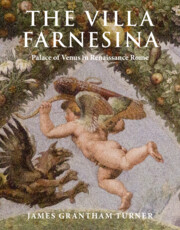
    The frescoes of Peruzzi, Raphael and Sodoma still dazzle visitors to the Villa Farnesina, but they survive in a stripped-down environment bereft of its landscape, sealed so it cannot breathe. Turner takes you outside that box, restoring these canonical images to their original context, when each element joined in a productive conversation. He is the first to reconstruct the architect-painter Peruzzi's original, well-proportioned, well-appointed building and to re-visualize his lost façade decoration‒erotic scenes and mythological figures who make it come alive and soar upward. More comprehensively than any previous scholar, he reintegrates painting, sculpture, architecture, garden design, topographical prints and drawings, archaeological discoveries and literature from the brilliant circle around the patron Agostino Chigi, the powerful banker who 'loved all virtuosi' and commissioned his villa-palazzo from the best talents in multiple arts. It can now be understood as a Palace of Venus, celebrating aesthetic, social and erotic pleasure.

    Awards

    Winner, 2023 PROSE Art History and Criticism Award, Association of American Publishers

    Reviews

    ‘This book is an absolute masterwork, impeccably and exhaustively researched, the material interpreted with wide and deep expertise filtered through the inspired genius of both the author and his protagonists, and the whole account beautifully written and easy to follow. It is a perfect match of scholar and subject.’

    Ingrid Rowland - University of Notre Dame

    ‘This volume is one of the single most important works in the field of Renaissance Studies to come along in some time. The book promises to be the locus classicus for all future studies of Chigi’s villa, the art that adorns it, and the world in which it was made.’

    Paul Barolsky - University of Virginia

    '… to recreate a largely vanished masterpiece of Renaissance architecture, painting and stucco in such detail, with diligent research fleshed out here and there by intelligent speculation and acute insight, is an achievement in itself. The Villa Farnesina is … a model of scholarly practice, lucidly written.’

    Keith Miller Source: The Times Literary Supplement

    ‘James Grantham Turner’s magisterial study The Villa Farnesina: Palace of Venus in Renaissance Rome captures the project’s intimate link with fantasy from the very moment of its conception…. With its lavish color illustrations, The Villa Farnesina is a thing of beauty appropriate to its subject and Turner’s passion for it.’

    Ingrid Rowland Source: New York Review of Books

    ‘… an important intervention in the study of a building that is so central to understanding Rome in the early sixteenth century. A useful tool for scholars and students alike, this book will not only help us better understand the Farnesina as a collective whole. Rather, it will give us a fuller understanding of where patrons like Chigi, architects like Peruzzi, and artists like Raphael fit into the intellectual, cultural, and artistic milieux of sixteenth-century Rome thanks to Turner’s systematic dive into one of the treasures of the Roman Renaissance.’

    Robert Clines Source: Renaissance and Reformation / Renaissance et Réforme

    ‘Turner’s Villa Farnesina, then, is an important intervention in the study of a building that is so central to understanding Rome in the early sixteenth century. A useful tool for scholars and students alike, this book will not only help us better understand the Farnesina as a collective whole. Rather, it will give us a fuller understanding of where patrons like Chigi, architects like Peruzzi, and artists like Raphael fit into the intellectual, cultural, and artistic milieux of sixteenth-century Rome thanks to Turner’s systematic dive into one of the treasures of the Roman Renaissance.’

    Robert Clines Source: Renaissance and Reformation

    Refine List

    Actions for selected content:

    Select all | Deselect all
    • View selected items
    • Export citations
    • Download PDF (zip)
    • Save to Kindle
    • Save to Dropbox
    • Save to Google Drive

    Save Search

    You can save your searches here and later view and run them again in "My saved searches".

    Please provide a title, maximum of 40 characters.
    ×

    Contents

    Metrics

    Altmetric attention score

    Full text views

    Total number of HTML views: 0
    Total number of PDF views: 0 *
    Loading metrics...

    Book summary page views

    Total views: 0 *
    Loading metrics...

    * Views captured on Cambridge Core between #date#. This data will be updated every 24 hours.

    Usage data cannot currently be displayed.

    Accessibility standard: Unknown

    Why this information is here

    This section outlines the accessibility features of this content - including support for screen readers, full keyboard navigation and high-contrast display options. This may not be relevant for you.

    Accessibility Information

    Accessibility compliance for the PDF of this book is currently unknown and may be updated in the future.
