Where There's a Will, There's a Way!

-
Select format
-
- Publisher:
- Cambridge University Press
- Publication date:
- May 2012
- December 2011
- ISBN:
- 9781139103695
- 9781108037907
- Dimensions:
- Weight & Pages:
- Dimensions:
- (216 x 140 mm)
- Weight & Pages:
- 0.31kg, 238 Pages
You may already have access via personal or institutional login
Show more authors 
You may already have access via personal or institutional login
Book description
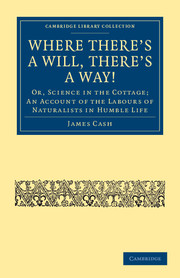
During the eighteenth and nineteenth centuries many scientists, naturalists, engineers and inventors from humble backgrounds, largely self-taught, made significant contributions to British science. This 1873 book by James Cash (1839–1909) celebrates their achievements in natural history, while promoting a 'self-help' ideology, stressing how disadvantages could be overcome by those with ability and determination. Many of his subjects corresponded with great names such as William Jackson Hooker, and sent specimens or local information which helped build up the larger picture. Cash gives particular attention to men from the north of England, where many men engaged in the cloth trade were also notable plant collectors. His subjects include George Caley, a weaver self-taught in Latin and French, and whom Sir Joseph Banks employed to go to New South Wales as a collector; Edward Hobson, a factory worker; and John Horsefield, a self-taught weaver who memorised the Linnaean orders at his loom.
Contents
Contents
Metrics
Altmetric attention score
Full text views
Full text views helpTotal number of HTML views: 0
Total number of PDF views: 0 *
 Loading metrics...
* Views captured on Cambridge Core between #date#. This data will be updated every 24 hours.
Usage data cannot currently be displayed.
Accessibility standard: Unknown
Why this information is here
This section outlines the accessibility features of this content - including support for screen readers, full keyboard navigation and high-contrast display options. This may not be relevant for you.
Accessibility Information
Accessibility compliance for the PDF of this book is currently unknown and may be updated in the future.