Women, Work, and Clothes in the Eighteenth-Century Novel

-
Select format
-
- Publisher:
- Cambridge University Press
- Publication date:
- 05 June 2013
- 13 June 2013
- ISBN:
- 9781139542708
- 9781107035003
- 9781316600931
- Dimensions:
- (247 x 174 mm)
- Weight & Pages:
- 0.7kg, 269 Pages
- Dimensions:
- (244 x 170 mm)
- Weight & Pages:
- 0.4kg, 272 Pages
- Subjects:
- Literature, English Literature 1700-1830
You may already have access via personal or institutional login- Subjects:
- Literature, English Literature 1700-1830
Show more authors 
You may already have access via personal or institutional login
Book description
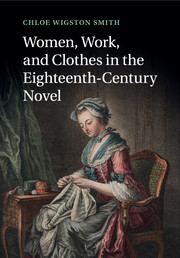
This groundbreaking study examines the vexed and unstable relations between the eighteenth-century novel and the material world. Rather than exploring dress's transformative potential, it charts the novel's vibrant engagement with ordinary clothes in its bid to establish new ways of articulating identity and market itself as a durable genre. In a world in which print culture and textile manufacturing traded technologies, and paper was made of rags, the novel, by contrast, resisted the rhetorical and aesthetic links between dress and expression, style and sentiment. Chloe Wigston Smith shows how fiction exploited women's work with clothing - through stealing, sex work, service, stitching, and the stage - in order to revise and reshape material culture within its pages. Her book explores a diverse group of authors, including Jane Barker, Jonathan Swift, Daniel Defoe, Eliza Haywood, Samuel Richardson, Henry Fielding, Charlotte Lennox, John Cleland, Frances Burney and Mary Robinson.
Reviews
'A book for collections strong in eighteenth-century studies, fashion history, and material culture … Highly recommended … upper-division undergraduates through faculty.'
M. E. Burstein Source: Choice
'… finely illustrated, well researched, and clearly written, plump with telling examples, intriguing details about eighteenth-century dress, and insightful readings, this is a delightful study of the early novel from a new and important perspective.'
Barbara M. Benedict Source: Journal of British Studies
'Women, Work, and Clothes in the Eighteenth-Century Novel tells a poignant story about a small gap in the cultural imagination of dress that was soon stitched closed again. … In her vivid retracing of a form of productive, buttoned-up femininity impervious to the dictates of both status and style, Wigston Smith shows us something almost unimaginable.'
Danielle Bobker Source: Eighteenth-Century Fiction
'[Wigston Smith’s] fresh and intelligent thesis contributes a relevant materiality that literary study generally lacks … One can use a study like hers to read eighteenth-century satire with a fuller understanding of what might have been meant by the appearance of a seemingly innocent needlewoman or spinster as advisor to a lady of fashion; what the mention of Turkish costume or Indian cotton might suggest beyond simple exoticism, especially when appearing on the wife of a tradesman rather than a lady; or how English wool became a political symbol of national identity.'
Carole Sargent Source: Eighteenth-Century Studies
'Wigston Smith's thorough research into surviving eighteenth-century garments imbues her work with a tactile particularity that is refreshing and illuminating. Her authoritative knowledge of the construction of garments and fabric informs her analysis of literature with rewarding results. … a must-read for those interested in material culture, particularly clothing, and contributes to gender and genre studies as well.'
Ashley Schoppe Source: Tulsa Studies in Women's Literature
'Women, Work, and Clothes in the Eighteenth-Century Novel is an important addition to current critical discourse about the relationship between literature and material culture. In this innovative book, Chloe Wigston Smith shows how the eighteenth-century novel pushes against what had become a traditional figurative relationship between text, dress, and representation.'
Alicia Kerfoot Source: Fashion Theory
Contents
Contents
Metrics
Altmetric attention score
Full text views
Full text views helpTotal number of HTML views: 0
Total number of PDF views: 0 *
 Loading metrics...
* Views captured on Cambridge Core between #date#. This data will be updated every 24 hours.
Usage data cannot currently be displayed.
Accessibility standard: Unknown
Why this information is here
This section outlines the accessibility features of this content - including support for screen readers, full keyboard navigation and high-contrast display options. This may not be relevant for you.
Accessibility Information
Accessibility compliance for the PDF of this book is currently unknown and may be updated in the future.