Wood-Engraving

-
Select format
-
- Publisher:
- Cambridge University Press
- Publication date:
- 29 August 2010
- 04 March 2010
- ISBN:
- 9780511707216
- 9781108009089
- Dimensions:
- Weight & Pages:
- Dimensions:
- (216 x 140 mm)
- Weight & Pages:
- 0.2kg, 156 Pages
You may already have access via personal or institutional login
Show more authors 
You may already have access via personal or institutional login
Book description
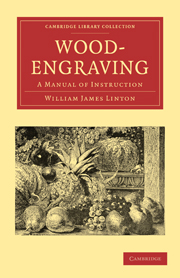
William James Linton (1812–1897) was a wood-engraver, poet, prose writer and political activist, who first worked in London but emigrated to the United States in 1866. He began his wood-engraving apprenticeship at the age of sixteen under the well-known London engraver G. W. Bonner. Linton's mature work, championing the use of 'white lining' and favouring the use of horizontal engraved lines and creating tone by differing line thickness, continued in the tradition of Thomas Bewick (1753–1828), the founding figure of wood-engraving. The publication of this book in 1884 marked the culmination of Linton's career, though he continued to research and write on the subject. The manual, originally published in only five hundred copies, is beautifully illustrated with Linton's own engravings and is a rich source for anyone interested in the technical details as well as the historical development of this specialist craft.
Contents
Contents
Metrics
Full text views
Full text views helpTotal number of HTML views: 0
Total number of PDF views: 0 *
 Loading metrics...
* Views captured on Cambridge Core between #date#. This data will be updated every 24 hours.
Usage data cannot currently be displayed.
Accessibility standard: Unknown
Why this information is here
This section outlines the accessibility features of this content - including support for screen readers, full keyboard navigation and high-contrast display options. This may not be relevant for you.
Accessibility Information
Accessibility compliance for the PDF of this book is currently unknown and may be updated in the future.