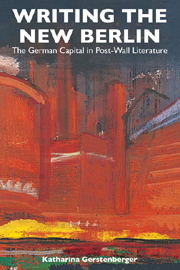
Writing the New Berlin

-
Select format
-
- Publisher:
- Boydell & Brewer
- Publication date:
- 05 February 2013
- 01 July 2008
- ISBN:
- 9781571138101
- 9781571133816
- 9781571135131
- Dimensions:
- Weight & Pages:
- 00kg,
- Dimensions:
- Weight & Pages:
- 00kg,
You may already have access via personal or institutional login- Subjects:
- Literature, Area Studies, European Literature, European Studies
Show more authors 
You may already have access via personal or institutional login
Book description
The wall was still coming down when critics began to call for the great Berlin novel that could explain what was happening to Germany and the Germans. Such a novel never appeared. Instead, writers have created a patchwork imaginary - in the form of about 300 works of fiction set in Berlin - of a city and a nation whose identity collapsed virtually overnight. Contributors to this literary collage include established writers like Peter Schneider and Christa Wolf, young authors like Tanja Dückers and Ingo Schramm, German-Turkish authors Zafer Senocak and Yadé Kara, and the Austrians Kathrin Röggla and Marlene Streeruwitz. The non-arrival of the great Berlin novel marks the reorientation in German culture and literature that is the focus of this study: the experience of unification was too diverse, too postmodern, too influenced by global developments to be captured by one novel. Berlin literature of the postunification decade is marked by ambiguity: change is linked to questions of historical continuity; postmodern simulation finds its counterpart in a quest for authenticity; and the assimilation of Germanness into European and global contexts is both liberation and loss. This book pursues a nuanced understanding of the search for new ways to tell the story of Germany's past and of its importance for the formation of a new German identity. Katharina Gerstenberger is associate professor of German at the University of Cincinnati.
Contents
Contents
Metrics
Full text views
Full text views helpTotal number of HTML views: 0
Total number of PDF views: 0 *
 Loading metrics...
* Views captured on Cambridge Core between #date#. This data will be updated every 24 hours.
Usage data cannot currently be displayed.
Accessibility standard: Unknown
Why this information is here
This section outlines the accessibility features of this content - including support for screen readers, full keyboard navigation and high-contrast display options. This may not be relevant for you.
Accessibility Information
Accessibility compliance for the PDF of this book is currently unknown and may be updated in the future.