To save content items to your account,
please confirm that you agree to abide by our usage policies.
If this is the first time you use this feature, you will be asked to authorise Cambridge Core to connect with your account.
Find out more about saving content to .
To save content items to your Kindle, first ensure no-reply@cambridge.org
is added to your Approved Personal Document E-mail List under your Personal Document Settings
on the Manage Your Content and Devices page of your Amazon account. Then enter the ‘name’ part
of your Kindle email address below.
Find out more about saving to your Kindle.
Note you can select to save to either the @free.kindle.com or @kindle.com variations.
‘@free.kindle.com’ emails are free but can only be saved to your device when it is connected to wi-fi.
‘@kindle.com’ emails can be delivered even when you are not connected to wi-fi, but note that service fees apply.
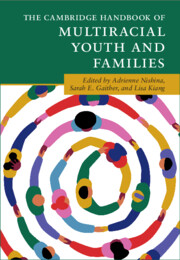
Multiracial youth is the fastest growing demographic in the USA, yet current research has only offered limited perspectives on their identities, relationships, and development. This handbook bridges that gap by combining cutting-edge research with practical guidance to support Multiracial young people's unique experiences and encourage future inquiry. It features clear explanations for how “Multiracial” is defined and explores the identity development, cultural navigation, and social challenges of Multiracial youth and their families. Featuring multidisciplinary contributions from experts across psychology, family studies, and child development, the chapters synthesize past and current research while guiding the creation of supportive environments, addressing microaggressions, and advocating for equity and representation. The volume equips researchers and practitioners to empower Multiracial youth and promote understanding among peers, while also providing a vital framework highlighting the unique Multiracial experience. It is an essential resource for any educational or community setting seeking to cultivate a sense of belonging.
As international adoption peaked at the turn of the 20th and 21st centuries, research on its outcomes has paralleled that peak in scope and depth. This book provides a comprehensive, integrative analysis of international adoption within its historical, political, and legal frameworks, situating the practice in the context of global child welfare and the search for permanent families. By synthesizing decades of multidisciplinary research, the chapters examine developmental trajectories of internationally adopted individuals from childhood through to adulthood, taking into account physical health, attachment, language, cognition, academic achievement, identity, and mental health. Drawing on diverse methodologies and international samples, the text advances our understanding of resilience, adaptation, and identity in cross-cultural contexts. It also identifies critical gaps and articulates directions for future inquiry, refining developmental theory and informing policy and practice. This essential resource supports researchers, professionals, and graduate students engaged in adoption, child development, and social care.
This Elements presents a series of studies investigating the relationship between language, Theory of Mind, and other cognitive skills, across different languages and cultures. The first set of studies focuses on longitudinal relationships between English-speaking children's understanding of complement-clause constructions (e.g., The cow knows the sticker is in the red box), mental verbs (e.g., know vs. think), modal verbs (e.g., must vs. might), and Theory of Mind. The second set of studies investigates links between complement-clause constructions, mental verbs, and Theory of Mind in Mandarin Chinese and English. The last study looks at English- and Turkish-speaking children's knowledge of evidentiality, source monitoring, and Theory of Mind. Together, these studies suggest that there are different linguistic tools that enable children to represent and acquire Theory of Mind, and that the availability and choice of these linguistic tools differ across languages and cultures.
How is ethnic and racial discrimination impacting our young people? Scholars around the world have found that discriminatory interactions of this nature have detrimental impacts on youth and their development. In this handbook, the world's leading experts on this topic examine the current state of the science, presenting current research and tracing foundational theories, empirical findings, multilevel methods, and intervention strategies for children, adolescents, and young adults. Covering multiple ethnic and racial groups across the United States and globally, chapters highlight both universal and distinct experiences and provide an in-depth overview of how race-related stressors affect youth outcomes. The text also offers clear conceptual frameworks, methodological guidance, and future-facing strategies to strengthen research, policy, and practice. With its expansive international scope and interdisciplinary depth, it is an essential resource for graduate students and scholars across developmental psychology, child development, human development and family studies, sociology, and ethnic studies.
This Element provides a broad overview of autism spectrum disorder from early childhood through adolescence. The Element reviews high-impact areas of research relevant to young children, including the shifting diagnostic conceptualizations of autism, current best practices related to screening and diagnosis, our understanding of factors that increase the likelihood of receiving an autism diagnosis, the overlap between autism and other co-occurring conditions, and related contemporary approaches to supports and interventions for young children. The discussion of these topics addresses measurement of outcomes, reproducibility, and methodological rigor. By focusing on these methodological gaps and progress, future directions for research in each of these areas is highlighted.
Before we can talk about how we learn, use, and lose language, we need to define what it is, and what it isn’t. Over the centuries, many people have attempted to describe language. In this chapter was ask: what is language? This is a simple enough question although the answer is much more complicated, and intriguing, than it seems at first. The question of “what is language?” isn’t something we can just sum up in a single pithy sentence. Language is a system of communication, but it’s so much more than that. Language is multi-faceted. It involves signs and symbols, smaller and bigger segments, dialects and accents, and also writing and signing. This chapter serves as a primer to introduce us to the basic underlying principles of language sceince, so we can now talk the talk.
How did language emerge? It has been suggested that language developed through mimicry of the sounds of nature and animals. Some propose that speech arose from grunts and groans, gestures, dance, or music. Others believe that language has more divine origins. A number of scientists speculate that language appeared spontaneously in our species, while opposing theories say that language evolved over a very long period of time. And which was the original language anyway? It makes sense that the question of how language emerged has been called “the hardest problem in science.” All of that being said, researchers don’t always agree as to what constitutes language. It’s generally accepted that communication differs from language in that the latter involves the use of symbols and syntax. For this reason, some argue that language is uniquely human. Others think our hominin relatives may have had speech as well. Animals have their own versions of communication too, while there are always quirky news stories about talking birds, signing chimpanzees, and even monkeys that use grammar. What are we to make of these claims? Let’s look at who has language and how it emerged.
What does it mean to know a language? Language is our primary tool for communication, and speaking, listening, reading, and writing are integral to our everyday lives. This chapter explores how adults use and understand language, from speech to the written word. We deconstruct the processes that are involved when speakers speak and listeners listen, and when readers read, and writers write. We delve into groundbreaking (and often controversial) studies to find out what they can tell us about speech production and comprehension. We’ll also find that a big part of language use is misuse. We look at the typical language of adults and the normal mistakes we make in our speech everyday, from mondegreens and malapropisms to spoonerisms and other slips of the tongue. We discuss what these speech and hearing errors mean, and what they reveal about the way language is organized in our minds.
In the previous chapter we looked at how we use and understand language, now let’s look at the ways that people lose language and also experience language difficulties of various kinds. These aren’t the normal errors and mistakes we’ve already discussed, but are the result of disability, disease, disorder, brain injury, and other factors that can affect speech use and understanding and further impair the ability to read and write. In the US alone, between five to ten percent of the population have various types of communication disorders. The figures are even higher for learning disorders such as dyslexia. All in all, this amounts to millions of people who live with language differences. This chapter discusses how both developmental and acquired disorders affect language processing and production.
Beyond Words is a book of big questions about language. What is language? Where did it come from? How do we learn our mother tongue? How do we learn other languages in addition to our mother tongue? How do we use and understand language? How do we lose language? Collectively, these topics fall under the umbrella of psycholinguistics. Psycholinguistics is the marriage of linguistics and psychology. It is a branch of language science that explores the relationship between language and the human mind. This is a book that takes us down many rabbit holes. It is filled with astonishing research and surprising discoveries. It is about fierce debate and contentious topics that have fascinated us since ancient times and continue to do so today. Language is weird, but also wonderful. Language is intricate and innovative, confusing and complex, mysterious and most of all, it is multifaceted. Language is beyond words.
Now that we’ve looked at what human language is, and where it comes from, this raises further questions. How do we acquire language? How does a baby develop its mother tongue from scratch? Babies go from burps and babbling through to native fluency in just a few short years. They seem to soak up language like a sponge. The process of learning to talk is so intuitive that it often seems like magic. While a child’s language development is exciting, it can also be frustrating and fraught with anxiety for everyone involved. Children make many mistakes along the way, leading parents and caregivers to ask themselves: Is my child on track or behind? Children, however, learn from their mistakes, and so can we. Let’s look at how language develops in children, what mistakes can teach us about language acquisition, and what happens when things don’t quite go according to plan.
Beyond Words has been an introduction to psycholinguistics, the study of language and the mind. This field merges linguistics and psychology, as its name suggests, but it’s much more complicated than that. Psycholinguistics is a multidisciplinary science that also combines insights from philosophy, cognitive science, and neuroscience, among other areas. To get more granular, there are the branches of study that fall under the umbrella of this field, including first language acquisition, second language acquisition, language comprehension and production, and what happens when this all goes wrong. At first, it is baffling to fathom how so many different branches could possibly belong to a single field. However, as the story unfolded it revealed how these pieces all fit together to help us understand the ways that we learn, use, and lose language.
Roughly half of the world’s population are bilingual, that is, around four billion people. Worldwide, language learning is on the rise, driven by factors such as immigration, globalization, and an increased awareness of the value of learning another language. In this chapter we explain how we learn languages in addition to our mother tongue, that is, the language we grew up speaking from early childhood. How is learning a second language different to learning a first? What are some of the challenges people face when learning another language? We explore issues around translation, and the creative inventions of sci-fi like the babel fish and the Tardis, versus the capabilities and limitations of AI. We take a look at unique cases of true (and fake) polyglot savants, and we revisit those who suddenly speak with another accent, or even in an entirely different language. We also see what science says about the considerable cognitive and social benefits of learning a new language.
In this chapter, the lives of a few older persons living in the Vineyard region are presented. After explaining how interviews were carried out and the life stories collected and analysed, and sketching the sociocultural environment of the Vineyard region, the chapter presents six short case studies, that of three women, two men and a married couple, that is, seven persons. For each person, I present their current situations and living arrangements and the transformation of their convoy of care during two and a half years. On this basis, I characterise their unique developmental trajectory: where do they come from, what did they live through? What ruptures and transitions did they experience, what resources did they find and what did they learn from them? What are their interest and engagements and how did they evolve with time? How much do they remember and imagine? What can we say about their domains of conduct and their reconfiguration over time? How, from there, can we see a unique life trajectory, a singular melody emerging from each of these lives, unfolding in the same region?