Element contents
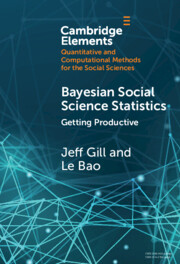
Bayesian Social Science Statistics
Getting Productive
Published online by Cambridge University Press: 17 February 2026

Summary
This Element introduces the basics of Bayesian regression modeling using modern computational tools. This Element only assumes that the reader has taken a basic statistics course and has seen Bayesian inference at the introductory level of Gill and Bao (2024). Some matrix algebra knowledge is assumed but the authors walk carefully through the necessary structures at the start of this Element. At the end of the process readers will fully understand how Bayesian regression models are developed and estimated, including linear and nonlinear versions. The sections cover theoretical principles and real-world applications in order to provide motivation and intuition. Because Bayesian methods are intricately tied to software, code in R and Python is provided throughout.
Keywords
Information
- Type
- Element
- Information
- Online ISBN: 9781009340984Publisher: Cambridge University PressPrint publication: 19 March 2026
References
Baldus, D. C., Pulaski, C. , & Woodworth, G. (1983). Comparative review of death sentences: An empirical study of the Georgia experience. The Journal of Criminal Law and Criminology (1973–), 74(3), 661–753.CrossRefGoogle Scholar
Bayer, D., & Diaconis, P. W. (1992). Trailing the dovetail shuffle to its lair. The Annals of Applied Probability 2(2), 294–313.CrossRefGoogle Scholar
Bernardo, J. M., & Smith, A. F. (2009). Bayesian theory (Vol. 405). John Wiley & Sons.Google Scholar
Brooks, S. P., & Gelman, A. (1998). General methods for monitoring convergence of iterative simulations. Journal of Computational and Graphical Statistics, 7(4), 434–455.CrossRefGoogle Scholar
Dale, A. I. (2012). A history of inverse probability: From Thomas Bayes to Karl Pearson. Springer Science & Business Media.Google Scholar
Diaconis, P. W., & Freedman, D. (1986). On the consistency of Bayes estimates. The Annals of Statistics, 14(1), 1–26.Google Scholar
Diaconis, P. W., & Freedman, D. (1998). Consistency of Bayes estimates for nonparametric regression: Normal theory. Bernoulli 4(4), 411–444.CrossRefGoogle Scholar
Gelfand, A. E., & Smith, A. F. (1990). Sampling-based approaches to calculating marginal densities. Journal of the American Statistical Association, 85(410), 398–409.CrossRefGoogle Scholar
Gelman, A., Goodrich, B., Gabry, J., & Vehtari, A. (2019). R-squared for Bayesian regression models. The American Statistician, 73(3), 307–309.CrossRefGoogle Scholar
Gelman, A., Jakulin, A. , Pittau, M. G., & Su, Y.- S. (2008, February). A weakly informative default prior distribution for logistic and other regression models. The Annals of Applied Statistics, 2(4), 1360–1383.CrossRefGoogle Scholar
Gelman, A., & Rubin, D. B. (1992). Inference from iterative simulation using multiple sequences. Statistical Science, 7(4), 457–472.CrossRefGoogle Scholar
Geman, S., & Geman, D. (1984). Stochastic relaxation, Gibbs distributions and the Bayesian restoration of images. IEEE Transactions on Pattern Analysis and Machine Intelligence, 6, 721–741.CrossRefGoogle ScholarPubMed
Geweke, J. (1992). Evaluating the accuracy of sampling-based approaches to the calculations of posterior moments. Bayesian Statistics, 4, 641–649.Google Scholar
Gilks, W. R., Thomas, A., & Spiegelhalter, D. J. (1994). A language and program for complex Bayesian modelling. Journal of the Royal Statistical Society: Series D (The Statistician), 43(1), 169–177.Google Scholar
Gill, J. (2014). Bayesian methods: A social and behavioral sciences approach, vol. 20. Chapman and Hall/CRC.CrossRefGoogle Scholar
Gill, J., & Bao, L. (2024). Bayesian social science statistics: From the very beginning. Elements in Quantitative and Computational Methods for the Social Sciences. Cambridge University Press.Google Scholar
Gill, J., & Torres, M. (2019). Generalized linear models: A unified approach (Vol. 134). Sage Publications.Google Scholar
Heidelberger, P., & Welch, P. D. (1983). Simulation run length control in the presence of an initial transient. Operations Research, 31(6), 1109–1144.CrossRefGoogle Scholar
Hopkins, D. J. (2010). Politicized places: Explaining where and when immigrants provoke local opposition. American Political Science Review, 104(1), 40–60.CrossRefGoogle Scholar
Karni, E. (2007). Foundations of Bayesian theory. Journal of Economic Theory, 132(1), 167–188.CrossRefGoogle Scholar
Kass, R. E., & Raftery, A. E. (1995). Bayes factors. Journal of the American Statistical Association, 90(430), 773–795.CrossRefGoogle Scholar
King, G., Tomz, M., & Wittenberg, J. (2000). Making the most of statistical analyses: Improving interpretation and presentation. American Journal of Political Science, 44(2), 347–361.CrossRefGoogle Scholar
Kuhn, T. S. (1997). The structure of scientific revolutions (Third reprint ed.). University of Chicago Press.Google Scholar
McGrayne, S. B. (2011). The theory that would not die: How Bayes’ rule cracked the enigma code, hunted down Russian submarines, & emerged triumphant from two centuries of controversy. Yale University Press.Google Scholar
Meng, X.- L. (1994). Posterior predictive -values. The Annals of Statistics, 22(3), 1142–1160.CrossRefGoogle Scholar
Metropolis, N., Rosenbluth, A. W., Rosenbluth, M. N., Teller, A. H., & Teller, E. (1953). Equation of state calculations by fast computing machines. The Journal of Chemical Physics, 21(6), 1087–1092.CrossRefGoogle Scholar
Murr, A., Traunmüller, R., & Gill, J. (2023, July). Computing quantities of interest and their uncertainty using Bayesian simulation. Political Science Research and Methods, 11(3), 623–632.CrossRefGoogle Scholar
Robert, C. P. (2007). The Bayesian choice: From decision-theoretic foundations to computational implementation (Vol. 2). Springer.Google Scholar
Robert, C. P., & Casella, G. (2011). A short history of MCMC: Subjective recollections from incomplete data. In Handbook of Markov Chain Monte Carlo, 49.CrossRefGoogle Scholar
Sekhon, J. S. (2008). Multivariate and propensity score matching software with automated balance optimization: The matching package for R. Journal of Statistical Software, 42(7), 1–52.Google Scholar
Spiegelhalter, D. J., Best, N. G., Carlin, B. P., & Van Der Linde, A. (2002). Bayesian measures of model complexity and fit. Journal of the Royal Statistical Society: Series B (Statistical Methodology), 64(4), 583–639.CrossRefGoogle Scholar
Stigler, S. M. (1982). Thomas Bayes’s Bayesian inference. Journal of the Royal Statistical Society: Series A (General), 145(2), 250–258.CrossRefGoogle Scholar
Stigler, S. M. (1983). Who discovered Bayes’s theorem? The American Statistician, 37(4a), 290–296.Google Scholar
Tiao, G. C., & Zellner, A. (1964). Bayes’s theorem and the use of prior knowledge in regression analysis. Biometrika, 51(1/2), 219–230.CrossRefGoogle Scholar
Von Neumann, J. (1963). Various techniques used in connection with random digits. John von Neumann, Collected Works, 5, 768–770.Google Scholar
Watanabe, S. (2018). Mathematical theory of Bayesian statistics. Chapman and Hall/CRC.CrossRefGoogle Scholar
Accessibility standard: WCAG 2.1 AA
Why this information is here
This section outlines the accessibility features of this content - including support for screen readers, full keyboard navigation and high-contrast display options. This may not be relevant for you.Accessibility Information
The HTML of this element
complies with version 2.1 of the
Web Content Accessibility Guidelines
(WCAG), covering newer accessibility requirements and improved
user experiences and achieves the intermediate
(AA)
level of WCAG compliance, covering a wider range of accessibility requirements.
Content Navigation
Table of contents navigation
Allows you to navigate directly to chapters, sections, or non‐text items through a linked table of contents, reducing the need for extensive scrolling.
Allows you to navigate directly to chapters, sections, or non‐text items through a linked table of contents, reducing the need for extensive scrolling.
Reading Order & Textual Equivalents
Single logical reading order
You will encounter all content (including footnotes, captions, etc.) in a clear, sequential flow, making it easier to follow with assistive tools like screen readers.
You will encounter all content (including footnotes, captions, etc.) in a clear, sequential flow, making it easier to follow with assistive tools like screen readers.
Short alternative textual descriptions
You get concise descriptions (for images, charts, or media clips), ensuring you do not miss crucial information when visual or audio elements are not accessible.
You get concise descriptions (for images, charts, or media clips), ensuring you do not miss crucial information when visual or audio elements are not accessible.
Visual Accessibility
Use of colour is not sole means of conveying information
You will still understand key ideas or prompts without relying solely on colour, which is especially helpful if you have colour vision deficiencies.
You will still understand key ideas or prompts without relying solely on colour, which is especially helpful if you have colour vision deficiencies.
Structural and Technical Features
ARIA roles provided
You gain clarity from ARIA (Accessible Rich Internet Applications) roles and attributes, as they help assistive technologies interpret how each part of the content functions.
You gain clarity from ARIA (Accessible Rich Internet Applications) roles and attributes, as they help assistive technologies interpret how each part of the content functions.