Introduction
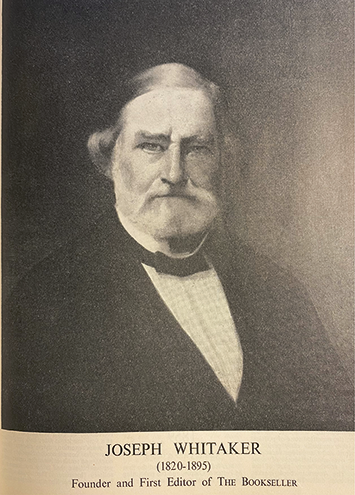
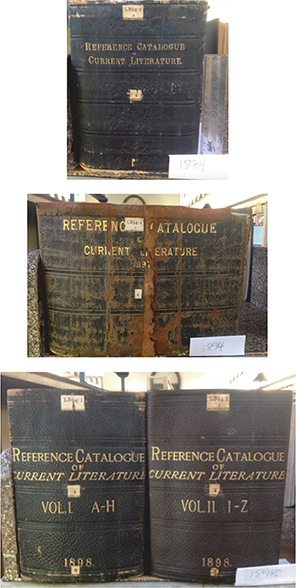
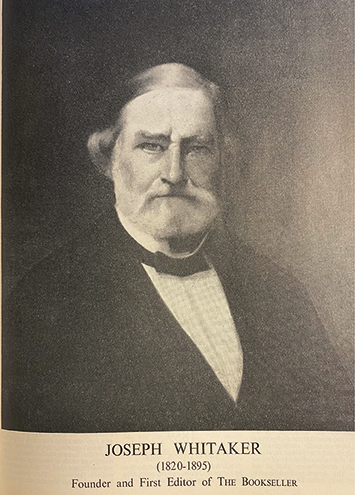
Remembered now primarily for the popular annual Whitaker’s Almanack, first published in December 1868, Joseph Whitaker should really be acknowledged as one of the most important publishers of the nineteenth century. Figure 1 shows him in his later years. The significance of his legacy to the modern book trade is indisputable, even if it is not very well known. Upon his death in May 1895, the St James Gazette obituary granted him a kind of immortality: ‘Whitaker, like Bradshaw, has long ceased to be a man and had become “part of the system of things”’.Footnote 1 The evidence for this legacy lies not just in the continued success of The Bookseller (1858), still the book trade’s main journal, but also in his contribution to the communication and information infrastructure that underpins the global publishing industry. The Reference Catalogue of Current Literature (1874) was the most comprehensive collection of information about books for sale then available, which in the twentieth century became the foundation of the bibliographic identifier system that made the modern industry possible. Thanks to Whitaker, the British book trade could develop the first internationally accepted system of identifiers in the late 1960s, when publishers and distributors started to computerise their warehouses. A later iteration of the Reference Catalogue, now called British Books in Print and published by Whitaker’s descendants, was used as the basis for the numbering system that identified every edition of every book registered. Without it, the International Standard Book Number (ISBN) system, electronic point of sale (EPOS), bestseller lists, and even Amazon, the behemoth of bookselling, would be unthinkable.
Joseph Whitaker, founder and editor of The BooksellerFootnote 2
Whitaker’s name is not well-known for several reasons, the most important of which is the scarcity of surviving archival material after the Whitaker offices were destroyed in the London Blitz in December 1940. In addition, his publications were mainly prosaic and workaday titles aimed at a specialist readership – booksellers, publishers, librarians, and enthusiastic book buyers. Nonetheless, on its first publication, The Bookseller was recognised as a pioneering trade journal that immediately spawned a raft of imitators for other trades. These new journals were intended to be conduits between the manufacturers and sellers of new goods – what would now be called business-to-business publications (B2B) – designed to support the retailers operating on the commercial front line. Whitaker’s proposal for his journal – a combination of highly relevant news, market analysis and consumer insight, statistics, product reviews, and extensive advertising – became the model for what was later known as trade journalism. For historians, these trade titles, for example The Draper and Clothier (1859), The Ironmonger and Metal Trades Advertiser (1859), and The Grocer (1862), are repositories of invaluable historical information not easily found anywhere else, and they deserve more study. In his own title, Whitaker captured the uneven and halting processes of modernisation and the resistance to these changes. He observed, chronicled, and commented on the key socio-economic, technological, and legislative changes that affected the 400-year-old printed book trade, aired the grievances and insights that resulted, and assembled for posterity an unrivalled treasure house of information about books and the circumstances of their production and distribution.
David Whitaker (1931–2021), the seventh editor of The Bookseller and former Chairman of J. Whitaker & Sons, described his great-grandfather as the ‘mechanic’ to the book trade, the provider of useful business tools and services that helped to modernise a 400-hundred-year-old industry.Footnote 3 But perhaps he should also be seen as the architect of a new communication system that enabled business information to flow beyond traditionally favoured traders to reach far-flung corners of the bookselling supply chain at home and overseas. Although there was an important and remunerative trade in second-hand and antiquarian books throughout the period, Whitaker senior’s main focus was on the challenges of selling new books. He was convinced that a better-informed and more collaborative book trade would be able to collaborate and act together in its own best interests, but, although his journal was widely read and despite repeated pleas to his readers to cooperate and form trade associations, this advice was ignored until the end of the century.
Due to the loss of the archive in 1940, any study of Whitaker’s life and work relies on publicly available documents and his printed works. These include back issues of The Bookseller (now digitised and available at the British Newspaper Archive), biographies and memoirs of his colleagues and peers, the national and trade press, and from a small collection of Whitaker papers at UCL Special Collections. The following sections tell Whitaker’s story and demonstrate the gift he had as an editor and publisher for reviving familiar genres and transforming them for a modern readership. Section 1 examines the influences of his early life as he began his apprenticeship in the book trade, his early years as an independent bookseller, and the bereavement and business collapse that followed. Section 2 focuses on his re-emergence from insolvency with an idea for a new kind of trade journal. The final section chronicles the publication that made his fortune, Whitaker’s Almanack, and The Reference Catalogue of Current Literature, which was to have an important historic afterlife.
1 Early Years 1820–1850s
The book world that greeted Joseph Whitaker in the early nineteenth century was in many ways unchanged since the days of Johannes Gutenberg 350 years earlier. He was born in 1820, in the same year as Florence Nightingale, Anne Bronte, and Herbert Spencer, when most printed books were still produced by hand in small print runs on wooden presses, set by typographers with lead type, printed on paper produced in small batches, hand-bound in leather, and sold at high prices through a network of largely London-based booksellers whose financial welfare was tightly bound together. London, then the largest city in the world, dominated the economy with a population of 1.2 million from an English total of 11 million. Its economic welfare was supported by a transport network of toll roads and canals. Literacy levels were low, and there were no public libraries and no compulsory elementary education. The book trade was centred in London, with Edinburgh as a secondary, much smaller hub. But there were changes afoot. Technical improvements such as steam-powered machinery, mass-produced paper, and cheap case binding promised lower production costs and encouraged the lowering of book prices. Book-making was becoming industrialised.
The term ‘bookseller’ could refer to the publishing, wholesaling, or retail functions, and many firms undertook all three. Some booksellers also ran printing and binding departments. A combination of lower book prices, a rise in the value of literary properties and copyrights, and increasing competition for sales slowly led to specialisation and the separation of these functions. More capital was required to exploit literary properties, and those booksellers that became publishers had to commit more capital to produce books in a wider range of formats and larger print runs. By the end of the century, many of the older houses, such as Longmans, John Murray, and Macmillan & Co, had closed their retail businesses to concentrate on publishing, leaving the retailing of books to smaller, often undercapitalised retailers.
By the 1850s, distribution had been transformed by the rapid expansion of a national rail network and a reformed post office that standardised postal rates across the country. Demand also increased with new markets for books, thanks to steady rises in literacy and standards of living. By the 1890s, as Whitaker reached the end of his life, the country was the supreme imperial power, could boast almost total literacy, an extensive railway system, gas and electric power in most towns, telephony, and photography; and more people had some disposable income and free time. Books were everywhere. Priced to suit every budget, they were available in traditional bookshops, on bookstalls on railway platforms, in department stores, in newsagents, and stationery shops, and more could be borrowed from a growing national network of publicly funded libraries. There was a healthy market for second- and third-hand books and specialist antiquarian editions, but Whitaker’s primary interest was in the purveyors of new books, booksellers who served the requirements of the ordinary reader.
Joseph Whitaker was born in London on 4 May 1820 to Thomas and Mary Whitaker, the youngest of three children and their only son. His father was a manufacturing silversmith who had been successful enough to have his own assay mark. The family lived in the parish of St Leonard’s in Shoreditch, a densely populated lower-middle-class area of skilled, semi-skilled, and unskilled families: ‘clerks, warehousemen, shopkeepers, mechanics, and labourers’.Footnote 4 His family were evangelical Protestants, and he was baptised in the Tabernacle in Shoreditch.
When he was thirteen years old, Whitaker’s mother died and his father quickly remarried. The nature and extent of his education are unknown, but he was then encouraged to leave home. Having developed ‘an insatiable passion for books’, he took up an apprenticeship with Mr Barritt, a bookseller, wholesaler, and binder in Fleet Street.Footnote 5 Although Whitaker was initially assigned to the bookbinding trade, Barritt believed him to have ‘superior qualities’ and soon trusted him with the responsibility of working in the bookshop.Footnote 6 The business was advertised as a ‘Wholesale Bible warehouse’ and supplied prayer books and church services, as well as Bibles in a range of formats and bindings.Footnote 7
The work of a booksellers’ apprentice in the 1830s was arduous, remembered by Scottish bookseller John Menzies as full of ‘drudgery and discomfort’.Footnote 8 Amongst the jobs to be carried out were: washing the stairs and sweeping the pavement outside; cleaning the windows; collecting incoming stock from the coach or train, unpacking and shelving the copies; wrapping and delivering books to local customers; sourcing requested titles; logging sales and keeping the account books; and keeping business correspondence.Footnote 9 Hours were long – starting at 7 a.m., apprentices could work fourteen-hour days six days a week, not finishing until the shop closed at 10 p.m.Footnote 10 Whitaker’s responsible nature took him from the bindery into the bookshop, but he was also gifted with a willingness to work hard and had ‘a determination to make his way in the world’.Footnote 11
During his apprenticeship, Whitaker may have resided with the Barritt family or lived as an outdoor apprentice in rooms nearby. Indoor boys received wages of £5 or £6 a year, but those who lived out could receive 4s a week to begin with, rising throughout their apprenticeship to £1 a week – a comfortable sum for a young single man.Footnote 12 There may also have been opportunities for overtime. As he neared the end of his apprenticeship, opportunities for additional wages would have been welcome as Whitaker saved towards his forthcoming marriage. Once his apprenticeship was completed, he was free to marry, and in November 1840, he tied the knot with Ann Norris at the Registry Office of the Strand Union.Footnote 13 He was now a clerk at Barritt’s and lived in Stanhope Street, near Drury Lane and close to Barritt’s Fleet Street offices. The daughter of a cabinet maker, Ann was three years older than her new twenty-three-year-old husband.Footnote 14 Their first child, Joseph Vernon Whitaker, was born on 3 February 1845, followed by two daughters, Anna Maria in July 1846 and Jessie in April 1848.
Whitaker left Barritt in 1843 and joined the thriving firm of John William Parker at the other end of the Strand, at number 445. The Strand was one of London’s major commercial streets and had strong literary ties. Several writers, booksellers, and publishers operated nearby, including Charles Dickens and Henry Mayhew in Wellington Street, John Chapman at 142 Strand, Chapman and Hall at 186 Strand, and The Illustrated London News at number 198. The cosmopolitan nature of the area extended to Holywell Street and Wych Street at the east end of the Strand, where the insalubrious, seditious, and pornographic texts sold by booksellers and publishers clustered there could not have escaped Whitaker’s notice and added a worldly, if not necessarily welcome, dimension to his education in the range and variety of bookselling activities.
J. W. Parker was a printer and substantial publisher who offered a broader range and style of general books than Barritt. The list focused on popular and natural science, education, literature, and children’s literature, and reflected an interest in social reform and educative works for the intelligent reader, such as works by George Henry Lewes, John Stuart Mill, and the anti-slavery campaigner Thomas Clarkson.Footnote 15 Parker was the publisher for the Society for Promoting Christian Knowledge and produced its penny magazine, Saturday Magazine. He had strong links with Cambridge, having been elected Printer to the University in 1836. Cambridge was a centre of the Broad Church movement, and Parker published works by many of its key proponents, such as F. D. Maurice and Charles Kingsley.Footnote 16
Whether by accident or design, Parker’s association with Cambridge placed Whitaker at the crossroads of one of the most important intellectual and spiritual controversies of the time: the resurgence of the Church of England. From the 1830s, a religious war raged between three competing forces within the Anglican Church, and the tensions between the Evangelicals, Broad Church liberals, and the Catholic sympathies of the Oxford Movement were vividly displayed in print in a torrent of books, pamphlets, and newspapers.Footnote 17 Perhaps the Christian socialism of the Broad Church movement did not appeal to Whitaker, or perhaps it was merely a coincidence that, a few months later, he left Parkers and crossed a theological divide by moving sixty miles away to another though unrelated Parker in Oxford, the home of the High Anglican Oxford Movement. It was to be a turning point in his life and reflected a journey from non-conformism to Anglicanism that lasted for the rest of his days.
Parkers was the mecca of Oxford bookshops. Located on Broad Street, the business was founded in 1814 by Joseph Parker, who became a privileged bookseller (bibliopola privilegiatus) and distribution agent for the University Press. The business passed to his nephew and former apprentice, John Henry Parker, in 1832, who was also a bibliopola privilegiatus and later Warehouse Keeper and Agent for the Learned side of the University Press.Footnote 18 The responsibilities of the Warehouse Keeper and Agent included organising the publishing operations of the Learned Press’ list of scholarly titles, selling these titles in Oxford, London, and beyond, and overseeing the warehouse for Press titles in Oxford.Footnote 19 Parkers published works by members of the Oxford Movement, also known as Tractarians, such as John Henry Newman, Edward Pusey, and John Keble. Although Parker did not publish the famous Tracts for the Times (1833–41), which were published by Rivingtons in London, Whitaker’s employment in the bookshop led to friendships with several of the Tractarians. He remained on warm corresponding terms with Newman, Pusey, and Keble well into the 1880s.
While he was working in Oxford, Whitaker’s wife and family most likely remained in London. This was possible thanks to the new railway line that reached Oxford in 1844, which made the journey between London and Oxford faster than by coach.Footnote 20 His commuting life ended in 1848 when he was dispatched back to London to open a branch of Parker’s business at 377 Strand.Footnote 21 Aged 28, he was now responsible for the daily running of a busy retail bookshop, as well as acting as distributor and wholesaler for the Learned Press’ books in London. Back in the familiar territory of the Strand, he was also given the opportunity to edit some of the firm’s publications, such as the Morning and Evening Church Services, and some titles that evoked the spirit of his Oxford friends, such as Tracts for the Christian Seasons, published in 1849, and Tracts for Parochial Use in 1852. He was also given permission to experiment with his own publishing ideas and launched a parish magazine inspired by his Oxford friends’ Tracts. After years as a bookseller, his publishing career had begun.
The new magazine, The Penny Post (1851), was intended for Anglican clergy to use in their parochial work. His concern was for the religious education of a particular section of society, which he called ‘the religiously-minded and moderately educated mass of the middle, and the more intelligent portion of the lower, classes of England’.Footnote 22 The Penny Post would direct them to ‘pressing Church issues’ and the principles on which they rested, ‘which alone can help them to a decided and consistent course of action’.Footnote 23 The new magazine would not tell readers what to think but instead would provide them with the information they needed to think for themselves. This would become a recurring theme in Whitaker’s publications.
Armed with confidence from the successful launch of the new magazine, Whitaker decided it was time to branch out on his own, and in 1852, he left Parker to open his own publishing and bookselling business in Pall Mall. He could not have known, but 1852 was to be a pivotal year for the book trade. Amongst other events that signalled the growing market for books was the move by Mudie’s Select Circulating Library, the largest library service, into larger premises to accommodate their burgeoning collections. Another sign was the enormous success of an American novel, Uncle Tom’s Cabin, which racked up British sales of a million and a half copies in the first eighteen months after publication.Footnote 24 The demand for new books was strengthening, and a mass market for cheap literature seemed possible now that 60 per cent of the population was literate.Footnote 25 But trouble was brewing.
The most consequential event of 1852 for both Whitaker and the book trade was the decision by a committee led by Lord Campbell that sought to settle the longstanding argument about who had the ultimate control over the retail price of books – the publisher or the bookseller. A committee was formed in 1829, drawn from the leading London houses, to monitor retail prices in London and enforce, albeit not always successfully, regulations that compelled booksellers to retail their new books at prices set by the publishers. Publishers usually offered trade allowances of between 25 per cent and 40 per cent off the retail price for wholesalers and booksellers to allow for profits. The regulations stipulated that. in order to ‘enjoy the privileges of the trade’ and be eligible for trade prices, every bookseller within a twelve-mile range of the General Post Office had to advertise their stock at the publishers’ recommended price and sell their books with no more than a 10 per cent discount from the advertised price for cash customers and no more than 15 per cent to book societies.Footnote 26 Booksellers who offered greater discounts were blacklisted as ‘undersellers’ and refused further stock.Footnote 27
Lord Campbell’s committee concluded that the regulations were inconsistent with the principles of free trade and should be abandoned.Footnote 28 The decision ended the publishers’ control over book prices and initiated a period of ‘free trade’ in books. Booksellers could now retail their stock at prices that suited the demands of their local markets. A few weeks later, the committee itself was dissolved with the result that there would no longer be any ‘rules for further guidance of the trade’.Footnote 29 Without it, there were no mechanisms for regulation, no means of governance, no forum for debate or discussion of issues affecting the trade, and no accountability for any traders operating outside accepted traditions and conventions. Underselling continued apace, and the ramifications of this decision would reverberate through the book trade for the next half-century.
The timing of Whitaker’s decision to start his own business must have seemed auspicious; new books were in demand. Book production had risen 63 per cent from 1846 to 1851, with The Publishers’ Circular (1837) recording 3,231 new titles in 1846, rising to 5,265 in 1851.Footnote 30 The numbers of publishers and booksellers also rose from 2,787 in 1831 to 8,433 in 1851.Footnote 31 However, 1852 was also the year when growth started to slow down; only 4,899 new titles were recorded in 1852, a drop of 7 per cent from the previous year.Footnote 32 There was another concern for the viability of bookselling; The Bookseller later reported that although the demand for books had grown ‘a hundredfold’ since the beginning of the century and publishers were producing more books than ever, booksellers were not benefitting, and their numbers were in sharp decline.Footnote 33
As an independent publisher and bookseller at 41 Pall Mall, Whitaker focused primarily on theological titles but did produce some books of general interest. St James’ was a fashionable part of London and well-located between the seat of government in Whitehall and the commercial streets of the West End. An additional consideration may have been proximity to one of the gentlemen’s clubs, the Oxford and Cambridge University Club, which was located almost directly opposite number 41. The club building at 71–77 Pall Mall was a London base for current and former members of the two ancient English universities, so Whitaker was ideally placed to engage visiting clergymen in his bookshop and offer them his publishing services.
The publishing side of the business started modestly with two titles under the new ‘J. Whitaker’ imprint: Whitaker’s Clergyman’s Diary 1852, which he had started at Parkers, and a short pamphlet by Thomas Ramsay entitled The Short-comings of our Public Education: a letter to the Right Hon. the Earl of Lonsdale.Footnote 34 There were also several general books, such as Tangible Typography: or How the Blind Read by Edmund C. Johnson, a forty-eight-page book about reading systems for blind readers such as braille; and Pitcairn’s Island: A Lecture delivered at the Christchurch School-room, St Pancras by Commander M. Burrows, a sixty-six page account of the island and the mutiny of 1789. One or two were sizeable publications, such as Richard Field’s Five Books of the Church in four quarto volumes priced at forty-two shillings, which would have required a substantial outlay to his printers. The following year, the list expanded again to eighteen titles, again a mixture of devotional and general books. In addition, three periodicals were launched: The Christian Student: An Educational Magazine, Synodalia: A Journal of Convocation, and The Churchman’s Magazine, which was intended for a general readership.
As with The Penny Post, Whitaker was concerned about the religious education of a particular group, in this case, the newly educated middle-classes. He was troubled by their apparent lack of interest in the teachings of the Church and by their inertia in the face of the neediness of the poor. In a letter to a friend describing the purpose of The Churchman’s Magazine, he lamented that:
the Clergymen commonly remark, “We can get at the very poor, we can get at the very rich, but the shopkeeper and the farmer seem to be out of our reach” .Footnote 35
Despite regular church attendance and charitable donations, this group showed little interest in doctrinal matters, the spiritual work of the Church, and they did not ‘even consider that those living around them in misery and vice have souls to be saved’.Footnote 36 He believed the Church of England would have more influence with this group if there were a ‘judiciously conducted Magazine’ based on sound Church principles and through which the work of the Church could be promoted.Footnote 37
While bookselling and publishing were his main concerns, Whitaker also offered writing and publishing services to clerics who wanted printed versions of their sermons.Footnote 38 However, despite the opportunity to develop the writing skills that would assist him in his future role as a journalist, the financial precarity of his clerical customers was to have a catastrophic effect on his business a few years later.
The Whitaker family did not live ‘over the shop’, as was common at the time, but instead rented a series of lodgings in various parts of London.Footnote 39 After a few years in a crowded house on Henrietta Street near the Strand, which was shared with another family of eight, Whitaker sought more space across the river Thames in Camberwell.Footnote 40 The expansion of the transport networks in the 1840s and 1850s created new residential suburbs several miles away from the City and Westminster that were served by the railways and by horse-drawn omnibuses, and trams. Camberwell was equally well-placed for access to the City and Westminster. By the 1850s, 200,000 people walked the mile and a half daily to work in shops and offices.Footnote 41 From dwellings at 280 Albany Road, a main thoroughfare running between the Old Kent Road and Walworth Road, Whitaker joined the lines of commuters heading north.
The family moved several times to houses in Camberwell, Peckham, and Brixton.Footnote 42 Although these southern suburbs offered more space, a move south of the river could also signal financial distress, as several debtors’ prisons, including the Marshalsea, the Queen’s Bench, and the Surrey gaol on Horsemonger Lane, loomed ominously in nearby Southwark.Footnote 43
Financial Calamity and Insolvency 1854–56
The satisfaction Whitaker may have experienced from launching his new business did not last long. In October 1853, the family suffered a calamitous misfortune when his wife, Ann, died from a stroke after the birth of their fourth child, Marian.Footnote 44 Whitaker was suddenly left alone to support three children plus a newborn baby. It was the beginning of a period of great difficulty. Although many of the books he published that year were short, several were more than 140 pages long, suggesting a commitment of considerable sums to printers and binders. Mid-way through 1854, and with only two new titles published, he became insolvent. His debts outweighed the sums owed to him, and he was unable to pay his creditors. No records remain to explain exactly what caused the insolvency, but his son George later offered a clue to what may have been a contributing factor: too many of the clergymen for whom Whitaker provided sermon writing and publishing services failed to pay him on time, or even at all:
His business, which was largely connected with the clergy, did not prosper, and it is regrettable to state that his faith in the honesty of many clergymen of the Church of England was a chief cause of its non-success. A prominent part of the business was the writing of sermons, which were supplied to those who either through indolence or incapacity, required them.Footnote 45
His predicament was common. It was said of the previous generation, ‘the cast of official bankrupts often reads … like a who’s who of the lost eighteenth-century London book trades’.Footnote 46 John Stockdale repeatedly found himself in debtors’ gaol thanks to poor publishing decisions, entering five different gaols from 1819 to 1840.Footnote 47 Bookselling was a precarious business, and even large and well-established firms could find themselves in financial disarray.
The difference between insolvent and bankrupt debtors was a question of scale. An insolvent was a person for whom the delicate balance between debt and credit had temporarily failed, while the bankrupt was usually a substantial merchant or manufacturer who owed large sums of money to creditors with little hope of ever being able to repay them, or who had even attempted to evade them. As an insolvent, Whitaker’s debt was modest but still devastating to him and his already grieving family.
Between 1854 and 1856, Whitaker’s name appeared repeatedly as an insolvent debtor in the pages of The London Gazette, the official journal of record, although it is not clear whether he suffered several lapses into insolvency or whether a single event was played out over two years. On 14 July 1854, an indenture notice stated that he had ‘conveyed and assigned all his estate and effects’ to two assignees: Joseph Bennett, a wholesale stationer, and a bookbinder called Thomas Chubb.Footnote 48 The men were entitled to collect any sums owed to Whitaker until the debts were cleared, and they were given two months to execute the agreement. The notice did not record the precise sums owed, but Whitaker later testified that £30 would clear his debts, the equivalent of approximately £30,000 today.Footnote 49 The size of the sum owed, and that it was owed to suppliers of publishing services indicated the fragility of his business.
The insolvency process was a means for an honest trader to honour commitments to creditors. The maintenance of a reputation and good standing amongst peers was assured by the quick repayment of debts.Footnote 50 In an effort to keep his good name, Whitaker wrote to his debtors to instruct them to pay directly to his creditors the sums that were owed to him:
41 Pall Mall, London
30th August 1854
Sir,
Having unfortunately been obliged to make an assignment of my Estate, for the benefit of my Creditors, I shall be much obliged by your paying the amount of your Account to Mr Joseph Bennett, one of the Assignees, of 181 Upper Thames Street by Post Office order or otherwise.
Your obedient Servant,
J Whitaker [signature]Footnote 51
He also tried to raise funds from other assets to clear the debt. The copyright of Whitaker’s Clergyman’s Diary was transferred to the Stationers Company, and The Educational Register and Family Almanack was returned to John Henry Parker.Footnote 52 To make matters worse, Whitaker’s father, Thomas, died in October 1854, leaving everything to his second wife, Susan, and nothing to his children.Footnote 53 Whitaker could not depend on his family for assistance.
Undaunted, he soon started another business at 310 Strand. Having given up the Pall Mall premises, perhaps as part of the settlement of his insolvency, he moved back to the Strand, and by January 1855 was publishing a new periodical called The Artist.Footnote 54 A departure from the primarily religious publications of his earlier attempts, this move indicated a broadening of his publishing interests. In addition, on 19 May 1855, less than two years after Ann’s death, he re-married, this time in an Anglican church wedding at St Giles, Camberwell.Footnote 55 Elizabeth Brown was the nineteen-year-old daughter of a silversmith who now had four motherless children to care for. That her father was a silversmith like Whitaker’s own, and that he and his new bride had both been living at the same address in Peckham at the time of their marriage, suggests a family connection, and possibly that she had been engaged to look after the children after Ann’s death.
Domestic life had calmed, but Whitaker was still in financial trouble. The sum he owed was small but, at over £20, it was enough to land him in debtor’s gaol.Footnote 56 He turned to the Royal Literary Fund (RLF) for assistance. Founded in 1790 ‘to relieve authors in distress’, the RLF had helped some very well-known writers, including Samuel Taylor Coleridge and Thomas Love Peacock.Footnote 57 In order to be eligible for RLF funds, the applicant had to be a bona fide author of published works. In support of his claim, Whitaker offered the four annual volumes of each of two titles he had initiated at Parkers, The Educational Register and The Clergyman’s Diary.Footnote 58 He confirmed that the reason for his application was ‘failure in business in 1854’ and he maintained that his income was ‘very trifling’, consisting of ‘occasional contributions to a country newspaper [unnamed] on which I expect to obtain a permanent engagement in a few months’.Footnote 59 Nonetheless, he was turned down on the grounds that the authorship of the two titles was ‘not sufficient to establish a claim on the fund’.Footnote 60 His books were categorised as compilations rather than authored works, even though they agreed that the works ‘could not have been got up without much mental toil and author’s craft’.Footnote 61 Approximately 17 per cent of applications to the RLF were rejected for a variety of reasons, and in this case, Whitaker was just not enough of an ‘author’ to qualify.Footnote 62 He would have to go to the Surrey gaol.
Built in 1798, the common gaol had a capacity for 400 inmates, many of whom were insolvent debtors like himself.Footnote 63 Debtors remained in gaol until their debts were repaid, sometimes for many years. The fortunate would be visited by family and friends, who could bring food, wine, and other items for their comfort. Men lived and slept in the same large room, and there was no privacy: ‘The unfortunate soldier, barrister, or merchant, is compelled to eat, herd, and sleep with the lowest vagabond of his sex’.Footnote 64
In January 1856, Whitaker was called to appear in the Court of Insolvent Debtors. Now described as a ‘newspaper reporter’, he appeared at the Court in Lincoln’s Inn, presenting himself ‘on his own petition’ in order to vest ‘in the Provisional Assignee [his] Estate and Effects’.Footnote 65 Like other insolvents, he had to place all his assets at the disposal of his creditors, apart from a few basic items for himself and his family, and commit to repaying the balance of all sums.Footnote 66 A month later, he was called again to appear in court to be discharged unless any creditor appeared in court to oppose the decision.Footnote 67 Whitaker did not appear in the London Gazette again after this entry, so his financial woes appeared to have been finally resolved almost two years after they began. As his debts were resolved, rehabilitation could begin.
Thanks to Whitaker’s good standing in the trade and his now-cleared financial record, he was quickly re-hired by his former employer, J. H. Parker, who had recently acquired the venerable general interest magazine The Gentleman’s Magazine and Historical Review. First published in 1731 by Edward Cave, it was a miscellany of writing sourced from a wide variety of publications on mainly historical and antiquarian topics, overseen by the pseudonymous editor ‘Sylvanus Urban’, a persona created to appeal to a broad readership from both town and country.Footnote 68 The magazine had two features that would be significant for Whitaker’s future career: a section of book reviews and a correspondence column for letters to the editor. He prepared his responses by compiling notebooks full of statistical information, newspaper cuttings, and extracts from government-issued ‘Blue Books’ so he would not be ‘caught napping’ by an unexpected question.Footnote 69 These notebooks would later become central to his plan for a new kind of almanack.
The book review section was used by the book trade and book-buyers looking for information about new books, but procuring the bibliographic details could be frustratingly difficult. Whitaker knew from his bookselling experience how important it was for booksellers to see publishers’ announcements and knew that they lay in a variety of sources, such as publishers’ catalogues, wholesalers’ lists, trade and auction sales catalogues as well as advertisements and reviews in the literary press and in national newspapers like The Times. He also knew that for small or provincial booksellers, it was expensive and difficult to access these multiple publications. Even the trade advertisers, Bent’s Literary Monthly Advertiser and The Publishers’ Circular, carried notices and advertisements primarily from the larger London publishers, with only a few entries from Edinburgh and smaller publishing centres. As Whitaker wanted to provide a wide range of titles in his columns, he was compelled to contact publishers directly, thereby broadening his own professional networks and developing relationships with a wide range of publishers all over the country. This expanded collection of trade contacts would be key to the success of his next venture, a new trade journal. He was now in direct contact with a large group of the very people who were most likely to become his contributors and subscribers, as well as the all-important advertisers.
Advertising was essential for bookselling, and printed books were amongst the first commodities to be marketed through advertising. The Bodleian Library has a copy of a poster advertisement for Pye’s of Salisbury, published by William Caxton in 1476, identifying the title of the work and where it might be acquired.Footnote 70 By the nineteenth century, advertising was publishers’ primary marketing tool. Publishers supplied the name of the author, title, format and size of the edition, type of binding, as well as the retail price. All these details contributed to the marketing effort and helped both booksellers and customers to identify the desired edition. The title and author conveyed the subject and credentials of the author of the work, while the format and binding signalled the likely market. The larger the size of the book and the more luxurious the binding, the higher the price was likely to be. Folios and quartos were usually priced higher than octavos and duodecimos.
The advertisements also played an important role in publicising the publication date of an edition. This action publicly established the start of the period of copyright protection for the work and allowed the publisher to assert their ownership of the copyright. However, although advertising was important, it was not cheap. The abolition of the 1/6 tax on advertisements in 1853 reduced the cost of advertising, but it remained a considerable expense for publishers, especially for the titles that needed to be advertised in several publications and over several years, such as schoolbooks, textbooks, and manuals. Richard Bentley and Messrs. Colburn and Co were rumoured to spend £5,000 annually on advertising, with Longmans paying even more.Footnote 71 Publisher John Chapman calculated that a publisher should expect to spend at least 25 per cent of the production costs for a new book on advertising.Footnote 72 He underlined the trade’s reliance on the practice:
the system of publishing in England involves a larger expenditure for advertising than is incurred in any other country; because here publishers depend more exclusively than elsewhere upon advertisements for making their works known to the public […] almost the only way in which readers become aware of the existence of new English books is by means of advertisementsFootnote 73
Other countries were not so reliant on advertising. The German book trade developed a centralised system organised by its trade association, der Börsenverein des Deutschen Buchhandels, to circulate information about new books via a network of agents and through its journal, das Börsenblatt für den Deutschen Buchhandels. This was a regular publication with printed lists and summaries of new books, along with some business news.Footnote 74 Using this information, booksellers could sample new books ‘à condition’ and return them for a full refund if necessary.Footnote 75 Similar practices applied in France and America. As booksellers were regularly notified about new books and could sample the texts for themselves, there was less need for extensive advertising.
There was no such system in England, but from 1802 William Bent produced a monthly publication, A List of New Publications, to provide booksellers with a trade list of new books. To attract subscribers and advertisers, Bent sent free copies to ‘all Booksellers in Town and Country’ for the first two years and made them available ‘at most of the Coffeehouses in London and Westminster’, locations frequented by businessmen and traders.Footnote 76 A charge of a penny was levied in January 1804, rising to 6d in May 1805, when the title changed to The Monthly Literary Advertiser. In 1829, the title was changed again to Bent’s Monthly Literary Advertiser (hereafter collectively referred to as Bent’s).
Bent’s provided a little editorial information on the back page in some issues under the heading ‘Literary Intelligence’. Most of the items were brief notices of forthcoming titles, but these snippets of literary news could also be surprisingly international. Although book production was concentrated in London, the market for these books extended nationally and internationally, and the London publishers needed to understand the nature of their overseas markets and to communicate with foreign booksellers. For instance, the December 1805 issue printed, amongst other foreign stories, an account of the setting up of an association in Natchez, Mississippi, for the dissemination of knowledge; a brief piece about how science was being taught in Turkey; and an item about how the Royal Academy of Fine Arts in Berlin had admitted into its membership a Mr. Wagener, who had devised a way to print geographical charts from moveable type that was superior to engravings.Footnote 77 This information was not meant to be esoteric. It broadened and enriched the booksellers’ knowledge of the wider world of books, enhancing their status as high-class tradesmen and helping them to impress their customers.
By the late 1830s, Bent’s main advertisers, the publishers and wholesaling booksellers, had become dissatisfied with the service it provided, and a committee of the principal London houses which was led by William Longman (1813–77) and included established firms such as John Murray, John Rivington, and Robert Seeley, launched a new trade publication called The Publishers’ Circular. The form and arrangement of the new publication were devised by Longman, and it was initially to be published by his firm until the committee agreed that the appearance of impartiality was important and appointed publisher Sampson Low as editor.Footnote 78 The publishers’ committee emphasised that the new journal was not the ‘speculation of an individual’ like Bent’s, but was instead a collective initiative backed by some of the most powerful booksellers and publishers in London.Footnote 79 Although it was not marketed as an official publication, the committee planned to act as a de facto authority or representative body, for instance by proposing that their new publication collect information for a central repository of bibliographic details and sale prices. Publishers were encouraged to submit ‘one Advertisement of every New Work and New Edition which they publish’ to be collected in a similar manner as in the German trade – a reference to the Börsenverein.Footnote 80
The Börsenverein was formed in 1825 to circulate information about new books and to regulate the production, distribution, and sale of books across the German states. In addition, the association lobbied for legislative changes to benefit the bookselling trade, acted as a clearing house for settling accounts, and later added other services for members, such as the provision of training and professional counsel.Footnote 81 Publishers sent details of their new and forthcoming titles to be included in the Annual Catalogue, and from 1834 the Börsenblatt was published several times a week to circulate news, reviews, and other details of new books. This service was invaluable, and the committee of The Publishers’ Circular perhaps hoped that they could play a similar role for the British book trade. However, there was too much friction and too little alignment of mutual interests between the older, established publishers and many of the newer retail booksellers for this to be achievable. Until the 1870s, The Publishers’ Circular remained primarily a publishers’ advertiser with limited news, commentary, or analysis of trade matters.
The first issue of The Publishers’ Circular appeared in October 1837 with fourteen pages of advertisements for books, periodicals, and engravings and a two-page classified index to the advertised books. Later a small editorial section appeared with a little news and ‘literary intelligence’, mainly notices or announcements of notable forthcoming books. The back pages offered a selection of small advertisements for businesses for sale, situations vacant, and books wanted, giving readers the opportunity to exchange information, hire staff, and offer other services related to their trade.
Claims were made in the early years that The Publishers’ Circular was ‘the first and only catalogue of the works published in Great Britain approaching completeness’.Footnote 82 By the late 1850s, however, this claim was hard to justify and, as Whitaker was to discover when editing The Gentleman’s Magazine, The Publishers’ Circular did not reflect the expansion and diversity of book production as many of the regional publishers and small London ones did not advertise with them. Nonetheless, these lists were the most comprehensive then available.Footnote 83
As trade news was not a priority, even topics of great significance received only minimal coverage. In what would have been considered an important development at the time, the abandonment of the booksellers’ regulations and the dissolution of the committee, merited only a brief paragraph in June 1852.Footnote 84 Sampson Low was not only the editor of the journal but also the Secretary of the committee, with a key role in the enforcement of the now abandoned regulations, so he would have been fully aware of the significance of the action. Publishers’ views on the matter were aired in a series of letters in The Times and in John Chapman’s Westminster Review, but not in the book trade’s own journal.Footnote 85 The Publishers’ Circular was a showcase for circulating publishers’ advertisements and news of forthcoming titles, it was not a forum for discussion or debate until the final decade of the century.
One of the reasons for the greater emphasis on advertising rather than journalism was its economic model. As editor, Sampson Low was not paid directly by the committee but instead accepted a ‘fair remuneration’ for his work by retaining the income from the advertisements.Footnote 86 This created a financial incentive to fill the paper with advertising rather than incurring the expense of writing news stories or reviews of new books. Low was an insider, a publisher with a general list, and, as noted earlier, the Secretary of the committee that enforced the booksellers’ regulations until 1852. He worked to maintain order within the trade, in part by circulating retail prices and bibliographic details in The Publishers’ Circular to ensure all booksellers knew the prices and publication dates for the books they sold.Footnote 87 Given his position as a publisher, he had no incentive to do anything that would disrupt the dominance of the leading London houses.
Whitaker emerged from his period of insolvency in 1856, just as competition between booksellers was intensifying. Without any regulations to restrict them, booksellers could apply whatever customer discounts they regarded as necessary to make a sale. His experience as an insolvent and as an editor at The Gentleman’s Magazine made him realise that booksellers were not well served by the existing trade publications and that they needed more help, particularly accurate and timely access to sales information about new books. A retrospective account of the early years of The Bookseller underlined the difficulty of finding this information:
I wanted to-day to refer to the exact title of one of Messrs. Hatchard’s works, but I could not find it, and had to hunt for a number of the ‘Christian Observer’. The same remark would apply to many other publishers, Longmans, and perhaps Murray, being the sole exceptions. As to Scottish publishers, I do not know where (except in their own catalogues) to find the titles or prices of any of their books.Footnote 88
He further noted that it was ‘practically impossible to find the exact title or publisher of many books then issued unless by a house of the front rank’.Footnote 89 If an experienced bookman based in central London like Whitaker had difficulty tracking down these details, it would have been nearly impossible for anyone less experienced, well-connected, or well-placed.
He was also aware that booksellers they needed not only more information about new books but also more guidance and institutional support. Decades of experience as a bookseller had equipped him with a deep personal knowledge of the difficulties faced by colleagues and of the issues that affected the smooth running of their businesses. Reminiscing in the fiftieth issue of The Bookseller in 1866, he reminded readers of his original reasoning. His journal would function not only as an advertiser but also as an independent information service, circulating valuable business intelligence for the benefit of the bookselling trade as a whole:
The want of the time was a journal representing the feelings and opinions of the trade; recording information of all with impartiality, and entirely free from the trammels of any publishing house or special connection.Footnote 90
This new plan required a new approach and a new location, so Whitaker prepared to restart his business yet again.
2 The Bookseller 1858–1870s
The period that followed the 1851 Great Exhibition was characterised by economic self-confidence, the supposed ‘great Victorian boom’ of the 1850s to the 1870s.Footnote 91 Some of the financial risks of doing business were lowered by important legislative reforms, such as the 1844 Banking Act that restricted the issuing of bank notes to the Bank of England, and the Joint Stock Acts of 1844 and 1856 that limited investors’ liability. Domestic industrial output grew, albeit unevenly, and overseas trade expanded. This dynamism was underpinned by a belief that markets, left to their own devices without interference from governments, would adjust to the prevailing economic headwinds and self-correct. This belief was not universally held and was perhaps a misreading of Adam Smith, but for much of this time, the principle of laissez-faire prevailed. The bookselling trade had also grown since the launch of The Publishers’ Circular, with new markets for books in the growing industrial towns and overseas in Britain’s colonial territories and in America. Book production grew steadily, with the numbers of titles published annually rising from 1840 and plateauing in the early 1850s.Footnote 92 There were reversals, such as during the American Civil War 1861–65 followed by a banking crisis between 1866 and 1867, which limited the availability of cash. Nonetheless, the 1842 Copyright Act extended the number of years that copyright was protected and included British books in the colonial territories, prompting publishers like John Murray to produce the Colonial and Home Library series aimed specifically at a colonial readership.Footnote 93 As the demand for printed books rose, the separation of the publishing and retailing functions grew wider, as the more entrepreneurial firms committed more capital to diversifying their lists and retreated from retailing and wholesaling.
The increasing demand for books attracted new entrants to the bookselling and publishing trade. The number of people describing themselves as booksellers and publishers in England and Wales rose from 8,433 in 1851 to 13,596 in 1891.Footnote 94 Unlike in Whitaker’s youth, newcomers to the trade were no longer expected to undergo an apprenticeship, and many had no previous experience of working with books. Some had worked in other trades and opened bookshops in retirement, like John Catchpole, a former miner from Derbyshire who opened a small bookshop after leaving the mines.Footnote 95 Many also sold items other than books, such as stationery and fancy goods, patent medicines, and even life insurance. They were not the ‘lettered bookmen’ of earlier generations and needed more than just information about new books. Following his recent experience of business failure, Whitaker knew how important it was to understand the wider market for books and the economic forces that shaped it. He intended his new journal to do more than just provide information about new books; it would also help his readers understand the structural forces that shaped the commercial environment and try to raise levels of trust between traders by fostering a sense of camaraderie and shared values.
With this third attempt at business, Whitaker moved to a different part of London. He initially worked from a building at 17 Warwick Square. It was a small square off Warwick Lane between the Oxford Arms coaching inn and Stationers’ Hall, the home of the Stationers’ Company founded in 1557. This location offered several advantages. The neighbourhood had long been associated with the book trade, and proximity to Stationers’ Hall in Ave Maria Lane meant Whitaker could check for details of new books registered there by their publishers.Footnote 96 There was also easy access to colleagues based in the West End via London’s major east-west route that ran down the newly built Cannon Street, passed by St Paul’s Cathedral, along Ludgate Hill, and on to Fleet Street and the Strand. The General Post Office was around the corner at St Martin le Grand and was not only the primary sorting office for London but also the starting point for the frequent scheduled mail coaches that radiated out throughout the country. There were also several coaching inns in Ludgate Hill and St Martin le Grand, in addition to the Oxford Arms in Warwick Square. Over the next ten years, moves were made to several other addresses nearby before one last relocation around the corner to 12 Warwick Lane in October 1869. The Whitaker business remained there until the building was destroyed by the Luftwaffe in December 1940.
The move was both practical and symbolic, and from the new premises, he could forge a role for himself at the established heart of the English book trade. Long associated with book production, the area around St Paul’s Cathedral and Paternoster Row was described by James Raven as ‘one of the greatest publishing centres in Europe’:
From here, throughout the nineteenth century, booksellers despatched books, magazines and other printed works not only to the country towns of England, but also to the colonies in North America, the Caribbean, India, Africa, Australasia and the Far East.Footnote 97
From the eighteenth century, a heavy concentration of printers, booksellers, publishers, and allied trades clustered together in the alleyways, lanes, courtyards, and streets, passing leases on to colleagues within the book trade.Footnote 98 Coffee houses and taverns, such as the Chapter Coffee House and the Queen’s Head, were convivial meeting places for mixing commerce and sociability among printers, booksellers, and others with shares in copyrights, as they bickered and agreed on deals to finance, produce, and distribute new books.Footnote 99 The accumulation of book trade activity here was such that:
Virtually every building in the precinct – coffeehouses, printing houses, bookshops, and even simple residences – had a role to play in the making and moving of words. In this area, the topography of print could be measured on a small scale, in feet and yards.Footnote 100
Although several important London houses traded in the fashionable districts of the West End, notably Hatchards in Piccadilly and John Murray in Albemarle Street, a cluster of the so-called ‘great’ publishing houses remained in the streets around Paternoster Row and St Paul’s Churchyard. Many of these publishers were proprietors of The Publishers’ Circular and had been members of the committee that enforced the Booksellers’ Regulations, but newer firms were still drawn to the location. Despite the increasingly dispersed nature of the book trade across London, the advantages of proximity remained for cultivating business relationships and access to trade gossip. The new location put Whitaker close to the sources of the essential information he needed for his new venture, and to many of his core advertisers.
The Bookseller was launched in January 1858 after a year of preparation. Friends were canvassed about his plans, and copies of the prospectus were sent anonymously in plain wrappers to key trade colleagues.Footnote 101 The response was positive, and he was promised support ‘such as he never dreamed of receiving’, which convinced him to proceed.Footnote 102 One hundred twenty-nine publishers bought advertising space in the first issue, compared to just thirty-three in The Publishers’ Circular in the same month.Footnote 103 2,000 copies of the first issue were sent free to ‘almost every person in the trade’, and two months later, he reported that ‘a large number’ had become subscribers.Footnote 104 Whitaker later claimed that almost 1,000 signed up in the first few weeks.Footnote 105 The number of advertisers grew over the first year, culminating with 165 in the December issue – a reassuring sign for a new journal.
Editorial Policy
It is not clear how many journalists wrote for The Bookseller other than Whitaker himself, but as editor, he set the tone and the contents reflected his priorities. Impartiality was key: The Bookseller had to appeal to publishers and booksellers alike as publishers’ advertisements contributed to its financial stability, and it was important to demonstrate editorial impartiality and even-handedness. Many readers would have known that The Publishers’ Circular was owned by a consortium of many of the same leading publishers who had controlled the defunct association. By contrast, The Bookseller was free to represent the interests of a broader constituency:
The Bookseller, being entirely unconnected with any publishing house, has endeavoured honestly to secure the support of all by placing all on precisely the same footing, and consulting the interests of the many rather than those of the few.Footnote 106
At heart, he was both an institutionalist and a moderniser, with a high regard for regulation and longstanding trade conventions, but he held an unsentimental conviction that some of the trade’s business practices needed reform. His sympathy was aligned with the booksellers rather than the publishers, and he was not above apportioning blame for unfair business practices and pointing the finger at publishers. He was particularly exercised about underselling and routinely referred to it as a problem, as ‘evil’, ‘ruinous’, or ‘a vexed subject’.Footnote 107 Some of the larger publishers were suspected of fostering the ‘spirit of underselling’ for their ‘own immediate interests’, but he also despaired at booksellers’ inability to resist the urge to offer lavish discounts to their customers.Footnote 108
One of Whitaker’s most persistent concerns was the lack of consensus about how to resolve many of the contentious issues that affected both sides, such as prices and copyright protection. He was a firm believer in the need for collaboration and consensus and thought that this was most likely to be achieved by a trade association:
If we can raise something like an esprit de corps in the trade, we may then hope to do something more: no good will be effected without the spirit of association being evoked, and although this will be gradual work, it may be effected in time – then, but not till then, may some uniform plan of operation be determined upon.Footnote 109
Without a trade association to arbitrate commercial conflicts and agree on regulations, he worried that unresolved conflicts would damage the reputation and profitability of the trade. Whitaker could not have known it then, but there would be neither sufficient esprit de corps nor any uniform plan for organising the book trade until the 1890s.
One of the reasons for this lack of consensus was what he perceived as booksellers’ lack of confidence in their own expertise and an ignorance of established trade conventions. Many newer booksellers had little or no training in bibliography and were unaware of the range of new books appearing each year. This lack of knowledge left them vulnerable to exploitation by both publishers and customers alike. There were reports of ‘scores of instances’ where customers had felt emboldened enough to haggle over prices in ‘a manner they would feel ashamed to do with their butcher or tailor’.Footnote 110 An example was given of a thirty-shilling book on sale only a few days after publication at a price that returned the bookseller only one shilling above the trade price.Footnote 111 For Whitaker, bookselling was a skilled occupation, ‘rather like a profession than a trade’, and required a deep knowledge of literary and bibliographic history.Footnote 112 If booksellers were better informed, especially about ‘the present ruinous system’ [of underselling], they could resist the temptation to cheapen their stock.Footnote 113 He repeatedly tried to convince his readers to develop a sense of pride in their work and to appreciate their superior status as retailers of books: ‘Cannot booksellers generally be made to feel that their profession is of a little higher order than that of snuff or tobacco dealers?’.Footnote 114 Of course, the suggested remedy was regular study of The Bookseller to improve booksellers’ knowledge of the range of books available and help them understand the emerging market for cheap books, including the new kinds of readers at the lower ends of the social scale. Perhaps prompted by Wilkie Collins’ recent essay in Household Words on the vast potential readership hidden amongst the ‘Unknown Public’, readers were advised to familiarise themselves with the popular lower-priced books by travelling to the poorer parts of London and the outskirts of towns and studying the shopwindows of booksellers who catered to people who read cheap literature.Footnote 115
Another of Whitaker’s concerns was market dominance. The balance of power within the book trade was held by the publishers, who acquired the copyright in many contractual arrangements and controlled the supply of books. This created the potential for misuses of market power and the exploitation of unfair advantage. While having no power himself to change these dynamics, Whitaker could highlight the risks for booksellers and try to mitigate the most blatant examples, such as too great a concentration of power in one company. For instance, the move by wholesalers Simpkin Marshall to larger premises in Stationers’ Hall Court prompted warnings that this expansion meant they would now ‘monopolise all the London trade’.Footnote 116 While not a publisher but rather a circulating library, Mudie’s Select Library was also a source of anxiety because of the volume of books it acquired. Founded in 1842 in the Bloomsbury area of London by George Mudie, the library grew quickly to become a dominant force with several provincial branches and a large list of overseas subscribers in Germany, Russia, India, China, and the Middle East.Footnote 117 This rapid growth and the enormous numbers of books required for the library – between 1853 and 1862 nearly 960,000 copies were added – gave Mudie a very strong hand when negotiating with publishers.Footnote 118 Described by Whitaker as ‘an eyesore to many booksellers’ for having a ‘monopoly of public patronage’, he feared that its enormous influence had become ‘an abuse of power’ perpetrated by its management.Footnote 119 The library was also accused of bias and of acting improperly with the ‘arbitrary rejection’ of respectable books because Mr. Mudie disagreed with their contents.Footnote 120 Whitaker was not generally hostile to Mudie, but he did plead with him ‘to exercise your great powers with some judgement and to remember that even kings are but mortal’.Footnote 121
Whitaker was right to be wary of monopoly power, as exemplified by a story that neither The Bookseller nor The Publishers’ Circular reported due to the extreme secrecy with which the matter was treated. In order to stave off bankruptcy, Mudie’s, the largest bulk buyer for many publishers, had to be re-formed in 1864 as a limited company and offer half of its shares to publishers, including Murray, Blackwood, and Bentley.Footnote 122 As David Finkelstein recounts, had the rest of the book trade realised the perilous state of Mudie’s finances, many publishers would have been ruined at an already depressed time for the book trade.Footnote 123 It was not reported whether Whitaker and Sampson Low were aware of the threat, but Whitaker’s views on behalf of retailers can be surmised from the letter printed in The Bookseller from ‘MJM’ after the announcement of the limited company:
Such publishers, being directors [of the new company], will be able to ensure the disposal of a given number of copies through that medium, there can be no question, but if they thus deliberately deploy their own artillery to supercede the middlemen and retailers, who have heretofore done duty so efficiently, they must not be surprised if they in return, have recourse to some measures indicative of their deep feeling of objection to such an alliance.Footnote 124
Although Mudie’s was too important to publishers to fail, retail booksellers were less sympathetic, as their own livelihoods were threatened by the library’s custom of selling off retired copies at very low prices. The incident also underlines the delicate diplomatic balance Whitaker had to maintain on matters of financial consequence for the trade. He observed the ordinary day-to-day struggles of the book trade from a different point of view than those presented in The Publishers’ Circular, and, although he sympathised with the concerns of booksellers, the good will and financial stability of publishers were essential for the commercial welfare of the book trade as a whole.
Whitaker was a diligent editor and remained acutely attuned and responsive to the needs of his readers. He also worked hard, claiming that ‘we editors not infrequently work 18 out of the 24 hours’, and attributed the success of The Bookseller to ‘the hearty manner’ in which he worked.Footnote 125 Many of the obituaries later confirmed his dedication to his work.Footnote 126 His single-minded commitment to The Bookseller and to his readers was such that he published no other titles for the next ten years:
I threw myself into the work and, for a long time, did nothing else. It never reached my ideal, in fact the work just adapted itself to the requirements of the trade, and I was wise enough to let it go its own way and not force any of my hobbies into its pages.Footnote 127
From the outset, The Bookseller was designed to be useful: to become a monthly reference guide that would furnish readers with the help they needed to find the advantages for their businesses in the increasingly competitive commercial environment.
The Organisation of The Bookseller
Whitaker stated his aims clearly in the first issue:
This work is intended primarily for the use of BOOKSELLERS and PUBLISHERS, furnishing them with a handy book of reference, and doing for the Bookselling trade what Bradshaw does for Railways, but so conducted that it may be equally useful to the Book-buyer and to the Bookseller.Footnote 128
The journal opened with a list of participating advertisers under the heading, ‘with complete lists of the works recently issued by … ’, along with the page numbers for the accompanying adverts to assist with searching. The three-column parade of publishing houses spoke volumes about the value of the journal to publishers. Many of the leading houses were regularly listed, including most of the owners of The Publishers’ Circular and its editor, Sampson Low. The numbers fluctuated from month to month but consistently included the majority of firms from across the country. The advertising section was the largest in each issue and regularly took up 75 per cent of the journal, rising to 95 per cent for the all-important Christmas issues. This list represented advertising income and was an important contribution to Whitaker’s financial stability. For the first year, the advertising fees were set lower than the two rivals’ publications but were soon raised to the same levels once he felt confident enough in his new publication.
The editorial section was usually between four and twelve pages long and constituted a compendium of statistics, news, and commentary drawn from official sources and from sources amongst his professional networks. Much of this specialist market knowledge was unlikely to have been recorded anywhere else and forms a rich and under-used primary source for historians.Footnote 129 The first item was a gazette of recent bankruptcies and insolvencies, mergers, and announcements of new firms sourced from The London Gazette, the official government journal of record. This was followed by a list of new businesses, recent partnerships, mergers, and dissolutions – a roll-call of businesses and partnerships as they formed and dissolved in real time. Details of businesses sold by auction and the prices realised, and changes of address, were also included along with information on any dividends due to creditors. This parade of dissolutions and new partnerships indicated the distribution of the book trade across the country and hinted at both the dynamism and precariousness of bookselling. It would have been difficult for ordinary booksellers to gather these details themselves, as trade directories such as Kelly’s and Kent’s were organised by city and county, making it difficult to get a national overview.
The accuracy of the information was vital. People with legal or financial responsibilities for a business could be identified, and assessments of their propriety and financial credibility could be made by any potential investors or partners. In case there was any doubt about the salience of this information, Whitaker cited a report of a lawsuit whose outcome relied on the evidence of the date of the change of name and ownership of a firm that had been printed in The Bookseller. He reminded them that this seemingly trivial information was ‘of the utmost value’, and that ‘the fact of the change in the name of the firm having been notified in The Bookseller had considerable weight in deciding the issue’.Footnote 130
The next section was headed ‘Trade Changes and Gossip’, and to Whitaker’s readership, this gossip was meaningful. While some may dismiss gossip as rumour or tittle-tattle, sociologists and business historians value the exchange and circulation of this information as an egalitarian act and as being of great value to a business community.Footnote 131 In a commercial context, exposure to a variety of viewpoints helped to build trust and foster understanding, reduce risks and costs, and encouraged the development of a common trade language, opening the community up to new ideas and fresh perspectives in ways that were good for business.Footnote 132
Exchanging and sharing gossip spread trade knowledge beyond just those with privileged and vested interests. Mark Granovetter’s theory of ‘weak ties’ suggests that access to information from beyond an individual trader’s own personal or professional networks has significant advantages for a trading community.Footnote 133 There were benefits for readers from hearing a range of opinions and Whitaker encouraged booksellers and publishers and even lowly assistants to contribute and represent their grievances and suggestions in a national forum. By presenting the journal as a forum where ‘the feelings and opinions of the trade’ could be represented, The Bookseller would be more than just a means of communicating information; it would be a virtual public square that connected bookselling colleagues dispersed across the country.Footnote 134
Whitaker also understood that this gossip played an important part in the construction of the book trade’s collective history by capturing what were later seen as decisive or seminal moments:
The monthly ‘Gossip’ of The Bookseller, trifling as it appears, yet records acts which to the person interested are the turning points of their lives – the tide which some catch at the very flood, and are thus borne on to fortune.Footnote 135
To deepen his readers’ knowledge of their trade and encourage them to feel part of a proud tradition, he published death notices, obituaries, and house histories of booksellers and publishers of note. These forms of historical and institutional gossip helped to establish an acceptable, if idealised, version of a collective history – a storied past that explained, legitimised, and reinforced the current value system.Footnote 136 With a knowledge of their trade’s history, readers could understand the issues and subtexts of the news stories and learn to use trade jargon and colloquialisms. By reading The Bookseller, they could acquire some of the insider knowledge necessary to be fully participating members of their trade and pass as part of the cognoscenti. The recording, organising, and disseminating of a respectable version of the past helped The Bookseller become a reservoir of trade folklore, the record of a common heritage. These details contributed stories and viewpoints to the collective consciousness and, in effect, became the first draft of an institutional history, albeit an incomplete and sometimes contradictory one.
It is this editorial section that perhaps holds the greatest interest for book historians as a historical source and displays Whitaker’s attempts at making the book trade into a more self-aware, self-defensive, collective-minded body of traders. The types of information he collected, refined, and presented there can be divided into four main categories: highlighting business opportunities; providing guidance on trade customs and conventions; monitoring for threats to the trading ecosystem; and fostering a trade identity and sense of community.
Highlighting Opportunities: Statistics and Innovation
Whitaker was a longtime enthusiast and collector of official data, statistics, and factual information. From his early years as a bookseller, he scoured newspapers, Board of Trade publications, and government ‘Blue Books’, and preserved his findings in a series of commonplace books to which he later referred to answer readers’ questions at The Gentleman’s Magazine and again for Whitaker’s Almanack.Footnote 137 In The Bookseller, he produced statistical data primarily about book production but also information of wider commercial interest. For instance, in the first year of publication, examples of this factual data included: the value of books imported into America (May); the population of Irish towns and the number of booksellers there, the value of paper duty received in the quarter to March 1858, and a list of literary pensions for the year (August); figures for Russian book production and a table of newspaper stamps issued in 1857 (September); figures for books sold at Bentley’s trade sale and proceeds of sales of annuals in 1829 (November); and stamps issued to Parisian journals (December).Footnote 138 The provision of statistics about book production, the fluctuations of business cycles, the relative health of foreign trade, and the growth or decline of certain kinds of demand contributed to an understanding of the state of the trade. It was hoped that they would also be able to recognise business opportunities and calculate any associated risks. What practical use booksellers made of the information is hard to know, but its inclusion in The Bookseller gave readers the opportunity of seeing the same information and developing a shared understanding of their business world.
One type of statistical information that booksellers sorely needed was credible sales figures for new books, but these were very hard to find. Publishers were notorious for exaggerating sales figures and Whitaker knew to treat them with care, even musing to his readers that the figures claimed publicly for some titles must ‘somewhat astonish their printers’.Footnote 139 Until the computerisation of wholesalers’ inventories in the 1970s, there was no reliable way to collect this data for books, but a hundred years earlier, Whitaker did try to do the next best thing by providing circulation figures for newspapers and periodicals based on the newspaper and paper taxes.Footnote 140 These were useful for booksellers’ assessment of the market, and in 1864 he published a column that included detailed analysis of sales figures with explanatory comments about the impact of the recent abolition of the tax on paper in 1861. Over time, and with regular attention to this information, readers could plot the growth, or otherwise, of individual titles and note emerging or declining trends.
While sales figures of books remained elusive, Whitaker realised that he could track the growth in the production of new titles, and from the early 1860s, he published lists of new titles published over the previous year. The original idea had come from The Spectator after a writer there had ‘taken the pain to wade through’ The Bookseller to ‘extract some returns of the publishing trade in this country’.Footnote 141 Readers who were ‘curious about these matters’ were encouraged to read the rest of The Spectator issue and preserve it for future reference. Appreciating the value of this information, Whitaker compiled the information himself from 1863.
The lists were not truly definitive, as it was hard to convince smaller and provincial publishers to submit the required information. Even thirty years later, it was reported that these publishers continued to be under-represented, with a ‘considerable number’ escaping notice every year.Footnote 142 Despite their deficiencies, the lists offered readers the chance to understand and appreciate emerging trends. In another attempt to empower his readers and encourage them to see themselves as a cohesive group of traders with some common values, Whitaker printed the findings of the national census. Extracts from the 1861 census were discussed alongside a similar selection from ten years earlier to show the changes within the book trade.Footnote 143 In the article, headed ‘literary census’, Whitaker showed how some roles had expanded while others declined. The figures showed a slight reduction in the number of publishers and booksellers in 1861 but a sharper drop in the numbers of copperplate printers, engravers, and typefounders. This was contrasted by the rise in the number of lithographic printers and reflected the on-going shift to the newer technology. Similarly, the reduction in the number of typefounders was due to the development of stereo- and electroplates that required fewer workers.Footnote 144 The reduction in the numbers of paper manufacturers and merchants was linked to the depression in the paper trade that preceded the abolition of the paper tax in 1861, a trend previously noted in The Bookseller:
As the duty on paper will cease on the first of October, we may expect that trade, until then, will be in a very depressed condition […] We may therefore expect that with the removal of the duty many new mills will be opened, that a great deal more will be imported from abroad, and that by bringing the maker into direct communication with the consumer, prices will come down considerably.Footnote 145
On the other hand, the steep rise in waste-paper dealers and a smaller one in rag gatherers and dealers, alongside the decrease in numbers of paper manufacturers and merchants, indicated the shortage of rags in the mid century. From these statistics, booksellers could better understand the market in which they operated as well as some of the transformations taking place within it.
Readers were kept up-to-date not only with new books but also with any novel and useful technological innovations and business practices. From 1861, there was a dedicated column headed ‘Inventions and Innovations During the Month’ that listed details of new patents sourced from the recently reformed Patent Office.Footnote 146 Items listed included stationery with minor enhancements such as ‘improved envelopes’ or ‘improved pens and pen-holders’, but also more substantial innovations such as new patents for embossing and stamping presses, and machines for stitching and folding paper.Footnote 147 Many of these innovations were undertaken by ‘shop floor inventors’, small-scale and undercapitalised single traders such as a Mr Lay of King William Street near Covent Garden, who improved the process of photographic printing by devising a method of fixing and toning positive prints without immersing them in water.Footnote 148
As an illustration of this interest in innovation, Whitaker reported on the 1862 International Exhibition, the successor of the Great Exhibition of 1851, in exhaustive detail in a thirty-two page report published over five issues from April to August.Footnote 149 Much of the reporting listed just the names and addresses of exhibitors plus a brief description of their products, but some of the more interesting products were reviewed in detail. Whitaker believed that some of the prototypes and emerging technologies on display would have ‘an enormous influence upon the manufacture of books during the next ten years’.Footnote 150 However, his overall view of the sections that concerned the book trade was one of disappointment. The representation of advances in paper manufacture was ‘unmistakably deficient’, and letterpress printing had ‘nothing new’ to offer, although lithography and colour printing were ‘fairly represented’.Footnote 151 Nonetheless, despite the mixed reviews, readers were able to see the vast array of technology being developed in their field, as well as a handy list of potential suppliers for reference.
Two topics of great concern were, unsurprisingly, paper and ink. The reduction in advertising duty in 1853 had contributed to an acute shortage of rags, the raw material of papermaking. Demands from the stationery trade for new consumer items such as wallpaper, wrapping paper, and paper-based toys exacerbated the problem. Demand increased again after the abolition of the paper tax in 1861, as paper no longer needed to be cut into individual sheets in order to calculate the tax payable and could be used from a more cost-effective option: a continuous web.Footnote 152 This increased demand led to experimentation with novel raw materials such as esparto grass in the 1850s and later wood pulp in the 1880s.Footnote 153 Whitaker covered the paper trade and advances in paper making with reports of a paper-producing insect called the sustillo, a form of caterpillar from India that could weave a piece of paper a yard-and-a-quarter long, which was ‘so perfect in its texture and consistency’ that it was ideal for writing.Footnote 154
British printing ink, another essential material, was not highly regarded by Whitaker. Letterpress printing suffered from poor materials, with some impressions having a ‘grey and speckled appearance’.Footnote 155 Both typefounders and printers denied the problem was their fault. The culprit was deemed to be the ink and the use of inferior manufacturing materials, such as lamp-black.Footnote 156 French printers used the superior spirit black, with the result that ‘much of the best French printing is better than the best of ours’.Footnote 157 The problem seemed to be a lack of innovation. Only four patents for inks were granted by 1850, but improvements were underway, and by the 1880s the number had increased to nearly a hundred, immeasurably widening the possibilities for colour printing.Footnote 158 Whitaker also blamed low-quality ink for limiting the potential of lithographic printing, which promised cheaper printing for illustrations, as existing inks were not suitable for the new lithographic printers.Footnote 159 However, a letter in The Bookseller from an anonymous journeyman printer hinted that the problem with ink was a matter of culture rather than innovation; the problem lay less with inferior quality but rather with the system of bribes and back-handers that prevailed in pressrooms as part of the practice of paying ‘chapel dues’.Footnote 160
One of the more intriguing inventions reported was something very much ahead of its time. The microphotoscope was a portable invention described in a letter to the journal headed ‘Books Superseded’.Footnote 161 It was designed to be worn as a pair of spectacles that magnified a series of tiny slides carrying photographic images of a text. The slides slotted into the top of the glasses so the wearer could read a speech or a sermon. The letter boasted that the invention would sweep away the need for a gentleman’s library and enable him to carry all his books in a waistcoat pocket. Mark Zuckerberg and his ‘Meta Glasses’ are only 140 years late.
Guidance on Customs and Conventions
The Victorian book trade operated under a collection of uncodified conventions and longstanding practices that had evolved over time and were passed down through personal networks in response to changing regulations, legislation, and economic circumstances. One of the results of the abolition of the booksellers’ regulations in 1852 was that there was no longer a mechanism to oversee trade activities or to ensure compliance with business norms. Any disputes between traders had to be settled privately, if at all. Misunderstandings and even outright illegality could occur as one trader, whether intentionally or unintentionally, infringed on the rights of another, risking costly legal action, lost sales, and reputational damage. Whitaker was keen to preserve both the stability and reputation of the book trade and worried that its economic performance would suffer if conventions were flouted through ignorance or opportunism.
His readers wrote to him about their unhappiness over the potential for unfair competition from new recruits who did not understand the conventions and used deep underselling as a sales technique. One country correspondent protested that the trade had abandoned its respectability by allowing ‘any broken-down tradesman, village-schoolmaster, or hairdresser who chooses to call himself a bookseller’ to enter the trade.Footnote 162 Not only were the businesses of what he called the ‘legitimate booksellers’ in the country trade being ‘frittered away’ by competition from these new traders who were willing to give away 2d in the shilling as discounts, but their ‘credit and respectability’ was also under threat.Footnote 163
Part of the problem was the number of these new traders. Newer entrants to the trade had different aims and strategies compared to the older generations of booksellers, who were worried that the propriety of the trade might be compromised. Whitaker differentiated between booksellers who were really ‘sellers’ of books and those who merely reacted to customer orders, between bona fide booksellers and merchants who also sold books as a sideline.Footnote 164 Those he considered proper booksellers were later defined as follows:
We mean those who are really booksellers, not people who keep stuff and tobacco shops and sell a few periodicals or toybooks, but those who have an account with Longmans or Simpkins, and keep a stock of books.Footnote 165
Complaints were also made about publishers who supplied books to religious societies on the same terms as agreed with those who were ‘really’ booksellers.Footnote 166 With few or no overheads and a captive audience in the form of a congregation, these arrangements by-passed local booksellers. Although reluctant to criticise the societies for what were seen as their positive roles in promoting ‘religious truth’, Whitaker commented that some of them used their privileged position as a pretext to deny sales to local booksellers by acquiring books and stationery at trade prices and then re-selling them to local school groups and congregations.Footnote 167 Addressing the delicate question robustly by invoking the eighth commandment, ‘thou shall not steal’, a number of unnamed religious societies were accused of ‘robbing honest tradesmen’ by pursuing ‘such practices as would and could only end in disgrace and bankruptcy if amenable to the ordinary business code’.Footnote 168
The Bookseller published explanations and clarifications of some conventions that were not always well-understood, such as the remaindering of overprinted titles and the return of unsold books. Remaindering was the common practice of publishers selling off excess copies of an edition at low prices. Warehousing slow-moving stock was expensive, and publishers could dispose of excess copies to booksellers as ‘remainder’ items with large trade allowances that were then retailed at very low prices. When carried out carefully, it was generally understood that remaindering should not harm the sales of new books as long as all copies of a remaindered title, not just a portion of them, were sold together. The root of the problem was the lack of consensus about how long after publication publishers had to wait before remaindering their extra copies. Whitaker’s view was that a minimum of two years was required for ‘the higher class books’.Footnote 169
There was also some confusion about the terms under which unsold copies could be returned by a bookseller. ‘Sale or return’ was the convention that allowed booksellers to return books they had bought speculatively, on the condition that they could be returned for a full refund if unsold. It was not a common practice in Britain, in contrast to the German and American book trades of the time, but it did happen.Footnote 170 Publishers did not want to accept returned stock, and booksellers did not want unsaleable stock taking up precious space. One correspondent suggested that copies could be returned with the carriage costs unpaid.Footnote 171 There was a view that publishers would benefit should booksellers be willing to display books speculatively, but even in the 1880s, The Bookseller doubted that, other than in certain ‘isolated and special cases’, the practice would be anything other than disastrous for both publisher and bookseller.Footnote 172 The former would never know whether they were trading at a loss, and the expertise of the latter would be redundant:
What looked like a success in October might in the following March turn out to be a disaster […] Then judgement and knowledge of the genuine bookseller would be entirely overmatched by the recklessness of book dealers, who understand how to augment their capital by periodical failure. Trading without risk is a myth.Footnote 173
Although ‘sale or return’ did not become widespread in England until the twentieth century, publishers did permit returned copies of unsold stock under certain circumstances; for instance, should the condition of the book be faulty, or when a new edition appeared before all the old copies a bookseller had in stock had been sold off.Footnote 174 Whitaker advised in these instances that the publisher was always responsible for imperfect copies, and it was ‘the custom of the trade to take back all copies of the old edition’ once a new edition was announced.Footnote 175
Much of Whitaker’s guidance was intended to reduce conflict between parties and to try to limit additional costs to booksellers, but some of the queries also revealed small but time-consuming frustrations. Bookshops were often small and cramped, with little counter space, so the arrival of unfolded newspapers and periodicals was unwelcome.Footnote 176 Opening with the adage ‘time is money’, a series of letters aimed at ‘London newspaper proprietors’ asked that newspapers arrive ready-folded.Footnote 177 The correspondent added that he received 450 copies to fold each week.Footnote 178 Another letter, published two months later explained that there were only 150 folding machines in London, many fewer than in Scotland, America, and Germany, but more would be available soon.Footnote 179 In the meantime booksellers should use ‘their best efforts’ to promote pre-folded newspapers and periodicals and refuse any unfolded ones: it was hoped that ‘an appeal that touches the pockets of newspaper proprietors will soon be met with a response’.Footnote 180
Other topics were not necessarily concerned with financial risk but were intended to help booksellers understand how differences in national characters affected their book-buying choices, such as whether new books should be sold with uncut or unopened pages.Footnote 181 Machines could cut and trim the pages of the books before binding, and American readers were thought to be too impatient for ‘all such needless hinderances’ to cut open the pages themselves.Footnote 182 On the other hand, English book buyers preferred the pages unopened and considered the act of releasing the pages themselves an act of respect for the book-making process.Footnote 183 The practical implications of the trend towards pre-cut pages in the export trade became clear a few years later when an Australian bookseller, described as a ‘utilitarian’ rather than a ‘bibliomaniac’, explained why he wanted books with uncut pages for his market.Footnote 184 Amongst the reasons were the guarantee that uncut pages proved the book was new as advertised, that re-binding would be easier due to the large page size, and that time-wasters could not read the book in the shop.Footnote 185
Back home, the issue remained live as the market for books broadened. While bibliophiles might enjoy the ritual of using a paper knife on a well-produced new book, those in other situations, such as libraries and educational settings, required cut edges. The reopening of the question prompted a wistful reminder of the need for an official trade forum where such matters could be discussed: ‘If we had a publisher’s club or society, where publishers could meet and freely exchange ideas from time to time, some uniformity of plan might be agreed upon.’Footnote 186 In the meantime, and with few signs of a trade association being formed, Whitaker continued to provide what guidance he could.
Monitoring for Threats
Much of the news and gossip in The Bookseller was sourced from its own subscribers and advertisers, which made Whitaker a de facto, if unofficial, watchdog for the book trade. From his editorial vantage point, he could observe and scrutinise the activities of his colleagues and warn of signs of threat. This was an attempt to transfer some power to booksellers by arming them with information and boosting their self-confidence as knowledgeable traders. Whitaker understood the structural forces and imbalances within the trade that put booksellers at a disadvantage and tried to create a fair and even playing field for all. It was undeniable that publishers held the balance of power by controlling the supply of books and setting the retail price, and this created the potential for misuse of that market power. Without any power to actually change these dynamics, Whitaker could at least highlight some of the risks.
Readers from across the trade were encouraged to use The Bookseller as a forum for debate by contributing information, opinions, and letters to the journal, and to share their experiences and concerns with trade colleagues.Footnote 187 This was an opportunity for readers to participate in trade discourse and consider themselves part of a trading community. Contributions were selected for publication based on the criteria of their usefulness, in Whitaker’s view, to ‘the vendors of books’.Footnote 188 The airing of grievances and exchanges of views was encouraged in the hope that a resolution might be reached. Some of the topics may have seemed trivial, such as the warning of a ‘literary hoax’ in November 1858, where ‘some wag’ tricked many of the country newspapers into printing an advertisement for a non-existent new book called Literary Pyrotechnics.Footnote 189 Grievances may never be resolved, but the exposure and discussion of the issues presented opportunities to consider the value and ramifications of certain practices and to appreciate different points of view.
Reports of individual acts of outright criminality were rare. One example was the swindler in Manchester who attempted to defraud London booksellers by placing orders for books that were never paid for.Footnote 190 His actions were camouflaged by the long credit periods booksellers agreed upon with their customers. The police were powerless, as the unsuspecting booksellers had willingly forwarded the books with an invoice, so the unpaid bill was considered an ‘ordinary debt’ rather than a crime.Footnote 191 Booksellers with meagre profits were vulnerable to this sort of attack, so warnings of renewed attempts were issued in September 1859, August 1861, and April 1862.Footnote 192 Other examples include notices of the fraudsters in Paternoster Row who posed as publishers’ travellers to steal remittances, and of the even more brazen thieves who managed to steal collectors’ bags from a cupboard at Simpkin Marshall.Footnote 193 At one point, the problem was so pervasive that warnings of ‘loose characters’ operating in the Row prompted Whitaker to offer a five-pound reward for ‘information as will enable the police to detect and convict any of the guilty parties’.Footnote 194 Reports of the capture of fraudsters were not common, but the rare successes were celebrated; the eventual capture of the Manchester swindler was reported in 1864.Footnote 195
The ‘Lady Scott Swindle’ was more sophisticated.Footnote 196 Following the story over several months, Whitaker reported that a pamphlet had been produced ‘for the purpose of exposing the tricks, contrivances, dodges, and other ingenious devices’ used by a fraudster with a string of false names including ‘James Hitchman’, ‘Miss Alexander’, the ‘Viscount de Montgomery’, and ‘Hamilton and Co’.Footnote 197 This individual had made a comfortable living by ‘laying traps for advertisers and others’, sending begging letters, obtaining credit with tradesmen and posing as an advertising agent. Suspicion was soon aroused about a new business in Stationers’ Hall Court called Hamilton and Co.Footnote 198 The assumption was that this was a new venture by the established firm of Hamilton, Adams, and Co., but few people were seen visiting the building other than the postman.Footnote 199 Further investigation found an advertisement on the back door for beautifying potions sold by a Miss Alexander.
Having been alerted to the potential threat in The Bookseller, several country booksellers reported that a Lady Scott had ordered many copies of one of Hamilton and Co’s titles, a book of poems and essays by a Vernon de Montgomery.Footnote 200 Fearing they would never be paid for the books, they raised their concerns with The Bookseller, which ‘immediately warned the chief wholesale houses of the intended fraud’.Footnote 201 Undeterred, the fraudster changed tack and wrote directly to a reader in Shropshire, asking for a loan of £100 in the name of V. de Montgomery.Footnote 202 Clearly not a reader of The Bookseller himself, the swindler did not realise that his aliases were now public knowledge and that booksellers and publishers were using their trade journal to protect themselves and stymie his efforts.
Some of the reported threats came from within the book trade itself and could be considered instances of chicanery rather than crimes. For instance, some publishers used ‘puffs’ to sell their books – the thinly disguised promotional pieces offered as independent opinions. Whitaker considered puffing a ‘mala fide practice’ and denounced publishers who used them.Footnote 203 The practice was blamed, perhaps unfairly, on American publishers and British publishers who imported American books, and readers were reminded that the respectable ‘great houses’ did not indulge in such behaviour.Footnote 204 The Bookseller policy for the Notices column stated that they were to be strictly impartial:
The rule we would like to see laid down is that, what appears as editorial should be strictly such, and what is advertisement should be marked as such; the public could then readily distinguish between the two.Footnote 205
For Whitaker, this was a matter of professional integrity as well as one of fairness and honesty. He disapproved of publishers attempting to access ‘free’ advertising and threatening the authority of his journal. But despite his criticisms of puffing and other unfair practices, many of them persisted. Finding solutions to these problems and standardising business conventions required greater consensus and cooperation than was possible without a trade association.
Fostering Trade Identity and Cooperation
Whitaker was convinced that the bookselling trade needed a stronger sense of identity and consensus to address some of the seemingly intractable issues that dogged the trade, particularly underselling and copyright infringement. Booksellers and publishers had to act together in their collective best interests to regulate prices and agree on business conventions. However, there was no appetite for going back to the old days pre-1852, when the leading houses dominated the London association. Whitaker made several attempts to encourage his readers to form associations both nationally and locally, but none emerged. There were still too many conflicts of interest between the various parts of the book trade. In the meantime, he continued to encourage a greater understanding between them by addressing matters of the welfare of book workers and philanthropy to support those who fell on hard times.
Throughout this period, there was one institution that did represent all parts of the book trade in London: the Booksellers’ Provident Institution (BPI). Founded in 1837 by Thomas Longman and other leading firms, with an initial fund of £10,000, the aim of the BPI was
the establishment of a Fund for the permanent assistance of Booksellers and Booksellers’ assistants, being members, and their widows; and temporary assistance of members, their widows, and children:- when in necessitous circumstances.Footnote 206
For an annual subscription of two guineas or a one-off payment of twenty guineas for a Life Membership, eligible members could request temporary and permanent financial assistance for themselves and their families should their businesses fail. Whitaker supported their efforts enthusiastically and recommended that all eligible booksellers join up. Reports of the BPI’s activities and the Annual Report featured in The Bookseller, and lists of assistance paid out were published to demonstrate the generous benefits of membership.
Other philanthropic efforts included individual fundraising on behalf of widows and orphans of deceased booksellers and a trade-wide effort on behalf of the Paris Booksellers’ Relief Fund for ‘distressed brethren’ in Paris who had been involved in the 1871 siege of the city.Footnote 207 The grand total of £2,000 was raised from more than 156 booksellers all over the country. However, despite the occasional instances of willingness to work together for the common good, it would take several more decades and greater financial pressure before there was sufficient momentum to formalise cooperation within the book trade.
A New Kind of Trade Journal
Despite some initial setbacks and disappointments, Whitaker was happy with the overall success of The Bookseller. Just two years after the first issue, he congratulated his readers and himself for the improvements he saw in the trade. He claimed that, thanks to his efforts, there was ‘no longer the apathy and ignorance of literature’.Footnote 208 Although there was still room for improvement, booksellers were now ‘thoroughly well-informed of all professional matters, as well as interested in them’.Footnote 209 His confidence had been boosted by letters of appreciation and praise from the local press. A bookseller from Peterhead in Scotland thanked Whitaker for including so much information that was useful for the country bookseller.Footnote 210 Another reader wrote:
Your excellent Bookseller is now the journal of the trade, and I have the pleasure of informing you that, in my neighbourhood, its opinions, information, and general management, are very highly appreciated – your claims upon the gratitude of the trade are already acknowledged.Footnote 211
The City Press, the local newspaper of the City of London, saw the emergence of these journals as ‘a sign of the expansion of trade’ and acknowledged their importance:
Most of the important branches of trade are setting up journals of their own for the purposes of intercommunication, mutual defense [sic] of interests, diffusion of intelligence, and, let us hope, the improvement, on no narrow or selfish basis, of the particular branch of commerce so represented.Footnote 212
The Bookseller was hailed as the archetype of the new class of journals, standing ‘at the head of the list’ and considered a great improvement on the existing publications.Footnote 213
Following Whitaker’s model, these new journals offered more than just lists of products and prices, they also offered access to impartial commentary and analysis of the relevant commercial sector and impartial assessments of new products.Footnote 214 Whitaker later claimed to have innovated many of the characteristic features of the new trade journals: ‘no trade organ has exhibited any praiseworthy feature which was not indicated in our very first number’.Footnote 215 Precisely what these features were was not specified, but he vigorously defended his claim as the prototype:
There were class journals, both literary and otherwise, in existence before that date [1858], but the essential distinction of a trade journal was unknown until after The Bookseller had led the way.Footnote 216
There was no definition of this ‘essential distinction’, but the shift in emphasis from providing a showcase for publishers’ new works to addressing the needs of the booksellers set The Bookseller apart from both Bent’s and The Publishers’ Circular. By the 1880s, Joseph Hatton’s history of journalism identified one of the main reasons for the ‘marvellous success’ of Victorian trade journals as the symbiotic relationship between the journalism they offered and the extensive advertising, and because there was ‘nothing redundant in their contents’.Footnote 217 This specialist content was of great value to the intended readership:
Every reader of a thorough-going and enterprising journal of this sort is a possible buyer of the articles advertised; hence a trade paper, with a regular circulation of, say, 12,000 to 15,000 copies, is worth more to the advertiser, who only deals with the members of the trade represented, than a general newspaper having a circulation of 250,000 to 300,000.Footnote 218
Trade journals soon reached every commercial sector, from The Baker’s Record and The Hatter’s Gazette to The Draper and The Hairdresser’s Chronicle. In the last decade of the century, the Victorian trade journal was acknowledged as the ‘organ of communication between manufacturers and dealers and their customers’.Footnote 219 These publications preserve a wealth of commercial information and business intelligence that traders and merchants used in their daily business lives and are invaluable historical resources.
The journalism in The Bookseller does not tell the whole or definitive story of the book trade in the mid- and late-Victorian period, but it does provide a record of the central concerns of the time and reveal some of the attempts to resolve them. It is a living history, with all the imperfections, shifts in emphasis, and dead ends implied by such a description. The information collected and preserved within the journal’s pages contained a diverse collection of consistent and contradictory opinions and advice, correct and incorrect interpretations of factual events, inaccurate and accurate sets of figures and statistics, and even bibliographic details of books that never reached the printers. The reporting was responsive to the needs of its readers and to the shifts in the larger social and political economies, which makes it hard to draw a consistent narrative about attitudes to the changing times. It is the combination of these elements that makes The Bookseller such a valuable resource for historians trying to understand the experiences of ordinary booksellers. The extent to which Whitaker’s journalistic efforts contributed to the economic fortunes of individuals or the trade as a whole is impossible to calculate, but The Bookseller did document the slow reconfiguring of trade practices and demonstrated how difficult it was to accomplish even the most urgent and accepted reforms without the organisational mechanisms with which to carry them out. The information collected, organised, and disseminated in The Bookseller over four decades formed the foundations of a bureaucratic and organisational infrastructure that underpinned the book trade as it slowly evolved into a recognisably modern industry in the last decades of the century.
3 Whitaker’s Almanack, The Reference Catalogue of Current Literature, and Trade Associations 1870s–1890s
In the last quarter of the nineteenth century, there were a series of indicators that suggested the conditions for a mass market for books might be discernible, if not yet realised. The financial panic of the mid-1860s and the trade disruptions caused by the American Civil War were in the past, and the British economy, boosted by its imperial adventures, was growing rapidly. An urbanising population had reached over thirty million by 1870, which, aided by technological advances in electricity and telephony, helped to increase domestic industrial output and foreign trade, which in turn led to unevenly distributed rises in living standards and purchasing power. Literacy continued to grow, and further efforts to raise standards were strengthened by the 1870 Forster Education Act. Book production, after a flat period, was again on the rise, with more titles available in a wider variety of formats and prices than ever before.Footnote 220
Thanks to the success of The Bookseller, Whitaker began to enjoy the fruits of his labour, and in 1862 he moved his family out of the crowded and smoky capital to a large house in Enfield, ten miles away from Warwick Lane. There was a direct rail link from the City to the new house, White Lodge, in Silver Street. It was suitably grand for a successful businessman and large enough for his household of eleven children and several servants. Four more children were to follow. The house was rented for £80 a year and had a library, a stable for horses and a chaise, a knife room, and a summer house.Footnote 221 Aged forty-two and a comfortably-off man of business, he was now entering a period of both professional success and domestic turbulence.
Whitaker’s Almanack: ‘The Most Complete, the Cheapest, and the Best Almanack Ever Published in England’
The pressures of supporting a large and still-growing family added to existing tensions within Whitaker’s marriage to Elizabeth. He needed new sources of income and turned to one of the oldest publishing genres of all, the almanack. He had already published several almanacks during his early years with John Henry Parker, including Whitaker’s Penny Almanack (1852) and Whitaker’s Almanack for Clergymen (1852). The new title was more ambitious. Whitaker’s Almanack was planned as a commonplace book of miscellaneous information he had collected to answer readers’ queries when he was editor of The Gentleman’s Magazine. He was fully aware of the competition, as The Bookseller carried advertisements and previews of new almanack titles every autumn, ranging from single-page sheets, neat volumes to fit into pockets, and larger editions for a gentleman’s library, all offered at prices to suit every budget. Trading on his reputation as a trusted figure in the book trade, he had no embarrassment about using his position as the editor of what was considered by some as the main trade journal to sell his own book. He boasted unashamedly that it would be ‘the most complete, the cheapest, and the best almanack every published in England’.Footnote 222
Advertisements appeared in The Bookseller throughout 1868, extolling the virtues of the new almanack, and prospectuses were sent to local agents around the country, promising that there would be ‘a very large demand’ for it.Footnote 223 Booksellers believed him and reserved multiple copies, so that the whole edition was fully ‘subscribed’ by the time it went on sale in December 1868. The first printing of 40,000 copies was quickly sold out, and a reprint was ordered; by March 1869, the entire edition was gone, setting the book up with ‘a good name and a good market for succeeding years’.Footnote 224 The strong sales for the first edition enabled Whitaker to repay his printers and binders and find the financial relief he sought.Footnote 225
Whitaker’s timing was good. Britain was now not only the workshop of the world but also its ‘warehouse, banking hall, shipping agency, and insurance office’.Footnote 226 The country and its empire generated about a quarter of all world trade.Footnote 227 It was not a coincidence that the new almanack was launched just after the passing of the 1867 Second Reform Act, which enfranchised nearly one million urban male voters – about 35 per cent of men over twenty-one years old. This group had benefitted from the expansion of the Victorian economy, and with prosperity came political influence. Whitaker would provide these men with access to the information they needed to become informed members of the body politic, including an overview of the British system of government, facts and statistics about the economy, and the names and ranks of senior members of the government, the judiciary, the military, and educational and religious institutions. He had seen the potential of a new market for a carefully priced and well-sourced compendium of useful information for a growing section of society that he understood well: the petit-bourgeoise. A preface for the 1877 edition identified this readership specifically: ‘The Publisher will feel obliged by booksellers giving their attention to the circulation of this almanack amongst manufacturers, farmers, tradesmen, and the lower middle class generally’.Footnote 228 In other words, men like himself.
Whitaker’s Almanack was an immediate success. Just ten years later, it was chosen to be included in the base of Cleopatra’s Needle on the embankment of the river Thames as a representative of Victorian social and cultural life, along with, among other things, a portrait of the Queen, a set of British coins, a map of London, and a selection of newspapers of the day. ‘Whitakers’, as it came to be known, had become a symbol of the quintessentially Victorian desire for classification and order, alongside Bradshaws, Mrs Beeton’s Book of Household Management (1861), and A New English Dictionary (first published in 1884 and later renamed The Oxford English Dictionary).
Of all his publications, the almanack was Whitaker’s favourite. It symbolised the importance he placed on the organisation, systemisation, and dissemination of high-quality information packaged in an affordable and accessible format for the ordinary reader. For his efforts, in 1875, he was elected to the Society of Antiquaries, an organisation founded in 1751 for ‘the encouragement, advancement and furtherance of the study and knowledge of the antiquities and history of this and other countries’.Footnote 229
Despite this personal success, Whitaker’s family life was again in trouble as relations with his wife deteriorated. In 1869, he petitioned for a judicial separation from Elizabeth after fourteen years of marriage, accusing her of ‘violent, insulting, and indecent language’ and acts of violence against the adult daughters from his first marriage.Footnote 230 He also accused her of attacking him physically. However, the petition did not result in separation, and even though four more children were born over the next six years, unhappiness remained. In 1877, Elizabeth petitioned for the restitution of conjugal rights but, despite the difficulties between them, they remained married until Whitaker’s death.
In 1875, he retired from The Bookseller and handed the editorial reins to his eldest son, Joseph Vernon, devoting himself to producing the almanack from his extensive library in Enfield. To ensure its continuation after his death, he created a deed of settlement with £10,000 deposited into a trust, separating its copyright and accounts from the rest of the family business and from his personal estate.Footnote 231 There was no mention in his will of The Bookseller, the firm’s other titles, or the fate of the firm as a whole, and his sons had to borrow money to maintain the rest of the publishing list, including The Bookseller, after his death.Footnote 232 But the almanack was not his last attempt at organising information.
The Reference Catalogue of Current Literature: ‘The Fattest Octavo Ever Published’
Just before Whitaker stepped away from The Bookseller, he came across a simple solution to a growing problem: how could booksellers keep up with the ever-increasing number of new titles produced each year?Footnote 233 Many publishers produced catalogues of their current lists, but not all booksellers received them. The catalogues were printed in a variety of formats, were not always regularly updated, and, in any case were easily lost. Trade catalogues, such as Sampson Low’s The English Catalogue, were useful cumulative lists of new books but retrospective in nature. They did not record any post-publication changes in prices that might have been made in the meantime. A comprehensive collection of all books in print and available for sale, which could be updated and circulated to all booksellers, would be invaluable.
Frederick Leypoldt, editor of the American trade journal Publishers’ Weekly, faced the same problem and had responded with the first The Uniform Trade List Annual in 1873. He asked American publishers to print their latest catalogues in a uniform, standardised format, arranged them in alphabetical order, and bound them together in one volume. Whitaker quickly saw the potential for the British trade and embarked on his own edition. In July 1874, he published The Reference Catalogue of Current Literature, a single volume of 3,200 pages with an index listing 50,000 of the titles. It was, among other things, a triumph of the binder’s skill and was bound with a special strong binding so the book would open freely. It weighed 7lb, measured six inches across the spine, and contained 148 publishers’ catalogues and advertisements representing the majority of British publishers. It was declared by its publisher as ‘the fattest octavo volume ever published’.Footnote 234
Where Leypoldt allowed publishers to list the trade prices of their books in their catalogues, rather than the retail prices, Whitaker instructed publishers to supply their catalogues with retail prices only.Footnote 235 The reasoning was that booksellers could then share the catalogue with their customers:
It frequently happens that a customer is undecided in his choice, or really has no knowledge of the books he wishes to present or purchase; he may then take the catalogue home to select at leisure or consult some friend.Footnote 236
The trade prices agreed upon between the publisher and the bookseller were commercially sensitive and it was considered inappropriate and unprofessional for customers to see them.Footnote 237
The most consequential elements of the publication were the index Whitaker devised to highlight the most important titles. Initially something of an afterthought, the index would later become one of the most important features of his catalogue. With 3,200 pages of new books, he realised that booksellers needed ‘a ready guide’ to help search for the one they wanted from among the thousands of others in the catalogue:
Without a general index [the catalogue] would be deprived of half its value as a Reference Catalogue of Current Literature. I therefore determined to furnish an Index as [sic] should include all the chief books, and all the collections; in some instances under the names of authors, but generally under the subjects.Footnote 238
The index listed, alphabetically, the short title for each book along with the name of the publisher and the page number in the publisher’s catalogue where the long title and other sales information were printed. For maximum effectiveness, the most important titles were listed several times: by title, by author name, and by subject heading. Books on the same subject and with similar titles, but produced by different publishers, were listed together, clearly marked with the corresponding page number of the publisher’s catalogue.
Booksellers now had their own personal copy of the largest collection of current bibliographic and sales information that had ever been available to the English book trades. Inside, the layout of the catalogues was simple and utilitarian, and designed to be easily navigable. Titles were usually arranged alphabetically by title, by author, or by series, with some titles appearing in several categories. Publishers with larger lists, such as Cassell, Petter and Galpin & Co. also listed books under broad subject categories such as ‘Illustrated Works’, ‘Children’s Books’, ‘Educational Works’, and ‘Serial Publications’.Footnote 239 W. and R. Chambers included an index to assist booksellers hunting for titles in categories such as ‘Arithmetical Text Books’, ‘English Grammars’, and ‘School Registers’.Footnote 240 Others included mixed categories such as lists of books suitable as school prizes, gifts, or birthday books.Footnote 241
The price of the huge volume was kept deliberately low to ensure a wide distribution and to acknowledge the contributing publishers’ considerable financial contribution for printing their catalogues. The London trade paid 2/6 per volume with an additional 3d for carriage costs to the country trade. To protect Whitaker’s own investment the entire edition of four thousand copies was pre-ordered and pre-paid before publication. Once published, multiple copies were ordered by booksellers of all sizes, not just by ‘a few large wholesale dealers but [by] more than a thousand booksellers in all parts of the world’.Footnote 242
In addition to surveying publishers’ offerings of new books booksellers could now engage in market research and advise customers of the most suitable titles for their needs. Sampson Low’s retrospective The English Catalogue was not optimised for the requirements of modern booksellers. Although a particular title could be searched and its price noted, booksellers could not easily judge between similar types of books from different publishers, nor compare the value for money or suitability of rival dictionaries, grammars and copy books, sermons and tracts, or the attractiveness of school prize books and travel guides. Subscribers to The Reference Catalogue had physical and visual evidence of this literary and bibliographical cornucopia sitting on their shop counter.
Any bookseller with the space to collect and store all eight editions published between 1874 and 1898 could not have failed to notice the rapidly increasing volume of book production over these years. A comparison of the spines of the successive volumes demonstrates the expansion of the catalogue as it swelled from six inches wide in 1874 to a whole foot long twenty years later, partly thanks to the index, which itself ran to 576 pages. Figure 2 demonstrates the widening volumes:
The Reference Catalogue 1874, 1894, and 1898
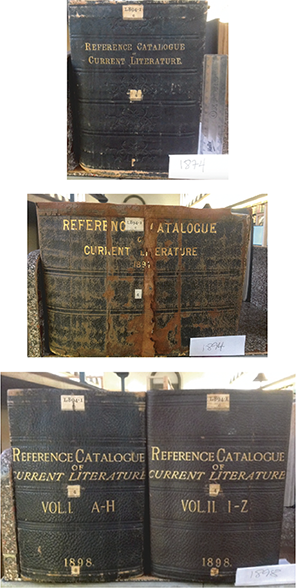
An example that illustrates this growth is Ward, Lock and Tyler’s catalogue which was 64 pages long in 1875 but had over 200 pages in 1894, including a 28-page index of its own. The 1898 edition had an index of 100,000 titles, and the finished version was so large that it had to be split into two volumes.
Not all publishers were persuaded of The Reference Catalogue’s usefulness and some never contributed their lists, such as Scottish publishers Oliver and Boyd and legal specialists Sweet and Maxwell. Nonetheless, and despite their limitations as historical sources, the eight editions have preserved valuable information about the Victorian book trade and the range of books available for sale. Book historians such as Simon Eliot and William St Clair have raised concerns over the likely under-counting of published titles in the Victorian period, especially for cheap books. These low-priced books were less likely to have been preserved in libraries and institutions and were therefore not enumerated in union catalogues or surveys such as the Nineteenth Century Short-Title Catalogue, but large numbers of them are listed in The Reference Catalogue.Footnote 243 Tabulating the titles in each of the publishers’ catalogues would be a huge undertaking but would be an invaluable exercise and offer historians a far greater understanding of the reading choices available to Victorian readers.
The catalogue continued to grow into the twentieth century, and by 1932, three volumes and two feet of shelving were required to accommodate them.Footnote 244 Whitaker’s heirs, now trading as J. Whitaker & Sons and known as ‘Whitakers’, decided to stop binding the individual catalogues and instead expanded the index alone, transforming it into the most comprehensive listing of English-language books in print in the world. Further changes were made over the years. After 1961, it was called British Books in Print, and in 1978 the records were transferred to microfiche and published monthly.Footnote 245 From 1988, the publication was renamed Whitaker’s Books in Print.
The firm’s role as the self-appointed guardian of book trade bibliography led to their involvement in several key developments. Whitakers acted as the distribution agents for the British National Bibliography and assisted the efforts to create a bibliographic service designed for libraries in 1950.Footnote 246 Of perhaps even greater significance to the current book trade, Whitakers also played a key role in the development of the international numbering system (ISBN) in the 1960s. As computerisation spread, albeit unevenly, to the book trade’s warehouses, the need for standardised identifiers across the global book and library trades became urgent. The old methods of identifying individual editions were no longer adequate; computers demanded machine-readable standardised systems using numbers rather than letters and words. According to David Whitaker, British publishers did not immediately appreciate the need for books to have a unique identifying number until W. H. Smith began to computerise their warehouse in 1965.Footnote 247 On behalf of Whitakers, the Council of British National Bibliography, and the Publishers Association, David Whitaker wrote the rule book for the Standard Book Numbering Agency in 1967.Footnote 248 Together with Daniel Melcher, the inheritor of Frederick Leypoldt’s business in America now called R. R. Bowker, the two publishers of book trade news and sales data became the official agencies for ISBNs in their respective countries in 1969.Footnote 249 Although still not digitised itself, traces of Whitaker’s catalogue remain at the heart of the most important information systems that underpin the operations of the national and international book trade. Its DNA lives on in the services now administered by the global data service company Nielsen Book UK, such as BookData, a database of published works and, in effect, the latest iteration of The Reference Catalogue.Footnote 250
Whitaker and the Organisation of the Trade
There had been no trade body to oversee book prices and control discounting since 1852 when the existing regulations were abolished and the committee that oversaw them was dissolved. This also meant that there was no central authority to act as a mediator for disputes between traders, regulate working conditions, or represent the interests of the book trade as a whole. Whitaker repeatedly implored his readers to consider forming a trade association, but the spirit of the times favoured free trade, and many booksellers preferred the freedom to set their own prices and discount freely. Nonetheless his views were clear: underselling was ‘the greatest evil of the day’, a pervasive problem that created ‘an insane competition’ that benefitted no-one.Footnote 251 While both publishers and booksellers were blamed, it was the publishers’ self-interest that he particularly condemned: ‘This spirit of underselling is said to be fostered by some of the larger publishers, who are charged with caring for nothing but their own immediate interests.’Footnote 252 Booksellers did not escape criticism and were accused of being complicit in their own destruction: ‘booksellers have been so insane as to run the prices down in a manner totally uncalled for’.Footnote 253 It was a problem they had created for themselves as a response to increasing competition, and it was for them to resolve it. For there to be any hope of improvement, Whitaker urged his readers to ‘make themselves acquainted with the pernicious results of the system’ promising that The Bookseller would be ‘instrumental in bringing about a better state of things’.Footnote 254 Its pages would be committed to the collective effort of finding a resolution:
This is a booksellers’ question; and if anything is to be done, it must be done by ourselves. Our columns will, to any reasonable extent, be open to the trade, and we shall be happy to recommend any well-intentioned plan.Footnote 255
Underselling was frequently discussed in the letter pages and in occasional editorials in The Publishers’ Circular in the 1860s and 1870s, but there was little agreement about where the responsibility for reform lay. Correspondents variously blamed booksellers, wholesalers, and publishers.Footnote 256 Publishers themselves did not accept responsibility: ‘A Publisher’ wrote to The Bookseller stating his surprise at his colleagues’ lack of interest in the issue, complaining that ‘the London publishers and wholesale houses appear to take so little interest in this important subject’.Footnote 257 The Publishers’ Circular doubted that a solution was even possible and that it was ‘beyond the power of any combination of the trade’.Footnote 258 For Whitaker, however, such resignation and passivity were unacceptable and the topic was raised and debated throughout his editorship of The Bookseller. Letters were published, arguments were ventilated, and meetings to discuss the possibilities for cooperation were proposed, but, despite intensifying competition, there was little actual progress until almost the end of the century when a group of London booksellers formed the London Booksellers’ Society (LBS).
By the 1890s even the publishers were beginning to be concerned. They were particularly worried about the viability of higher class booksellers on whom they relied to stock a wide range of books in a variety of formats and bindings. Not only did they have to compete with undersellers but now there was new competition from cooperative societies like the Army and Navy Stores and from department stores such as Harrods. These retailers bought in bulk and received preferential terms from publishers which enabled them to offer discounts of 3d or even 4d in the shilling to undercut smaller booksellers. Publishers themselves were also under pressure from authors, with support from 1884 from the Society of Authors, demanding a fairer return from their copyrights and from rises in the costs of production and distribution. Pressure was growing and the book trade had to change and address new commercial imperatives.
In March 1890, The Bookseller published a letter that marked the beginning of a new phase of cooperation between booksellers and publishers. Publisher Frederick Macmillan’s letter, printed under the heading ‘A Remedy for Underselling’, proposed two new pricing and discounting strategies: ‘subject’ books would be sold at whatever discount the bookseller decided as usual but ‘nett’ books would be sold at the price fixed by the publisher.Footnote 259 Booksellers would also be offered a reasonable trade allowance to ensure a modest profit per copy sold. The scheme would not be compulsory and booksellers who wanted to sell with discounts could continue to do so. The trade’s reaction was initially mixed, but Macmillan forged ahead and tested his idea, fittingly, with a new book by the eminent economist Alfred Marshall, Principles of Economics. It was priced at 12/6 rather than the more usual 16s for a book of this kind.
A few months later, a ‘private and informal’ meeting of a dozen booksellers was convened in to discuss forming a London Booksellers’ Society (LBS) with Whitaker’s son Joseph Vernon, now editor of The Bookseller, nominated as one of the council members.Footnote 260 The chief purpose of the new society went beyond just pricing policies. It would also:
invite the co-operation of the London trade in forming a permanent and organised society, having for its aim to maintain and improve the position of the retailer bookseller, to improve social intercourse, and to soften the asperities incidental to commercial rivalry.Footnote 261
More specific objectives included standardising trading terms, establishing a mechanism to resolve grievances that might arise between parties, and providing the opportunity for ‘social intercourse’ among members.Footnote 262 Although these may not have been couched in the same words, the concerns of the LBS broadly reflected those championed by Whitaker Senior in The Bookseller since 1858. Perhaps at last noting some improvement in trade relations, The Bookseller reported that there was ‘a growing inclination on the part of the trade to enter into closer bonds of relationship one with another than has hitherto been customary’.Footnote 263 Finally, there was enough common cause for the book trade to start to act together in its own interests. But despite the positive signs, progress remained slow, and it was another half-decade before significant reforms were agreed.
In the summer of 1894, publishers came under pressure from W. H. Smith and Mudie’s, both influential bulk buyers, to delay the publication of cheap reprint editions of novels that first appeared in the three-volume format for up to a year.Footnote 264 Two months previously, the LBS had submitted a ‘memorial to publishers’ signed by a thousand booksellers, claiming that they could not make a profit from the ‘better class’ of books on current terms.Footnote 265 The Bookseller commented that few booksellers were interested in three-volume novels unless they also operated a library themselves, and the LBS declared themselves to be ‘unanimously in favour of such novels being published at once in a six-shilling form’.Footnote 266 The publishers of higher-priced books suddenly found common cause with booksellers, prompting a leader in The Publishers’ Circular that mused whether it was time for publishers to follow the examples of authors and booksellers and ‘combine to protect their interests’.Footnote 267
The formation of a national booksellers’ association, the Associated Booksellers of Great Britain and Ireland (ABGBI) in 1895, increased the pressure further. In January 1896, the Publishers Association (PA) was formed with C. J. Longman as President and John Murray as Vice-President. Support from the most powerful publishers was essential for any trade-wide initiative, and it was an important indicator of the gravity of the moment that the committee of the PA was formed of the leading publishers, including Longmans, Green & Co., William Blackwood and Sons, Smith, Elder & Co., and John Murray. Illustrating the grip the leading houses continued to have over the trade and the entrenched nature of its structures, this new committee included many of the same houses that had controlled the previous association, which was dissolved in 1852, with only one of the newer houses, William Heinemann (1863–1920), invited on to the committee.Footnote 268
Finally, after a break of more than four decades, both sides of the book trade were now ready to cooperate to protect their mutual interests and accept regulation for the common good. After four years of negotiation, the PA, acknowledging that they had to act ‘in the interests of the booksellers’, drew up terms for a scheme that was satisfactory to the ABGBI.Footnote 269 The Net Book Agreement (NBA), described by Frederick Macmillan as the ‘Magna Charta [sic] of the book trade’, came into operation on 1 January 1900. It remained in force until 1995. Whitaker had managed to sustain a dogged belief in cooperation and the need for a trade association through nearly four decades, despite the lack of interest from his colleagues.
Later, observers from the younger generation offered their analysis for the reluctance to cooperate. Heinemann suggested that, in contrast to the German states, the historically highly centralised nature of the British trade, with its twin centres of production in London and Edinburgh meant that there was less need for a separate trade body.Footnote 270 He also identified the highly competitive nature of the British trade as another factor and feared that this tendency might threaten its very survival:
I for one do not envy the person who is engaged in so ennobling a business as ours, living as he does in the companionship of the great minds, past and present; I do not envy him, I say, who feels that in such a calling and in such a cause there is no higher obligation, no other purpose, than that of making profit at the expense of his neighbour; […] it is assuredly not the right road to the making of riches and the creating of a commonwealth.Footnote 271
In a memoir published in 1923, Joseph Shaylor (1844–1932), a bookseller and former managing director of wholesalers Simpkin Marshall, noted other factors such as the over-production of books, their low prices, and the inclusion of ‘outside firms’, presumably referring to drapers, grocers, and latterly department stores, in selling books.Footnote 272 W. G. Corp, chronicler of the ABGBI, suggested that a combination of the ‘highly individualistic tendency of the age’ and the pusillanimity of the publishers of the day prevented the necessary cooperation.Footnote 273 If the strengths of the book trade were its enterprise, diversity, and openness to new entrants, it was these very characteristics that had also made it resistant to accepting anything that restricted their entrepreneurial impulses.
Retirement
Although supposedly retired in 1875, Whitaker remained active after relinquishing editorial responsibility for The Bookseller. He was now fifty-five years old and had recently been elected as a Fellow to the Society of Antiquaries. He was also still fully engaged with his own business and in the wider book trade. Three of his daughters had married publishers, and, in addition to Joseph Vernon, several of his younger sons would join in the family firm. His youngest child, Leonard, born in 1875, was the last of fifteen children and the one whose own offspring would eventually pilot the family’s publishing interests up to the eve of the new millennium in 1999.Footnote 274
Retirement was busy. In addition to producing the annual editions of Whitaker’s Almanack, the veteran publisher remained faithful to his motivating mission to produce books with a practical use. He returned to the devotional manuals and commentaries authored by friends that he had published in the 1850s, but now, responding to what he hoped would be a more receptive market, offered his titles in a wider selection of formats. One such title, The Daily Round: Meditation, Praise and Prayer Adapted to the Course of the Christian Year, was advertised as available in ten different editions. They ranged in price from a pocket-sized volume bound in cloth for three shillings to a larger octavo printed in large type and marketed as ‘a most acceptable present to Aged Persons’ bound in Morocco leather and retailing at eighteen shillings.Footnote 275
Eventually even the indefatigable Whitaker succumbed to ill-health, which was exacerbated by a broken heart. In February 1895, his eldest son, Joseph Vernon, had died aged fifty, and the ailing publisher, now aged seventy-five, followed a few months later on 15 May. The funeral was to be simple, ‘plain decent and inexpensive and without mutes feathers scarves flowers or gloves’.Footnote 276 At his request the funeral procession started at the offices of The Bookseller in Warwick Lane, a poignant reminder of the centrality of the book trade to his life.Footnote 277 The procession headed to Norwood in south London, where he was buried beside his son. His estate was valued at £16,934 0s 9d.Footnote 278 After the family, generous legacies and gifts were provided for in his will for close friends, professional associates, and colleagues. His chief cashier and business partner, Charles William Speight, received £100; Reverend Thomas Benson Pollock, the long-time Whitaker author of The Daily Round, received twenty guineas; Whitaker’s four assistants were gifted ten guineas each, and all the clerks, porters, and other office assistants who had been with the company for more than three years were also given £5 each. There were small gifts of ten guineas to his mother-in-law and other family friends.Footnote 279 All the female domestic servants in the household were given £5 over and above their wages.Footnote 280
News of his death was greeted with sadness and respect for his publishing achievements. Many of the newspaper obituaries focused on the success of Whitaker’s Almanack, but the literary and trade press acknowledged the significance of his work. The Athenaeum told its readers that:
He was a man greatly respected in the trade, and his opinion on any matter connected with publishing or selling of books carried great weight. He was an authority on all questions of copyright, and was frequently called upon to act as arbitrator.Footnote 281
The Book and News Trades Gazette described The Bookseller as ‘The Times of bookselling journals’, a recognition of the journal’s continued pre-eminence.Footnote 282 The obituary also mentioned Whitaker’s ‘magnificent’ library, noting that ‘he was never more delighted than when showing his treasures to friends who shared his own intense love of books’.Footnote 283 However, Whitaker himself knew all too well that a love of books, however intense, was not enough for successful bookselling. At the very least it also required a thorough understanding of the unpredictable market for books and access to the latest bibliographic information.
Conclusion
Whitaker’s legacy lives on in the infrastructure of the modern publishing industry. The Bookseller remains the industry journal, and the industry could not function without the database that grew out of The Reference Catalogue. Over the last third of the nineteenth century, Whitaker’s publications became the primary sources of information and means of communication for a bookselling trade in the throes of transforming itself, often unwillingly, into a modern industry. The processes of this change have been preserved for historians in the pages of his publications. Many business records and archives of Victorian booksellers have disappeared, and many of the remaining ones are incomplete, so the surviving issues of The Bookseller and The Reference Catalogue contain a unique corpus of information about the personalities, practices, and frustrations of bookselling. The Bookseller has preserved the accumulation of snippets of the everyday irritations and squabbles that threatened booksellers’ livelihoods and offers a unique view of the extensive but usually voiceless networks of small businessmen as they tried to make a living from a trade in books, telling a different but complementary history to that in The Publishers’ Circular. The dramatic expansion of The Reference Catalogue from 1874 to 1898 vividly demonstrates the growth in book production over those years and contains perhaps the only record of some of the books that posterity has deemed not important enough for preservation in libraries.
Much has changed in the book trade since Whitaker’s time, but many of the same problems persist. Even though booksellers have a trade association to offer advice and support, Nielsen Book UK to provide sales figures and market analysis, and, of course, The Bookseller to provide trade news, bookselling remains a challenging business. The number of bookshops has halved in a quarter century, falling from just under two thousand in 1995 when the NBA was abandoned to just 890 at the end of 2019.Footnote 284 Independent booksellers are still threatened by aggressive price competition from monopolistic online retailers, supermarkets, and chain booksellers like Waterstones, as well as from rising fixed costs, taxes, rent, and labour. Hours are still unsociable, with chains often open seven days a week until 8pm, and earnings for assistants remain persistently low – starting salaries average £14–17,000 per year.Footnote 285
Managing the huge volume of books in print is even more difficult. A bookshop can only stock a fraction of the 20 million plus titles in print.Footnote 286 Nevertheless, Whitaker would have felt vindicated by the views of Britain’s most important bookseller, James Daunt of Waterstones (UK), and Barnes and Noble (US), which reflect many of his own: booksellers must be free to select and curate stock to suit their own customer base and choose books they are knowledgeable and passionate about, not just publishers’ recommendations; committed booksellers should be properly trained and remunerated.Footnote 287 It is a testament to Whitaker’s understanding of the fundamentals of bookselling that his publications remain central to the publishing industry and are available for historians seeking further understanding of the Victorian book trade.
Joseph’s Whitaker’s contribution to the Victorian book trade was critical and far-reaching, and the description by David Whitaker of his great-grandfather’s firm as the ‘mechanic’ to the book trade understates his achievements. The information system he created with The Bookseller and The Reference Catalogue helped to transform a traditional trade into a modern global industry, and remnants of his influence on the contemporary publishing industry are still discernible 130 years after his death. On their blue plaque, English Heritage may define him as the originator of a popular almanack, but his achievements were of far greater and of more lasting significance: he deserves to be recognised as one of the most important publishers of the nineteenth century.
- 1820
–Born Shoreditch London
- 1833
–Apprenticed to Barritts in Fleet St London
- 1840
–Marries Ann Norris at the Strand Union London
- 1843/4
–Employed at J. H. Parker in Oxford
- 1847/8
–Opened Parker’s London branch in the Strand
- 1852
–Starts own independent bookselling and publishing business in Pall Mall
- 1853
–Ann dies in childbirth
- 1854–56
–Insolvent debtor
- 1855
–Marries Elizabeth Brown
- 1856
–Editor of The Gentleman’s Magazine
- 1858
–Launches The Bookseller
- 1868
–Launches Whitaker’s Almanack
- 1874
–Launches The Reference Catalogue of Current Literature
- 1875
–Retires from editorship of The Bookseller
- 1875
–Elected to the Society of Antiquaries
- 1895
–Dies in Enfield London
Prospectus for The Penny Post (12 December 1850).
The Penny Post (1850).
The Family Almanack and Educational Register (1850).
Whitaker’s Almanack for Clergymen (1852).
Whitaker’s Clergymen’s Diary (1852).
Whitaker’s Penny Almanack (1852).
The Artist (1855).
The Bookseller (1858).
Whitaker’s Almanack (1869).
The Reference Catalogue of Current Literature (1874).
Series Editor
Samantha J. Rayner
University College London
Samantha J. Rayner is Professor of Publishing and Book Cultures at UCL. She is also Director of UCL’s Centre for Publishing, co-Director of the Bloomsbury CHAPTER (Communication History, Authorship, Publishing, Textual Editing, and Reading), and co-Chair of the Bookselling Research Network.
Associate Editor
Leah Tether
University of Bristol
Leah Tether is Professor of Medieval Literature and Publishing at the University of Bristol. With an academic background in medieval French and English literature and a professional background in trade publishing, Leah has combined her expertise and developed an international research profile in book and publishing history, from manuscript to digital.
Advisory Board
Simone Murray, Monash University
Claire Squires, University of Stirling
Andrew Nash, University of London
Leslie Howsam, Ryerson University
David Finkelstein, University of Edinburgh
Alexis Weedon, University of Bedfordshire
Alan Staton, Booksellers Association
Angus Phillips, Oxford International Centre for Publishing
Richard Fisher, Yale University Press
John Maxwell, Simon Fraser University
Shafquat Towheed, The Open University
Jen McCall, Central European University Press/Amsterdam University Press
About the Series
This series aims to fill the demand for easily accessible, quality texts available for teaching and research in the diverse and dynamic fields of Publishing and Book Culture. Rigorously researched and peer-reviewed Elements will be published under themes, or ‘Gatherings’. These Elements should be the first check point for researchers or students working on that area of publishing and book trade history and practice: we hope that, situated so logically at Cambridge University Press, where academic publishing in the UK began, it will develop to create an unrivalled space where these histories and practices can be investigated and preserved.
Gathering Editor: Andrew Nash
Andrew Nash is Reader in Book History and Director of the London Rare Books School at the Institute of English Studies, University of London. He has written books on Scottish and Victorian Literature, and edited or co-edited numerous volumes, including, most recently,The Cambridge History of the Book in Britain, Volume 7 (Cambridge University Press, 2019).
Gathering Editor: Leah Tether
Leah Tether is Professor of Medieval Literature and Publishing at the University of Bristol. With an academic background in medieval French and English literature and a professional background in trade publishing, Leah has combined her expertise and developed an international research profile in book and publishing history from manuscript to digital.