Element contents
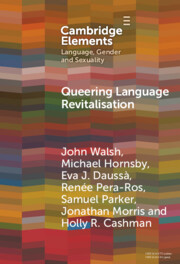
Queering Language Revitalisation
Navigating Identity and Inclusion among Queer Speakers of Minority Languages
Published online by Cambridge University Press: 08 January 2025

Summary
This Element aims to deepen our understanding of how the fields of multilingualism, second language acquisition and minority language revitalisation have largely overlooked the question of queer sexual identities among speakers of the languages under study. Based on case studies of four languages experiencing differing degrees of minoritisation – Irish, Breton, Catalan and Welsh – it investigates how queer people navigate belonging within the binary of speakers/non-speakers of minoritised languages while also maintaining their queer identities. Furthermore, it analyses how minoritised languages are dealing linguistically with the growing need for 'gender-fair' or 'gender-neutral' language. The marginalisation of queer subjects in these strands of linguistics can be traced to the historical dominance of the Fishmanian model of 'Reversing Language Shift' (RLS), which assumed the importance of the deeply heteronormative model of 'intergenerational transmission' of language as fundamental to language revitalisation contexts.
Keywords
Information
- Type
- Element
- Information
- Online ISBN: 9781009591034Publisher: Cambridge University PressPrint publication: 30 January 2025
References
Abbou, J., 2011. ‘Double gender marking in French: A linguistic practice of antisexism’. Current Issues in Language Planning 12 (1), 55–75.CrossRefGoogle Scholar
Académie francaise, 2017. ‘Déclaration de l’Académie française sur l’écriture dite “inclusive”’. Déclaration de l’Académie française sur l’écriture dite ‘inclusive’. https://bit.ly/4cy3x11 (accessed 15 April 2023).Google Scholar
Amarelo, D., 2019. ‘A (de)construción identitaria homosexual na conversa: Implicacións socioculturais no discurso gay galego’. Madrygal: Revista de Estudios Gallegos 22, 31–49.CrossRefGoogle Scholar
Angouri, J., 2021. ‘Language, gender, and sexuality: Sketching out the field’. In Angouri, J. and Baxter, J. (eds.), The Routledge Handbook of Language, Gender, and Sexuality. London: Routledge, 1–22.CrossRefGoogle Scholar
Ansara, Y. G. and Hegarty, P., 2014. ‘Methodologies of misgendering: Recommendations for reducing cisgenderism in psychological research’. Feminist Psychology 24, 259–270.CrossRefGoogle Scholar
Ar Rouz, D., 2016. ‘À la poursuite du diamant glaz: Le standard breton’. Sociolinguistica 30 (1), 145–174.CrossRefGoogle Scholar
Bailey, A., 2019. ‘“Girl-on-girl culture”: Constructing normative identities in a corpus of sex advice for queer women’. Journal of Language and Sexuality 8 (2), 195–220.CrossRefGoogle Scholar
BBC, 2022a. Oes cynrychiolaeth LHDTC+ ddigonol yn y sîn gerddoriaeth Gymraeg? [Is there enough LGBTQ+ representation in the Welsh-language music scene?]. www.bbc.co.uk/cymrufyw/60290333 (accessed 18 January 2023).Google Scholar
BBC, 2022b. ‘Dal ffordd i fynd’ i fod yn gynhwysol at bobl LHDTC+ [Still a way to go to be inclusive towards LGBTQ+ people]. www.bbc.co.uk/cymrufyw/62418244 (accessed 18 January 2023).Google Scholar
BBC, 2023a. Siaradwyr Cymraeg anneuaidd eisiau iaith LHDTC+ gynhwysol [Non-binary Welsh speakers want inclusive LGBTQ+ language]. www.bbc.co.uk/cymrufyw/64166667 (accessed 18 January 2023).Google Scholar
BBC, 2023b. Sefydlu Eisteddfod leol ar gyfer pobl LHDTC+? [Establish a local Eisteddfid for LGBTQ+ people?]. www.bbc.co.uk/cymrufyw/64240610 (accessed 18 January 2023).Google Scholar
Berger, M., 2019. ‘A guide to how gender-neutral language is developing in the world’. The Guardian. https://wapo.st/3VRWzyA (accessed 15 April 2023).Google Scholar
Boellstorff, T. and Leap, W. L., 2004. ‘Introduction: Globalization and “new” articulations of same-sex desire’. In Leap, W. L. and Boellstorff, T. (eds.), Speaking in Queer Tongues: Globalization and Gay Language. Urbana: University of Illinois Press, 1–22.Google Scholar
Bonnin, J. E. and Coronel, A. A., 2021. ‘Attitudes toward gender-neutral Spanish: Acceptability and adoptability’. Frontiers in Sociology 6, 616–629.CrossRefGoogle ScholarPubMed
Borba, R., (ed.), 2020. Discursos transviados: Por uma linguística queer. São Paulo: Cortez Editora.Google Scholar
Borba, R., 2022. ‘Animating other wor(l)ds: Transformations of language and social justice (Notes on “allied linguistics”)’. American Association of Applied Linguistics (AAAL). Pittsburgh, March 19–22.Google Scholar
Boroditsky, L., Schmidt, L. A., and Phillips, W., 2003. ‘Sex, syntax, and semantics’. In: Getner, D. and Goldin-Meadow, S. (eds.) Language in mind: advances in the study of language and thought. Cambridge: MIT Press, 61–79.CrossRefGoogle Scholar
Boudreau, A., 2016. À l’ombre de la langue légitime: L’Acadie dans la Francophonie. Paris: Classiques Garnier.Google Scholar
Boudreau, A. and Dubois, L., 2005. ‘L’affichage a Moncton: Miroir ou masque?’ Revue de l’Universite de Moncton 36 (1), 185–217. https://doi.org/10.7202/011993ar.CrossRefGoogle Scholar
Braun, V., and Clarke, V., 2006. ‘Using thematic analysis in psychology’. Qualitative Resesarch in Psychology 3 (2), 77–101.CrossRefGoogle Scholar
Braun, V. and Clarke, V., 2022. Reflexive Thematic Analysis: A Practical Guide. London: Sage.Google Scholar
Braun, V. and Clarke, V., 2023. ‘Toward good practice in thematic analysis: Avoiding common problems and be(com)ing a knowing researcher’. International Journal of Transgender Health 24 (1), 1–6.CrossRefGoogle ScholarPubMed
Broudic, F., 2009. Parler breton au XXIe siècle: Le nouveau sondage de TMO-Régions. Brest: Emgleo Breiz.Google Scholar
Brutt-Griffler, J., and Kim, S., 2017. ‘In their own voices: Development of English as a gender-neutral language’. English Today 34 (1), 12–19.CrossRefGoogle Scholar
Burke, P. J. and Stryker, S., 2016. ‘Identity theory: Progress in relating the two strands’. In Stets, J. E. and Serpe, R. T. (eds.), New Directions in Identity Theory and Research. Oxford: Oxford University Press, 657–692.CrossRefGoogle Scholar
Butler, J., 1990. Gender Trouble: Feminism and the Subversion of Identity. Abingdon: Routledge.Google Scholar
Caldwell, S., 2018. ‘Marxism, feminism and trangender politics’. International Socialism 157, 25–52.Google Scholar
Carlin, P. and Mac Giolla Chríost, D., 2016. ‘A standard for language? Policy, territory, and constitutionality in a devolving Wales’. In Durham, M. and Morris, J. (eds.), Sociolinguistics in Wales. London: Palgrave Macmillan, 93–119.CrossRefGoogle Scholar
Cashman, H., 2018. Queer, Latinx, and Bilingual: Narrative Resources in the Negotiation of Identities. Abingdon: Routledge.Google Scholar
Castillo Sánchez, S. and Mayo, S., 2019. ‘El language inclusivo como “norma” de empatía e identidad: Reflexiones entre docentes y futures profesores’. Literatura y lingüística (40), 377–391.CrossRefGoogle Scholar
Central Statistics Office, 2017. Census of Population 2016. Profile 10: Education, Skills and the Irish Language. Cork: Central Statistics Office. www.cso.ie/en/releasesandpublications/ep/p-cp10esil/p10esil/.Google Scholar
Central Statistics Office, 2022. Census of Population 2022. Profile 8: The Irish Language and Education. Cork: Central Statistics Office. https://bit.ly/3VLk9Nx.Google Scholar
Chantreau, K. and Moal, S., 2022. ‘The transmission of Breton in the family: The effect of family rupture and recomposition’. In Hornsby, M., McLeod, W. (eds), Transmitting Minority Languages: Complementary Reversing Language Shift Strategies. Palgrave Studies in Minority Languages and Communities. Cham: Palgrave Macmillan, 247–275.Google Scholar
Clarke, V. and Braun, V., 2017. ‘Thematic analysis’. Journal of Positive Psychology 12 (3), 297–298.CrossRefGoogle Scholar
Coady, A., 2018. ‘The origin of sexism in language’. Gender and Language 12 (3), 271–293.CrossRefGoogle Scholar
Del Valle, J., 2018. ‘La política de la incomodidad. Notas sobre gramática y lenguaje inclusivo’. Anuario de Glotopolítica (August 28th).Google Scholar
Cor, D. N. and Chan, C. D., 2017. ‘Intersectional feminism and LGBTIQQA+ psychology: Understanding our present by exploring our past’. In Ruth, R. and Santacruz, E. (eds.), LGBT Psychology and Mental Health: Emerging Research and Advances. Santa Barbara: Praeger, 109–132.CrossRefGoogle Scholar
Crenshaw, K., 1989. ‘Demarginalizing the intersection of race and sex: A black feminist critique of antidiscrimination doctrine, feminist theory and antiracist politics’. University of Chicago Legal Forum 1989 (1), Article 8. https://bit.ly/4c9fvic (accessed 18 January 2023).Google Scholar
Deuchar, M., Donnelly, K. and Piercy, C., 2016. ‘“Mae pobl monolingual yn minority”: Factors favouring the production of code switching by Welsh–English bilingual speakers’. In Durham, M. and Morris, J. (eds.), Sociolinguistics in Wales. London: Palgrave Macmillan, 209–239.CrossRefGoogle Scholar
Dołowy-Rybińska, N., 2020. ‘Informal bilingual teachers’ language practices and the consequences on pupils’ language choices in a situation of unequal bilingualism: The case of an Upper Sorbian education system’. Multilingua: Journal of Cross-Cultural and Interlanguage Communication 39 (2), 169–191.CrossRefGoogle Scholar
Dołowy-Rybińska, N., 2022. ‘Native and non-native speakers’ school language practices and transmission in Upper Lusatia’. In Hornsby, M. and McLeod, W. (eds.), Transmitting Minority Languages: Complementary Reversing Language Shift Strategies. Cham: Springer, 139–164.CrossRefGoogle Scholar
Doty, A., 1993. Making Things Perfectly Queer: Interpreting Mass Culture. Duluth: University of Minnesota Press.Google Scholar
Driscoll-Evans, P. R., 2020. Sexual citizenship beyond the metropolis: Bareback sex, chemsex and loneliness in a rural county in the United Kingdom. PhD thesis, University of Essex. https://bit.ly/3VuoR0R (accessed 12 February 2024).Google Scholar
Edelman, L., 2004. No Future: Queer Theory and the Death Drive. Durham: Duke University Press.Google Scholar
Everett, C. 2011. ‘Gender, pronouns, and thought: The ligature between epicene pronouns and a more neutral gender perception’. Gender and Language 5 (1), 133–152.CrossRefGoogle Scholar
Fishman, J., 1991. Reversing Language Shift: Theoretical and Empirical Foundations of Assistance to Threatened Languages. Clevedon: Multilingual Matters.CrossRefGoogle Scholar
Fuertes Gutiérrez, M., 2022. ‘Lenguaje inclusivo y universidad: Guías para el lenguaje no sexista’. Online presentation at the Seminario ELEUK, October 14.Google Scholar
Fundeu (Instituto de Ingeniería del Conocimiento), 2020. ‘Uso en Twitter de la x, la e y la @ para evitar la mención expresa del género’. https://fundeu.es/documentos/marcasinclusivastwitter.pdf (accessed 15 April 2023).Google Scholar
Gal, S., and Irvine, S. T., 1995. ‘The boundaries of languages and disciplines: How ideologies construct difference’. Social Research 62 (4), 967–1001.Google Scholar
Geffard, V. 2022. ‘Elles créent un lexique en breton du vocabulaire féministe qui englobe la communauté LGBTQIA+’. Ouest France, Rennes, 3 November. https://bit.ly/3VxlpCn (accessed: 8 June 2023).Google Scholar
Ghaziani, A. and Brim, M., 2019. ‘Four provocations for an emerging field’. In Ghaziani, A. and Brim, M. (eds.). Imagining Queer Methods. New York: New York University Press, 3–27.Google Scholar
Grieser, J., 2021. ‘Critical race theory and the new sociolinguistics’. In Burkette, A. and Warhol, T. (eds.). Crossing Borders, Making Connections: Interdisciplinarity in Linguistics. Berlin: De Gruyter Mouton, 41–58.CrossRefGoogle Scholar
Griffiths, J., 2021. Speak Not: Empire, Identity and the Politics of Language. London: Bloomsbury.CrossRefGoogle Scholar
Gustafsson Sendén, M., Bäck, E. A. and Lindqvist, A., 2015. ‘Introducing a gender-neutral pronoun in a natural gender language: The influence of time on attitudes and behavior’. Frontiers in Psychology 6 (893).CrossRefGoogle Scholar
Gygax, P. and Gesto, N., 2007. ‘Féminisation et lourdeur de texte’. L’Année Psychologique 107 (2), 239–255.CrossRefGoogle Scholar
Hall, K., Borba, R. and Hiramoto, M., 2021. ‘Relocating power: The feminist potency of language, gender and sexuality research’. Gender and Language 15 (1), 1–10.CrossRefGoogle Scholar
Heller, M., 2001. ‘Gender and public space in a bilingual school’. In Pavlenko, A., Blackledge, A., Piller, I. and Teutsch-Dwyer, M. (eds.). Multilingualism, Second Language Learning and Gender. Berlin: Mouton de Gruyter, 257–282.CrossRefGoogle Scholar
Heller, M., 2007. ‘Bilingualism as ideology and practice’. In Heller, M. (ed.), Bilingualism: A Social Approach. London: Palgrave Macmillan, 1–22.CrossRefGoogle Scholar
Heller, M. and Labrie, N., (eds.), 2003. Discours et Identités: La Francité Canadienne entre Modernité et Mondialisation. Fernelmont: Éditions Modulaires Européennes.Google Scholar
Hennen, P., 2008. Faeries, Bears, and Leathermen: Men in the Community Queering the Masculine. Chicago: University of Chicago Press.CrossRefGoogle Scholar
Hinton, L., 2013. ‘Introduction’. In Hinton, L. (ed.). Bringing Our Languages Home: Language Revitalization for Families. Berkeley: Heyday, xi–xx.Google Scholar
Hiramoto, M., Borba, R. and Hall, K., 2020. ‘Hope in a time of crisis’. Gender and Language 14 (4), 347–357.CrossRefGoogle Scholar
Hornsby, M., 2015. ‘The “new” and “traditional” speaker dichotomy: Bridging the gap’. International Journal of the Sociology of Language 231 (1), 107–25.Google Scholar
Hornsby, M., 2017. ‘Finding an ideological niche for new speakers in a minoritised language community’. Language, Culture and Curriculum 30 (1), 91–104.CrossRefGoogle Scholar
Hornsby, M., 2019a. ‘Gender-fair language in a minority setting: The case of Breton’. Studia Celtica Posnaniensia 4 (1), 59–74.CrossRefGoogle Scholar
Hornsby, M., 2019b. ‘Positions and stances in the hierarchization of Breton speakerhood’. Journal of Multilingual and Multicultural Development 40 (5), 392–403.CrossRefGoogle Scholar
Hornsby, M. and McLeod, W. (eds.), 2022. Transmitting Minority Languages: Complementary Reversing Language Shift Strategies. Cham: Springer.CrossRefGoogle Scholar
Hornsby, M., and Quentel, G., 2013. ‘Contested varieties and competing authenticities: Neologisms in revitalised Breton’. International Journal of the Sociology of Language 223, 71–86.Google Scholar
Hornsby, M. and Vigers, D., 2018. ‘“New” speakers in the heartlands: Struggles for speaker legitimacy in Wales’. Journal of Multilingual and Multicultural Development 39 (5), 419–430.CrossRefGoogle Scholar
Jaspal, R. and Bayley, J., 2020. HIV and Gay Men: Clinical, Social and Psychological Aspects. London: Palgrave Macmillan.CrossRefGoogle Scholar
Jones, R., 2019. ‘Place and identity: Wales, “Welshness” and the Welsh language’. Geography 104 (1), 19–27.CrossRefGoogle Scholar
IEC, 2023. Minutes of the Plenary Session of October 20th. Secció Filològica de l’Institut d’Estudis Catalans.Google Scholar
Imborek, K. L., Nisly, N. L., Hesseltine, M. J., Grienke, J., Zikmund, T. A., Dreyer, N. R., et al., 2017. ‘Preferred names, preferred pronouns, and gender identity in the electronic medical record and laboratory information system: is pathology ready?’ Journal of Pathologics Informatics 8 (8), 42.CrossRefGoogle ScholarPubMed
Kalinowski, S., 2019. ‘Lenguaje inclusivo: Cambio lingüístico o cambio social’. Revista CTBCBA 141, 53–55.Google Scholar
Kalinowski, S., 2020. ‘Lenguaje inclusivo en usuarios de Twitter en Argentina: Un estudio de corpus’. Cuarenta Naipes 2 (3), 233–259.Google Scholar
Katsiveli-Siachou, S., 2021. Intersections of sexuality and Greek national belonging: A conversation analytic approach. PhD thesis, Queen Mary, University of London.Google Scholar
Kaufmann, C. and Bohner, G., 2014. ‘Masculine generics and gender-aware alternatives in Spanish’. IZGOnZeit: Onlinezeitschrift des Interdisziplinären Zentrums für Geschlechterforschung (IZG), 8–17.Google Scholar
Kennard, H., 2022. ‘Transmission of Breton among immersion-school students: The impact of home language’. In Hornsby, M., McLeod, W. (eds) Transmitting Minority Languages: Complementary Reversing Language Shift Strategies. Palgrave Studies in Minority Languages and Communities. Palgrave Macmillan, Cham, 247–278.CrossRefGoogle Scholar
Kiger, M. E., and Varpio, L., 2020. ‘Thematic analysis of qualitative data: AMEE Guide No. 131’. Medical Teacher 42 (8), 846–854.CrossRefGoogle Scholar
Kircher, R., 2022. ‘Intergenerational language transmission in Quebec: Patterns and predictors in the light of provincial language planning’. International Journal of Bilingual Education and Bilingualism 25 (2), 418–435.CrossRefGoogle Scholar
Koch, M., 2008. Language and Gender Research from a Queer Linguistic Perspective: A Critical Evaluation. Saarbrücken: VDM, Verlag Dr Muller.Google Scholar
Lakoff, R.T., 1973. ‘Language and woman’s place’. Language in Society 2, 45–80.CrossRefGoogle Scholar
Lakoff, R.T. 2021. Fractures: Le féminisme et le mouvement LGBT en danger. Joinville-le-Pont: Éditions Double Ponctuation.Google Scholar
Mac Eoghain, T., 2022. An Foclóir Aiteach (2nd ed.). Dublin: Union of Students in Ireland.Google Scholar
Maegusuku-Hewett, T., Raithby, M. and Willis, P., 2015. ‘Life in the Pink Dragon’s Den: Mental health services and social inclusion for LGBT people in Wales’. In Fish, J. and Karban, K. (eds.), Lesbian, Gay, Bisexual and Trans Health Inequalities: International Perspectives in Social Work. Bristol: Policy Press, 79–95.Google Scholar
Márquez Reiter, R. and Martín Rojo, M. (eds.), 2019. ‘Special issue. Experiences of speakerhood: Migrant speakers’ battles for inclusion in traditionally monolingual and bilingual contexts’. International Journal of the Sociology of Language, 257.Google Scholar
Martínez, G. A., 2009. ‘Towards a sociolinguistics of hope: The inter-generational maintenance of Spanish and development of Spanish-speaking communities in the southwestern United States’. Spanish in Context 6 (1), 127–137.CrossRefGoogle Scholar
Marzullo, M. and Leap, W., 2022. ‘Where lavender languages and critical sexuality studies meet: Looking back, looking forward’. Roundtable discussion at Lavender Languages 28, Università di Catania, Catania, Italy, May 23.Google Scholar
McEvoy, E. and Ní É, C., 2021. ‘Idir Mise agus Craiceann do Chluaise – script’. Copy with kind permission of Eoin McEvoy.Google Scholar
McEwan-Fujita, E., 2020. ‘Gaelic revitalization efforts in Nova Scotia: Reversing language shift (RLS) in the 21st century’. In McEwan-Fujita, E. (ed.) Gaelic Language Revitalization: Concepts and Challenges. Halifax: Bradan Press, 287–314.Google Scholar
Milani, T. M., 2013. ‘Are “queers” really “queer”? Language identity and same-sex desire in a South African online community’. Discourse and Society 24 (5), 615–633.CrossRefGoogle Scholar
Milani, T. M. and Borba, R., 2022. ‘Queer(ing) methodologies’. In Flick, U. (ed.), The SAGE Handbook of Qualitative Research Design. Thousand Oaks: Sage, 194–209.CrossRefGoogle Scholar
Milani, T. M. and Levon, E., 2017. ‘Queering multilingualism and politics: Regimes of mobility, citizenship and (in)visibility’. In Wodak, R. and Forchtner, B. (eds.), The Routledge Handbook of Language and Politics. Abingdon, Oxon: Routledge, 528–540.CrossRefGoogle Scholar
Milroy, J., 2001. ‘Language ideologies and the consequences of standardization’. Journal of Sociolinguistics 5 (4), 530–555.CrossRefGoogle Scholar
Motschenbacher, H., 2011. ‘Taking queer linguistics further: sociolinguistics and critical heteronormativity research’. International Journal of the Sociology of Language, 212, 149–179.Google Scholar
Moyano, J., (coord.), 2023. Guia gramatical del llenguatge no binari. Barcelona: Raig Verd.Google Scholar
Muñoz, J. E., 2009. Cruising Utopia: The Then and There of Queer Futurity. New York: NYU Press.Google Scholar
National Eisteddfod of Wales, 2022. Mas ar y Maes [Out on the Field]. https://bit.ly/4ca2O6C (accessed 18 January 2023).Google Scholar
Ní É, C. and McEvoy, E., 2021. ‘Spotsholas ar thogra: AerachAiteachGaelach. Ciara Ní É agus Eoin McEvoy i mbun allagair le Róisín Ní Ghairbhí’. In Ní Mhuircheartaigh, É., Ní Ghairbhí, R. and Liatháin, Ó, P. (eds), Ó Chleamairí go Ceamaraí: Drámaíocht agus Taibhealaíona na Gaeilge faoi chaibidil. Dublin: Cló Léann na Gaeilge, 259–272.Google Scholar
Nieves, G. P., and Hernández, D. I. S., 2022. ‘El uso del lenguaje inclusivo en el habla de docentes y alumnos universitarios’. Enletawa Journal 15 (2), 1–34.CrossRefGoogle Scholar
Northern Ireland Statistics and Research Agency, 2022a. Census 2021: Main statistics for Northern Ireland. Statistical bulletin: Language. 22 September 2022. Belfast: Northern Ireland Statistics and Research Agency. https://bit.ly/3z7dwvU.Google Scholar
Northern Ireland Statistics and Research Agency, 2022b. MS-B07: ‘Frequency of speaking Irish’ (Excel table). Belfast: Northern Ireland Statistics and Research Agency. www.nisra.gov.uk/publications/census-2021-main-statistics-language-tables.Google Scholar
Nossem, E., 2017. ‘Queering lexicography: Balancing power relations in dictionaries’. In Baer, B. J. and Kaindl, K. (eds.), Queering Translation, Translating the Queer: Theory, Practice, Activism. New York: Routledge, 172–187.CrossRefGoogle Scholar
Ó Tuathaigh, G., 2011. ‘An stat, an fhéiniúlacht náisiúnta agus an teanga: Cás na hÉireann’. In Mac Cormaic, B. (ed.), Féiniúlacht, Cultúr agus Teanga i Ré an Domhandaithe. Dublin: Coiscéim, 76–112.Google Scholar
publik ar Brezhoneg, Ofis, 2022. Les chiffres de la rentrée scolaire de l’enseignement bilingue en 2022. www.fr.brezhoneg.bzh/include/viewFile.php?idtf=4658&path=af%2F4658_983_Sifrou-DS-ar-c-helenn-divyezhek-2022_glg.pdf (accessed 17 April 2023).Google Scholar
Olid, B. 2018. Amb ‘i’ d’inclusiva. Jornada. 13 Agost 2018. http://catalallengua.blogspot.com/2018/08/amb-i-dinclusiva.html (accessed 15 April 2023).Google Scholar
O’Rourke, B., 2018. ‘New speakers of minority languages’. In Hinton, L., Huss, L. and Roche, G. (eds.), The Routledge Handbook of Language Revitalization. New York: Routledge, 265–274.CrossRefGoogle Scholar
O’Rourke, B. and Walsh, J., 2020. New Speakers of Irish in the Global Context: New Revival? London: Routledge.CrossRefGoogle Scholar
O’Rourke, B., Pujolar, J. and Ramallo, F., 2015. ‘New speakers of minority languages: The challenging opportunity – Foreword’. International Journal of the Sociology of Language, 231, 1–20.CrossRefGoogle Scholar
Palys, T., 2008. ‘Purposive sampling’. In Given, L. M. (ed.), The Sage Encyclopedia of Qualitative Research Methods (vol. 2). Los Angeles: Sage, 697–698.Google Scholar
Parra, M. L. and Serafini, E. J., 2021. ‘“Bienvenidxs todes”: El lenguaje inclusivo desde una perspectiva crítica para las clases de español’. Journal of Spanish Language Teaching 8 (2), 143–160.CrossRefGoogle Scholar
Penelope, J., 1988. ‘Prescribed passivity: The language of sexism’. In the Nebraska Sociological Feminist Collective (eds.), A Feminist Ethic for Social Science Research. Lewiston/Queenston: Edwin Mellen Press, 119–138.Google Scholar
Pennycook, A., 2017. ‘Language policy and local practices’. In García, O., Flores, N. and Spotti, M. (eds), The Oxford Handbook of Language and Society. Oxford: Oxford University Press, 125–146.Google Scholar
Pera-Ros, R., 2021. ‘Ell, ella, elli’. In Junyent, C. (ed.), Som dones, som lingüistes, som moltes i diem prou. Vic: Eumo Editorial, 193–194.Google Scholar
Pérez, S. and Moragas, F., 2020. ‘Lenguaje inclusivo: Malestares y resistencias en el discurso conservador’. In Kalinowski, S., Gasparri, J., Pérez, I. and Moragas, F. (eds.), Apuntes sobre lenguaje no sexista e inclusivo. Rosario: UNR Editora, 69–95.Google Scholar
Plataforma per la Llengua, 2019. ‘The Catalan Language: 10 million European Voices’. https://bit.ly/3XAyuOc (accessed 15 April 2023).Google Scholar
Plummer, K., 2005. ‘Critical humanism and queer theory’. In Denzin, N. K. and Lincoln, Y. S. (eds.), The Sage Handbook of Qualitative Research. Thousand Oaks: Sage, 357–373.Google Scholar
Popic, D. and Gorjanc, V., 2018. ‘Challenges of adopting gender-inclusive language in Slovene’. Studies in Language 86, 329–350.Google Scholar
Pujolar, J., 2001. Gender, Heteroglossia and Power: A Sociolinguistic Study of Youth Culture. Berlin: Mouton de Gruyter.CrossRefGoogle Scholar
Pujolar, J. and O’Rourke, B., 2022. ‘Theorizing speakers and speakerness in applied linguistics’. Journal of Applied Linguistics and Professional Practice 16 (2), 207–231.CrossRefGoogle Scholar
Romaine, S., 2006. ‘Planning for the survival of linguistic diversity’. Language Policy 5, 441–473.CrossRefGoogle Scholar
Rowlett, B. J. L., 2020. ‘Second language socialization in the margins: Queering the paradigm’. Multilingua 39 (6), 631–662.CrossRefGoogle Scholar
Ruiz Mantilla, J., 2020. ‘Santiago Muñoz Machado: “Tenemos una lengua hermosa y precisa. ¿Por qué estropearla con el lenguaje inclusivo?”’. El País Semanal, 17 July 2020. https://elpais.com/elpais/2020/07/17/eps/1594981722_985896.html (accessed 15 April 2023).Google Scholar
Sallabank, J., 2022. ‘Peer-to-peer endangered language transmission among adults’. In Hornsby, M. and McLeod, W. (eds), Transmitting Minority Languages: Complementary Reversing Language Shift Strategies. Cham: Springer, 191–216.CrossRefGoogle Scholar
Santos, A. C. (ed.), 2023. LGBTQ+ Intimacies in Southern Europe: Citizenship, Care and Choice. London: Palgrave Macmillan.CrossRefGoogle Scholar
Schmitz, J., 2021. ‘Deaf-queer signing in process: A qualitative sociolinguistic study of “queering deafhood”, “deafing queerhood”, and “queer sign language style”’. Sign Language Studies 22 (1), 42–74.CrossRefGoogle Scholar
Sczesny, S., Formanowicz, M. and Moser, F., 2016. ‘Can gender-fair language reduce gender stereotyping and discrimination?’ Frontiers in Psychology 7 (25), 1–11.CrossRefGoogle ScholarPubMed
Shoham, A., and Lee, S. M., 2018. ‘The causal impact of grammatical gender marking on gender wage inequality and country income inequality’. Business and Society 57 (6), 1216–1251.CrossRefGoogle Scholar
Cymru, Stonewall, 2016. Geirfa [Vocabulary]. www.stonewallcymru.org.uk/cy/cymorth-chyngor/geirfa (accessed 18 January 2023).Google Scholar
Surace, A., Kang, A., Kahler, C. W . and Operario, D., 2022. ‘“I’m gay with an asterisk”: How intersecting identities influence LGBT strengths’. Journal of Homosexuality. First published online 8 December 2022. https://doi.org/10.1080/00918369.2022.2132579 (accessed 18 January 2023).CrossRefGoogle Scholar
Tevanian, P. and Tissot, S., 2010. Les mots sont importants. Montreuil: Les éditions Libertalia.Google Scholar
Trenchs-Parera, M., Larrea Mendizabal, I. and Newman, M., 2014. ‘La normalització del cosmopolitisme lingüístic entre els joves del segle XXI? Una exploració de les ideologies lingüístiques a Catalunya’. Treballs de Sociolingüística Catalana 24, 281–301.Google Scholar
Viennot, É. , 2018. Le langage inclusif: Pourquoi, comment. Donnemarie-Dontilly: Éditions iXe.Google Scholar
Vila, F. X., 2013. ‘Catalonia’. In Extra, G. and Kutlay, Y. (eds.), ‘Language rich Europe: Multilingualism for stable and prosperous societies’. European Journal of Language Policy 5 (1), 201–207.Google Scholar
Walsh, J., 2019. ‘National identity and belonging among gay “new speakers” of Irish’. Journal of Language and Sexuality 8 (1), 53–81.CrossRefGoogle Scholar
Walsh, J., 2022. One Hundred Years of Irish Language Policy, 1922–2022. Oxford: Peter Lang.CrossRefGoogle Scholar
Welsh Government, 2017. Cymraeg 2050: A Million Welsh Speakers. https://bit.ly/4cgoONm (accessed 18 January 2023).Google Scholar
Welsh Government, 2023. LGBTQ+ Action Plan for Wales. www.gov.wales/lgbtq-action-plan-wales-contents (accessed 20 February 2023).Google Scholar
Woolard, K. A. , 2016. Singular and Plural: Ideologies of Linguistic Authority in 21st Century Catalonia. Oxford: Oxford University Press.Google Scholar
Woolard, K. A. and Frekko, S. E., 2013. ‘Catalan in the twenty-first century: Romantic publics and cosmopolitan communities’. International Journal of Bilingual Education and Bilingualism 16 (2), 129–137.CrossRefGoogle Scholar
Wright, L., 2020. Critical Perspectives on Language and Kinship in Multilingual Families. London: Bloomsbury.CrossRefGoogle Scholar
Zimman, L., 2018. ‘Transgender voices: Insights on identity, embodiment, and the gender of the voice’. Language and Linguistics Compass 12 (8): e12284.CrossRefGoogle Scholar
Accessibility standard: Unknown
Why this information is here
This section outlines the accessibility features of this content - including support for screen readers, full keyboard navigation and high-contrast display options. This may not be relevant for you.Accessibility Information
Accessibility compliance for the HTML of this element is currently unknown
and may be updated in the future.
- 11
- Cited by