Element contents
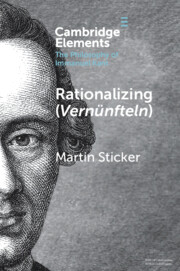
Rationalizing (Vernünfteln)
Published online by Cambridge University Press: 24 December 2021

Summary
Kant was a keen psychological observer and theorist of the forms, mechanisms and sources of self-deception. In this Element, the author discusses the role of rationalizing/Vernünfteln for Kant's moral psychology, normative ethics and philosophical methodology. By drawing on the full breadth of examples of rationalizing Kant discusses, the author shows how rationalizing can extend to general features of morality and corrupt rational agents thoroughly (albeit not completely and not irreversibly). Furthermore, the author explains the often-overlooked roles common human reason, empirical practical reason and even pure practical reason play for rationalizing. Kant is aware that rationality is a double-edged sword; reason is the source of morality and of our dignity, but it also enables us to seemingly justify moral transgressions to ourselves, and it creates an interest in this justification in the first place. Finally, this Element discusses whether Kant's ethical theory itself can be criticised as a product of rationalizing.
Information
- Type
- Element
- Information
- Online ISBN: 9781108625661Publisher: Cambridge University PressPrint publication: 20 January 2022
References
Adelung, Johann Christoph (1811) Grammatisch-kritisches Wörterbuch der hochdeutschen Mundart (Vienna: Bauer).Google Scholar
Allais, Lucy (2021) ‘Deceptive Unity and Productive Disunity: Kant’s Account of Situated Moral Selves’. In Ansgar Lyssy and Christopher Yeomans (eds.), Dimensions of Normativity in Kant (London: Palgrave), pp. 45–67.Google Scholar
Allison, Henry (1990) Kant’s Theory of Freedom (Cambridge: Cambridge University Press).Google Scholar
Allison, Henry (2011) Kant’s Groundwork of the Metaphysics of Morals: A Commentary (Oxford, New York: Oxford University Press).Google Scholar
Ameriks, Karl (2000) The Fate of Autonomy: Problems in the Appropriation of the Critical Philosophy (Cambridge: Cambridge University Press).Google Scholar
Ameriks, Karl (2003) Interpreting Kant’s Critiques (Oxford, New York: Oxford University Press).Google Scholar
Anderson, Elizabeth (2016) ‘The Social Epistemology of Morality: Learning from the Forgotten History of the Abolition of Slavery’. In Michael Brady, Fricker (eds.), The Epistemic Life of Groups: Essays in the Epistemology of Collectives (Oxford: Oxford University Press), pp. 75–94.Google Scholar
Bacin, Stefano (2013) ‘The Perfect Duty to Oneself Merely as a Moral Being (TL 6: 428–437)’. In Andreas Trampota, Oliver Sensen and Jens Timmermann (eds.), Kant’s ‘Tugendlehre’: A Comprehensive Commentary (Berlin, Boston, MA: De Gruyter), pp. 245–69.Google Scholar
Baron, Marcia (2005) ‘(Putative) Justification’. Annual Review of Law and Ethics, 13, 377–94.Google Scholar
Beck, Lewis White (1960) A Commentary on Kant’s Critique of Practical Reason (Chicago, IL: University of Chicago Press).Google Scholar
Broadie, Alexander and Pybus, Elizabeth (1982) ‘Kant and Weakness of Will’. Kant-Studien, 73(4), 406–11.Google Scholar
Callanan, John (2019) ‘Kant on Misology and the Natural Dialectic’. Philosophers’ Imprint, 19(47), 1–22.Google Scholar
Caswell, Matthew (2006) ‘The Value of Humanity and Kant’s Conception of Evil’. Journal of the History of Philosophy, 44(4), 635–63.Google Scholar
Cohen, Alix (2020) ‘A Kantian Account of Emotions as Feelings’. Mind, 129(514), 429–60.Google Scholar
Crusius, Christian (1772) Kurzer Begriff der Moraltheologie, oder nähere Erklärung der praktischen Lehren des Christentums (Leipzig: Ulrich Christian Saalbach).Google Scholar
Cushman, Fiery (2020) ‘Rationalization is Rational’. Behavioral and Brain Sciences, 43(28), 1–16.Google Scholar
Darwall, Stephen L. (1988) ‘Self-Deception, Autonomy, and Moral Constitution’. In Brian McLaughlin, Rorty (eds.), Perspectives on Self-Deception (Berkeley: University of California Press), pp. 407–31.Google Scholar
Di Giulio, Sara (2020) ‘Video meliora proboque, deteriora sequor. Zur Irreführung des Gewissens bei Kant’. In Sara Giulio, Di and Alberto Frigo (eds.), Kasuistik und Theorie des Gewissens. Von Pascal bis Kant (Berlin: De Gruyter), pp. 233–89.Google Scholar
Eisler, Rudolf (1930) Kant-Lexikon. Nachschlagewerk zu Kants sämtlichen Schriften/Briefen und Handschriftlichem Nachlass (Berlin: Pan-Verlag Kurt Metzner).Google Scholar
Ellis, Jonathan and Schwitzgebel, Eric (2020) ‘Rationalization in the Pejorative Sense: Cushman’s Account Overlooks the Scope and Costs of Rationalization’. Behavioral and Brain Sciences, 43(28), 23–4.Google Scholar
Formosa, Paul (2009) ‘Kant on the Limits of Human Evil’. Journal of Philosophical Research, 34, 189–214.Google Scholar
Formosa, Paul (2017) Kantian Ethics, Dignity and Perfection (Cambridge: Cambridge University Press).Google Scholar
Formosa, Paul and Sticker, Martin (2019) ‘Kant and the Demandingness of the Virtue of Beneficence’. European Journal of Philosophy, 27(3), 625–42.Google Scholar
Franklin, Benjamin (1909) The Life of Benjamin Franklin: An Autographical Manuscript (New York: P.F. Collier and Son).Google Scholar
Freyenhagen, Fabian (2011) ‘Empty, Useless, and Dangerous? Recent Kantian Replies to the Empty Formalism Objection’. Hegel Bulletin, 32(1–2), 95–118.Google Scholar
Frierson, Patrick (2014) Kant’s Empirical Psychology (Cambridge: Cambridge University Press).Google Scholar
Graham, Jesse (2020) ‘Ideology, Shared Moral Narratives, and the Dark Side of Collective Rationalization’. Behavioral and Brain Sciences, 43(28), 24–5.Google Scholar
Gregor, Mary J. (1996) Practical Philosophy (The Cambridge Edition of the Works of Immanuel Kant in Translation) (Cambridge: Cambridge University Press).Google Scholar
Grenberg, Jeanine (2010) ‘What is the Enemy of Virtue?’. In Lara Denis (ed.), Kant’s Metaphysics of Morals: A Critical Guide (Cambridge: Cambridge University Press), pp. 152–70.Google Scholar
Grenberg, Jeanine (2013) Kant’s Defense of Common Moral Experience. A Phenomenological Account (Cambridge: Cambridge University Press).Google Scholar
Grimm, Jacob and Grimm, Willhelm (1889) Deutsches Wörterbuch von Jacob Grimm und Wilhelm Grimm (Leipzig: Hirzel). Available at http://dwb.uni-trier.de/de/.Google Scholar
Guyer, Paul (2000) Kant on Freedom, Law, and Happiness (Cambridge: Cambridge University Press).Google Scholar
Guyer, Paul and Matthews, Eric (2000) Critique of the Power of Judgment (The Cambridge Edition of the Works of Immanuel Kant in Translation) (Cambridge: Cambridge University Press).Google Scholar
Guyer, Paul and Wood, Allen (1992ff.) Cambridge Edition of the Works of Immanuel Kant (Cambridge: Cambridge University Press).Google Scholar
Guyer, Paul and Wood, Allen (1998) Critique of Pure Reason (The Cambridge Edition of the Works of Immanuel Kant in Translation) (Cambridge: Cambridge University Press).Google Scholar
Haidt, Jonathan (2001) ‘The Emotional Dog and its Rational Tail: A Social Intuitionist Approach to Moral Judgment’. Psychological Review, 108(4), 814–34.Google Scholar
Henrich, Dieter (1967) Kant: Gentz. Rehberg. Über Theorie und Praxis (Frankfurt a. M.: Suhrkamp).Google Scholar
Henrich, Dieter (1994) Dieter Henrich. The Unity of Reason: Essays on Kant’s Philosophy, ed. Richard Velkley (Cambridge, MA: Harvard University Press).Google Scholar
Herman, Barbara (2011) ‘A Mismatch of Methods’. In Derek Parfit (ed.), On What Matters, vol. 2 (Oxford: Oxford University Press), pp. 83–116.Google Scholar
Herodotus (n.d.) The History of Herodotus, trans. George Rawlinson. http://classics.mit.edu/Herodotus/history.html.Google Scholar
Hill, Thomas E., Jr. (2012) Virtue, Rules, and Justice: Kantian Aspirations (Oxford: Oxford University Press).Google Scholar
Hill, Thomas E., Jr. and Boxill, Bernard (2001) ‘Kant and Race’. In Bernard Boxill (ed.), Race and Racism (New York: Oxford University Press), pp. 448–71.Google Scholar
Holzhey, Helmut and Mudroch, Vilem (2005) Historical Dictionary of Kant and Kantianism (Lanham, MD: The Scarecrow Press).Google Scholar
Kerstein, Samuel (2002) Kant’s Search for the Supreme Principle of Morality (Cambridge: Cambridge University Press).Google Scholar
Klingner, Stefan (2012) Technische Vernunft. Kants Zweckbegriff und das Problem einer Philosophie der technischen Kultur (Berlin, Boston, MA: De Gruyter).Google Scholar
Kohl, Markus (2017a) ‘Radical Evil as a Regulative Idea’. Journal of the History of Philosophy, 55(4), 641–73.Google Scholar
Korsgaard, Christine (2009) Self-Constitution: Agency, Identity, and Integrity (Oxford: Oxford University Press).Google Scholar
MacFarquar, Larissa (2016) Strangers Drowning: Voyages to the Brink of Moral Extremity (London: Penguin).Google Scholar
Mele, Alfred (1987) Irrationality: An Essay on Akrasia, Self-Deception, and Self-Control (New York, Oxford: Oxford University Press).Google Scholar
Mercier, Hugo and Sperber, Dan (2018) The Enigma of Reason: A New Theory of Human Understanding (London: Penguin).Google Scholar
Moeller, Sophie (2020) Kant’s Tribunal of Reason (Cambridge: Cambridge University Press).Google Scholar
Moran, Kate (2014) ‘Delusions of Virtue: Kant on Self-Conceit’. Kantian Review, 19(3), 445–73.Google Scholar
Morrisson, Iain (2005) ‘On Kantian Maxims: A Reconciliation of the Incorporation Thesis and Weakness of the Will’. History of Philosophy Quarterly, 22(1), 73–89.Google Scholar
Papish, Laura (2018) Kant on Evil, Self-Deception, and Moral Reform (Oxford: Oxford University Press).Google Scholar
Pinheiro Walla, Alice (2015) ‘Kant’s Moral Theory and Demandingness’. Ethical Theory and Moral Practice, 18(4), 731–43.Google Scholar
Piper, Adrian (1987) ‘Moral Theory and Moral Alienation’. Journal of Philosophy, 84(2), 102–18.Google Scholar
Piper, Adrian (1988) ‘Pseudorationality’. In Brian McLaughlin and Amelie Rorty (eds.), Perspectives on Self-Deception (Berkeley: University of California Press), pp. 297–324.Google Scholar
Piper, Adrian (2008) Rationality and the Structure of the Self. Volume II: A Kantian Conception. Available at: www.adrianpiper.com/rss/docs/PiperRSSVol2KC.pdf.Google Scholar
Piper, Adrian (2012a) ‘Kant’s Self-Legislation Procedure Reconsidered’. Kant Studies Online, 203–77.Google Scholar
Piper, Adrian (2012b) ‘Kant’s Two Solutions to the Free Rider Problem’. Kant Yearbook, 4, 114–42.Google Scholar
Potter, Nelson (2002) ‘Duties to Oneself, Motivational Internalism and Self-Deception’. In Mark Timmons (ed.), Kant’s ‘Metaphysics of Morals’: Interpretative Essays (Oxford: Oxford University Press), pp. 371–90.Google Scholar
Railton, Peter (1984) ‘Alienation, Consequentialism, and the Demands of Morality’. Philosophy and Public Affairs, 13(2), 134–71.Google Scholar
Reath, Andrews (2006) Agency and Autonomy in Kant’s Moral Theory: Selected Essays (Oxford: Oxford University Press).Google Scholar
Rochefoucauld, Francois de la (2002) Réflexions ou sentences et maximes morales et réflexions diverses, édition établie et présentée par Laurence Plazenet (Paris: Honoré Champion).Google Scholar
Rukgaber, Matthew (2015) ‘Irrationality and Self-Deception within Kant’s Grades of Evil’. Kant-Studien, 106(2), 234–58.Google Scholar
Scanlon, T. M. (2011) ‘How I Am Not a Kantian’. In Derek Parfit (ed.), On What Matters, vol. 2 (Oxford: Oxford University Press), pp. 116–39.Google Scholar
Schapiro, Tamar (2006) ‘Kantian Rigorism and Mitigating Circumstances’. Ethics, 117(1), 32–57.Google Scholar
Schönecker, Dieter (1997) ‘Gemeine sittliche und philosophische Vernunfterkenntnis. Zum ersten Übergang in Kants Grundlegung’. Kant-Studien, 88(3), 311–33.Google Scholar
Schwitzgebel, Eric and Ellis, Jonathan (2017) ‘Rationalization in Moral and Philosophical Thought’. In Jean-François Bonnefon and Bastien Tremoliere (eds.), Moral Inferences (London: Psychology Press), pp. 170–91.Google Scholar
Sedgwick, Sally (2008) Kant’s Groundwork of the Metaphysics of Morals: An Introduction (Cambridge: Cambridge University Press).Google Scholar
Sensen, Oliver (2013) ‘The Moral Importance of Autonomy’. In Oliver Sensen (ed.), Kant on Moral Autonomy (Cambridge: Cambridge University Press), pp. 262–81.Google Scholar
Sensen, Oliver (2014) ‘Universalizing as a Moral Demand’. Estudos Kantianos, 2(1), 169–84.Google Scholar
Seymour Fahmy, Melissa (2019) ‘On Virtues of Love and Wide Ethical Duties’. Kantian Review, 24(3), 415–37.Google Scholar
Shell, Susan (2009) Kant and the Limits of Autonomy (Cambridge, MA: Harvard University Press).Google Scholar
Sherman, Nancy (1997) Making a Necessity of Virtue: Aristotle and Kant on Virtue (Cambridge: Cambridge University Press).Google Scholar
Sievers, Thomas (2020) ‘Antecedent Rationalization: Rationalization Prior to Action’. Behavioral and Brain Sciences, 43(28), 34–5.Google Scholar
Stark, Werner (ed.) (2004) Immanuel Kant. Vorlesung zur Moralphilosophie (Berlin, New York: De Gruyter).Google Scholar
Sticker, Martin (2015) ‘The Moral-Psychology of the Common Agent – A Reply to Ido Geiger’. British Journal for the History of Philosophy, 23(5), 976–89.Google Scholar
Sticker, Martin (2016a) ‘When the Reflective Watch-Dog Barks – Conscience and Self-Deception in Kant’. The Journal of Value Inquiry, 51(1), 85–104.Google Scholar
Sticker, Martin (2016b) ‘Kant on Engaging Other Agents and Observing Reason at Work’. History of Philosophy Quarterly, 33(4), 347–73.Google Scholar
Sticker, Martin (2017a) ‘Kant’s Criticism of Common Moral Rational Cognition’. European Journal of Philosophy, 25(1), 85–109.Google Scholar
Sticker, Martin (2017b) ‘Experiments in Ethics? Kant on Chemistry, Means of Education and Methods of Practical Philosophy’. Idealistic Studies, 46(1), 41–63.Google Scholar
Sticker, Martin (2020a) ‘Kant und das fehlbare Gewissen’. In Sara Giulio, Di and Alberto Frigo (eds.), Kasuistik und Theorie des Gewissens. Von Pascal bis Kant (Berlin: De Gruyter), pp. 289–311.Google Scholar
Sticker, Martin (2020b) ‘Kant, Eudaimonism, Act-Consequentialism and the Fact of Reason’. Archiv für Geschichte der Philosophie, 102(2), 209–41.Google Scholar
Sticker, Martin (2021a) ‘How Common is Common Human Reason? The Plurality of Moral Perspectives and Kant’s Ethics’. In Ansgar Lyssy and Christopher Yeomans (eds.), Dimensions of Normativity in Kant (London: Palgrave), pp. 167–89.Google Scholar
Sticker, Martin (2021b) ‘Kant, Moral Overdemandingness and Self-Scrutiny’. NOUS, 25(2), 293–316.Google Scholar
Stohr, Karen (2011) ‘Kantian Beneficence and the Problem of Obligatory Aid’. Journal of Moral Philosophy, 8(1), 45–67.Google Scholar
Timmermann, Jens (2007) Kant’s Groundwork of the Metaphysics of Morals: A Commentary (Cambridge: Cambridge University Press).Google Scholar
Timmermann, Jens (2011) Groundwork of the Metaphysics of Morals, trans. Jens Timmermann and Mary Gregor (Cambridge: Cambridge University Press).Google Scholar
Timmermann, Jens (2018) ‘Autonomy, Progress and Virtue: Why Kant Has Nothing to Fear from the Overdemandingness Objection’. Kantian Review, 23(3), 379–97.Google Scholar
Timmermann, Jens (2020) ‘Der Status unvollkommener Pflichten in Kants Theorie des Gewissens’. In Sara Di Giulio and Alberto Frigo (eds.), Kasuistik und Theorie des Gewissens. Von Pascal bis Kant (Berlin: De Gruyter), pp. 217–33.Google Scholar
Marcel, Van Ackeren and Sticker, Martin (2015) ‘Kant on Moral Demandingness’. Ethical Theory and Moral Practice, 18(1), 75–89.Google Scholar
Marcel, Van Ackeren and Sticker, Martin (2018) ‘Moral Rationalism and Demandingness in Kant’. Kantian Review, 23(3), 407–28.Google Scholar
Vogt, Katja (2008) ‘Duties to Others: Demands and Limits’. In Monika Betzler (ed.), Kant’s Virtue Ethics (Berlin, New York: De Gruyter), pp. 219–45.Google Scholar
Vujosevic, Marijana (2018) ‘Kant’s Account of Moral Weakness’. European Journal of Philosophy. http://doi.org/10.1111/ejop.12389.Google Scholar
Ware, Owen (2009) ‘The Duty of Self-Knowledge’. Philosophy and Phenomenological Research, 79(3), 671–98.Google Scholar
Wehofsits, Anna (2016) Anthropologie und Moral. Affekte, Leidenschaften und Mitgefühl in Kants Ethik (Berlin: De Gruyter).Google Scholar
Wehofsits, Anna (2020) ‘Passions: Kant’s Psychology of Self-Deception’. Inquiry. http://doi.org/10.1080/0020174X.2020.1801498.Google Scholar
Welsch, Martin (2019) ‘Kant über den Selbstbetrug des Bösen’. Kant-Studien, 110(1), 49–73.Google Scholar
Willaschek, Marcus, Stolzenberg, Jürgen, Mohr, Georg and Bacin, Stefano (eds.) (2015) Kant-Lexikon (Berlin, Boston, MA: De Gruyter).Google Scholar
Williams, Bernard (1973) Utilitarianism: For and Against, with J. J. C. Smart (Cambridge: Cambridge University Press).Google Scholar
Williams, Bernard (1985) Ethics and the Limits of Philosophy (Cambridge, MA: Harvard University Press).Google Scholar
Wilson, Catherine (1993) ‘On Some Alleged Limits to Moral Endeavor’. The Journal of Philosophy, 90(6), 275–89.Google Scholar
Wood, Allen (2002) ‘Preface and Introduction (3–16)’. In Otfried Höffe (ed.), Immanuel Kant. Kritik der praktischen Vernunft (Berlin: Akademie Verlag), pp. 25–43.Google Scholar
Wood, Allen and Giovanni, Di, George (1998) Kant: Religion within the Boundaries of Mere Reason: And Other Writings (Cambridge Texts in the History of Philosophy) (Cambridge: Cambridge University Press).Google Scholar
Zhouhuang, Zhengmi (2016) Der sensus communis bei Kant. Zwischen erkenntnis, Moralität, und Schönheit. (Berlin, Boston, MA: De Gruyter).Google Scholar
Accessibility standard: Unknown
Why this information is here
This section outlines the accessibility features of this content - including support for screen readers, full keyboard navigation and high-contrast display options. This may not be relevant for you.Accessibility Information
Accessibility compliance for the HTML of this element is currently unknown
and may be updated in the future.