Element contents
Series: Elements in Construction Grammar
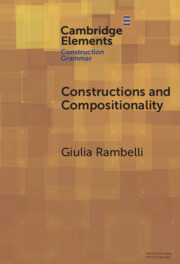
Constructions and Compositionality
Cognitive and Computational Explorations
Published online by Cambridge University Press: 17 December 2024

Summary
How do we understand any sentence, from the most ordinary to the most creative? The traditional assumption is that we rely on formal rules combining words (compositionality). However, psycho- and neuro-linguistic studies point to a linguistic representation model that aligns with the assumptions of Construction Grammar: there is no sharp boundary between stored sequences and productive patterns. Evidence suggests that interpretation alternates compositional (incremental) and noncompositional (global) strategies. Accordingly, systematic processes of language productivity are explainable by analogical inferences rather than compositional operations: novel expressions are understood 'on the fly' by analogy with familiar ones. This Element discusses compositionality, alternative mechanisms in language processing, and explains why Construction Grammar is the most suitable approach for formalizing language comprehension.
Information
- Type
- Element
- Information
- Series: Elements in Construction GrammarOnline ISBN: 9781009437929Publisher: Cambridge University PressPrint publication: 30 January 2025
References
Abbot-Smith, K., & Tomasello, M. (2006). Exemplar-learning and schematization in a usage-based account of syntactic acquisition. The Linguistic Review, 23(3), 275–290. https://doi.org/10.1515/TLR.2006.011.CrossRefGoogle Scholar
Adger, D. (2019). Language unlimited: The science behind our most creative power. Oxford: Oxford University Press.Google Scholar
Adger, D. (2020). Syntax and the failure of analogical generalization: A commentary on Ambridge. First Language, 40(5–6), 560–563. https://doi.org/10.1177/0142723720905921.CrossRefGoogle Scholar
Albright, A., & Hayes, B. (2003). Rules vs. analogy in English past tenses: A computational/experimental study. Cognition, 90(2), 119–161. https://doi.org/10.1016/S0010-0277(03)00146-X.CrossRefGoogle ScholarPubMed
Altman, G. T., & Kamide, Y. (1999). Incremental interpretation at verbs: Restricting the domain of subsequent reference. Cognition, 73, 247–264. https://doi.org/10.1016/S0010-0277(99)00059-1.CrossRefGoogle Scholar
Ambridge, B. (2010). Children’s judgments of regular and irregular novel past-tense forms: New data on the English past-tense debate. Developmental Psychology, 46(6), 1497–1504. https://doi.org/10.1037/a0020668.CrossRefGoogle ScholarPubMed
Ambridge, B. (2020a). Against stored abstractions: A radical exemplar model of language acquisition. First Language, 40(5–6), 509–559. https://doi.org/10.1177/0142723719869731.CrossRefGoogle Scholar
Ambridge, B. (2020b). Abstractions made of exemplars or “You’re all right, and I’ve changed my mind”: Response to commentators. First Language, 40(5–6), 640–659. https://doi.org/10.1177/0142723720949723.CrossRefGoogle Scholar
Arnon, I., & Snider, N. (2010). More than words: Frequency effects for multi-word phrases. Journal of Memory and Language, 62(1), 67–82. https://doi.org/10.1016/j.jml.2009.09.005.CrossRefGoogle Scholar
Asher, N. (2015). Types, meanings and coercions in lexical semantics. Lingua, 157, 66–82. https://doi.org/10.1016/j.lingua.2015.01.001.CrossRefGoogle Scholar
Asher, N., Van de Cruys, T., Bride, A., & Abrusán, M. (2016). Integrating type theory and distributional semantics: A case study on adjective–noun compositions. Computational Linguistics, 42(4), 703–725. https://doi.org/10.1162/COLI_a_00264.CrossRefGoogle Scholar
Baggio, G. (2020). Review of M. Christiansen, H. & Chater, N., Creating Language: Integrating Evolution, Acquisition, and Processing. Nordic Journal of Linguistics, 43(1), 127–132. doi:10.1017/S0332586519000258.CrossRefGoogle Scholar
Baggio, G. (2021). Compositionality in a parallel architecture for language processing. Cognitive Science, 45(5), e12949. https://doi.org/10.1111/cogs.12949.CrossRefGoogle Scholar
Baggio, G., & Hagoort, P. (2011). The balance between memory and unification in semantics: A dynamic account of the n400. Language and Cognitive Processes, 26(9), 1338–1367. https://doi.org/10.1080/01690965.2010.542671.CrossRefGoogle Scholar
Baggio, G., Van Lambalgen, M., & Hagoort, P. (2012). The processing consequences of compositionality. In Hinzen, W., Werning, M., & Machery, E. (Eds.), The Oxford handbook of compositionality (pp. 655–672). New York: Oxford University Press. https://doi.org/10.1093/oxfordhb/9780199541072.013.0032.Google Scholar
Bannard, C., & Matthews, D. (2008). Stored word sequences in language learning: The effect of familiarity on children’s repetition of four-word combinations. Psychological Science, 19(3), 241–248. https://doi.org/10.1111/j.1467-9280.2008.02075.x.CrossRefGoogle ScholarPubMed
Baroni, M., Bernardi, R., & Zamparelli, R. (2014). Frege in space: A program of compositional distributional semantics. LiLT (Linguistic Issues in Language Technology), 9, 241–346.Google Scholar
Baroni, M., & Zamparelli, R. (2010). Nouns are vectors, adjectives are matrices: Representing adjective-noun constructions in semantic space. In Proceedings of the 2010 conference on empirical methods in natural language processing (pp. 1183–1193).Google Scholar
Barton, S. B., & Sanford, A. J. (1993). A case study of anomaly detection: Shallow semantic processing and cohesion establishment. Memory & Cognition, 21(4), 477–487. https://doi.org/10.3758/BF03197179.CrossRefGoogle ScholarPubMed
Behrens, H. (2017). The role of analogy in language processing and acquisition. In Hundt, M., Mollin, S., & Pfenninger, S. E. (Eds.), The changing English language: Psycholinguistic perspectives (pp. 215–239). Cambridge: Cambridge University Press.CrossRefGoogle Scholar
Beltagy, I., Roller, S., Cheng, P., Erk, K., & Mooney, R. J. (2016). Representing meaning with a combination of logical and distributional mode. Computational Linguistics, 42(4), 763–808. https://doi.org/10.1162/COLI_a_00266.CrossRefGoogle Scholar
Bergen, B., & Chang, N. (2005). Embodied construction grammar in simulation-based language understanding. Construction Grammars: Cognitive Grounding and Theoretical Extensions, 3, 147–190. https://doi.org/10.1075/cal.3.08ber.CrossRefGoogle Scholar
Bergen, B., & Chang, N. (2013). Embodied construction grammar. In Hoffmann, T. & Trousdale, G. (Eds.), The Oxford handbook of construction grammar (pp. 168–190). Oxford: Oxford University Press. https://doi.org/10.1093/oxfordhb/9780195396683.013.0010.Google Scholar
Bergs, A. (2018). Learn the rules like a pro, so you can break them like an artist (picasso): Linguistic aberrancy from a constructional perspective. Zeitschrift für Anglistik und Amerikanistik, 66(3), 277–293. https://doi.org/10.1515/zaa-2018-0025.CrossRefGoogle Scholar
Bergs, A., & Kompa, N. A. (2020). Creativity within and outside the linguistic system. Cognitive Semiotics, 13(1), 20202025. https://doi.org/10.1515/cogsem-2020-2025.CrossRefGoogle Scholar
Blache, P. (2016). Representing syntax by means of properties: A formal framework for descriptive approaches. Journal of Language Modelling, 4(2), 183–224. https://doi.org/10.15398/jlm.v4i2.129.CrossRefGoogle Scholar
Blache, P. (2017). Delayed interpretation, shallow processing and constructions: the basis of the “interpret whenever possible” principle. In Sharp, B., Sèdes, F. & Lubaszewski, W. (Eds.), Cognitive approach to natural language processing (pp. 1–19). Oxford: Elsevier. https://doi.org/10.1016/B978-1-78548-253-3.50001-9.Google Scholar
Blache, P. (2024). A neuro-cognitive model of comprehension based on prediction and unification. Frontiers in Human Neuroscience, 18, 1356541. https://doi.org/10.3389/fnhum.2024.1356541.CrossRefGoogle ScholarPubMed
Blache, P., Chersoni, E., Rambelli, G., & Lenci, A. (2023). Composing or Not Composing? Towards Distributional Construction Grammars. (Manuscript submitted for publication)Google Scholar
Blevins, J. P., & Blevins, J. (2009). Introduction: Analogy in grammar. In Blevins, J. P. & Blevins, J. (Eds.), Analogy in grammar: Form and acquisition (pp. 1–12). Oxford: Oxford University Press.CrossRefGoogle Scholar
Blumenthal-Dramé, A. (2012). Entrenchment in usage-based theories. Berlin: Mouton De Gruyter.CrossRefGoogle Scholar
Blything, R. P., Ambridge, B., & Lieven, E. V. (2018). Children’s acquisition of the english past-tense: Evidence for a single-route account from novel verb production data. Cognitive Science, 42, 621–639. https://doi.org/10.1111/cogs.12581.CrossRefGoogle ScholarPubMed
Boas, H. C. (2021). Construction grammar and frame semantics. In John, R. Taylor & Xu, Wen (Eds.), The Routledge handbook of cognitive linguistics (pp. 43–77). New York: Routledge. https://doi.org/10.4324/9781351034708-5.CrossRefGoogle Scholar
Bod, R. (2009). From exemplar to grammar: A probabilistic analogy-based model of language learning. Cognitive Science, 33(5), 752–793. https://doi.org/10.1111/j.1551-6709.2009.01031.x.CrossRefGoogle ScholarPubMed
Boleda, G. (2020). Distributional semantics and linguistic theory. Annual Review of Linguistics, 6, 213–234. https://doi.org/10.1146/annurev-linguistics-011619-030303.CrossRefGoogle Scholar
Boleda, G., & Herbelot, A. (2016). Formal distributional semantics: Introduction to the special issue. Computational Linguistics, 42(4), 619–635. https://doi.org/10.1162/COLI_a_00261.CrossRefGoogle Scholar
Bommasani, R., Hudson, D. A., Adeli, E., et al. (2021). On the opportunities and risks of foundation models. arXiv preprint arXiv:2108.07258.Google Scholar
Bos, J., Clark, S., Steedman, M., Curran, J. R., & Hockenmaier, J. (2004). Wide-coverage semantic representations from a ccg parser. In COLING 2004: Proceedings of the 20th international conference on computational linguistics (pp. 1240–1246).Google Scholar
Boyland, J. T. (2009). Usage-based models of language. In Eddington, D. (Ed.), Experimental and quantitative linguistics (pp. 351–419). Munich: Lincom.Google Scholar
Busso, L., Pannitto, L., & Lenci, A. (2018). Modelling Italian Construction Flexibility with Distributional Semantics: Are Constructions Enough? In Proceedings of the fifth Italian conference on computational linguistics (clic-it 2018) (pp. 68–74). https://doi.org/10.4000/books.aaccademia.310.CrossRefGoogle Scholar
Bybee, J. L. (2006). From usage to grammar: The mind’s response to repetition. Language, 82(4), 711–733. https://muse.jhu.edu/article/208049.CrossRefGoogle Scholar
Bybee, J. L. (2010). Language, usage and cognition. Cambridge: Cambridge University Press.CrossRefGoogle Scholar
Bybee, J. L., & Moder, C. L. (1983). Morphological classes as natural categories. Language, 59(2), 251–270. https://doi.org/10.2307/413574.CrossRefGoogle Scholar
Cacciari, C., Corrardini, P., & Ferlazzo, F. (2018). Cognitive and personality components underlying spoken idiom comprehension in context. An exploratory study. Frontiers in Psychology, 9, 659. https://doi.org/10.3389/fpsyg.2018.00659.CrossRefGoogle ScholarPubMed
Cacciari, C., & Tabossi, P. (1988). The comprehension of idioms. Journal of Memory and Language, 27(6), 668–683. https://doi.org/10.1016/0749-596X(88)90014-9.CrossRefGoogle Scholar
Călinescu, L., Ramchand, G., & Baggio, G. (2023). How (not) to look for meaning composition in the brain: A reassessment of current experimental paradigms. Frontiers in Language Sciences, 2, 1096110. https://doi.org/10.3389/flang.2023.1096110.CrossRefGoogle Scholar
Carrol, G., & Conklin, K. (2020). Is all formulaic language created equal? unpacking the processing advantage for different types of formulaic sequences. Language and Speech, 63(1), 95–122. https://doi.org/10.1177/0023830918823230.CrossRefGoogle ScholarPubMed
Chandler, S. (2017). The analogical modeling of linguistic categories. Language and Cognition: An Interdisciplinary Journal of Language and Cognitive Science, 9(1), 52–87. https://psycnet.apa.org/doi/10.1017/langcog.2015.24.CrossRefGoogle Scholar
Chandler, S. (2020). Sentence-level constructions: A demonstration in support of Ambridge. First Language, 40(5–6), 569–572. https://doi.org/10.1177/0142723720905764.CrossRefGoogle Scholar
Chaves, R. P. (2019). Construction grammar. In Kertész, A., Moravcsik, E., & Rákosi, C. (Eds.), Current approaches to syntax. A comparative handbook (pp. 49–96). Berlin: Mouton De Gruyter. https://doi.org/10.1515/9783110540253-003.CrossRefGoogle Scholar
Christiansen, M. H., & Chater, N. (2016a). Creating language: Integrating evolution, acquisition, and processing. Cambridge, MA: MIT Press.CrossRefGoogle Scholar
Christiansen, M. H., & Chater, N. (2016b). The Now-or-Never bottleneck: A fundamental constraint on language. Behavioral Brain Science, 39, e39–e62. https://doi.org/10.1017/S0140525X1500031X.CrossRefGoogle ScholarPubMed
Christianson, K., Hollingworth, A., Halliwell, J. F., & Ferreira, F. (2001). Thematic roles assigned along the garden path linger. Cognitive Psychology, 42(4), 368–407. https://doi.org/10.1006/cogp.2001.0752.CrossRefGoogle ScholarPubMed
Coecke, B., Sadrzadeh, M., & Clark, S. (2010). Mathematical foundations for a compositional distributional model of meaning. ArXiv, abs/ 1003.4394.Google Scholar
Colmerauer, A. (1982). An interesting subset of natural language. In Clark, K. & Tärnlund, S. (Eds.), Logic programming (pp. 45–66). Orlando, FL: Academic Press.Google Scholar
Contreras Kallens, P., & Christiansen, M. H. (2022). Models of language and multiword expressions. Frontiers Artificial Intelligence Appl., 5, 43–77. https://doi.org/10.3389/frai.2022.781962.Google ScholarPubMed
Coolen, R., Van Jaarsveld, H. J., & Schreuder, R. (1991). The interpretation of isolated novel nominal compounds. Memory & Cognition, 19, 341–352. https://doi.org/10.3758/BF03197138.CrossRefGoogle ScholarPubMed
Copestake, A., Flickinger, D., Pollard, C., & Sag, I. A. (2005). Minimal recursion semantics: An introduction. Research on Language and Computation, 3(2), 281–332. https://doi.org/10.1007/s11168-006-6327-9.CrossRefGoogle Scholar
Croft, W. (1991). Syntactic categories and grammatical relations: The cognitive organization of information. Chicago: University of Chicago Press.Google Scholar
Croft, W. (2001). Radical construction grammar: Syntactic theory in typological perspective. Oxford: Oxford University Press. https://doi.org/10.1093/acprof:oso/9780198299554.001.0001.CrossRefGoogle Scholar
Croft, W., & Cruse, D. A. (2004). Cognitive linguistics. Cambridge: Cambridge University Press. https://doi.org/10.1017/CBO9780511803864.CrossRefGoogle Scholar
Culicover, P. W., & Jackendoff, R. (1999). The view from the periphery: The English comparative correlative. Linguistic Inquiry, 30(4), 543–571. https://doi.org/10.1093/acprof:oso/9780199271092.003.0014.CrossRefGoogle Scholar
Culicover, P. W., & Jackendoff, R. (2006). The simpler syntax hypothesis. Trends in Cognitive Sciences, 10(9), 413–418. https://doi.org/10.1016/j.tics.2006.07.007.CrossRefGoogle ScholarPubMed
Daelemans, W., & Van Den Bosch, A. (2010). Memory-based learning. The Handbook of Computational Linguistics and Natural Language Processing, 154–179.CrossRefGoogle Scholar
DeLong, K. A., Urbach, T. P., & Kutas, M. (2005). Probabilistic word pre-activation during language comprehension inferred from electrical brain activity. Nature Neuroscience, 8, 1117–1121. https://doi.org/10.1038/nn1504.CrossRefGoogle ScholarPubMed
Del Pinal, G. (2015). The semantic architecture of the faculty of language: compositional operations and complex lexical representations (Unpublished doctoral dissertation). Columbia University, New York, NY.Google Scholar
Diessel, H. (2019). The grammar network: How linguistic structure is shaped by language use. Cambridge: Cambridge University Press.CrossRefGoogle Scholar
Diessel, H. (2023). The constructicon: Taxonomies and networks. Cambridge: Cambridge University Press.CrossRefGoogle Scholar
Dowty, D. (2007). Compositionality as an empirical problem. In Barker, C. & Jacobson, P. I. (Eds.), Direct compositionality (pp. 14–23). Oxford: Oxford University Press. https://doi.org/10.1093/oso/9780199204373.003.0002.Google Scholar
Elman, J. L. (2009). On the meaning of words and dinosaur bones: Lexical knowledge without a lexicon. Cognitive Science, 33(4), 547–582. https://doi.org/10.1111/j.1551-6709.2009.01023.x.CrossRefGoogle ScholarPubMed
Elman, J. L. (2011). Lexical knowledge without a lexicon? The Mental Lexicon, 6, 1–33. https://doi.org/10.1075/ml.6.1.01elm.CrossRefGoogle Scholar
Elman, J. L. (2014). Systematicity in the lexicon: On having your cake and eating it too. In Calvo, P. & Symons, J. (Eds.), The architecture of cognition (pp. 115–145). Cambridge, MA: The MIT Press. https://doi.org/10.7551/mitpress/9559.003.0008.Google Scholar
Erickson, T. D., & Mattson, M. E. (1981). From words to meaning: A semantic illusion. Journal of Verbal Learning and Verbal Behavior, 20(5), 540–551. https://doi.org/10.1016/S0022-5371(81)90165-1.CrossRefGoogle Scholar
Erk, K., & Padó, S. (2008). A structured vector space model for word meaning in context. In Proceedings of the conference on empirical methods in natural language processing (pp. 897–906).CrossRefGoogle Scholar
Falkenhainer, B., Forbus, K. D., & Gentner, D. (1989). The structure-mapping engine: Algorithm and examples. Artificial Intelligence, 41(1), 1–63. https://doi.org/10.1016/0004-3702(89)90077-5.CrossRefGoogle Scholar
Fauconnier, G., & Turner, M. (2002). The way we think: Conceptual blending and the mind’s hidden complexities. New York: Basic books.Google Scholar
Ferreira, F. (2003). The misinterpretation of noncanonical sentences. Cognitive Psychology, 47(2), 164–203. https://doi.org/10.1016/S0010-0285(03)00005-7.CrossRefGoogle ScholarPubMed
Ferreira, F., Bailey, K. G., & Ferraro, V. (2002). Good-enough representations in language comprehension. Current Directions in Psychological Science, 11(1), 11–15. https://doi.org/10.1111/1467-8721.00158.CrossRefGoogle Scholar
Ferreira, F., Christianson, K., & Hollingworth, A. (2001). Misinterpretations of garden-path sentences: Implications for models of sentence processing and reanalysis. Journal of Psycholinguistic Research, 30(1), 3–20. https://doi.org/10.1023/A:1005290706460.CrossRefGoogle ScholarPubMed
Ferreira, F., & Lowder, M. W. (2016). Prediction, information structure, and good-enough language processing. In Ross, B. H. (Ed.), Psychology of Learning and Motivation (Vol. 65, pp. 217–247). San Diego: Academic Press. https://doi.org/10.1016/bs.plm.2016.04.002.Google Scholar
Ferreira, F., & Patson, N. D. (2007). The “good enough” approach to language comprehension. Language and Linguistics Compass, 1(1–2), 71–83. https://doi.org/10.1111/j.1749-818X.2007.00007.x.CrossRefGoogle Scholar
Ferretti, T. R., McRae, K., & Hatherell, A. (2001). Integrating verbs, situation schemas, and thematic role concepts. Journal of Memory and Language, 44(4), 516–547. https://doi.org/10.1006/jmla.2000.2728.CrossRefGoogle Scholar
Fillmore, C. J. (1982). Frame semantics. In The Linguistic Society of Korea (Ed.), (pp. 111–137). Seoul: Hanshin Pub. Co.Google Scholar
Fillmore, C. J., & Baker, C. (2010). A frames approach to semantic analysis. In Heine, Bernd & Narrog, Heiko (Eds.), The Oxford handbook of linguistic analysis (pp. 313–340). Oxford: Oxford University Press.Google Scholar
Fillmore, C. J., Kay, P., & O’Connor, M. C. (1988). Regularity and idiomaticity in grammatical constructions: The case of let alone. Language, 64(3), 501–138. https://doi.org/10.2307/414531.CrossRefGoogle Scholar
Firth, J. R. (1957). A synopsis of linguistic theory, 1930–1955. In Firth, J. R. (Ed.), Studies in linguistic analysis (pp. 1–31). Special Volume of the Philological Society. Oxford: Blackwell.Google Scholar
Fodor, J. A. (2001). Language, thought and compositionality. Royal Institute of Philosophy Supplements, 48, 227–242. https://doi.org/10.1017/S1358246100010808.CrossRefGoogle Scholar
Fodor, J. A., & Pylyshyn, Z. W. (1988). Connectionism and cognitive architecture: A critical analysis. Cognition, 28(1–2), 3–71. https://doi.org/10.1016/0010-0277(88)90031-5.CrossRefGoogle ScholarPubMed
Forbus, K. D., Ferguson, R. W., Lovett, A., & Gentner, D. (2017). Extending sme to handle large-scale cognitive modeling. Cognitive Science, 41(5), 1152–1201. https://doi.org/10.1111/cogs.12377.CrossRefGoogle ScholarPubMed
Gagné, C. L. (2001). Relation and lexical priming during the interpretation of noun–noun combinations. Journal of Experimental Psychology: Learning, Memory, and Cognition, 27(1), 236–254. https://doi.org/10.1037//0278-7393.27.1.236.Google ScholarPubMed
Gagné, C. L., & Shoben, E. J. (1997). Influence of thematic relations on the comprehension of modifier–noun combinations. Journal of Experimental Psychology: Learning, Memory, and Cognition, 23(1), 71–87. https://psycnet.apa.org/doi/10.1037/0278-7393.23.1.71.Google Scholar
Garrette, D., Erk, K., & Mooney, R. (2014). A formal approach to linking logical form and vector-space lexical semantics. In Bunt, H., Bos, J., & Pulman, S. (Eds.), Computing meaning. Text, speech and language technology (Vol 47). Springer, Dordrecht. https://doi.org/10.1007/978-94-007-7284-7_3.Google Scholar
Gayral, F., Kayser, D., & Lévy, F. (2005). Challenging the principle of compositionality in interpreting natural language texts. In Machery, E., Werning, M., & Schurz, G. (Eds.), The compositionality of meaning and content, Vol. 2 in the series Linguistics & Philosophy (pp. 83–106). Heusenstamm: Ontos Verlang. https://doi.org/10.1515/9783110332865.83.Google Scholar
Gentner, D. (1983). Structure-mapping: A theoretical framework for analogy. Cognitive Science, 7(2), 155–170. https://doi.org/10.1016/S0364-0213(83)80009-3.Google Scholar
Gentner, D. (1988). Metaphor as structure mapping: The relational shift. Child Development, 59, 47–59. https://psycnet.apa.org/doi/10.2307/1130388.CrossRefGoogle Scholar
Gentner, D., & Markman, A. B. (1997). Structure mapping in analogy and similarity. American Psychologist, 52(1), 45–56. https://psycnet.apa.org/doi/10.1037/0003-066X.52.1.45.CrossRefGoogle Scholar
Gentner, D., & Smith, L. A. (2012). Analogical reasoning. In Ramachandran, V. S. (Ed.), Encyclopedia of human behavior (2nd ed.) (pp. 130–136). Oxford: Elsevier. https://doi.org/10.1016/B978-0-12-375000-6.00022-7.CrossRefGoogle Scholar
Gentner, D., & Smith, L. A. (2013). Analogical learning and reasoning. In The Oxford handbook of cognitive psychology (pp. 668–681). New York: Oxford University Press. https://doi.org/10.1093/oxfordhb/9780195376746.013.0042.Google Scholar
Gibbs, R. W. (1980). Spilling the beans on understanding and memory for idioms in conversation. Memory & Cognition, 8(2), 149–156. https://doi.org/10.3758/BF03213418.CrossRefGoogle ScholarPubMed
Gibbs, R. W., Nayak, N. P., & Cutting, C. (1989). How to kick the bucket and not decompose: Analyzability and idiom processing. Journal of Memory and Language, 28(5), 576–593. https://doi.org/10.1016/0749-596X(89)90014-4.CrossRefGoogle Scholar
Giora, R., Fein, O., Kronrod, A., et al. (2004). Weapons of mass distraction: Optimal innovation and pleasure ratings. Metaphor and Symbol, 19(2), 115–141. https://doi.org/10.1207/s15327868ms1902_2.CrossRefGoogle Scholar
Goldberg, A. E. (1995). Constructions: A construction grammar approach to argument structure. Chicago: University of Chicago Press.Google Scholar
Goldberg, A. E. (2003). Constructions: A new theoretical approach to language. Trends in Cognitive Sciences, 7(5), 219–224. https://doi.org/10.1016/S1364-6613(03)00080-9.CrossRefGoogle ScholarPubMed
Goldberg, A. E. (2006). Constructions at work: The nature of generalization in language. New York: Oxford University Press.Google Scholar
Goldberg, A. E. (2013). Constructionist approaches. In Hoffmann, Thomas & Trousdale, Graeme (Eds), The Oxford handbook of construction grammar (pp. 14–31). Oxford: Oxford University Press.Google Scholar
Goldberg, A. E. (2015). Compositionality. In Riemer, N. (Ed.), The Routledge handbook of semantics (pp. 435–449). New York: Routledge.Google Scholar
Goldberg, A. E. (2019). Explain me this: Creativity, competition, and the partial productivity of constructions. Princeton: Princeton University Press.Google Scholar
Goldberg, A. E. (2024). A chat about constructionist approaches and llms. Constructions and Frames, special issue. (to appear). https://doi.org/10.31234/osf.io/8bmwz.Google Scholar
Goldberg, A. E., & Ferreira, F. (2022). Good-enough language production. Trends in Cognitive Sciences, 26(4), 300–311. https://doi.org/10.1016/j.tics.2022.01.005.CrossRefGoogle ScholarPubMed
Goldberg, A. E., & Jackendoff, R. (2004). The english resultative as a family of constructions. Language, 80, 532–568. https://doi.org/10.1353/LAN.2004.0129.CrossRefGoogle Scholar
Groenendijk, J., & Stokhof, M. (2005). Why compositionality. In Carlson, G. N. & Pelletier, F. J. (Eds.), Reference and quantification: The partee effect (pp. 83–106). Stanford: CSLI.Google Scholar
Gulordava, K., Bojanowski, P., Grave, E., Linzen, T., & Baroni, M. (2018, June). Colorless green recurrent networks dream hierarchically. In Walker, M., Ji, H., & Stent, A. (Eds.), Proceedings of the 2018 conference of the North American chapter of the association for computational linguistics: Human language technologies, volume 1 (long papers) (pp. 1195–1205). New Orleans, Louisiana: Association for Computational Linguistics. https://doi.org/10.18653/v1/N18-1108.Google Scholar
Hagoort, P. (2013). MUC (Memory, Unification, Control) and beyond. Frontiers in Psychology, 4, 1–13. https://doi.org/10.33892Ffpsyg.2013.00416.CrossRefGoogle ScholarPubMed
Hagoort, P. (2016). MUC (Memory, Unification, Control): A model on the neurobiology of language beyond single word processing. In Hickok, G. & Small, S. L. (Eds.), Neurobiology of language (pp. 339–347). San Diego: Elsevier. https://doi.org/10.1016/B978-0-12-407794-2.00028-6.CrossRefGoogle Scholar
Hagoort, P., Baggio, G., & Willems, R. M. (2009). Semantic unification. The Cognitive Neurosciences, 819–836. https://psycnet.apa.org/doi/10.7551/mitpress/8029.003.0072.Google Scholar
Hale, J. (2001). A probabilistic earley parser as a psycholinguistic model. In Proceedings of the second meeting of the North American chapter of the association for computational linguistics on language technologies (p. 1–8). USA: Association for Computational Linguistics. 10.3115/1073336.1073357.Google Scholar
Harris, Z. S. (1954). Distributional structure. Word, 10, 146–162. https://doi.org/10.1080/00437956.1954.11659520.CrossRefGoogle Scholar
Hartmann, S., & Ungerer, T. (2023). Attack of the snowclones: A corpus-based analysis of extravagant formulaic patterns. Journal of Linguistics, 1–36. https://doi.org/10.1017/S0022226723000117.Google Scholar
Haspelmath, M. (1999). Why is grammaticalization irreversible? Linguistics, 37, 1043–1068. https://doi.org/10.1515/ling.37.6.1043.CrossRefGoogle Scholar
Hauser, M. D., Chomsky, N., & Fitch, W. T. (2002). The faculty of language: What is it, who has it, and how did it evolve? Science, 298(5598), 1569–1579. https://doi.org/10.1126/science.298.5598.1569.CrossRefGoogle ScholarPubMed
Hendriks, P. (2020). The acquisition of compositional meaning. Philosophical Transactions of the Royal Society B, 375(1791), 20190312.CrossRefGoogle ScholarPubMed
Hilpert, M. (2019). Construction grammar and its application to English (2 ed.). Edinburgh: Edinburgh University Press.CrossRefGoogle Scholar
Hilpert, M. (2021). Ten lectures on diachronic construction grammar. Leiden: Brill.CrossRefGoogle Scholar
Hinzen, W., Werning, M., & Machery, E. (2012a). Introduction. In Hinzen, W., Werning, M., & Machery, E. (Eds.), The Oxford handbook of compositionality (pp. 1–16). New York: Oxford University Press.CrossRefGoogle Scholar
Hinzen, W., Werning, M., & Machery, E. (Eds.). (2012b). The Oxford handbook of compositionality. New York: Oxford University Press.CrossRefGoogle Scholar
Hock, H. H. (2003). Analogical change. In Brain, D. Joseph & Richard, D. Janda (Eds.), The handbook of historical linguistics (pp. 441–460). Oxford: Blackwell.CrossRefGoogle Scholar
Hoffmann, T. (2017). Construction grammars. In Dancygier, B. (Ed.), The Cambridge handbook of cognitive linguistics (pp. 310–329). Cambridge: Cambridge University Press. https://doi.org/10.1017/9781316339732.020.CrossRefGoogle Scholar
Hoffmann, T. (2018). Creativity and construction grammar: Cognitive and psychological issues. Zeitschrift für Anglistik und Amerikanistik, 66(3), 259–276. https:doi.org/10.1515/zaa-2018-0024.CrossRefGoogle Scholar
Hoffmann, T. (2019). Language and creativity: A construction grammar approach to linguistic creativity. Linguistics Vanguard, 5(1), 20190019. https://doi.org/10.1515/lingvan-2019-0019.CrossRefGoogle Scholar
Hoffmann, T. (2022a). Construction grammar. Cambridge: Cambridge University Press.CrossRefGoogle Scholar
Hoffmann, T. (2022b). Construction grammar: The structure of English. Cambridge: Cambridge University Press.CrossRefGoogle Scholar
Hoffmann, T. (2024). Cognitive approaches to linguistic creativity. To appear in: The Cambridge Encyclopedia of Cognitive Linguistics. doi:10.33774/coe-2024-8tnpsGoogle Scholar
Hoffman, T., & Bergs, A. (2018). A construction grammar approach to genre. CogniTextes. Revue de l’Association française de linguistique cognitive (Volume 18). https://doi.org/10.4000/cognitextes.1032.Google Scholar
Hoffmann, T., Brunner, T., & Horsch, J. (2020). English comparative correlative constructions: A usage-based account. Open Linguistics, 196–215. https://doi.org/10.1515/opli-2020-0012.CrossRefGoogle Scholar
Hoffmann, T., & Trousdale, G. (Eds.). (2013). The Oxford handbook of construction grammar. Oxford: Oxford University Press.CrossRefGoogle Scholar
Hofstadter, D. R. (1985). Analogies and role in human and machine thinking. In Hofstadter, D. R. (Ed.), Metamagical themas: Questing for the essence of mind and pattern (Ch. 24, pp. 547–603). New York: Basic Books, Inc.Google Scholar
Hofstadter, D. R. (2001). Analogy as the core of cognition. In Holyoak, K. J., Gentner, D., & Kokinov, B. N. (Eds.), The analogical mind: Perspectives from cognitive science (pp. 499–538). Cambridge, MA: The MIT Press.CrossRefGoogle Scholar
Hofstadter, D. R. (2009). Analogy as the core of cognition. www.youtube.com/watch?v=n8m7lFQ3njk.Google Scholar
Hofstadter, D. R., & Mitchell, M. (1994). The copycat project: A model of mental fluidity and analogy-making. In Holyoak, K. J. & Barnden, J. A. (Eds.), Analogical connections (pp. 31–112). New York: Ablex.Google Scholar
Holyoak, K. J. (2012). Analogy and relational reasoning. The Oxford Handbook of Thinking and Reasoning, 836, 234–259.CrossRefGoogle Scholar
Holyoak, K. J., Gentner, D., & Kokinov, B. N. (2001). The place of analogy in cognition. In Holyoak, K. J., Gentner, D., & Kokinov, B. N. (Eds.), The analogical mind: Perspectives from cognitive science (pp. 1–19). Cambridge, MA: MIT Press.Google Scholar
Huettig, F. (2015). Four central questions about prediction in language processing. Brain Research, 1626, 118–135. https://doi.org/10.1016/j.brainres.2015.02.014.CrossRefGoogle ScholarPubMed
Huettig, F., Audring, J., & Jackendoff, R. (2022). A parallel architecture perspective on pre-activation and prediction in language processing. Cognition, 224, 105050. https://doi.org/10.1016/j.cognition.2022.105050.CrossRefGoogle ScholarPubMed
Hupkes, D., Dankers, V., Mul, M., & Bruni, E. (2020). Compositionality decomposed: How do neural networks generalise? Journal of Artificial Intelligence Research, 67, 757–795.CrossRefGoogle Scholar
Ibbotson, P. (2013). The scope of usage-based theory. Frontiers in Psychology, 4, 1–15.CrossRefGoogle ScholarPubMed
Ichien, N., Liu, Q., Fu, S., et al. (2021). Visual analogy: Deep learning versus compositional models. In Proceedings of the 43rd annual meeting of the cognitive science society. Cognitive Science Society.Google Scholar
Jackendoff, R. (1997). The architecture of the language faculty (No. 28). Cambridge, MA: MIT Press.Google Scholar
Jackendoff, R. (2002). Foundations of language: Brain, meaning, grammar, evolution. New York: Oxford University Press.CrossRefGoogle Scholar
Jackendoff, R. (2013). Constructions in the parallel architecture. In Hoffmann, T. & Trousdale, G. (Eds.), The Oxford handbook of construction grammar (pp. 70–92). Oxford: Oxford University Press. https://doi.org/10.1093/oxfordhb/9780195396683.013.0005.Google Scholar
Jakubíček, M., Kilgarriff, A., Kovář, V., Rychlý, P., & Suchomel, V. (2013). The tenten corpus family. In 7th international corpus linguistics conference cl (pp. 125–127).Google Scholar
Janssen, T. M., & Partee, B. H. (1997). Compositionality. In van Benthem, Johan & ter Meulen, Alice (Eds.), Handbook of logic and language (pp. 417–473). Amsterdam: Elsevier.CrossRefGoogle Scholar
Jiang, S., Jiang, X., & Siyanova-Chanturia, A. (2020). The processing of multiword expressions in children and adults: An eye-tracking study of Chinese. Applied Psycholinguistics, 41(4), 901–931.CrossRefGoogle Scholar
Johns, B. T., & Jones, M. N. (2015). Generating structure from experience: A retrieval-based model of language processing. Canadian Journal of Experimental Psychology, 69(3), 233–251.CrossRefGoogle ScholarPubMed
Jolsvai, H., McCauley, S. M., & Christiansen, M. H. (2020). Meaningfulness beats frequency in multiword chunk processing. Cognitive Science, 44(10), e12885.CrossRefGoogle ScholarPubMed
Kamp, H., & Reyle, U. (1993). From discourse to logic: Introduction to modeltheoretic semantics of natural language, formal logic and discourse representation theory. Dordrecht: Kluwer Academic Publishers.Google Scholar
Kaplan, A. (2017). Exemplar-based models in linguistics obo in Linguistics. doi: 10.1093/obo/9780199772810-0201CrossRefGoogle Scholar
Kay, P., & Michaelis, L. A. (2012). Constructional meaning and compositionality. Semantics: An International Handbook of Natural Language Meaning, 3, 2271–2296.Google Scholar
Kim, A., & Osterhout, L. (2005). The independence of combinatory semantic processing: Evidence from event-related potentials. Journal of Memory and Language, 52(2), 205–225.CrossRefGoogle Scholar
King, J. C. (2006). Formal semantics. In Smith, B. C. (Ed.), The Oxford handbook of philosophy of language (pp. 557–573). Oxford: Oxford University Press.Google Scholar
Kleinschmidt, D. F., & Jaeger, T. F. (2015). Robust speech perception: Recognize the familiar, generalize to the similar, and adapt to the novel. Psychological Review, 122(2), 148–203. https://doi.org/10.1037/a0038695.CrossRefGoogle Scholar
Krott, A. (2009). 1186 The role of analogy for compound words. In James, P. Blevins & Blevins, Juliette (Eds.), Analogy in grammar: Form and acquisition (pp. 18–136). Oxford: Oxford University Press. https://doi.org/10.1093/acprof:oso/9780199547548.003.0006.Google Scholar
Kuperberg, G. R., & Jaeger, T. F. (2015). What do we mean by prediction in language comprehension? Language Cognition & Neuroscience, 3798, 32–59.Google Scholar
Lake, B., & Baroni, M. (2018). Generalization without systematicity: On the compositional skills of sequence-to-sequence recurrent networks. In Dy, J. & Krause, A. (Eds.), 35th International Conference on Machine Learning, ICML 2018 (Vol. 7, pp. 4487–4499). International Machine Learning Society (IMLS).Google Scholar
Langacker, R. W. (1987). Foundations of cognitive grammar: Theoretical prerequisites (Vol. 1). Stanford: Stanford University Press.Google Scholar
Langacker, R. W. (1999). Grammar and Conceptualization. Berlin and New York: De Gruyter Mouton. https://doi.org/10.1515/9783110800524.CrossRefGoogle Scholar
Lebani, G. E., & Lenci, A. (2017). Modelling the Meaning of Argument Constructions with Distributional Semantics. In Proceedings of the AAAI 2017 spring symposium on computational construction grammar and natural language understanding (pp. 197–204).Google Scholar
Leech, G. N. (2014). A linguistic guide to English poetry. New York: Routledge.CrossRefGoogle Scholar
Lenci, A. (2018). Distributional models of word meaning. Annual Review of Linguistics, 4(1), 151–171.CrossRefGoogle Scholar
Lenci, A., & Sahlgren, M. (2023). Distributional semantics. Cambridge: Cambridge University Press. https://doi.org/10.1017/9780511783692.CrossRefGoogle Scholar
Levin, B., & Hovav, M. R. (1995). Unaccusativity: At the syntax-lexical semantics interface (Vol. 26). Cambridge, MA: MIT press.Google Scholar
Levshina, N., & Heylen, K. (2014). A radically data-driven construction grammar: Experiments with Dutch causative constructions. In Boogaart, Ronny, Colleman, Timothy, & Rutten, Gijsbert (Eds.), Extending the scope of construction grammar (pp. 17–46). Berlin: Mouton de Gruyter.CrossRefGoogle Scholar
Levy, R. (2008). Expectation-based Syntactic Comprehension. Cognition, 106(3), 1126–1177.CrossRefGoogle ScholarPubMed
Levy, O., & Goldberg, Y. (2014). Dependency-based word embeddings. In Proceedings of the 52nd annual meeting of the association for computational linguistics (volume 2: Short papers). Stroudsburg, PA, USA: Association for Computational Linguistics.Google Scholar
Libben, G. (2014). The nature of compounds: A psychocentric perspective. Cognitive Neuropsychology, 31(1–2), 8–25.CrossRefGoogle ScholarPubMed
Libben, M., & Titone, D. (2008). The multidetermined nature of idiom processing. Memory & Cognition, 36(6), 1103–1121.CrossRefGoogle ScholarPubMed
Lindes, P. (2022). Constructing meaning, piece by piece: A computational cognitive model of human sentence comprehension (Doctoral dissertation University of Michigan, nn Arbor, MI). https://dx.doi.org/10.7302/4697.Google Scholar
Linzen, T., Dupoux, E., & Goldberg, Y. (2016). Assessing the ability of lstms to learn syntax-sensitive dependencies. Transactions of the Association for Computational Linguistics, 4, 521–535.CrossRefGoogle Scholar
Loula, J., Baroni, M., & Lake, B. M. (2018). Rearranging the familiar: Testing compositional generalization in recurrent networks. arXiv preprint arXiv:1807.07545.Google Scholar
Maienborn, C., von Heusinger, K., & Portner, P. (2011). Semantics: An international handbook of natural language meaning (Vol. 1). Berlin: Walter de Gruyter.CrossRefGoogle Scholar
Martin, A. E., & Baggio, G. (2020). Modelling meaning composition from formalism to mechanism. Philosophical Transactions of the Royal Society B, 375(1791), 20190298. https://doi.org/10.1098/rstb.2019.0298.CrossRefGoogle ScholarPubMed
Mattiello, E. (2016). Analogical neologisms in English. Italian Journal of Linguistics, 28(2), 103–142.Google Scholar
Mattiello, E. (2017). Analogy in word-formation: A study of English neologisms and occasionalisms (Vol. 309). Berlin: Walter de Gruyter.CrossRefGoogle Scholar
Maybin, J. (2015). Everyday language creativity. In Jones, Rodney (ed.), The Routledge handbook of language and creativity (pp. 25–39). New York: Routledge.Google Scholar
McCauley, S. M., & Christiansen, M. H. (2019). Language learning as language use: A cross-linguistic model of child language development. Psychological Review, 126(1), 1–51.CrossRefGoogle ScholarPubMed
McRae, K., Hare, M., Elman, J. L., & Ferretti, T. (2005). A basis for generating expectancies for verbs from nouns. Memory & Cognition, 33(7), 1174–1184.CrossRefGoogle ScholarPubMed
McRae, K., & Matsuki, K. (2009). People use their knowledge of common events to understand language, and do so as quickly as possible. Language and Linguistics Compass, 3(6), 1417–1429.CrossRefGoogle Scholar
McRae, K., Spivey-Knowlton, M. J., & Tanenhaus, M. K. (1998). Modeling the influence of thematic fit (and other constraints) in on line sentence comprehension. Journal of Memory and Language, 38(3), 283–312.CrossRefGoogle Scholar
Metusalem, R., Kutas, M., Urbach, T. P., et al. (2012). Generalized event knowledge activation during online sentence comprehension. Journal of Memory and Language, 66(4), 545–567.CrossRefGoogle ScholarPubMed
Michaelis, L. A. (2013). Sign-based construction grammar. In Hoffmann, T. & Trousdale, G. (Eds.), The Oxford handbook of construction grammar (pp. 133–152). Oxford: Oxford University Press.Google Scholar
Michaelis, L. A. (2015). 147 Sign-based construction grammar. In Heine, Bernd & Narrog, Heiko (Eds.), The Oxford handbook of linguistic analysis (pp. 139–158) Oxford: Oxford University Press. https://doi.org/10.1093/oxfordhb/9780199677078.013.0007.Google Scholar
Michaelis, L. A. (in press). Meaning and sign based construction grammar. In Sinha, C. & Wen, X. (Eds.), Cambridge encyclopedia of cognitive linguistics. Cambridge: Cambridge University Press.Google Scholar
Michel, C. (2023). Scaling up predictive processing to language with construction grammar. Philosophical Psychology, 36(3), 553–579. https://doi.org/10.1080/09515089.2022.2050198.CrossRefGoogle Scholar
Mikolov, T., Yih, W.- t., & Zweig, G. (2013). Linguistic regularities in continuous space word representations. In Proceedings of the 2013 conference of the North American chapter of the association for computational linguistics: Human language technologies (pp. 746–751).Google Scholar
Miller, G. A., & Charles, W. G. (1991). Contextual correlates of semantic similarity. Language and Cognitive Processes, 6(1), 1–28.CrossRefGoogle Scholar
Mitchell, M. (2021). Abstraction and analogy-making in artificial intelligence. Annals of the New York Academy of Sciences, 1505(1), 79–101.CrossRefGoogle ScholarPubMed
Mitchell, J., & Lapata, M. (2008). Vector-based models of semantic composition. In proceedings of acl-08: Hlt (pp. 236–244).Google Scholar
Mitchell, J., & Lapata, M. (2010). Composition in distributional models of semantics. Cognitive Science, 34(8), 1388–1429. https://doi.org/10.1111/j.1551-6709.2010.01106.x.CrossRefGoogle ScholarPubMed
Mitchell, J., Lapata, M., Demberg, V., & Keller, F. (2010). Syntactic and Semantic Factors in Processing Difficulty: An Integrated Measure. In Proceedings of ACL (pp. 196–206). Uppsala, Sweden.Google Scholar
Molinaro, N., & Carreiras, M. (2010). Electrophysiological evidence of interaction between contextual expectation and semantic integration during the processing of collocations. Biological Psychology, 83(3), 176–190.CrossRefGoogle ScholarPubMed
Mollica, F., Siegelman, M., Diachek, E., et al. (2020). Composition is the core driver of the language-selective network. Neurobiology of Language, 1(1), 104–134.CrossRefGoogle Scholar
Montague, R. (1970a). English as a formal language. In Visentini, B. (Ed.), Linguaggi nella societa e nella tecnica (pp. 188–221). Bologna: Edizioni di Communita.Google Scholar
Montague, R. (1973). The proper treatment of quantification in ordinary English. In Hintikka, K., Moravcsik, E., & Suppes, P. (Eds.), Approaches to natural language (pp. 221–242). Dordrecht: Springer.CrossRefGoogle Scholar
Moot, R. (2012). Wide-coverage semantics for spatio-temporal reasoning. Trait. Autom. des Langues, 53(2), 115–142.Google Scholar
Nosofsky, R. M. (1990). Relations between exemplar-similarity and likelihood models of classification. Journal of Mathematical Psychology, 34(4), 393–418.CrossRefGoogle Scholar
Paczynski, M., & Kuperberg, G. R. (2012). Multiple influences of semantic memory on sentence processing: Distinct effects of semantic relatedness on violations of real-world event/state knowledge and animacy selection restrictions. Journal of Memory and Language, 67(4), 426–448.CrossRefGoogle ScholarPubMed
Pagin, P., & Westerståhl, D. (2010a). Compositionality i: Definitions and variants. Philosophy Compass, 5(3), 250–264.CrossRefGoogle Scholar
Pagin, P., & Westerståhl, D. (2010b). Compositionality ii: Arguments and problems. Philosophy Compass, 5(3), 265–282.CrossRefGoogle Scholar
Paperno, D., Pham, N. T., & Baroni, M. (2014). A practical and linguistically-motivated approach to compositional distributional semantics. In Proceedings of the 52nd annual meeting of the association for computational linguistics (volume 1: Long papers) (pp. 90–99).Google Scholar
Partee, B. H. (1995). Lexical semantics and compositionality. In Gleitman, L. & Liberman, M. (Eds.), Language: An invitation to cognitive science (pp. 311–360). Cambridge, MA: The MIT Press.Google Scholar
Partee, B. H. (2004). Compositionality in formal semantics: Selected papers. Oxford: Blackwell.CrossRefGoogle Scholar
Partee, B. H. (2016). Formal semantics. In Aloni, M. & Dekker, P. (Eds.), The Cambridge handbook of formal semantics (pp. 3–32). Cambridge: Cambridge University Press.CrossRefGoogle Scholar
Partee, B. H., ter Meulen, A. G., & Wall, R. (1990). Mathematical methods in linguistics (Vol. 30). Studies in Linguistics and Philosophy. Dordrecht, NL: Kluwer Academic Press.Google Scholar
Pelletier, F. J. (1994). The principle of semantic compositionality. Topoi, 13(1), 11–24.CrossRefGoogle Scholar
Pelletier, F. J. (2016). Semantic compositionality. In Aronoff, M. (Ed.), Oxford research encyclopedia of linguistics. Oxford: Oxford University Press.Google Scholar
Perek, F. (2016). Using distributional semantics to study syntactic productivity in diachrony: A case study. Linguistics, 54(1), 149–188. https://doi.org/10.1515/ling-2015-0043.CrossRefGoogle Scholar
Perek, F. (2018). Recent change in the productivity and schematicity of the way-construction: A distributional semantic analysis. Corpus Linguistics and Linguistic Theory, 14(1), 65–97.CrossRefGoogle Scholar
Pickering, M. J., & Gambi, C. (2018). Predicting while comprehending language: A theory and review. Psychological Bulletin, 144(10), 1002–1044.CrossRefGoogle Scholar
Pickering, M. J., & Garrod, S. (2013). An integrated theory of language production and comprehension. Behavioral and Brain Sciences, 36(4), 329–347.CrossRefGoogle ScholarPubMed
Pinker, S., & Prince, A. (1988). On language and connectionism: Analysis of a parallel distributed processing model of language acquisition. Cognition, 28(1–2), 73–193.CrossRefGoogle ScholarPubMed
Pleyer, M., Lepic, R., & Hartmann, S. (2022). Compositionality in different modalities: A view from usage-based linguistics. International Journal of Primatology, 45, 670–702. https://doi.org/10.1007/s10764-022-00330-x.CrossRefGoogle Scholar
Pullum, G. K., & Scholz, B. C. (2010). Recursion and the infinitude claim. Recursion in Human Language, 104, 111–138.CrossRefGoogle Scholar
Pustejovsky, J. (2012). Co-compositionality in grammar. In Hinzen, W., Machery, E., & Werning, M. (Eds.), The Oxford handbook of compositionality (pp. 371–382). Oxford; New York: Oxford University Press. https://doi.org/10.1093/oxfordhb/9780199541072.013.0017.Google Scholar
Pustejovsky, J., & Batiukova, O. (2019). The lexicon. Cambridge: Cambridge University Press.CrossRefGoogle Scholar
Rambelli, G., Chersoni, E., Blache, P., Huang, C.- R., & Lenci, A. (2019). Distributional semantics meets construction grammar. Towards a unified usage-based model of grammar and meaning. In Proceedings of the first international workshop on designing meaning representations (DMR 2019) (pp. 110–120).CrossRefGoogle Scholar
Rambelli, G., Chersoni, E., Blache, P., & Lenci, A. (2022). Compositionality as an analogical process: Introducing ANNE. In Proceedings of the workshop on cognitive aspects of the lexicon (pp. 78–96). Taipei: Association for Computational Linguistics.CrossRefGoogle Scholar
Reed, S. E., Zhang, Y., Zhang, Y., & Lee, H. (2015). Deep visual analogy-making. In Cortes, C., Lawrence, N., Lee, D., Sugiyama, M., & Garnett, R. (Eds.), Advances in neural information processing systems (Vol. 28, pp. 1252–1260). New York: Curran Associates.Google Scholar
Rimell, L., Maillard, J., Polajnar, T., & Clark, S. (2016). Relpron: A relative clause evaluation data set for compositional distributional semantics. Computational Linguistics, 42(4), 661–701.CrossRefGoogle Scholar
Rommers, J., Meyer, A. S., Praamstra, P., & Huettig, F. (2013). The contents of predictions in sentence comprehension: Activation of the shape of objects before they are referred to. Neuropsychologia, 51(3), 437–447.CrossRefGoogle ScholarPubMed
Sadeghi, F., Zitnick, C. L., & Farhadi, A. (2015). Visalogy: Answering visual analogy questions. In Cortes, C., Lawrence, N., Lee, D., Sugiyama, M. & Garnett, R. (Eds.), Proceedings of the 28th International Conference on Neural Information Processing Systems (Vol. 2, pp. 1882–1890). Montreal: MIT Press.Google Scholar
Sag, I. A. (2010). English filler-gap constructions. Language, 86(3), 486–545.CrossRefGoogle Scholar
Sag, I. A. (2012). Sign-based construction grammar: An informal synopsis. In Boas, H. C. & Sag, I. A. (Eds.), Sign-based construction grammar (Vol. 193, pp. 69–202). Stanford: CSLI.Google Scholar
Sag, I. A., Boas, H. C., & Kay, P. (2012). Introducing sign-based construction grammar. In Boas, H. C. & Sag, I. A. (Eds.), Sign-based construction grammar (pp. 1–29). Standford: CSLI.Google Scholar
Sag, I. A., & Pollard, C. (1994). Head-driven phrase structure grammar. Chicago, IL: University of Chicago Press.Google Scholar
Sahlgren, M. (2008). The distributional hypothesis. Italian Journal of Disability Studies, 33–53.Google Scholar
Sampson, G. (2016). Two ideas of creativity. In Hinton, M. (Eds.), Evidence, experiment and argument in linguistics and the philosophy of language (pp. 15–26). Berlin: Peter Lang Verlag.Google Scholar
Sanford, A. J. (2002). Context, attention and depth of processing during interpretation. Mind & Language, 17(1–2), 188–206.CrossRefGoogle Scholar
Sanford, A. J., & Sturt, P. (2002). Depth of processing in language comprehension: Not noticing the evidence. Trends in Cognitive Sciences, 6(9), 382–386.CrossRefGoogle ScholarPubMed
Senaldi, M. S. G., & Titone, D. (2022). Less direct, more analytical: Eye-movement measures of L2 idiom reading. Languages, 7(2), 91.CrossRefGoogle Scholar
Senaldi, M. S. G., & Titone, D. (2024). Idiom meaning selection following a prior context: Eye movement evidence of l1 direct retrieval and l2 compositional assembly. Discourse Processes, 61, 1–23. https://doi.org/10.1080/0163853X.2024.2311637.CrossRefGoogle Scholar
Senaldi, M. S. G., Wei, J., Gullifer, J. W., & Titone, D. (2022). Scratching your Tête over language-switched idioms: Evidence from eye-movement measures of reading. Memory & Cognition, 50(6), 1230–1256.CrossRefGoogle ScholarPubMed
Shieber, S. M., & Pereira, F. C. (1987). Prolog and natural-language analysis. Center for the Study of Language and Information.Google Scholar
Siyanova-Chanturia, A., Conklin, K., & Schmitt, N. (2011). Adding more fuel to the fire: An eye-tracking study of idiom processing by native and non-native speakers. Second Language Research, 27(2), 251–272.CrossRefGoogle Scholar
Siyanova-Chanturia, A., & Sidtis, D. V. L. (2018). What online processing tells us about formulaic language. In Siyanova-Chanturia, A. and Pellicer-Sánchez, A. (Eds.), Understanding formulaic language (pp. 38–61). New York: Routledge.CrossRefGoogle Scholar
Skousen, R. (1989). Analogical modeling of language. Dordrecht: Springer Science & Business Media.Google Scholar
Skousen, R. (1992). Analogy and structure. Dordrecht: Springer Science & Business Media.CrossRefGoogle Scholar
Snider, N., & Arnon, I. (2012). A unified lexicon and grammar? Compositional and non-compositional phrases in the lexicon. In Divjak, D. & Gries, S. (Eds.), Volume 2 frequency effects in language representation (pp. 127–164). Berlin: De Gruyter Mouton. https://doi.org/10.1515/9783110274073.127.CrossRefGoogle Scholar
Socher, R., Huval, B., Manning, C. D., & Ng, A. Y. (2012). Semantic compositionality through recursive matrix-vector spaces. In Proceedings of the 2012 joint conference on empirical methods in natural language processing and computational natural language learning (pp. 1201–1211).Google Scholar
Socher, R., Manning, C. D., & Ng, A. Y. (2010). Learning continuous phrase representations and syntactic parsing with recursive neural networks. In Proceedings of the NIPS2010 deep learning and unsupervised feature learning workshop (pp. 1–9).Google Scholar
Socher, R., Perelygin, A., Wu, J., et al. (2013). Recursive deep models for semantic compositionality over a sentiment treebank. In Proceedings of the 2013 conference on empirical methods in natural language processing (pp. 1631–1642).CrossRefGoogle Scholar
Staub, A., & Clifton, C. J. (2006). Syntactic prediction in language comprehension: Evidence from either... or. Journal of Experimental Psychology: Learning, Memory, and Cognition, 32, 425–436.Google ScholarPubMed
Steels, L. (2011). Introducing Fluid Construction Grammar. In Steels, L. (Ed.), Design patterns in fluid construction grammar (pp. 3–30). Amsterdam: John Benjamins Publishing Company. https://doi.org/10.1075/cal.11.03ste.CrossRefGoogle Scholar
Steels, L. (2013). Fluid construction grammar. In Hoffmann, T. & Trousdale, G. (Eds.), The Oxford handbook of construction grammar (pp. 153–167). Oxford: Oxford University Press. https://doi.org/10.1093/oxfordhb/9780195396683.013.0009.Google Scholar
Steels, L. (2017). Basics of fluid construction grammar. Constructions and Frames, 9(2), 178–225. https://doi.org/10.1075/cf.00002.ste.CrossRefGoogle Scholar
Swinney, D. A., & Cutler, A. (1979). The access and processing of idiomatic expressions. Journal of Verbal Learning and Verbal Behavior, 18(5), 523–534.CrossRefGoogle Scholar
Szabó, Z. G. (2000). Compositionality as supervenience. Linguistics and Philosophy, 23, 475–505.CrossRefGoogle Scholar
Szabó, Z. G. (2012). The case for compositionality. In Hinzen, W., Werning, M., & Machery, E. (Eds.), The Oxford handbook of compositionality (pp. 64–80). New York: Oxford University Press.Google Scholar
Tabossi, P., Fanari, R., & Wolf, K. (2009). Why are idioms recognized fast? Memory & Cognition, 37(4), 529–540.CrossRefGoogle ScholarPubMed
Tanenhaus, M. K., Spivey-Knowlton, M. J., Eberhard, K. M., & Sedivy, J. C. (1995). Integration of visual and linguistic information in spoken language comprehension. Science, 268(5217), 1632–1634.CrossRefGoogle ScholarPubMed
Titone, D., Columbus, G., Whitford, V., Mercier, J., & Libben, M. (2015). Contrasting bilingual and monolingual idiom processing. In Heredia, R. R. & Cieślicka, A. B. (Eds.), Bilingual figurative language processing (pp. 171–207). Cambridge: Cambridge University Press.CrossRefGoogle Scholar
Titone, D., & Connine, C. M. (1999). On the compositional and noncompositional nature of idiomatic expressions. Journal of Pragmatics, 31(12), 1655–1674.CrossRefGoogle Scholar
Tomasello, M. (2009). Constructing a language: A usage-based theory of language acquisition. Cambridge, MA: Harvard University Press.Google Scholar
Tremblay, A., & Baayen, R. H. (2010). Holistic processing of regular four-word sequences: A behavioral and ERP study of the effects of structure, frequency, and probability on immediate free recall. In Wood, D. (Ed.), Perspectives on formulaic language: Acquisition and communication (pp. 151–173). London: Continuum.Google Scholar
Tremblay, A., Derwing, B., Libben, G., & Westbury, C. (2011). Processing advantages of lexical bundles: Evidence from self-paced reading and sentence recall tasks. Language Learning, 61(2), 569–613.CrossRefGoogle Scholar
Turner, M. (2018). The role of creativity in multimodal construction grammar. Zeitschrift für Anglistik und Amerikanistik, 66(3), 357–370. https://doi.org/10.1515/zaa-2018-0030.CrossRefGoogle Scholar
Ungerer, T., & Hartmann, S. (2020). Delineating extravagance: Assessing speakers’ perceptions of imaginative constructional patterns. Belgian Journal of Linguistics. 34(1), 345–356. https://doi.org/10.1075/bjl.00058.ung.CrossRefGoogle Scholar
Ungerer, T., & Hartmann, S. (2023). Constructionist approaches: Past, present, future. Cambridge: Cambridge University Press. https://doi.org/10.1017/9781009308717.CrossRefGoogle Scholar
Upchurch, P., Snavely, N., & Bala, K. (2016). From a to z: Supervised transfer of style and content using deep neural network generators. arXiv preprint arXiv:1603.02003.Google Scholar
Ushio, A., Espinosa Anke, L., Schockaert, S., & Camacho-Collados, J. (2021, August). BERT is to NLP what AlexNet is to CV: Can pre-trained language models identify analogies? In Proceedings of the 59th annual meeting of the association for computational linguistics and the 11th international joint conference on natural language processing (volume 1: Long papers) (pp. 3609–3624). Online: Association for Computational Linguistics.Google Scholar
Vespignani, F., Canal, P., Molinaro, N., Fonda, S., & Cacciari, C. (2010). Predictive mechanisms in idiom comprehension. Journal of Cognitive Neuroscience, 22(8), 1682–1700.CrossRefGoogle ScholarPubMed
Wang, Y., Daille, B., & Hathout, N. (2021). Caractérisation des relations sémantiques entre termes multi-mots fondée sur l’analogie (semantic relations recognition between multi-word terms by means of analogy ). In Actes de la 28e conférence sur le traitement automatique des langues naturelles. volume 1 : conférence principale (pp. 115–124). ATALA.Google Scholar
Wray, A. (2002). Formulaic language and the lexicon. Cambridge: Cambridge University Press.CrossRefGoogle Scholar
Wray, A. (2012). What do we (think we) know about formulaic language? An evaluation of the current state of play. Annual Review of Applied Linguistics, 32, 231–254.CrossRefGoogle Scholar
Zanzotto, F. M., Korkontzelos, I., Fallucchi, F., & Manandhar, S. (2010). Estimating linear models for compositional distributional semantics. In International conference on computational linguistics (coling).Google Scholar
Zhu, X., & de Melo, G. (2020). Sentence analogies: Linguistic regularities in sentence embeddings. In Proceedings of the 28th international conference on computational linguistics (pp. 3389–3400).CrossRefGoogle Scholar
Accessibility standard: Unknown
Why this information is here
This section outlines the accessibility features of this content - including support for screen readers, full keyboard navigation and high-contrast display options. This may not be relevant for you.Accessibility Information
Accessibility compliance for the HTML of this element is currently unknown
and may be updated in the future.