Series Preface
The Elements in Forensic Linguistics series from Cambridge University Press
Publishes across four main topic areas (1) investigative and forensic text analysis; (2) the study of spoken linguistic practices in legal contexts; (3) the linguistic analysis of written legal texts; and (4) explorations of the origins, development and scope of the field in various countries and regions.
Forensic Linguistics in Indonesia: Origins, Progress, and Prospects by R. Dian Dia-an Muniroh and E. Aminudin Aziz, is the fifth Origins Element in the series focusing on diverse forensic linguistic development in the Philippines, Australia, China and Southern Africa. In providing this Element the authors bring to attention to a further global south nation where the discipline has taken hold and is developing fast.
This Element traces the history of language evidence in the Indonesian justice system back to the 1950’s and then brings it forward to its institutionalised development through both the higher education systems and through governmental intervention and support to a degree that has not been observed in the previous Origins Elements. The systematic literature review of research evidences the breadth of interests across the subdisciplines of forensic linguistics with strongest showing in the area of language as evidence and the section on practice shows how language expertise can and is making impact in cases including in court.
Overall, this is a valuable contribution to the Elements series, both itself by providing a fascinating insight into Indonesian forensic and legal linguistics, and also in terms of contrasts with the other countries and jurisdictions already covered in the growing Origins subseries. We look forward to more of the same.
Tim Grant
Series Editor
1 Introduction
1.1 Introducing the Element
In this Element, we provide a comprehensive discussion on forensic linguistics, beginning with its definition and conceptual scope. Our exploration then extends to the historical development of forensic linguistics in Indonesia, tracing its origins, early influences, key milestones, first encounters with the field, and its defining characteristics within the Indonesian context. Beyond its historical evolution, we examine forensic linguistic research in Indonesia, incorporating linguistic theories and concepts, methodological approaches, interdisciplinary connections, and collaborative efforts. We also discuss forensic linguistic practices in Indonesia, covering the role of language experts, the preparation of expert reports, analytical models, and ethical considerations. In the conclusion, we present summary, identify key challenges, and outline future directions.
To enrich our analysis, we integrate findings from a purposefully administered survey which was conducted in Indonesian, capturing the perspectives of fifty-three forensic linguistics researchers and practitioners. This survey provides empirical evidence and diverse insights, offering an emic perspective on the definition and scope of forensic linguistics in Indonesia. Additionally, it reveals how academics and practitioners first encountered the field. To support our discussion, we conducted a literature search using Publish or Perish software and Google Scholar, analyzing publications from 2011 to 2023 with five keywords: forensic linguistics, language and law, language as evidence, legal linguistics, and Indonesia. This period was chosen because 2011 marks a significant milestone in the development of forensic linguistics in Indonesia.
In this section, we embark on an in-depth examination of forensic linguistics, the Indonesian legal system, and the sociocultural challenges unique to the region. Recognizing Indonesia’s diverse sociolinguistic landscape, we aim to unravel the complex interplay between language, culture, and the legal domain.
1.2 Definition and Overview of Forensic Linguistics
This Element explores the applications of linguistic analysis in law and crime in Indonesia, defining forensic linguistics through global perspectives from foundational works such as Svartvik (Reference Svartvik1968), Shuy (Reference Shuy2006), Grant and MacLeod (Reference Grant and MacLeod2020), alongside insights from Indonesian academics and practitioners obtained through a purposeful survey. In Indonesia, participants largely view forensic linguistics as applied linguistics, reflecting earlier global definitions but showing limited awareness of recent distinctions between forensic and legal linguistics (see e.g. Guillén-Nieto & Stein, Reference Guillén-Nieto, Stein, Guillen-Nieto and Stein2022; Longhi & Makouar, Reference Longhi and Makouar2025; Wright & Picornell, Reference Wright and Picornell2024). Future development should integrate interdisciplinary knowledge and methods to enhance the role of language analysis in justice processes. Influential contributions by scholars such as O’Barr, Solan, Le Cheng, Šarčević, and Goźdź-Roszkowski, covering legal discourse, statutory interpretation, multilingual legal systems, and interdisciplinary law-language studies, remain acknowledged. This section addresses four aspects: historical and global definitions, disciplinary distinctions, Indonesian perspectives, and the working definition in Indonesia.
1.2.1 Historical and Global Definitions
All literature acknowledges and agrees that the earliest term related to the study of language as applied in law and criminal contexts is forensic linguistics, introduced by Jan Svartvik in 1968 in his book, The Evans Statements: A Case for Forensic Linguistics (e.g. Ariani et al., Reference Ariani, Sajedi and Sajedi2014; Perkins, Reference Perkins2021). This marked the initial instance of applying contemporary technical linguistic knowledge scientifically. Although Philbrick used the term “Forensic English” in his 1949 book titled Language and the Law: The Semantics of Forensic English, it did not become widely adopted (Coulthard & Johnson, Reference Coulthard and Johnson2010).
In the early 1990s, experts such as Levi (Reference Levi1994), Gibbons (Reference Gibbons1999), and Kniffka (Reference Kniffka, Kniffka, Blackwell and Coulthard1996) considered forensic linguistics a subset of the broader field of language and law.Footnote 1 While language and the law is a broader interdisciplinary field that investigates how language functions in legal contexts including legal language, language rights, and courtroom discourse, forensic linguistics refers more narrowly to the scientific analysis of language as evidence in legal and investigative contexts. Levi (Reference Levi1994), in her extensive bibliography on language and the law, divides the field into three main categories: spoken language in legal settings, language as a subject of the law, and the written language of the law, with an additional applied category of forensic linguistics. Similarly, Gibbons (Reference Gibbons1999) categorizes the field in his edited book based on the topics of the papers: language constructing law, language and disadvantage before the law, and forensic linguistics. Aligning with both experts, Kniffka (Reference Kniffka, Kniffka, Blackwell and Coulthard1996, p. 22) states that the “mother-field” of forensic linguistics is language and the law. At the same time, he acknowledges that forensic linguistics also functions as a form of applied linguistic expertise, particularly in legal and judicial contexts. As he explains, “forensic linguistics involves basic and applied research in the area of linguistic expert testimony in court” (Kniffka, Reference Kniffka, Kniffka, Blackwell and Coulthard1996, p. 31).
In contrast, other scholars view forensic linguistics exclusively as a branch of applied linguistics. Kurzon (Reference Kurzon1997), for example, noted that forensic linguistics involves the applied use of certain linguistic approaches to problems that may arise in the judicial, especially criminal process. Much of the work deals with voice recognition, which may be included under applied phonology (Kurzon, Reference Kurzon1997, p. 121). Shuy viewed forensic linguistics as a branch of applied linguistics: “Forensic linguistics is, after all, primarily the study and use of linguistic tools in the legal context” (Reference Shuy, Aronoff and Rees-Miller2017, p. 639). McMenamin (Reference McMenamin2002) also defined forensic linguistics as applied linguistics: “Forensic linguistics is the scientific study of language as applied to forensic purposes and contexts.” McMenamin further acknowledged that other terms coexist with forensic linguistics, such as legal linguistics or language and the law: “the interconnection of linguistics and other disciplines, including law (Tiersma, Reference Tiersma, Gibbons and Turell2008), is the emergence of forensic linguistics, also known more generally as legal linguistics or language and the law” (McMenamin, Reference McMenamin2002) (see Alduais et al., Reference Subyantoro, Zuliyanti and Putri2023; Olsson & Luchjenbroers, Reference Olsson and Luchjenbroers2014).
When viewed as a branch of applied linguistics, it is understandable that during its development, some people use and accept the term “forensic linguistics” in a very broad sense. This broader interpretation encompasses any use of linguistic tools in a legal context, not limited solely to the provision of linguistic evidence. Consequently, they also view forensic linguistics as nearly synonymous with “language and the law.” However, while both fields overlap particularly in areas like legal discourse and courtroom interaction, language and the law is a broader interdisciplinary field, whereas forensic linguistics refers more narrowly to the scientific analysis of language as evidence in legal and investigative settings. The following paragraph offers an alternative perspective, framing forensic linguistics as encompassing both broad and narrow definitions in terms of its scope.
Other experts define forensic linguistics both broadly and narrowly. The term has come to encompass all areas defined by Coulthard and Johnson (Reference Coulthard and Johnson2010) and Coulthard, May, and Sousa-Silva (Reference Coulthard and Johnson2010): the written language of the law, spoken interaction in legal contexts, and language as evidence, while the narrow definition restricts the discipline to language as evidence alone. Gibbons (Reference Gibbons1999) defines forensic linguistics in the strict sense as “the field of the provision of linguistic evidence.” The broad coverage of forensic linguistics is also highlighted by Hutton (Reference Hutton2009, p. xi):
Forensic linguistics is concerned with how linguistics can be applied in an evidential or expert witness capacity, or in defense of the language rights of groups disadvantaged by the legal process’s language culture. It deals with issues such as legal interpreting and translation; the comprehensibility of legal documents, jury instructions, and police communication with suspects and the general public; issues of age, gender, and race within the discourse of the legal system; discourse analysis of the language of judges; plagiarism; and the authenticity of documents.
Olsson and Luchjenbroers (Reference Olsson and Luchjenbroers2014) describe forensic linguistics in the broadest sense as the interface between language, crime, and law, encompassing law enforcement, judicial matters, legislation, disputes or proceedings in law, and even disputes potentially involving some infraction of the law or a necessity to seek a legal remedy.
In the 1990s, forensic linguists formed the International Association of Forensic Linguists (IAFL), and the information on its website also uses a broad definition: “In its broadest sense, ‘forensic linguistics’ covers all areas where law and language intersect: language and law, language in the legal process, language as evidence, research, and teaching” (https://www.iafl.org/forensic-linguistics, accessed 2020). This content is still maintained after the name changed to the International Association for Forensic and Legal Linguistics (IAFLL) (https://iafll.org/forensic-linguistics/, accessed June 6, 2024).
As Alduais (Reference Alduais, Al-Khulaidi, Allegretta and Abdulkhalek2023) notes, “Broadly defined and better known as “language and law,” forensic linguistics is the application of linguistic theory and method to any point where there is an interface between language and the law” (Macleod & Wright, Reference Macleod, Wright, Adolphs and Knight2020, p. 360). It includes language analysis and study as applied to legal settings (Kniffka, Reference Kniffka2007), the study of courtroom discourse (Tiersma, Reference Tiersma1999; Yi, Reference Yi2024), legal interpretation and translation (Berk-Seligson, Reference Berk-Seligson2012; Ng, Reference Ng2023), the readability and comprehensibility of legal documents and jury instructions (Tracy, Reference Tracy2024), police caution comprehensibility to suspects (Svennevig et al., Reference Svennevig, Urbanik and Diepeveen2024), and linguistic minorities in the legal process (Eades, Reference Eades and Gibbons1994; Eades & Pavlenko, Reference Eades and Pavlenko2016; Pavlenko, Reference Pavlenko2024). For further definitions of forensic linguistics, see also Ariani et al. (Reference Ariani, Sajedi and Sajedi2014).
It is important to mention the area of legal discourse, a significant branch of language and law. It operates as an intersemiotic process linking discourse, law, and society. It covers written forms like legislation, spoken forms such as courtroom interaction, and nonverbal elements including physical evidence and courtroom layout (Cheng & Danesi, Reference Cheng and Danesi2019). This perspective highlights the interplay of legal texts and other sign systems within cultural, social, economic, and human rights contexts. Scholarship in this area is featured in The International Journal of Legal Discourse and showcases interdisciplinary research connecting law, linguistics, semiotics, politics, sociology, and psychology.
Among the various perspectives on forensic linguistics, a unifying thread across definitions is its applied nature and the interdisciplinary domains it encompasses. This framework is particularly useful for discussing forensic linguistics in the Indonesian context. Additionally, a significant perspective comes from Grant and MacLeod (Reference Grant and MacLeod2020), who highlight a critical dimension of the field: its role in enhancing the delivery of justice through linguistic analysis. This definition not only complements the common applied focus but also underscores the importance of addressing justice-related issues. This critical dimension is essential for ensuring that forensic linguistics contributes meaningfully to legal proceedings and promotes equitable access to justice.
1.2.2 Distinction between Legal Linguistics and Forensic Linguistics
While McMenamin (Reference McMenamin2002) acknowledged the coexistence of the terms legal linguistics and forensic linguistics, recent scholarship has introduced a clear distinction between the two entities. Guillén-Nieto and Stein (Reference Guillén-Nieto, Stein, Guillen-Nieto and Stein2022) argue that legal linguistics primarily addresses the theoretical and systemic aspects of language within the legal domain, such as legislative drafting and legal interpretation. In contrast, forensic linguistics focuses on the practical application of linguistic analysis to legal evidence, often in adversarial contexts. They describe forensic linguistics as
[t]he use of evidence from language use, based on records or “texts,” or “traces” – not as live substance, but as vestiges of the use of language, of communication or speech acts that took place in the past, however medially constituted, spoken, written, digital, in connection with the resolution of crime.
Additionally, they elaborate:
The legal linguist is a theoretician, but the forensic linguist has the practical task of having to act, to appear at court, know the rules of conducting and executing this part of the law, different in different legal cultures […] and also acquire a rhetoric for presenting evidence at court.
This distinction reflects the differing emphases within language and law. Legal linguistics focuses on theoretical and analytical frameworks for language in legal contexts, such as courtroom interaction, legislative drafting, and legal reasoning. Forensic linguistics, in its narrower sense, applies linguistic analysis to legal evidence, including authorship attribution, speaker profiling, and contested meanings. The aim is not to set rigid boundaries but to show how one is more academic and interpretive, the other more investigative and case-specific.
This differentiation is also reflected in the International Association of Forensic and Legal Linguistics (IAFLL), formerly known as the International Association of Forensic Linguists (IAFL). The rebranding highlights the multifaceted intersections of language and law and the diverse roles involved in language-related legal contexts. IAFLL’s tagline, “Bringing together the global forensic and legal linguistic community,” reflects its commitment to fostering collaboration across these domains. According to the IAFLL Constitution (Article 1), the organization’s primary goal is to enhance the functioning of legal systems worldwide by promoting a deeper understanding of the interactions between language and law (IAFLL, https://iafll.org/constitution/).
1.2.3 Emic Perspectives from Indonesian Scholars and Practitioners
In Indonesia, scholars’ and practitioners’ understanding of forensic linguistics tends to align with earlier global definitions. However, the distinction between legal linguistics and forensic linguistics is less pronounced. Notably, the term linguistik hukum (ENG legal linguistics) was absent from participants’ responses, indicating a limited awareness of its distinction from forensic linguistics, which is a relatively new field in Indonesia. This observation emerged from our survey, which was carried out in Indonesian, and assessed participants’ understanding of forensic linguistics. Their exposure to the field varied: less than 1 year (17%), 1–5 years (42%), 5–10 years (25%), and more than 10 years (17%). Participants generally defined forensic linguistics in three main ways:
1) As the application of linguistic theory and methods to legal contexts (see Excerpt #1).
Excerpt #1
IND: Penerapan ilmu bahasa pada ranah hukum. (Partisipan #8)Footnote 2
ENG: The application of linguistics in the field of law. (Participant #8)
2) As a broad term encompassing the application of linguistics to legal contexts, as well as a narrower focus on language as evidence (see Excerpts #2 and #3).
Excerpt #2
IND: Penerapan linguistik dalam ranah hukum, baik dalam analisis alat bukti hukum, produk hukum, maupun proses hukum. (Partisipan #5)
ENG: The application of linguistics in the field of law, including the analysis of legal evidence, legal products, and legal processes. (Participant #5)
Excerpt #3
IND: Cabang ilmu bahasa yang menelaah seluk beluk bahasa sebagai bukti, baik itu dalam rangka profiling, pengawasan, intelijen, maupun penegakan hukum. (Partisipan #20)
ENG: A branch of linguistics that examines the intricacies of language as evidence, whether for profiling, surveillance, intelligence, or law enforcement. (Participant #20)
3) As a discipline with a justice-oriented focus, emphasizing its role in enforcing law (see Excerpt #4).
Excerpt #4
IND: Pengaplikasian ilmu linguistik dalam data bahasa untuk membantu dalam penegakan hukum. (Partisipan #3)
ENG: The application of linguistic science to language data to assist in law enforcement. (Participant #3)
1.2.4 Working Definition of Forensic Linguistics
Informed by global scholarly perspectives and insights from participant responses, this Element adopts a comprehensive view of forensic linguistics as an applied discipline. It bridges interdisciplinary areas, encompasses both broad and narrow scopes, and emphasizes critical, justice-oriented dimensions. This approach does not disregard the distinction between forensic linguistics and legal linguistics but reflects the emic perspectives of participants, which is a central objective of this work.
Accordingly, forensic linguistics for Indonesian context is defined as the interdisciplinary scientific study of language applied in legal and investigative contexts, with a justice-oriented focus. It includes linguistic evidence analysis, examination of spoken and written legal communication, linguistic disadvantages in legal processes, legal document analysis, forensic linguistics literacy education, all as efforts to promote equitable legal processes. This operational definition integrates established global traditions with Indonesia’s unique multilingual and multicultural landscape, addressing its specific legal and sociolinguistic challenges.
Furthermore, as with linguistics as a whole, which traditionally encompasses two major avenues – research and practice (Shuy, Reference Shuy, Aronoff and Rees-Miller2017; Tayebi & Coulthard, Reference Tayebi and Coulthard2022) – this Element explores both the research and practical applications of forensic linguistics within the Indonesian context (see Section 3 and Section 4). The following section elaborates Indonesia’s legal landscape and sociocultural contexts.
1.3 Indonesia’s Legal Landscape and Sociocultural Contexts
The study of forensic linguistics shows strong potential in Indonesia, reflected in increasing collaboration between law enforcement apparatus and linguistic experts in investigative interviewing, expert testimony, and high-profile cases (see Sections 2.1.2 and 4.1). Such engagement can enhance cultural sensitivity, communication, decision-making, and legal processes, contributing to a more just legal system.
Essentially, language underpins all legal matters in a state governed by law, as recognized in Article 1 Section (3) of the 1945 Constitution. From drafting legislation to presenting evidence, the legal system is language-centric, making linguistic expertise essential (Shuy, Reference Shuy2008). In this regard, reliable analysis requires high awareness of language’s role and integrating language considerations into legal processes (Shuy, Reference Shuy2006, Reference Shuy2008).
This section outlines Indonesia’s legal, criminal, and sociocultural contexts, examining how they shape the development of forensic linguistics and how linguistic expertise can address legal challenges. It establishes the field’s relevance and potential to improve legal processes and outcomes in Indonesia.
1.3.1 Indonesia’s Legal System
Indonesia’s legal system is both diverse and complex, reflecting its rich history with multiple legal traditions. As a former Dutch colony, Indonesia primarily inherited the Dutch Civil Law system, which serves as the foundation of its legal framework. However, Indonesia’s legal landscape also integrates two other significant traditions: the hukum adat (customary legal system) and the religious legal system grounded in Islamic Sharia law (Butt & Lindsey, Reference Butt and Lindsey2018; Wardhani et al., Reference Wardhani, Noho and Natalis2022). This coexistence of multiple legal systems is referred to as legal pluralism (Isra & Tegnan, Reference Isra and Tegnan2021; Lukito, Reference Lukito2012), a condition in which a population adheres to more than one body of law (Woodman, Reference Woodman, Dupret, Berger and Al-Zwaini1999). The application of civil law, customary law, or Islamic law depends on the specific case and the cultural or religious backgrounds of the people involved.
Over time, Indonesia has adapted its colonial-era laws to align more closely with national values and societal needs, often incorporating adat (customary) and Islamic principles where appropriate. Notably, the interplay of these three legal systems predates Indonesia’s independence, reflecting centuries of legal evolution. In this complex legal framework, linguistic analysis contributes to enhance transparency, fairness, and effectiveness within the legal system. Its contribution might include clarifying legal ambiguities in statutory writing (e.g. Rifai, Reference Rifai2020; Solan, Reference Solan2010), examining the relationship between linguistic structures and legal interpretation (e.g. Solan, Reference Solan2005; Tiersma, Reference Tiersma, Gibbons and Turell2008) and promoting legal awareness and literacy (cf. Toan, Reference Toan2024).
The following sections examine the distinctive features and contemporary applications of civil law, customary law, and Islamic law within Indonesia’s legal framework. Additionally, they highlight the significant and multifaceted roles of language analysis in enhancing the delivery of justice and ensuring fairness across these interconnected legal systems.
Civil Law System
The civil legal system in general exhibits distinctive characteristics, namely (1) the law is predominantly written and organized in the form of legal codes, statutes, and regulations; and (2) unlike the common law system based on the doctrine of stare decisis, where judges are bound by precedents, the Indonesian legal system gives judges more flexibility in guiding, influencing, and deciding cases through an inquisitorial approach. In this regard, judges play a significant role in the judicial process (Budiono et al., Reference Budiono, Yuspin and Nurani2023; Butt & Lindsey, Reference Butt and Lindsey2018). Yet, jurisprudence can still be considered by judges in deciding cases.
Indonesia’s legal system follows a hierarchical structure as stipulated in Article 7 Section (1) Law Number 12 of 2011 on the Establishment of Laws and Regulations, with the 1945 Constitution of the Republic of Indonesia holding the highest position. This is followed respectively by the Ketetapan Majelis Permusyawaratan Rakyat (ENG Decree of People’s Consultative Assembly), statute/legislation, government regulations in lieu of laws, government regulation, presidential regulation, provincial regulation, and regency or municipality regulations.
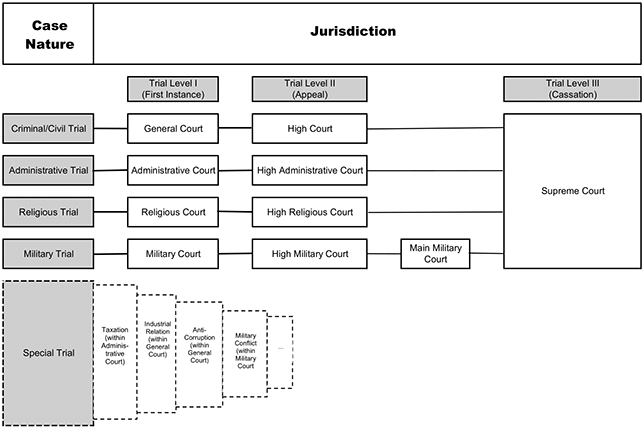
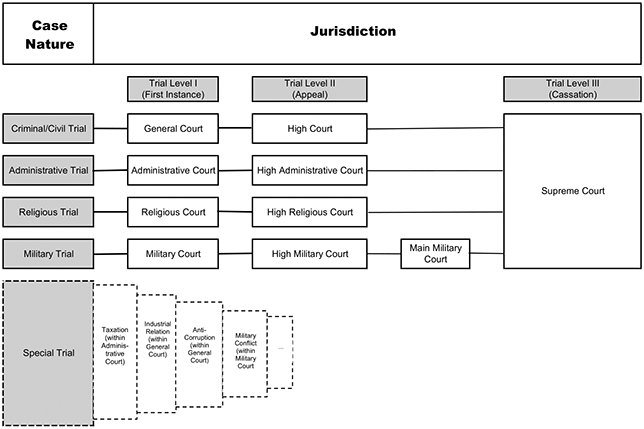
The court system in Indonesia has three main tiers: District Courts (the first instance of appeal in each regional area), High Courts (courts of appeal in each province), and the Supreme Court (the highest judicial institution at the national level). The Supreme Court oversees four distinct court jurisdictions: general courts, administrative courts, religious courts, and military courts (see Figure 1).
The structure of the Indonesian judicial system. This figure can also be found online at www.cambridge.org/muniroh.
General courts handle a wide range of civil and criminal cases. Within the general court system, there are also several special courts that have the authority to investigate, prosecute, and rule on specific types of cases. These include, among others, the Industrial Relations Dispute Court, Commercial Court, and Corruption Court (Butt & Lindsey, Reference Butt and Lindsey2018; Crouch, Reference Crouch2019). The creation of specialized courts after authoritarian rule has been a notable aspect of Indonesia’s court reform efforts. Crouch (Reference Crouch2021, p. 2) noted: “The trend towards judicial specialization can be found across jurisdictions in Asia, although the Indonesian case is remarkable in the scale and breadth of areas of specialization.”
Administrative courts have the jurisdiction to resolve disputes arising from decisions made by government officials and administrative bodies. Religious courts have the authority to settle issues within the Muslim community, such as those related to marriage, inheritance, wills, grants, waqf (ENG Islamic endowments), zakat (ENG charitable donations), infaq (ENG voluntary contributions), shadaqah (ENG charitable giving), and sharia economics. These matters fall under the jurisdiction of religious courts by law for Muslim citizens, rather than by personal or administrative choice. Military courts are empowered to handle offenses committed by soldiers or individuals recognized as soldiers, as designated by the army commander and approved by the Minister of Justice and Human Rights. They also have jurisdiction over internal military disputes and civil cases connected to military offenses. The structure of the Indonesian judicial system is illustrated in Figure 1 (cf. Butt & Lindsey, Reference Butt and Lindsey2018, p.84).
Within this court structure, there are typically two stages of appeal. The initial appeal is made to a higher court (High Court), and the second option is to file a cassation appeal to the Supreme Court, which is the highest court. In general, most cases are handled by a panel of three judges, with some exceptions (see Article 11 Section (1) Law 48 of 2009 on Judicial Power).
It is important to note that the Constitutional Court is not part of the organizational hierarchy of the regular court system in Indonesia. The Constitutional Court is an independent judicial body with nine judges, and it serves as the initial and ultimate authority for cases that fall under its jurisdiction. The Constitutional Court’s recent work has included handling disputes on related to the results of the 2024 general election. Prior to that, the court also reviewed the legal requirements for presidential and vice-presidential candidates, which was an important and controversial process leading up to the 2024 election. The Constitutional Court is responsible for resolving matters related to the Constitution, such as interpreting its clauses and deciding whether laws and government activities comply with the Constitution. Acting independently from the usual court system, the Constitutional Court has a crucial role in maintaining the foundations of Indonesia’s constitutional democracy. All decisions made by the Constitutional Court are final and binding.
The hierarchical structure of the court system in Indonesia is used for both civil and criminal law system to maintain order and resolve disputes within Indonesian society. The civil law system in Indonesia covers a range of noncriminal legal matters, which are primarily governed by the Indonesian Civil Code (Arifin, Reference Arifin2020). Examples of civil cases include contract disputes, property rights and ownership issues, family law matters (such as marriage, divorce, and inheritance), as well as commercial and business-related conflicts. In civil cases, the emphasis is on how individuals relate to one another and their respective rights and obligations. The plaintiff bears the responsibility of proving their claims. Civil courts have the authority to grant rulings for monetary compensation, specific fulfilment of obligations, or other fair solutions.
Indonesia’s hierarchical court system, handling diverse civil and criminal cases, offers significant potential for forensic linguistic research. Article 195 of the Criminal Procedure Code and Article 13 of the Law on Judicial Power mandate public access to court proceedings, except in restricted cases (Amarini et al., Reference Amarini, Saefudin, Kartini, Marsitiningsih and Ismail2023). Researchers may observe and collect data but must obtain prior permission from relevant authorities. Unlike the Constitutional Court, the High and Supreme Courts do not hold hearings but decide cases based on lower court records.
Despite its potential, research in courtroom interactions remains sparse. Linguistic researchers predominantly focus on interactions in general courts rather than specialized courts, and very few have examined appeals to higher courts or cassation appeals to the High Court from forensic linguistic perspectives.
The introduction of electronic court services which commenced in 2018 now allows registered users to manage their legal matters online. This comprehensive service includes features such as online case registration (e-Filing), online payment of court fees (e-Payment), electronic issuance of summonses (e-Summons), and conducting trials via online platforms (e-Litigation). These digital tools streamline the legal process, making it more accessible, efficient, and convenient for all parties involved (please visit e-Court Mahkamah Agung, ENG Supreme Court).
For forensic linguistic researchers, these digital innovations offer significant benefits. Researchers can now access court decisions more easily and check schedules for specific proceedings in the relevant courts, facilitating observation and data collection. This accessibility enhances the scope and efficiency of linguistic studies in the judicial context.
However, despite these advancements, substantive and technical challenges persist within the system (Amarini et al., Reference Amarini, Saefudin, Kartini, Marsitiningsih and Ismail2023; Rossner et al., Reference Rossner, Tait and McCurdy2021; Tiwisia et al., Reference Tiwisia, Maroni and Tisnanto2023). The existing legal frameworks and regulations have yet to fully address the gaps needed to ensure that digital court processes are conducted with the same rigor and integrity as traditional proceedings. One significant concern is the reduced transparency of online proceedings, which may not align with the Indonesian Criminal Procedure Code’s requirement for trials to be open to the public. Consequently, there is a pressing need to amend the Indonesian Criminal Procedure Code or introduce separate legislation to adequately regulate and support electronic court proceedings.
Meanwhile, criminal laws in Indonesia are substantively sourced from the Kitab Undang-Undang Hukum Pidana (KUHP) (ENG the Criminal Code) (Butt & Lindsey, Reference Butt, Lindsey, Lindsey and Pausacker2020). The Indonesian Criminal Code is derived from the Wetboek van Strafrecht voor Nederlands-Indië (WvS-NI), which was imposed by the Dutch colonial government in 1918 (Butt, Reference Butt2023; Faisal et al., Reference Faisal, Rahayu, Haryadi, Darmawan and Manik2024). This colonial-era legal framework has served as the foundation of Indonesia’s criminal law system. Since 1963, efforts to codify genuine national values and shift away from the colonial paradigm of criminal law in Indonesia have been ongoing. These efforts culminated in December 2022 with the completion of the New Criminal Code, which accommodates Adat Criminal Law (see Butt, Reference Butt2023; Yoserwan, Reference Yoserwan2024) and embodies a complex array of ideas aimed at achieving substantive justice (see Butt, Reference Butt2023; Faisal et al., Reference Faisal, Rahayu, Haryadi, Darmawan and Manik2024).
The KUHP defines various criminal acts and the applicable penalties for those who commit them. The procedures for criminal cases are outlined in the Kitab Undang-undang Hukum Acara Pidana, or KUHAP (ENG the Code of Criminal Procedure), as per Law Number 8 of 1981. The KUHAP regulates the duties of the police and prosecutors, as well as the rules governing arrests, warrants, detention, searches, provision of legal aid, management of evidence, trial procedures, and the appeals process for most categories of criminal cases (Butt & Lindsey, Reference Butt, Lindsey, Lindsey and Pausacker2020). The state prosecutes criminal cases, with public prosecutors serving as representatives. It is the prosecution’s responsibility to prove the defendant’s guilt beyond a reasonable doubt. Defendants, if found guilty, may be subject to penalties including fines, imprisonment, or, in certain instances, the death penalty. Further discussion about the procedural aspects of criminal law is provided in Section 1.4.2.
Due to historical factors, many terms in Indonesian civil and criminal law are derived from Dutch or Latin, rendering the legal language highly specialized. While the language of the law is formally Indonesian and used uniformly across the country, some legal registers including numerous archaic and technical terms unfamiliar to most laypersons are still found. These legal terms underscore the distinct and technical nature of the Indonesian legal language, which remains largely confined to the professional sphere of lawyers, judges, and other legal practitioners, rather than being part of the everyday Indonesian lexicon. For example, words like posita/positum (ENG basis of the claim/grounds for the lawsuit), petitum (ENG the claims/demands in the lawsuit), repliek (ENG the plaintiff’s rebuttal), duplik (ENG the defendant’s response to the repliek), verstek (ENG a default judgment rendered in the absence of the defendant or without the defendant’s presence), and verzet (ENG an objection or opposition to a verstek judgment) are deeply rooted in the country’s colonial legal heritage, but are not widely used outside of legal contexts (Abubakar & Din, Reference Abubakar and Din2022).
Forensic linguistics can play a critical role in addressing these challenges. By analyzing and interpreting the specialized legal language, forensic linguists can contribute to the translation and simplification of legal documents (e.g. Marlia et al., Reference Marlia, Lukmana and Gunawan2023), making them more accessible to nonlegal professionals and the general public. This includes translating complex legal terms into plain language without compromising their legal accuracy, thereby bridging the gap between technical legal discourse and lay understanding.
Customary or Adat Law
Customary legal system or adat law is an ethnic legal tradition based on the long-standing and deeply ingrained values of the Indonesian people, as well as the community’s own understanding of justice and peace (Lukito, Reference Lukito2012). As Indonesia is rich in diverse ethnicities (more than 600 ethnicities spread over some 17,000 islands), there is no single Indonesian customary law, but rather various regional customary laws, such as Adat law of Aceh, Java, Minangkabau, and so on (Mutaqin, Reference Mutaqin2011; Tamma & Duile, Reference Tamma and Duile2020). Therefore, Mutaqin (Reference Mutaqin2011, p. 352) said that “no single scholar, even if he is an Indonesian, can be an expert of adat law.”
A key feature of these customary laws is that it operates in the languages of the respective ethnic groups and have specific domain of application, which may differ from one region to another (Butt & Lindsey, Reference Butt and Lindsey2018; Warman et al., Reference Warman, Isra and Tegnan2018). The use of these languages is central to their transmission and practice, reflecting cultural values and ensuring the credibility of customary legal systems.
The adat law primarily governs matters related to land ownership and usage (e.g. Bakker, Reference Bakker2023; Fitzpatrick, Reference Fitzpatrick and Lindsey1999, Reference Fitzpatrick, Davidson and Henley2007; Simarmata, Reference Simarmata2019). Additionally, it encompasses certain aspects of family law, including regulations around marriage, divorce, and inheritance (e.g. Deliana & Rauf, Reference Deliana and Rauf2022; Judiasih & Fakhriah, Reference Judiasih and Fakhriah2018; Thalib, Reference Thalib2023). Customary law also plays a role in the handling and resolution of a select number of civil and criminal disputes (see Law Number 30 of 1999 on Arbitration and Alternative Dispute Resolutions). In these cases, customary law often employs restorative approaches, which focus on repairing the harm caused and restoring harmony within the community, rather than solely on punitive measures (Budianto et al., Reference Budianto, Rato, Anggono and Setyawan2022; Wardhani et al., Reference Wardhani, Noho and Natalis2022). Customary law is mainly practiced in rural and remote areas, where limited state presence leaves legal matters to local traditions.
However, as urbanization and economic development have continued to transform Indonesia since the 2010s, with the increasing numbers of people migrating to cities, the adherence and practice of customary law is steadily declining (Butt & Lindsey, Reference Butt and Lindsey2018; Priambodo, Reference Priambodo2018). This trend is driven by the growing influence of the national Indonesian language and the state’s formal legal institutions in urban settings, which has led to the gradual erosion of the linguistic and cultural foundations of customary law. As a result, customary law’s wider relevance and applicability have been increasingly undermined, especially among the populations that have relocated from rural areas to major cities. Nevertheless, customary law remains an important and influential legal tradition in many remote parts of Indonesia, where ethnic and indigenous communities continue to maintain strong connections to their ancestral lands and traditional governance structures (e.g. Salahuddin et al., Reference Salahuddin, Ahmad, Suharti and Nurhilaliati2023; Yulia et al., Reference Yulia, Prakarsa and Bustami2023).
Forensic linguistics can play a valuable role in the understanding, documentation, and application of hukum adat (customary laws) in Indonesia which is deeply rooted in oral traditions and expressed through diverse local languages. To date, there has been little to no forensic linguistic research focused on the intersection of language and customary law in Indonesia, making this a promising area for future exploration. Forensic linguists can contribute by documenting and analyzing oral testimonies, ceremonial language, and patterns of discourse used in traditional dispute resolution processes. They can also provide linguistic analysis of customary legal texts or oral statements. They can help clarify ambiguities and ensure that customary norms are correctly interpreted in formal legal settings. This is particularly valuable in a country where adat (ENG custom) often intersects with state and religious laws. Despite its importance, this area of research remains relatively underexplored, presenting opportunities for further scholarly and practical contributions.
Sharia Law
The other significant legal tradition applied in Indonesia is the religious legal system based on Islamic Sharia law. Indonesia, with over 80 percent of its population being Muslim, is considered one of the largest Muslim-majority countries in the world. However, it is important to note that Indonesia is not an Islamic state and does not apply Islamic law as the supreme source of law in the constitution and national legislation. Instead, the state ideology Pancasila (ENG the five pillars; Soekarno refers to it as Weltanschauung in German, roughly equivalent to the English word “worldview”) serves as the foundational principle.
Only the province of Aceh in Indonesia currently enforces Sharia law. The application of Islamic law in Aceh is provided under Law Number 44 of 1999, which grants the province a special autonomous status, as well as Keputusan Presiden (ENG Presidential Decree) Number 11 of 2003. Unlike customary law, which is primarily unwritten, the implementation of Sharia law in Aceh is codified in the form of Aceh Qanun, or local regulations, for example, Aceh Qanun Number 6 of 2014 about Qanun Jinayat (ENG Aceh Criminal Code) and Aceh Qanun Number 7 of 2013 about Hukum Acara Jinayat (ENG Aceh Criminal Procedure Code). These codes operate alongside the national Indonesian Criminal Code and Indonesian Criminal Procedure Code in Aceh, reflecting the province’s special autonomous status and the application of Islamic criminal law within the broader Indonesian legal framework. The ulama council, also known in Indonesian as the Majelis Permusyawaratan Ulama, has been a key institution in the enforcement of this Qanun. Additionally, Wilayatul Hisbah (ENG the Sharia police) has also its relevance. Furthermore, Mahkamah Syariah (ENG the Islamic courts) have played a significant role in legal operation (Cammack & Feener, Reference Cammack and Feener2012).
Unlike customary law, which operates primarily in local languages, the Aceh Qanun is predominantly written in Indonesian, incorporating specific terminologies derived from Arabic. Terms such as jarīmah, uqūbat, hudūd, tazīr, khalwat, ikhtilāth, liwāth, musāhaqah, and khamar have been integrated into Kamus Besar Bahasa Indonesia (ENG the Great Indonesian Language Dictionary). However, their enforcement can sometimes pose challenges due to linguistic and cultural differences (Abubakar & Din, Reference Abubakar and Din2022).
The coexistence of Sharia law, as codified in the Aceh Qanun, alongside the national legal system and customary law in Indonesia reflects the country’s rich religious and cultural diversity. This pluralistic legal landscape continues to be a subject of ongoing discussion and negotiation within the Indonesian context.
Forensic linguistics can enhance fairness, transparency, and communication in Sharia-based legal processes by analyzing texts, judgments, and testimonies to identify inconsistencies, clarify interpretations, and ensure equitable application of legal language. Examining how key terms are understood across cases supports consistency and fairness. Although this area remains underexplored, a notable study by Yusuf, Mansur, and Muthalib (Reference Yusuf, Mansur and Muthalib2024) applies legal linguistics and critical discourse analysis to public opinion on Qanun Putroe Phang, an Aceh regulation on governance and women’s and children’s rights. The authors recommend revising the qanun toward a persuasive rather than mandatory approach, aligning with Acehnese values and social dynamics. This emerging research highlights the potential of language–law studies to inform Sharia-based legal practices while respecting cultural and religious contexts.
1.3.2 Indonesian Criminal Law and Procedures
This section focuses on the procedural elements of criminal law. The elements, such as regulations concerning police investigations, prosecutions, and trials, are outlined in the Kitab Undang-Undang Hukum Acara Pidana or KUHAP (ENG Criminal Procedure Code). In contrast to the Criminal Code, which was initially enacted in 1918, KUHAP is not a product of colonialism. Instead, it was created as the Indonesian government efforts to replace the Dutch procedural code, which had been in force since 1926, and address modern demands for the management of criminal justice. KUHAP is not impacted by the New Criminal Code (Butt, Reference Butt2023).
KUHAP outlines four stages of criminal procedure (Butt & Lindsey, Reference Butt, Lindsey, Lindsey and Pausacker2020). The first is the penyelidikan (ENG preliminary investigation), aimed at determining whether a crime has occurred. The second is penyidikan (ENG the main investigation) which seeks to gather further information and evidence, and identify suspects. At this stage, praperadilan (ENG pre-trial hearings) may also occur. The third stage is penuntutan (ENG prosecution), during which prosecutors prepare their case against the accused for presentation in court. Lastly, pengadilan (ENG the trial) takes place, where a panel of typically three judges reviews the case, determines the defendant’s guilt or innocence, and, if found guilty, assigns punishment. This section does not detail further about KUHAP (for further readings, see Butt & Lindsey, Reference Butt, Lindsey, Lindsey and Pausacker2020). Instead, it will link these stages to the potential importance of forensic linguistics thus far.
Among the four stages, the first and second stages often attract public concern, particularly because the police, who lead the investigation process, have been repeatedly reported for employing coercive practices against suspects during custody and interrogation, according to Komnas HAM (ENG the National Human Rights Commission) (Pratama & Ibrahim, Reference Pratama and Ibrahim2024) and the Institute for Criminal Justice Reform (Azeez, Reference Azeez2024). Although the Indonesian police have regulations grounded in principles of human rights and ethics, they often struggle to implement these principles in practice (Muniroh & Heydon, Reference Muniroh and Heydon2022).
To address these issues, initiatives have been launched, including training programs aimed at transforming traditional interrogation methods into investigative interviewing practices (Asplund, Reference Asplund2019). Kompolnas RI (ENG Indonesia’s National Police Commission), a supervisory body established to promote police accountability, advocates for the nationwide adoption of investigative interviewing techniques and the use of designated interview rooms (Hatoum, Reference Hatoum2023).
In this context, forensic linguistics plays a crucial role in enhancing police investigators’ awareness of how language can influence or minimize the potential for torture. It also facilitates research on the discourse used in police interviews, including language employed by investigators, witnesses, victims, and suspects. This area of investigation has been explored by Indonesian scholars, as will be detailed in Section 3.
As noted by Muniroh (Reference Muniroh2019) and Muniroh and Aziz (Reference Aziz2016), recording is not mandatory during police interviews in Indonesia. Consequently, linguists interested in police investigations may encounter challenges in collecting natural data (see Muniroh & Heydon, Reference Muniroh and Heydon2024). In contrast to police interviewing, which lacks transparency, the openness of court proceedings to the public, as discussed previously, presents a more promising area for investigation.
1.3.3 Sociocultural Contexts
In addition to the legal system and criminal law shaping the development of forensic linguistics in Indonesia, sociocultural contexts also play a significant role in influencing its progress. These sociocultural factors encompass Indonesia’s linguistic diversity, the wide range of ethnic groups and religions, the unique sociocultural norms that define interactions and communication within the country, and literacy of Indonesian people. Together, these elements create both challenges and opportunities for the application of forensic linguistics in addressing legal issues.
Linguistic Diversity
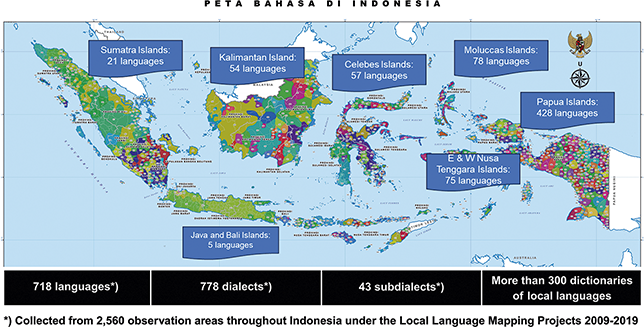
Indonesia possesses an exceptional richness in linguistic diversity. Zein (Reference Zein2020) observed and support Steinhauer’s assertion (Steinhauer, Reference Steinhauer1994) that although the exact number of languages spoken globally is unknown, it is estimated that one-tenth of them are spoken in Indonesia. This claim is later reinforced by Florey and Himmelmann (Reference Florey, Himmelmann and Florey2010, p. 123), who state that Indonesia represents 10.7 percent of the world’s languages. At the current statistics as shown in Figure 2, there are 718 languages,Footnote 3 778 dialects,Footnote 4 and 43 subdialectsFootnote 5 collected from 2,560 observation areas throughout Indonesia under the Local Language Mapping Projects, 2009-2019 (Aziz, Reference Aziz2024).
Language maps of Indonesia (Aziz, Reference Aziz2024). This figure can also be found online at www.cambridge.org/muniroh.
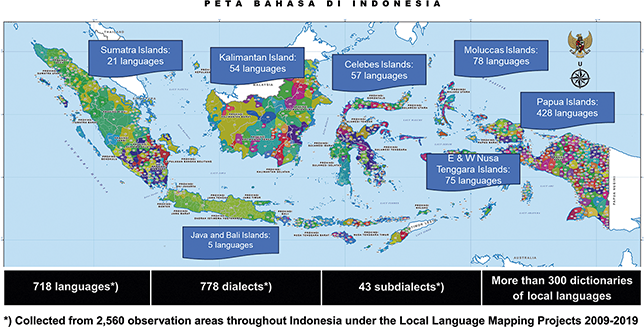
Figure 2 Long description
Map of Indonesia's linguistic diversity titled 'Peta Bahasa di Indonesia,' showing the distribution of 718 local languages across islands. Sumatra has 21 languages, Kalimantan 54, Celebes 57, Moluccas 78, Papua 428, Java/Bali 5, and Tenggara Islands 75. The map includes 778 dialects, 43 subdialects, and 248 local language dictionaries. Data collected from 2,560 observation areas (2009–2019) by Indonesia's Agency for Language Development and Cultivation under the Ministry of Education.
With Indonesia’s rich diversity of languages, cultures, and ethnicities, law enforcement and the delivery of justice face both significant opportunities and challenges. Linguistic differences can complicate communication within legal settings, particularly during police investigations and court proceedings. While Indonesian is mandated as the language of the courtroom and judicial proceedings (Article 53 of the Indonesian Criminal Code), the reality of multilingual interactions necessitates careful management of language issues.
Indonesian regulations have long acknowledged the importance of language in legal contexts. Law Number 8 of 1981 on Criminal Procedure explicitly references the role of interpreters in Articles 53 Section (1) and Article 177 Section (1), as follows:
Article 53 Section (1)
In examinations conducted at the level of investigation and trial, the suspect or defendant has the right to receive the assistance of an interpreter at any time, as referred to in Article 177.
Article 177 Section (1)
If the defendant or witness does not understand the Indonesian language, the presiding judge of the trial shall appoint an interpreter who has sworn an oath or made a pledge to accurately translate everything that needs to be translated.
However, the regulations lack detailed provisions regarding the qualifications required for interpreters in legal settings. This gap is further exacerbated by certain attitudes among law enforcement officers regarding language use. Overconfidence in their own linguistic abilities or assumptions about language familiarity can lead officers to forego engaging professional interpreters. In some cases, court staff members, such as judicial case analysts, archivists, or even security personnel, are appointed as interpreters solely based on their language background, regardless of their professional training or expertise in legal interpretation (see e.g. Tampubolon, Reference Tampubolon2024). For instance, letters issued by the court (see: Supreme Court of Indonesia Legal Products,Footnote 6 accessed December 10, 2024) stated that assigned staff members were considered competent and capable of serving as interpreters in courtroom proceedings. The letters also outlined the responsibilities of courtroom interpreters: (1) render the language accurately and completely, (2) remain impartial and avoid taking sides, and (3) prevent conflicts of interest.
Addressing these issues requires establishing clear interpreter qualifications and standards in legal settings to ensure fairness and accuracy in multilingual courtrooms. This highlights the importance of professionalizing the role of interpreters to safeguard justice and equity within Indonesia’s pluralistic legal landscape.
Another issue related to linguistic diversity is the differences in people’s perceptions or attitudes toward particular languages, dialects, or vernacular languages. These views can often lead to conflicts in cross-linguistic interactions, especially when some are viewed as more prestigious than others. In Indonesia, such interactions are particularly common due to migration from one region to another for work or educational purposes, which brings together speakers of different languages. For example, the distinction between standard Bahasa Indonesia (a high variety) and the vernacular Bahasa Indonesia of Eastern Indonesia (a low variety) illustrates this dynamic. The unique dialectal characteristics of Eastern Indonesian languages – phonological, lexical, and morphological – can raise issues of linguistic racism and privilege (Wijaya & Rizal, Reference Wijaya and Rizal2023). These variations in Bahasa Indonesia often lead to further forensic linguistic issues, such as bullying and hate speech.
Another relevant illustration to issues related to linguistic diversity is the disputed meanings of words stemming from conflicting prescriptive and descriptive views on the emerging use of language, such as slang. A notable case involves the word “anjay.”Footnote 7 According to Indonesian YouTuber Lutfi Agizal, this word should be prohibited to use as it can damage the morality of Indonesian youth, and those who use it should be punished for its insulting nature. As a response to this, the National Commission for Child Protection released a statement purporting to ban the word, arguing that it diminishes someone’s honor and dignity, which can be punishable by law under verbal violence (Utami, Reference Utami2020). This statement received strong reactions from Indonesian netizens. In this context, both the YouTuber and the National Commission viewed the word prescriptively, while linguists approached it descriptively, recognizing that the meaning of the word may vary depending on the context of its use.
Ethnicity and Religion
According to the 2020 Population Census by BPS Statistics Indonesia, Indonesia has a population of 278.7 million and over 600 ethnic groups (Zein, Reference Zein2020). The five largest groups are the Javanese (40.2% of the population), Sundanese (15.5%), Batak (3.6%), Sulawesi (3.22%), and Madurese (3.03%) (Na’im & Syaputra, Reference Na’im and Syaputra2011). Most Indonesians identify as Muslims (87.18%), followed by Christians (6.96%), Catholics (2.91%), Hindus (1.69%), Buddhists (0.72%), Confucians (0.05%), and adherents of other religions (0.5%).
As a multi-ethnic and multi-religious nation, Indonesia generally maintains peaceful interethnic and interreligious relationships. Core values like tolerance and Bhinneka Tunggal Ika (Unity in Diversity) foster harmony, while Pancasila, the state ideology, promotes mutual respect and cooperation. Together, these principles serve as social capital for violence prevention and conflict resolution (Hartoyo et al., Reference Hartoyo, Teuku and Sunarto2020).
However, interethnic and interreligious conflicts have occurred, particularly after the fall of the New Order regime in 1998 (Dewantara et al., Reference Dewantara, Budimansyah and Darmawan2024; Liu & Ricks, Reference Liu and Ricks2022). Key causes include economic inequality, lack of understanding of religious differences, and perceptions of unfair treatment (Rasyid et al., Reference Rasyid, Lubis and Hutagalung2023). Challenges persist, including tensions involving the Chinese community – Indonesia’s fifteenth largest ethnic group (Adi & Bahri, Reference Adi and Bahri2023; Sinaga et al., Reference Sinaga, Kusumaningtyas and Rozi2024) – as well as issues related to Islamic radicalism and terrorism.
An example of interethnic conflicts can be illustrated by the tendencies of certain ethnic groups, such as the Batak, who are known for speaking directly and with a high tone. This directness can lead to perceptions of anger or aggression. In contrast, other ethnicities, such as the Javanese or Sundanese, often communicate in a more indirect and soft-spoken manner. These differing communication styles can create misunderstandings and tensions between groups, highlighting the impact of cultural differences on interpersonal interactions. Another illustration can be found in Dewantara et al.’s research on verbal violence and discrimination in Multi-Ethnic Schools in West Kalimantan, Indonesia (Dewantara et al., Reference Dewantara, Budimansyah and Darmawan2024).
In Indonesia, sensitive issues related to ethnicity and religion are categorized under SARA (Suku, Agama, Ras, dan Antargolongan – ENG Ethnicity, Religion, Race, and Intergroup Relations). These aspects are central to defining verbal violence such as hate speech and understanding social tensions. Addressing SARA-related challenges is essential for promoting tolerance and unity in Indonesia’s multicultural society.
Forensic linguistics has played a significant role in addressing SARA-related conflicts. By analyzing the language used in media, legal documents, and public discourse, forensic linguists can identify hate speech, inflammatory rhetoric, or biased narratives that exacerbate tensions. They can contribute to developing clearer guidelines for detecting and prosecuting hate speech under Indonesian law, ensuring that SARA-related violations are addressed effectively (see Section 4).
Sociocultural Norms
In Indonesia, a remarkably diverse nation, linguistic and cultural variations naturally emerge across its many ethnic groups. Despite this diversity, Indonesian society has traditionally emphasized unity, harmony, and collective responsibility, as reflected in the national ethos of gotong royong – mutual cooperation and the prioritization of shared goals (Butt, Reference Butt2023; Rahardjo, Reference Rahardjo1994). These values live in community-based interactions which are hold in face-to-face communication mode. However, this landscape has been shifting since 2015, driven by modernization, globalization, and democratization (Abdullah et al., Reference Abdullah, Jubba and Pabbajah2019). Increasingly, individual interests are prioritized over collective values. In the past, Indonesian collectivism was the norm, with the concept of aku (ENG I, the self) illustrating that individual identity was deeply embedded in community relationships. This sharply contrasted with Western individualism, where the self is perceived as autonomous and independent (Rahardjo, Reference Rahardjo1994).
Today, with the rise of “selfism” or individualism, Indonesians are becoming more assertive and self-focused, more aware of honor and reputation in social interactions, particularly in urban and digital communication. What was once perceived as confrontational or disruptive to communal harmony is now becoming more commonplace. This cultural shift has led to social fragmentation and a weakening of traditional ethical frameworks, contributing to increased social tensions. Conflicts related to privacy, self-image, and individual rights have become more apparent.
The adverse effects of technology have drastically changed the way people interact and communicate, leading to a significant sociocultural shift. It has created new realities in which individuals navigate both a digital world and the physical one. Unlike face-to-face communication, digital communication allows for interaction without the limitations of time and geography, enabling exchanges that are often instant and capable of reaching a global audience. While individuals enjoy a degree of freedom in presenting themselves and sharing their interests – thanks to the possibility of anonymity – they may not realize that their messages or posts in the digital realm can leave a lasting trace. This permanence can have unintended consequences, impacting their reputation and privacy in ways they might not anticipate.
Digital communication has also given rise to a new genre of language practices, blending spoken language styles with written forms. Therefore, digital literacy is essential, as many Indonesians may lack this skill, resulting in problematic language use in the virtual world, including hoaxes, hate speech, slander, fraud, manipulation, insults, defamation, plagiarism, and more (Saifullah, Reference Saifullah2021).
This transformation underscores the growing importance of forensic linguistics in addressing expressions that may lead to hate speech, insults, or defamation not only in face-to-face communication but also in digital world. As communication norms evolve, forensic linguistics plays a critical role in providing expert testimony and analysis to navigate disputes and uphold justice in a changing societal landscape.
2 Historical Development of Forensic Linguistics in Indonesia
2.1 Origins, Early Influences, and Key Milestones
Indonesian history reveals that cases involving language, which could result in imprisonment or other punishments, have occurred since the Soekarno era or Old Order (1945–1966), continued through the Suharto era or New Order (1966–1998) administration, and persist to this day. During the Old and New Order periods, the term “forensic linguistics” was not yet in use, language-related cases were rarely brought to court, and the analysis of language in connection with crimes was referred to simply as common language analysis. Criticism directed at the government or authorities during these periods often led to punishment to the critics, which could be in the form of imprisonment. This is in line with what Human Rights Watch (2010, p. 2) reported:
Holding public demonstrations protesting corruption, writing letters to the editor, complaining about fraud, registering formal complaints about acts of impropriety by politicians, and writing and publishing news reports about sensitive subjects are common practices in a democratic society. But in Indonesia, such criticism can lead to criminal charges and land you in prison, even if what you say is true.
According to the literature, early language-related cases frequently involved critics and defamation, with many of these cases pitting citizens against government or journalists against authorities (Margiyono, Reference Margiyono2010; Teguh, Reference Teguh2019). One notable example is Mochtar Lubis, the editor-in-chief of the newspaper Indonesia Raya, who was imprisoned during the 1950s. He served a ten-year sentence after being accused of criticizing and defaming the government during the Old Order under President Soekarno. Following his release, during the Soeharto era, Lubis continued his critical reporting through Indonesia Raya, publishing exposés on corruption within Pertamina, Indonesia’s state oil company. As a result, he was imprisoned again for two and a half months, and his newspaper was banned (Teguh, Reference Teguh2019).
Another example is Ashadi Siregar. In 1973, he was brought to trial for publishing an article titled “Mukaddimah” in Sandi magazine. The article reportedly contained sharp criticisms of government policies and highlighted the societal impact of authoritarianism, making it a target in a political climate intolerant of dissent. Ashadi was sentenced to one year in prison, and Sandi magazine was subsequently banned from publication (Badan Pengembangan dan Pembinaan Bahasa, 2016). Two other cases worth mentioning here, namely the imprisonment to Sri Bintang Pamungkas for his affront expressions (defamation) addressed to President Soeharto. The other one was the use of linguistic expressions Ada Tomy di Tenabang (ENG There is Tomy in Tanah Abang – a district in Jakarta) on the cover of the March 2003 edition of Tempo magazine. This phrase referred to prominent Indonesian businessman Tomy Winata. Winata took offense to the reporting, deeming it inaccurate and defamatory. Tempo had suggested his involvement in the Tanah Abang Market fire incident and alleged he secured a 53 billion IDR renovation project for the market. This resulted in the charges to the editors and the magazine was then banned.
During that era, Indonesia already had legal provisions for defamation inherited from the Herzien Inlandsch Reglement (HIR) of the Dutch colonial period, which were codified in the Indonesian Criminal Code (KUHP) under Chapter XVI, Articles 310–321. These articles provided the legal framework frequently used to prosecute defamation cases. Below are the relevant provisions from Articles 310 and 311, which were commonly invoked:
Article 310
(1) The person who intentionally harms someone’s honor or reputation by charging him with a certain fact, with the obvious intent to give publicity thereof, shall, being guilty of slander, be punished by a maximum imprisonment of nine months or a maximum fine of three hundred rupiahs
(2) If this takes place by means of writings or portraits disseminated, openly demonstrated or put up, the principal shall, being guilty of libel, be punished with a maximum imprisonment of one year and four months or a maximum fine of three hundred rupiahs
(3) Neither slander nor libel shall exist as far as the principal obviously has acted in the general interest or for a necessary defense.
Article 311
(1) Any person who commits the crime of slander or libel in ease proof of truth of the charged fact is permitted, shall, if he does not produce said proof and the charge has been made against his better judgment, being guilty of calumny, be punished by a maximum imprisonment of four years.
(2) Deprivation of rights mentioned in Article 35 first to thirdly may be pronounced.
However, this defamation law has raised significant concerns among scholars and human rights activists due to its negative impact in Indonesia. It is frequently used as a tool of official repression to criminalize individuals and restrict freedom of expression – a right explicitly protected by Indonesia’s Constitution (Heryanto, Reference Heryanto1995; Human Rights Watch, 2010). Article 28 Section (e) states, “Every person shall have the right to the freedom of association and expression of opinion,” while Article 28 Section (f) affirms, “Every person shall have the right to communicate and obtain information for the development of his/her personal life and social environment, and shall have the right to seek, acquire, possess, keep, process, and convey information using all available channels.”
During the Old Order, the involvement of language experts in legal proceedings was almost nonexistent. This absence can be attributed to the prevailing perception that legal matters primarily required expertise in fields such as law, politics, sociology, human rights, communication, or journalism (Heryanto, Reference Heryanto1995; Margiyono, Reference Margiyono2010). Language analysis, particularly in legal contexts, was not yet regarded as a significant or relevant tool for resolving disputes or clarifying evidence in court.
This trend continued into the New Order, as demonstrated by the courts’ rejection of language experts as witnesses in 1989, even when requested by defendants and their lawyers (Heryanto, Reference Heryanto1995). This decision highlighted the limited recognition of their potential contributions to legal proceedings at the time. Furthermore, linguistic scholarship during this period primarily focused on theoretical pursuits, such as the study of suffixes, complex sentences, and grammatical structures, rather than practical applications like forensic linguistics. Additionally, linguistic studies were more oriented toward corpus development, language standardization, and language learning, with little emphasis on applied research, let alone forensic purposes. Heryanto (Reference Heryanto1995) indicates that the first recorded instance of a language expert being invited to court by prosecutors occurred on August 8, 1995, when Drs. Lukman Hakim provided testimony in the Permadi insult case at the Sleman District Court.
The rejection of language experts by the courts was largely influenced by the shortcomings in the regulation and provision of expert testimonies in Indonesia. Law Number 8 of 1981 on the Indonesian Criminal Procedure Code (KUHAP) does not clearly or comprehensively define expert testimony or specify the qualifications required to be considered an expert. This lack of clarity in the legal framework contributed to the courts’ limited acceptance of expert witnesses, including language experts. Expert testimony, recognized as valid evidence under the law, is addressed in only one article. Found in Part Four, Chapter X, Article 186 of the Criminal Procedure Code states: “Expert testimony is what an expert declares in court.” Similarly, the norms governing the qualifications of an expert are minimal. Article 1 Section (28) of the Criminal Procedure Code merely defines expert testimony as “the testimony provided by a person with specific expertise on matters required to clarify a criminal case for the purposes of an investigation” (Raspati, Reference Raspati2012). However, this Article does not clarify whether an expert’s explanation can be submitted as written statement alone or if the expert must appear in court to present and defend their statement (Butt & Nathaniel, Reference Butt and Nathaniel2024).
This illustration clearly highlights that in Indonesia, the primary focus of language in legal contexts has been its use as evidence. However, this does not imply that other areas, such as spoken language in legal processes and written language in legal documents, are without issues. For instance, violations of human rights during investigative processes at police stations and the ambiguity of legal texts remain a significant concern – one that forensic linguistics can help address. This raises a critical question: when did people begin recognizing or referring to the practice of providing expert testimonies in legal cases as forensic linguistics?
The emergence of forensic linguistics in Indonesia can be categorized into three key factors. First, the influence of Indonesian scholars who studied abroad either through degree programs or specialized courses, and returned to disseminate their knowledge. Second, the growing number of Indonesian scholars exposed to forensic linguistic research, literature, and publications, which helped to expand awareness and understanding of the field. Third, the increasing recognition of language’s pivotal role in the legal and judicial system, particularly following the enactment of the Electronic Information and Transactions Law in 2008 (Law Number 11 of 2008) and its amendment in 2016 (Law Number 19 of 2016).
The authors of this Element are included in the first category. More particularly, E. Aminudin Aziz played a pivotal role as one of the pioneering Indonesian scholars in the early dissemination of forensic linguistics in the country (see Aziz, Reference Aziz2012, 2016; Mira, Reference Mira2002; Rustandi, Reference Rustandi2011). His journey in forensic linguistics began while pursuing his doctoral degree in linguistics at Monash University Australia in 1997. To our knowledge, exposure to forensic linguistics among Indonesian scholars during this period was still rare, and even fewer pursued MA or doctoral studies specifically in this field.
During this time, he received formal training in forensic linguistics and was involved in assisting with language analyses for forensic cases involving local languages in Australia. He was also introduced to the work of Diana Eades on Aboriginal language cases during a Master class taught by Anne Pauwels. Yet, his theses fell under the area of Pragmatics, focusing on politeness phenomena in speech acts of refusals.
After completing his PhD in 2000, he returned to Indonesia and began teaching undergraduate sociolinguistics courses in the English language education program at Universitas Pendidikan Indonesia or UPI (ENG Indonesia University of Education), where R. Dian Dia-an Muniroh was one of his students. In these classes, he introduced forensic linguistics, incorporating it into the syllabus. The course included student presentations based on critical readings of sociolinguistic materials assigned from the first meeting. Muniroh had the opportunity to present and share her understanding of language and the law in Australia, focusing on the Kevin Condren case, in which Diana Eades served as an expert witness. This presentation marked Muniroh’s introduction to forensic linguistics and sparked her interest in the field.
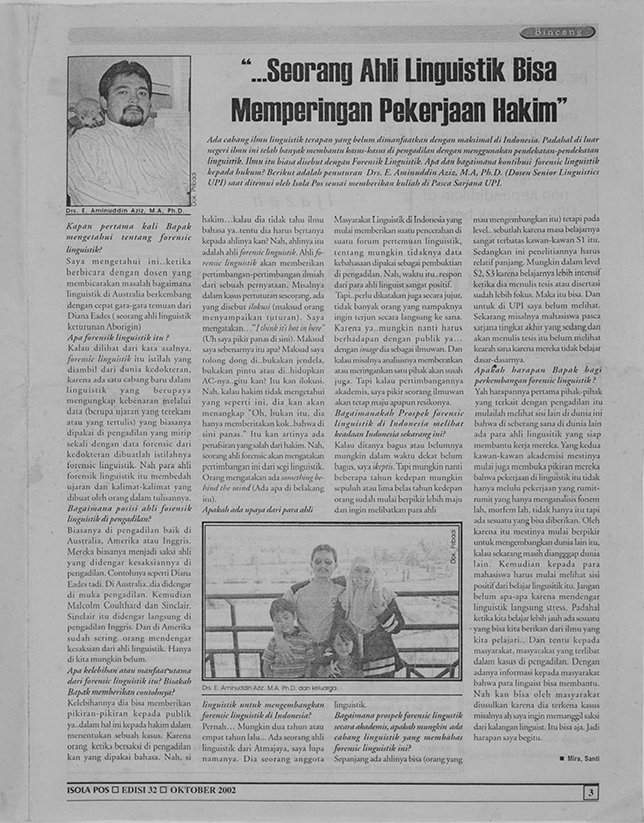
In October 2002, Aziz was interviewed by an Isola PosFootnote 8 journalist and his explanation about forensic linguistics was published in this newspaper with the title “Seorang Ahli Linguistik Bisa Memperingan Kerja Hakim” (ENG A Linguistics Expert Can Ease a Judge’s Work; see Figure 3) (Mira, Reference Mira2002). This marked the first time the term “forensic linguistics” was used and disseminated through the media in Indonesia.
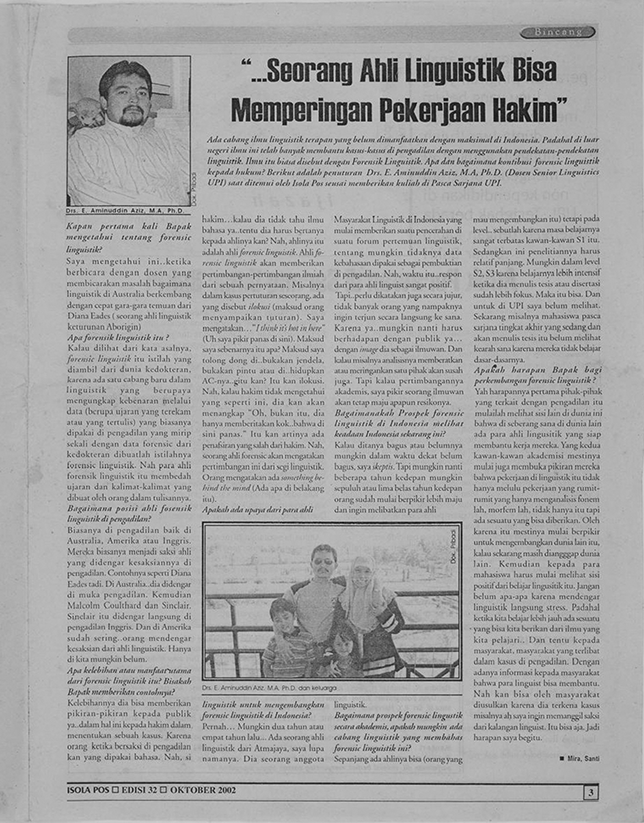
Figure 3 Long description
The newspaper article from Isola Pos (Edition 32, October 2002) titled A Linguist Can Ease a Judge’s Work, featuring an interview with E. Aminudin Aziz, a Senior Linguistics Lecturer at Indonesia University of Education (UPI). The article discusses forensic linguistics and its underutilized potential in Indonesia. Key points from the interview include introduction to forensic linguistics, role of forensic linguists in courts, challenges of forensic linguistics in Indonesia, future expectations. The article concludes with his hope for collaboration between courts and linguists to improve judicial accuracy.
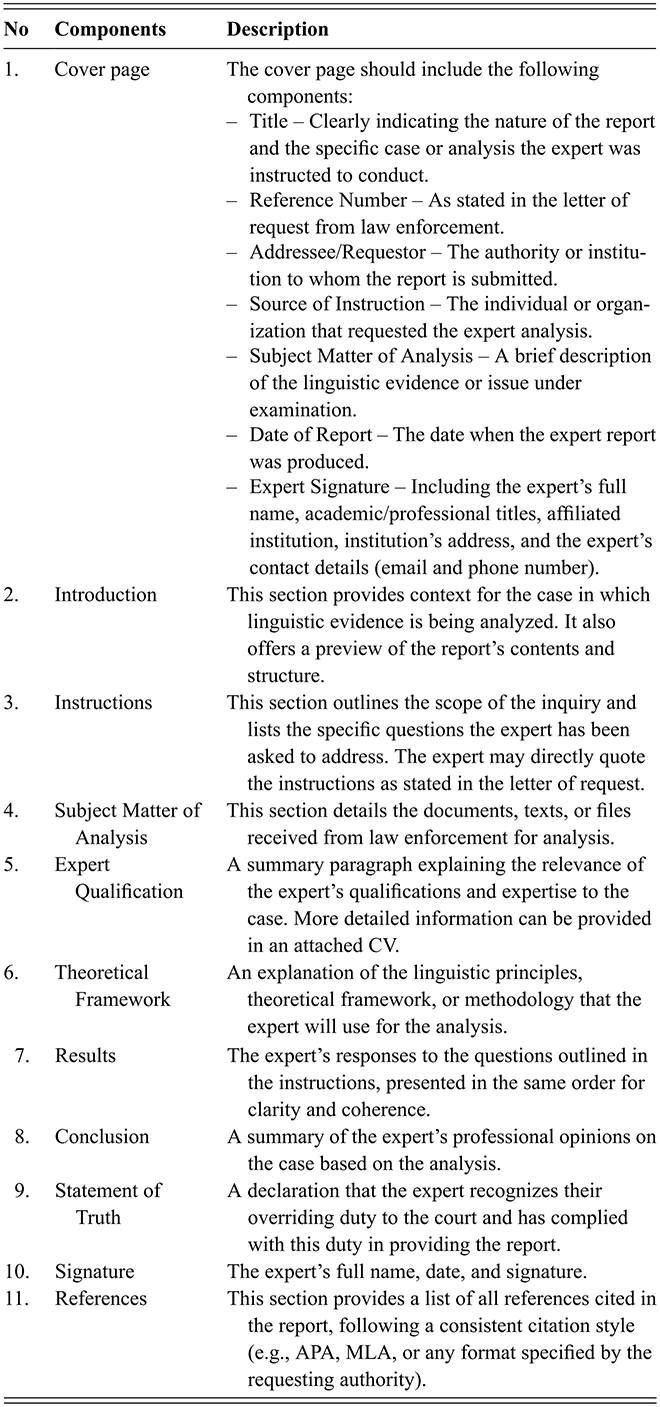
Another significant milestone in the dissemination and development of forensic linguistics in Indonesia was the international conference organized through a collaboration between the Universitas Pendidikan Indonesia (UPI) branch of the Linguistic Society of Indonesia, led by Aziz, and the Linguistic Society of Indonesia (https://www.mlindonesia.org/).Footnote 9 This event, known as Kongres International Masyarakat Linguistik Indonesia or KIMLI (ENG International Conference of the Linguistic Society of Indonesia), took place in Bandung, West Java, on October 9–12, 2011. Under the theme “Language and Nation Character Building,” forensic linguistics was one of the main topics offered during the One Day Master Class offered in pre-conference session, alongside two other key areas discussed by linguists (Rustandi, Reference Rustandi2011). The other two topics included Field Linguistics, which focused on mapping endangered languages, and Applied Linguistics, which explored models of English language teaching that emphasized critical thinking. The Master Class on forensic linguistics was well-attended by Indonesian scholars, journalists, and law enforcement officers. The conference featured Dr. Georgina Heydon, a forensic linguist from RMIT University in Melbourne, Australia, who delivered the Master Class and served as a keynote speaker. Her paper presented at KIMLI 2011, titled “Forensic Linguistics: Forms and Processes,” was later published in the Linguistik Indonesia journal February 2014 (Heydon, Reference Heydon2014). This publication marked the first academic article on forensic linguistics to appear in an Indonesian journal.
Following this conference, Indonesian scholars reached a significant milestone by presenting their papers on forensic linguistics at the First Asia Regional Conference of the International Association of Forensic Linguists, held during July 5–7, 2012, in Kuala Lumpur, Malaysia. Under the theme “Forensic Linguistics/Language and Law: Researching Interdisciplinary Dimensions and Perspectives,” Muniroh and Aziz, lecturers from Universitas Pendidikan Indonesia (UPI), presented a paper on the language used by defendants in corruption cases during courtroom proceedings. Another Indonesian presenter, Susanto, a doctoral student in linguistics and phonetics at the English and Foreign Languages University in Hyderabad, India, delivered a paper on the use of an Indonesian speaker verification system to analyze authorship in corruption cases. Prior to the conference, Muniroh and Aziz participated in the 12th International Summer School in Forensic Linguistic Analysis (ISSFLA), an intensive training program facilitated by Professor Emeritus Malcolm Coulthard and Dr. Krzysztof Kredens of Aston University, United Kingdom. This program was held in conjunction with the conference and provided foundational knowledge and practical expertise in forensic linguistics. The ISSFLA equipped the authors with valuable insights and inspiration, sparking ideas for advancing forensic linguistics in Indonesia.
Another significant contribution to the development of forensic linguistics in Indonesia is the publication of two volumes of forensic linguistics textbooks by the Center for National Resilience Studies at Universitas Andalas, Padang, authored by Sawirman and his colleagues in 2014 and 2015, respectively. The first volume introduces readers to the fundamental concepts of forensic linguistics, including investigative logic, case exploration, and related concepts, supported by practical examples (Sawirman et al., Reference Sawirman, Hadi and Yusdi2014). The second volume provides detailed explanations of methods, as well as software and hardware tools, that can facilitate forensic linguistic analysis (Sawirman et al., Reference Sawirman and Yusdi2015). In addition, Badan Bahasa (ENG the Agency for Language Development and Cultivation)Footnote 10 published the Guidelines for Forensic Linguistic Studies (Khatimah & Kusumawardani, Reference Khatimah and Kusumawardani2016). This highlights the increasing exposure of Indonesian scholars to forensic linguistics through research, literature, and publications, which has significantly contributed to raising awareness and deepening understanding of the discipline.
Still within the realm of language as evidence, a significant milestone in the development of forensic linguistics in Indonesia is the enactment of the Electronic Information and Transactions Law (ITE Law) under Law No. 11 of 2008, and its subsequent amendment in 2016 (Law No. 19 of 2016). This legislation was designed to safeguard individual rights in online interactions, electronic transactions, intellectual property, and various business or consumer-related matters. Under the law, individuals who use social media platforms, Internet news portals, or television to intimidate or defame others can be charged with criminal offenses for insulting someone’s dignity (see Article 27). Human rights activists, the media, and many members of the public believe this undermines free expression in Indonesia and tarnishes the nation’s otherwise successful transition from an authoritarian regime to Southeast Asia’s most robust democracy.
Since its introduction, the ITE Law has contributed to a steady rise in language-related cases in Indonesia’s cyber domain, including defamation, hate speech, insults, and blasphemy. Between 2009 and 2014, the law led to the prosecution of seventy-one individuals in defamation cases (Zifana et al., Reference Zifana, Lukmana and Sudana2021). One of the most notable cases, and the first known victim of the ITE Law, occurred in 2009 when Prita Mulyasari was detained for cyberdefamation. This followed the circulation of her email criticizing the treatment she received at a private hospital near Jakarta, which was shared in an online chat group (Batubara, Reference Batubara2009; LBH Masyarakat, Reference Masyarakat2009). According to 2020 data from the Supreme Court of the Republic of Indonesia on violations of the ITE Law, there were 193 recorded court decisions. Of these, 33 percent pertained to defamation, 21 percent to hate speech, 18 percent to violations of Article 27 paragraph 1 regarding criminal acts of indecency, and the remainder involved offenses such as unauthorized access, threats, forgery, and extortion (Pastika et al., Reference Pastika, Dewi and Putra2023).
The increase in such cases is undeniably linked to the low digital literacy skills in Indonesia, a nation strongly influenced by oral traditions. These traditions, reflected in folklore and social interaction patterns, have shaped how Indonesian society engages with social media. As the role of language experts has gained recognition and linguistic analysis has become pivotal in the legal and judicial system, the demand for expertise in language-based cases has also risen. This trend aligns with the significant growth in the use of expert evidence in general in Indonesia over the past two decades (Butt & Nathaniel, Reference Butt and Nathaniel2024). Consequently, scholars are increasingly being invited to provide expert testimonies in court. These experts are mostly language lecturers from universities or widyabasa (ENG language specialists) from Badan Bahasa.
Building on the discussion of the involvement of language experts and the use of language as legal evidence, another critical area contributing to the development of forensic linguistics in Indonesia is scholars’ focus on language use in legal processes, particularly in police interviews and legal interpreting. In such processes, instances of injustice in Indonesia have often stemmed from inadequate police interviewing practices (Meliala, Reference Meliala2001; Muniroh & Heydon, Reference Muniroh and Heydon2022). While the role of language experts in providing courtroom testimonies has been more widely recognized, scholarly involvement in analyzing language used in police interviews primarily began through research initiatives. For example, the establishment of the Forensic Linguistics Research Group at Universitas Pendidikan Indonesia in 2013, inspired by materials from ISSFLA, marked a significant step. Aziz, Muniroh, and their team, supported by a research grant from the university, investigated the accuracy of police investigation reports. Their findings revealed that these police reports often failed to include all the information provided by interviewees during investigations (Aziz et al., Reference Aziz, Muniroh and Hermawan2013). The results of this research were shared in two key academic forums: a paper titled “Investigators’ Questioning Strategies and Its Implications to Truth Disclosure” was presented at the KIMLI held on February 19–22, 2014, at the Sheraton Hotel in Bandar Lampung, and another paper titled “The Quality of Investigators’ Questions in Police Investigation Reports” was presented at the 12th Biennial Conference of the International Association of Forensic Linguists (IAFL) at Guangdong University of Foreign Studies in Guangzhou, China, on July 6–9, 2015. Subsequent developments in this field include several early significant publications: a book chapter on contemporary police interviewing practices in Indonesia (Muniroh & Aziz, Reference Aziz2016), research on adapting cognitive interviewing techniques to Indonesian policing contexts (Muniroh, Reference Muniroh2019), and a study on question types in police investigations involving children’s cases (Bachari et al., Reference Bachari, Sudana and Gunawan2019).
Legal interpreting, particularly court interpreting, is commonly required in criminal cases involving foreigners who do not speak Indonesian.Footnote 11 These foreigners may be expatriates, visitors, or tourists (Tampubolon, Reference Tampubolon2024). Notably, one of the pioneers of court interpreting in Indonesia is I Wayan Ana from Bali, who has been involved in this field since 1987 (Koagouw, Reference Koagouw2022). Bali, being a major international tourist destination, has the highest demand for legal interpreters in the country (Ana, Reference Ana2018). However, the field of legal interpreting faces significant challenges, including a shortage of qualified human resources and an imbalance between supply and demand.Footnote 12 Another area in forensic linguistics that draws the attention of Indonesian scholars, in addition to language as evidence and language in legal processes, is the study of legal language, particularly the textual analysis of legal documents. Notable publications in this area include the research report reconstructing legal language of the civil servant oath text (Aziz & Lukmana, Reference Aziz and Lukmana2013), investigations into legal language in regulations (Rifai, Reference Rifai2020; Shidarta, Reference Shidarta2017), the characteristics of Indonesian legal language in notarial documents (Ana, Reference Ana2020), and studies on translating legal texts (Amani et al., Reference Amani, Indrayani and Sofa2023; Sofyan & Rosa, Reference Sofyan and Rosa2021; Suryasa et al., Reference Suryasa, Wirawan, Thoms and Bonviglio2021). Other works include analyses of plain language versus legal language in controversial Indonesian laws (Marlia et al., Reference Marlia, Lukmana and Gunawan2023). An important milestone in this area was the Forum for Language Experts in the Police Force and Parliament, organized by the Community Development Center of Badan Bahasa, on August 27, 2015, at Hotel Park, Jakarta (Badan Pengembangan dan Pembinaan Bahasa, 2015). Discussions during the forum addressed topics such as the use of Indonesian language in drafting Berita Acara Pemeriksaan (ENG police investigation reports), issues of word and sentence structure, and challenges in legislative drafting. This highlights the significant contributions of language experts to institutions such as the police force and the House of Representatives (see also Dewan Perwakilan Rakyat RI, Reference Dewan2021).
Another milestone in the development of forensic linguistics in Indonesia is the contribution of institutions in hosting activities or launching products, services, or policies related to forensic linguistics. These contributions come from both higher education and non-higher education institutions. For the purposes of this Element, the explanation is divided into two sections as follows.
2.1.1 Development of Forensic Linguistics in Higher Education Institutions
As forensic linguistics continues to gain recognition and significance in Indonesia, universities and higher education institutions have begun incorporating this field into their curricula. Lecturers are disseminating forensic linguistics to students, actively conducting research, sharing their findings with local, national, and international audiences, and participating in community-based projects focused on forensic linguistics. The advancement of forensic linguistics in higher education aligns with the three primary functions of universities: teaching, research, and community service. To explore this development further, the authors conducted an extensive search, utilizing keywords in Indonesian such as linguistik forensik Indonesia (ENG forensic linguistics in Indonesia) and kurikulum linguistik forensik (ENG curriculum of forensic linguistics), and drawing on their own expertise and familiarity with the field.
In the area of teaching, forensic linguistics has been integrated into the curriculum at several universities in Indonesia since 2011. Although not yet available as a dedicated degree program, it is offered as a main or elective course, with credit hours ranging from two to twelve, across undergraduates, master’s, and doctoral programs.
At the undergraduate level, forensic linguistics is typically offered as an elective course. For instance, the English Language and Literature program at Universitas Pendidikan Indonesia or UPI (ENG Indonesia University of Education) includes a 4-credit course for students in their seventh semester (before new curriculum of 2024), while the Indonesian Language and Literature program at UPI offers a 2-credit course for sixth-semester students.Footnote 13 Additionally, UPI provides this course in a MOOC format via platforms such as WajarIdFootnote 14 and Open University. Similarly, Universitas Pembangunan Nasional Veteran, East Java offers a 4-credit course to fifth-semester students in its linguistics program.Footnote 15 Other institutions incorporating forensic linguistics at the undergraduate level include Universitas Negeri Surabaya (a 2-credit course for fourth-semester students in the Indonesian Language and Literature program),Footnote 16 Universitas Diponegoro in Central Java,Footnote 17 and Universitas JambiFootnote 18 (available in the Indonesian Literature program for 2 and 3-credit hours, respectively).
At the master’s level, forensic linguistics is integrated as either an elective course or a specialization within linguistics programs. For example, Universitas Indonesia includes a 3-credit elective in forensic linguistics within its Linguistics program, while Universitas Nusa Cendana in KupangFootnote 19 offers a similar 3-credit elective. Universitas Al Azhar Indonesia provides a more in-depth focus with a 12-credit concentration in its Applied Linguistics Master’s Program, which includes courses like Language as Legal Evidence, Language in Judicial Processes, and Language in Legal Products.Footnote 20 At Universitas Brawijaya, forensic linguistics is part of the Linguistics Master’s curriculum, alongside a 2-credit course in Legal and Business Translation.Footnote 21 Other institutions offering forensic linguistics in their Linguistics Master’s programs include Universitas Padjadjaran,Footnote 22 Universitas Gadjah Mada (delivered via e-learning),Footnote 23 Universitas Negeri Yogyakarta,Footnote 24 and Universitas MataramFootnote 25 in its Indonesian Language Education program and Universitas Warmadewa in its Linguistics Program.Footnote 26
At the doctoral level, forensic linguistics remains available as an elective option. For instance, UPI offers a 4-credit forensic linguistics course in its Doctoral Program of Linguistics.Footnote 27 Likewise, Universitas Pendidikan Ganesha features a 3-credit elective in forensic linguistics as part of its Doctoral Program in Language Education.Footnote 28 Other universities, including Universitas Negeri Jakarta (Applied Linguistics Doctoral Program),Footnote 29 Universitas Udayana,Footnote 30 and several others, also incorporate forensic linguistics into their doctoral curricula as elective courses.
To meet the demands of teaching and curriculum development, lecturers having a special interest in forensic linguistics have authored books in the field (Mahsun, Reference Mahsun2018; Pastika & Puspani, Reference Pastika and Puspani2021; Sholihatin, Reference Sholihatin2019; Subyantoro, Reference Subyantoro2022). Additionally, students have conducted research as part of course assignments or final projects (theses or dissertations) and published their findings in national or international journals (e.g. Adbaka & Datang, Reference Ng2023; Haryanto & Arimi, Reference Haryanto and Arimi2022; Hermawan et al., Reference Hermawan, Rahyono and Dallyono2021; Safitra et al., Reference Safitra, Saifullah and Syihabuddin2024).
The second key responsibility of lecturers is conducting research. As a relatively new field in Indonesia, forensic linguistics offers significant research gaps, providing ample opportunities for exploration and the potential to attract research funding. Moreover, given its critical role in addressing injustices through language analysis, research in forensic linguistics can contribute meaningfully to achieving Sustainable Development Goals (SDGs), particularly Goal 10 on reducing inequalities and Goal 16 on promoting peace, justice, and strong institutions. For instance, the authors of this Element received research funding from UPI in 2013 and 2014 (see Aziz et al., Reference Aziz, Muniroh and Hermawan2013, Reference Aziz, Muniroh and Hermawan2014). Additionally, Muniroh successfully obtained postdoctoral research funding in forensic linguistics, resulting in international journal publications. The first funding came from UPI’s Visiting Fellow Scholarship program (July–August 2019), and the second from the Postdoctoral Program Awardee (September–December 2022) funded by the Ministry of Education, Culture, Research, and Technology of the Republic of Indonesia. Publications resulting from these grants appeared in high-ranking journals (see Muniroh & Heydon, Reference Muniroh and Heydon2022, Reference Muniroh and Heydon2024). Another example of funded research with outputs published in high-ranking journals is a study on person reference in police investigative interviews (see Vidhiasi et al., Reference Vidhiasi, Muniroh and Gunawan2024). Another platform for lecturers to disseminate findings besides journal article publication is presenting in national or international conferences.
Currently, many national and international linguistic conferences hosted by universities and associations in Indonesia, such as KIMLI, CONAPLIN, KOLITA, and SEMANTIK, include or specifically call for papers on forensic linguistics. This growing interest has led to an increase in publications and scholarly discussions in the field. Universities have also shown a commitment to advancing forensic linguistics by organizing general or guest lectures featuring scholars from both local and international contexts.Footnote 31 Similarly, universities abroad have invited forensic linguistics scholars from Indonesia to share their expertise.Footnote 32 Collaboration among universities to host forensic linguistics events and discussions further highlights the growing recognition and importance of the field.Footnote 33
Disseminating forensic linguistics through conferences also ties into the third key responsibility of lecturers: providing community service. In this capacity, academics aim to engage not only academic audiences but also the public including students, teachers, and law enforcement officers, raising awareness about forensic linguistics. Dissemination efforts often take the form of workshops or training sessions focused on the scopes of forensic linguistics offering solutions to societal problems. For example, these initiatives may involve educating participants about linguistic features in social media posts or expressions that could harm or offend others, potentially leading to legal issues. Such efforts address the increasing prevalence of language-based violence in digital media and schools, promoting preventive measures to mitigate these problems.Footnote 34 Another initiative involves providing training for police officers, prosecutors, and other law enforcement personnel to enhance their information-gathering skills while adhering to human rights and ethical standards.Footnote 35
The growing recognition of forensic linguistics in universities is also evident in the establishment of centers for forensic linguisticsFootnote 36 and dedicated journal platform for publication.Footnote 37 However, further support is needed to ensure the sustained development of these initiatives.
2.1.2 Development of Forensic Linguistics in Non-higher Education Institutions
Non-higher education institutions in this Element refer to Badan Bahasa (ENG the Agency for Language Development and Cultivation), Badan Riset dan Inovasi Nasional or BRIN (ENG The National Research and Innovation Agency), Kepolisian Republik Indonesia or Polri (ENG Indonesian National Police), Badan Narkotika Nasional or BNN (ENG National Narcotics Board), Badan Pemeriksa Keuangan or BPK (ENG The Audit Board of the Republic of Indonesia), Komunitas Linguistik Forensik Indonesia or KLFI (ENG Indonesian Forensic Linguistics Community), and Himpunan Penerjemah Indonesia or HPI (ENG The Association of Indonesian Translators). The following paragraphs detail their attention to forensic linguistics.
Providing forensic language analysis has been one of the primary services offered by Badan Bahasa for many years, though it was formally established as a program in 2015. This initiative stemmed from frequent requests from the Indonesian National Police to analyze language-related cases and provide expert testimonies. However, the language specialists at Badan Bahasa often lacked adequate training or knowledge in forensic linguistics, and there was no standardized approach for such work. To address this, Badan Bahasa published the Guidelines for Forensic Linguistic Studies (Khatimah & Kusumawardani, Reference Khatimah and Kusumawardani2016).
In 2018, Badan Bahasa took another significant step by establishing the Forensic Linguistics Laboratory.Footnote 38 One of its flagship programs is Bengkel Forensik Kebahasaan (ENG the Workshop on Forensic Linguistics series), which has been conducted annually since its inception in 2018. The workshop covers topics such as language as evidence and language in police interviews. In 2019, it included a session on investigative interviewing, featuring Associate Professor Georgina Heydon, president of the International Association of Forensic Linguists, as a guest speaker. The workshops attract participants from various institutions, including the police, prosecutors, lawyers, cybercrime units, and immigration authorities.
Badan Bahasa has also addressed language-based crimes, such as by conducting research on cyberbullying among students in 2019 and 2020. In addition to disseminating findings to schools and relevant stakeholders, this research resulted in the publication of book chapters (Muniroh et al., Reference Muniroh, Sukma and Puspitasari2022) and journal articles (e.g. Sukma et al., Reference Sukma, Puspitasari and Afiyani2021). However, following the institutional transformation that required all research activities to fall under the National Research and Innovation Agency, Badan Bahasa was no longer allowed to conduct research directly.
Under Aziz’s leadership, which began at Badan Bahasa in 2020,Footnote 39 the institution has placed greater emphasis on forensic linguistics, implementing strong programs for both internal and external audiences. The organization was restructured into specialized units known as Kelompok Kepakaran dan Layanan Profesional or KKLP (ENG Specialised-Expertise and Professional Services Groups). One of these groups is dedicated to Language Cultivation and Legal Services. Under this KKLP, training and workshops in forensic linguistics for internal staff have become more frequent and systematic, aiming to enhance their professionalism and expertise in service delivery. Other than its Main Office in the Capital, Badan Bahasa also has thirty regional representative offices across nearly all provinces in Indonesia, each mirroring the structure and programs of the main office in Jakarta. These regional offices actively work to improve staff capacity by organizing seminars and workshops, often collaborating with local universitiesFootnote 40 or inviting speakers from academic institutions and law enforcement agencies. This approach enables them to reach more diverse audiences and incorporate more authentic and varied materials into their programs.
In 2021, as a platform for disseminating research findings and studies, Badan Bahasa published the inaugural issue of Jurnal Forensik Kebahasaan (ENG the Journal of Forensic Linguistics).Footnote 41 In 2023, in response to the general election, which often features heated language disputes between parties, Badan Bahasa organized the Advanced Forensic Linguistics Class (Jakarta, October 8–14, 2023). This program was limited to fifteen participants who were required to demonstrate active English proficiency and provide a forensic linguistics portfolio. The class, led by experts from Aston University, United Kingdom Dr. Tahmineh Tayebi and Amy Booth along with specialists from Badan Bahasa, focused on advanced studies of hate speech within the field of forensic linguistics.Footnote 42 To disseminate the importance of language analytic skills and awareness for police officers, Aziz often gave special trainings for the police investigators at the regional police departments in conjunction with his regular visits to language regional offices.
Another institution that has shown interests in the development of forensic linguistics is BRIN (the National Research and Innovation Agency). As its name suggests, this agency serves as a hub for researchers across Indonesia. Forensic linguistics falls under the purview of the Research Centre for Language, Literature, and Community. Researchers who were previously affiliated with Badan Bahasa and had an interest in forensic linguistics have continued contributing to the field under their new roles at BRIN. For instance, research on authorship analysis utilizing a corpus linguistics approach has gained traction within the agency (Puspitasari, Reference Puspitasari2022; Puspitasari et al., Reference Puspitasari, Fakhrurroja and Sutrisno2023, Reference Puspitasari, Sutrisno, Fakhrurroja, Stroupe and Roosman2025) as well as hate speech (Sanubarianto et al., Reference Sanubarianto, Sitanggang and Hendrastuti2023) and other issues in legal settings (Sukma et al., Reference Sukma, Hendrastuti and Rahmawati2023). BRIN is also actively engaged in promoting forensic linguistics through webinars.Footnote 43
The Indonesian National Police, through their Puslitbang (ENG Centre for Research and Development), has demonstrated significant attention to the field of forensic linguistics. Recognizing the critical role of language analysis in addressing language-based crimes, the authorities have undertaken notable initiatives to build capacity in this area. One such effort was an action research project aimed at enhancing police investigators’ knowledge on forensic linguistics (see Azis, Reference Azis2022). This initiative was prompted by the observation that language-based crimes are often not effectively addressed using forensic linguistic approaches due to several challenges. These include difficulties in accessing qualified forensic linguistics experts, particularly in Polres (ENG district police offices), and investigators’ limited knowledge of the field. Additional challenges include insufficient IT infrastructure for investigating language-based crimes, inadequate familiarity with forensic linguistics tools and methodologies, budget constraints for investigative operations – especially in remote island regions, and a lack of skills to identify criminal speech or discourse and apply linguistic analysis in solving crimes.
To address these issues, the action research incorporated training to enhance investigators’ knowledge and skills. The project was implemented across four Polda (ENG regional police departments): East Nusa Tenggara,Footnote 44 North Sulawesi,Footnote 45 East Java,Footnote 46 and North Sumatera,Footnote 47 with thirty police investigators participating from each Polda. The training materials included an introduction to forensic linguistics theories, analytical models specific to language-based cases, authorship analysis techniques, and the application of forensic transcription. In this regard, participants engaged in case-based practicums and learned to use advanced tools such as ELAN (EUDICO Linguistic Annotator), PRAAT, AntConc (version 3.5.9), and AntWordProfiler (version 1.5.1). The research also involved a linguist as a consultant to guide the process.
The findings revealed significant insights. Many police investigators initially perceived language as merely a tool for communication, overlooking its potential role in facilitating or motivating crimes. They also struggled to differentiate between closely related language-based offenses, such as provocation, incitement, and hate speech. These challenges are not surprising, given the lack of formal training in forensic linguistics. These findings underscore the pressing need for systematic improvements in addressing language-based crimes in Indonesia. Key recommendations included (1) integration of forensic linguistics training as a core component of education and training programs for the Indonesian National Police, (2) expansion of the action research approach to all regional police departments to establish standardized practices for handling language-based crimes, and (3) establishment of databases on a Criminal Threat Assessment Database (CTAD) or a Criminally Oriented Communication Corpus (COCC) to support investigators with data-driven insights and case references. By implementing these recommendations, the Indonesian National Police can enhance the capacity of its law enforcement personnel to address the complexities of language-based crimes effectively.
As highlighted earlier in this Element, issues of injustice frequently occur within the realm of law enforcement. It is commendable that law enforcement institutions, such as the Indonesian National Police and the National Narcotics Board, have hosted investigative interviewing training sessions and invited forensic linguists, including Muniroh and Aziz, to contribute. These initiatives provide opportunities for forensic linguists to enhance police interviews from a linguistic perspective, although such training is not conducted regularly. In this regard, forensic linguistics provides valuable insights not only for addressing language-based crimes but also for improving police officers’ interviewing competencies.
Another key institution in Indonesia that supports law enforcement efforts, while operating independently, is Badan Pemeriksa Keuangan or BPK (ENG the Audit Board of the Republic of Indonesia). BPK’s primary mandate is auditing financial statements and ensuring accountability in the use of public funds. Notably, BPK has engaged with forensic linguistics through investigative interviewing training. In this context, Muniroh contributed to developing the SANTAI investigative model, adopted by BPK. This model integrates international research and policy insights to enhance best practices.Footnote 48
Badan Pengawas Pemilu or Bawaslu (ENG General Election Supervisory Agency) is another institution that has actively used expertise of forensic linguists for its mission purposes. As an independent entity, Bawaslu functions to supervise general elections at all levels: national, provincial, and municipal/regency. To avoid or minimize the potential of black campaigns that include insults, defamations, and other kinds of hate speech by candidates, Bawaslu sets up forums for its supervisory teams involving police officers and attorneys by inviting forensic linguists to give their insights. Aziz has always become one of the speakers in the forums.
Worth mentioning in this Element that also have contributed to the dissemination of forensic linguistics is The Indonesian Forensic Linguistics Community (KLFI),Footnote 49 founded by Susanto on November 3, 2014. It serves as a platform for discussing and sharing knowledge about forensic linguistics in Indonesia. This learning community has brought together enthusiasts from across the country and organizes online annual international conferences. These conferences often feature prominent figures in forensic linguistics, from the UK, Europe, Australia, the United States, and Asia, including Indonesia, and law enforcement authorities.
Himpunan Penerjemah Indonesia or HPI (ENG The Association of Indonesian Translators) is the other non-higher education institution discussed in this Element. As the primary professional body for translation and interpreting in Indonesia, HPI has significantly contributed to the field of legal interpreting and the translation of legal documents. To enhance competencies in legal interpreting, HPI has organized various training initiatives, including a webinar on ethics in interpreting (covering police and court contexts),Footnote 50 a session on court interpreting procedures,Footnote 51 and specialized training on translating court documents.Footnote 52 HPI also offers a Directory of Indonesian Translators and Interpreters, featuring filters for profession (translator, interpreter, or both), language pairs (encompassing foreign languages like English and European and Asian languages, as well as local languages), and areas of specialization (such as law enforcement, legal contracts, and general legal contexts). This resource simplifies access for individuals and professionals seeking relevant translation and interpreting services. While HPI is not officially recognized as a certification authority, it has conducted certification exams in multiple languages over the past two decades (Infotek HPI, Reference Infotek2024). Notably, HPI member I Gede Bhisma Griwanasta has established agreements with law enforcement bodies, including Religious Courts in Denpasar, Badung, and Gianyar in Bali Province, to provide courtroom interpreting services when required.Footnote 53
This concludes the section on the origins, early influences, and key milestones of forensic linguistics in Indonesia, highlighting the contributions of both individuals and institutions to its development. The following section explores how scholars in Indonesia engage with forensic linguistics. This discussion is crucial for triangulating the active roles of academics, higher education institutions, and nonacademic organizations in disseminating forensic linguistics across the country.
2.2 First Encounter with Forensic Linguistics
This section describes how scholars in Indonesia encounter forensic linguistics, drawing parallels with the trajectories of leading international scholars – such as Eades, Ainsworth, Coulthard, Finegan, Gibbons, and Shuy, whose influential work over several decades has helped shape the field. Their reflections, featured in a 2021 volume of the Language and Law/Linguagem e Direito dedicated to “how I got started as a forensic linguist,” offer valuable insights into the development of forensic linguistics and the diverse entry points scholars have taken into the discipline (Coulthard & Sousa-Silva, Reference Coulthard and Sousa-Silva2021).
According to responses from fifty-three participants to the question, “How did you first encounter forensic linguistics?” the results suggest that scholars have diverse initial encounters with forensic linguistics, primarily through academic and professional channels such as reading books or other sources (25%), attending lectures (23%), interacting with linguist colleagues (21%), and participating in seminars or conferences (21%). This indicates the significant role of formal education, professional networks, and academic events in introducing individuals to the field. Lesser influences include other methods (8%) and documentary films (4%), showing that diverse media and experiences can also spark interest in forensic linguistics. This distribution is illustrated in Figure 4.
First encounter with forensic linguistics.
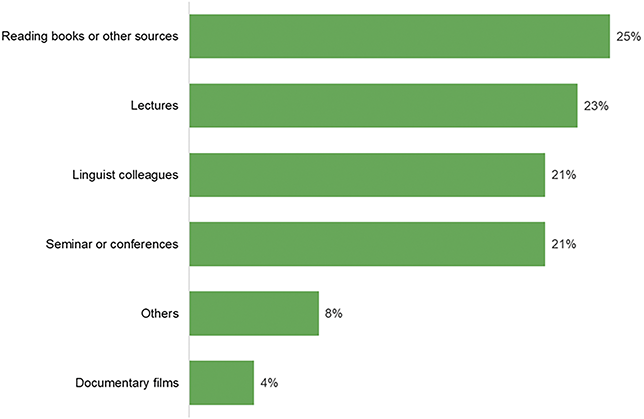
A follow-up question regarding their motivation to study forensic linguistics reveals a range of driving factors. Participants are motivated by curiosity about persuasive language dynamics (18%), involvement in language analysis for legal cases (15%), a desire for research and academic pursuits (15%), fascination with complex crime narratives (14%), a commitment to justice enhancement (14%), interest in lectures on language analysis (12%), career aspirations in the legal field (9%), other motivations (2%), and personal experiences in crime (1%). The distribution of these motivations is illustrated in Figure 5.
Motivation to study forensic linguistics.
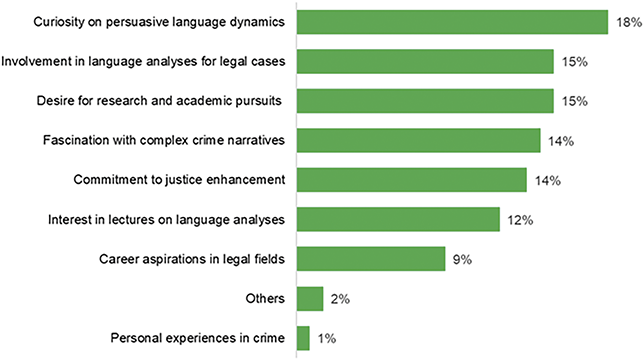
These findings contrast with the experiences of leading international scholars in forensic linguistics. While many participants in the study were motivated by academic interests and specific career goals, renowned scholars often began their careers in forensic linguistics through unexpected or unplanned events. For instance, some were approached by lawyers (e.g. Eades, Reference Eades2021), colleagues (e.g. Coulthard, Reference Coulthard2021), solicitors (e.g. Gibbons, Reference Gibbons2021), or attorneys (e.g. Finegan, Reference Finegan2021) seeking their linguistic expertise for specific legal cases. The differences might reflect the development of forensic linguistics in the world which now has been acknowledged as a mature discipline (see Coulthard et al., Reference Coulthard, May and Sousa-Silva2021).
Another interesting finding from the survey reveals a range of similarities between the experiences of participants and those of leading international scholars. For instance, many scholars such as Gibbons (Reference Gibbons2021), Coulthard (Reference Coulthard2021), and Shuy (Reference Shuy2021) have a background in linguistics. Additionally, several have transitioned from other areas, such as literature or language education, to forensic linguistics, mirroring Ainsworth’s (Reference Ainsworth2021) path. As illustrated in Figure 6, the participants’ educational backgrounds are predominantly in Indonesian language, literature, or education (49%), followed by linguistics including applied linguistics and forensic linguistics (38%). A smaller percentage come from English language, literature, or education (8%), unmentioned fields (4%), and classical Javanese literature (2%).
Participants’ educational background.
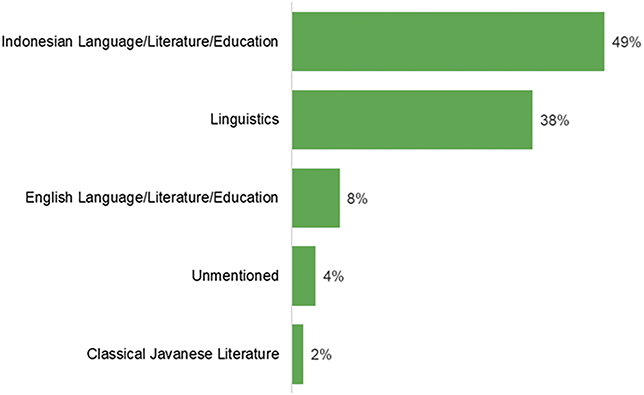
Almost half of the participants perceived their educational background as relevant to forensic linguistics. Among these, half reported attending forensic linguistic training, specifically organized by the Agency for Language Development and Cultivation of the Republic of Indonesia and the Integrated Forensic Centre of the University of Indonesia. The other half stated that although their educational background was not directly relevant, they received additional training in the field. There is a growing number of Indonesians pursuing postgraduate degrees in forensic linguistics, at universities in Indonesia which have either an academic major or offer courses in forensic linguistics (e.g. Universitas Pendidikan Indonesia, University of Indonesia, North Sumatra University) or abroad (e.g. in Australia, the United Kingdom).
With the aforementioned educational backgrounds, the participants work as language experts in governmental offices (66%), academics (23%), unspecified fields (6%), and researchers (6%) (Figure 7). Among those working as language experts in governmental offices, 71 percent have experience analyzing language for courtroom purposes. Specifically, they are involved in providing expert analysis on language-related crimes, including insults, defamation, hate speech, fake news, and cases involving the problems of land deeds. In contrast, only 45 percent of the academic participants have experience conducting research in forensic linguistics and providing expert opinions in legal contexts. Notably, none of the researchers surveyed have practical experience in analyzing language as evidence. These results point to the critical application of forensic linguistics in government and legal contexts in Indonesia, while also identifying areas where academic and research involvement in practical forensic linguistics could be expanded.
Participants’ profession.
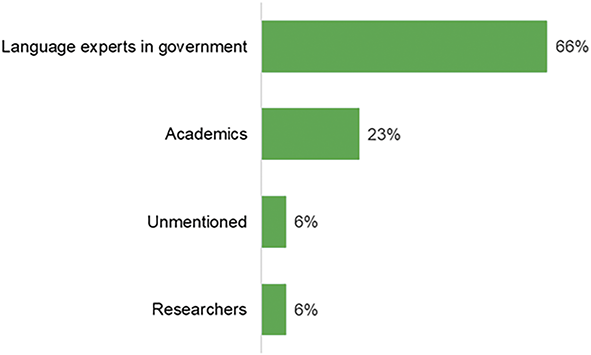
As discussed in the previous section, both authors of this Element are academics who entered the field of forensic linguistics through academic and professional pathways. Muniroh was introduced to forensic linguistics in 2002 during a sociolinguistics class as part of her bachelor’s degree in English Language Education. Aziz began his journey in the field while pursuing a doctoral degree in linguistics at Monash University in 1997, reflecting a trend observed among the majority of survey participants. However, it is important to acknowledge earlier scholars, such as Lukman Hakim, who provided testimony in 1995. Similar to experiences described by Coulthard and Eades in their early cases, these pioneers often entered forensic linguistics without prior exposure to the discipline, relying instead on their broader linguistic expertise. The next section provides an overview of the key characteristics of forensic linguistics in Indonesia.
2.3 Characteristics of Forensic Linguistics in Indonesia
Indonesia, a nation characterized by its diverse social landscape, has witnessed a growing academic interest in forensic linguistics. Alongside this, universities and government institutions have become increasingly engaged in promoting and advancing the field. These developments position Indonesia to contribute significantly to the global achievement of sustainable development goals through the practical application of forensic linguistics.
This section explores the defining characteristics of forensic linguistics in the country. By understanding these attributes, stakeholders can identify emerging needs, address existing gaps, and provide targeted support to further develop the discipline, ensuring its impact is both meaningful and far-reaching. There are three main characteristics of forensic linguistics in Indonesia:
1) Many scholars practicing forensic linguistics enter the field from broader linguistic backgrounds, gaining expertise through experience, research, and specialized training to address forensic contexts, rather than through specialized master’s or doctoral degrees in forensic linguistics.
This reflects the interdisciplinary and applied nature of the field, where expertise in areas like phonetics, morphology, syntax, semantics, pragmatics, sociolinguistics, and discourse analysis can be effectively applied depending on the linguistic challenges presented by a case. Moreover, the judicial system does not currently mandate that forensic linguists hold specialized master’s or doctoral degrees in forensic linguistics. While such degrees provide tailored knowledge and skills that are undoubtedly beneficial, universities in Indonesia have not yet introduced comprehensive master’s or doctoral programs dedicated solely to forensic linguistics. Nonetheless, an increasing number of scholars, often supported by scholarships, are pursuing advanced degrees in forensic linguistics at universities in the United Kingdom and Australia, thereby contributing to the growing academic and professional expertise in the field. Additionally, some scholars practicing forensic linguistics opt to obtain formal degrees in law, either at the bachelor’s or master’s level, to gain a stronger grasp of legal perspectives. This interdisciplinary knowledge enhances their ability to collaborate effectively with legal professionals.
The importance of both linguistic expertise and contextual knowledge is underscored by notable cases in Indonesia. Heryanto (Reference Heryanto1995) critiques the analysis by Drs. Lukman Hakim in the case of alleged insults by Permadi, where the interpretation of the words otoriter (ENG authoritarian) and diktator (ENG dictator) relied solely on dictionary definitions. Heryanto argued that such an approach failed to capture the nuanced meanings of the terms within their specific contexts. Similarly, Mahsun (Reference Mahsun2018) highlights the challenges in the Ahok blasphemy case, where divergent linguistic analyses demonstrated the complexity of applying linguistic frameworks to legal contexts without formal forensic linguistics training.
This trend is also evident in legal interpreting. Many interpreters assisting in legal settings possess proficiency in the required languages but lack formal training or certification as legal interpreters. Tampubolon (Reference Tampubolon2024), building on Hale’s works (Reference Hale2011, Reference Hale, Goodman-Delahunty and Martschuk2019), emphasizes that interpreters need skills that extend beyond bilingual fluency. These include four essential areas of competence: linguistic and discursive abilities, contextual understanding, interpreting expertise, and interactional proficiency.
In Indonesia, with its diverse local languages and growing influx of expatriates and tourists, the role of interpreters is critical, as their presence directly impacts the resolution of legal cases. In response to this need, law enforcement institutions, such as courts, have established memoranda of understanding with professional legal interpreters. In contrast, some courts rely on local staff who speak the relevant languages, or those with a background in foreign languages such as English, to serve as interpreters. This practice also extends to the police, prosecutors, and lawyers, who often have to resort to non-professional interpreters.
These examples illustrate the potential and limitations of scholars entering the field with broader language or linguistic expertise. While their contributions are valuable, the evolving demands of forensic linguistics emphasize the need for specialized training, education, and standardized approaches to address complex language-based legal challenges effectively.
2) The use of language as evidence has gained significant prominence, largely driven by growing demands from the justice sector.
This trend is rooted in several key historical and societal shifts: the early influence of language-based crimes during the Old Era, where restrictions on freedom of expression often led to imprisonment; the societal transition from communal structures to a more individualistic focus, emphasizing personal dignity; Indonesia’s rich history of oral traditions; and the shift from face-to-face interactions to digital-mediated communication. These factors collectively highlight the evolving role of language in both societal dynamics and legal contexts as well as the increasing prevalence of language-based crimes in recent years.
Let us examine some crime data from Indonesia. According to the original data accessed from the National Crime Information CenterFootnote 54 on June 20, 2024, covering the years 2022–2024, the total number of crimes in Indonesia is 1,056,234. From the comprehensive dataset, we have identified the top ten types of crimes in Indonesia (see Figure 8). The highest number of crimes is aggravated theft with 126,174 cases, followed by traffic accidents with 115,805 cases, and persecution with 105,090 cases. Lower on the list are fraud with 102,616 cases, regular theft with 99,972 cases, narcotics with 91,449 cases, motor vehicle theft with 43,402 cases, embezzlement with 35,218 cases, beating with 32,786 cases, and criminal acts in child protection with 27,780 cases. In such cases, forensic linguistics in a broad definition can provide valuable insights to support police interviews and other related legal processes and enhance the overall understanding and resolution of these cases.
Top ten types of crime during 2022–2024.
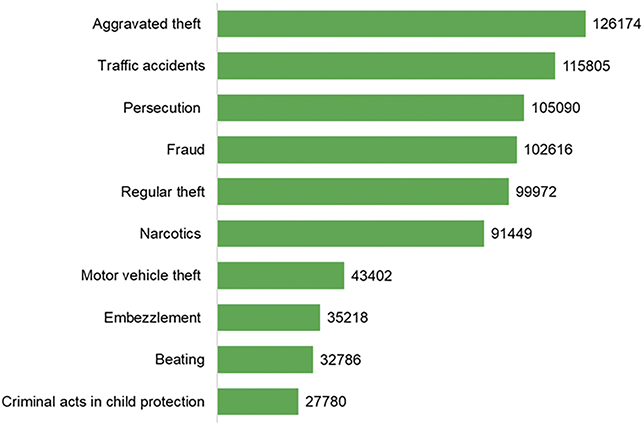
Meanwhile, the types of crime that often rely on language-based evidence were identified to appear lower on the list. These include threats (10,038 cases), forgery of authentic letters (6817 cases), defamation (5480 cases), insults (3028 cases), and blackmail and threats (2964 cases) (other types of cases can be seen in Figure 9). It is true that the number of cases sits on the lower positions, yet such number has sparked the need of forensic linguists to take part in the legal processes. Many studies relevant to these have been conducted by Indonesian scholars and examples of linguistic analysis for the purposes of case investigation are provided in Section 4.
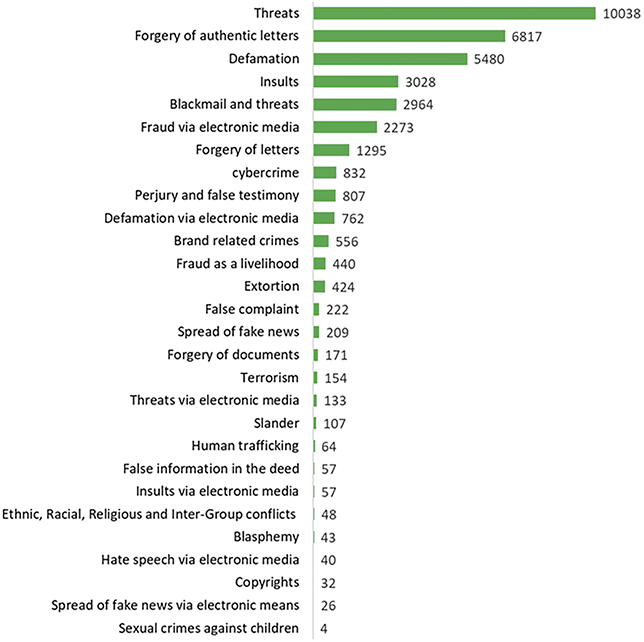
Figure 9 Long description
Bar chart titled 'Crime Statistics in Indonesia' displaying the frequency of various offenses. The most common crimes include: Threats (10,038 cases), Forgery of Authentic Letters (6,817), Defamation (5,480), Insults (3,028), Blackmail & Threats (2,964), and Fraud via Electronic Media (2,273). Lesser-reported crimes include Cybercrime (832), Perjury (807), Terrorism (154), Human Trafficking (64), and Sexual Crimes Against Children (4). Data highlights trends in digital offenses (e.g., fake news, hate speech) and traditional crimes.
Crimes that heavily rely on language-based evidence were found to be less frequently represented in the research literature despite their high incidence (see Figure 9 for a complete list of crime types). While Indonesian scholars have conducted research on these crimes, and Section 3 provides examples of forensic linguistic research, there appears to be an imbalance in research focus. For instance, despite threats being a significant area of concern, with high demand for forensic linguist testimony as indicated by the high number of cases (Figure 9), research on threatening communication appears to be underrepresented in the literature. Similarly, research investigating forgery or authorship is relatively rare. This gap in the literature presents a significant area for future research and scholarly contribution.
By leveraging the expertise of forensic linguists, legal professionals can delve deeper into the linguistic nuances, uncover hidden meanings, and strengthen the overall investigation and prosecution of these cases. In this regard, forensic linguists can assist in areas like the analysis of verbal and written evidence, the interpretation of idiomatic expressions and cultural references, and the identification of authorship. By integrating linguistic expertise into the legal process, professionals can make more informed decisions and ensure a more thorough and fair investigation and adjudication of these crimes.
3) As authoritative figures, linguists have gained reputable recognition and expansion of forensic linguistics in Indonesia.
Many linguists practicing forensic linguistics in Indonesia occupy influential leadership positions at universities or national organizations. With their capabilities and academic authorities, they play pivotal roles in developing relevant programs to support forensic linguistics and securing funding for the initiatives. This is particularly evident in the work of those serving as presidents of forensic linguistics associations or directors of language-related centers in universities, where their primary responsibilities align with advancing forensic linguistics.
One notable figure is E. Aminudin Aziz, who, as the head of the MLI Branch at UPI and vice rector for Planning, Research, and Development at UPI, facilitated the success of KIMLI 2011 by inviting Dr. Georgina Heydon, a prominent forensic linguist from Australia. Furthermore, in his capacity as the head of the Agency for Language Development and Cultivation since 2020, forensic linguistics has become integrated into more systematic programs and has been disseminated through representative offices across the archipelago in line with the institution vision and mission.
4) The introduction of forensic linguistics in bachelor’s degree programs at universities reflects the growing academic recognition and development of the field, offering early exposure to students and supporting its continued expansion within academia.
There is a common misconception among law enforcement officers that anyone with a background in language or linguistics is automatically qualified to practice forensic linguistics. This view overlooks the specialized training and expertise required in the field, which goes beyond core areas of linguistics and combines linguistic depth with context-specific competence. Such training often includes skills in forensic linguistic analysis, authorship attribution, expert witness report writing, communicating findings to legal audiences, and analyzing the pragmatics of legal texts and spoken evidence.
Additionally, the rising prevalence of social media conflicts leading to legal repercussions highlights a lack of digital literacy and language awareness among the public. To address these issues, increasing early academic exposure to forensic linguistics is crucial. This is evident in the development of courses on forensic linguistics as introduction in bachelor’s degree in some universities in Indonesia. Such exposure can raise awareness about the societal and legal impact of language use and misuse while demonstrating how studying linguistics can contribute to enhancing the delivery of justice in the country. Furthermore, these courses broaden students’ academic and career pathways, encouraging them to pursue advanced studies in forensic linguistics.
This early academic exposure in Indonesia has encouraged students, lecturers, and researchers to publish journal articles in the field of forensic linguistics, contributing to a broader scope for linguistics conferences in the country. The following section explores the trends in research gaps, theoretical frameworks, and concepts within Indonesian forensic linguistic analysis.
3 Forensic Linguistic Research in Indonesia
The growth of forensic linguistics in Indonesia has been shaped by contributions from students and scholars trained domestically and abroad, influencing research nationally and internationally. To map publications, the authors used Publish or Perish and Google Scholar to search works from 2011 to 2023 with five keywords: forensic linguistics, language and law, language as evidence, legal linguistics, and Indonesia (accessed on March 15, 2024). The period begins in 2011, a milestone year for the field, and covers a decade to capture publication trends. A manual review of journals and conference proceedings complemented the keyword search.
To check for recent developments, the authors searched Scopus and Web of Science for 2024 publications (accessed on August 7, 2025) using similar keywords. None were found in Web of Science, and only five in Scopus, mostly on established themes, such as language in legal processes (see Anisah & Sari, Reference Anisah and Sari2024; Muniroh & Heydon, Reference Muniroh and Heydon2024) and language as evidence (see Mardikantoro & Yuniawan, Reference Mardikantoro and Yuniawan2024; Mubarok et al., Reference Mubarok, Sudana, Yanti, Aisyah and Af’idah2024). One notable exception was found to apply forensic linguistics to Sharia law in Aceh (see Yusuf et al., Reference Yusuf, Mansur and Muthalib2024). These findings support focusing on the 2011–2023 time frame for a consistent and representative overview.
Given potential overlaps in keyword search results for 2011–2023 publications, the authors carefully identified and removed or merged duplicates. After data reduction, a total of 298 publications were included in the analysis. This encompassed a diverse range of sources, including Scopus-indexed journals, international journals not indexed in Scopus, SINTA-accredited journals, national journals not accredited in SINTA, international conference proceedings, and other relevant publications such as books/book chapters and theses/dissertations.
As we can see in Figure 10, this distribution reveals that SINTA-accredited journals (36%) were the most common publication venue for forensic linguistics research in Indonesia, followed by international conference proceedings (28%) and national journals not accredited in SINTA (18%). International journals not indexed in Scopus (7%) and Scopus-indexed journals (5%) accounted for a smaller proportion of publications. Books/book chapters and theses/dissertations constituted the smallest proportion, each representing 3 percent of the total.
Types of publication.
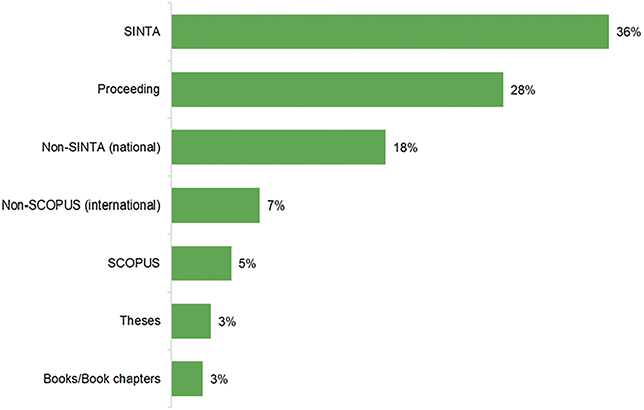
This finding can be partly explained by the academic requirements for students in many Indonesian universities. For example, at our university, undergraduate students have the option of completing their studies through either a traditional thesis pathway or by publishing an article in a national journal. While publication is optional, those who choose the publication pathway must submit evidence of their article having been submitted to a journal indexed at least at the SINTA 6 level, or they must provide proof of publication (both print and digital copies) in a journal indexed at least at the SINTA 6 level.
For master’s and doctoral students, scientific publication is a mandatory requirement. Master’s students must fulfil one of the following criteria: they must have one article accepted for publication (accepted status) in a nationally accredited journal with a minimum SINTA 3 rating or in an international journal, or they must have presented at least one scientific paper at an international seminar. For master’s students aiming for a cum laude grade (equivalent to First Class Honours), which typically requires a GPA of 3.76 or higher out of 4.0, the publication requirements are often more stringent. These students are frequently required to publish their research in international conference proceedings indexed by Scopus or Web of Science, or in SINTA 2-ranked journals.
Doctoral students typically need to fulfil the following: they must have one article accepted for publication (accepted status) in a reputable international journal indexed by Scopus or Web of Science, and they must have an article published (published status) in the proceedings of a reputable international seminar indexed by Scopus or Web of Science. Alternatively, they can fulfill this requirement by having an article accepted for publication (accepted status) in a nationally accredited journal with a minimum SINTA 3 rating. However, for doctoral students aspiring to graduate with a cum laude grade, they are typically required to publish one article in a Q2 Scopus-indexed journal or two articles in Q3 Scopus-indexed journals as part of their degree requirements.
This emphasis on publication within the academic system, particularly in SINTA-accredited journals and conference proceedings, likely contributes to the high proportion of publications in national journals and conference proceedings. The lower occurrence of publications in books or book chapters can be explained by the fact that publications in books or book chapters may hold less weight in academic promotion compared to Scopus-indexed journal articles.
These publications were then categorized into four research areas of forensic linguistics: “language and the law,” “language in the legal processes,” “language as evidence,” and “language education and law.” Additionally, a category labeled “others” was included to accommodate publications that did not neatly fit within the other four categories. Data from books and book chapters were excluded from the analysis as they primarily focused on descriptive accounts and lacked specific theories, concepts, or methodologies.
As shown in Table 1, research on “language as evidence” constituted the largest proportion (61.03%), followed by “language in legal processes” (15.17%) and “others” (11.72%). “Language and the law” (10.34%) and “language education and law” (1.72%) comprised the smallest proportions. This finding is in line with the historical and sociocultural conditions of Indonesia as discussed in Section 1.
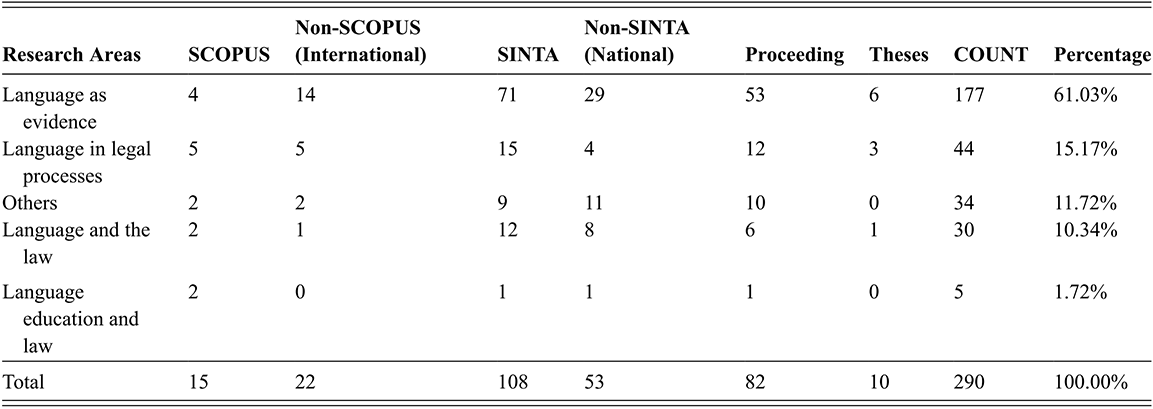
Across all publication platforms, research in these four areas was predominantly published in national journals accredited in SINTA, followed by conference proceedings or national journals not accredited in SINTA. Notably, while “language as evidence” generally dominates research, an interesting observation in Scopus-indexed publications is a higher proportion of research in “language and legal processes” compared to “language as evidence,” although this difference is not statistically significant. The high number of articles published in national journals demonstrate the growing interest of Indonesian journals in these topics. Additionally, the increasing number of presentations at international conferences indicates a growing interest in forensic linguistics research within the Indonesian academic community. Other reasons have been explained in the previous paragraph related to academic requirements in universities.
It is generally perceived that publishing in a SINTA 1 journal indicates high-quality research, often equated to the level of quality expected in Scopus-indexed journals. However, it is important to note that while SINTA 1 signifies a high standard within the Indonesian academic context, it does not automatically guarantee inclusion in Scopus, which has its own rigorous indexing criteria. Given the relatively low number of publications by Indonesian scholars in international forensic linguistics research, several factors might contribute to this. Firstly, language barriers pose a significant challenge, as publishing in international journals requires high-quality English writing. Secondly, some research may not yet meet the stringent international standards for publication in Scopus-indexed journals, which often have rigorous requirements for research methodology, data analysis, and theoretical frameworks. Lastly, a lack of international collaboration can hinder research quality and reduce the likelihood of publication in international journals.
The distribution of the publications across the various publication platforms is given in Table 1.
The following subsections provide a detailed analysis of the publications, including an exploration of the trends in linguistic theories and concepts relevant to forensic linguistics in Indonesia, the methodological approaches employed, and the interdisciplinary approaches adopted within the field in Indonesia.
3.1 Linguistic Theories and Concepts
The most significant contributions of forensic linguistics research in Indonesia concern “language as evidence,” reaching audiences both domestically and internationally through publications in Indonesian and English. An analysis of 177 publications revealed fifteen distinct forensic case types. The five most prevalent cases were hate speech (27%), defamation (17%), insult (15%), fake news (9%), and suicide notes (8%) (see Table 2). Other identified cases included cyberbullying, blasphemy, sexual harassment/abuse, incitement, forensic speaker analysis, trademark disputes, threatening communication, bribery, fraud, and murder. The observed distribution of case types and their frequencies is not surprising, given the historical and sociopolitical context of Indonesia as discussed in Section 1.
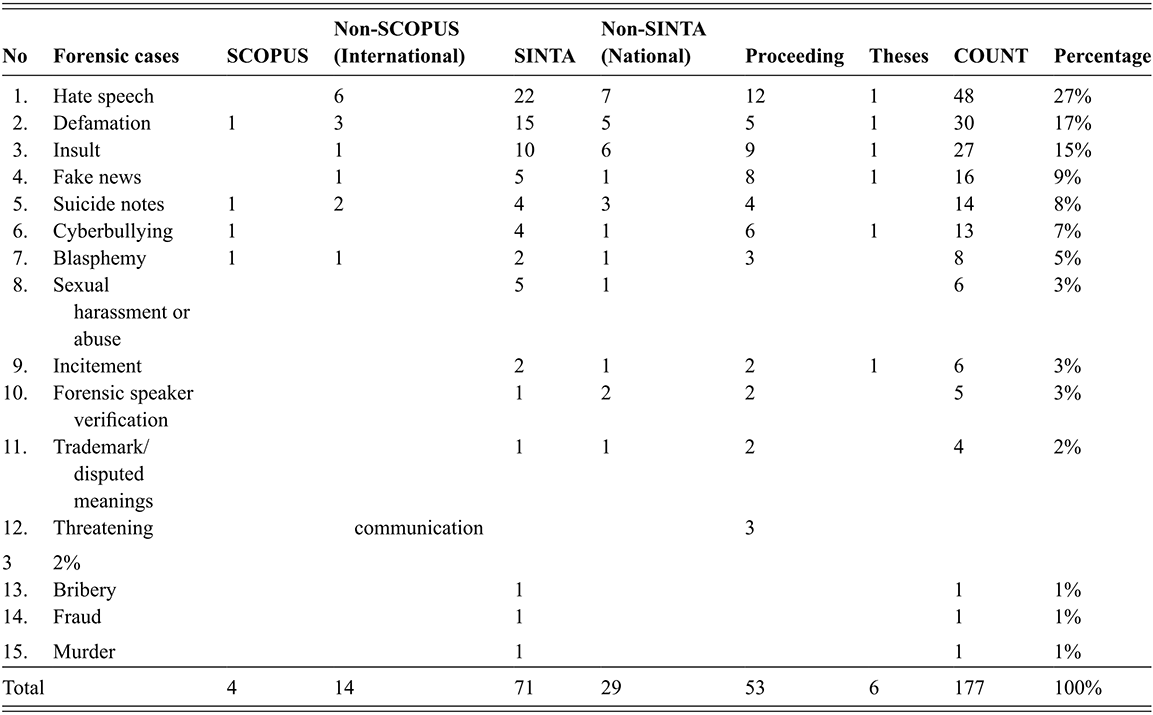
Table 2 Long description
The table presents a cross-tabulation of 15 crime types across six categories of publication outlets. The data is organized to show how frequently these crimes are studied in forensic linguistics in Indonesia within six types of publication outlets. The table is structured according to crime types, ranging from Hate Speech to Murder, listed in the second column. The subsequent columns categorize the 177 studies by source, beginning with the high-impact SCOPUS-indexed journals up to the institutional theses. The last two columns and rows provide the total frequency and percentage for each crime type and outlet.
The data identifies Hate Speech (27%), Defamation (17%), and Insult (15%) as the three most prevalent subjects of linguistic analysis. Research publications are heavily concentrated in SINTA-indexed journals, followed by proceedings and non-SINTA national journals. Within the SINTA category, the frequency of cases mirrors the overall trend, with Hate Speech, Defamation, and Insult being the most discussed.
Conversely, only four crime types are represented in SCOPUS-indexed journals: Defamation, Suicide Notes, Cyberbullying, and Blasphemy. Other cases identified in the dataset include fake news, suicide notes, cyberbullying, blasphemy, sexual harassment or abuse, incitement, forensic speaker verification, trademark/disputed meanings, threatening communication, bribery, and fraud.
While most forensic case studies were published in national journals accredited in SINTA, followed by conference proceedings and national journals not accredited in SINTA, some appeared in international journals. These included topics on hate speech, defamation, insult, fake news, suicide notes, and blasphemy, albeit in smaller quantities. Notably, only four case types – defamation, suicide notes, cyberbullying, and blasphemy – were found in Scopus-indexed journal publications. The distribution of these cases across various publication platforms is presented in Table 2.
An analysis of publications from 2011 to 2023 revealed that research in this area primarily employed concepts and frameworks drawn from semantics and pragmatics. Although theories on functional grammar, critical discourse analysis, computer-mediated discourse, and phonetics/phonology were also adopted, their application was less frequent. The following examples highlight some of the most prominent approaches.
1) Lexical and grammatical semantics
Antara (Reference Antara2023) employed a lexical–grammatical semantics framework to analyze a statement by Dayu Gayatri on the Chanel Palace YouTube channel (2021), in which she allegedly defamed Perhimpunan Pemuda Hindu or Peradah (ENG Hindu Youth Association) by claiming it was affiliated with Vishva Hindu Parishad, categorized as a terrorist organization. Similar frameworks have been used in other studies on defamation (e.g. Amin & Burhanuddin, Reference Amin and Burhanuddin2021; Mintowati, 2016) and hate speech (e.g. Tarigan & Mulyadi, Reference Tarigan and Mulyadi2019).
2) Speech acts
Sarifuddin et al. (Reference Sarifuddin, Tadjuddin and Iswary2021) applied speech act theory to analyze alleged incitement by Natalius Pigai on YouTube, where he claimed that Indonesia’s president and vice president are always from Java, implying that people from other islands serve only as subordinates. Similar approaches have been used in research on hate speech. Similar framework have been used in other studies on hate speech (e.g. Ria & Setiawan, Reference Ria and Setiawan2023; Suryani et al., Reference Suryani, Istianingrum and Hanik2021), defamation (e.g. Halid, Reference Halid2022), insult (e.g. Karenisa, Reference Karenisa2020), cyberbullying (e.g. Syahid et al., Reference Syahid, Sudana and Bachari2022), and blasphemy (e.g. Pastika, Reference Pastika2019).
3) Conversational implicatures or cooperative principles
Radfar et al. (Reference Radfar, Sudana and Gunawan2020) applied Grice’s theory of conversational implicature to analyze recorded conversations related to the murder of Jamal Khashoggi.
4) Relevance theory
Ilzam (Reference Ilzam2019) analyzed a suicide note by a married young woman to identify its underlying motive.
5) Politeness
Subyantoro et al. (Reference Subyantoro, Zuliyanti and Putri2023) applied Culpeper’s impoliteness framework to analyze cyberbullying comments on Instagram targeting Indonesian celebrity. A similar framework has been applied in studies on hate speech (e.g. Manik et al., Reference Manik, Pardede, Franklin and Pasaribu2022; Widiantho, Reference Widiantho2020).
6) Critical discourse analysis
Thamrin et al. (Reference Thamrin, Sudana, Bachari and Muniroh2023) employed Fairclough’s (1995) critical discourse analysis framework to examine fake news as found in Supreme Court decisions on fake news through the categories of representation, relations, identity, and sociocultural practices. This framework has also been employed in other studies on defamation (e.g. Kusno, Reference Kusno2021) and hoaks (e.g. Arianto, Reference Arianto2021).
7) Transitivity analysis
Rifki et al. (Reference Rifki and Usman2021) examined process types in email fraud through the transitivity system, finding a predominant use of material processes to create misleading statements and false authority figures aimed at deceiving and persuading recipients. A similar framework has been applied in studies on suicide notes (e.g. Ridhwani & Sawirman, Reference Ridhwani and Sawirman2020; Sujatna & Sujatna, Reference Sujatna and Sujatna2020).
8) Appraisal theory
Adbaka and Datang (Reference Ng2023) applied appraisal theory to analyze an alleged defamation case in which a Probolinggo civil servant claimed the Regional People’s Representative Council (DPRD) had lower social status than local sex workers. Other studies applying appraisal theory have examined hate speech (e.g. Bachari, Reference Bachari2019; Syahid et al., Reference Syahid, Sudana and Bachari2021).
Research on hate speech in Indonesia has predominantly employed frameworks such as lexical semantics, pragmatic speech acts, politeness theory (encompasses the notion of impoliteness), and appraisal theory. These approaches were highlighted in the in-depth study by Sirulhaq, Yuwono, and Muta’ali (Reference Sirulhaq, Yuwono and Muta’ali2023). The data for their research were analyzed using a CALL (computer-assisted language learning) approach, integrating NVivo 12 software with Lancs Box 6.0. Articles were drawn from all Indonesian publications indexed in DOAJ and Google Scholar without restrictions on publication year. A total of forty-four articles related to hate speech in Indonesia were identified, encompassing fields such as communication studies, education, linguistics, computer science, law, and religious studies. However, this number is relatively small compared to the frequency of hate crime cases reported (see Figure 5). While previous studies have established a strong link between hate speech, social media, political factors, and discrimination, the adoption of critical approaches in this area remains minimal. Sirulhaq et al. argued that this limitation stems from a prevailing perception of hate speech in Indonesia as a personal issue rather than an ideological one. As a result, the ideological roots of hate speech have been largely overlooked, posing significant challenges to effectively addressing this phenomenon without a deeper understanding of its underlying causes.
In the field of language in legal processes, scholars have applied pragmatics, discourse analysis, and systemic functional linguistics to analyze language use in police interviews and courtroom settings. The following examples illustrate some of the most prominent approaches used in selected publications.
1) Speech acts
Purnama (Reference Purnama2023) used speech act theory to examine the pragmatic features of verbal attacks in Indonesian courtrooms, drawing data from publicly available transcripts. Other studies have applied speech act analysis to courtroom discourse (e.g. Zulaeha et al., Reference Zulaeha, Yuiawan, Suproyono, Wijayanti and Prihatmini2022) and police interview (e.g. Firdaus et al., Reference Firdaus, Amelia and Lailiyah2019)
2) Presupposition
Hadiyani (Reference Hadiyani2014) used a presupposition framework in police interviews to uncover the underlying assumptions in investigators’ questions.
3) Cooperative principles
Ramadani et al. (Reference Ramadani, Syaifullah and Gunawan2023) applied Grice’s cooperative principles to analyze police interrogations in a theft case in Indonesia. All four maxims – quantity, quality, relevance, and manner – were observed, with avoidance occurring in several exchanges. Similar frameworks have been used in other studies of police interview (e.g. Santoso & Apriyanto, Reference Santoso and Apriyanto2020; Satria et al., Reference Satria, Darwis and Kamsinah2022).
4) Narrative statement analysis
Kusumanegara et al. (Reference Kusumanegara, Syihabuddin and Saifullah2022) employed Olsson’s (Reference Olsson2008) narrative statement analysis to examine trial transcripts from three cases in Indonesian Religious Courts, categorizing statements by time, place, sequence, description, and other words.
5) Appraisal theory
Hermawan et al. (Reference Hermawan, Rahyono and Dallyono2021) applied Martin and White’s appraisal theory (2005) to analyze the plea of an accused in a corruption trial, focusing on evaluative strategies used to counter the prosecution’s narrative.
The relatively small number of publications on language and the law indicates that researchers have primarily employed discourse analysis, critical discourse analysis, and argumentative analysis. The following examples present prominent frameworks relevant to the study, with descriptions illustrating their application in selected publications.
1) Text analysis
Marlia et al. (Reference Marlia, Lukmana and Gunawan2023) employed Bivins’ (Reference Bivins2008) text analysis framework to examine the complexity of Indonesian legal language in the Job Creation Law and propose plain language alternatives.
2) Critical discourse analysis
Zifana, et al. (Reference Zifana, Lukmana and Sudana2021) applied van Leeuwen’s (Reference Van Leeuwen2004) Critical Discourse Analysis to examine court verdicts in Indonesian defamation cases.
3) Argumentation theory
Subuki et al. (Reference Subuki, Nuryani, Hudaa and Hariyanto2023) applied Toulmin’s (Reference Toulmin2003) and Walton’s (2006) argumentation theory to examine the reasoning in an Indonesian court verdict imposing the death penalty.
3.2 Methodological Approaches
In forensic linguistics, as in other fields of study, methodology should match the research question, data, and goals. Rigorous and transparent approaches ensure valid and reliable findings, especially for publication in high-ranking journals where clarity and credibility are essential.
Most forensic linguistics research in Indonesia has traditionally relied heavily on qualitative methodologies, often incorporating descriptive statistics to analyze the frequency of linguistic features. However, recent years have witnessed a growing emphasis on interdisciplinary approaches. For instance, corpus linguistics has gained prominence in research on cyberbullying (e.g. Puspitasari, Reference Puspitasari2022) and hate-speech (e.g. Sirulhaq et al., Reference Sirulhaq, Yuwono and Muta’ali2023). Indonesian scholars utilize corpus search systems that are either web-based or software-based (applications), including CQPWeb, AntConc, and LancsBox. These tools facilitate linguistic analysis and enhance the methodological rigor of forensic linguistic research in Indonesia. In addition, several Indonesian language corpora have been available to support forensic linguistics research in the Indonesian context, including: Leipzig Corpora Collection (https://corpora.uni-leipzig.de/en?corpusId=>ind_mixed_2013), language corpus for natural language processing (https://github.com/kmkurn/id-nlp-resource), Korpus Indonesia or Koin (https://korpusindonesia.kemdikbud.go.id/index.php?r=site/about), SEAlang Library Indonesian Text Corpus (https://sealang.net/indonesia/corpus.htm), and abusive Indonesian language training data (https://fold.aston.ac.uk/handle/123456789/30, https://hatespeechdata.com/#Indonesian-header).
Techniques such as N-gram analysis and stylometry have been employed in authorship analysis (e.g. Puspitasari et al., Reference Puspitasari, Fakhrurroja and Sutrisno2024). Furthermore, scholars are increasingly integrating perspectives from fields such as psychology (Bachari et al., Reference Bachari, Sudana and Gunawan2019; Lubis et al., Reference Lubis, Sinar and Masdiana2023; Muniroh, Reference Muniroh2019; Muniroh & Heydon, Reference Muniroh and Heydon2022), computer science (Puspitasari et al., Reference Puspitasari, Fakhrurroja and Sutrisno2023, e.g. Reference Puspitasari, Fakhrurroja and Sutrisno2024, Reference Puspitasari, Sutrisno, Fakhrurroja, Stroupe and Roosman2025), and nursing and health (e.g. Muniroh & Heydon, Reference Muniroh and Heydon2024) to achieve a deeper understanding of language use in legal contexts. This cross-disciplinary method enables more nuanced and holistic analyses of forensic linguistic research. Researchers and law enforcement officers used and are introduced to incorporate tools or softwares for language processing such as Lancsbox, ELAN (EUDICO Linguistic Annotator), PRAAT, AntConc, and AntWordProfiler.
3.3 Interdisciplinary Connections and Collaborations
While methodological advancements in forensic linguistics research have integrated insights from other disciplines, authorship patterns often reflect a limited range of contributors: (1) university-based research when research is conducted by academics affiliated with Indonesian universities (e.g. Sinar et al., Reference Sinar, Zein and Nurlela2021) and (2) government agency involvement when researchers affiliated with national agencies contributed to the field (e.g. Kusumawardani & Puspitasari, Reference Dewan2021; Sukma et al., Reference Sukma, Puspitasari and Afiyani2021). While interuniversity and interinstitutional collaborations exist, they often follow specific patterns. Interuniversity collaborations frequently occur within university networks, often involving collaborations between students, graduates, and their former supervisors (e.g. Hermawan et al., Reference Hermawan, Rahyono and Dallyono2021; Sirulhaq et al., Reference Sirulhaq, Yuwono and Muta’ali2023; Vidhiasi et al., Reference Vidhiasi, Muniroh and Gunawan2024). Interinstitutional collaborations typically arise from established partnerships between institutions or derive from collegial partnerships (e.g. Muniroh et al., Reference Muniroh, Sukma and Puspitasari2022; Puspitasari et al., Reference Puspitasari, Fakhrurroja and Sutrisno2023, Reference Puspitasari, Sutrisno, Fakhrurroja, Stroupe and Roosman2025). These patterns are not surprising considering the inherent nature of academic collaborations.
International collaborations, while crucial for advancing the field, remain relatively limited. Notable exceptions include the work of Muniroh and Heydon (Reference Muniroh and Heydon2022, Reference Muniroh and Heydon2024), Muniroh et al. (Reference Muniroh, Findling, Heydon and Nick2018), and Susanto et al. (Reference Susanto, Yingli and Nanda2017). These collaborations, often involving former supervisors and their students, demonstrate the potential for Indonesian academics to achieve international recognition, which is increasingly important in the context of the globalizing higher education landscape.
Furthermore, while strong connections between academics and law enforcement agencies are essential for effective forensic linguistics research, these collaborations are still under development in many cases. Currently, collaborations primarily involve law enforcement agencies as research partners, primarily facilitating data collection. However, future collaborations should aim to involve law enforcement agencies more actively in the research process, such as in the co-designing of research questions and the identification of critical research needs. These collaborations will ensure that research findings are highly relevant to real-world legal challenges and contribute significantly to the practical application of forensic linguistics in the justice system.
4 Forensic Linguistic Practices in Indonesia
The role of forensic linguists in developing the field in Indonesia either as insiders/practitioners or as outsiders/researchers are equally important. Shuy (Reference Shuy, Alatis, Hamilton and Tan2000) defined insiders or practitioners as those involved in law cases, often producing reports and testimonies, and occasionally testifying in court as expert witnesses. On the other hand, outsiders or researchers are those who are not involved in litigation, but instead study the language of the law, including statutes, trial language, police interviews and witness language. This section discusses the role of practitioners only, while the role of researchers has been discussed in the previous section.
Despite the long-standing contributions of forensic linguists as expert witnesses in Indonesian courts, the profession lacks formal accreditation. While Badan Bahasa has been working toward a certification scheme for its own language experts since 2018,Footnote 55 a broader accreditation system for forensic linguists has yet to be implemented.
Article 28 Section (1) of the Indonesian Criminal Procedure Code (KUHAP) defines expert testimony as the statement given by a person who possesses special expertise on a matter necessary to clarify a criminal case for the purpose of investigation. Furthermore, Article 184 Section (1) of the KUHAP recognizes expert testimony as one of the valid forms of evidence in criminal proceedings. While KUHAP allows for expert testimony, it does not provide specific criteria for the qualifications of expert witnesses. It states that as long as an individual possesses specialized knowledge relevant to the case and is presented by a party involved in the case, their testimony can be admitted into evidence.
The role of interpreters in legal settings is formally recognized by the Indonesian Criminal Procedure Code (KUHAP). The KUHAP states that defendants or witnesses who do not understand Indonesian have the right to the assistance of an interpreter (Article 53 Section (1) and Article 177). While the KUHAP acknowledges the importance of interpreters, it lacks specific criteria for their qualifications. Courts often require interpreters to present their membership card from the Association of Indonesian Translators (HPI). However, it is crucial to understand that possessing a HPI membership card does not automatically guarantee that an individual is a certified interpreter. Here, there is a common misconception among some judges that possessing a HPI membership card automatically signifies that an individual is a certified and qualified interpreter.Footnote 56 This misconception arises from the assumption that membership in a professional organization guarantees a certain (high) level of expertise.
In contrast to the relatively limited formal recognition for forensic linguists, the field of interpreting has seen some progress with the establishment of professional organizations like HPI. These organizations have developed accreditation schemes and codes of ethics, contributing to the professionalization of the field and ensuring higher standards of quality in interpreting services.
The relatively broad framework of both expert witnesses and interpreters in legal settings highlight the need for clearer guidelines and a more formalized recognition of the profession of forensic linguists in Indonesia. This section addresses the provision of language experts, the writing of affidavit or expert witness report, and standardization and best practices in Indonesia.
4.1 Provision of Language Experts
This section outlines how language experts – such as forensic linguists or interpreters – are engaged in criminal investigation processes and court proceedings. Typically, three main parties request the involvement of language experts: the Indonesian National Police, the Office of the Attorney General of the Republic of Indonesia, and lawyers.
In most cases, language experts are academics, and their testimony can be provided at the investigation stage, the prosecution stage, and/or the court trial stage. Their involvement is not required at every stage of the judicial process; rather, they are consulted when their expertise is deemed necessary.
The police officers often have a list of potential experts to consult as part of standard operating procedures.Footnote 57 If they do not have a specific expert in mind, they informally seek recommendations from other academics they know and trust. For instance, the first author was approached by her police colleagues for recommendations on who could assist with a case, and she subsequently referred a suitable expert.
Language experts may be involved with police investigators at different stages of a case. In the pre-investigation stage – before a case is formally pursued and before determination of the status of becoming suspects – language experts may provide an initial opinion that helps investigators assess the strength of the evidence and decide whether to proceed. Their expertise can contribute to the investigators’ confidence in the case.
During the investigation stage, where suspects’ status has been determined, language experts are interviewed by investigators for their analysis of the linguistic evidence in question, and their responses are documented in Berita Acara Pemeriksaan or BAP (ENG police investigation report). For this purpose of investigation, according to the standard procedures, law enforcement agencies send a formal request letter – along with a list of case-related questions – to an institution to obtain a language expert. In response, the institution assigns their language expert to carry out the task. More specifically, when the request is submitted to Badan Bahasa or its representative offices across Indonesia, depending on the location of the requesting police, prosecutor, or lawyer’s office, the procedure follows these steps.Footnote 58
1) The requestor of service submits a Letter of Request for Language Expert Witness services.
2) The administrator processes the request letter.
3) The leadership appoints a staff member to provide the Language Expert Witness services.
4) The administrator issues an assignment letter for the appointed staff.
5) The appointed staff member coordinates further with the relevant parties.
Language experts may also be involved in later judicial proceedings. Prosecutors’ office or lawyers might invite them to provide testimonies before judges in court, particularly when clarifications are needed regarding their opinions in the police investigation report. Supreme Court Decision No. 191 K/Sip/1962 dated October 10, 1962, affirms how many experts need to be heard and states that the assessment of expert and witness testimony is entirely at the discretion of the judge.
Indonesia’s linguistic diversity often requires law enforcement to engage interpreters or language experts for ethnic languages. Police requests are usually directed to local Badan Bahasa offices, many of which have staff fluent in regional languages, for example, Batak and Nias in North Sumatra, or Sasak and Samawa in West Nusa Tenggara. When in-house expertise is lacking, offices contact language activists, university lecturers in regional languages, or the Indonesian Association of Translators (HPI), drawing on partner contact lists.
This system leverages community networks, academic expertise, and professional associations but lacks a centralized pool of trained interpreters for all ethnic languages. Reliance on external partners can cause delays or inconsistent quality, creating potential linguistic disadvantages for speakers of less common languages.
In the analysis of linguistic evidence, a language expert may not only focus on examining the disputed text but could also suggest the possibility of mediation, particularly when the victim and perpetrator share a family relationship. This suggestion remains within the scope of linguistic expertise. Specifically, the language expert may analyze the linguistic data to reveal whether the speaker truly intended to cause harm through language. Drawing on the nature of the speech act (e.g., defamation, misunderstanding, politeness strategies) and sociolinguistic and cultural insights, the expert may identify relational dynamics, such as family ties or social hierarchies – that suggests the case could be more constructively resolved outside formal prosecution. From this analysis, the expert may conclude that while the utterance was harmful, the cultural context especially in settings that highly value social harmony supports restorative approaches such as mediation. The actual mediation, however, is conducted by police officers, trained mediators, or other neutral parties – not by the linguist.
An example of this is found in Inderasari et al. (Reference Inderasari, Kusno and Kusmanto2022) in a defamation case involving an uncle and a nephew with a Javanese cultural background. In this case, the nephew posted on social media about his uncle’s behavior, which he considered inappropriate and insulting. The uncle got offended, feeling that his nephew had defamed him. Believing his nephew had crossed the line, he reported the case to the police. Following the language expert’s suggestion, the police facilitated mediation between the two parties. The police encouraged the nephew, as the younger person, to take the initiative to apologize to his uncle, as this aligns with the Javanese tradition of respecting elders. Ultimately, the conflict was resolved through mediation.
4.2 Writing Expert Reports
When reporting the results of a linguistic evidence analysis, a language expert may prepare an expert report. While writing an expert report is not currently mandatory, law enforcement officers highly appreciate experts who provide this important document, as it comprehensively presents the expert’s opinions on matters within their expertise. This section outlines the key elements of an expert report and the approach to analyzing a case.
Based on our experience in preparing expert reports, the following components should be included.
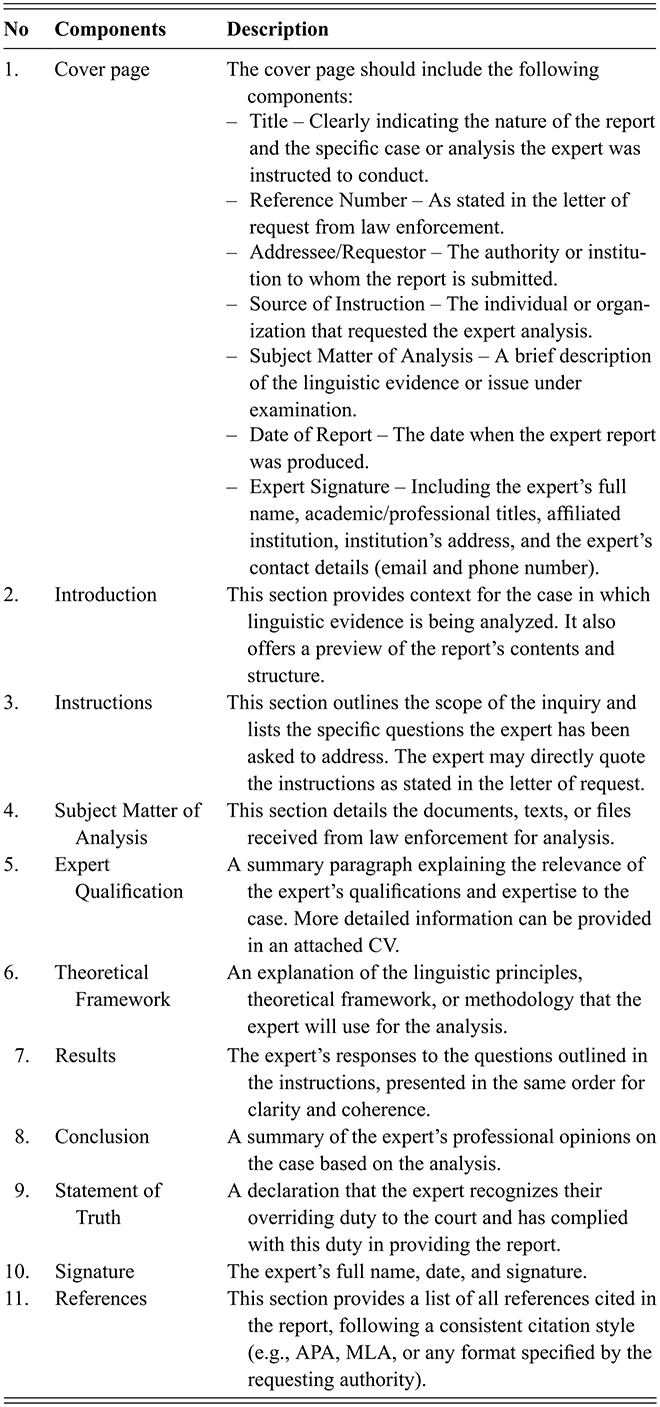
Table 3 Long description
A linguistic expert testimony report should include eleven recommended components, namely Cover Page, Introduction, Instructions, Subject Matter of Analysis, Expert Qualification, Theoretical Framework, Results, Conclusion, Statement of Truth, Signature, and References.
• The Cover Page component, in particular, is further recommended to include seven subcomponents, namely Title, Reference Number, Addressee/Requestor, Source of Instruction, Subject Matter of Analysis, Date of Report and Expert Signature. The details for each subcomponent are as follows:
o Title - Clearly indicating the nature of the report and the specific case or analysis the expert was instructed to conduct.
o Reference Number – As stated in the letter of request from law enforcement
o Addressee/Requestor – The authority or institution to whom the report is submitted.
o Source of Instruction – The individual or organization that requested the expert analysis.
o Subject Matter of Analysis – A brief description of the linguistic evidence or issue under examination.
o Date of Report – The date when the expert report was produced.
o Expert Signature – Including the expert’s full name, academic/professional titles, affiliated institution, institution’s address, and the expert’s contact details (email and phone number).
• The Introduction component provides context for the case in which linguistic evidence is being analyzed. It also offers a preview of the report’s contents and structure.
• The Instructions component outlines the scope of the inquiry and lists the specific questions the expert has been asked to address. The expert may directly quote the instructions as stated in the letter of request.
• The Subject Matter of Analysis component details the documents, texts, or files received from law enforcement for analysis.
• The Expert Qualification component is a summary paragraph explaining the relevance of the expert’s qualifications and expertise to the case. More detailed information can be provided in an attached CV.
• The Theoretical Framework Component includes an explanation of the linguistic principles, theoretical framework, or methodology that the expert will use for the analysis.
• The Result component describes expert’s responses to the questions outlined in the instructions, presented in the same order for clarity and coherence.
• The Conclusion component provides a summary of the expert’s professional opinions on the case based on the analysis.
• The Statement of Truth component is a declaration that the expert recognizes their overriding duty to the court and has complied with this duty in providing the report.
• The Signature component includes the expert’s full name, date, and signature.
• The Reference component provides a list of all references cited in the report, following a consistent citation style (e.g., APA, MLA, or any format specified by the requesting authority).
When preparing an expert report, the expert should follow a structured approach similar to conducting research. The following key considerations should be ensured when analyzing linguistic evidence (see Kusno, Reference Kusno2021).
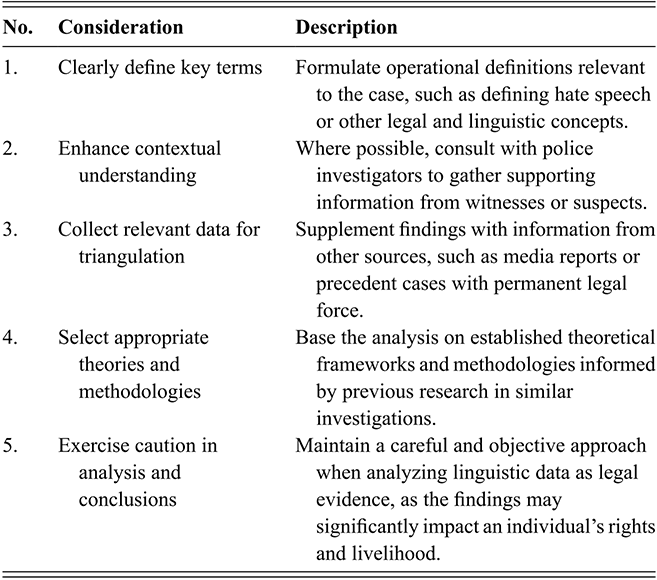
4.3 Model of Analysis and Ethics
This section addresses two key aspects: (1) a model for analyzing cases involving disputed meanings, where a language expert is tasked with determining whether the utterances or texts in question constitute defamation, insult, hate speech, or other forms of language conflict or language war, and (2) the ethical principles that language experts must adhere to in the course of their work.
In this context, “language war” refers to the deliberate use of language as a tool or weapon by a speaker or writer to advance their own interests or those of their group. The purpose is to attack the ideas, thoughts, behavior, honor, or physical condition of an individual or a group of interlocutors, either directly or indirectly (Aziz, Reference Aziz2020). Language war can be categorized along a continuum based on the level of harm inflicted on the victim. The continuum starts with suggestion, which has the least impact or potential of losing face, and progresses toward slander, which has the most significant effect. In between, the sequence unfolds as criticism, mockery, incitement, defamation, and insult, each increasing in intensity. The severity of a language war can escalate based on how the target is referenced or identified, as outlined by Aziz (Reference Aziz2020). At one end of the continuum, an implicit reference without specific identification leaves room for debate on potential criminal liability; clarity of the identity of the suspect is subtlety hidden. At the other end, an explicit mention of the target removes any doubt about liability, making the potential suspect obvious to the public. Between these two extremes, the level of liability increases with the following types of references:
– Mentioning of initials
– Describing general characteristics of a reference
– Describing specific characteristics of a reference
The model for analysis involves three main considerations, namely (1) utterance as the focal point of analysis, (2) holisticism of analysis, and (3) speech acts as theoretical bases for analytical framework.
1) Utterance as the focal point of analysis
The primary focus of analysis is on the utterances in question. The utterances will appear with various accompanying features, which at a minimum will represent Speaker, Hearer, and Context. Context refers to the setting of the utterance (time, place, prosody), the topic of the utterance, and the textual environment.
The term “utterance” is used here to contrast its concept with sentence as defined in the study of Syntax. While most of the data analyzed are spoken, written data are also included, provided they are treated as representations of spoken utterances. We define utterance as any stretch of talk performed in a given context bounded by silence before and after its articulation. When written, an utterance may consist of a sequence of sentences, or a single phrase, or even a single word. Each utterance is believed to contain a proposition.
2) Holisticism of analysis
This entails systematic analyses of all elements of the utterance, which can be parsed into as small as morphophonemic elements or into as big as a set of complete textual discourse. Analysis can also involve the search of paralinguistic concomitants that can influence the interpretation of linguistic phenomena. This holistic approach ensures accuracy and reliability in the analysis.
3) Speech acts as the theoretical bases for analytical framework
The analysis is guided by speech act theories, which will examine the intended meaning, function, and impact of the utterances within their social and cultural context.
The utterance is analyzed according to its class, that is, constatives or performatives. Constatives are analyzed in terms of the truth conditions (whether the statement can be judged true or false). Performatives, on the other hand, are analyzed in terms of felicity conditions (whether the utterance is appropriate and effective within its context). Felicity conditions involve three key aspects (cf. Allan, Reference Allan1986; Bach & Harnish, Reference Bach and Harnish1979; Searle, Reference Searle1969):
– The preparatory conditions (P) refer to the readiness requirement, the appropriateness of speech, and the absolute authority of a speaker to perform or not perform an action.
– The sincerity conditions (S) refer to the speaker’s genuine intention for an utterance to occur or not occur, which demands honesty and deliberateness in producing the utterance.
– The illocutionary intention (I) refers to the intended purpose of an utterance. It clarifies the essential goal of the speech act. For example, an utterance may serve as an accusation, confession, promise, command, etc.
It is evident from the previous sections that there is currently no certification for forensic linguists, and the association still requires support to sustain its activities. Therefore, considering its vital role, scholars like Aziz have formulated the following ethical principles that language experts must adhere to (Aziz, Reference Aziz2020).
1) Honesty
Stating the truth as it is, in accordance with the factual data available and the knowledge and understanding possessed.
2) Fairness
Being impartial towards the parties involved in the case.
3) Professionalism
Providing opinions in accordance with the scientific principles they possess or understand, as a form of professional responsibility in upholding the essence and dignity of truth.
4) Proportionality
Not judgmental but limited to offering guidance for parties involved in the judicial process. This guidance remains firmly within the scope of linguistics, for example, by clarifying ambiguities, identifying inconsistencies in language use, and interpreting meaning based on linguistic principles.
5) Credibility
Capable of maintaining the confidentiality of data and the identities of the parties involved in the case until it is declared open to the public by a judge’s ruling.
5 Conclusion and Final Thought
The development of forensic linguistics in Indonesia, from its early milestones to its progress up to 2024, reflects more positive advancements than major obstacles. While its growth has been gradual, the need for forensic linguistics in the legal system is evident, the gap between research, practice and policy development remains clear, and the interest from academics and institutions continues to grow – highlighting its significance and future potential. This section summarizes the key discussions, presents challenges, and outlines the future directions for the field.
5.1 Summary
In this Element, forensic linguistics is defined as the interdisciplinary scientific study of language applied in legal and investigative settings. It covers various areas, including the analysis of linguistic evidence, the examination of spoken and written legal communication, the interpretation of legal documents, and the promotion of forensic linguistic literacy. The ultimate goal is to contribute to fairer justice processes. To explore the origins, progress, and future directions of forensic linguistics in Indonesia, this Element integrates survey data from academics and practitioners alongside a systematic literature search conducted using Publish or Perish software.
The Element discusses the development of forensic linguistics in Indonesia, which has progressed from public criticism of authorities to the formal inclusion of linguists in legal proceedings, as mandated by regulations. The origins of forensic linguistics in Indonesia can be traced back to early language-related cases during the Soekarno or Old Order era, the first academic contribution to a judicial process in 1995, and the initial scholarly publication in the media that same year. The term “forensic linguistics” was first mentioned in Indonesian media in 2002, marking a significant step in the field’s recognition and development (see Figure 3).
In its early stages, the growth of forensic linguistics in Indonesia was largely driven by academics who were introduced to the field during their master’s or doctoral studies abroad. This exposure played a crucial role in disseminating and expanding the discipline, sparking research in areas such as disputed meaning, police interviews, courtroom discourse, and legal interpretation. Over time, the field has continued to evolve, with linguists employing diverse theories and concepts, methodological approaches, integrating interdisciplinary perspectives, and fostering collaborations – both with international scholars for research and publication and with legal professionals for capacity building and language awareness initiatives.
Underlying these advancements, forensic linguistics in Indonesia exhibits three key characteristics. First, many scholars in the field come from diverse linguistic backgrounds, developing their expertise through research, practical experience, and specialized training rather than formal master’s or doctoral programs in forensic linguistics. Second, the role of language as evidence has become increasingly prominent, largely driven by the growing needs of the justice sector. Lastly, linguists have gained authoritative recognition, contributing to the expansion and credibility of forensic linguistics in Indonesia.
Support for forensic linguistics has extended beyond higher education institutions, where the field has been integrated into bachelor’s, master’s, and doctoral programs through 2–6 credit hour courses. Non-higher education institutions have also acknowledged its significance, promoting engagement through expert collaborations and knowledge-sharing initiatives. The number of language experts – both forensic linguists and interpreters – offering testimony in language-related cases and facilitating communication in judicial processes has steadily grown, including specialists in local languages. Their expertise is increasingly sought not only by the Indonesian National Police and the Office of the Attorney General but also by lawyers, with forensic linguists playing a role at various stages of judicial proceedings.
Efforts to strengthen capacity building in forensic linguistics have been largely incidental, supported through workshops, seminars, and masterclasses organized by universities and government institutions. These training programs cater not only to professionals, such as linguists seeking to refine their skills in language analysis and law enforcement officers aiming to enhance their language awareness, but also to the general public. By educating laypeople on the responsible use of language, these initiatives help prevent individuals from becoming involved in language-related crimes. This broader approach reflects the growing efforts to integrate forensic linguistics into the legal system and enhance its recognition by law enforcement agencies. As a result, such initiatives have reinforced the role of forensic linguistics in legal proceedings, further solidifying its importance in ensuring linguistic expertise within judicial processes.
5.2 Challenges
Forensic linguistics has undeniably reached a level of maturity in the world globally, as demonstrated by its institutional recognition, theoretical foundations, methodological advancements, professional practice, ethical standards, and legal impact. This assessment is based on benchmarking against developments in developed countries such as the UK, particularly as represented by the Aston Institute for Forensic Linguistics. In this context, forensic linguistics has evolved into a dynamic research discipline, supported by institutional structures, methodologies, and academic cultures that actively foster new knowledge, critical inquiry, and theoretical advancements. Forensic linguistics in Indonesia can be further established, considering its current stage of development. Achieving this requires outlining and addressing challenges to strengthen its foundation.
Establishing forensic linguistics in Indonesia remains a complex endeavor due to the country’s vast linguistic diversity, which includes numerous languages, dialects, and ethnic groups. This diversity demands extensive documentation and poses challenges for directly applying forensic linguistic methods developed for English or other major languages to Indonesian and its local languages. Muniroh’s adaptation of cognitive interviewing highlights these difficulties (Muniroh, Reference Muniroh2019). Translating phrases like “think of” and “get a clear picture in your mind” was challenging (see also Lai, Reference Lai2016), as was finding an appropriate equivalent for “you” due to Indonesian’s open referencing system (Muniroh & Heydon, Reference Muniroh and Heydon2024). These issues become even more pronounced when considering local languages, as information retrieval is often more effective in the language where events are originally encoded in memory (Filipović, Reference Filipović2011). Additionally, regional variations in dialect, accent, and speech patterns complicate linguistic analysis on language evidence, linguistic profiling and authorship analysis, particularly when experts lack familiarity with these linguistic nuances. As we can see in Section 4.1, various ethnic language interpreters and experts were in fact available through the representative offices of Badan Bahasa across Indonesia, but the number of experts is lower than that of the number of languages in Indonesia, that is, 718 languages, 778 dialects, and 43 subdialects as detailed in Section 1.3.3. Furthermore, there is a pressing need for tools or technologies that can be directly utilized for forensic linguistic analysis, such as authorship analysis, with relatively high accuracy and reliability.
Regarding ethnic diversity, it is crucial to adopt problem-solving approaches that are sensitive to ethnic norms and values, as illustrated in Section 4.1. This sensitivity presents an opportunity for forensic linguists to explore the possibility of mediation in language-related crimes involving individuals of the same ethnicity. However, a challenge lies in ensuring that such mediation processes remain impartial and do not inadvertently reinforce existing power imbalances within or between ethnic groups. Ethnic identity can influence communication styles, perceptions of authority, and expectations regarding justice, all of which may affect both the mediation process and its outcomes.
Ethnicity-related issues can also introduce concerns such as ethnic bias in judicial decision-making (cf. Choi et al., Reference Choi, Harris and Shen-Bayh2022). While there is no documented evidence of this occurring in Indonesia, recognizing ethnicity as a potential source of judicial bias is essential for ensuring due process. In-group favoritism can lead to coethnic bias, where judges may be more inclined to grant appeals from individuals of their own ethnicity over those from different ethnic backgrounds. To the best of the authors’ knowledge, judges assigned to a particular region may come from different ethnic backgrounds than the majority population in that area. For instance, at the West Java District Court, judges are not only of Sundanese ethnicity but also from other ethnic groups such as Batak, Minang, and Bugis.
Another challenge concerns institutional and legal recognition. While forensic linguistics has gained significant traction in Indonesia in recent years and has been utilized by legal institutions, as discussed in Section 2.1.2, many law enforcement officers, prosecutors, and judges still have limited awareness of the field and its practical applications. Compared to forensic disciplines such as medical forensics, digital forensics, and forensic psychology, forensic linguistics remains less widely recognized. Notably, the online version of Kamus Besar Bahasa Indonesia (ENG the Great Dictionary of the Indonesian Language) still defines “forensik” primarily in relation to medical forensics, although the term “forensik” has already been included after the entry linguistik (ENG linguistics). Furthermore, forensic linguistic research in Indonesia tends to be more descriptive, with limited influence on policy development. The field also continues to face challenges in achieving universal recognition as an expert domain within the legal community.
Lastly, a significant challenge lies in educational and training gaps. While linguistics is widely taught in Indonesian universities, as discussed in Section 2.1.1, forensic linguistics remains a course rather than a full-fledged study program. Establishing such a program requires careful consideration of professional and career pathways, which remain unclear in Indonesia. Unlike translators or interpreters, forensic linguists are not yet widely recognized as a distinct profession, making it difficult for graduates to secure employment outside academia. Moreover, as highlighted in Section 4.1, there is a lack of standardized competency frameworks for forensic analysts as well as a systematic workshop or training program for becoming a forensic linguist. Currently, forensic linguists in Indonesia typically hold established roles as lecturers or language specialists, such as those in Badan Bahasa.
5.3 Future Directions
Challenges should be seen as opportunities for improvement, informing future directions to strengthen and sustain growth of forensic linguistics in Indonesia. A multipronged approach is essential to achieving this goal.
While Indonesia’s linguistic and cultural diversity is one of its defining characteristics, it should be managed in a way that contributes to the advancement of forensic linguistic analysis. Addressing this and other related challenges requires a comprehensive approach that includes conducting research that embraces linguistic diversity, standardizing forensic linguistic practices, strengthening or revitalizing professional associations and research centers, and promoting research that informs policy development.
Documenting linguistic diversity through the creation of linguistic databases plays a crucial role in enhancing forensic linguistic analysis. Developing corpora of legal and forensic language data, while examining lexical and syntactic variations across languages and dialects, can significantly improve analytical accuracy. For example, language-related crimes such as hate speech and insults often involve swear words; building a specialized corpus of these linguistic elements can aid forensic analysis and contribute to the development of a hate speech database. These databases can also serve as valuable resources for training, research, and reference in forensic linguistics.
To maximize effectiveness, linguists should invest in forensic linguistic technology that accommodates Indonesia’s diverse languages and dialects – a need that has been emphasized in the preceding discussion. For instance, in a case involving hate speech on social media, a forensic linguist could utilize a specialized language model trained on hate speech corpora across multiple Indonesian dialects. Such a system would enable the identification of offensive language patterns, flag implicit threats, and provide contextual analysis to support legal proceedings.
Furthermore, forensic linguists should develop expertise in multiple regional languages and dialects while collaborating with sociolinguists, anthropologists, and legal experts. This interdisciplinary approach ensures a deeper understanding of how language and culture intersect with forensic analysis, ultimately strengthening forensic linguistic practices in Indonesia.
Standardization is essential in forensic linguistics, particularly in legal processes and the assessment of linguistic evidence. However, it must be applied in a way that acknowledges linguistic diversity rather than disregarding it. Globally, police investigations have shifted from traditional interrogation methods to science-based approaches, with investigative interviewing becoming widely recommended. When adapting and implementing investigative interviewing within the Indonesian policing context, it is crucial to consider not only linguistic factors but also regional languages and sociocultural norms. These elements should be integrated into relevant stages of interviewing, while ensuring that the final reports are presented in Indonesian. This approach enables police officers across Indonesia to conduct interviews effectively using a standardized method while maintaining sensitivity to local linguistic and cultural contexts.
To achieve this balance, forensic linguistic protocols must be designed to account for language variation while maintaining legal and scientific rigor. This approach not only ensures consistency in forensic linguistic practices but also allows for necessary adaptations that reflect Indonesia’s complex linguistic and cultural landscape. In line with standardization, to effectively implement these strategies, forensic linguistics training programs should be designed to address specific linguistic and cultural contexts within Indonesia. Such training can help legal professionals and forensic linguists apply forensic linguistic principles effectively while respecting the nation’s linguistic diversity.
Technology can also play a crucial role in standardizing forensic work, particularly in addressing issues such as ethnic bias in judicial decisions. Research on the use of Artificial Intelligence (AI) in forensic linguistics has shown promising results in mitigating bias and improving consistency in forensic analysis (e.g. Lopes, Reference Lopes2024; Rosili et al., Reference Rosili, Zakaria and Hassan2020).
Another challenge concerns institutional and legal recognition. Addressing this issue requires a strategic and collaborative effort between forensic linguists and law enforcement agencies. Collaborating with law enforcement officers offers various opportunities to integrate their expertise into forensic linguistics. One approach is to invite them as speakers at forensic linguistics conferences or seminars, a practice that has already been implemented, recognizing their valuable perspectives on enhancing the delivery of justice. Similarly, conducting community service programs for law enforcement by academics, such as training on language evidence analysis, police interviewing, or the role of interpreters in legal settings, has also been practiced, further strengthening engagement between forensic linguists and the legal community. Beyond these efforts, working together on ethics committees when research involves individuals within the judicial process can foster ethical oversight and mutual understanding. Such partnerships can ultimately enhance effective advocacy and promote the practical application of forensic linguistics in legal contexts.
Strengthening or revitalizing professional organizations and research centers on forensic linguistics within universities is essential. By working collectively with a shared vision and clear objectives, these organizations can take a more structured, systematic, and professional approach to enhancing recognition in the field. Additionally, they can serve as catalysts for the establishment and growth of forensic linguistics in Indonesia by developing capacity-building training programs, setting professional standards, raising language awareness among legal professionals and the public, and securing institutional support. Moreover, such initiatives will help bridge educational and training gaps by creating well-defined pathways for professional development in forensic linguistics.
More specifically, as outlined in Section 3, forensic linguistics research in Indonesia primarily focuses on language as evidence, with limited exploration of language in legal processes and language and the law. However, there are many emerging and underexplored areas such as indigenous language-related cases where forensic linguists can expand their research beyond descriptive analysis to actively contribute to policy recommendations. One of the key research-related challenges is ensuring that forensic linguistic studies have practical implications for legal and institutional reforms. Encouraging collaborative research with law enforcement agencies and jointly identifying research problems can enhance the likelihood of influencing policy and legal practices. While this approach presents challenges – not only for forensic linguistics as an emerging field in Indonesia but also for other disciplines – it offers a strategic pathway for integrating linguistic insights into legal and institutional frameworks, ultimately strengthening the role of forensic linguistics in shaping policy development. Additionally, increasing publication efforts in both national and international journals is essential to enhance Indonesia’s contribution to the global forensic linguistics discourse.
These future directions would help clarify career pathways for forensic linguists and contribute to the advancement of forensic linguistics in Indonesia, ensuring its broader recognition and impact within legal and academic domains.
Acknowledgments
The authors express their gratitude to the Series Editors for their guidance, the anonymous reviewers for their constructive feedback, and all survey participants for their valuable contributions. Appreciation is also due to Rizki Juanda for assistance with literature data collection and analysis. The use of artificial intelligence tools for language refinement is acknowledged.
Tim Grant
Aston University
Tim Grant is Professor of Forensic Linguistics, Director of the Aston Institute for Forensic Linguistics, and past president of the International Association of Forensic Linguists. His recent publications have focussed on online sexual abuse conversations including Language and Online Identities: The Undercover Policing of Internet Sexual Crime (with Nicci MacLeod, Cambridge, 2020).
Tim is one of the world’s most experienced forensic linguistic practitioners and his case work has involved the analysis of abusive and threatening communications in many different contexts including investigations into sexual assault, stalking, murder, and terrorism. He also makes regular media contributions including presenting police appeals such as for the BBC Crimewatch programme.
Tammy Gales
Hofstra University
Tammy Gales is Professor of Linguistics and the Director of Research at the Institute for Forensic Linguistics, Threat Assessment, and Strategic Analysis at Hofstra University, New York. She has served on the Executive Committee for the International Association of Forensic Linguists (IAFL), is on the editorial board for the peer-reviewed journals Applied Corpus Linguistics and Language and Law / Linguagem e Direito, and is a member of the advisory board for the BYU Law and Corpus Linguistics group. Her research interests cross the boundaries of forensic linguistics and language and the law, with a primary focus on threatening communications. She has trained law enforcement agents from agencies across Canada and the U.S. and has applied her work to both criminal and civil cases.
About the Series
Elements in Forensic Linguistics provides high-quality accessible writing, bringing cutting-edge forensic linguistics to students and researchers as well as to practitioners in law enforcement and law. Elements in the series range from descriptive linguistics work, documenting a full range of legal and forensic texts and contexts; empirical findings and methodological developments to enhance research, investigative advice, and evidence for courts; and explorations into the theoretical and ethical foundations of research and practice in forensic linguistics.