

1 Introduction
How is academia portrayed in English language children’s literature? From The Water-BabiesFootnote 1 to Tom Sawyer Abroad,Footnote 2 Professor Branestawm,Footnote 3 The Lion, the Witch and the Wardrobe,Footnote 4 and on to Northern LightsFootnote 5 and the Harry Potter series,Footnote 6 professors are established as central characters in children’s books: yet this role has been hitherto unexamined. In this ambitious Element, the representation of fictional academics – individuals teaching or researching within a university or higher education context, or with titles that denote a high rank within the academic sector – is analysed, concentrating on illustrated texts marketed towards children. Focussing on graphic depictions of fictional academics allows the gathering of a corpus which enables a longitudinal analysis: 328 academics were found in 289 different English language children’s illustrated books published between 1850 and 2014, allowing trends to be identified using a mixed-method approach of both qualitative and quantitative analysis of overall bibliographic record, individual text and illustration. This establishes a publishing history of the role of academics in children’s literature, while highlighting and questioning the book culture which promotes the construction and enforcement of stereotypes regarding intellectual expertise in media marketed towards children.
It is academics – teachers and scholars within a higher education setting – rather than other mentions of the university which come to represent the academy in children’s literature: mentions of institutions or their associated structures or customs are rare. The appearance of fictional academics is closely tied to the history of higher education, with the earliest occurrences coinciding with the public funding and growth of the university sector in the latter part of the Victorian period. From then on, fictional academics appear regularly in children’s books, and feature in popular and enduring texts. The incidence of professors in children’s illustrated books increases over the latter half of the twentieth century, although this is closely linked to the fact that there are simply more children’s books being produced within this timeframe. The academics are overwhelmingly white and male and tend to be elderly scientists. Fictional professors can be used as a device to explain and instruct in both fact and fiction. Professors and academic doctors coalesce into three distinct stereotypes: the kindly teacher who is little more than a vehicle to explain scientific facts; the baffled genius who is incapable of functioning in a normative societal manner; and the evil madman who is intent on destruction and mayhem. By the latter part of the twentieth century, the stereotype of the male, mad, muddlehead with absurd hair, called Professor SomethingDumb, is so strong that academics in children’s literature are overwhelmingly presented as such without backstory or explanation. Experts, intellect and higher education are routinely presented as either slapstick or terrifying, in humorous yet pejorative fashion to the child reader, although there is also a trope of the trusted pedagogue or wise old man. These developed stereotypes also establish constraints around which authors and illustrators can easily build characterisation and plotlines and allow publishers to pigeonhole and market texts.
It is first useful to understand how different professions have been studied in children’s literature, focussing on the closest sector that has received some attention: scientists. Next, the method is presented, looking at identifying, accessing and then classifying the texts in a methodological fashion. The corpusFootnote 7 is detailed, giving an overview of the 289 books, and looking at societal and commercial factors underpinning the growth of occurrences of professors in children’s literature over this period of study. Distant readingFootnote 8 of bibliometric data – quantitative computational analysis of descriptions of books in the corpus – is combined with traditional close reading practices: a content analysis of the gathered collection guides attention to areas likely to repay individual focus. The striking heteronormative, patriarchal, white, scientific, maleness of academics in children’s literature is revealed, underscoring previously undertaken research into the lack of diversity in children’s literature, while also showing how stereotypes of academics fossilise and concentrate, becoming increasingly hard to break out from in modern texts. Turning to enduring and popular representations of academics in children’s books, these stereotypes become blueprints for others to follow, or to deliberately fight against.
Representations of academics are tied to wider societal influences, including the depiction of celebrities such as Einstein, popular culture references to book, film and television such as Frankenstein, the resulting public perception of science and scientists, and, more broadly, the ‘cult of ignorance’Footnote 9 in a society which has ‘had enough of experts’.Footnote 10 The corpus demonstrates that, even to a preschool audience, illustrated books are describing advanced learning, intellectual excellence and academic achievement as something to be either feared or laughed at. The ramifications of this for their readership are unknown and unproven. However, the lack of diversity and the mocking nature, showing both the narrow perception of who is allowed intellectual agency in the fictional academy, and what little respect it should be given, potentially impacts the child reader, given previous studies into the effect of negative gender representation in children’s books. It is possible to scope out probable effects of this, and point to how children’s literature can both increase its diversity and step away from damaging stereotypes. In addition, the corpus of texts that have built up over the past century and a half are a lasting testament to the societal undercurrents of patriarchy, uniformity and anti-intellectualism, and how we teach our children to understand these cultural infrastructures. Although this survey concentrates on professors in children’s literature, it is likely that a similar study on different professions would show alarmingly interchangeable results (except vocations in which women have been traditionally ‘allowed’ to excel: teaching, nursing and librarianshipFootnote 11). The corpus has a complex, and sometimes uncomfortable, relationship with its real-life counterpart, simultaneously mirroring, mocking and reinforcing the lack of diversity in the actual academy.
This study pushes the affordances of digital methods, expanding established research methodologies and showing opportunities for others undertaking longitudinal, corpus-based work on changing representations in the study of children’s literature. It is demonstrated that social media tools can be of benefit in the identification of texts to build up large-scale corpora, as well as making use of established methods of library catalogue searching and chaining. Access to digitised texts, particularly those in the public domain and those digitised on demand, improves the range of material that can be included in longitudinal corpora (although copyright restrictions mean a paucity of digitised twentieth-century texts can be obtainable legally). In addition, this research also highlights difficulties in navigating the current state of print-on-demand texts and ebooks, whilst demonstrating opportunities for studying children’s literature at scale, over a long timeframe, using bibliographic data. It is shown that a mixed-method quantitative and qualitative approach can be used to allow both distant and close reading of texts, allowing trends and tropes to be identified, scrutinised and explained, in a ‘genre study’ that ‘oscillates between levels of analysis, training its vision on a constellation of objects then telescoping in for a closer look’ (Rosen, ‘Combining Close and Distant’), this research, then, explores novel methods that may be useful for others in children’s literature studies, and those undertaking longitudinal analyses of popular culture.
Relevant literature, including research into representation in children’s literature and the portrayal of higher education in other media, is surveyed in Section 2. The research approach adopted here, including gathering and analysing the corpus, is presented in Section 3. Section 4 details the results of the analysis, looking at the historical growth of academics in illustrated children’s literature and the main stereotypes that emerge regarding gender, race, class, appearance, subject matter and plot. The main behavioural stereotypes – those of the teacher, the baffled blunderer and the evil madman – are discussed in Section 5, while stereotypes are also presented as a framework for modern children’s authors and illustrators to build upon. The influences on the construction of characters are detailed, including the representation of scientists in popular media, the building of the stereotype via popular and enduring works of children’s literature, the influence on the representation of fictional academics by the constitution (and public perception) of the real-life university sector, and the wider socio-political media climate that fosters anti-intellectualism and populist rhetoric, revealing a complex network of associations referenced by authors and illustrators when depicting academics in children’s literature. Finally, the findings are summarised in Section 6, which questions the dominance of the male, mad, muddlehead, asking what can be done to challenge the stereotype, while discussing limitations of this research, and areas for future study. Many of the early examples discussed in this analysis have also been made available in an open access anthology.Footnote 12
It is hoped that by carrying out this analysis, we can start to ask what we are teaching our children when it comes to experts and intellectual agency. The ridiculous parallel nature of our societal structures – the pale, male and stale universitiesFootnote 13 – and how we reinforce them to our children – the male, mad, muddlehead of children’s literature – are revealed. We can see how children’s literature responds to and, consciously or unconsciously, echoes societal trends in education, politics, history and popular culture. Looking at such a publishing history raises issues of the role of authors, illustrators and publishers in both utilising and standing up to established pejorative stereotypes within the children’s book industry. Need fictional representations – which provide an extension of the world to our children – reinforce negative stereotypes so slavishly? Do these representations encourage us to ask difficult questions about the current constitution of the real-life academy? What can authors, illustrators and publishers do to address these issues? We can see where the shorthand of the male, mad, muddlehead professor emerges from, and then, hopefully, we can – in even a small way – challenge it.
2 Related Research: Representation, Vocation and Higher Education
Although no prior longitudinal analysis of academics and the university in children’s literature has been found, there are various approaches, methods and observations that informed this research. Essentially, this is a study of representation within children’s literature, and there is much prior work done in developing methods in which to identify, classify and analyse specific factors in children’s books: these are briefly surveyed. Such analyses are important given the effects that dominant narratives can have on child development: an overview is given of material that investigates this link, indicating why this type of study matters. Previously published research on professions in children’s literature is summarised, followed by work undertaken which analyses scientists both in books written for a childhood audience and the wider media landscape, including work on how academia is presented in media targeted towards older audiences (including comic books, and popular culture). Although there is no published work on academics in children’s literature, there is a wealth of methods that can be adopted and adapted from these prior studies.
2.1 The Study of Representation in Children’s Literature
Before considering the portrayal of academics in children’s books, it is useful to survey the long history of the study of representation in children’s literature. Representation studies – focussing on the analysis of particular aspects featured in children’s literature by: their illustration; the tone and word choice used in textual description; and how these two interact – are usually targeted towards broad measures such as gender,Footnote 14 ethnic diversity and cultural identity,Footnote 15 parental roles,Footnote 16 sexualityFootnote 17 and disability.Footnote 18 Qualitative and quantitative analyses reveal time and time again that children’s literature is severely lacking in all areas of diversity.Footnote 19 Representational analysis is also used to study subjects in children’s literature as diverse as behavioural issues,Footnote 20 school environments,Footnote 21 bereavement,Footnote 22 Art MuseumsFootnote 23 and the appearance of objects such as the moon.Footnote 24
These previous studies, which often analyse written and visual text in both qualitative and quantitative approaches, informed the methodology. The number of books analysed varies, depending also on the methods used: from close reading – with two books,Footnote 25 four,Footnote 26 thirteen,Footnote 27 fourteenFootnote 28– to the use of qualitative methods – with twenty-two books,Footnote 29 twenty-five books,Footnote 30 thirty-three,Footnote 31 thirty-seven,Footnote 32 seventy-three,Footnote 33 seventy-four,Footnote 34 seventy-eight,Footnote 35 eighty,Footnote 36 eighty-four,Footnote 37 ninety-one,Footnote 38 100,Footnote 39 111,Footnote 40 200,Footnote 41 300,Footnote 42 455,Footnote 43 537Footnote 44 and 952.Footnote 45 Given the relatively large size of our corpus, a mixed method approach was both helpful and required, looking to the studies that carried out an analysis of over seventy books, using a content analysis methodology detailed in Section 3.
2.2 Why Study Representation in Children’s Literature?
Why does it matter to study such representation and to identify stereotypes? Entertainment media affects the behaviour, ethical approach, perspective, outlook and conduct of consumers.Footnote 46 Much research into diversity in children’s literature assumes stereotypes are bad without explaining their mechanisms or the evidence that exists for their negative affect on child development. To counter this, Peterson and LachFootnote 47 surveyed previously publicised research into the effects of gender stereotyping in children’s books on child development, showing ‘that the reading materials to which we expose children shape their attitudes, their understanding and their behaviour’,Footnote 48 indicating that stereotypes
may impair the development of positive self-concepts, and induce negative attitudes towards the child’s own developmental potential and toward that of other children. They may significantly alter the child’s cognitive development, presenting them with an inaccurate and potentially destructive world-view … Educators would seem to bear a special responsibility in facilitating further change.Footnote 49
Likewise, SteyerFootnote 50 updates this survey of research into the effects of gender stereotyping on children, including television, film, books, video games and the Internet, showing that negative portrayals had ‘a negative effect on female self-efficacy’.Footnote 51 Research into the effects of other stereotypes is in its infancy but is expected to closely follow these findings associated with gender stereotypes, and, indeed, the very threat of being judged negatively due to stereotypes affects performance.Footnote 52 Negative stereotypes can be subverted; for example, ‘exposure to non-sexist gender portrayals may be associated with a decrease in stereotypical beliefs about gender roles’.Footnote 53 The success of ‘media literacy education to reduce the media’s role in perpetuating stereotypes – training people in the skills to “interpret, analyse, and critique” negative stereotypes ’ – is not yet well evidenced,Footnote 54 but it offers a potential source of intervention into the perpetration of bias.Footnote 55 Understanding the source, mechanism and prevalence of representational stereotypes helps unpack their power and provides a means by which to critique and suggest alternatives. The study presented here aims to provide an analysis of how academia is portrayed in children’s literature, in the hope we can both understand, improve and learn from it.
2.3 Analysis of Vocations in Children’s Literature
Analysing diversity in children’s literature, or the lack thereof, is a major contemporary topic for the research community.Footnote 56 Previous work analysing the representation of different professions in children’s books focuses on occupational gender stereotypesFootnote 57 and how they have changed over time: Allen et al.Footnote 58 found a weak trend towards more egalitarian representation, although males are more likely to be characterized as ‘active, outdoors, and non-traditional … in diverse occupations more often than females’.Footnote 59 Tangentially, a strand of research also follows, considering how occupational stereotypes are perceived by, and affect, children.Footnote 60 The representation of individual, specific vocations in children’s picture books has received relatively limited attention, the focus instead having been primarily on distinct professions identifiable to children, such as doctors,Footnote 61 veterinarians,Footnote 62 librarians,Footnote 63 farmers,Footnote 64 soldiersFootnote 65 and teachers.Footnote 66 These studies examined various areas such as gender, ethnic diversity (the lack of diversity in both gender and race is a common cause for concern) and characteristics of the individuals portrayed, to look at both the explicit and implicit messages about these professions that the illustrations and text were conveying.
Of greatest interest is previous work done on the representation of scientists in children’s literature (in both fiction and nonfiction): it should be borne in mind that scientists are not all academics, and academics are not all scientists, but there is some understandable overlap between the two, and previous studies proved useful to this approach. Rawson and McCool examined images of 1657 scientists in 111 nonfiction juvenile trade books, demonstrating that ‘Scientists in these books are shown in a wide variety of settings and are largely missing stereotypical features’; however, ‘the standard image of the scientist as a White male is still perpetuated in these titles, and this is a cause for concern’. Footnote 67 Van Gorp et al. looked at the representation of scientists in a range of books and comics aimed at Dutch children and teenagers, identifying seven main stereotypes: ‘the genius, the nerd, the puzzler, the adventurer, the mad scientist, the wizard, and the misunderstood genius’,Footnote 68 stressing that scientists in children’s fiction were generally more stereotypically eccentric, undertaking more risky, useless experiments than those in factual texts. Similar findings emerged from Van Gorp and Rommes’ study of scientists in Belgian comic books.Footnote 69 There has been a great deal of work done on the representation of scientists in media marketed towards adults, including literatureFootnote 70 and film and television,Footnote 71 which will contribute to the discussion of the research findings: scientists in fiction are generally old, white malesFootnote 72 with a master narrative of the scientist as a bad and dangerous person linked to societal fears regarding the impact of technological change, which is particularly pronounced after the Second World War.Footnote 73
2.4 Analysis of Higher Education in Popular Culture
Previous analysis of depictions of higher education in popular culture suggests
the dominance of straight white men, the lack of diversity, privileging certain types of institutions, and non-academic depictions contribute to anti-intellectual representations of higher education.Footnote 74
Even the campus novel itself, analysed in Showalter, while usually ‘sensational and apocalyptic’,Footnote 75 adheres to these well-established hierarchies, dealing with anything that deviates from them in regard to sexuality or race in ways which are ‘quirky, pedantic, vengeful, legalistic, and inhumane. The ivory towers have become fragile fortresses with glassy walls’.Footnote 76 There are well-established tropes of who gets to have intellectual agency within the fictional academy in books, television, and film, with gendered portrayals that ‘unjustly and inaccurately privilege men within the context of a higher education environment’.Footnote 77
The analysis of higher education in specific comic strips has been carried out, such as in Tank McNamaraFootnote 78 and Piled Higher and Deeper.Footnote 79 A qualitative analysis of the representation of academia in American comic books published between 1938 and 2015 found examples of higher education, including settings and characters, in over 700 comic books, and purposively sampled them to analyse how Higher Education is depicted in generalFootnote 80 and how professors are depicted specifically.Footnote 81 Expertise is the defining characteristic of comic book academics:
Professors are established as the characters that innovate, discover, examine and create both cutting edge technology and bold scientific experiments that are often needed to save the day.Footnote 82
The dominance of STEM subjects is also identified, and the absence, or grotesque portrayal of women, leading to
possible percussions for the validity of an inclusive profession and non-differentiated expectations of students, or others, based on gender, race, and discipline.Footnote 83
Interestingly, ‘only rarely do professors deliberately work for nefarious purposes’,Footnote 84 puncturing any expectations of evil scientists. ReynoldsFootnote 85 traces the history of academia in comic books, finding both static and dynamic elements of depiction of fictional higher education. College itself is ‘a spaciously green, safe space that doesn’t really change … connect[ing] with and bolster[ing] public imaginings of US institutions of higher education’ but ‘depicting fictional institutions of indistinguishable type’.Footnote 86 The act of going to college provides a structural narrative convention around which much action pivots. Students are a dominant focus, but there are also many professors ‘who are overwhelmingly male’ that ‘feature in narratives as main or supporting characters’ acting ‘as villains or rivals in some comic book narratives’.Footnote 87 Women tend to have peripheral roles. Heroes are all white ‘but perhaps unsurprisingly, villains might not be’,Footnote 88 and there is limited inclusion of diverse characteristics. Reynolds suggests that the ‘blanket anti-intellectual discourse in media related to higher education’ is replaced with ‘more sophisticated understandings of these themes’,Footnote 89 sometimes challenging, but sometimes reinforcing, anti-intellectual messages. These studies provide a useful counterpoint to the work presented here; however, many of the comics surveyed are produced for a much older age range than is focused upon in this analysis.
2.5 Analysis of Individual Children’s Texts
There are a few analyses of individual academic scientists in children’s fiction. For example, Smith’s examination of the ‘kindly’ Professor Ptthmllnsprts (‘Put them all in Spirits’) from The Water-BabiesFootnote 90 in his overview of the importance of science to the Victorian novel highlights how
Even the well-meaning naturalist could become consumed by his interests to the detriment of his connections with, and responsibilities towards, family, friends and community.Footnote 91
Ptthmllnsprts is considered ‘a symbol of secular science … particularly illustrated by his obsession with collecting’ in Talairach-Vielmas.Footnote 92 Giddens uses Ptthmllnsprts as a frame to discuss the illustration of science to a nineteenth-century childhood audience, showing how the adult body dominates depictions of science.Footnote 93 Bell’s consideration of Professor BranestawmFootnote 94 looks at the ‘ways in which images of children or the childlike are used in the construction of the scientist’.Footnote 95 JafariFootnote 96 explores the Jungian archetype of the wise old man in The Chronicles of Narnia,Footnote 97 examining Professor Digory Kirke’s role in temporally and intellectually framing the series from The Lion, The Witch and The Wardrobe onwards.Footnote 98 Much academic interest surrounds the Harry Potter series;Footnote 99 for example, see Heilman,Footnote 100 WhitedFootnote 101 and Fenske,Footnote 102 with publications mentioning the professorial teachers at Hogwarts such as Birch, who demonstrates that Albus Dumbledore is a paragon: ‘kind and gentle, energetic and wise, trusting and trusted, experienced and patient’Footnote 103 and that Minerva McGonagall’s ‘appearance, her personality, and her pedagogy conjure images of a stereotypical school-marm’.Footnote 104 However, Birch stresses the ‘absence of intellectual work by teachers as well as the singular and completely school based identities’,Footnote 105 and there is little consideration of the academic achievements or standing of the professors found in the Harry Potter critical literature (or, indeed, in the texts). Overall, considerations of lone academics are rare. There has been no prior overarching work found on trends and tropes in the representation of academics, more broadly framed, in children’s literature.
2.6 Conclusion
The literature review has shown that there has been no prior overarching research on the representation of higher education in children’s books, despite both the importance of these institutions to today’s society, and the fact that academics (such as professors and non-medical or research doctors) feature in many popular and enduring works. Nowadays, university is an expected educational ‘next step’ for a large proportion of school-leavers in the Western world, and the lack of prior work on how academia is portrayed to a childhood audience through literature is therefore surprising. There are useful research methods that can be appropriated from the analysis of representation in children’s literature and other media, and relevant prior work on how specific professions, including scientists, are portrayed and perceived in children’s literature. Understanding the representation of the university sector in books marketed towards a young audience is important, given the effect stereotypes and portrayals have on children’s actuation and development, and this analysis will reveal what messages are being portrayed to young children about intellectual achievement and higher education.
3 Research Methodology
What methods could be used to study how academics are depicted in children’s literature? A search of English language children’s books indicated that the people, rather than the places, are the focus of both fiction and non-fiction texts, and a methodology was developed to analyse illustrated fictional academics. This gathered core information on features of academics, using both textual references and analysis of illustrations. It is acknowledged that there are many more professors, doctors and researchers which appear in the text of books marketed towards children that do not have illustrations: the requirement for illustration also somewhat limits the corpus to a manageable size to facilitate a longitudinal study, while firmly focussing on texts produced for a young childhood audience. Illustrations also impart further information about the representation of academics than analysing textual descriptions alone, providing a rich corpus from which to draw upon.
There are two aspects to the method necessary for a study of this nature: first, the collection of the unique corpus, and second, the framework used to analyse it. Given the scope of this research, and the variety of texts identified for inclusion, clear decisions had to be made to guide both.
3.1 Building the Corpus
The corpus was constructed over a four-year period between April 2012 and April 2016, gathering all relevant texts possible that were published before the close of 2014. The gap between the end of the census and analysis allows for the fact that books often take a while to appear in library catalogues or other online environments. The use of digital resources was central to this task, facilitating the commonly used information seeking behaviour of starting, chaining, browsing, differentiating, monitoring and extractingFootnote 106 to identify relevant examples. Seed keywords included many terms related to academia (and their plurals): academic; academy; campus; college; degree; doctor; faculty; fraternity; fresher; freshman; graduate; graduation; lecturer; polytechnic; professor;Footnote 107 research; researcher; semester; sophomore; student; term; tutor; undergraduate; university; and varsity.Footnote 108 The irony is not lost here that searching for illustrated academics in children’s books required textual searches: there is no current way to allow searching for aspects of academia that may be pictured, such as mortar boards or academic gowns and hoods, in illustrated texts, many of which are still in copyright and few of which are available in digital form. Such representations, without textual explanation, may also only be of old-fashioned schoolteachers (for example, this is surely the case with the bespectacled, gowned scholars seen in the background of the town square in Zeralda’s OgreFootnote 109).
Standard online bibliographies, major library catalogues, specific children’s literature resources and digital libraries were consulted. These included WorldCatFootnote 110 and libraries such as The British Library,Footnote 111 The National Library of Scotland,Footnote 112 The National Library of AustraliaFootnote 113 and The Library of Congress.Footnote 114 Specific catalogues of children’s literature that were utilised include The International Children’s Digital Library,Footnote 115 The International Youth Library,Footnote 116 The Children’s Literature Collection at Roehampton University,Footnote 117 Children’s Literature Research Collections at the University of Minnesota,Footnote 118 The National Centre for Children’s Books (UK),Footnote 119 The Center for Children’s Books at the University of Illinois at Urbana-Champaign,Footnote 120 The Baldwin Library of Historical Children’s Literature at the University of FloridaFootnote 121 and the Children’s Literature Collection at the State Library of Victoria.Footnote 122 Digital libraries used included Google Books,Footnote 123 Hathi Trust Digital Library,Footnote 124 the Internet ArchiveFootnote 125 and the Digital Public Library of America.Footnote 126 The coverage and cataloguing in these resources varied, but the combination of a positive match on at least one of the search terms and a note that a book was illustrated was enough to check a copy, ideally of the physical book or a digitised version from a reputable source, for an instance to be included in this corpus. In some cases, user-generated videos of children’s books being read aloud, which had been posted to YouTube,Footnote 127 also proved to be a useful resource for the checking of details (although the problematic relationship of these amateur videos to official publishing channels is acknowledged).
In addition to traditional bibliographic methods, the building of the corpus was facilitated by interacting with online communities and via social media. Many of the mentions of universities, professors or doctors do not appear either in the title of the book or in library catalogue descriptions, meaning examples were not apparent through a traditional literature search: for example, Professor Euclid Bullfinch in Danny Dunn and the Antigravity PaintFootnote 128 or Mrs Hatchett, Doctor of Literature in The Pirate’s Mixed-Up Voyage.Footnote 129 However, there are various other online sources that contain textual details, including listings on Amazon,Footnote 130 eBayFootnote 131 and online marketplaces specialising in rare books such Abe Books,Footnote 132 AlibrisFootnote 133 and Biblio:Footnote 134 these are useful precisely because they contain alternative descriptions to library catalogues. In particular, user reviews on Amazon and other social media sites for reviewing, tracking and rating books, such as GoodReads,Footnote 135 LibraryThing,Footnote 136 BookDigitsFootnote 137 and Shelfari,Footnote 138 and fan forums such as posts on Stack Exchange,Footnote 139 revealed university-related content. The author’s own use of social media throughout this project helped identify candidates: finds were parked on a dedicated Tumblr microblog, ‘Academics in Children’s Picture Books’,Footnote 140 and the topic was regularly discussed on the social media platform Twitter.Footnote 141 In 2014 a preliminary analysis of the corpus was presented on the author’s blog,Footnote 142 which was syndicated and featured elsewhere onlineFootnote 143 and in print in the Times Higher Education.Footnote 144 This activity encouraged others to get in contact to propose further candidates for inclusion: 20 per cent of the corpus was provided by readers’ suggestions, which would not have been found by any other method. For example, two professors in an Oor Wullie cartoon,Footnote 145 spotted by Ann Gow and sent to the author via Twitter: ‘Crivens, profs from Oor Wullie, 1944. A’bodys stereotype.’Footnote 146
It is acknowledged that there will be other relevant texts that have not been found,Footnote 147 but the limits of both traditional and non-traditional bibliographic methods to gather candidates for the corpus have been exhausted.Footnote 148 In addition, the online information environment is ever shifting and it is difficult to replicate the conditions and sources upon which a search was based: if this corpus were started in the ‘now’ of the reader, it would likely be different to the one on which this analysis is based, which was gathered between 2012 and 2016. The constraints of copyright upon digital libraries plays a part in the ease of finding texts, with many pre-1920s texts being available digitally in the public domain, and those after unable to be computationally full-text searched.
Paradoxically, given how useful online search mechanisms were to finding texts, it was incredibly difficult to identify bona fide candidates for the corpus printed after 2007, given the exponential rise in self-published ebooks. Although the ‘[s]elf-publishing of books has a long and illustrious history’,Footnote 149 the ease at bringing self-published books to market changed in 2007 when the Kindle Digital Text Platform was launched, allowing authors to format and upload texts for sale as self-published books on Amazon.Footnote 150 ‘Publishers’ such as CreateSpace, iUniverse, Lulu Enterprises, Inc., Xlibris Corporation and AuthorHouse are actually print-on-demand services which individually print ebooks once a sale has been made, supporting the self-publishing market.Footnote 151 At the time of writing, there are over one million self-published books listed on Amazon via its CreateSpace Independent Publishing Platform service.Footnote 152
These changes in the publishing environment have resulted in the flooding of the literature market with digital-only texts of variable quality, with little signs of readership.Footnote 153 For example, an imprint of Speedy Books LLCFootnote 154 giving itself the author name ‘Baby Professor’ uploaded 102 digital-only children’s books for Kindle to Amazon on 15 December 2015 alone.Footnote 155 Given the huge number of ebooks of questionable quality identified by the methodology that were published after 2007, it was decided to exclude digital-only, or print-on-demand, texts from the corpus. Examples thus excluded on these grounds include the print-on-demand Professor Woodpecker’s Banana SandwichesFootnote 156 and the only-available-in-ebook The Adventures of Professor Bumble and the Bumble Bees: the pool,Footnote 157 neither of which have been included in any of the 16,452 library collections worldwide that share their digital bibliographic catalogues via WorldCat.Footnote 158 It should be noted that the vast numbers of digital-only ebooks produced for children since 2007 raises methodological questions for the study of present-day children’s literature, just as questions are being raised and methods developed within the library sector to catalogue and process self-published items and e-resources.Footnote 159
Once candidates for inclusion were identified, the texts were consulted to check they met the criteria. More than three-quarters of the corpus was purchased. The current low cost of second-hand books, many retailing for a penny online, made this feasible.Footnote 160 Rare and prohibitively expensive texts were consulted while on other academic business to major libraries including The British Library, The National Library of Scotland, The Koninklijke Bibliotheek, and The National Library of Australia. Online versions of texts from digital libraries were extensively used. Digitised versions of twenty-one items were procured using ‘digitisation on demand’ services, mainly from libraries in North America. For example, The Dream Slayer Mystery, Or, the Professor’s Startling CrimeFootnote 161 was digitised within a matter of days, without cost, by Northern Illinois University Libraries (thanks!). Despite this multi-pronged approach, there were twenty books identified that could not be viewed in person: although Legal Deposit Libraries can request copies of all books printed within their jurisdiction, the current situation for library provision of children’s book collections was explained by John Scally, the National Librarian of Scotland:
Over the centuries that legal deposit has been in existence, children’s books have not always been rigorously claimed from publishers, so that there are gaps in the record. Some of the sub-formats within children’s publishing, for example foam ‘bath books’, wall charts, and sticker books have always been collected in a selective manner, while other format types are collected in their entirety but only by geographic region (so, for example, Scotland acquires all school workbooks relating to the Scottish curriculum). In recent decades, as there has been a wider understanding of the importance of collecting children’s literature, the national libraries have worked to fill the gaps retrospectively and today collect texts produced for children across the full range of print and non-print materials in the same way as we collect any other type of literature, and in addition we and other libraries now have special collections of children’s books which provide a rich resource for researchers.Footnote 162
As a result, it can be difficult to find print copies of minor, pre-twentieth century children’s books, even in major national libraries. The twenty potential books that could not be located, many of which were printed in Singapore and Malaysia,Footnote 163 were therefore sadly excluded from the analysis, although they are listed in Appendix C.
3.2 Analysing the Corpus
Once potential books had been identified, they first had to be checked to see if they met the relatively strict criteria for inclusion. Firstly, it became apparent that mentions or illustration of any facet of higher education were for the most part associated with specific fictional characters, meaning the research began to focus on these doctors and professors. Books were checked to ensure they did contain images relating to a fictional academic, keeping the analysis here strictly to fantasy: heavily illustrated books discussing the work of real academics and their research are not included. There is a parallel strand of these texts throughout the history of children’s literature: for example, Victorian texts encouraging curiosity and experimentation, such as The Boys’ Playbook of ScienceFootnote 164 and A Short History of Natural Science: And of the Progress of Discovery from the Time of the Greeks to the Present Day.Footnote 165 More recently, there are many biographies of real scientific figures specifically produced for the children’s literature market. This is a fascinating subgenre, with a variety of picturebook biographies available for leading scientific figures such as Mary Anning,Footnote 166 Albert EinsteinFootnote 167 and Marie Curie.Footnote 168 For this study it was felt that comparing the representation of fictional academics such as Professor Pippy Pee-Pee Diarrheastein Poopypants EsquireFootnote 169 or Professor PigglePoggleFootnote 170 to the accomplishments of world-leading innovators such as Anning or Einstein was simply not appropriate. For an analysis of the portrayal of scientists in children’s science biographies, see Dagher and Ford:Footnote 171 non-fiction texts are often aspirational and can exist as a counterpoint to the biases which are entrenched within fiction, and an analysis specifically of how academics are represented within these would be an obvious future study.
Generic scientists with no academic title or stated university affiliation are not included (which would be another future study). This excludes the likes of the wonderful Mrs Castle, who goes to work as an atomic scientist while her husband stays at home, minds the children and makes plum preserves in Jam: A True Story,Footnote 172 given there is no mention of her academic title or university setting. Medical doctors are not included in the corpus, unless they are noted as carrying out some aspect of university-based research, for example, Dr Dog,Footnote 173 who ‘went to a Conference in Brazil to give a talk about Bone Marrow’Footnote 174, or Doc Eisenbart in Daisy-Head Mayzie,Footnote 175 who thinks that the plant growing out of Mayzie’s head will assist him in getting research funding. Doctor Dolittle also falls into this category,Footnote 176 as he leaves medicine to undertake zoological research (although he is on the very borderline of being included in this study, showing how difficult it can be to set up exhaustive classification frameworks).
Characters that first appear in film, television or video games are excluded: this research focusses on those that originate from children’s texts, rather than in book spin-offs created from other media. This eliminated a variety of material including: books containing Professor Yaffle from the much-loved television show Bagpuss,Footnote 177 the Professor Fizzy cookbooks based on the online series by PBS Kids, Fizzy’s Lunch Lab;Footnote 178 the professors in Pokémon Black and White, a manga cartoon book series based on the Pokémon video game;Footnote 179 and the hundreds of books based around the Pixar film Monsters University.Footnote 180 These are just some of the academic characters found that did not have their genesis in books: an analysis of the representations of higher education in other media marketed to children is an obvious follow-up study.
Characters who appear first in magazines and comics specifically marketed towards a pre-teen audience were included – which meant that professors appearing in Wide Awake (1886), St Nicholas (1888), The Up To Date Boy’s Library (1900), Oor Wullie (Sunday Post 1944), Eagle (1950), Jinty (1977), Toby and See-saw (1977) and Rupert the Bear (1993) feature. Given the importance of children’s magazines and serials to the history of children’s literature,Footnote 181 it seems churlish to exclude them here, and comics have been included in other studies of children’s literature.Footnote 182 However, because of the difficulties in finding content in early comics, it is likely that they are a source of more academics for the corpus, and this shall continue to be pursued in a future study via references in the Grand Comics Database.Footnote 183 Comics marketed towards a young-adult audience and upwards, such as superhero titles, were excluded from the analysis given the complexity of knowing whether this material is age-appropriate (although, without a doubt, many of these comic books are accessed and read by younger childrenFootnote 184).
Books originally written for or marketed towards adults, which may now be commonly thought of as Young Adult Fiction, were also excluded (in particular, the works of Jules Verne fall into this category,Footnote 185 as do those of Arthur Conan Doyle). There are fictional reimaginings of characters that first appear in previously published fiction, with Frankenstein and Frankenstein’s monster (who are often conflated) frequently reimagined as characters in other children’s books; for example, Making Friends with Frankenstein;Footnote 186 The Frankenstein Teacher;Footnote 187 and Robot Zombie Frankenstein.Footnote 188 Given the huge volume of these, just one randomly chosen example is included here for completeness (Dr Frankenstein’s Human Body Book: The Monstrous Truth about How Your Body WorksFootnote 189); likewise, one reimagining of Professor Van Helsing from Dracula (How to Slay a WerewolfFootnote 190) is included. An analysis of how famous literary figures (such as Frankenstein and his monster, or Dracula and Van Helsing) have been repurposed in children’s literature would be a separate study.
Each academic is only counted once in the quantitative analysis, so in the case of a character who appears in multiple books in a series, such as Professor Branestawm,Footnote 191 they are only recorded the first time they appear in illustrated form (which may not be in the first edition of the text: for example, Professor Ptthmllnsprts appears in Kingsley’s The Water-Babies in 1863, but is not illustrated until the 1885 edition; Dr Mary Malone appears in Pullman’s The Subtle Knife of 1997, but is not pictured until the Folio Society Edition in 2008Footnote 192). This concentrated the corpus on when figures were first presented to a childhood readership.Footnote 193 Illustrated books with a Professor or Doctor in the title are included even if there is not an illustration of that individual: it was noted during the course of the research that the academic can sometimes be an absent, omniscient narrator, guiding the reader through a voice of authority (although these texts are in the minority, with only five in the corpus: for example, Professor Miriam Carter in The Mystery of Unicorns, The True History RevealedFootnote 194). Both fiction and non-fiction texts were examined, as fictional professors are often employed as a device of authority to encourage education and instruction in factual texts, as well as being characters in fiction: ambitiously, the full range of books produced as part of the children’s literature market is considered here.
Once the corpus was constructed, all books were read and notes taken on the text. An open coded content analysisFootnote 195 was used to identify and delineate concepts about each academic, including name, gender, age, appearance, subject area, temperament, place of publication etc., using a developing coding scheme to produce label variables that emerged from the data itself as each individual instance was examined. Based on a grounded theory methodology,Footnote 196 this technique assists in the synthesis of large amounts of informationFootnote 197 and can facilitate an efficient and effective summative evaluation of documentary material.Footnote 198 Previous studies have used a fixed coding instrument developed in advance of the analysis of the data: for example, ChambersFootnote 199 developed the ‘Draw-a-Scientist Test’ (DAST), which looked at seven common features of scientists in addition to gender, and this has been adapted and used since by others.Footnote 200 Instead, a coding instrument that could expand to encompass many aspects as the analysis progressed was employed.Footnote 201 For example, as it became clear that gender uniformity was a major issue, the gender of the writer of each text was determined (to the best available knowledge)Footnote 202 in order to ascertain whether there was a correlation between male writers and male protagonists. Working with a large but defined set of texts which did not exceed ‘a single researcher’s analytic capabilities’Footnote 203 meant that this coding methodology was the most efficient for this application. Data were checked and cross-referenced at various intervals, including a complete corpus check at the close of the analysis to identify any duplication or errors, allowing the results to be audited and ‘validated in principle’Footnote 204 even though undertaken by a sole researcher. This analysis was undertaken incrementally from 2014 onwards, and finalised alongside the final list of texts included in 2016, with the write-up undertaken from August 2016 onwards.
Clark notes that, while quantitative approaches such as content analysis provide a valuable tool for feminist and socialist analyses of children’s literature, the limits of positivist methodologies can result in narrow findings under a certain pressure to quantify.Footnote 205 Clark stresses the importance of qualitative methods: ‘it is time for feminist social scientists to do something other than counting as well’.Footnote 206 In this study, quantitative approaches are used in tandem with detailed qualitative analysis, juxtaposing close and distant readingFootnote 207 and treating both illustrations and their surrounding stories as unified texts,Footnote 208 to provide a multifaceted approach to a broad corpus in order to identify and understand its major themes. The broad content analysis allows us to identify trends, and to track and present both individual textual and pictorial examples for closer scrutiny, looking at the ‘complementarity of image and text’Footnote 209 both ‘literally and expressively’.Footnote 210 This is done rather than focussing solely on illustrative techniques employed: given the size and scope of the corpus there is a full range of both monochrome and colour printing processes used, and attention is drawn to the mechanics and features of individual illustrations (given that there can be many pictures of a single character throughout even one book) only when pertinent. Examples of both illustrations and quoted text are woven into the analysis where useful and instructive, to flesh out and describe the findings. Copyright clearance for these was an arduous and expensive process,Footnote 211 undertaken in 2017.
3.3 Conclusion
The gathering and analysis of the corpus presented here was no small task, and required a structured, methodological approach to identify texts that originated as being developed for a child reader (rather than as spin-offs from other media). Taking the time to develop such a stringent framework allows confidence in the resulting corpus of 289 books, while providing the basis for their qualitative and quantitative analysis.
4 An Analysis of Academics in Children’s Illustrated Literature
An overview of the corpus is presented here, tracing the growth of appearance of academics in English language children’s literature over the past 160 years, from the earliest example found until 2014. It is the academics themselves that represent the university sector: very little attention is paid to the institutions or buildings where they work. Using a mixed methods approach, their visual stereotype is explored, showing the domination of the white-haired, old, Caucasian male scientist, while textual clues identify subject area, social class and function within the plot. Academics in our corpus are revealed as loners, and intellect as strange and other, and these factors are juxtaposed with available statistics regarding the university sector, indicating a complex relationship between these stereotypes and the real-life academy.
4.1 An Overview of the Corpus
There were 328 academics found in 289 different English-language illustrated children’s books, which are listed in Appendices A and B. The English-language corpus is international, with the majority published in the United Kingdom (49%) and the United States (41%),Footnote 212 but with texts also from Australia (5%), Canada (2%), India (1%), New Zealand (1%) and one text each from Ireland, Germany, South Africa and Singapore. It is noted that amongst these, some – such as The Water-Babies,Footnote 213 the Dr Dolittle series,Footnote 214 the Professor Branestawm series,Footnote 215 The Famous Five series,Footnote 216 The Chronicles of Narnia,Footnote 217 The Moomins series,Footnote 218 the His Dark Materials seriesFootnote 219 and the Harry Potter seriesFootnote 220 – are more popular and enduring than others – such as Walk Up! Walk Up! and See the Fools’ Paradise: with the Many Wonderful Adventures There as Seen in the Strange, Surprising Peep Show of Professor Wolley Cobble,Footnote 221 The Wisdom of Professor Happy,Footnote 222 Professor Peckam’s Adventures in a Drop of Water,Footnote 223 Professor Fred and the Fid-FuddlephoneFootnote 224 or Vampire Cat, the Phoney-Baloney Professor.Footnote 225
The books were classified given their potential audience’s age range, as catalogued using the MARC 21 bibliographic specification ‘target audience’ 22/006/05,Footnote 226 which indicates whether a book is written for an unknown, preschool, primary, pre-adolescent or adolescent reader. No infant board books containing fictional academics were found.Footnote 227 There are ABC board books about real universities, particularly in the United States, marketed towards ‘alumni, students, and toddling future graduates alike’;Footnote 228 for example, B is for BaylorFootnote 229 and 1, 2, 3 Baylor: ‘Babies and toddlers can get to know Baylor University before they can even speak!’Footnote 230 However, no fictional academics in books for very young children were identified. Additional words have to be associated with the illustrations to indicate academic affiliation (which is a limiting prerequisite of this methodology), and in books designed to develop the vocabulary of very young children it is unlikely that the word ‘Professor’, or other words associated with the university, will be prioritised. Mentions of higher education which are not made in relation to a character such as a Professor or Doctor are very rare.Footnote 231 Only two exceptions to this were found: in the picturebook Baby Brains, the smartest baby in the world is pictured out for a walk in his buggy, pushed by his mum, and ‘On the way home Baby Brains said he wanted to go to university and study medicine’;Footnote 232 in Flix,Footnote 233 the eponymous dog goes to university, as a normal episode of the anthropomorphic life described between birth and becoming a parent himself, although there is high drama as he saves a student from a fire in the female dormitory, whom he then goes on to marry. The university setting here is incidental, although there is an unnamed, pipe-smoking dog in full academic regalia, sitting at a bench. While it would be possible to manually search through children’s picture books looking for visual signifiers of higher education such as this – mortar-boards, gowns and degree scrolls – this is an impossible-to-quantify manual task.
As the target age range of audiences for the books rises, there are more instances of professors: the corpus consists of 22 % Preschool texts (ages 3–5), 33 % Primary (6–8) and 35 % Pre-adolescent (9–11) texts. Understandably, the books move more and more towards full text throughout these stages, with more contextual detail provided. Books marketed towards a 12+ (Adolescent) range make up only 10 % of the corpus, usually having small or occasional illustrated decorations,Footnote 234 and it can be difficult to know where the cut-off point for inclusion in the children’s literature corpus is. The majority of the books are fiction (255, 88 %). There are twenty factual books (7 %) explained by a fictional professor, such as Professor Standish Brewster, professor of Pilgrimology at Plimouth University (sic), who explains the voyage of the Mayflower from Plymouth to the New World in 1620, in Two Bad Pilgrims,Footnote 235 or a sympathetic kingfisher who answers questions about the natural world, agony aunt style, in the Ask Dr K. Fisher series:
Dear Dr. K. Fisher, I’m a rabbit and I would like to know why so many animals want to eat me … Dear Give Peace a Chance, The world is not a perfect place for rabbits, but nor is it for foxes and owls…Footnote 236
There is one cookery bookFootnote 237 and one art and craft manual.Footnote 238 Fourteen books (5 %) are a curious blend of fact and fiction: where a fictional professor explains how the world works, but get it very, very wrong. This is used for comic effect, such as in the Dr Xargle seriesFootnote 239 (this genre will be explored in Section 5), but also to persuade children of the veracity of ideas: seemingly ‘academic’ expertise is used to promote creationism and other religious propaganda, for example in Professor Noah Thingertoo’s Bible Fact Book, Old Testament.Footnote 240
4.2 The Appearance of Professors in Children’s Literature
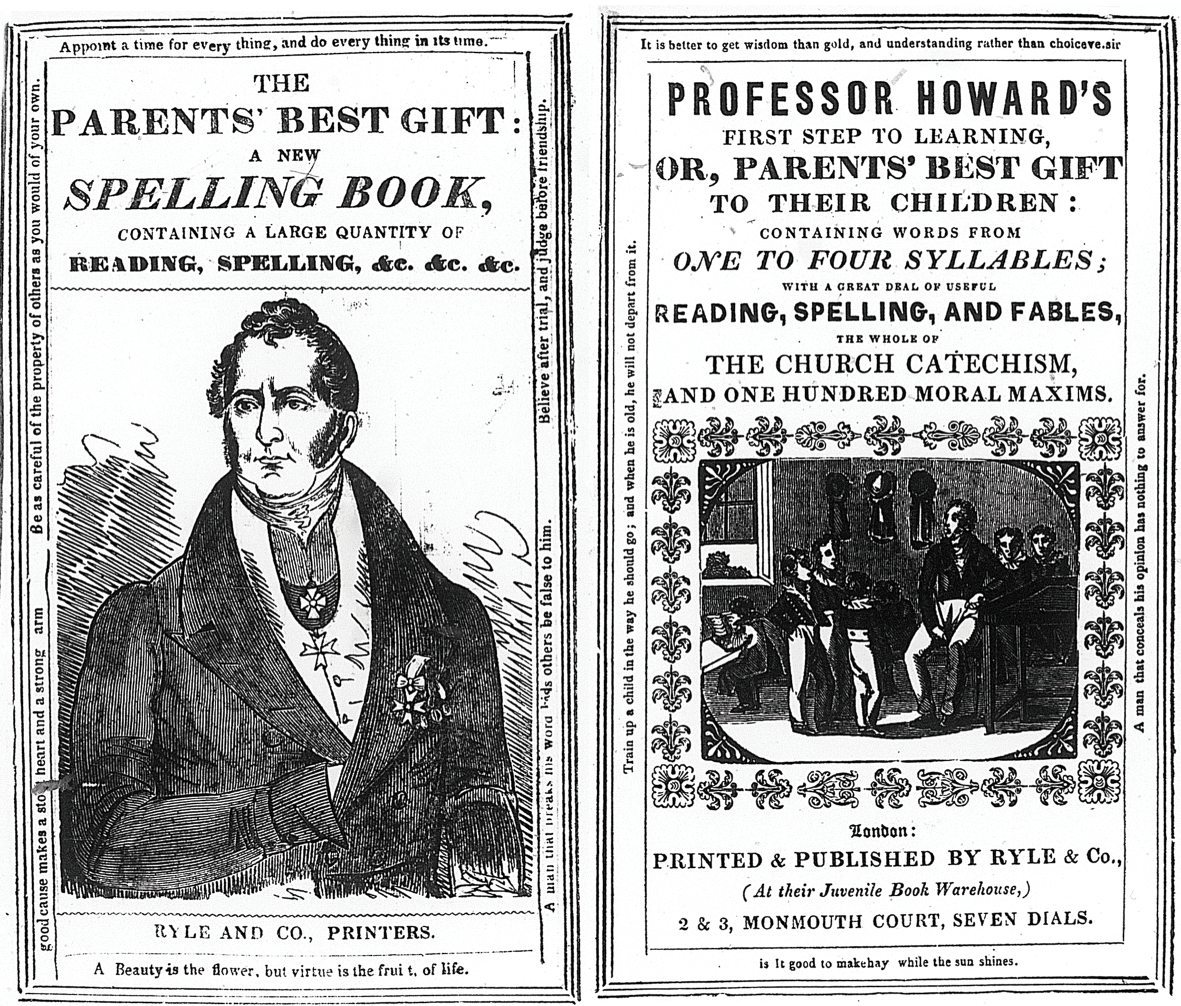
The earliest Professor is to be found in a chapbook primer,Footnote 241 printed circa 1850:Footnote 242 The Parents’ Best Gift: A New Spelling Book, Containing a Large Quantity of Reading, Spelling, etc. with the additional cover title Professor Howard’s First Step to Learning. The content of the primer – as is common for chapbooks – is adapted, reprinted and copied from earlier publications promoting both the Anglican Church catechisms and rote learning of letters and numbers.Footnote 243 The fictional Professor Howard featured within a classroom setting (See Figure 1) is presumably invoked to represent intellectual, academic and social authority as a positioning device to promote and encourage children’s learning (although that authority is directed towards the adult purchasing the book: this primer, in an increasingly crowded market, is the one you should trust). The picture of Professor Howard with his class – reminding us that professors are associated with teaching as well as expertise – is juxtaposed with an ambiguous image on the title page that looks remarkably like Field Marshal Arthur Wellesley, the 1st Duke of Wellington (1769–1852). It was common for woodcuts to be reused by early printers,Footnote 244 and often ‘children’s books were built up out of woodcuts lying around in the shop or borrowed from other works’.Footnote 245 This particular untitled image is further used to convey power: it may or may not be our Professor Howard, but this is a book confidently espousing its teaching credentials in a display of male authority and privilege. There is no further mention of the professor within the text, which is a short, fourteen-page pamphlet containing the popular Tom Thumb’s Alphabet,Footnote 246 reading lessons, church catechisms, and ‘one hundred moral maxims’ such as ‘Books alone can never teach the use of books’.Footnote 247
Woodcut illustrations, title page (left) and frontispiece (right) from The Parents’ Best Gift: Professor Howard’s First Step to Learning (circa 1850),.
The use of a Professor in the publication of this fourteen-page pamphlet in the mid-nineteenth century is significant. During this period, children’s education was rapidly changing, becoming more institutionalised with an expansion of the scholastic system (which is reflected in children’s literature of the periodFootnote 248). The new importance of learning resulted in an expanding market for ABC books, chapbooks and primers,Footnote 249 although many of these were ‘numbingly dull compilations of facts and dates which Victorian schoolchildren had to learn by heart in those “catechetical” classes’.Footnote 250 Well-circulating textbooks were printed throughout the nineteenth century that traded on the academic qualifications of the authors as an imprimatur. An 1816 guide for Young LadiesFootnote 251 contains a ‘hypothetical bookseller’s bill’ as a ‘revealing index of what were considered desirable reading habits’:Footnote 252 out of twenty-four (real) texts, three are written by those with higher degrees, and sold as such: Dr Watts’ Improvement of the Mind (first published 1741, with many subsequent editions);Footnote 253 Essays on Rhetoric by Dr Blair (first published in 1784 with many subsequent reprints)Footnote 254 and Dr Mavor’s New Speaker, or English Class Book (1811).Footnote 255 Dr Isaac Watts and Dr Hugh Blair both spent considerable time in the academy and gained qualifications.Footnote 256 However, Dr Mavor is a pseudonym for Sir Richard Phillips, a schoolteacher and bookseller, and the title is presumably used for marketing purposes.Footnote 257 This established mechanism of academic titles being used to frame a text’s trustworthiness crosses over into a recommendation from a fictional professor in our mid-nineteenth century chapbook: indeed, much of the religious text for this chapbook appeared in an earlier format which was promoted by an actual academic figure, Dr William Paley:Footnote 258 Parents Best Gift containing the Church Catechism, Questions and Answers out of the Holy Scriptures. Dr Paley’s Important Truths and Duties of Christianity.Footnote 259 This title, and the habit of using an academic imprimatur to promote texts, indicates a potential trajectory for the switch into fictional endorsement of the reprint of the text in Professor Howard’s First Step to Learning, around 1850. By the late nineteenth century, other authors with professorial titles are selling textbooks, such as Professor Miekeljohn’s Series, one of the first, best-selling standard set of school textbooks in the late Victorian era, written by J. M. D Meikeljohn, Professor of the Theory, History, and Practice of Education at the University of St Andrews and published by Blackwoods from 1883 onwards.Footnote 260
Professors would have become more visible during this period, as the university sector was also transforming, becoming more established throughout the world and playing an increasing role in society, integrating science into a curriculum that had previously eschewed it.Footnote 261 Between the 1860s and 1930s ‘a small, homogenous, elite and pre-professional university turned into a large, diversified, middle-class and professional system of higher learning’,Footnote 262 transforming universities from what had been previously been viewed as an optional phase in the development of privileged young white gentlemen into a core institution informing modern society.Footnote 263 Moving away from their ‘traditional task of serving the older landed and professional elite’,Footnote 264 universities started to adapt to the needs of industrial society. As ‘pressure intensified on parents to invest in education’,Footnote 265 and as the university curriculum became more distinct from secondary schooling, accelerated further by state intervention, we see the forming of an ‘academic profession, which only becomes recognizable as such at the end of the nineteenth century’.Footnote 266 The emergence of ‘the academic’ expert in both research and teaching is itself part of the rise of Professionalism during the Victorian period.Footnote 267
These developments in the university sector, and the growing public perception of academia as a profession, can be coupled with the fact that the nineteenth century was a period where more and more books were being created for a childhood audience, particularly in the United Kingdom and the United States: ‘The latter half of the nineteenth century saw the beginnings of a great age of children’s fiction, an outpouring of literature written by middle-class adults for middle-class children’.Footnote 268 In addition, advancement in printing technology at this time allowed illustrations of higher quality to be produced more easily.Footnote 269 In many ways, the confluence of these factors mean we could only expect an academic to appear fully illustrated in children’s literature from the mid-nineteenth century.
There are forty-one other academics which appear in the corpus in the nineteenth century, all in its last thirty years, with twenty others from the United Kingdom and twenty-one from the United States (see Appendix B, and also the open access anthology which draws together many of these short stories and poemsFootnote 270). It should also be noted, however, that the coverage of books from the United States is influenced by the number of texts appearing in the corpus from the wonderful Baldwin Library of Historical Children’s Literature at the University of Florida, which provides much digitised children’s literature in the public domain: showing how mass digitisation, combined with the constraints of copyright (American texts published in or after 1923 remain in copyright and generally are not digitised and made freely available, but those published prior to that can be without risk, meaning only earlier texts are freely available), can influence the dynamics of corpus-based analysis.
The appearance of professors in children’s literature over this period reflects the growing importance of universities at that time in these contexts, although few characters have anything to do with academic institutions. The Professor in The Professor’s Merry ChristmasFootnote 271 is the first to be included in fiction,Footnote 272 in a Christian retelling of Dickens’ A Christmas CarolFootnote 273 two children are illustrated delivering food to a poor, elderly professor who has decided not to celebrate Christmas, until shown visions of families, charity and the second coming. There is a showman (Professor Wolley Cobble, in Walk Up! Walk Up! 1874), American coming-of-age tales of hard-working students and young professionals (Herbert Carter’s Legacy, or, The Inventor’s Son,Footnote 274 Professor Johnny,Footnote 275 Professor PinFootnote 276 and a thrilling adventure in the The Professor’s Last Skate,Footnote 277 where a teacher recalls to his students the last time he went skating alone, years ago: breaking his leg and having to haul himself miles home across the ice). Many of the early professor’s in the corpus are indistinguishable from higher-level school teachers, showing both the changing linguistic use of the term and also the formalisation of academic training: for example, the Old Professor in the Princess of Hearts,Footnote 278 draughted in unsuccessfully to deal with a precocious royal child. More random stories do start to appear: the grotesque Professor Menu is a ‘celebrated experimental cook, who had been driven away from London because of the effect of his awful experiments on the digestions of the customers at his restaurant!’,Footnote 279 discovered on an island by starving shipwrecked sailors, but whose worrying scientific experiments on food drive the narrator ambiguously to madness, or a confession, it was all a tall tale.
An early colour illustration (Figure 2)Footnote 280 appears in the fairy tale Professor Bumphead,Footnote 281 which publishes a lecture given by the fairy professor, on the setting up of a Society for the Prevention of Cruelty to Inanimate Objects (stressing the ridiculousness of professorial advice, at this early stage, mocking Victorian scholarly and scientific societies): ‘A few well-chosen words addressed to a gate-post, flower-pot, bottle or any other inanimate object, will cheer its heart and encourage it to get through the terrible monotony of its existence’.Footnote 282
Professor Bumphead lecture tells us how miserable windmills are. In The Fairies’ Annual (Johns, The Fairies’ Annual, p. 31). Every effort has been made to trace any right-holder who may own the rights to this work (the estate of Cecil Starr Johns, and The Bodley Head), although it is believed to be in the public domain: any further information is most welcome in order to remedy permissions in future editions.

Early professors in children’s literature cover a range of tales and genres, symptomatic of the first one hundred years of the corpus, where there are sixty-eight academics found (thirty-eight being from the United Kingdom, with thirty from the United States). There is a warning tale of a conman and magician (Professor De Lara),Footnote 283 advice on healthy living (The Wisdom of Professor Happy),Footnote 284 a scientific quest in Professor Peckam’s Adventures in a Drop of Water,Footnote 285 and an anthropomorphic short story in the style of Beatrix Potter (Professor Porky the Porcupine).Footnote 286 The most enduring characters of this period are the scientist Professor Ptthmllnsprts in Kingsley, The Water-Babies, the doctor turned zoologist Doctor Dolittle,Footnote 287 and the baffled scientist and inventor Professor Branestawm,Footnote 288 giving three best-selling blueprints for scholarly conduct in children’s literature. There are two spikes Chart 1, which shows the date of publication of books in the corpus: the first towards the end of the nineteenth century shows both the growing awareness of the university sector and also the effect of full text search in public domain mass digitisation on the process of corpus building. Instances fall away once manual searching of print takes over in early twentieth-century texts, before rising again. It is only from the mid-twentieth century that academics in children’s books gain in popularity in this dataset, becoming more prevalent (or, at least, easier to find) and settling down into established stereotypes.
Academics appearing in English language children’s books per year since 1850. Note, in some books, more than one academic may be featured: therefore the number of books in which they appear per year has been noted, as well as the total number of academics found per year.
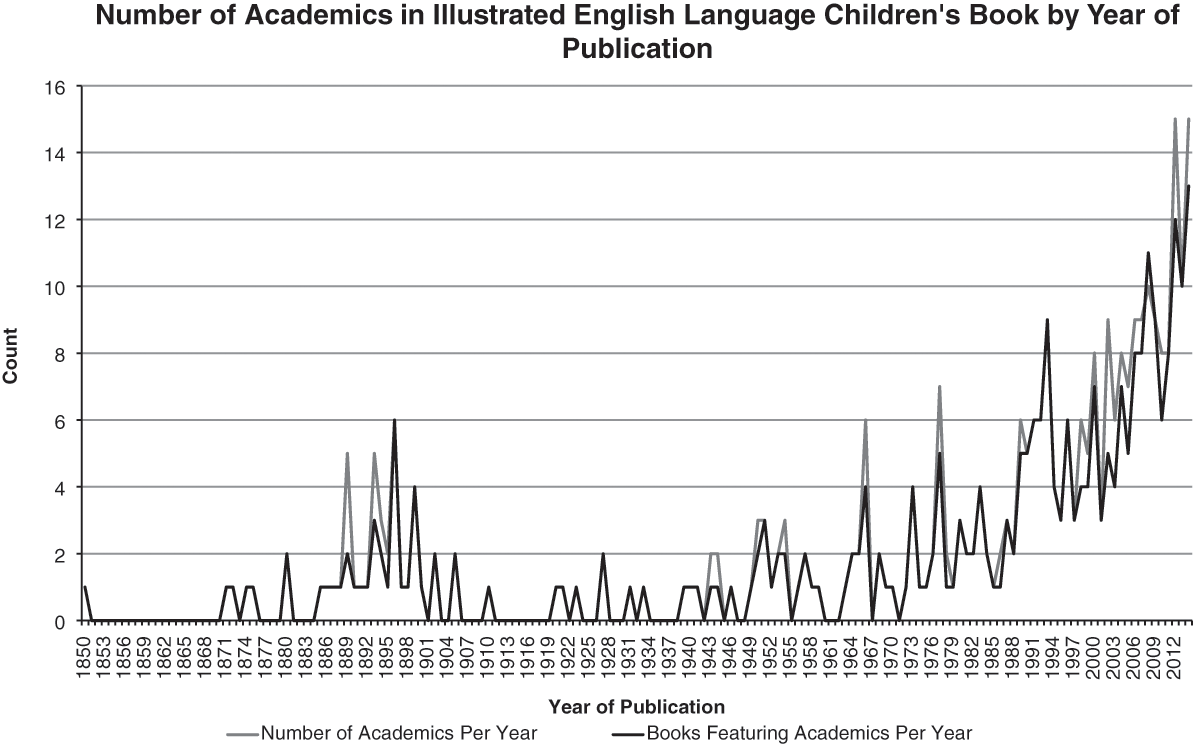
It is tempting to relate the growth of the number of illustrations of academics found in children’s books per year across in the second part of the twentieth century to the rapid expansion of and increased access to higher education throughout the English-speaking world within that period.Footnote 289 For example, in the United Kingdom, the number of universities more than doubled in the latter half of the twentieth century, and the population’s ‘overall participation in higher education increased from 3.4% in 1950, to 8.4% in 1970, 19.3% in 1990 and 33% in 2000’.Footnote 290 However, the growth shown in Chart 1 does not necessarily correlate to this; nor does it mean that academics are becoming more important as a theme in children’s literature and appearing in a higher percentage of texts.
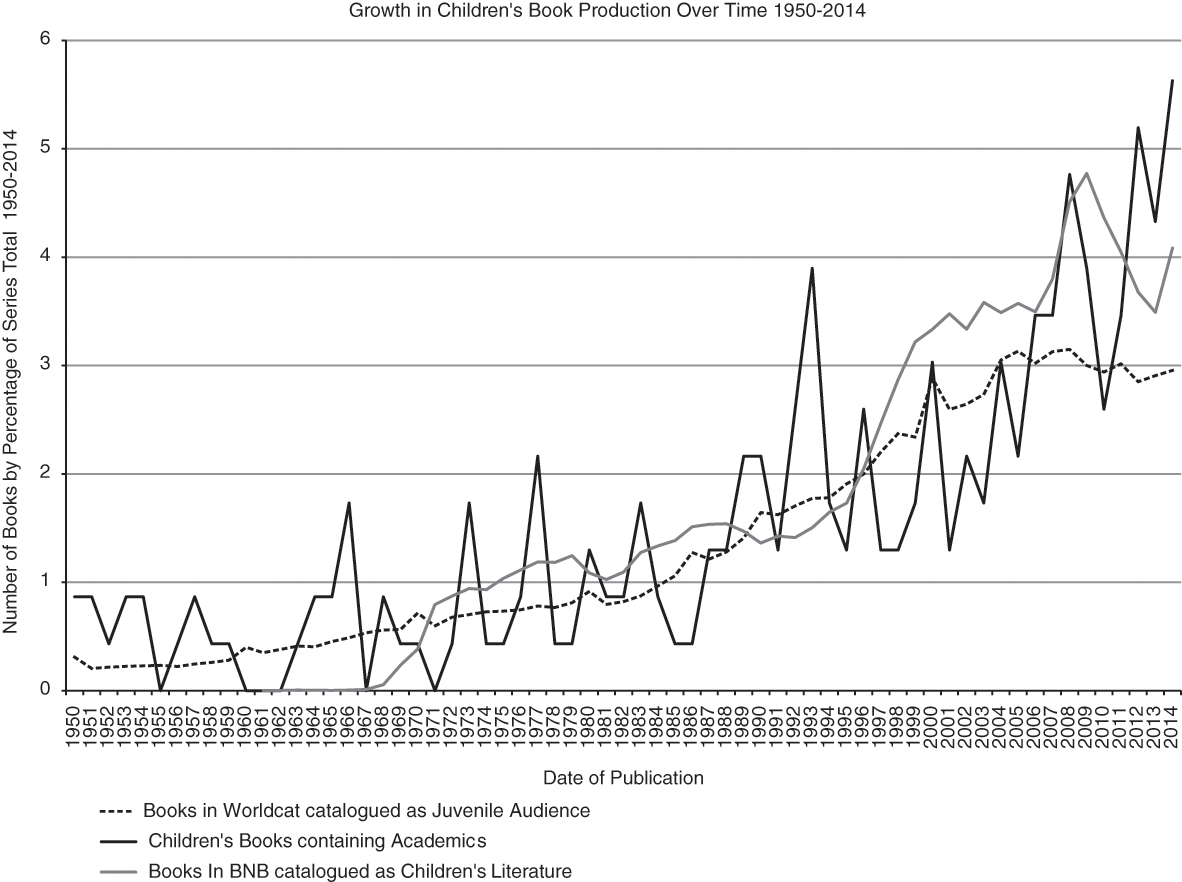
The growth in the corpus can be plotted against known data on book production from two library catalogue sources. Firstly, counts of all books catalogued as English language for a junior audience in WorldCat were manually scraped from the site.Footnote 291 Given it is so difficult to ascertain reliable statistics for book publications over time,Footnote 292 WorldCat remains a useful resource for quantitative analysis despite its known limitations.Footnote 293 There are 1781 books in WorldCat that were catalogued as being English-language juvenile-audience text published in 1856, 1574 in 1906, 8082 in 1956 and 50,477 in 2006 (concluding the period prior to the exponential growth of self-published books, many of which do not feature in library catalogues). Secondly, The British National Bibliography (BNB),Footnote 294 which has been recording the publishing activity of the United Kingdom and the Republic of Ireland since 1950,Footnote 295 was contacted and asked for a list of children’s books published in the United Kingdom, which had been included in the BNB since its inception, and which they began cataloguing in 1961 given changing cataloguing conventions.Footnote 296 However, it should be noted that the division between children’s and adult books is not often clear within the catalogue,Footnote 297 and there is yet to be a special edition of the BNB listing only children’s books, given books for children and books about children are often hard to distinguish within the ‘juvenile literature’ heading (this is an area ripe for community input, to crowdsource a national bibliography of children’s fiction and non-fiction literature). There are currently 1033 juvenile literature books in the BNB catalogued as being published in 1970, 2912 in 1980, 3653 in 1990, and 8938 in 2000. To allow comparison between WorldCat and the BNB data, the volume of books catalogued as juvenile literature published per year is expressed as a percentage of the total books in each individual series, indicating that more books are produced towards the end than the middle of the twentieth century.
Chart 2 shows growth in the number of children’s books appearing in the BNB and in WorldCat, year on year, from the mid-twentieth century: more books classified as juvenile literature are produced yearly. The WorldCat data (from 1850) comprises of over 1.6 million books, the BNB data (from 1961, where books published in England and Ireland were first catalogued as Children’s Literature in the BNB) contains just short of 270,000 records (although there may be some false positives in this dataset, with books for children as subject being conflated with books for children as audience, so further cleaning and statistical work is needed on this dataset). Our corpus of 289 books in comparison shows a much more volatile trajectory, being more sensitive to the addition of one or two texts per year. However, all show upward trends, indicating that despite the growth of the university sector, the increase in the number of academics is correlated with the fact there are simply more and more children’s books being produced in the second half of the twentieth century, rather than the topic becoming more important and prevalent in juvenile literature over time (which would be represented by curve that deviated further from the BNB and WorldCat series in Chart 2). The percentage of texts which feature an illustration of an academic (calculated by the total books per year, and the books catalogued, as above, in WorldCat or the BNB – provided all possible examples have been found, which is rather unlikely!) is roughly constant. Using the BNB introduces interesting methodological opportunities for the study of children’s literature (or ‘juvenile literature’, as it is described as a topic in the Library of Congress Subject Headings used by the BNB) but requires a robust methodology to be developed to mitigate against statistical uncertainty. The BNB and other national bibliographiesFootnote 298 are, as yet, an untapped dataset for children’s literature scholarship, and hold future potential for evidence-based quantitative research on the topic, provided the datasets can be further cleaned and moderated in a way which would establish them as authoritative data sources for children’s book publishing.
The growth in book production over time, by publication year. The number of children’s books published that contain professors is compared to two available data sources: total number of books catalogued for juvenile audience in WorldCat, and books catalogued as ‘juvenile literature’ in the British National Bibliography. The x-axis represents the percentage of books published in that one year, in comparison to the total number of books published for that series between 1950 and 2014 (the series total reaches 100 %, so in the case of WorldCat we can see that 0.5 % of books classified as juvenile literature in WorldCat are published in 1950, but 3 % in 2004: the number of children’s books produced over time rises year on year). In all three series, proportionally more books appear across the end of the twentieth century, suggesting that there are more children’s books being published in total (which, in addition, are more likely to be catalogued in the modern library environment; see quote from Scally in Section 3.1), not that academics in children’s literature are becoming proportionally more prevalent.
The increase in number of books in the corpus towards the close of the twentieth century does mean that 50 per cent of the academics first appear in books published from 1993 onwards, and will therefore reflect modern representations of academia, once tropes have had a chance to develop, in a form which ‘declares its debt to postmodern modes of production’ with ‘the rise of the experimental, multi-voiced, metafictional children’s text in the latter half of the twentieth century’.Footnote 299 The prominence of academics in enduring and popular best-selling children’s texts means that their influence goes far beyond this relatively low occurrence in the pantheon of children’s literature, with ‘famous’ academics in children’s literature both building and reinforcing the stereotypes used by subsequent authors and illustrators as blueprints and shorthand for their characters. Overall, distinct themes emerge which become constant: universities as places or institutions are not as important as the people within them, and fictional academics have stereotypes that emerge involving gender, race, class, age, appearance and academic subject. These – and the dominant stereotypes that emerge – will be explored and placed into context via their external influences. Drawing on trends and stereotypes that came before them in often ‘playful subversion’,Footnote 300 as the stereotype of the mad male muddlehead coalesces, it can become both easier to drop a character into a children’s story without need for explanation as part of intertextual exploration, and harder for writers and illustrators to confront and break free from these expected mores.
4.3 The Presence and Absence of the University
It may be thought obvious to look first at how universities are pictured as settings in children’s literature. However, after reading and analysing the corpus, it became clear that any analysis should concentrate on the individuals that appear in the books, both as protagonists and minor characters, rather than the representation of universities as places or institutions: there is so very little comment on anything other than the people in the texts, either in text or as background setting in illustrations. This is unlike school stories, where ‘the school features almost as a character itself’,Footnote 301 or the analysis of universities in American superhero comics where the leafy green park life spaces of campus ‘connect with and bolster public imaginings of U.S. institutions of higher education’.Footnote 302
There are only three books for a young audience that are mainly based in university settings, although descriptions of these are slight and show the dominance of Oxbridge and the Ivy League in popular conception of universities. Sylvie and Bruno and Sylvie and Bruno Concluded (the last novels written by Lewis Carroll, in 1889 and 1893) proceed in a rather disjointed dual setting: the university and fairyland.Footnote 303 They have a range of characters typically found around Oxbridge colleges (although no specific geographical setting is given), with seven illustrated: the Professor, the Other Professor, the Vice-Warden, the Chancellor (1889), two Heads of College, and a student (1893). The stories focus on and ridicule the people and processes within academic institutions, rather than the physical university itself: although there are mention of libraries, college halls, lecture rooms and gardens which have conversations, teaching and meetings within them, they are not described at all, and only appear as the odd brick wall or corner of a room in illustrations. There are parallels drawn between fairyland and the university system, poking fun at intellectual expertise, within the text. Much fun is made of the pursuit of funding: a visiting academic tells the tale of how professors motivated students by offering them money for correct answers, until the students made more money than the professors earn. Students were chosen by ‘Scholarship Hunts’ where principals chased them through the streets as they get off the train, aiming to catch the best ones (Figure 3).Footnote 304 Throughout the book, it is these characters, and their reminiscing and actions, rather than the setting, which is important.
Heads of college chasing good students, in a ‘cub-hunt’, in Carroll, Sylvie and Bruno Concluded (p.189), illustrated by Harry Furniss. Public Domain: image from copy held at University of California Libraries and available at archive.org. This style of illustrating the university of Sylvie and Bruno is common throughout the text, with hints of stonework and flagstones.
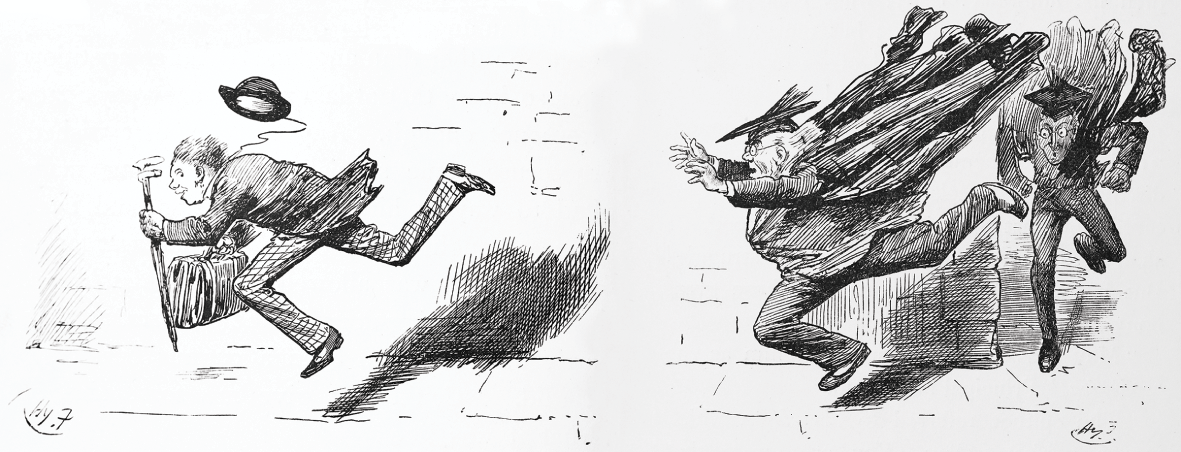
Likewise, Jack Dawe Super Scientist and the Professors,Footnote 305 a book which never had a wide circulation – written by an anonymous Oxford professor for his nieces and nephews – has illustrations of indistinguishable packs of male dons wearing sub fusc mortar boards and gowns, but little comment on the university itself. The scientist Jack Dawe works at Oxford, but is called away to deal with infestations at the Australian University, university business at The University of the Ganges, and the Congo University, and to procure computers for universities in America. There is little comment on the buildings or settings of the universities, with the book instead mostly focussing sarcasticallyFootnote 306 on the male academics within each setting and their weird academic lifestyle (there is a lot of going to the dining room, see Figure 4).
The Oxford Professors, with super scientist Professor Jack Dawe, and the children who accompany him on adventures. In Uncle B and Green, Jack Dawe Super Scientist and the Professors (p. 61), illustrated by Brian Green. Every effort has been made to trace the current right-holders, Allday Limited, Uncle B and Brian Green, who own the rights to this work: any further information is most welcome in order to remedy permissions in future editions.

‘The Professors’ throughout are clueless academics with insular, limited views, in colonialist tales:
Professor Stickeybeak … had been sent out [to Borneo] by the Oxbridge University Professors to find out all about the Takeover Tribe which they had heard was very happy, and this was a mystery because the Oxford Professors could not understand how anybody could be happy without culture and they thought that anyone who sold shrunken heads could not have any culture.
The academics themselves are the focus, even though there are different university settings, presented without description or illustration, throughout.
The exception to this is Mahalia Mouse Goes to College,Footnote 307 where we see a fully illustrated university setting with detailed depictions of Harvard’s redbrick campus, including pictures in the background of the diverse student population, based on a poem that was delivered as part of the award-winning actor John Lithgow’s commencement speech there in 2005.Footnote 308 Mahalia is shown partaking in all aspects of campus life (even if she is a mouse in a world of humans, accepted because of her genius), appearing in lectures, theatre productions, the dormitory, cafeteria, glee club and the graduation ceremony. The lecture halls and porticos of Harvard loom behind her mouse-eye-view in a redemptive story of the transformative power of education as a means to lift oneself out of poverty, ending on commencement day (Figure 5).
Mahalia mouse celebrates her graduation at Harvard. In Lithgow and Oleynikov, Mahalia Mouse Goes to College (p. 39).
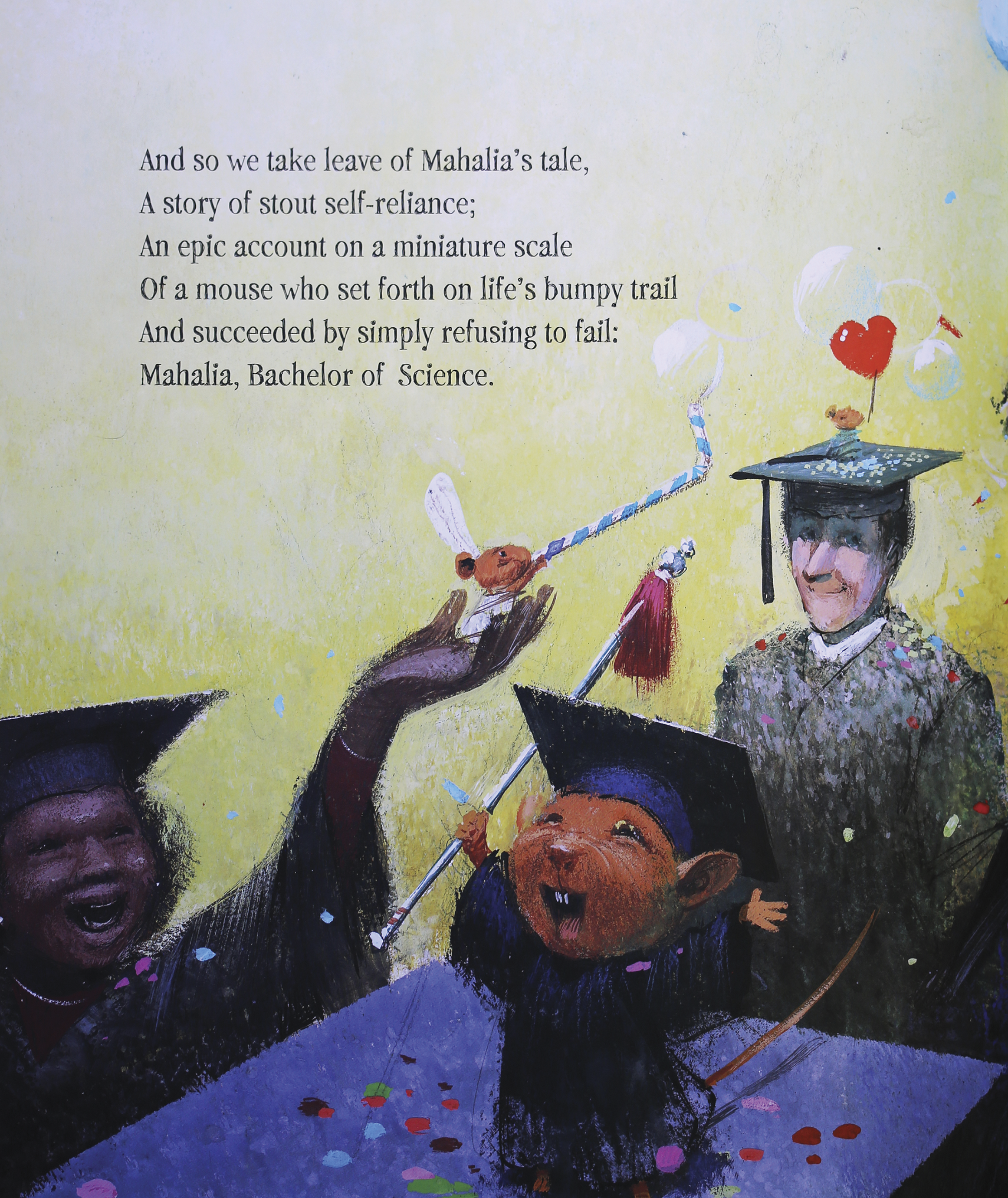
Lithgow describes that his intention in writing Mahalia mouse was ‘to get small children already interested in the idea of education in general and college in particular, giving them this very, very, far away goal to aim for’.Footnote 309 These three texts were all written by those with a close relationship with the university: Lewis Carroll and the mysterious ‘Uncle B’ being Oxford academics, Lithgow being a graduate of Harvard himself, speaking this poem aloud at graduation there.Footnote 310 Both the satirical and inspirational take depend on insider knowledge of the university setting, and trade upon in-crowd jokes.
It is not until books created for an older childhood audience – such as Professor Pin,Footnote 311 the first two and last chapters of Carney’s House Party,Footnote 312 the His Dark Materials trilogy,Footnote 313 The Seven Professors of the Far NorthFootnote 314 and The Oath of the Five LordsFootnote 315 (and, of course, Hogwarts in the Harry Potter seriesFootnote 316 if you are willing to believe the apex of the formal wizarding instructional system counts as an Higher Education institution) – that the university and its buildings routinely function as a character itself, and these are mostly textually described rather than illustrated. Our seats of learning would seem to require explanation rather than depiction.
There are three specific places on campus that appear in the background of illustrations: in a very few recent books there are lecture halls, generally showing professors professing on stage in front of a half-empty or disinterested audience (Figure 6).Footnote 317 More prevalently, in a fifth of the books there are scientific laboratories. Most of the factual books explain science, and these tend to have settings in laboratories, such as Professor Crackinbottle and Professor Tidymind and their Two Young Helpers,Footnote 318 Professor I.Q. Explores the Senses,Footnote 319 Professor Astro Cat’s Frontiers of SpaceFootnote 320 and Professor Whiskerton Presents Steampunk ABC,Footnote 321 which explains the alphabet through clockwork Victoriana, engines, machinery and derring-do explorer’s maps and zeppelins.
Professor Mudweed lecturing, in Orme and Richardson, Boffin Boy and the Wizard of Edo (p. 1).
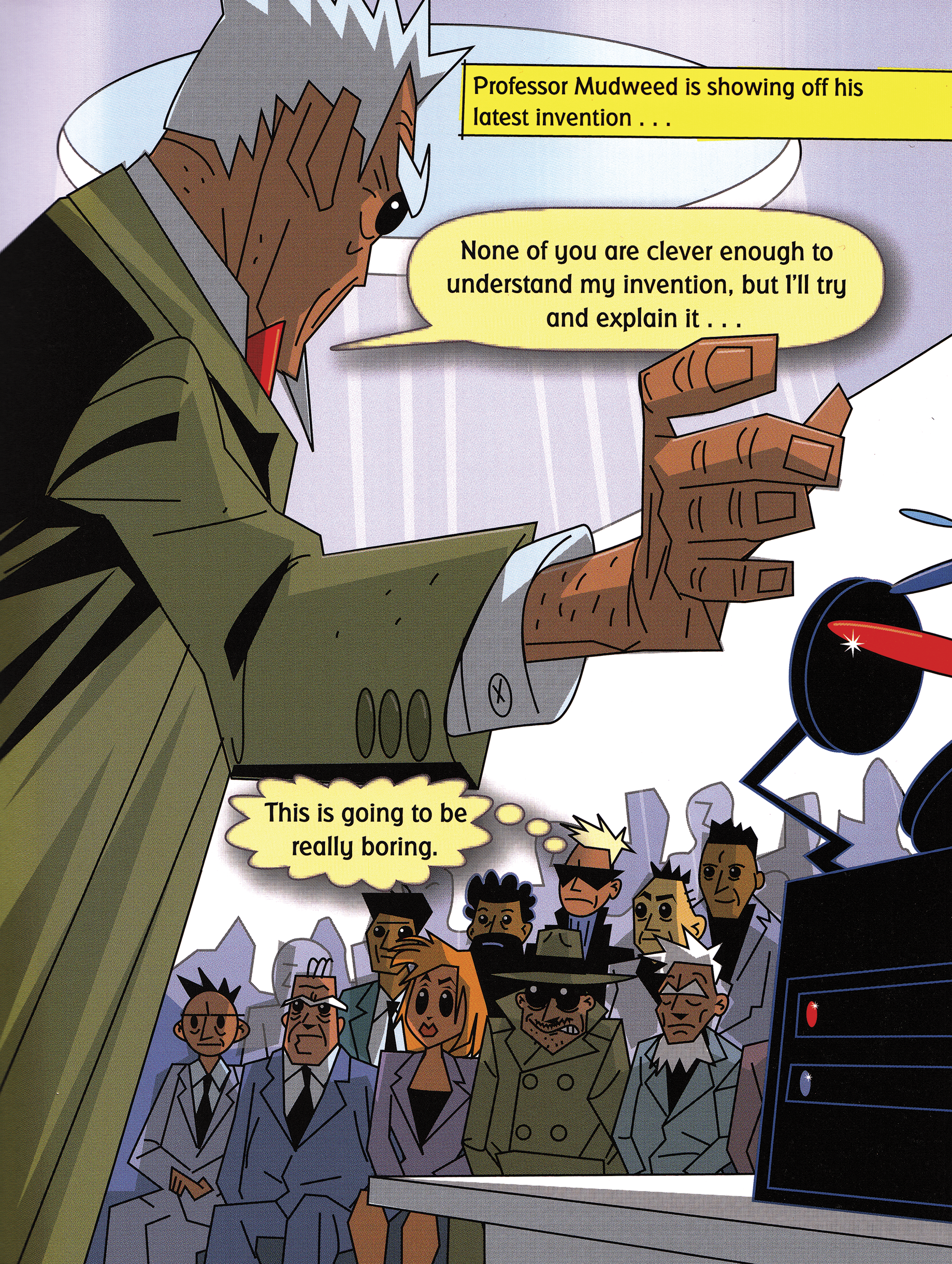
The scientific kit on show represents complex yet stereotypical depictions of science (there are lots of test tubes regardless of subject area). The few labs which appear in fiction are usually messy, dangerous and crammed with mysteriously complex scientific equipment.Footnote 322 The laboratory in Professor Puffendorf’s Secret Potions,Footnote 323 which is filled with complex glassware, smoking machinery, bicycle chains, spills, books, skulls, notebooks, furnaces, cobwebs, top-secret cabinets and gadgets including a ‘Titanium Blender’ and Puffendorf’s own inventions, the Banana-matic and Smell-o-Telephone. Likewise, the short reader Professor Rumbold and the Great Recycling MachineFootnote 324 (see Figure 12) is set in a complex factory or laboratory setting with conveyor belts, robots and gadgets. These laboratory settings require scrutiny by the reader to comprehend – or to be in awe of – the rich scientific environment: invention and science would seem to come from a place of chaos and other-worldliness.
The Professor’s Lecture, in Carroll, Sylvie and Bruno Concluded (p. 345), illustrated by Harry Furniss. Public Domain.
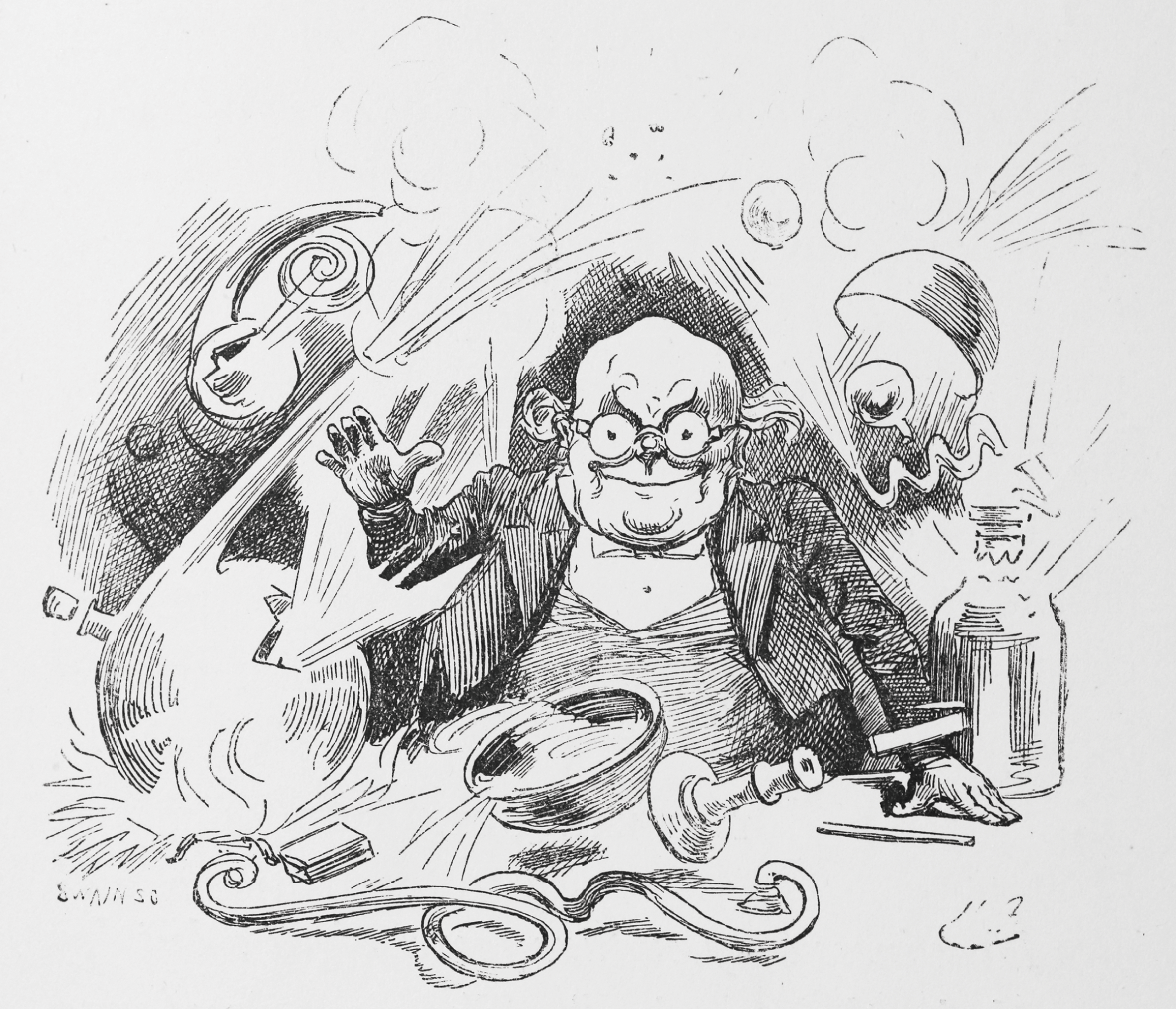
A final place which is either mentioned within the text or referred to in illustrations is the library. Professor Inkling in The Octonauts and the Frown FishFootnote 325 exclaims ‘to a confused crew’ when explaining what always cheers him up: ‘There’s nothing like perusing the printed word to stimulate the intellect and galvanize the imagination! … To the library, my delightful colleagues!’Footnote 326
In other texts, libraries are alluded to, or characters pass through them or book-lined studies in illustrations, without much comment or fanfare, as books are presumed to be part of the intellectual landscape. See, for example, background detail in illustrations of Professor Johnny,Footnote 327 The Professor in Mistress Masham’s Repose,Footnote 328 The Administrator in Professor Diggins Dragons,Footnote 329 Professor Barnabus Quill and Professor Quibble in The Rise and Fall of Mount Majestic,Footnote 330 Professor Mortimer in The Oath of the Five LordsFootnote 331 and Professor Tobin in Maisie Hitchins: The Case of the Feathered Mask.Footnote 332 In addition, many of the illustrated characters hold or carry books (see Figures 8, 10, 11, 22, 23, 27and 29 in this Element), showing how important the spread of information is to their livelihoods. Books seem to be the one pictorial way that education and intellectual achievement is communicated to the childhood audience.Footnote 333
Professor Inkling reading aloud to his more junior crew, much in the same way as reading sessions happen in pre-school settings. From Meomi, The Octonauts and the Frown Fish (p. 24), used with kind permission from Meomi and Immedium.
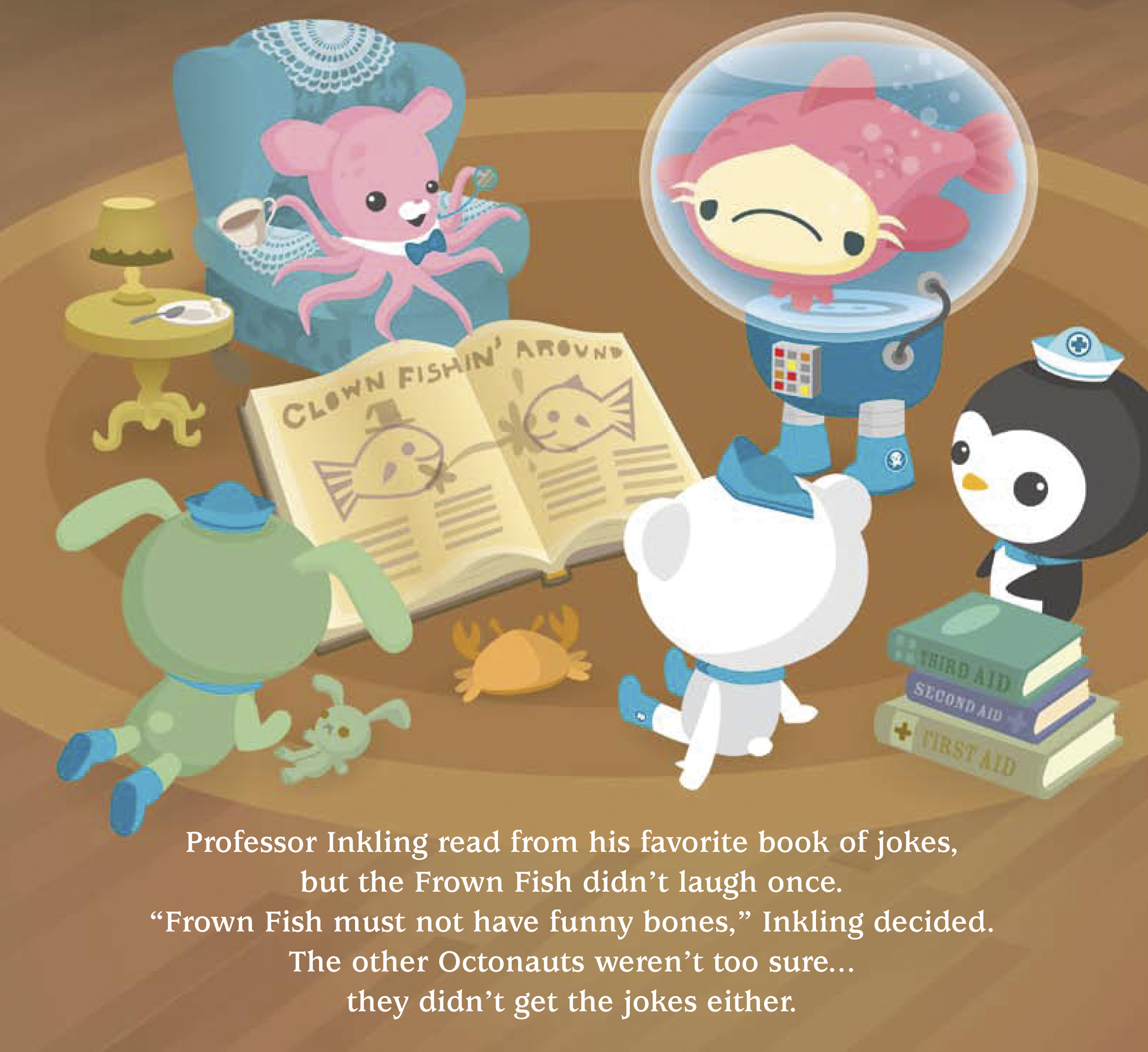
However, laboratories, lecture halls and libraries are far from the most common of settings within the illustrations. There is a trope of academics being away from their institutional homes in order to carry out fieldwork, such as the zoologists in Professor Twill’s Travels,Footnote 334 Professor Wormbog in Search for the Zipperump-a-ZooFootnote 335 and Professor Potts meets the Animals in Africa;Footnote 336 the archaeologists in The Amazing Time Travelling Adventures of Professor McGinty in Ancient GreeceFootnote 337 and Professor Nutter and the Curse of the Pharaoh’s Tomb;Footnote 338 the palaeontologist in the Dog that DugFootnote 339 and The Case of the Crested Cryptoclidus. Professor Barrister’s Dinosaur Mysteries,Footnote 340 and Professor Mackenzie, the explorer in the Maisie series.Footnote 341 Most of the action in Professor Puffendorf’s Secret PotionsFootnote 342 happens in her lab when she is away at a conference, and Dr Dog travels away to a conferenceFootnote 343 and then on holiday.Footnote 344 Academics are rarely at their university: as a result, it is a place seldom presented to the readers of these children’s books, either in illustration or description. Paradoxically, universities are not explained to children through books, perhaps as they are thought not to be known to them: but universities are not known to children as they are not explained as part of the media produced for a child audience.
Academics are not depicted as being part of institutions: they mostly work alone. Twenty-two of the 289 books feature pairs or triples of professors working together – or against each other – in the same text (for example, Professor Gylden Lox and Dr Med Yusa run a hairdressing academyFootnote 345). The largest number of individually named academics in a single book is four, working together in a lab in Mad Professor: Concoct Extremely Weird Science Projects.Footnote 346 Two books briefly feature exclusively male scholarly societies and all-male academic panels: the scientific committee in Moon ManFootnote 347 and the ‘Wise Professors of Prague’ in The Wicked Tricks of Till Owlyglass.Footnote 348 Jack Dawe Super Scientist and the Professors has its packs of dons.Footnote 349 However, in the majority of the corpus, in 267 books, the academics are lone figures acting independently, generally away from the institution: academia is mostly portrayed as a singular, even lonely, endeavour, which mimics the upholding of the myth of the lone scholar emanating from the academy itself: see Grendler’s analysis of depictions of lone scholars in the Italian RenaissanceFootnote 350 and Algazi’s analysis of depictions of studies in Early Modern European Cultures.Footnote 351 This is in stark contrast to family stories that dominate children’s literature.Footnote 352 ‘Like small children who play on their own, main characters in preschool literature act alone … they make their decisions based on their need to discover how the world works for them’:Footnote 353 lone academics are set up as adult counterparts to the lone child reader, experiencing difference together.
More than half of these academics are depicted in their household environment rather than in a university setting. The distinction between work and home is blurred by the fact that many carry out scientific experiments on their own property, which are therefore not the type of homes that the book’s readership would typically live in. For example, Professor Mickimecki has a barn workshop with a windmill on the roof, scientifically kitted out, and big enough to build submarines in.Footnote 354 Professor Nut ‘lived in an old house in the oldest part of town’,Footnote 355 and it is there that he has a laboratory where he can record an avant garde (tuneless!) symphony with his friend Professor Crotchet. Professor Oliver Query has a spaceship in his yard, ‘a telescope on the roof, and a weather-vane that pointed in two directions at once. There was even an anchored flying saucer’.Footnote 356 This focus on the home of the person as the locus for the intellect stresses the importance of the academic individual rather than the higher education institution within the children’s literature genre. It is interactions within these homes that situate the plot: the starting setting of The Lion, The Witch and the Wardrobe is Professor Digory Kirke’s isolated house, ‘in the heart of the country, ten miles from the nearest railway station and two miles from the nearest post-office’ which was ‘so old and famous that people from all over England used to come and ask permission to see over it’.Footnote 357 CockatoosFootnote 358 centres around the birds of a baffled professor, which decide to hide all over his large house. The Mysterious Collection of Dr David HarleysonFootnote 359 features a treasure hunt around his mansion, with no indication of why he would be called Dr in the first place, given he is a ‘famous artist’Footnote 360 – with the treasure hunt ending in the most domestic of rituals: Dr Harleyson’s marriage. The individual, and the individual’s home, is the focus here, but homes are different to usual suburban living, often being large, messy mansions full of antiquities, oil paintings and silverware. Professor Digory Kirke’s House is full of ‘the pictures and the armour, and the rare books in the library’.Footnote 361 These strange abodes give some sense of the other-worldliness of the academics:
At that moment, the passageway opened out into a large room. Sunlight filtered through the narrow windows, showing the strange hieroglyphics covering the walls. Broken jars, some with lids with animal heads covered the tables, and bits of old stone littered the floor. There was dust everywhere. Dust and pawprints.
‘It’s not like a proper house,’ I said. ‘There’s hardly any furniture. Just a lot of … rubbish.’
‘Ancient objects, you mean,’ said a familiar voice, and Dr Sphinx appeared from a hidden door in the far wall. [Pictured wearing a safari suit and pith helmet see Figure 9]Footnote 362.
Dr Sphinx’s living room. In Ryan, Weird Street: The Riddle of Dr Sphinx, © Margaret Ryan, 1997, Weird Street: The Riddle of Dr Sphinx and A&C Black Children’s and Educational, an imprint of Bloomsbury Publishing Plc, p. 37.
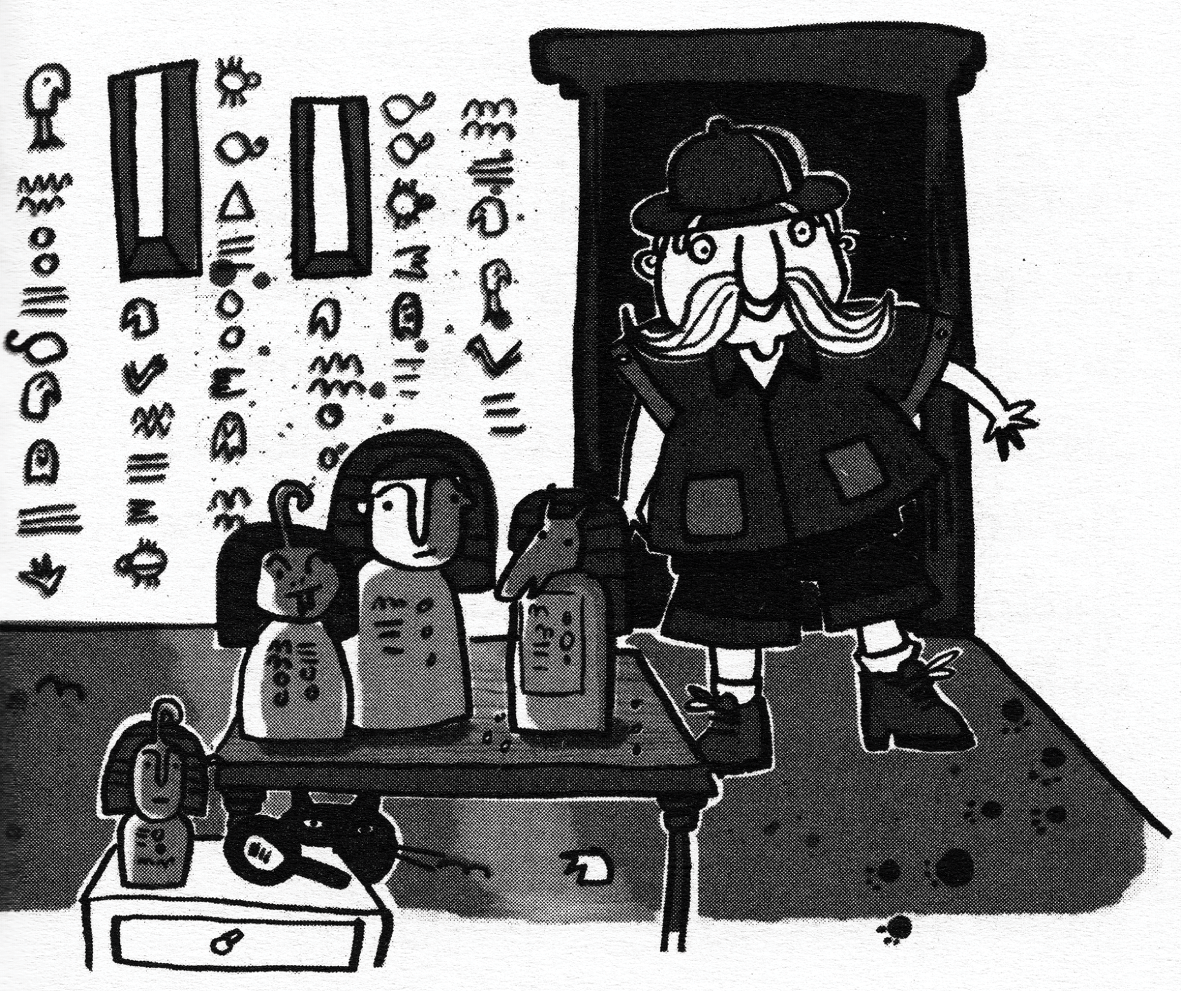
It is therefore not universities or higher education per se that are of interest in texts marketed towards a childhood audience, but the people who belong to the university – the professors and doctors – and their lifestyle and characteristics, that are presented to readers. By meeting them in their home environment, we can see the differences in how they choose to live, and what a ‘life of the mind’ involves, in a location where children can come into contact with them easily. These individuals, in turn, come to represent the university, and intellectual achievement, in children’s literature. As a result, this analysis will focus on the representations of academics across the corpus, the stereotypes that emerge, and the influences and perceptions that endure.
4.4 Gender
The most striking element of the corpus is gender: of 328 academics, 298 are men and twenty-nine are women (9 per cent), with only one having an ambiguous gender identity (Chart 3). The delineation between heterosexual gender norms is pronounced, and even with the five unseen narrators, or animal or inanimate object academics, it is easy to determine gender, given names, pronouns and physical characteristics. This difference between male and female characters accrues over time, and this visualisation demonstrates the dominance of male characters.
Gender of academics, revealing totals over time. The first female student appears in 1949, and the first female academic did not appear until 1950. Although there has been a growth in the total number of books featuring academics, they are still mostly men. Non-gender-specific individuals are not an important factor in the corpus.
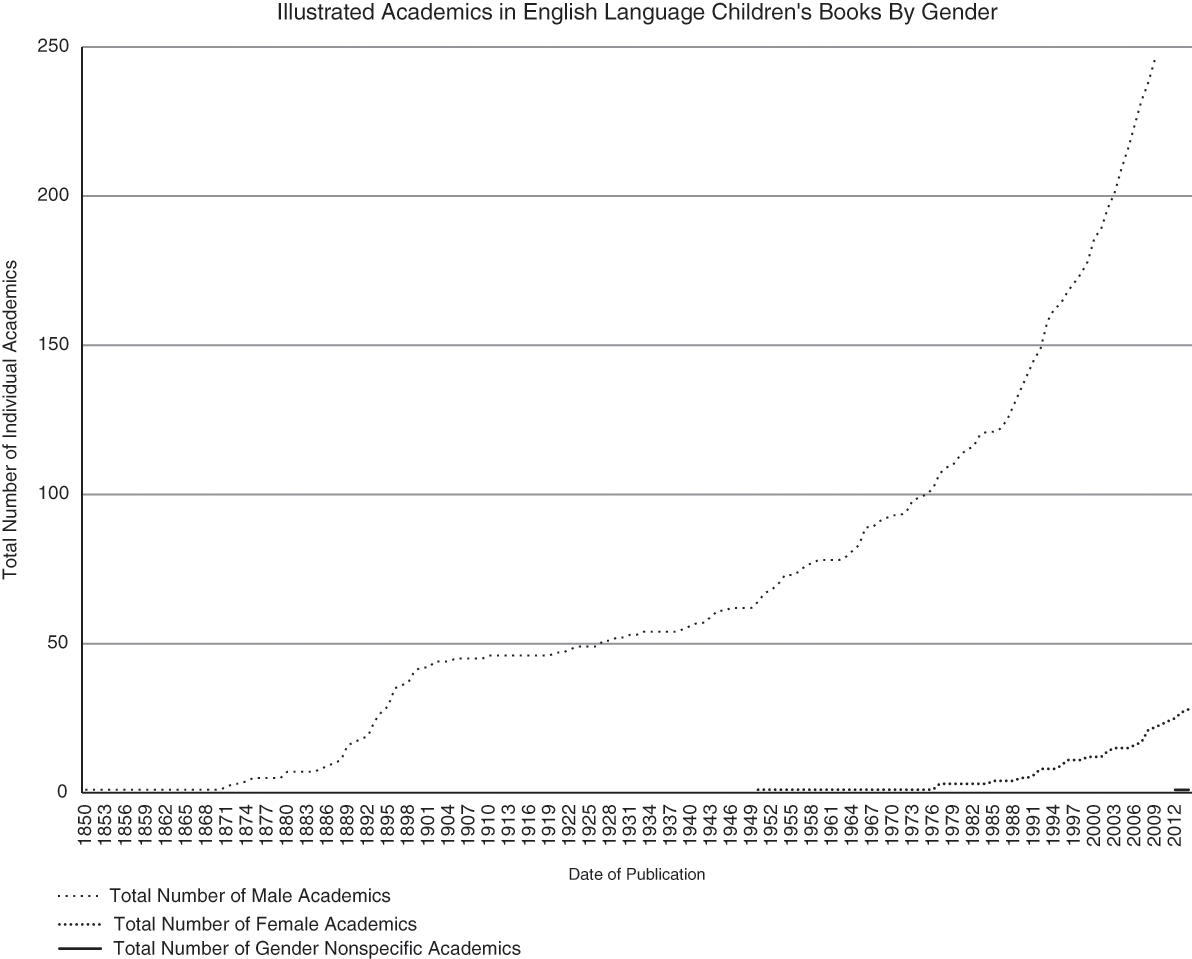
This discrepancy between male and female academics can be explained in two ways. Firstly, it has to be acknowledged that, despite the admission of women to study in many places of higher education in English-speaking areas from the late nineteenth century, women were mostly barred from taking up academic positions until the late twentieth century.Footnote 363 There is still a range of ‘structural-institutional, social, and cultural factors’ that explain women’s current woeful underrepresentation in academic life.Footnote 364 Across Europe in 2015, only 20 per cent of full professors were female.Footnote 365 There were therefore, and are therefore, few women in society who have a senior academic role and the corpus reflects this expected discrepancy in the profession. Secondly, the corpus is only of fictional academics, and it would have been reasonable to hope that authors’ imaginations could reflect possibilities and depict contemporary impossibilities or aspirations rather than to entrench realities: unfortunately, children’s literature seems to veer towards safe, established, dominant tropes that allow plots to develop without much explanation, rather than behaving imaginatively.Footnote 366 This, however, has the effect of reiterating and reinforcing social inequalities. The incentives and discincentives for the publishing of ‘radical’ children’s literature that exposes unjust power structures and promotes social justice are covered in Mickenberg and Nel,Footnote 367 although, as we shall see in Section 6, the current digital environment seems to be finally marrying publishers with an audience for such material.Footnote 368
The first female in our corpus is a student, Carney Sibley, in the early and final chapters of Carney’s House Party published in 1949, a fictional account of the time around the summer break at the then all-female Vassar College in the United States.Footnote 369 Although Carney clearly loves the campus, the novel focuses more on her engagement and her future as a wife than on her education. Shortly after, the first female professor appears in the corpus – a full hundred years after the first male, when there are already sixty-eight males; Professor Jocelyn Mabel Peabody, who appears in the Eagle comic (1950 onwards) as Space Fleet’s Permanent Special Advisor to the Exploration and Research Department and a regular sidekick to Dan Dare. She is a product of the imagination of the writers, with her blue-chip academic backstoryFootnote 370 including a doctorate from Magdalen College, Oxford, being impossible at the time of writing.Footnote 371 Set in the mid to late 1980s, the writers saw the future of science as including women. Dan Dare’s creator and artist, Frank Hampson, said of Peabody when interviewed in 1974:
I didn’t want to produce a strip without a female. In a way I struck a blow for Women’s Lib! She was shown as a very clever, attractive young lady. It also paved the way for a few arguments between her and [the men] in the first story – a nice human touch … she was just a very normal, efficient, competent girl.Footnote 372
However, Professor Peabody encounters significant bias and approbation at every turn, see Figure 10.
Professor Peabody’s first appearance, as she joins Dan Dare’s team in Eagle, 12 May 1950 (Vol. 1 No 5). She holds a book as a symbol of her professional status.
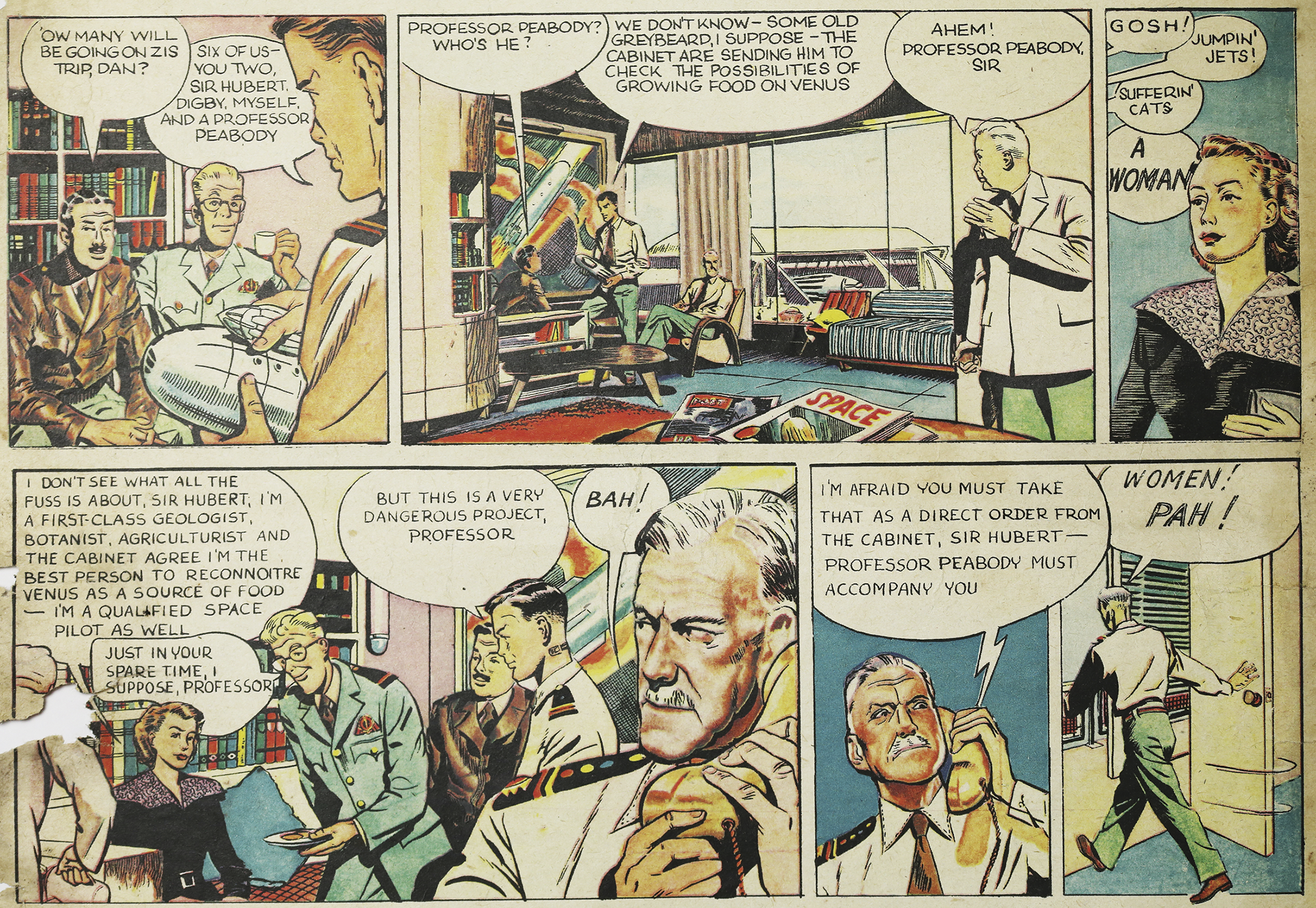
Unfortunately, Professor Peabody is an outlier (and featured in a comic rather than a codex). The first illustrated female academic in a book, after sixty-nine males are already in the corpus, is a ‘researcher’ and mother, not even given a name as the focus in on her male employer and her son, in Professor Coconut and the Thief (Figure 11):
Professor Albert is the head of our group of anthropologists. My mother is an anthropologist. We came to Africa to dig for bones of animals and people who lived millions of years ago.Footnote 373
The Doctor of Literature in The Pirates Mixed-Up VoyageFootnote 374 is not given her academic title, being known as Mrs Hatchett.Footnote 375 The female palaeontologist in The Dog That Dug is not given a name.Footnote 376 The first book to contain a named female professor is the short scholastic reader, Professor Rumbold and the Great Recycling Machine (1991) (Figure 12), in which she calmly designs technology to deal with the world’s growing environmental crisis, in a reader published to support the introduction of Science into the new UK National Curriculum in schools.Footnote 377
The female anthropologist in Gelman and Richter, Professor Coconut and the Thief (p. 13), an outsider to the male argument led by Professor Albert, who is renamed Professor Coconut by the children. Note that she is holding paperwork, even in the jungle.
Professor Rumbold, the first named female in the corpus. Note the robots in the background which interact with the child reader, as the professor concentrates on the technology. In Crispin, Professor Rumbold and the Great Recycling Machine (p. 3).
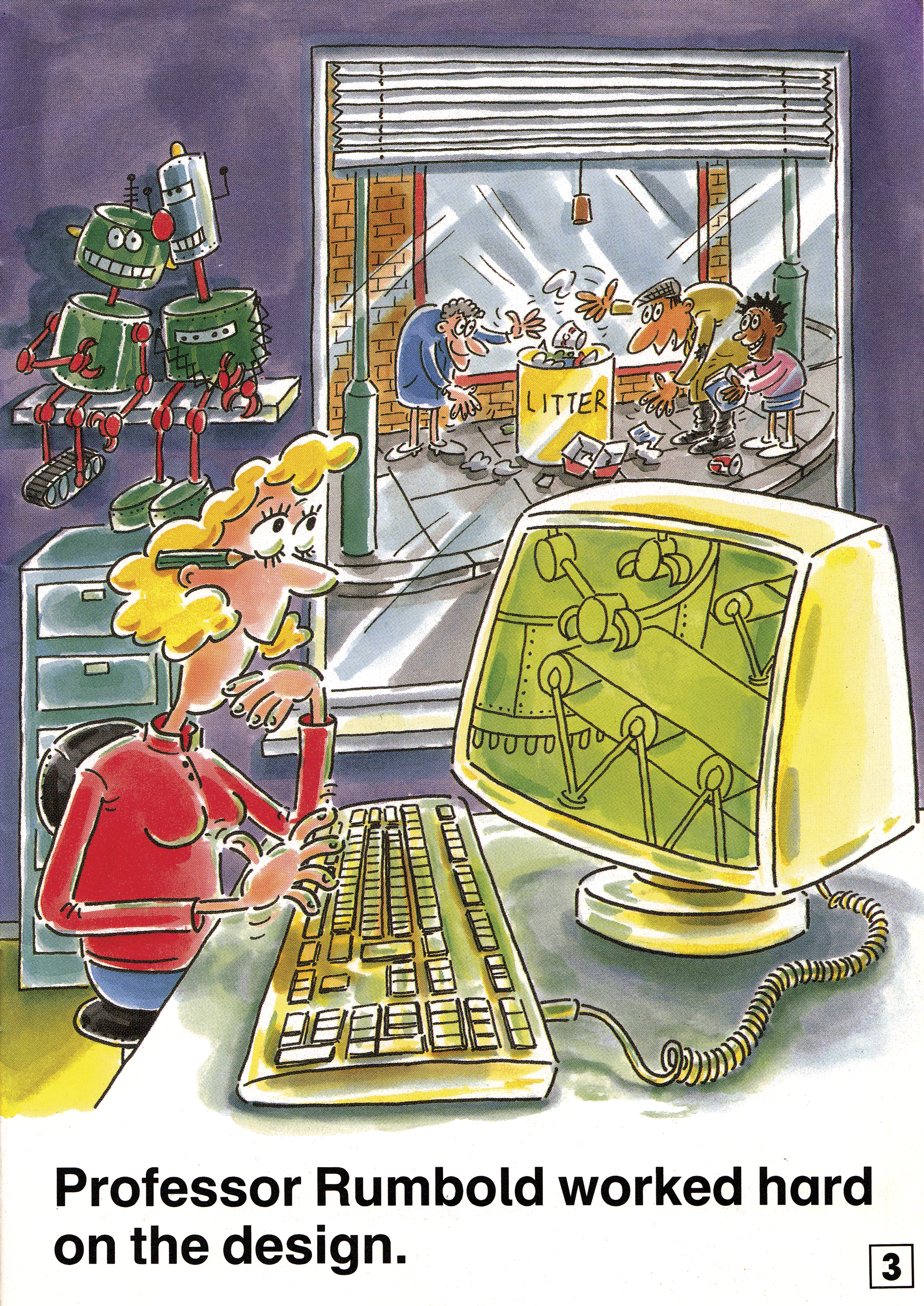
There are significantly fewer females than should be expected given the current statistics of real-life academia: even over the five-year period 2009–14 there are fifty-nine male academics to only seven females (12 per cent) in the corpus, which is half of the number that would be expected in the real-life academy in this recent period. We are reminded that males routinely outnumber females as protagonists in children’s literature,Footnote 378 that ‘female characters … in award-winning pictures books [are] almost non-existent and, when present, [are] stereotypically passive and domestic’.Footnote 379 ‘Male characters are twice as likely to take leading roles in children’s picture books and are given far more speaking parts than females.’Footnote 380 A quarter of children’s books have no female characters at all, and this ‘symbolic annihilation’ has ‘implications for children’s understandings of gender’.Footnote 381 Will this proportion of professors in children’s books change as time goes on, with the growing public perception of women being part of the academy? Or does this erasure contribute to children’s perception of appropriate gender roles, and so reinforce inequalities?
The female academics are illustrated in books published in the United Kingdom (18), the United States (9) and Canada (2): showing how lacking the representation of intelligent, authoritative females are in the rest of the English speaking world’s children’s literature (7 % of the total corpus comes from three countries: Australia, 5 %, India, 2 % and New Zealand, 1 %; there is not a female academic to be found among these, nor in the single books published in Ireland, Germany, South Africa and Singapore). Women are so lacking as protagonists that the surprise denouement of a ‘choose your own adventure’ book hinges upon the fact that a missing professor is actually female, and you didn’t expect that, did you? (Whatever Happened To Professor Potts?: Follow the Clues to Unravel the Mystery.Footnote 382 Apologies for the spoiler.) In addition, the illustrations featured in the American editions of the Harry Potter novelsFootnote 383 concentrate on the male academics: Dumbledore, Snape and Quirrell;Footnote 384 Lockhart;Footnote 385 Mad-Eyed Moody and Hagrid;Footnote 386 Firenze and Lupin;Footnote 387 Slughorn.Footnote 388 The only two female professors illustrated are TrelawneyFootnote 389 and Umbridge:Footnote 390 Professor Minerva McGonagall, although a central maternal figure within all the Harry Potter books, is omitted from any illustration in any English language edition published prior to 2015.
There are plenty of women in the 289 books, but they tend to be wives and housekeepers who very visibly provide stability and practical support for the helplessly dependent academics, such as the wife in the ‘Structural Reader’, Professor Boffin’s Umbrella (Figure 13).Footnote 391
How can professors keep dry without a wife to help them? In Alexander, Professor Boffin’s Umbrella (p. 3).
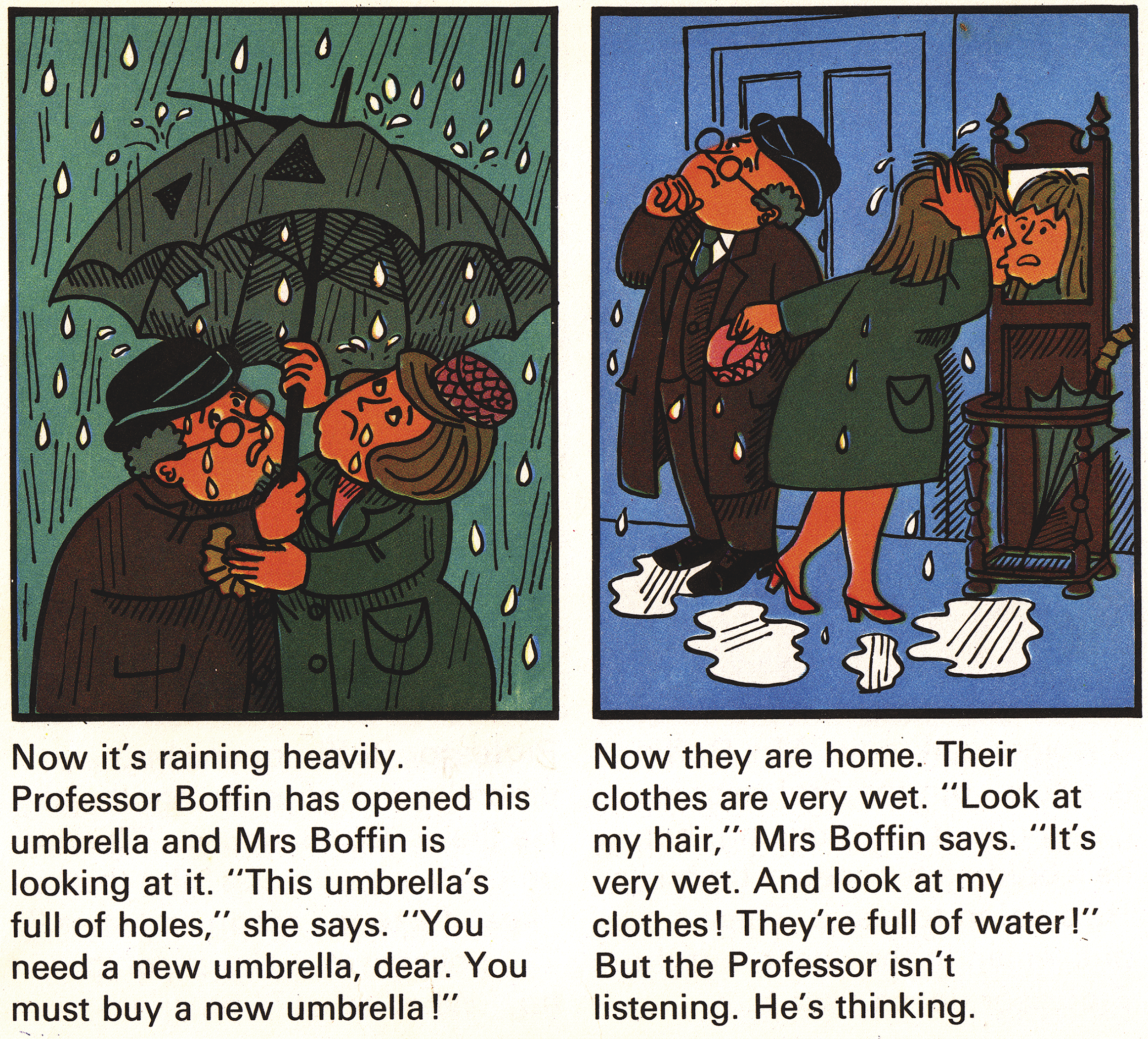
Or:
Miss Lavender sighed heavily. After thirty years, she was used to the Professor’s absent-minded ways, but she did believe in sitting down to tea when it was served …Footnote 392
‘Just a minute,’ said Miss Lavender. ‘I’ve left the oven on.’
The Professor muttered something old-fashioned about women and science, but he waited patiently till she returned (Figure 14).Footnote 393
Or:
[T]here they were, in a big cloud of smoke and dust, back in the Professor’s garden. Mrs Smith was on her back doorstep, hands on hips, very angry indeed. Her washing was covered in soot and coal dust. But there was no time for the Professor … to apologise (Figure 15).Footnote 394
And (indicating that this trope is not outdated, but enduring):
Mrs Molecule had given [Professor Molecule] his own key once, but she had had to replace it more than six times before kindly suggesting that maybe he should just knock when he came home and therefore not to worry about such trivial things as door keys.Footnote 395
Professor Digory Kirke has a housekeeper called Mrs Macready and three female servants.Footnote 396 Professor Euclid Bullfinch has a housekeeper, Mrs Dunn, whose son Danny accompanies the Professor on adventures.Footnote 397 Professor Diggins relies heavily on his wife for dressing and feeding.Footnote 398 Dr Xargle relies on Matron to undertake practical elements of student activities.Footnote 399 Professor Dupont has a cook called Hortense.Footnote 400 Professor Mortimer has a housekeeper called Mrs Benson.Footnote 401 Over and over, women are shown in subservient positions, in little change from what Nilsen noted as long ago as 1971 that the majority of women in children’s books are ‘token females … [who] stand in doorways … look through windows … unobtrusive’.Footnote 402 There are parallels here with campus novels written for adults about the university system: in an analysis of which Showalter noted, ‘I was always hoping to find stories of women professors … I’ve been sharply aware of the women who appear in the background, as students, as eccentric dons and dames, and especially as faculty wives’.Footnote 403
Professor Magnus MacWhizzer is fawned upon by his long-suffering housekeeper in Englander, The Amazing Professor and his Travels in Time (p. 26). The children pictured are his great-great-niece and nephew, relieved they have returned safely after time-travel did not go to plan.
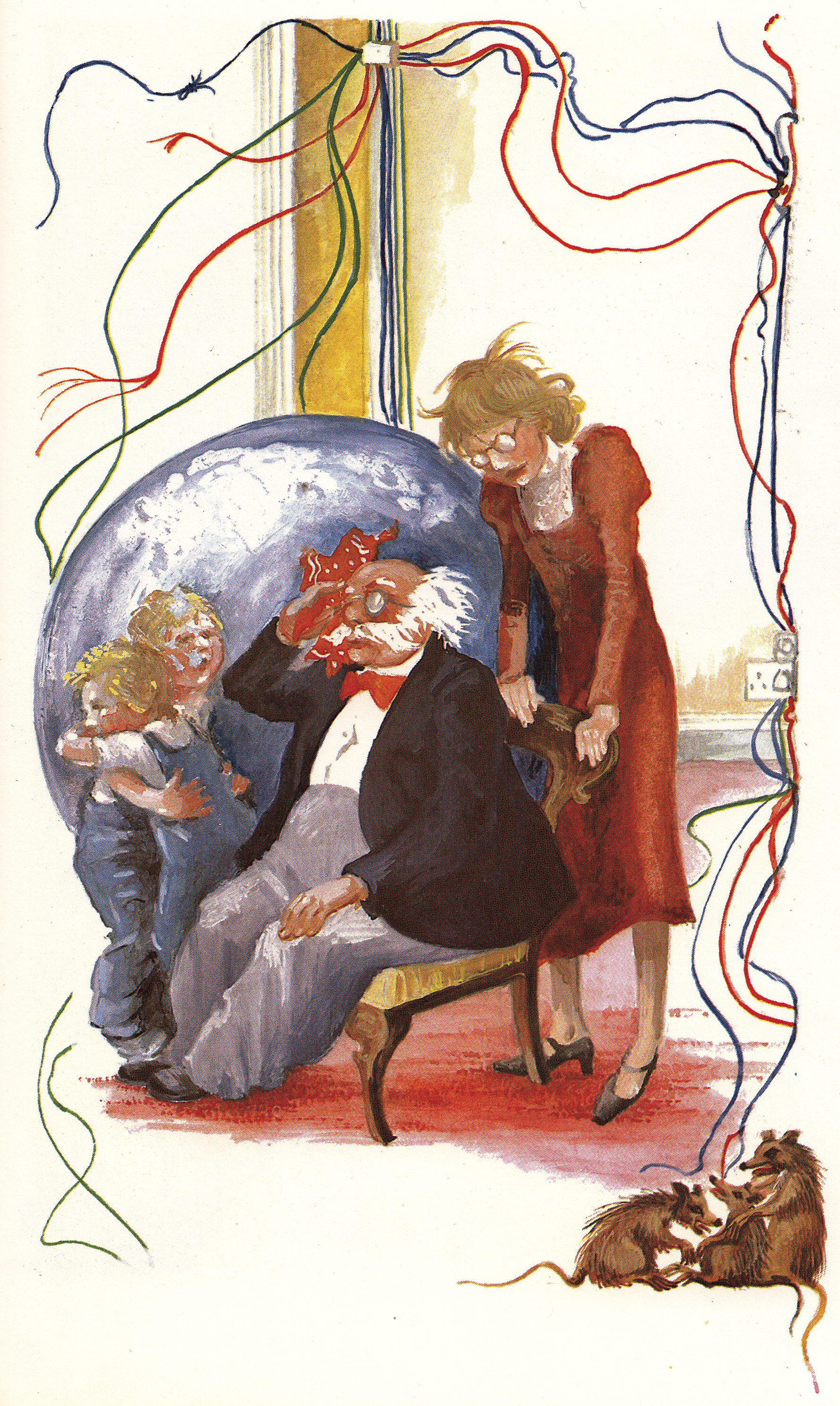
Professor P. Brain’s disdain for household chores. In McLeay, Professor P. Brain’s Astronomical Trip (p. 32). Illustrated by “Mark Fenton and his computer”, in the first obviously digital illustration.

The women academics do not have partners or assistants, with the exception of Professor Puffendorf, who has a male lab assistant – Enzo – but the story revolves around his jealousy, and what happens when he chooses to disobey Puffendorf’s instructions when she is away.Footnote 404 The men may have wives and housekeepers to assist them but there is an absence of their own offspring. Only one woman and seven men are noted as being parents: the unnamed female anthropologist in Professor Coconut and the Thief mentioned by her son, the childhood narrator (no father is in the text);Footnote 405 the mostly absent scientific father in The Professor’s Children,Footnote 406 Professor Hayling, loving father of Tinker and a friend of Uncle QuentinFootnote 407 in Five Are Together Again,Footnote 408 the mysterious Professor Gamma, who involves his daughter Kiryl in a series of science fiction adventures,Footnote 409 Professor Mackenzie, absent explorer father who leaves his daughter Maisie with her grandmother,Footnote 410 Lord Asriel, who has placed his daughter into the care of others,Footnote 411 and Professor Oliver Query, who is reunited with his daughter after she had been living with her mother, in My Father the Mad Professor, although ‘I have no ambition to be a normal father’.Footnote 412 The father in ‘The Mad Professor’s Daughter’ is never seen, but his fearful presence, while out of sight, is terrifying.Footnote 413 The gender of the parent is usually juxtaposed with the opposite gender of child, with the majority being (absent) male professors with daughters. There are three uncles: Dr Ivor Dare, Dan Dare’s uncle;Footnote 414 Professor Dinglebat, ‘we’re so lucky to have an uncle who’s a famous professor’;Footnote 415 and The Evil Professor in Tetrax the Swamp Crocodile in the Sea Quest series;Footnote 416 and one Great-Great-Grand-Uncle, Professor Magnus MacWhizzer in The Amazing Professor and His Travels in Time.Footnote 417 However, there are no academic aunts. Although many academics are depicted in the place where family stories are usually set – the home – the academics are normally not in a family environment (nor a typical home environment, given their houses are so strange), which sets up a different mechanism for plot and theme given that ‘probably the majority of children’s fiction has been set within the family’.Footnote 418 Interactions with unrelated children spur on plot lines and challenge scientific stereotypes, which will be explored in Section 4.12.
It is worth noting that, although only 9 per cent of the academics in the corpus are female, ninety-two (32 per cent) of the 289 books have an identifiably female author, and thirty-three have a female illustrator, showing the dominance of male creative influence in the corpus.Footnote 419 Of the 29 female academics, sixteen are authored, and nine illustrated, by women. Both male and female authors have preferred to write about dominant male academics and subservient females who facilitate and enable their intellectual brilliance, although female authors are more likely to include female academic characters.
It can be difficult to introduce ambiguity, or to get away from male dominance, in children’s picture books: the author and illustrator of Traction Man is Here (2005), Mini Grey, said: ‘There’s an issue I often face with picture book characters – that when I want to make them gender-neutral, I make them vaguely male rather than female – but really I want them not to have a gender’.Footnote 420 Subtle characteristics can be both introduced by the author and/or perceived by the reader, to reinforce the ‘implicit biases’ we all have regarding gender.Footnote 421 Only one character in the corpus has an deliberately playful, ambiguous gender identity: an unspecified narratorial voice which may or may not be the female child of colour on the cover of, or one of the boys inside, Professor Cook’s Mind-Blowing Bakes.Footnote 422 Debbie Foy, the Managing Editor of Wayland, part of Hachette Children’s Books, confirmed:
‘Professor Cook’ was originally intended to be ‘faceless’ and was probably envisaged as the stereotypical white-haired, white, male, science prof, but when we did the photo shoot and started to put the covers together we really liked the idea of subverting the stereotype with a black girl who could be identified (on the cover at least) as ‘Professor Cook’. We then counterbalanced it on the inside with boys in the professor/cooking role, as we seek to sell to a broad educational/library market and of course these kinds of issues are key.Footnote 423
This response from a present day publisher of children’s books suggests that they are both aware of the gender inequalities of children’s literature and hoping to overcome them, through creative ambiguity and playing with established stereotypes. Challenging the dominance of the male in children’s literature can only happen if done deliberately and imaginatively.
4.5 Race
Fictional academics are predominantly white. There are only seven who are visibly of black, Asian or minority ethnic descent, and only three of these are actually adults within a university: a Chinese Professor, in Rollo’s Journey to Cambridge,Footnote 424 a Professor of Linguistics in Points of View with Professor Peekaboo,Footnote 425 and Professor Wiseman, the science museum director, in the later instantiations of the Curious George book series.Footnote 426 The remainder invoke the term ‘professor’ to suggest intelligence: a charlatan professor in a Chinese folk tale,Footnote 427 one child so intelligent he is called ‘The Prof’ in Henry’s Baby,Footnote 428 and two of the children in The Preschool Professors Learn How Seeds Grow.Footnote 431 This inclusion of visibly, culturally different races in these few examples is a recent response to the long-noted white hegemony of children’s literature.Footnote 432 In fact, Professor Wiseman in the Curious George series changes both gender and race over the course of the franchise, turning from a stereotypical white academic male to a friendly, female ‘American, likely with Indian ancestry’,Footnote 433 in the latest range of books that accompany the PBS television cartoon series running since 2006: this indicates how issues of diversity can be influenced by external pressures (Figure 16).Footnote 434
The change of Professor Wiseman, Science Museum Director, and erstwhile Rocket Scientist, in the Curious George series. Left: 1957 original version (seated at desk). Illustration from CURIOUS GEORGE GETS A MEDAL by H. A. Rey © 1957 and renewed 1985 by Margaret E. Rey. Reprinted with permission of Houghton Mifflin Harcourt Publishing Company.Footnote 429 All rights reserved. In Rey and Rey, The Complete Adventures of Curious George (p. 189).
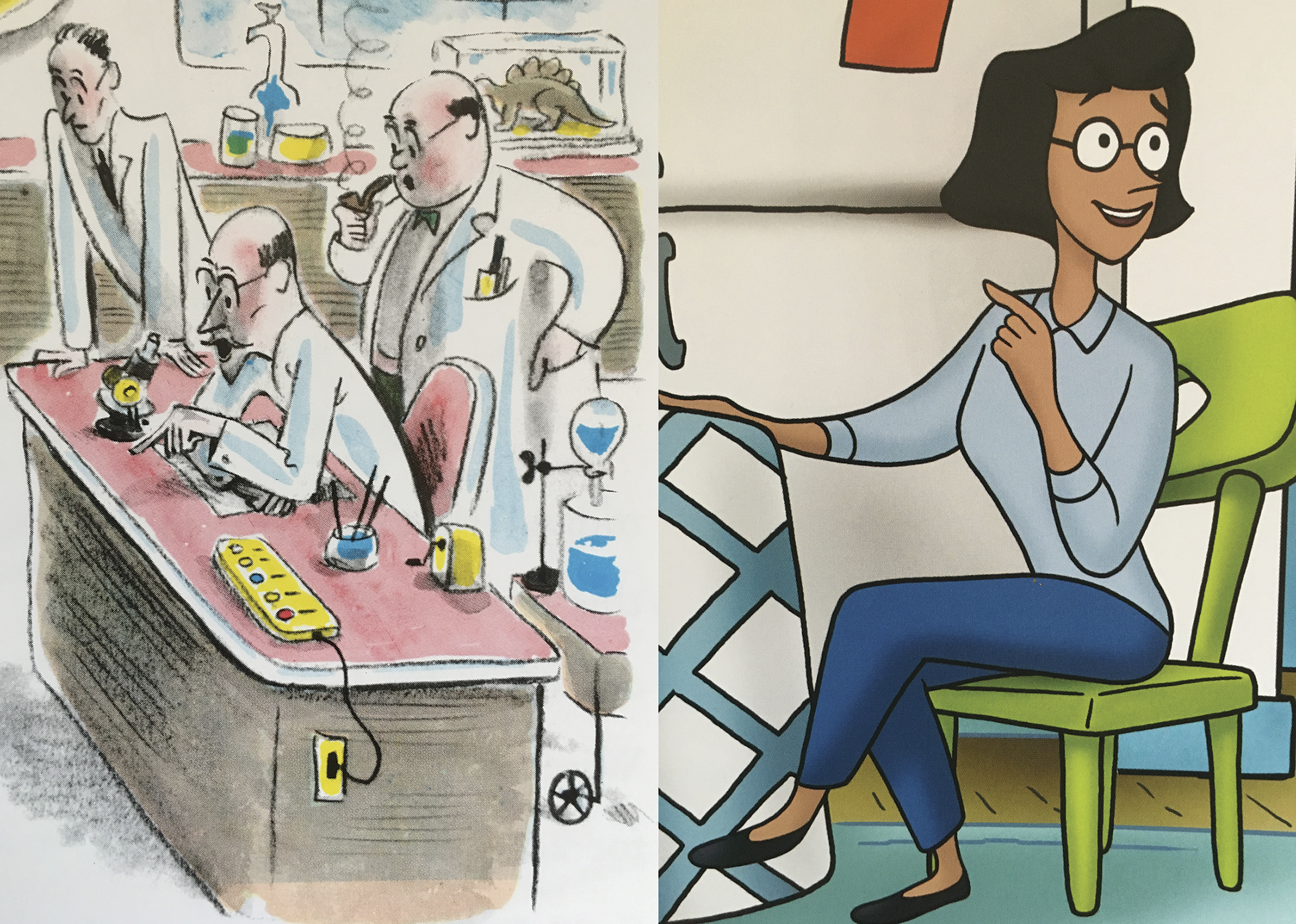
There are also not-so-subtle racist undertones to be found. The Chinese Professor in Rollo’s Journey to Cambridge is described as a ‘yellow-skinned gentleman with eyes cut bias’Footnote 435 and is not allowed to be more than an oriental caricature. Professor Jim Crow, a forgetful but kindly blackbird, who knows little about how the world operates without double-checking it first in his book of wisdom that doesn’t seem to explain anything, appears in the Little Jack Rabbit series,Footnote 436 particularly in Little Jack Rabbit and Professor Crow (Figure 17).Footnote 437 These stories for children were first syndicated through newspapers on the East Coast of the United StatesFootnote 438 that owe much to Br’er Rabbit, published at the height of the Jim Crow laws that enforced racial segregation in America.Footnote 439 A blackbird called Jim Crow at this particular point in place and time,Footnote 440 depicted in this way, reinforces the ‘romanticized version’ of the stereotype of black people as ‘simple and quaint, yet still irresponsible, stupid, and lazy’.Footnote 441 Another racist slur occurs in Bugville Life for Big and Little Folk with a disturbing pastoral ditty for preschoolers called ‘Coon Songs in Bugville’:
Professor Jim Crow in Cory, Little Jack Rabbit and Professor Crow (Frontispiece).
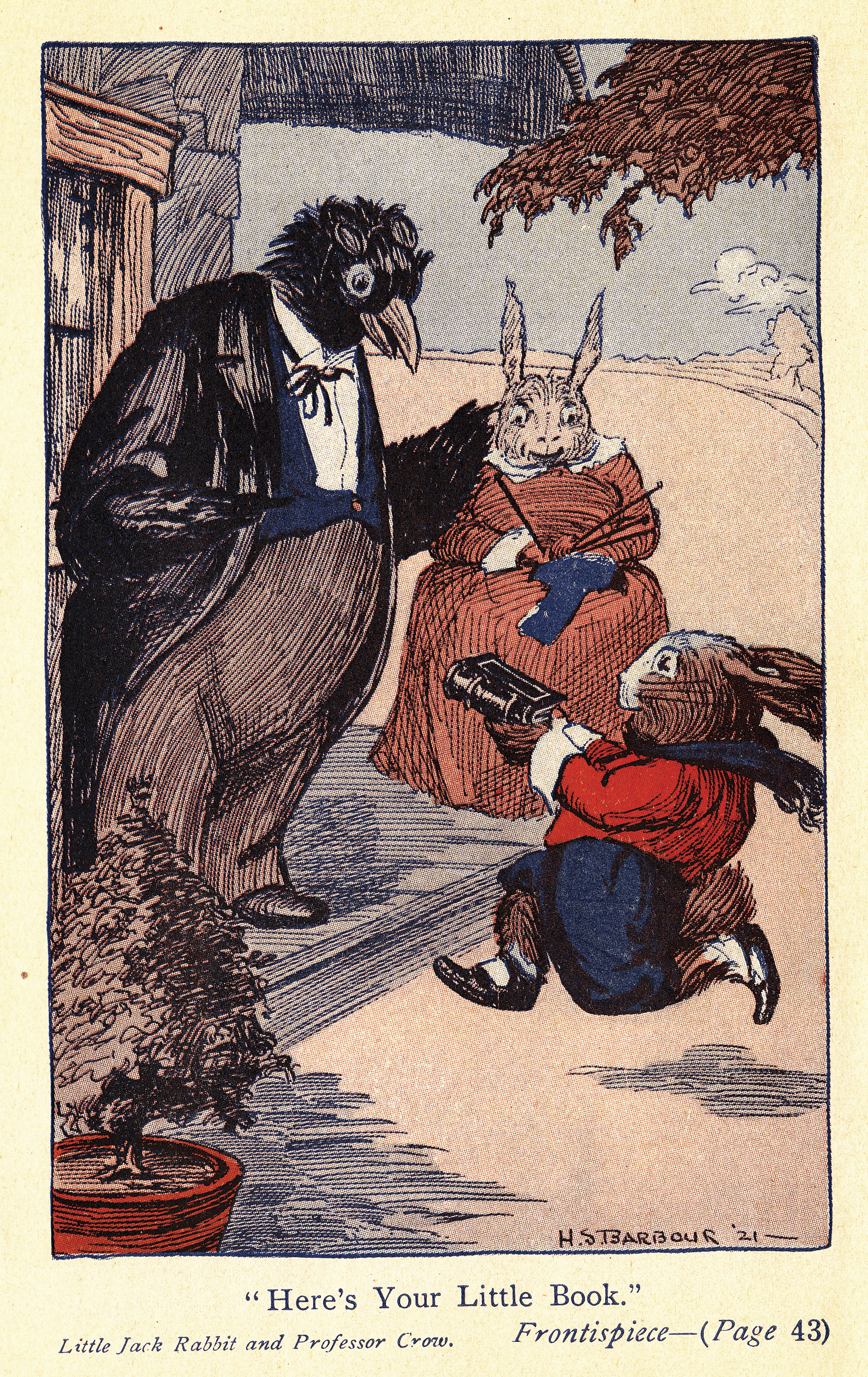
The dissonance between the ethnophaulism and the bucolic description is jarring, in a magazine with a readership of 65,000 children a month.Footnote 443 The earlier quote from Jack Dawe suggests the Western world viewpoint of “foreign” civilisations as “other” (see p. 72). These instances remind us that racial and political commentary can reverberate into stories written for children, teaching and reinforcing cultural and racial oppression: ‘the colonising force of fiction to inculcate hegemonic ideologies or to reinforce gender roles is powerful through the history of children’s literature.’Footnote 444
The lack of ethnic diversity in these books mirrors the lack of diversity within academia itself.Footnote 445 In the United States in 2000, 72 % of faculty were white men, 17 % were white women, 8 % were men of colour and only 2 % were women of colour.Footnote 446 In the United Kingdom in 2015, 92.4 per cent of professors were white, with 0.49 % being black.Footnote 447 The trends observed here also follows those in children’s publishing regarding ethnic diversity: only 4% of children’s books published in the UK in 2017 featured BAME characters, despite 32% of pupils of compulsory school age in England being of minority ethnic origin,Footnote 448 and there being evidence to suggest that Black and Asian children – particularly girls – are those that both enjoy and are most regularly reading.Footnote 449 A rudimentary application of critical race theoryFootnote 450 can aid us in understanding how problematic the lack of diversity is in both children’s literature and the academy itself: which actors and processes can appropriate intellectual agency and authority, excluding others as they do so? Who is barred from both the real and the fictional professoriate, in structural and complicit decisions based on race? What affect does this cumulative lack of diversity and structural racism (a common criticism of children’s literature) have on its readership?
4.6 Visual Stereotypes and the Judging of Appearance: Age, Hair and Dress
It is important that we unpack the visual stereotypes within the corpus, given that common media depictions of professors are
of academics as mustachioed white men wearing tweed coats with elbow patches and doing their work in an office surrounded by books. Such assumptions are not only gendered masculine but have class, race, and heteronormative implications as well.Footnote 451
The academics are predominantly middle aged or older, classed by an interpretation of their appearance in illustrations. Six were smart children, most with academic nicknames such as ‘The Preschool Professors’,Footnote 452 twenty-one were young adults (aged 18–45), 128 were middle-aged (45–65) and 133 were elderly (65+). Forty had indeterminate age (animals, spades, etc. – see Section 4.8). However, it is worth noting that there were no elderly women: there are two children, eight young adults, seventeen middle-aged and two indeterminately aged females. There are no ‘granny’-type females with white hair or any other signifiers of age and experience. While this echoes
the generational effect in the higher education and the government sectors, whereby women researchers, compared to men, are more concentrated in the youngest age groups, but the opposite is observed in the oldest age groups,Footnote 453
it would also seem to indicate an impossibility that elderly woman – who are routinely feared, patronised, dismissed and held in contempt in children’s literatureFootnote 454 – can even be allowed within the fictional academy.Footnote 455 The elderly make up the largest section of fictional academics (41 per cent), but the old here are only men.
The attire of the academics was surprisingly formal, given academia’s real-life reputation for scruffiness.Footnote 456 Eighty-nine are in a suit, a further twenty-seven wear a suit with bowtie, with an additional five in shirt and tie. Forty-eight are wearing a lab coat, five of these with bowtie. Twenty-two are in formal academic regalia (one wearing a gown accompanied fetchingly with bovver boots).Footnote 457 Sixteen are in a safari suit and eleven wear magician’s robes. Five are in black tie with an additional five also sporting a top-hat. Four are in spacesuits, four in military uniform, two in medieval robes and two in formal court uniform. Five females are wearing dresses and two are in twin sets: a quarter of the women wear lab coats and a further quarter wear suits, but no women sport ties, bowties or top-hats (Professor Peabody in the EagleFootnote 458 wears a range of clothing from ballgowns to spacesuits). Only three academics are dressed casually in sweatshirts, and six wear jeans. There are also two academics in raincoats, and one each in a bomber jacket, chef’s whites, climbing gear, cloak, clown suit, medical scrubs, pyjamas, traditional Chinese clothing, and fairy, jester, wrestler’s trunks and superhero costume. There are, of course, various animals, aliens and vegetables that do not have any garments (see Section 4.8). The majority of those wearing clothing think they are dressed for authority and business, although there is a lot of tweed going on, and the suits are often crumpled and threadbare, living up to the unkempt stereotype where formal attire has seen better days. For example, in the choose-your-own-adventure book Professor Q’s Mysterious Machine:
You look up – all the way up. Past his scuffed brown shoes, up his rumpled, stained, baggy plaid pants, about five feet of them, up his dusty pink shirt that’s buttoned wrong, up his long, skinny neck, up his long, skinny face, up to his thick black hair sticking out in all directions.Footnote 459
Hairstyles are where the formalities end: intellect is demonstrated with dishevelled and uncouth styling. Although fify-four have neat, short hair, with a further eight with fashionable short men’s haircuts, forty-nine are decidedly scruffy, with a further twenty-one sporting long white spiky hair, mimicking Einstein, who had by the mid-twentieth century come to represent the archetype of American Genius.Footnote 460 His, hair, in particular, presented a ‘symbol of populist intelligence’:Footnote 461 we see it visually referenced again and again in Professor Gamma,Footnote 462 Professor I. Q.,Footnote 463 Professor Poopypants,Footnote 464 Professor Bumblebrain,Footnote 465 Professor DinglebatFootnote 466 and Professor Von Evil.Footnote 467 One alien, Professor Dribble, disguises himself as Albert Einstein, including the hairstyle and moustache, to go incognito on planet Earth (Figure 18).Footnote 468
The alien Professor Dribble, incognito. In Kettle, Professor Dribble (p. 44).
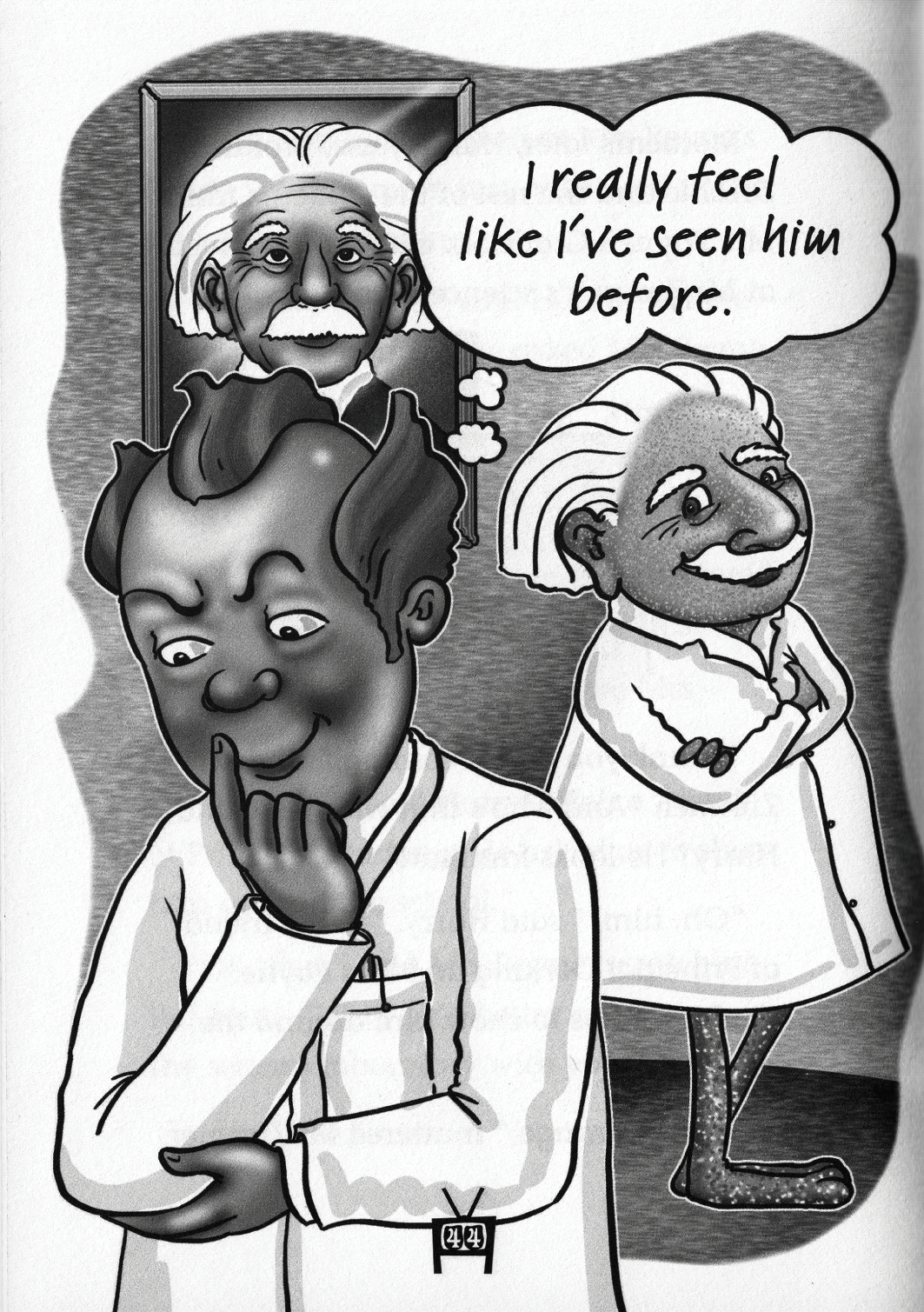
Eighty-four men are bald, symptomatic of the age-range of candidates, but many of those sport long unkempt hair tufts. There are a few outliers – dreadlocks, Princess Leia buns, snakes, very long straight hair, neat bobs for women – but for the most part, big, messy hair is the order of the day, for academic men and women alike (see The Lecturer in Mahalia Mouse Goes to CollegeFootnote 469 and Professor BlabbermouthFootnote 470). This is particularly the case for those found in the latter (recent) half of the corpus, providing a counterpoint to lab coats and suits: the informal clashes with the formal. Given that almost half the corpus is illustrated with black and white images, it is difficult to ascertain anything meaningful about hair colour, although ninety-two men (no women) have white hair, and twenty-one men (no women) have grey hair (meaning 44 per cent of the humans in the corpus are greying or white-haired men). Of those in colour, ginger is the most common shade (Professor Sniff and the Lost Spring Breezes,Footnote 471 The Lecturer in Mahalia Mouse Goes to CollegeFootnote 472) but there are also renegades sporting coiffures that are purple (Professor Med Yusa in Professor Gylden Lox’s Hair SchoolFootnote 473), green (Professor Rock LtdFootnote 474) and blue (Professor Blue: Top Secret Lab JournalFootnote 475), reflecting the different and outsider nature of these characters.
One hundred and seventeen (45 per cent of the humans) have facial hair, with moustaches being most common (sixty-two), then beards (forty-eight), side-burns (five) and a goatee (two). Beards also have a tendency to be messy (see The Professor in Mistress Masham’s Repose,Footnote 476 the waist-long beard of The Professor in Comet in Moominland,Footnote 477 the leaf-incrusted beard of Professor PottsFootnote 478 or Professor Perkin in Winnie’s Dinosaur DayFootnote 479), culturally echoing the unkempt beards of Victorian gentlemen of intellectual renown, such as Charles Darwin, Edward Lear and Alfred, Lord Tennyson. None of the academic women have facial hair.
There are no visible physical disabilities, and no behaviour that can be classed other than heteronormative. This lack of inclusion is simultaneously problematic while reminding us of the lack of diversity routinely shown in children’s literature,Footnote 480 and unintentionally, or subconsciously, mirroring the lack of diversity within the academy.Footnote 481 Statistics for the proportion of academic staff that have physical disabilities, or are LGBTQ, are difficult to ascertain, as disclosure rates are assumed to be poor given existing prejudices within society: 4.6 per cent of UK academic staff disclosed their disability in 2016, whereas 70 per cet of staff did not disclose their sexual orientation.Footnote 482 There is no attempt to represent academics in any way rather than being heterosexual and able-bodied: yet again, children’s literature misses the opportunity to address and tackle prejudices through positive representation of difference here, while both reflecting (and possibly critiquing?) the academy we have. The representation of mental health issues is discussed in Section 5.
4.7 Class
It is worth looking at ‘what kinds of economic lives are presented as normal and therefore desirable’ in these books.Footnote 483 Although there is only one Lord,Footnote 484 the message is projected over and again that academia is associated with wealth (particularly in the books produced in the United Kingdom). Academic homes are very different from those of the average reader: for example, the mansions of Professor Digory Kirke,Footnote 485 Professor Diggins,Footnote 486 Doktor Bunsen Van Der Dunkel’s ancient, lonely castle,Footnote 487 Dr Monsoon Taggert, who planned to build a palace but it came out as a very large mansion,Footnote 488 Professor QuicklyFootnote 489 and Doctor Harleyson.Footnote 490 Professor Sniff lives on a huge wind farm, and a point is made of the ‘parents’ small flat’ of the children who befriend him.Footnote 491 We’ve already covered all the servants, housekeepers and cooks. In addition, the top hats and tails sported by some academics project class privilege, but so do displays of disposable income. Professors have hobbies that require vast resources, such as designing their own hot-air balloons.Footnote 492 The Professor in Babar and the Professor has enough wealth to design and build a river boat massive enough to transport many elephant friends, on a whim.Footnote 493 The unnamed palaeontologist in The Dog That Dug can quickly rustle up a fortune to purchase the bones of an unearthed dinosaur fossil:
There is also discussion of expensive possessions. Packing a picnic for her Professor husband,
Mrs Diggins … had fitted a small cupboard with cups and dishes, silverware and linens. ‘You may wish to rough it’ she said, ‘but sometimes you may tire of that and wish to use some nice china and silver’. So she put in a set of her good Meissen, packing it carefully, and some handsome silverware and a good damask cloth.Footnote 495
To finance a trip to the moon, Professor Blabbermouth ‘sold everything – all Blabbermouth’s valuable oil paintings, her stocks and shares, even her shoes and socks’.Footnote 496 These fortunes are not immutable: Professor Digory Kirke’s ‘very large house’Footnote 497 is lost by The Voyage of the Dawn Treader as ‘he had somehow become poor since the old days and was living in a small cottage with only one bedroom to spare’Footnote 498 – the shame of it! – and The Professor in Mistress Masham’s Repose was ‘as poor as a church mouse’Footnote 499 and frequently starving. However, clues abound that the professoriat is upper middle class, if not upper class, with wealth, comfort and disposable income, giving clear messages out to the readership of their social and economic standing, presenting a further barrier between them and the majority of child readers. This, of course, is reflected in the real-life academy, which follows a ‘steeply hierarchical structure that reflects profound social inequality’,Footnote 500 with entrenched ‘practices of class elitism and discrimination’Footnote 501 contributing to ‘negative perceptions of the university’,Footnote 502 which has resulting impacts that further compound class inequalities, for example, in low uptake in higher education attendance from working-class students, particularly white boys,Footnote 503 while apparently ‘only the rich can afford to work at Oxford and Cambridge’.Footnote 504 We have, at some point, to consider how stereotypes of academia are linked to current realities, and the effect this will have on an audience, and shall do so in Section 6.
4.8 Not All Fictional Academics are Created Human
Although 260 (79 per cent) of the fictional academics are human, there are other forms of Professor or Doctor. Forty-five (14 per cent) are animals: with six dogs, five mice, three cats, two toads, two frogs and an ant, bandicoot, bear, beaver, beetle, chimp, chipmunk, cockatoo, cockroach, crow, dumbo octopus, gorilla, kingfisher, lion, mole, monkey, otter, owl, pig, porcupine, possum, rabbit, rat, rhino, rooster, shark and stegosaurus. This does not seem to correlate with any dominance of stereotypical representation of intellectual anthropomorphism (such as Athena’s owl, or wily foxes); however, it sits within a long history of animal and object stories that help us query ‘our own species’ … claim to distinction’.Footnote 505 This also ventures into the Lacanian Symbolic, conferring animated life in ‘an anti-Cartesian world where animism rules, where all things are democratically, anarchically, even, given a voice’:Footnote 506 the corpus has five aliens, and one each of centaur, comic book bubble, fairy, gorgon, half-human half-dwarf, half-human half-giant, mineral, sock, spade and vegetable.Footnote 507 These representations challenge the intellectual authority and importance of academics, and intellectuals can be reduced to caricature: if a rock can be a professor, what value does the title give?Footnote 508 The symbolic representations are also heavily gendered with easily identifiable traits that reflect and reinforce societal conventions. Only two are female: Mahalia MouseFootnote 509 and Professor Steg the Stegosaurus in Fortunately, the Milk …Footnote 510 Even four of the five academics who are godlike omniscient narrators, not pictured themselves, have male gender-specific traits and pronouns. The teacher’s guide to Fortunately, the Milk…, provided by Bloomsbury, asks, ‘Were you surprised to learn that Professor Steg is female? If so, why?’Footnote 511
4.9 Academic Title
The majority of academics in the corpus are professors (259, 80 per cent) with forty-two doctors. There are eight university students, two researchers, two lecturers, two heads of college and various administrators, a chancellor, a vice-warden, a keeper of a museum, a research assistant and personal assistant combined, a post-doc and, in what is probably the most specific university-related book title of a children’s text ever, an Assistant Professor Toad who is a ‘not-so-smart snozzie scientist from the Snoz Invention Centre, and he was EXTREMELY jealous of Professor Dribble’.Footnote 512 It is debateable whether these roles would be understood by their audience, especially given that they usually appear without explanation or backstory. The fact that most academics are represented with the most senior of titles – where are all the students? – creates distance between them and the childhood audience of the books, setting an unknown and unnamed process of how one would acquire this honorific between character and reader.Footnote 513 The fictional characters form representations of intellectual achievement that are not a known continuum of a child’s own schooling, but another, strange authority: separate and unexplained, as Lithgow commented, they are ‘very, very, far away’.Footnote 514
4.10 Academic Subject Area
Science, Technology, Engineering and Mathematics (STEM) dominate the subject area of fictional academics (Chart 4).
Subject area of fictional academics, determined by mention of subject within text.
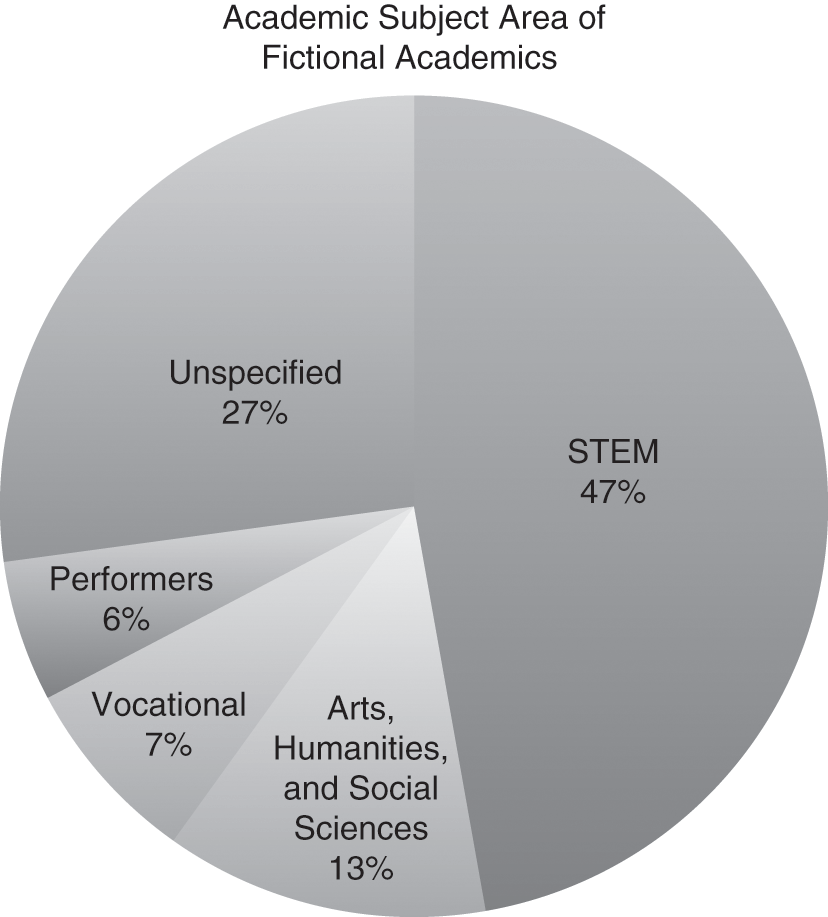
Although eighty-nine (27 per cent of) fictional academics have no subject area specifically linked to them (this includes the six children), 154 (47 per cent) are specifically linked to STEM areas, with fifty-four scientists, twenty-three inventors, thirteen zoologists, ten biologists, seven mathematicians, six medical researchers, four chemists, five palaeontologists, three astronomers and two each of engineers, physicists and rocket scientists. There is one aeronaut, astrophysicist, botanist, computing scientist, ecologist, explorer, geographer, geologist, marine biologist, oceanographer, criminal scientist, space scientist, veterinary scientist, metereologist, natural historian, psychologist and food scientist. Getting into the questionable areas of ‘science’, there is also a homeopath and a Necrobioneopalaeonthydrochthonanthropopithekologist (showing the ineffectual and questionable science of Professor Ptthmllnsprts in The Water BabiesFootnote 515). Five are in non-existent mythical beast ‘subjects’, with three in Dragonology or Serpentology (studying Dragons), one researching Unicorns and one undertaking the very scary-sounding ‘demonological research’ (Professor Van Helsing in How to Slay a WerewolfFootnote 516). This indicates a small attempt to take science and academic authority into the mythological, imaginative realm.
There are only eighty-four (26 per cent) who are non-STEM, and although they represent a wide range of experience and expertise, this bias towards the sciences projects a very limited picture of the subject range that is available, and important to children, at university level. This, of course, is a battle fought by the Arts, Humanities and Social Sciences for government funds, for a fair representation of the way universities are presented in the media and even for fair support within institutions,Footnote 517 but it is worrying that it is also played out in children’s books, suggesting entrenched cultural biases regarding the academic value of non-STEM areas.Footnote 518 The interests of non-STEM experts can be divided into three areas: the Humanities and Social Sciences (13 %), Performing Arts (6 %) and vocational subjects (7 %). Within the Humanities and Social Sciences, the most common subject areas as archaeology (nine), history (five), museology (five), music (five), linguistics (four), education studies (four), economics (two), with one in anthropology, art, Chinese, literature, manuscript studies, psychology, theatre, theology and religion. The vocational cluster has fourteen teachers, two hairdressers, two cooks and one each of an administrator, explorer, headteacher, secret agent, comic book artist and vocal instructor. The performing arts cluster has twelve magicians and entertainers, one clown and a downright fraudster. Interestingly, this shows a non-university influence within children’s illustrated literature: the Music Hall, presenting the professor as entertainer rather than scientist, which will be explored below in Section 4.11.
Women are not necessarily associated with the ‘softer’ academic subjects. Granted, there is a hairdresser, and four that undertake more traditional Arts and Humanities subject areas (a doctor of literature, a student of history, an anthropologist and an archaeologist) and a teacher, which have been subjects traditionally more statistically likely to be chosen by females than males;Footnote 519 however, there are also four female scientists, two palaeontologists, two museum scientists and a botanist, chemist, ecologist, engineer, economist, mathematician, physicist, one who studies dragons and another who studies unicorns. The few women who do appear are often wonderful role models, for example, the fictional author of My First Pet Dragon: The Complete Handbook for Beginners:
Professor Georgie Blink (BSc, MSc, PhD, Dip. Drag, OBE), studied at London University, Harvard, and the Centre for Advanced Dragon Studies in Vladivostock. She is a world expert in dragons, and a founding member of the International College of Serpentology. She now lives near Bristol, England, with an 85 year old Stumptailed Bolonka dragon called Picton. The professor has kept dragons since childhood and is a regular contributor to many dragon owner helplines and newsletters. The Professor and Picton are available for occasional visits to well-fireproofed schools.Footnote 520
The fact that 27 per cent of the academics do not have any subject area at all is interesting: indicating that that characterisation is about expertise and authority, without necessarily displaying that in any way beyond the character’s own interactions with those around them. This is particularly the case with non-human academics, for example, the spade in Traction Man is Here:Footnote 521 ‘wicked professor spade is really just a spade with a name – (what on earth is it going to be a professor of?)’.Footnote 522 The honorific titles add meaning by linking to stereotypical prior associations of how doctors and professors behave, without necessarily positioning them in an area of expertise.
4.11 Puppeteers, Magicians and Performers
Throughout the corpus, there is prevailing influence of the academic as entertainer. Before the growth of the university sector and the establishment of academia as a profession in the late nineteenth century, mock honorifics and grandiose titles were assumed to denote expertise in music halls and circuses. Punch and Judy men had been called Professors since the eighteenth century.Footnote 523 By 1864 it was noted that the word ‘professor’ was ‘so desecrated in its use that we are most familiar with it in connection with dancing schools, juggler’s booths, and veterinary surgeries’,Footnote 524 and during this period the term ‘professor’ was ‘commonly adopted by marionette players, band directors, animal trainers, magicians, ventriloquists, acrobats, etc’.Footnote 525 Wilson writes of Victorian animal trainers using honorifics, including the sea lion tamer Professor, or Captain, WoodwardFootnote 526 and the dog trainers Professor Chard and Professor Devereaux.Footnote 527 The conjuror George Arthur Fox took on his stage name Professor De Lyle ‘from a tin of Lyle’s Golden Syrup, adding De for a touch of class and gave himself the title of Professor, as all good Punch and Judy men are called’.Footnote 528 The usage of the term in this way fell out of favour in the second quarter of the twentieth century.Footnote 529 However, we see the echoes of these showmen, in both subject area and dress: white-tied, top-hatted and ready to dazzle. The earliest example is Professor Wolley Cobble:
My occasional neighbour, Mr Cobble – or, as he delights in being called, ‘PROFESSOR WOLLEY-COBBLE’ – always draws a good audience when he exhibits his Peep-Show in Piccadilly or in Regent Street. He is of the old school of Showmen: voluble in small talk, ever ready with answers to countrymen and others, and with a never-ending supply of Bartholomew Fair trumpet-jokes.Footnote 530
He is followed by Professor Knox,
A famous professor who works a cat and dog show … who had just arrived in town from circuit. He was a Professor. A what? In the public business, had a caravan and worked dogs and cats.Footnote 531
Professor Bolero ‘Cannon Ball Tosser and Lightning Change Artist to the Crowned Heads of Europe’, asks:
I’m a poor man, sir, with a large family, sir, an’ I’d be very thankful for any small jobs, sir, like givin’ you sparrin’ lessons, or massage, or takin’ care of the furnace, sir!Footnote 532
Tom Sawyer, Huck Finn and Jim join The Professor, a showman with a balloon in Tom Sawyer Abroad:
He has a good enough sort of a cretur, and hadn’t no harm in him, and was just a genius, as the papers said, which wasn’t his fault. We can’t all be sound: we’ve got to be the way we are made.Footnote 533
These figures are often sinister, and linked to magic, money-making and then on to fraud.Footnote 534 For example, Professor de Lara in The Twopenny Spell (Figure 19):
She looked for the name over the shop. Instead of being somebody or other, Florist, it was ‘Dolor de Lara, Professor of white and black Magic,’ and in the window was a large card, framed and glazed. It said:
ENCHANTMENTS DONE WHILE YOU WAIT. EVERY DESCRIPTION OF CHARM CAREFULLY AND COMPETENTLY WORKED. STRONG SPELLS FROM FIFTY GUINEAS TO TWO PENCE. WE SUIT ALL PURSES. GIVE US A TRIAL. BEST AND CHEAPEST HOUSE IN THE TRADE.Footnote 535
De Lara tricks Lucy into buying a spell that will make her strong, and her brother weak (‘“No goods exchanged,” he said crossly; “you’ve got what you asked for”’Footnote 536), although the children’s one-day switching of roles leads to better behaviour from both, long-term.
Professor de Lara in Nesbit, ‘The twopenny spell’, from Oswald Bastable and Others.

The circus and music hall echo throughout the corpus, in The Highly Trained Dogs of Professor Petit,Footnote 537 Dr Merlin’s Magic Shop,Footnote 538 Professor Ali Pokanini, ‘musician, magician, ventriloquist, and imitator’ in The Four Adventurers meet The Evil ProfessorFootnote 539 and the magician Dr Sanders in Rupert and the Rope Trick.Footnote 540 Professor Fergus Fahrenheit blends the conman and scientist together with His Wonderful Weather Machine,Footnote 541 in a fictionalised story of the travelling rainmakers that would fraudulently extort money for precipitation spells in the Great Plains states.Footnote 542 Professor Gilderoy Lockhart in Harry Potter and the Chamber of Secrets is unmasked as a fraud, after building his celebrity on unfounded public bragging.Footnote 543 There is also a long-established cultural link to magic and performance as science, inherited from the trope of the alchemist,Footnote 544 which plays out in this suggestion of science and intellect as magic; for example, the long-lived scientist, Doktor Bunsen van der Dunkel in Moon Man,Footnote 545 who had been trying to build a spacecraft to fly to the moon for hundreds of years, is shown, now, as the bald-headed elderly lab-coated scientist surrounding by electronic equipment, standing in front of a portrait of his younger self as a wizard.Footnote 546 The professor as performer and magician, inherited from circus and music hall traditions and linked to the coinciding representation of scientist as alchemist, is therefore an important trope that lives on in children’s literature, long after the music halls themselves have closed.Footnote 547
4.12 The Academics in the Plot
There is little use made of characters’ intellectual expertise. Academics tend to function in a similar way to the childlike, childless ‘avuncular older men’Footnote 548 trope who shift the balance between adults and children, no longer being ‘the bringers of discipline or wisdom’.Footnote 549 Many of the benevolent, baffled professors interact with children and ‘themselves learned from, and were liberated by, the children’.Footnote 550 Plots are usually spurred on by children coming into contact with these lone, family-less, eccentric academics, allowing interactions which usually occur without parental supervision or input: the agent acting in loco parentis exhibiting behaviour far removed from typical familial activity. These interactions can take two forms, the first in an extension of the Jungian ‘wise old man’Footnote 551 trope in children’s literature where the professor passes on wisdom that extends and challenges the child’s normality. For example, the Pevensie children in The Lion, The Witch and the Wardrobe are ‘sent away from London during the War because of the air-raids’ to the home of Professor Digory Kirke (Figure 20),Footnote 552 who is no relation to them, persuading them of the logic that parallel worlds exist:
‘Nothing is more probable,’ said the Professor, taking off his spectacles and beginning to polish them, while he muttered to himself, ‘I wonder what they do teach them at these schools’.Footnote 553
Lydia and Jarmes McGill (sic) are educated in wider possibilities of the natural world in Professor Diggins’ Dragons:
[I]t was part of their daily life to walk with the Professor on their way to school, and on his way to the University, and at that time to hear stories and riddles and songs and ideas about all manner of things that were exciting enough to carry them through spelling and arithmetic and well into civics.Footnote 554
The reader in the biblical choose-your-own-adventure Professor Q’s Mysterious Machine visits Professor Quinten to return a book, ending up in a time machine witnessing (and perhaps dying in) various battles that feature in the scriptures, learning more about Jesus in the process.Footnote 555 The wise old man in these books opens up the world to the children. A child next door helps explore The Professor’s Garden in Maclennan: ‘My mom said the Professor’s garden was a mess. But he liked it that way, and so did I’.Footnote 556 The death of the Professor next door means the child has to process loss, and understand the importance of acts of remembrance, for a friend who had engaged with glee in the child’s games (Figure 21).
Professor Digory Kirke in his study advising Peter and Susan Pevensie, in Lewis, The Lion, The Witch and the Wardrobe (1950, p. 49).
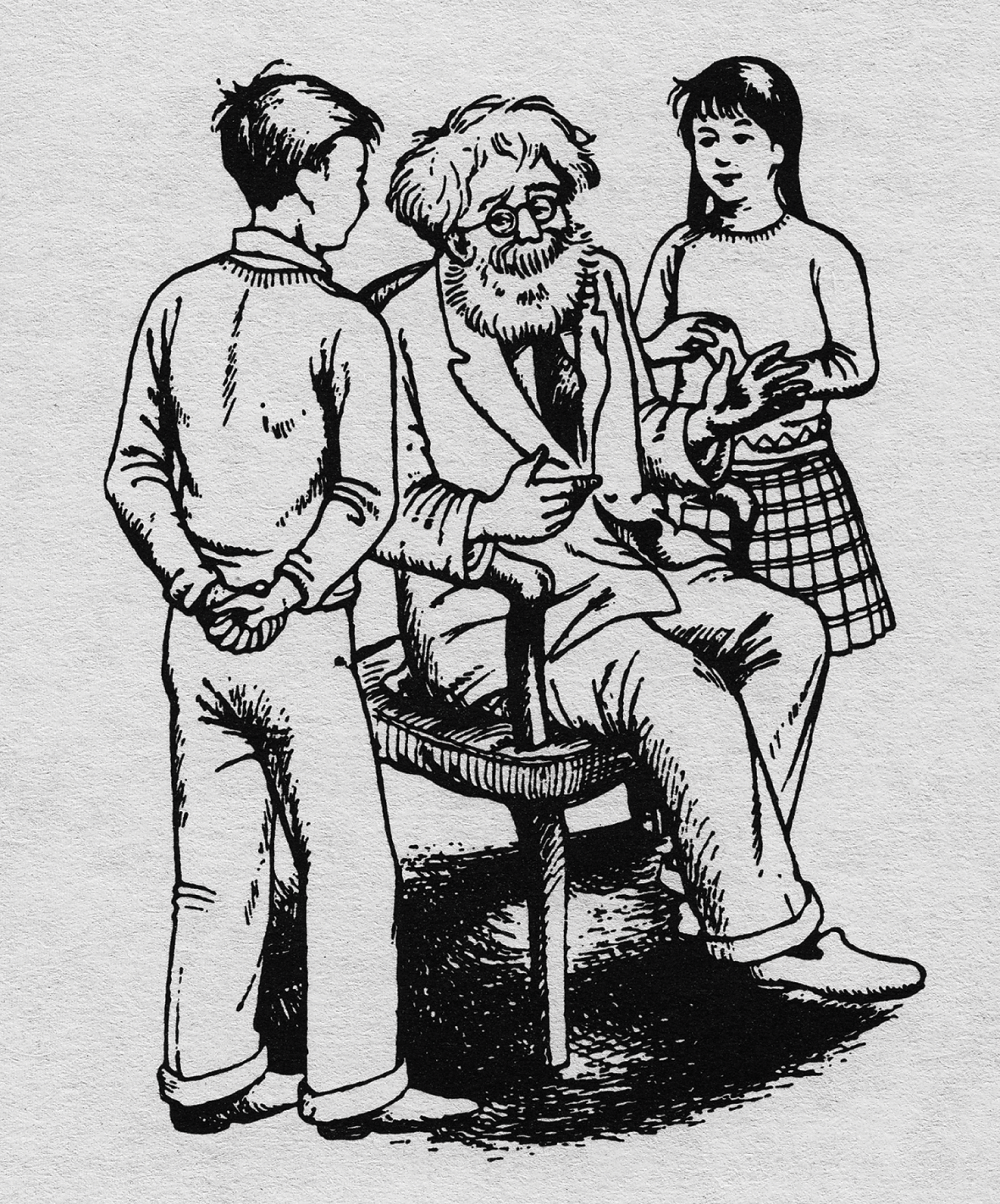
Katy and her friendship with her ‘eccentric old neighbour’ who sports academic robes while scaring starlings, in Maclennan, The Professor’s Garden (p. 10).
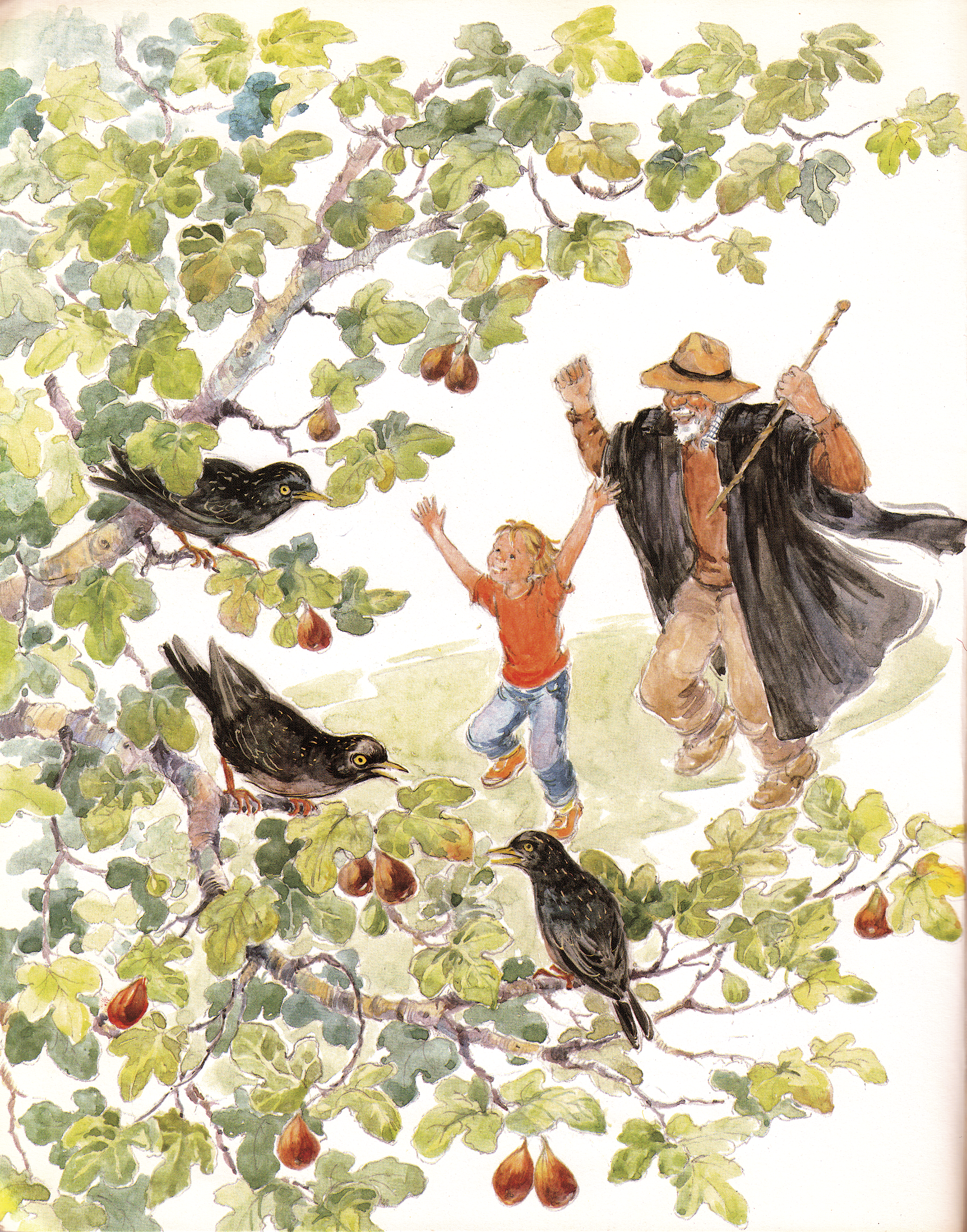
An inversion of this is where the child’s interaction changes the academic’s thinking by challenging their scientific values. Giddens notes that cultures of illustration in didactic children’s books of the Victorian period were ‘surprisingly reluctant to represent the child engaging with science’ but that fantasy such as Kingsley’s The Water-Babies ‘inaugurated a tradition of visually representing the child scientist (or at the very least the inquisitive child) – leading to the possibility of the child engaging critically with the natural and mechanical world’.Footnote 557 Professor Ptthmllnsprts in The Water-BabiesFootnote 558 is a friend sent out to look for biological specimens on a seaside walk, to educate an estate owner’s daughter, Ellie (Figure 22):
For in the stupid old times, you must understand, children were taught to know one thing, and to know it well; but in these enlightened new times they are taught to know a little about everything, and to know it all ill; which is a great deal pleasanter and easier, and therefore quite right … So Ellie and he were walking on the rocks, and he was showing her about one in ten thousand of all the beautiful and curious things which are to be seen there … Now little Ellie was, I suppose, a stupid little girl; for, instead of being convinced by Professor Ptthmllnsprts’ arguments, she only asked the same question over again. ‘But why are there not water-babies?’Footnote 559
They come across Tom, the Water-Baby, and Ellie’s childhood views challenge Ptthmllnsprts’ scientific approach, eventually sending him mad. The Water-Babies is closely linked to, and satirises, real scientific debates and characters of the period (which Kingsley was enmeshed in), but also sets up the fictional academic in children’s literature as ineffectual with a tendency towards insanity. Although a relatively minor character in the book, Ptthmllnsprts was (and is)Footnote 560 experienced by a very broad audience, promoting a sense of ridiculousness and failure associated with experts and intellectual achievementFootnote 561 while also establishing the child as essential foil to academic expertise.
Professor Ptthmllnsprts walking alone with Ellie at the seaside, in the 1915 edition of Kingsley, The Water-Babies,.
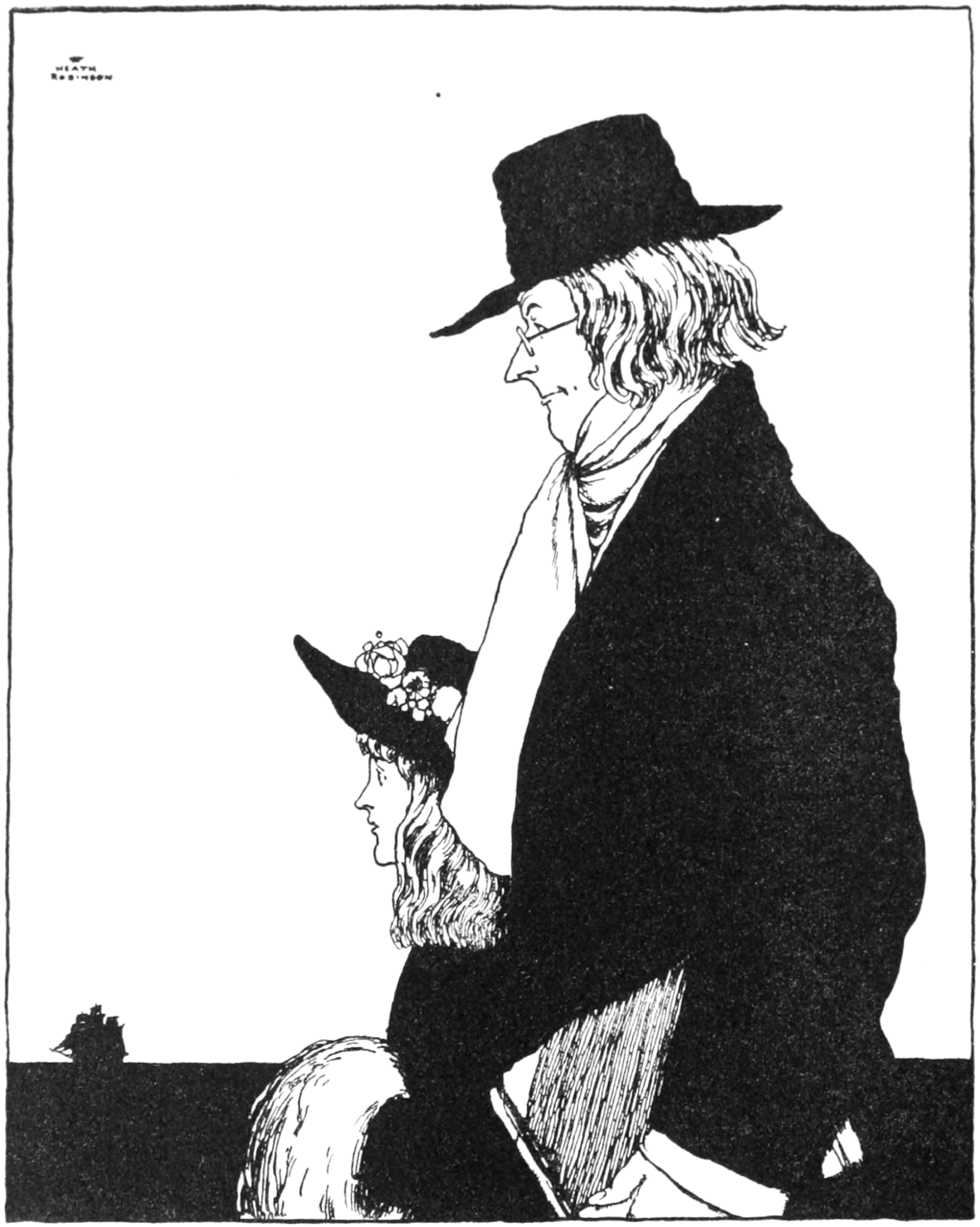
The primary school-aged Finn in The Rooftop Rocket Party ‘went to visit Doctor Gass in New York. Doctor Gass was a famous rocket scientist’,Footnote 562 although he keeps his rockets only ‘in the most secret and unusual place of all … my head!!’Footnote 563 Finn ends up educating him about the presence of the ‘unmathematical … so very unscientific’ man in the moon;Footnote 564 The botanist Professor Tobin takes a room in Maisie Hitchin’s Grandmother’s boarding house in The Case of the Feathered Mask,Footnote 565 allowing Maisie to solve the mystery of a theft that the adults cannot comprehend. This mechanism links the trope of the ‘wise old man’ to the trope of the wise or ‘divine child’ (the romantic motif where ‘the adult moves from teacher to student, from stern moralizing to the undisciplined child to patient listening to the wise instruction of the simple and imaginative child’,Footnote 566 another Jungian motif). The academic figures can ‘constitute alternative ideals for children.Footnote 567 They stand as figures for the father, for the writer, for the adult authority in society’Footnote 568 but also represent what happens when this authority fails. This plays with intellectual agency, questioning expertise, prestige and power, and the child’s place in social constructs, while also indicating room for intellectual aspiration and potential, alternative, pathways to adulthood. However, these traits are taken to extremes in the stereotypes discussed in the following section, as academics become so baffled as to be ineffectual, or so eccentric as to be mad and dangerous.
4.13 Conclusion: The Stereotypes Emerge
Undertaking a content analysis of this corpus of 289 books has allowed the dominant visual stereotype of an academic, particularly in the latter part of the twentieth century, to emerge: a professor in children’s literature is now generally an elderly white able-bodied scruffy man with sticking-out messy hair and perhaps an unruly beard. The related texts suggest that they are most likely to be a scientist or inventor, with wealth or at least disposable income, and have a support network of wife or housekeeper to aid and assist them. They are most likely to be depicted away from the university, either at home or on some form of trip. It is these characters that are the most important part in children’s literature, rather than the universities or institutions that they belong to: ‘academics act as a symbol for higher education in popular culture’.Footnote 569 There is little attention paid to fictional academics’ work or expertise, rather than what they do when involved in the plot, often interacting in some way with children, playing with ideas of intellectual agency and power.
Throughout this analysis, the counts and statistics revealed have been related to available information regarding the diversity (or not) of academia. It is tempting to reflect that many of the books were written throughout the late nineteenth and into the middle of the twentieth century, and parallels that can be drawn indicate that, although the representation of academics within children’s texts may be non-diverse and problematic, it may somewhat fairly reflect the real-world academy and wider socio-political structures as instantiated during that period. It would be too easy to discount these texts as being ‘of their time’. With half of the corpus being written after 1993, many of the representations we see have chosen to self-refer to established tropes and stereotypes, indicating that that the cultural hegemony continues in modern society and remains expressed strongly through the medium of children’s literature, and, in addition, texts produced in earlier times continue to be available to, and influence, child readers today. The stereotypes coalesce into three distinct types of behaviour, and these will be explored in Section 5.
5 Pedagogical, Baffled or Mad: Building Stereotypes
It has been demonstrated that the stereotypical academic is an old white male scientific professor working alone, with wild hair, likely to have a messy white beard, in a suit or lab coat: although these are often represented with humour and warmth, they echo the ‘pale, male, and stale’ establishment that manage our real-life public bodies.Footnote 570 Alongside these identifiable characteristics there are three key behavioural models that can be seen in this corpus: the professor as kindly teacher, the professor as baffled, blundering goon and the professor as dangerous, evil madman. Whilst the teacher is a positive but shallow depiction of academia, the ineffectual and evil stereotypes are pejorative about intellectual achievement, presenting a humorous but negative view of expertise and academia to a young audience. It is important to note, however, that these stereotypes provide a framework within which modern authors and illustrators can work, particularly in picture books. Playing with established constructs and constraints provides impetus to the plot, or an efficient vehicle to impart information. In this chapter the three behavioural stereotypes in the corpus will be surveyed, while also highlighting how they provide modern authors and illustrators with constraints around which narratives can successfully be built, often to encourage the child reader’s own feelings of intellectual autonomy.
5.1 The Stereotypical Professor as Teacher
The first stereotype is that of a helpful, kindly teacher or intellectual guide. Academics appear as teachers to children throughout the corpus; to give but some examples: Professor Howard in the first book;Footnote 571 the teacher in The Professor’s Last Skate, who regales his class with an adventure tale;Footnote 572 Professor Crow who advises the young woodland animals poorly but kindly;Footnote 573 Dr Cornelius, mentor and teacher to Prince Caspian;Footnote 574 Dr Monsoon Taggert, head of a finishing academy;Footnote 575 and Dr Chimp, classroom teacher in mortar board and gown in Rupert the Bear.Footnote 576 This pedagogical relationship provides a mechanism for children to come into contact with adult – or grandfather-like, given they are almost always male – experts, in a formalisation of the ‘wise old man’ Jungian trope, all the way through the corpus. In factual books it is a framing device, used as a personable way to explain science and industry to a childhood readership. For example, from its publication in 1950, Professor Brittain appeared every fortnight in the Eagle comic for at least the first few years of its publication, to explain scientific developments such as telescopes,Footnote 577 deep sea divers,Footnote 578 X-ray,Footnote 579 traffic lightsFootnote 580 and motorcycle engines.Footnote 581 A kind, fatherly figure, it is also important to note that he explained science equally to both boys and girls, with characters called Bob and Joan asking him questions (although their relationship is never explained). For example,
Bob, Joan and the Professor at the Motor-cycle races.
[Joan asks] ‘I’d like to know how a motor-bike works, Professor’.
[Professor Brittain replies] ‘After this lap I’ll try to explain the broad principles.’Footnote 582
The Professor promotes science as a career for both genders: after explaining X-ray, Joan remarks, ‘Yes, I’d love to be a radiographer!’Footnote 583
We see this type of relationship throughout the corpus: the expert professorial father figure is used to explain facts, such as science and industry in the So That’s the Reason! series,Footnote 584 maths in Professor Googol’s Flying Machine and Atomic Space Capsule Math Primer,Footnote 585 biology in the Einstein-alike Professor I. Q. Explores the Senses,Footnote 586 the alphabet in Learning Your Animal ABC’s with Professor HootFootnote 587 and physics in Professor Astro Cat’s Frontiers of Space.Footnote 588 They are used, too, in official public health guidance: Professor Oonoose Q. Eckwoose explains food groups in a booklet made by the United States Department of Agriculture Office of CommunicationFootnote 589 and Professor Bumblebee provides a Guide to Type 1 Diabetes for Diabetes Australia.Footnote 590 These academics are nothing but kindly and helpful, and they can be used as role models; for example, in the cartoon Oor Wullie, the local policeman P.C. Murdoch remarks to Wullie, the child protagonist, ‘Ye should be stickin’ in tae yer lessons an’ be brainy like the twa professors yonder – they ken a’thing!’ (Figure 23)Footnote 591 However, there is little exploration of any individuality: the trope of the kindly pedagogue, used without need for explanation, sets up a well-known mechanism for framing explanation.
Oor Wullie, in The Sunday Post, 14 May 1944, p. 11. Note that the professors are holding books to indicate their expertise. Oor Wullie ® © DC Thomson & Co. Ltd 2017.
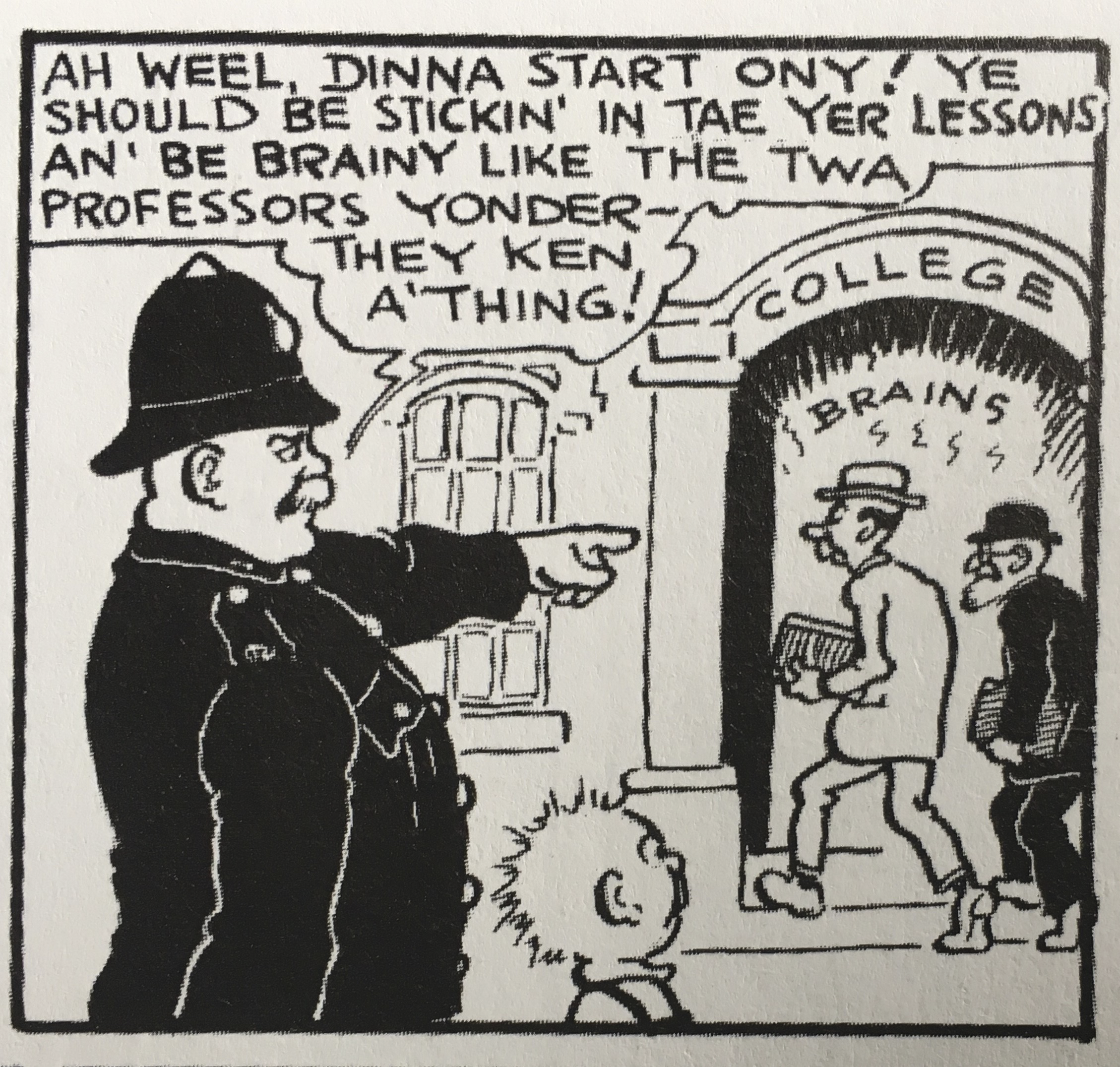
In fiction books, interactions with the teacher or mentor moves the plot forward, allowing them to learn more about the outside world, in tales based around science (often written by scientists). For example, the fictional Professor Hill explains the study of skunks (The Professor and the Mysterious BoxFootnote 592) and the tracking of whales (The Professor and the Vanishing FlagsFootnote 593) to children of a family he knows. Professor Potts’ travels are a thinly veiled mechanism to teach children about the wildlife of Asia, North AmericaFootnote 594 and Africa.Footnote 595 Professor Inkling in the Octonauts original book seriesFootnote 596 is a fount of old-fashioned wisdom, patronal guidance and scientific explanation to his younger crew of adventurers (see Figure 8). The characters can sometimes be hollow and thinly drawn, but they are trustworthy sources of information both for other characters in the book and for readers. The (relatively recently) archetypical example of a fully fleshed out paternal figure is, of course, Professor Albus Dumbledore in the Harry Potter series,Footnote 597 who is wise old man, teacher, father figure and expert combined.
This sense of expertise and authority is turned on its head in various ways: recent creationist propaganda uses elderly male professors to demonstrate religious texts as fact: for example, Professor Noah Thingertoo’s Bible Fact BookFootnote 598 and Professor Bumblebrain’s Bonkers Book on … God.Footnote 599 For more comic effect, there are books that explain mythical beasts in the style of a natural history book: Professor Dalrymple’s Fairy Field Guide;Footnote 600 Professor Miriam Carter in The Mystery of Unicorns, The True History Revealed.Footnote 601 In a humorous play on convention, professors can explain how the world works, but get it utterly wrong, such as in Professor Mole’s Machines (the amazing pop-up book of how things REALLY work!) where a hamster on a wheel is shown to power a washing machine motor, and rabbits keep planes aloft by driving crankshafts: ‘Faster, bunnies, faster!’ ‘We’re tired, Daddy’.Footnote 602 Professor Gilderoy Lockhart, in Harry Potter and the Chamber of Secrets,Footnote 603 is a comically drawn cross between showman, ambitious bighead and bully, his public exposure as a fraud puncturing the sense of authority that comes with being a professor at Hogwarts.
The masters of this clash of pedagogical intention and erroneous information are Jeanne Willis and Tony Ross in their award-winning Dr Xargle picture books,Footnote 604 where the five-eyed, betentacled green alien in academic gown and mortar board prepares his class for an excursion to Earth. They each start in the same way: ‘Good morning, class. Today we are going to learn about …’Footnote 605 and investigate various topics, where the explanation rapidly falls apart, revealing tension between both the truth that is known by the reader and the explanation given in the text, and the description of the scene and its accompanying illustration, in a multi-layered questioning and refocusing on habits, Western lifestyle and English language (Figure 24).
Dr Xargle explains cats gleefully but wrongly in Willis and Ross, Dr Xargle’s Book of Earth Tiggers (p. 2).
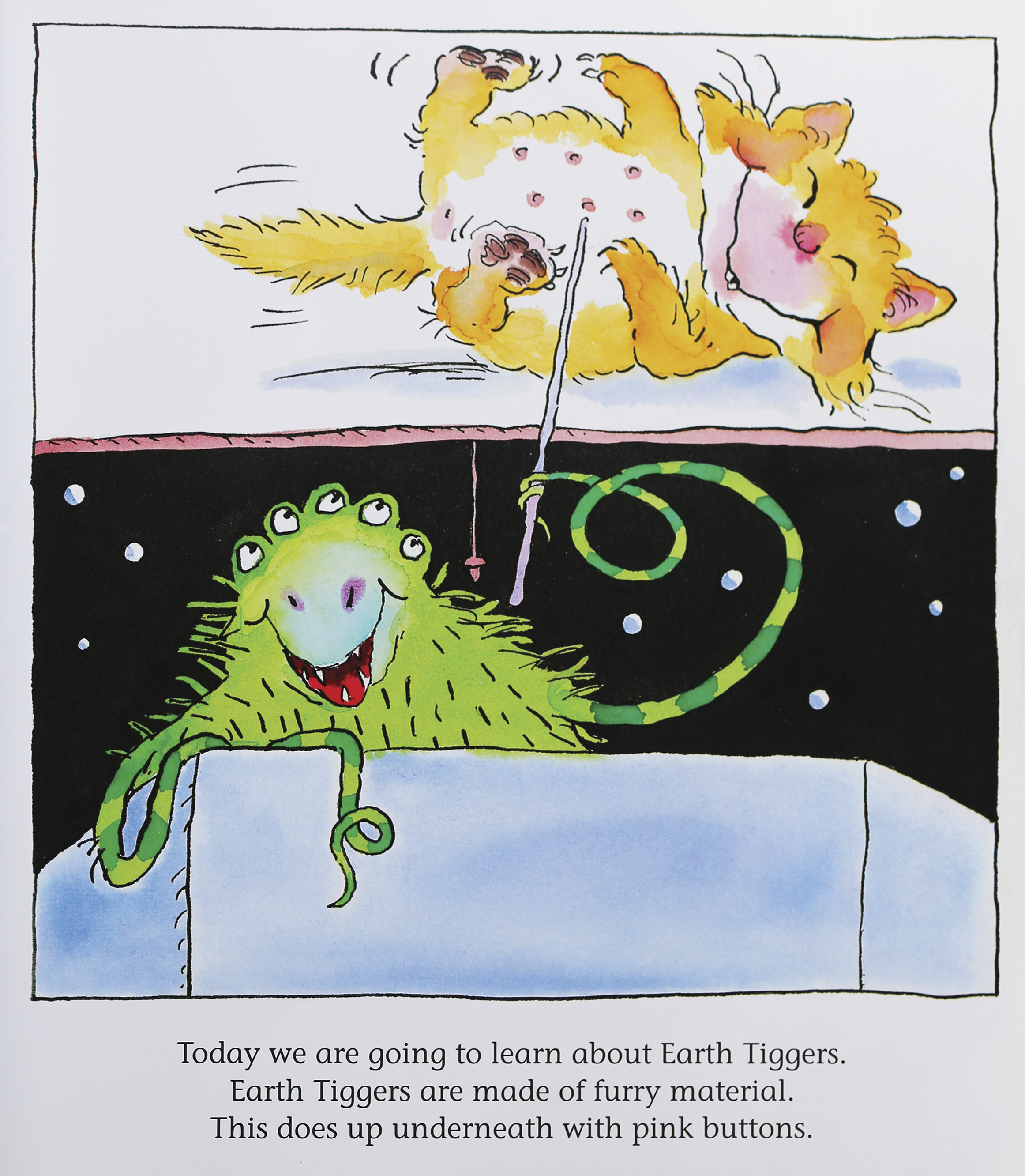
In the first book of the series, Dr Xargle’s Book of Earthlets (1988), babies: ‘come in many colours … but not green. They have one head and only two eyes, two short tentacles with pheelers on the end, and two long tentacles called leggies’.Footnote 606 The baby is shown being tickled by Dr Xargle’s tentacles, questioning the assumed normality of the human body. ‘They have square claws which they use to frighten off wild beasts known as Tibbles and Marmaduke’.Footnote 607 The baby is shown happily and firmly pulling the tails of two cats, who are desperately trying to get away, evidently terrorised by the baby, who has overturned their water bowl, leaving a dummy as a calling card in their food, allowing the reader to revel in the clash of picture and explanation. After a series of explanations, Dr Xargle comments, ‘That is the end of today’s lesson. If you are all very good and quiet we are going to put our disguises on and visit Earth to see some real Earthlets. The space ship leaves in five minutes …’Footnote 608 In later books in the series, these misunderstandings anticipate that visits will go wrong in the closing illustration of the book: in Dr Xargle’s Book of Earth Mobiles (1991), Matron arranges for the students to go on a train ride, which turns out to be a fairground ghost train; in Dr Xargle’s Book of Earth Weather (1992), the aliens end up dressed as miniature Santas singing ‘Hark the horrid angels sing’Footnote 609 at a summer garden party to the bemusement of the humans; in Dr Xargle’s Book of Earth Tiggers (1992) they end up in close proximity to a tiger by mistake. This play with the role of the teacher, known facts, conflicting illustration and retooled language, revels in tensions and differences, lampooning expertise and allowing the child reader to be the expert of their own lifestyle, knowing more than the alien professor or his visiting hordes of aliens will ever do.Footnote 610 This clever and funny series, which has been recommended in the teaching of science in schools,Footnote 611 would also not function had professorial tropes in children’s literature not previously been established.
5.2 The Stereotypical Muddle-Head
In a recurrent motif throughout the corpus, professors are routinely baffled, eccentric and ineffectual, with no grasp on the real world. The inventions and science often fail, accompanied by slapstick humour, and they demonstrate very poor life skills. A Professor in The Forgetful Forget-me-notFootnote 612 asks the flower why it is so named, and is curtly told to go away and use his skill and look it up in books himself, the plant having forgotten too. In Sylvie and Bruno, ‘The Professor’ is
a wonderfully clever man, you know. Sometimes he says things that only the Other Professor can understand. Sometimes he says things that nobody can understand!Footnote 613
Little Jack Rabbit regularly comments on how the world works, pointing out that his friend ‘Professor Crow didn’t tell me that’, in a failure of the professor’s Little Book of Wisdom.Footnote 614
The archetypal absent-minded professor who creates malfunctioning inventions is, of course, Professor Branestawm (appearing in thirteen books from 1933):
[A]lthough the Professor was so clever, or perhaps because he was so clever, he was absent-minded. He was so busy thinking of wonderful things like new diseases or new moons that he simply hadn’t time to think of ordinary things like old spectacles.Footnote 615
These books also establish the role of the Professor’s housekeeper, Mrs Flittersnoop, as an essential enabler as well as foil (Figure 25).
Professor Branestawm and The Colonel, being served tea by Mrs Flittersnoop after they blow up the Palace of Squiglatania. In Hunter, The Incredible Adventures of Professor Branestawm, p. 21,.
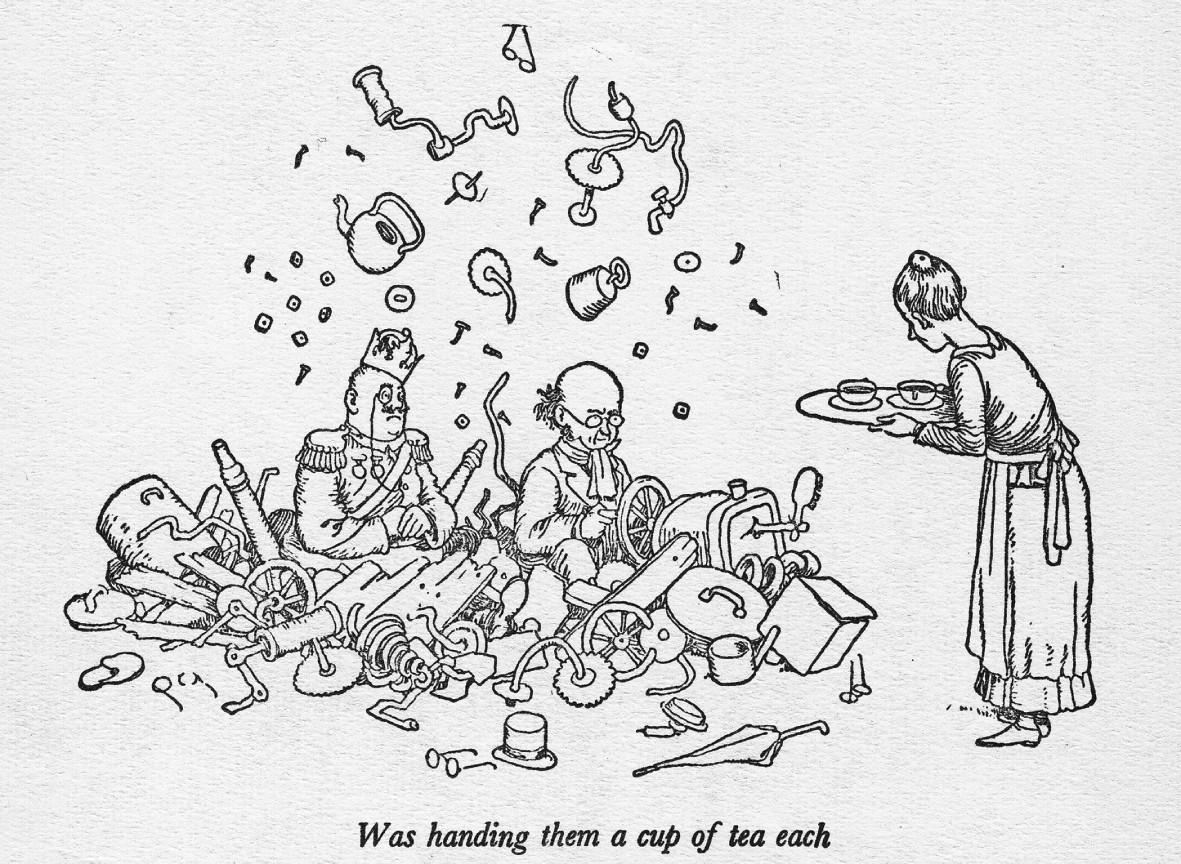
The publishing success of Branestawm colours the characteristics of the academics that follow in children’s literature. The Professor in Mistress Masham’s Repose
was a failure, but he did his best to hide it. One of his failings was that he could scarcely write, except in a twelfth century hand, in Latin, with abbreviations. Another was that, although his cottage was crammed with books, he seldom had anything to eat. He could not tell from Adam … what the latest quotation of Imperial Chemicals was upon the Stock Exchange.Footnote 616
These baffled professors are often illustrated with humour, linking concentration and intellectual obsession with the reason they are incapable in other aspects of life. Webb’s illustration affectionately lampoons and characterises the features of hard-thinking professors, summing up the common stereotype in one handy graphic in Figure 26
Professor Ponsonby in Parker, Professor Ponsonby, McIntosh and the Wool Bug (p. 39),.
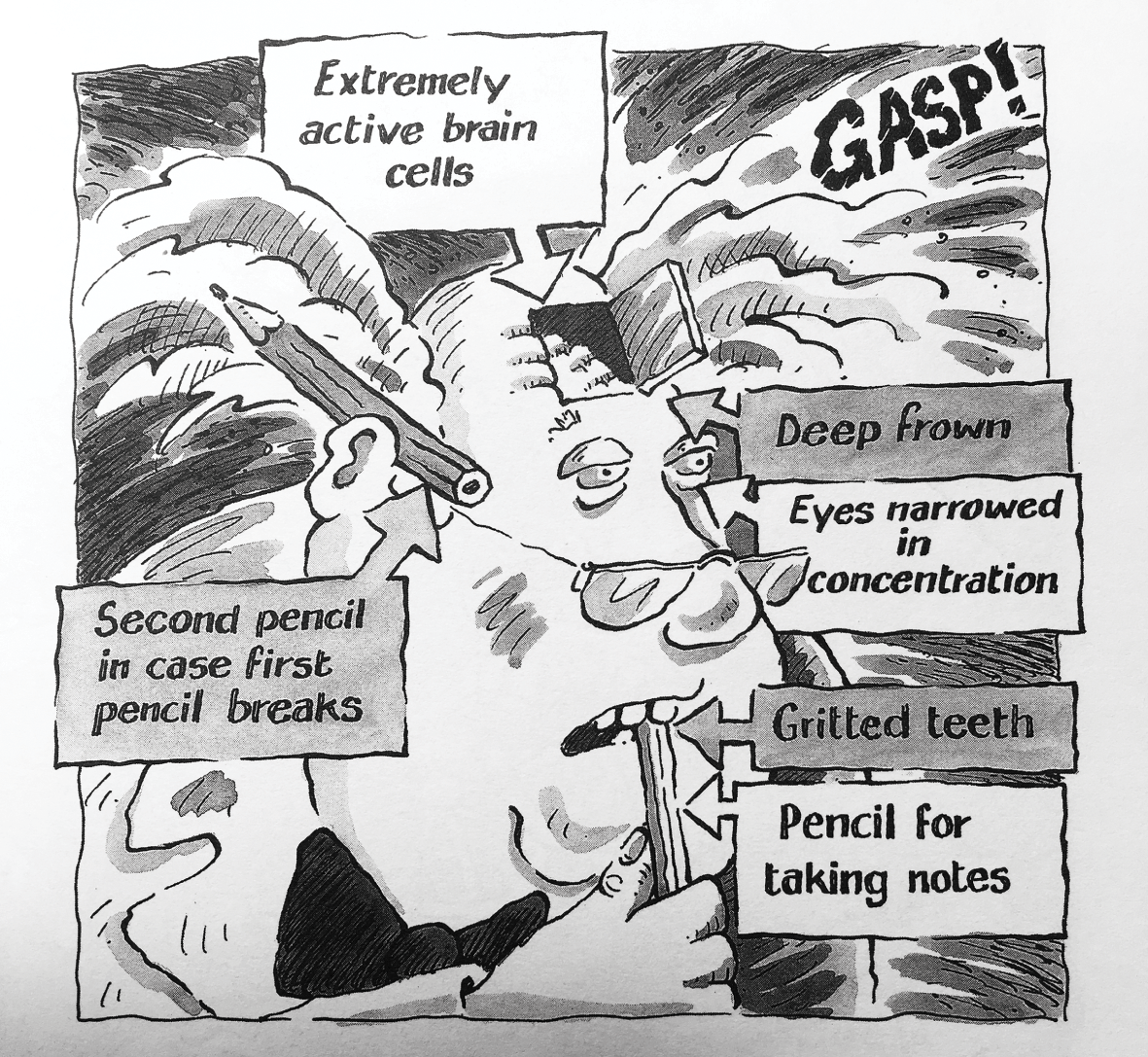
The confusion and baffled nature of the academics, who are supposed to be in control, is a plot device which causes juxtapositions to move the story along. Professor Magnus MacWhizzer invents a time machine but cannot drive it:
I must say I’m getting rather good at working this vehicle … We shall arrive several degrees north or south of the solar system … It will be yesterday, next week, or the year two thousand and one. That is the finest degree of accuracy with which I can predict our course. If you want greater precision then I must recommend that next time you ride in a Number 12 bus.Footnote 617
The erratic, chaotic travels allow the professor, along with his housekeeper and his great-great-niece and -nephew, to travel through space, although the professor himself is ultimately stranded by his invention when ‘lost in a delicious daydream, the Professor overbalanced, tripped over his own toe, and one flailing arm caught the lever marked GO …’:Footnote 618 he is shown disappearing in the pop of a bubble. Likewise, the gap between what the professor perceives and what the action is drives forward the picture book Cockatoos,Footnote 619 where the eccentric and absent-minded Professor Dupont is repeatedly outsmarted by his pet birds, who hide all over his house (providing a counting game to the reader). Professor Quickly doesn’t notice – unlike everyone else, including the reader, who can see a ghost at the window – that his new house is haunted.Footnote 620 Professor Yahoo is tasked by the Queen to collect a menagerie so she can have a zoo of her own, but trips over a goat and breaks his glasses, leading him to collect a random selection of things mistaken for exotic animals:
The denouement, in this case, is that the Queen – who has broken her glasses too – is delighted by the collection, but mistakes Professor Yahoo for a talking goose, and so he now lives happily in a zoo enclosure (Figure 27).
Professor Yahoo congratulates himself for collecting a ‘Polar Bear and Penguin’ for his zoo.
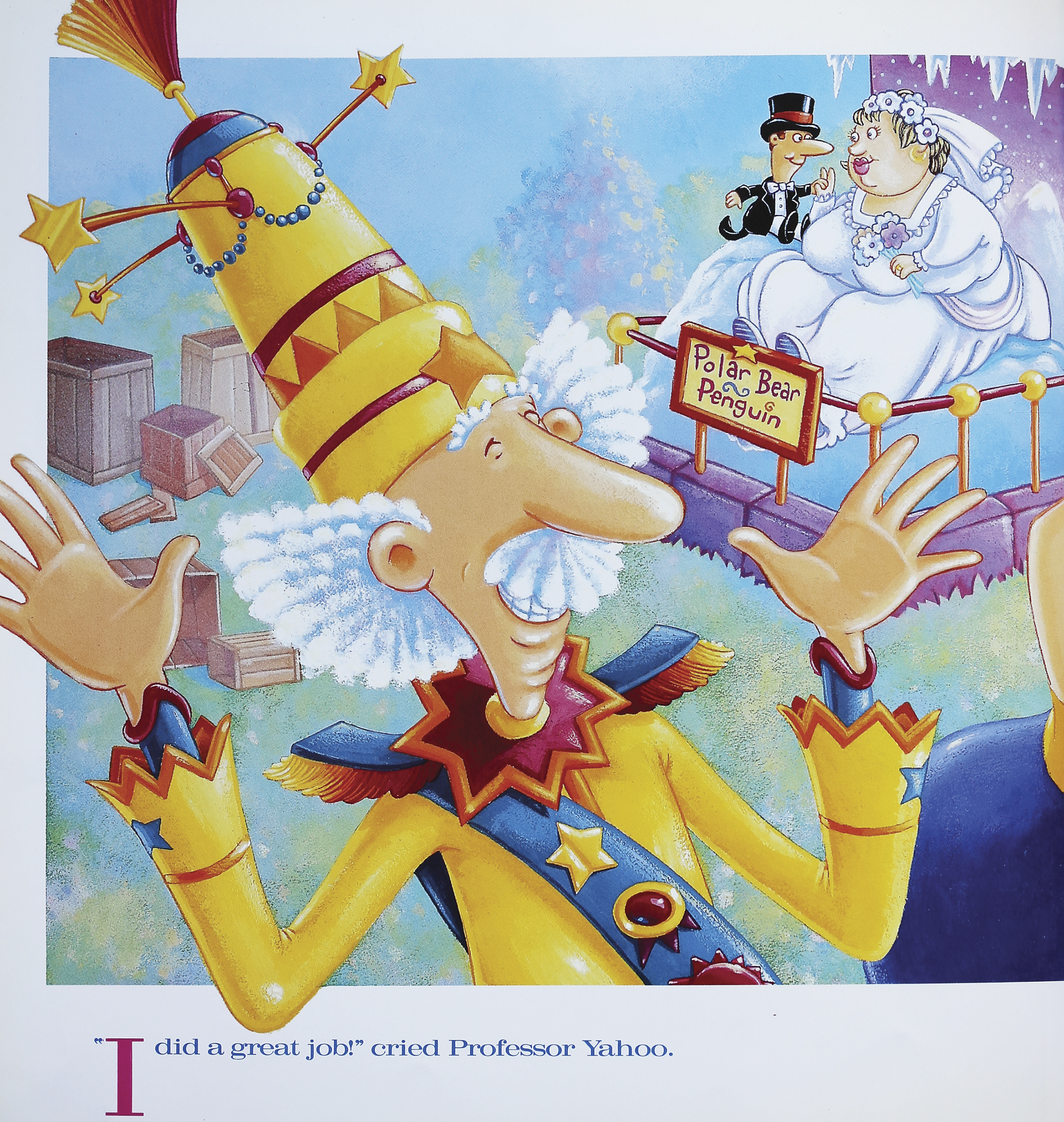
Professors get nicknames because of their baffled nature:
Sometimes I think that Professor Albert lived millions of years ago, too. He is very absent-minded. One day, when Professsor Albert was wearing his shirt inside out for the third day in a row, Sipo said ‘I think there is coconut milk in his head, instead of a brain.’ After that, we called him Professor Coconut.Footnote 622
Professors change their own names, too:
When he said goodbye, Professor Llawonk confided to Jack Dawe that his real name was Professor Knowall but he has changed it round because he really did not know very much.Footnote 623
Comment is made about the uselessness of the inventions and science undertaken. The reader in Did I Ever Tell You How Lucky You Are?Footnote 624 is asked to consider how much more fortunate they are than Professor de Breeze, who has spent three decades trying to teach Irish ducks to read the Jivanese language. The ducks are pictured being lectured, and are unconvinced. Likewise, Professor Ponsonby (Figure 26)
was always inventing things to help … There was no statue to Professor Ponsonby in Baaville … That was because so far none of professor’s inventions had worked. But he still invented non-stop, usually when the rest of Baaville was fast asleep in bed.Footnote 625
The engineer Professor Von Bean in Silly Stories spends his lifetime inventing a machine:
Whatever they are doing – whether inventing, undertaking scientific experiments or digging on an archaeological site – many of the academics are shown as endearingly ineffectual and pointless, in a deprecatory (and at times vituperative) depiction of the ‘life of the mind’.
Lectures and classes are depicted as confusing and boring. The Professor’s lecture in Sylvie and Bruno Concluded (Figure 7),Footnote 627 despite featuring miniaturised elephants, and explosions, is rambling, has no topic and loses the audience’s attention. ‘“How long must we wait?” grumbled the Emperor.’Footnote 628 Professor Mudweed in the Boffin Boy series comments, ‘None of you are clever enough to understand my invention, but I’ll try and explain it …’, at which point, an audience member thinks, ‘This is going to be really boring’,Footnote 629 in an exaggeration of the stereotype of a yawn-inducing academic lecture.Footnote 630 Professor Bumblebrain comments, ‘I do hope you are finding my lecture of interest. When you have a brain as large as mine, it is so very easy to bore an audience to death’ (Figure 28).Footnote 631 Science, in particular, is portrayed as a magical source only accessible to academics, linking to stage-tricks and conjuring, but also crossing into fantastical thinking, showing intellect as sitting between realism and impossibility, building on tropes of nonsense-writing, of grotesques and of caricature.Footnote 632 The bafflement in these cases creates a gap between the intellectual authority of the professor and the knowledge of the child reader, who can see, via illustrations, where the adults are ineffectual, wrong and boring, and not in control of the environments around them. The childhood audience is encouraged to explore the gaps, in an intellectual equivalent of spotting that the emperor has no clothes.
Robb, Professor Bumblebrain’s Bonkers Book on God (p. 53).
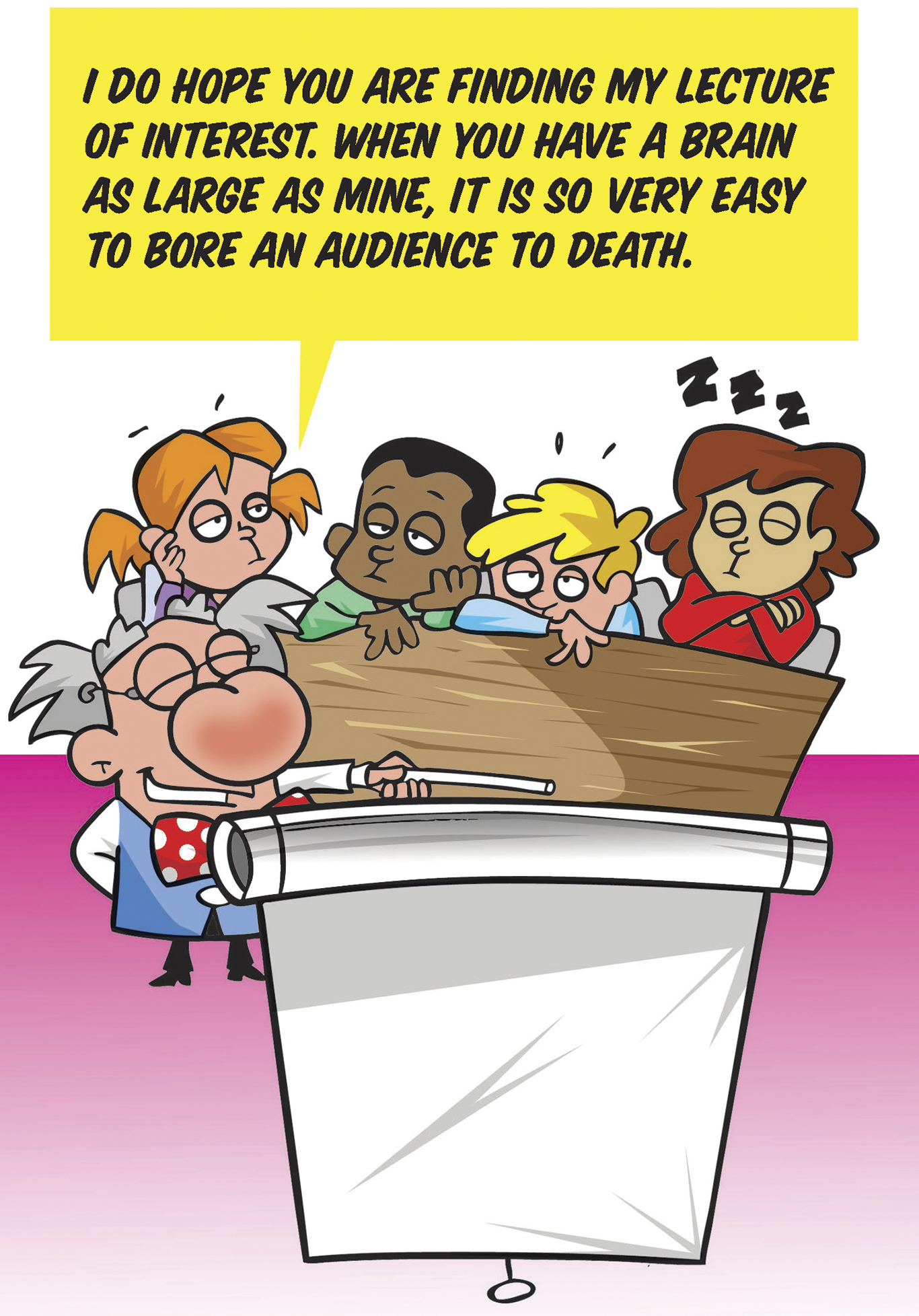
The apparent confusion at real life is often stressed by the juxtaposition of normal and magical thinking: Professor Bull
was fond of three things: music … radishes … and his umbrella, Philip … ‘My goodness gracious!’ said the professor. ‘Hardly a radish left in the house! Philip, we must see to that at once.’ And he took up Philip and his market basket.Footnote 633
Eccentric, baffled professors are, then, playing with logic and rationalisation in an extension to and in the tradition of nineteenth-century nonsense writing, where fantastic adventures are playfully framed against known, mundane reality in a ‘perfect tension between meaning and absence of meaning’Footnote 634 that is amusing (particularly to a childhood audience) and that encourages the reader to think about normal behaviour and what it is to be an adult. These professors act, rather like Mary Poppins, as ‘the conduit between reality and fantasy, the structural interface in the text’,Footnote 635 allowing safe exploration of the impossible and illogical where ‘the structure of the text enables readers to suggest their own conclusions because there is a pattern of connection which moves from the known to the unknown’Footnote 636 provided by ‘a real figure of authority and didacticism … and the fantastic facilitator of magical experiences’.Footnote 637 While professors are shown in pejorative fashion as being ineffectual, and their work meaningless, which (as we shall see) plays into the view of the scientist in popular culture and actively reinforces distrust of expertise, this mechanism can also be more complex: giving authors and illustrators a place to play with known constraints, using tropes to explore authority and intellect via nonsense.
The mostly ineffectual nature of these academics is reflected in their challenging names. Pedagogues are apparent, with three Professor Wisemans,Footnote 638 two Professor IQsFootnote 639 and a Professor Boffin,Footnote 640 Professor Egghead,Footnote 641 Professor Inkling,Footnote 642 Professor NoodleFootnote 643 and Professor Tidymind.Footnote 644 However, there are far more with pejorative names. There are two Professor Bumbles,Footnote 645 a Professor Blabbermouth,Footnote 646 Professor Bumblebrain,Footnote 647 Professor Bumphead,Footnote 648 Professor Clickilty Klunk,Footnote 649 Professor Dinglebat,Footnote 650 Professor Doodle,Footnote 651 Professor Dribble,Footnote 652 Professor Hogwash,Footnote 653 Professor Von Hardbum,Footnote 654 Professor Muddlehead,Footnote 655 Professor P. Brain,Footnote 656 Professor PigglePoggle,Footnote 657 Professor Pingwit,Footnote 658 Professor Poopypants,Footnote 659 Professor Poppoff,Footnote 660 Professor StupidoFootnote 661 and Professor Whatzit.Footnote 662 Those who are given ‘real’ names have ones that are foreign, unusual or difficult to the English tongue, highlighting their otherness; for example: Professor Euclid Bullfinch;Footnote 663 Professor Pompilius McGrath;Footnote 664 Professor Mickimecki;Footnote 665 and Professor Aristides Pilaster.Footnote 666
There are also three Professor PottsFootnote 667 and a Professor Pots,Footnote 668 Professor Nutter,Footnote 669 Professor Nut,Footnote 670 Professor CoconutFootnote 671 and Professor Crackinbottle,Footnote 672 pointing to another theme in the corpus: madness.
5.3 The Stereotypical Madman
There is little thought given to the impact of ableist language by authors: ‘Sometimes I think my friend Professor Solomon Snickerdoodle is a little funny in the head.’Footnote 673 Books even have madness in the title, such as or My Father the Mad Professor,Footnote 674 Mad Professor: Concoct Extremely Weird Science Projects,Footnote 675 Dr Brad Has Gone MadFootnote 676 and The Mad Professor’s Workshop.Footnote 677
The apparent madness of academics is closely associated with genius:
Professor Blabbermouth was as bright as buttons. There was no doubt about it. She had enough university degrees to paper her toilet walls. Some people said she was a genius. Some people said she was a nutter. It was all a matter of opinion … All those brains and nothing to use them on made her do rather … eccentric things. Like cycling backwards to the shop in the belief it saved time. Or for a complete week never using the letter ‘e’ whn spaking to popl. She never explained her reasons for this. And nobody thought to ask.Footnote 678
The dishevelled, big-haired appearances of the academics feed into this slap-stick, oddball otherworldliness, where the madness can be kindly and eccentric, separated from (and not understanding) cultural norms. Doctor Crotchet and Professor Nut devote their energies to recording a symphony that is so loud and awful it terrorises their town, without them noticing.Footnote 679 Professor Peekaboo is asked, ‘would you subscribe to the view that you’re essentially eccentric?’ – and agrees.Footnote 680 Professor Molecule’s friends often laugh and shake their heads at him, commenting, ‘What a crazy Professor!’Footnote 681 Professor Oliver Query is suddenly custodian to his teenage daughter in My Father The Mad Professor,Footnote 682 and his eccentricities, and the differences between his own lifestyle and that of ‘normal’ Americans, provides the mechanism for the teenage narrator to explore father–daughter relationships and bonding with a parent, post-divorce:
I have been living with my father now for nearly a year. He still eats Estonian eggplant with that deep-sea, iodine-rich plankton, but Quintus [the parrot] has sunflower seeds and I eat baked beans. It’s not a perfect life. My father still blows up if I meddle with his experiments. I still blow up if he meddles with my clothes or food. And things are decidedly weird. The other day, a meteorite landed in the chimney…Footnote 683
However, alongside the eccentricities and questionable mental health comments, comes representation of ever-present malice and Machiavellianism:
it looked as if all of the Earth’s dilemmas would be fixed for ever. But who would have believed that in just a few short weeks, Professor Poopypants would be trying to take over the planet in a fit of frenzied rage?Footnote 684
The evil scientific desire for dominance and destruction is revealed in numerous texts, where the madness often comes to define them. Doctor Daffney in the Boffin Boy series is a ‘famous mad scientist, you know.’Footnote 685 ‘Mad Professor Erasmus’ in Stitch Head, The Ghost of Grotteskew is ‘considered by most to be the maddest professor of all. He had spent a lifetime creating crazy creations.’Footnote 686 Doctors are more likely to be evil than professors: so much so that the villain in Professor Blabbermouth on the Moon,Footnote 687 ‘The meanest and most jealous scientist in the world, and a man who smelt of aftershave,’Footnote 688 is simply known as Doctor Doctor: ‘He had been plotting and being evil all day, and Doctor Doctor was tired.’Footnote 689 The threats posed by these characters are usually told with humour, and the violence is often entertaining, such as the glorious Dr Frankenstinker, who exercises his madness as if he were the naughtiest boy in the school (Figure 29).
From MUNGO AND THE SPIDERS FROM SPACE by Timothy Knapman, illustrated by Adam Stower, p. 9.
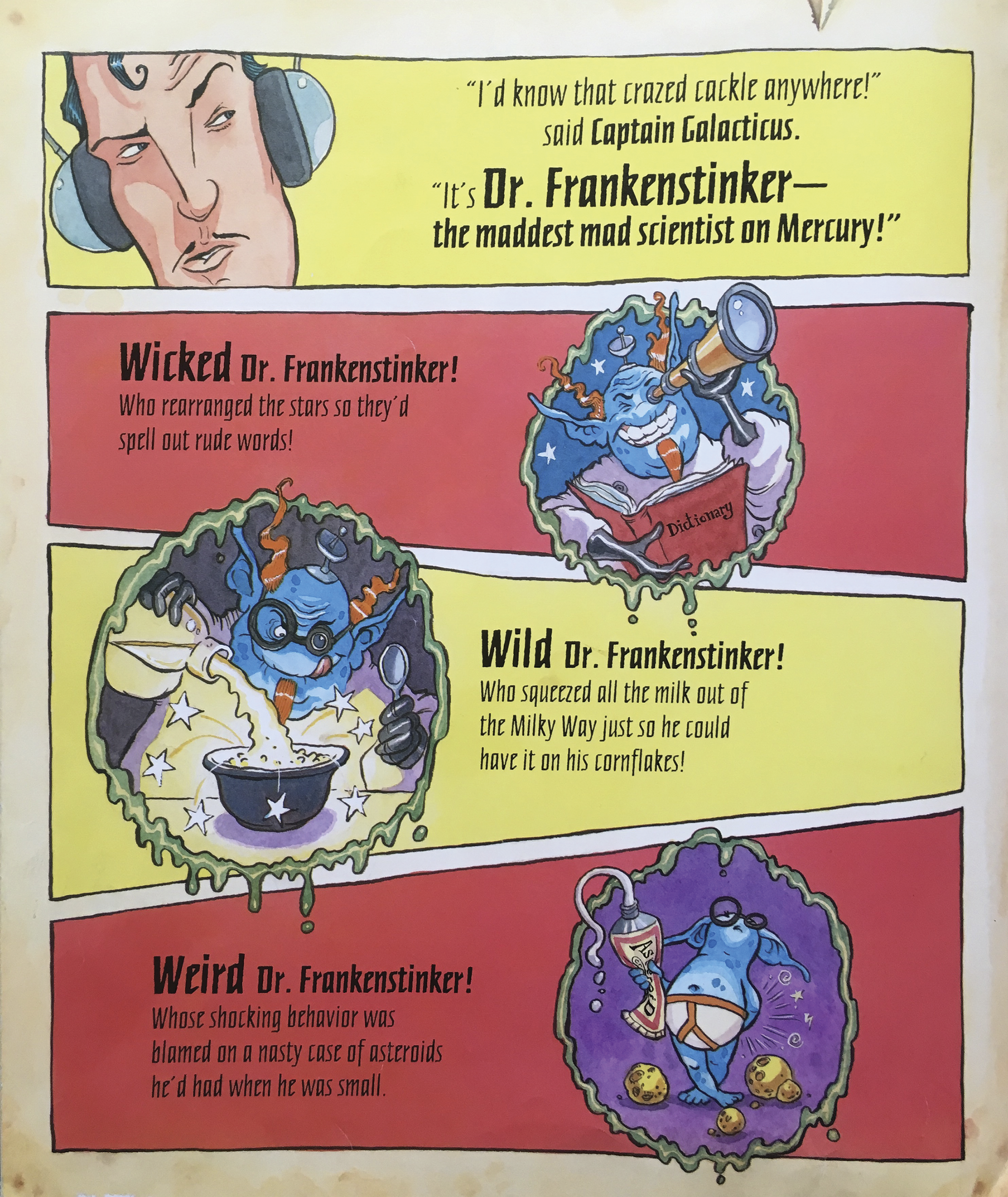
Dr Frankenstinker – his name a comic play on Frankenstein just rude enough to be funny for an infant school audienceFootnote 690 – plays with the mad scientist idea, with his evil ways reflecting the kind of things children would be told off for, converted to science fiction. The author, Timothy Knapman, commented:
there’s often no room in a picture book to create a fully-functioning world of the author’s own (like the one that, say, J. K. Rowling has furnished for her readers) so you sometimes take character types and settings ‘off the peg’, as it were, and play variations on them.Footnote 691
In Mungo and the Spiders From Space, the evil scientist needs no introduction, being accepted by the reader as a fully formed troublemaker and nemesis without the need for backstory, eventually thwarted by child hero Mungo, in a text that plays with conventions (the books are ‘deliberatively [given] a retro look … the Dan Dare-style comic of Spiders’Footnote 692).
In the case of Dr Frankenstinker, Knapman reflected back to his childhood viewing:
I loved science fiction and horror as a child and I remember evil mad scientists from those days – Frankenstein himself most of all (I remember being very excited when the BBC showed a season of the original, black and white Universal horror movies). Though I have to say that the mad scientists that meant something to me back then were kindly ones – Doctor Who, in his manic Tom Baker incarnation, and Professor Branestawm. I used a mad scientist villain in Spiders From Space for the same reason that I’d chosen a pirate book for Mungo to be reading in [Mungo and the] Picture Book Pirates.Footnote 693 There hadn’t been any mad scientists in popular culture for a while, just as there hadn’t been any pirates, so I thought it was time to revisit the idea.Footnote 694
Dr Frankenstinker sits within a long tradition of evil scientists, played up for comic effect, in an intertextual rollicking space adventure that nods to the film, television, and texts that have come before it, expecting the reader to be aware of the conventions used. The humour here is in a long tradition of classic picture books reminding us that
children expand their worlds through misbehaviour – and how mischief can be a surprisingly constructive, and even creative, means by which children adapt to, and seek to revise, societal and familial boundaries.Footnote 695
Fully illustrated picture books for three- to five-year-olds contain many straightforward stereotypical academic madmen who are introduced without the need for explanation, such is their known trope. In Traction Man Is Here,Footnote 696 Evil Doctor Sock tries to force a cupcake to be his bride, and wicked Professor Spade keeps dollies captive (Figure 30). This references, and plays with the casual misogyny and gender structure of, boys’ own adventure tales:Footnote 697 the sock and spade in Traction Man Is Here are actors playing the part of the typical baddie, sprung from the boyish imagination of Traction Man’s owner, who drives the plot on. However, these stereotypical structures are subverted: both Doctor Sock and the harassed cupcake forget about the villain and victim roles when confronted with Traction Man’s ridiculous green knitted outfit, which has been provided lovingly by the boy’s grandmother, and worn by Traction Man unwillingly: everyone laughs, and the structures and predicted plot line disintegrate.
Traction Man sets out to rescue Cupcake, but is thwarted by his ridiculous knitted romper suit. Artwork: Mini Grey, from Traction Man Is Here, by Mini Grey, Published by Jonathan Cape, Reprinted by permission of The Random House Group Limited.
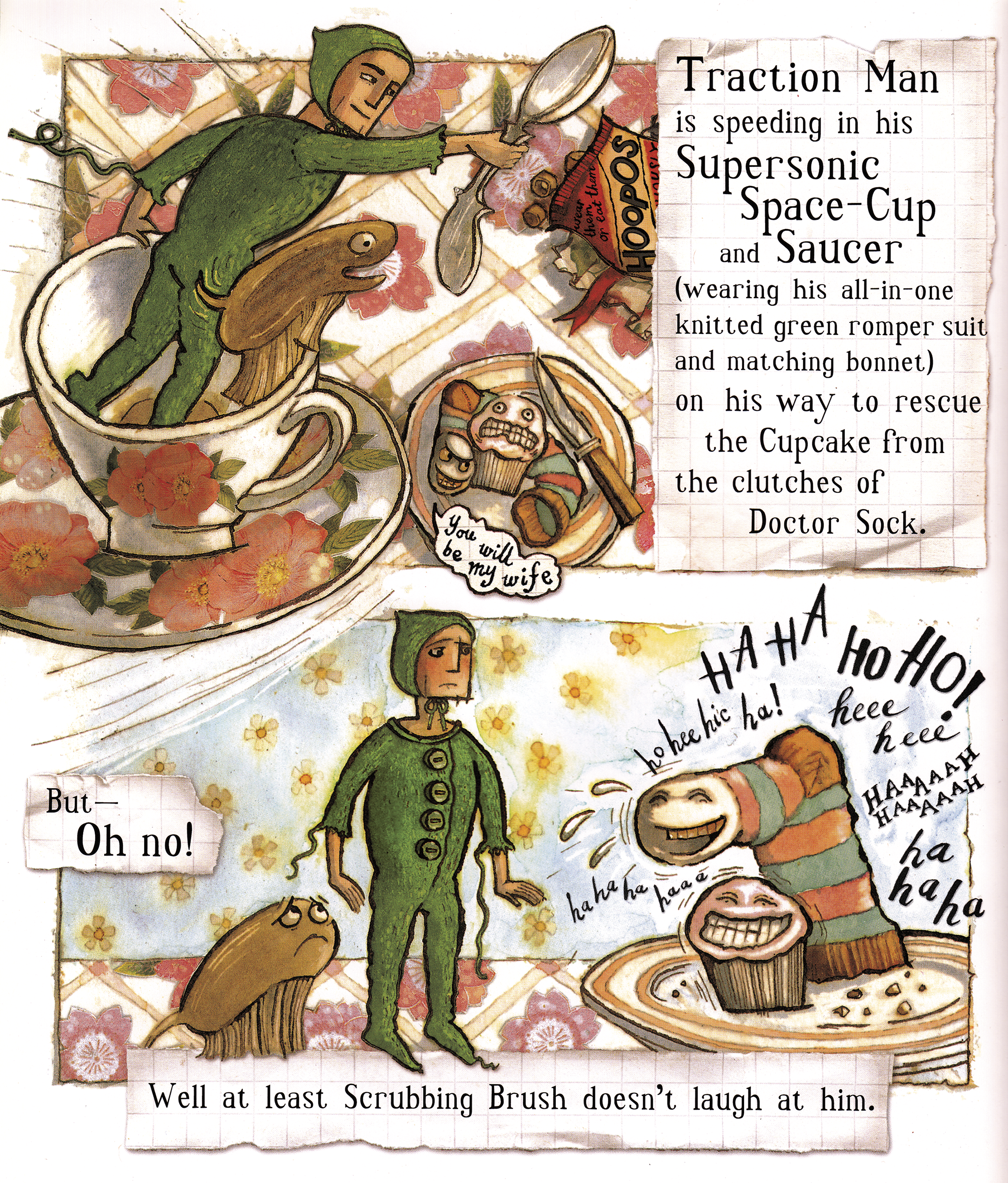
Similarly, the denouement of The Astonishing Secret of Awesome ManFootnote 699 is that Awesome Man is the alter ego of a boy, who imagines foes for his superhero character that short-cut straight to established stereotypes in superhero set pieces. Awesome Man takes on Professor Von Evil, who is illustrated inside a marauding, egg-shaped metallic robot with a pointed top and robot legs, that is shooting out green goo from its arms. The professor is shown through a green-tinted window in the centre, that reveals a small old bespectacled man in lab coat with long, pointed, Einstein-like hair and a maniacal expression as he pulls leavers, controlling the bot (Figure 31). Here is the entire mention of the evil professor, from entrance to vanquishing, in the picture book:
Here comes Professor Von Evil in his Antimatter Slimebot! Antimatter slime is extra gross!Footnote 700
But okay, check this out. I change into my secret identity – and the dude just sklooshes right past me. Do you see me? Professor Von Evil doesn’t!Footnote 701
Then I just sneak up behind him, slap a big old power grip on his pointy head … and SKA-RUNCH! ‘It[’]s time the professor learned his lesson!’Footnote 702
Awesome Man then moves swiftly on to his next adventure, fighting his ‘arch nemesis’,Footnote 703 The Flaming Eyeball. This playing with established stereotypes of adventure and superhero stories, in the abbreviation of children’s play, highlights how entrenched doctors and professors are as comic villains in later children’s literature, with no prior knowledge needed about the character or role to set up the scene, in a postmodern borrowing and playing with established frameworks, structures and histories. Of course the professor is an evil version of Einstein with a marauding robot that will attack the city with science! Of course! The story is not focussed on the Professor, but is about the growing autonomy, and imagination, of the child, who plays with established stereotypes.
Professor Von Evil from Chabon and Parker, The Astonishing Secret of Awesome Man (p. 11).
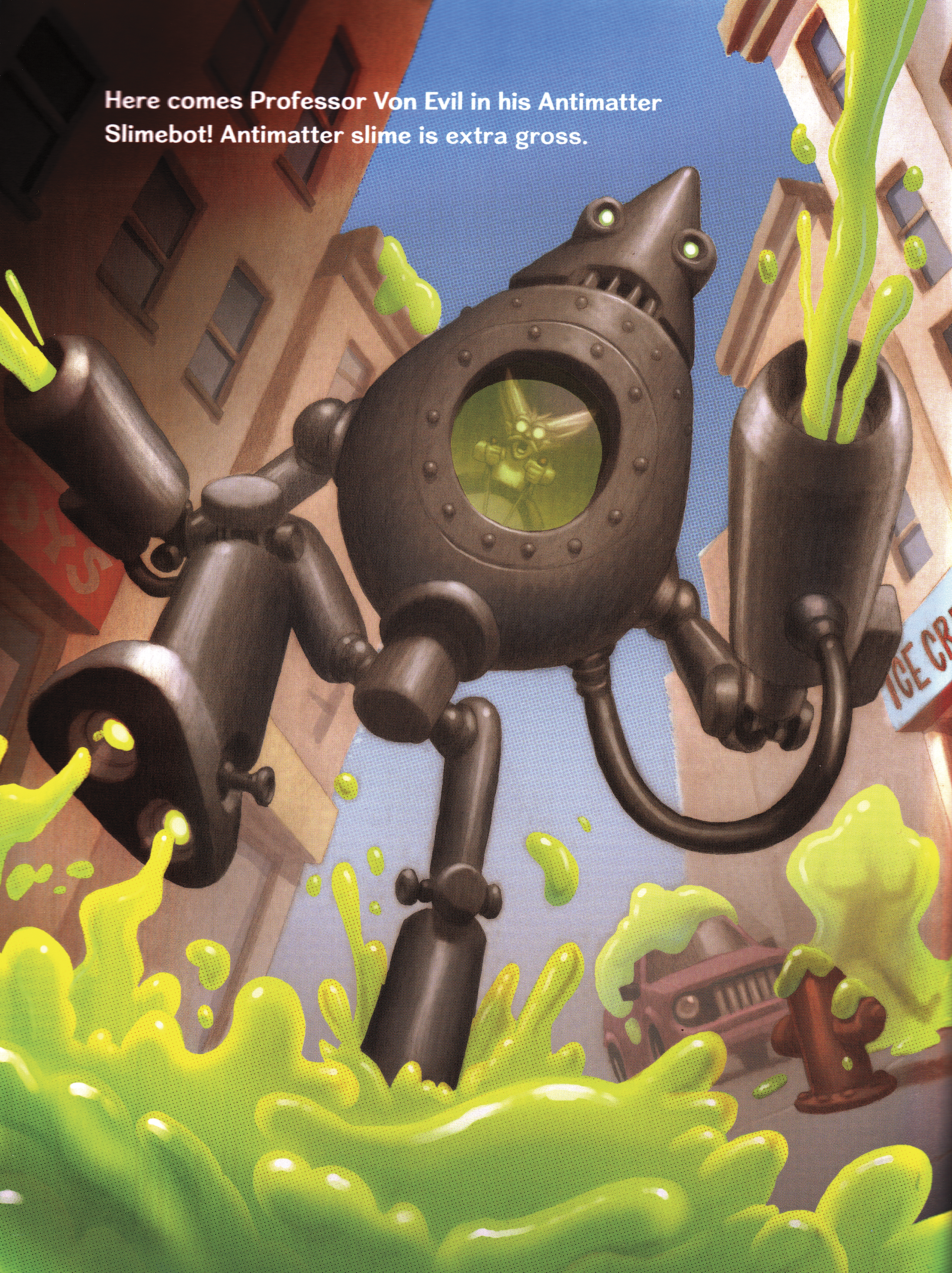
These evil representations of intelligence become more threatening as the predicted audience for the texts advances. Dr Morrison (the first of three evil woman), in the Jinty story Battle of the Wills (1977), wants to demonstrate how she can clone teenage girls, despite the effect on them, for scientific glory. Doctor Daffney wants to turn everyone into bonsai treesFootnote 704 in a reference to the Daphne and Apollo myth (Figure 32).Footnote 705 Professor Dolores Umbridge, in Harry Potter and the Order of the Phoenix (2003), is malevolent, and abuses both her power and the children and adults in her care.
Boffin Boy and his friend Polly held captive by Doctor Daphne, in Orme and Richardson, Boffin Boy and the Poison Garden (p. 19).
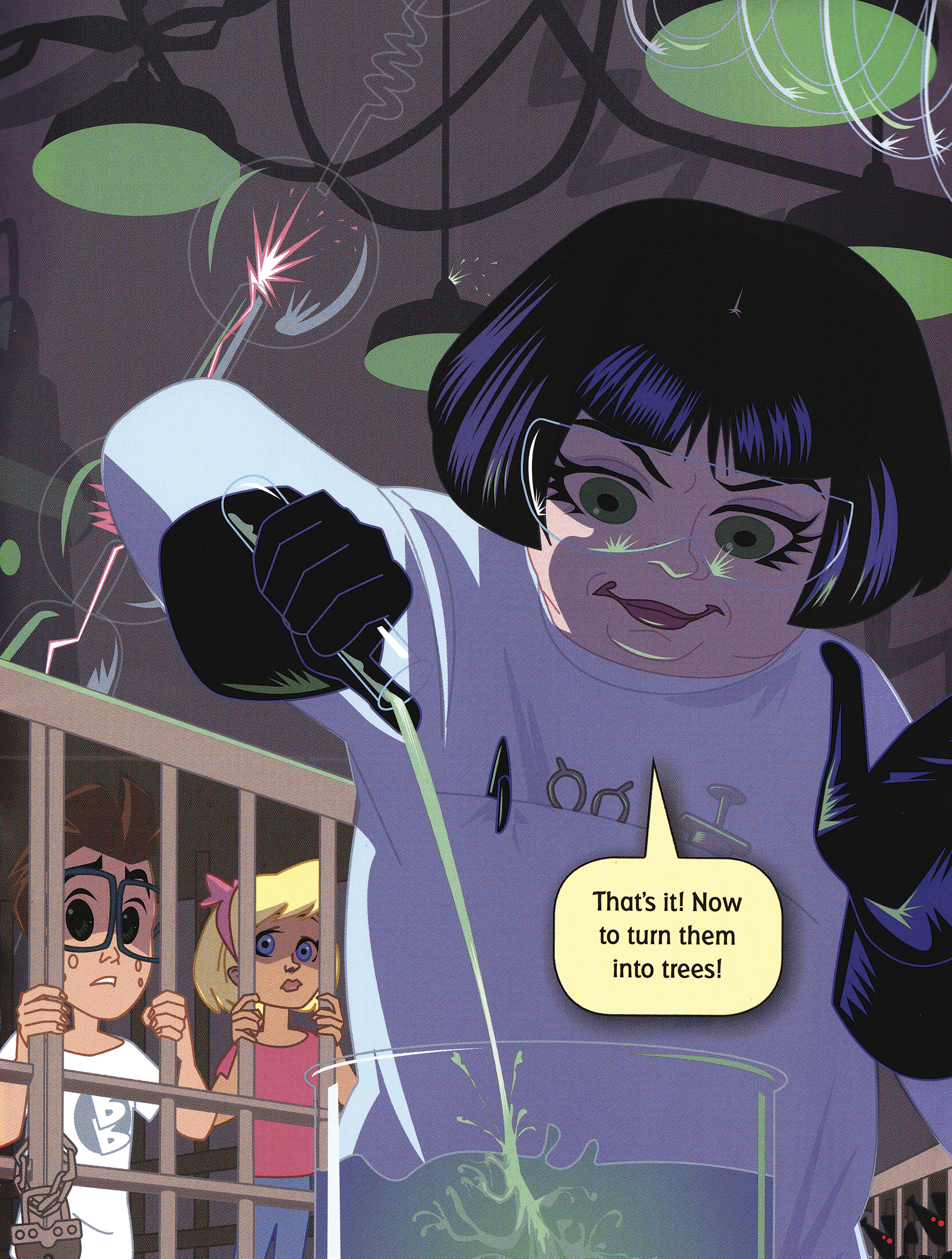
In a 2018 study, ‘male villains were eight times more likely to appear compared to female villains’ in children’s books:Footnote 706 wickedness is heavily gendered, and the majority of evil professors here are male. Dedrick the Professor invents a Robobeast army that will take control of nature and the oceans.Footnote 707 Professor Aldous P. Lickpenny, criminal mastermind, wants to turn children into his robot ‘mechanizmos”.Footnote 708 Professor Severus Snape is a complex, vindictive, often intimidating, presumed evil figure in the Harry Potter series.Footnote 709 Lord Asriel is a dominating, stern and calculatingly cruel presence in the His Dark Materials trilogy (although in the end shows his love for his child and former lover).Footnote 710 Professor Gargoyle, in a school story for older children which revolves around sinister teachers, mutant two-headed rodents and tentacles that threaten to overpower unsuspecting pupils, is shown dislocating his shark-toothed jaw, snake style, and holding up a rat to eat it whole in a frightening illustration in Professor Gargoyle, Tales from Lovecraft Middle School, showing that professors’ evil madness can also be terrifying.Footnote 711 Likewise, children are lured home with the ‘Mad Professor’s Daughter’ with gruesome consequences in the Allan Ahlberg poem:
This piece is commonly placed on reading lists for children aged seven to ten, and regularly recommended for a poetry exercise in UK primary schools.Footnote 713 A tale of being lured away from the safe school setting into the hands of the Mad Professor is enjoyable when the readers are safe enough to explore fear,Footnote 714 in a reminder that ‘much humour for children is exaggerated, fantasy writ large, a reminder of the monstrous and the freakish’.Footnote 715 Children know that when academics are not telling them how the world works, or being ineffectual, boring and eccentric, they are being destructive and evil: readers can enjoy the thrill, laugh at the difference and explore the threat safely from tales in books. Nevertheless, the mad, evil stereotype is reinforced: intellect is predictably other, strange and dangerous. The irony here, of course, is that there are increasing levels of stress, anxiety and mental illness being reported by those working within the University system, due in part to the increasing pressures being placed on those operating within the academic machine.Footnote 716
5.4 Influences from Popular Culture
Children’s literature does not exist in a vacuum, and it reflects and responds to external events and pressures. The characters and behaviour of fictional academics do not operate in isolation, but mirror historical events and existing structures which are firmly embedded into our culture, responding to and producing what publishers believe will be commercially viable product. The readers of children’s literature, too, are part of this experience: ‘children’s knowledge, understanding, and values are culturally saturated’.Footnote 717 Given that half of the corpus has been published in the last 25 years, many fictional academics have absorbed and inherited characteristics from other media.
Haynes has traced the developing stereotype of the scientist in popular culture, suggesting that these function as ‘enduring myths to explore and express the deep-rooted but often irrational fears their society has held, usually inarticulately, and perhaps even subconsciously, with respect to science and technology’.Footnote 718 Haynes traces how ‘the recurrent mutual suspicion between scientists and other members of society was developed and reinforced in Western literature’,Footnote 719 chronicling the growing and changing stereotype or caricature: the oral tradition of the sorcerer or shaman; alchemists (moving beyond areas most people can understand); evil Dr Faustus (the intellectual madman); the foolish Restoration virtuosi (‘pursuing useless, irrelevant, and usually disgusting research, into topics with which no gentleman should concern himself’Footnote 720); the Enlightenment philosophers (Newton, and the scientist as genius); the ‘Romantic image of the scientist as cold, inhuman, and unable to relate to others’ which ‘has been one of the most influential in twentieth-century stereotyping of the scientist in both literature and film’,Footnote 721 particularly in its depiction and exploration of Dr Frankenstein; the Victorian adventurer-scientist who ‘should be an isolated individual or at most supported by a small band of assistants, necessarily inferior to him in mental ability’;Footnote 722 the fin-de-siècle adulation of the inventor, and the connection between the scientist and machineries of war. The impersonal and amoral scientist dominates in the twentieth century with a roughly chronological development of ‘the power maniac seeking to destroy the world … the scientist with an essentially evil philosophy … the scientist as exemplar of amoral perspective … because of his own personal inadequacies in nonrational pursuits’Footnote 723 and finally ‘a different kind of troubled and inadequate scientist, a peculiarly twentieth-century figure’: the scientist who has lost control of his discovery.Footnote 724 These representations coalesce in the aftermath of the atomic bombFootnote 725 and the invention of nuclear power and its associated risks, colouring our modern conception of the fictional scientist. Haynes stresses that men dominate throughout, and that fictional characters such as Dr Faustus, Dr Frankenstein, Dr Moreau, Dr Jekyll, Dr Caligari and Dr Strangelove have done more to influence Western society’s perception of scientists than actual scientists (Newton, Curie and Einstein being exceptions), playing out ‘Western society’s own confused cost–benefit analysis of science, its terrors, and its promises’.Footnote 726 This cultural bias towards science and scientists can also point to further reasons for the male dominance within the books: while science itself is dominated by men across all occupations,Footnote 727 the supposedly radical and forward-looking genre of science fiction is also notoriously dominated by aggressive and elite male characters.Footnote 728 Leading children’s books author Ursula Le Guin described science fiction’s sexist and hierarchical structure:
From a social point of view most SF has been incredibly regressive and unimaginative. All those Galactic Empires, taken straight from the British Empire of 1880. All those planets – with 80 trillion miles between them – conceived of as warring nation-states, or as colonies to be exploited, or to be nudged by the benevolent Imperium of Earth towards self-development – the White Man’s Burden all over again. The Rotary Club of Alpha Centauri, that’s the size of it … It is a perfect baboon patriarchy, with the Alpha Male on top, being respectfully groomed, from time to time, by his inferiors.Footnote 729
It can be shown how the previous depiction of academics in children’s literature informs the depictions in later texts. In an analysis of the maturing science in the Professor Branestawm books, Bell observes that, over time, ‘images of science become more ambivalent, drawing on the childlike images of the past while adding new features’Footnote 730 as the ‘nostalgic tendencies of book production and dissemination’ means that the images portrayed are ones that look ‘back nostalgically at the time and remains resonant in its nostalgia today’.Footnote 731 The representations of academics we find in children’s books become more stereotypical over time, compounding and self-referencing popular fictional figures in children’s literature, from the mid-twentieth century onward. Indeed, the academics found in enduring (still in print, or available in multiple editions) or popular (many-selling) children’s books from the Victorian period until the middle of the twentieth century set the blueprint for other characters to follow, helping to form the dominant cultural stereotype of academics in children’s literature themselves, The Water-Babies’ Professor Ptthmllnsprts,Footnote 732 Professor BranestawmFootnote 733 and The Lion, The Witch and the Wardrobe’s Professor Digory KirkeFootnote 734 setting the tone for much literature that followed.
Furthermore, the anti-intellectualism – ‘the distrust of intellectuals and the resentment of intellectual activities’Footnote 735 shown in picture books such as Professor P. Brain,Footnote 736 Professor Poopypants,Footnote 737 Professor BumblebrainFootnote 738 and Professor StupidoFootnote 739 – has a long history. ‘The strain of anti-intellectualism has been a constant thread winding its way through our political and cultural life, nurtured by the false notion that democracy means that “my ignorance is just as good as your knowledge.”’Footnote 740 Described as a ‘Cult of Ignorance’,Footnote 741 anti-intellectual popularist rhetoric has played out in mainstream culture, particularly in American election campaigns. In 1952, Adlai Stevenson was dubbed an ‘egghead’ by Richard Nixon, and ‘this dichotomy carried over into future elections, one candidate serving an as “everyman” and the other, often unfairly, cast as an elitist intellectual’.Footnote 742 In 1968, presidential candidate George Wallace, Governor of Alabama, ‘got his strongest applause for denouncing bureaucrats, pointy-headed pseudo-intellectuals and professors who know “how to run the war in Vietnam but can’t park their bicycles.”’Footnote 743 Carrying on to the present day, we find UK politicians sneering that they have ‘had enough of experts’,Footnote 744 that ‘the suspicion of experts goes back to antiquity and it’s a very healthy thing to have. Experts, soothayers and astrologers are in much the same category’,Footnote 745 and – at time of writing – a President of the United States of America decrying ‘fake news’ while promoting ‘alternative facts’ and making statements like ‘I love the poorly educated. We’re the smartest people, we’re the most loyal people’.Footnote 746 Given the coverage of this type of statement in popular news media over the past sixty years, anti-intellectualism is now firmly entrenched into western culture,Footnote 747 and is seen playing out in children’s literature, from the laughter at the lecture in Sylvie and BrunoFootnote 748 onwards. The academic as baffled failure in children’s books reaffirms established tropes, becomes more popular in the latter half of the twentieth century and teaches the next generation to distrust boffins, eggheads and intellectuals. As Franzini, in her study on the representation of intelligence in children’s television, notes: ‘this lack of emphasis on academics, together with its “uncoolness” underscores our society’s devaluation of intelligence, thus keeping intelligence unattractive to people from an early age’.Footnote 749 The children most susceptible to this bombardment, of course, are those who do not have the cultural capital (either financial or intellectual) to shield them, and who are not encouraged to partake in higher education despite these prevailing cultural messages.
There is, in addition, a double whammy for female experts, given the ‘concerted and ubiquitous … attacks on women and on women’s credibility’ in the modern media environment;Footnote 750 and the popular media’s attitude to women, and the lack of their representation, also provides another sociological driver for their exclusion in any corpus-based research. Biases exist as to expectations of who is allowed to be a genius, reflecting prevailing gender stereotypes.Footnote 751 Children’s media is far from the only media that is biased against women, in a problem that is worldwide and ongoing.Footnote 752 Children’s literature begins from a world of inherited anti-female bias, although it should be awake, by now, to this, given the volume of research that demonstrates its complicity.
Illustrators, authors and publishers draw on a cultural inheritance comprising alchemists, wizards, the music-hall, popular literature, film and television. We also see a presumption in children’s literature that academia equates to scientific enquiry, and scientific enquiry equates to male domination, which is something that has both been picked up from the history of academic institutions and reinforced by cultural stereotypes: the highlighted shorthand of modern’s children’s fiction, which ‘depends upon a canon of sentiment’.Footnote 753 The dominant form of the professor in children’s literature that we arrive at by the close of the twentieth century is, then, a postmodern repacking of various themes, tropes and influences, which, like postmodern art,
splices high and low culture, it raids and parodies past art, it questions all absolutes, it swamps reality in a culture of recycled images, it has to do with deconstruction, with consumerism, with television and the information society.Footnote 754
It can be very difficult to break these associations, once made: they can be played with, overridden or deliberately challenged, but ‘Many, if not all of us, work in systems in which books published some time in the past are used regularly’Footnote 755 and ‘The system is older than you. It has absorbed more venom than you can ever hope to emit.’Footnote 756 We have to choose to understand our ongoing inheritance from children’s literature in order to challenge it.
5.5 Conclusion
These three distinct tropes in the corpus – the teacher, the baffled inventor and the evil genius madman – have evolved over time, and now dominate the behaviour of academics in children’s literature. The stereotypes of professors and doctors themselves become functional aspects of children’s literature, and are entrenched by the time the majority of the corpus has been created from established stereotypes embedded into contemporary culture, in an act of ‘Cultural Cloning’Footnote 757
which is predicated on the taken-for-granted desirability of certain types, the often-unconscious tendency to comply with normative standards, the easiness with the familiar and the subsequent rejection of those who are perceived as deviant.Footnote 758
It is easy, and in places just, to decry these as pejorative or hollow depictions of intellectual achievement and the academy. We also have to concede that these stereotypes work because they are so suitable for their audience:
it is difficult to … overcome the present negative image. Because upper primary age children delight in slapstick and exaggerated humor, the character of the ‘Mad Scientist’ is tailor-made for them.Footnote 759
However, these stereotypes now also provide a framework in which modern authors and illustrators can swiftly introduce characters into children’s literature, without the need for lengthy explanation or backstory: Knapman commented that Dr Frankenstinker came from ‘rooting around in the dressing up box of children’s literature’;Footnote 760 Grey said, ‘stereotyping characters is a way of staying within the bounds of what seems normal to the reader’.Footnote 761 While this does not excuse the bias and lack of diversity we see, it raises questions about the nature, role, function and necessity of stereotypes, which fulfil ‘cognitive, emotional, and pragmatic’ functions.Footnote 762 While stereotypes are normally ‘treated in conjunction with prejudice’,Footnote 763 children’s literature depends on their advantages: stable relationships, constructs and meanings in which the ‘brevity of description and extreme poverty of detail permit an immediate recognition of the basic model’,Footnote 764 participating ‘in the elaboration of the text as network, in a reworking of models and problematization of commonplace visions of the world’.Footnote 765 This analysis has attempted to unpack the complex historical and societal trends which underpin the stereotypes of professors that exist in children’s literature.
An attempt to describe how we can build upon this knowledge positively is given in Section 6.
6 Conclusion
This analysis has undertaken a major publishing history of the representation of academia, and academics, in children’s literature, scoping out the history, growth, positioning and representation of academia in books written for a childhood audience, analysing their collective book culture. A strict methodology was developed to build a longitudinal corpus, excluding books that developed as spin-offs from other media: however, the resulting corpus has been shown to be increasingly intertextual, referring to, and building on, other media and popular culture, and these internal and external influences on how the academy is represented in children’s literature have been teased out. The trope of the male, mad, muddlehead has been shown to have condensed and stabilised within children’s illustrated books towards the end of the twentieth century, and is now a known and readily identifiable stereotype. The white-haired old scientist, called SomethingStupid, is a vehicle and mechanism within children’s picture and illustrated books, which has a complex relationship to the real-life academy.
Throughout this analysis, the fictional university depicted in children’s literature has been closely compared with historical and current statistics about its real-world counterpart. We have shown that the real university has both historical and present issues regarding diversity, including gender balance, race and class. With some of those – such as gender balance – improving slowly over the past decade or so, we hope that other media referencing this culture should also begin to reflect these changes, even if it will take time for this to trickle down (the growth of the female professoriate in children’s literature being much slower than we would expect; see Section 4.4). With other equally complex diversity issues – such as race and class within the academy and the elitism of high-performing institutions combined with their cultural dominance – can we really complain if children’s literature does not reflect a fairer world than our real-life institutions? These factors do not exist in isolation, and children’s literature has held up a mirror to the university, reflecting what it has shown, darkly, indicating that ‘Illustrations and texts in books for young children … both carry and challenge prevailing cultural ideologies and stereotypes’.Footnote 766 The dominant historical representation of academics in popular culture is that of old white scientific men: combatting this is a weight for any author or illustrator to lift, while also assumptions and tropes that have been learnt by even a young readership on the mechanics and function of professors and doctors within children’s literature need to be taken into account. It will take playful imagination and deliberate action by publishers, authors and illustrators to decompress the stereotype of the male, mad, muddlehead that the academy has been distilled to, particularly in picture books, and this may never happen if the university sector itself does not improve on its own diversity measures.
Given the work necessary to gather the corpus, it is highly unlikely that any children would have seen all of the examples presented here,Footnote 767 but they will have come across enough (in books, but also in other media) to understand the ineffectual mad male professor stereotype, given ‘children and their culture are shaped not just by individual texts but by the aggregate impact of all children’s literature, especially the most popular or most recommended works’.Footnote 768 The long tradition of anti-intellectualism, as well as racism and sexism, in children’s literature lives on in previously published texts, and will be encountered by children in higher volumes than any modern publishing attempts to address or subvert problematic stereotypes. The effect this will have on a child reader is debateable; however, it is likely (given studies that have been carried out on the effect of other stereotypes) that children will internalise the negative messages regarding intellectual achievement, expertise and higher education that they are being mostly shown. We have to ask, ‘What values are being promoted, and who is the reader to become – whose life are you sharing – during the reading?’Footnote 769 When we trot out examples of the male, mad, muddlehead ‘What are we doing to – or not doing for – children?’Footnote 770 How does the role and effect of children’s literature fit into the complex media landscape that contributes to children’s development? It has been shown that ‘career aspirations of young men and women are shaped by societal stereotypes about gender’ and ‘by the age of 6, girls are less likely than boys to believe their gender are “really really smart”, because “cultural messages about the presumed cognitive abilities of males and females are likely to be influential throughout development”’ in a paper titled Gender Stereotypes About Intellectual Ability Emerge Early and Influence Children’s Interests.Footnote 771 Is it coincidental that around the age of six is when most children begin to read? This analysis provides evidence that academia and intellectual achievement is presented in a sexist, racist way in children’s books, and Bian et al.’s study confirms that this is contributing to gender disparities in science and academia, which has ramifications throughout academic structures for female intellectual attainment.Footnote 772 Stereotypes impair women’s careers in science,Footnote 773 and probably do so for other minorities in other situations, too. Time out, authors, illustrators and publishers!
What would challenging the stereotypes revealed in this analysis entail? Indeed, what would it take to break the overall bias towards able-bodied white men in children’s literature? More females – behaving in both good and bad ways – and in particular more elderly females; less gendering of even inanimate objects as male; more black, Asian or ethnic minority characters; fewer upper middle or upper class characters; more attention to diverse depictions of physical disability; avoidance of ableist depictions of mental illness; and less reinforcement of heteronormative behaviour, would start to redress the imbalance shown within this particular corpus, in a shopping list that could be applied to almost any genre or topic in children’s literature, to make it more closely and fairly reflect societal makeup while providing diverse role models that can help positively shape culture and behaviour. Expanding the role in fiction for experts and professors by playing with these variables would allow an expansion of a depiction of the professoriate which has become increasingly narrow in the latter half of the twentieth century. However, is it realistically possible to change this, given the challenges that this poses to publisher, author, illustrator and reader in fighting against a complex and tightly bound cultural inheritance and a well-defined marketplace? The quantification of biases via content analysis, which serves to highlight the lack of diversity in children’s literature, has been a focus of much academic activity for the past forty years, but we see here that these biases maintain, persist and even grow. Any modern trends in encouraging diversity
and decreased stereotyping cannot be taken for granted and probably reflects real gains in public consciousness … about the importance of gender-egalitarian displays in children’s media. Antifeminist backlash in other media … suggest that such a trend is reversible.Footnote 774
From a methods perspective, this study raises interesting opportunities for the study of children’s literature, particularly for those undertaking longitudinal corpus-based research. Indeed, this research is an advert for transparency and the use of digital media within the research process, given that it would not exist without its trajectory from discussions on Twitter to a collection on Tumblr to blog post to write-up. Methodological innovations include highlighting the importance of liaising with librarians when undertaking a study of this nature; the integration of library records and datasets into longitudinal study, expanding the methodology of current approaches in children’s literature (although it is conceded that much more could be done to both improve and visualise the British National Bibliography dataFootnote 775); the use of online environments, including social media resources, which have been demonstrated to be a rich information source to complement existing, and essential, library catalogues; the integration of digitised content, and content created by digitisation on demand, which can be juxtaposed with the consultation of physical texts, to undertake a longitudinal content analysis and expand the set of available books to study(while also making source material available as an anthologyFootnote 776); and the need to develop methodological approaches to encompass print-on-demand or ebook-only publications, when studying the modern children’s literature publishing environment. It was only possible to build the broad corpus analysed here by using an array of digital methods, online resources, digitisation on demand and social media platforms, indicating the centrality of the digital to future children’s literature research. There are no doubt further research gains to be found by undertaking large-scale automated analysis of the actual texts within children’s literature corpora, although the copyright restrictions in gaining access to enough text, and the complexities of semantic image processing, mean that this is a further, rather than nearer, future research methodology. It is one to keep in mind, however, given developments in big data analysis for other media.Footnote 777
As well as these methodological benefits of digital approaches and use of the online information environment, it may be that creative use of online mechanisms can help broadcast and challenge bias in children’s literature in a far wider way than can traditional subscription-only behind-paywall academic publications. It is not enough to tell other academics about the biases involved, but to involve authors, illustrators, publishers and ultimately consumers of children’s literature in the debates surrounding diversity and stereotyping. We see this in online activism springing up in social media campaigns contesting the lack of diversity, or enforced gender roles, of different media, such as #OscarsSoWhiteFootnote 778 and #LetToysBeToys,Footnote 779 or those which respond to structural oppression in higher education such as #DistractinglySexy, #StayMadAbby and #BeckyWithTheBadGrades,Footnote 780 which ‘exemplify an emerging mode of online resistance by marginalized subjects’ with ‘the use of social media platforms to gain wide visibility, the creation of hashtags to allow for grassroots collective participation and viral spread of content, and, crucially, the use of humour to destabilize the institutional framing of these conflicts by dominant groups’.Footnote 781 Content analysis done by volunteers provides research as ammunition; for example, the VIDA Count,Footnote 782 which quantifies gender disparity in major literary publications and book reviews. Academic and industry reports on bias are accruing, such as those from the Geena Davis Institute on Gender in Media,Footnote 783 which focusses on the film and television industry, the outputs of the Cooperative Children’s Book Center at the University of Wisconsin-Madison,Footnote 784 which produce yearly statistics on children’s books about people of colour and first/native nations,Footnote 785 and the UK Arts Council funded ‘Survey of Ethnic Representation Within UK Children’s Literature 2017’ produced by the Centre for Literacy in Primary Education.Footnote 786 It is clear that digital, community-based participatory methods will be part of the solution to broadcast, share and challenge assumptions regarding what is appropriate in children’s literature, and this development is evident in sites such as A Mighty Girl,Footnote 787 ‘The world’s largest collection of books, toys and movies for smart, confident, and courageous girls’ (2017), and We Need Diverse Books,Footnote 788
a grassroots organization of children’s book lovers that advocates essential changes in the publishing industry to produce and promote literature that reflects and honors the lives of all young people.
Indeed, the ‘most funded book in crowdfunding history’ is an inspirational collection of ‘100 bedtime stories about the life of 100 extraordinary women from the past and the present, illustrated by 60 female artists from all over the world’:Footnote 789 Good Night Stories for Rebel Girls.Footnote 790 Raising over $1m from 20,000 backers through a Kickstarter and Indiegogo campaign, the success of this project shows that the authors ‘are filling a vacuum … We are responding to clear need’,Footnote 791 which should also be a rejoinder to those who say there is no market for diverse children’s books.Footnote 792 The follow-up volume, Good Night Stories for Rebel Girls Vol. 2,Footnote 793 crowdfunding at the time of writing, has gone on to ‘smash the Kickstarter record for the fastest-funded publishing project in the crowdfunding platform’s history’.Footnote 794 It would appear that the current digital environment is finally matching demand for diverse texts with commercial distribution mechanisms which can allow them to be profitable. However, concerns remain that the market is for texts which prioritise female empowerment only, rather than equality and diversity across the board.Footnote 795
Can publishers do more to foster, encourage and respond to this type of activity? Despite the comments made earlier about digital-only print-on-demand texts, and while recognising the skill it takes to produce high-quality children’s literature, it should also be possible for authors, illustrators and publishing houses to experiment with a wider range of titles, exploring diverse issues and harnessing the power of social media, if using online publishing mechanisms. There needs to be concerted effort in utilising online platforms to disrupt established publishing hegemonies, and reaching and reflecting wide audiences, while counteracting the low-quality, rushed digital content flooding the market, as a mechanism to embrace the forces of social media that are encouraging open discussions on diversity and difference.Footnote 796 Digital participation and critique of children’s literature from diverse communities could also provide a necessary feedback loop to the publishing industry, much in the way online discourse is now influencing television production,Footnote 797 or in the shift in producer and consumer power demonstrated with the growth of the fan fiction community.Footnote 798 This digital outreach need not only be online, to avoid the ‘excessive dependence’ on the Internet, to improve digital literacy in impoverished rural areas worldwide.Footnote 799 Engaging with this digital shift will also require ‘new media modes of public/scholarship’ which
offer us the opportunity and the imperative to transform ourselves as scholars, because our technologies and practices remain shot through with systemic biases and inequities that structure and constrain existing educational, social, political, and economic interactions and institutions. How could they not be?Footnote 800
This text has aimed to be transparent in the presentation of research activities, including the labour involved in the publishing process, whilst being respectful of the efforts made by others other than the writer which were required to present it to you, in this form. The text you are reading here is published in print, but is also freely available in online ‘open access’ to anyone who wishes to read it. This was a policy decision regarding the necessity to make such criticism available in order to reach a wide community, in the hope that the investment needed for open access means it can contribute to ongoing debates on gender, diversity, higher education and the media created for children. However, this was only possible through UCL paying a Book Processing Charge of £6,762, and I am cognisant of the privilege this represents, and the open access advantages it endows. It is hoped that, by making such a forward-looking longitudinal study freely available to all, it can contribute to discussions regarding media and higher education and provide an accessible resource to bolster future ongoing discussion.
There are, of course, weaknesses in this study. The corpus has been treated as a whole, when it is unlikely that any author, illustrator or publisher will have come into contact with many of the representations mentioned here, and it should be remembered that these characters are created from a complex relationship with prior influences. Academics in pre-teen periodicals were included, and although there is a confidence in the exhaustion of candidates in books found by this particular methodology, there will be some that have been missed, and more can be done to ensure that the coverage of comics is comprehensive, given how patchy their documentation is. A bibliometric method could have been developed to track recurrent characters across book series, rather than noting only their first appearance in the corpus. There has been no attempt at ‘reader response criticism’ in discerning the child reader’s experience of this corpus.Footnote 801 There is always a danger of becoming too po-faced about media which is designed to – and does – entertain children, and we have to remember that the slapstick humour of the baffled expert, or the world-destroying naughtiness of the madman, works for children because they are stereotypes that are ridiculous and funny, and that play with behavioural expectations and norms: it is hoped that this has been noted throughout the text, without falling too hard into stern potholes of Lacanian and Jungian symbolism. Further research is needed into the impact of the stereotypical representation of intellect and academic achievement before conclusions can be drawn about the effect they have on children, although all signs point to media diets impacting behaviour and children’s self-belief and self-actuation. Obvious follow-on studies can be sketched out: how universities and academics are portrayed in texts for older child audiences that are not illustrated,Footnote 802 or a comparison of how the representation of academics in English children’s texts compares with books in other languages.Footnote 803 There is more that could be, and should be, done with the British National Bibliography dataset, including further cleaning and double-checking data and examples, in order to build up a public-facing informational resource that would benefit a wide-ranging children’s literature community. Distant Reading could be expanded to the content of texts, rather than limited to their metadata, although copyright is a barrier here.
Thought must be given into how best to communicate these findings to the authors, illustrators and publishers that create children’s literature, who can maintain stereotypes, or have the mechanisms and potential to create products that can challenge problematic representation. How best can we persuade the consumers of children’s literature (or, more accurately, the purchasers of children’s literature) to point their spending power to books that can entertain, while not excluding a diverse range of readers or have the effect of narrowing their opportunities? These last two points are no small ask, and it is hoped that, by carrying out this study in such a public-facing manner right from its inception, others can become aware of the problems that exist regarding representation in children’s literature, while also wagging a finger at the academy itself for its own problematic behaviour regarding diversity. Time out, provosts and chancellors – 85 percent of whom, across Europe, are white men!Footnote 804 It’s complicated,Footnote 805 but a range of practical interventions can be used to improve gender equality in research organisations.Footnote 806
In some respects, this topic has been a tiny borehole through the pantheon of children’s literature, showing how it upholds structural inequalities and systemic biases that are entrenched within society, while simultaneously mocking and criticising the world it reflects through stressing the ridiculousness of the stereotypes it builds upon. Authors, illustrators and publishers can be censured for profiting from negative stereotypes without creatively or imaginatively challenging them; however, they can also use these ready-made constructs as scaffolding upon which to build plot and pace, without using up precious resources in explanation. While the stereotypes presented from this analysis can be and should justly be questioned, the dual nature of (particularly present-day) children’s literature in both reinforcing and highlighting cultural tropes needs to be situated within the postmodern context. There are tensions between the relationship of real life to children’s fiction, the depiction of accurate representations, the genesis of pejorative stereotypes that reaffirm social bias while showing how problematic they are, or the development of hopeful and imaginative representations that can challenge established tropes. We see all this wrestling within the corpus, in an attempt to educate and entertain children, in media that depend upon cultural shorthand for efficiency. Children’s literature scholarship depends on spotting these intersections:
Young children need plenty of time to sort out the differences between make-believe and reality, dreaming and living, fantasy and fact. To recognize this is to pay attention to the form and content of the imagery we make available to them. It is to understand that, from their point of view, each image has an effect that we as adults do not fully grasp, unless, perhaps, we pay attention.Footnote 807
It is hoped that, by paying close attention to the representation of one profession within children’s literature, future debates on higher education, public perceptions of the academy and the impact of media created for children that deals with intellectual achievement and agency can all be considered anew.
The asking of a simple question – how are universities depicted in children’s illustrated literature? – has resulted in a multifaceted analysis of visual and textual tropes, evolving into a picture of intertextuality, popular culture, the mechanisms that create and utilise stereotypes and the relationship of the fictional academy to its real-world counterpart. A study of fictional academics has forced reflection on obsession, intellect, expertise and how professors in the higher education environment are perceived, and also how they operate. This has both revealed representations of, and been carried out because of, the detail-driven, curiously ‘other’, mentality that drives many academics and their studies. This is also research that has only been possible because of, and enabled by, a certain amount of privilege. I mean, who would voluntarily spend four years collecting books that feature mad professors in order to make a spreadsheet that counted their beards? And then write a book about it, for fun? Weirdo. Weirdos, the lot of them.,
Acknowledgements
This was not a book I intended to write. In the spring of 2012, while reading to my sons, the eldest of whom was then three years old, and his one-year-old twin brothers, I came across two professors in children’s books in quick succession. An initial sharing of these characters on the social media platform TwitterFootnote 1 gradually became a habit, and eventually the encouragement came that I should set up a Tumblr blog to collate them,Footnote 2 which I duly did: http://academiainchildrenspicturebooks.tumblr.com/.
Searching for mentions of representations of academics in children’s books became the thing I did in boring staff meetings, but as well as building what turned out to be a corpus, it allowed me to play with the digital information structures that underpin academic humanities research. My day job at the time of writing was to teach digitisation technologies within a Library school, and I partake in large-scale team-based digital humanities initiatives that aim to open up access to resources through digitisation (such as Transcribe BenthamFootnote 3 or the Great Parchment BookFootnote 4). Here, instead, was a miniature, unfunded, refreshing project I could undertake on my own, that asked: how do you find difficult-to-trace examples in an under-catalogued and under-digitised area? How exactly do you find representations of universities in children’s literature, and which information science methods and approaches are the most fruitful in this changing library environment? The response to writing up my findings in an initial blog post in 2014Footnote 5 made it obvious that this wasn’t a ‘funny-ha-ha’ project anymore. An invitation to discuss my work with the Children’s Literature Group while visiting Deakin University in Melbourne at the close of 2014 was my first real contact with children’s literature scholars, and they encouraged me to think that my research was brave and innovative, and could be useful to others: thus the methodical analysis began. I attempted to finalise this in a paper in 2016, but there was far too much to say. This Element is the result of a playful asking of a question – how is academia represented in children’s illustrated books? – answered over a period of a few years, being the result of ‘slow’ researchFootnote 6 with no deadlines, no pressures and no funders to answer to, carried out in rare breaks and breathers, for pure ludic joy. Academics are strange like that.
I’ve leant heavily on the expertise of my colleagues, often ending a meeting about something else with a pointed question about woodcuts in the nineteenth century, or cataloguing guidelines in the twentieth, and I am indebted to those who took the time to listen to me babble about a project seemingly unconnected to the day job. Anne Welsh has been my go-to bibliographer, and ‘my’ librarian, throughout this project. Deb Verhoeven has been a great ally in encouraging my feminist thinking, and she facilitated contact with Professor Clare Bradford and her Children’s Literature Seminar colleagues at Deakin University who took the time to discuss my embryonic work, and persuaded me it was worth pursuing further. It was Edward Vanhoutte who suggested that this project was not a blog post but a short book, Lisa Jardine who encouraged it, and Melanie Ramdarshan Bold and Samantha Rayner who gave me the opportunity to publish in this form, with assistance from Bex Lyons. Pauline Reynolds, Lesley Pitman, Claire Easingwood and Julianne Nyhan all provided detailed, insightful comments on an early draft that aided the shaping of my argument. Lorna Richardson was extremely helpful in an initial formatting of the appendices, and Eugene Giddens expertly steered the text to the final version you see here, assisted by Tim Mason, Richard Hallas, Dave Morris, Victoria Parrin and Bethany Thomas from Cambridge University Press.
Tania Evans was my remote assistant in checking details in books at the National Library of Australia, and Floor Buschenhenke assisted with texts in The Koninklijke Bibliotheek in Den Haag. Books were provided for me, digitised on demand, by: Cambridge University Library; The School of Oriental and African Studies Library; University of New Brunswick Library; Watkinson Library, Trinity College, Hartford, Connecticut; Oxford University Libraries; The British Newspaper Archive; and Rare Books and Special Collections, Northern Illinois University Libraries. I would like to thank the anonymous librarians and photographers involved in connecting me with the texts required throughout this project.
I have asked questions of people in the children’s literature industry, who replied generously and promptly, including Debbie Foy (Managing Editor of Wayland) and the authors Mavis Crispin, Felice Holman, Mini Grey, Timothy Knapman, Sally Odgers and David Orme, and the illustrator Emily Arnold McCully. Many other information professionals, librarians and academics have aided and abetted, including: James Baker, Giles Bergel, Alan Danskin, Amy Earhart, Graeme Forbes, Vanessa Freedman, Amanda Gailey, Adam Gibson, Ann Gow, Graham Hawley, Graham Hogg, Darryl Mead, Victoria Morris, Aimée Morrison, Ben O’Steen, Lesley Pitman, Ernesto Priego, Melanie Ramdarshan Bold, Samantha Rayner, Pauline Reynolds, Helen Roberts, John Scally, Matthew Symonds, Ben Taylor, Helen Vincent and Sarah Werner. Julianne Nyhan has provided welcome and consistent encouragement, input and supportive friendship throughout the writing of this text. Thank you all for providing helpful advice and further suggestions.
This research was unfunded; however, it was finally completed as part of a scheduled term-long sabbatical from UCL. I’m appreciative of the academic freedom which has allowed me to pursue something outside my normal area of expertise, as well as the support of UCL Library staff, and the UCL resources which have enabled this text to be made available in open access.
I am lucky with my friendships, and thank Felicity and Sattam Al-Mugheiry, Jane Audas, David Beaumont, Natalie Curtis, Claire Easingwood, Susan Edwards, Andrew Green, Hannah Isher, Inna Kizhner, Sue Mucieniks, Fleur Porter, Rosalind Porter, Justin Pniower, Caroline Sills and Edward Vanhoutte for all patiently listening to me bang on about obscure academic characters when they simply asked me how I was. Raj Chand, Cindy McIntyre and Rachel Luck have literally put me back on my feet numerous times during the writing of this text: thank you. I am indebted to my family: my parents, my grandmother, my brother Robin and my cousin Fiona. My husband Andrew Ostler (Os) is the best thing I ever found on the Internet, and this Element would not exist without his practical, intellectual and emotional support.
Finally, thanks go to my children. My eldest, Anthony, excitedly ran home from infant school to present me with doctors and professors in reading books that would not have been found any other way. We have laughed wholeheartedly at Dr Xargle’s underfrillies and stinkfume, along with my youngest two, Edward and Fergusson, who gave me surprising insights into their view of texts, in a reminder that, although this is now a serious endeavour, it stems from – and should also be – fun. I have enjoyed every minute of sharing these books with you three: thanks, boys.
For Anthony, Edward and Fergusson (who are turning out to be useful research assistants).
Appendix A Children’s Books Included in the Analysis
Appendix B Academics Identified in Children’s Literature, Listed Chronologically
Appendix C Potential Books Identified (But Unavailable)
Series Editor:
Samantha Rayner
University College London
Samantha Rayner is a Reader in UCL’s Department of Information Studies. She is also Director of UCL’s Centre for Publishing, co-Director of the Bloomsbury CHAPTER (Communication History, Authorship, Publishing, Textual Editing and Reading) and co-editor of the Academic Book of the Future BOOC (Book as Open Online Content) with UCL Press.
Associate Editor:
Rebecca Lyons
University of Bristol
Rebecca Lyons is a Teaching Fellow at the University of Bristol. She is also co-editor of the experimental BOOC (Book as Open Online Content) at UCL Press. She teaches and researches book and reading history, particularly female owners and readers of Arthurian literature in fifteenth- and sixteenth-century England, and also has research interests in digital academic publishing.
Advisory Board:
Simone Murray, Monash University
Claire Squires, University of Stirling
Andrew Nash, University of London
Leslie Howsam, Ryerson University
David Finkelstein, University of Edinburgh
Alexis Weedon, University of Bedfordshire
Alan Staton, Booksellers Association
Angus Phillips, Oxford International Centre for Publishing
Richard Fisher, Yale University Press
John Maxwell, Simon Fraser University
Shafquat Towheed, The Open University
Jen McCall, Emerald Publishing
About the series:
This series aims to fill the demand for easily accessible, quality texts available for teaching and research in the diverse and dynamic fields of Publishing and Book Culture. Rigorously researched and peer-reviewed Elements will be published under themes, or ‘Gatherings’. These Elements should be the first check point for researchers or students working on that area of publishing and book trade history and practice: we hope that, situated so logically at Cambridge University Press, where academic publishing in the UK began, it will develop to create an unrivalled space where these histories and practices can be investigated and preserved.
Gathering Editor: Eugene Giddens
Eugene Giddens is Skinner-Young Professor of Shakespeare and Renaissance Literature at Anglia Ruskin University. His work considers the history of the book from the early modern period to the present. He is co-author of Lewis Carroll’s Alice’s Adventures in Wonderland and Through the Looking-Glass: A Publishing History (2013).
Elements in the Gathering
Picture-Book Professors: Academia and Children’s Literature
Melissa M. Terras
Christmas Books for Children
Eugene Giddens


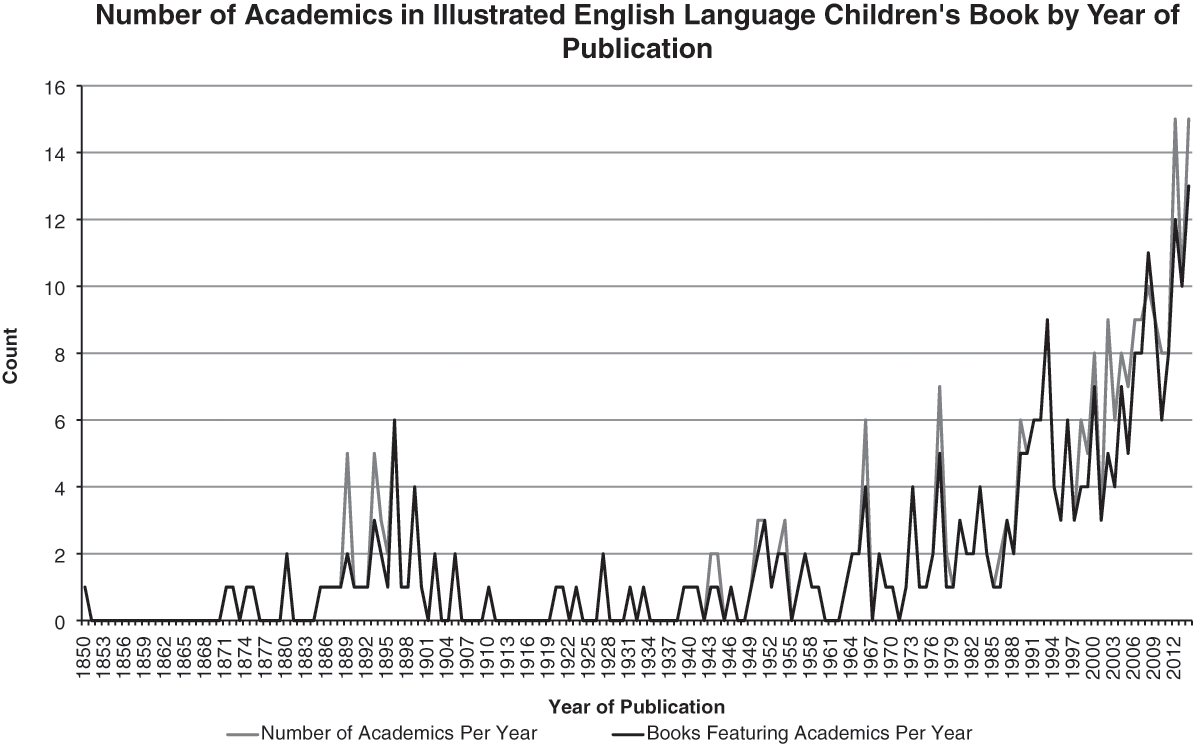


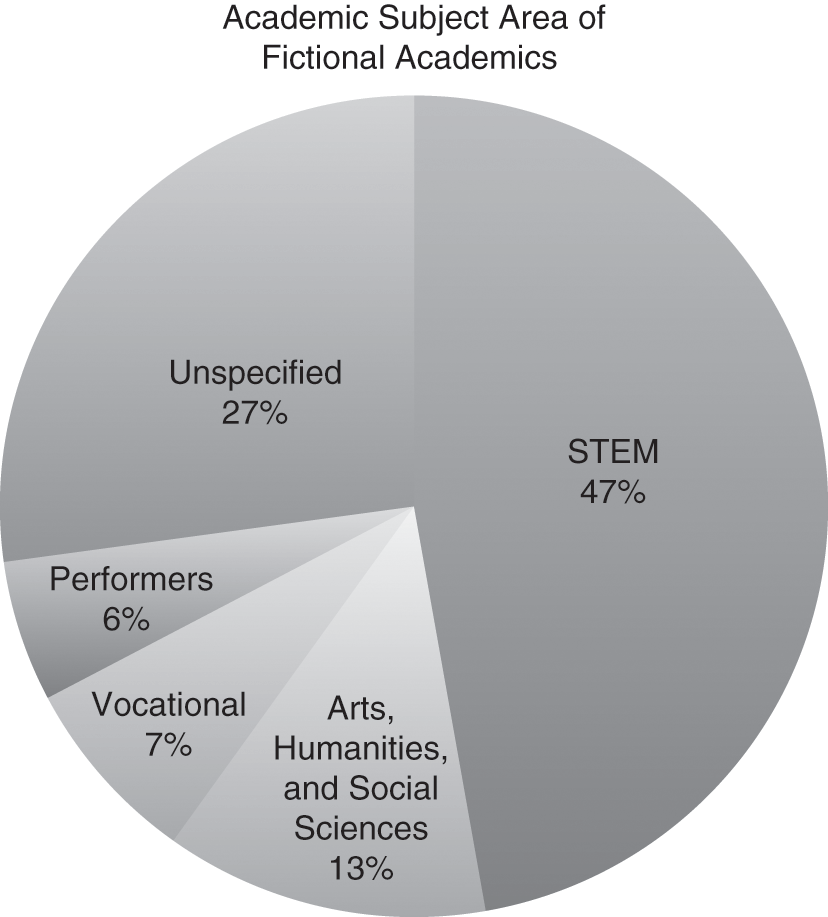


 Open access