


Introduction
In 2017, like many of my colleagues and students, I was deeply unsettled when Donald Trump, as the forty-fifth President of the United States, launched an unusually aggressive campaign – even by American standards of anti-government sentiment – against the administrative state. His deliberate clampdown on government employees and agencies eroded US state capacity and obviously undermined the foundations of the relationship between democracy and bureaucracy. If such developments could occur in the United States – the world’s oldest democracy – they could occur anywhere. Indeed, similar patterns soon emerged in Brazil, Mexico, Poland, and Slovakia.
As public organizations came under pressure from populist governments in many democracies, expectations simultaneously grew that state bureaucracy and bureaucrats would serve as bulwarks against illiberal transformations of state structures and policymaking. Yet bureaucracies and public administration systems often appeared ill-prepared to defend democracy, especially when a growing share of citizens had lost trust in the system and sought alternatives. This raised a critical question: What can we reasonably expect from public administration when democratic systems come under illiberal threat?
While this Element does not provide definitive answers, it offers a framework for understanding and rethinking how the relationship between democracy and bureaucracy must evolve to remain both legitimate and functional in an era of profound change and antidemocratic challenge. However modest this may seem, with Donald Trump’s return as the forty-seventh President of the United States and the rise of other illiberal leaders, the urgency of this discussion is evident.
1 The Illiberal Challenge
Populists, once in power, seek to implement their ideologies – like any government. But unlike traditional political parties that work within the existing institutional setup, populist movements aim to radically transform it, pursuing their goals with limited regard for informal norms, formal rules, or the pluralistic values that balance democratic politics broadly and executive power specifically. There is increasing evidence that populists in government use the temporary authority granted to them to pursue their objectives by disregarding legitimate standards and due process, thereby deliberately eroding liberal democracies from within (Bermeo, Reference Bermeo2016, Reference Bermeo2022; Levitsky and Ziblatt, Reference Levitsky and Ziblatt2018; Norris and Inglehart, Reference Norris and Inglehart2019; Urbinati, 2019; Waldner and Lust, Reference Waldner and Lust2018). Populists in power view state institutions as instruments unconditionally at their disposal, to be organized at will in ways that help to achieve their goals. This places public administrations and civil servants in the spotlight (Peters and Pierre, Reference Peters and Pierre2019; Yesilkagit et al., Reference Yesilkagit, Bauer, Peters and Pierre2024; James, Reference James2025; Bauer, Reference Bauer2025b); it is through state structures managed by government employees that populists in power must advance their illiberal transformations. Democratic bureaucracy thus has the potential to become both the target and tool of populist politics in the quest to transform liberal policies and the liberal democratic system itself. This dual risk constitutes the illiberal challenge for public administration (Hajnal, Reference Hajnal2021; Lotta et al., Reference Lotta, Alves de Lima and Costa Silveira2024a, Reference Lotta, Michelle, Pedote, Landi, Guaranha, Silveira, de Lima, Morais de Sá e Silva and Gomide2024d; Sørensen and Ansell, Reference Sørensen and Ansell2023; Bauer et al., Reference Bauer, Peters and Pierre2021a; Peci, Reference Peci2021; Boda and Hajnal, Reference Boda and Hajnal2025). This Element provides an overview of scholarship on populist public sector governance, examining how populists in government attempt to reshape state bureaucracies and public policies. It highlights key populist strategies of administrative transformation, bureaucratic responses, and crucial research gaps. The aim is to foster dialogue among academics and practitioners on countering illiberal shifts in public administration in order to better understand and deal with the illiberal challenge.Footnote 1
The underlying proposition is that under authoritarian populist rule, bureaucrats may become victims, accomplices, or – whether willingly or unwillingly – guardians against democratic regression (Bauer and Becker, Reference Bauer and Becker2020; Milhorance, Reference Milhorance2022; Raadschelders, Reference Raadschelders, Ladner and Sager2022; Morais de Sá e Silva and Gomide, Reference de Sá, Silva and Gomide2024a; Yesilkagit et al., Reference Yesilkagit, Bauer, Peters and Pierre2024). Yet, social science research struggles to map populist illiberal transformation strategies systematically with respect to the public sector, to explain the occurrence of bureaucratic collaboration or resistance, let alone to provide guidance on how to strengthen democratic public administration systems or to recommend adequate administrative behavior when confronted with illiberal demands (Nabatchi et al., Reference Nabatchi, Goerdel and Peffer2011; Ventriss et al., Reference Ventriss, Perry, Nabatchi, Milward and Johnston2019; Du Gay and Lopdrup-Hjorth, Reference du Gay and Lopdrup-Hjorth2023; Yesilkagit et al., Reference Yesilkagit, Bauer, Peters and Pierre2024; Bertelli, Reference Bertelli2021; Lotta et al., Reference Lotta, Piotrowska and Raaphorst2024b).
1.1 Populism and Democratic Administration
While recent experiences in Brazil, the UK, and Poland suggest that populist rule is neither inevitable nor necessarily enduring, the electoral success of populist parties in Argentina, Austria, Belgium, the Netherlands, and Slovakia underscores the continued virulence of the populist challenge to liberal democracies. Writing at a time when Donald Trump has returned to the US presidency, Giorgia Meloni seeks to reinvent Italy as a plebiscitary democracy, and Viktor Orbán’s firm hold on power in Hungary shows sign of waning, emphasizes the persistent threat of populist and autocratic-leaning political leadership, demonstrating the need to advance and consolidate the debate about the causes, impact, and responses to populists in government – also in the field of Public Administration (PA).Footnote 2
Like many concepts in social science, defining populism remains a subject of debate (Carrión, Reference Carrión2022). Mudde and Rovira Kaltwasser (Reference Mudde and Rovira Kaltwasser2017, p. 6) advocate an ideational approach, describing populism as “a thin-centered ideology that considers society to be ultimately separated into two homogeneous and antagonistic camps, ‘the pure people’ versus ‘the corrupt elite,’ and which argues that politics should be an expression of the [general will] of the people.” Similarly, Müller (Reference Müller2016, pp. 19–20) defines populism as “a particular moralistic imagination of politics, a way of perceiving the political world that sets a morally pure and fully unified people against elites who are deemed corrupt or in some way morally inferior.” In this view, populists are not only anti-elitist but also – and this is perhaps more crucial if we are to understand their conception of the state – decisively anti-pluralist and anti-liberal. Populism is seen as transforming political institutions within democracies (Urbinati, Reference Urbinati2019b) and disrupting the established consensus of ruling elites (Mansbridge and Macedo, Reference Mansbridge and Macedo2019).
Mansbridge and Macedo have analyzed the variegated debates on populism and suggest a definition of populism consisting of a core and its peripheral elements; while the core is fixed, the other elements vary widely, thus producing the many different empirically observable variants of populism (Mansbridge and Macedo, Reference Mansbridge and Macedo2019). Accordingly, the core element of populism should be seen – similarly to Mudde and Rovira Kaltwasser (Reference Mudde and Rovira Kaltwasser2017), Müller (Reference Müller2016), and Moffitt (Reference Moffitt2020) – as “the people in a moral battle against elites” (Mansbridge and Macedo, Reference Mansbridge and Macedo2019, p. 60), while other components have a close resonance, that is, appear often in combination with populism (among the most important are “a homogenous people,” “nationalism,” and “charismatic leadership”).Footnote 3
Few scholars go as far as Ernesto Laclau, who endorses populism as “the democratic element of contemporary representative systems” (Laclau, Reference Laclau2005, p. 176; Mouffe, Reference Mouffe2018, Reference Mouffe2019); but there is consensus that despite its “definitional precariousness” (Urbinati, Reference Urbinati2019a, p. 114) populism cannot outrightly be reprimanded as nondemocratic, as it is democratic in the majoritarian sense (Mudde and Rovira Kaltwasser, Reference Mudde and Rovira Kaltwasser2017, p. 10). Thus, populism must not necessarily be bad for democracy (Urbinati, Reference Urbinati2014). Populism as a force of the political opposition can even be conceived to be democratically healthy, reintegrating marginalized groups into the mainstream political fabric.
That is not the case, however, for populism in government. A broad consensus sees populists in government as a threat to liberal democracy (Bang and March, Reference Bang and Marsh2018; Urbinati, Reference Urbinati2019b; Morais de Sá e Sliva and Gomide, Reference de Sá, Silva and Gomide2024a), chiefly because populism has little respect for non-majoritarian democratic safeguards and counterweights to executive power (Levitsky and Ziblatt, Reference Levitsky and Ziblatt2018). Although there is no automatism, it is precisely the observation that populism often drives the dismantling of formal and informal guardrails of liberal democracy – conceived of as democratic backsliding, that is, the gradual reversal of democratic standards by incumbent governments (Bermeo, Reference Bermeo2016; Coppedge, Reference Coppedge2017) – which is seen as particularly dangerous (Levitsky and Way, Reference Levitsky and Way2002).Footnote 4
In other words, although “the” bureaucracy constitutes one of the elite groups populism is per definition skeptical about, one needs additional – in Mansbridge and Macedo’s terms – noncore elements to decipher what aims a specific populism in government has for its respective public administration. Seemingly, the greater the sense of populist mission empowered by an imagined unique relationship to the supporting majority, the smaller the patience for expert advice, due process, constitutional constraints, and counterweights, the greater is the populist desire to bring the bureaucracy “in line” and under undisputable control.Footnote 5
In democracies, the bureaucracy’s duty is to “speak truth to power” (Wildavsky, Reference Wildavsky1979) by providing objective expertise and serving as a platform for pluralist engagement with societal groups affected by public decisions (Lehmbruch, Reference Lehmbruch, Czada and Windhoff-Héritier1991). By fulfilling this role and integrating pluralism and technocratic objectivity into public decision-making, conflicts with populist governments inevitably arise. As an epistemic counterweight, bureaucracy inherently contrasts with purely ideological majoritarian decision-making (Rosanvallon, Reference Rosanvallon2011; Heath, Reference Heath2020; Christensen, Reference Christensen2022).
What is democratically problematic about populists is thus not necessarily their specific policy stances on particular matters. Rather, it is their attack on pluralism, opposition, expertise, and the foundational values that shape society at large and the democratic system in particular (Terry, Reference Terry2003; Adams and Balfour, Reference Adams and Balfour2016; Bertelli et al., Reference Bertelli, Cannas, Sharova and Uriarte2025).
In brief, while populist demands for drastic policy change may stem from legitimate grievances, their claim to exclusive representation of the people – invoking a mandate to exclusive interpretation of this will and to dismantle all that is seen to stand in its way – does contradict principles of liberal democracy.
While the focus of this Element is on right-wing authoritarian populism, it is important to note that populist challenges to liberal democracy have also emerged from the left. The most prominent cases are found in Latin America, where leaders such as Hugo Chávez in Venezuela and Evo Morales in Bolivia fused redistributive agendas with plebiscitary understandings of democracy, thereby politicizing bureaucracies and subordinating administrative structures to executive control (Stavrakakis et al., Reference Stavrakakis, Kioupkiolis, Katsambekis, Nikisianis and Siomos2016; Caiani and Graziano, Reference Caiani and Graziano2019, Reference Caiani and Graziano2021; Carrión, Reference Carrión2022). These experiences are often characterized by authoritarian centralization, with public administrations transformed into instruments of regime loyalty, especially via large-scale patronage (González-Vázquez, Nieto-Morales, and Peeters, Reference González-Vázquez, Nieto-Morales and Peeters2024). By contrast, in Europe, few left-wing populist governments have held sustained executive office, most notably Syriza in Greece and, to some degree, the Five Star Movement in Italy. Elsewhere, left-leaning parties in France or Spain have articulated programmatic visions for state transformation, but these remain neither consistently developed nor empirically implemented in ways that allow systematic comparison (Katsambekis and Kioupkiolis, Reference Katsambekis and Kioupkiolis2019). Given this imbalance, and since the most significant recent episodes of democratic backsliding have been driven by right-wing authoritarian populists in power, this study concentrates on that strand of populism.
1.2 The Illiberal Transformation
Democratic bureaucracy under populist rule faces a variety of challenges as well as tough choices (Bauer, Reference Bauer2025b; Boda and Hajnal, Reference Boda and Hajnal2025). If “democracy” is conceived primarily as an outflow of popular sovereignty and in organizational terms as a chain of command deriving from elected government down to implementation (Finer, Reference Finer1941; Jackson, Reference Jackson2009; Bertelli and Schwartz, Reference Bertelli and Schwartz2022), then, under authoritarian populist rule, bureaucracy is in danger of becoming complicit in illiberal regime transformation (Bauer, Reference Bauer, de Sá e Silva and Gomide2024c). This means that the tension between the “liberal” parts of democratic regimes (in the form of counter-majoritarian components) and its features of “electoral sovereignty,” which have successfully been balanced in the second half of the twentieth century, are dramatically reappearing in the current age of the rise of authoritarian populism (Krastev, Reference Krastev2011; Kriesi, Reference Kriesi2014; Heath, Reference Heath2020; Bertelli, Reference Bertelli2021).
The discipline of PA must thus reexamine fundamental value questions, which have been to some extent neglected while the discipline’s main focus was on more pragmatic aspects of optimizing bureaucratic management (as discussed by Roberts, Reference Roberts, Bouckaert, Hondeghem, Steen and van de Walle2025; see also Appleby, Reference Appleby1952; Stoker, Reference Stoker, Bauer, Peters, Pierre, Yesilkagit and Becker2021; Bertelli et al., Reference Bertelli, Cannas, Sharova and Uriarte2025). Thus, there is a need for PA to contemplate its ethical and deontological ideals to a much greater extent than has been done in recent decades (Cooper, Reference Cooper1990; O’Leary, Reference O’Leary2013, Reference O’Leary2017; Spicer, Reference Spicer2015; du Gay, Reference du Gay2020; Bertelli, Reference Bertelli2021).
There is also the question whether public administration theorizing ought to conceive “democratic” primarily in a popular-electoral or in a comprehensive liberal-pluralist sense (Heath, Reference Heath2020; Manow, Reference Manow2021; Bertelli and Schwartz, Reference Bertelli and Schwartz2022; Schäfer and Zürn, Reference Schäfer and Zürn2023; Koliba, Reference Koliba2025), that is, whether bureaucracy’s main role should be (limited) to be an instrument of the elected leadership or whether it needs (to be extended) to become (and be understood accordingly as) an institution of pluralist government in its own right. How are the unavoidable tensions between these two legitimating principles (majoritarian will vs. deliberating expertise) in bureaucratic practice to be balanced (Nabatchi, Reference Nabatchi2010; Dean, Reference Dean2023)?
1.3 Core Questions and Definitions
Social scientists have little doubt that populist movements will continue shaping our political reality, with citizen-system alienation probably persisting until the roots of public discontent are adequately addressed (Schäfer and Zürn, Reference Schäfer and Zürn2023; Manow, Reference Manow2024, Reference Manow2021; Acemoglu, Reference Acemoglu2024; Weyland, Reference Weyland2025). While this Element cannot provide an exhaustive analysis of the phenomenon of rising populism in liberal democracies or offer any easily applicable remedies, it does attempt to examine the specific link between populist rule, its tendency toward democratic backsliding as illiberal transformation, and the role of public administration in that context. Key questions include: What are the patterns of illiberal administrative transformation; what is its impact on policy change; how adequate still are the standard intellectual foundations of bureaucratic responsiveness; when is bureaucratic resistance justified, and, if bureaucratic resistance can under some circumstances be justified, what are the implications for administrative ethics and responsibility both conceptually and in practice.Footnote 6
To facilitate the discussion, I now briefly outline the core concepts used in this Element to provide a consistent approach for their use in light of the inherent connection they have. First, populism is understood as a chameleon-like ideology that prioritizes the electoral-majoritarian dimension of democracy over other democratic principles. Its Manichean nature, combined with a culture of strongman leadership and reliance on simplistic solutions to complex policy issues, drives it toward illiberal policies (Mansbridge and Macedo, Reference Mansbridge and Macedo2019). Second, illiberal policies are those policies that undermine or limit core democratic principles, such as individual rights, checks and balances, and the rule of law. Unlike liberal democratic policies, which emphasize pluralism, freedom of expression, and minority protections, illiberal policies tend to prioritize the perceived will of an imagined majority or the preferences of those in power, often at the expense of democratic safeguards against the abuse of executive power (Wagrandl, Reference Wagrandl, Sajó, Uitz and Holmes2021). Third, the pursuit of illiberal policy solutions leads to a specific form of democratic backsliding. Democratic backsliding refers to the gradual erosion or decline of democratic institutions, norms, procedures, and practices. It is marked by the weakening of features that are central to liberal democracy, such as checks and balances, judicial independence, free and fair elections, civil liberties, and political pluralism (Bermeo, Reference Bermeo2016). Unlike sudden transitions to authoritarianism, democratic backsliding is typically subtle and incremental, often occurring within the framework of existing legal or political systems (Haggard and Kaufman, Reference Haggard and Kaufman2021). Finally, the deformation of democratic administration and governance is conceived as a key outcome of democratic backsliding in general, and of illiberal transformation in particular. Adopting this perspective brings the focus to what occurs within the state executive branch. In other words, populists in government are examined as democratic backsliders, in particular in terms of their illiberal transformation strategies toward administrative structures, processes, and policies (Bauer et al., Reference Bauer, Peters and Pierre2021a; Yesilkagit et al., Reference Yesilkagit, Bauer, Peters and Pierre2024, p. 417). The Element provides a descriptive framework for identifying patterns of these illiberal administrative transformation strategies and what is known about the responses of affected bureaucrats before tentatively suggesting how PA ought to respond.
1.4 Outline
This opening section sets the stage by defining the illiberal challenge facing modern public administration systems. It briefly introduces how populist and authoritarian tendencies are reshaping the political landscape, positioning public administration at the frontline of this ideological battle. The central thesis posits that a robust, ethically grounded public administration is essential for defending liberal democracy against these encroaching threats.
The subsequent section analyzes current trends in illiberal governance, reviewing studies from the discipline of PA. I identify common tactics employed by autocratic leaders to subvert democratic institutions, highlighting how these strategies impact public administration and policy change. The section emphasizes the subtle and often gradual nature of illiberal administrative transformations, underscoring the need for vigilance among public servants tasked with upholding democratic norms. It develops a descriptive framework as an overview of illiberal administrative transformation strategies and potential bureaucratic reactions to them, which serves as a reference throughout the subsequent argumentation (see also Peters and Pierre, 2019; Bauer et al., 2021).
Exploring the intellectual foundations of bureaucratic loyalty versus resistance, Section 3 draws on political theory and public administration scholarship to examine the ethical dilemmas faced by public servants in illiberal contexts. Theories of bureaucratic neutrality and loyalty are contrasted with arguments advocating for administrative resistance and moral autonomy. This discussion provides a nuanced understanding of the competing values and obligations that shape bureaucratic behavior under illiberal pressure.
Section 4 delves into how public administrations have reacted to – and in particular, resisted – illiberal pressures, presenting a spectrum of responses ranging from compliance and cooperation to resistance and reform. Real-world examples illustrate the challenges faced by bureaucrats when confronted with unethical or antidemocratic directives, as well as the effectiveness of various coping strategies employed in these situations.
Building on these empirical insights and theoretical foundations, Section 5 shifts focus to practical measures designed to enhance public administrations’ robustness against illiberal influences. I present concrete strategies for fostering ethical awareness, building institutional safeguards, and developing networks of support for public servants committed to democratic values. Section 5 also addresses the challenges of how best to implement these measures across diverse political and cultural contexts.
In conclusion, the final section synthesizes key insights in order to articulate features for a vision for a democratic public administration capable of withstanding illiberal pressures. I advocate a proactive approach that transcends mere resistance, promoting a public service ethos deeply rooted in liberal democratic principles. The Element closes with a call to action, urging scholars, practitioners, and citizens alike to engage in nurturing and protecting democratic institutions through robust, ethical public administration. If liberal democracy is to weather its current crises, it will require a consciously liberal bureaucracy to serve as both its backbone and its shield: An administrative order committed to the values of transparency, accountability, and the protection of democratic norms.
2 Patterns of Illiberal Transformation
There is always a sensitive balance to strike between the elected leaders of the executive, who embody the principle of popular majoritarian sovereignty, and the permanent civil service, which wields a functional power constituted by policy expertise and formal process know-how (Weber, Reference Weber1968; Dahl, Reference Dahl2005). However, a veritable clash of those two roles is preprogrammed under populists’ expansive illiberal agenda (Box, Reference Box2017, Reference Box2021; Peters, Reference Peters, de Sá e Silva and Gomide2024). In examining the mode and impact of this clash on democratic public administration, the literature divides into two main strands; one analyzes, conceptually or empirically, how backsliders transform bureaucratic organizations, while the other focuses on illiberal policy change and treats administrative deformation (resulting from illiberal rule) as an explanatory factor, often as one independent variable among others.
2.1 Administrative Deformation
Over the past years, public administration research has increasingly focused on the impact of populism on bureaucracy (Green, Reference Green2019; Rockman, Reference Rockman2019; Peters and Pierre, Reference Peters and Pierre2019). We now possess a good selection of case studies demonstrating how populists in government treat their bureaucracy in order to achieve their goals, why they do so, and with what results (Bauer et al., Reference Bauer, Peters and Pierre2021a; Bauer, Reference Bauer2024a).
Regarding the modes of illiberal administrative transformations, a notable distinction emerges between parliamentary systems, more common in Europe, and presidential systems, characterized by a winner-takes-all dynamic, particularly prevalent in South America and Asia (Bell et al., Reference Bell, Brown, Jayasuriya and Jones1995). In parliamentary regimes with proportional representation systems, populist parties often hold power partially, as part of coalition governments. Proportional representation systems tend to produce more fragmented parliaments, leading to a higher likelihood of coalitions to form governments (Ganghof, Reference Ganghof, Vatter and Freiburghaus2024). In presidential regimes with first-past-the-post electoral systems, populist parties can potentially gain more complete control of government, especially if they are headed by a charismatic leader. However, the extent of illiberal transformations in these systems is significantly influenced by the effectiveness of systemic checks and balances and the robustness of civil society. Where these mechanisms falter, direct populist transformations seem most advanced (Bauer and Becker, Reference Bauer and Becker2020; Hajnal and Boda, Reference Hajnal, Boda, Bauer, Peters, Pierre, Yesilkagit and Becker2021).Footnote 7 The impact of populist ideology in parliamentary systems works arguably more “indirectly” by permeating the mainstream political discourse more subtly via electoral competition, which forces mainstream parties to converge to extremist positions to keep their ability to integrate votes at the margins. Thus, even when populists are not formally in power, populist impact can be felt, though more in terms of converging policy positions than in terms of organizational, or let alone institutional, transformations of the state itself.Footnote 8
Populists in government simply “ignoring” their whole executive apparatus is rare (Peters and Pierre, Reference Peters and Pierre2019; Bauer et al., Reference Bauer, Peters and Pierre2021a). The logic and incentives of power maintenance through electoral competition, which remains a defining feature of populism, distinguishing it from autocratic regimes where such competition is abolished, make such deliberate disregard for the bureaucracy unlikely. Governing always involves making decisions about what and how to change the status quo; some degree of reform is invariably required. As circumstances evolve, even choosing to maintain existing state structures and policies, via nondecisions, may effectively mean prioritizing certain trajectories over others (Hacker et al., Reference Hacker, Pierson, Thelen, Hacker, Pierson and Thelen2015). This also casts doubt on whether “reform” can be considered a meaningful analytical category to describe a possible general approach of populists in power toward their bureaucracy (Bauer and Becker, Reference Bauer and Becker2020). Instead, it is the intensity of “reforms” that is likely to matter, as some degree of “change,” often presented or interpreted as “reform,” is a routine aspect of governance.
Excluding the vague concept of “reform” and the empirically unsupported notion of “ignoring,” four ideal-typical approaches of populists in power toward their bureaucracies emerge, grounded in empirical research and not mutually exclusive: dismantling, capture, sabotage, and bypassing. Each of these approaches is documented in the literature.
Alberto Fujimori’s presidency (1990–2000) is a stark example of how populism, with a negative view of the state, can lead to the dismantling of public administration. His regime targeted the state itself, using neoliberal policies to dismantle parts of the Peruvian bureaucracy, which Fujimori portrayed as inefficient and corrupt (Ellner, Reference Ellner2003; Weyland, Reference Weyland and Carrión2006). With little opposition from the relatively weak administrative system and civil society, Fujimori centralized power in the executive branch, weakening decentralization and reducing external oversight (Mauceri, Reference Mauceri and Carrión2006). He created a new Ministry of the Presidency to control key infrastructure projects, sidelined regulatory agencies, and restructured the civil service, further politicizing it. His anti-pluralist reforms and structural centralization consolidated presidential control, leading to the rapid erosion of the state’s bureaucratic functions, illustrating how fragile administrative orders can quickly be dismantled under populist rule (Roberts, Reference Roberts1995; Echebarría and Cortázar, Reference Echebarría, Cortázar and Lora2007).
After serving a prison term for abuse of power, Fujimori died on December 6, 2023, having been able to witness Javier Milei’s rise to power in Argentina. Milei, a more charismatic figure than Fujimori and potentially an even bolder dismantler of government institutions, demonstrated his radical approach through theatrical appearances with a chainsaw and plans to abolish multiple ministries (Rosti, Reference Rosti2024). Similarly, right after taking office in 2025, Donald Trump, together with Elon Musk, created the Department of Government Efficiency (DOGE) tasked with cutting federal spending and restructuring agencies (Bauer and Knill, Reference Bauer and Knill2014; Moynihan, Reference Moynihan2022, Reference Moynihan2025b; Horwitz, Reference Horwitz2022; Bauer and Becker, Reference Bauer and Becker2020; Wolf, Reference Wolf2024).Footnote 9
The Hungarian state – and first and foremost the transformation of the Hungarian administrative system – is a textbook example of populist capture, in this case by Fidesz under the leadership of Viktor Orbán. The political ideology for this capture was promoted by Orbán in a 2014 speech on his vision of illiberal democracy (Tóth, Reference Tóth2014).Footnote 10 The surprise lay less in the content of this speech itself than in the openness and boldness with which Orbán dared to advocate for it (Bíró-Nagy, Reference Bíró-Nagy2017). He argued for a political system distinct from Western liberal democracies, aiming instead to create a “work-based society” that prioritized national sovereignty, economic self-sufficiency, and a centralized, pro-state model aligned with Hungarian cultural values.Footnote 11 However, as early as 2010, Viktor Orbán’s Fidesz party had pursued a highly centralized approach to public administration in Hungary, favoring close and active oversight and the placement of trusted party members in crucial positions (Kovacs and Hajnal, Reference Kovacs, Hajnal, Nemec and Špaček2017). Institutional changes have since included reducing the independence of the constitutional court, controlling budgetary bodies, gerrymandering electoral districts, strengthening state influence over media, and curbing the operations of NGOs. Orbán’s governance can draw on a legacy of communist strong-state sentiment in Hungary, capitalizing on existing weaknesses in the administrative system to deepen state control (Hajnal and Boda, Reference Hajnal, Boda, Bauer, Peters, Pierre, Yesilkagit and Becker2021).
Viktor Orbán’s capture of Hungary’s public administration was a strategic move to consolidate power and implement an illiberal regime vision. Through a series of centralized reforms, Orbán reshaped Hungarian administrative structures to serve the goals of his government, ensuring that the bureaucracy would become a powerful tool for implementing his illiberal agenda and help him to control political competitors. The establishment of government-controlled “county government offices” and the consolidation of ministries shifted power away from local authorities and further concentrated decision-making at the center. This centralization was not just about efficiency but about control, ensuring that Hungary’s public administration functioned as an instrument of Orbán’s political agenda. Moreover, by securing the authority to govern via executive decrees, Orbán bypassed traditional checks and balances, further diminishing democratic oversight. The creation of new agencies by government decree allowed for policymaking outside of the usual accountability channels, further consolidating Orbán’s grip on the Hungarian state. Personnel policies advanced this process by orienting the civil service toward political loyalty, reducing the possibility of resistance from within the administration.
Orbán’s ability to capture the state bureaucracy (as part and as a tool for further capturing the whole Hungarian state) was certainly facilitated by Hungary’s existing politico-administrative landscape, which, after the democratic transition, was fragmented and lacked a strong, democratic, administrative tradition. The limited success of earlier reforms, combined with lingering anti-pluralist sentiment in Hungarian political culture, meant that Orbán faced little opposition in his efforts to transform the bureaucracy. This environment allowed him to reshape Hungary’s public administration as a tool for implementing his illiberal state model, aligning the machinery of government with his personal political objectives (Bayer, Reference Bayer2013; Müller, Reference Müller2016; Kovacs and Hajnal, Reference Kovacs, Hajnal, Nemec and Špaček2017; Hajnal and Boda, Reference Hajnal, Boda, Bauer, Peters, Pierre, Yesilkagit and Becker2021).
It is surprising that even after Orbán’s 2014 speech, the Hungarian case did not spark a broader debate in PA about the threat of illiberalism to democratic bureaucracy. Despite this, in hindsight, it can be seen as perhaps the purest case – and certainly the most “successful,” in terms of producing long-lasting effects – of illiberal administrative transformation (Hajnal and Csengődi, Reference Hajnal and Csengődi2014). Orbán, a renowned political provocateur, was probably not taken seriously enough at the time, and there might have been doubts about the liberal democratic credentials of pre-Orbán Hungary.Footnote 12 Be this as it may, interest in the Hungarian case from the PA perspective rose considerably when Donald Trump took office in 2017; Hungary has ever since been analyzed as the prime example of democratic backsliding via illiberal administrative transformation (Kovacs and Hajnal, Reference Kovacs, Hajnal, Nemec and Špaček2017; Bauer et al., Reference Bauer, Peters and Pierre2021b; Hajnal, Reference Hajnal2021; Hajnal and Boda, Reference Hajnal, Boda, Bauer, Peters, Pierre, Yesilkagit and Becker2021; Knight, Reference Knight2021; Boda and Hajnal, Reference Boda and Hajnal2025).
Owing to the constraints of the US system of checks and balances on presidential power, combined with Trump’s need to rely on the Republican Party elite to govern after his arguably unexpected victory in November 2016, his capacity for outright administrative dismantling was limited. As a result, his approach to the federal bureaucracy between 2017 and 2020 can be characterized as a deliberate strategy of sabotage. His administration’s actions went far beyond traditional conservative goals of administrative reform and efficiency improvement, aiming, if often indirectly (by withholding financial resources or by appointing agency heads opposed to the mission of their house),Footnote 13 for a more fundamental disabling of administrative capacity, seen as an obstacle to economic activity, especially in the energy sector. The relative resilience of the US administrative system in the face of these efforts underscores the value of robust institutional structures in containing populist impulses and maintaining governmental stability, at least for a time (Drezner, Reference Drezner2019; Horwitz, Reference Horwitz2022; Moynihan, Reference Moynihan, Bouckaert, Hondeghem, Steen and van de Walle2025a).
Trump attacked the “administrative state” from the start (Johnston, Reference Johnston2018; Goodsell, Reference Goodsell2019; Bauer, Reference Bauer2018a). In his 2017 inaugural address, he promised in a classical populist manner that “we are not merely transferring power from one administration to another, or from one party to another – but we are transferring power from Washington, DC, and giving it back to you, the American People” (White House, 2017). A year later, in his first State of the Union speech, Trump boasted that “in our drive to make Washington accountable, we have eliminated more regulations in our first year than any administration in history” (White House, 2018). Some members of his inner circle of advisers had even more ambitious aims. For example, Steve Bannon, then one of Trump’s closest counselors, stated that the difference between the political right in the United States and Europe lies in their view of the state; namely, European populists want to gain control over the state, while Americans seek (metaphorically) to blow it up (Lewis, Reference Lewis2018; Scheuermann, Reference Scheuermann2018).
During this period, significant attention was directed toward Trump’s management of the Environmental Protection Agency (EPA), an organization traditionally viewed with skepticism by Republicans (Belton, Krutilla, Graham, Reference Belton, Krutilla and Graham2017; Pierson, Reference Pierson2017). Trump appointed Scott Pruitt as head of the EPA, positioning him as a kind of an “anti-leader.” Pruitt redirected the agency’s focus toward deregulation and pro-business policies, actively working to dismantle many of Obama’s environmental regulations, particularly those targeting climate change and the fossil fuel industries. His tenure, however, was marred by ethical controversies, including allegations of excessive spending and conflicts of interest, which led to at least fourteen federal investigations and culminated in his resignation in July 2018 (Dillon et al., Reference Dillon, Sellers, Underhill, Shapiro, Ohayon and Sullivan2018; Moynihan and Roberts, Reference Moynihan and Roberts2021).
Outright opponents of the respective missions of the Consumer Financial Protection Bureau, the Secretary of Education, and the Secretary of Energy were appointed as agency heads, committed to disrupting regulatory activities. Where no such anti-leaders were installed, leadership positions were often left vacant, a strategy that accomplished similar objectives since acting heads often refrain from making bold decisions or taking new initiatives (Rein, Reference Rein2017).
A deliberate disdain for expertise and the will to politicize further the civil service also transpired in the last year of Trump’s first term. Schedule F was an executive order from October 2020, aimed at fundamentally altering the federal workforce structure. The order sought to create a new category of federal employees who could be hired and fired more easily, potentially stripping job protections from tens of thousands of career civil servants involved in policymaking. This controversial measure would have allowed the reclassification of employees in “confidential, policy-determining, policy-making, or policy-advocating” roles, making them essentially at-will employees (Moynihan, Reference Moynihan2022). While President Biden rescinded the order upon taking office, Trump reinstated and broadened Schedule F in 2025, resulting in the dismissal of tens of thousands of civil servants and eroding government performance, accountability, and the merit-based system established in 1883 (Simon and Moltz, Reference Simon and Moltz2022; Moynihan, Reference Moynihan, Bouckaert, Hondeghem, Steen and van de Walle2025a, Reference Moynihan2025b).
No need to elaborate further on Trump’s actions, as they are already extensively covered and debated (for an overview, see Bozeman, Reference Bozeman2025; Moynihan, Reference Moynihan, Bouckaert, Hondeghem, Steen and van de Walle2025a, Reference Moynihan2025b). Taken together, Trump nowadays pursues an illiberal public administration agenda aimed at undermining the state bureaucracy to ensure its capabilities for control and monitoring cannot be effectively applied. While his policies align with Republican traditions of reducing government size (e.g., Norquist, Reference Norquist2008), they extend far beyond state skepticism. The typical goal of increasing government efficiency was absent in his first term; instead, Trump’s approach was deliberately destructive (Goodsell, 2019). In his second term, Trump treats the state as both an adversary and a resource, hollowing out civil service neutrality while colonizing it through loyalty-based control and personalist appropriation of a neopatrimonial kind (Bauer, Reference Bauer2025b). In brief, whereas Trump’s first administration relied on sabotage of the administrative state, his second term is marked by a more systematic combination of dismantling and capture.
A fourth general approach to bureaucracy can be described as bypassing or sidelining. This involves establishing ideologically aligned structures parallel to the existing civil service to execute tasks according to the political priorities of the leadership. Hugo Chávez’s tenure in Venezuela, for example, was marked by such a reorganization, effectively creating a parallel military structure that operated alongside traditional government institutions (Muno and Briceño, Reference Muno and Briceño2021). This transformation was part of Chávez’s broader strategy to consolidate power and ensure loyalty from the armed forces. To some extent, Bolsonaro in Brazil also tried to bypass normal standard operations by militarizing federal ministries and agencies (Hunter and Vega, Reference Hunter and Vega2022; Milhorance, Reference Milhorance2022; Bauer, Lotta, and Hollanda Schmidt, Reference Bauer, Brandsen and Kovarek2025). González-Vázquez and colleagues analyze a typical case, giving the case of Mexico’s “Servants of the Nation” – a group of more than 19,000 former party members and sympathizers hired by the government to perform street-level tasks – as an example of “parabureaucracy designed to sideline formal administrative command structures for the benefit of the government in power but may also serve as a means to bypass stifled and dysfunctional traditional bureaucracies” (González-Vázquez, Nieto-Morales, and Peeters, Reference González-Vázquez, Nieto-Morales and Peeters2024, p. 41; see also Dussauge-Laguna, Reference Dussauge-Laguna, Bauer, Peters, Pierre, Yesilkagit and Becker2021).
Bypassing is not a recent phenomenon, nor is it confined to South America. For instance, research on Nazi Germany underscores the use of party structures as parallel channels of control and administration (see Bracher et al., Reference Bracher, Schulz and Sauer1962; Caplan, Reference Caplan1988, Reference Caplan2014; Reichardt and Seibel, Reference Reichardt and Seibel2011; Strobel and Veit, Reference Strobel, Veit, Bauer, Peters, Pierre, Yesilkagit and Becker2021). Likewise, the military has frequently served as a parallel authority in autocracies and outright dictatorships, as seen in countries such as Egypt, Iran, Myanmar, and North Korea (see Kolkowicz and Korbonski, Reference Kolkowicz and Korbonski2021).
The four types described – dismantling, capture, sabotage, and bypassing – can be further systematized by introducing two key analytical dimensions: The objective democratic and institutional robustness of a state’s administrative order, and the ideological stance of populists toward the role of the state in view of regulating the economy and society (ranging from laissez-faire to interventionist). These dimensions help to anticipate the varying prevalence of the described general approaches to the bureaucracy in contexts of illiberal transformation. It is important to emphasize that the resulting matrix (see Table 1) cannot be more than an ideal-typical approximation (see Bauer and Becker, Reference Bauer and Becker2020; Lotta et al., Reference Lotta, Alves de Lima and Costa Silveira2024a). In practice, backsliders may employ a mixture of these approaches at the same time or in sequence.
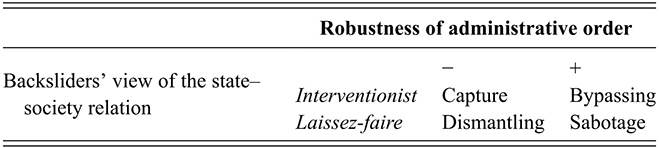
Table 1 Long description
Table with two axes: (1) robustness of administrative order (low/high) and (2) view of state (interventionist/laissez-faire). Cells: Interventionist + weak order = Capture, Interventionist + strong order = Bypassing, Laissez-faire + weak order = Dismantling, Laissez-faire + strong order = Sabotage.
Source: own compilation. See also Bauer and Becker, 2020; Bauer et al., 2021a.
The preference of backsliders with a laissez-faire or even skeptical view of the state as such is to seek to dismantle the bureaucracy or its capacity to regulate and manage (unwanted) policies. This seems to work particularly well if the existing administrative orders are fragile. If the state order is more robust, anti-state administrative backsliders will see more utility in establishing parallel structures, thereby bypassing the existing bureaucracy and limiting its capacity to counteract their government. Instead, the preference of backsliders with an interventionist view of the state seeks to capture its institutions, for example, by taking them over from within by placing their own cronies in top management positions, including in the administration. Again, this is easier in fragile state orders. If the administrative order in place turns out to be more robust, pro-state backsliders must content themselves with sabotaging the bureaucracy, thus indirectly reducing its capacity to function according to the regulation and established standard operating procedures. It should be noted that the employment of these approaches likely depends on whether the populist party in power holds a firm parliamentary majority or, more broadly, on the extent to which checks and balances remain in place and operational. More direct and comprehensive transformations, such as institutional capture, are more probable when the state’s democratic and institutional framework has already been partially undermined. Conversely, when this framework remains relatively stable, indirect strategies of dismantling may be the populists’ preferred choice.Footnote 14
In addition, populists can theoretically rely on a variety of strategies to transform bureaucracies into (in their eyes) “reliable” instruments to execute their illiberal agendas, all driven by mistrust against what they conceive as an excessively “liberal” and “establishment-elitist” civil service, full of “pockets of resistance” (Bauer et al., Reference Bauer, Peters and Pierre2021a). Populists thus attempt to centralize administrative structures; they are keen to strengthen top-down command and control; they cut administrative budgets to quell independent parts of the services; they see to a cleansing of staff on ideological lines, patronizing government favorites; they undermine democratic norms of how to run the civil service; and they reduce external accountability of the bureaucracy to parliament or other institutional auditors, as well as interaction with (organized) society (Rockman, Reference Rockman2019; Peters and Pierre, Reference Peters and Pierre2019; Reference Peters and Pierre2022; Bauer et al., Reference Bauer, Peters and Pierre2021a; Guedes Neto, Reference Guedes-Neto, Morais de Sá e Silva and Gomide2024). Table 2 systemizes such potential strategies of illiberal administrative transformation in five main categories.
- Structural centralization
Centralizing formal power by reinforcing top-down command and control within the central government, reducing horizontal distribution of power, and limiting the autonomy of lower-level bodies and agencies that might act as a counterbalance to central authority.
- Redistributing resources
Steering administrative conduct through allocation of funds as well as administrative and informational resources, that is, for instance, weakening specific units by reducing funds and staff numbers, leaving them out of information loops, or impairing their work by imposing excessive administrative demands. Resources can be withdrawn, condemning the organization to a zombie status or leading to its complete and formal dismantlement.
- Ideological staffing overhaul
Ideologically reshaping the workforce by intensifying patronage in hiring and promotions, moving beyond typical “spoils” practices. This involves diminishing meritocratic and representative criteria in personnel policies through heightened or newly introduced methods of politicization. Such strategies can extend to creating parallel structures that undermine and ultimately overtake established career pathways. Additionally, management may create a hostile work environment through bullying, intimidation, or other informal tactics aimed at silencing internal dissent and pressuring critical civil servants to leave voluntarily. In brief, politicization, patronage, and forcing out are the main features of such ideological staffing overhaul.
- Instilling illiberal norms
Fully aligning the administrative culture with the new ideological agenda by undermining the official neutrality of the bureaucracy or highlighting its instrumental role. For example, leadership might apply informal pressure on staff to prioritize loyalty to political objectives over professional impartiality, subtly encouraging employees to align their actions with the prevailing ideology rather than following established procedures.
- Undermining external accountability
Reducing the role of service agencies in engaging with parliament and other external oversight bodies, limiting transparency and information-sharing with third parties, and restricting media access. For example, leadership might implement policies that prevent agencies from disclosing detailed reports to parliamentary committees or the public, thereby reducing opportunities for external scrutiny and weakening democratic oversight.
Source: own compilation. See Bauer and Becker, 2020; Bauer et al., 2021a.
Figure 1 provides an overview of the illiberal transformation space covered in this Element, highlighting key features. This section has focused largely on the impact on bureaucracy, while Section 2.2 examines the effects on policy change. Additionally, Figure 1 outlines potential bureaucratic responses to illiberal strategies, which will be explored in a subsequent section.
Analytical frame for studying populist administrative deformation. Figure 1 long description.
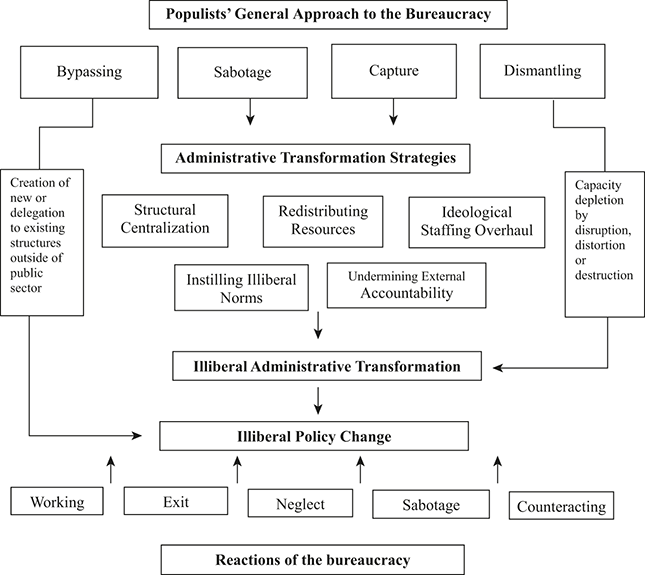
Figure 1 Long description
Conceptual framework showing causal links between populist strategies (dismantling, capture, bypassing) and administrative transformation (staffing overhaul, resource redistribution, centralization, illiberal policy change). These lead to bureaucratic reactions ranging from exit and neglect to sabotage and counteraction.
It can be debated whether populists in government view administrative deformation as an end in itself or merely a means to an end, and to what extent altering the organizational foundations of political power – understood as public administration policy – always remains an indisputable prerogative of legitimate government. Society at large may exhibit limited concern or compassion for the ways in which populist governments reshape bureaucratic organizations and manage elite bureaucrats under their authority. Such indifference becomes less defensible when illiberal policy changes are enacted through deformed bureaucratic politics.
2.2 Illiberal Policy Making
With the rise of populists to power in established democracies, social science research about the policy consequences of populist rule has gained momentum (Moffitt, Reference Moffitt2016; Mudde and Rovira Kaltwasser, Reference Mudde and Rovira Kaltwasser2012; Caiani and Graziano, Reference Caiani and Graziano2021, Reference Caiani and Graziano2022). This debate has yielded insights, particularly regarding the policy stances of authoritarian populists, who prioritize nativist positions on immigration, exhibit skepticism toward climate change policies, restrict LGBTQ+ rights, and adopt anti-internationalist approaches (Mosler and Potrafke, Reference Mosler and Potrafke2020; Börzel and Zürn, Reference Börzel and Zürn2021; Dijkstra et al., 2022). Such key policy positions have been explored in connection with populists’ broader agendas of democratic backsliding and, most relevant to the focus of this Element, the linkage between administrative deformation (as discussed in Section 2.1) and illiberal policy change (Morais de Sá e Silva and Gomide, Reference de Sá, Silva and Gomide2024a; Lotta et al., Reference Lotta, Tavares and Story2024c; James, Reference James2025).
For example, populist performance in government has been associated with economic weakening; several studies indicate a decline in economic growth under populist leadership. Research by Funke, Schularick, and Trebesch (Reference Funke, Schularick and Trebesch2023) even found that after fifteen years of populist governance, GDP per capita is typically 10 percent lower compared to a non-populist counterfactual (see also Bellodi et al., Reference Bellodi, Morelli and Vannoni2024; Kleinfeld, Reference Kleinfeld2024). These works highlight that economic disintegration, decreasing macroeconomic stability, and the erosion of institutions often accompany populist rule. This aligns with earlier studies by Sachs (Reference Sachs1989) and Edwards and Dornbusch (Reference Edwards and Dornbusch1991), which identified a “populist cycle” characterized by short-lived booms followed by economic crises. Yet, the relationship between populism and economic performance remains contested (for overviews, see Guriev and Papaioannou, Reference Guriev and Papaioannou2022; Kühnast, Reference Kühnast2024).Footnote 15
Other studies have examined the impact of populist governments on various policy areas (Bartha et al., Reference Bartha, Boda and Szikra2020), including social policy (Fenger, Reference Fenger2018), development (Bergmann et al., Reference Bergmann, Hackenesch and Stockemer2021), migration (Krause and Giebler, Reference Krause and Giebler2020), law and order (Biard, Reference Biard2019), and environmental policies (Hoerber et al., Reference Hoerber, Kurze and Kuenzer2021; Jahn, Reference Jahn2021). Unsurprisingly, given populism’s characterization as a “thin ideology” (Mudde and Rovira Kaltwasser, Reference Mudde and Rovira Kaltwasser2017), the findings of these studies vary depending on whether the focus is on left- or right-wing authoritarian populists in government, as well as on the specific national contexts (Caiani and Graziano, Reference Caiani and Graziano2022, p. 573ff.).
It emerges that where authoritarian populism dominates, several policy fields – such as immigration, multilateralism (especially EU membership), cultural-identity policies, environmental protection, and climate change – face contestation. Meanwhile, other areas outside that focus may continue to be managed as business as usual (Boda, Reference Boda, Morais de Sá e Silva and Gomide2024). Hence, populists in government seem to be selective with their attention toward policies under their tutelage. Moreover, other research suggests that populists in government intentionally aggravate, then exploit societal polarization (Hacker and Pierson, Reference Hacker and Pierson2019; Peters, Reference Peters, de Sá e Silva and Gomide2024). Such polarization, it is argued, paves the way for both increasingly radicalized policy styles – characterized by tactics like the deliberate abandonment of conventional constraint in political competition (Levitsky and Ziblatt, Reference Levitsky and Ziblatt2018; Morais de Sá e Silva and Gomide, Reference de Sá, Silva, Gomide, Morais de Sá e Silva and Gomide2024b)Footnote 16 – and the adoption of increasingly extreme policy measures.
Along that line, B. Guy Peters connects the ambitions of populists for radical policy change in government with democratic backsliding effects, observing a paradox in how populists in government shape policies. Populists, Peters argues, prioritize their short-term political gains over the long-term needs of the state, thus sacrificing sustainable governance for immediate electoral or ideological victories (Peters, Reference Peters, de Sá e Silva and Gomide2024). Yet, populists oversimplify their promises, presenting themselves as champions of the people while fostering distrust in the state. This distrust, writes Peters, stems from their narrative that traditional elites have corrupted the state, necessitating its “takeover” by populists. Ironically, once in power, populists perpetuate this mistrust, undermining the very institutions they control and further eroding public confidence in state policies. This dynamic illustrates a fundamental contradiction; while claiming to restore democratic ideals, populists destabilize the institutional foundations of democracy, creating conditions that deepen democratic backsliding (Peters, Reference Peters, de Sá e Silva and Gomide2024; see also Bellodi et al., Reference Bellodi, Morelli and Vannoni2024).
The mechanisms at play to implement illiberal policy change are varied. There is first budgetary politics. This is the case with agencies whose missions contradict populists’ priorities – the prime example is how Trump dealt with the Environmental Protection Agency (Dillon et al., Reference Dillon, Sellers, Underhill, Shapiro, Ohayon and Sullivan2018) – who see their operational or policy budgets cut (Guedes Neto, Reference Guedes-Neto, Morais de Sá e Silva and Gomide2024). There is, second, what can be conceived of as disrupting the policy subsystem (Morais de Sá e Silva and Gomide, Reference de Sá, Silva, Gomide, Morais de Sá e Silva and Gomide2024b, p. 10; Milhorance et al., Reference Milhorance, de Andrade, Le Coq and Sabourin2024). The regular democratic exchange of information and points of view between the bureaucracy and interested actors is inhibited, and supportive networks of unwanted policies thus lose opportunities for access or are otherwise weakened in their advocacy role (Morais de Sá e Silva and Gomide, Reference de Sá, Silva, Gomide, Morais de Sá e Silva and Gomide2024b). There is also the often-noted disregard for traditional policy expertise, which weakens feedback loops and thereby disrupts policy implementation, with the deliberate aim of dismantling past policy achievements (Koga et al., Reference Koga, Karruz, Palotti, Soares Filho and Couto2023; Lotta et al., Reference Lotta, Piotrowska and Raaphorst2024b).
In sum, while administrative deformation may be an instrumental goal for illiberal governments, intended to suppress or punish a bureaucracy perceived as upholding liberal values, inconvenient policy expertise, or the “wrong” mission, the primary objective for populist backsliders seems most of the time to facilitate and accelerate prioritized policy changes. Where direct regulatory change appears cumbersome or out of reach using democratic procedures, leveraging direct executive powers over the bureaucracy serves as a means to bypass the lengthy and uncertain process of legislative revisions, as well as the unpredictability associated with parliamentary involvement. Furthermore, the subversive strategy of enacting policy changes through bureaucratic deformation minimizes the risk of societal resistance that might otherwise arise from the deliberation and media scrutiny typically accompanying legislative procedures.
Beyond the Environmental Protection Agency episode (Dillon et al., Reference Dillon, Sellers, Underhill, Shapiro, Ohayon and Sullivan2018), illustrative cases include President Trump’s efforts to weaken the capabilities of the US foreign policy bureaucracy, aimed at eroding multilateral problem-solving attitudes (Drezner, Reference Drezner2019), and Jair Bolsonaro’s undermining of the Brazilian Institute of the Environment and Renewable Natural Resources and the Brazilian National Indigenous Foundation (Bauer, Lotta and Holanda Schmidt, Reference Bauer, Brandsen and Kovarek2025). In all these cases, “sabotaging” (Bauer and Becker, Reference Bauer and Becker2020, p. 26; similar Drezner, Reference Drezner2019, p. 723) constituted the preferred strategy to distort, disrupt, or even destroy administrative capacities in order to hamper the bureaucracy from doing its job (Moynihan and Roberts, Reference Moynihan and Roberts2021). To put it bluntly, in such constellations, bureaucracies are deformed to then act as instruments for illiberal policy change. Their organizational transformation, in other words, is as significant as the impact such administrative change has on the policy under examination (Drezner, Reference Drezner2019; Morais de Sá e Silva, Reference de Sá and Silva2022).
A couple of studies show how backsliders indeed manage to change public policies by fiddling with bureaucratic capacities. Morais de Sá e Silva highlights how Bolsonaro’s U-turn on human rights engagement led to a dramatic shift in policy. Instead of promoting human rights domestically, his administration reversed course by persecuting activists and marginalizing human rights bureaucrats within the civil service (Morais de Sá e Silva, Reference de Sá and Silva2020, p. 647). A study on agricultural commodity chains in Brazil is in a similar vein. Focusing on state capacity, it becomes clear that via reorganizing and dismantling parts of the Brazilian state administration, the Bolsonaro government managed to effectively undermine transnational sustainability governance (Schilling-Vacaflor et al., Reference Schilling-Vacaflor, Gustafsson, Cotta, Lenschow, Soendergaard, Inoue and Newig2022). In another study, Pereira and colleagues trace the intentional dismantling of state capacities in the Brazilian deforestation inspection sector (Pereira et al., Reference Pereira2022). According to this research, populist leaders chose to ignore their own bureaucracy’s expertise. The underlying mechanism, “sidelining” of the bureaucracy in the suggested diction, leads to intended policy dismantling through the backdoor as protection standards de facto decreased, which, in consequence, led to the acceleration of deforestation in the Brazilian Amazon. Finally, Peci shows how patronage can be used as an executive instrument to shake up existing equilibria within the bureaucracy, or between the bureaucracy and social actors, needed to shape a certain policy. When populist governments oppose current policy aims, bringing in actors that antagonize in the policy subfield, it increases the chances of stalemate, or at least it throws sand in the gears of policy production (Peci, Reference Peci2022).
Further examples of how illiberally transformed bureaucracies impact policy change are analyzed in a recent special issue of Governance, highlighting the interplay between populist action and bureaucratic agency in policy implementation (Lotta et al., Reference Lotta, Michelle, Pedote, Landi, Guaranha, Silveira, de Lima, Morais de Sá e Silva and Gomide2024d; see also Yesilkagit et al., Reference Yesilkagit, Bauer, Peters and Pierre2024, p. 418).Footnote 17 The papers collectively highlight the complex roles of frontline bureaucrats and public organizations in the context of illiberal policy changes and democratic backsliding. Resh et al. demonstrate, for example, how anti-statist populist leadership in the US undermines policy implementation by eroding personnel morale, creating a feedback loop that weakens administrative capacity (Resh et al., Reference Resh, Ahn and Moynihan2024). Similarly, Stauffer and colleagues illustrate the resilience-building power of collaboration and professional standards in mitigating the risks of blame-shifting implementation strategies under political conflict (Stauffer et al., Reference Stauffer, Sager and Kuenzler2024).
In sum, the empirical examples of illiberal policy change via administrative deformation highlight how administrative changes become effective in a “negative,” “indirect,” or “exclusive” mode. Populist attempts have been “negative” in the sense that they are destructive to the policy currently in place but are unlikely to result in the creation of coherent populist policy alternatives, at least not in the short term (see Milhorance, Reference Milhorance2022). Their approaches to implement policy change are indirect, relying on informal strategies and subterfuge rather than formal, constructive rulemaking (Héritier, Reference Héritier1997; Bauer and Knill, Reference Bauer and Knill2014). Furthermore, they are exclusive, as the circle of actors involved in the policymaking process is deliberately reduced to ideologically like-minded groups and individuals, effectively narrowing participation and excluding others. This fuels suspicion that illiberal policy change, achieved through bureaucratic deformation, is more of a covert than an overt strategy; an observation that has implications for the analytical questions to be raised, and for the research designs employed to study it in the future.Footnote 18
2.3 Patterns of Illiberal Policy Change
In order to draw analytical conclusions from the reviewed literature, let us recall some specific examples of illiberal policy change. In the United States, Trump’s first administration rolled back environmental protections. Over 100 regulations aimed at limiting greenhouse gas emissions, safeguarding waterways, and controlling industrial pollution were rescinded. This dismantling was not achieved through open debate or legislative overhaul but by undermining the EPA. By cutting agency budgets, sidelining scientific advisory panels, and appointing officials hostile to environmental regulation, the administration weakened enforcement capabilities while avoiding significant public resistance (Guedes-Neto, Reference Guedes-Neto, Morais de Sá e Silva and Gomide2024).
In Hungary, Prime Minister Viktor Orbán’s Fidesz party manipulated electoral rules to entrench its power, a hallmark of populist policymaking. Gerrymandering, the reduction of opposition-friendly constituencies, and revisions to campaign finance laws ensured systemic advantages for the ruling party. These changes were accompanied by administrative tactics such as curbing judicial oversight and replacing impartial electoral officials with loyalists. By avoiding direct public engagement and operating within an ostensibly legal framework, the government solidified its position while preserving a semblance of democratic legitimacy (Knight, Reference Knight2021; Hajnal and Boda, Reference Hajnal, Boda, Bauer, Peters, Pierre, Yesilkagit and Becker2021).
Brazil’s handling of the COVID-19 pandemic under Jair Bolsonaro demonstrates how populists can undermine state capacities to achieve ideological ends. The administration delayed vaccine procurement, spread misinformation about preventive measures, and removed health experts from critical positions. These actions eroded public trust in health institutions and disproportionately impacted vulnerable populations. By sabotaging Brazil’s robust public health infrastructure through administrative inaction rather than formal policy change, Bolsonaro’s government circumvented accountability for its failures (Lotta et al., Reference Lotta, Magri and Nunes2021; Fernandez et al., Reference Fernandez, Magri, Maia and Lotta2023).
Poland’s Law and Justice party (PiS) employed personnel tactics to consolidate control over public media and academic institutions. Public broadcasting boards were staffed with party loyalists, transforming them into tools of government propaganda. Simultaneously, universities faced governance reforms designed to curtail academic freedom and promote nationalist narratives. These administrative maneuvers avoided overt censorship but had a chilling effect on independent media and critical scholarship, reshaping cultural discourse in the party’s favor (Sadurski, Reference Sadurski2018; Mazur, Reference Mazur, Bauer, Peters, Pierre, Yesilkagit and Becker2021).
In India, Prime Minister Narendra Modi’s government targeted programs supporting minorities and marginalized groups through subtle yet effective administrative obstruction. Educational and welfare initiatives for minority communities, including scholarships and development programs, were defunded or delayed. Rather than repealing these initiatives outright, the government employed procedural barriers and funding cuts to weaken their impact. This indirect strategy minimized public outcry while advancing a nationalist agenda that favored dominant social groups (Vajpeyi, 2020; Khan and Muhammad, Reference Khan and Muhammad2023; see also Jhumpa Mukherjee, Reference Mukherjee2025).
These examples reveal recurring patterns and suggest underlying connections. The choice of forms of policy change in each case appears linked to two key variables. The first is whether the populist government has a secure legislative majority, allowing it to dominate the formal policy process, or whether it operates within a coalition or under strong checks and balances (Caiani and Graziano, Reference Caiani and Graziano2022). The second variable is the method of pursuing illiberal policy change, either directly through regulations or executive orders or indirectly via resource allocation or manipulations within the policy subsystem (Milhorance, Reference Milhorance2022). This distinction is visualized in Figure 2, where the dashed rectangle on the right highlights areas where populists in government are likely to leverage a deformed administration to enact illiberal policies through executive governance.
Patterns of illiberal policy change. Figure 2 long description.
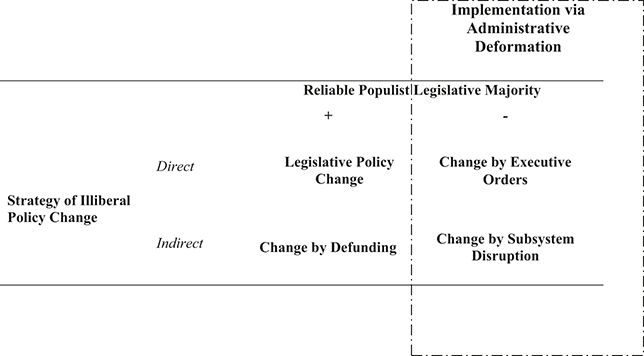
Figure 2 Long description
Matrix with two axes: presence or absence of reliable legislative majority (+/–) and strategy of change (direct vs. indirect). Cells show: (1) Direct + Majority = legislative policy change, (2) Direct + No Majority = executive orders, (3) Indirect + Majority = defunding, (4) Indirect + No Majority = subsystem disruption.
Thus, populists in government implement illiberal policies in two ways, depending on the given circumstances. If they hold a legislative majority and are willing to operate within democratic rules, they can enact changes through standard procedures. However, lacking a majority or facing uncertainty about its reliability, they often resort to indirect or covert means to achieve their objectives. In such cases, a deformed public administration, as discussed earlier, becomes their essential tool.
2.4 Resumé
Stimulated by the debate about the decline of liberal democracies and alerted by drastic examples of what backsliders in government do to their civil services in Hungary, Poland, Brazil, and in the US, a small body of PA literature on the topic has emerged (Bauer et al., Reference Bauer, Peters and Pierre2021b; Caiani and Graziano, Reference Caiani and Graziano2022; Morais de Sá e Silva and Gomide, Reference de Sá, Silva and Gomide2024a; see also James, Reference James2025). We now possess a selection of instructive examples of how backsliders treat and transform their bureaucracy in order to achieve anti-pluralistic agendas, why they do so, and with what results. Backsliders see democratic bureaucracy as an elite club and as a threat to the achievement of their political goals. They clamp down especially on the “liberal” components of democratic public administration, that is, transparency culture, scientific expertise provision, the bureaucracies’ interest intermediation role, societal consultation and participation mechanisms, decentralizing rooms for maneuver, and so on. Backsliders’ image of the bureaucracy is strictly hierarchical and instrumental, one of absolute loyalty and obedience toward their own, often personal, leadership. Where backsliding governments are unsure of their grip on a legislative majority, or lack one entirely, they turn to their (deformed) bureaucracies to achieve policy objectives through subterfuge. The resulting illiberal policy changes are selective, largely indirect, and frequently enacted by dismantling state capacities. This dismantling occurs through calculated actions such as withdrawing resources, suppressing expertise, and disrupting policy subfields. As such measures undermine the ability to address objective policy problems effectively, they ultimately drive change in an auto-destructive yet deliberate manner (Bellodi et al., Reference Bellodi, Morelli and Vannoni2024; Peters, Reference Peters, de Sá e Silva and Gomide2024).
Throughout the struggle over policy change and administrative reform, the backsliders’ core belief reflects an instrumental view of the civil service. The central question then arises: How do democratic administrative elites – simultaneously despised, feared, and utilized by backsliders – respond to their superiors’ demands for anti-liberal transformation? How do civil servants navigate, and under what conditions do they resist illiberal orders? This question is explored in the subsequent chapters.
3 Intellectual Foundations of Bureaucratic Responsiveness
Where can we find theoretical orientation within the PA discipline to guide civil servants in confronting threats of illiberal transformation? This section reconstructs two images of PA thinking of political–administrative relations, outlining an instrumental and an institutional perspective, and taps into their potential to go beyond loyalty and obedience to elected government when the integrity of democracy is threatened by the very government they serve (Yesilkagit et al., Reference Yesilkagit, Bauer, Peters and Pierre2024).
3.1 The Instrumental View
In the instrumental perspective, the bureaucracy is a downstream function strictly subordinated to the elected government. It is the legitimately elected government alone that incorporates the democratic expression of the political will of a community. The instrumental perspective emerges from classical positions about the relationship between politicians in executive offices and permanent bureaucrats in the state civil service. Classical works like those of Wilson (Reference Wilson1887), Weber (Reference Weber1968), and Goodnow (Reference Goodnow1900) are interpreted to promoteFootnote 19 a dualist view, discussed as the politics–administration dichotomy. While its empirical veracity has been regularly questioned (Appleby, Reference Appleby1949), the dichotomy informed and still informs large parts of the theorizing about the relationship between bureaucrats and politicians, and it is central to what is conceived as the instrumental perspective (Overeem, Reference Overeem2005; Rosenbloom et al., Reference Rosenbloom, Kravchuk and Clerkin2009). According to this instrumental view, the bureaucracy belongs to the sphere of preparing and implementing public policies clearly separated from the political world of (redistributive and value-based) decision-making. In such a top-down logic, the bureaucracy is regarded as an apolitical tool of government (Cuff, Reference Cuff1978). In that thinking, the main problem is thus keeping the bureaucracy as an efficient and effective tool separated from political value decisions, and independent or politically proactive behavior of bureaucrats is undesirable (Yesilkagit et al., Reference Yesilkagit, Bauer, Peters and Pierre2024, p. 418).
Where Weber, as the main proponent of a machinery-like image of the bureaucracy, saw a noble “ethos of the office” at work, his epigones added a Hobbesian micro-foundation, and it was this combination which merged into the public choice or economics of bureaucracy school (Downs, Reference Downs1965, Reference Downs1967; Niskanen, Reference Niskanen1971). Bureaucratic behavior is portrayed as driven by individual selfishness and rent-seeking at the taxpayer’s expense, concealed by information asymmetries and plagued by principal–agent pathologies (Shepsle, Reference Shepsle2010; for a critique, see Seibel, Reference Seibel2010). This is, obviously, a far cry from Weber’s intrinsic ethos of the office (du Gay, Reference du Gay2000), but it is compatible with most other elements of his theory of bureaucracy.Footnote 20
In the top-down logic of the instrumental perspective, bureaucracy is thus a mere tool of government, and if left unchecked, it risks undermining the very political leadership tasked with setting its objectives. Hence, the main concern in this tradition is how to keep the bureaucracy under control. Any independent or political proactive behavior of bureaucrats is, in this perspective, undesirable or worse. As the bureaucracy has potentially overwhelming powers, the main task of a theory of the relationship between democracy and administration is to help to minimize the risks of a runaway bureaucracy that sets itself the operational objectives and structurally escapes parliamentary control (Weber, Reference Weber1968).
In sum, the thinking in this perspective conceives bureaucracy as an instrument of potentially overwhelming power because of inbuilt risks of self-aggrandizement, domination through knowledge, operational secrecy, and insufficient parliamentary control. It is obvious that in such a pessimistic line of thinking about the perils of bureaucratic power – “pessimistic” in view of the desirability of active and autonomous bureaucratic behavior – the focus is on how to keep “unelected” bureaucratic power in check. In this image, the dangers are seen to lie within the bureaucracy itself, while the possibility that democratic erosion might originate from elected government – and could potentially be mitigated by bureaucratic resistance – remains outside its horizon.
3.2 The Institutional View
In what can be conceived of as the institutional perspective, the relationship between bureaucracy and other political actors is viewed as more complex (March and Olsen, Reference March and Olsen1983). This perspective frames “democracy and public administration as mutually supportive, as each depends on the other for its realization” (Ventriss et al., Reference Ventriss, Perry, Nabatchi, Milward and Johnston2019, p. 276). It can be seen as a critical response to the perceived theoretical limitations and empirical descriptive inaccuracy of the instrumental image. As a result, the institutional perspective offers greater nuance but less coherence than the instrumental view (Stivers, Reference Stivers2001; Olsen, Reference Olsen2006, Reference Olsen2008; Seibel, Reference Seibel2010; Stivers and DeHart-Davis, Reference Stivers and DeHart-Davis2022; Goodsell, Reference Goodsell2022).
The empirical-conceptual work of Aberbach and colleagues (Aberbach, Putnam, and Rockman, Reference Aberbach, Putnam and Rockman2021/1981) constitutes a main point of reference for such an institutional interpretation. Starting with the observation of the increasing incongruence of the standard instrumental argumentation as regards the policy involvement of bureaucrats, they reconceptualized political–administrative relations in Western democracies as hybridization, or convergence, of the roles of politicians and top bureaucrats, rather than as dualism (Aberbach and Rockman, Reference Aberbach and Rockman2006). Works in this tradition also contributed to a reassessment of the term “political” within PA scholarship. While there is consensus that bureaucrats have to be “apolitical,” in the sense of staying out of “party-politics,” dealing productively with the political implications of their work is, however, considered part of the job description of top bureaucrats (Heclo, Reference Heclo1974; Rosenbloom et al., Reference Rosenbloom, Kravchuk and Clerkin2009). These and similar positions allow for some leeway for conceiving a “political” role of the bureaucracy and thus attenuate the rigorism of the politics-administration dichotomy (Overeem, Reference Overeem2005).
Many debates in PA and Public Management implicitly transcend the instrumental image, even if they are not always acknowledged as such. For example, alongside questioning the efficiency and the desirability of external controls over the bureaucracy, concerns arose about the bureaucracy’s inner democratic life (Waldo, Reference Waldo1952; Riggs, Reference Riggs1965). In that context studies about (passive and active) representativeness (to the composition of the citizenry) of the civil service (Kingsley, Reference Kingsley1944; Meier, Reference Meier1975; Wise, Reference Wise1993), about transformative interactions between bureaucrats and politicians (Kettl, Reference Kettl2015; Torfing et al., Reference Torfing, Andersen, Greve and Klausen2020), and about increased civic participation in bureaucratic decision-making (Bovaird, Reference Bovaird2007; Nabatchi and Leighninger, Reference Nabatchi and Leighninger2015) testify to attempts to overcome (or at least, to complement) the dominating instrumental view of the bureaucracy (Stivers and DeHart-Davis, Reference Stivers and DeHart-Davis2022).
Many of those studies reflect altering perspectives on and changing realities of the internal conditions as well as the external contexts of bureaucratic organization. Works in these areas rely on Hegel, Tocqueville, Friedrich, Selznick, Waldo, Arendt, Ostrom, and Olsen, that is, on lines in PA thinking that highlight, beyond trends of intra-organizational democratization, the importance of the intrinsic motivation of bureaucrats to serve society and the importance of the role of bureaucracy to mediate between rulers and society to further the common good (Perry and Wise, Reference Perry and Lois1990; Shaw, Reference Shaw1992).
The institutionalist perspective thus provides for coming to terms with more complexity in the relationship between government and administration. It bestows greater autonomy and, consequently, increased responsibility upon democratic bureaucracy. A parallel can be made to the rise of the welfare state (Ansell and Lindvall, Reference Ansell and Lindvall2020); a narrative suggesting that as the welfare state expands, accompanied by the managerial demands inherent in modern governance, the bureaucracy necessarily gains further discretion, to an extent difficult to accommodate by the instrumental image (Fukuyama, Reference Fukuyama2023). This necessarily extends administrative discretion, which is not a pathology (as conceived in the instrumental view) but a result of differentiation processes and natural limitations of modern political leadership in how executive power in democracies needs to be organized (overcharging a relatively small group of popularly elected individuals holding direct democratic legitimation by giving them the formal responsibility over a large apparatus with often thousands of staff) (Ansell and Lindvall, Reference Ansell and Lindvall2020). Accordingly, developed liberal democratic systems can function only because most of the time an autopilot guides their administrations, which run on (and are contained by) various accountability relations into which bureaucrats are trained and socialized (Carpenter and Krause, Reference Carpenter and Krause2015).
According to Rohr (Reference Rohr1998), Cooper (Reference Cooper1990), du Gay (Reference du Gay2020), and Heath (Reference Heath2020), civil servants are seen as guided by three ethical poles of allegiance: First, to elected government; second, to the public directly; and third, to the independently defined interests of the state as the embodiment of a community grounded in certain values, usually enshrined in the constitution. It starts to get difficult when the three become misaligned; that is, when “questions about the fundamental obligations of the civil servant arise” (Heath, Reference Heath2020, p. 48). To assess the potential for “misalignment,” the guiding concepts of administrative neutrality, mission, and constitution are here briefly revisited.
Administrative neutrality means that civil servants must be neutral with respect to partisan political disagreements surrounding their job. It thus acknowledges that disagreement usually exists in a population about what constitutes the common good and via which policy it should be pursued. In liberal democracies, the range of available policy choices, as well as the selection of instruments to pursue them, are limited by the rule of law or other higher public values like fairness or equal citizenship. Administrative neutrality is thus not “absolute,” but contextual, and it does not absolve the bureaucracy of its responsibility to act as a constraint against policy or instrumental choices that, if adopted, would exceed the liberal consensus of a polity, even when these choices arise from majoritarian politics (Heath, Reference Heath2020, p. 93; Bozeman et al., Reference Bozeman, Nelson, Bretschneider and Lindsay2024; Yesilkagit et al., Reference Yesilkagit, Bauer, Peters and Pierre2024).
Bureaucrats also have obligations that arise from the office they are holding, that is, a responsibility emerging from their professional expertise combined with their institutional role (Waldo, Reference Waldo1952; Appleby, Reference Appleby1952). Friedrich has illuminated the professional side of the argument, justifying independent bureaucratic agency on the basis of its superior expertise provided by professional technical standards of how best to achieve substantial policy objectives (Friedrich, Reference Friedrich1960). Du Gay invokes a normative responsibility in the form of an “ethos of office” which would also constitute a “bulwark against populism” (du Gay, Reference du Gay2020, p. 77). Building on Weber’s ideas while extending them, du Gay advances a normative reinterpretation of the public office.Footnote 21 This interpretation encourages and necessitates bureaucrats to uphold stability and predictability within society, thereby safeguarding the very foundations upon which individual as well as collective liberty is built. They achieve this by wholeheartedly pursuing their professional missions (du Gay, Reference du Gay2020, p. 83; du Gay and Lopdrup-Hjorth, Reference du Gay and Lopdrup-Hjorth2023).
Ultimately, the imperatives for bureaucratic behavior also encompass the safeguarding of the values upon which a regime is founded (Rohr, Reference Rohr1998; Hindkjaer Madsen, Reference Hindkjaer Madsen2024; Bertelli et al., Reference Bertelli, Cannas, Sharova and Uriarte2025), and thus the preservation of the integrity of the polity itself (Cooper, Reference Cooper1990; Terry, Reference Terry2003). Some kind of “administrative statesmanship” is required to run and conserve a constitution according to those values, which Larry D. Terry has framed into the concept of administrative conservatorship. Stretching over legal, managerial, and institutional dimensions, administrative conservatorship offers the most decisively prescriptive and proactive position in the discussion about bureaucratic agency, discretion, and leadership in light of making a stand against democratic backsliding (Terry, Reference Terry1990, p. 396; see also Yesilkagit et al., Reference Yesilkagit, Bauer, Peters and Pierre2024).
3.3 Resumé
The two images of the politico–bureaucratic relationship – instrumental and institutional – are necessarily stylized and simplified depictions, yet they yield two very different ethical conceptions of bureaucratic responsiveness. These two concepts can be referred to as bureaucratic-instrumental and democratic-institutional ethics (Olsen, Reference Olsen2006; Yesilkagit et al., Reference Yesilkagit, Bauer, Peters and Pierre2024).
The bureaucratic-instrumental image arguably dominates mainstream PA scholarship, largely because its simplicity and coherence make it the default lens for conceiving relations between bureaucrats and politicians at the core of executive governance. It often serves as the starting point in scholarly teaching and continues to resonate with long-standing stereotypes about “politics” and “administration.” It is held dear perhaps also because it reflects a nineteenth-century republican ideal of the clear division of power between elected politicians accountable to a parliament that decides, bureaucrats that just implement, and judges that adjudicate in contested matters. Never mind that such an ideal probably never existed in reality, the bureaucratic-instrumental imageFootnote 22 is a cornerstone of PA thinking, and for the many authors, the main challenge in politico–administrative relations remains the containment of potentially nefarious independent bureaucratic power. In the bureaucratic-instrumental perspective, the optimization of accountable administrative behavior in relation to citizens occupies the center, and there is no question of any form of ethical empowerment of bureaucratic guardians in relation to rogue superiors. According to the instrumental image, bureaucratic empowerment for any form of guardianship appears simply impossible.
In contrast, the antecedents of a democratic-institutional ethics can be traced back to Kant and Hegel (Meier, Reference Meier1997; Olsen, Reference Olsen2006, Reference Olsen2008; Stivers, Reference Stivers2008; Nabatchi et al., Reference Nabatchi, Goerdel and Peffer2011; Etzioni-Halevy, Reference Etzioni-Halevy2013). Here, the bureaucracy itself is regarded as a political institution of the (democratic) state with its own normative and moral values based on the rules and values of the respective society (Waldo, Reference Waldo1952; Yesilkagit et al., Reference Yesilkagit, Bauer, Peters and Pierre2024; Bertelli et al., Reference Bertelli, Cannas, Sharova and Uriarte2025). And it is from the vantage point of such institutionalist thinking that developing the conception of a proactive bureaucracy able to guard against backsliding seems possible. Bureaucracy, in such a perspective, has a necessary and justifiable degree of autonomy and legitimate stamina nonadaptive to political leaders and environmental demands. Administrative legitimacy is based on constitutional principles, rule of law, due process, and impartial expertise, or, put differently, the deontological ethical standards of the bureaucrats are based on their mission and the democratic constitution (Olsen, Reference Olsen2006, p. 16ff.; Olsen, Reference Olsen2008; Nabatchi, Reference Nabatchi and Leighninger2015). Administrators thus cannot be neutral and purely instrumental in the face of challenges to the political integrity of the regime they serve. They need to ground their behavior on higher-order moral principles such as constitutionalism and the public interest, which in a liberal state are defined by values like social equity and justice (Woller, Reference Woller1998; Nabatchi et al., Reference Nabatchi, Goerdel and Peffer2011; Heath, Reference Heath2020; Hindkjaer Madsen, Reference Hindkjaer Madsen2024).
These debates indicate that bureaucrats, however well instructed by elected superiors or faithful to the constitution they may be, will always find themselves in situations where they have to rely on their individual judgment to complete their concrete policy work, sometimes taking difficult decisions (Kass, Reference Kaas1988; Denhardt, Reference Denhardt1988; Rohr, Reference Rohr1998; Bertelli, Reference Bertelli2021). Providing orientation for how civil servants are to handle this inevitable discretion lies at the heart of PA as a discipline and has intrigued generations of authors far beyond classics like Hegel, Wilson, and Weber (Mosher, Reference Mosher1982; Weingast and Moran, Reference Weingast and Moran1983; Wood and Waterman, Reference Wood and Waterman1991; du Gay and Pedersen, Reference du Gay and Pedersen2020; Bertelli et al., Reference Bertelli, Cannas, Sharova and Uriarte2025).
The bureaucratic-instrumental and the democratic-institutional images are treated as stylized perspectives that originate in the history of ideas concerning the relationship between government and its bureaucratic apparatus. They are not intended as analytical devices directly applicable to empirical analysis. To derive concrete policy recommendations for fostering democratic bureaucracy, analysts must remain attentive to the specific scope conditions of their respective empirical cases. Such conditions are provided for, for example, by models of permeable versus rigid organizational boundaries (Silberman, Reference Silberman1993), conceptions of autonomous versus instrumental bureaucracy (Knill, Reference Knill1999), comparative accounts of bureaucratic autonomy (Carpenter, Reference Carpenter2001; Ege and Bauer, Reference Ege and Bauer2017), and, more broadly, by accounts of policy and administrative styles as well as administrative traditions (Richardson, Gustafsson, and Jordan, Reference Richardson, Gustafsson, Jordan and Richardson1982; Knill, Reference Knill1998; Jugl, Reference Jugl2025). If efficiency is the major concern, organizational designers are well advised to consider incentive and control concepts as suggested by conceptualizations in the tradition of the instrumental view. If democratic quality itself is at stake, and if majoritarian politics propels illiberal backsliders into power, democratic bureaucracy has to recall its “hybrid” character. While public administration always remains an instrument of government, the loyalty and political neutrality of its workforce in view of the transformative projects of the rulers of the day are by no means unconditional. They are confined by the fact that bureaucracy is also a liberal institution of democracy that can be called upon to counter unwarranted majoritarian demands with, at the very least, mission-related expertise and constitutional-preserving watchfulness (Heath, Reference Heath2020; Koga et al., Reference Koga, Karruz, Palotti, Soares Filho and Couto2023; Fukuyama, Reference Fukuyama2023, p. 2; Yesilkagit et al., Reference Yesilkagit, Bauer, Peters and Pierre2024). It is this counter-majoritarian function that normatively justifies bureaucratic resistance to democratic backsliding, especially when values like neutrality and preserving the integrity of a political system clash. Bureaucratic resistance can thus be justified theoretically by manifest ethical misalignments. The question then lingers whether resistance is a right or a duty, and how bureaucrats can ascertain the appropriateness of the mode of their resistance to specific instances of democratic backsliding.
4 Administrative Reactions
Civil servants usually swear an oath to uphold the constitution, but are also bound by loyalty to the government of the day. How can civil servants, whose professional ethos is, according to Max Weber, rooted in the principle “sine ira et studio,” that is, to implement political orders without anger and passion, navigate the tension between impartiality and the need to assess whether government actions overstep informal guardrails or ethical standards of democratic governance? How can bureaucrats evaluate whether certain government actions might be inappropriate or even illegal and, in the long run, erode the democratic foundations of the state they serve? And what should they do about it, what may guide their behavior or justify resistance?
4.1 Where Precisely do Bureaucrats Clash with Backsliders?
In order to answer some of these questions, we need more concrete notions of what backsliding conflicts between bureaucrats and governments are actually about. Only then can the bureaucratic responses to such backsliding be systematically assessed. Considering bureaucrats in their roles as both instruments and victims of regressive democratic governance, as analyzed in the previous sections, the empirical observations of clashes can be ordered into four categories.Footnote 23
First, there may be outright power abuses by political superiors, frequently taking the shape of decisions that bypass established procedures and prerogatives of other state institutions. A second aspect involves deliberate endeavors to diminish the role of the bureaucracy as a liberal institutional counterbalance to the power of the elected executive. The third dimension revolves around regulation and policymaking, that is, procedural changes or changes of policy substance, in an illiberal direction. Finally, conflicts may arise from the creation of an intimidating workplace setting that puts civil servants under professional and social stress. These four categories of conflict, gleaned from the pertinent literature, are briefly illustrated here.
Outright power abuses are reported on a lower scale (e.g., unduly intervening in recruitment or promotion decisions), but also in dramatic political situations (e.g., when Donald Trump tried to overturn the presidential election results in Georgia). Potential further examples comprise Bolsonaro’s violation of indigenous rights (Rapozo, Reference Rapozo2021) and Trump’s role in the attack on the US Capitol to prevent the transition of power to his successor in January 2021 (Conklin, Reference Conklin2021).Footnote 24
The second category of potential conflicts, administrative deformation, arises because in liberal institutional settings the democratic bureaucracy de facto counterbalances the power of the elected executive. Its objective expertise, its de facto autonomy, and its commitment to due legal process put the bureaucracy in a position to act as a “counter-majoritarian check” to government projects, despite the latter resting on a legitimacy derived from the majoritarian principle (Wildavsky, Reference Wildavsky1979; Heath, Reference Heath2020, p. 345; Hindkjaer Madsen, Reference Hindkjaer Madsen2024). Backsliders’ response to such constraint consists in transforming the public administration to bring it back into line and make it a willing instrument for implementing governmental policy. Most of the public administration literature about backsliders in government is precisely about such “structural deformation” geared toward weakening the bureaucracy’s weight in the checks and balances equation (see Section 2.1). The strategies for that weakening may vary.Footnote 25 The aim always remains the same: Subordinating the bureaucracy to the primacy of illiberal objectives and eliminating any independent administrative discretion that might impede the advance of populist government initiatives.
While the second category depicts potential constellations where bureaucrats come into conflict with backsliders regarding the change of the administrative organization itself, the third category covers such deformations with respect to policymaking, the second of the two main components of illiberal transformation discussed in Section 2.2. Such conflict emerges most often around regulatory rollback initiatives. The repealing of the US Clean Air Power Act, the Amazon rainforest and deforestation policy in Brazil, and the abolition of LGBTQ+ rights in Brazil and Hungary are examples in which bureaucratic resistance has been reported. Bureaucratic resistance concerns, in those cases, less political policy change per se (as a result of regular political processing via parliament, etc.) but rather the abolition of participation and deliberation rights – also discussed as “policy subfield disruption” (Morais de Sá e Silva and Gomide, Reference de Sá, Silva, Gomide, Morais de Sá e Silva and Gomide2024b) – which, by cutting out potential liberal dissenters, indirectly favors more illiberal outcomes. Beyond such “negative” dismantling, backsliders also have “positive” policy objectives, like regulatory tightening in immigration and human rights, where clashes with civil servants are likely. In sum, while it depends upon the specific preferences of the backsliders in question, illiberal policy change (as regulatory tightening or easing, as well as the shift in public spending priorities) constitutes a potential broad area of conflict between a backsliding government and mission-conscious liberal bureaucrats.
Finally, civil servants are reported to suffer from a broad range of unfair and ethically doubtful behavior by superiors at work, especially by political appointees catapulted to managerial jobs despite dubious levels of experience (Morais de Sá e Silva, Reference de Sá and Silva2022; Kucinskas, Reference Kucinskas2025). It appears that the resulting workplace dysfunctionality is deliberately pursued by illiberal managers to weaken liberal attitudes and styles within bureaucratic units. Backsliders’ management style can thus be characterized by a commanding and authoritarian approach toward their subordinates. Bosses often seem to assume an overly dominant and controlling role, displaying an attitude of superiority (Kucinskas and Zylan, Reference Kucinskas and Zylan2023; Lotta et al., Reference Lotta, Tavares and Story2024c). Such demeanors result in mistreatment and disrespectful behavior toward employees, especially those who criticize government initiatives on professional grounds, encompassing actions like belittling, berating, and demeaning staff members, as well as ignoring their input and disregarding their well-being. This type of workplace atmosphere is reported to lead to a sense of fear, intimidation, and low morale among employees, as they feel powerless and undervalued because of the oppressive behavior of their bosses (Kucinskas and Zylan, Reference Kucinskas and Zylan2023; Bauer, Lotta, and Holanda Schmidt, Reference Bauer, Brandsen and Kovarek2025; Lotta et al., Reference Lotta, Michelle, Pedote, Landi, Guaranha, Silveira, de Lima, Morais de Sá e Silva and Gomide2024d).
In summary, conflicts between backsliders in government and democratic bureaucrats arise primarily in four broad areas, and they concern direct abuses of power, the erosion of bureaucratic capacity for checks and balances, the implementation of illiberal policy changes, and deliberate disruptions of the workplace. What do we know about how democratic civil servants react in such situations of conflict?
4.2 Maneuvering Between Loyalty and Resistance
Empirical research about the responses of democratic civil servants to illiberal demands by superiors relies conceptually on theories about workplace dissatisfaction, first and foremost on guerrilla government approaches (O’Leary, Reference O’Leary2013, Reference O’Leary2019) and dissent shirking concepts (Brehm and Gates, 2010, p. 30ff.), both inspired by the classic work of Albert O. Hirschman about responses to organizational decline (Hirschman, Reference Hirschman1970). Exit, voice, loyalty, and – later added – neglect (Farrell, Reference Farrell1983), combined with components of public sector motivation research (Ripoll and Schott, Reference Ripoll and Schott2024), do thus constitute the typical heuristic frames within which to study the patterns and mechanisms behind bureaucratic responses to political superiors who act unethically, pose illiberal demands or pursue policies perceived as going against the common good of society (Schuster et al., Reference Schuster, Mikkelsen, Correa and Meyer-Sahling2022; Kucinskas and Zylan, Reference Kucinskas and Zylan2023; Saxlund Bischoff, Reference Bischoff2023; Cox, Reference Cox2025). “Illiberal demands” in this context are conceived as problematic requests from political superiors that contribute to democratic backsliding by going far beyond normal politics and regular political management, contradicting established democratic norms and principles (see Bertelli, Reference Bertelli2021; Moynihan, Reference Moynihan2022; Schuster et al., Reference Schuster, Mikkelsen, Correa and Meyer-Sahling2022; Bauer, Reference Bauer2024a; Lotta et al., Reference Lotta, Michelle, Pedote, Landi, Guaranha, Silveira, de Lima, Morais de Sá e Silva and Gomide2024d).
A survey vignette experiment conducted with Brazilian bureaucrats, for example, asks whether civil servants would be willing to act as veto players by refusing to implement policies that undermine democratic institutions, and comes to the optimistic assessment that a majority would be willing to shirk and sabotage if assigned to implement policies that are perceived to restrict democratic rights, such as the freedoms of the press and expression. It turns out that prosocial individual values correlate positively with such a guardianship attitude (Story, Lotta, and Tavares, Reference Story, Lotta and Tavares2023; Lotta et al., Reference Lotta, Tavares and Story2024c; see also Guedes-Neto and Peters, Reference Guedes-Neto, Peters, Bauer, Peters, Pierre, Yesilkagit and Becker2021). Such a positive linkage between public sector values and hypothetical guerrilla behavior also shows in a survey by Schuster and colleagues (Hollibaugh, Miles, and Newswander, Reference Hollibaugh, Miles and Newswander2020; Schuster et al., Reference Schuster, Mikkelsen, Correa and Meyer-Sahling2022). Another – more generic – survey among Danish civil servants reveals a pessimistic view, with a quarter reporting significant endorsement of undue orders from superiors when faced with dilemmas between responsiveness to government and upholding the law (Saxlund Bischoff, Reference Bischoff2023; see also Kucinskas and Zylan, Reference Kucinskas and Zylan2023, as well as Sasso and Morelli, Reference Sasso and Morelli2021).
If one focuses on empirical explanations, Schuster et al. (Reference Schuster, Mikkelsen, Correa and Meyer-Sahling2022) argue that bureaucrats with measured higher public service motivation – especially in the area of attraction to the public service – are more likely to (hypothetically) resist through voice (advocating for principled policies) or sabotage (hindering unprincipled ones). Resistance increases with career length but decreases with hierarchical rank, as senior managers are less likely to oppose unprincipled demands. Bureaucrats motivated by community aid, addressing social issues, and contributing to the common good show stronger resistance. Saxlund Bischoff (Reference Bischoff2023) investigated how civil servants, again hypothetically, respond to illegal demands by superiors and found that bureaucrats with a legal education are most likely to resist illegal demands, supporting the notion that professional training influences behavior. On the basis of interviews with civil servants working under the first Trump administration, Kucinskas and Zylan (Reference Kucinskas and Zylan2023) and Kucinskas (Reference Kucinskas2025) emphasize the role of professional norms and institutional scripts in shaping resistance. According to their observation, democratic and professional values, as well as the agency’s mission, are key factors. Resistance often stems from a desire to perform duties faithfully rather than obstruct leadership (see also van Lit, Reference van Lit2024).
Although virtually all empirical studies about bureaucratic reactions to backsliding start off with the exit-voice-loyalty-neglect heuristic, some doubts emerge about the appropriateness of the scheme. The skepticism mirrors criticism, which has already been directed toward classical studies in the field, for example, that the exit category is ambiguous. A “silent” exit might be innocuous from the perspective of backsliders (or worst, provoking exits might be part of backsliders’ objective so “freed” jobs can be filled with supporters, see Peters and Pierre, Reference Peters and Pierre2022); quite a different matter is a “noisy” exit, that is, when a top civil servant leaves an important position making her or his protest public (Kucinskas and Zylan, Reference Kucinskas and Zylan2023, p. 1770; Bauer, Reference Bauer2024d). Only the latter would count as active “resistance,” but it has been, so far, empirically quite rare.
The survey studies further indicate that outright direct sabotaging of unprincipled governments (not implementing, internally mobilizing against government action, directly undermining implementation, leaking) is rarely observed and seems to be the least preferred option in the case of ethical or professional clashes. Civil servants – at least in the vignette experiments – prefer, first, to try to voice dissent, and if this does not work, to exit silently, instead of directly and consciously undermining regressive governmental action (Schuster et al., Reference Schuster, Mikkelsen, Correa and Meyer-Sahling2022, p. 12).
Kucinskas and Zylan interviewed civil servants working for the first Trump administration, analyzing these first-hand experiences about working under backsliding rule. They show how pressured civil servants want to hold on to their missions, cautiously calibrating responses to dynamic and increasingly threatening environments (Kucinskas and Zylan, Reference Kucinskas and Zylan2023, p. 1763). Such a dynamic picture also emerges from Lotta and colleagues, who see bureaucrats carefully considering their reactions according to the quality of pressure wielded by backsliding governments (Lotta et al., Reference Lotta, Michelle, Pedote, Landi, Guaranha, Silveira, de Lima, Morais de Sá e Silva and Gomide2024d; Bersch and Lotta, Reference Bersch and Lotta2024).
In sum, the empirical research on bureaucratic responses to backsliding is still in its infancy (Alon-Barkat et al., Reference Alon-Barkat, Gilad, Kosti and Shpaizman2025; Fragoso Lobo et al., Reference Fragoso Lobo, Marinho, Peci and Guedes-Neto2025). While the exit-voice-loyalty-neglect heuristic constituted a plausible starting point for the empirical study of bureaucratic behavior under illiberal rule, these categories need to be redesigned to conceptualize bureaucratic “resistance” (instead of “responses”). This is the case because “exit” comprises quite different intensities of resistance (“silent-passive” vs. “noisy-active” variants), while superficial “loyalty” obviously cannot be counted in any way as a form of administrative resistance, even if bureaucrats work under backsliders in a spirit of a disengaged inner emigration.
Focusing on forms of bureaucratic resistance, the empirical insights provided so far can be ordered in four categories. There is first, and most mildly, the “silent exit.” Officials finding themselves in ethical or professional conflict can ask to be transferred to another post or leave the civil service. Individually, the latter is a tough choice and deserves to be respected as such. From the perspective of the matter that might be at stake, that is, specific backsliding projects pursued by illiberal governments, silent exit is a relatively innocuous form of resistance, at least as long as it remains an individual and not a collective act. More intense in terms of incurring political damage appears to be professional “neglect” (aka “dissent shirking”). An agent who covertly neglects tasks can significantly hinder or delay the realization of a government’s principal objectives, and such negligence is exceptionally challenging for supervisors to detect. “Sabotage,” that is, the deliberate damaging, obstructing, or undermining of backsliding action, constitutes an active and risky undertaking by an official. “Sabotage” goes far beyond mere “neglect”; it needs more determination, and it carries a greater risk of detection and subsequent punishment. Finally, one could conceive a category of “counteracting,” which is not only an active form of resistance but also one that takes place in or seeks the public sphere. That is why a “noisy exit” should be subsumed under that heading. Officials who counteract their government want to correct a state of affairs that they see from their professional perspective as harmful. Counteraction goes beyond mere sabotage; it represents a higher level of personal responsibility, aiming to set an example and encourage others to see the better option, thereby carrying the dimension of mobilization.
In sum, “exit,” “neglect,” “sabotage,” and “counteracting” are the forms of bureaucratic resistance to democratic backsliding that can be systematically retrieved from the pertinent literature. However, under what conditions, if any, can a particular form of bureaucratic resistance be justified from a normative perspective?
4.3 Right or Duty to Resist?
Only from the institutional perspective outlined in the previous section is it possible to justify bureaucratic resistance to a government when liberal values and democratic standards are violated, and an illiberal transformation is underway. However, how can bureaucrats be guided in making such a choice? And if they decide that resistance is, in their situation, the way ahead, what kind of resistance would be appropriate, given that democratic backsliding comes in quite diverse forms?
The answer to that question starts, “It depends.” Officials suspecting that management decisions and government actions constitute or bring about democratic backsliding will need to assess the severity of the projected action and choose their response accordingly. For example, if a backsliding action concerns the potential violation of legal rules or procedures, the resistance of the bureaucracy should certainly be more rigorous than in cases when the managerial style within an organization is at stake. In general, a government, also an illiberal one, has greater legitimacy to reorganize its own organizational basis (i.e., the bureaucracy and how it is managed) and to decide about policy (the latter being its prime function) than it enjoys with respect to decisions impinging on the powers of other state institutions or societal actors. Greater resistance is thus appropriate when illiberal actions pose a threat to the democratic system itself, such as undermining the rule of law, infringing on civil liberties, or eroding checks and balances.
Integrated into a practical framework, clamping down on bureaucrats, and making policy changes constitute less severe instances of backsliding when compared to actions aimed at altering the existing power balance in favor of the incumbent government or infringing on formal laws, rules, and procedures. In the former cases, one could speak of a “right of bureaucratic resistance,” but in the latter cases, this right moves in the direction of a “duty,” given the obligation of public officials to preserve the polity they embody.
Building on these considerations, the categories of backsliding, combined with the realistically available forms of resistance, which intensify in response to the increasing severity of the backsliding they aim to counter, offer an indication of the appropriateness of each form of resistance relative to the gravity of governmental backsliding, as illustrated in Figure 3.
Appropriateness of bureaucratic resistance against democratic backsliding. Figure 3 long description.
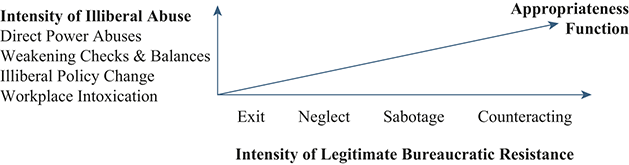
Figure 3 Long description
Conceptual graph mapping severity of democratic backsliding (x-axis) to intensity of legitimate bureaucratic resistance (y-axis). Identifies four escalating responses: exit, neglect, sabotage, counteracting.
From “workplace intoxication” to “direct power abuses,” the severity of illiberal transformation via backsliding varies significantly. Direct power abuses justify robust countermeasures by the bureaucracy, whereas instances of “workplace intoxication” only warrant a lower intensity of resistance. Although no precise framework can be established based on these considerations, the key point is that the severity of backsliding must align with the intensity of the bureaucratic response. This alignment is essential to ensure that the reaction remains both normatively and practically appropriate. To consolidate a taxonomy for backsliding action by management and provide an adequate and dynamic framework to understand and justify varying bureaucratic resistance is one of the major tasks ahead (see Lotta et al., Reference Lotta, Alves de Lima and Costa Silveira2024a, Reference Lotta, Michelle, Pedote, Landi, Guaranha, Silveira, de Lima, Morais de Sá e Silva and Gomide2024d).
4.4 Reassessing Bureaucratic Responsibility
Authoritarian populists seek to reshape executive governance, bypassing checks and balances to advance illiberal policy change (Green, Reference Green2019; Rockman, Reference Rockman2019; Bauer, Reference Bauer2024a). This form of democratic backsliding, mainly via illiberal administrative deformation, risks producing lasting effects on government organization and policy output alike (Albertazzi and McDonnell, Reference Albertazzi and McDonnell2015; Müller, Reference Müller2016; Urbinati, Reference Urbinati2019a; Carothers and Hartnett, Reference Carothers and Hartnett2024). However, we still know little about how government employees react to illiberal demands, under what circumstances they comply, and when they resist illiberal transgressions. These questions are among the most pertinent, not least because they go beyond positivist mainstream public administration research. While bureaucratic reactions to illiberal demands need to be analyzed empirically in comparative systematic ways, dealing with them also raises tricky ethical concerns in practice (Yesilkagit et al., Reference Yesilkagit, Bauer, Peters and Pierre2024).Footnote 26 It is probably fair to say that PA has not considered enough what happens to administrative responsibility in dark times, when the democratic system is threatened from within (Arendt, Reference Arendt1995/Reference Arendt1955; Stivers, Reference Stivers2008; Nabatchi et al., Reference Nabatchi, Goerdel and Peffer2011; Bauer, Reference Bauer2024d). During such dark times, democratic bureaucracy needs to emphasize its civic responsibility, reflect on its pluralist mission, worry about the endurance of the political order of which it is a part, and ask itself whether individual bureaucratic action undermines or invigorates liberal standards. While in normal times, instrumental professionalism as a guiding principle for bureaucrats may suffice, in dark times – just as Hannah Arendt reminds us (Reference Arendt1955) – normative and value questions must receive greater attention.
The analysis of bureaucratic resistance as discussed in this section must be read against the institutionalist tradition of administrative thought, which views bureaucracy not merely as an instrument of government but as a democratic institution endowed with normative commitments that reach back to Kant and Hegel. The empirical evidence surveyed here indicates that compliance remains the dominant bureaucratic response, yet forms of resistance – ranging from voice and neglect to sabotage and counteraction – do emerge under conditions of severe backsliding (Schuster et al., Reference Schuster, Mikkelsen, Correa and Meyer-Sahling2022; Saxlund Bischoff, Reference Bischoff2023; Kucinskas and Zylan, Reference Kucinskas and Zylan2023; Lotta et al., Reference Lotta, Michelle, Pedote, Landi, Guaranha, Silveira, de Lima, Morais de Sá e Silva and Gomide2024d; Bersch and Lotta, Reference Bersch, Lotta, de Souza Santos and Hatzikidi2025). The legitimacy of such resistance rests on constitutional principles, the rule of law, due process, impartial expertise, and the ethics of office. From this perspective, a proactive and resilient bureaucracy is warranted, in particular when illiberal political pressures undermine democratic standards. What follows is a conception of democratic administrative responsibility in which public administrators are guided by constitutionalism, citizenship, social equity, justice, and mission fidelity. They are expected to safeguard institutional integrity and the continuity of constitutional governance, even when this requires privileging long-term legitimacy over short-term efficiency or personal advantage. By reconnecting the empirical contours of resistance identified in this section with the normative foundations of the institutionalist image, the ground is prepared for the next step, which is to examine how this conception of democratic administrative responsibility can be pragmatically reinforced in practice.
5 Boosting the Bureaucracy’s Ability to Resist Illiberal Demands
Addressing illiberal transformations requires measures to fortify democratic bureaucracies against mounting populist pressures. However, determining which kinds of reforms to implement in practice is challenging, as their effectiveness likely depends on the specific regime context, the diversity of legal systems, and administrative traditions, among others (Painter and Peters, Reference Peters2010; Ganghof, Reference Ganghof, Vatter and Freiburghaus2024). Scholarship on bureaucratic ethics, administrative responsibility, and countermeasures to politicization and patronage offers first cues (Cooper, Reference Cooper1990; du Gay, Reference du Gay2000; Peters and Pierre, Reference Peters and Pierre2004, Reference Peters and Pierre2022; Goodsell, Reference Goodsell2022; Frederickson and Rohr, Reference Frederickson and Rohr2015). Moreover, a range of recommendations grounded in normative and empirical analysis have been made during the last decade in direct response to the rise of authoritarian populists to government (Bauer et al., Reference Bauer, Peters, Pierre, Yesilkagit and Becker2021a; Bauer, Peters, Pierre, Reference Bauer, Peters and Pierre2021; Raadschelders, Reference Raadschelders, Ladner and Sager2022; Bauer, Reference Bauer2024d; Kucinskas and Zylan, Reference Kucinskas and Zylan2023; Lotta, Fernandez, Pedote et al., 2024; Bozeman et al., Reference Bozeman, Nelson, Bretschneider and Lindsay2024; Koliba, 2024; Callahan, Reference Callahan2025).Footnote 27 Building on that debate, this section proposes five medium-range, pragmatic strategies to enable individual civil servants and civil services, as collective actors, to address the challenges posed by illiberal governments. Rather than prescribing specific measures, this section aims to indicate directions where and with what objectives to look for measures increasing bureaucratic robustness within varying situational and institutional contexts (Sørensen and Ansell, Reference Sørensen and Ansell2023). What follows is thus not a comprehensive list but rather a set of propositions for rethinking the status quo.
5.1 Creating Awareness
As organizations themselves do not make choices, it is ultimately the individuals within them who determine the course of action or reaction. Therefore, there is a broad consensus that it is crucial to prepare individual civil servants to withstand or, if necessary, even counteract the pressures of illiberal challenges (Saxlund Bischoff, Reference Saxlund Bischoff2018; Bauer, Peters, Pierre, Reference Bauer, Peters and Pierre2021; Yesilkagit et al., Reference Yesilkagit, Bauer, Peters and Pierre2024, p. 418ff.). At the top of the list for justifying and fostering such resistance is the cultivation of a culture of awareness, which can be achieved through comprehensive civil servants’ training programs focused on ethical standards and democratic values. Such training ensures that bureaucrats not only understand their role within executive government but also appreciate its limitations as well as the limitations of other actors, including their own government. Civil servants must be – more than ever – aware that, while they owe loyalty to the government of the day, this loyalty is defined by the constitution and needs also to be directed toward maintaining the integrity of the liberal political system itself (du Gay, Reference du Gay2020; Heath, Reference Heath2020; du Gay and Lopdrup-Hjorth, Reference du Gay and Lopdrup-Hjorth2023; Hindkjaer Madsen, Reference Hindkjaer Madsen2024).
Thus, bureaucrats, more than any other “normal” citizens, cannot ignore their responsibility to resist and counteract violations of fairness, equality, and justice within the democratic system. In this regard, their loyalty to the elected government is not absolute or unconditional, as these governments also have no absolute or unconditional power but must remain within the confines of their roles as determined by the constitution. Bureaucrats need to be trained – again and more – in constitutional law, political philosophy, and ethics to recognize that a government that undermines constitutional values forfeits its claim to bureaucratic loyalty and obedience (Yesilkagit et al., Reference Yesilkagit, Bauer, Peters and Pierre2024, p. 421). As civil servants are deeply embedded in the state’s machinery, much depends upon their understanding that their commitment extends beyond obedience to a duty to uphold the liberal political system itself (Arendt, Reference Arendt1958; Terry, Reference Terry1990).
In practice, raising awareness of what can be conceived of as the constitutional role of bureaucrats as protectors of democratic principles in routine and policy-making contexts, superseding the loyalty demands imposed by the government of the day, must be a key focus of civil service education programs. The excessive emphasis on managerial implementation and efficiency values needs to be recalibrated (Stoker, Reference Stoker2019; Bertelli et al., Reference Bertelli, Cannas, Sharova and Uriarte2025), and greater attention must be given to the public law dimension of good administration (Resh, Reference Resh2019; Saxlund Bischoff, Reference Bischoff2023). Measures aimed at “strengthening the autonomy of the bureaucracy from the bottom up” (Cooper, Reference Cooper1990; Yesilkagit et al., Reference Yesilkagit, Bauer, Peters and Pierre2024, p. 421) – such as making recruitment and career progression more independent and curbing populist politicization (Peters and Pierre, Reference Peters and Pierre2022) – are wise recommendations. However, awareness-building must also extend to the societal narrative of what the civil service and individual bureaucrats represent and what constitutional role they play. Public understanding and appreciation of the bureaucracy’s “conservatorship function” must grow alongside structural professionalization efforts (Terry, Reference Terry2003). However, limiting awareness efforts to the bureaucracy only risks overlooking the broader issue at hand. Awareness of the role of civil servants to protect democracy needs to be cultivated both within the civil service and across the society it serves.
5.2 Strengthening Professional Ethos
Bureaucracy is designed to integrate professional policy expertise into the political decision-making process. It serves as a functional counterweight, grounded in technical specialization, to the majoritarian political demands. Unsurprisingly, resistance to illiberal transformations seems to come, if it comes, most of the time from mission-driven civil servants, who refuse to compromise their professional standards as experts in their respective fields for political demands (Kucinskas, Reference Kucinskas2025). It is thus the professional ethos – the commitment to upholding professional standards among civil servants – that must be cultivated to strengthen justified resistance to illiberal drift (Friedrich, Reference Friedrich, Friedrich and Mason1940, Reference Friedrich1960; Appleby, Reference Appleby1952; Pennock, Reference Pennock and Friedrich1960; Yesilkagit et al., Reference Yesilkagit, Bauer, Peters and Pierre2024, p. 419). Professional standards help define the bureaucrats’ role as experts in their respective fields, with a responsibility not only to follow political orders but to resist decisions that disregard these standards, especially if these decisions are potentially harmful or counterproductive to the original aims of a specific policy. The professional vigilance of responsible bureaucrats should hold at least as long as a parliamentary majority does not derogate the policy or change specific objectives. In that sense, bureaucratic expertise based on the professional state of the art in a specific field can serve as a counterforce against illiberal policies that prioritize political motives over objective, evidence-based decision-making.
The discussion about the connection between professional expertise and resulting bureaucratic responsibility can be traced back to the classic Friedrich-Finer debate (Friedrich, Reference Friedrich, Friedrich and Mason1940, Reference Friedrich1960; Finer, Reference Finer1941; Jackson, Reference Jackson2009), which still offers guidance on how bureaucrats should balance loyalty to political leaders with their professional duty to uphold constitutional values (Heath, Reference Heath2020).Footnote 28 The professional judgment-based model, as outlined by Friedrich, remains thus highly relevant in contemporary discussions about bureaucratic autonomy (Raadschelders, Reference Raadschelders, Ladner and Sager2022; Raadschelders and Sanders, Reference Raadschelders and Sanders2025). It underscores the importance of professional expertise in resisting pressures to compromise democratic values. Bureaucrats who are committed to their professional standards and to serving the public good can play a vital role in protecting democratic governance from authoritarian drift.Footnote 29
5.3 Fostering Peer Deliberation
Insights from social psychology and behavioral economics, which emphasize the complexity and contextuality of ethical decision-making (Hogan, Reference Hogan2017; Grabowski et al., Reference Grabowski, Chudzicka-Czupała, Chrupała-Pniak, Mello and Paruzel-Czachura2019), suggest that bureaucratic resistance to illiberal demands could be encouraged by group deliberation. So far, the analysis of bureaucratic reactions to illiberal demands has neglected the role of such peer group dynamics. This is astonishing as standard theories of empowerment and interactional dynamics (Gaudine and Thorne, Reference Gaudine and Thorne2001; Vadera et al., Reference Vadera, Pratt and Mishra2013) provide a solid foundation for expectations that individual bureaucrats stand up against inappropriate demands by superiors, in particular when they feel supported by their peers in their professional environment; recent empirical research also points to such group and peer mechanisms as a primer for resistance against illiberal demands (Kucinskas, Reference Kucinskas2025).
The limited prominence of group considerations may stem from the traditional focus of public administration research on individual agency and its reliance on an instrumental image of bureaucracy.Footnote 30 These tendencies make it challenging to integrate group-based explanations and to appreciate their potential for uncovering how bureaucrats individually and collectively resist autocratic pressures (Bauer, Reference Bauer2024d; Raadschelders and Sanders, Reference Raadschelders and Sanders2025). Shifting attention toward interaction and deliberation within bureaucratic networks could thus empower civil servants to better evaluate the ethical implications of policies and align their decisions with democratic values. By engaging in peer deliberation and dialogue, bureaucrats can reduce their sense of isolation, develop a shared understanding of ethical challenges, and strengthen their capacity to resist illiberal demands from political leaders. Encouraging peer deliberation and peer solidarity in dark times is thus likely to constitute an important and cost-effective strategy to boost the robustness of the civil service as a collective.
5.4 Fostering External Connections
A similar interaction argument applies to enhancing the external networks and embeddedness of the civil service in transnational professional groups and structures, whether through engagement with civil society or collaboration with international and transnational organizations (Bauer et al., Reference Bauer, Peters and Pierre2021a, p. 48). Interactions with civil society and international partners, much like internal peer deliberations, offer civil servants opportunities to reflect on the implications and legitimacy of certain measures or reforms pursued by illiberal governments. Partnerships with liberal NGOs and civil society groups provide not only moral support but also advocacy for sticking to democratic values, raising public awareness about the risks of illiberal policies.Footnote 31 Crucially, this relationship is not one-sided; public engagement initiatives can educate citizens on policy implications, encouraging active participation in democratic processes or resistance to illiberal measures.
Within the EU, intergovernmental administrative networks and transnational ties can stiffen civil servants’ professional resolve and create soft constraints on illiberal transformation. Dense links through EU working groups and with societal partners raise exit costs and diffuse liberal administrative norms, buying time and cover for rule-bound conduct. Yet, protection stemming from such external embeddedness remains limited. It is unclear whether EU membership has prevented governments from illiberally reshaping their civil services, as cases in Hungary, Poland, and Slovakia suggest; politicization and administrative capture have at best been tempered. The Treaties deliberately limit the EU’s “intrusion” into national administrative organization; conferral, subsidiarity, and proportionality, and the national-identity clause in Article 4(2) TEU, leave discretion to Member States. Article 288 TFEU leaves form and methods to national authorities when implementing directives, and Article 197 TFEU provides only support, not harmonization, of administrative cooperation. In practice, EU networks sustain morale and professional standards under pressure but are unlikely to provide hard veto points. Resilience may rise when transnational linkages are broadened and dispersed across ministries and agencies rather than centralized in a small EU coordination core. The implication is clear: To help preserve the liberal character of domestic civil services and to deter illiberal state transformation, Union-level capacity should be strengthened, with credible monitoring, targeted conditionality, and professionalization tools.
In sum, fostering external networks (within the EU, transnationally or internationally), particularly to such partners beyond the control of a rogue government, may help to counterbalance illiberal demands “at home.” This exchange will strengthen the congruence of individual civil servants’ value systems with their various liberal organizational environments and stakeholders, precisely most needed when they face mounting illiberal pressure. Since isolating the civil service and individual civil servants has been identified as a prime strategy of authoritarian populists in government to bring the bureaucracy to heel, fostering external interactions and connections (and making such connections institutionally sticky so they cannot easily be dismantled) is the obvious counterstrategy.
5.5 Experimentation
There is no doubt that to enhance bureaucratic potential for resistance, structural and institutional reforms would be beneficial. Proposals in this regard focus on protecting the civil service from undue political interference, such as professionalizing merit-based recruitment and career systems to prevent populist politicization and patronage (Peters and Pierre, Reference Peters and Pierre2022) or encouraging individual resistance to illiberal pressures by establishing more robust channels for whistleblowing (Witt, Reference Witt2011; O’Leary, Reference O’Leary2017, Reference O’Leary2019). Another argument concerning the reform of state structures advocates for greater agencification (Yesilkagit et al., Reference Yesilkagit, Bauer, Peters and Pierre2024, p. 422) in order to minimize opportunities for political interference in governance. Such a proposal, if implemented, would indeed limit, at least in the short- to medium-term, populists’ room for maneuver to decide directly on policy change, thus reducing the potential to implement illiberal change. Yet, it would do so by changing the politics–administration balance in favor of the bureaucratic side and thus invite criticism for reducing the responsiveness of the bureaucracy to elected politicians, fueling exactly those complaints about top-down technocratic domination, elitism, and irresponsiveness on which populist campaigns usually thrive (see Schäfer and Zürn, Reference Schäfer and Zürn2023; Manow, Reference Manow2024).
Detaching the bureaucracy from government, as most proposals aiming at structural changes currently on the table implicitly or explicitly do, thus raises a legitimacy dilemma for democratic reformers; if not via elected government, how can the independence of the bureaucracy be justified? An answer might lie in new forms of linking citizens more directly with bureaucratic action (Brugué and Gallego, Reference Brugué and Gallego2003; Bovaird, Reference Bovaird2007; Nabatchi and Leighninger, Reference Nabatchi and Leighninger2015; Sørensen and Torfing, Reference Sørensen and Torfing2018). The proposition is that inspiration from these ongoing debates might guide experimentation with structural solutions also able to counterbalance illiberal governments. For example, if a more autonomous bureaucracy is problematic, given that the traditional legitimacy chain only goes via elected governments, we need to look for innovative forms of interaction between the bureaucratic part of the executive and citizens (Rosanvallon, Reference Rosanvallon2011, Reference Rosanvallon2018). The hope is that, via the more and more direct involvement of citizens, not only could the legitimacy of governance be increased, but also a core imagination of populist leadership balance (the populist leadership, and the populist leadership alone, interprets the “real” will of “the people”) could be defused. Expanding citizen participation, involvement, and codesign may be the most effective long-term strategy to counter populist claims of uniquely knowing the people’s will (Brugué and Gallego, Reference Brugué and Gallego2003; Ansell, Sørensen, Torfing, Reference Sørensen and Ansell2023). Thus, any structural reform enhancing citizen participation and self-government – citizens assemblies, coproduction, co-optation into the governance process – would not only enhance the acceptance of regulatory decisions but also limit populists’ ability for covert illiberal policy change using the tactics described in Section 2 (Zeitlin et al., Reference Zeitlin, van der Duin, Kuhn, Weimer and Jensen2023; see Bauer, Brandsen, Kovarek et al., Reference Bauer, Brandsen and Kovarek2025).
Beyond experimenting with citizen involvement, it is also worth considering institutional innovations at the systemic level, similar to the logic of fire alarms (Damonte, Reference Damonte, Dunlop and Radaelli2014). This could be achieved by the establishment of an independent council, composed of citizens, civil society representatives, and political stakeholders, tasked with assessing the quality of democracy. Such a council could monitor the quality of democracy, and in case of backsliding risks, if necessary, trigger higher levels of professional vigilance within the bureaucracy (see Rose, Reference Rose2024). Such an institutional innovation would raise awareness within bureaucracies about their duty to protect democratic integrity, fostering a culture of vigilance against illiberal transformations. If such a council – say for two consecutive years – determines that the democracy is endangered, this could trigger a kind of administrative modus (for a predetermined period), which empowers bureaucrats to prioritize their role as administrative conservators (Terry, Reference Terry2003), allowing for the kind of guardianship functions detailed elsewhere (Yesilkagit et al., Reference Yesilkagit, Bauer, Peters and Pierre2024).
There are at least three arguments why it is worthwhile engaging in institutional experimentation as a strategy against populist transformation. First, enhanced legitimacy can be gained through citizen involvement. In that sense, institutional innovation could better link bureaucratic actions to citizens, thus increasing governance legitimacy. This undermines populist narratives of exclusive representation of the “real” will of the people, defusing their central claim of unique legitimacy. Second, institutional innovations could be designed to prevent illiberal policy change before it is enacted; for example, citizens’ assemblies or coproduction processes can increase transparency, thus limiting populist leaders’ ability to implement covert illiberal policy changes, preserving democratic integrity. Third, new forms of institutional vigilance may limit the chances of backsliding. There are certainly other areas where institutional experimentation could successfully lead to added value in terms of enhancing protective capacity against illiberal transformation attempts. However, increasing citizen involvement, transparency, and vigilance are certainly good places to start thinking about how precisely this could be done in particular situations and governance contexts.
5.6 Resumé
If it is agreed, in principle, that a bureaucratic duty to resist democratic backsliding exists, then the civil service must be enabled to exercise it (Bauer, Reference Bauer, Bouckaert, Hondeghem, Steen and Van de Walle2025a; Fragoso Lobo et al., Reference Fragoso Lobo, Marinho, Peci and Guedes-Neto2025). Since national administrative systems interact differently with their governments, and the interplay of the rule of law and administrative traditions varies significantly from country to country (Knill, Reference Knill1999),Footnote 32 there is no panacea or “silver bullet” to ensure administrative robustness against backsliding via a certain functional design. Instead, a patchwork of diverse solutions might be required, spanning value-based leadership, deliberation, organizational structures, and experimenting with potential institutional innovations.
Based on current insights, minimally invasive strategies as described in this section provide perspectives for public administration theory and public management practice alike. To counter the pressures of illiberal transformations effectively, public administrations may adopt both individual and collective measures. These measures should aim to enhance professional autonomy, foster external networks, and encourage citizen engagement. By implementing comprehensive training, promoting ethical reflection, and fostering a culture of participation and exchange, bureaucracies can build capacities to withstand populist pressures.
Institutional experimentation may also open innovative avenues that acknowledge the evolving nature of executive power. Even amid the current populist threat, executive authority is likely to transform as democracies adapt to new socioeconomic and communicative realities. One such long-standing process is the growing dominance of the executive branch over legislative and judicial powers (Sartori, Reference Sartori1997; Poguntke and Webb, Reference Poguntke and Webb2005; Mounk, Reference Mounk2018). This makes it more challenging but also more important to “democratize” the bureaucratic organization of government in new ways (Rosanvallon, Reference Rosanvallon2011). No single strategy for enhancing bureaucratic robustness outlined in this section will suffice; strategies, plural, contribute to the broader, ongoing efforts and debates on the subject (Zacka, Reference Zacka2017; Yesilkagit et al., Reference Yesilkagit, Bauer, Peters and Pierre2024; Bauer, Reference Bauer, de Sá e Silva and Gomide2024c, Reference Bauer2024d). While it is doubtful that bureaucratic guardianship alone can rescue a democratic system from illiberal transformation in the long term (Yesilkagit, Reference Yesilkagit2021; Zacka, Reference Zacka2017), it would be unwise not to make efforts to strengthen democratic bureaucracy as much as possible, particularly through pragmatic reforms on the basis of the actionable strategies outlined in this chapter.
6 Meeting the Challenge
Democracy rests on many conditions, among them a functioning constitutional order, free media, a vibrant civil society, and above all, the trust and commitment of democratic citizens forming the majority of the population. It would thus be hubris to believe that the public bureaucracy alone could preserve the liberal democratic character of a political system. In particular, bureaucratic guardianship will not be able to protect democracy against the persistent will of a majority of citizens who vote for extremist leaders, especially if the expression of that will is repeated in several consecutive elections.Footnote 33 Nevertheless, as the analysis of the previous sections suggests, bureaucrats can play a modest role in democracy’s defense. As trusted servants of the democratic state, democratic administrators ought to uphold its integrity and resist becoming tools for those seeking to undermine the liberal order from within (Terry, Reference Terry2003; Yesilkagit et al., Reference Yesilkagit, Bauer, Peters and Pierre2024). Bureaucracy can contribute, especially if its role as an institution and integral component of the modern democratic state is recognized. This does not mean denying the pathologies of bureaucracy in other areas, such as red tape, administrative burdens, tardiness, or overregulation. However, it requires distinguishing clichés from reality and avoiding oversimplifications or treating context-specific interpretations as unchangeable truths. If history has no definitive endpoint, our models of democracy, including how we organize legitimate decision-making and implement collective action, must over time evolve and adapt. The widely perceived crisis of Western democratic systems underscores the need for such adaptation, which will also require changes in state bureaucracy. It is debatable whether frameworks for structuring the relationships among citizens, politicians, and bureaucrats rooted in nineteenth-century political theories remain the most suitable guides for coming to grips with the disruptive dynamics in twenty-first century democracies (Rosanvallon, Reference Rosanvallon2018). As the future of liberal democratic systems is open, so is the question of how best to organize the relationship between politicians, citizens, and bureaucrats.
Such considerations raise a final question: If democratic bureaucracy plays a role in safeguarding the liberal order as has been argued in this Element, what are the implications for the discipline of PA? How should the field – encompassing both the scholarly agendas and professional commitment to training government employees – prepare for this challenge? This final section examines three critical areas where PA as an academic discipline should reassess its collective stances and initiatives; the ethical education of civil servants, the prevailing model of the administrative individual in mainstream theory, and the discipline’s role as a “policy science of democracy” in contributing to broader philosophical and interdisciplinary debates about the future of liberal democracy (Lasswell, Reference Lasswell, Lerner and Lasswell1951; Waldo, Reference Waldo1952; Bertelli, Reference Bertelli2021; Bertelli et al., Reference Bertelli, Cannas, Sharova and Uriarte2025).
6.1 Revisiting Democratic Ethics
Administrative guardianship begins with an inner conflict of individual bureaucrats. Under backsliding governments, bureaucrats face a difficult choice: either remain neutral and faithfully serve the elected illiberal government or engage in resistance. Remaining passive may implicate civil servants in deliberate democratic erosion, while resistance is hard to justify within traditional instrumental views of PA, unless populist governments overtly violate constitutional principles.Footnote 34
Public Administration, as a discipline, appears to have neglected the fact that the stability of the democratic order is not guaranteed but is a fragile good that requires constant cultivation and protection. This is not to say that scholars have entirely ignored insights from Dwight Waldo and others on the importance of a proactive contribution by the discipline to sustaining democratic administration (Waldo, Reference Waldo1952; Appleby, Reference Appleby1952; Cooper, Reference Cooper1990; Terry, Reference Terry1990; O’Leary, Reference O’Leary2013, Reference O’Leary2017; Spicer, Reference Spicer2015; du Gay, Reference du Gay2020; Bertelli, Reference Bertelli2021). However, discussions on how bureaucrats should respond in a concrete way to maintain and foster liberal democracy have received diminishing attention in leading journals and academic curricula alike. This trend must change, and encouraging contributions indicates that it is changing (see Stivers, Reference Stivers2008; Witt, Reference Witt2011; Nabatchi et al., Reference Nabatchi, Goerdel and Peffer2011; Yesilkagit et al., Reference Yesilkagit, Bauer, Peters and Pierre2024; Bauer, Reference Bauer, de Sá e Silva and Gomide2024c; Koliba, Reference Koliba2025).Footnote 35
Whether and how the civil service ought to “stand up against” illiberal challenges, and what can be expected from democratic bureaucrats under pressure to advance illiberal agendas, needs to be discussed and thought through more systematically (Bauer, Reference Bauer2024a, Reference Bauer2025b; Callahan, Reference Callahan2025). PA has to take on the task to develop deontological and normative frames to orient bureaucratic behavior by relaunching the debate on practical bureaucratic ethos (deLeon and deLeon, Reference deLeon and deLeon2002). This implies a reconsideration of what administrative responsibility means today (Rohr, Reference Rohr1986, Reference Rohr1998; Bertelli, Reference Bertelli2021; Meier et al., Reference Meier, Compton, Polga-Hecimovich, Song and Wimpy2019; Brugué and Gallego, Reference Brugué and Gallego2003; Železník and Fink-Hafner, Reference Železnik and Fink-Hafner2023; Bauer, Reference Bauer, de Sá e Silva and Gomide2024c). Such a debate must address, and probably establish, a new balance between the values of professional neutrality and political integrity (Bertelli et al., Reference Bertelli, Cannas, Sharova and Uriarte2025). The challenge posed by backsliders in government thus calls for a refocus on public service ethics and professional deontology to intellectually equip and orient civil servants on how they are to cope with the “backsliding dilemma.” A dilemma in which civil servants must weigh their actions and assess the demands as well as the limits of their professional roles (Grønnegård Christensen and Opstrup, Reference Christensen and Opstrup2018; Koliba, Reference Koliba2025).Footnote 36
Accordingly, professional ethical training for civil servants should be revisited, emphasizing the underlying principles of a good civil service and appropriate administrative behavior during crises. Beyond legal and constitutional training, civil servants must be taught how to ground their behavior in higher-order moral principles such as constitutionalism, citizenship, public interest, social equity, and justice to preserve liberal democracy (Nabatchi et al., Reference Nabatchi, Goerdel and Peffer2011; Heath, Reference Heath2020). Yesilkagit and colleagues (Reference Yesilkagit, Bauer, Peters and Pierre2024) have proposed a manifesto for active guardianship by democratic bureaucrats in response to backsliding governments. Similarly, Bertelli’s (Reference Bertelli2021) “complementary principle” provides a normative orientation for bureaucrats to remain true to democratic values in their governance work. Bureaucracy’s legitimacy to act in this capacity must be outlined explicitly in constitutional principles and the rule of law (Heath, Reference Heath2020; Saxlund-Bischoff, Reference Bischoff2023). Moreover, deontological ethical standards must be developed and tested to guide democratic administrative performance (Stivers, Reference Stivers2008; Nabatchi et al., Reference Nabatchi, Goerdel and Peffer2011). Sociological work also testifies to the importance of professional peer interaction in collectively assessing whether illiberal demands go against the mission of an agency (Kucinskas, Reference Kucinskas2025). All those contributions give hints on how to innovate the debate on bureaucratic ethos and administrative responsibility under the challenge of democratic backsliding.
Without preempting that necessary debate, some contours of what has to happen can already be described. Democratic administration must provide a normative foundation for active administrative responsibilities against illiberal governments (Brugué and Gallego, Reference Brugué and Gallego2003; Etzioni-Halevy, Reference Etzioni-Halevy2013; Wood et al., Reference Wood, Matthews, Overman and Schillemans2022; Železník and Fink-Hafner, Reference Železnik and Fink-Hafner2023). A shift in focus from external controls to internal responsibility will be necessary, moving away from top-down managerial concerns and toward democratic resilience in the education of future civil servants. Potential solutions include ensuring bureaucratic accountability to parliament and society, protecting civil service recruitment and career progression from political monopolization, and intensifying citizen participation in governance (see Koliba, Reference Koliba2025). Promoting democratic values for civil servants is crucial to bolstering the bureaucracy’s confidence and resilience. In other words, the discussion surrounding bureaucratic ethics needs to offer recommendations on how to reform organizational structures and procedures to solidify the institutional foundations for the professional security of bureaucrats, so as to facilitate meaningful choices based on their democratic ethos (Yesilkagit et al., Reference Yesilkagit, Bauer, Peters and Pierre2024).
There is no denying that the wielding of moral discretion by the bureaucracy, mindful of safeguarding the political integrity of a democratic system, poses a challenge to public administration theory and practice alike (Appleby, Reference Appleby1952). Such moral responsibility concerns are part of a greater reflection about the benefits of bureaucratic organization and of administrative autonomy as advocated by Johan Olsen or Francis Fukuyama, who advocate a “rediscovery” (Olsen, Reference Olsen2006) or a “revaluing” (Fukuyama, Reference Fukuyama2023) of democratic bureaucracy and the autonomy it has.Footnote 37 Bureaucrats should be motivated to adopt a more expansive perspective when it comes to their assigned tasks. They must contemplate their actions within the framework of higher-order values that primarily stem from the democratic constitution of their polity. Consequently, the inclination for active resistance should rise, particularly when the required course of action contradicts established professional standards and expertise beyond constitutional requirements. “Dark times” stand for morally uncertain contexts, for phases of potential democratic regression, in which individual actions and choices unavoidably take on a public political meaning and impact (Arendt, Reference Arendt1958). The point that has to be made is that rulers forfeit their right to be loyally served by democratic bureaucrats implementing any policy choices “sine ira et studio,” if rulers themselves are unwilling to preserve the very values, spirit, and institutional integrity of the political system that empowered them in the first place and overstep their prerogatives. Bureaucrats resisting illiberal temptations can state that public service ethics is primarily about meeting the demands of the office (see du Gay and Lopdrup-Hjorth, Reference du Gay and Lopdrup-Hjorth2023), and it is the defense of the morality of that public office, as well as the insistence that constitutional roles and procedures are respected, which constitutes the particularity of public administration. Only by reestablishing that particularity can we hope to increase the resilience of public servants against the challenge of having to work for illiberal governments (Stoker, Reference Stoker2019, Reference Stoker, Bauer, Peters, Pierre, Yesilkagit and Becker2021).
In sum, when populist governments aim at illiberal transformations, the responsibility of bureaucracy shifts away from purely instrumental loyalty (Cooper, Reference Cooper1987, p. 325). Instead, civil servants must conceive themselves as “servants and guardians of legal and professional rules and a constitutional order, not of the rulers” (Olsen, Reference Olsen2008, p. 17; Raadschelders, Reference Raadschelders, Ladner and Sager2022; Yesilkagit et al., Reference Yesilkagit, Bauer, Peters and Pierre2024). Such a perspective demands a robust ethical and normative framework, ensuring that civil servants understand when they need to actively defend the democratic order against illiberal threats (Sørensen and Torfing, Reference Sørensen and Torfing2024).
6.2 Taking Theoretical Pluralism Seriously
Although PA theorizing is in principle open and pluralistic, in practice, it is heavily influenced by what has been described as the hierarchical instrumental image (see section 3; Cooper, Reference Cooper1987; critical Lynn, Reference Lynn2001). Rationalist frameworks often assume that bureaucratic behavior is primarily driven by extrinsic motivations – efficiency, compliance, and loyalty to authority – neglecting intrinsic values such as public service, equity, and democratic accountability. The prevailing focus remains on creating systems that ensure top-down control, predictability, and protection against opportunistic behavior. This technocratic approach prioritizes the optimization of structures for efficiency over fostering participatory mechanisms and cultivating democratic deliberation.
Put differently, mainstream rational choice approaches in PA undoubtedly provide valuable insights into organizational design and decision-making processes. However, their dominance has led to an unintended narrowing of discourse, focusing predominantly on empirical design while sidelining critical normative questions about democracy and the bureaucratic ethos (Woller, Reference Woller1998; deLeon and deLeon, Reference deLeon and deLeon2002; Jo and Meier, Reference Jo and Meier2024). This imbalance is concerning because it risks reducing PA to a technical endeavor, stripped of its ethical and democratic dimensions.
While empirical design is undeniably important, treating it as the sole “game in town” overlooks the broader mission of PA to sustain and advance democratic governance. Reinvigorating discussions around bureaucratic and democratic ethos could reorient the field toward a more balanced paradigm, one that values both empirical rigor and the normative pursuit of democratic ideals and human rights (Roberts et al., Reference Roberts, Resh and Basu2024). By embracing a richer interplay between technical and normative concerns, PA can better address the complex, value-laden challenges of modern governance.
A central question to start with concerns the underlying anthropology of PA theorizing: Which model of the administrative (wo)man should take center stage, the rational-choice framework or a more relational and normative one? A democratic-institutionalist perspective offers an alternative to rationalist approaches. The rationalist concept emphasizes efficiency, neutrality, and hierarchical compliance and rests on a Hobbesian view of individuals as self-serving actors requiring external control. Accountability in this model is externally imposed rather than internally guided by moral judgment. In contrast, the institutionalist perspective, drawing on Kantian-Hegelian traditions, envisions bureaucrats as communal beings with intrinsic moral agency. This approach emphasizes a dynamic interplay between top-down authority and bottom-up initiative, seeing bureaucratic responsibility as both technical and political. Accountability is rooted in public service and the collective good, with bureaucrats seen as participants in shaping and safeguarding democratic norms.
Institutions, in this relational view, are not merely rule-enforcing mechanisms but repositories of collective identity and legitimacy. As March and Olsen (Reference March and Olsen1989) note, they shape behavior through norms of appropriateness rather than efficiency alone. Bureaucratic autonomy, essential to this model, allows agencies to innovate and resist political manipulation, as Carpenter (Reference Carpenter2001) shows. Such autonomy is indispensable for defending democracy against authoritarianism and illiberal trends.
Under this paradigm, policymaking becomes an iterative process where discretion, guided by principles like constitutionalism and equity, is essential to sustaining democratic governance. Bureaucrats transcend immediate political directives to uphold higher-order values, protecting institutions from erosion and democratic backsliding (Bauer et al., Reference Bauer, Peters and Pierre2021a; Yesilkagit et al., Reference Yesilkagit, Bauer, Peters and Pierre2024).
To counter democratic erosion, PA must reclaim its dual mission of advancing practical and normative dimensions of governance. The institutionalist conception of administrative responsibility, grounded in moral obligation and organizational values, redefines bureaucracy as a proactive guardian of democracy. As Lasswell (Reference Lasswell, Lerner and Lasswell1951) envisioned, PA must revive its role as the “policy sciences of democracy” to address the pressing challenges of our time.Footnote 38
6.3 Seeking Multidisciplinary Dialogue about the Future of Liberal Democracy
The illiberal challenge compels PA to reflect on the current trajectory – and increasing fragility – of liberal democratic systems, as well as on the prospects for redeeming the democratic ideal in the future (Roberts, Reference Roberts, Bouckaert, Hondeghem, Steen and van de Walle2025; Moynihan, Reference Moynihan, Bouckaert, Hondeghem, Steen and van de Walle2025a). The rise of populism can be interpreted as a symptom of a broader crisis facing the liberal democratic model (Tormey, Reference Tormey2014). This crisis contrasts starkly with the ideal of a rational-instrumental bureaucracy, which assumes a republican framework where legislative, executive, and judicial powers are strictly divided. However, developments such as the management of the modern welfare state have disproportionately transformed the role and powers of the executive, of which the bureaucracy is an essential part. Consequently, the nineteenth-century ideal of an instrumental bureaucracy is increasingly at odds with the twenty-first century realities of bureaucratic roles and functions in modern representative and participatory political systems.
An urgent question for PA is thus how the growing powers of the executive, needed to keep the regulatory and welfare state operational, can be legitimized, particularly in contexts where elections and party systems no longer foster a trustworthy connection between rulers and the ruled (Rosanvallon, Reference Rosanvallon2011, Reference Rosanvallon2018). Addressing this legitimacy crisis requires the PA to examine critically and account for the changing reality of bureaucratic roles within today’s political systems. Part of this reality is that the vast diversity and complexity of state functions are often sustained by bureaucracies operating on “autopilot” (Ansell and Lindvall, Reference Ansell and Lindvall2020). Yet, as this trend deepens, new forms of citizen-bureaucracy connections are emerging and, in many cases, becoming integral to state operations. Examples include citizen participation through codesign and coproduction, corporatist sector governance under bureaucratic oversight, representative bureaucracy, and other innovative forms of procedural and institutional “bricolage” (Carstensen et al., Reference Carstensen, Sørensen and Torfing2023).
While predicting the “next stage” of systemic democratic development – whether it is a progressive advancement or a regressive retreat – is impossible, one thing remains clear: PA must engage in a dialogue with other disciplines, particularly political philosophy and democratic theory. Such interdisciplinary exploration is crucial for envisioning how democracy could function in the future and for innovating democratic relationships between citizens and bureaucracy within new institutional contexts and under evolving structural conditions.
PA as a discipline is thus called upon to improve the participatory and interactive basis of how “democracy administered” (Bertelli, Reference Bertelli2021) works in the twenty-first century and, by teaming up with political philosophers and pioneers of new forms of legitimacy in complex governance configurations, to provide realistic models to experiment with (even) more collaborative and inclusive forms of public administration in practice. If bureaucracy aims to avoid becoming entrenched in the illiberal vision of the democratic state’s future, it must develop a counter-vision for liberal democratic organization. Greater experimentation with democratic administration – through increased direct involvement of citizens and civil society organizations – likely represents the most appropriate path forward (Zeitlin et al., Reference Zeitlin, van der Duin, Kuhn, Weimer and Jensen2023; Trondal, Reference Trondal2023; Torfing et al., Reference Torfing, Sørensen, Trondal and Ansell2024).
In summary, a discipline of PA that shares concerns about the growing fragility of Western liberal democratic regimes (Yesilkagit et al., Reference Yesilkagit, Bauer, Peters and Pierre2024; Roberts, Reference Roberts, Bouckaert, Hondeghem, Steen and van de Walle2025; Moynihan, Reference Moynihan, Bouckaert, Hondeghem, Steen and van de Walle2025a, Reference Moynihan2025b), needs to reengage – more vigorously than ever (see Waldo, Reference Waldo1952) – in a dialogue with political philosophy and other normative political and social sciences about the adequate design of democratic institutions in the future. This dialogue is critical for exploring the potential and limits of democratic administration in democracies in the twenty-first century (Bertelli, Reference Bertelli2021) and understanding how PA can help safeguard popular trust in the liberal democratic project (Bouckaert, Reference Bouckaert2012; Yesilkagit et al., Reference Yesilkagit, Bauer, Peters and Pierre2024).
Against this backdrop, democratic bureaucracy under populist rule faces difficult choices. If “democracy” is understood primarily as popular sovereignty, with a hierarchical chain of command flowing from elected government to implementation (Finer, Reference Finer1941; Niskanen, Reference Niskanen1971; Shepsle, Reference Shepsle2010), then bureaucracy risks becoming complicit in the illiberal transformation of regimes under authoritarian populist rule (Bauer, Reference Bauer2024a). This highlights the reemergence of the inherent tension between the “liberal” elements of democratic regimes – embodied in counter-majoritarian institutions – and “majoritarian-plebiscitary” elements and their emphasis on “electoral sovereignty.” While these tensions were successfully balanced during the second half of the twentieth century, they are now resurfacing in the age of slowing economic growth, new geopolitical competition, and waning trust in traditional political parties and political systems. In light of this, PA must take an active part in debates on the future of democracy, stressing the crucial role of bureaucracy in realizing democratic objectives and in ensuring that these are pursued with equality, transparency, and fairness. Failure to do so risks forfeiting PA’s identity as a social science dedicated to democracy and relegating it to a mere auxiliary discipline of technocratic governance.
6.4 Closing Remarks
Democracy seems to be in crisis because it is increasingly failing to deliver on its promises (Robinson and Acemoglu, Reference Robinson and Acemoglu2012; Acemoglu, Reference Acemoglu2024). While analyzing this issue in depth lies beyond the scope of this Element, it is important to recognize that, if this claim is true, populism is not the root cause of current ailments. Rather, democratic underperformance – manifested in its inability to address pressing societal challenges effectively – has fueled the rise of populism, especially in its authoritarian and illiberal brands. Yet, once such a vicious cycle emerges, it raises critical questions of trust and hope: How can citizens maintain faith in a system that appears exhausted and incapable of renewal? The erosion of trust in democratic institutions fosters a pervasive sense of disillusionment, further entrenching this downward spiral. Breaking free from this cycle requires not only addressing the underlying causes of democratic underperformance but also revitalizing the democratic ideal to inspire renewed confidence and engagement among citizens (Bauer, Brandsen, Kovarek et al., Reference Bauer, Brandsen and Kovarek2025).
Against this background, this Element has surveyed what authoritarian populists in government do with the public administration system over which they have come to rule, with what objectives and what results. It has analyzed the responses of civil servants to illiberal demands and gauged the adequacy of forms of resistance in view of intensifying forms of deliberate abuse by illiberal management. Providing for strategies to make the civil service more robust in view of the authoritarian challenge, it has also called upon scholars of PA to revisit the discipline’s normative foundations as a social science of liberal democracy collectively. The Element advocates working across disciplinary boundaries on the conception of a liberal public administration philosophy in order to defend liberal democracy against purely majoritarian populist conceptions of bureaucracy.
The key normative lesson is that public administration as a discipline should strive for an even more liberal conception of democratic bureaucracy. Such a bureaucracy acknowledges the inherent tension between loyalty to the government of the day and the enduring duty to uphold democratic principles; self-rule, equality, sound decision-making, and institutional integrity (Applbaum, Reference Applbaum1999; Hindkjaer Madsen, Reference Hindkjaer Madsen2024, p. 2). This dual commitment underscores the moral responsibility borne by civil servants in democratic systems.
Within this framework, dissent from illiberal governmental policies is not only permissible but morally justified when it reflects public reason, upholds democratic values – justice, liberty, equality, and the common good – and protects the integrity of democratic institutions (Heath, Reference Heath2020; Bertelli et al., Reference Bertelli, Cannas, Sharova and Uriarte2025). Democratic bureaucracy is thus not merely about compliance but about sustaining the conditions for a thriving democracy, even under political pressure. Democratic public administrators require a moral compass to guide them through crises and ethical uncertainty (Appleby, Reference Appleby1952; Blau, Reference Blau1956; Barnard, Reference Barnard1968; Selznick, Reference Selznick1994). Likewise, today’s civil servants in liberal democracies must be prepared to navigate “dark times” with integrity and a firm commitment to democratic principles (Arendt, Reference Arendt1955).
Acknowledgments
I am deeply grateful to Stefan Becker for helping lay the foundations, and to György Hajnal and Zsolt Boda for revealing to me the analytical power of the concept of illiberalism in understanding contemporary bureaucratic transformations. I extend my gratitude to B. Guy Peters, Jon Pierre, and Kutsal Yesilkagit for working together with me through challenging yet significant stages of this intellectual journey and for jointly developing key arguments that are also reflected in this text. Special thanks are also due to Rahel M. Schomaker, David Levi-Faur, Johan P. Olsen, Geert Bouckaert, Steven Van de Walle, Alexandre de Ávila Gomide, Gabriela Spanghero Lotta, and Michelle Morais de Sá e Silva, who encouraged me to develop further many arguments covered in this Element. As a non-native English speaker, I modestly acknowledge the assistance of AI language tools, including ChatGPT, in improving the spelling and grammar of this text. Special thanks go wholeheartedly to Alyson Price for her professional language editing. This work is supported by ERC grant (LIBRAD, Grant Agreement No. 101200219). Funded by the European Union. Views and opinions expressed are however those of the author(s) only and do not necessarily reflect those of the European Union or the European Research Council Executive Agency. Neither the European Union nor the granting authority can be held responsible for them.
Michael W. Bauer holds the Chair of Public Administration at the Florence School of Transnational Governance, European University Institute, Italy. He is currently on leave from the German University of Administrative Sciences Speyer. He received his Ph.D. from the European University Institute in 2000 and has held positions as Fellow at the Max Planck Institute for Research on Collective Goods and as professor at the University of Konstanz and Humboldt-Universität zu Berlin.
He has published widely in leading international journals, including Public Administration Review, Governance, Journal of Public Administration Research and Theory, Journal of European Public Policy, West European Politics, Public Administration, and International Studies Review. His research focuses on public administration in comparative and global contexts, with recent work examining the ethical responsibilities of civil servants and the effects of populist backsliding on state institutions.
Robert Christensen
Brigham Young University
Robert Christensen is the George W. Romney Professor of Public and Nonprofit Management at Brigham Young University.
Jaclyn Piatak
University of North Carolina at Charlotte
Jaclyn Piatak is co-editor of NVSQ and Professor of Political Science and Public Administration at the University of North Carolina at Charlotte.
Rosemary O'Leary
University of Kansas
Rosemary O'Leary is the Edwin O. Stene Distinguished Professor Emerita of Public Administration at the University of Kansas.
About the Series
The foundation of this series are cutting-edge contributions on emerging topics and definitive reviews of keystone topics in public and nonprofit administration, especially those that lack longer treatment in textbook or other formats. Among keystone topics of interest for scholars and practitioners of public and nonprofit administration, it covers public management, public budgeting and finance, nonprofit studies, and the interstitial space between the public and nonprofit sectors, along with theoretical and methodological contributions, including quantitative, qualitative and mixed-methods pieces.
The Public Management Research Association
The Public Management Research Association improves public governance by advancing research on public organizations, strengthening links among interdisciplinary scholars, and furthering professional and academic opportunities in public management.

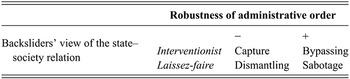

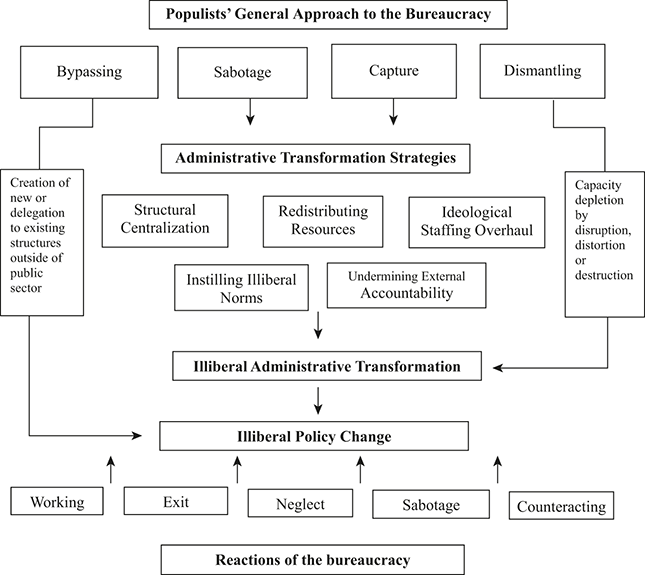
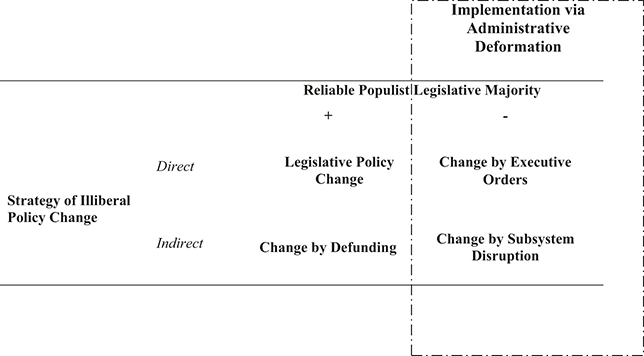
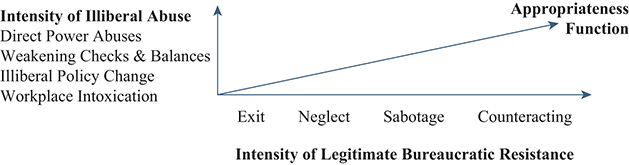

 Open access