


1 The Refugee Trap
In the 1990s, the United Nations Refugee Agency (UNHCR) created a poster campaign, with a series of diverse LEGO figures and the slogan ‘spot the refugee’. The point was that the refugee could have been any one of them because, as the poster in the small print said, ‘You see refugees are just like you and me. Except for one thing. They have been forced to flee their country because of persecution or war’. Different versions of the poster emerged, including with a teachers’ guide. The campaign sought to humanise refugees by challenging the idea of inherent difference between refugees and members of host communities.
Around the world, in camps or urban areas that host large numbers of refugees, it seems difficult at first glance to distinguish refugees and host communities based on their material circumstances. The overwhelming majority of refugees are hosted in low- and middle-income countries, and in such countries, they often live alongside local people, interacting within the same markets. They may similarly rely on the informal economy and have limited access to educational opportunities or financial services. It is tempting to look at refugees and nearby host communities living in low- and middle-income countries as simply part of a generic ‘global poor’.
However, are there grounds to believe that refugees are the same – in economic terms – as otherwise similar people who have not been forced to flee their country of origin? Or does forced displacement inherently lead to different sets of constraints and opportunities? Does it lead to different economic outcomes, decision-making, or behaviours, compared to the general non-refugee population?
Most obviously, when people flee across borders because of war and authoritarianism, it means that they are often conferred a particular immigration status. International legal norms mean that if someone leaves their country because of a risk of serious harm at home, they acquire a particular set of rights, including the right not to be forced to return to their own country. But beyond labelling and the acquisition of legal status, how similar or different are refugees compared to the host population?
Our basic proposition is that UNHCR’s LEGO campaign got it partly wrong. Not wrong in an ethical sense; the aim of challenging prejudice was laudable, and it was probably effective in achieving that. But wrong in an empirical sense. Refugees, we suggest, face inherently different material constraints and are therefore likely to be worse off on average – in terms of income, assets, subjective wellbeing, and health, for example – compared to otherwise similar members of the host community. Refugees have distinctive economic lives, and the fact of being a refugee makes people worse off than they would otherwise be if they had otherwise identical characteristics but were a member of the host community. At different stages of the refugee journey, they face particular experiences of deprivations of rights, trauma, dispossession, and uprootedness, each of which can lead to material deficits compared to otherwise similar members of the host community.
Borrowing from the concept of the poverty trap, we term this deficit ‘the refugee trap’. A poverty trap refers to a situation in which households, communities, or countries remain persistently poor because of self-reinforcing mechanisms, such that ‘current poverty is itself a direct cause of poverty in the future’ (Kraay and McKenzie, Reference Kraay and McKenzie2014). A large literature has examined the mechanisms that give rise to such traps, including constraints on saving, borrowing, or asset accumulation (Balboni et al., Reference Balboni, Bandiera, Burgess, Ghatak and Heil2022); behavioural factors such as present bias (Farah and Hook, Reference Farah and Hook2017); and deficiencies in nutrition, mental health, and cognitive functioning that limit productive capacity (Dasgupta, Reference Dasgupta1997; Ridley et al., Reference Ridley, Rao, Schilbach and Patel2020). This literature has also explored a range of interventions aimed at enabling people to escape poverty traps, for example, through large asset transfers or investments in mental health and psychosocial support (see Ghatak, Reference Ghatak2015, for a review).
We define the refugee trap as the socio-economic deficit experienced by people as a result of becoming refugees. We conceptualise the refugee trap as a specific form of poverty trap. As in other poverty-trap frameworks, deprivation is sustained by self-reinforcing constraints. What distinguishes the refugee trap is that these constraints are shaped by forced displacement itself, through trauma, dispossession, uprootedness, and restricted rights, which interact with and compound material poverty.
Our aim is to describe and explain this refugee trap. We suggest that there is a lot at stake in understanding the refugee trap. If refugees have fundamentally different economic lives and constraints, then we may need to study them differently. And, more importantly, if we can explain those differences, we may be able to identify the interventions needed to overcome the deficits created by the experience of being a refugee.
A Neglected Research Topic
Refugee and Forced Migration Studies (RFMS) has emerged as an interdisciplinary field that aims to understand the causes and consequences of forced displacement, mainly using the tools of social science. It has grown especially since the 1980s, when the Refugee Studies Centre was created at the University of Oxford, as the first dedicated research centre of its kind, and specialist academic journals such as the Journal of Refugee Studies began to emerge. Its primary disciplinary focus areas were initially anthropology and law. This reflected the fact that its main interest was in understanding the lived experience of forcibly displaced people, and in supporting advocacy to ensure refugees’ rights in exile (Harrell-Bond, Reference Harrell-Bond1986).
Gradually, from the 1990s, the disciplinary lenses used within RFMS began to diversify, with sociologists (Richmond, Reference Richmond1988), political scientists (Loescher, Reference Loescher1996), and historians (Gatrell, Reference Gatrell2013) deepening our empirical understanding of forced displacement, with a growing focus on comparative research enabling refugee policies and their consequences to be explored alongside lived experience. It was not until the early 2000s that an interest emerged in the economic lives of refugees. Karen Jacobsen (Reference Jacobsen2005) first described the economic lives of refugees, drawing upon comparative and qualitative data. She highlights the challenges faced by refugees in rich and poor countries, and the strategies they adopt for earning a livelihood when faced with protracted exile. This work led to a small but important, and mainly qualitative, literature on camp economies (Werker, Reference Werker2007) and refugee livelihoods (Horst, Reference Horst2007).
Since the 2015–2016 European ‘refugee crisis’, which raised the global profile of forced displacement, economists have become interested in the study of forced displacement, introducing quantitative methods into a field that had hitherto been almost exclusively dominated by qualitative research.Footnote 1 Their work has focused mainly on two questions (Rozo, Reference Rozo2025). First, what are the impacts of refugees on host communities? The literature addressing this question primarily uses host population data, comparing areas with varying densities of refugee presence. Overall, it finds modest effects, though vulnerable groups may face increased competition in labour markets and public services may come under strain (see Verme and Schuettler, Reference Verme and Schuettler2021; Maystadt et al., Reference Maystadt, Hirvonen, Mabiso and Vandercasteelen2019 for reviews). Second, what is the effectiveness of humanitarian and development assistance to refugees? This body of work, which we review in Section 9, typically draws on primary data collected directly from refugee populations and impact evaluation methods.
However, both the RFMS literature and the application of development economics to refugee settings have implicitly bypassed a set of foundational questions. Do refugees constitute an economically distinctive population? And, if so, might we need different sets of theoretical or methodological tools to make sense of the economic lives of refugees? The question of what, if anything, makes refugees distinctive remains largely unanswered, whether within economics or social science more broadly.
Several factors help explain this knowledge gap. First, the question of ‘who is a refugee?’ has been assumed to be answered from a legal point of view, and social scientists have generally seen their role to study that population rather than to ask what, if anything, is analytically distinctive about it. Second, the question of ‘what is distinctive about refugees?’ is a general, descriptive question, while economists tend to prioritise narrow, causal questions suited to experimental or quasi-experimental analysis.Footnote 2 Third, answering these questions empirically requires representative data on both refugee and host populations – data that are rarely collected in a systematic or comparable way. Finally, understanding what makes refugees distinctive likely demands insights from multiple disciplines – including law, sociology, anthropology, economics, and psychology – yet such multidisciplinary collaboration remains rare in academia, where researchers often work in silos.
Recognising this knowledge gap in 2015–2016, we launched a multidisciplinary research programme at the University of Oxford to address it. Drawing on expertise from anthropology, political science, and economics, we set out to combine the strengths of the RFMS and economic literatures to study refugee and host economies. Between 2016 and 2019, we collected extensive quantitative and qualitative data on more than 16,000 refugees and host community members across refugee camps and urban areas in East Africa, building one of the most comprehensive datasets of its kind. This Element uses this data to explore the question of ‘what, if anything, is distinctive about refugees?’.
What Is at Stake?
Answering this question matters for theory and practice. On a theoretical level, identifying that there is something inherently distinctive about the economic lives of refugees would indicate whether there is value in a specific field of study. Could ‘refugee economics’ be a valid sub-field of economics, rather than just a population of study within development economics? When we study refugees in low- and middle-income countries, are the theories and methods typically used in development economics to study ‘the poor’ sufficient, or do we need specific analytical tools? If there are differences between refugees and proximate host populations, are they differences of kind or merely differences of degree? And if they are differences of kind, what are they, and how can we make sense of them both empirically and theoretically? Similarly, when we study asylum seekers and refugees in advanced industrialised economies, can we simply borrow from existing economic theory, such as labour economics and the economics of immigration, or do we also require something more specific?
In terms of policy, it is vitally important that practitioners understand whether there is anything distinctive about the economic lives of refugees. The international community currently operates largely without a comprehensive, evidence-based understanding of the difference it actually makes to be a refugee. Under the status quo, there are two dominant ways in which practitioners conceptualise policies for refugees.
The first focuses on ‘durable’ solutions, which are viewed as the end of the refugee cycle (Black and Koser, 1999). Traditionally, it is assumed that there are three of them: repatriation (going home), resettlement (relocating to a third country), or local integration (naturalising where they are). They are conventionally viewed as mutually exclusive and exhaustive because they are defined in relation to the restoration of effective citizenship (Long, Reference Long2013). Underlying this is an assumption that what makes refugees distinctive is their loss of effective citizenship (Arendt, Reference Arendt1958; Agamben, Reference Agamben1998).
However, this is a reductionist view of the refugee experience, and leads to the implication that restoring ‘normality’ and the ‘end of the refugee cycle’ is predominantly about state-centred forms of restitution (Maple and Hovil, Reference Maple and Hovil2025). While aspects of the economic differences between locals and refugees are undoubtedly the result of the lack of citizenship rights, they are not exclusively the result of the loss of these rights. A purely citizenship-centred view risks ignoring other forms of loss and deficit that result from being a refugee, and consequently other forms of restitution or restoration that might be needed (and available) to restore normality, including the reintegration into the global economy and society as much as into the international community of states.
The second category of policies focuses on addressing the short-term needs of refugees through humanitarian aid or, more recently, through development aid and so-called self-reliance programmes (see e.g., MacPherson and Sterck, Reference MacPherson and Sterck2021). Yet effective intervention requires a clear understanding of whether refugees differ in meaningful ways from other vulnerable populations, both in terms of their needs and the constraints they face. The history of international development is littered with examples of generically applied interventions that fail because of an inability to adapt to the particular needs and circumstances of the community (Ferguson, Reference Ferguson1994; Scott, Reference Scott1998; Mosse, Reference Mosse2013). Refugee settings, which are shaped by legal precarity, trauma, dispossession, uprootedness, and complex aid governance structures, may be especially vulnerable to such mismatches. Even interventions with a strong evidence base in other contexts may not translate or scale effectively (Al-Ubaydli et al., Reference Al-Ubaydli, List and Suskind2017; Muralidharan and Niehaus, Reference Muralidharan and Niehaus2017; Vivalt, Reference Vivalt2020). Practitioners need to know whether to draw from the same toolbox of ‘international development’ or ‘social protection’ that they would apply to other ‘poor people’, or whether refugees require a particular set of interventions.
Contribution and Limitations
Our Element presents one of the most comprehensive empirical studies of the economic lives of refugees and surrounding host communities in low- and middle-income countries. We draw on original quantitative data collected between 2016 and 2019 from over 16,000 refugees and host community members across three major host countries – Kenya, Uganda, and Ethiopia – in both urban and camp settings. Combined with more than 500 qualitative interviews and focus groups, our mixed-methods approach allows us to compare refugees and hosts across a broad range of dimensions and contexts. In doing so, we address the central question that motivates this Element: what difference does it make, if any, to be a refugee? Our answer, supported by the data, is that refugees are indeed different – not only poorer on average but trapped in a distinct set of structural constraints. We offer the concept of the refugee trap to capture these constraints and propose a set of solutions.
This Element is organised as follows.
Section 2 outlines our methodology. We describe our sampling and data collection strategies, as well as our analytical approach.
Section 3 introduces the concept of the refugee trap and the four mechanisms that sustain it: trauma, dispossession, uprootedness, and constrained rights.
Section 4 turns to the data, comparing key socio-economic outcomes for refugee and host populations. We highlight disparities in nutrition, poverty, labour market access, and overall living standards.
Sections 5–8 examine each mechanism of the refugee trap in turn, showing how displacement leads to trauma, dispossession, uprootedness, and reduced rights, and how these mechanisms shape refugees’ lives.
Finally, Section 9 discusses policy implications, outlines possible interventions to address the structural sources of the refugee trap, and proposes directions for future research.
While this Element aims to offer a comprehensive overview of the refugee experience in East Africa, it also has limitations.
First, our analysis focuses on refugee and host communities living in camps and urban areas in East Africa. The situation of refugees in other contexts – particularly in high-income countries with different legal regimes, welfare systems, and labour markets – may differ substantially. Caution is therefore warranted when generalising our findings beyond the settings we studied. In addition, our analysis reflects the legal and policy environments in place during the period of data collection; subsequent reforms fall outside the temporal scope of this work.
Second, we focus primarily on adults. However, refugee populations are disproportionately young, and children represent a large segment of the population. Although we occasionally reference issues that affect children, such as nutrition or education access, the lived experiences and long-term trajectories of displaced children deserve far greater attention than we are able to provide here.
Finally, our analysis is primarily descriptive. While we draw attention to correlations between displacement-related shocks and economic outcomes, we do not claim to offer definitive causal estimates of the impact of refugee status or particular interventions. Where we discuss causal mechanisms, they should be understood as hypotheses grounded in theory and supported by observed patterns, rather than the result of experimental or quasi-experimental identification strategies. It is possible that some patterns may be partially driven by other factors, such as those related to being a migrant rather than being a refugee, as well as by selection into international displacement. To ensure comparability across sites, we did not compare outcomes between refugees and other migrants, as areas surrounding the refugee camps tend not to be locations where other migrants reside. Our goal is to provide a detailed empirical foundation for future research and policy, and to propose a conceptual framework for understanding the distinctive constraints that shape refugee economies.
2 Comparing Refugees and Host Communities
We set out to collect representative data on both refugee and host populations across multiple sites, enabling systematic comparisons between refugee and host populations in urban and camp contexts. Between 2016 and 2019, our team undertook large-scale quantitative and qualitative surveys in Kenya, Uganda, and Ethiopia, covering refugee and host populations in the three capital cities and in seven refugee camps – resulting in one of the most comprehensive datasets of its kind (Figure 1).
Location and sample size from first wave of data collection.
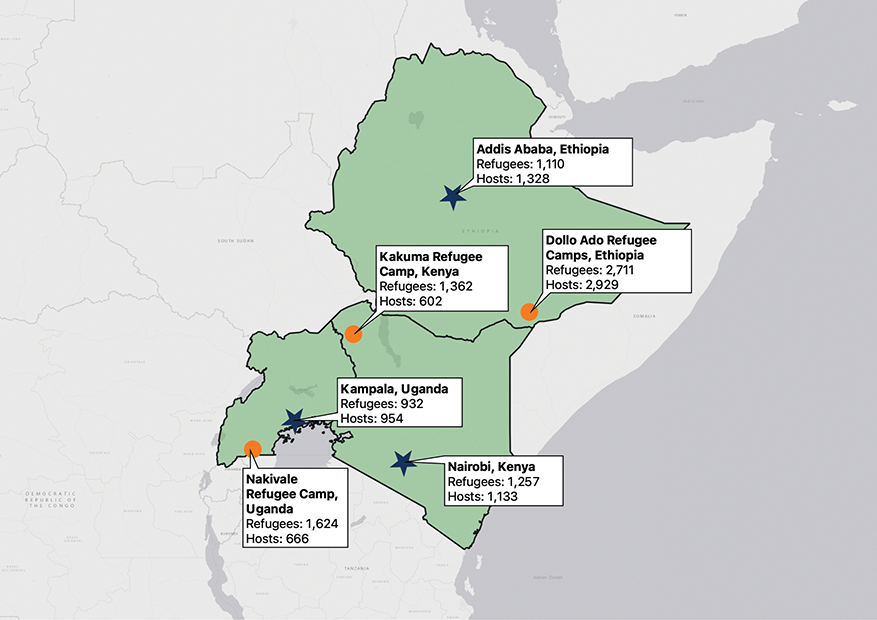
Figure 1 Long description:
The map shows the location of six survey locations: 1) Addis Ababa in Ethiopia, where the refugee sample size is 1,110 and the host community sample size is 1,328. 2) Dollo Ado Refugee Camps in Ethiopia, where the refugee sample size is 2,711 and the host community sample size is 2,929. 3) Nairobi in Kenya, where the refugee sample size is 1,257 and the host community sample size is 1,133. 4) Kakuma Refugee Camp in Kenya, where the refugee sample size is 1,362 and the host community sample size is 602. 5) Kampala in Uganda, where the refugee sample size is 932 and the host community sample size is 954. 6) Nakivale Refugee Camp in Uganda, where the refugee sample size is 1,654 and the host community sample size is 666.
We chose to conduct our research in low- and middle-income countries, which – despite hosting the vast majority of the world’s refugees (84% in 2016, when we began data collection) – often have limited resources to support them. We selected these specific countries because they had contrasting refugee policies and legislation. At one end of the spectrum, Uganda allowed refugees the right to work and enjoy a significant degree of freedom of movement. At the other end of the spectrum, Kenya denied refugees the right to work and move freely. And, in the middle, Ethiopia was gradually embarking on a transition from an approach similar to Kenya’s towards one potentially similar to Uganda’s.Footnote 3
We started our research in Kenya in 2016, beginning with Kakuma refugee camp in Turkana County, which borders South Sudan. At the time, the country hosted nearly 500,000 refugees, of whom around 164,000 lived in Kakuma. Our sample in the camp focused on three major refugee nationalities: South Sudanese, Somali, and Congolese. In early 2017, we extended our fieldwork to Nairobi, which was home to approximately 65,000 urban refugees. There, we focused on Somali and Congolese refugees living in the city’s eastern and southern neighbourhoods.Footnote 4 We also collected a second wave of data in 2019, both in Kakuma and Nairobi, in order to study refugee mobility.Footnote 5
Fieldwork in Uganda was conducted between February and May 2018. At that time, Uganda hosted more than 1.1 million refugees – making it the largest refugee-hosting country in Africa. Our research focused on two sites: Nakivale refugee settlement and the capital, Kampala. Nakivale, located in Isingiro District near the border with Rwanda and the Democratic Republic of Congo, is Africa’s oldest refugee settlement and hosted around 104,000 refugees at the time of our visit. Kampala had a similarly sized refugee population, estimated at 100,000, dispersed across various low-income neighbourhoods. In both settings, we concentrated on Congolese and Somali refugee populations, reflecting their large presence and the regional displacement dynamics.
Field research in Ethiopia took place between August and December 2018. At the time, the country hosted around 900,000 refugees. We selected two contrasting sites: the Dollo Ado refugee complex and the capital city, Addis Ababa. Dollo Ado is an Ethiopian town located near the Somali border. Next to it, five refugee camps hosted roughly 220,000 refugees – nearly all of Somali origin. Starting from the camp closest to Dollo Ado town and the Somalia–Ethiopia border, the five camps are, in order: Buramino, Hilaweyn, Kobe, Melkadida, and Bokolmayo. In Addis Ababa, we included both Somali and Eritrean refugees in our study. These urban refugees lived under special legal arrangements, such as the Out-of-Camp Policy and Urban Assistance Program (UAP), which allowed a subset of the refugee population to reside legally in the capital. While smaller in size than our other sites, the Addis Ababa sample offers a useful contrast to the camp-based Somali population in Dollo Ado and reflects the growing role of cities as places of refuge.
While our research focuses on Kenya, Uganda, and Ethiopia, similar research efforts have gradually emerged in other refugee-hosting contexts. For instance, building on the Jordan Labour Market Panel Survey 2016, which includes households in refugee camps (Krafft and Assaad, Reference Krafft and Assaad2021), Stillman et al. (Reference Stillman, Rozo and Tamim2022) launched the Syrian Refugee Life Study in Jordan in 2020 to track the socio-economic trajectories of Syrian refugees over time. In 2023, UNHCR carried out its inaugural Forced Displacement Survey – focusing on South Sudan and with similar efforts planned in Pakistan and Cameroon – aimed at offering a comprehensive picture of the legal and socio-economic conditions of both refugees and host communities (UNHCR, 2024). Since 2019, the World Bank, UNHCR, and their Joint Data Center on Forced Displacement have supported a range of initiatives to collect or harmonise data on both refugees and host communities (see, e.g., Wieser et al., Reference Wieser, Tesfaye, Abeje, Lebow and Yonis2024; World Bank, 2023). They also worked to integrate refugees into existing national censuses or surveys – such as the Demographic and Health Surveys (DHS) and Multiple Indicator Cluster Surveys (MICS) – by encouraging their inclusion in sampling frames.
Qualitative Data
Across all sites, we adopted a mixed-methods, participatory approach. One of our starting points is that some things cannot be quantified. Making sense of the economic lives of refugees involves understanding perceptions and norms that are grounded in local context. Similarly, the right and opportunity to work is shaped by political economy questions that require qualitative insights. We therefore began all our research with qualitative data collection.
The primary qualitative methods used were focus group discussions and semi-structured interviews, through which we conducted over 500 interviews across the three countries. To ensure broad representation, we covered a diverse range of respondents, including men and women, individuals of varying ages, and members of different national and ethnic groups. In addition to refugee participants, we interviewed key non-refugee actors – such as staff from UN agencies and NGOs, as well as local and national government officials involved in refugee governance – to triangulate findings.
The qualitative data collection followed a consistent two-stage sequence across sites. First, each fieldwork phase began with open-ended, unstructured interviews with key informants – including refugee and host community leaders (both formal and informal) and representatives of organisations operating locally. These initial interviews served to build contextual understanding and inform the design of site-specific survey instruments, ensuring that our quantitative tools were sensitive to local realities. In the second stage, we conducted more structured qualitative engagements, using semi-structured individual interviews and focus groups to explore specific themes that had emerged during the initial phase. This approach enabled us to investigate the economic strategies, constraints, and coping mechanisms of refugees in greater depth, providing a richer understanding of their livelihoods and decision-making processes within each setting. In order to protect the privacy and safety of participants, interviewees were either given pseudonyms or anonymised.
Quantitative Data
In each context, we then undertook large-scale quantitative surveys on representative samples of refugees and host communities living nearby. It took more than three years of fieldwork to build the dataset, with data collection taking place between October 2016 and December 2019. The total sample size of the cross-sectional dataset was 16,608, comprising 8,996 refugees and 7,612 members of the proximate host community (Table 1).
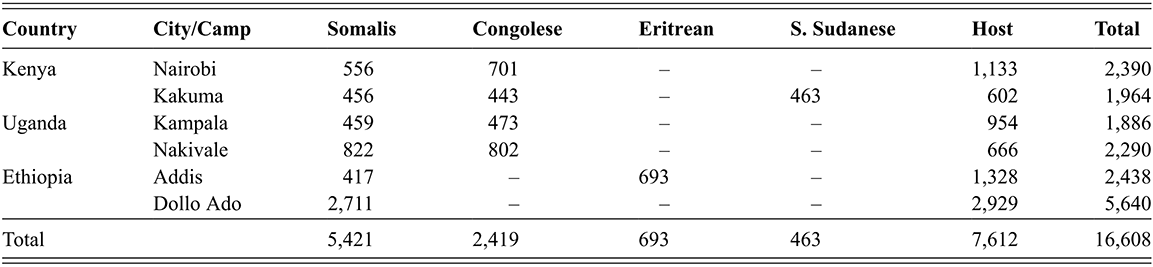
Table 1 Long description:
The table reports sample sizes by nationality across study sites in Kenya, Uganda, and Ethiopia. In Kenya, the Nairobi sample includes 556 Somali and 701 Congolese respondents, with no Eritrean or South Sudanese participants, plus 1,133 host community respondents, for a total sample of 2,390. In Kakuma camp, the sample includes 456 Somali, 443 Congolese, and 463 South Sudanese respondents, with no Eritreans, alongside 602 host community respondents, totalling 1,964.
In Uganda, the Kampala sample includes 459 Somali and 473 Congolese respondents, with no Eritrean or South Sudanese participants, and 954 host community respondents, for a total of 1,886. In Nakivale camp, the sample includes 822 Somali and 802 Congolese respondents, with no Eritrean or South Sudanese participants, plus 666 host community respondents, totalling 2,290.
In Ethiopia, the Addis Ababa sample includes 417 Somali and 693 Eritrean respondents, with no Congolese or South Sudanese participants, and 1,328 host community respondents, for a total of 2,438. In Dollo Ado camp, the sample includes 2,711 Somali respondents only, with no other refugee nationalities represented, and 2,929 host community respondents, totalling 5,640.
Across all sites, the total sample comprises 5,421 Somali, 2,419 Congolese, 693 Eritrean, and 463 South Sudanese respondents, along with 7,612 host community respondents, for an overall sample size of 16,608.
The survey questionnaire was intentionally wide-ranging to enable us to explore a range of themes. It included modules covering demographic information, economic activities, income, expenditure, assets, education, health and wellbeing, food security, financial inclusion, networks, mobility, social cohesion, sport, and community participation, for example. The survey instruments were developed through an iterative process, including multiple rounds of testing and feedback with members of the refugee and host communities to ensure clarity, relevance, and cultural appropriateness.
Finalised questionnaires were translated into the principal languages spoken by respondents in each site. Across all sites, we trained approximately 200 refugees and members of the host community as research assistants and enumerators.
In each site, we aimed to collect data on representative samples of refugee communities and of the host population living nearby. To sample the host population, we focused on administrative areas close to refugee camps in rural areas and on neighbourhoods with a high density of refugees in urban centres. Our sampling strategy varied across contexts and communities, depending on the availability and accessibility of a sampling frame.Footnote 6 Where we were able to obtain accurate contact details for the entire population of interest, we were able to use simple random sampling. In Addis Ababa (Ethiopia), for example, UNHCR shared names and contact details from their database of urban refugee households, for both registered Somali and Eritrean refugees. In the five Dollo Ado camps (Ethiopia), we exploited the sampling frame of UNHCR’s Standardised Expanded Nutrition Survey and the relatively well-defined structure of the camps, which allowed us to randomly select addresses in the camps. Around the Dollo Ado camps, we undertook a census of local host communities and randomly selected households for the full survey. In Nairobi, we worked with community leaders of the Congolese communities to establish a list of households and randomly select study participants.
In most of our contexts, however, simple random sampling was not a viable option because we could not obtain complete and accurate contact information for the populations of interest. And so, we instead used two-stage cluster sampling. The first stage involved the random selection of a certain number of ‘enumeration areas’ (whether blocks, neighbourhoods, or buildings) on official maps or satellite images. The second stage involved mapping selected enumeration areas and randomly selecting respondent households within them.
For example, in Kakuma, we used existing UNHCR maps and data to estimate the distribution of different nationalities across the blocks. We then randomly selected blocks proportional to the number of individuals of each nationality living within the blocks. The selected blocks were mapped by enumerators, and random sampling was used to select households within each block. We implemented similar sampling frames in other contexts.
One key innovation in our research was also to go beyond the household heads and look at diversity within households. For this purpose, in each household we interviewed the head of household, the primary food preparer, and up to three randomly selected other members of the household.
In addition to our multi-site, cross-sectional data, we also undertook a second wave of data collection with the same cohort of refugees and host community members in Kenya. We collected the second wave two years after the first wave in Nairobi, and three years after the first in Kakuma. The purpose of this second wave was twofold – to explore what, if anything, had changed during the elapsed time, and to assess the sample attrition rate during the intervening period, as a means to explore patterns of migration and mobility (Betts et al., Reference Betts and Sterck2023). Because of COVID-19, this panel data collection was only undertaken in Kenya.
Our approach to analysing the data is primarily descriptive. We will present bar charts and other figures to compare the means of variables of interest in different refugee and host populations. We also use simple regressions to compare average outcomes in different groups of refugees and hosts, for example, who live in different contexts (e.g., urban vs. camp) or report different genders. As our analysis is descriptive, we do not include control variables in order to simplify the interpretation of results and avoid issues relating to bad controls. Sampling weights and clustering are used throughout the analysis to account for the sampling design.Footnote 7
3 Four Mechanisms Underlying the Refugee Trap
In this Element, we use our rich dataset to explore whether refugees face distinctive economic outcomes compared to nearby host populations – and if so, why.
Our empirical observations reveal that refugees are generally worse off than proximate members of the host community across a wide range of indicators (see Section 4). They have lower employment rates and, when employed, earn substantially less than their host community counterparts. These income gaps translate into lower overall household consumption, heightened food insecurity, and poorer dietary diversity. Importantly, these differences are not only large but also enduring: even after ten years or more in exile, refugees remain significantly worse off on average. This sets the stage for our central argument: that there is something structurally distinct about the refugee experience that traps people in disadvantage.
Drawing upon the concept of the poverty trap, we theorise this gap as resulting from a ‘refugee trap’. A ‘poverty trap’ can be understood as a set of self-reinforcing mechanisms whereby countries, communities, or people start poor and remain poor: poverty begets poverty, so that current poverty is itself a direct cause of poverty in the future (Kraay and McKenzie, Reference Kraay and McKenzie2014).
Within the wider development economics literature, a range of mechanisms have been identified as underlying the poverty trap (Dasgupta, Reference Dasgupta1997; Kraay and McKenzie, Reference Kraay and McKenzie2014; Ghatak, Reference Ghatak2015; Ridley et al., Reference Ridley, Rao, Schilbach and Patel2020; Balboni et al., Reference Balboni, Bandiera, Burgess, Ghatak and Heil2022). Explanations include savings and credit traps; hunger-based traps in which physical work capacity is reduced by the lack of food; occupational traps relating to lack of access to education or the inability to scale small businesses; behavioural traps resulting from short-term time horizons; health traps resulting from poor physical or mental health limiting productive capacity; and geographical traps resulting from living in regions that lack infrastructure or opportunity.
Diagnosing the causes of poverty traps is important for prescribing effective solutions. What are the mechanisms underlying ‘the refugee trap’? How does the fact of being a ‘refugee’, holding other factors constant, make people worse off?
To address these questions, our starting point is to examine and decompose the multifaceted shocks experienced by forcibly displaced people when they become refugees. We distinguish four key components of these shocks, broadly sequenced over time – from the country of origin, through flight and transit, to exile in the host country. First, refugees often endure physical and psychological trauma, resulting from experiences in their country of origin, during transit, or while in exile. Second, displacement is accompanied by the dispossession of essential resources, both material (such as assets and property) and immaterial (such as legal status or academic credentials), which severely limits their opportunities. Third, displacement typically entails a rupture from social and geographic ties: refugees are uprooted from their homes and communities, and forced to live in a place they do not know. Fourth, exile frequently involves the deprivation of fundamental rights – such as the right to work, to move freely, to own property, or to access education and healthcare.
These four categories of shock – trauma, dispossession, uprootedness, and rights deprivation – serve as both an analytical lens for understanding the refugee trap and a structural framework for the rest of this Element. Each is also closely related to the economic concepts of identity, capital, networks, and institutions, respectively (Table 2), which we mobilise to understand how, in theory, these shocks can entrap refugees.
Before describing the four mechanisms in detail, two clarifications are needed. First, none of the mechanisms is unique to refugees. Non-refugees may experience psychological distress, asset loss, abandonment, or some form of institutional exclusion in various contexts. What distinguishes the refugee experience, however, is the high likelihood that these mechanisms occur simultaneously, persist over extended periods, and unfold within environments that restrict opportunities for adjustment and recovery.
Second, although the four mechanisms are conceptually distinct, they are not mutually exclusive and often interact in practice. Trauma can reduce the capacity to rebuild livelihoods or engage with economic opportunities. Dispossession often involves the loss of key documentation, which can restrict access to rights, limit mobility, and hinder the formation of new social and economic networks. Uprootedness can exacerbate psychological distress while weakening the social support structures that might otherwise help individuals cope. The deprivation of rights further restricts access to labour markets, services, and institutions. While we distinguish the four mechanisms for analytical clarity, they often interact and reinforce one another, generating feedback loops that persist over time and constrain pathways out of deprivation, contributing to the persistence of the refugee trap.
| The traps | Underlying concept | Solutions |
|---|---|---|
| Trauma | Identity | Psychological support |
| Dispossession | Capital | Economic opportunity |
| Uprootedness | Networks | Social integration |
| Rights | Institutions | Political advocacy |
Trauma
Section 5 will examine the consequences of trauma. Refugees face traumatic experiences within their country of origin, whether because of war or persecution. Exposure to violence, threats, loss, and prolonged uncertainty can have long-lasting psychological and physiological consequences, including post-traumatic stress disorder (PTSD), depression, and functional impairment (Charlson et al., Reference Charlson, van Ommeren and Flaxman2019; Blackmore et al., Reference Blackmore, Boyle and Fazel2020; Pozuelo et al., Reference Pozuelo, Bradenbrink, Stierna and Sterck2023). Displacement itself can also be a source of stress, including through social exclusion, poverty, discrimination, and insecurity (Miller and Rasmussen, Reference Miller and Rasmussen2017; Ellis et al., Reference Ellis, Winer, Murray and Barrett2019). These events can have effects not only on mental and physical health but also on identity – that is, on who refugees are and how they perceive themselves.
This, in turn, can affect behaviour, aspirations, and decision-making. Trauma can reduce individuals’ capacity to work, plan for the future, or invest in education and skills – key behaviours necessary for escaping poverty. Trauma may also shorten time horizons, diminish risk tolerance, and disrupt social trust, all of which can weaken economic agency (Haushofer and Fehr, Reference Haushofer and Fehr2014; Cassar et al., Reference Cassar, Healy and Von Kessler2017). Furthermore, individuals with depression, PTSD, or functional impairment may have reduced motivation, confidence, and ability to engage in productive activities, and may avoid interactions or spaces associated with stress, including labour markets or schools. At the household level, trauma can affect intra-household decision-making, parenting, and caregiving, and have implications for children’s long-term outcomes (Betancourt et al., Reference Betancourt, McBain, Newnham and Brennan2015; Mutuyimana et al., Reference Mutuyimana, Sezibera and Nsabimana2019; Jensen et al., Reference Jensen, Sezibera, Murray, Brennan and Betancourt2021).
These psychological and behavioural responses are likely to generate self-reinforcing dynamics: trauma and poor mental health can lead to adverse economic conditions, which in turn exacerbate stress, reinforce pessimistic beliefs, and deepen psychological distress. In this way, trauma contributes not only to immediate welfare losses but also to feedback loops that sustain deprivation over time (Barrett and Schofield, Reference Barrett and Schofield2026).
Dispossession
Section 6 will examine how the dispossession of both material and immaterial resources severely limits refugees’ opportunities. Displacement often entails the sudden loss of natural, physical, human, social, and financial capital. Refugees may abandon homes, land, livestock, and business assets. Bank accounts may become inaccessible, and personal belongings may be looted, destroyed, or left behind. These forms of material loss are compounded by the erosion of human capital: educational credentials and professional qualifications are frequently unrecognised in the host country, and language differences further impede the transferability of skills and knowledge and restrict access to education.
Dispossession can create multiple types of poverty traps by constraining refugees’ ability to access employment, become entrepreneurs, or access further education – key conditions for breaking out of poverty (Brell et al., Reference Brell, Dustmann and Preston2020; Balboni et al., Reference Balboni, Bandiera, Burgess, Ghatak and Heil2022). Refugees may lack the collateral or credit history required to obtain loans, which may limit business creation or expansion (Santos and Barrett, Reference Santos and Barrett2011). Limited access to land reduces options for agriculture or self-employment. Meanwhile, the devaluation of prior education and credentials forces many to restart at the bottom of the labour market or educational system, irrespective of their prior education. Language barriers compound these constraints by limiting access to the labour market (Dustmann and Fabbri, Reference Dustmann and Fabbri2003; Chiswick and Miller, Reference Chiswick and Miller2015; Lochmann et al., Reference Lochmann, Rapoport and Speciale2019; Foged et al., Reference Foged, Hasager, Peri, Arendt and Bolvig2024). The inability to access financial capital or use existing human capital reduces returns to education and work opportunities, trapping skilled individuals in low-productivity sectors.
Uprootedness
Section 7 will compare how refugees’ and hosts’ outcomes are differentially shaped by their access to social networks. While often contested as a metaphor (Malkki, Reference Malkki1992, Reference Malkki1995), the idea of ‘uprootedness’ captures an important aspect of forced displacement: it severs people from the social fabric that underpins their everyday lives and economic agency. When fleeing, refugees frequently lose access to kin networks, professional ties, community associations, informal lenders, and patronage relationships – forms of social capital. Unlike economic migrants who often cultivate their social networks before migration (Haug, Reference Haug2008), refugees must rebuild their social networks in the host country, often from scratch.
Limited social network capital can trap households into poverty (Chantarat and Barrett, Reference Chantarat and Barrett2012). There is a large theoretical and empirical literature that documents how differential access to social networks explains inequalities in economic outcomes, such as employment, income, and educational attainment, across racial, gender, ethnic, and other groups (Jackson, Reference Jackson2014; Jackson et al., Reference Jackson, Rogers and Zenou2017). In contexts where labour markets are largely informal and access to jobs depends on word-of-mouth or trust-based hiring, network loss can result in prolonged unemployment or underemployment (Munshi, Reference Munshi2003; Dagnelie et al., Reference Dagnelie, Mayda and Maystadt2019). When access to finance is limited, informal networks are essential to cope with idiosyncratic negative shocks, and the lack thereof can give rise to persistent socio-economic deficits (Ambrus et al., Reference Ambrus, Mobius and Szeidl2014; Banerjee et al., Reference Banerjee, Breza and Chandrasekhar2024). This is especially consequential for refugees, who often face compounded risk exposure and limited access to formal protection mechanisms.
Rights
Section 8 will explore how rights deprivations can lead to a poverty trap. Within their country of asylum, refugees are likely to face different regulatory and institutional constraints compared to citizens and other migrants (Costello et al., Reference Costello, Foster and McAdam2021). On the one hand, thanks to international protection, refugees may have access to different forms of entitlements, such as access to assistance or protection qua refugees. On the other hand, they may also face greater legal and regulatory constraints in areas such as rights relating to employment, mobility, banking, and property ownership (Ginn et al., Reference Ginn, Resstack and Dempster2022; Betts and Sterck, Reference Betts and Sterck2022).
These rights deprivations may create or reinforce poverty traps. Institutional economists have long argued that inclusive economic institutions – such as secure property rights, freedom to contract, and access to formal financial systems – are critical for long-term development (North, Reference North1990; Williamson, Reference Williamson2000; Acemoglu and Robinson, Reference Acemoglu and Robinson2012). When refugees are legally barred from accessing labour markets, they are often pushed into low-productivity informal employment or excluded from work altogether, limiting their ability to accumulate capital, build skills, or invest in their future (Zetter and Ruaudel, Reference Zetter and Ruaudel2016; Marbach et al., Reference Marbach, Hainmueller and Hangartner2018; Fasani et al., Reference Fasani, Frattini and Minale2021). Restrictions on mobility reduce access to wider markets, suppress competition, and increase prices for goods and services in enclosed camp economies (Werker, Reference Werker2007). Barriers to opening bank accounts or owning property may prevent refugees from saving securely, accessing credit, or using collateral to start or expand a business (Martin, Reference Martin2019; Dhawan and Zollmann, Reference Dhawan and Zollmann2023). These constraints impose structural disadvantages that reduce returns to effort and inhibit upward mobility, even when refugees have entrepreneurial potential or prior experience.
Restoration
The follow-up question, addressed in Section 9, is how we think about solutions. What is the source of ‘exit’ from the refugee trap? Generally, in refugee policy, solutions are assumed to be linked to the restoration of effective citizenship through pathways to so-called durable solutions – repatriation, resettlement, and local integration. Here, though, resolving the refugee trap relies upon restoring the socio-economic opportunities needed to alleviate each source of the gap. This requires successfully addressing each element of the trap: trauma, dispossession, uprootedness, and rights. The task for researchers is to identify ‘what works’ in each of these areas to restore refugees to ‘normality’, whether benchmarked against the host community or some other threshold.
Along these lines, Michael Cernea (Reference Cernea1997, Reference Cernea1998) developed a model called the Risks and Reconstruction model for addressing the sources of harm associated with displacement. He originally developed the framework for development-induced displacement as a result of large development projects such as dam construction. His core argument was that identifying the negative sources of impact resulting from displacement inherently offered an insight into the solutions. For Cernea, diagnosis enables restitution. The risks and impoverishment that result from displacement and the solutions needed for returning communities to normality are the ‘flip side of the same coin’.
In our case, the ‘flip side’ of trauma is psychological support, the flip side of dispossession is economic opportunity, the flip side of uprootedness is social integration, and the flip side of rights is political advocacy (Table 2).
Therein lies an alternative view of what ‘durable solutions’ can and should mean in relation to refugees. Instead of being based just on the restoration of effective citizenship, durable solutions can be reconceived as addressing the multi-dimensional causes of the refugee trap. This recognition is especially important in a world in which traditional durable solutions have increasingly become a fiction, unavailable to most refugees.
4 Welfare Outcomes: Better or Worse Off?
My name is Rose. My household has 10 people. But in May, my sister passed away. She was sick. I had no choice but to adopt her children – they are five in total. I couldn’t bear to see them die of hunger. They are human beings, like us. So, I decided to take care of them and share my food with them. If they were to die, it would be better for us to die together. I couldn’t leave them alone. They are also suffering, and people would judge me if I didn’t help. It would reflect badly on me, especially after my sister’s death. Then, just one week after my sister passed away, my brother was shot dead in South Sudan. I never got the chance to see him because I moved to Kakuma in 2000, and he stayed in South Sudan. This broke my heart. Since I came to Kenya, I haven’t seen any of my relatives. Life separated us. But after his death, my brother’s children, also five in number, were brought to me. They are now my responsibility too. In total, I now care for 20 people. I face many challenges. Besides my own children, I have all these orphans to care for. I depend on food assistance from the UN. But we also need money for other things like grinding flour, school fees, and firewood. Sometimes the children get sick, and I need money for medicine. We often eat without oil or onions because when we think of buying these, there are always other things that are more important, like salt or broth. We haven’t eaten onions or tomatoes in a long time because we simply can’t afford them. My debts are huge, and I don’t know how to pay them off. I borrowed money when I had no choice. The children needed school supplies – exercise books and uniforms. And when my sister was sick and trying to reach me, I borrowed money to help her. She made it here, but she died in May. All the expenses for her care and burial came from my debts. The shopkeeper who lends me money is always upset. He says, ‘Don’t bring all your problems to me. You need to find a way to help yourself.’ So now, we eat only once a day – at 2 p.m. We don’t eat again until 2 p.m. the next day. When the children are in school, they get a meal there – whether it’s rice or githeri (a mixture of maize and beans). But when school is closed, they suffer again because there’s no food at home. We haven’t tasted meat or onions in a long time. We eat once a day, and that’s it until the next day. Even tea, which others talk about, we never drink, especially now that food is scarce and there’s no money for sugar. That’s why I’m thin. These are the burdens I carry. Our food is not enough. If we had more, life would be better. I wish the UNHCR could see our struggles. I am happy that you are in the community to witness our burdens. Many people here are suffering, not just me. Many children are orphans. When the food is ready, I feed the children first. When they are full and go out to play, that’s when I eat what’s left. If there’s nothing left, I go hungry. This is how I live because I put them first – they are like my own eyes. I survive by putting them first, even if it means I go hungry until the next day. When God helps me, I eat. Otherwise, I wait. When the children play, I feel happy. They are our future. God has asked us to keep our hearts humble. I tell them that even if the food is small, they should have a good heart. That’s our life. I have been surviving like this since 2000, and my heart has almost lost hope. October 2023, Kakuma, Kenya
In this section, we compare the outcomes of refugee and host populations living in both camps and cities across East Africa. Rose’s story is representative across our research sites. Our findings show that most refugees are extremely poor and vulnerable. Refugees fare worse than host populations across a broad range of key indicators. They are less likely to be employed, and when they are, their average income is significantly lower. However, refugees also benefit from humanitarian aid in camps and from remittances, which partly offset disparities in employment income between refugees and hosts.
Low Employment
Refugees in our study populations face lower access to labour markets compared to members of surrounding host communities – a pattern that holds across countries and sites. As shown in Figure 2, two-thirds (65%) of adults in host communities were employed at the time of the survey, compared to only 31% of refugees. Employment rates are consistently higher in cities, in both refugee and host communities.
Refugees’ participation in the labour market increases with the length of time spent in the host country (Figure 3). For each additional year of residence, the probability of employment rises by 1.6 percentage points. On average, only 25% of refugees who have been in the host country for less than five years are employed, but this proportion increases to under half (48%) among those who have been there for ten years or more. Despite this improvement over time, refugee employment rates still fall short of the host community’s average labour participation rate of 65%.
Percentage of individuals with a job, by location and refugee–host status.
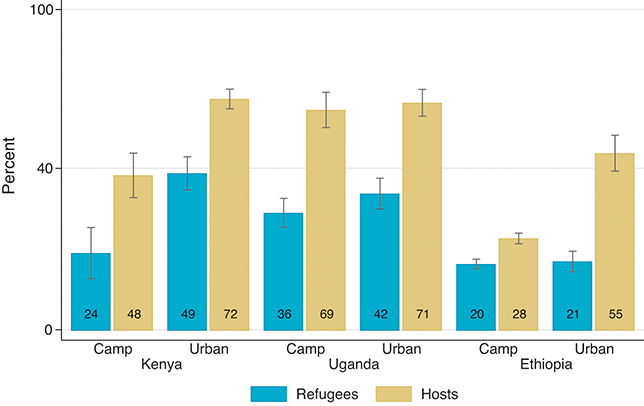
Figure 2 Long description:
The bar chart shows the percentage of individuals with a job in six locations: 1) the percentages of refugees and host communities who have a job in Kakuma Refugee Camp are 24 and 48.2 respectively; 2) the percentages of refugees and host communities who have a job in Nairobi are 48.8 and 72.1 respectively; 3) the percentages of refugees and host communities who have a job in Nakivale Settlement are 36.5 and 68.8 respectively; 4) the percentages of refugees and host communities who have a job in Kampala are 42.5 and 70.9 respectively; 5) the percentages of refugees and host communities who have a job in Dollo Ado camps are 20.5 and 28.5 respectively; 6) the percentages of refugees and host communities who have a job in Addis Ababa are 21.3 and 55.1 respectively.
Percentage of individuals with a job, by location and number of years in host country.
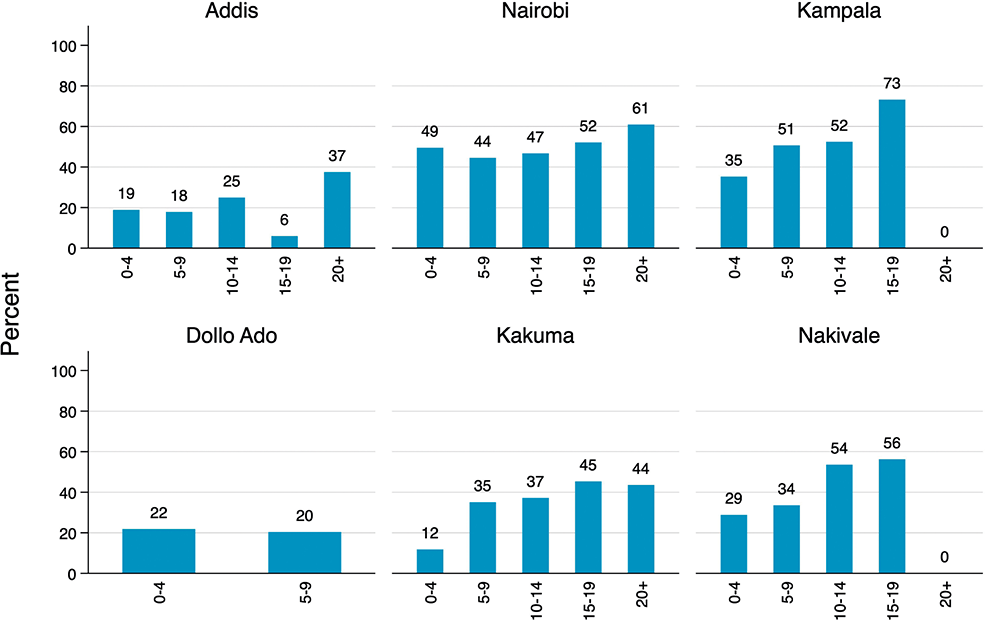
Figure 3 Long description:
The bar chart shows the percentage of individuals with a job in six locations. 1) Addis Ababa - less than 4 years: 19%; 5-9 years: 18%; 10-14 years: 25%; 15-19 years: 6%; more than 20 years: 37%. 2) Nairobi - less than 4 years: 49%; 5-9 years: 44%; 10-14 years: 47%; 15-19 years: 52%; more than 20 years: 61%. 3) Kampala - less than 4 years: 35%; 5-9 years: 51%; 10-14 years: 52%; 15-19 years: 73%; more than 20 years: 0%. 4) Dollo Ado - less than 4 years: 22%; 5-9 years: 20%. 5) Kakuma - less than 4 years: 12%; 5-9 years: 35%; 10-14 years: 37%; 15-19 years: 45%; more than 20 years: 44%. 6) Nakivale - less than 4 years: 29%; 5-9 years: 34%; 10-14 years: 54%; 15-19 years: 56%; more than 20 years: 0%.
Low Wages
Refugees not only participate less in the workforce, but also earn significantly lower wages (Figure 4). The disparity is striking: among those who are employed, host community members earn on average three times more than refugee workers.
Average wage of workers, by location and refugee–host status.
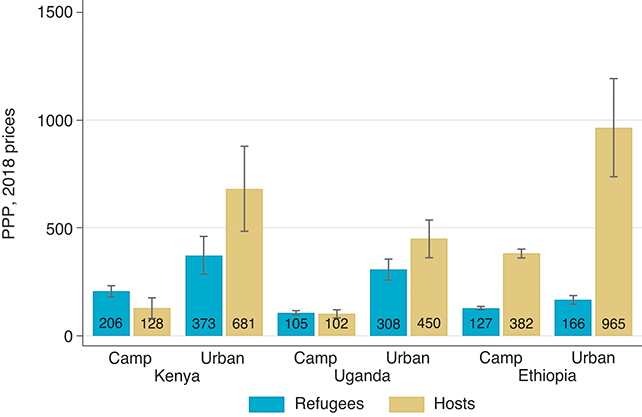
Figure 4 Long description:
The bar chart shows the average wage of workers in six locations. 1) Kakuma: 206.1 for refugees, 127.9 for host. 2) Nairobi: 372.8 for refugees, 681 for host. 3) Nakivale: 105.1 for refugees, 102.1 for host. 4) Kampala: 307.5 for refugees, 450 for host. 5) Dollo Ado: 126.8 for refugees, 381.8 for host. 6) Addis Ababa: 166.2 for refugees, 965.1 for host.
The refugee–host work income disparity is wider in urban settings. For instance, during our fieldwork in Addis Ababa in 2018, we observed some Eritrean refugees working for Ethiopian employers as casual labourers in the informal sector. However, payment from these informal ad-hoc jobs was usually much smaller than that of host Ethiopians and was inadequate to cover living expenses in Addis. A twenty-six-year-old male Eritrean refugee, who works as a casual labourer at a laundry facility owned by an Ethiopian, expressed his frustration about his meagre salary. ‘I work eight hours per day and seven days a week. I have no [paid] holidays. My salary is only 1500 birr (159 PPP$, 2018 prices) per month. Ethiopian colleagues [working at the same laundry] are earning a higher salary [than mine].’
Despite being dissatisfied with his salary, this refugee chose not to negotiate with the owner of the laundry business, fearing that asking for a raise might embarrass the owner and risk his job.
This example illustrates how the fear of losing their jobs compels refugees to accept lower wages. In the following sections, we provide evidence showing that refugees’ vulnerability in the labour market is exacerbated by gaps in human capital and language proficiency (Section 6), weaker social networks in the host country (Section 7), and discriminatory regulations (Section 8).
Gender Gaps
Although gender differences are not the primary focus of this Element, they are so striking that they cannot be overlooked.
Female participation in work is significantly lower than that of males in both refugee and host populations (80% vs. 55% for hosts, and 37% vs. 26% for refugees). The gender gap in employment rates is generally narrower in camp settings, partly because NGOs offer short-term, low-paid ‘incentive’ positions – such as teaching assistants or community mobilisers – which are often allocated with gender balance in mind.
There is also a large gender pay gap, both for refugee and host workers. However, the gender pay gap is wider among host community workers. Female refugee workers earn on average 188 PPP$ per month, under three-quarters (72%) of the average male refugee wage of 258 PPP$ per month. In comparison, female workers in host communities earn an average of 446 PPP$, half (52%) of the average wage of their male counterparts (844 PPP$).
Low Total Incomes
While refugees have lower employment rates and lower wages than the host community surrounding them, some manage to partially offset this disadvantage through greater access to remittances from abroad and humanitarian aid.
Nearly a fifth (17%) of the refugees receive transfers from individuals living outside the host country compared to only 3% among the host community. However, this only partially offsets the income gap as refugees are less likely to receive transfers from individuals living in the host country. Considering both transfers within the host country and remittances from abroad, refugee households receive on average 131 PPP$ per person per month, compared to 96 PPP$ among households in the host communities. We explore these trends further in Section 7, linking remittances to overseas networks.
Refugees also have access to humanitarian assistance, especially in refugee camps. At the time of our research, all camp-based refugees in Kenya, Ethiopia, and Uganda were receiving food assistance from the World Food Programme (WFP). Historically, WFP distributed monthly in-kind rations, typically including cereals, pulses, enriched Corn Soy Blend, and vegetable oil, designed to provide around 2,100 calories per person per day. However, WFP is increasingly shifting to cash transfers to give refugees more autonomy, support local markets, and reduce costs (MacPherson and Sterck, Reference MacPherson and Sterck2021). During our research, refugees in Kakuma received a combination of in-kind rations and cash transfers, while those in Nakivale and Dollo Ado still relied solely on in-kind rations. In addition to food assistance, host governments and NGOs provide services such as shelter, healthcare, education, and WASH programmes in camps.
As highlighted by Rose in the opening story, many camp-based refugees fully depend on the WFP’s food assistance. However, because refugees need other necessities than food, dependence on aid is also often associated with debt and with participation in a shadow resale market, where many refugees sell food rations to purchase other necessities. We describe these survival strategies and associated informal markets in Section 6.
In contrast, humanitarian aid is scarce in urban areas. Refugees in Nairobi, Kampala, and Addis Ababa typically receive little to no material support, except for Somali households benefiting from the UAP in Addis Ababa. Urban Assistance Program refugees, who have specific medical, protection, or humanitarian needs, receive a monthly stipend along with health and education support from UNHCR.
We define total household income as the sum of earnings from work, remittances, and humanitarian aid. Our data reveal stark contrasts in total income per capita between camp and urban contexts (Figure 5). In refugee camps, income levels are extremely low for both refugees and host communities. In Kakuma and Nakivale, refugees have higher average incomes per capita than the hosts, largely due to remittances and food assistance. However, differences are small, and the most striking finding is the extremely low average incomes per capita for both refugee and host communities in and around camps.
Household income per capita, PPP$, 2018 prices, by income sources, location, and refugee/host.
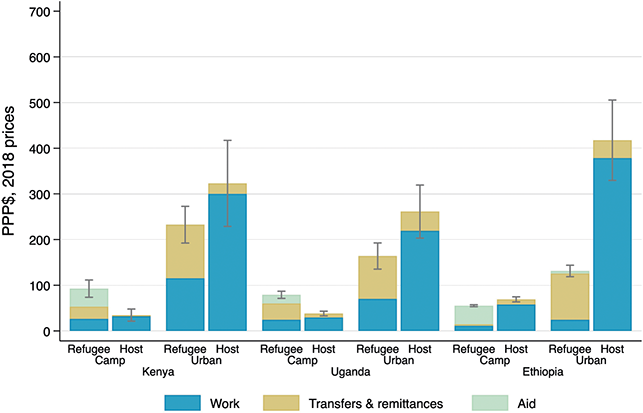
In cities, average incomes per capita are higher, especially among the host population. Host households earn 337 PPP$ per person per month, compared to just 184 PPP$ for refugees, a 45% gap. Work income is the main source of household earnings for host communities in urban areas – making up 88% of per capita income in capital cities – while for refugees, it accounts for only 56%. This difference reflects the fact that while refugees have higher access to remittances, it is not sufficient to close the income gap.
Higher Food Insecurity
Lower access to resources translates into higher food insecurity for refugees. We measure this using the Household Food Insecurity Access Scale (HFIAS), which captures different dimensions of food security (Coates et al., Reference Coates, Swindale and Bilinsky2007). Respondents were asked whether and how frequently their household experienced nine specific situations in the past four weeks (listed in Figure 6), with responses scored from zero (never) to three (more than ten times). The HFIAS score, ranging from 0 to 27, is the sum across the nine questions, with higher values indicating greater food insecurity.
Household food insecurity, by refugee/host status.
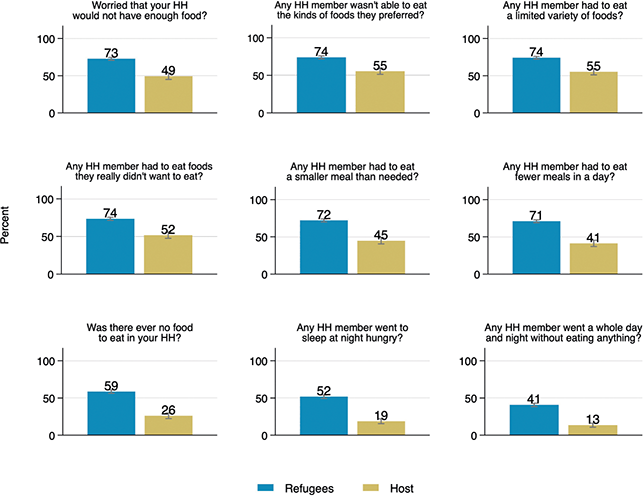
Figure 6 Long description:
1) Respondent had to worry that their household would not have enough food - 72.7 for refugees, 49.2 for hosts. 2) Respondent's household members were not able to eat the kinds of foods they preferred - 73.9 for refugees, 55.4 for hosts. 3) Any household members had to eat a limited variety of foods - 74.1 for refugees, 55.2 for hosts. 4) Any household member had to eat some foods they did not want - 73.5 for refugees, 51.7 for hosts. 5) Any household member had to eat a smaller meal than they felt they needed - 72.1 for refugees, 44.7 for hosts. 6) Any household member had to eat fewer meals in a day - 71 for refugees, 41.2 for hosts. 7) There was ever no food to eat of any kind in the household - 58.6 for refugees, 26 for hosts. 8) Any household member had to sleep at night hungry - 51.8 for refugees, 18.7 for hosts. 9) Any household member had to go a whole day and night without eating anything - 40.7 for refugees, 13.5 for hosts.
On average, refugee households are significantly more food insecure than households in the host communities. The mean score for refugee households is 12, almost double compared to households in the host communities (6.3). Looking at the responses to each question (Figure 6), 84% of the refugee households have been worried about not having enough food to eat, ate less preferred food, reduced variety of food they eat, or reduced quantities of food or meals in the past four weeks. In comparison, 63% of the households in the host communities experienced these situations.
Worryingly, 65% of the refugee households reported having no food at all or going to bed hungry in the past four weeks, and 41% had to go an entire day and night without eating. Such extreme levels of food insecurity are less common among host communities, affecting 28% and 13% of the households, respectively. Kakuma is one exception, where nearly three-quarters of host households reported going a full day and night without food – 25 percentage points higher than among refugees.
Refugees are also eating a less diversified diet in comparison with individuals in the host communities. We measure dietary diversity using the Individual Dietary Diversity Score from the Food and Agriculture Organization of the United Nations (Kennedy et al., Reference Kennedy, Ballard and Dop2011). This metric captures the number of different categories of food items individuals consumed in the past seven days, out of twelve groups, as listed in Figure 7. The score ranges from 0 to 12, with higher scores indicating greater dietary diversity. We find that, on average, refugees consume food from two fewer categories in a week than individuals in the host communities. Exploring differences in specific food categories, we see stark differences in consumption of non-staple food groups, including fruits, meats, fish, eggs, dairy products, and sugar products. For example, nearly three-quarters (74%) of the individuals from host communities ate fruits in the past seven days, but only 43% of the refugees did. Similarly, 77% of the individuals from the host communities ate meat in the past week, while only 57% of the refugees did.
Per cent of individuals who ate food items under each food category in the past seven days, by refugee/host status.
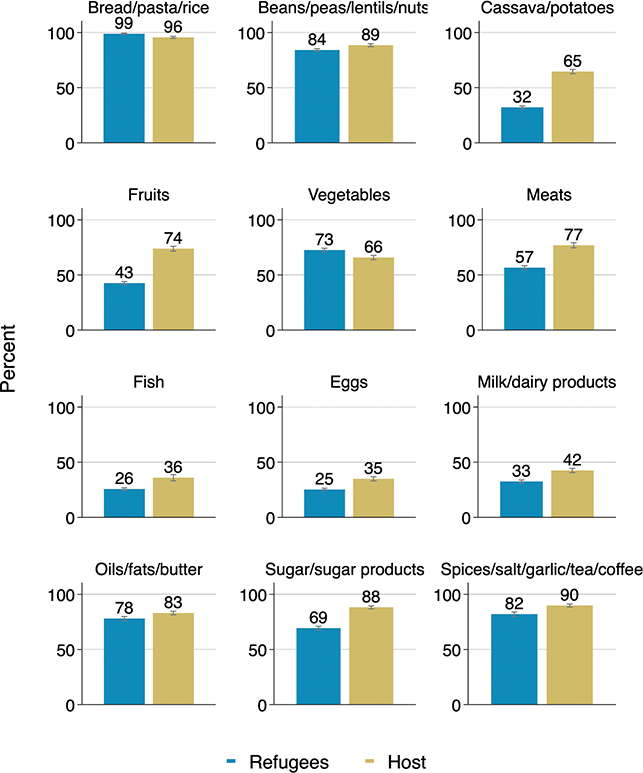
Figure 7 Long description:
1) Cereals (bread/pasta/rice) - 98.9 for refugees, 95.6 for hosts. 2) Beans/peas/lentils/nuts - 84.1 for refugees, 88.5 for hosts. 3) Cassava/potatoes - 32.1 for refugees, 64.6 for hosts. 4) Fruits - 42.6 for refugees, 73.8 for hosts. 5) Vegetables - 72.5 for refugees, 65.8 for hosts. 6) Meats - 56.6 for refugees, 76.9 for hosts. 7) Fish - 25.7 for refugees, 35.9 for hosts. 8) Eggs - 25.2 for refugees, 34.9 for hosts. 9) Milk/dairy products - 32.5 for refugees, 42.5 for hosts. 10) Oils/fats/butter - 78.1 for refugees, 83.1 for hosts. 11) Sugar/sugar products/honey - 69.3 for refugees, 88.3 for hosts. 12) Spices/salt/garlic/tea/coffee - 82 for refugees, 89.9 for hosts.
Dietary patterns can vary within households, particularly when resources are scarce. For example, as Rose mentioned earlier, mothers may eat less to ensure their children can eat more. While we do not have dietary diversity data for children, we can assess inequality in adult diets by measuring the range in dietary diversity scores within a household – the difference between the highest and lowest individual scores.
Refugee households tend to be more equal in dietary diversity than hosts. Among households with more than one adult, refugee households are 11 percentage points more likely to have no difference in dietary diversity scores across adults.Footnote 8 However, in refugee households where differences do exist, women are more likely to be disadvantaged. Female adults in refugee households are 8.1 percentage points more likely to be the individual with the least diverse diet, a gender gap not observed among host households.Footnote 9 These patterns suggest that while refugees may more often share food equally, unequal sharing – when it occurs – disproportionately affects women.
Poverty and Inequality
Focusing solely on average wages, incomes, and consumption levels can be misleading, especially when inequality is a concern. Whether resources are evenly shared among everyone or concentrated in the hands of a few individuals, average figures remain unchanged, obscuring critical disparities.
To address this limitation, we adopt the poverty and inequality measures developed by Sterck (Reference Sterck2024) and Kraay et al. (Reference Kraay, Decerf and Jolliffe2023), which offer two key advantages: they are sensitive to distribution, placing greater emphasis on the poorest, and they are decomposable, allowing meaningful analysis of differences between groups.
The poverty measure of Sterck (Reference Sterck2024) is simply the average time needed to consume 2.15 PPP$ per day, the cut-off for the extreme poverty line of the World Bank.
We find that poverty is widespread in all contexts, and extreme in Kakuma for both refugees and hosts and in Dollo Ado for refugees (Figure 8). In these contexts, four days are needed on average to consume just 2.15 PPP$. These groups are not only poor, they are also, on average, very far below the extreme poverty line. Poverty figures are also high for other groups, particularly among refugees. Poverty levels in refugee communities are nearly twice as high as in host communities, with those living in camps being disproportionately affected. Poverty levels are comparable to those observed in the world’s poorest countries, such as DR Congo, South Sudan, and Somalia.
Average poverty
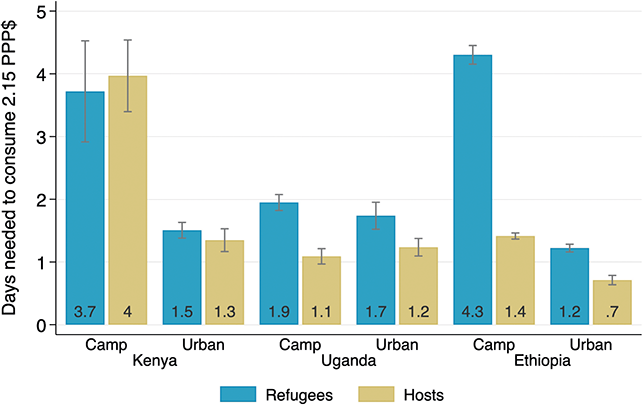
Figure 8 Long description:
The bar chart shows the following data. 1) Kakuma - 3.7 for refugees, 4 for hosts; 2) Nairobi - 1.5 for refugees, 1.3 for hosts; 3) Nakivale - 1.9 for refugees, 1.1 for hosts; 4) Kampala - 1.7 for refugees, 1.2 for hosts; 5) Dollo Ado - 4.3 for refugees, 1.4 for hosts; 6) Addis - 1.2 for refugees, 0.7 for hosts.
Inequality is moderate (Figure 9), which is partly driven by the fact that most households have very little. Inequality levels are slightly higher for refugees and hosts in Kakuma and for refugees in Dollo Ado. Taking two individuals at random in Kakuma, the expected ratio of their food expenditures is around 1.9, indicating moderate levels of inequality. Among refugees in Ethiopia, the corresponding ratio is 2.3. This is comparable to inequality levels in Kenya, Uganda, and Ethiopia as a whole. By comparison, the expected income ratio in 2024 was approximately 5 in the US and 3.6 in South Africa – two of the most unequal countries (Moramarco and Sterck, Reference Moramarco and Sterck2025).
Inequality.
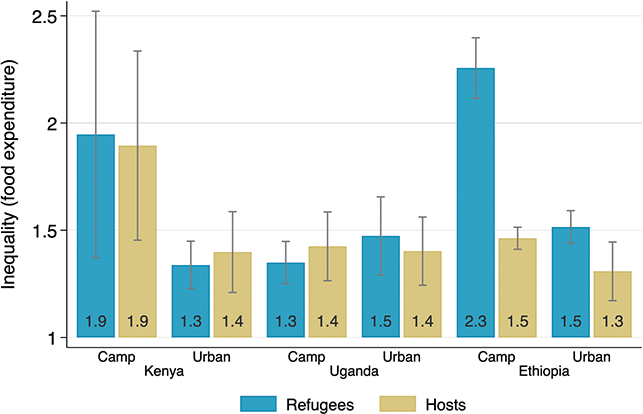
Figure 9 Long description:
The bar graph shows the following data. 1) Kakuma - 1.9 for refugees, 1.9 for hosts; 2) Nairobi - 1.3 for refugees, 1.4 for hosts; 3) Nakivale - 1.3 for refugees, 1.4 for hosts; 4) Kampala - 1.5 for refugees, 1.4 for hosts; 5) Dollo Ado - 2.3 for refugees, 1.5 for hosts; 6) Addis - 1.5 for refugees, 1.3 for hosts.
5 Trauma
October 2022, Kakuma camp, Kenya
They thought I was dead. I laid there for hours, beneath six people they had killed. I was in so much pain, but I had to stay still. Eventually they left. They thought everyone was dead.
This was in 1996. At the time I was shot, there wasn’t the terrorist group that there is now. It was a tribal fight. When the government collapsed in my country people were fighting over power. The major clans were attacking the minor clans. I am from a small clan; we were just farmers. We didn’t have weapons.
After I was shot, I was being taken care of by my two uncles. They carried me in a wheelbarrow. They were both killed … and I couldn’t get any medical support in Somalia, so my wife told me to flee with a donkey cart. She helped me and took me to a place called Bardale. Then, she told me to go to Kenya.
In Bardale, I searched for a vehicle for two days. When I found someone to take me, I went to a place called Beled Hawo. I crossed the border by foot to Mandera. The Kenyan army didn’t stop me because I was injured. In Mandera, I searched for a vehicle that was going to Nairobi. I travelled with a car that carried vegetables. I was hidden inside with the vegetables. I was carried as a vegetable. When I arrived in Nairobi, I didn’t know anyone and there were so many problems. I cannot say how difficult it was. I searched how to get to the United Nations and when I found them, I received a paper. When the United Nations accepted me, I was given a paper every month. And then I got the national mandate; my refugee identity card. I was 45 years old when I was registered in Nairobi. 45. That was ten years ago.
After I received the mandate in 2012, the [Kenyan] authorities said Somali people who were not civilians of the state should be taken back to Somalia. The UN sent me a message telling me to go to Kakuma or Dadaab. They didn’t help with transport. I said to myself that going to Dadaab might be challenging. So, I thought Kakuma might be better because the army there was less likely to forcefully move refugees back to Somalia.
I don’t miss Somalia. I was born in a rural village, about 28 km away from a town called Baidoa. We were farmers and we reared livestock. We grew so many things. Maize, nuts, sesames, potatoes, grains and so many types of grains. But when the war started, the land was stolen. Property was ruined. People became jobless and started to migrate. We left the farms. I cannot miss it because I was displaced.
In 2014, I received news that my wife had been killed. She was told to get married forcefully and she refused. She was asked why she didn’t want to marry these people, the men who usually hide their faces [Al-Shabaab]. She said she has her own husband, who is still alive, so she cannot marry them. Immediately, she was shot. And my children cried and they killed all of them. My children were killed because they were crying. So, I cannot miss that place. My wife was killed, my son was killed, and my daughter was killed and I was told while I was here in the camp.
You know, in Kakuma, I have faced so many problems. I was jobless and I used to move with my wheelchair. I used to beg people. I used to ask them to buy me a credit [sim] card so I could put it in my phone. People used to say that the ‘guy is coming’ then chased me away. I went to this organisation called NCCK. They gave me money, like 4000 [Kenyan shillings]. I built a small table beside my wheelchair that I use to move around and sell small items. … I sell the things that people hate the most, which is cigarettes. I don’t use them but I sell them because I don’t have a good [enough] income to sell good items which are quite expensive such as sugarcane and wheat flour, which big shops usually sell. I sell cigarettes, chewing gum and sweets which are cheaper.
Actually, the only thing that I have a problem with are the people who are calling me these names. They are calling me a disabled man. If you go outside, these people who are calling names to people like me who are disabled and lack part of their bodies. If you lack a hand, they call you ‘one hand’ and if you lack a leg, they call you ‘one leg’. If you don’t have an eye, they call you ‘one eye’ (Sterck et al., 2026).
Abdirizak’s story illustrates the lasting impact that traumatic experiences can have on refugees’ lives. For many, trauma is not confined to the past – it spans their country of origin, the journey to safety, and life in exile.
Trauma before and during Displacement
Somalia, South Sudan, DR Congo, and Eritrea, the four countries from which refugees in our sample originate, are among the most fragile states worldwide. They are ranked 1st, 3rd, 5th, and 26th in the 2024 Fragile States Index, out of 178 countries.
Populations in these countries have faced and are still facing a combination of violence, persecution, and extreme climatic conditions. As a result, millions of refugees have fled these countries to seek protection.
Before settling in one place, refugees often face long and uncertain journeys, which are often marked by violence, exploitation, hunger, and administrative hurdles.
Data from our surveys show that refugees spent on average nine months on the road, between their home and their arrival in the site where we interviewed them.Footnote 10 As Abdirizak, who first registered in Nairobi before moving to Kakuma, many refugees stopped in different regions or even countries before arriving at the location where we interviewed them. Figures 10–14 illustrate this diversity, showing the top three most common journeys for each setting and nationality.Footnote 11 Somali refugees heading to Addis Ababa frequently spent years in Dollo Ado camps, while Eritreans often stayed in northern Ethiopian camps such as Hitsats or Harush. By contrast, many Congolese and Somali refugees in Nairobi and Kampala arrived directly from their countries of origin, though some experienced long detours – up to seven years in camps such as Kakuma or Dadaab for Somalis before eventually reaching Nairobi. Similarly, while many respondents went directly to the camp where they were interviewed (e.g., the Congolese in Kakuma and Nakivale; the South Sudanese in Kakuma; the Somali in Dollo camps), some made long stops on their way (e.g., the Somalis in Kakuma and Nakivale).
The migratory journey can directly affect the physical and mental health of forced migrants, who frequently face physical and environmental threats, hunger, and distress (WHO, 2013). At each stage of their journey (often including long sedentary periods with temporary status), forced migrants’ access to healthcare is hindered by legal, informational, cultural, and language barriers, as well as the lack of continuity in treatment (Kirmayer et al., Reference Kirmayer, Narasiah and Munoz2011; Brandenberger et al., Reference Brell, Dustmann and Preston2019). Undocumented migrants and asylum seekers face the greatest problems in accessing health services and are often expected to cover the full costs of their medical treatment (Watson, Reference Watson2009; Rechel et al., Reference Rechel, Mladovsky, Ingleby, Mackenbach and McKee2013). Restricted access to primary care leads to delayed care, higher usage of emergency services, and, often, increased per-person health expenditure in host countries (Langlois et al., Reference Langlois, Haines, Tomson and Ghaffar2016).
Top three most common routes from country of origin to Addis Ababa, Ethiopia.
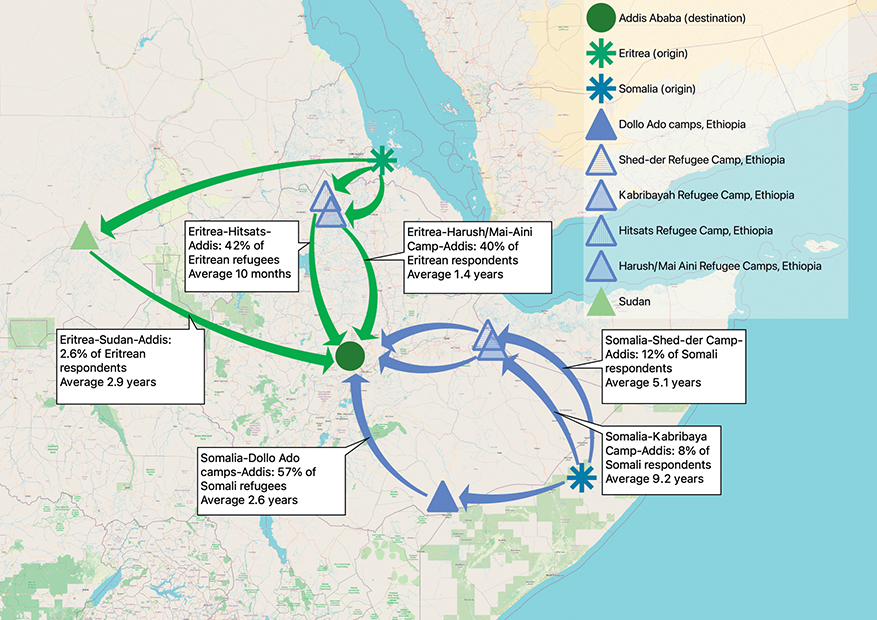
Figure 10 Long description:
1) Somalia-Shed-der Camp-Addis: 12% of Somali respondents; average 5.1 years; 2) Somalia-Kabribaya Camp-Addis: 8% of Somali respondents; average 9.2 years; 3) Somalia-Dollo-Ado camps-Addis: 57% of Somali refugees; 2.6 years; 4) Eritrea-Harush/Mai-Aini Camp-Addis: 40% of Eritrean respondents; average 1.4 years; 5) Eritrea-Hitasats-Addis: 42% of Eritrean refugees; Average 10 months; 6) Eritrea-Sudan-Addis: 2.6% of Eritrean respondents; average 2.9 years.
Top three most common routes from country of origin to Kakuma refugee camp in Kenya.
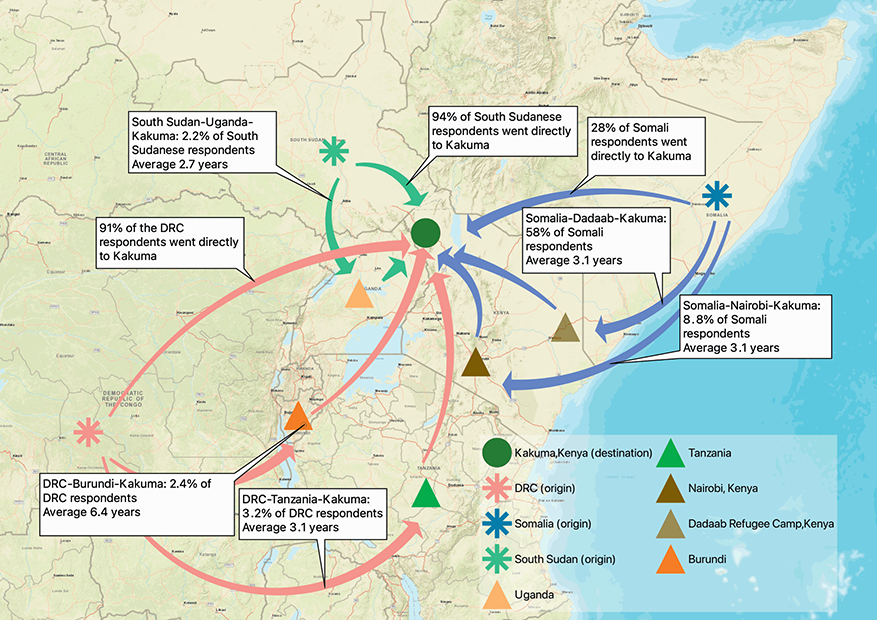
Figure 11 Long description:
1) Somalia-Nairobi-Kakuma: 8.8% of Somali respondents; average 3.1 years; 2) Somalia-Dadaab-Kakuma: 58% of Somali respondents; average 3.1 years; 3) 28% of Somali respondnets went directly to Kakuma; 4) 94% of South Sudanese respondents went directly to Kakuma; 5) South Sudan-Uganda-Kakuma: 2.2% of South Sudanese respondents; average 2.7 years; 6) 91% of the D R C respondents went directly to Kakuma; 7) D R C-Burundi-Kakuma: 2.4% of D R C respondents; average 6.4 years; 8) D R C-Tanzania-Kakuma: 3.2% of D R C respondents; average 3.1 years.
Top three most common routes from country of origin to Nairobi, Kenya.
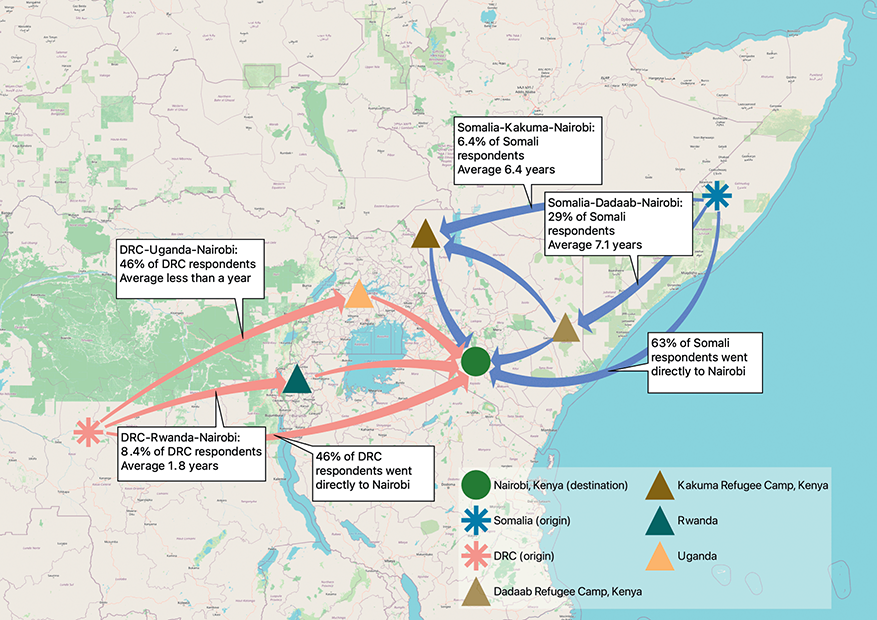
Figure 12 Long description:
1) 63% of Somali respondents went directly to Nairobi; 2) Somalia-Dadaab-Nairobi: 29% of Somali respondents; average 7.1 years; 3) Somalia-Kakuma-Nairobi: 6.4% of Somalia respondents; average 6.4 years; 4) D R C-Uganda-Nairobi: 46% of D R C respondents; average less than a year; 5) D R C-Rwanda-Nairobi: 8.4% of D R C respondents; average 1.8 years; 6) 46% of D R C respondents went directly to Nairobi.
Top three most common routes from country of origin to Nakivale, Uganda.
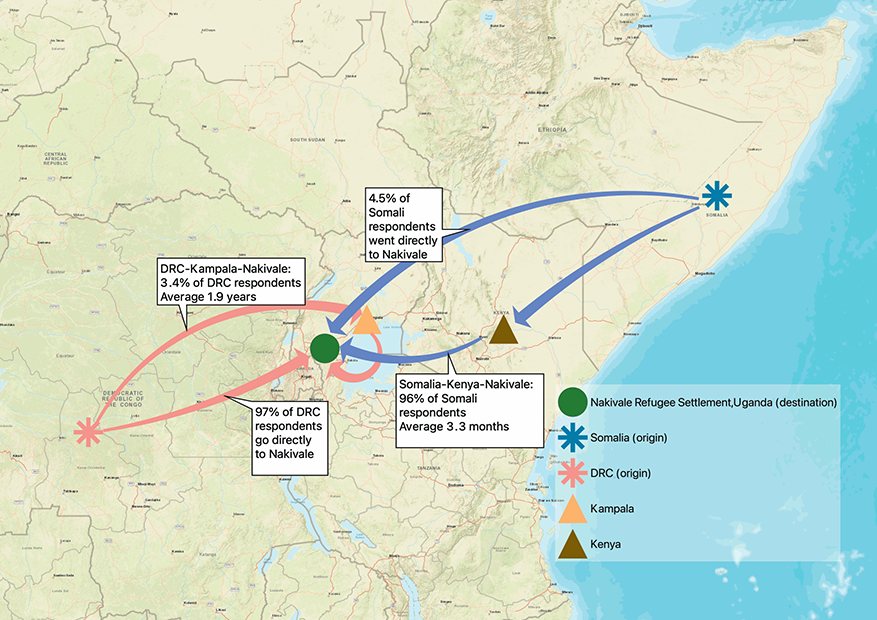
Figure 13 Long description:
1) 4.5% of Somali respondents went directly to Nakivale; 2) Somalia-Kenya-Nakivale: 96% of Somali respondents; average 3.3 months; 3) 97% of D R C respondents go directly to Nakivale; 4) D R C-Kampala-Nakivale: 3.4% of D R C respondents; average 1.9 years.
Top three most common routes from country of origin to Kampala, Uganda.
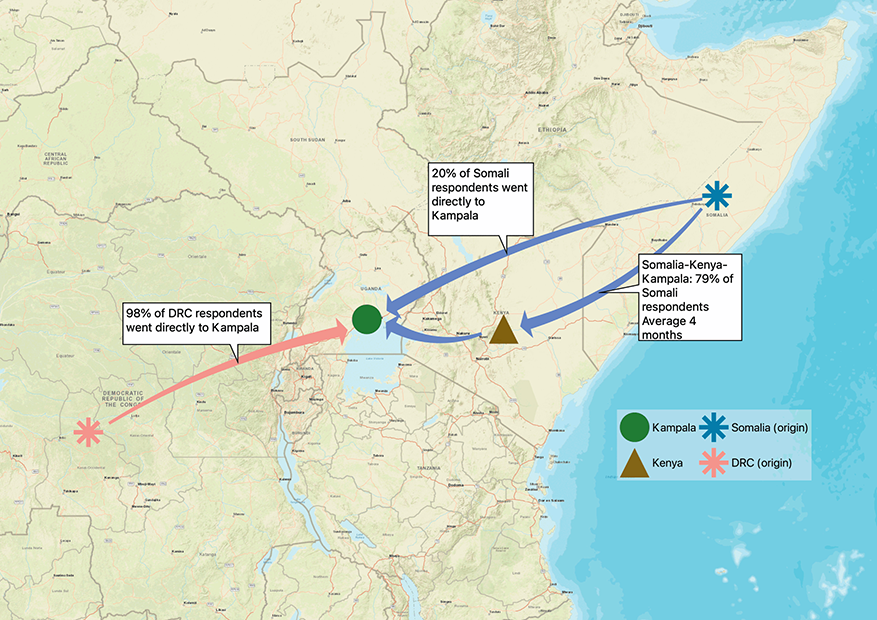
Figure 14 Long description:
1) Somalia-Kenya-Kampala: 79% of Somali respondents; average 4 months; 2) 20% of Somali respondents went directly to Kampala; 3) 98% of D R C respondents went directly to Kampala.
Trauma and Mental Health in Exile
Refugees remain vulnerable to traumatic shocks and discrimination, even after being granted their refugee status.
Families often split when they flee, with some members staying behind to safeguard assets or due to physical frailty, while others may escape in different directions. Splitting may sometimes be a strategy to diversify risks and opportunities. As a result, even if certain household members find refuge and a better status in exile, others may endure losses elsewhere, with repercussions for the entire household. Take the case of Abdirizak, whose wife tragically lost her life while he was in exile.
In exile, refugees may also face difficult conditions, which can take a toll on their mental health. Most refugees find protection in low- and middle-income countries, which host 76% of refugees (Davis et al., Reference Davis, López-Peña, Mobarak and Wen2024). Within host countries, camps and settlements are often placed in remote areas, far away from markets and essential services. In cities, most refugees can only afford to live in poor neighbourhoods, often in crowded and insalubrious accommodations.
Living in these restrictive environments can create depression or anxiety for refugees. This was especially observable with Eritrean and Somali refugees living in Addis Ababa. Some of the most common challenges facing refugees are boredom, idleness, and hopelessness, stemming from their current unproductive lives in exile, as expressed by our participants in Addis Ababa:
Here life is boring. We stay at home, sleeping, chatting, drinking coffee, doing sports like volleyball and football. We are all young but we are killing time every day. We want to move out of dependency but no way out.
We have to kill time here. We see movies, DVD, watch TV, play football, do the PlayStation, and read. I had hope before to move to the US where I would have access to education, freedom, betterment. But hope is diminishing. I cannot go back to Somalia yet. I feel hopeless.
These refugees repeatedly mentioned that they have to ‘kill time’ every day even though most of our interviewees were healthy, able-bodied, and young people in their 20s–40s. For them, doing nothing is detrimental to their mental and physical well-being.
In addition, many refugees highlighted the feeling of idleness as a psychological issue for them. One Eritrean refugee in their late 40s said that this is a particularly serious problem for youth.
You see so many refugees hanging around in pool bars or cafes. They don’t have anything to do. This is very bad. Many start drinking and chewing khat. Khat is not common in Eritrea so they learned this in Ethiopia.
Other refugees echoed these concerns, pointing to the link between boredom, idleness, and delinquency among young people who feel they have no ‘life’.
Given the limited access to avenues for personal development, refugees, especially Eritreans, in Addis Ababa suffer from a sense of liminality or limbo. When asked whether he wanted to stay in Ethiopia, one male refugee raised his voice and emphatically responded:
I don’t see any future in Ethiopia. This is not a place to stay long … We are treated as second class people here. We have no access to opportunities. In this country, my life can be dismantled at any time by the government.
Measuring Trauma, Depression, and Anxiety
Existing research on trauma and mental health among refugees has predominantly centred on those residing in high-income countries (Blackmore et al., Reference Blackmore, Boyle and Fazel2020), despite the fact that a large majority of forcibly displaced people live in low- and middle-income countries. To address this gap, our survey questionnaires included questions on exposure to violence, depression, and functional impairment (Pozuelo et al., Reference Pozuelo, Bradenbrink, Stierna and Sterck2023).
To measure exposure to violence, refugees were asked whether they were ever victims or witnesses of violence or torture in their country of origin or in exile (we did not collect data from host populations). A staggering 62% of refugees reported some exposure to violence. Males and respondents from urban backgrounds are more likely to report exposure to violence. We also find that 9.1% and 0.9% of refugee women and men are widows and widowers respectively, like Abdirizak, whose wife was assassinated. By contrast, these percentages are 4% and 0.5% in the host population, showing that violence and other shocks affecting spouses are far more likely among refugees.
Exposure to violence can have enduring effects on mental well-being. We employed the Patient Health Questionnaire-9 (PHQ-9) to assess the prevalence of depressive symptoms. This instrument comprises nine questions that inquire about the frequency of depressive symptoms experienced during the two weeks preceding the survey. Examples of these symptoms include feeling down, having trouble falling asleep, and having low energy. Respondents are invited to provide ratings on a scale from 0 (‘Not at all’) to 3 (‘Nearly every day’). The PHQ-9 score is the sum of the nine responses, ranging from 0 to 27. Higher scores indicate more severe symptoms of depression.
Using this scale, we find that 31% of refugees had moderate or severe depressive symptoms, compared to 10% of the host population. These results are very similar to those obtained in high-income countries and confirm that refugees are disproportionately affected by mental health issues compared to host populations. Using regression analysis, we find that women, older refugees, and refugees living in camps are significantly more likely to report depressive symptoms. Refugees from DR Congo also report significantly higher PHQ-9 scores than other refugee subgroups living in the same sites. The PHQ-9 score is positively correlated with length in exile, suggesting mental health issues – if left untreated – may persist and accumulate over time.
Traumatic experiences can also have physical consequences, with important consequences on livelihoods. In Nairobi, we interviewed Philip, a Congolese refugee, both in 2017 and 2019. For refugees who are living in urban areas, households often need to secure multiple income sources from adult members in order to meet living expenditures including rent. However, Philip was the only one in his household working, employed as a security guard at a Kenyan company, since his wife still suffers from a severe injury that she sustained during the civil war. Philip described:
During the war, she was hit by the rebel and her brain got damaged. But she has not yet received proper medical treatment [for her brain injury]. She still suffers from pain. [Due to this injury] She needs to stay at home and rest.
Throughout this interview, Philip appeared to be tired and lacklustre. As refugees’ access to medical support from relief agencies is limited in Nairobi, Philip had to earn sufficient income for her treatment. These circumstances eventually harmed Philip’s own health as well, since he had to work long hours to cover living costs and medicines for his wife. The impacts of trauma before displacement can continuously undermine refugees’ economic capacity even in exile.
During our fieldwork in Kampala, Uganda, we also met a number of refugees with disabilities, some of which were caused during the period of forced displacement, while some others were victims of torture in their homeland. Refugees with disabilities face particular survival challenges in the urban economy given the absence of humanitarian assistance from aid organisations. As they face common challenges, refugees with disabilities in Kampala organised themselves and founded the Association of Refugees Living with Disability (ARD) in 2010, with some 350 registered members as of 2018. Following is an excerpt of an interview with the chairperson of ARD.
[There is] Very limited option for us. We are forced to depend on our relatives or church for survival. We cannot hawk around [due to disabilities]… [Communal support is] Very limited. Other refugees are also suffering and struggling to make a living so they cannot extend support to us…Living conditions [in settlements] will be more difficult for those with disabilities. Agriculture does not fit us. Building our own houses in camps is hard. So we have no choice but stay in Kampala despite numerous challenges here.
As refugees in urban areas are required to cover high living costs, a household with many non-working members tends to face more challenges. The fact that they cannot contribute to the household budget affects the mental health and psychological state of these groups of refugees.
To capture the physical consequences of trauma and assess impacts on livelihoods, we used six questions from the WHO Disability Assessment Schedule 2.0 (WHODAS 2.0). The questions measure functional impairment in terms of mobility, life activities, cognition, and participation (Üstün et al., Reference Üstün, Chatterji and Kostanjsek2010). Respondents were asked to report on the difficulty they had performing different types of activity in the past 30 days, including standing for long periods, taking care of their household responsibilities, learning a new task, joining in community activities, concentrating on doing something for ten minutes, and walking a long distance. Possible answers range from 0 (‘No Difficulty’) to 4 (‘Extreme difficulty’). The cumulative score, derived from the answers to these six questions, spans from 0 to 24. A higher score indicates more pronounced functional impairment.
We find that 62% of refugees reported moderate or severe functional impairment, compared to 25% of the host population. A significant proportion of refugees reported moderate to severe difficulties in walking (34%), standing (21%), taking care of household responsibilities (32%), concentrating (22%), learning (27%), and joining community activities (24%). As for depressive symptoms, the degree of functional impairment is significantly higher for females, older people, and those with extended exile periods. Time alone does not seem to be enough as a solution to mitigate the consequences of trauma.
We find a strong association between exposure to violence before exile and high depressive symptoms and functional impairment in exile. Refugees who reported being exposed to violence are 17 percentage points more likely to experience moderate or severe depressive symptoms and 18 percentage points more likely to report functional impairment. Among refugees who were not exposed to violence, 21% experience moderate or severe depressive symptoms and 52% report moderate or severe functional impairment. These percentages jump to 38% and 69% for those exposed to violence. Mental and physical trauma are a reality for a large proportion of refugees, especially those who experienced violence before or during exile.
Consequences
Trauma can have wide-ranging consequences for refugees’ social and economic lives, as well as their overall well-being. Using our data, we examine the relationship between depressive symptoms, functional impairment, and various socio-economic outcomes. We find that both depressive symptoms and functional impairment are associated with lower wages, reduced life satisfaction, and poorer dietary diversity. The strength of these associations is greater among host community members than among refugees. One possible explanation is that refugees may have developed forms of psychological resilience that partially mitigate the negative consequences of trauma. However, these findings should be interpreted with caution. Correlation does not imply causation, and the observed relationships may be influenced by unobserved variables. Moreover, the direction of causality remains ambiguous: while poor mental and physical health may constrain socio-economic inclusion, exclusion and poverty can also worsen health outcomes.
Despite the widespread need for support, access to effective treatment remains limited. Traditional therapies are often costly and difficult to scale in displacement settings due to a lack of qualified mental health professionals. Even general healthcare access remains uneven. In urban areas, only 59% of refugees report having access to healthcare, compared to 88% of host community members. While the gap is narrower in camp settings, disparities persist: 81% of refugees report access to healthcare, compared to 90% of hosts. These figures highlight the broader structural constraints facing health systems in displacement contexts.
6 Dispossession
Eric and Joanna got married in 2005. They were childhood friends and since birth had lived in the same town in North Kivu in the Democratic Republic of Congo (DRC). They had two children together in 2006 and 2008. Their life changed in 2013. Their town was attacked by an armed rebel group. The family fled in fear and abandoned all their belongings. During their frantic flight, the family members were separated but managed to find each other in a refugee reception centre in Uganda. After spending a few weeks at the reception centre, they were transferred to Nakivale settlement, located in a rural and underdeveloped area in Southeastern Uganda, near the Rwandan border. Before fleeing, Eric and Joanna ran a shop that sold household items such as soap, stationery, cooking oil, and canned food. They also kept chickens in their garden. However, they were unable to carry any of these assets with them to Uganda. Upon arrival in Nakivale, like other refugees, Eric and Joanna’s family applied for and received a plot of land sized about 30 m × 50 m for subsistence and commercial farming. Eric and Joanna had no experience in agriculture from their life in the DRC. They received some basic farming instructions from aid organisations and began cultivating the plot. In the first few years after their arrival in Nakivale, they grew beans and maize and sold some portions of their crops to local brokers. They also benefited from in-kind food assistance from WFP. Last year, however, Eric and Joanna stopped engaging in agriculture. The fertility of their farmland had declined rapidly due to over-cultivation. Eric said: ‘Before we farmed 50 kg of beans and 200 kg of maize in one season. But last year we only harvested half of that.’ Using their small amount of savings earned from farming and selling portions of their WFP food rations, they opened a small bar inside the settlement. While Eric takes care of the bar, Joanna capitalises on the freedom of movement for refugees in Uganda and often travels to Mbarara, the second largest city in the country after the capital. There, on crowded streets near major markets, Joanna sells imitation jewellery and accessories, and textiles. Itinerant hawking is a popular strategy used particularly by female refugees in Nakivale. To save on transportation costs, Joanna and other refugee hawkers rent a room in a local lodge and sleep together for a few nights until they sell all of their items. A primary concern for Eric and Joanna, who had a third child while in Nakivale, is their children’s futures in exile, since return to their hometown seems unrealistic given the instability in eastern DRC. They want their children to acquire as much education as possible, and ideally to go to university to earn degrees. February 2018, Nakivale, Uganda
As Eric and Joanna’s story illustrates, displacement usually results in the loss of both material and immaterial forms of capital. Refugees may flee without assets, leaving behind homes, savings, land, education, and professional networks. Even when they arrive in safety, the capital they once possessed – whether physical, human, financial, or social – is rarely transferable. Refugees often find themselves in places where the language, customs, and economies are unfamiliar, making their socio-economic integration even more challenging. Educational credentials may go unrecognised, and work experience may be irrelevant to the new context. As a result, many are unable to find jobs, and if they work, it is often in a different sector that may not match their skills or qualification level. In camps, humanitarian assistance not only offers relief to households but also significantly shapes refugee economies, which often revolve around the aid cycle and employment opportunities with NGOs.
Asset Loss
Most refugees are forced to flee without their possessions, having to rebuild their lives from scratch in exile. This is evident in our data – refugee households have significantly fewer assets than those in the host communities (Figure 15). On average, the value of assets owned by host community households is five times higher than that of refugee households. This stark difference is observed in both urban areas and camps.
For instance, over three-quarters (78%) of the households in the host communities reported owning a television at the time of the survey, compared to only 34% among refugee households. Similarly, 15% of the households in the host communities own a car, compared to only 2.2% among refugee households. Mobile phones are nevertheless owned by the majority of households: 97% among households in the host community and 85% among refugee households.
Value of assets owned in a household, per capita, in USD in 2018 prices, by refugee status and location.
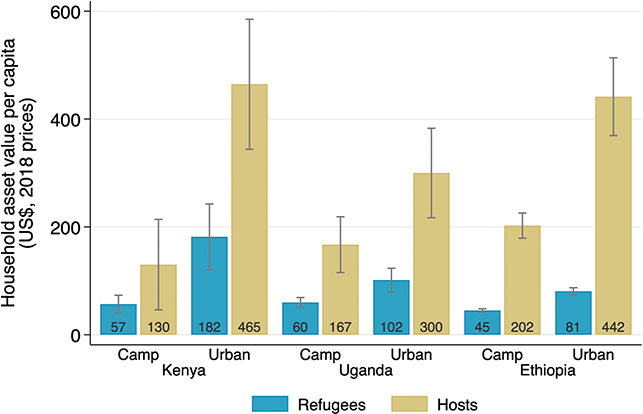
Figure 15 Long description:
The bar chart shows the following data. 1) Kakuma - 56.8 for refugees, 130 for hosts; 2) Nairobi - 181.8 for refugees, 464.6 for hosts; 3) Nakivale - 59.9 for refugees, 167.1 for hosts; 4) Kampala - 101.5 for refugees, 300 for hosts; 5) Dollo: 45.1 for refugees, 202.4 for hosts; 6) Addis: 80.8 for refugees, 441.5 for hosts.
Among households living in camp settings, refugees are significantly less likely to own livestock in comparison with households in the host communities. For example, in Nakivale, half (49%) of the households in the host communities reported owning livestock. While most of these households own poultry, some of them also have cattle, goats, and pigs. By contrast, only 18% of the refugee households own livestock and most of them own only poultry. Very few refugee households have higher-valued livestock, such as cattle.
Most refugee participants in our studies lost their accommodation. Refugees who decide to reside in the capitals often struggle to find suitable accommodation and may need to settle for one that is of poor quality. Indeed, refugees living in the capitals are living in more congested living spaces in comparison with host communities. On average, refugee households have less than half a room per person (0.47). Households in host communities have more spacious accommodation, with an average of 0.80 rooms per person. To illustrate, a couple living in a one-bed flat may consist of one bedroom, one kitchen, one bathroom, and one living room – a total of four rooms, with two rooms per person on average. By comparison, the average across the European Union was 1.6 rooms per person (Eurostat, Reference Eurostat2021).
During qualitative interviews, Congolese refugees living in Kampala, Uganda, frequently complained about the high living costs, especially rising rent. Robert, the representative of a refugee-led NGO in Kampala explained: ‘Many Congolese refugees [in Kampala] rent a single room in an apartment in cheaper areas and squeeze all members there.’ Room-sharing among them commonly takes place even with refugees who are unrelated by blood. One male Congolese refugee who came to Kampala alone in 2016 told us: ‘I stay with three other Congolese refugee friends in one room.’ In Addis Ababa, where refugees have no right to work, most Eritrean refugees choose to live together to share the financial burden of covering rent and food expenses.
In addition, refugees are paying more rent per room in comparison with those from the host communities (Figure 16). Refugee households pay on average 159 PPP$ (2018 prices) per room, double the amount paid by households in the host communities. This is 80 PPP$ per person in a refugee household, compared to 64 PPP$ per person among households in the host communities.
The rental prices are also increasing, forcing some refugee households to be constantly moving. In 2019, we tracked down the households that we had interviewed in Nairobi in 2017. Many respondents reported moving because the rent increased or the building was demolished (Betts et al., Reference Betts and Sterck2023).
Monthly rent per room, in PPP$, 2018 prices, by refugee status and country.
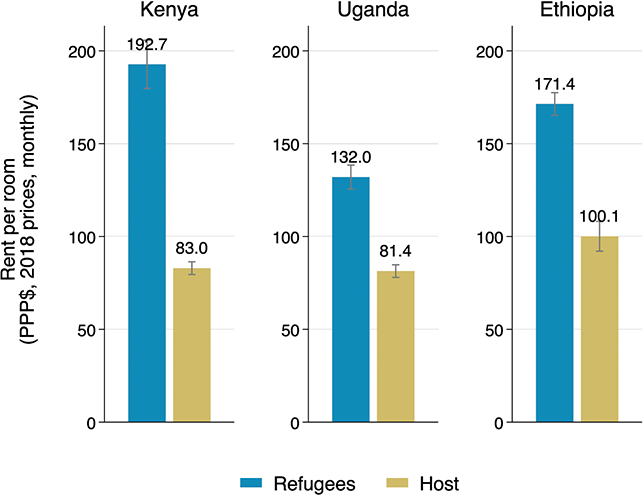
Figure 16 Long description:
The bar chart shows the following data. 1) Kenya: 192.7 for refugees; 83 for host; 2) Uganda: 132 for refugees; 81.4 for host; 3) Ethiopia: 171.4 for refugees; 100.1 for host.
Disrupted Education
Becoming a refugee presents both significant barriers and sometimes unique opportunities for education.
Many young refugees experience interruptions in their education both before displacement, due to living in conflict-affected areas, and after, as they struggle to access or adapt to a new education system during displacement. On average, refugees have six years of education, compared to eleven years of education among members of the host community.
Refugees, like other types of migrants, often find their previous credentials obtained in the country of origin unrecognised by the host government. For example, both the Ugandan and Kenyan governments do not recognise refugees’ licences, certificates, and academic degrees obtained in their country of origin, such as the DRC. This disjuncture is partly due to differences between Anglophone and Francophone education systems in these countries. As a result of non-transferability of their credentials or titles, refugees often have to restart their education or abandon pre-existing careers or professional vocational skills such as medical doctors, nurses, teachers, or lawyers, for example.
Language is another form of human capital that often limits refugees’ ability to participate in the workforce. Only 23% of refugees reported having a good command of the local language (compared to virtually all members of the host community). Limited proficiency in the primary language of the host country presents a major barrier to refugees’ entry into labour and commercial markets. Nevertheless, those with strong language skills leverage them to access economic opportunities. For example, Congolese refugees in Nairobi can capitalise on their knowledge of Kiswahili, Kenya’s official language, to secure informal employment from Kenyan nationals. Our survey data reveal that refugees with good local language proficiency are, on average, 21 percentage points more likely to be employed.
The availability and quality of education may sometimes be better in the host country than in countries of origin. In camps, UNHCR and governments typically ensure children can access education. Free lunches are often distributed by WFP at schools to encourage attendance and improve child nutrition. As a result, enrolment rates in primary education are very high. In Kakuma, the net enrolment rate for primary schools among refugee children was approximately 93% (UNHCR, 2017). Access to secondary and tertiary education is more limited, yet often better than in countries of origin. In Kakuma, we met refugees who came for education opportunities, either for themselves or for their children. For instance, Celina fled violence in South Sudan and sought education opportunities for her children in the camp (Sterck et al., 2026):
My husband was shot. … I had to raise my children on my own after the death of my husband. Being a widow has made it difficult to fulfil my responsibilities as a mother. So, seeking refuge in Kenya was the only choice I had, it was also an opportunity for my children to go to school. I hope that they go to school so they can help me in the near future.
Education levels vary significantly between camps and cities, both for children and adults in the refugee and host populations. In cities, children in refugee households are significantly less likely to be attending school compared to those in the host communities. The average proportion of children above five years who are attending school in a household is 97% for the host communities, compared to only 63% for the refugee households. During the fieldwork in Kampala, both Congolese and Somali refugees identified securing education for their children as one of the major challenges alongside high living costs. In one of the focus group discussions with Congolese refugees, a participant lamented that primary education is not free in Uganda:
There is a good number of Congolese [school-aged] children who are out of school … Many parents failed to pay school fees which are costly. At primary level, one term at public school costs about 200,000 UGX (164 PPP$, 2018 prices) and there are three terms per year. Imagine if you have multiple children. At secondary school per term costs will be 400,000
Other participants also showed concerns about increasing levels of youth idleness as they are neither studying nor working in Kampala.
By contrast, school attendance among refugee and host communities in camp settings is on average the same (85%). In designated camps, most refugees can access free education provided by UNHCR and its partner agencies, and these schools are usually open to host nationals living in the neighbourhood.
Rural and urban differences can also be observed in adult education levels (Figure 17). In camps, adult education levels are notably lower, especially among the host population. For example, in Kakuma, the average years of education among members of the host community is only 2.7 years (partly due to their pastoral lifestyle and limited social services in the Turkana area), significantly lower than the 6.2 years among refugee adults living in the refugee camp.
In urban settings, however, refugee adults tend to have significantly fewer years of completed education compared to their host community counterparts. This disparity is most evident in Nairobi, where refugees average 8.4 years of education compared to 12 years for the host population.
These patterns reflect several factors. As previously discussed, education in refugees’ countries of origin is often inaccessible, of poor quality, or disrupted due to conflict and forced migration. Some refugees must restart their education because foreign diplomas are not recognised. The figure also reflects a selection effect: refugees with higher education levels are more likely to have urban backgrounds and, consequently, more likely to settle in cities when in exile. Similarly, hosts with higher education levels are more likely to relocate to urban centres.
Completed years of education, by location, and refugee/host status.
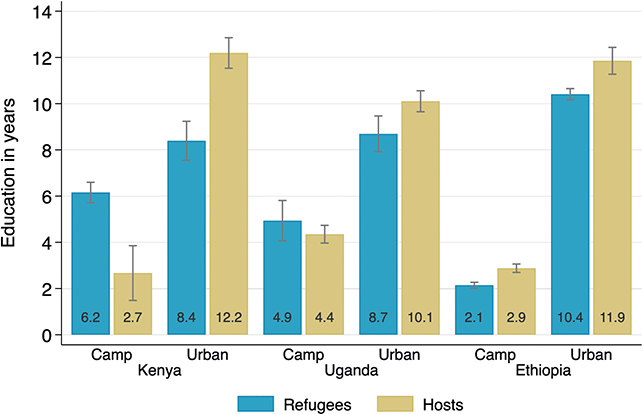
Figure 17 Long description:
The bar chart shows the following data. 1) Kakuma - 6.2 for refugees, 2.7 for hosts; 2) Nairobi - 8.4 for refugees, 12.2 for hosts; 3) Nakivale - 4.9 for refugees, 4.4 for hosts; 4) Kampala - 8.7 for refugees, 10.1 for hosts; 5) Dollo: 2.1 for refugees, 2.9 for hosts; 6) Addis: 10.4 for refugees, 11.9 for hosts.
Lower levels of education and lack of recognised credentials among the refugee communities have implications for earnings. For instance, only a small minority of refugees work in the sector with the highest wages – skilled non-manual work. One of the barriers to entry is the level of education required. Figure 18 shows that refugee workers in this sector have on average ten years of education. This barrier also exists for workers in the host communities.
Returns to education are also higher for members of the host community. Conditional on having a job, for one extra year of education, refugees only increase their earnings by 5.8%, compared to 22% for workers in the host community.Footnote 12 This disparity can be partly attributed to discrimination, but also to the fact that refugees are often unable to continue working in their pre-exile professions and are frequently compelled to take jobs that differ from those typically held by the host community.
Average years of education, by sector and host/refugee status.
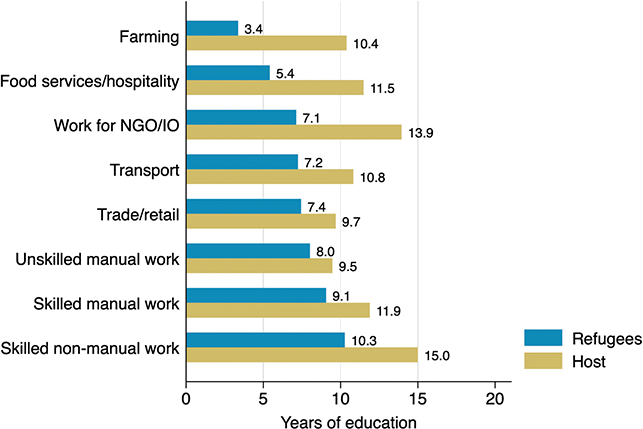
Figure 18 Long description:
The horizontal bar chart shows the following data. 1) Farming - 3.4 for refugees, 10.4 for hosts; Food services/hospitality - 5.4 for refugees, 11.5 for hosts; Work for N G Os/I O - 7.1 for refugees, 13.9 for hosts; transport - 7.2 for refugees, 10.8 for hosts; trade/retail - 7.4 for refugees, 9.7 for hosts; unskilled manual work - 8.0 for refugees, 9.5 for hosts; skilled manual work - 9.1 for refugees, 11.9 for hosts; Skilled non-manual work - 10.3 for refugees, 15 for hosts.
Recreating Livelihoods
When fleeing, refugees are forced to leave their jobs behind and start a new life in the host country. However, work opportunities in the host country are often different or not available. On average, among refugees who reported having had a job prior to displacement, fewer than half (42%) were employed at the time of the survey in the host country. The situation is particularly challenging for those in camps – only 35% of refugees who had been employed before displacement still had a job in the camp. By contrast, 59% of refugees living in capital cities reported being employed.
Displacement also appears to widen gender disparities in labour market participation. Among individuals who were previously employed, only 35% of the women had a job at the time of the survey, a smaller percentage compared to 49% for men.
Among refugees who do find work in their host country, 70% of them had to switch to a completely new type of activity (Figure 19). We classify activities into nine distinct categories: working for NGOs, farming, trade and retail, food services and hospitality, transport, unskilled manual work, skilled manual work, skilled non-manual work, and others. Farming was the most common economic activity before displacement. Under a third (31%) of the refugee workers in our sample were farming before displacement. However, out of those, only 6.5% remained dependent on farming as their main livelihood in exile.Footnote 13 This was especially noticeable among the South Sudanese refugees in Kakuma. Among (the few) South Sudanese workers, while two-thirds (66%) of them were farming before displacement, none of them reported farming as a livelihood in Kakuma, where agriculture is constrained by the arid climate and lack of water. Instead, 80% were without a job, 8.8% were working for an NGO or international organisation as incentive workers and 6.3% were working in food services or hospitality.
Percentage of respondents working in a type of activity, before and after displacement.
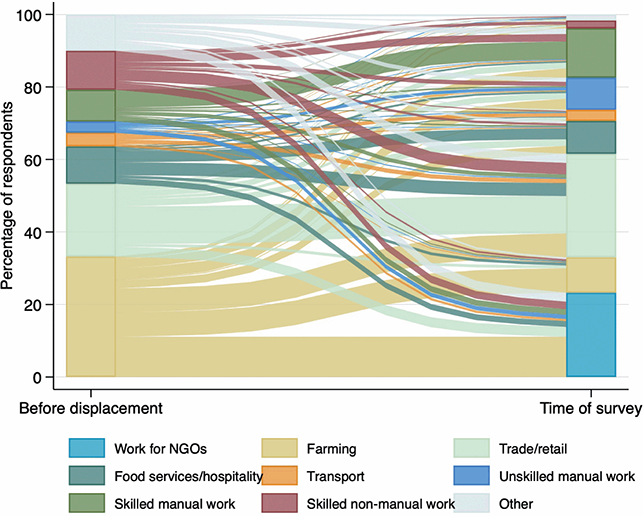
Workers who were in jobs related to trade and retail before displacement are more likely to remain in this type of work in the host country. Across sites, 41% of the refugee workers who were working in jobs related to trade and retail before displacement continue to work in trade and retail after displacement. For instance, Somali refugees in Nakivale settlement in Uganda tend to engage in commercial activities and have developed a vibrant economic zone inside the settlement, which represents a hive of commercial activity, such as shops selling electronics, pharmacies, and foreign exchange bureaus.
The type of work available to refugees shapes the wage gap with host communities (Figure 20). Employment with NGOs or international organisations is one of the most common types of work for both refugees and host community members, but the returns differ. While such jobs pay a wage premium for host community workers, refugees are confined to lower roles and ‘incentive work’, which are capped at a fraction of national wages. In Kakuma, for instance, nearly half of refugee workers are employed by NGOs (Figure 21), yet they earn barely a third of what their Kenyan colleagues make. Steven, a South Sudanese refugee employed as a community mobiliser, described how his monthly incentive pay is insufficient even for basic needs: ‘With my current salary, I am not able to afford basic items such as a mattress and food. But I cannot find any better job in Kakuma, so I have no choice.’ This pattern is repeated across countries: NGO work is both one of the most common opportunities and the sector in which the wage gap is greatest.
Median earnings and percentage of workers, by sector and host/refugee status.
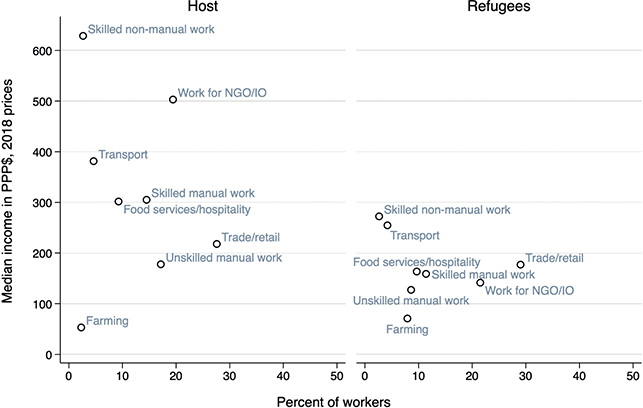
Type of income-generating activities, by location, and refugee/host status.
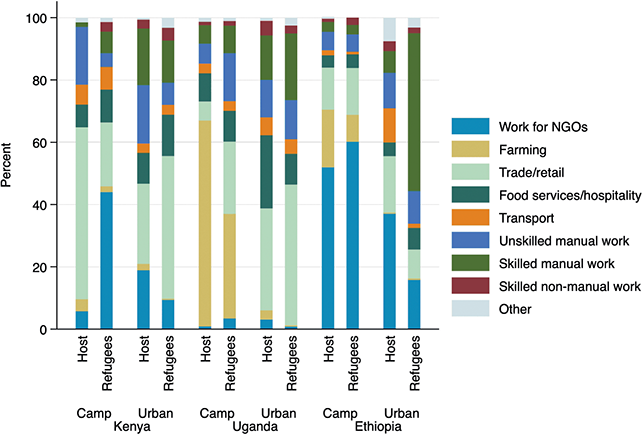
Refugees’ access to higher-paying jobs is constrained by capital requirements. Skilled non-manual roles and transportation work pay more, but they require diplomas, vehicles, or other forms of capital that only a few refugees have. Instead, trade and retail dominates refugee employment – about a third of refugee workers overall, and nearly half in Nairobi and Kampala. While the wage difference between refugee and host workers is not significantly different in this sector, refugees tend to work under more precarious conditions, turning to street hawking at far higher rates than their hosts. The result is a labour market where refugees cluster in the most accessible sectors, but those sectors either pay less or expose them to greater insecurity.
Limited Access to Financial Capital
Access to sources of start-up capital is essential for refugee entrepreneurs as they need to start from scratch in exile. Refugees’ access to formal financial services such as private banks and public financial institutions in the host country is limited due to both formal and informal regulations. Only 19% of refugees had a savings account in comparison to 56% among the members of the host communities. Only 6% of the refugee entrepreneurs reported having used a loan from a bank or microfinance institution to build their start-up capital. This lack of access to credit, in turn, means that refugees need to mobilise their networks to draw any finance for building or expanding their businesses. In most settings, refugee and host communities also depend on their own savings to build up the start-up capital.
The situation in Kampala illustrates these challenges. In order for refugees in Kampala to open a bank account, they must either be formally employed, with a signed letter from their employer, or self-employed with a recommendation letter from a referee who has a bank account at the same bank. In addition, access to credit is unavailable for refugees as formal lenders categorise refugees as ‘high risk’. According to one Congolese refugee, Ugandan banks do not provide any lending to refugees because they are unable to provide property collateral for loans and are perceived to be a flight risk. Only 3% of the refugee entrepreneurs in Kampala reported getting their start-up capital through loans, compared to 15% among entrepreneurs in the host community.
Limited access to financial capital partly explains why working refugees are on average 7.1 percentage points less likely to work in their own business than the members of the host community.Footnote 14 The disparity is especially wide in Kakuma Camp, where working refugees are 40 percentage points less likely to have their own business than members of the host community (Figure 22).
Percentage of individuals working as employees, self-employed, or in a family business, by location and refugee/host status.
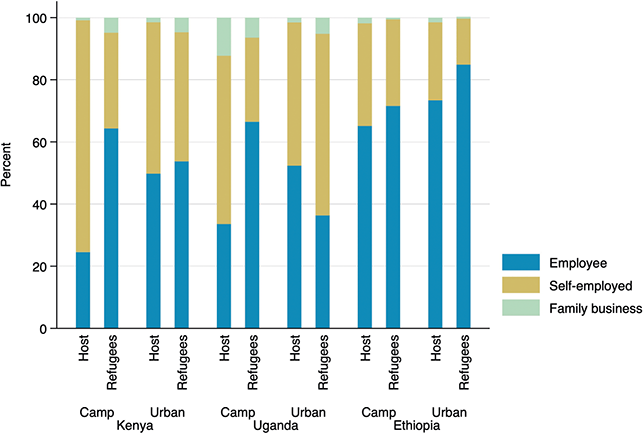
Humanitarian Aid as Capital
Refugees living in camps can access humanitarian aid, which is a core element of refugee protection, but also development programmes that support refugee livelihoods and self-reliance.
The primary form of humanitarian assistance received by refugees is food assistance, which is delivered by WFP. WFP traditionally provided monthly food packages containing in-kind items such as grains, pulses, fortified Corn Soy Blend, and vegetable oil, aimed at delivering approximately 2,100 calories per day. Recently, WFP has been shifting towards cash transfers to stimulate refugees’ independence and self-reliance, to bolster local economies, and to lower operational costs (MacPherson and Sterck, Reference MacPherson and Sterck2021).
The primary purpose of food assistance is to increase food security. However, food assistance also has two unintended functions: (1) it can be an important source of livelihood for refugees and (2) it is used as collateral to obtain credit.
Many refugees use food rations as a source of livelihood. Even though WFP prohibits the sale of food rations, refugees often informally resell part of their rations to local traders, other refugees, or members of the host community. This enables them to obtain cash, which they can use to buy other preferred food items or cover other expenses such as education, health, or energy. Some refugees, mostly women, collectively organise to sell food rations. We interviewed the founder of one of these groups in Hilaweyn camp, Ethiopia:
Many refugees are involved in the sale of WFP food items. Refugees in the camp need cash to buy other items not provided by UNHCR … I sell rice, porridge, sorghum and maize. Taking maize as an example, I buy one kilogram at 12 birr (1.3 PPP$, 2018 prices) and sell at 13 birr (1.4 PPP$). For rice, I buy one kilogram at 15 birr (1.6 PPP$) and sell at 20 birr (2.1 PPP$). Rice is more popular, so the profit margin is higher.
Large-scale shadow markets for the resale of food rations were observed in all camps we visited. Some refugees resell food to get cash while others prefer to barter using food from their rations as ‘currency’ to buy other items. In Kakuma and Kalobeyei, Kenya, we found that 49% of households resold or exchanged food in the resale market in a given month. Median resale market prices are 18% to 38% lower than those in the retail market, indicating that households experience considerable financial losses when reselling goods (Siu et al., Reference Siu, Sterck and Rodgers2023).
In some camps, the resale market is informal while in others it is highly structured and organised. A donkey-cart driver in one of the Dollo Ado camps in Ethiopia explained:
My main work is to go outside the camp and collect firewood and carry it back to the camp. Also, on the day of food ration, I collect food and carry it to host community wholesalers … I earn 100 to 200 birr (11–21 PPP$, 2018 prices) per day on average. Some refugees pay me with their food rations. Not always a full bag, but small portions like a cup of rice. I save these food rations and sell them onward to other refugee food sellers … Yes, I also run a ROSCA [rotating savings and credit association] with two other donkey cart riders. All of us bring together the food rations, and one person sells them in the market for cash. This is a rotation system.
A WFP staff member in Dollo Ado emphasised the significance of free food rations for refugees in the camps:
For refugees in Dollo Ado, food rations become a key asset for all refugees. They are entitled to them every month, so refugees see them as a reliable source of income inside the camps … There are also well-established market mechanisms for the food trade here. Once refugees receive their food rations at distribution centres, they sell them to Somali Ethiopian traders. These traders are aware of the exact dates of food ration distributions in the camps. Many of them are from Dollo Ado town. They sell items to Kenya, Ethiopia, and Somalia.
With relatively few livelihood options in the camps, food rations are a key resource for refugees. A WFP representative in Ethiopia explained: ‘Food rations are more than just food. Food rations are also a tool of empowerment, giving an alternative to refugees. This is a key ingredient of the refugee camp economies’.
In the Dollo Ado camps, there is often a complex political economy relating to food aid, which involves local host populations. Food items like wheat are distributed to refugees by WFP and then sold onward by refugees to private companies owned by Somali Ethiopian businesspeople. In Dollo Ado town, there is a well-known wheat-processing factory owned by a Somali Ethiopian businessman. His close relative gave us a history and overview of the company:
This factory was established in 2014. He [the owner] buys wheat from refugees on the day of food distribution. There are no processing factories in the camps, so he takes the wheat to his factory in Dollo and processes it into flour and small pasta. Then he sells it in the refugee camps, among host communities, and in Dollo Ado, Somalia, and Mandera [Kenya] … It is not easy to get wheat in large quantities in Dollo Ado. Without refugee camps, this business would be hard to run.
In Dollo Ado, this factory is the only local provider of flour and pasta; the rest is imported. Within this business model, the refugee camps appear twice in the supply chain. First, they sell wheat to the factory, and, second, they buy the pasta that is produced.
Most of our findings are presented as a comparison between refugees and hosts, but as the previous example shows, some economic synergies can emerge between them, including through access to international aid whose benefits can spill over to host populations. In fact, according to our survey data, the relationship between the refugee and host communities in the Dollo Ado camps is extremely positive. The positive attitude to refugees among Ethiopian hosts can be explained by a combination of the shared Somali identity of refugees and hosts, and considerable material and perceived benefits from the presence of both refugees and international humanitarian organisations.
Many refugees also use food assistance to obtain credit. This mechanism is especially prevalent in the Kakuma camp in Kenya, where refugees use the SIM and ATM cards through which food assistance is delivered as collateral to obtain food on credit from retail shops.
According to data we collected in 2022, 87% of refugee households there were indebted to their food retailers, with South Sudanese households being the most affected.Footnote 15 Refugees rely on credit to cope with food insecurity, even though they recognise the limitations of this arrangement. As one shop owner in Kakuma said:
People are suffering. You don’t request credit until you are hungry, until you are suffering. But then you will go and take credit. There are many debts in these shops. Certainly, people disturb these shopkeepers when they borrow money to eat. But it is only hunger or sickness that makes one do such a thing.
In addition to using loans to purchase food, in 2022, we found that 56% of households had spent on education and 32% on health in the four weeks preceding our survey, often turning to borrowing to cover these expenses. Delays in humanitarian aid also contribute to the accumulation of debt (Bruni and Sterck, Reference Bruni and Sterck2025a). Many households depend entirely on aid, and when cash transfers are delayed, they are forced to rely on credit.
The consequences of over-indebtedness among refugees are severe. First, indebted households pay higher prices for goods bought on credit, with some reporting a 30% price increase compared to cash purchases. Second, debt reduces agency, with 38% of South Sudanese refugees in Kalobeyei saying they are not allowed to choose when to buy food. Third, debt has significant psychological and social impacts. As one refugee stated:
Debt is like death. It is the worst of all things. People run mad. Sometimes they look confused and disoriented. This is the stress of having debts that you cannot repay. I see debt like a Hellfire. But we have no other option than to accept it.
Beyond humanitarian assistance, organisations and authorities in the host country often offer development programmes and livelihood opportunities to refugees living in camps. For example, Uganda is widely known for its self-reliance strategy. In rural settlements, the provision of arable land by the Ugandan government to refugee households is the central underpinning of its strategy, which has been highly commended by the international refugee regime.
Upon arrival, refugees, such as Eric and Joanna, can apply for access to a plot of land to cultivate. In Nakivale, the most popular livelihood for refugees is commercial agriculture, in which refugees are able to use the plot given to them by Ugandan authorities to produce maize, beans, sorghum, and vegetables for their own self-consumption and commercial sales.
However, refugees in Uganda are not legally allowed to own land, regardless of how long they stay and cultivate the land they are given. Furthermore, the steep increase in the number of refugees in Uganda has led to an acute shortage of land for refugees. In response, Ugandan authorities have reallocated land away from existing refugees to share with newly arriving refugees. This was experienced by many of our focus group participants in Nakivale settlement. One of them, Jean Pierre, a Congolese refugee who has lived in Nakivale since Reference Campbell2006, shared his experience:
Initially I was given a plot of 50 metres by 100 metres. I started farming using the plot. But later my land was reduced due to the influx of new refugees. This happened to me twice. In 2013, I experienced the first reduction due to influxes of Congolese refugees. I had to give away 20 metres by 60 metres. Then in 2015, I had the second reduction due to influxes of Burundian refugees. Again, I gave away 20 metres by 60 metres … Of course my crop production is much smaller now … OPM [Office of the Prime Minister] said ‘You have to help each other. You were given a large plot of land so please share with your fellow refugees.’ So I had to accept it.
Beyond the Ugandan model, there are other types of livelihood support interventions in other contexts. In the Dollo Ado camps in Ethiopia, since 2015, UNHCR shifted the scope of assistance towards self-reliance for refugees and promoted developing livelihood opportunities in agriculture, livestock, and commerce. In the Dollo Ado camps, one distinctive characteristic of livelihood assistance for refugees is the extensive use of cooperatives, which usually consist of both refugees and members of the host community producing and selling collectively. One refugee explained the development of the agricultural cooperative to which he belonged:
The cooperative was established in 2015. In 2015, IKEA and UNHCR initiated construction work for an irrigation canal. In 2018, we finally started farming maize and onions. This [2018] is our first harvest season, but farming is going well. This is good for us since many refugees have experience as farmers from Somalia … Now we have a total of 146 members, 66 refugees and 80 hosts.
The cooperative model has resulted in higher income levels and greater social cohesion (Betts, Reference Betts2021). In Kenya, UNHCR and its implementing partner agencies have also shifted their approach and are now promoting self-reliance and entrepreneurship for refugees (MacPherson and Sterck, Reference MacPherson and Sterck2021). In many contexts, however, the impacts of self-reliance programmes are mixed or limited, with most refugees in camps unable to achieve independence from aid (Betts et al., Reference Betts, Omata and Sterck2020).
7 Uprootedness
It was a rainy and chilly day. We were waiting for Aklilu at an open café in Lafto Condominium, one of the localities where many Eritrean refugees reside in Addis Ababa. He finally came to a scheduled interview almost two hours late. Aklilu was slim and tall, with curly hair and a grown beard; at a first glance, he looked to be in his mid-30s but later reported being only 22 years old. To escape from involuntary national services, he left Eritrea alone and sought refuge in neighbouring Ethiopia in 2015. At the age of 18, Aklilu was separated from his immediate family members and close friends in his homeland. After spending several weeks in a refugee camp, he decided to move to the Ethiopian capital. Aklilu had been working at a small metal factory for the last few months. The factory deals with welding and repairs for doors, houses, and fences. The owner of the workshop is Ethiopian. In Ethiopia, the central government has officially denied refugees the rights to work within the country. Despite this illegality, some refugees used social and ethnic ties with Ethiopian host populations to engage in income-generating activities. Aklilu said: ‘I found this work through my [Eritrean refugee] friend … He has been living in Addis a long time and knows many Ethiopians …’ There are five employees at the factory and all of them are Eritrean refugees who are informally hired by the Ethiopian owner. They all make the same amount of 3,000 birr (318 PPP$, 2018 prices) per month. Aklilu knew none of them before joining the factory but they all found the work through their personal networks. In addition to this job, Aklilu receives remittances from his relatives abroad. Some of his refugee friends in Addis regularly receive as much as a few hundred USD every month, and they live exclusively on these remittances. However, Aklilu’s relatives send money only irregularly and usually only in small amounts of around 50 USD over a few months. He says, ‘I cannot count on money from them.’ Still, Aklilu regularly visits internet cafes to send emails and WhatsApp messages to his contacts abroad in order to stay connected with them. Even if small and unpredictable, the loss of such support would be a hit to his survival given his limited access to income in Addis Ababa. Even so, it’s not enough for Aklilu to cover all his living costs in Addis Ababa. In order to save on expenditures, he lives with three other Eritrean male refugees. None of them are kin-related to him. Aklilu is sharing the monthly rent of 5000 birr (318 PPP$, 2018 prices) for a one-bedroom flat, as well as other expenses for water and electricity. Every month, each roommate puts in 500 birr (53 PPP$) for food, and one of them cooks the meals for all of them, in order to save on costs of cooking oil and ingredients. They divide all other household tasks like washing and cleaning by rotation. Similar to Aklilu, his roommates are surviving by combining informal work as hairdressers, mechanics, or shopkeepers, with irregular ad hoc remittances. In case of difficulties such as illness or loss of informal work, they assist each other materially and psychologically. A few years ago, Aklilu found daily labour work through one of his roommates, and in turn he introduced others to his Ethiopian friends to find them work. Aklilu has no intention to stay in Addis Ababa for good. At the end of the interview, he said: ‘I don’t see any future in Ethiopia. Here, life is tough. This is not a place to stay long …’ He envisions moving out of Ethiopia, and one day building a new life in one of the developed countries where some of his relatives reside. September 2018, Addis Ababa, Ethiopia
Violence and forced migration reshape families and social ties, often separating kin across regions and borders – sometimes as a result of circumstances, sometimes as a strategic economic choice. As a result, refugee households are typically more complex, varied, and dynamic than those of hosts, often including extended family members and non-relatives. Forced migration also disrupts local networks, which refugees must rebuild in exile. Local networks are crucial for social protection in times of need and for facilitating access to work. Despite these challenges, as the example of Aklilu illustrates, some refugees succeed in re-establishing social ties or forming new ones, both locally and transnationally. Many move internally or across borders to reunite with family or seek opportunities, and as a result, refugees are significantly more likely than hosts to maintain international connections, which can facilitate the flow of remittances. These transnational ties can play a compensatory role, substituting in part for lost local networks, but they also introduce new forms of risk, obligation, and inequality.
Disruption of Households
Forced migration disrupts and transforms families. Many lives are lost. Not everyone migrates simultaneously or to the same destination. Families adapt by merging, adopting new members, or splitting apart – responses shaped by survival strategies, mutual support, and significant life events.
Our data show that refugee households are large, often including members who are not only immediate family members. Refugees are living not only with their spouse, children, parents, and siblings, but also with their aunts, uncles, cousins, nephews, nieces, and individuals who are not related biologically, such as friends and foster children. Nearly a quarter (23%) of heads of households are living with their extended family members and individuals who are not related biologically, compared to only 12% among the households in the host communities. Among married heads of households, 39% of refugee households are living with members other than their spouse or children. In comparison, this percentage is only 19% among households in the host community.
The disruption and reconstruction of families influence who the key decision-maker in the household is, which in turn can impact their welfare. To investigate this, we compare who is considered as the head of household in refugee and host communities. We find that heads of households in refugee communities tend to be younger.Footnote 16 The difference is especially stark in Addis Ababa, where 57% of the refugee households are headed by an individual aged below thirty, in comparison with 16% among households in the host communities. Like Aklilu, most of these young Eritreans left the country alone to escape from the repressive regime and to seek opportunities outside the country. Most were single, able-bodied, and relatively young people aged between twenty and thirty, who were fit and eager to pursue socio-economic and educational opportunities.
We also find that refugee households are significantly more likely to be headed by a female member. Nearly half (47%) of the refugee households in our sample are managed by a female member, in comparison to just over one third for host households (34%). This gap may partly reflect cultural differences in how groups report who is the head of household but appears mainly to result from refugeehood, given that many female respondents reported living alone with their children, often with husbands being deceased or living elsewhere. Among female-headed refugee households, almost a fifth (19%) have lost their partner. This percentage is only 9.1% among those from the host communities.
Disruption of Local Networks
Refugees are often forcibly separated from their immediate family members while fleeing. Almost all members of the host community (98%) have at least one immediate family member such as parents, children, siblings, or spouse(s) living in a separate household in the host country. This is, however, only the case for 57% of the refugees. The difference is especially apparent in Addis Ababa (Figure 23), where 95% of the members of the host community have family connections in Ethiopia, compared to only 26% for refugees.
Differential access to local family networks has direct implications for social protection. When faced with emergencies, members of both refugee and host communities turn to local family members and friends for assistance. However, support from family is more available to hosts than to refugees. For example, in Uganda, 71% of the members of the host community reported that they would turn to local family members, compared to only 45% for refugees.
Instead, for many refugees, the first source of assistance is from fellow refugees from the same origin. Like Aklilu in Addis Ababa, Congolese refugees in Kampala who are single often form fictive households with other Congolese refugees. For example, Yoram, a thirty-one-year-old male Congolese refugee who arrived in Uganda alone in 2016, lives as follows:
I stay with other Congolese refugee friends and I am sharing accommodation and food with them. My family is still in DRC. I left my family behind and came to Uganda alone … I had some Congolese refugee friends living in Kampala so I joined them.
Some refugees organise groups to help each other. As explained in Section 6, refugees in exile are often excluded from formal financial services. To fill this gap, refugees resorted to informal lending from within their own community. For instance, within the Somali community in Nairobi, there are numerous ‘ayutos’, a type of community savings mechanism. Fatuma, a Somali female refugee, who has run an ayuto since 2011, explained its importance for refugees:
Now we have 17 members. Every Friday, each member gives 1500 KES (36 PPP$, 2017 prices). One person will get this total … In Eastleigh, we need to start business to secure our bread, medicine and police bribe [on our own]. But it is not easy to get a loan for us. We don’t have documents and ID cards which formal banks request. This is the only way to get initial capital.
Other refugees formed a business ‘consortium’ with fellow refugees to reduce the burden of common expenditures. For example, there was a group consisting of seven Congolese refugee tailors in Nairobi. They rented a workspace from a Kenyan landlord and shared the rent of 5000 KES (120 PPP$, 2017 prices) and electricity bills, while continuing to work individually without pooling their profits. Some members in this group shared a sewing machine – a form of physical capital – which they co-purchased by putting together their limited earnings.
Differential access to local networks also has implications on access to job opportunities. Both refugee and national workers are heavily reliant on personal connections – friends, family, former colleagues, or managers – in their job search. On average, 55% of the refugee workers reported that they landed on their job through personal connections. At similar levels, this percentage is 51% among the members of the host community.
Like the case of Aklilu in Addis Ababa reliance on personal connections is especially pronounced in urban settings for refugees. Three-quarters (75%) of the refugee workers in the three capital cities reported depending on personal connections to get their jobs, compared to 46% for the refugee workers living in camps. Only 8% of urban refugees found their jobs by responding to advertisements, compared to 37% for refugees in the camps. For instance, Yoram, the Congolese refugee in Kampala whom we mentioned earlier, was working as a shopkeeper at a clothing shop owned by a Ugandan owner in downtown Kampala. He found this informal work through his Congolese refugee friend who was also working at the same shop. Similarly, some Somali refugees in Addis Ababa have sought informal employment through their Somali counterparts in Bole Michael. One of them is Nur, a Somali female refugee who works as a shopkeeper at a grocery shop owned by a Somali Ethiopian in Bole Michael. When asked how she got this work, she replied: ‘The owner lives in my neighbourhood in Bole. I know he has a business so I asked him to give me a job.’
Percentage of individuals who have family members in the host country, by location and refugee/host status.
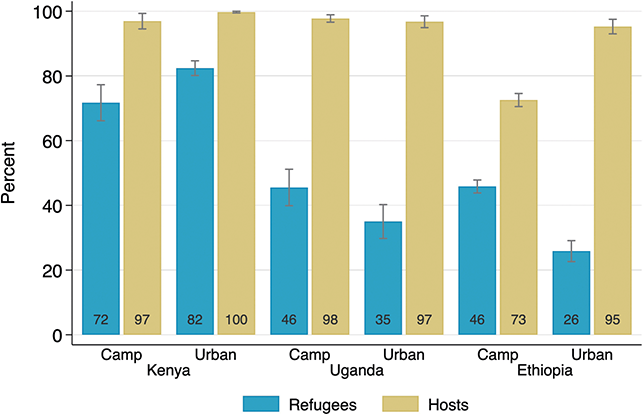
Figure 23 Long description:
The bar chart shows the following data. 1) Kakuma - 71.7 for refugees, 96.9 for hosts; 2) Nairobi - 82.4 for refugees, 99.7 for hosts; 3) Nakivale - 45.5 for refugees, 97.7 for hosts; 4) Kampala - 35 for refugees, 96.7 for hosts; 5) Dollo: 45.8 for refugees, 72.6 for hosts; 6) Addis: 25.9 for refugees, 95.3 for hosts.
Expansion of International Networks
Refugees tend to have broader transnational ties than members of the host community: 17% of the refugees have connections in other African countries and 12% in the Global North (Europe, North America, or Australia). In comparison, only 2% of the members of the host community have immediate family members in other African countries and only 6% of them have family connections in the Global North. In addition, a majority of the refugees have immediate family members in their home country (64%).
Family connections in the Global North are more common among urban refugees (Figure 24). In particular, 57% of refugees have such connections in Addis, compared to only 1.1% of refugees living in the Dollo Ado camps. Although with lower percentages, 12% of the members of the host community in Addis have family connections in the Global North, compared to nearly none (0.2%) in Dollo Ado.
Connections in the Global North have implications for total household income. As mentioned in Section 4, remittances are a crucial source of income for refugees. They make up an average of 23% of the household income per capita, much higher than 12% for the host community. In a focus group interview with several Ethiopian nationals living in one refugee-concentrated area in Addis Ababa, all participants agreed that a large number of Eritreans have relatives living in developed countries and benefit from financial support unlike nationals. One of them said:
Most Ethiopian residents here don’t have access to remittances. Maybe some get but only sporadically, for example when they have celebration or events … We can work here so we don’t need to depend on remittances.
Households with family members in countries in the Global North are more likely to receive remittances. Among those who have family members in the Global North, as many as 74% of the refugees and 41% of the members of the host communities receive remittances from these family members. In comparison, only 12% of the refugees with family members in their home country receive remittances from these family members.
Because refugees in Addis Ababa are excluded from the formal economy due to the government restrictions, access to overseas remittances represents a crucial livelihood strategy. Some 44% of the refugees in Addis Ababa have received remittances from the Global North. Indeed, numerous refugees, both from Eritrea and Somalia, highlighted the significance of remittances as their ‘lifeline’. Ismail, a twenty-four-year-old Somali refugee who lives in Bole Michael with his mother, is one of those who benefit from regular remittances from his sister in the US: ‘From family in the US, we get about 200 USD per month. This is the only source of income for us because we do not have to work here.’ Since his arrival in Addis Ababa in 2014, Ismail and his mother have been living entirely on remittances for more than four years.
The impact of receiving overseas remittances was also significant among Nairobi’s refugee communities. Very often, large or medium-sized businesses, especially in Eastleigh, owned or co-owned by Somali refugees had benefited from overseas remittances through the diaspora. For instance, Katra is a Somali female refugee who co-owns a clothing business with her relative who was resettled in Minnesota, US, from Nairobi. Katra and her relative each contributed 5000 USD to launch this business. Even after her relative’s resettlement in the US, this business partnership remains and they are sharing the profit equally. According to Katra, her diaspora partner visits Kenya from the US once a year, and they are even discussing a plan to make a further investment in the business for expansion.
Percentage of individuals who have family members in the Global North, by location and refugee/host status.
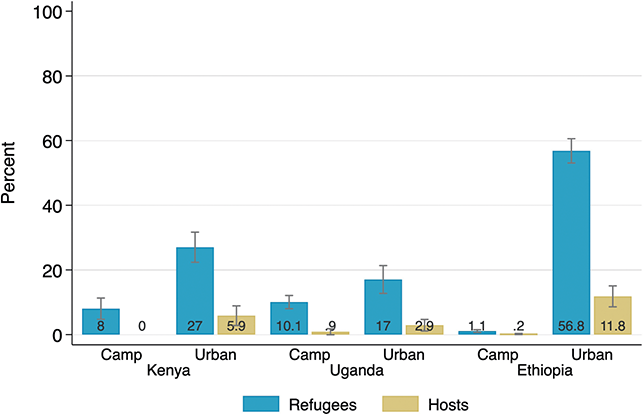
Figure 24 Long description:
The bar chart shows the following data. 1) Kakuma - 8 for refugees, 0 for hosts; 2) Nairobi - 27 for refugees, 5.9 for hosts; 3) Nakivale - 10.1 for refugees, 0.9 for hosts; 4) Kampala - 17 for refugees, 2.9 for hosts; 5) Dollo: 1.1 for refugees, 0.2 for hosts; 6) Addis: 56.8 for refugees, 11.8 for hosts.
International Mobility
International mobility is critical for maintaining and developing family and business networks, yet it remains limited overall (Figure 25). Only 2.4% of refugees and 5.1% of host community members reported having travelled outside the host country in the year prior to the interview. International mobility is notably higher in urban areas and generally higher among host populations.
Dollo Ado, however, stands out as an exception to the general pattern. There, a higher share of refugees (5.2%) than host community members (1.3%) reported travelling abroad. Almost all of these refugee travellers (99%) had returned temporarily to Somalia, highlighting the strong cross-border ties that persist despite displacement.
Percentage of individuals who travelled outside host country, by survey location and refugee/host status.
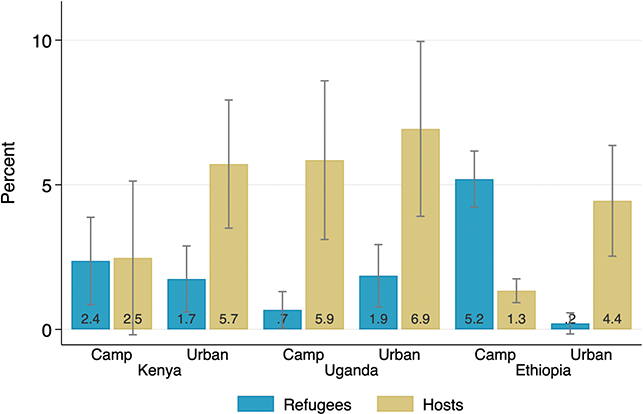
Figure 25 Long description:
The bar chart shows the following data. 1) Kakuma - 2.4 for refugees, 2.5 for hosts; 2) Nairobi - 1.7 for refugees, 5.7 for hosts; 3) Nakivale - 0.7 for refugees, 5.9 for hosts; 4) Kampala - 1.9 for refugees, 6.9 for hosts; 5) Dollo: 5.2 for refugees, 1.3 for hosts; 6) Addis: 0.2 for refugees, 4.4 for hosts.
The cross-border economy with Somalia underpins the livelihood strategies of a significant proportion of both refugees and the host community in Dollo Ado. Dollo Ado town has long served as a commercial hub on trade routes between Ethiopia and Somalia, and for people from the surrounding area, crossing the border into Somalia is part of everyday life. Yusuf, a Somali Ethiopian local chief who was born and raised in Dollo Ado town, notes: ‘Dollo Ado is part of wider Somalia, not a different country’.
Similarly, refugees in Dollo Ado camps also take trips to Somalia, although it is prohibited by the camp authorities. During our survey, a substantial proportion of refugee households reported that at least one of their members had travelled to Somalia during the year preceding the survey. Such behaviour appeared to be much more prevalent in camps that are closer to the border: only 0.5% for households living in Bokolmayo, the camp that is the furthest away from the Somali border, but 19% for households from Buramino, the camp which is the closest to the Somali border. But these rates are likely to be underestimates, and other sources indicate a higher frequency of cross-border movement.
We interviewed refugees who had recently visited Somalia about the reasons for their trips, under the condition of strict confidentiality. Given the scarcity of economic opportunities in the camp, one common reason given by interviewees was that they visited Somalia to access livelihood opportunities. The following is an excerpt of an interview with a Somali male refugee who recently visited Somalia:
I went there between May and November 2018. I just came back five days ago. I went to my hometown to see my relatives … [During this period] I also went to Dollo Somalia and made money by doing construction labour. There was major construction happening there.
Several refugees said they went to Somalia specifically to access economic opportunities provided by aid agencies supporting internally displaced persons (IDPs). For example, the Kabasa IDP camp was set up near Dollo, Somalia, in May 2018. Unlike the refugee camps in Dollo Ado, Kabasa provides cash assistance for beneficiaries, which attracted many refugees. A male refugee from Hilaweyn camp described his trip to Kabasa IDP camp in October 2018:
I visited Kabasa IDP camp. I wanted to register myself to access cash support in order to assist my family. I learned they give US $100 per household … Food rations in Dollo Ado are too small. Alternative livelihoods [in the camp] are few. I can only do casual labour like farming and construction work, which pays little money.
While we came across several refugees who visited Kabasa camp, none of them intended to remain in the IDP camp. Another refugee in Buramino camp who went to Kabasa camp explained that there is a trade-off:
Buramino gives us peace, good education and health facilities, as well as food rations. Kabasa gives people cash support, but there is no peace there. Al-Shabaab is still active in that area. I prefer peace over cash. Many refugees who went there were attracted to the cash programme, but most of them came back [to Ethiopia].
As these examples demonstrate, the Dollo Ado economy and linkages with Somalia play a vital role in refugees’ economic lives in the camps. By visiting sites of humanitarian relief in Somalia, refugees in the Dollo Ado camps evaluated the pros and cons of different options. The camps in Dollo Ado are valued by refugees as a place to access education and health facilities. In that sense, the camps are viewed as a form of social security which is not readily available in their home villages in Somalia.
8 Rights
It was a typical dry season day in Turkana County, Northern Kenya, with the scorching sun beating down relentlessly. On this particular day, Ahmed was feeling a deep sense of frustration. He had been waiting and waiting, and the wait seemed endless. A month earlier, Ahmed had submitted a letter to seek permission to travel from the refugee camp to visit markets in Nairobi. Yet, he had heard nothing back from the camp authority. He visited the camp manager’s office repeatedly, only to be told each time to return the next day. Yesterday, he made yet another visit, only to be informed once more to come back the day after. This morning he returned again, hopeful that today might finally be the day. He waited outside the office for over two hours until the officials arrived. But when he entered, he found his request letter still buried in a pile of other applications on the camp authority’s desk. Once again, he was told to return the next day. With visible anger, Ahmed shared: ‘The movement pass process is really frustrating…This is the biggest problem for me.’ Ahmed arrived at Kakuma refugee camp from Somalia in 2009. Since 2013, he has been running a small grocery shop within the camp, selling items such as rice, flour, pasta, cooking oil, tea, milk, and various canned goods. His main customers are fellow Somali refugees who live nearby. Rice, pasta, and sugar are the best-selling items at his shop – staples that Somali people consume regularly. This was not the first time Ahmed had faced such delays. In May, he submitted a travel request, hoping to stock up on supplies before the end of Ramadan in early June, when demand for items like rice and pasta would surge among Somali refugees after their one-month fast. But his request languished for over three weeks, and by the time he received permission, it was too late to capitalise on the demand hike. He had missed a significant business opportunity. According to Ahmed, it has become increasingly difficult to obtain travel permission to leave the camp, especially for business purposes. What once took four to five days now easily stretches to a month or more. Frustratingly, while obtaining travel permission is in theory free, in practice it often comes with a cost. Ahmed used to pay 1000 KES (25 PPP$, 2016 prices) as a bribe to the camp officials each time he requested permission. This time, he offered 3000 KES (75 PPP$) in hopes of expediting his application, but it was to no avail. Years ago, tired of waiting for travel authorisation, Ahmed took the risk of sneaking out of Kakuma camp without a pass, a common practice among some refugees. He went to Nairobi, purchased food supplies for his business, and attempted to return to the camp. Unfortunately, upon re-entering the camp with his parcels, he was caught by the police, who confiscated his goods. Without money to bribe them, Ahmed was jailed until his relatives could pay for his release. Ahmed has considered hiring Somali–Kenyan brokers to purchase merchandise in Nairobi on his behalf, but he is reluctant. The commission fees they charge would cut into his already thin profit margins. Ahmed envies Somali–Kenyans who run lucrative trading businesses both inside and outside Kakuma camp. They are not burdened by the same restrictions like him. He believes that if he could travel freely to access major markets in Kenya, his shop could grow significantly, perhaps even to the scale of these nationals’ enterprises. Another source of resentment for Ahmed is the annual taxation of refugee businesses by the County Government of Turkana. Kakuma Camp is home to many enterprises, most of which operate informally without official recognition or registration by the state government. However, in recent years, the local government has required refugee enterprises within the camp to pay a fee for a business licence. According to the County Government, refugees in Kakuma Camp must follow the same tax regulations as Kenyan nationals, as they are both operating businesses on Kenyan soil. Ahmed remains perplexed by this explanation, as refugees have never been treated like Kenyan citizens. Ahmed and his wife have been seriously considering moving to Uganda, where they heard that the living environment is less restrictive compared to Kenya. However, he remains torn between starting his business over in Uganda and staying in Kakuma, as he has heard that registering as a refugee in Uganda might not be as easy as he initially thought. August 2019, Kakuma camp, Kenya
In economics, institutions are understood as the set of formal and informal rules shaping behaviour, including laws, policies, norms, customs, and perceptions (Casson et al., Reference Casson, Della Giusta and Kambhampati2010). Institutions play a central role in structuring the opportunities and constraints refugees face. But as the story of Ahmed illustrates, refugees often live under a distinct set of institutional arrangements that differ markedly from those governing citizens or other migrants. These institutional arrangements can provide certain entitlements, such as humanitarian assistance or international protection, but they also impose restrictions on mobility, employment, property ownership, and financial inclusion. Together, these institutional constraints can limit refugees’ ability to pursue economic opportunities and build sustainable livelihoods, contributing to what may become self-reinforcing poverty traps.
Understanding how these institutions operate in practice requires close attention to the actors who design and enforce them. While, in principle, host governments are formally responsible for refugee policy on their territory, the reality on the ground is more complex. Elizabeth Colson (Reference Colson, Nugent and Vincent2004) described this as ‘a chain of dual administration’, referring to the overlapping authority of state actors and humanitarian agencies. In many contexts, however, this is better understood as fragmented governance with multiple overlapping institutions having authority over refugees’ lives. Many different actors – such as host populations, local municipalities, chiefs or even religious leaders – can play a crucial role in regulating refugees’ living environment, and they can exert considerable influence on refugees’ economic lives, as shown next.
Right to Move
On average, only 21% of refugees had travelled within the host country in the year prior to the survey, compared to 64% of individuals in host communities (Figure 26). Destinations are also less diverse for refugees, especially those living in camp settings (Figures 27 and 28).
This disparity is partly explained by regulatory restrictions imposed by national authorities. At the time of our fieldwork, Kenya and Ethiopia had strict encampment policies, which required refugees to reside in a designated refugee camp, with rare exceptions for health, education, or resettlement. These policies significantly constrained the freedom of movement of camp-based refugees and their access to commercial and labour markets beyond the camp areas, unless refugees had obtained special permission from the camp authorities.
Percentage of individuals who travelled within host country in the past year, by location and refugee/host status.
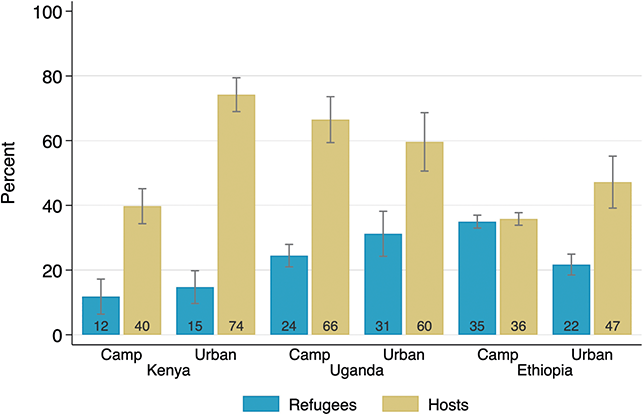
Figure 26 Long description:
The bar chart shows the following data. 1) Kakuma - 11.8 for refugees, 39.8 for hosts; 2) Nairobi - 14.7 for refugees, 74.2 for hosts; 3) Nakivale - 24.5 for refugees, 66.5 for hosts; 4) Kampala - 31.2 for refugees, 59.6 for hosts; 5) Dollo: 35 for refugees, 35.8 for hosts; 6) Addis: 21.7 for refugees, 47.2 for hosts.
The disparity is especially stark in Kenya (Figure 26), where only 13% of the surveyed refugees living in Kakuma and Nairobi reported having travelled within Kenya beyond Kakuma and Nairobi, compared to 68% for those in the host communities. Among those who travelled, individuals in the host communities in Kenya travelled 2.5 times more frequently than refugees.
The lower mobility can partly be attributed to the need to apply for movement passes to travel from the Kenyan authority, as illustrated by Ahmed’s experience. Refugees can apply for these travel documents if they need to access higher education or specialised medical care, or if they are confronted with serious protection threats inside the camps. However, other reasons such as economic purposes were often rejected or took time to obtain. On average, 16% of the refugees in Kakuma reported having applied for a movement pass in the year preceding data collection in 2016, but 31% of respondents had their applications rejected at least once. The median processing time for the pass was seven days, with a maximum of ninety-one days.
While the movement pass should be free, in 2016, 51% of the refugees who applied for a pass paid for it, with a median of KES 4000 per pass (100 PPP$). In 2019, we find that the prevalence of paying this informal fee has lowered substantially to 23%, and the median charge was KES 2000 per pass (45 PPP$).
Beyond applying for a movement pass, refugees in Kakuma report facing scrutiny by authorities. Of those who travelled to Nairobi in 2019, 92% reported being stopped by the police, with an average of three times during the journey. In addition, 21% of the travellers to Nairobi reported giving informal payments to police officers during their journeys.
Refugees frequently mentioned restrictions on their rights to move freely outside the camp as a major obstacle to their livelihoods. Due to the encampment policy, refugees have difficulties selling their products and services outside the camps. Some UNHCR partner agencies provide technical skills training programmes for refugees. However, participants have very few places to utilise the vocational skills that they acquire. A representative of an NGO explained:
In the current conditions, no matter how much livelihood support we provide for refugees, success will be very limited because refugees have no place to use their learned skills.
This NGO taught refugee women how to weave textiles and craft handbags. Although the products produced by the refugee trainees were of good quality, they were piled up in boxes for several months because this NGO cannot provide refugees with market access.
Nevertheless, the presence of encampment policies does not make refugee camps completely isolated from their surroundings. For instance, there is frequent trade between the camp and nearby Kakuma town, to which refugees can walk freely. Though prohibited, a certain number of refugees ventured farther beyond the camp areas without a movement pass. Some refugee business owners purchase their merchandise directly from Kenyan counterparts in other commercial centres such as Nairobi and Kitale (Figure 27). There is a commercial bus service between Kakuma and Nairobi, Dayah Bus Company, which is owned by a Kenyan businessperson. Many items, including clothing, household items, medicines, stationery, and cosmetics, enter into the camp through this transportation service.
As in Kenya, the Ethiopian government employs an encampment policy towards refugees within the country by placing constraints on freedom of movement. All refugees who intend to move are required to obtain travel permission from the Administration for Refugee and Returnee Affairs (ARRA) in advance of their trips. Some informants described the challenges of obtaining authorisation:
When I go to Dollo Ado [town], I have to get a pass permit, and it permits me to stay only for three days. But the process takes a long time, often about five days. ARRA’s offices are not open on Friday afternoon or over the weekends, but for business purposes, I need to be quick.
However, our research revealed that even without travel permissions, Somali refugees in the Dollo Ado camps regularly move between the camps, visit Dollo Ado town, and even travel to villages in Somalia as part of broader familial socio-economic strategies, as explained in Section 7. ARRA and the local government staff are aware of refugees’ movements to neighbouring commercial hubs and even to Somalia. One ARRA staff member explained how the government views refugees’ cross-border movements:
We are aware that many refugees visit Somalia. The main reasons are family visits and keeping their properties there. They also have to attend some important family ceremonies and events, like funerals … For ARRA, security is the biggest concern due to Al-Shabaab movements near the border areas. But if people’s reasons for visiting Somalia are not security related, we allow them to go, although with a warning.
Despite the official encampment rule, local government officials with a Somali–Ethiopian background recognise the historical ties that precede and transcend the border. According to a head of IOM working in Dollo Ado camps, ‘These are “Tacit rules” [due to a long history of cross-border movement]’. For some refugee households, these cross-border movements between Ethiopia and Somalia are employed as important economic strategies, as discussed in Section 7.
Although refugees in Uganda do not face the same movement restrictions as refugees in Kenya and Ethiopia, fewer refugees still travel within Uganda than the hosts (Figure 26) and they travel less often. Our data reveal that 31% of refugees in Kampala and 24% of refugees in Nakivale have travelled within Uganda in the past year, compared to 60% among Ugandans in Kampala and 66% among Ugandans living in Nakivale. While refugees residing in Nakivale are allowed to travel without permits, the spread of locations where they travel to is limited compared to the destinations of refugees in Kampala (Figures 27 and 28). The most common reasons for travel from Kampala are to collect food rations and for registration processes, and the most common reasons for travel from the Nakivale settlement are for medical treatment and for business purposes.
During our research, we came across Somali refugee households that had divided their households between Kampala and Nakivale to make the most of economic opportunities, often sending economically active male members to Somali neighbourhoods in Kampala to benefit from interactions with the wider Somali economy. Conversely, the more vulnerable members of the household, such as the elderly, children, and disabled, and those who were ill remained in Nakivale, where they could access the humanitarian assistance that UNHCR only offers in the settlement. We also encountered a significant number of Somali refugees registered in Nakivale, especially young men, who work for large-scale Somali oil enterprises in Kampala, such as City Oil and HAAS. For all of these families, their primary income-generating means is not inside the settlement but in Kampala.
Destinations of travels undertaken by refugees in the past year, by location.
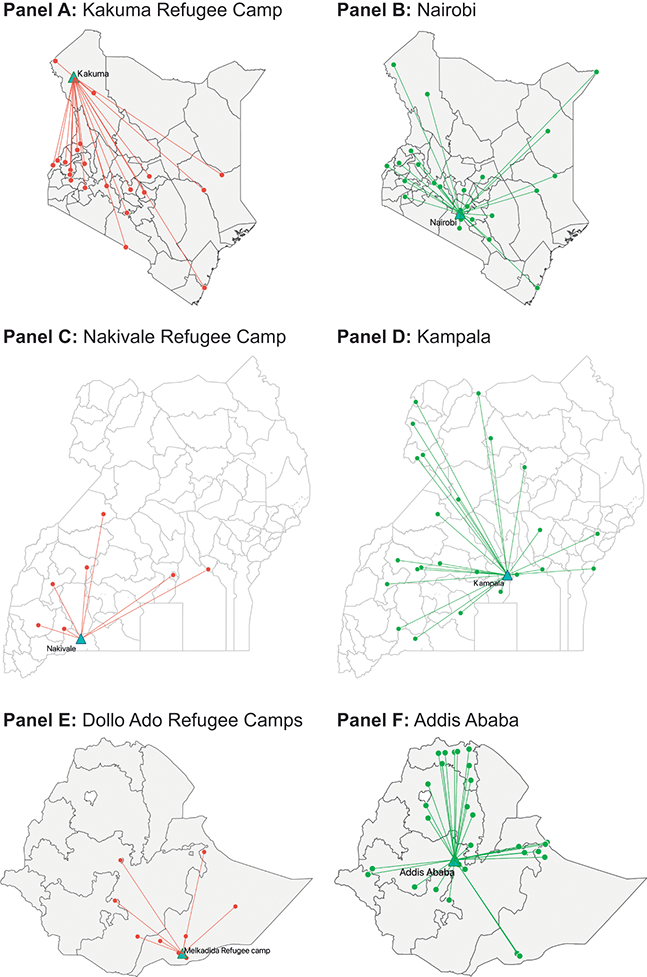
Destinations of travels undertaken by individuals in the host community in the past year, by location.
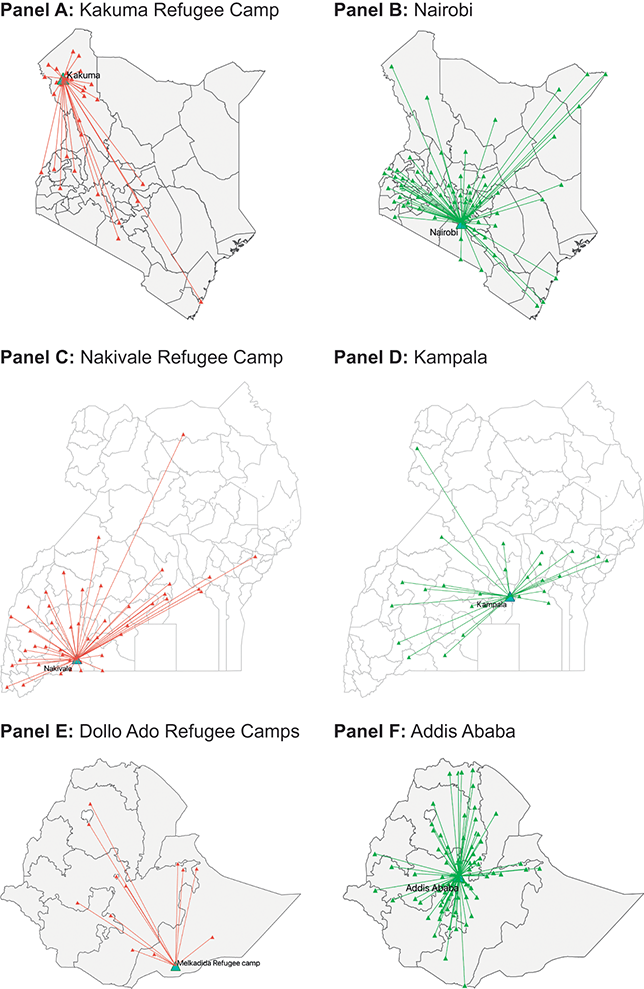
Right to Work
In Kenya and Ethiopia, refugees’ right to work outside camps was constrained by national authorities. The Ethiopian government was particularly restrictive with refugees’ socio-economic rights. Under the Refugee Proclamation of 2004, refugees have not been able to access any form of formal employment or have not been allowed to register their businesses in Ethiopia.Footnote 17 As many as 88% of the refugees residing in Addis Ababa thought that they did not have as many opportunities to find formal work as their Ethiopian neighbours. Although some find ways around these constraints, by working in the informal sector or engaging in business partnerships with members of the host community, the scale of their business and their level of income are generally limited.
At the time of our data collection, in Ethiopia as a whole, the youth unemployment rate was 14%, with two million more people entering the labour market each year (Young Lives, 2019; Geda, Reference Geda2022). In Addis Ababa, levels of youth unemployment were the highest in the country at 23%, and the city was facing pressure from rapid urbanisation (Poschke, Reference Poschke2020). Unsurprisingly, we found that most refugees were unemployed in Addis Ababa: 77% of Eritrean refugees and 93% of Somali refugees were unemployed, compared with 44% of the surrounding host communities. As one NGO worker in Addis Ababa explained, ‘partnering with Ethiopians is their only way to get involved in economic activities’. Informal connections to the host community are the main source of both employment and self-employment opportunities.
In Kenya, the 2006 Refugee Act stipulates that refugees are allowed to work in Kenya and should be able to apply for formal employment with a ‘Class M’ work permit. In reality, these permits are rarely provided, and refugees are virtually excluded from engaging in the formal labour market. A staff member of the Refugee Consortium of Kenya, a well-known refugee-supporting agency in Nairobi, said:
The Class M work permit is intended for refugees seeking formal employment. The Ministry of Interior is in charge of this work permit … But refugees are requested to submit many other documents to get this permit and in reality, very few permits are given to refugees.
Compared to Kenya and Ethiopia, Uganda offered a more generous regulatory environment for refugees at the time of our research, giving refugees the right to work, move around the country, and live within the community. In reality, few refugees can access formal employment because obtaining work permits from the Ugandan government is, as in Kenya, bureaucratically challenging and costly. Across each of our focus countries, the vast majority of refugees are therefore limited to working in the informal sector.
In African cities, the presence of an informal economy is significant and even host nationals often engage in informal commercial activities as refugees do. However, an important difference is that refugees are largely forced to eke out their living in the informal economy and often to accept payment at lower-than-ordinary rates compared to local nationals.
Legal Pluralism
Some of the institutional constraints imposed by the national authorities are often muddled, mediated, or even challenged in local practice. Despite the Kenyan encampment policy that requires refugees to live in one of two refugee camps, its enforcement at a local or community level in Nairobi has been relaxed.Footnote 18 When we asked a local government official about the encampment policy, the assistant chief of Kayole, an area with a high concentration of Congolese refugees, replied:
Yes, we know the Kenyan national government has a tough policy against refugees, but at the community level, we are accommodating them … I think most local governments do not really pay attention to the legal status [of refugees living] in their areas.
In Nairobi, while the national government rarely issues work permits for refugees, we interviewed several refugees who were given business licences by Nairobi’s City Council. Among them was Anne-Marie, a Congolese refugee who has run a hair salon since 2015. When we asked whether her salon is officially registered or not, she responded: ‘Yes. I paid 9,500 KES (228 PPP$, 2017 prices) for a business licence. In addition, I paid 5,000 KES (120 PPP$) and 4,500 KES (108 PPP$) for trade and fire licences.’
These different treatments can be explained by the politics relating to refugees’ economic inclusion. Depending on the potential benefits that can be derived from the presence of refugees, authorities vary in their degree of restrictiveness. Refugee employment is sometimes perceived as taking jobs away from Kenyan nationals, a concern that can fuel local resentment and create political pressure on national and local authorities. But self-employment gives financial incentives to these authorities through the collection of registration fees and might even create employment opportunities for Kenyans. A legal officer of a legal and human rights NGO in Nairobi explained the contradiction between the national government and the Nairobi City Council regarding refugees’ right to work.
Provision of business licences falls under the authority of Nairobi City Council. This is a completely separate process from work permits issued by the Ministry of Interior … Fees from business licences are a part of City Council’s revenue so they do not exclude refugees as long as they pay it. In a way, the Council does not discriminate between refugees and locals.
While these inconsistencies complicate the situation on the ground, they also create spaces for refugees’ livelihood activities. As shown earlier, refugees in Nairobi and Kampala often seek informal employment for example as security guards, porters, and cleaners from host national employers, usually with compromised wages. One Ugandan business owner who employs refugees at his trading company dealing with agricultural processed products explained:
At my shop, I employ some Congolese refugees as porters and staff who help pack these items into bags. For more than 10 years, I have been working with these Congolese residents … I hire them because they are cheaper than Ugandan labour. This is a seasonal recruitment so no contract. Whenever I need people, I call these Congolese refugees [who live in my neighbourhood].
The wage difference between refugee and national labourers was observable across all of the urban research sites, even though refugees were doing the same type of work as nationals, as described in Section 6. The inconsistencies in the implementation of national regulations may create spaces for refugees’ livelihood activities; yet engaging in informal economic work leaves refugees with reduced income.
These examples illustrate that, in practice, local implementation of national policies can diverge significantly from their official formulation. But informal rules do not always work in refugees’ favour. Just as some local authorities turn a blind eye or create regulatory space for economic inclusion, others introduce additional layers of constraint.
Local Rules and Restrictions
Refugees often face an additional set of informal regulations constraining the activities they can and cannot undertake in their locality. These constraints are particularly salient in Kakuma, Kenya (Rodgers, Reference Rodgers2021a,b). Refugees in Kakuma camp are not permitted to keep livestock such as cattle, goats, and camels and are prohibited from collecting firewood and cutting down trees for charcoal production or construction. These restrictions are imposed by the local host authorities.
These local regulations are part of a legacy of previous conflicts between refugees and Turkana host communities. In the early years of the camp’s history, the absence of restrictions on collecting natural resources led to refugees’ exploitation of these resources and put considerable pressure on the forage necessary for Turkana pastoralists (see Newhouse, Reference Newhouse2015). These tensions generated violent clashes between them.
While these local restrictions on refugees were initially brought in as a mitigation measure in response to these conflicts, they are now providing alternative economic opportunities for Turkana populations living around Kakuma camp. Turkana people have traditionally relied upon pastoralist livelihoods, but nowadays, many of them have lost such livelihoods. The local rules imposed on refugees have in turn generated economic opportunities for Turkana, who have established a monopoly on livestock, firewood, and charcoal markets. Many Turkana locals sell firewood, charcoal, and building materials inside the camp.
During one of the focus group discussions with Turkana people who are residing nearby Kakuma camp, we asked questions about the differences between refugees and host nationals. One elderly member commented:
Refugees have better access to aid including food rations and social services … But Turkana have more rights [than refugees]. We can enjoy freedom of movement, land access, and choose jobs we want [to do].
Local restrictions on refugees’ economic activities also exist in Uganda’s settlement. During our research in Nakivale settlement, one of the village leaders living close to the settlement explained that refugees are not allowed to grow bananas because bananas are seen as ‘permanent crops’. According to this leader, banana trees are very persistent once planted, and it requires removing the entire roots from the soil and waiting for some seasons before they shift to other crops. The leader said to me: ‘refugees are guests to our village so they should not plant anything that takes a long time’.
Even in urban areas, host populations can exert considerable influence over economic spaces in which refugees can participate. Since around 2016, some Congolese refugees in Nairobi started selling mandazi, a popular sweet fried bread in their neighbourhood. Their mandazi became popular among local Kenyans. As the business demand for mandazi started growing, more and more Congolese entered this business. Later, this led to acute tension with Kenyan mandazi vendors, who were displeased with the rapid growth in popularity of these Congolese mandazi. In 2017, Kenyan mandazi sellers convened a meeting and organised a protest against Congolese mandazi makers. The protesters claimed: ‘Refugees are not allowed to work in Kenya’ and thus they cannot sell mandazi in Nairobi.
In 2018, frustrated Kenyan mandazi producers requested these refugees stop making mandazi and announced that they would accept a maximum of fifty refugee mandazi hawkers in the whole city and that they would be required to purchase from Kenyan mandazi producers. Yet some Congolese refugee sellers ignored such requests. Towards late 2018, Kenyan mandazi producers intensified their surveillance on the street, sometimes confiscating their goods and taking sales revenues from refugee mandazi sellers. Due to violent attacks from the host community members, many Congolese refugee sellers gave up the business.
We interviewed a Kenyan livelihood officer working for an international NGO that serves refugees in Nairobi. She was carefully following up on the conflicts between Kenyans and refugees in the mandazi business. She explained the stereotyped perception of refugees among Kenyans:
When refugees are doing better than Kenyans, this creates tension with hosts. This is especially so with nationals working as informal labourers like refugees. Their living conditions are not easy. They think: ‘How can refugees become better than us?’ The case of mandazi is a typical one. It provoked this sentiment amongst Kenyans.
Perceptions matter because they shape the informal institutional constraints on refugees’ economic lives. Economic activity on Nairobi’s streets is shaped by informal rules and customs, with different rules for refugees compared to locals, rather than functioning as a free market. While the Kenyan government imposed restrictions on refugees’ right to work and to live outside camps, the enforcement of such regulations is largely left to the tolerance or discretion of local nationals. This means, once the hosts perceive refugees as an ‘economic threat’, their tolerance can shrink and refugees risk losing their safe space to make a living in Nairobi.
Securitisation and Harassment
Securitisation policies towards refugees can affect refugees’ economic lives. Kenyan refugee policy has been inseparable from the issue of national security. Refugees and asylum seekers have been connected with terrorism (Freeman, Reference Freeman2019). In particular, Somali refugees are the direct victims of these tighter securitisation policies. A string of attacks by Al-Shabaab, such as the Westgate mall siege in Nairobi in 2013, the massacre of nearly 150 students at a university in Garissa in 2014, and the DusitD2 complex attack in Nairobi in 2019, led to growing intolerance and even hostility against Somali communities, including refugees. The linkage between insecurity and refugee-hosting has evidently exacerbated public perceptions towards Somali refugees, particularly in urban areas.
The mounting negative sentiments against Somali refugees led to extensive police harassment of them. From our data, some 29% of the Somali refugees living in Kenya have been arrested or questioned by the police in the three months preceding the survey. In comparison, this percentage is just 5.1% among the host community. In Kenya, the police are another institutional actor that shapes refugees’ livelihood activities both in the camp and the city (Omata, Reference Omata2021). During our fieldwork with Somali refugees living in Nairobi, among many challenges, the biggest livelihood obstacle was abuse from the public authorities, especially police officers (see also Pavanello et al., Reference Pavanello, Elhawary and Pantuliano2010; Lindley, Reference Lindley2011; Campbell, Reference Campbell2006). Bribery is a common feature of the informal sector in Kenya. With precarious legal status, refugees in Nairobi are subjected to increased risk of harassment and extortion by the police compared to their host populations.
In Nairobi, paying cash to the police has become so routine for many refugees that they include such costs in their daily budgets. For instance, Najat is a Somali woman who runs a retail shop in Eastleigh. She is registered in Nairobi as a refugee and her business is officially registered with the Nairobi City Council, but she is constantly exposed to police harassment as her testimony indicates.
When I am on my way home, they [police officers] stop me and say ‘refugees have no right to stay in Nairobi’ and ‘refugees must go to the camp.’ Last time, I had to pay 4,000 KES (96 PPP$, 2017 prices). Even though I am registered in Nairobi, they don’t care about my paper documents.
For refugees in Nairobi, paying bribes is a necessary aspect of their survival strategies if they are to avoid arrest and imprisonment. Aside from its emotional toll, the practice of bribery increases the cost of goods and services for refugee entrepreneurs, making their livelihoods less profitable and more precarious.
Whereas the practice of bribery affects both refugees and hosts, refugees – especially those from Somalia – are much more vulnerable to police abuse due to their precarious legal status and limited access to justice in Nairobi. Ahmed, a Kenyan shop owner of Somali origin, described how Somali refugees suffer in Nairobi because of their refugee status:
In recent years, unfortunately, Somali–Kenyans are often targeted by Kenyan police and government officials. But Somali refugees suffer more than we do. We are essentially Kenyan nationals. We can speak the local language and have national ID cards, which usually resolve cases of potential harassment.
Whilst harassment by authorities is a common challenge for urban refugees, police abuse is also a problem for refugees living in the Kakuma camp, regardless of nationality. According to refugees, some police officers target ‘unauthorised’ businesses run by refugees, such as pharmacies, clinics, motorbike taxi drivers (boda boda), and brewery businesses, all of which are formally required to acquire specific licences from the Kenyan authorities. Many lack such certification, and so refugee business owners must either pay unofficial charges and bribes or face the closure of their enterprise.
A Congolese refugee in Kakuma camp in his late 20s expressed his frustration when we asked about the police’s behaviour. He came to Kakuma in 2013 with his wife and child, and he now works as a boda boda driver (motorbike taxi driver). According to him, police systematically collect ‘toll fees’ from motorbike drivers operating within the camp.
There are two specific stopping points in the camp. Every day, we have to pay 50 KES (1.3 PPP$, 2016 prices). If we pay once, they will not stop us again in the same day … If we resist the police or refuse to pay, they will take our motorbike and keep it at the police station. The police will then give us a ‘fine’ of 10,000 KES
There was a clear difference in the way members of the local host community were treated by police. During research, we asked tens of Turkana host people whether they experienced any police harassment or requests for bribes. Their responses were almost always ‘never’. The systematic targeting of refugees for bribes imposes a significant handicap on refugees’ economic endeavours.
9 Escaping the Trap
This Element has explored a simple question: what difference does it make to be a refugee, from an economic perspective? Methodologically, we have been able to answer this question through comparative research based on harmonised data collected from both refugee and host communities across three countries in East Africa.
Our findings show that being a refugee makes a significant material difference. Poverty in refugee communities is nearly double that of host communities. Refugees’ access to the labour market is severely limited across all three countries, with workers in the host communities earning nearly three times more than refugee workers. Refugees are unable to close the income gap with time spent in exile. Some refugees manage to access remittances and humanitarian aid to partially offset the lack of income from work. Despite this, refugees’ total income – including earnings, remittances, and aid – is generally lower than that of host communities.
We refer to the overall gap between refugees and the proximate host community as ‘the refugee trap’. To understand the origins of this gap, we explored four different mechanisms – trauma, dispossession, uprootedness, and the loss of rights.
Trauma resulting from events before, during, and after displacement leaves lasting legacies in terms of mental and physical health. Our analysis reveals some worrying patterns. A staggering 62% of refugees reported having ever been exposed to violence. With exposure to violence strongly associated with mental and physical health, almost a third of the refugees had moderate or severe depressive symptoms, three times more than the host population. Similarly, nearly two-thirds of the refugees reported moderate or severe functional impairment, such as having difficulties in walking, learning, and participating in activities, at twice the rate observed in the host population. Faced with limited access to healthcare during the displacement journey and in the host country, refugees’ health situation is worse among those with extended exile periods. Poor health conditions affect their capacity to work, invest in skills, and participate in society.
Because of displacement, refugees are often dispossessed of essential assets – homes, savings, land, and tools – forcing them to rebuild their lives in exile with far fewer resources than members of the host community. Disruptions in education also contribute to a significant gap in human capital: refugees tend to complete fewer years of schooling than their hosts. Even when they have accessed education before displacement, their qualifications are often unrecognised in the host country, further limiting job opportunities. As a result, the economic return to an additional year of education is far lower for refugees – less than a third of that enjoyed by host community workers. Part of this disparity reflects the need for refugees to rebuild their livelihoods from scratch. Among employed refugees, nearly two-thirds had to switch sectors or professions after displacement. Refugee entrepreneurs also face severe barriers to accessing financial capital. Access to humanitarian aid can partially offset these differences, sometimes through refugees’ opportunistic use of aid that is beyond the intended food security purposes. For instance, food rations are frequently sold to refugee or host households or private vendors, effectively transforming food aid into a source of cash. Some refugees also use food assistance as collateral to obtain credit from local shopkeepers. While these strategies reflect resilience and adaptability, they may also increase vulnerability.
Displacement also uproots refugees from familiar environments and profoundly reshapes their social networks. Local ties at the household and community levels are often disrupted through separation, dispersal across borders, or relocation within the host country. Only about half of refugee households report having family members living elsewhere in the same host country – compared to nearly all households in the host community. These sparser local networks limit refugees’ ability to rely on informal coping strategies during emergencies and narrow the range of job opportunities they can access through social connections. In response, refugees adapt, for instance by forming fictive households, creating business ‘consortiums’ with hosts, and establishing informal lending groups with others from the same nationality. At the same time, refugees tend to have more geographically dispersed networks than host community members. Most maintain ties with relatives abroad and some receive remittances from the Global North – transfers that account for nearly a quarter of total household income on average.
Finally, displacement often results in restricted access to rights compared to citizens of the host country. Refugees frequently face constraints on socio-economic entitlements, including the right to move, work, own property, run a business, and choose their place of residence. Yet host countries often exhibit legal pluralism and inconsistent rule enforcement, leaving significant scope for refugees to work in the informal economy. However, some local rules and customs, as well as frequent police harassment and periodic government crackdowns on refugees, limit their livelihood options and often reduce their ability to earn beyond subsistence income.
Policy Implications
One of the key ideas to emerge from this Element is the notion of ‘socio-economic durable solutions’. The three traditional durable solutions – resettlement, repatriation, and local integration – have been prioritised because they represent pathways to restoring effective citizenship. And citizenship has been prioritised because of an underlying assumption that everyone should, in theory, have a right to participate meaningfully within a national political community.
A generation of scholars, beginning with Hannah Arendt, have reinforced the idea that the refugee predicament is inherently about the loss of political rights; that the worst aspect of being a refugee is not material but political, becoming ‘bare life’ through which existence becomes merely biological and material (Arendt, Reference Arendt1958; Agamben, Reference Agamben1998). From this perspective, the restoration of normality and the ‘end of the refugee cycle’ come from the restoration of effective citizenship, and hence participation in a polity, whether back home or elsewhere.
Our research shows that becoming a refugee does not only involve political loss; it also involves economic and social losses. It is not only about a relationship to the state and the state system, but also a relationship to markets, the global economy, and society. Of course, some of the socio-economic deficits experienced by refugees are the result of loss of citizenship rights, and this is partly captured by the institutional dimensions of our framework (‘loss of rights’), but there are aspects of the refugee trap that appear not to be reducible to membership of a political community. Recognising this also offers grounds for optimism, by opening up forms of remedy that may not rely exclusively on pathways to citizenship.
Our understanding of durable solutions needs to broaden to reflect this. It is as much about the restoration of a ‘normal’ relationship to markets and society as to states. As much about economics, sociology, and psychology as about politics. And from a basic rights perspective – the view that the rights that matter most are the ones that are necessary to enjoy any rights – economic and social participation and living standards are at least as important as political participation. Genuinely durable solutions for refugees, therefore, have to entail restoration of a ‘normal’ level of socio-economic inclusion. This, for us, must involve overcoming the refugee trap; ensuring that trauma, dispossession, uprootedness, and the loss of rights are addressed through their restorative corollaries: psychological support, economic opportunity, social integration, and political advocacy.
One key follow-up question, though, is how should we benchmark socio-economic durable solutions? What level of socio-economic restoration is ‘enough’ to imply that the material deficit of becoming a refugee has been overcome, and ‘normality’ restored?
There are several options. First, the living standards of the host community. In this Element, we have understood the ‘refugee trap’ in terms of the gap between refugees and proximate members of the host community. International human rights law generally stipulates that the appropriate expectation relating to socio-economic rights is a standard relative to that enjoyed by the wider surrounding community. Yet even the concept of a ‘proximate host community’ can be difficult to define. And is it appropriate to use local host populations as a benchmark when refugees are frequently settled in some of the country’s most deprived regions?
Second, the living standards previously experienced in the country of origin. There is a case that to restore someone to ‘normality’ is to return them to the living standards they had before they were displaced. However, estimating living standards pre-displacement and in conflict-affected contexts is often difficult. Immediate pre-flight conditions may have further deteriorated as a result of conflict, making them a poor reference point. How far back should one look to establish a baseline? In this sense, ‘normality’ is inherently ambiguous and difficult to measure in forced displacement contexts.
These two benchmarks may ultimately be inadequate, especially given that a large share of the population in both host and countries of origin already lives in poverty. An alternative is to benchmark against an international standard – such as a global poverty or prosperity standard. This approach has the advantage of avoiding the need for context-specific average measurements and offers a consistent threshold for assessing socio-economic restoration. However, its drawback lies in its potential disconnection from local realities – raising questions about its relevance and legitimacy in specific settings.
Addressing the Trap
Regardless of how we benchmark the point at which the refugee trap is overcome, and the material impact of being a refugee has been resolved, there is a question of what works to address the different facets of the refugee trap. Thinking through solutions based on the ‘risks’ identified in this Element (Cernea, Reference Cernea1998), what kinds of evidence-based interventions are likely to be effective for addressing the four main traps, and ensuring effective psychological support, economic opportunity, social integration, and political advocacy?
We present these categories as a broad framework for policymakers that will, of course, require adaptation and specification to fit the local and regional context. The dynamics of forced displacement, and the political and institutional context within which policy solutions are applied, will shape what is feasible in East Africa and elsewhere. There will also be localised contextual variation, including between urban and rural areas. Nevertheless, we think these categories offer a coherent starting point for thinking about the relationship between different dimensions of the refugee trap and solutions.
Across each of the four areas, we discuss some of the intervention-based studies that examine potential policies and programmes that may help individuals escape from the refugee trap. We also identify areas where further research is needed.
Psychological Support
In response to trauma, the literature in psychology and psychiatry generally finds that psychosocial interventions for PTSD, depression, and anxiety have large and persistent effects on refugees and asylum seekers (Turrini et al., Reference Turrini, Purgato and Cadorin2025). Traditional therapies are, however, costly and often not directly or widely implementable in contexts of forced displacement because of a lack of qualified mental health professionals and a general lack of access to healthcare. To address financial and human resource gaps, the ‘task shifting’ approach for mental health support seeks to transfer certain tasks to lay community members to expand the mental health support available at the local level (Sijbrandij et al., Reference Sijbrandij, Acarturk and Bird2017). Community members are trained to provide peer-to-peer support within the community for cases of mild to moderate distress or depression, with more severe cases being directed towards mental health professionals for further support (Cohen and Yaeger, Reference Cohen and Yaeger2021).
Due to the widespread availability of smartphones among refugees, mobile applications and online approaches are also increasingly used to favour access to mental health support. Preliminary evidence from research with different refugee communities indicates that adapted cognitive behavioural therapies delivered through community members or mobile applications might effectively reduce symptoms of depression, anxiety, and distress (de Graaff et al., Reference De Graaff, Cuijpers and Twisk2023; Schäfer et al., Reference Schäfer, Thomas, Lindner and Lieb2023).
However, more evidence is needed to understand whether and what type of psychosocial interventions can positively affect the socio-economic outcomes of refugees and asylum seekers. Further research on these low-cost treatment modalities should be continued and expanded, especially given the increasingly resource-constrained nature of humanitarian settings.
Economic Opportunity
In response to dispossession, immediate material support, such as finance and shelter, is critical, as well as access to economic opportunities. Empirical studies that examine the impact of the cash transfer programmes for the displaced population generally show that there are efficiency and welfare gains in providing unrestricted cash rather than restricted cash, vouchers, or in-kind assistance (Hidrobo et al., Reference Hidrobo, Hoddinott, Peterman, Margolies and Moreira2014; Aker, Reference Aker2017; MacPherson and Sterck, Reference MacPherson and Sterck2021; Siu et al., Reference Siu, Sterck and Rodgers2023). While cash transfers provided to the displaced population are found to have positive impacts on a range of outcomes (Bahar et al., Reference Bahar, Brough and Peri2024), these impacts can be short-lived once the programme ends (Altındağ and O’Connell, Reference Altındağ and O’Connell2023).
Recent evidence suggests that sufficiently large asset transfers, such as providing livestock, can enable some low-income individuals to escape poverty (Balboni et al., Reference Balboni, Bandiera, Burgess, Ghatak and Heil2022). However, these transfers may not be large enough to enable the poorest to escape poverty, and their impacts on the displaced population remain unclear. Further research is needed to understand not only the impact of large cash or asset transfers on the welfare outcomes of the displaced population, but also the kinds of transfers that would be most effective in helping individuals escape the refugee trap.
In response to the loss of homes, there is a need to provide sustainable housing solutions for refugees beyond temporary shelters. The evidence base on how this can be achieved is thin. Most recently, Tamim et al. (Reference Tamim, Smith and Palmer2025) find that a housing subsidy provided to refugees and landlords in Jordan not only has limited positive impacts on refugees’ welfare but also leads to a deterioration of host attitudes towards Syrian refugees. While international organisations are rolling out alternative solutions, such as social housing (UNHCR, 2022), the impacts of these solutions have yet to be rigorously evaluated.
A growing body of research examines interventions that aid refugees in recreating livelihoods in host countries. Language courses are among the most effective interventions for refugees, not only improving employment and wages in both the short and long term, but also enhancing outcomes in education, mental health, and healthcare access (Foged et al., Reference Foged, Hasager, Peri, Arendt and Bolvig2024; Schmid, Reference Schmid2023; Dang, Reference Dang2025; Tumen et al., Reference Tumen, Vlassopoulos and Wahba2025). Active labour market policies, such as job-search assistance and tailored employment support, have been shown to improve refugee employment outcomes, particularly in high-income countries (Battisti et al., Reference Battisti, Giesing and Laurentsyeva2019; Fasani, Reference Fasani2024; Bahar et al., Reference Bahar, Brough and Peri2024; Cole et al., Reference Cole, Jabbour, Ozgen and Yumoto2024; Bratu et al., Reference Brell, Dustmann and Preston2025). From the wider literature, providing transport subsidies or cash transfers that aim at reducing job-search costs are found to be effective in helping individuals in low-income countries secure formal employment, but impacts may be short-lived (e.g., Franklin, Reference Franklin2018; Abebe et al., Reference Abebe, Caria and Fafchamps2021; Banerjee and Sequeira, Reference Banerjee and Sequeira2023; Caria et al., Reference Caria, Gordon and Kasy2024).
Such policies can also place pressure on refugees to enter into the workforce immediately, which may unintentionally push them into taking precarious jobs (Arendt, Reference Arendt2022). In addition, Caria et al. (Reference Caria, Franklin and Witte2023) find that financial support, such as transport subsidies, can lead to deterioration of mutual support among unemployed individuals, leading to worse job-search outcomes for those who did not receive financial support. This reflects the need to consider job quality and broader impacts when implementing such interventions.
Social Integration
Addressing uprootedness involves social integration by supporting refugees in re-establishing networks. For example, Dagnelie et al. (Reference Dagnelie, Mayda and Maystadt2019) find that refugees with more business owners in their networks have better employment outcomes in the US. One potential way to assist in creating these connections is through mentorship programmes. In theory, mentoring can reduce information gaps and has been implemented to improve various outcomes, such as education, employment, career development and entrepreneurship. The successes of mentorship programmes are nevertheless mixed, and highly dependent on the design of the programme and the characteristics of the mentor–mentee pair (Bagnoli and Estache, Reference Bagnoli and Estache2022; Carlana et al., Reference Carlana, La Ferrara and Pinotti2022; Baseler et al., Reference Baseler, Ginn, Kasirye, Muya and Zeitlin2025). Research on mentorship is still nascent, and more evidence is needed to understand their impacts on various outcomes and the mechanisms behind these impacts.
The spatial placement of refugees also matters. In Denmark, Foged et al. (Reference Foged, Hasager, Peri, Arendt and Bolvig2024) show that assigning refugees to areas with high employment rates significantly improves their job prospects. More broadly, because refugees hold private information about their networks and skills that others cannot easily observe, Delacrétaz et al. (Reference Delacrétaz, Kominers and Teytelboym2023) find that allowing them to choose their own settlement locations can generate more efficient outcomes.
As described in previous sections, remittances are an important source of income for refugees. As such, enabling refugees to receive remittances easily and at low cost is important. Policies which impede the flow of remittances can have an immediate negative impact on the welfare of not only refugee households but also of the host population (Alix-Garcia et al., Reference Alix-Garcia, Walker and Bartlett2019). In contrast, drawing from the wider literature, digital technologies, such as mobile banking, which facilitates remittance flows, can help smooth consumption in the event of negative shocks and can reduce poverty (Riley, Reference Riley2018; Lee et al., Reference Lee, Morduch, Ravindran, Shonchoy and Zaman2021).
Another important emerging theme is the role of cross-border mobility. Forced migration scholars have long documented refugees’ transnational livelihood strategies and networks (e.g., Monsutti, Reference Monsutti2008), and recent studies show how refugees engage in cross-border trade, maintain farms or businesses in their origin countries, or use split-household strategies to maximise sources of both humanitarian and private income (Betts et al., Reference Betts and Sterck2021; Omata and Gidron, Reference Omata and Gidron2025). However, more work is needed to understand impacts and opportunities for extended households.
Political Advocacy
In relation to rights, over half of the refugees worldwide live in countries where there are significant restrictions on their work rights (Ginn et al., Reference Ginn, Resstack and Dempster2022). Studies have shown that restricting refugees’ legal right to work can lead to long-term negative impacts on their labour market outcomes, even after these restrictions are lifted (Marbach et al., Reference Marbach, Hainmueller and Hangartner2018). Fasani et al. (Reference Fasani, Frattini and Minale2021) find that employment restrictions across European countries reduce the likelihood of refugees being employed after the ban by 15%, with effects lasting up to a decade. Similar negative impacts on employment, as well as trust in institutions and the host community, are observed due to delayed asylum decisions, which often affect work rights (Hainmueller et al., Reference Hainmueller, Hangartner and Lawrence2016; Sohlberg et al., Reference Sohlberg, Agerberg and Esaiasson2024). These bans can have impacts beyond labour market integration as employment not only enables refugees to be self-reliant but also improves mental health (Hussam et al., Reference Hussam, Kelley, Lane and Zahra2022). Together, these results show the importance of providing access to decent work for the displaced population.
Regularisation or citizenship – which come with legal rights beyond work, such as residency and access to public services and criminal justice – can have important impacts on a range of welfare outcomes of displaced individuals. Colombia’s large-scale amnesty programme for undocumented Venezuelan refugees has increased formal employment, well-being, education, as well as ability to cope with shocks, without displacing work from the host community (Bahar et al., Reference Bahar, Ibáñez and Rozo2021; Urbina et al., Reference Urbina, Rozo, Moya and Ibáñez2023; Ibáñez et al., Reference Ibáñez, Moya, Ortega, Rozo and Urbina2025). In high-income countries, access to citizenship has led to large long-term positive impacts on employment and wages of refugees (Steinhardt, Reference Steinhardt2012; Gathmann and Keller, Reference Gathmann and Keller2018; Hainmueller et al., Reference Hainmueller, Hangartner and Ward2019).
Recent research reveals the political economy underlying the conditions under which states are willing to allow refugees to work and have the freedom to choose where they reside (Betts, Reference Betts2021; Betts and Sterck, Reference Betts2022). What configuration of power, interests, and ideas leads governments to choose to restrict or grant refugees’ right to work, freedom of movement, or right to own property? We know that refugees can make a positive economic contribution when given the right to work, but also that there may be redistributive consequences to such decisions, and that politicians at local and national levels can win or lose from advocating for or against the right to work for refugee populations (Betts, Reference Betts2021; Betts and Sterck, Reference Betts and Sterck2022). Effective political advocacy can encourage more governments to adopt inclusive policies that provide access to work rights and citizenship to refugees. From a bottom-up perspective, while superficial refugee–host interactions can increase support for exclusionary policies (Dinas et al., Reference Dinas, Matakos, Xefteris and Hangartner2019; Hangartner et al., Reference Hangartner, Dinas, Marbach, Matakos and Xefteris2019), prolonged interactions may enhance social cohesion and support for inclusive policies (Kalla et al., Reference Kalla and Broockman2020; Mousa, Reference Mousa2020; Steinmayr, Reference Steinmayr2021; Betts et al., Reference Betts and Sterck2023; Larson and Lewis, Reference Larson and Lewis2025). Policies designed to benefit both refugees and host communities can foster cooperation and social cohesion, but their effectiveness varies by context and depends in part on the credibility of communication (Valli et al., Reference Valli, Peterman and Hidrobo2019; Lehmann, Reference Lehmann and Masterson2020; Baseler et al., Reference Baseler, Ginn, Kasirye, Muya and Zeitlin2025). Greater empirical attention to these dynamics is essential for understanding the feasibility and durability of policy reform.
(Re)Searching for a Holistic Approach
The impact evaluations reviewed in the previous section typically target a single mechanism of the refugee trap – trauma, dispossession, uprootedness, or constrained rights. In reality, these mechanisms are deeply interconnected, and so too are the solutions. More research is needed to explore how these four sources of disadvantage interact and reinforce one another, and how different interventions might do the same.
Understanding these interaction effects matters from a theoretical perspective in order to further explore the extent to which the socio-economic deficits that we identify are specifically made worse by being a refugee. Counterfactually, might any person experiencing violence or trauma expect to endure similar deficits? Or, alternatively, is there something inherent to the way they combine as part of the refugee experience that is self-reinforcing, and creates the trap-like effect of both deficit and the incapability of escaping that condition?
Insights on interaction effects might be drawn from the literature on the graduation approach, which combines multiple services to help households escape poverty (Banerjee et al., Reference Banerjee, Duflo and Goldberg2015). Similarly, research needs to test bundled interventions among refugee populations and assess the interaction effects between them. For example: how do mental health services interact with mentorship and work permit facilitation? What is the combined effect of business training, microcredit, language instruction, and mobility rights? How does cash-based assistance function when paired with support for building social networks? Exploring interactions may require complex research designs. Still, advancing our understanding of such dynamics is essential to informing more effective policy design and to developing a ‘graduation model’ tailored to the specific mechanisms of the refugee trap.
Beyond the study of the refugee trap, one of the important implications of our Element has been methodological. The analysis highlights the value of a mixed methods approach to studying the economic lives of refugees. The combination of quantitative economics and qualitative refugee and forced migration studies offers complementary insights. Using quantitative methods enables us to derive rigorous and comparable insights. Using qualitative methods enables us to understand and interpret perceptions and context. In an area with relatively limited quantitative data, our analysis has revealed the value of descriptive statistics, often under-appreciated within economics, as a useful tool for revealing and visualising patterns and comparisons.
It is also evident that more needs to be done to undertake panel data collection, following the economic lives of forcibly displaced people over time. It would be fascinating, although methodologically challenging, to be able to follow the lives of people from initial displacement through to protracted exile in order to be able to unpack the different effects across the stages of our model: trauma-dispossession-uprootedness-rights. Disaggregating these effects through longitudinal research would rely upon being able to collect representative data either from the very onset of (or prior to the onset of) a conflict or crisis, and then follow people over time, whether through in-person or online data collection.
We are also aware that our analysis has focused on just three countries, and that the mechanisms underlying the refugee trap may partly vary across countries and regions. In particular, it would be interesting to explore ways in which the trap plays out for asylum seekers and refugees in advanced industrialised economies of the Global North.
Finally, this research agenda should be extended to IDPs. Compared to refugees, there has been limited research on ‘IDP economies’ – the resource allocation systems that shape socio-economic outcomes for IDPs. Yet there are over 70 million conflict-induced IDPs around the world, with more displaced by other factors such as natural disasters and climatic changes, for example. IDPs have socio-economic rights, which are recognised in international law and in the Guiding Principles on Internal Displacement. Furthermore, there are grounds to believe that greater socio-economic opportunities for IDPs may have important consequences for security, fragility, social cohesion, peace-building, and post-conflict reconstruction.
One of the interesting features of applying our Trauma-Dispossession-Uprootedness-Rights theoretical framework is that IDPs are likely to face some of these challenges in similar ways to refugees. IDPs have in common with refugees the experience of displacement. However, they do not have in common the experience of exile. Consequently, we might have grounds to believe that they will face ‘trauma’ and ‘dispossession’, but have different experiences in relation to ‘uprootedness’ and ‘rights’ compared to refugees.
There are therefore a wide range of thematic, methodological, and theoretical opportunities to deepen our understanding of the economic lives of displaced populations. As research in this area deepens and broadens, including to other regions of the world, we hope that those insights will offer new ways for policymakers and practitioners to overcome the range of poverty traps associated with being a refugee.
Abbreviations
- ALMP
Active Labour Market Policy
- ARRA
Administration for Refugee and Returnee Affairs
- CBT
Cognitive Behavioural Therapy
- DRC
Democratic Republic of the Congo
- HFIAS
Household Food Insecurity Access Scale
- IDP
Internally Displaced Person
- NGO
Non-Governmental Organisation
- OPM
Office of the Prime Minister
- PHQ-9
Patient Health Questionnaire-9 (a measure for depression severity)
- PTSD
Post-Traumatic Stress Disorder
- RFMS
Refugee and Forced Migration Studies
- UNHCR
United Nations High Commissioner for Refugees
- WFP
World Food Programme
- WHO
World Health Organization
Acknowledgements
This Element is based upon more than a decade’s research by the Refugee Economies Programme, based at the Refugee Studies Centre, at the University of Oxford. We are especially grateful to the IKEA Foundation and the Danish Ministry of Foreign Affairs for supporting our work. We also thank colleagues who have played a key role in the programme’s research, including Isabelle Aires, Madison Bakewell, and Cory Rodgers for the coordination of the Refugee Economies Programme, and Jordan Barnard, Raphael Bradenbrink, Imane Chaara, Antonia Delius, Eyoual Demeke, Maria Flinder Stierna, Leon Fryszer, Aregawi Gebremariam, Abis Getachew, Jonathan Greenland, Louise Guo, Helen Karanja, Clarissa Kimera Tumwine, Jana Kuhnt, Hiwot Mekonen, Rashid Mwesogwa, Patrick Mutinda, and Halefom Nigus for research assistance. Our research would not have been possible without the contribution of around 290 refugee and host community researchers in Uganda, Kenya, and Ethiopia. They contributed to our programme in a range of ways, including as research assistants, coordinators, and enumerators. Where permission has been granted, their names are shared in the programme’s Activities and Impact report on our programme website. Finally, we wish to thank Peter Ho as our Elements series editor for supporting publication of this work, as well as three anonymous reviewers for their comments and suggestions.
Peter Ho
Zhejiang University
Peter Ho is Distinguished Professor at Zhejiang University and high-level National Expert of China. He has held or holds the position of, amongst others, Research Professor at the London School of Economics and Political Science and the School of Oriental and African Studies, Full Professor at Leiden University and Director of the Modern East Asia Research Centre, Full Professor at Groningen University and Director of the Centre for Development Studies. Ho is well-cited and published in leading journals of development, planning and area studies. He published numerous books, including with Cambridge University Press, Oxford University Press, and Wiley-Blackwell. Ho achieved the William Kapp Prize, China Rural Development Award, and European Research Council Consolidator Grant. He chairs the International Conference on Agriculture and Rural Development (www.icardc.org) and sits on the boards of Land Use Policy, Conservation and Society, China Rural Economics, Journal of Peasant Studies, and other journals.
Servaas Storm
Delft University of Technology
Servaas Storm is a Dutch economist who has published widely on issues of macroeconomics, development, income distribution & economic growth, finance, and climate change. He is a Senior Lecturer at Delft University of Technology. He obtained a PhD in Economics (in 1992) from Erasmus University Rotterdam and worked as consultant for the ILO and UNCTAD. His latest book, co-authored with C.W.M. Naastepad, is Macroeconomics Beyond the NAIRU (Harvard University Press, 2012) and was awarded with the 2013 Myrdal Prize of the European Association for Evolutionary Political Economy. Servaas Storm is one of the editors of Development and Change (2006-now) and a member of the Institute for New Economic Thinking’s Working Group on the Political Economy of Distribution.
Advisory Board
Arun Agrawal, University of Michigan
Jun Borras, International Institute of Social Studies
Daniel Bromley, University of Wisconsin-Madison
Jane Carruthers, University of South Africa
You-tien Hsing, University of California, Berkeley
Tamara Jacka, Australian National University
About the Series
The Cambridge Elements on Global Development Studies publishes ground-breaking, novel works that move beyond existing theories and methodologies of development in order to consider social change in real times and real spaces.
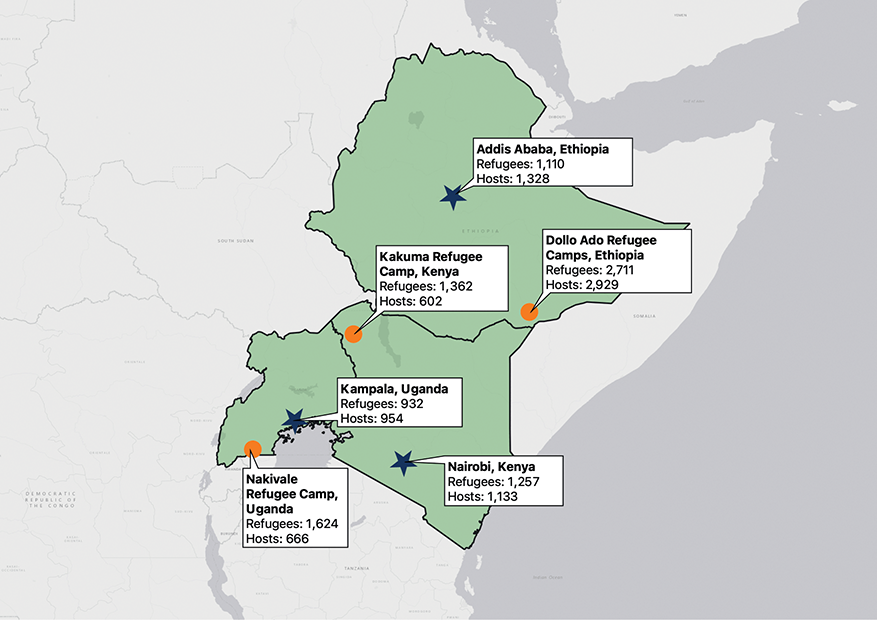
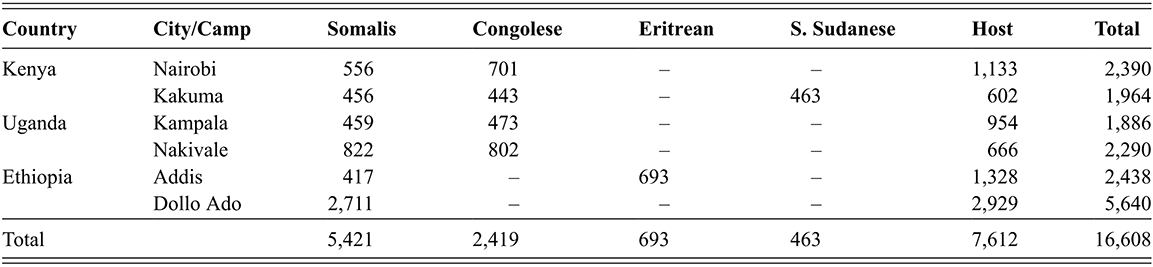
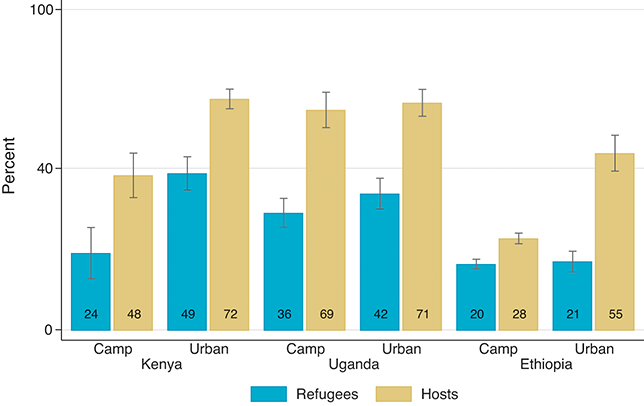
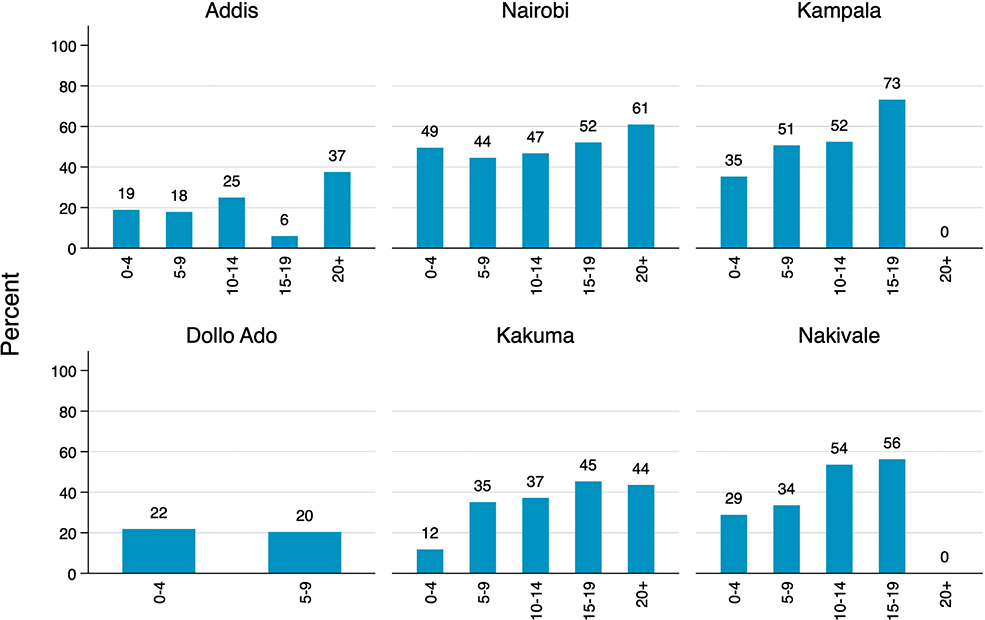
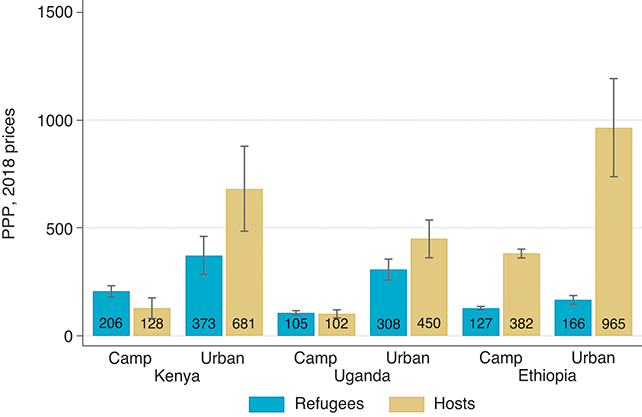
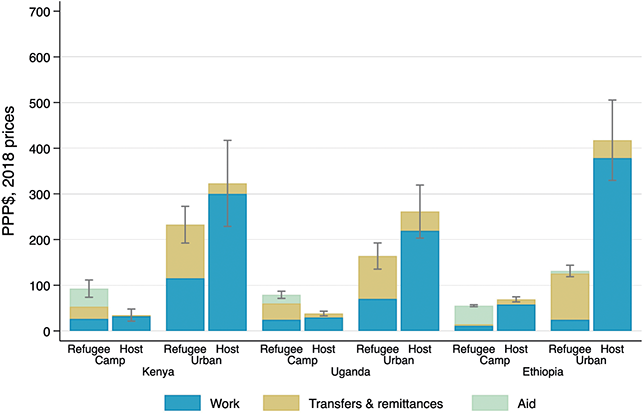
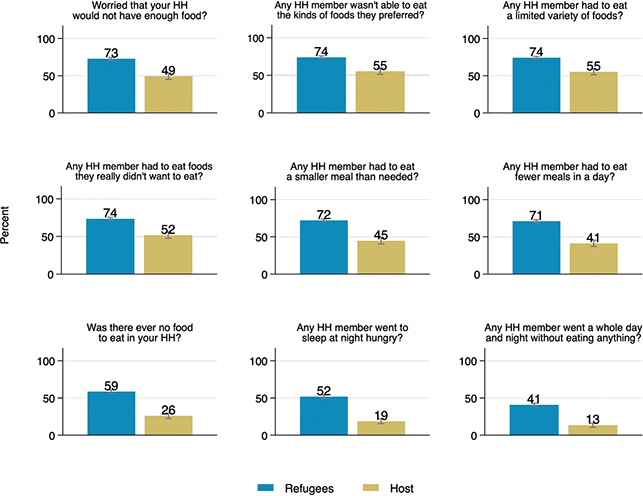
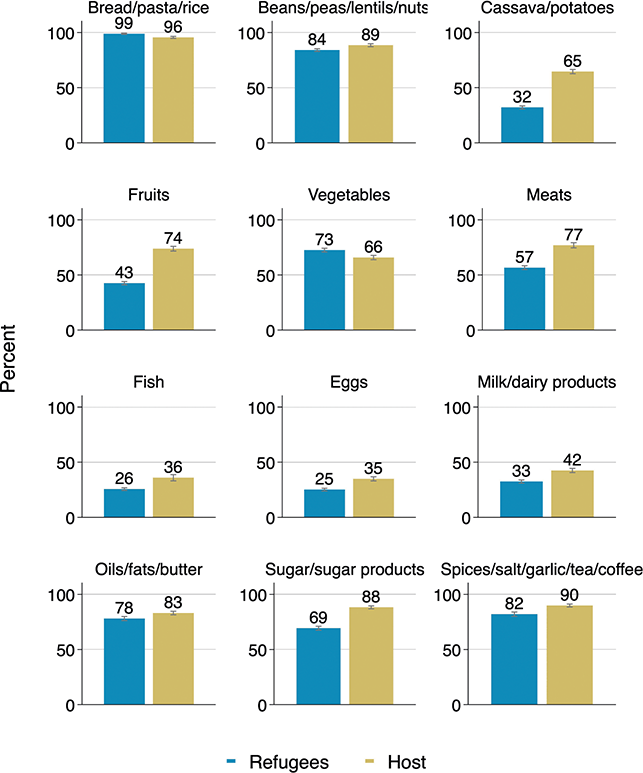
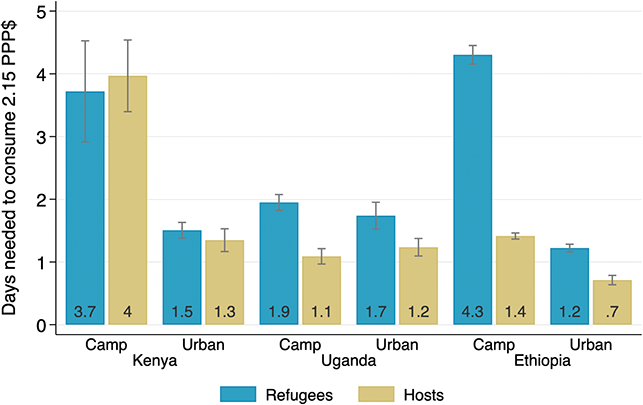
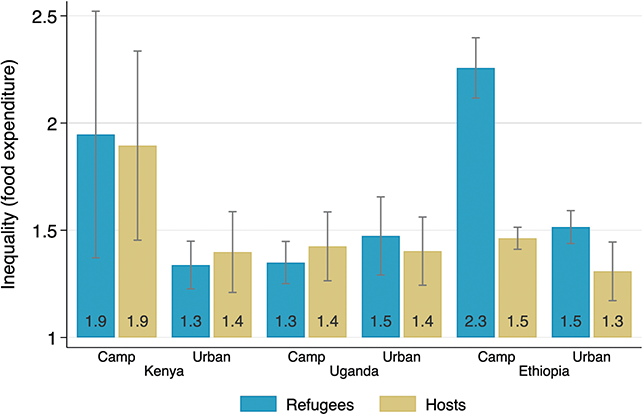
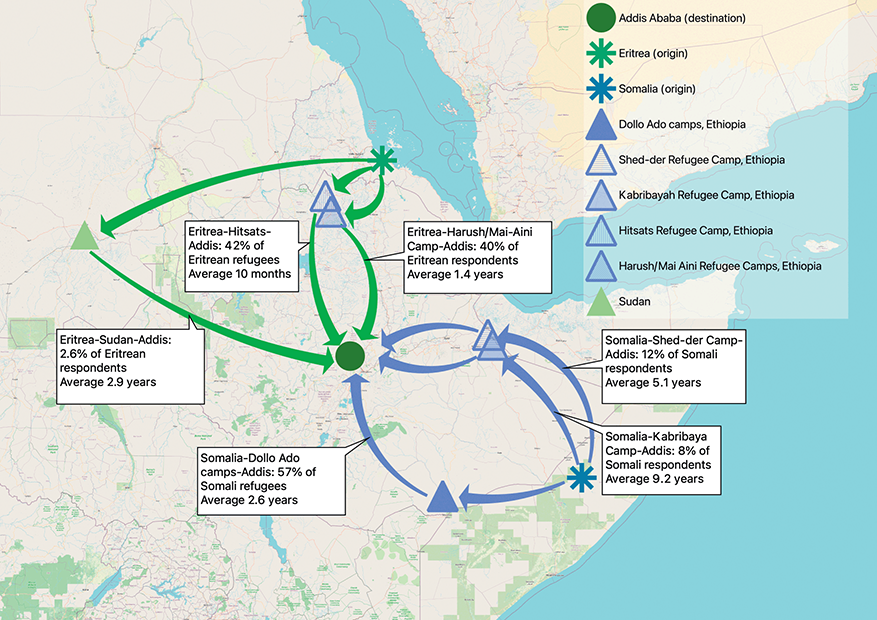
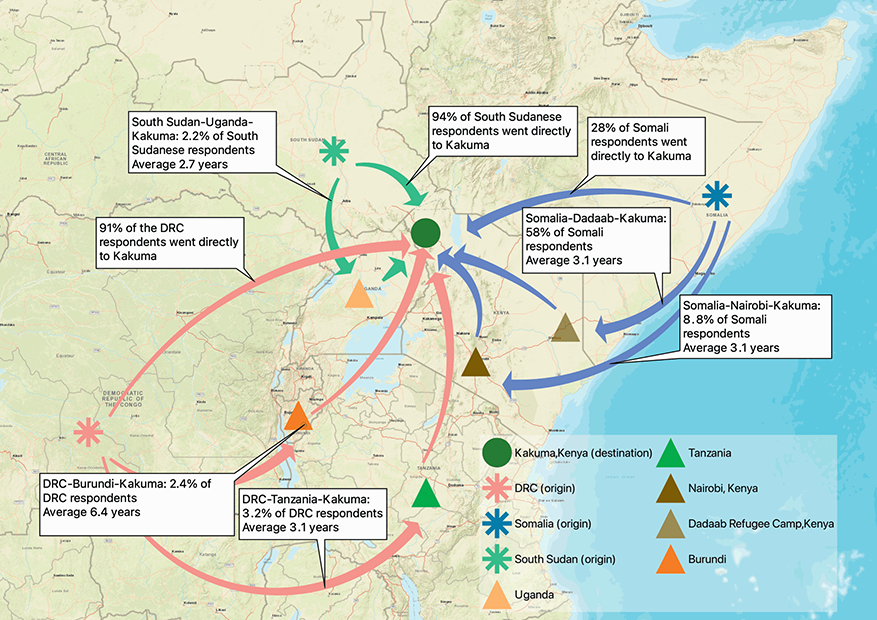
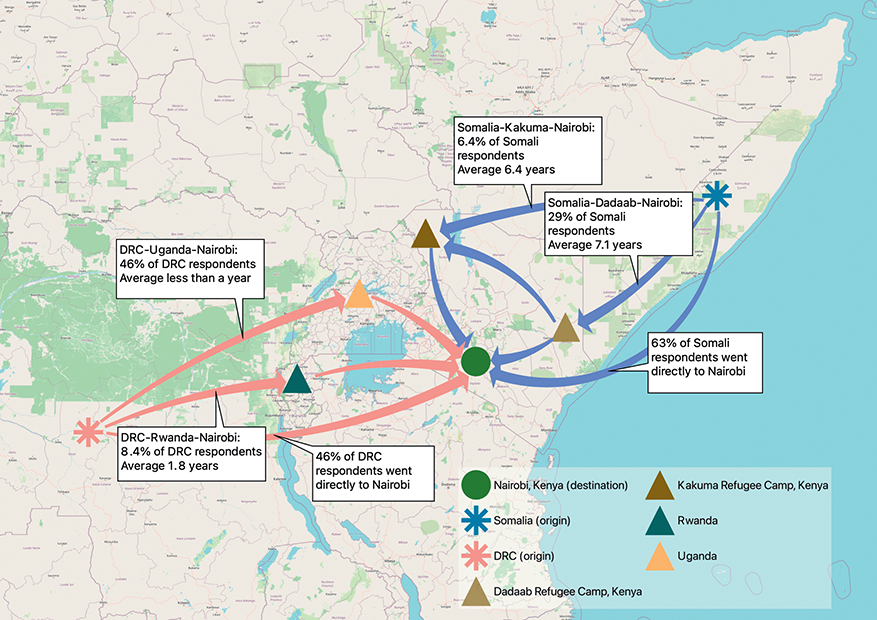
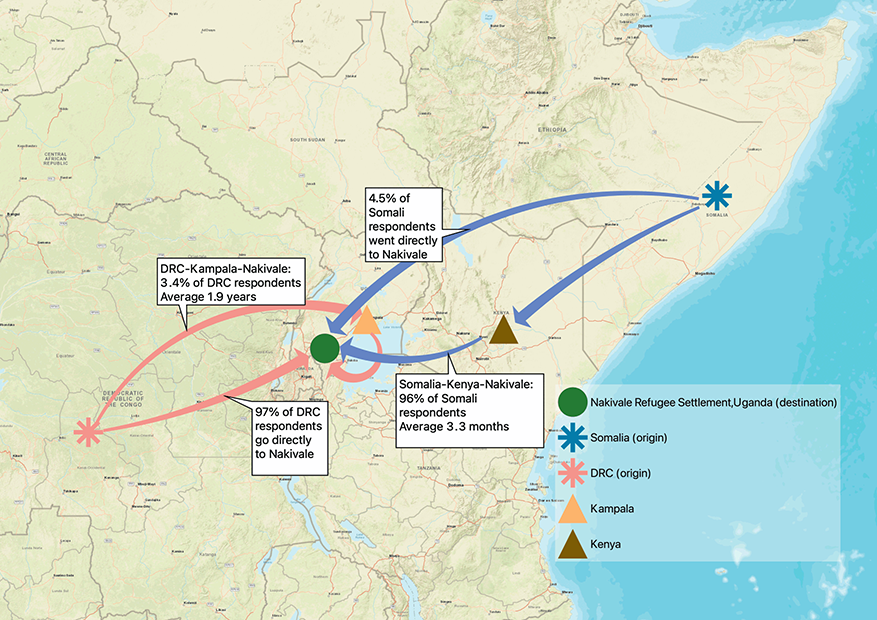
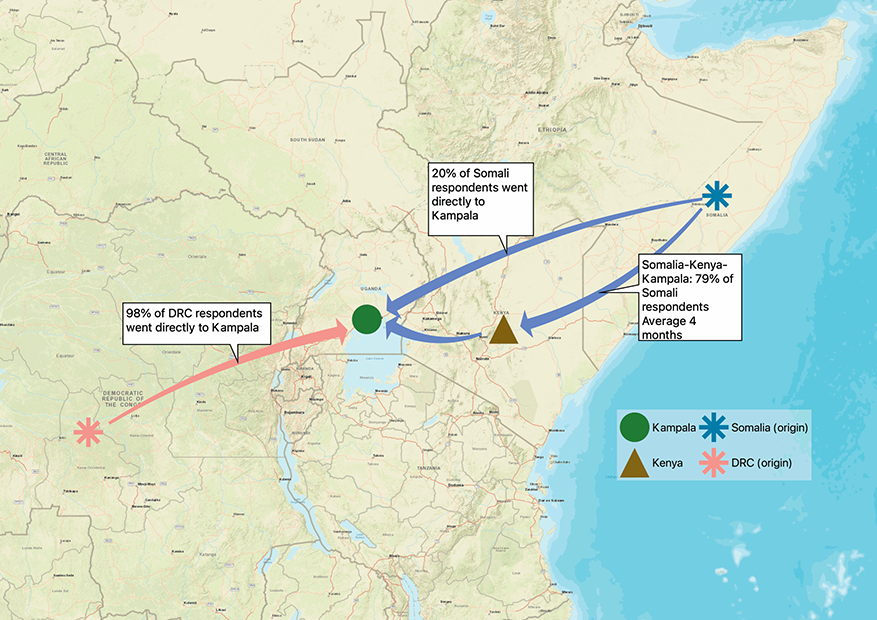
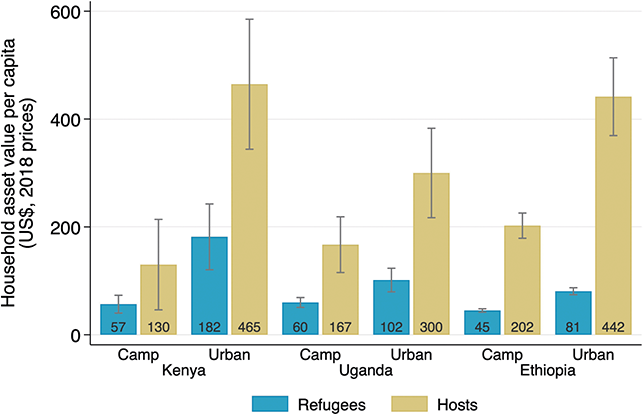
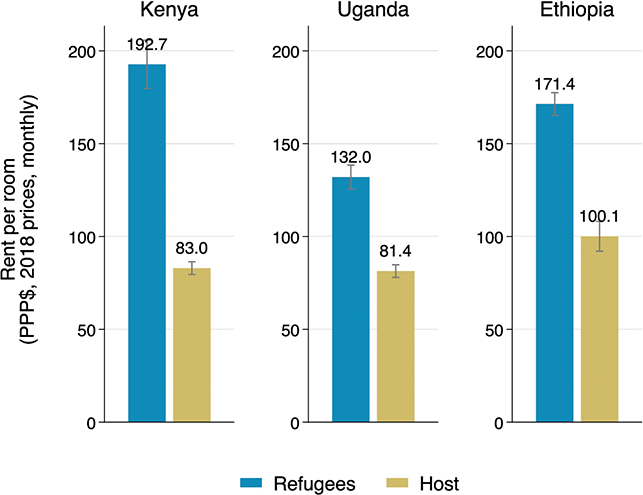
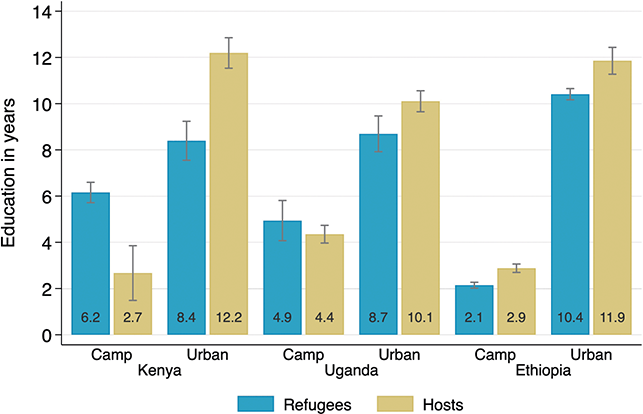
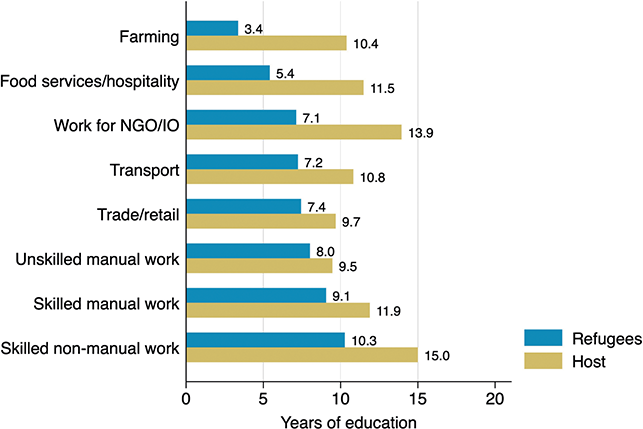
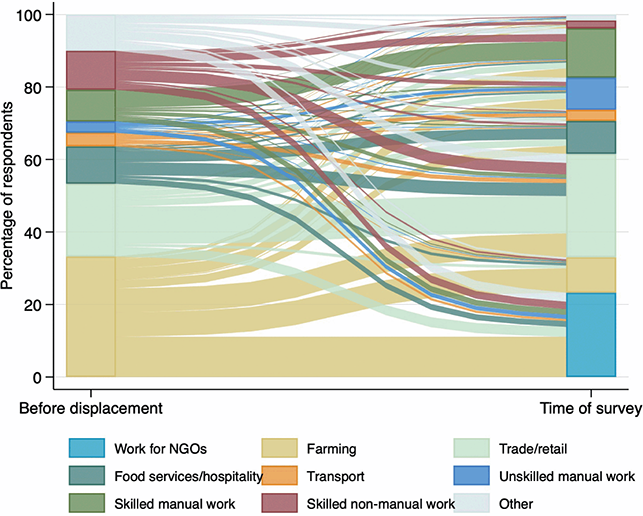
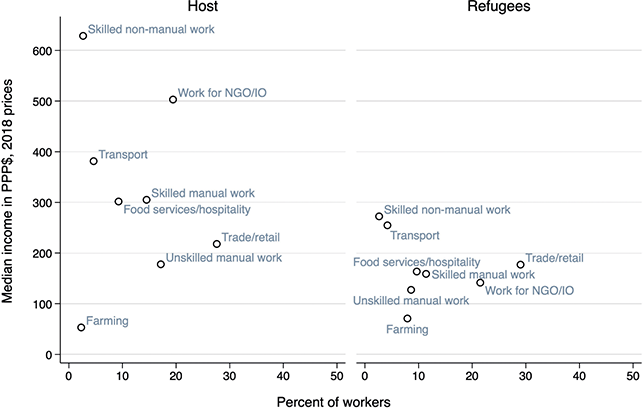
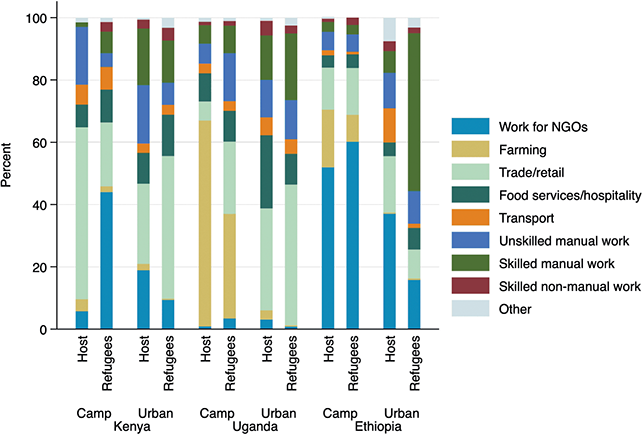
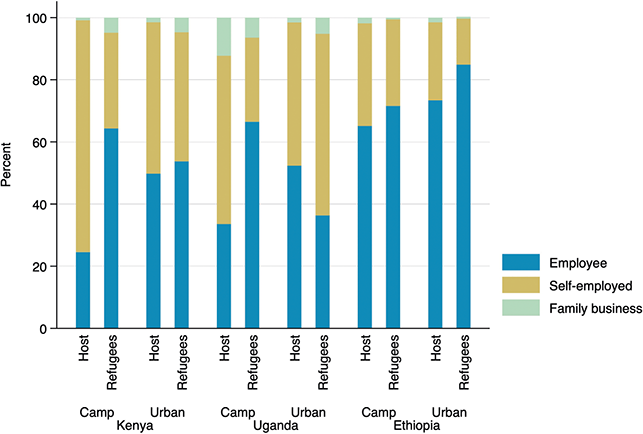
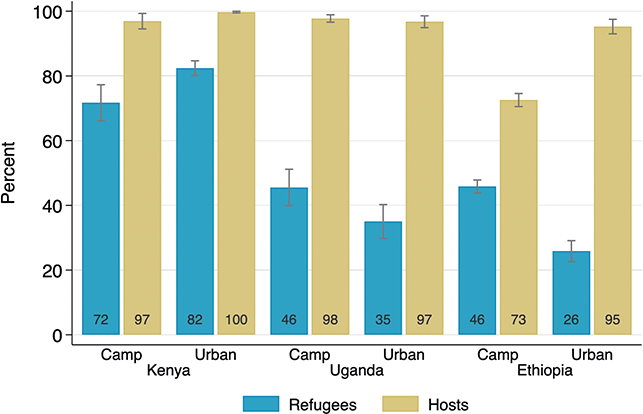
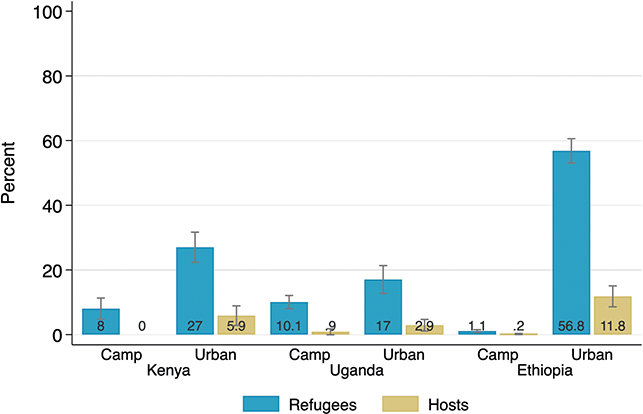
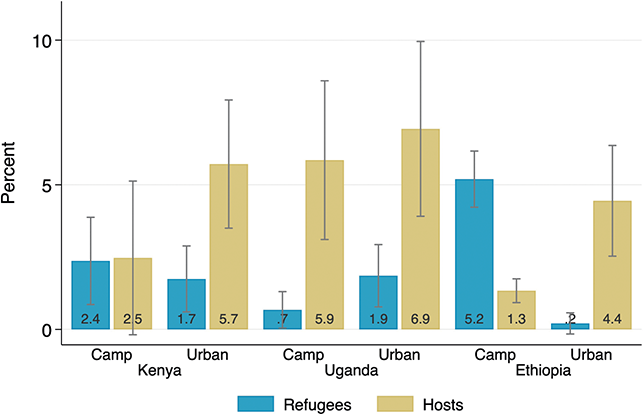
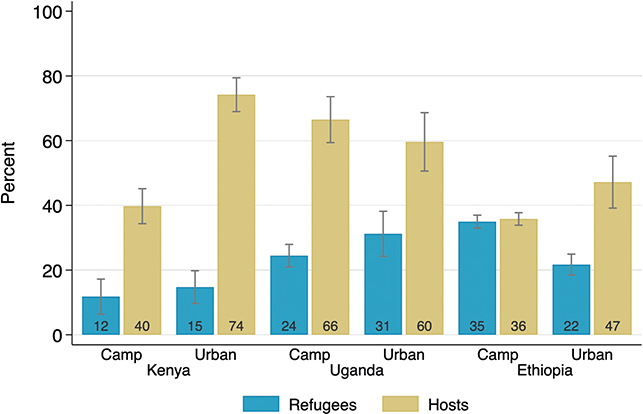
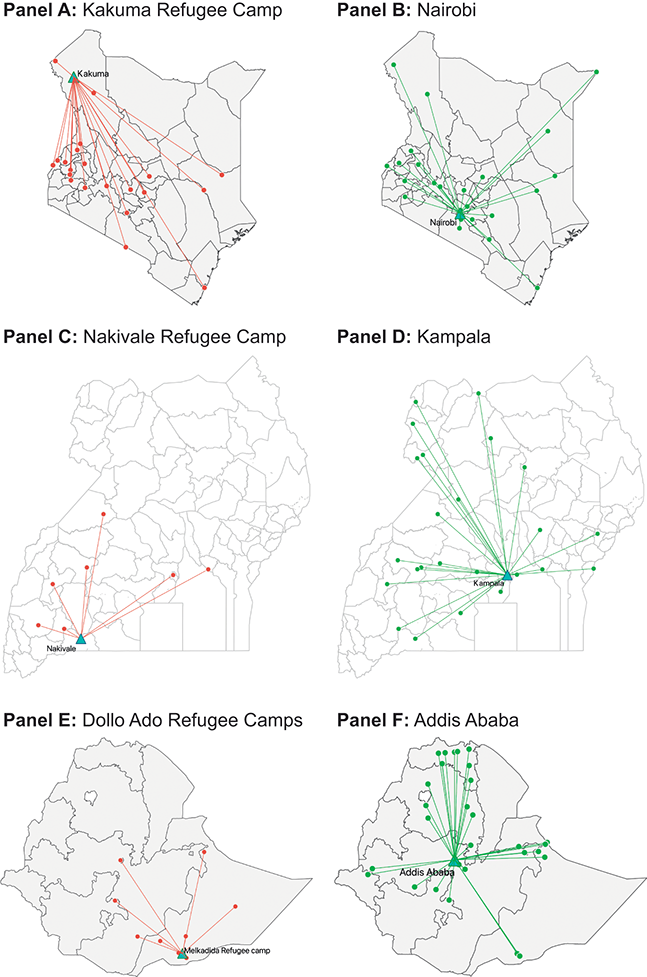
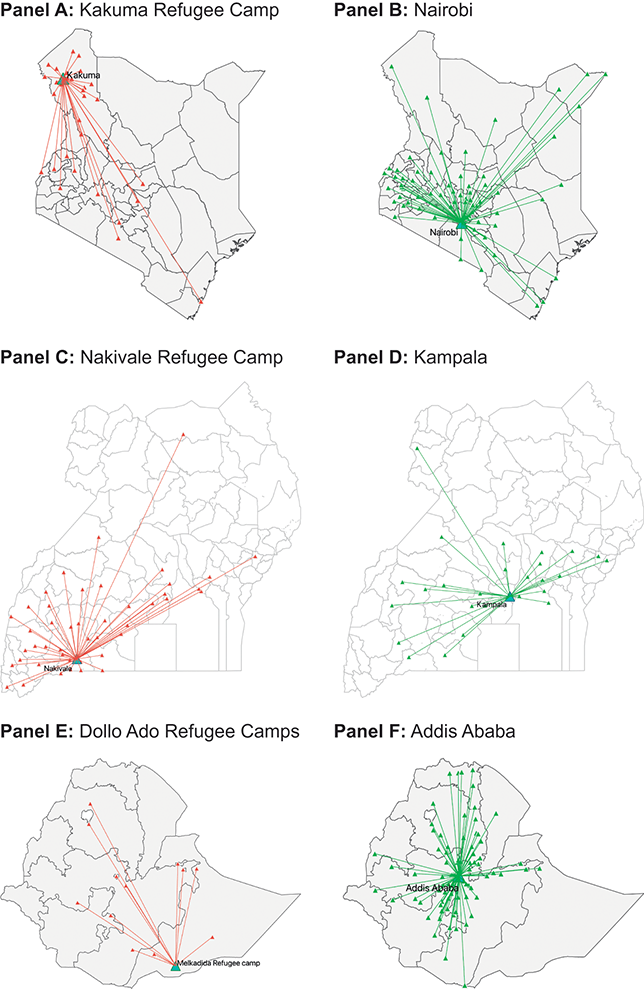

 Open access