Introduction
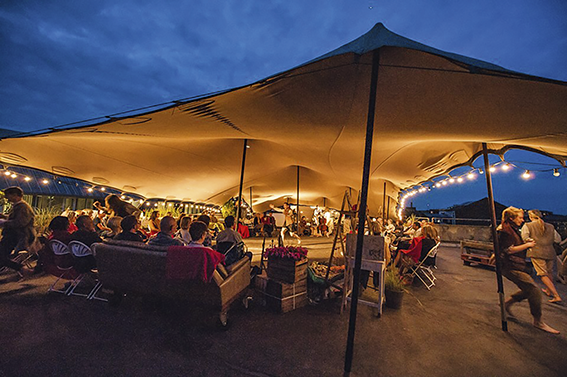
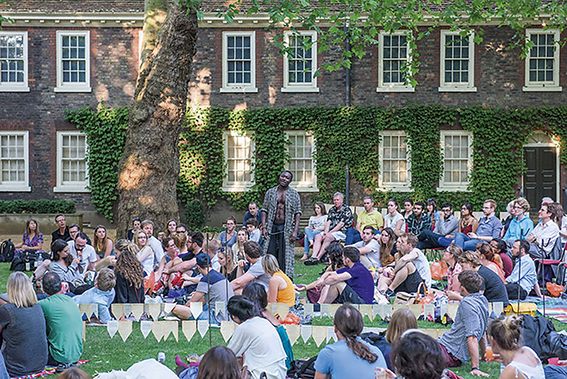
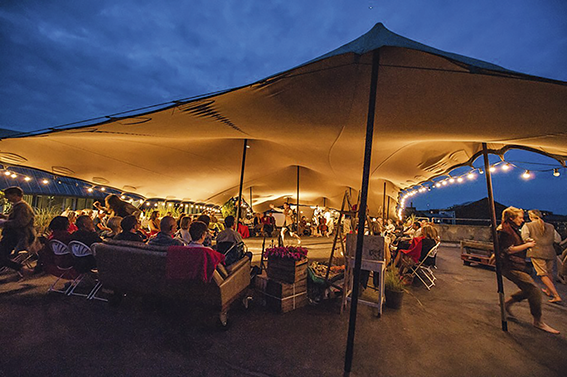
On the rooftop garden of a Shoreditch warehouse, a performance of A Midsummer Night’s Dream is in full swing. Staged beneath a large patio tent, the production features clips from Charles Kent’s 1909 silent film projected from below upon the canvas. The intervention weaves together centuries of the play’s performance history across different media. It also allows for judicious cutting of the text, adapted to meet the venue’s running-time requirements. During Act Five, audience members move from under the canvas to watch ‘Pyramus and Thisbe’ in the open air, where they are surrounded by the imposing skyscrapers of the City of London.
This Dream was staged by Malachite Theatre at Rockwell House, Shoreditch, in August 2014. Six months later, the warehouse and its rooftop garden were gone; torn down to make way for a forty-story tower block. The development that emerged in its place is called ‘The Stage’, and the name is purposely theatrical. Among its foundations lies the footprint of the Curtain – one of the early modern period’s longest-lasting playhouses, and a venue that almost certainly hosted performances of Shakespeare’s A Midsummer Night’s Dream by the Lord Chamberlain’s Men between 1597 and 1599.Footnote 1
The occupants of Rockwell House knew about the Curtain connection, of course. They also knew their building was soon to be razed. Its demolition was hastened, in part, by a commitment from developers to excavate and preserve the Curtain’s archaeology in a new ‘Museum of Shakespeare’. Despite the dark clouds looming over Rockwell House (a metaphor rendered literal by the fierce summer storms that rolled across east London, usually during Acts 2 and 3 of Dream), they invited The Malachites, a Shoreditch-based theatre company, to stage the play during their final weeks, commemorating the same connection with early modern performance that sealed the building’s destruction.
There was a prevailing sense of impermanence around several aspects of this production, something I was keen to emphasise in my role as the play’s director. The Malachites had staged an immersive ‘birthday party’ for Shakespeare at Rockwell House on 23rd April. This production was a last-minute booking arising from that first collaboration. By the time performance dates had been negotiated and marketing produced, the company had a total of nine afternoons to rehearse the play in a living room at 10 Hoxton Square, whilst the same actors staged Richard II at Shoreditch Church in the evenings.Footnote 2
Those days were as fulfilling as they were evanescent. Here was a group of players operating on a shoestring budget, rehearsing Shakespeare by day and performing by night, staging theatre above the ruins of an early modern playhouse and over the bones of Shakespeare’s players, all in celebration of the playwright’s 450th birthday. This network of beginnings and endings, of vulnerability and resilience, of opportunity and finality, spoke to qualities of the Dream itself – a joyous but fleeting foray into the forest before the realities of city life return at dawn (Figure 1).
A Midsummer Night’s Dream by Malachite Theatre, at Rockwell House, Shoreditch (2014).
As you make your way through this Element, you will find something of the ‘quick and dirty’ in several accounts from theatre-makers producing site-specific Shakespeare today. This shared ethic is characterised variably in these pages as ‘Guerrilla Shakespeare’; ‘Bodega Shakespeare’; ‘Punk Shakespeare’; ‘Rough Shakespeare’; ‘Poor Shakespeare’; and even ‘Shakespeare from Below’, referring to sited-theatre made by artists working under extremely restrictive financial conditions, as temporary visitors in spaces they do not control. The result is a type of Shakespearean performance that is as unexpected and distinctive as it is irreplicable and impermanent.
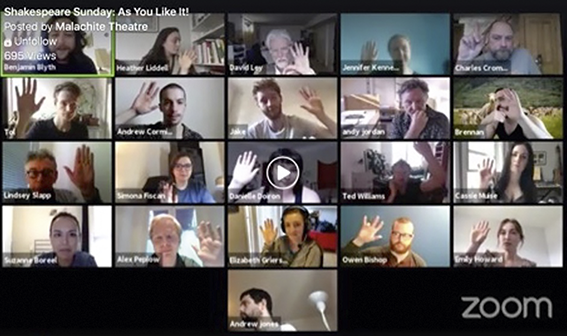
In a series of personal reflections, practitioner interviews, and company case studies, you will hear from theatre makers, artistic directors, actors, producers, and scholars working with a plurality of performance sites: from those with a particular connection to Shakespeare (like the former Rockwell House) to found spaces that speak distinctively to different texts, themes, and moments. You will encounter touring companies that shift their work to new sites, approaching site-specificity as a feature of process; companies working with the land, confronted by the challenges of colonisation and climate change; and you will hear from those who carried the torch when the world shut down, venturing into virtual spaces during the pandemic. The final section draws these threads together, reflecting on how these artists are struggling in increasingly restrictive post-COVID funding landscapes whilst striving to challenge increasingly entrenched social and theatrical establishments.
In the process, this Element examines the ways that site-specific Shakespeare companies generate something truly distinctive in the art form – whether consciously or not, their work reaches backwards as well as forwards. In her review of Malachite Theatre’s Midsummer Night’s Dream for Everything Theatre, Hana Gilbert connects our aesthetic choices with aspects of the play’s performance heritage:
Soft lighting surrounds the performance space … All sound effects and music are played live by the cast, in full view of the audience. This combination of elements makes for a lively atmosphere, and the music felt like a befitting acknowledgement of the play’s Elizabethan roots.
For Gilbert, live music and shared lighting evoke connections with an imagined ‘Elizabethan’ past. These appear as layers in the visible palimpsest of contemporary performance, at a site with a known connection to Shakespeare.Footnote 3 Throughout this Element, theatre practitioners are (almost unanimously) resistant to claims of ‘authenticity’. They do identify both synchronic and diachronic features of staging site-specific Shakespeare, however, creating contemporary theatre that both speaks to us now and reaches through time. This dynamic interplay between event and site is what first attracted me to directing Shakespeare, where theatrical meaning arises from both the dramatic poetry and layered histories of space and place.
Reflecting on the art form after a decade of site-specific practice, this Element asks: how do practitioners navigate the challenges and opportunities of staging site-specific Shakespeare in the twenty-first century? In so doing, this study explores how Shakespeare’s plays engage with a plurality of sites worldwide and examines the effects of unconventional spaces on early modern drama. Finally, it looks ahead to how site-specific performance is adapting to the complex challenges we face today, while forging remarkable connections between Shakespeare’s works and our contemporary moment across a range of physical and digital sites.
‘Site-Specific’ Shakespeare
Whilst site-specific theatre itself dates back to ancient Greece, the term began to be theorised with in the 1980s. Companies around the world, from Brith Gof in Wales and TheatreWorks in Australia, began staging theatre in spaces like abandoned factories and moving streetcars, creating distinctive experiences tailored to engage local audiences. The term ‘site-specific’ entered scholarly discourse at this time as a means to group these international experiments in site-based performance.
In the 1990s, theatre director Cliff McLucas proposed a foundational metaphor for site-specific theatre, distinguishing between the ‘host’ (the site) and the ‘ghost’ (the work): ‘with the performance, the ghost, haunting the site, the host, for a period of time’ (in Kaye, Reference Kaye1996: 220). McLucas viewed these two features as coming from different places, making them ‘co-existent but crucially are not congruent’ in performance. Nick Kaye extended this metaphor in 2000, adding a third party: ‘the Witness, i.e., the audience’. Together with the ‘host’ and the ‘ghost’, Kaye argues, this created ‘a kind of a Trinity that constitutes the Work’ (Kaye, Reference Kaye2000: xi), work that generated theatrical meaning through a temporary coming together of performance and site.
When experiments in site-specific theatre diversified in the 1990s, scholars attempted to wrangle fragmenting types of performance into one consistent working definition. At the time, much of the critical conversation focused on how sites functioned as a form of resistance to established hierarchies and structures. In his influential definition, Patrice Pavis conceived of site-specific performance as:
a staging … conceived on the basis of a place in the real world (ergo outside an established theatre). A large part of the work has to do with researching a place, often an unusual one that is imbued with history or permeated with atmosphere: an aeroplane hangar, unused factory, city neighbourhood, house or apartment. The insertion of a classical or modern text in this found space throws new light on it, gives it an unsuspected power and places the audience at an entirely different relationship to the text, the place and the purpose for being there.
Rather than the type of ‘non-congruent coexistence’ proposed by McLucas, Pavis saw site-specific performance as an ‘insertion’ of text into the site. Definitional fissures began to emerge between work that adapted existing texts to specific sites (such as Brith Gof’s 1988 production of the Old Welsh poem Goddodin) and work that generated new performances arising from the sites themselves (such as TheatreWorks’ 1982 production of Storming Mont Albert by Tram).
In an attempt to address this fissure, scholars in the early 2000s sought instead to codify differences, producing a taxonomy of site-specific practice that drew attention to the types of specificity it produced. On one hand, the research collective Wrights & Sites argued that ‘the experience of site-specific performance work is so varied and expansive that no clear definition or methodology of such practice seems possible’. With the other hand, however, they were working up a detailed terminological framework that did just that, compartmentalising site-specific theatre into:
Outside theatre: e.g. Shakespeare in the Park, Site sympathetic theatre: e.g. Existing performance text physicalized in a selected site, Site Generic Theatre: e.g. performance generated for a series of like sites – car parks, swimming pools – and Site-specific theatre: e.g. performance specifically generated from/for one selected site where layers of the site are revealed through reference to: historical documentation, site usage (past and present), found text, objects, actions, sounds, etc., anecdotal guidance, personal association, half-truths and lies, site morphology (physical and vocal explorations of site).
These distinctions were advanced by Fiona Wilkie in her influential Reference Wilkie2002 survey of site-specific performance. Wilkie observed that ‘for many site-specific companies the move away from a traditional theatre space is an explicitly political one’, citing companies like Lone Twin whose reasoning was ‘to engender ideas of place and community’ (Wilkie, Reference Wilkie2002: 144). Whilst advancing Wrights & Sites codification of site-sympathetic/site-generic work, Wilkie also notes ‘a tendency to treat site-specific theatre … as a means of moving away from the strict codes of the traditional theatre and encouraging creative freedom’ (Wilkie, Reference Wilkie2002: 249), approaching the term ‘site’ (as Nick Kaye does) as one contingent on the role of the audience.
Concurrent with Wilkie’s research into types of specificity, scholars in the early 2000s began to reevaluate the utility of the term ‘site’. This gathered momentum in 2001 following the publication of Pearson and Shanks’ field-defining book Theatre/Archaeology, which sought to connect:
performance art and archaeology through shared interests: forms of (re)collection – the gatherings of memory practices; and site and locale – treated as multitemporal articulations, where different events and times endure and come together in the material forms of inhabited places.
Cathy Turner argues this approach positioned ‘archaeology as performative (an enactment of the past in the present) and site-specific performance is viewed as an archaeological investigation of place’ (Turner, Reference Turner2004: 376). Here, Pearson and Shanks argue site-specific performances are ‘conceived for, mounted within and conditioned by the particulars of found spaces’ and ‘rely, for their conception and their interpretation, upon the coexistence, superimposition and interpenetration of a number of narratives and architectures’ (Pearson and Shanks, Reference Pearson and Shanks2001: 23). To Pearson and Shanks, the relationship between text and space is reciprocal in site-specific theatre, a position that attains new layers of meaning when those points of connection are explicitly historical.
In the archaeological turn that followed, scholars began to conceive of theatrical spaces themselves as palimpsests in site-specific performance. As Turner notes, this involves an understanding that sites contain ‘traces of what has happened there before, layers of history and meaning’ (Turner, Reference Turner2004: 373). Approaching performance sites in this way has significant implications for staging historically distant material, including Shakespeare. In his influential Reference Pearson2010 book Site-Specific Performance, Mike Pearson elucidates these negotiations between text and site, arguing that site-specific work ‘challenge[s] … the notion that the auditorium is a neutral venue of representation’ (Pearson, Reference Pearson2010: 94). Pearson describes this work as engaging with the ‘imbued history’ (Pearson, Reference Pearson2010: 95) of individual performance spaces – a framework that proves equally applicable to reconstructed early modern playhouses, abandoned asylums, military bases, public parks, and virtual platforms that emerged as theatre spaces during the pandemic.
It is through this prism of the site-as-palimpsest that scholars in Shakespeare studies took hold of the term ‘site-specific’ in the 2010s. Bridget Escolme argues that ‘Shakespeare’s plays were written with the knowledge of the site for which they would be performed’ (Escolme, Reference Escolme2012: 507), a position that develops an earlier argument posited by Tiffany Stern that early modern playhouses contained a ‘thematic geography’ that allowed Shakespeare to begin ‘wrapping playhouse features into his fictional world, [and] sometimes wrapping his fictions around their features’ (Stern, Reference Stern2004: 32). Sarah Dustagheer’s research into Shakespeare at the Globe and Blackfriars reads early modern performance ‘sites’ as aggregations of their own layered histories in which ‘past uses of the theatre site come to affect plays performed there in the early modern period’ (Dustagheer, Reference Dustagheer2018: 4). This scholarship has enriched our understanding of how Shakespeare’s plays negotiated specific architectural conditions in the sixteenth and seventeenth centuries, encouraging an exciting and ongoing turn towards playhouse-studies.Footnote 4
The application of site-specific theory to Shakespeare has not been without friction, however. As Sally Barnden notes, strict definitions of site-specificity ‘would exclude performances of early modern drama on the grounds that they involve a pre-existing text’ (Barnden, Reference Barnden2017: 207). Escolme similarly argues that taxonomies like Wilkie’s ‘essentialize both text and site in a series of one-way relationships: performance text is physicalized; site is selected. The meaning of neither is radically changed by the practice’ (Escolme, Reference Escolme2012: 508). These critiques target the taxonomic impulse of the early 2000s – delineating between site-specific as ‘performance specifically generated from/for one selected site’ and site-sympathetic as ‘existing performance text physicalized in a selected site’ (Wilkie, Reference Wilkie2002: 150) – as exclusory when applied to Shakespeare performance, whether early modern or contemporary.
This prevailing view that ‘site-specific’ theatre is a series of ‘one-way’ relationships between performance and site has, ultimately, reinscribed the uncomfortable hierarchy that sited-based theatre sought to challenge. In his influential Reference Field2008 article for The Guardian, Andy Field asks, ‘Site-specific theatre? Please be more specific’, suggesting that ‘as site-specific theatre grows ever more bloated, its original meaning becomes fainter and more diluted’ (Field, Reference Field2008). To Field, ‘authentic’ or ‘original’ site-specific theatre refers (counterintuitively) to both the work of BrithGof and the definitions of Wrights & Sites – definitions derived from a time ‘before newspapers got hold of the term’ and it began ‘slipping inevitably towards something an awful lot more vague’. As local and amateur theatre companies started experimenting with sited-theatre, so resistance grew against the use of the term in ‘bloated’ popular contexts. In this way, Field’s article could perhaps be titled: ‘site-specific theatre? Please be more exclusive’.
Over the last ten years, attitudes like Field’s – derived from a desire to ‘nail down’, compartmentalise, restrict, and, ultimately, control popular experiments in site-specific performance – have had the unfortunate effect of doing just that. Despite the term ‘site-specific’ appearing in company mission statements around the world, many of the practitioners interviewed in this Element were wary that their engagement with ‘sites’ was (at best) ‘not specific enough’, and (at worst) somehow ‘deficient’, ‘old-fashioned’, or ‘bad’. I was once told that my work was categorically not site-specific because Shakespeare did not write for churches. This empirical motive to isolate and restrict an art form by what it is not, rather than listen to what it is saying, has had a regrettable and lasting impact on those making (and those awarding funding to) site-specific theatre.Footnote 5
Furthermore, this impulse to taxonomise site-specific work has led scholars and practitioners down a conceptual rabbit hole. A dead-end that is predicated upon a fundamental refusal to acknowledge the ways in which texts and sites (or ghosts and hosts) speak to each other. Whilst previous site-specific theory positions text and site in a series of static relationships, site-specific Shakespeare engages simultaneously with what a text contains (its literary, linguistic, and dramaturgical features) and what it activates (in performance at specific sites). This reciprocal engagement – between textual aesthetics and performance utility – reveals that Shakespeare’s plays contain dramaturgical features enabling adaptation to multiple, unpredictable performance contexts. Written for companies that moved between guild halls, great houses, and inn yards, the plays’ spatial openness becomes an enabling condition that practitioners activate through tactical intelligence.Footnote 6
In this Element, I reposition the term ‘site’ as an active collaborator with spatial dramaturgies embedded in Shakespeare’s plays. Rather than proposing quantifiable features of specificity, this Element considers qualitative examples of how modern theatre companies discover and activate Shakespeare’s plays in dialogue with their performance sites (organising these examples by the types of spatial challenges practitioners face, rather than by the degrees of ‘authenticity’ they achieve). Site-specific Shakespeare, as this Element understands it, encompasses any performance practice in which Shakespeare’s embedded spatial intelligence and the distinctive qualities of a performance site enter into active, reciprocal dialogue. Forged in the heat of these collisions between text and place, this work generates living encounters that resonate across time without ever being bound by it.
This approach builds on a wave of recent scholarship that has expanded our understanding of site-specific Shakespeare beyond reconstructed playhouses and into the diverse ecology of contemporary practice. Martin Orkin’s important work on ‘Local Shakespeares’ examines how ‘proximations’ and power shape meaning-making in performances rooted in specific communities (Orkin, Reference Orkin2005). William Floyd Wolfgang’s research on ‘Grassroots Shakespeare’ documents amateur performance traditions, privileging geographical embeddedness and love for Shakespeare’s plays over institutional authority (Wolfgang, Reference Wolfgang2021). Katherine Steele Brokaw’s recent book, Shakespeare as Community Practice, illuminates how site-specific work operates outside institutional frameworks, building connections between texts and the communities that gather around them (Brokaw, Reference Brokaw2023). This new, community-centred research reveals that site-specific Shakespeare encompasses a field of practice in which local adaptation, community engagement, and spatial negotiation converge – an ecology this Element maps through the testimony of those doing the work.
Representatives from twenty companies are profiled in this Element. These accounts chart the experiences of artists, scholars, and producers engaged in a wide variety of sited practices today. As in this Introduction, my own work as a theatre director appears alongside the testimonies of other practitioners. The personal reflections that open each section chart similar conditions of constraint, adaptation, and responsive creativity that frame several of the companies examined here. By positioning my work in discourse with this broader survey of contemporary practice I write both from and about site-specific Shakespeare.
The selection process for interviews was shaped by both scholarly rigour and practical contingency – a combination that reflects the tactical operations that recur throughout this study. I began by identifying theatre companies whose work engaged distinctive types of performance sites, privileging those that featured the term ‘site-specific’ in their mission statements. At the same time, I deliberately sought geographical diversity and a range of organisational scales among these accounts. From this initial survey, the final selection was determined by a more contingent factor: whoever answered my calls and emails. The companies that did respond were precisely those for whom the term ‘Site-Specific Shakespeare’ sparked particular meaning or relevance. The generosity and willingness to share working methods, financial circumstances and artistic philosophies produced the rich testimonies documented in this study, and I am enormously grateful for their honesty, openness, time, and expertise. The voices gathered here are from predominantly Anglophone theatrical cultures, and the framework of tactical intelligence awaits testing in non-Anglophone Shakespeare traditions.
The companies that appear in this Element represent a diversity in scale, geography, and approach. At one end of the spectrum, Shakespeare’s Globe and the American Shakespeare Center are large, purpose-built reconstructions of early modern playhouses with professional companies and substantial turnovers. At the other, The HandleBards tour on bicycles carrying minimal props, whilst Shakespeare BASH’D began in Toronto bars with a mandate to produce Shakespeare ‘as cheaply as possible’. Between these extremes, companies across Canada, Australia, the United Kingdom, and the United States have developed distinctive relationships with outdoor, found, and heritage sites – from Come You Spirits performing at the Esperance Stonehenge, to the Drilling Company staging free Shakespeare in New York parking lots. During the pandemic, several companies carried their site-specific practice into viral platforms, discovering new possibilities for community formation in corporate software never designed for theatre.
The sections that follow examine site-specific Shakespeare across five types of ‘site’ – Revenant, Found, Shifting, Green, and Viral – before the conclusion considers the shared challenges facing post-pandemic practice. Encountering site-specific performance at its most ‘bloated’, these categories are heuristic rather than hermetic. Consequently, several companies profiled here could productively appear across multiple sections. Shakespeare in the Ruins, for instance, performs in the historic architecture of a former convent – a ‘found site’ with institutional memory – whilst simultaneously engaging the ‘green’ qualities of outdoor, environmentally exposed performance. The Container Globe’s mobility could position it among ‘shifting sites’ as readily as ‘revenant’ ones, whilst the HandleBards’ commitment to low-carbon touring connects their ‘shifting’ practice to the ecological imperatives of ‘green’ performance. These productive tensions illuminate rather than undermine the framework, further illustrating how the diversity of site-specific Shakespeare resists taxonomies that seek to refine it. These companies demonstate shared negotiations with particular types of spatial challenge – whether that challenge is memorial authority, institutional control, geographic mobility, environmental exposure, or digital mediation.
In doing so, this Element traces site-specific practitioners who turn economic precarity into creative freedom, transform spatial constraints into dramaturgical opportunities, and convert institutional exclusion into democratic accessibility. In navigating these challenges, what emerges is a future-facing practice – a ‘Guerrilla Shakespeare’ that operates beyond institutional walls, bringing Shakespeare to communities and spaces that rarely encounter live performance.
1 Revenant Sites
A spectre is always a revenant … it begins by coming back.
I often say … we’re going back to the future
Rose Playhouse, Bankside
It is the opening night of a new production of Macbeth at the Rose Playhouse, Bankside. As first nights go, this one will live long in the memory. The actor playing Macbeth has called in sick, and (of course) there is no understudy. One trade secret about directing Shakespeare is that, after three weeks of rehearsal, you tend to learn most of the lines. Fortune’s fickle wheel has turned, and as a gaggle of London’s theatre critics congregate in the lobby, I am sheepishly pulling on a chainmail hat.
Perhaps Malachite Theatre was tempting fate by staging the ‘Scottish play’ on the site of Bankside’s oldest playhouse in the first place. Whilst Macbeth’s early modern curse may endure, the Rose itself looks very different today. After an exploratory excavation in 1989, the playhouse’s wooden foundations were reburied in Thames mud, then covered with a concrete shell. This, in turn, was submerged with water, its acidity controlled by a pH monitoring system. A viewing platform runs along the eastern corner of the site, which is enclosed in a hollowed-out shell beneath an office block housing the Crown Prosecution Service. Were it not for the information boards detailing the Rose’s connection to early modern performance and some red strip lights denoting the playhouse outline, the audience could be forgiven for thinking they were watching a play beside a sunken lake in a concrete cave.
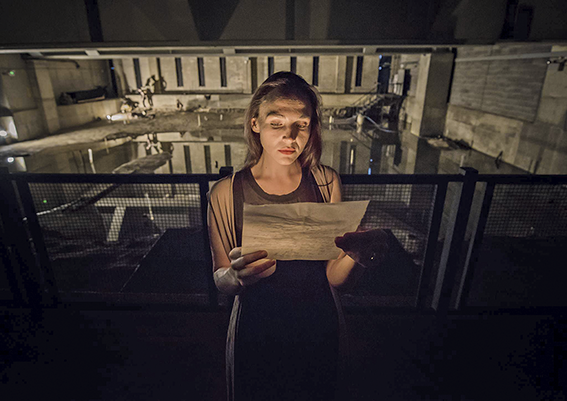
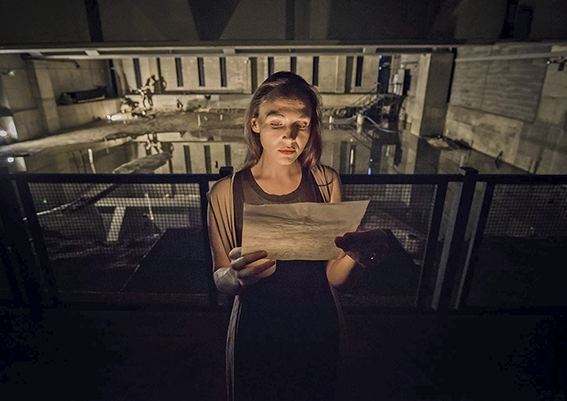
Theatre makers must navigate this complex visible palimpsest at the Rose. These tensions between memory and innovation exemplify what Elizabeth Tavares identifies as the site’s ‘hauntological resonances’ and ‘murder corners’ – spaces that accumulate meaning through dramatic repetition (Reference Tavares2023: 78). The Rose’s split-level architecture offered unexpected dramaturgical possibilities for our Macbeth. Scenes staged ‘above’ (on the viewing platform) operated in something approaching ‘real time’, whilst those ‘below’ (around the edges of the flooded timbers) drew out the play’s themes of magic and fate. The witches appeared exclusively on the archaeological side of the space, their constant presence rendering the haunted quality of both the play and the site tangible. This staging created what Sally Barnden terms ‘temporal thickness’ – ‘the layering of past, present and future as one experience’ (Reference Barnden2017: 215) – as multiple temporal registers operated simultaneously: Macbeth’s fictional past, the early modern playhouse’s historical past, and the contemporary performance’s present (Figure 2).
Orla Jackson as Lady Macbeth at the Rose Playhouse, Bankside (2015).
The Rose certainly felt haunted on opening night. Unseasonal weather had added some extra-textual bite to the loose setting of ‘Medieval Scotland’, as our audience of fifty or so huddled together to keep warm whilst a storm raged outside. To add further layers of metatheatrical verisimilitude, the heating had broken that afternoon, and our Stage Manager rushed out to fetch blankets for the audience. Each time a new audience member arrived, the Rose’s doors swung open, and the unfortunate souls in the lobby were soaked anew. If there were any horses within twenty miles, the odds are they did turn and eat each other.
The next morning brought surprisingly generous reviews and a new government. It was the day after the 2015 General Election. David Cameron secured a small majority, promising an in/out referendum on EU membership, and the SNP swept Scotland. For Ed Frankl in The Stage, the timing felt uncanny: ‘The stars sometimes align on press nights. For this Macbeth, it was the SNP’s victorious night in Scotland – “the earth was feverous and did shake,” or perhaps, “confusion now has made his masterpiece”’ (Frankl, Reference Frankl2015).
Nick Kaye conceives of site-specific performance as a type of haunting: ‘the host site is haunted for a time by a ghost that the theatre makers create’ (Reference Kaye1996: 220). On our storm-ravaged press night, this haunting reversed – the Rose became an active participant in the exchange. The last-minute rehearsal, press pressure, loss of heating, the impact of the storm, the general election, and perceptions of a ‘curse’ all layered a singular palimpsest on a site intrinsically connected to early modern performance. These types of confluence are one feature of what I term ‘revenant sites’: spaces haunted by Shakespearean theatre history yet inexorably alive with performance, generating renewed and innovative theatrical meanings through the dynamic interplay between past and present.
In this context, the term ‘revenant’ derives from Jacques Derrida’s concept of ‘hauntology’: the philosophical idea that the past exists as a spectral presence in contemporary experience, refusing to remain past. Derrida’s fascination with recursive stage directions in Hamlet – ‘Enter the Ghost, Exit the Ghost, Enter the Ghost, as before’ – further illustrates his argument that ‘a spectre is always a revenant. One cannot control its comings and goings because it begins by coming back’ (Reference Derrida1994: 11). This uncontrollability exemplifies one feature of revenant sites, setting them apart from static historical reconstructions or memorial preservation. Such sites disrupt predictability, producing surprising encounters between Shakespeare’s spatial dramaturgies and contemporary conditions that open new possibilities for theatrical rebellions.
In Old Hamlet’s Ghost, Derrida also sees a logic of ‘repetition and first time’ – each ghostly entrance is both familiar and unprecedented (Reference Derrida1994: 10). On opening night of Macbeth at the Rose, this temporal logic was made manifest: the playhouse’s association with early modern performance created a ritual ‘return’ of audiences expecting a theatrical encounter linked to Shakespearean history. The ‘first time’ arose in the unprecedented convergence of circumstances – illness, broken heating, storm, and election – producing singular conditions for this performance. The ‘last time’ stems from the irreplicable nature of live performance, making each ghostly return both inaugural and terminal.
Shakespeare is distinctive among subjects of site-specific theatre as centuries of scholarship have uncovered sites with historical connections to his life and work. From the Shakespeare Birthplace Trust and Royal Shakespeare Company in Stratford-upon-Avon, to Bankside sites like the Rose and reconstructed Globe; from newly excavated playhouses in East London to touring venues like St George’s Guildhall in King’s Lynn; from churches and residences to blue plaques and floor plans; the word ‘Shakespeare’ resonates across a variety of spaces, creating a vibrant network of historically connected sites that refuse a static memorialisation in favour of active re-encounters through live performance. In this sense, the Rose’s archaeological remains evidence a paradigm for a ‘revenant’ engagement with early modern theatrical spaces: performance that acknowledges the distance between past and present whilst refusing to let that distance become unbridgeable.
This section explores how site-specific practitioners harness Shakespeare’s spatial dramaturgies across a variety of ‘revenant sites’, which provide catalytic conditions for contemporary creativity. A distinguishing feature among these theatre makers is not rigid fidelity to historical ‘authority’ or precedent, but their commitment to fostering what Stephen Purcell calls ‘excess knowledge’ and ‘accidental discoveries’ (Reference Purcell2017: 439) – meanings that transcend the boundaries of ‘authenticity’. Each case that follows explores revenant engagement as a distinct mode of practice, in which architecture and memory fuel rather than constrain innovation. This underscores how contemporary practitioners continually reanimate ‘Shakespearean’ sites, crafting transformative theatrical experiences instead of attempting to reconstruct the past.
Shakespeare’s Globe
In 1989, the Rose excavations revealed unprecedented physical evidence of early modern playhouse structures and inspired a generation of theatre reconstructions. They also created a problem for Sam Wanamaker, who was fundraising for a nearby reconstruction of the Globe. Barry Day reflects that the Rose excavations gave rise to the ‘paradigm of “Shakespeare’s Rose v. Wanamaker’s Globe” … Who wouldn’t prefer the real thing, inaccessible as it may be to a replica?’ (Day, Reference Day2019). As Day recognises, the Rose remains provided tangible evidence that any prospective modern reconstruction could not match. As revenant sites with historical connections to Shakespeare performance (one through archaeology and the other through architecture), both the Rose and Shakespeare’s Globe began a Derridian ‘return’ in the 1990s, albeit from different starting points and charting different courses.
Shakespeare’s Globe opened to the public in 1997 as a ‘best guess’ reconstruction of the 1599 playhouse. It was designed by architect Paul McCurdy and constructed using traditional methods and materials. The auditorium is open-air, with much of the audience standing, and sharing light with the actors. In its early years, the project was regularly framed as an ‘experiment’. Andrew Gurr, chief academic advisor to the Globe, conceived of the new playhouse as ‘no more than a test-tube, the basis for experiments aimed at getting a better idea of how Shakespeare expected his plays to be staged’ (Reference Gurr, Mulryne and Shewing1997: 159). In Staging Shakespeare at the New Globe, Pauline Kiernan suggests performance experiments produced ‘experiential evidence’, and the ‘playing the Globe space is able to produce research findings about original staging’ (Reference Kiernan1999: 123). Scholarly passions continue to run high around competing claims of ‘authority’ and ‘originality’ at the Globe. Julian Bowsher reflected on the playhouse’s limitations in 2009, observing that ‘the Wanamaker Globe is … an academic product of its time’ reveals the space’s origins in late twentieth-century Shakespeare scholarship, limited by modern building regulations and available evidence (Reference Bowsher and Miller2009: 455).
Recovery and re-enactment are rarely provinces of the revenant. The term ‘Original Practices’ emerged in the late 1990s as practitioners at the Globe sought to distinguish their work from problematic claims of historical ‘authenticity’. As Stephen Purcell documents, the phrase was coined by Mark Rylance and Ralph Alan Cohen to describe theatrical approaches that draw selectively on aspects of early modern performance practice without attempting complete historical reconstruction (Reference Purcell2017: 432). At that time, ‘Original Practices’ encompassed a wide range of experimental techniques, including shared lighting between actors and audience, all-male casting, period costume and makeup, minimal rehearsal periods, doubling of roles, and performance on thrust stages or in architectural approximations of early modern playhouses. Crucially, as Rylance explained in 2001, practitioners ‘choose which known “original practices” may be helpful to the modern relationship between actor and audience and reject those we think will constrict that relationship’ (Reference Purcell2017: 438).
Purcell suggests that the term ‘experiment’ in this context has been misunderstood: ‘when used in the context of avant-garde theatre, it makes no pretence towards objectivity, but is usually meant to signify work that is daring, provocative, and exploratory’ (Reference Purcell2017: 437). This appropriation transforms historical techniques into contemporary tools for theatrical discovery, creating, as Purcell identifies, a shift from historical questions (‘How did … ?’) to speculative ones (‘How can … ?’) (Reference Purcell2017: 437). Thus, ‘Original Practices’ at the Globe shares spectral dynamics of revenance through its deliberate refusal of authentic reconstruction in favour of what Rylance termed ‘an ongoing tool for experiment’ (Reference Purcell2017: 438). Rather than attempting to recover a fixed historical past, the Globe generated what Purcell identifies as a productive ‘alienation effect’ that exposes modern assumptions whilst generating new theatrical possibilities (Purcell 435). Bridget Escolme’s argument that Globe performance should be understood as ‘site-specific’ is helpful here, because ‘it defamiliarises the experience of watching the work of acting and foregrounds the space in which that work is taking place’, suggesting how the Globe’s space transcends the strict conceptual confines of reconstruction.
A spirit of experimentation has endured at the Globe, an ethos that continues to evolve in the run-up to its thirtieth anniversary season. In this time, the theatre has progressed through distinct phases under different artistic directorships. In conversation, the Globe’s Interim Director of Education, Will Tosh, reflects:
It won’t be that long before we’re longer lived than the two first Globes put together. I think once you get to that stage, the philosophical notion about how you treat a reconstructed space becomes irrelevant, because you’ve been down that road, and the space has sort of grown into itself.
This institutional maturation characterises the Globe’s evolution over these thirty years. Whilst the Rose remains submerged in Thames mud – simultaneously present and absent – the Globe continues to progressively reencounter its purpose through an experimental self-consciousness that is re-energised with each new artistic director.Footnote 7 This highlights a central tension in revenant performance: Today, the Globe’s ‘inherent radicalness’, derives less from its proximity to early modern architecture than from its accumulated performance histories – suggesting revenant sites generate their own hauntings over time, layered in palimpsest upon the spectre of historical performance.
Practitioners continue to play with the Globe’s space in remarkably creative ways that disprove the claim it is an academic experiment of its time. From Rylance’s early experiments with Original Practices, to the Globe-to-Globe season that welcomed thirty-six companies from around the world staging Shakespeare in languages other than English (2012), to Blanche McIntyre’s innovative bilingual production of Antony and Cleopatra using spoken English and British Sign Language (2025), the playhouse continues to promote experimentation with Shakespeare’s plays.
In her Reference Schmitz2016 article ‘Per/forming Memorial: Site-Specific Performances of Shakespeare’s All Is True’, Joanna Schmitz notes director Mark Rosenblatt exploited the Globe’s architectural features to create rapid scene alternation reminiscent of early modern staging conventions: a red-carpet runner defined a ‘hallway’ at the stage’s perimeter, allowing characters to be seen approaching chambers before entering them, whilst the discovery space and tiring house enabled continuous action across interior and exterior spaces (2017: 690). Most strikingly in this production, Queen Katherine’s confrontation with Cardinal Wolsey in Act 3 Scene 1 spiralled through the entire Globe architecture – from discovery space to tiring house to stage-left door, around the carpet perimeter and back through stage-right, finally returning to centre stage – creating a spatial metaphor from Katherine’s defensive circling.
Rosenblatt’s production is one exemplar of how revenant sites generate meaning through the collision of historical resonance and contemporary innovation. The ‘repetition’ inheres in the play’s return to a Globe stage. The ‘first time’ emerges through Rosenblatt’s use of the carpet-runner, transforming Katherine’s confrontation with Wolsey into a spatial experience unavailable to early modern audiences or, indeed, to any previous Globe production.
The venue is still called ‘Shakespeare’s Globe’, of course, and the revenant always returns. The Globe space haunts contemporary performance whilst being haunted itself by a theatrical past, refusing museum-piece preservation in favour of what Turner identifies as ‘active, sometimes violent, re-encounter’ (Turner, Reference Turner2004: 373). In ‘growing into itself’, the Globe shows how revenant sites can develop from experimental reconstructions into spaces of ongoing discovery – suggesting a relationship to ‘originality’ through the venue’s capacity to generate new theatrical encounters through site-specific performance.
Sam Wanamaker Playhouse
The Sam Wanamaker Playhouse (SWP) provides another instructive case study of how revenant spaces negotiate their distinctive identities. The SWP opened in 2014 and is situated adjacent to the Globe. Described by Shakespeare’s Globe as an ‘archetype’ of a Jacobean indoor playhouse, the space is modelled on the Worcester College plans for an unknown seventeenth-century indoor theatre. The candlelit auditorium holds approximately 340 people in a U-shaped configuration with galleries surrounding a pit of seating and a small platform stage.
The word that has dominated critical responses to the SWP is ‘intimate’ – a term that, as Sarah Dustagheer observes, requires careful unpacking. The space’s intimacy derives partly from physical proximity (no spectator sits more than nine metres from the stage), partly from the shared candlelight that swathes performers and audiences alike, and partly from modern cultural associations with candlelit spaces as sites of personal encounter. As Dustagheer recognises, in our era of electric lighting, ‘candlelight is the visual environment of our intimate and personal relationships, of religious sites, of romance, of dinner parties, of celebration’ (Dustagheer, Reference Dustagheer2017: 235). Audiences may project these associations onto the SWP, framing their experience through contemporary rather than historical meanings of shared light.
The SWP’s institutional evolution illuminates how revenant spaces develop and advance distinct identities over time. As Will Tosh observes: “Those terms of engagement with the [SWP] are still slightly in flux. There was particular clarity around the use of the space and, in particular, the lighting in the first couple of years, which took a slightly different direction … And now there’s a sort of clarity about what marks the space as distinct: the lights” (Tosh, Reference Tosh2024). Where the Globe has moved beyond its initial experimental phase, the indoor playhouse is still negotiating its identity – suggesting that revenant sites develop along different trajectories depending on their material conditions and institutional contexts.
The SWP’s architecture also suggests one way that revenant sites generate meaning through unexpected encounters with Shakespeare’s texts. The SWP’s candlelit intimacy produces its own revenant temporality. When audiences experienced The Duchess of Malfi (2014, dir. Dominic Dromgoole) for example, a repetition operates through the return of Webster’s text to shared-light conditions that approximate its original staging; the first time emerges through what Dustagheer identifies as contemporary associations with candlelit spaces – romance, celebration, personal encounter – meanings unavailable to Jacobean audiences for whom candles were synonymous with being indoors after dark. Such collisions suggest that revenance operates through its capacity to generate new encounters between early modern texts and contemporary theatrical vocabularies with early modern archetypes.
American Shakespeare Center
Where the Globe was conceived as an experiment around a building, the American Shakespeare Center (ASC) began as an experiment around a process. Founded by Ralph Cohen and Jim Warren as the Shenandoah Shakespeare Express in 1988, the ASC started life as a touring company producing work in what they termed ‘Shakespeare’s Staging Conditions’ (ASC, 2025). In conversation, Warren recalls the company’s evolution from touring group to institution:
We started in 1988, and we would have been just a small Virginia touring company if we had gotten booked in Virginia, but because Ralph was a Shakespeare scholar … by the early 1990’s, we had been to 47 US States, five other countries, and one US Territory.
At its foundation, the ASC’s emphasis was on creating the closest approximation to early modern playing conditions in whatever spaces were available. Warren asked, ‘How can we take that space and put an audience on three sides of a playing area … so it was kind of transforming any space we found into the kind of space that Shakespeare was writing for’ (Warren, Reference Warren2024). To the ASC, the Shakespeare haunting these early touring projects was not bound to a specific playhouse, but to a method of early modern performance facilitated by thrust staging.Footnote 8
As performance methodologies, ‘Original Practices’ and ‘Shakespeare’s Staging Conditions’ share antecedent motivations to revisit the conditions of early modern performance. For Warren, these encounters are simultaneously familiar and unprecedented: ‘when you go to any space and try and turn it into the feel, the vibe of an Elizabethan or a Jacobean playhouse. These plays come alive’ (Warren, Reference Warren2024). Warren recognises an insurgent strain to this work:
I often say ‘Guerrilla Shakespeare’. The phrasing I use with my old company, that I’m using with my new company, is ‘going back to the future’, that these 400-year-old staging conditions create an immediacy, a vibe and excitement, an in-your-face thing that makes people say things like, well, who did the translation because I understood that stuff.
Warren’s concept of ‘Guerrilla Shakespeare’ encompasses acts of resistance to a theatrical establishment reliant on modern technology:
You can do great things with smoke machines, rotating stages, and stuff he didn’t have available. But I do think there is something guerrilla about it. There’s something primal. There is some connective tissue oriented toward recreating the staging conditions he was writing for.
The ASC opened their reconstructed Blackfriars Playhouse in Staunton, Virginia, in 2001. The theatre became a permanent home for the company’s practices developed over years of tactical adaptation to shifting sites. A 300-seat wood-pegged, post-and-beam structure made of Virginia oak, the playhouse offers audiences ‘Elizabethan experiences’ through universal lighting, doubling of roles, and audience interaction (American Shakespeare Center, 2025).
To Warren, shared light is an essential feature of this work: ‘The biggest Shakespeare staging condition that I think, makes the most difference in production is shared light as soon as you are the audience and the actors are sharing the same light, and the audience is on three sides of the playing area … that makes theatre of the imagination’ (Warren, Reference Warren2024). Current ASC Acting Fellow, Jake Raiter, agrees that shared light provides a conduit for metatheatrical interaction:
If those lights don’t go down, it becomes like, oh, I can just start to sing along or respond. Last night, the actor starts singing the song, “Stand by me” … And for the first time in the entire run of the show so far, the audience started to sing along, and it became this just thunderous chorus.
The actors and staging conditions at the ASC encouraged this response from an audience familiar with Ben E. King’s lyrics – a spontaneity that demonstrates how revenant sites operate across multiple temporal layers. The shared light that Warren champions as an ‘Elizabethan’ feature becomes the medium through which twenty-first-century audiences encounter Shakespeare’s capacity for theatrical surprise.
The ASC’s focus on process does not preclude acts of memorialisation. Reflecting on their own production of All Is True at the Blackfriars (2013), Raiter notes: ‘Henry VIII talks about events that occurred in the Blackfriars … if anything’s going to be site-specific for Shakespeare, that’s it’ (Raiter, Reference Raiter2025). The play dramatises events that occurred at the site of the original Blackfriars theatre – Katherine of Aragon’s divorce trial took place in the Blackfriars refectory in 1529. Audiences watching Katherine’s stage trial occupy a space named for the building where her historical trial took place, whilst actors perform a text written partly by Shakespeare (who owned shares in the original Blackfriars theatre). Ralph Cohen’s programme note emphasised this connection: ‘84 years earlier, Henry VIII divorced Katherine of Aragon in a trial at the Blackfriars’ (American Shakespeare Center, 2025). The performance becomes an act of spatial memory, creating what Schneider terms ‘syncopated time’ where ‘then and now punctuate each other’ (Schneider, Reference Schneider2011: 2). Where the Globe’s 2010 production of the same playgenerated these encounters through an engagement with physical architecture, the ASC’s production established revenance through geographical displacement. In Cohen’s terms, the distance from London intensifies rather than dissolves the play’s site-specific resonance.
Through this complex palimpsest of process and reconstructed space, the ASC Blackfriars shows that revenant sites generate connections beyond restrictive features of geography. Warren’s ‘Guerrilla Shakespeare’ – forged through years of tactical adaptation to touring conditions – found a permanent home in Staunton without sacrificing the insurgent energy or experimental spirit of the Shenandoah Shakespeare Company. The Blackfriars Playhouse is not just a memorial to the Blackfriars in London; it is a site for continuing reencounters with Shakespeare’s texts.
Container Globe
Where the Globe is rooted in entrepreneurialism and experimentation, and the ASC in process-based touring, the Container Globe rose from a self-consciously ‘punk’ rejection of both institutional authority and geographical fixity. Currently located in Detroit, Michigan, this latest iteration of the Container Globe opened in 2024 with the mission: ‘to build a modern Globe (or Globes!) from re-purposed shipping containers and commonly available building materials and have a venue not only for putting on big gutsy Shakespeare, but also for music, dance and live events’ (Container Globe, Reference Globe2025).
Its materials signal a deliberate break from the archaeological anxieties that haunted earlier reconstructions, whilst its modular design refuses the rootedness that grounds both the Globe and the ASC in their respective locations. In this sense, the Container Globe is a Shakespearean revenant that reaches forwards as well as backwards, sharing ‘guerrilla’ qualities and an ‘inherent radicalness’ (Tosh, Reference Tosh2024) with the earlier case studies in this section, but leveraging this connection as a jumping-off point to create something ‘modern, vital and new’ (Container Globe, Reference Globe2025).
The project is led by Angus Vail, a Shakespeare enthusiast and manager of the rock band KISS. For Vail, these two professions are intrinsically connected: ‘I kind of think Shakespeare was a punk rocker of his time, you know, in a way, and at least the way he treated language and plays, and the structure of plays and all that stuff’ (Vail, Reference Vail2024). The idea to create a mobile reconstructed playhouse emerged, in part, as a rejection of a large-scale festival culture around Shakespeare in the United States: ‘I always say, you know, that whole festival [model] that’s taken how many years to get that way … My wife comes from a town very close to Ashland, so you know it was a thing to do … they would just go to the Oregon Shakespeare Festival’ (Vail, Reference Vail2024). For Vail, mobility and adaptability are key features that separate the Container Globe from other playhouse reconstructions: ‘It’s a big Lego set. I can just go buy a bunch more containers, fabricate them, and bang on another ring … It’s a different kind of beast’ (Vail, Reference Vail2024). The venue’s punk ethos and ‘pop-up’ quality were key factors behind its current site:
Detroit was chosen more for the fact that I could get the land, and they have a much more punk rock ethos, you know, in Detroit … and also because they want this more. New York is a much more established art and theatre market, so this is something that people are enthusiastic about.
In contrast to Southwark, which maintained a revenant connection to the first Globe, and Staunton, Virginia, a municipality that sought to expand upon the North American festival model, the Container Globe is not rooted in one particular model or site but is spatially mobile to prevailing conditions at its performance sites.
Whilst its materials and mobility distinguish the Container Globe from most other reconstructed spaces, Vail is particular about the site’s dimensions. Working with the standard eight-foot width of shipping containers, Vail notes that ‘two containers together is sixteen feet – precisely matching what scholars estimate as the original Globe’s tiring house width’. This became a foundational principle to his design philosophy: ‘it’s defined by the size of my containers and the way it works’ (Vail, Reference Vail2024). By arranging ‘nine twenty-foot containers in a ring with a twenty-forty-foot container in front’, Vail achieves what he calls ‘95% size of the yard at the globe’ whilst working entirely within standardised shipping infrastructure (Vail, Reference Vail2024). These dimensional constraints aren’t viewed as limitations but generative parameters that honour both Shakespeare’s spatial intelligence and logistics available at early modern sites.
The Container Globe’s first season showed how a ‘punk ethos’ generates distinctive encounters with Shakespeare’s texts. Vail cites Starling Shakespeare Company as an exemplar of this work:
They just arrived in a van: five actors. They had minimal props. And just basically they banged out Henry IV, Part 1 in the afternoon [then] Twelfth Night in the evening, passed the hat round, stayed the night, and buggered off to go keep touring, and they were just like a punk band.
This stripped-down approach extends to Vail’s cross-programming strategy, which deliberately blurs boundaries between Shakespeare and contemporary culture:
We had a techno festival this year, and thousands of people came. Some of them returned to see Twelfth Night. If we get five people who go to a techno festival who are twenty years old and come to a Twelfth Night, and walk out and go ‘Yeah!’ … That’s exactly what I want.
Vail conceives of this cross-over between techno/punk and classical theatre as a form of ‘Bodega Shakespeare’: ‘we have, like, our corner stores here we call Bodegas, and I’ve seen some fantastic Shakespeare where it’ll be super avant-garde. It’ll be like two-person Shakespeare, or you know, one person, King John’ (Vail, Reference Vail2024). In programming, Vail seeks companies such as these as embodying the rebellious spirit that he believes Shakespeare himself possessed: ‘I’m much less worried about us failing … Sometimes we’ll fail, and we can. We can have that crazy Shakespeare company’ (Vail, Reference Vail2024). In this way, Vail’s ‘punk’ companies perform acts of revenance that refuse static memorialisation, instead channelling what he identifies as Shakespeare’s ‘original capacity’ for theatrical disruption through contemporary acts of creative rebellion.
Revenant Rebellions
What emerges across this brief survey of revenant sites is not a singular pursuit of ‘authentic’ performance, but a broad range of negotiations with memorial authority across a variety of sites connected with Shakespeare. In these examples, practitioners activate revenant sites to produce theatrical knowledge through a temporal logic Derrida recognises in Old Hamlet’s Ghost: each performance is simultaneously a repetition (Shakespeare’s text returning to an early-modern-style space), a first time (unprecedented convergence of specific actors, audiences, and conditions), and a last time (the impossibility of recreating that singular encounter). Rather than preserving a static past, theatre practitioners at revenant sites generate meaning through what Turner describes as ‘reinterpretation … even rewriting’ of cultural space (Reference Turner2004: 373), each performance simultaneously memorial and inaugural, familiar and unprecedented.
At the Rose, for example, theatre-makers confront what Sally Barnden describes as an ‘ambivalent model of site-specificity’ – a space that invites contact with early modern performance whilst insisting on distance from it (Reference Barnden2017: 214). Working within its divided space, practitioners must navigate the tension between the site’s promise of historical proximity and its physical reminder of irrecoverable absence, transforming archaeological constraint into dramaturgical resource.
As a cultural organisation, Shakespeare’s Globe has progressively challenged the experimental origins of its academic founding, allowing what Tosh describes as ‘growing into itself’. Likewise, at the SWP, theatre-makers generate an intimacy that derives as much from contemporary immersive vocabularies as from Jacobean precedent – demonstrating how practitioners adapt reconstructed spaces to theatrical expectations rather than subordinating contemporary practice to historical recreation.
The ASC’s Blackfriars offers a different path of site-specific revenance. Beginning with a process rather than building, Warren and Cohen manifested their ‘guerrilla’ methodology into permanent architecture. The Container Globe pushes furthest from archaeological precedent: Vail’s ‘punk’ ethos embraces industrial infrastructure and mobility, demonstrating that practitioners can deploy revenant thinking without heritage materials. This evolution suggests that practitioners at revenant sites progressively liberate themselves from the constraints of memorialisation.
Through its modular mobility and punk ethos, the Container Globe evidences one way that revenant sites channel what Vail identifies as Shakespeare’s inherent ‘punk’ spirit through cultural operations that transform industrial infrastructure into democratic theatrical space. In this way, early modern playing spaces may ‘begin by coming back’ (Derrida, Reference Derrida1994: 11) as evolving agents in an ongoing creative discourse.
The revenant rebellions outlined in this section take several distinct forms: against memorialisation and the museum impulse; against the academic authority that underwrites claims of historical authenticity; against theatrical technology and the fourth wall; and against spatial fixity. Derrida’s logic of ‘repetition and first time’ refuses the idea that there is a correct, original moment to recover or reconstruct, rendering memorialisation, institutional authority, and spatial fixity not merely undesirable but structurally impossible. Revenant sites, at their most rebellious, do not seek to ‘preserve’ Shakespeare through site-specific performance, but rather to put him to work.
2 Found Sites
Tactics belong to those who must “make use of” spaces controlled by others, creating meaning through adaptation, negotiation, and temporary occupation
You can pop it up anywhere. It’s not about all of those bells and whistles. It is about the play that you create with this group of people, wherever that happens to be.
Peckham Asylum
In December 2014, Malachite Theatre began work on a production of King Lear, with John McEnery in the title role. Lear was a play that I had been wanting to work on with John for some time. We first met at St Leonard’s in Shoreditch in 2013, and John went on to perform in our productions of Richard II and Othello at the church. At the time, John was a resident at Acorn House, home of the Spitalfields Crypt Trust, a charity whose mission is to ‘enable people with complex drug and alcohol addictions to achieve lasting recovery and a more fulfilling life’ (Spitalfields Crypt Trust, 2025). John struggled with addiction throughout his life, and I was privileged to witness the renewed sense of purpose working on Shakespeare gave him in his later years. As a father of three daughters concerned about the early stages of dementia, the veil between art and life was particularly thin with John’s Lear.
To add further paratextual frisson, the production itself had been rendered homeless in November 2014 when our working relationship with St Leonard’s came to an end. After three successful productions, the church felt that the company had outgrown the venue, and we began looking for a new space. Until that point, the Malachites’ work had been rooted solely in Shoreditch. Associate Director Claire Dunlop and I wanted to find a venue that spoke to a sense of decay we both found in Lear’s Britain, and it was Claire who first suggested we visit a semi-derelict asylum in Peckham, South London.
The Asylum has a fascinating history: a former almshouse chapel, it was almost destroyed by an incendiary device during the Second World War. Remarkably, the chapel’s stained-glass windows survived, and today these make for a striking feature among the interior ruins. After the bombing, the chapel’s crypt was filled with cement, and the building was fitted with an asbestos roof. The move to Peckham was a big step for the company. At St Leonard’s, the company’s manifesto had been to reconnect Shakespeare with Shoreditch. In the asylum, however, the Shakespearean revenants were the ones we brought in with us. This shift underscored the inherent precarity of our process. Operating without external sponsorship or grant funding, the company’s site-specific work had always been insecure.
With our late-stage relocation, the Malachites encountered what spatial theorist Michel de Certeau identifies as the fundamental challenge of tactical cultural operations: the vulnerability of creating art in spaces controlled by others. In The Practice of Everyday Life, de Certeau defines ‘strategy’ as ‘the calculation (or manipulation) of power relationships that becomes possible as soon as a subject with will and power (a business, an army, a city, a scientific institution) can be isolated. It postulates a place that can be delimited as its own and serve as the base from which relations with an exteriority … can be managed’ (de Certeau, Reference Certeau1984: 35–36). By contrast, ‘tactics’ belong to those who must ‘make use of’ spaces controlled by others, operating through ‘adaptation, negotiation, and temporary occupation’ without claiming ownership or control (de Certeau, Reference Certeau1984: 35–39). Strategy belongs to institutions with spatial power – purpose-built theatres, cultural venues, spaces designed for specific functions. Tactics belong to those who must work within existing constraints. For site-specific Shakespeare, this paradigm reveals itself in the practical challenges of found site work: companies must negotiate with hotel managers, community centre booking policies, unfavourable weather conditions, passing pedestrians, and architectural constraints never designed for performance.
In this section, ‘found sites’ refers to venues not typically associated with theatre, which practitioners temporarily transform for performance. The ‘finding’ is itself an inherently tactical act: theatre makers identify latent potential in everyday spaces, negotiate access to environments controlled by others, and activate dormant resonances between site and text. Unlike revenant sites, where Shakespearean ghosts enable contemporary acts of rebellion and reencounter, found sites require negotiation with competing hauntologies – from the sanctuary history of the asylum, to colonial legacies of military bases, or the transitory liminality of a parking lot. Companies must justify Shakespeare’s continued relevance through tactical responses in spaces that belong to others, and that bear their own institutional histories, architectural constraints, and environmental challenges.
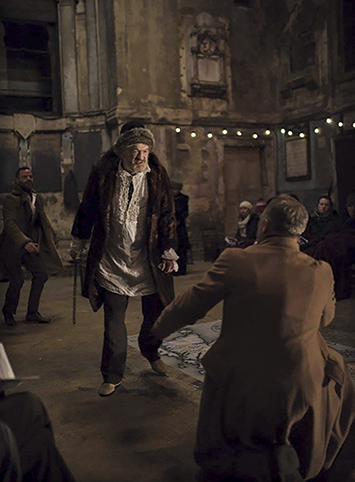
King Lear exemplified several of these tactical challenges in found site performance. In uprooting the production from St Leonard’s to the Peckham Asylum, the company showed a remarkable adaptability at short notice, producing new marketing material the following week. Shakespeare’s Globe kindly lent us spare costume items to support our performance. Props were used sparingly and only when they served an explicit dramaturgical function. On the morning of the first performance, for example, Martin Prest (Cornwall) arrived with a pair of bouncy balls to use for Gloucester’s eyes. Reflecting on this process, it is easy to hear echoes of Angus Vail’s ‘Punk’, or Jim Warren’s ‘Guerrilla’ Shakespeare in this account. There was certainly something insurgent about our Lear. With John (as with all of us), we knew this project was now-or-never, and in that moment, the one thing the company could control was the storytelling itself (Figure 3).
John McEnery as King Lear, Peckham Asylum (2015).
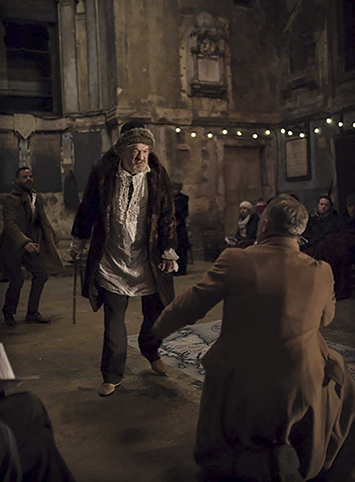
These negotiations acquired a new dimension when we moved into the asylum. The venue was extremely generous with its space. Working in the chapel for hours at a time, it quickly became clear how cold the space was, especially if you were sitting still. We adapted as best we could. Advance notices to wrap up warm were sent out, hot drinks and blankets were provided, and audience configuration was adjusted to help keep people warm. Ultimately, the environment added an important layer to the site-in-palimpsest. One reviewer observed that the cold became ingrained in the production:
If there is one word in which I could describe my experience when watching this play, it would be ‘cold’. Not only is the physical sensation of the room freezing, but the coldness that becomes part of the story. It is ingrained in it, in their relationships, mostly devoid of genuine love and warmth.
Another review saw the space in thematic alignment with the environmental harshness of the play: ‘It is an appropriate setting for King Lear, a play whose dark, hopeless misery is already enough to chill one to the marrow’ (Trickett). The breath-misting cold, the blanket-wrapped audience, the actors who ‘cavorted around the cavernous stone space, often barely clothed’ (Trickett) all became part of the play’s exploration of exposure, vulnerability, and the stripping away of affective comforts found in the proscenium theatre.
King Lear at the Peckham Asylum represents just one example of the broader challenges and opportunities in found site practice. Site-specific theatre makers around the world stage Shakespeare in non-traditional spaces: Montana Shakes, for example, tours rural communities; Recycled Shakes performs in California; Butterfly Theatre, Gift Horse Theatre, and Parrabbolla create work in found sites worldwide. The EarthShakes Alliance demonstrates the international scope of this tactic – unifying companies ranging from well-funded regional theatres to grassroots collectives with no institutional support. These practitioners share a commitment to performing Shakespeare as temporary guests in spaces never intended for theatre. To illustrate this variety of tactical responses, this section profiles three companies – Bard in the Barracks (Fredericton, New Brunswick), the Drilling Company (New York), and Shakespeare BASH’D (Toronto) – each demonstrating distinct approaches to the challenges and opportunities of performance at found sites.
Bard in the Barracks
When companies abandon established theatre spaces, they inevitably engage with the social forms, cultural practices, and colonial legacies embedded in those found sites. Gieseking and Mangold identify ‘place’, in these terms, as ‘bounded and specific to a location … a materialisation of social forms and practices as well as affective experience’ – and ‘space’ as ‘abstract, unlimited, universalising, and continuous’ (Gieseking and Mangold, Reference Gieseking, Mangold, Gieseking and Mangold2014: xix). This distinction is crucial for understanding how site-specific Shakespeare companies navigate the political implications of their own spatial choices. This political dimension of spatial practice becomes especially complex when companies use Shakespeare’s cultural authority to occupy spaces that carry their own institutional histories, requiring tactical negotiation between the playwright’s associations with empire and the specific colonial contexts of different places.
Bard in the Barracks is a Fredericton, New Brunswick-based non-profit theatre company. Founded in 2006, their mandate is ‘to produce innovative and entertaining site-specific outdoor productions of the plays of William Shakespeare’ (Bard in the Barracks, 2025). Led by Artistic Director Len Falkenstein, the company was conceived as a means of supporting new writing in Fredericton:
I actually got the idea in part to start it as a way of supporting another festival that we run, which is a festival of plays by local playwrights called ‘Notable Acts’. So, we figured, you know, people like Shakespeare, we can get people out to see the Shakespeare, and it’ll help support the new play festival.
At its inception, the company leveraged Shakespeare’s cultural capital to reach new audiences and promote new writing. In this case, however, the place itself adds another complex layer to the site-in-palimpsest. Fredericton was a British garrison town from 1784 to 1869, and the company’s first performances were staged in Barracks Square, a military compound that has been designated a National Historic Site of Canada. Retaining the name of the barracks whilst creating site-specific Shakespeare in a British colonial outpost on the unceded traditional lands of Wolastoqiyik understandably raises questions around the ties between Shakespeare’s cultural capital (utilised here to support local new writing) and educational structures of the British Empire. Consequently, Bard in the Barracks must negotiate Fredericton’s military heritage whilst creating contemporary, site-specific Shakespeare performances at various locations.
During their first three years (2006–08), the company staged works in Barracks Square, but has since branched out to other sites across the city. Falkenstein recalls a degree of architectural responsiveness in these early productions: ‘Our very first production was Much Ado About Nothing, that we kind of set post Second World War … so we did have the soldiers coming home to the square’ (Falkenstein, Reference Falkenstein2024). The barracks themselves offered some opportunities for tactical staging: ‘one of the prominent features of that building is that it has a large balcony that runs around the main building. So, you know, it’s an obvious choice for Romeo and Juliet’ (Falkenstein, Reference Falkenstein2024). Falkenstein recognises significant limitations with the space, however: ‘the interior spaces of the barracks are not really that accessible … so it’s not like we could present the barracks themselves as a setting, but there was, you know, at least a gesture towards that past’ (Falkenstein, Reference Falkenstein2024). This approach neither celebrates nor condemns military history at the barracks, but employs its existing architecture for contemporary storytelling.
Julius Caesar (2009) is arguably the company’s most subversive production to date. Staged in promenade through downtown Fredericton, the performance situated Caesar’s assassination on the steps of the provincial legislature. By staging Shakespeare at the seat of provincial government, the company transformed routine civic space into a site of unexpected theatrical encounter. Whilst not directly attacking governmental authority, the tactical subversion co-opted existing architecture to amplify the play’s political themes. The uncontained performance – with no barriers between theatrical action and passing pedestrians – embodies the democratic potential of tactical cultural operations, making both Shakespeare and political critique accessible to anyone who happens to be walking by. Through this strategic use of public space, Bard in the Barracks redistributed Shakespeare’s cultural capital whilst simultaneously commenting on contemporary political conditions, turning the provincial legislature’s steps into an impromptu amphitheatre.
Shakespeare in the Parking Lot
Where legislature steps provided a platform for political commentary, parking lots offer a fundamentally different type of disruption – through the radical democratisation of urban space. Founded in 1995 in New York’s Lower East Side, The Drilling Company’s ‘Shakespeare in the Parking Lot’ estimates they have performed for 40,000 patrons over the last thirty years. Like Malachite Theatre, the company faced the fundamental precarity of site-specific work in 2014, when it was forced to leave its original location at Ludlow and Broome Streets after nearly two decades. In that time, the parking lot had become synonymous with Shakespeare, and news of the company’s displacement made the Wall Street Journal: ‘Shakespeare in the Parking Lot is losing its parking lot’ (Catton, Reference Catton2014). The company’s website notes: ‘our former venue … is now giving way to Essex Crossing, a giant mixed-use development’ (Drilling Company, 2025). With echoes of the demolition at Rockwell House in Shoreditch, the company’s twenty-year occupation provided no protection against strategic redevelopment of the site at the municipal level.
What followed for the Drilling Company was a nine-month search for a replacement site. Where other site-specific companies might have moved to another type of found space, the Drilling Company believed the parking lot was fundamental to the group’s identity and mission. Part of this USP was the company’s management of uncontrolled spatial interactions. The company explains:
Shows are offered whilst the lot is in use. The action sometimes takes place around a parked car that drives away during a performance. At such times, the players stop, and the audience moves its chairs, pausing the performance the same way a show would stop for rain uptown in Central Park. It’s all part of the fun.
This protocol makes a theatrical characteristic out of narrative disruption highlighting a capacity for environmental collaboration that extends beyond architectural adaptation to include other forms of unpredictability in site-specific Shakespeare performance.
Another factor behind the company’s decision to take a hiatus whilst finding a new parking lot is a commitment to what their promotional materials describe as radical accessibility: ‘Seats are available on a first-come, first-served basis, with audience members often arriving early to secure a place. You are encouraged and welcome to bring your own chair. Once seats are gone, blankets are spread out’ (Drilling Company, 2025). The BYOC (bring your own chair) model encourages participatory engagement, whilst the first-come-first-served policy democratises access to Shakespeare’s cultural capital, typically controlled in the city by larger, strategic institutions.Footnote 9
Founder Hamilton Clancy positions the work within the broader tactical cultural tradition of site-specific theatre, explaining that they are ‘following the spirit of Joseph Papp. But putting our own spin on it by placing it in a parking lot, making an urban wrinkle’ (Drilling Company, 2025). This represents a sophisticated tactical response: rather than competing with strategic cultural institutions like Central Park’s Delacorte Theatre, the parking lot creates alternative infrastructure that serves different communities through different means. The company describes its productions as ‘typically intrepid, bare-boned and often gloriously ingenious adaptations of the classics’, as demonstrated by its own Julius Caesar (2010), staged as a battle for control of an urban school system, with women playing Antony, Brutus, and Cassius (Drilling Company, 2025). They eventually relocated to a parking lot on the east side of Norfolk Street, between Delancey and Rivington Streets, just three blocks from the lot where the gritty cultural attraction began in 1995 (Drilling Company, 2025). This allowed ‘Shakespeare in the Parking Lot’ to serve the same community, maintaining spatial proximity whilst requiring complete renegotiation of site-specific relationships.
Whilst the Drilling Company’s focus remains in New York, the widespread replication of the parking lot model suggests that ‘Shakespeare in the Parking Lot’ has identified a transferable model for site-specific Shakespeare. To this end, the company notes: ‘the concept of free Shakespeare in a parking lot, presented with a “poor theatre” aesthetic, is now widely imitated around the US and around the world, with productions as far away as New Zealand’ (Drilling Company, 2025).Footnote 10 Their sustained practice of managing displacement, uncontrolled interactions with parked cars, and democratic access with free attendance has sparked a wider cultural movement in site-specific Shakespeare.
Shakespeare BASH’D
When faced with the pressures and vulnerabilities of creating Shakespeare as temporary visitors to spaces they do not control, site-specific theatre artists pursue markedly different tactical paths. Where Shakespeare in the Parking Lot chose to pause operations until a similar site became available, other companies build resilience through more portable approaches to crisis.
Shakespeare BASH’D is a Toronto-based theatre company led by James Wallace and Julia Nish-Lapidus. Winners of NOW Magazine’s ‘Best Site-Specific Theatre Company’ in 2018 and 2019, their mission is to ‘make classical theatre welcoming, inviting, and social … synthesising the classical with the modern, to look at the plays from a place of curiosity, joy, investigation, truth, and love’ (Shakespeare BASH’D, 2025). The company’s mission shares familiar characteristics with other insurgent, site-specific companies operating outside of an existing institutional hierarchy. BASH’D was founded by ‘a group of young actors who decided to share their love of Shakespeare and stake a claim in the Toronto theatre community by exploring the works of Shakespeare in a collective environment’ (Shakespeare BASH’D, 2025). For Nish-Lapidus, there was a deliberate element of hierarchy-busting to the company’s early work:
One of our big ideas from the beginning was that we wanted to do Shakespeare in sort of social, casual spaces … we’ve been taught for so long that there is a proper way to do and watch Shakespeare. You sit in the theatre, and you sit up straight, and you politely listen, and you clap at the end.
Economic constraints were motivating factors in BASH’D’s early tactical innovations: ‘We asked, what’s the cheapest way we can put on a Shakespeare play? And so that was what it was really at the time’ (Nish-Lapidus and Wallace, Reference Nish-Lapidus and Wallace2024). As Wallace emphasises, this tactical approach became part of the company’s brand: ‘There’s a practical element to that, too … we’re very DIY. This has been us from the beginning’ (Nish-Lapidus and Wallace, Reference Nish-Lapidus and Wallace2024). Rather than viewing limited resources as a cause for artistic limitation, the company has developed an approach that turns spatial constraints into artistic advantages, creating intimacy, immediacy, and audience participation that conventional theatre spaces struggle to achieve.
Their model of economically accessible performance led to a broader democratisation of access to Shakespeare across Toronto, particularly in hotel and bar spaces. James Wallace views the bar as serving a dual function in site-specific performance: ‘My favourite thing about the theatre is the bar afterwards … the actual discussion that comes from what you saw. So, I was just like, well, why don’t we bring the bar to the theatre?’ (Nish-Lapidus and Wallace, Reference Nish-Lapidus and Wallace2024). The deliberate collapse of the distance between actor and audience also breaks down barriers between performance and criticism, inviting audience members to discuss and reflect throughout the action.
Staging performances in pubs required the company to make use of materials readily available at their performance sites. Nish-Lapidus views this through a form of architectural responsiveness: ‘One word I love to use is architecture. What is the architecture that we’re dealing with here? And how do we make this theatrical?’ (Nish-Lapidus and Wallace, Reference Nish-Lapidus and Wallace2024). Rather than imposing predetermined staging concepts, tactical operations must read and respond to existing spatial configurations, turning constraints into creative opportunities. In this way, bars and hotel rooms operate as tactical found spaces – temporarily occupied by performance that uses existing furniture and architecture, unpredictable acoustics, and an intimate scale that breaks conventional performer/audience relationships. BASH’D achieves this through tactical movement rather than strategic control.
This type of site-responsive tactic is not limited to the architecture of found sites. Reflecting on the company’s inaugural production of The Taming of the Shrew at the Victory Café, Nish-Lapidus recalls: ‘Christopher Sly was sitting outside the bar as people were coming in … our director played Sly, drinking and sitting in the front row and watching the full show every night’ (Nish-Lapidus and Wallace, Reference Nish-Lapidus and Wallace2024). This approach demonstrates another aspect of tactical spatial intelligence: using the bar’s existing social dynamics (drinking, casual conversation, street-level accessibility) to enhance the narrative impact of the play’s framing device.
The pandemic motivated a transition in the company’s work away from hotel and bar spaces and towards established theatres. James Wallace notes: ‘We made a conscious decision right off the bat, when Zoom theatre began, that we were never going to do that … We were prepared to wait, and we were prepared to shift our focus to education’ (Nish-Lapidus and Wallace, Reference Nish-Lapidus and Wallace2024). For BASH’D, their return to an established ‘theatre’ space was necessitated, in part, by masking protocol:
We moved to the Theatre Centre because we wanted to come back and do our show. We wanted to have the audience masked. It didn’t quite work at a bar. We wanted to have a little more room … Do we pack people in at the bar? We felt like people aren’t going to want to squish in quite so much, you know, right at the tail end of this pandemic.
Their main concern throughout this relocation was a loss of company identity:
But we were really worried that, after having this home in that bar for so long, we thought … are we going to lose what is so special about what we do? Our audience is going to come and say, “Well, this isn’t Shakespeare BASH’D anymore”. “This isn’t what you do”.
When addressing this concern, the company discovered its own type of revenance, turning away from found spaces but retaining a methodology and approach that retained a degree of characteristically tactical site-responsivity:
What we realised is that, after so many years of working in these different venues and respond[ing] to the space, we had established something so solid with the way we do these plays, and the relationship with the audience, that in serving our audience the only response was, “well, the chairs were more comfortable here” … the people, and the actors were more comfortable.
Ultimately, BASH’D’s post-pandemic transition to conventional and established theatre spaces validates de Certeau’s distinction between tactical and strategic cultural operations. Whilst, on the one hand, their move represents a shift towards strategic practice, their years of tactical operations produced a kind of ‘portable tactics’ – an ability to create intimacy, immediacy, and democratic access regardless of architectural context.
Rather than losing their identity, BASH’D demonstrated that tactical approaches can operate within strategic environments, maintaining their core mission of making ‘classical theatre welcoming, inviting, and social’ whilst gaining the logistical benefits of improved infrastructure. This evolution points towards a more nuanced understanding of tactical cultural work at found sites: as a learned capacity for creative adaptation that can operate effectively across the spectrum of spatial contexts.
Tactical Specificity
The focused sample of companies profiled in this section suggests some of the ways that ‘found site’ Shakespeare produces ‘tactical specificity’ – practitioner competencies for creating theatrical meaning by entering into dialogue with performance conditions, rather than exercising strategic control over the environment. Unlike revenant sites that exercise historical connections to Shakespeare, found sites demand practitioners develop sophisticated skills for environmental collaboration, institutional negotiation, and democratic reach. In these terms, ‘tactical specificity’ emerges from refined methodologies responding to the particular constraints of spaces never designed for theatre: the thematic cold of the Peckham Asylum, Bard in the Barracks’ subversive occupation of civic spaces, the Drilling Company’s negotiations with parking cars, and BASH’D’s portable tactics each demonstrate distinctive forms of this learned capacity.
These tactical operations reflect embedded qualities of Shakespeare’s spatial dramaturgy. The plays are structured around flexible deixis, environmental responsiveness, and threshold moments that practitioners can activate in dialogue with found sites. When Lear rages against the storm, when Julius Caesar bleeds on the senate steps, when Christopher Sly is discovered drunk outside a tavern – these moments invite environmental collaboration with their sites of performance.
Found site practitioners identify and exploit this flexibility, understanding what Eleanor Rycroft identifies as early modern theatrical awareness that ‘doors, galleries, pillars, decorated canopy over the stage, visible audience, wind and weather – all were there to be referenced and used in performance’ (Escolme, Reference Escolme2012: 507–508). The freezing chapel becomes Lear’s heath; the provincial legislature becomes Caesar’s Rome; the bar becomes the alehouse of the Induction to Shrew.
This also reveals a fundamental aspect of the plays themselves. Shakespeare’s dramaturgy contains enabling conditions for tactical adaptation – not because he anticipated twenty-first-century site-specific practice, but because early modern theatre was itself a tactical art form, creating meaning across diverse, unpredictable, and uncontrollable performance contexts. Found site practitioners thus operate as contemporary inheritors of the collaborative intelligence that enabled early modern drama to thrive. By demonstrating how Shakespeare’s texts enable tactical cultural operations when activated by skilled practitioners, found sites confirm that site-specific performance activates spatial responsiveness embedded within early modern dramaturgy.
3 Shifting Sites
A masterpiece always moves, by definition, in the manner of a ghost … it inhabits without residing.
I think of touring as making one show site-specific for multiple different sites.
Hamlet on Tour
In summer 2015, a producer from the Guangzhou Drama Theatre, China, invited Malachite Theatre to tour as part of a cultural exchange marking the 400th anniversary of the deaths of Shakespeare and Tang Xianzu. I had already arranged a promenade Hamlet in London and we had been asked to return to the Lichfield Festival for a performance in the Lichfield Guildhall. These three contracts aligned, though not seamlessly. I needed to adapt my approach to direct a Hamlet that could work in period gardens in London, a medieval guildhall in Lichfield, and a proscenium theatre in China.
The shifting spatial constraints facing touring companies intensifies the tactical negotiations of performing Shakespeare from site to site. Instead of restricting site-specific performance to shows staged or conceived for a single location, touring companies adapt the same play to different spaces. Their adaptations highlight how practitioners use flexible spatial dramaturgies in Shakespeare’s plays.
The historical record confirms an adaptive capacity in early modern playing. The Chamberlain’s Men – and after 1603, the King’s Men – routinely performed the same plays across radically different spatial configurations: the open-air Globe with its thrust stage and standing yard; the candlelit Blackfriars with its indoor acoustics and seated galleries; great halls at court with temporary stages provincial guildhalls during regional tours; and inn yards during plague closures when playhouses were shuttered.Footnote 11 Hamlet itself was performed at the Globe, at court, on tour (the 1603 quarto’s title page advertises performances ‘in the two Universities of Cambridge and Oxford’), and aboard the Red Dragon off the coast of Sierra Leone in 1607.Footnote 12 Each venue demanded different spatial negotiations – sightlines, acoustics, entrance configurations, audience proximity – yet the same play was regularly staged across these contexts. Contemporary touring companies at ‘shifting sites’ engage an adaptive practice that was foundational to early modern theatrical operations, rather than a modern innovation imposed upon Shakespeare’s texts.
Touring productions are not the only ones to draw out spatially responsive elements of Shakespeare’s plays. King Lear at the Peckham Asylum was staged to highlight themes of decay, especially through the king’s cognitive decline and his relationship with his daughters. In performance, discordant double basses echoed in the chapel’s ruinous interior. Macbeth at the Rose was edited extensively to use the split-level performance spaces. A Midsummer Night’s Dream at Rockwell House took a different approach again, staging the play in a ‘town square’ style. In each case, the performance spaces shaped the theatrical conversation, offering a unique experience with each production.
These productions were developed and rehearsed with one specific site in mind. Hamlet presented a new challenge, further blurring the boundaries between text and space. I wanted to highlight the play’s themes of captivity and surveillance. Thresholds became key symbols that linked the production’s threads across three sites. In the period gardens, the audience moved to a different section at each narrative threshold (see Figure 4). The ghost spoke only from within a walled herb garden. Audiences moved between this private space and a more public ‘court’ during Act One. In Lichfield, the threshold became the space between the judicial bench and the ‘robing room’. Much of the action was staged at the Guildhall’s dais-end. The platform’s architecture became part of Prince Hamlet’s extended existential trial. Claudius spied on Hamlet and Ophelia from the Minstrels’ Gallery. The arras, behind which Polonius hid, led to the Moulton Room – a space used for minor committee meetings that suited Polonius’s character. In Guangzhou, silhouettes in doorframes and mezzanine windows echoed this sense of claustrophobia and judgment. Hamlet, breaking the fourth wall and stepping off stage, preserved a direct address style from the gardens and the guildhall.
Anatole Gadsby as Hamlet, Museum of the Home (2016).
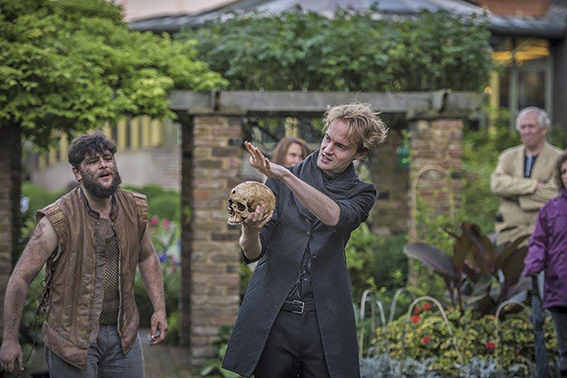
In Derridean terms, our Hamlet was ‘inhabiting without residing’ (Reference Derrida1994: 20) in each space, retaining a spectral heart that ‘began by coming back’ (Reference Derrida1994: 11). Here, each performance offers practitioners an opportunity to explore spatial possibilities within Shakespeare’s dramaturgy. Thus, ‘shifting sites’ foreground de Certeau’s idea that cultural practices generate meaning through movement, adaptation, and response rather than permanent occupation or control.
Pigeon Creek Shakespeare Company
At first glance, Grand Haven, Michigan, a city of little over 11,000 situated on the eastern shores of Lake Michigan, seems like an unlikely home for a site-specific Shakespeare company. For the Pigeon Creek Shakespeare Company, however, the choice is tactical – their home city is a base from which to tour a range of sites between Chicago and Detroit.
Pigeon Creek was founded in 1998 by a group of actors and directors who had worked with the Grand Valley Shakespeare Festival, including Executive Producer Katherine Mayberry. The company’s mission emphasises a commitment to performing in ‘non-traditional performance venues’, a mandate shared by several site-specific companies in this study. They use ‘universal lighting and audience contact to adapt its productions to multiple performance venues, and to actively engage audience members in performance’ (Pigeon Creek Shakespeare Company, 2025). Mayberry completed a Master’s with the ASC, and Jim Warren recognises features of processional revenance in Pigeon Creek’s approach: ‘A company like Katherine’s is very much more concerned with process than with place’ (Warren, Reference Warren2024). Early modern staging practices are a foundational principle in the company’s work, blurring the boundaries between specificity and responsiveness to its performance sites.
Pigeon Creek’s commitment to ‘Shakespeare’s original theatre practices’ does not preclude an engagement with site-specificity. Mayberry notes: ‘I think of touring as making one show site specific for multiple different sites … We want people to react to the space’ (Mayberry, Reference Mayberry2024). Beyond shared light, Mayberry extends these early modern practices to include company organisation:
We have a repertory company, a group of people who’ve participated in a certain number of productions. Those people have a shorthand for working together, a shorthand in terms of thinking about Shakespeare’s text, a shorthand in terms of thinking about the space.
Mayberry’s ‘shorthand’ is not restricted by a commitment to use only original practices: ‘we do some physical training that uses similar viewpoints, and Lecoq for developing the actor’s relationship to space’ (Mayberry, Reference Mayberry2024). Utilising viewpoints in this way develops an actor’s capacity to read and respond to any spatial configuration through body-based awareness rather than predetermined staging, generating a form of embodied tactical intelligence specific to Pigeon Creek’s repertory company. This approach enables a rapid series of spatial negotiations without losing theatrical depth or narrative focus from site to site, generating site-specific possibilities within each new spatial encounter.
Whilst Pigeon Creek’s approach remains the same in each performance space, working in West Michigan allows the company access to two playhouse reconstructions with revenant connections. Angus Vail counts them as ‘another Punk company’, whose collaborative work at the Container Globe with the Motor City Youth Theatre encouraged greater access to Shakespeare performance for Detroit’s inner-city youth:
They [Pigeon Creek] banged out scenes from Macbeth. And then the Motor City Youth Theatre came …, and that was cool for the kids to watch the professionals. And then the kids got up on the same stage, and they were hilarious. We were like falling off our chairs, that was so funny.
Vail reflects that the event encouraged Pigeon Creek and Motor City Youth Theatre to learn from each other on the Container Globe stage, stating, ‘it’s great for the kids to get up and actually have a full stage and see what we were doing. And then they talked afterwards’ (Vail, Reference Vail2024). This type of ‘punk’ education connects Pigeon Creek to the broader tactical cultural rebellion examined throughout these sections, where site-specific theatre makers use Shakespeare’s cultural authority for democratic rather than institutional purposes.
Perhaps the most surprising site hosting Pigeon Creek performances, however, is ‘The Rose’: a complete replica of an Elizabethan playhouse constructed in 2010 at Blue Lake Fine Arts Camp, in West Michigan’s Muskegon County. The venue is not widely known outside of Michigan and is described as ‘a synthesis of various popular sixteenth-century English theatres’, which was built following ‘surviving sketches and documents from the period’ (Pigeon Creek Shakespeare Company, 2025). Like the SWP, focusing on archetypal features of playhouse design shields the venue from detractors who question its historical accuracy as a replica. The Rose includes a ‘traditional thrust stage, a Juliet balcony, seating for approximately 600 in two galleries, plus the yard in front of the stage that can hold up to 150 groundlings’ (Pigeon Creek Shakespeare Company, 2025).
The playhouse is primarily used by middle and high school campers during the summer, with Pigeon Creek the only company to date to have negotiated access to perform at the site, echoing the experiences of other site-specific companies interviewed in this Element that create work in spaces they do not control. Whilst the question of ‘The Rose’s’ revenance seems important to Pigeon Creek, Mayberry’s insight that touring can be ‘site specific for multiple different sites’ challenges the fundamental assumption that site-specific Shakespeare requires singular spatial relationships. Instead, the company demonstrates that the same tactical intelligence enabling architectural adaptation can generate distinctive vocabularies of spatial responsiveness.
The HandleBards
The HandleBards is a UK-based company founded in 2013, which cycles between its venues whilst on tour. Staging productions of Shakespeare from no permanent base, they are constantly adapting their performances to whatever spaces and conditions they encounter. Similar to Shakespeare BASH’D, the HandleBards was founded by four friends leaving university, and their touring practice initially emerged as a response to financial restrictions. As producer Will Orton explains: ‘They hired a director, cycled, and camped at venues. It was just the four of them doing the whole thing …, and they cycled it, and people kept going. When are you coming back?’ (Orton, Reference Orton2024). Unlike strategic cultural institutions protected by public funding, The HandleBards generated their following through direct community engagement rather than institutional support.
A registered charity, the HandleBards built an organisational structure that affords it a degree of artistic freedom. As Orton notes, ‘our funding comes from lots of different places, so we’re not necessarily beholden to huge sponsors or donors that are interested in very [specific content]’ (Orton, Reference Orton2024). This financial independence manifests in other areas of their organisational and artistic culture: ‘It’s actually quite fun not to have to do work that fits within this rigid structure’, enabling an artistic autonomy that isn’t possible in strategically controlled cultural institutions (Orton, Reference Orton2024). The operational model shares commonalities with Warren’s ‘guerrilla Shakespeare’ and Vail’s ‘bodega Shakespeare’: a ‘punk’ operation that eschews ‘high-carbon’ touring.
The company’s bicycles serve symbolic as well as practical functions in performance, becoming an essential element for the troupe’s brand. Orton notes, ‘the shows normally start their life on a bicycle. But then, if there are other opportunities for them, we’ll try and make it as green as possible’ (Orton, Reference Orton2024). This approach requires an adaptive philosophy that manifests in the company’s performance style through spatial responsiveness. Commenting on a recent production of Twelfth Night, Orton notes, ‘shows have always kind of been loose enough for a company to make those adaptations on the fly with the space … I’d have a chat with Bill, who’s playing Antonio, because he would always come on from somewhere really daft … depending on where we were’ (Orton, Reference Orton2024). Spatial engagement is thus built into the HandleBards’ production through rehearsal, then adapted to utilise the distinctive features of each individual site.
Orton is relating a moment from Act 3, Scene 4, where Antonio breaks up a duel between Sir Andrew Aguecheek and Viola (disguised as Cesario), whom he mistakes for Sebastian. Antonio enters mid-action with urgent verbal interruption – ‘Put up your sword. If this young gentleman / Have done offence, I take the fault on me’ (3.4.320–21) – creating a moment where the text demands disruption of ongoing action whilst leaving the spatial staging unspecified. Shakespeare provides neither entrance location nor blocking relationships between Antonio and the duelling pair, requiring only that he arrive with sufficient dramatic impact to halt violence. The textual openness of Antonio’s entrance – he must arrive, must interrupt, but the how remains undetermined – exemplifies what practitioners recognise as enabling conditions for spatial adaptation within Shakespeare’s plays.
In the HandleBards’ staging, this textual adaptability enabled site-specific improvisation: ‘Antonio would run… Get the lift up to the 5th floor! Would shout “Oi!” because he’s coming on to break up the fight between Toby and Violet. From the top! And then the audience would see this … It would take like a full minute’ (Orton, Reference Orton2024). The extended duration of Antonio’s descent – a full minute of visible approach – transformed the scene’s urgency through architecture, demonstrating how practitioners activate spatial possibilities that Shakespeare’s text enables but does not prescribe. To some extent, this anecdote exemplifies Cathy Turner’s insight that ‘each occupation, or traversal, or transgression of space offers a reinterpretation of it, even a rewriting’ (Turner, Reference Turner2004: 373), whilst revealing how Shakespeare’s dramaturgy provides the enabling conditions for such spatial reinvention.
Place is also an important consideration in the HandleBards’ work, and their model suggests ways in which site-specific Shakespeare can foster unique conditions for cultural democracy. Orton articulates this democratic mission: ‘What it does is it lets people realise that art, and good art, is and should be where they are, and where they’re from. They should be able to walk from their homes and see it’ (Orton, Reference Orton2024). Like ‘Shakespeare in the Parking Lot’, this philosophy materialised in a free show ‘by the side of the cycle track’ in South Manchester, which came about following a gap in tour programming: ‘We just did this free show by the side of the cycle track with sessions, and again loads of people, and they all just come from the sort of like from all the houses around … I had reached out to them’ (Orton, Reference Orton2024). The performance temporarily occupied unused space (decommissioned railway land) to create a community cultural experience.
The HandleBards’ democratic philosophy demonstrates how tactical intelligence can redistribute cultural capital through direct spatial practice, making Shakespeare more accessible precisely by refusing the strategic authority of traditional theatrical venues. In this way, site-specificity becomes less about the characteristics of individual spaces and more about the adaptive capacity to make Shakespeare’s plays work in discourse with their sites of performance.
The Lord Chamberlain’s Men
Orton somewhat reluctantly acknowledges a foundational connection between the HandleBards’ model and early modern touring practice: ‘In our most whimsical moments this idea of “what [Shakespeare] would have wanted”, which I hate, but the idea of it can catch the imagination as a travelling troop of troubadours going from place to place under their own steam’ (Orton, Reference Orton2024). London-based company The Lord Chamberlain’s Men (TCLM), by contrast, wears its association with authenticity more openly. Artistic Director Peter Stickney claims ‘the company is the modern-day reincarnation of Shakespeare’s original company, that he started with a bunch of colleagues in 1594’ (Stickney, Reference Stickney2024). Stickney (a former actor who performed with the company in 2007–08) purchased the company from founder Mark Puddle for an undisclosed fee in 2016.
Their website claims TLCM are ‘the UK’s premier all-male theatre company with direct links to the history of William Shakespeare, presenting Shakespeare’s work as he first saw it; all male, in the open air and with Elizabethan costume, music and dance’ (The Lord Chamberlain’s Men, 2025). In Stickney’s view, Shakespeare is not so much a hauntological revenant in the work of The Lord Chamberlain’s Men, but the original company is reincarnated in TLCM performances. This bold claim is a unique selling point and an embedded feature of the company’s brand. This approach to ‘presenting Shakespeare’s work as he first saw it’, sits in stark contrast to other companies working with Shakespeare and sited-performance – either through staging performance at revenant sites, through the use of revenant practices (in the model of the Shenandoah Shakespeare Company before they became the ASC), or by adopting a ‘punk’ approach to temporary spatial occupation.
Where others are wary of the word ‘authentic’, Stickney leverages the term in his company’s mantra: ‘there are three watchwords for the company … that’s authenticity, excellence and magic’ (Stickney, Reference Stickney2024). When pressed to define ‘authenticity’ in conversation, Stickney conceded that the claim is subjective: ‘that’s something that I hold to myself about personally being authentic to who I am and what I believe, and my foibles, and everything that comes with me and my history and my story … and working from where I am every single time’ (Stickney, Reference Stickney2024). In this regard, the ‘authenticity’ essential to the company’s brand is articulated through the director’s eyes. As Shakespeare’s Globe has repeatedly found, however, one of the challenges with claims of authenticity (claims that Wanamaker notably did not make) is that the term is temporally static and unravels as new research inevitably teases at its loosest threads.
This resistance to site-responsivity evidences a fundamental tension between product and process in TLCM’s work. Stickney reflects: ‘If you were to respond to 69 different venues in 17 weeks. The show would be just a complete blancmange … You’d never be able to get any sort of control over the product’ (Stickney, Reference Stickney2024). TLCM’s consistency is achieved across venues through modes of control extended by staging and rehearsal. Stickney notes: ‘The 6x6 metre platform that we have is exactly the same. The moves on that platform are exactly the same. The text is exactly the same, gets delivered apart from a sort of nuance of space, gets delivered in the same way’ (Stickney, Reference Stickney2024). This focus on product rather than process suggests a replicable kind of habitation derived from the rehearsal room, where the performance from one site occupies the space of another. Whilst performance sites shift, the product remains demonstrably the same.
To achieve this level of product control, the Lord Chamberlain’s Men conduct extensive rehearsals. Stickney notes: ‘We spent five-and-a-bit weeks in rehearsals crafting a thing, and that is the thing that we wanted to deliver’ (Stickney, Reference Stickney2024). This demonstrates a depth of financial resources that are not available to several touring companies that work tactically with their performance sites. Rather than making use of spaces controlled by others, this suggests the Lord Chamberlain’s Men exhibit features of ‘strategy’, which de Certeau defines as:
The calculation (or manipulation) of power relationships becomes possible as soon as a subject with will and power (a business, an army, a city, a scientific institution) can be isolated. It postulates a place that can be delimited as its own and serve as the base from which relations with an exteriority … can be managed.
In this definition, ‘strategy’ refers to institutions that exercise spatial power – purpose-built theatres, cultural venues, and spaces designed for specific functions. Retaining ‘spatial power’ of product control from the rehearsal room to over seventy touring venues, the Lord Chamberlain’s Men resist the kind of tactical negotiations typical of site-specific performance. Conducting large-scale national and international tours, the company is extremely popular, a trait which Stickney attributes to the quality and replicability of this product: ‘It’s about our connection to the audience, and how we treat them. and how we look after them, and that we don’t patronise them in any way, shape or form and respect their time and their money, and them coming out to see us’ (Stickney, Reference Stickney2024). Ironically, this strategic approach contradicts the tactical adaptability characteristic of early modern theatrical operations.
Specificity-as-Process
The companies profiled in this section show that staging Shakespeare across shifting sites activates a distinctive form of theatrical revenance – with practitioners demonstrating a capacity for theatrical mobility through a dramaturgical approach that characterised early modern playing. This is not a ghostly return to historically resonant places examined in Section 1, but the spectral mobility of Shakespeare’s dramaturgy across multiple spaces. Here, each new venue becomes a site where theatrical ghosts ‘begin by coming back’ (Derrida, Reference Derrida1994: 11), through accumulated tactical knowledge of how Shakespeare’s texts enable spatial adaptation. Katherine Mayberry’s insight that touring operates as ‘making one show site-specific for multiple different sites’ reframes an apparent contradiction between specificity and mobility, demonstrating that practitioners’ tactical intelligence activates Shakespeare’s spatial dramaturgy through adaptive process rather than spatial fixity.
The HandleBards and Pigeon Creek approach each new venue as an opportunity to activate spatial possibilities latent in Shakespeare’s dramaturgy. The HandleBards’ cycling embodies this temporary, spectral occupation; Pigeon Creek’s shared vocabulary enables rapid spatial negotiations in each new site, developing what Mayberry calls ‘a shorthand for thinking about the space’. The Malachites’ Hamlet shared in this process of spectral adaptation – where the textual thresholds functioned distinctively either as garden gates, judicial architecture, and mezzanine silhouettes; with each venue revealing previously unknown spatial possibilities within the production’s themes of surveillance and judgement.
The Lord Chamberlain’s Men offer a crucial counterpoint in this regard, demonstrating how strategic resistance to sited-engagement contradicts, rather than honours, the diversity and responsiveness of early modern theatrical practice. By prioritising product consistency over environmental interactions, TLCM resist the dramaturgical features that make Shakespeare’s plays so amenable to spatial adaptation, instead using claims of cultural authority as part of a broader commercial strategy. Shifting sites thus show practitioners activating Shakespeare’s spatial dramaturgy through revenant movement rather than memorial occupation. This spectral mobility of ‘inhabiting without residing’ provides an essential preparation for the escalating environmental, logistical, and financial challenges examined in subsequent sections.
4 Green Sites
Shakespeare has always been outdoors. He was never ignoring the roughness of that setup or the noises of it, or the chaos of the weather … this space always influenced his work.
The space of a tactic is the space of the other. Thus, it must play on and with a terrain imposed on it and organised by the law of a foreign power … In short, a tactic is an art of the weak
Museum of the Home
A distinct set of tactical negotiations is required when staging site-based Shakespeare outdoors. Companies must interact with audiences who may not have chosen to attend – passersby, dog walkers, families, and those preoccupied with other activities. In outdoor settings, companies rely on timing and improvisational responsiveness rather than spatial control. They must adapt to environmental constraints, complex issues of colonisation and relationality with the land, and the climate crisis. These factors shape the tactical decisions needed in green spaces. Success depends on creative adaptation that balances environmental collaboration, decolonial aims, and democratic accessibility in spaces neither owned or controlled by the theatre-makers.
The Museum of the Home consists of Grade I-listed eighteenth-century almshouses with open lawns in front. Hamlet (Section 3) was Malachite Theatre’s second production at the venue, after we staged Twelfth Night on the front lawns the previous year. The two productions had entirely different auditory environments. The period gardens at the back are quiet, adjoining a courtyard. In contrast, the front lawns are enclosed by buildings, trapping the noise from Kingsland Road, a major east London roadway.
The traffic became a reality of Twelfth Night. On one occasion, a number 149 bus broke down outside the museum whilst stuck in reverse, a circumstance that the bus reminded us of once every five seconds for about half an hour: ‘This vehicle is reversing!’ Our performance featured live music, and the actor-musicians adapted to incorporate the same key and rhythm as the broken bus’s song. Sir Andrew Aguecheek (Anatole Gadsby) incorporated ‘reversing’ into his illustration of the ‘back-trick’, and Malvolio’s party-pooping intervention in Act 2 Scene 3 was greeted with cheers when the bus’s alarm was either providentially fixed or finally switched off at this appropriate narrative moment. The situation became part of a shared joke between performers and play-goers, a tacit understanding utterly unique to that afternoon.
The production was staged in the corner of the lawns, furthest from the road, with actors moving among the audience. This allowed some access to interior spaces (which were used as dressing rooms) and enabled the production to engage directly with the built environment. The design gestured loosely towards an imagined eighteenth-century setting, situating the narrative around the date of the museum’s buildings.
This staging brought another subversive layer of the site’s palimpsest into conversation. At that time, the museum was known as the Geffrye Museum after Robert Geffrye, a wealthy ironmonger and Mayor of London who paid for the almshouses to be built. The museum underwent an £18 million renovation in 2018 and reopened with a new name. Geffrye was a slave owner, and the museum was reluctant to acknowledge this as the reason behind the rebranding. Speaking to The Guardian in 2019, the museum’s director, Sonia Solicari, reasoned: ‘Because Robert Geffrye didn’t create the museum … It’s not his collection, [and] he may or may not have liked the idea of a museum in his almshouses’ (Brown, Reference Brown2019). Solicari’s position is that the museum’s name was changed to make its purpose easier for the public to grasp.
Solicari added that the name ‘Geffrye’ was not being dropped entirely, as the almshouses would still bear his name (Brown, Reference Brown2019). Writing in Museum Next, Manuel Charr asks ‘what’s in a name?’, noting ‘the renaming does not seem to be linked to controversy around Sir Robert Geffrye being both a slave owner and someone who was involved in and profited from the enslavement of African people’ (Charr, Reference Charr2019). Our Twelfth Night played to audiences with the brilliant Jude Owusu as Duke Orsino, while a prominent statue of Geffrye overlooked the performance from the almshouses (Figure 5).
Jude Owusu as Orsino in Twelfth Night, Museum of the Home (2015).
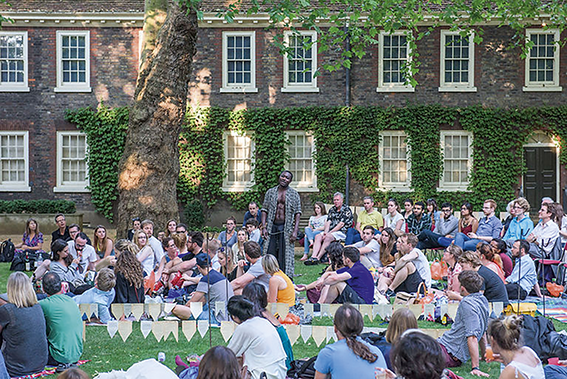
The museum sparked further controversy in 2020 when, after public consultation, it decided not to remove the statue. In a press release, the museum stated, ‘overall, the response [of the public consultation] was in favour of removing the statue … However, feedback showed that what to do with the statue is a complex debate, full of nuance and different opinions’ (York, Reference York2020). Speaking to the Huffington Post, Hackney resident Jermaine Jackman says, ‘Black lives clearly don’t matter to that board of trustees’, whilst human rights activist Toyin Agbetu calls the decision ‘morally abhorrent’ and ‘anti-democratic’ (York, Reference York2020). The statue still stands above the almshouses, overlooking a green space that occasionally hosts Shakespeare performances.
Site-specific Shakespeare must navigate the complex palimpsests of contested colonial spaces, environmental crisis, and Shakespearean revenance that converge in green sites; subverting without controlling those spaces or narratives. In this regard, Michel de Certeau’s concept of ‘the art of the weak’ provides a useful theoretical paradigm for understanding the ways in which theatre practitioners operate tactically in green sites. De Certeau argues that ‘the space of a tactic is the space of the other. Thus it must play on and with a terrain imposed on it and organised by the law of a foreign power … in short, a tactic is an art of the weak’ (de Certeau, Reference Certeau1984: 37). Unlike strategic institutions site-specific companies must work within environmental and political constraints beyond their control – public parks, heritage gardens, and contested colonial legacies.
For Shakespeare performance, the temporal dimension proves especially important as, whilst ‘strategies pin their hopes on the resistance that the establishment of a place offers to the erosion of time’, tactics depend on ‘a clever utilisation of time, of the opportunities it presents and also of the play that it introduces to the foundations of power’ (de Certeau, Reference Certeau1984: 38–39). Green site companies exemplify this temporal art of the weak, seizing momentary opportunities to occupy contested spaces through Shakespeare’s cultural authority, whilst increasing accessibility and challenging hierarchies of institutional power.
This section examines how ‘green sites’ – outdoor, natural, and environmentally focused performance spaces – both return features of Shakespeare’s early theatrical origins and evolve towards sustainable, accessible, and community-engaged practice. Shakespeare in the Parks programs across North America represent the most widespread manifestation of green site performance. These programs exemplify the democratic accessibility inherent in green site work whilst facing the same climate challenges documented above – increasingly unpredictable weather, air quality concerns, and the need to adapt established schedules to accommodate for accelerating environmental instability.
Climate change is the defining challenge for contemporary outdoor performance. Land relationships are also a central consideration for green site Shakespeare, raising new questions of how performances engage with space. As Patricia Allinson from Shakespeare in the Ruff explains, ‘we’re very aware of how Shakespeare was used as a colonial tool. And so there’s also something that is really grounding for us about being outside and on land as … our chosen spot, for where we tell Shakespeare stories’ (Allinson and Yung, Reference Allinson, Yung and Blyth2024). These issues go beyond logistics such as weather policies or land acknowledgements; they represent a fundamental shift in ‘the art of the weak’, shaping how site-specific Shakespeare operates today.
Shakespeare in the Ruins
Shakespeare in the Ruins (SIR) in Winnipeg, Manitoba, has staged outdoor performances for thirty years in and around the historic ruins of the former Assiniboine Convent. Founded as a summer festival, the company has evolved from its original collective structure, with artistic director Rodrigo Belifuss leading the organisation since 2019. Today, the company stages promenade performances that move audiences through different sections of the ruins and surrounding parkland five to six times per show, creating what Belifuss calls a ‘site-specific quality up a notch’ (Belifuss, Reference Belifuss2024).
The convent remains central to SIR’s work. Reflecting on a recent production of Hamlet, Belifuss notes: ‘It was just such a no-brainer to start the play at the facade with the guards at the front steps, you know, looking out for the ghost. It was like “this is the Elsinore Castle”’ (Belifuss, Reference Belifuss2024). SIR’s practice of moving audiences through historic spaces speaks to Gretchen Minton’s observation that ‘the context that mattered … was not an imagined whole called “the play,” but instead a site-specific environment that released Shakespeare from a conventional interpretive framework’ (Reference Minton, Werier and Budra2023: 321). Where Katherine Mayberry approaches each Pigeon Creek performance as a site-specific opportunity, Belifuss suggests that SIR’s approach generates new sites with each audience relocation.
In conversation, Belifuss identifies a revenant quality to outdoor Shakespeare performance, claiming that ‘Shakespeare has always been outdoors … he was never ignoring the roughness of that setup or the noises of it or the chaos of the weather. It was always like this space always really influenced his work’ (Belifuss, Reference Belifuss2024). To Belifuss, the influence between space and play is reciprocal upon both audiences and actors:
It forces the actors to really use the words. You have to externalise things. The environment demands that audiences listen to our plays better when they are outside in a site-specific place … the association between word, image, and environment is much clearer.
The hauntological framework, articulated here by Belifuss, suggests outdoor performance doesn’t simply return Shakespeare to ‘original’ conditions, but creates a kind of spectral return, in which past and present haunt each other. Belifuss argues that ‘so many of his plays, as you know, reference the elements are obsessed with the elements are about nature … it makes complete sense to put them outside’ (Belifuss, Reference Belifuss2024). This connection gestures towards something fundamental to staging Shakespeare in green sites, arguing this ‘innateness’ captures something ‘that only happens in specific outdoor Shakespeare’ – unique, unrepeatable moments where past and present collapse into singular events that could occur nowhere else (Belifuss, Reference Belifuss2024).
Approaching environmental encounters as a form of dramaturgy, Belifuss offers an example of these environmental negotiations in site-specific performance. In Act 1, Scene 2 of Henry V, the English court is debating the practicalities of war with France:
Reflecting on this moment at an SIR performance, Belifuss recalls: ‘When the actor was saying that, one night he looked up and an eagle was hovering above. So, it was like the actor found the metaphor … that only happens in specific outdoor Shakespeare’ (Belifuss, Reference Belifuss2024). These irreplicable encounters create further layers of specificity, rendering a textual moment literal during a performance at a site with a complex history of Anglo-French conflict. These types of intervention are not always complementary, of course: ‘The other side of it, of course, is when we did Hamlet, the school bus by the parking lot decided to re-park … so then it’s like, alas, we have this intrusion’ (Belifuss, Reference Belifuss2024).
In addition to transcendent moments of serendipity, the climate crisis is creating a rapidly accelerating series of challenges for outdoor performance. This includes extreme temperature swings, causing increasingly unpredictable conditions in southern Manitoba: ‘We opened in June to -2 [Celsius] and by closing it was +38 … within three weeks’ (Belifuss, Reference Belifuss2024). More critically, Belifuss noted SIR had to cancel shows for the first time because of forest fires, with ‘the air just thick with smoke’. Rapidly spreading cases of Dutch Elm disease and Emerald Ash Borer threaten further ecological crisis in Winnipeg: ‘80% of the trees we have are either Ash or Elm, and they’re both dying right now … the canopy of Winnipeg is dying’ (Belifuss, Reference Belifuss2024). This environmental degradation produces tangible, rapid changes to the landscapes that generate meaning in outdoor, site-based performance.
Outdoor festivals, like SIR, are well-placed to reflect on the pace and scale of the climate crisis. A snapshot of examples from around Canada indicates a broad range of challenges facing outdoor performance in the climate crisis. Dave Horak (Artistic Director of the Freewill Shakespeare Festival in Edmonton, Alberta), corroborates Belifuss’s account of temperature swings: ‘This year it was very cold at the opening. People were wearing sweaters, and by the end, we actually had to cancel a few shows because it was too hot. It was over 30 degrees’ (Horak, Reference Horak2024). In Freewill’s case, this resulted in a truncated season, with several performances cancelled due to heat and smoke. Drew Douris-O’Hara (Associate Artistic Director of Shakespeare by the Sea) identifies climate change and global warming as making their rehearsal process ‘really challenging’ (Douris-O’Hara, Reference Douris-O’Hara2024). The company faces a specific operational problem: they perform on the Battery in Halifax but can only rehearse there in the evenings, which creates scheduling conflicts for their repertory productions. He explains: ‘global warming has made that aspect of our work really challenging, just to be able to create the shows’ (Douris-O’Hara, Reference Douris-O’Hara2024). Whilst Len Falkenstein (Bard in the Barracks) recalls: ‘the year that we did Coriolanus it rained every single day through June, there were, I think, three performances that were not affected by rain in some fashion’ (Falkenstein, Reference Falkenstein2024). When the weather affects the vast majority of performances, it ceases to be an incidental factor and becomes a dominant force shaping both artistic choices and audience experience.
Based at the same site for thirty years, Belifuss reflects that climate change has informed ‘how we make, approach, and interpret the art. It’s changing everything, really’ (Belifuss, Reference Belifuss2024). At SIR, this includes ‘readdress[ing] all of our weather policies to address air quality’, and providing shade for health and safety, which has restricted the spaces and scenes the company can perform in and around the ruins themselves (Belifuss, Reference Belifuss2024). Horak identifies a regulatory gap in this regard, noting: ‘there’s very little in Alberta that tells us we cannot work outside. In this condition, we have to. We have to stop work, or we have to cancel … they’re not quite caught up to the fact that there’s an environmental change’ (Horak, Reference Horak2024). Collectively, these testimonies suggest that outdoor Shakespeare companies are functioning as climate witnesses, documenting environmental changes in real-time whilst struggling to maintain and adapt artistic practices that climate disruption may ultimately render unsustainable.Footnote 13
Shakespeare in the Ruff
Toronto-based Shakespeare in the Ruff faces similar climate challenges as the other outdoor Shakespeare companies surveyed in this section. The company operates as a collective, with members Patricia Allinson (choreographer) and Jeff Yung (actor) working alongside Christine and Nathaniel in leadership roles. Allinson shares Horak’s concerns with the unsuitability of heat and air quality policies:
We started losing a lot of rehearsal days, too … we had forest fires, and our air quality was terrible. We had a brutal day, and according to equity, we were still within the range, but then the actors came to us and said, “That was too much.” As a result of that conversation, we adjusted our weather policy.
The company is ‘dedicated to decolonising the Shakespearean canon by challenging who tells these stories, and who they are told for’ (Shakespeare in the Ruff, 2025). They stage productions in Toronto’s Withrow Park, producing ‘radical reimaginings of Shakespeare … literally between two trees in the middle of the park’ (Allinson and Yung, Reference Allinson, Yung and Blyth2024), raising operational funds through local and municipal arts bodies and passing around a bucket at the end of the performance.
Using space in this way, Shakespeare in the Ruff stretches de Certeau’s definition of tactical operations in spaces controlled by others (de Certeau, Reference Certeau1984: 35). Staging performances for free enables greater accessibility to the company’s work. As Allinson states: ‘Often people find us by just walking by, and a little bit they get tricked into watching our performance because they’re not going to a Shakespeare performance. They’re just walking by, and they look over, and they stop and watch’ (Allinson and Yung, Reference Allinson, Yung and Blyth2024). Allinson relates that ‘Often what will happen is like, five or six kids will come over and they’ll sit down. and then we’ll have their parents like creeping up behind them being like we have to go, and then the parents just sit down behind the children’ (Allinson and Yung, Reference Allinson, Yung and Blyth2024). Indeed, for some, the company’s performances can provide new connections with cultures across barriers of geography and language: ‘Last year we had this family, who had just immigrated to Toronto, and barely spoke English, but they were walking by, and they heard Arabic being spoken, and the children, their children, ran over and sat down and were mesmerised’ (Allinson and Yung, Reference Allinson, Yung and Blyth2024).
The company uses its public platform to proactively decolonise Shakespearean performance, and, in this regard, its work shares a subversive element with other ‘punk’ companies. For example, their Reference Allinson, Yung and Blyth2024 production, The Tempest: A Witch in Algiers, was an adaptation of The Tempest by award-winning playwright Makram Ayache that ‘decentres Prospero and gives a new voice to two neglected characters from the original play: Caliban, Prospero’s servant on the island; and Sycorax, Caliban’s mother’ (Shakespeare in the Ruff, 2025). Reminiscent of features of the ‘art of the weak’, Allinson details how the company utilise Shakespeare’s cultural capital to create alternative cultural experiences:
We’re using Shakespeare as a subversive device. We’re trying to hook those people who are like Shakespeare purists with the word Shakespeare, and then the story or the reimagining that we feed them is often challenging and often pushes against a lot of traditional values.
Speaking back to ‘traditional values’ associated with Shakespeare in this way, the company’s work also resonates with Derrida’s concept of ‘tele-technic dislocation’ – the way contemporary technological and cultural processes disrupt traditional linkages between identity and place, ‘making more outdated than ever’ what he calls the ‘primitive conceptual phantasm of community, the nation-State, sovereignty, borders, native soil and blood’ (Derrida, Reference Derrida1994: 102). The deliberate recentering of Caliban and Sycorax in A Witch in Algiers operates through this logic of dislocation, using Shakespeare’s cultural authority to displace the colonial narrative structures embedded in The Tempest whilst creating space for voices that the original systematically marginalised. In this way, Shakespeare in the Ruff illustrates how site-specific Shakespeare can operate as active cultural resistance, showing that revenant site-specific Shakespeare shares the ‘punk spirit’ identified across performance in revenant sites – using Shakespeare’s spectral cultural presence to enable radical acts of cultural rebellion and reclamation.
Come You Spirits
The impact of climate change and decolonisation is felt by site-specific performances of Shakespeare around the world. Come You Spirits (CYS) is a touring company based in Sydney, Australia, specialising in what they call ‘site-responsive’ Shakespeare. Led by Jo Bloom and Charlie Mayer, the company maintains a repertory of five productions adapted for different outdoor locations across Australia.
Both founders bring extensive and established classical theatre backgrounds – Bloom from the Australian Shakespeare Company’s twelve-year outdoor seasons, Mayer (a former infantry commander in the British Army) from international Shakespeare companies – but have developed an approach that integrates Indigenous protocols, off-grid performance technology, and what they describe as ‘temple building’ in natural spaces. Regarding the company’s commitment to sustainability, Jo Bloom notes: ‘We are leading the way, having done it through trial and error and now doing full-scale shows … with all the light and sound completely off grid, without a generator, it’s all solar-powered batteries’ (Bloom and Mayer, Reference Bloom and Mayer2024). Their off-grid solar technology represents an art of the weak – using environmental constraints and technological innovation to seize opportunities for sustainable performance.
Come You Spirits represents one of the most spiritually engaged approaches to ‘green site’ Shakespeare, treating performance locations as sacred spaces through ceremonial preparation and ongoing relationship with the land. Rather than erecting a set or preparing sound and lighting, CYS tend to the energy of each space before performance, part of a broader commitment to engage with the land. This has developed from land acknowledgements to an active discourse with each site:
We started off saying kind of a version of that is a sort of guideline, but then we sort of made it our own … now I start the shows by speaking to Bunjalung and not talking to the audience, saying we acknowledge that this is Bunjalung country, calling out to Bunjalung.
Charlie Mayer’s shift from speaking ‘to the audience’ about Indigenous country to ‘calling out to Bunjalung’ suggests an attempt to move beyond performative acknowledgement towards genuine discourse. The company also recognises that ‘deep healing of the land’ (Bloom and Mayer, Reference Bloom and Mayer2024) requires Indigenous leadership rather than settler practice. In ‘clearing’ their performance sites, then, CYS deliberately address colonial legacies of place, and engages those histories in active discourse through performance.
Working in discourse with their chosen sites, CYS conceive of an active agency that green sites exhibit in performance. Mayer approaches elements of performance space as characters within the narrative: ‘The trees that are there become characters … it’s a very real thing for me that the nature there loves hearing Shakespeare, the stones in a castle love hearing Shakespeare’ (Bloom and Mayer, Reference Bloom and Mayer2024). To some extent, this mirrors the serendipity recognised by Rodrigo Belifuss, or Jeff Yung’s recognition of the ‘innateness’ of outdoor Shakespeare. Mayer goes further, however, to suggest a flexibility in Shakespeare’s plays that create specific moments in performance regardless of the conditions: ‘It always seems to be perfect timing, and Shakespeare is great for that … if it started raining on the balcony for Romeo and Juliet, it would be funny and sweet and beautiful and they’d have to work their way through it’ (Bloom and Mayer, Reference Bloom and Mayer2024). Mayer exemplifies these collaborations between environment, text, and performance space in CYS’s performance at the Esperance Stonehenge, a full-sized replica of Stonehenge situated in Western Australia:
We did Macbeth in the Stonehenge circle under a full moon. And then the clouds came over as I was going into murder Duncan. It poured with rain over all of that discovery … And then, after the murder scene was complete and we were crowned, the clouds moved away. The full moon came out, and there was a rainbow around the moon.
Like Belifuss’ eagle, this kind of environmental collaboration illustrates how green sites function as active collaborators in theatrical meaning-making, where environmental elements reshape dramatic narratives in ways that exceed human control.
Climate change has fundamentally altered outdoor performance at sites across Australia. Come You Spirits’ approach has shifted, requiring adaptations that extend far beyond weather contingencies to encompass seasonal programming and industry-wide risk assessment. Reflecting on her experience with the Australian Shakespeare Company, Jo Bloom notes, ‘the heat has played a big factor in Australia. We have to be really mindful of scheduling’ (Bloom and Mayer, Reference Bloom and Mayer2024). In physically demanding shows like A Midsummer Night’s Dream, Bloom notes ‘there’s long chunks of text whilst you’re running’ which becomes dangerous in extreme heat: ‘doing that in the middle of the heat, we’re nearly passing out … It’s just not feasible’ (Bloom and Mayer, Reference Bloom and Mayer2024). This has necessitated a broader seasonal restructuring, including the company’s abandonment of summer programming. As Bloom explains, ‘going back to that same area this year, we went in October. So it’s not summer, it’s spring’.
Reflecting on broader changes where ‘the extremes of weather and having now really rainy summers in Australia’ mean companies no longer ‘have that kind of stronghold of we’re going to do open air Shakespeare for twelve weeks all the way through’ (Bloom and Mayer, Reference Bloom and Mayer2024). Bloom observes this shift as an industry-wide trend: ‘I’m seeing a trend in other companies going, we’re just not really going to do something. It’s too risky’ (Bloom and Mayer, Reference Bloom and Mayer2024). However, CYS’s touring model provides adaptive advantages over fixed-location festivals, as their work remains ‘fleet-footed’ because ‘as you’re moving from space to space, you are responding directly to the green spaces that you find in a way that a set theatre like a summer festival can’t really do’ (Bloom and Mayer, Reference Bloom and Mayer2024). Their response demonstrates both the practical challenges climate change poses to outdoor performance and the growing need for tactical flexibility in an era of environmental unpredictability.
‘Art of the Weak’
Unlike strategic institutions that establish permanent cultural venues on the foundation of Shakespeare’s cultural capital, site-specific companies work through strategic timing – seizing momentary opportunities to occupy contested spaces. Shakespeare in the Ruff acknowledges ‘we’re using Shakespeare as a subversive device … We hook them in with the word Shakespeare, and then we feed them, which is often challenging’ (Allinson and Yung, Reference Allinson, Yung and Blyth2024). The company’s staging of free performances and its success in drawing audiences who ‘would have never chosen to go to a show’ demonstrate how tactical timing enables cultural accessibility without strategic control over infrastructure. Through this engagement with temporal tactics and ‘the art of the weak’, green site practitioners leverage Shakespeare’s texts as opportunities for tactical cultural resistance in an era of environmental crisis and economic precarity.
The climate crisis intensifies these temporal challenges in green sites, forcing companies to exploit increasingly narrow windows for performance. When SIR must ‘readdress all weather policies to address air quality’ due to wildfire smoke, or CYS abandons traditional summer programming for spring seasons, they demonstrate tactical adaptation to accelerating environmental instability, illustrating how the art of the weak evolves through flexibility rather than spatial control. Considered together, the companies in this section suggest that green site Shakespeare operates as part of a wider movement for tactical cultural democracy, exploiting temporal opportunities to create accessible theatre that can challenge colonial hierarchies and environmental destruction. These companies embrace de Certeau’s notion of ‘play that time introduces to the foundations of power’ – using Shakespeare’s embedded adaptability to generate contemporary meanings.
5 Viral Sites
The virtualisation of space and time, the possibility of virtual events whose movement and speed prohibit us more than ever from opposing presence to its representation, “real time” to “deferred time”.
The speed of response is often as important as anything else.
COVID-19
In December 2019, I was preparing to stage a repertory season of Julius Caesar and A Midsummer Night’s Dream in Edmonton, Alberta. One of our actors spent Christmas visiting his family in Vancouver. He returned with a debilitating virus that severely affected his breathing. At the time, we thought this was a bad case of the flu, which tends to spread around Alberta in winter. In hindsight, we were all extremely fortunate. He recovered after spending much of the final two weeks of rehearsal in bed, and the virus did not spread among a company that worked extremely closely together for the next five weeks.
By the time the season closed in February, a new virus was causing significant global disruption. Vancouver was one of the first North American cities to report COVID-19 cases, dating back to November 2019. Terms like ‘lockdown’ and ‘social distancing’ began to enter the public discourse, as supermarket shelves started to empty. On 12 March 2020, Broadway theatres closed without advance warning. London’s West End followed suit four days later. Deprived of ticket revenue, the sector faced an unprecedented crisis as theatres around the world began to fall into administration.
The ASC issued a press release on 16th March announcing that it was furloughing staff and needed to raise $350,000 to stay in business until revenue-generating work could resume (American Shakespeare Center, 2020). Shakespeare’s Globe issued a similar plea on 18th May. Detailing their urgent need for £5 million, the press release stated: ‘We are a model for the non-subsidised arts sector that is well-run, well-managed and financially resilient, but in the face of a crisis such as this one, there is no mechanism to help us’ (Shakespeare’s Globe, 2020). As a self-funded organisation, they were ineligible for the Arts Council of England’s COVID-19 relief fund. Shakespeare’s Globe was eventually saved by the UK Government’s £1.57 billion support package, announced from the Globe’s stage on 6th July, to protect theatres, arts, cultural, and heritage institutions.
Without access to a similar emergency fund, the ASC attempted to relaunch that summer with their ‘SafeStart’ season. The season was highly contentious, and tightening restrictions in the autumn led the company to produce a virtual production of A Christmas Carol, which could be streamed at home and screened at drive-in movie theatres. The Globe’s doors remained closed all year. During that time, the organisation developed a large online following. They released six Globe Player videos for free on YouTube, offered over 400 online events for teachers, schools, and families from March to December, and created two new digital festivals of new work broadcast from the SWP – ‘Shakespeare and Race’ and ‘Shakespeare and Fear’. Both organisations approached the crisis differently, but required considerable support to survive the lockdowns.
With lower operating costs than reconstructed playhouses, smaller site-specific companies responded quickly and creatively to the crisis. They often did so without external support. These diverse responses reflected both the limitations and the ingenuity of each group. At one extreme, Shakespeare BASH’D made a ‘conscious decision to not do performances online’ (Nish-Lapidus and Wallace, Reference Nish-Lapidus and Wallace2024). Shakespeare in the Ruff performed outdoors in summer 2020 but eliminated all indoor spaces for safety, as ‘rehearsing outside was safer, breathing-wise’ (Allinson and Yung, Reference Allinson, Yung and Blyth2024). The HandleBards demonstrated tactical flexibility pivoting completely to ‘free online workshops for kids’ and used ‘donated ticket money from cancelled shows to keep the company afloat’ (Orton, Reference Orton2024). Meanwhile, The Container Globe maintained community through online readings. These ‘established an online community where there were people from all over the world that would call in and read’ (Vail, Reference Vail2024), and digital connection proved beneficial for mental health during isolation. For companies and creatives who continued to make work during COVID, the shift towards crowdfunding, community building, outdoor performance, and educational resources became essential.
When COVID-19 forced theatres to close worldwide, Shakespeare practitioners faced an unprecedented challenge: how (and why) to keep working when actors and audience could not congregate. W.B. Worthen’s insight that ‘theatre’s constant passing is cognate with its constitutive penchant for auto remediation, recovery, or restoration framed within the affective force of nostalgia’ (Reference Worthen2021: 183) provides an important framing for our understanding of this crisis. Digital platforms did not just serve as emergency substitutes for the ‘real thing’ during the pandemic. They became active sites where Shakespeare’s tactical, adaptive intelligence was reencountered through new technologies.
The pandemic transformed the practice of site-specific Shakespeare. Instead of engaging with the material traces and palimpsestic histories of physical locations, practitioners had to reconceptualise text, space, and place through digital media.Footnote 14 I had scheduled a return to St Leonard’s in Shoreditch with a new production of Romeo and Juliet in April 2020. This was cancelled and replaced by remote work, on digital platforms. This section considers how platforms like Zoom, YouTube, and social media did more than replace lost gathering spaces. They actively transformed corporate software into arenas for cultural resistance and community building. Consequently, these platforms became new sites for Shakespearean performance. In this context, the term ‘viral’ is understood through the lens of biological necessity, rapid content dissemination, and adaptive tactical innovation.Footnote 15 These pandemic-era ‘viral sites’ became a new test of site-specific Shakespearean performance.
Shakespeare Sunday
Malachite Theatre’s Shakespeare Sunday was an online series of play-readings and performances produced during the pandemic. Running over fourteen months from 22 March 2020 to 16 May 2021, the series was hosted on Zoom and shared live on YouTube, Facebook, and Instagram. The project began as an exercise in maintaining and creating community during isolation, where participants read and reflected on Shakespeare’s plays in the contemporary moment. Richard II was the first play in the series, which we billed as a ‘tale of greed, isolation, privilege, and loss’ (Malachite Theatre, 2020).
The project spread organically, crossing geographical and generational lines. I had anticipated some local engagement in Canada, but the first Shakespeare Sunday also drew participants from the United States, Mexico, France, the Netherlands, and the United Kingdom. These sessions became forums for comparative political analysis. British attendees viewed John of Gaunt’s ‘Sceptred Isle’ speech through the lens of Brexit. Canadians interpreted it in light of Trump’s isolationism. Shakespeare’s texts catalysed cross-cultural dialogue that responded in real time to world events. After the murder of George Floyd, for example, the discussion on The Merchant of Venice shifted to intersectional violence and systemic racism. The play became a common reference point, fostering diverse perspectives and sustained engagement with social justice.
This dialogue grew across sessions, forming an international repertory of interested participants that gathered weekly around Shakespeare’s texts. As participants gained confidence with early modern drama and Zoom, we experimented more with the platform. The interface became the performance space: a grid of screens displayed participants’ domestic settings – sometimes visible, sometimes hidden by virtual backgrounds – constantly shifting the mise-en-scène. Zoom readings allowed unexpected dramaturgical possibilities. The chat featured real-time commentary and annotation, creating a parallel layer of interpretation that enriched the main text. Participants used camera controls for entrances and exits and changed Zoom names to match roles. This minimal but effective method clarified the narrative. This dispersed geography created a new site-specificity, shaped by technological and social conditions of isolated performance (see Figure 6).
As You Like It, Shakespeare Sunday, Zoom (2020).
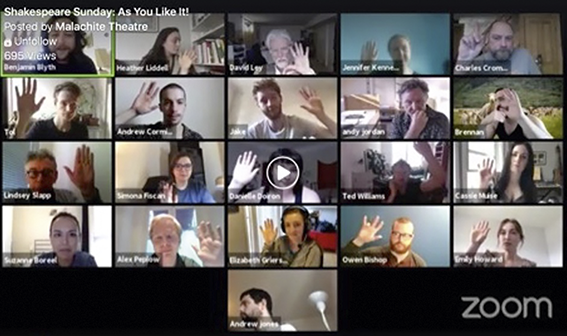
Where traditional site-specific work operates within clear distinctions between bounded ‘place’ and abstract ‘space’, Shakespeare Sunday seemed to engage in what Derrida identifies as ‘the virtualisation of space and time’ where such distinctions collapse (Derrida, Reference Derrida1994: 212). Participants simultaneously inhabited geographically distant places and a shared virtual space, responding to material and textual constraints whilst inhabiting a shared digital infrastructure. This evidences a kind of ‘generative tactics’ that uncovered theatrical affordances within corporate software never designed for performance. In Spectres of Marx, Derrida theorises a collapse of ‘presence to its representation, “real time” to “deferred time”’ (Derrida, Reference Derrida1994: 212). In Shakespeare Sunday, this became the enabling condition for viral sites, where participants are simultaneously live and mediated, present and absent, individual and collective. Consequently, the ‘site’ of Shakespeare Sunday was simultaneously everywhere and nowhere – each participant broadcasting from their own domestic space whilst collectively inhabiting a shared platform.
The ‘viral’ spread of Shakespeare Sunday suggests these experiments in virtual site-specificity have lasting innovations that extend beyond the disruption of lockdown. In troubling established definitions of the ‘site’, digital experiments conducted during the pandemic underscore the mutability of Shakespeare’s plays, a quality that enables his texts to adapt to radically different performance conditions. By embracing rather than fighting the medium’s constraints, the project produced new forms of theatrical intimacy and cultural participation.
The Show Must Go Online
Where Shakespeare Sunday generated collaborative site-making through community engagement, The Show Must Go Online (TSMGO) demonstrated how tactical responses to crisis could extend viral innovations into full-scale digital theatre production. TSMGO emerged in early 2020, launching just two days after the closure of West End theatres on 19th March. A volunteer initiative led by Rob Myles, the project, became one of the most prolific digital theatre producers of the pandemic era, mounting over forty productions in nine months, including Shakespeare’s complete First Folio in chronological order and four of Ian Doescher’s pop-Shakespeare adaptations. With over 500 creatives from sixty countries, TSMGO generated a quarter of a million views across online platforms whilst fostering an inclusive global community that welcomed performers of all experience levels, from amateurs to veterans of prestigious institutions such as the Globe, RSC, and Broadway. Beyond their artistic achievement, the company also demonstrated remarkable social responsibility, establishing an opt-in hardship fund that raised over £23,000 to support struggling performers, exemplifying how digital innovation could create both artistic connection and practical solidarity during a period of unprecedented isolation.
The speed of the company’s pandemic response was essential to its public profile. The creative team’s pre-existing Zoom experience enabled a response that outpaced institutional competitors, allowing them to prioritise deployment and engagement over perfection. Myles reflects that ‘the rudimentary nature of it in other respects kind of came second to the fact that you could activate it very quickly, which, when you’re in a time of crisis, the speed of response is often as important as anything else’ (Myles, Reference Myles2024). Unlike larger institutions that took months to develop COVID protocols, TSMGO launched through tactical exploitation of existing corporate infrastructure, embodying the temporal precision that Myles terms ‘Kairos … doing the right thing at the right time’ (Myles, Reference Myles2024). The pace of response led to a production scale that strategic organisations were unable to match.
This approach shares a tactical characteristic that practitioners throughout this Element describe variably as ‘guerrilla’, ‘bodega’, ‘punk’, or ‘fleet-footed’ Shakespeare. Myles explicitly theorises this as what he terms ‘Shakespeare from below’. Drawing from ‘history from below’ Myles compares his approach to a kind of piracy: ‘they [pirates] weren’t bloodthirsty criminals, they were oppressed people that escaped that oppression and created a far more equitable version of society for themselves’ (Myles, Reference Myles2024). Myles’s conception ‘anatomises how power is used and abused, and how people can try and navigate that world successfully or not’, positioning Shakespeare as a tool for critiquing, rather than reinforcing, hierarchical authority (Myles, Reference Myles2024). Myles connects this to historical precedent: ‘The idea of taking Shakespeare away from a big institution and putting it into the hands of people that aren’t supposed to have it has its mirror in working-class self-improvement societies from the Victorian age … Shakespeare has a pedigree for being used in that way’ (Myles, Reference Myles2024). TSMGO’s viral success indicates this democratic potential in practice – using corporate infrastructure tactically to create what Myles calls ‘all the same guerrilla aspect of rapid response to a current event that was using readily available stuff to get a message out with minimum barriers to entry’ (Myles, Reference Myles2024).
Consequently, TSMGO’s work also shares several characteristics with other companies that exhibit de Certeau’s ‘art of the weak’, developing a distinctive vocabulary in response to the conditions of their temporary performance space. Myles conceives of this theatrical appropriation as a kind of subversion of spaces controlled by others, in this case, of corporate technology: ‘We were hacking … all of these devices that Zoom had at the time in order to make them do things that they weren’t designed to do, but were useful to us’ (Myles, Reference Myles2024). Encountering Zoom as a site of performance, the company advanced a new form of virtual site-specificity that exploited Zoom’s unique affordances – from gallery view as collective stage space to the strategic use of mute buttons and screen sharing.
Some elements of the company’s tactical ‘hacking’ came quickly, as Myles notes: ‘we had already established if you turn your video on and off, that is on and off stage … creating a stage-like space, where you could see all of the actors present in the scene simultaneously’ (Myles, Reference Myles2024). Other innovations came with further experiments of Zoom’s utility for performance, however, and further exercised the tactical intelligence embedded within Shakespeare’s plays. Whilst the flat screen does not provide the three-dimensional perspective to curate a downstage/upstage, the company were able to convey proximity through camera position: ‘if there was meant to be a private conversation between two characters, we’d get them to lean closer to the camera’ (Myles, Reference Myles2024). Similarly, if the company wanted to project action or movement in a scene, this was also done through camera control: ‘I hold my laptop like so, and suddenly I can be panning it around and moving relative to my own space’ (Myles, Reference Myles2024). The company also experimented with digital effects like AR and double exposure, including one memorable example from A Midsummer Night’s Dream: ‘when we did Bottom, we used an augmented reality Shrek donkey head that just mapped onto my face’ (Myles, Reference Myles2024). Myles also found that a double exposure filter gave a ghostly quality to the performance: ‘I come in, give my performance. Then I layer that over the top, and it goes semi-transparent’ (Myles, Reference Myles2024). Replacing material props and costumes with digital effects further emphasises the tactical nature of the company’s ‘hacking’.
One of Zoom’s affordances absent from TSMGO’s performances was the use of digital backgrounds. Myles suggests this was a dramaturgical decision designed to confront, rather than obscure, the realities of Zoom performance: ‘We were never trying to pretend that this flat surface was a stage … It was always a Peep show, we thought. So, the camera was their eyes on’ (Myles, Reference Myles2024). This aesthetic philosophy connects directly to the revenant principle of shared light explored in Section 1, as Myles reflects: ‘Shakespeare especially … is shared space and shared light. So, the idea was to replicate the conditions that the audience would be watching in. i.e., their kitchens, their bedrooms, their living rooms’ (Myles, Reference Myles2024). In this way, the company’s refusal of virtual backgrounds becomes a political choice – maintaining pandemic solidarity between actor and audience. TSMGO’s domestic spaces carried the ‘ghosts’ of lockdown experience into every performance – every kitchen, bedroom, and living room became a memorial space for shared pandemic experience.
With neither actors nor audiences sharing physical space, staging Shakespeare on Zoom required a new set of negotiations for audience behaviour. Streaming Zoom rooms live to YouTube, TSMGO encouraged audience interaction through YouTube’s ‘chat’. Myles recalls:
What the chat allowed was to have a noisy audience … That didn’t interrupt the show, so there’s this constant stream of discussion and interaction. I felt like the YouTube chat allowed that to happen without it necessarily bringing what was happening on stage to a halt … more similar, really, to an arena than a theatre.
In this way, the chat function temporarily restored audience agency by offering a real-time commentary on dramatic choices and textual interpretation, whilst encouraging community formation across geographical and generational boundaries. This community, however, was a silent one, a feature that Myles identifies as a ‘missing element that we always wished we could have was the audio from the audience, so that you could hear their feedback at the same time’ (Myles, Reference Myles2024). This limitation highlights embodied aspects of performance that digital cannot fully replicate, requiring TSMGO performers to use ‘thought experiments and visualisation meditations … Imagine the audience laughter is rolling in, and every joke that you’re saying lands’ in order to recover these ‘missing’ voices (Myles, Reference Myles2024).
The company developed specific protocols for staging proxemic relationships: ‘if there was meant to be a private conversation between two characters, we’d get them to lean closer to the camera and have that conversation. So, both the listener and the speaker would come together, and then everybody else would be sitting in the back of the frame’ (Myles, Reference Myles2024). The conspiracy scenes in Julius Caesar exemplify this textual adaptability: Shakespeare’s text requires Brutus and Cassius to speak privately, signalling secrecy and urgency through their dialogue, whilst other characters remain present but excluded from their confidence. The text provides the dramatic relationships – who speaks to whom, who overhears, who remains ignorant – but prescribes neither entrance locations nor specific blocking. This openness proved particularly suited to Zoom’s constraints and affordances. As Myles explains, ‘if you’re doing a conspiracy like Julius Caesar, I can be all up in your face like this, and whisper, and that seems really intense. But I can’t do that in the theatre’ (Myles, Reference Myles2024). The camera’s capacity for extreme intimacy – impossible in traditional theatrical spaces where whispered dialogue cannot reach distant audiences – enabled TSMGO to exploit the conspiratorial urgency embedded within Shakespeare’s text through technological means. Similarly, Shakespeare’s frequent deployment of direct address and asides proved particularly effective through Zoom’s camera-facing setup, maintaining the fourth-wall-breaking eye contact that such moments require.
The company also experimented with digital effects, including augmented reality for Bottom’s transformation in A Midsummer Night’s Dream, using technology to realise metamorphoses that Shakespeare describes verbally. These innovations further demonstrate the tactical intelligence theatre-makers bring to Shakespeare’s texts, which place dramaturgical emphasis on character relationships, verbal dexterity, and flexible staging requirements. This creates plays that practitioners can activate across different technological platforms, from early modern tiring houses to corporate video conferencing software.
Whilst these features gesture towards a degree of diachronicity in site-specific Zoom performance, the form itself is synchronically associated with lockdown. Rob Myles was blunt about TSMGO’s post-pandemic prospects: ‘there is no afterlife, because it’s not sustainable’ (Myles, Reference Myles2024). The project’s tactical advantages – its speed, volunteer mobilisation, and crisis-driven innovation – proved inseparable from the emergency conditions that enabled them. The post-pandemic economic reality reveals the true cost would have been ‘in the hundreds of thousands, like 180,000, maybe 220’ if participants had been paid even £10 per hour, making the model viable only because ‘we didn’t have to think about money’ during lockdown (Myles, Reference Myles2024). More significantly, Myles identified a psychological barrier that institutional discourse avoided: ‘People don’t want to see Zoom theatre now, because it reminds them of a time that they don’t want to remember’ (Myles, Reference Myles2024). This ‘trauma response’ created a fundamental loss of appetite for digital theatre, whilst creative exhaustion set in after they had ‘explored every executional corner there was to explore’ across over fifty productions (Myles, Reference Myles2024).
Zoom Shakespeare Productions
Whilst the scale of TSMGO’s success may ultimately have prevented its post-pandemic survival, smaller initiatives like Houston-based Zoom Shakespeare Productions (ZSP) demonstrate how viral sites can evolve into sustainable, in-person, theatrical practice. Founded by Rebecca Bernstein in March 2020, ZSP emerged from the same confluence of isolation and technological opportunity that characterised the pandemic’s early days.
Bernstein’s journey into digital Shakespeare also began with a disruption: ‘In 2020, I was about to play Laura in a production of Glass Menagerie … I, like a lot of people, was feeling kind of sad and lonely and thought, let’s get some friends together on Zoom to read A Midsummer Night’s Dream’ (Bernstein, Reference Bernstein2025). The organic growth that followed mirrors the tactical emergence of Shakespeare at other viral sites, with ZSP reaching participants around the world: ‘What’s amazing is by week three … people had told their friends in Canada, and those people had told their friends in the UK, and everybody across the world had nothing to do. So, we had people joining us from the UK at 3am’ (Bernstein, Reference Bernstein2025). Bernstein describes this viral response as ‘a celebration of theatre and a celebration of Shakespeare’, transforming necessity into an international community (Bernstein, Reference Bernstein2025). Unlike TSMGO’s canonical approach, ZSP’s work developed thematically, with concept-forward productions like ‘a Game of Thrones-inspired King John’ and ‘a post-apocalyptic Macbeth’ that encouraged participants to ‘have fun with makeup’ (Bernstein, Reference Bernstein2025).
In line with other ‘punk’ or ‘guerrilla’ Shakespeare companies, there is an ‘anti-establishment’ strain to ZSP’s work. Bernstein views this as ‘tearing down the preciousness’ of Shakespeare – a philosophy that proved particularly suited to digital performance during the pandemic (Bernstein, Reference Bernstein2025). Bernstein contrasts this with approaches that ‘treat this thing as sacred and precious, and let’s stand in one place and yell it’ (Bernstein, Reference Bernstein2025). This stance enabled creative freedom on Zoom focusing on ‘people talking and kind of making it feel relevant to now’ rather than replicating conventional theatrical hierarchies (Bernstein, Reference Bernstein2025).
The transition from digital to in-person performance required both artistic vision and practical risk-taking. ‘This was around 2022, and I was thinking, I want to keep this going’, Bernstein reflects. ‘I didn’t come into this wanting to be an artistic director. It was just something fun to do initially … But I thought, let’s see if we can take some of the magic we’ve created and bring it to Houston’ (Bernstein, Reference Bernstein2025). The company launched through crowdfunding, with their Kickstarter campaign revealing how a digital community could translate into financial support: ‘seeing people who had worked with us before believing in this’ enabled the transition to live performance (Bernstein, Reference Bernstein2025). Rather than abandoning their digital origins entirely, ZSP retained their name and an ‘intimate aesthetic’ developed on Zoom. In this way, the company is an example of a pandemic revenant, where viral sites inform post-pandemic practice rather than disappearing. Indeed, the company’s mission statement (‘bringing new life to old stories in new and exciting ways with casts as diverse as our city’) demonstrates how pandemic innovations in accessibility and inclusion could become permanent features of theatrical practice (MATCH Houston, 2025).
In an account shared by several site-specific theatre makers interviewed in this Element, Bernstein attributes ZSP’s success to making Shakespeare accessible: ‘What’s been really wonderful is to hear people say, Oh, I understood the story this time’ (Bernstein, Reference Bernstein2025). The company’s evolution from pandemic necessity to sustainable practice illustrates how tactical responses to crisis can become permanent cultural innovations. By maintaining their commitment to ‘tearing down the preciousness’ whilst transitioning from digital to physical space, ZSP suggests that the experience of working on viral sites continues to influence post-pandemic theatre.
Viral Tactics
Site-specific Shakespeare during the pandemic was distinguished by its viral tactics – through the synchronous propagation of creative projects across international theatre communities facing identical constraints across new media. Digital platforms serving as sites for Shakespeare performances generated a viral response, with one company’s discoveries rapidly spreading to others. W.B. Worthen identifies this as theatre’s ‘constitutive penchant for auto remediation, recovery, or restoration framed within the affective force of nostalgia’ (Reference Worthen2021: 183), where emergency adaptation paradoxically both preserves and transforms theatrical practice.
The collaborative site-making of Shakespeare Sunday, TSMGO’s ‘Shakespeare from Below’ and ZSP’s ‘tearing down the preciousness’ all circulated across international networks at a time of unprecedented global isolation. Driven by a spike in demand, the democratising access afforded by viral sites recalls the ‘punk spirit’ among companies operating in reconstructed spaces, appropriating corporate infrastructure for temporary theatrical occupations. The pandemic’s viral sites operated through this dynamic tension, using Shakespeare’s cultural authority to justify tactical occupation of corporate platforms whilst simultaneously discovering new possibilities for democratic access and international community building.
The post-pandemic landscape reveals divergent paths for companies that experimented with viral sites. Whilst TSMGO proved unsustainable other practitioners integrated digital innovations into ongoing work. Shakespeare in the Ruff maintained its outdoor focus but adapted its weather policies, informed by pandemic flexibility. The HandleBards retained educational workshop models developed during lockdown alongside touring practice. The Container Globe’s international reading community, established out of pandemic necessity, continues as supplementary programming to in-person performances. Significantly, companies like ZSP demonstrate how pandemic-era principles – diverse casting, lowered participation barriers, international reach – can inform post-pandemic in-person work. These varied trajectories suggest that viral sites functioned as crucibles for tactical innovations that continue to influence site-specific practice, from hybrid performance models to democratised access strategies developed under significant constraints.
The same energy that propelled Shakespeare on Zoom during the pandemic also revealed fundamental limitations to the medium. Rob Myles’s identification of missing audience audio, for example, points towards the irreducible embodied dimensions of theatrical encounter that corporate platforms cannot replicate. The response associating viral sites with lockdown created a fundamental loss of appetite for digital theatre, as Rob Myles notes: ‘people don’t want to see Zoom theatre now, because it reminds them of a time they don’t want to remember’ (Myles, Reference Myles2024). Post-pandemic economic reality revealed the true cost of TSMGO’s volunteer model, whilst creative exhaustion set in after companies had ‘explored every executional corner there was to explore’ (Myles, Reference Myles2024).
6 Future Sites
Given that a revenant is always called upon to come and to come back, the thinking of the spectre, contrary to what good sense leads us to believe, signals toward the future
We always hope the work grows with every play, you know, and we always hope funding changes.
Throughout this Element, we have encountered site-specific practitioners who turn economic precarity into creative freedom, transform spatial constraints into dramaturgical opportunities, and convert institutional exclusion into democratic accessibility. From Shakespeare BASH’D asking ‘what’s the cheapest way we can put on a Shakespeare play?’; to Come You Spirits’ staging Macbeth under a moonlit rainbow at the Esperance Stonehenge; to the Drilling Company’s ‘bring your own chair’ model that and sparked replicas in parking lots ‘as far away as New Zealand’; site-specific theatre makers around the globe turn financial disadvantages into creative opportunities at sites they do not control, producing thrilling new encounters with Shakespeare’s plays.
Across these five sections, practitioners have demonstrated Shakespeare’s capacity for spatial adaptation through tactical responses to constraints through sited performance, manifesting in flexible staging directions, architectural responsiveness, opportunities for audience address, portable scenic effects, and an environmental responsiveness that encourages site-specific meaning-making. These companies have navigated challenges by prioritising speed over perfection, adaptation over control, and community over institution, illustrating how Shakespeare’s embedded tactical intelligence enables rapid responses to unforeseeable future challenges, with site-specific practice emerging as a form of cultural survival during the pandemic.
Yet the very qualities that distinguish site-specific Shakespeare – its opportunism, grassroots engagement, and fleet-footed responsiveness – pose structural challenges when scaled. The ability to react creatively to unforeseeable circumstances – like broken heating systems, passing eagles, or even social distancing – reflects resilience in the face of challenges that can’t be predicted or planned. This opportunism relies on an agility that management can’t schedule a year in advance and large-scale grassroots mobilisation requires unsustainable volunteer labour. In this way, this adaptive responsiveness thrives on restrictions but falters when constraints become systemic. Peter Stickney of The Lord Chamberlain’s Men recognises this tension: ‘running a completely commercial organisation’ whilst taking creative risks creates challenges that ‘don’t necessarily sit together’ (Stickney, Reference Stickney2024). Similarly, when Shakespeare BASH’D moved from bars to theatres, they worried, ‘Are we going to lose what is so special about what we do?’ (Nish-Lapidus and Wallace, Reference Nish-Lapidus and Wallace2024). When companies try to future-proof this elusive quality of site-specific performance, they risk losing the unpredictability that enables tactical response in the first place.
Consequently, ‘future sites’ operate as both literal spaces these companies must navigate – climate-disrupted landscapes, digitally mediated platforms, contested colonial territories – and conceptual territories where tactical intelligence meets unprecedented systematic challenges. This raises new questions for the future of site-specific Shakespeare. In this Element, practitioners bring ‘tactical intelligence’ to Shakespeare’s plays in performance at revenant, found, shifting, green, and viral sites – but what does this capacity mean for future cultural practice when constraints themselves are rapidly intensifying? Unconventional theatre spaces from asylum chapels to corporate software platforms unlock adaptive capacities within early modern dramatic texts – but which spaces remain resistant, and what new sites are emerging? Contemporary site-specific companies navigate challenges and opportunities through tactical intelligence developed in response to immediate pressures, but can this ‘art of the weak’ scale sustainably, or does it represent a fundamentally different model of cultural resilience?
In confronting these questions, the interviews in this Element reveal an alarming reality: access to arts funding is increasingly restrictive for smaller and emerging organisations across the Western world. In the United Kingdom, the Campaign for the Arts noted that ‘the Arts Council’s budget decreased by 18% in real terms between 2009–10 and 2022–23’ (Campaign for the Arts, 2023), meaning that by 2029 the government is projected to be spending well over a third less per citizen on Culture, Media & Sport in real terms compared with 2010 (Museums Association, 2025). The Canada Council for the Arts will also ‘lower its current spending incrementally over three years: $3.63 million in 2024–25, $7.33 million in 2025–26 and $9.88 million in 2026–27 and going forward’ (Canada Council for the Arts, 2025). Artists in the United States face an even starker crisis. The Biden administration had proposed $210.1 million for the National Endowment for the Arts in 2024, but the Trump administration has since proposed eliminating the National Endowment for the Arts and has begun cancelling NEA grants to ‘hundreds of arts groups’ (NPR, 2025). These funding cuts reveal a two-tier system where established institutions maintain a reduced, but protected, level of core funding, whilst smaller site-specific companies – locked out of institutional stability by an invisible glass ceiling – bear the brunt of reductions, compelling them to perfect the tactical innovations this research documents as both creative necessity and structural exclusion.
The private sector has responded similarly, resulting in a broader decline in financial support. In Canada, this is compounded by decreasing corporate backing for Shakespeare programming, attributed to its colonial associations. Rodrigo Belifuss specifically observes reduced corporate support for SIR:
They’ve distanced themselves from anything called Shakespeare. I’ve noticed that for sure … we’ve lost funding from TD Bank and also from Canada Life insurance companies … TD Bank said something like ‘While we appreciate your endeavours to highlight the classical canon, it’s not aligned with our current priorities right now’. So, 100% a fear of anything that could be deemed as colonial, right?.
For theatre makers, the irony is stark – companies performing progressive, site-specific Shakespeare that actively advance decolonial conversations face funding cuts precisely because their work challenges the same colonial associations that corporate sponsors fear being linked with.
Some tactical innovations are emerging, and the corporate retreat in North America has generated some unexpected counterbalances at the community level. Belifuss observed ‘a massive increase in private donations and individual giving … It’s the work that people want to support’ (Belifuss, Reference Belifuss2024). Individual donors value the political and artistic risk-taking that institutions find commercially dangerous. Houston-based ZSP successfully used crowdfunding to transition from online to live performance, with their Kickstarter campaign demonstrating how a digital community translates into financial support. Edmonton, Alberta’s Freewill Shakespeare Festival have recently launched a ‘Save Freewill’ fundraising campaign. The HandleBards have also developed a diversified funding model combining box office, merchandise, private donations, and education fund contributions, providing creative freedom through financial diversity: ‘our funding comes from lots of different places. So we’re not necessarily beholden to huge sponsors or donors’ (Orton, Reference Orton2024). The HandleBards’ move to NPO status would ‘massively increase their community and education output’, whilst reduced funding forces artistic compromises elsewhere.
These funding pressures raise fundamental questions about the scale and sustainability of site-specific work. David Horak, Artistic Director of the Freewill Shakespeare Festival, describes a direct correlation between decreased funding and scope: ‘Our funding has been dropping, so my cast has gotten smaller. We used to have 16–17 members of the cast … But lately I’ve been doing about 10 or so’ (Horak, Reference Horak2024). This represents significant artistic constraint in an environment where ‘shows are increasingly 4 to 5-handers’. Horak’s account echoes Rob Myles’s estimation that TSMGO would have cost ‘£180,000, maybe £220,000 … and that’s only paying everybody 10 pounds an hour’ for the thirty-plus people involved. Instead, the work was done ‘completely voluntarily’ – meaning hundreds of thousands of pounds worth of labour subsidised what appeared to be a cost-effective digital innovation.
This scarcity of funding for site-specific Shakespeare is not for lack of trying. Myles notes he’s had ‘fifteen funding rejections this year’ and that ‘all of those required unpaid labour to do’, revealing the compounding effect of the funding crisis: artists must donate labour both to apply for funding they won’t receive and to create the work that funding would have supported (Myles, Reference Myles2024). The ‘opportunism’ and ‘fleet-footed responsivity’ celebrated in site-specific work operate in an industry that either reduces the number of jobs for artists or requires artists to accept poverty wages, or no wages at all. The recurrence of this phenomenon throughout this study represents a form of endemic structural violence across international arts sectors. The ‘tactical innovations’ documented throughout this study are, for many, not just creative solutions, but survival strategies built on unsustainable labour that this crisis in central funding renders invisible.
Emerging from the pandemic into this funding landscape, several companies recognise they are at pivotal moments. Peter Stickney of The Lord Chamberlain’s Men articulated being at an ‘inflexion point’ with multiple future pathways, including international expansion and all-female work, whilst prioritising ‘nimbleness’ over permanent homes (Stickney, Reference Stickney2024). This reflects a broader trend towards mobility and adaptability rather than institutional permanence. At Shakespeare’s Globe, Will Tosh conceives a future of maturation rather than expansion as the Globe continues to ‘grow into itself’ (Tosh, Reference Tosh2024). This includes moving beyond Original Practices, reflecting that whilst the Globe has been seen as ‘the motherlode for that kind of practice … with a number of years in an institution, you go through those phases and then do other things’ (Tosh, Reference Tosh2024). Angus Vail states that scalability is ingrained in the Container Globe’s design: ‘I can just go and buy a bunch more containers and fabricate them and bang on another ring … hopefully make some money and build it’ (Vail, Reference Vail2024). The cost of materials means the design is replicable; other Container Globes could ‘pop-up’ without significant capital investment, and the venue is mobile, having been previously relocated from Jersey City to Detroit.
Not all reconstructed revenants focus on maturation and flexibility. Jim Warren is in an advanced, but delicate, stage of fundraising towards the ‘American Globe Center’ project in Norwich, Connecticut, which will include a reconstruction of the 1614 Globe. Designed by Peter McCurdy and ‘built with Elizabethan/Jacobean building methods and materials along with modern safety and ADA elements’, the 1614 Globe ‘will be the only one of its kind in the world’ (American Globe Center, 2025). Warren’s focused on creating ‘a destination theatre’ at the site, although the project has faced municipal resistance: ‘the mayor preferred a food truck court’ (Warren, Reference Warren2024).
These questions of funding and scale are inextricably linked to how site-specific companies engage with their communities. A striking theme across interviews was the urgent need to bridge the gap between professional Shakespeare companies and their audiences. Jake Raiter from the ASC highlighted the challenge that many residents feel ‘alienated’ by professional theatres in their towns, saying ‘I’m not a Shakespeare person, and I don’t really care about theatre’ (Raiter, Reference Raiter2025). Raiter’s advocacy for companies to invest in community-bridging work recognises that long-term sustainability depends on local engagement. This alienation reflects a broader risk posed by extractive cultural practices in touring models, where companies extract revenue from communities without meaningful investment in local development.
Several site-specific companies have developed innovative approaches to audience engagement in order to address this alienation. Shakespeare in the Ruff produces exciting visual choreography to draw passersby. Patricia Allinson describes their tactical approach: ‘Often people find us by just walking by, and a little bit they get tricked into watching our performance’ (Allinson and Yung, Reference Allinson, Yung and Blyth2024). The HandleBards articulate a similar philosophy of transformational accessibility. Will Orton describes how their performances ‘transform a space that might just be where you walk your dog or a local park into something that’s a little bit magical for a little bit of time’ (Orton, Reference Orton2024). This approach ‘lets people realise that art and good art is and should be where they are and where they’re from, and they should be able to walk from their homes and see it’ (Orton, Reference Orton2024). Educational programmes are also emerging as a form of community investment in site-specific work. The Lord Chamberlain’s Men emphasised cultivating younger audiences as ‘theatregoers of the future’, viewing education programmes as essential rather than supplementary. Rob Myles advocates for institutional collaboration that ‘leaves the ladder down behind you’ so ‘the new generation start a few steps further ahead’, advocating sustainable knowledge rather than extractive cultural practices (Myles, Reference Myles2024).
The anxieties shared by companies across this study evidence a wider structural problem, with consequences for how the art form is funded around the world. The evidence gathered here suggests that the future vitality of site-specific Shakespeare (and grassroots Shakespeare more broadly) lies not in scaling up, but in spreading out. A single large federal grant absorbed by one institution creates one company, one product, and one type of career opportunity – most often to those with privileged access, who are able to build up a body of work without remuneration. Distributed across several small companies, the same quantity of capital investment would generate multiple productions, multiple employment pathways, and multiple communities of engagement: reaching not merely wider audiences, but deeper ones, in the neighbourhoods, parks, parking lots, and found spaces that strategic institutions cannot or will not occupy. As Rob Myles observes, concentrating Shakespeare funding in one building means that building gets to decide what kind of Shakespeare gets made – and, crucially, who gets to make it. Site-specific Shakespeare has consistently demonstrated its capacity to serve as a gateway into the arts for performers from less privileged backgrounds, offering formative, low-barrier work that builds careers from the ground up, in the communities those artists will ultimately represent and serve.
Looking ahead, today’s site-specific Shakespeare practitioners also serve as climate witnesses, documenting environmental change in real time through site-based performance. Notably, Shakespeare in the Ruins experienced a forty-degree temperature swing – from 2°C to +38°C within three weeks – and faced first-ever smoke cancellations when ‘the air was just thick with smoke’ from wildfires (Belifuss, Reference Belifuss2024). Horak describes similar extremes in Edmonton, Alberta: ‘This year it was very cold at the opening. People were wearing sweaters, and then by the end … we had to cancel a few shows because it was too hot’ (Horak, Reference Horak2024). This is forcing fundamental seasonal restructuring. In Australia, Jo Bloom describes abandoning traditional summer programming: ‘I’m seeing a trend in other companies, going, we’re just not really going to do summer. It’s too risky’ (Bloom and Mayer, Reference Bloom and Mayer2024). The physical demands of outdoor performance become dangerous in extreme heat. Climate change represents more than operational adjustment – it’s ‘the defining challenge of contemporary outdoor performance’, requiring new forms of tactical intelligence for environmental partnership rather than control. These extreme weather patterns are compelling companies to develop what Dave Horak identifies as a regulatory gap where environmental policy hasn’t ‘quite caught up to the fact that there’s an environmental change’ (Horak, Reference Horak2024). The tactical intelligence emerging from these conditions requires companies to operate as environmental witnesses, documenting and responding to climate change through embodied practice.
Alongside the environmental crisis, engagement with the land has become central to contemporary site-specific Shakespeare, and extracting the plays from the abuses of British colonial education. Yet the challenge extends beyond acknowledgement to fundamental questions about authority and relationship. Madeline Sayet’s solo performance, Where We Belong, reveals the profound difference between Indigenous and settler relationships to land – for Indigenous peoples, land is a living relation rather than a performance venue, home rather than a backdrop. Sayet’s navigation between Mohegan homelands and English theatrical spaces illuminates what she calls the ‘doubleness’ that Indigenous artists must navigate when engaging colonial cultural forms whilst asserting Indigenous sovereignty.
This tension runs throughout the companies examined here, creating what Charlie Mayer from CYS describes as the need for respectful address to Indigenous land. The company has evolved from conventional land acknowledgements to what Mayer calls active discourse. This shift from speaking ‘to the audience’ about Indigenous country to ‘calling out to Bunjalung’ suggests an attempt to move beyond performative acknowledgement towards a genuine relationship. However, the question of whether settler-led companies can truly decolonise their practice, or whether such work requires Indigenous leadership, remains unresolved but increasingly urgent as the climate crisis intensifies disputes over land use, water rights, and resource extraction. As CYS note, ‘deep healing of the land’ requires future Indigenous leadership rather than settler practice alone.
Alongside decolonisation and the climate crisis, digital advances are causing rapid re-encounters between Shakespeare’s texts and their performance sites. The pandemic ‘hacking’ that Rob Myles identified in Zoom Shakespeare represents another form of tactical cultural intelligence in site-specific work. Shakespeare Sunday’s growth into an international community demonstrates how viral sites created cultural relationships that transcend traditional institutional boundaries, generating forms of cross-cultural dialogue impossible in traditional theatres. Whilst this capacity for simultaneous local presence and global community challenges fundamental assumptions about cultural authority and institutional control, tactical operations like Zoom Shakespeare remain vulnerable to strategic control by platform owners.
Another future site may exist in hybrid models that integrate rather than abandon the digital tactical intelligence developed during the pandemic. Jim Warren’s vision for a ‘Netflix-type subscription thing’ at the American Globe Center, which offers exclusive content to remote audiences, represents sophisticated thinking about virtual community building before audiences can ‘make the pilgrimage’ to physical performance (Warren, Reference Warren2024). This hybrid approach treats digital engagement as a complement rather than a replacement for live encounter, maintaining ‘shared light’ principles across multiple platforms whilst pointing towards a more accessible community engagement. The persistence of hybrid models depends on recognising this tension between digital democratisation and platform dependency. The most sustainable future approaches will combine global digital reach with local physical presence, using technological tools to enhance rather than replace live encounters. Yet the question remains whether cultural democracy remains accessible only during emergency conditions, when conventional power structures temporarily collapse. Climate change, economic precarity, and potential future disruptions will require the adaptive capacity that digital experimentation pioneered – not merely as crisis response, but as ongoing cultural practice.
The challenges of the 2020s – climate crisis, economic precarity, societal disruption, and technological advances – require exactly the adaptive capacity these companies have developed through decades of site-specific practice. The tactical intelligence that enables practitioners to engage freezing chapels and military heritage sites with Shakespeare’s plays translates to tactical responses to Zoom and YouTube. What emerges for site-specific Shakespeare are future-facing survival skills rather than nostalgic craft preservation. This evolutionary pressure towards flexibility rather than institutional permanence appears across multiple companies profiled in this Element, companies that demonstrate the capacity to transform constraints into creative opportunities whilst maintaining artistic commitments under unpredictable conditions.
There are lessons here from the pandemic, when the world turned to Shakespeare to create and sustain community amid global isolation. In this regard, the real-term benefits of site-specific performance are clear. ‘Shakespeare from below’, offers one vision of this future, where even a fraction of the investment earmarked for buildings is invested in supporting the human beings that fill them.
The ‘Guerrilla Shakespeare’ that emerges across cultures and contexts suggests Shakespeare’s texts function as tools for cultural rebellion rather than institutional authority in site-specific performance around the world. Crucially, the companies profiled here demonstrate that effective practice requires investment in people rather than spaces – that the ‘art of the weak’, properly supported, generates rich and lasting cultural encounters. The persistence of a ‘punk’, ‘pirate’, and ‘bodega’ spirit across technological and social change suggests that the tactical intelligence embedded within Shakespeare’s spatial dramaturgy continues returning as a Derridean revenant, where Shakespeare’s theatrical ghosts refuse to stay buried, haunting contemporary performance with possibilities that remain as rebellious now as they were 400 years ago.
W. B. Worthen
Barnard College
W. B. Worthen is Alice Brady Pels Professor in the Arts, and Chair of the Theatre Department at Barnard College. He is also co-chair of the Ph.D. Program in Theatre at Columbia University, where he is Professor of English and Comparative Literature.
Advisory Board
Pascale Aebischer, University of Exeter
Todd Landon Barnes, Ramapo College of New Jersey
Susan Bennett, University of Calgary
Rustom Bharucha, Jawaharlal Nehru University, New Delhi
Gina Bloom, University of California, Davis
Bridget Escolme, Queen Mary University of London
Alan Galey, University of Toronto
Douglas Lanier, University of New Hampshire
Julia Reinhard Lupton, University of California, Irvine
Peter W. Marx, University of Köln
Sonia Massai, King’s College London
Alfredo Michel Modenessi, National Autonomous University of Mexico
Robert Shaughnessy, Guildford School of Acting, University of Surrey
Ayanna Thompson, George Washington University
Yong Li-Lan, National University of Singapore
About the Series
Shakespeare Performance is a dynamic collection in a field that is both always emerging and always evanescent. Responding to the global range of Shakespeare performance today, the series launches provocative, urgent criticism for researchers, graduate students and practitioners. Publishing scholarship with a direct bearing on the contemporary contexts of Shakespeare performance, it considers specific performances, material and social practices, ideological and cultural frameworks, emerging and significant artists and performance histories.