1 Introduction
Alignment behavior has long been a core area of inquiry in the study of international relations (IR). Alignment is about how a state positions itself vis-a-vis other actors, especially the bigger or stronger ones. It reflects a state’s propensity to power – specifically, the power to harm and help in the anarchic international system. Accordingly, alignment involves a state’s choices to position itself with and/or against principal sources of danger and support. Such choices (and associated actions-reactions) determine how proximate/distant a state maintains its relations with the major actors, where their actions converge/diverge, as well as in what ways and to what extent the mighty actors’ power is embraced, partially accepted, partially resisted, selectively leveraged, and/or rejected.
This Element is about the alignment choices of “middle states,” that is, the lesser powers that are sandwiched between two or more competing great powers. As US–China rivalry intensifies across the globe especially in the Indo-Pacific region, the vast majority of the middle states in the region – and beyond – are not taking sides with either of the rivalling powers. Instead, they are actively pursuing neutral, inclusive approaches to diversify ties, offset risks, and keep options open amid growing uncertainties.
Some theorists have called such insurance-seeking approaches “hedging,” a term brought into the field of IR from other disciplines in the 1990s (Lake, Reference Lake1996; Pollack, Reference Pollack and Shinn1996; Art, Reference Art1999; Johnston & Ross, Reference Johnston, Ross, Johnston and Ross1999; Edelstein, Reference Edelstein2000). Initially, hedging was primarily used to describe the post-Cold War strategies of the major and next-tier powers (Heginbotham & Samuels, Reference Heginbotham and Samuels2002; Art, Reference Art, Paul, Wirtz and Fortmann2004; Medeiros, Reference Medeiros2005; Foot, Reference 85Foot2006; Tunsjø, Reference Tunsjø2010; Tessman & Wolfe, Reference Tessman and Wolfe2011). However, since the mid-2000s, a growing number of scholars have employed the term to depict the small- and medium-sized Southeast Asian states’ “neutrality-plus” responses to big-power competitions and courtships (Chung, Reference Chung2004; Goh, Reference Goh2005; Roy, Reference Roy2005; Ciorciari, Reference Ciorciari2007, Reference Ciorciari2009; Kuik, Reference Kuik2008, Reference Kuik2016a, Reference Kuik and Shambaugh2022; Lim & Cooper, Reference Lim and Cooper2015; Haacke, Reference 86Haacke2019; Shambaugh, Reference Shambaugh2020; Wen, Reference Wen2022). The responses are “neutral” in that their goal is not to choose sides; they are “plus” as such a goal is typically pursued through a bundle of active, inclusive, and adaptive approaches (see Section 2) to insure against multiple risks of uncertainties (Kuik, Reference Kuik2023a, Reference Kuik2024b, Reference Kuik2026).
Over time, more scholars have come to use “hedging” as a concept to challenge “balancing” and “bandwagoning,” the dominant schools of thought in IR to explain state alignment choices toward an ascendant power (Goh, Reference Goh2005, Reference Goh2016; Han, Reference Han2008; Kuik, Reference Kuik2008, Reference Kuik2010, Reference Kuik2013; Chung, Reference Chung2009; Chan, Reference Chan2012; Korolev, Reference Korolev2016; Murphy, Reference Murphy2017; Ba, Reference Ba, Ebert and Flemes2018; Koga, Reference 89Koga2018; Tran & Sato, Reference 98Tran and Sato2018; Ciorciari & Haacke, Reference Ciorciari and Haacke2019; Chang, Reference Chang2022; He & Feng, Reference He and Feng2023; Marston, Reference Marston2023, Reference Marston2024). The “balancing” school posits that, when driven to preserve their security (Waltz, Reference Waltz1979), states – especially weaker ones – tend to perceive a rising power as a growing threat that must be counter-checked by alliance (external balancing) and armament (internal balancing). This is particularly so if the major power’s aggregate capabilities are accompanied by geographical proximity, offensive capabilities, and offensive intentions (Walt, Reference Walt1985, Reference Walt1987). The “bandwagoning” school, by contrast, contends that, instead of siding with others to contain an emerging power, weaker states often subordinate themselves to the rising power in exchange for profit (Schweller, Reference Schweller1994; Schroeder, Reference Schroeder1994; Sweeney & Fritz, Reference Sweeney and Fritz2004) or security (Walt, Reference Walt1985), especially if leaders of weaker states view the rising power as a principal patron that can be leveraged to preserve their own interests (David, Reference David1991).
The dominant theories, however, do not explain all state behaviors at all times. Over the past decades, growing research has indicated that the two mainstream propositions do not accurately reflect the reality in different parts of the world – not only East and South Asia, but also Australasia, Central Asia, Europe, Latin America, and the Middle East (Clarke, Reference Clarke, Horesh and Kavalski2014; Hoo, Reference Hoo2016; Lim & Mukherjee, Reference Lim and Mukherjee2019; Chan, Reference Chan2020; Rangsimaporn, Reference Rangsimaporn2023; He & Feng, Reference He and Feng2023; Spektor, Reference Spektor2023; Tunsjø, Reference Tunsjø2013; Cook et al., Reference Cook, Bilhar, Ohle and Han2024; Kara, Reference Kara2024; Bakir & Al-Shamari, Reference Bakir and Al-Shamari2025). More and more scholars are asserting that, under the current circumstances, few states are pursuing balancing or bandwagoning in the strict sense of the words. Instead, most states have adopted a hedging policy that has been variously described as a “middle” position or a “mixed” strategy (Goh, Reference Goh2005; Kuik, Reference Kuik2008, Reference Kuik2016a; Le, Reference Le2013; Tunsjø, Reference Tunsjø2013; Tan, Reference Tan2020; Gerstl, Reference Gerstl2022; Kobayashi & King, Reference Kobayashi and King2022), an “opposite” position with “mutually counteracting” measures (Kuik, Reference Kuik2008, Reference Kuik2016a, Reference Kuik2024a; Jackson, Reference Johnston2013; Anwar, Reference Anwar2022; Parks, Reference Parks2023; Marston, Reference Marston2024; Pacheco Pardo et al., Reference Pacheco Pardo, Koga, Jing and Jo2025), an “ambiguous” act (Lim & Cooper, Reference Lim and Cooper2015; Haacke, Reference 86Haacke2019; Chang, Reference Chang2022), a “prudent” practice (Jones & Jenne, Reference 88Jones and Jenne2022), a “policy without pronouncement” (Kuik, Reference Kuik2020, Reference Kuik2025), a “risk-management” approach (Haacke & Ciorciari, Reference Haacke and Ciorciari2022; Heng, Reference Heng2022; Kuik, Reference Kuik2008, Reference Kuik2023a), a “multi-vector” policy (Kakachia et al., Reference Kakachia, Lebanidze and Kakabadze2024; Kukeyeva, Reference Kukeyeva2025), “active non-alignment” (Heine et al., Reference Heine, Fortin and Ominami2025), or “a category of neutrality” (Figiaconi, Reference Figiaconi2025).
By the mid-2020s, the idea of strategic hedging as state behavior – parallels to the notions of agricultural hedging, financial hedging, and linguistic hedging in various knowledge disciplines (discussed in Section 2) – has grown into a research program with expanding analytical themes and cross-disciplinary insights. As alignment behavior, strategic hedging has been applied to growing empirical cases beyond contemporary Asia, including nineteenth-century Siam (Mendiolaza et al., Reference Mendiolaza, Rich and Muraviev2022), nineteenth-century Europe (Haas, Reference Haas2021), early twentieth-century Europe (Simón & Figiaconi, Reference Simón and Figiaconi2024), Second World War South America (Bilhar et al., Reference Bilhar, Han, Ohle and Cook2023), early Cold War Europe (Castillo & Downes, Reference Castillo and Downes2023), Cold War Southeast Asia (Kuik, Reference Kuik2024b; Yao, Reference Yao2025), the secondary members of BRICS+ (Kuik & Razak, Reference Kuik, Razak, Tang and Wong2025), and the Global South countries’ agency in global order transition (Laïdi & Tiberghien, Reference Laïdi and Tiberghien2026). In addition, as a strategic logic, hedging has also been adopted beyond military security (Liao & Dang, Reference Liao and Dang2020; Kuik & Tso, Reference Kuik and Tso2022; Nguyen, Reference Nguyen and Myers2023; Yan, Reference Yan2023; Vidal López et al., Reference Vidal López, Pelegrín Solé and Gonzalez-Pujol2024; Zhao, Reference Zhao2025; Valockova, Reference Valockova2026) and even beyond the discipline of IR (Mendiolaza et al., Reference Mendiolaza, Rich and Muraviev2022; Schindler & DiCarlo, Reference Schindler and DiCarlo2022).
This brief intellectual history of strategic hedging highlights that while the research program is far from being a research paradigm, its insights have gained traction across disciplines and progressed across themes. However, problems and gaps remain. Medeiros (Reference Medeiros2005: 164) commented that hedging is “highly underdeveloped both in the international relations theory and the security studies literatures.” More than a decade later, Haacke (Reference 86Haacke2019: 376) identified several shortcomings in IR hedging literature, including “the conceptual looseness of hedging, divergent specific definitions, as well as a level-of-analysis issue.” Liff (Reference Liff2019) opined that the concept of hedging and associated methods “are heavily contested.” Their observations, by and large, still hold true today, as indicated by the lack of a consensual definition of the term among IR scholars. Jones and Jenne (Reference 88Jones and Jenne2022: 207) criticize “the underlying problem of rationalism” in the risk management interpretations among hedging scholars. Instead, they propose an alternative conceptualization of hedging as “a counsel of prudence in the conduct of statecraft that fits strategic ends to limited means.” Aside from conceptual and ontological issues, some critiques further point out that the negative aspects of hedging remain under-examined in the literature (Chong, Reference Chong and Huang2016).
A more fundamental issue is the scarcity of systematic attempts to theorize hedging as state behavior. Thus far, hedging literature has focused primarily on conceptualizations of the term, in varied and contested forms, as noted, and with uneven applications in a wide array of empirical cases. Few attempts have been made to theorize hedging as an alignment choice. While some works have developed a number of pertinent analytical building blocks (such as cost–benefit calculations, “risk-contingency” and “returns-maximizing” options, strategic offsets), these parameters have not been turned into a coherent theoretical framework (exceptions include He & Feng, Reference He and Feng2023). To date, theorizing efforts have been confined primarily to “how” states hedge and “what” states hedge about (examples include Goh, Reference Goh2008; Kuik, Reference Kuik2016a, Reference Kuik2016b, Reference Kuik2024b; Strating, Reference Strating2020a; Castillo & Downes, Reference Castillo and Downes2023; Lee, Reference Lee2024). Relatively few studies address “when” and “why” states hedge (exceptions include Chung, Reference Chung2009; Kuik, Reference Kuik2020, Reference Kuik2021, Reference Kuik2023a, Reference Kuik2024b; Keating & Ruzicka, Reference Keating and Ruzicka2014; Wang, Reference Wang2018; Wu, Reference Wu2019; Meijer & Simón, Reference Meijer and Simón2021; He & Feng, Reference He and Feng2023; Zha, Reference Zha2025). Theoretical attempts to systematically explain “when” hedging shifts to/from other forms of alignment choice and “why” similarly situated states hedge differently are practically absent.
This Element aims to bridge these gaps by refining conceptual elements and reframing theoretical explanations of strategic hedging. It performs these tasks by developing an applicable framework to identify the primary conditions under which hedging emerges, evolves, and ends, as well as explain why middle states, confronted by similar power circumstances (asymmetries, rivalries, and uncertainties), opt to hedge differently. The framework helps tie together existing analytical building blocks and turn them into a coherent hedging theory in the study of IR, with stimulating applicability across domains and disciplines.
This Element is important for three reasons: First, it addresses the lack of consensus on how best to define strategic hedging by offering a cross-disciplinary conceptualization that unpacks the underlying logics of hedging as human behavior at the international level. This conceptualization identifies attributes, antecedent conditions, and other common denominators that are observable in all hedging behavior across the various domains of human activity. This is a vital starting point to understand strategic hedging, because sovereign actors hedge in ways similar to commodity traders, farmers, financial investors, academic writers, lawyers, politicians, and individuals in organizations characterized by intense power dynamics and immense uncertainties. When stakes are high and situations uncertain, human actors hedge.
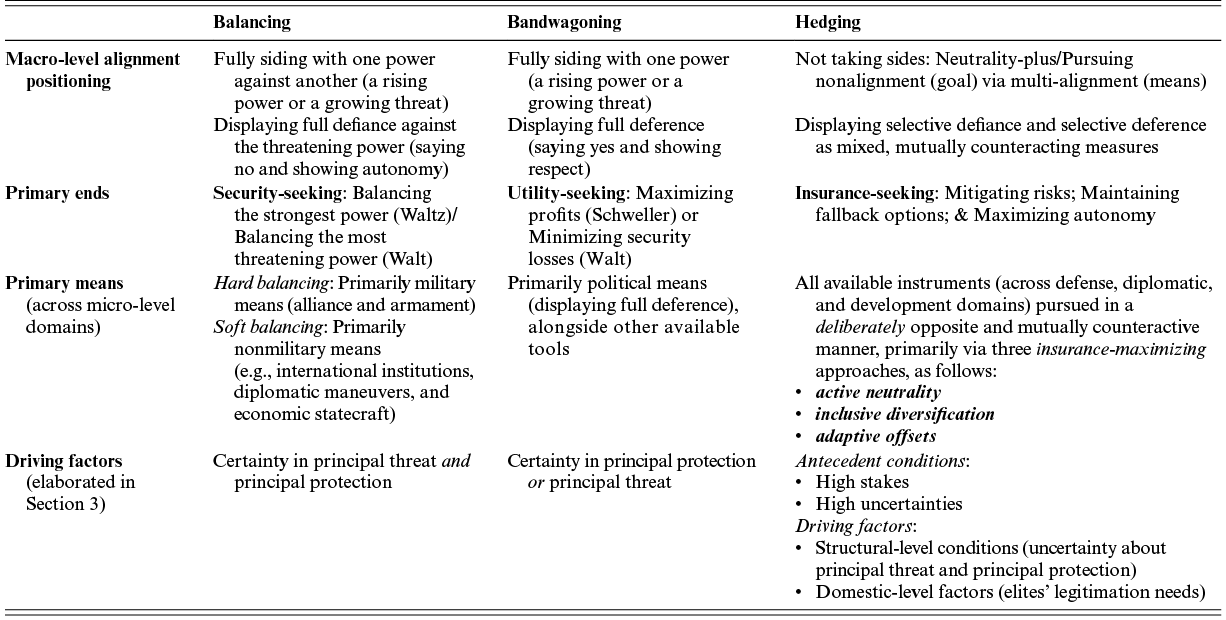
Hence, in this study, hedging is defined as insurance-maximizing alignment behavior under conditions of high-stakes and high-uncertainties, where state actors seek to mitigate risks and maintain fallback maneuverability by pursuing active neutrality, inclusive diversification, and adaptive offsets vis-à-vis the competing powers. Hedging is about not taking sides, but not taking sides is not the same as not taking positions. Far from being passive, isolative, or static (as misconceived by many observers), hedging is active, inclusive, and adaptive. This conceptualization is detailed in Section 2, which includes a table that shows how hedging is conceptually distinct from balancing and bandwagoning (see Table 1).
Such cross-disciplinary definition not only contributes to knowledge accumulation but also highlights strategic hedging as a product of two-level dynamics. That is, while “high-uncertainties” are largely a matter of structural-level processes, the interpretations of and responses to “high-stakes” – what stakes, what risks, and how best to hedge against these risks – are necessarily domestic-level issues. After all, it is the governing elites of the day who define stakes and (un)certainties, decide which interests to prioritize, which risks to emphasize (and de-emphasize), as well as determine which approaches to pursue, for what ends, and at what price (or tradeoffs).
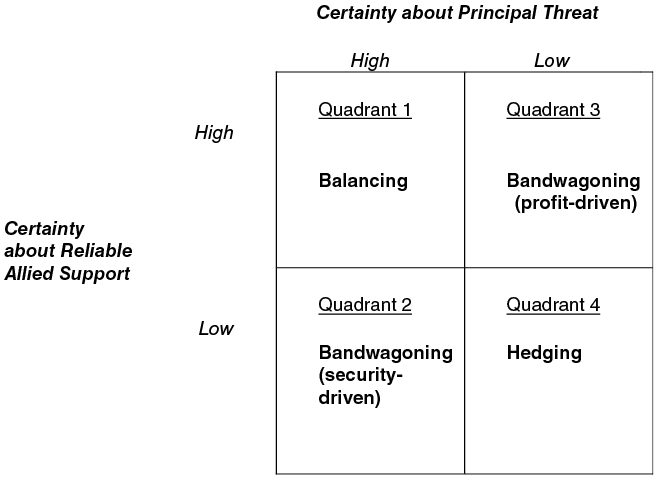
Second, this Element goes beyond conceptualization by developing a two-level hedging theory. The theory engages and complements He and Feng’s “preference-for-change” model (Reference He and Feng2023) and related theoretical work aimed at explaining the dynamic complexities underpinning state alignment decisions under different conditions. While He and Feng’s model concentrates on the macro-dynamics during the period of order transition, this Element’s hedging theory covers both the macro-drivers and micro-determinants – including how structural-level effects are filtered by domestic-level factors – in order to explain the pace of the shifts and the variations in alignment choices across comparable cases. I develop this theory in Section 3, where I present a two-level explanation: while structural drivers largely explain when an alignment shift occurs (from non-hedging to hedging, or vice versa), domestic drivers explain how and why states hedge the ways they do. These structural variables are elaborated in Section 3, which includes a 2×2 matrix that indicates how different combinations of systemic conditions drive different alignment choices, that is, balancing, security-driven bandwagoning, profit-driven bandwagoning, and hedging (Figure 1).
This two-level hedging theory differs from Robert Putnam’s (Reference Putnam1988) “two-level game” model in an important aspect. Unlike the Putnam model that focuses on cross-level bargaining, the hedging theory focuses on cross-level filtering, where the effects of systemic conditions are defined and deciphered based primarily on the elites’ domestic political needs. Filtering the structural effects and framing the elites’ internal political needs are the interplay of the deeper micro-determinants of a state’s external alignment choices. This is not a trivial issue, because states do not make decisions, the elites do; and they make choices based on – first and foremost – their own legitimation-driven necessities at home. Ultimately, the elites decide the state’s prioritized ends, preferred means, and acceptable tradeoffs based on these necessities.
The Element thus presents one of the first systematic and generalizable theories to explain hedging in IR. This hedging theory explains not just the shifts in alignment choices (e.g., from balancing to hedging, from hedging to balancing), but also the major variations in alignment decisions (e.g., heavy hedging versus light hedging). These analytical focuses (elaborated in Sections 4, 5, and 6, respectively) complement He and Feng’s After Hedging, both in terms of typology and explanatory variables. All in all, the hedging theory analyzes how different combinations of external and internal factors drive, limit, and shape lesser powers’ alignment choices. The framework echoes and enriches the neoclassical realist’s basic proposition (Rose, Reference Rose1998; Rathbun, Reference Rathbun2008; Lobell et al., Reference Lobell, Ripsman and Taliaferro2009; Ripsman et al., Reference Ripsman, Taliaferro and Lobell2016) in one important aspect: although structural factors matter in driving foreign policy choices, their effects are neither given nor straightforward, but are filtered instead by intervening variables at domestic level. This, in turn, generates analytical space for bringing in regional, national, and local indigenous insights across the Global South and elsewhere, thereby engaging in wider Global IR research agendas (Acharya & Buzan, Reference Acharya and Buzan2019) and encouraging more diverse theoretically-driven alignment studies across the Global majority.
Third, this Element is significant for policy reasons. The conceptual and analytical elements developed here offer useful parameters to monitor, assess, and analyze the policy substance and shifts in the alignment positions of middle states in the Indo-Pacific region and beyond, particularly since the advent of Donald Trump’s second term as US President in 2025 (hereafter Trump 2.0). The parameters, for example, enable analysts to identify which lesser powers hedge, how they hedge, and why some countries hedge more heavily than others (judging from the extent and manner in which individual countries respond to risks and embrace/reject/partner with each major power). They also allow analysts to ascertain if – and in which direction – a country’s position is shifting from non-hedging to hedging (how hedging emerges); from hedging to non-hedging (how hedging ends); and switching among different forms of hedging, for example, from heavy hedging to light hedging, and vice versa (how hedging evolves). The framework’s ability to monitor and measure the evolution of alignment positions is particularly valuable, given that hedging is a “policy without pronouncement” (Kuik, Reference Kuik2025). Few countries would announce or admit to “hedging” as doing so increases rather than reduces risks. Hedging is discernible if and when a state’s alignment behavior begins to display all three defining elements of hedging as identified in this Element, that is, active neutrality, inclusive diversification, and adaptive offsets (see Section 2).
In combination, the Element’s conceptual and analytical contributions unpack the complex dynamics of strategic hedging as an alignment behavior. States opt for hedging not because it is risk-free or cost-free (there is no such thing in the policy world). Rather, it is because hedging is regarded as a more acceptable or less unacceptable choice, out of a range of nonideal options under fluid and uncertain circumstances. The empirical cases (Sections 4–6) illuminate the logic, limits, and lure of hedging as an imperfect but indispensable policy under anarchy and uncertainties:
The logic: Hedging prevails when anarchy and uncertainty combine to compel survival-seeking states to undertake pragmatic insurance-maximizing measures to mitigate multiple risks, minimize potential loss, and maintain fallback options.
The anarchical nature of the international system necessitates all states – especially those who are more vulnerable – to do what they can, and must, for survival. Anarchy – the absence of a centralized supranational entity – does not automatically lead to hedging. Hedging arises under anarchy when highly uncertain circumstances compel a state to take pragmatic measures to manage risks and protect valued stakes. Under anarchy, pragmatism means a readiness to engage in dialogue or cooperation with other countries despite differences, disagreements, or dislike (Kuik, Reference Kuik2023b). Under uncertainties, the survival instinct necessitates a state to pragmatically engage as many powers and partnerships as possible, regardless of whether the partners are likeminded, less-likeminded or even not-likeminded (e.g., Australian, French, Canadian and British leaders’ successive visits to and enhanced engagements with China amid the growing volatility of Trumpian unpredictability since 2025). Put differently, hedging arises when the conditions of high-stakes (too much to lose, to gain, and to forego) overlap with high-uncertainties (uncertain sources of protective support; a helping hand becomes a harming hand; less-than clear-cut perceptions of dangers; unpredictable big-power relations; old order collapses abruptly prior to the emergence of a new one). When both conditions are present regionally and/or globally, a state tends to see not one but multiple forms of risks (most notably big-power coercion, estrangement, entrapment, abandonment, and domestic discontent). It then seeks to insure against the perceived risks and protect prioritized interests by adopting precautionary self-help mechanisms to mitigate potential dangers, maintain diverse portfolios, and maximize fallback maneuverability (as opposed to “burning its bridge” or “putting all eggs in one basket”). Such mechanisms do not necessarily be armament and alliance directly targeted at a specific country (as prescribed by neorealist theories). More often, they manifest in a combination of active, inclusive, and adaptive multilayered approaches (military and nonmilitary means) aimed at cultivating space and preserving options to hedge against unpredictable future outcomes.
The limits: Hedging is no panacea, never perfect, and not permanent.
The logic of hedging does not suggest that a hedger state will always get what it wants. Hedging – like all forms of policy choices – is no panacea: hedging resolves some but not all problems. Hedging – like insurance – manages risks but it does not eliminate them. It cannot prevent any risks or undesirable outcomes from happening. In addition, hedging is not perfect: hedging entails its own drawbacks and downsides. In the real world, there is no magic solution, no one-size-fits-all policy, and no fool-proof option. You can’t eat your cake and have it too. Whichever option a state chooses – hedging, balancing, or bandwagoning – the eventual choice always involves tradeoffs, that is, compromising something in exchange for something else; getting x by giving up y; choosing between two competing goals or alternative actions, and so on. Furthermore, hedging, like all decisions, is not permanent: nothing lasts forever. Hedging – just as non-hedging behavior – adapts, accommodates, or abandons according to changing realities. The crux of all alignment choices is not whether any alignment behavior is tenable, but under what conditions a given behavior prevails, persists, or pivots away.
The lure: Hedging persists (despite its limitations) because its active, inclusive, and adaptive approaches allow state elites to optimize the inevitable issue of “tradeoffs” better than other policies under uncertainties.
The earlier limitations notwithstanding, hedging has remained numerous states’ persistent policy choice. This is primarily because the hedger states’ neutrality-plus approaches enable them to actively and adaptively avoid the unacceptable dangers of entrapment, abandonment, estrangement, and other systemic risks while still productively creating space and cultivating options to leverage on external realities for internal necessities. By remaining independent and pursuing inclusive engagements with all powers that matter, hedger states’ diversification and dynamic offset efforts serve to maintain maneuverability while optimizing the tradeoffs between prioritized benefits and unavoidable costs (as opposed to maximizing some benefits but incurring higher costs or unacceptable tradeoffs).
These observations are applicable to cases across and beyond the Indo-Pacific. At a time when US–China rivalry widens and uncertainty deepens during President Trump’s second term, many middle states across world regions – out of survival instincts – find themselves hedging because they must. Absent certainty in the structural-level conditions, hedging is likely to persist, making active neutrality, inclusive diversification, and adaptive offsets the defining themes of world politics in our time.
2 A Cross-Disciplinary Conceptualization
Hedging is a relatively new term in the study of IR, but it is not a new behavior in world politics. However, despite its endurance as a prevalent phenomenon, hedging has remained a highly contested concept. Nearly three decades after being introduced into the field, there is still no firm consensus among alignment scholars on how best to define hedging, what its key defining attributes are, and the extent to which it is useful as an analytical tool to make sense of state alignment choices (Haacke, Reference 86Haacke2019; Jones & Jenne, Reference 88Jones and Jenne2022; He & Feng, Reference He and Feng2023). This section tackles these issues by tracing the roots of hedging as instinctive human behavior across disciplines, identifying the drivers of the behavior, and then presenting a table to distinguish strategic hedging from balancing and bandwagoning, the two dominant concepts in alignment literature.
To develop a cross-disciplinary conceptualization of strategic hedging, it is necessary to identify the shared features underpinning hedging behavior across human domains. The common usage of hedging is a useful point of departure. The Oxford English Dictionary (OED) defines “hedge” as an act “to secure oneself against loss” by “making transactions on the other side so as to compensate more or less for possible loss on the first.” The Merriam Webster Dictionary similarly defines hedging as “protect[ing] oneself from losing or failing by a counterbalancing action.” The phrase “to make a hedge,” according to Francis Grose’s 1811 Dictionary of the Vulgar Tongue means “to secure a bet, or wager, laid on one side, by taking the odds on the other, so that, let what will happen, a certain gain is secured, or hedged in, by the person who takes this precaution.” After 200 years, the essence of the term has stayed largely unchanged. The 2011 edition of the OED included an expression “to hedge one’s bets,” which means “to confront uncertain circumstances by pursuing multiple courses of action” and “to avoid committing oneself.” That the term has existed over centuries with more or less the same meanings indicates that hedging is a persistent and prevalent human behavior.
The above usage and definitions highlight several shared behavioral attributes. To begin, hedging is a precautionary act under the condition of uncertainty to insure against loss and protect prioritized values (e.g., financial, reputational, or existential stakes). In the real world, any undertaking (e.g., a bet, a deal, an effort) to maximize values, benefits, or gains is always fraught with risks – the possibility of loss – because the actual outcome may differ from what an actor wants. Under uncertainty, an actor’s gain-maximizing act unavoidably exposes it to the risks of loss, adverse event, injury, damage, or other unfavorable results (Bernstein, Reference Bernstein1996; Kay & King, Reference Kay and King2020). This possibility thus dictates that all actions aimed at maximizing returns – whether tangible stakes such as material gains and safety or ideational values such as prestige, honor, and autonomy – go hand in hand with efforts to reduce all conceivable risks of loss. Hence, while high uncertainty is the antecedent condition of human hedging behavior, the imperative to mitigate the perceived risks from uncertainty is the driver of hedging.
Risks and returns, hence, are two sides of the same reality coin. Under uncertainty, hedgers tend to pursue risk-minimization and returns-maximization measures concurrently. Reducing or mitigating risks is the primary goal of hedging, even and especially as hedgers seek to maximize their prioritized returns while maintaining maneuverability (keeping options open, rather than getting boxed into a corner). High uncertainty means that the risk or possibility of a prioritized stake being damaged or diminished is high. Insuring against those risks or protecting those stakes necessarily involves a price, in the form of either an actual expense (e.g., an insurance premium) or an opportunity cost (i.e., foregoing some potential gain in exchange for protecting against some potential loss), and often both. Hedging, in short, is not cost-free. Like all choices, hedging always entails a price or tradeoff, in one way or another.
Aside from the abovementioned antecedent condition and driver, another key feature of hedging is its modus operandi. Hedging – as a risk management tool – is active and not passive. To mitigate risks, a hedger typically performs several active tasks simultaneously: avoiding absolute commitment while adopting multiple deliberately contradictory measures. These measures are not blindly conflicting, but precautionary acts aimed at mitigating and offsetting multiple perceived risks. All returns-maximizing transactions are exposed to multiple forms of risks, because things may move in a different direction (e.g., changes in weather, fluctuations in prices, fallouts in relations, leadership changes, shifting intentions), resulting in multiple undesired outcomes. To mitigate these omnidirectional risks, hedgers find it necessary to proactively pursue two or more mutually counteracting measures to offset the effects of one another, thereby preserving space for fallback maneuverability.
Put differently, under uncertain conditions, rational actors would, ceteris paribus, avoid waging everything on a single bet to avoid betting on the wrong horse. Realizing that anything could happen (in nature, socioeconomic, and political life), hedgers would avoid making rigid commitments or taking irrevocable positions (e.g., choosing sides; placing a single bet; making an absolute, irreversible statement). Instead, they would actively and adaptively seek to keep options open to maneuver and mitigate multiple risks by making multiple efforts, especially additional transaction(s) opposite to their prime undertaking – usually in a magnitude equal to that of the earlier transaction – to offset the effects of these transactions. By making “cross-bets,” hedgers hope that whatever the eventual outcome, the opposite acts would cancel out each other’s effects, thereby preserving space for adaptable maneuverability and protecting their prioritized interests. Thus, hedging is about avoiding speculations, not making speculations. When conditions are highly uncertain, the risks and price of placing the wrong bets would be too high. Hedging, hence, is an act of proactive precaution, rather than passive, opportunistic, indecisive, sitting-on-the-fence, two-faced behavior.
These features – uncertainty as the antecedent condition, risk-mitigation as the primary purpose, and deliberately opposite measures as the primary means – combine to define hedging as a distinctive human behavior. All three features are evident in hedging across many spheres of human activity. While the term hedging is often associated with hedge fund managers and gamblers placing multiple bets to avert exposure to risks, hedging as human behavior precedes and goes beyond monetary domains. Indeed, hedging has been a prevalent – and recurring – act in agriculture, economic, language, legal, psychology, and politics (Stiles, Reference Stiles1922; Wright & Mischel, Reference 100Wright and Mischel1988; Hyland, Reference Hyland1996; Campbell et al., Reference Campbell, Serfaty‐De Medeiros and Viceira2010; Andriani, Reference Andriani2019).
Farmers, commodity traders, financial investors, insurance holders, academic writers, lawyers, and politicians are quintessential hedgers when they seek to reduce and offset the risks of unfavorable but possible outcomes. Such risks include a severe loss in crop revenue as a result of an unpredictable change in weather conditions, a fluctuation in commodity prices or stock performance, a loss in life or property, an erosion in professional credibility, or the cost of siding with the wrong camp. To mitigate the perceived risks, hedgers typically make opposing transactions aimed at counteracting the effects of their principal undertaking to preserve prioritized stakes under conditions of uncertainties.
In these varying domains of human activity, hedging occurs when the antecedent condition of high uncertainty is accompanied with high stakes. When an actor pursues a gain-maximizing transaction (e.g., selling an agricultural product, investing in a foreign currency, making an argument, supporting a candidate in a party contest), such a pursuit often entails a sense of high stakes on the part of the actors: the possibility of big loss (failure) or big gain (success). When both circumstances (high stakes and high uncertainties) are present, a rational actor – driven by a just-in-case or what-if mindset – tends to find ways to mitigate and offset the risks it is exposed to. The higher the uncertainty and the higher the stakes, the higher the likelihood an actor would hedge. In the economic sphere, uncertainty stems primarily from fluctuations in prices. In the political sphere, uncertainty derives mainly from fluctuations in power structure and power relations (Edelstein, Reference Edelstein2000; Rathbun, Reference Rathbun2007; Kirshner, Reference Kirshner2022). In other domains of human life, uncertainty and its associated consequences are rooted in the variability of the human mind, the randomness of nature, the unpredictability in life, or simply luck (Bernstein, Reference Bernstein1996; Jarvis, Reference Jarvis2011).
In sum, under conditions of high-uncertainty and high-stakes, human actors are likely to hedge. Hence, farmers worried about a possible drop in crop prices would hedge against such a risk by entering into a futures contract with a merchant, which enables them to lock in a fixed price and deliver the crop when it is harvested (Munn et al., Reference Munn, Garcia and Woelfel1991; Ferguson, Reference Ferguson2008). Traders in the commodity market and investors in the stock market, who are concerned that their profits might be adversely affected by an unfavorable price change, would hedge by making mutually counteracting transactions (Campbell et al., Reference Campbell, Serfaty‐De Medeiros and Viceira2010). Academic writers habitually use what linguists call “hedging devices” – for example, words and linguistic devices such as “approximately,” “sort of,” “loosely speaking,” “according to,” and “having said that” – to project vagueness and ambiguities in their arguments to limit and make caveats to their own propositions, thereby preserving their professional reputations (Clemen, Reference Clemen, Markkanen and Schröder1997). These linguistic hedges work as cross-bets to qualify categorical arguments, preempt objections, and neutralize critics for such purposes as gaining their readers’ acceptance of their claims and recognition from peers, while avoiding overstatements that might harm their occupational credibility (Grabe & Kaplan, Reference Grabe, Kaplan, Markkanen and Schröder1997).
Hedging is also common in the political sphere, although it has surprisingly remained understudied in Political Science as in IR. In the realm of domestic politics, hedging is evidently prevalent in various aspects ranging from coalition politics to legislative behavior, from inter-elite competition to intra-party contests, and from bureaucratic decisions to the executive’s policy choices. When stakes (political survival and success) are high and the situation uncertain, political actors are likely to hedge by deliberately making seemingly inconsistent and even contradictory undertakings to appeal to different support bases to protect or maximize their own political capital. Hence, in the United States, legislators who were uncertain about their constituents’ preferences have “hedge[d] their bets ideologically” by voting inconsistently, as revealed by a study of US senators’ voting positions between 1961 and 2004 (Yoshinaka & Grose, Reference Yoshinaka and Grose2011). In Pakistan, weak political parties confronted with uncertainty as their members defect have engaged in “praise-for-protection” behavior, in which they “laud competitor groups as a means of hedging against political risks” (White, Reference White2012).
Applying these cross-disciplinary insights of hedging to IR, three themes stand out. First, sovereign actors hedge under the same antecedent conditions as agricultural hedging, financial hedging, and linguistic hedging: when the stakes (prospects of security, prosperity, autonomy) are high and when the circumstances determining those stakes are highly uncertain (e.g., unpredictable power structure, unstable relations, unclear intentions). If the stakes are low, there is no need to hedge: a state could afford to do anything or nothing. But if the stakes are high (i.e., too much to gain or lose) and the situations extremely uncertain (e.g., unsure of the future intentions of a rising power; unsure of the long-term commitment of a principal patron; unsure of the reliability of old and new partners), then a state is expected to do all it can – and must – for its own survival. That is, it will hedge by avoiding putting all eggs in one basket while actively pursuing not a single approach but a bundle of precautionary measures to keep options open, with an eye to ensuring self-preservation (minimizing security risks), enhancing existential strengths (maximizing prosperity and capability), and exercising agency (maintaining autonomy). Such self-help measures are imperative in the shadow of the future: just in case a neighboring giant becomes aggressive, a patron reduces or retracts its commitment, big-power rivalry escalates into big-power war, or superpowers strike deals to establish their respective spheres of influence.
Second, under conditions of high-stakes and high-uncertainties (when it is unclear who is helping hand and who is harming hand), states are likely to hedge by rejecting both full-alignment (or “alliance-first” policy: fully allying with a power against another) and zero-alignment. Instead, a hedger would typically opt for “limited alignments” with both (or all) powers (Ciorciari, Reference Ciorciari2010; Wilkins, Reference Wilkins2012; also Kuik, Reference Kuik2008, Reference Kuik2010, Reference Kuik2025), often by forging partnerships and alignments (but short of forming alliances) with as many partners as possible. Such tendency is particularly clear among states which are “allergic” to military alliances for a combination of historical, structural and domestic reasons (Kuik, Reference Kuik2023a, Reference Kuik2025, Reference Kuik2026).
In practice, hedging often manifests in various forms of “non-alignment via multi-alignment.” That is, states would pursue the goal of nonalignment or neutrality (not siding with any power) via the means of multi-alignment, that is, engaging in multiple partnerships and alignments (without alliance), typically in an inclusive, active and adaptive fashion. The means are inclusive in that the multiple alignments are developed concurrently with all powers and key players, without excluding or targeting at any actor. For lesser powers who are alliance-allergic, hedging – as a policy of “neutrality-plus” – enables them to exert their autonomy and enhance risk-resilience while still preserving room to explore and maximize partnerships across domains based on converging and emerging needs.
Some conceptual distinctions are in order. In IR, “alignments” are a more institutionalized form of inter-state partnerships, which can be forged in defense, diplomatic, and development domains. However, not all partnerships can be regarded as alignments. An alignment is a partnership with 3Cs: a relatively high convergence of interests, a regularized consultation, and some degrees of compatibility-enhancement coordination. An “alliance” is the highest form of alignments. But not all alignments can be deemed alliances, as an alliance is a binding alignment with a mutual defense commitment.
A hedger state typically exercises its agency by choosing to not choose sides. It does so not only by rejecting the alliance-first option, but also by pursuing multiple alignments in inclusive, active, and adaptive fashions, as noted. These fashions are not trivial; rather, they are functioning features of hedging, which allow a state to hedge against perceived risks. Under conditions of high-uncertainties, risks are multiple, omnidirectional, and fluid. Strategic hedging is about managing risks at the international level: not a single but multiple risks; not against any single actor per se, but against a wide array of actual and potential dangers, hazards, and undesirable outcomes (Kuik, Reference Kuik2016b, Reference Kuik2023a; Kuik & Tso, Reference Kuik and Tso2022). To mitigate multiple risks that are omnidirectional in their sources and manifestations (not just from a single great power, not only from state actors, and dangers in varied forms: military security, nontraditional security, economic vulnerability, and political fragility), a hedger state finds it necessary to actively and inclusively (rather than passively or exclusively) engage different circles of powers as partners in forming multiple alignments (bilaterally, minilaterally, and/or multilaterally) across domains and levels (based on relative convergence of interests). Because most risks are fluid and often unforeseeable, no state can accurately predict or speculate which risks will emerge or become more pressing and profound in the future. To mitigate the ever-evolving risks, a hedger is compelled to adopt an adaptive – and perhaps agile – approach (rather than a fixed or rigid one) in coping with all enduring and emerging challenges, constantly calibrating and recalibrating its means and mechanisms based on changing circumstances and changing necessities.
One caveat must be made: while hedging almost always manifests in active and inclusive multiple alignments, not all forms of multi-alignment policy qualify as hedging. This is because hedging is not just about forging multiple alignments as an active signaling of neutrality and an inclusive approach to diversifying one’s developmental, diplomatic, and defense partnerships. These elements – “active neutrality” and “inclusive diversification” – are essential but insufficient in determining what is or is not hedging. After all, hedging – more fundamentally – is about offsets, or more specifically, “adaptive offsets”, that is, a deliberate and continuously adjustable act of pursuing opposite and seemingly contradictory measures to negate and cancel out the perceived risks, with the ultimate aim of ensuring space for fallback maneuverability and survivability. Accordingly, multi-alignment policies that are undertaken without any offsetting acts should not be regarded as strategic hedging.
This brings us to the third and the most important attribute of hedging in the realm of IR. Strategic hedging – as an alignment decision – is not only a middle position, but also opposite positions vis-à-vis the competing big powers. A “middle” position means that a state situates itself in between the rivalling powers, forging partnership or even alignment with both but without completely allying with either side (Goh, Reference Goh2005; Kuik, Reference Kuik2008; Ciorciari, Reference Ciorciari2010; Tan, Reference Tan2020; Anwar, Reference Anwar2022; Basri & Laksmana, Reference Basri and Laksmana2025). “Opposite” positions, on the other hand, means the adoption of synchronously opposing, contradictory, and mutually counteracting measures, aimed at offsetting and cancelling out risks. Such measures are not blindly contradictory, but intended acts with the purposes of cushioning risks, cultivating Plan-B options, and creating space for fallback maneuverability.
A common example of opposing, mutually counteracting measures is the adoption of both “cooperative” and “competitive” policies by states sandwiched between Washington and Beijing. From small and secondary states to the second-tier powers, sovereign actors confronted by increasing pressures from the intensifying US–China rivalry are pursuing such mixed policies of “institutions” and “soft-balancing” (Khong, Reference Khong, Suh, Katzenstein and Carlson2004); “enmeshment” and “indirect-balancing” (Goh, Reference Goh2008); “engagement and constraintment” (Ba & Kuik, Reference Ba, Kuik, Ba and Beeson2018); “deference” and “defiance” (Kuik & Lai, Reference Kuik and Lai2025), and so on.
These measures are not only mixed, but deliberately contradictory. When states pursue these measures concurrently, they do so for several interrelated purposes and functions. These include: using the opposing measures to generate mutually counteracting effects that serve to offset, negate, and balance out a range of risks, nullify downsides, and create adaptable space to cover undesired and unintended consequences, thereby fostering “fallback” position and alternative options (Khong, Reference Khong, Suh, Katzenstein and Carlson2004; Kuik, Reference Kuik2010), that is, maintaining maneuverability, retaining resilience, and cultivating contingency (Kuik, Reference Kuik2021, Reference Kuik2023a, Reference Kuik2024a, Reference Kuik2024b). A hedger’s opposite measures, hence, are neither blind nor random; rather, they are purposeful, precautionary acts aimed at offsetting not one but multiple risks and dangers, thereby preserving adaptable and advanceable options in the face of uncertainties. They are largely motivated by a preparing-for-the-worst reasoning, even and especially when the hedger continues to work for the best.
Put differently, hedgers pursue opposite measures because – under uncertainties – executing one without the other would expose a state to a range of unnecessary risks and dangers. Take deference and defiance, for example. Deference is about “saying yes” and “showing respect” to a stronger power, whereas defiance is about “saying no” and “showing one’s autonomy.” Defiance without deference vis-à-vis a superpower risks provoking estrangement and creating self-fulfilling prophecy (turning a potential security problem into an immediate threat), alongside increasing the dangers of entrapment (being entangled into a war when big-power rivalry escalating into armed conflict), and abandonment (a patron retreating or reducing its commitment). Conversely, deference without defiance against a mighty actor risks domestic discontent, external subservience, dependency and other systemic hazards like entrapment and abandonment.
Uncertainties breed risks and dangers. As an alignment behavior under uncertainties, hedging consists of three insurance-maximizing approaches aimed at mitigating and offsetting an array of risks and hazards across policy domains:
active neutrality: making efforts to signal a not-taking-sides stance vis-à-vis competing powers (aimed at minimizing the dangers of external entrapment, abandonment, and estrangement, alongside the risks of internal disapproval, political irrelevance, eroded legitimacy);
inclusive diversification: diversifying defense, diplomatic, and developmental ties with as many powers as possible, collaborating with all sides of the competition spectrum (aimed at mitigating the risks of economic dependency, political subservience, strategic subordination); and
adaptive offsets: pursuing opposite and mutually counteracting measures to negate and cancel out different risks (e.g., territorial insecurity versus strategic backlash and political rigidity; external hostility versus internal exasperation; short-term vulnerability versus long-term dependency; unnecessary estrangement versus unjustifiable subservience) while preserving space for maneuverability, contingency, as well as fallback options to adapt and adjust if circumstances change.
These insurance-maximizing approaches – the defining atrributes of hedging – serve several mutually reinforcing purposes: ensuring a not-taking-sides stance, exercising one’s own agency of diversifying partnerships, while exploring fallback options in case things go awry. Together, these three attributes fundamentally define hedging and distinguish it from other alignment choices. For example, while hedging is often equated with “nonalignment” and “neutrality” because of the shared attribute of not-taking-sides, not all forms of nonalignment and neutrality can be regarded as hedging. A passive form of nonalignment is not hedging, because a passively neutral state does not pursue any active and inclusive measures aimed at maintaining independence and maximizing diversified portfolios. Similarly, the attributes also distinguish hedging from other forms of multi-alignment policies that are not aimed at adaptively offsetting risks and ensuring fallback maneuverability, as noted.
These attributes further differentiate hedging from the pure forms of “balancing” and “bandwagoning.” None of these neorealist-style strategies constitute a middle position. On the contrary, both involve a clear choice of siding with one power against another. In the contemporary context, balancing means fully aligning with the United States against China, whereas bandwagoning means fully jumping on the China bandwagon for maximizing profits or minimizing security loss. Neither are opposite positions: pure-balancing and pure-bandwagoning both involve single-directional approaches of fully aligning with one single power, fully rejecting another power, thereby putting all of one’s eggs in one basket with zero or little offset efforts. When a state pursues pure-balancing, it is practically demonstrating full defiance (without deference) against a stronger power: rejecting the power’s ascendancy, saying no to its initiatives, and confronting its moves. When a state pursues pure-bandwagoning, it essentially displays full deference (without defiance): accepting the power’s rising status, saying yes to its proposals, and aligning closer with an eye to leveraging on the power’s rising clout for profits, in practice accepting a hierarchical relationship vis-à-vis the power.
A hedger state, by comparison, pursues adaptive offsets by rejecting both full defiance and full defiance, insisting instead on doing both partially and selectively. This is to avoid – and offset – the abovementioned risks and dangers. To these ends, a hedger chooses to pursue the opposite measures: deferring and defying both or all competing powers simultaneously and selectively, seeking to optimize security and prosperity without compromising its autonomy. The actual mix can be open defiance and quiet deference, high-profile deference but subtle defiance, or political deference but security defiance. Deference and defiance – in whatever forms and relative proportions – are among the primary means and measures to mitigate and offset multiple risks.
Table 1 illustrates how hedging is conceptually distinguishable from balancing and bandwagoning. The distinctions involve several dimensions: macro-level alignment positioning, primary ends, primary means, and driving factors (this last dimension will be elaborated in Section 3). Hedging overlaps with “soft balancing” in one aspect: the use of nonmilitary means such as international institutions, diplomatic maneuvers, and economic instruments (Pape, Reference Pape2005; Paul, Reference Paul2005). However, they differ in many other dimensions: soft balancing is security-seeking behavior that involves largely exclusive coalition-building efforts and predominantly defiant approaches against a perceived principal threat, whereas hedging is insurance-maximizing behavior that manifests in inclusive multi-alignments, selective defiance and selective deference vis-à-vis all competing powers.
To sum up, hedging is pursued – and manifested – by three insurance-seeking approaches: an active form of neutrality, inclusive form of diversification, and adaptive form of strategic offsets. Passive neutrality won’t work under high uncertainties because passivity and inactivity amid intensifying rivalry mean leaving one’s survival to the mercy of the competing giants. In a similar vein, exclusive diversification – efforts to diversify strategic and economic links within one power bloc – amounts to de facto one-sided alignment. Such a position not only undermines the goal of nonalignment, it also disallows a credible implementation of multi-alignment means (which necessitate diversification above and beyond any single camp). To mitigate multiple risks that may stem from any power and any direction, all-directional inclusive diversification is not a luxury; it is essential. Finally, precautionary fallback also necessitates an adaptive way of pursuing strategic offsets. For the purposes of underscoring neutrality and preserving maneuverability, such offsets must be executed adaptively, in tandem with, and proportional to, the evolving dangers and opportunities.

Table 1 Long description
The differences are presented in four rows. They are the four major dimensions that distinguish “hedging” from “balancing” and “bandwagoning.” These dimensions are as follows:
Macro-level alignment: Hedging is about not taking sides, whereas balancing and bandwagoning are about filly siding with one against another.
Primary ends: Hedging is about insurance-seeking, whereas balancing about security-seeking and bandwagoning about utility-seeking.
Primary means: Hedging involves all available instruments, whereas balancing primarily military means and bandwagoning political means.
Driving factors
3 A Two-Level Theory
This section presents a two-level hedging theory that identifies the factors driving and shaping middle-state alignment choices under uncertainties. The framework posits that while structural-level conditions are the primary driver determines “when” states opt to hedge, it is domestic-level factors that largely explain “why” and “how” states hedge the ways they do. Figure 1 presents a 2×2 matrix that specifies the structural conditions that induce states to stick to or shift away from their current alignment choice, either hedging or non-hedging. Under this two-level framework, structural conditions are the independent variables, domestic factors the intervening variables (which filter the structural effects, playing up or down the dangers and opportunities “out there”), and alignment decisions the dependent variable (DV). Together, the two-level logics form a coherent theory that explains not only the shifts but also the variations in middle-state alignment choices (the analytical focus of Sections 4–5 and 6, respectively).
3.1 Structural Drivers: Explaining the Shifts in Alignment Choices
By “structural” conditions, I refer to the systemic-level attributes and processes whose causes and configurations are beyond any single unit’s preferences, but whose consequences are affecting every unit in the system (Hollis & Smith, Reference Hollis and Smith1991; Jervis, Reference Jervis1998). In IR, such structural factors have both material and ideational sources. These include relative capabilities (as pointed out by neorealists or structural realists such as Waltz, Reference Waltz1979; Walt, Reference Walt1985; Mearsheimer, Reference Mearsheimer2001), intersubjectivity of social meanings (as observed by social constructivists such as Wendt, Reference Wendt1999; Acharya, Reference Acharya2004; Finnemore & Wendt, Reference Finnemore and Wendt2024), and interactive intentions of powerful actors (discussed shortly) in the anarchic international system. While no individual state can control the origins of these systemwide processes, all states must face their outcomes, both directly and indirectly, positively and negatively. This is in large part because the big powers – especially the competing ones – can harm and help the non-big powers, in more ways than one. It is also because regardless of the big powers’ intentions, the effects of their actions and interactions are almost always top-down and hierarchically commanding – albeit not necessarily even and not entirely indiscriminate – across the units in the system.
Two systemic-level factors are the most profound in determining state alignment choices. They drive the shifts from non-hedging to hedging and vice versa (e.g., from hedging to balancing). These factors are the relative certainty (measured as high and low) about:
(a) the presence of principal threat (a clear-and-present, unequivocal danger to a state’s existential interests) and
(b) the availability of principal protection (a principal patron or a coalition of allied support to tackle perceived threat).
These factors are “systemic” in that their manifestations and magnitudes are – by and large – co-constitutive, evolutive, and, above all, interactive. Whether, to what extent, and in what ways a great power acts – and is perceived – as a principal threat and/or a principal patron depends not only on relative capabilities (as realists point out), but also on interactive intentions among the mightiest actors in the system. Intentions are relative, evolutive, and interactive, especially among the great powers, whose DNA includes competing among themselves and prevailing over others. The action-reaction process among the most powerful giants engenders top-down effects to all units in the system. It gives rise to the problem of “security dilemma” for the competing powers (Herz, Reference Herz1950; Jervis, Reference Jervis1978; Glaser, Reference Glaser1997; Booth & Wheeler, Reference Booth and Wheeler2008; Tang, Reference Tang2009). It also complicates the perception – and relative certainty – of a non-big power about whether, who, and to what extent it faces any unequivocal threat (a mighty actor who is posing unambiguous dangers) and reliable allied support (a protector or a coalition of middle-power allies capable of lending indispensable help) under conditions of anarchy and uncertainties.
Competing giants seeking to maximize their own security and/or power (Morgenthau, Reference Morgenthau1948; Waltz, Reference Waltz1979; Mearsheimer, Reference Mearsheimer2001) tend to view each other’s gains and losses in zero-sum terms, thereby acting and reacting to each other’s actions, relative capabilities, and perceived intentions (Paul et al., Reference Paul, Wirtz and Fortmann2004; Brooks & Wohlforth, Reference Brooks and Wohlforth2008; Paul et al., Reference Paul, Larson and Wohlforth2014; Khong, Reference Khong2019). An established hegemon’s relative decline and/or reduced strategic resolve, for instance, might prompt a rising power to become more assertive, push for greater interests, demand more respect, while projecting itself as a reliable or alternative patron to targeted states (Johnston, Reference Johnston2013; Chen et al., Reference Chen, Pu and Johnston2014; Christensen, Reference Christensen2015; Allison, Reference Allison2017; Pu & Wang, Reference 95Pu and Wang2018; Zhang, Reference Zhang2019; Chubb, Reference Chubb2021). A rising power’s growing assertiveness, in turn, might prompt the hegemon to forge coalitions to push back, creating a security-insecurity vicious cycle among the giants while increasing pressures on other units across the system, pushing them to make the “right choice” of aligning with it against the opposing power (Mearsheimer, Reference Mearsheimer2001; Allison, Reference Allison2017).
Big-power interactions present both opportunities and dangers to middle states, particularly those who are relatively more vulnerable. The outcomes can be opportunities when peacetime competitions bring about courtships and cooperative offers. However, when competitions escalate into tensions, the outcomes are likely to be imposed negatively on most if not all units across the system (albeit in dissimilar degrees and forms). Such systemic risks, depending on whether great powers make war or deals among themselves, include the dual dangers of entrapment (the hazard of being entrapped in a hot war, if and when big-power competition escalates into armed conflict) and abandonment (the peril of being abandoned by an ally or partner, if and when new leaders emerge, priorities change, and relations fluctuate), as long discussed by alignment theorists (Snyder, Reference Snyder1984; Morrow, Reference Morrow1993, Reference Morrow2000; Cha, Reference Cha2000). They also include the menaces of estrangement (antagonizing either or both powers), subordination (becoming subservient to either or both powers), and worst, unilateral coercion.
Each of these potential dangers is vividly but variously displayed as US–China uncertainties intensify during Trump 2.0. The risks are “systemic” in that their causes, conducts, and consequences are, by and large, above any single actor’s preferences and plans. Non-big powers know full well that it is beyond their capacity to determine whether Washington and Beijing will collide or collude; whether and for how long a trade deal or security reassurance might last; whether and to what extent any of the superpowers might use military and nonmilitary instruments to reward, coerce, and/or punish weaker ones. Lesser powers also know full well that, whichever direction the intra-great power relations evolves into (collision, collusion, or coexistence), they will always be among the receiving end who face the effects of fluctuating power dynamics in one way or another.
The sense of vulnerability drives middle states to explore and exercise survival-seeking agency. Of course, the vulnerability and risks faced by lesser powers are not always from stronger states (big powers or mighty neighbors), but also from nonstate actors and nonmilitary processes. These include cyclical economic downturn, supply chain crisis, climate disruption, cyberattacks, transnational crimes, terrorist threats, contagious diseases, and other transborder problems (Caballero-Anthony et al., Reference Caballero-Anthony, Emmers and Acharya2006; Hameiri & Jones, Reference Hameiri and Jones2013). Mitigating these nontraditional security (NTS) problems, however, often requires support from powerful nations. This is partly due to the transboundary nature of the challenges, partly the inherent limitations of most lesser powers, and partly the competing powers’ tendencies to intervene.
Depending on the overall systemic circumstances, a non-big power often views a great power with great apprehension (if the power’s acts harm or exacerbate the state’s vulnerability) and/or with great attraction (if the power lends support that enhances the state’s survivability). And depending on the relative urgency and magnitude of dangers faced by the state as well as the relative resolve and reliability of its powerful ally or partner(s) to assist, the state may become more (or less) certain about the presence of principal “threats” (how many, how pressing, from where) and/or “support” (who, how reliable, who else). Such perceptions of certainty will always be relative, nonlinear, and, above all, contingent primarily on big-power action-reaction (but filtered by domestic factors, as discussed in the following empirical sections). Accordingly, while referring “uncertainty” to the general unpredictability in the broad external environment, the hedging theory focuses on a specific type of uncertainty, that is, the lack of certainty in the principal sources of danger (harming hand) and/or protection (helping hand).
Figure 1 presents a 2×2 matrix that captures these structural circumstances and their expected outcomes. Specifically, the matrix identifies four different combinations of systemic conditions – the relative degrees of certainty (coded as high and low) about principal threat and principal support – that lead to four different alignment choices. They are: balancing, security-driven bandwagoning, profit-driven bandwagoning, and hedging.
Quadrant 1 represents a straightforward situation, that is, a scenario in which there is a high certainty about both the principal threat (an unequivocal, clear and present danger) and the principal allied support (a reliable patron and/or credible coalition partners) capable of jointly confronting the perceived threat. Under such straightforward circumstances, a state’s alignment choice would be clear-cut as well. That is, in order to maximize its own security vis-à-vis the threatening power, the state is likely to adopt “balancing”: allying fully with the principal patron to counter-balance the principal threat (e.g., the Western European states’ decision to join the US-led NATO to counter-check the Soviet threat throughout the Cold War period; Japan and South Korea’s respective alliances with the United States since the early 1950s; Finland and Sweden’s decisions to join NATO following the Russian invasion of Ukraine in 2022). Under such circumstances, a state’s primary ends would be security-maximizing and its primary means would be military alliance (external balancing) and armament (internal balancing), as long prescribed by neorealists (Waltz, Reference Waltz1979; Walt, Reference Walt1985; Mearsheimer, Reference Mearsheimer2001). Accordingly, the state tends to reject the threatening power’s ascendancy by displaying across-the-board defiance. When both structural variables (i.e., relative certainty in principal threat and certainty in protective support) are present, there would be no room for hedging.
Structural Conditions and Alignment Choices
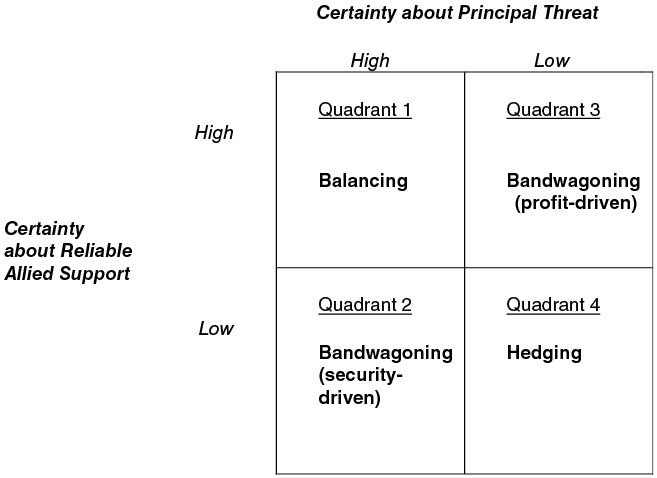
Figure 1 Long description
The 2×2 matrix specifies the combinations of structural conditions that induce states to stick to or shift away from their current alignment choice, either hedging or non-hedging. These conditions are the relative certainty (measured as high and low) about:
(a) the presence of an principal threat (a clear-and-present, principal danger in key domains) and
(b) the availability of a reliable allied support (a principal patron and/or a coalition of likeminded partners).
Quadrant 2 indicates a partially straightforward scenario: when high certainty about a principal threat is accompanied by low certainty (or high uncertainty) of any credibly reliable sources of allied support to counter-balance the threat. The absence of a principal protection might be the result of the following: a traditional patron is reducing or retreating from its security commitment (e.g., the United States during Trump 2.0); the patron is reaching a deal with the other power to create respective spheres of influence; and/or the patron is undergoing a relative/absolute decline in an order transition. Under such circumstances, a state is likely to pursue what Stephen Walt refers to as security-driven bandwagoning (Walt, Reference Walt1987). This choice of reluctantly accepting the reality of a threatening power’s ascendancy includes making necessary concession and showing subservience to the power in order to reduce security loss. Put differently, while a Waltian bandwagoning state’s primary end is still about security maximizing, its primary means would not be military instruments (because options like reliable counter-balancing alliance is not available), but political ones: displaying deference and accepting the power’s terms. When only one of the structural conditions is present (certainty about principal threat but uncertainty about principal protection), there would be little room for balancing. When a principal patron becomes a desirable-but-no-longer-feasible reality, the self-preservation survival imperative would compel weaker states to compromise and make the inevitable tradeoff: sacrificing autonomy for security (and potentially prosperity as well).
Quadrant 3, on the other hand, describes a scenario when a state does not see any imminent threat, but highly certain about the availability of a principal protection, that is, a clear-cut, indispensable patron capable of providing the needed private and public goods. Under such circumstances, a state is likely to pursue what Randall Schweller terms as “profit-driven bandwagoning” or, colloquially, “if you can’t beat a power, join it, and join it for profits.” In the absence of any imminent danger on the horizon, a state can afford to voluntarily (as opposed to reluctantly) accept – even embrace and leverage – a major power’s ascendancy, siding with and showing subservience to that power with an eye to maximizing benefits, both tangible and ideational (i.e., prosperity, protection, and prestige) (Schweller, Reference Schweller1994). The primary aim for a Schwellerian bandwagoning state is profit-maximizing and its primary means to achieve this end involve political and nonpolitical instruments, which include displaying high-profile and unconstrained deference, that is, readily (and even preemptively) saying “yes” to the patron’s preferences, showing respect for its ideas, and signaling support for its initiatives across the board. When a state sees no threat but visible opportunities for patronage and partnerships with abundant benefits and acceptable tradeoffs (deference and cooperation are conducted on voluntary basis), there would be no need to balance or hedge. Historical and contemporary examples of profit-driven bandwagoning include the Asian kingdoms’ tributary relations with Imperial China (Wang, Reference Wang and Fairbank1968; Kang, Reference Kang2010; Womack, Reference Womack2016) and most of the Western Hemisphere states’ relations with the United States in the immediate post-Cold War decades (Khong, Reference Khong2013). The post-World War II trans-Atlantic relations (up until Trump 2.0) indicates that bandwagoning has been particularly prevalent for asymmetrical relations with no territorial or sovereignty disputes, but bonded by sociocultural affinity, historical ties, and shared political values.
Quadrant 4 captures a more complex, but also more prevalent situation in the contemporary era, even before Trump 2.0. It presents an intricate scenario when there is low certainty (or high uncertainty) of both principal threat and principal protection. In this situation, a middle state sees not a single unequivocal threat but multiple sources of potential dangers and risks (across security, economic, and political realms), as well as viewing not a single indispensable patron but multiple uneven partners, some of which are both a source of problems as well as solutions across domains.
Under such structural realities, a state’s perceptions of external realities would be far from black and white, but shades of gray (with some shades much “grayer” than others). Instead of seeing one power as a clear-cut threat (black) and another power as a straightforward ally (white), the shades-of-gray outlook is essentially ambivalent, where a state views each power with both anxiety and admiration.
Such ambivalent perceptions call for a mixed, prudent, and “balanced” policy (not to be confused with a “balancing” strategy, as elaborated shortly). Under less-than-certain, less-than-straightforward conditions, a middle state would avoid taking sides between competing powers. Rather, it is more likely to stay actively neutral and balanced (in the strict sense of the word), by inclusively diversifying its external partnerships, while adaptively pursuing mutually counteracting measures to insure against the risks of multiple just-in-case scenarios, and keeping options open.
In the absence of a direct threat and a reliable protective support, a state is unlikely to take sides because rigidly tying itself to one power against another will incur unjustifiable tradeoffs. When circumstances are uncertain, fully siding with any power is tantamount to speculating, placing all of one’s eggs in a single basket, thereby running the risk of betting on the wrong horse. Fully confronting another power, on the other hand, amounts to burning one’s bridges, actualizing the self-fulfilling prophecy of turning a potential danger into an immediate threat. Hence, pursuing balancing and bandwagoning (both involve fully aligning with one power against another) under uncertainties is not only imbalanced and unbalanced, but also provocative and potentially destabilize. When both structural conditions are highly uncertain, it makes little sense to opt for the rigid strategies of balancing and bandwagoning.
By comparison, hedging – as a precautionary insurance-seeking policy aimed at offsetting multiple risks and preserving fallback options – is a more logical choice. When anarchy meets uncertainties, middle states are compelled to pragmatically pursue the three insurance-maximizing approaches of active neutrality, inclusive diversification, and adaptive offsets, as noted. Of course, none of these approaches can prevent big powers from competing, or prevent big-power rivalry from escalating into an all-out war. No policy can. However, hedging allows the survival-seeking states to work for the best while preparing for the worst-case scenarios.
Survival instincts breed “what if” mindsets: what if power structures fluctuate, what if relations fall apart, what if leaders change and intentions evolve, and so on. Such mindsets, in turn, push states to take “just-in-case” measures to mitigate the risks of several highly undesirable-but-probable scenarios in world politics: just-in-case a powerful neighbor turns aggressive (either because of a perceived window of opportunity externally or political chaos internally, or both); just in case a patron abandons its commitments (because of leadership change and/or other domestic transformation); just in case competing giants clash militarily, or worse, collude politically to establish exclusive spheres of influence, and so on. Each scenario presents profound dangers to the existential conditions of lesser powers. While hedging cannot prevent negative eventualities from happening, they serve as protective insurance and risk-mitigation mechanisms in several ways. These include reducing loss if a negative eventuality occurs; retaining fallback options for maneuvering contingency; and reinvigorating resilience to cope with future uncertainties.
To summarize, when structural-level conditions are uncertain – that is, when principal dangers are neither single nor straightforward (all powers are partially harmful or potentially hurtful in one domain but helpful in other realms) and when the availability of a principal protection is unclear – a middle state is likely to hedge, rather than balance or bandwagon. For reasons outlined previously, a state is likely to hedge against the risks of uncertainties by pursuing active neutrality, inclusive diversification, and adaptive offsets. Although none of these approaches can prevent systemic volatilities or hostilities, they allow hedgers to explore and exercise agency to mitigate risks and maintain fallback for as long as systemic-level conditions allow.
The structural logic of the hedging theory – that changing structural conditions cause changing alignment choices – leads to two hypotheses. One, when structural certainty is replaced by uncertainty, a shift from non-hedging to hedging is likely to occur. Two, conversely, when systemic uncertainty is replaced by certainties, we can expect a shift from hedging to non-hedging (e.g., balancing). Sections 4–5 test these hypotheses by examining the structural conditions that explain when hedging emerges, evolves, and ends.
3.2 Domestic Determinants: Explaining the Variations in Hedging
The earlier structural-level conditions – the relative certainty about principal threat and principal protection – only drive the directions of alignment choices (to hedge or not to hedge; to start or stop hedging); they do not determine the substance of alignment behavior (to what extent states hedge; in what ways they pursue mutually counteracting measures to hedge). The substance of hedging is a product of domestic-level factors.
By “domestic” factors, I refer to the governing elites’ internal political needs, specifically, the necessity to earn, enhance, and legitimize their authority to rule at home. Such focus is because it is governing elites who make key policy choices for a sovereign state, and their policy considerations are based primarily on their own political necessities and exigencies at home. All politics is local. The elites’ decisions, hence, tend to be based on the political logic of here and now, with the relative importance and urgency defined by elites’ primary pathways of legitimation vis-à-vis the contending elites and targeted constituencies.
Elites acquire their authority – or consented political power – when they gain considerable support from the people and when they circumvent or reconcile with competing or nonruling elites. The latter includes the challengers or potential contenders, either from within or outside the governing party or coalition, including the opposition, oligarchs, economic elites, religious or cultural clerics, intellectuals, social influencers, and local leaders. All ruling elites – once in power – seek to exercise, consolidate, and justify their authority over society and all contending elites. They do this by a combination of governance, co-option, coercion, and control, but also by legitimation in various forms (Lipset, Reference Lipset1960; Gramsci, Reference Gramsci, Hoare and Smith1971; Weber, Reference Weber1978; Gerschewski, Reference Gerschewski2013).
“Legitimation” is defined as a process where the elites seek to acquire political legitimacy by acting – and deliberating – in accordance with the very foundations of their support base and authority (Manin, Reference Manin1987; Tyler, Reference Tyler2006). The more legitimacy the elites acquire, the wider their consented power, and the greater their consolidated authority. Legitimacy is central to politics. Elites who enjoy considerable legitimacy want more; those who suffer from legitimacy deficit struggle to gain as much legitimacy as possible; and those with little hope to win legitimacy resort to coercion and control as the primary means to hold on to unconsented authority to remain in power. Hence, politics is essentially a process of legitimation. While legitimacy is a noble end in politics (Alagappa, Reference Alagappa1995; Beetham, Reference Beetham, Amenta, Nash and Scott2012), legitimation is a means to attain such goals as power, patronage, and privilege. In short, legitimation may be parochial and not necessarily noble, but it is a necessary element in understanding ruling elites’ policy choices, both domestic and external.
The domestic logic of the hedging theory, hence, is the imperative of elite internal legitimation. It posits that a state’s external alignment behavior (e.g., whether, how, and how heavy a state hedge or align) is an extension of the ruling elites’ internal needs of acquiring and advancing their legitimacy or “right to rule” by pursuing three pathways to legitimation: performance (result-based), procedural (ideology-based), and particularistic (identity-based) inner-justification (Kuik, Reference Kuik2010, Reference Kuik2024a, Reference Kuik2024b; Lampton et al., Reference Lampton, Ho and Kuik2020). Elites typically pursue all three pathways but in different combinations and emphases, depending on the type of political system, leadership, national characteristics (societal DNA), as well as plurality of inter-elite dynamics and state–society relations. Very often, elites rely on one major pathway (e.g., development-based performance legitimation) as the primary instrument, while simultaneously using the others (e.g., democracy-based procedural legitimation, nationalism-based particularistic legitimation) as secondary, supplementary tools to complement and/or counteract the effects of the primary ones. All instruments and tools are used with the ultimate goal of appealing to different audiences and winning the hearts and minds of as many targeted segments of constituencies as possible.
Internal legitimation shapes the external outlook, including how a state views external goals, dangers, and opportunities. Indeed, a state’s perceptions of stakes and risks “out there” are neither given nor fixed (Haacke & Ciorciari, Reference Haacke and Ciorciari2022; Kuik, Reference Kuik2008, Reference Kuik2023a; Wijaya, Reference Wijaya2024). Rather, they are constantly shaped – and filtered – by the way in which elites seek to justify and enhance their domestic authority by acting, deliberating, and reasoning in accordance with the very bases of their political support and authority at home at a given time (Kuik, Reference Kuik2023a, Reference Kuik2024a, Reference Kuik2024b). Put differently, while states defend national interests, it is elites – driven primarily by their legitimation needs – who define what these national interests are, as well as how and how best to pursue those interests.
Accordingly, the domestic logic of hedging theory hypothesizes that it is the variations in the elites’ pathways of legitimation (intervening variable) that explain the variations in the respective states’ alignment choices (DV). The causal mechanism works as follows: the elites’ primary legitimation pathway (e.g., the relative primacy of performance and/or particularistic legitimation over procedural justification) defines policy prioritization (i.e., emphasizing certain goals over the others, e.g., prioritizing immediate economic benefits and/or autonomy over longer-term security concerns), thereby filtering structural-level effects (playing up or down particular danger or support; identifying one single patron or multiple partners), calculating policy tradeoffs (accepting some risks and costs as an unavoidable price in exchange for prioritized stakes and benefits), eventually causing some states to hedge more heavily while others hedge more lightly (or in a mixed manner). Legitimation, in short, defines policy prioritization, drives “riskification” (playing down or up certain risks), determines tradeoff calculation, in turn shaping alignment choices (heavy hedging, light hedging or so on).
This is not to suggest that domestic factors matter only for hedging behavior. In fact, domestic variables matter for non-hedging behavior as well. They serve as intervening variables that play up or down the perceived risks and opportunities. Indeed, even when structural circumstances lead to non-hedging choices (e.g., balancing, bandwagoning), the domestic imperative of calculating and optimizing tradeoffs based on elites’ legitimation needs still shapes the magnitude and manifestation of the respective choices. This was evidenced in the case of Australia’s alignment behavior after the mid-2010s, as discussed in Section 5.
Methodologically, this Element adopts “structured, focused comparison” and “process-tracing” as developed by George and Bennett (Reference George and Bennett2005). To test the validity of the structural hypotheses of the hedging theory (that changing structural conditions cause shifting alignment choices), the next two sections examine the representative pivotal cases that involve structural-level changes at two different junctures. Section 4 focuses on Malaysia’s shifting behavior in the later Cold War period, tracing how changing systemic circumstances in the second half of the 1960s pushed the country – alongside other similarly situated states in Southeast Asia – to adjust and eventually shift their position from balancing (non-hedging) to an embryonic form of hedging. Section 5 examines Australia’s alignment choices since the mid-2010s, tracing how changing structural factors led Canberra to replace its post-Cold War hedging with balancing, a position that persisted until Trump 2.0 in 2025. The countries represent different parts of the Indo-Pacific region, that is, Southeast Asia and Oceania, respectively. In both cases, the shifts did not come about overnight; rather, they took years, unfolding in tandem with external and internal developments. In each case, I assess the relative impact of structural (un)certainty vis-à-vis the other explanatory variables in causing the respective shifts.
To test the validity of the domestic logic of the hedging theory, I focus on two similarly situated cases in the Indo-Pacific, which represent two major types of hedging behavior: heavy hedging (Vietnam) and light hedging (Malaysia). They are selected primarily because they involve similar sets of structural conditions and comparable domestic attributes but display differences in the DV. The two Southeast Asian states are “similarly situated” in a structural sense (asymmetric power relations with both Washington and Beijing; geographical proximity with China; complex ambivalence with the United States; among the center of competition and courtships by the major and next-tier powers, etc.). Holding the structural-level variables constant, the comparison orients the focus of analysis onto the domestic-level variations.
Although the Element’s empirical examples are all from the Indo-Pacific region, the hedging model’s theoretical relevancy extends to other world regions. The model’s two-level logics apply to middle states who find themselves sandwiched between two or more competing powers, particularly those facing situations of growing uncertainties. Hedging theory’s generalizability is shaped but not nullified by cultural, institutional, and geographical differences across regions. While these variables are pertinent, they matter chiefly in terms of shaping the styles and the space through which alignment choices would be pursued. The directions and substance of alignment behavior – hedging or non-hedging, how heavy or how light – are determined primarily by structural and domestic factors as identified by the model, discussed in Sections 4–6.
Giovanni Sartori’s (Reference Sartori1970, Reference 96Sartori1991) critical distinction between “differences in kind” and “differences in degree” strongly supports the Element’s focus on “shifts” and “variations” as the theoretical themes: shifts highlight “differences in kind” (from one type of alignment choice to another, for example, from balancing to hedging, and vice versa), while variations highlight “differences in degrees” (in the intensity of hedging, as measured by heavy- versus light-hedging). Sartori’s distinction also guides the sequence of the Element’s empirical cases: Sections 4 and 5 focus on “differences in kind,” while Section 6 focuses on “differences in degree.”
4 Explaining the Shifts (I): From Non-Hedging to Hedging
When Malaya obtained its independence from the United Kingdom in August 1957 at the height of the Cold War, its alignment choice was quintessentially Waltian balancing: joining a military alliance (with the West) to counterbalance a perceived, proximate threat (China). Under its first premier Tunku Abdul Rahman (1957–1969), the new state entered into the Anglo-Malayan Defence Agreement (AMDA) with its former colonial ruler, embraced the Washington-led “Free World,” while unequivocally pursuing an anti-communist and anti-China policy (Ott, Reference Ott1972; Singh, Reference Singh1988).
Such clear-cut approaches indicated that, in the early years of the Cold War, Malaya did not hedge. Rather, it took sides by adopting an unambiguously pro-West, anti-communist position. Amid the ideological tensions and geopolitical competitions between the US-led Western democracies and the Soviet-led Eastern communist regimes, Malaya put all its eggs in the Western basket, that is, directly with the UK and indirectly with the United States. Although Malaya avoided joining the US-led Southeast Asia Treaty Organization (SEATO) for domestic and regional reasons, it associated itself with the US-led camp. Backed by the Western powers, the small state publicly adopted a confrontational stance vis-à-vis the communist powers. In 1957, Malaya rejected communist China’s offer to establish diplomatic ties. In 1959, Malaya strongly deplored China’s suppression of the Tibetan revolt and cosponsored a UN resolution, calling for “respect for the fundamental human rights of the Tibetan people and for their distinctive cultural and religious life” (Jain, Reference Jain1984: 39–40; Jeshurun, Reference Jeshurun2007: 27). In October 1962, when the India–China border war broke out, Malaya criticized China’s actions and launched a “Save Democracy Fund” to “help India defend itself against Chinese aggression” (Saravanamuttu, Reference Saravanamuttu1983: 27). Throughout the first decade of its independence, Malaya’s China policy was all defiance, no deference. It was a classic case of balancing.
Malaya’s balancing policy was rooted in rather black-and-white structural conditions. Malaya saw China as a principal threat, and regarded the Western powers as a principal source of allied support to deal with that threat. Malaya’s threat perception of China was grounded at both internal and regional levels. Domestically, the ruling elites in Kuala Lumpur saw Beijing as the biggest adversary primarily because of China’s support of the outlawed Malayan Communist Party (MCP), which aimed to overthrow the democratically elected Malayan government. Malaya’s perception of the “Chinese problem” was also exacerbated by the People’s Republic of China’s (PRC) practice of treating all “overseas Chinese” as Chinese citizens. This posed a big problem to Malaya, as more than a third of Malayan population then were ethnic Chinese. Thus, China’s policy toward the overseas Chinese complicated the Malayan government’s efforts to cultivate a shared sociopolitical bond among the heterogeneous communities of the new nation (Wang, Reference Wang1991; Suryadinata, Reference 97Suryadinata2004). Regionally, China’s support for the communist movements across Southeast Asia compelled Malayan leaders to view Red China as an expansionist power, who posed a threat to Malaya and neighboring countries. Tun Ismail Abdul Rahman, a senior minister in the Tunku’s cabinet, described China as a giant who was “bent on a long-range programme of expanding its power and influence through its proxies in South East Asia” (quoted in Jain, Reference Jain1984: 91).
Such certainty in principal threat was matched by an equal certainty in the availability of the principal patron. With the threat imminent and allied support certain, balancing was an unmistakable choice and hedging an irrelevant option. The AMDA and the associated Commonwealth alignment (involving also Australia and New Zealand) helped Malaya to pursue the security-maximizing goal throughout the first decade of its statehood. The choice of aligning with the Western powers, in retrospect, enabled Malaya, and then Malaysia – a larger federation formed in September 1963 when Malaya merged with Sabah, Sarawak, and Singapore – to safeguard its security not only from the internal and external communist threats but also from the dangers in its immediate neighborhood.Footnote 1 Indonesia’s President Sukarno, who saw the formation of Malaysia as a “neocolonialist” plot by Western powers, launched Konfrontasi, a low-intensity military campaign against the newly created federation. With allied support from the Western powers, Malaysia managed to fend off the challenge of Konfrontasi, which lasted until the Gestapu coup in Indonesia and the change of leadership from Sukarno to Suharto in 1965–1966.
Although the Tunku and other Malaysian leaders were convinced as to the benefits of the AMDA, they soon realized they had no control over the sustainability of the alliance and Malaysia’s wider alignment with the West. Like elsewhere, the prospect of alliance was beyond the preferences of junior partners. The end of Konfrontasi coincided with the British announcement in July 1967 to withdraw its forces east of Suez, particularly from their bases in Malaysia and Singapore, by the mid-1970s. In January 1968, due to mounting financial pressures, the Wilson government announced its decision to accelerate the withdrawal to March 1971 (Hawkins, Reference Hawkins1972). In July 1969, largely due to US military setbacks in the Vietnam War, President Richard Nixon announced in Guam that the United States would no longer defend its allies in Asia unconditionally: while Washington would continue to uphold its alliance obligations, it expected its allies to be responsible for their own military defense. In 1971, the British began the withdrawal of its forces from Singapore and Malaysia. The AMDA was replaced by the Five Power Defense Arrangements (FPDA), involving Britain, Australia, New Zealand, Malaysia, and Singapore. The FPDA obligated all partner states to “consult” each other in the event of external aggression against Malaysia and Singapore; there was, however, no obligation for the partners to act (Chin, Reference Chin1974). The FPDA is thus an alignment and not an alliance (Ahmad, Reference Ahmad, Storey, Emmers and Singh2011). Around the same time, the United States also started to reduce its ground troops in mainland Southeast Asia, as enunciated by the Nixon Doctrine.
The British East of Suez policy and the US Nixon Doctrine, alongside other regional and global trends, marked a wave of profound structural changes. The changes altered the power structure regionally and globally, and in turn, the configurations of strategic choices of the Western powers’ junior partners.
The structural changes were particularly profound for Malaysia and other noncommunist Southeast Asian states, who relied on the Western powers for security and prosperity. For these small and secondary states, the top-down consequences meant that while the principal dangers (i.e., the communist threats) remained, their principal patrons were no longer available to protect them. The states began to see a more unbalanced, and more unpredictable security environment. In the wake of the retreat and the reduced presence of Western powers in the region, Malaysian analyst Noordin Sopiee wrote: “the British lion no longer had any teeth, the Australian umbrella was leaking, and the American eagle was winging its way out of Asia” (Sopiee, Reference Sopiee and Bull1975: 136).
Washington’s plan to pursue a negotiated settlement and reduce its role in Indochina was viewed by many as a turning point that highlighted the limits of American power (Yahuda, Reference Yahuda1996: 88; McMahon, Reference McMahon1999). In the eyes of Malaysia and other Western-allied states in the region, the fact that their mighty patron (US) was retreating from Indochina while moving toward a rapprochement with their principal foe (PRC) plainly revealed the unpredictability of great powers’ intentions and actions. It suggested to the smaller actors that the United States was now “slowly changing the nature and the basis of her commitment to Southeast Asia,” from one of containing communism to that of safeguarding its own strategic interests (Zain, Reference Zain and Lau1973: 131).
Such structural changes – the risks of abandonment and other dangers – were watershed moments for Malaysia and other regional states. Malaysia, like other junior partners of Western allies, began to see the risks of fully aligning with one power against another, and the hazards of rigidly confining one’s options to one single camp. Consequently, in light of the imminent departure of their Western patrons, the noncommunist Southeast Asian nations began reassess their external posture. According to a confidential diplomatic dispatch dated March 17, 1971 from the United Kingdom’s Foreign and Commonwealth Office (FCO) Far Eastern Department:
The Malaysian and Indonesian Governments are making increasing efforts to strike a more Asian, non-aligned posture. This attitude may stem partly from concern over US redeployment in Asia as part of the Nixon doctrine. It may also reflect a growing realization in both countries that they must make more effort than in the past to come to terms with their Asian surroundings. This policy inevitably involves reaching an accommodation of some kind with China, and ideally obtaining some gesture of acceptance from Peking [italic added].
Indeed, as a result of the emerging structural realities since the second half of the 1960s, Malaysian leaders gradually adjusted the country’s overall alignment directions. This was evidenced by a series of interrelated moves on the part of Malaysia: stopped rigidly aligning with one camp against another; stopped confronting China openly; emphasizing neutralism, regionalism, and nonalignment; and exploring normalization with the PRC. These calibrations eventually led to several new postures in Malaysia’s foreign policy: reducing its anti-communist rhetoric; recognizing and forging ties with the Soviet Union and Eastern European countries; joining the Non-Aligned Movement (NAM) in 1970; and establishing diplomatic ties with China in 1974.
Together, these new postures marked Malaysia’s shifting alignment position from balancing to a rudimentary form of hedging. Even though still in its embryonic stage, Malaysia’s changing stance clearly embodied the basic elements of hedging behavior. First, Malaysia actively signaled its neutral, nonaligned position (which replaced the country’s previously held pro-West and anti-Communist stance). Second, it adopted an inclusive and pragmatic approach by diversifying relations and partnerships despite differences in values and political systems (thus replacing the earlier ideology-based exclusive policy). Third, Malaysia began to develop an adaptive, insurance-seeking inclination of pursuing seemingly contradictory measures, with an eye to reducing risks and keeping fallback options.
Malaysia’s shift to hedging did not take place overnight. Rather, the shift – including the constituent components of hedging – evolved and expanded in stages, largely as a response to the ever-changing external and internal circumstances. Structurally, the emerging uncertainties surrounding the big powers compelled Malaysia to replace its alliance-first strategy with a self-help hedging policy, as noted. The policy, in turn, led Malaysia to explore and employ a bundle of military and nonmilitary means (including political, diplomatic, and economic tools of statecraft) to pursue the multiple ends of hedging (i.e., mitigating risks, offsetting dangers, cultivating fallback). The creation of the Association of Southeast Asian Nations (ASEAN), a regional body founded by Indonesia, Malaysia, Singapore, Thailand, and the Philippines in August 1967 provided diplomatic platforms and space for member states to pursue region-level initiatives, for example, Malaysia’s proposal of “regional neutralization” and the concept of a Treaty of Amity and Cooperation (TAC), a nonaggression pact among ASEAN members. Some of these initiatives and efforts served as the building blocks of Malaysia’s evolving hedging approaches. Domestically, leadership change and other internal circumstances shaped the ways and extent the constituent elements of hedging were applied.
A central component of Malaysia’s shift to hedging was its China policy. Realizing that Malaysia could no longer count on its Western patrons for counter-balancing the Chinese threat, its leaders sought to deal directly with China. This was not done militarily but through a combination of political, diplomatic, and economic approaches. Under the new leader Tun Abdul Razak Hussein (1970–1976), Malaysia replaced the Tunku’s pro-West, alliance-first policy with nonalignment and “regional neutralization” (Ghazali, Reference Ghazali1982: 157). The idea of “neutralization of Southeast Asia,” first enunciated by Tun Dr Ismail (then a backbencher and a former cabinet member) in 1968, was presented by Ghazali Shafie (then foreign ministry’s permanent secretary) at the Preparatory Non-Aligned Conference at Dar-es-Salam in April 1970 (Ghazali, Reference Ghazali1982: 157). In September 1970, shortly before he assumed the premiership, Tun Abdul Razak formally presented the idea of regional neutralization at the Non-Aligned Summit Conference in Lusaka. This new stance necessitated Malaysia to change its China policy and normalize relations with Beijing, the principal source of perceived threat. This is because neutralization “required formal relations between the neutralized and the guarantor” (Sopiee, Reference Sopiee and Bull1975: 149). In a speech on Malaysia’s neutralization proposal in December 1970, Prime Minister Razak said “Malaysia could not afford to ignore a big neighbor such as China” (Brewer, Reference Brewer1971; Clift, Reference Clift1971). With the policy change, Malaysia sent positive signals to China, who responded favorably. This paved the way for negotiations between the two countries’ representatives in New York, which resulted in Razak’s historic May 1974 visit to China and the establishment of diplomatic ties. Malaysia was the first ASEAN member state to establish official ties with China.
To summarize: the British East of Suez policy and the US Nixon Doctrine in the late 1960s – which unleashed unprecedented uncertainty – were watershed moments for Malaysia’s defense policy. The changes effectively deprived the junior partner of the security umbrella of its patrons, convincing the Malaysian leaders that they could no longer assume their Western allies would protect them as they had done in the past. These realizations compelled Malaysian leaders to replace the country’s alliance-first posture with a hedging policy, stressing more on self-reliance and pragmatic realignment in its security planning. Malaysia’s shift from balancing to hedging demonstrated that structural change – from certainty to uncertainty – is a primary factor driving the state’s evolving alignment choice. Under highly certain conditions, when a state facing a direct threat was backed by a reliable patron with credible commitment, it was logical to pursue balancing. However, when uncertainty replaced certainty in the later Cold War period, when a patron’s commitment and/or capability to provide security protection turned questionable, the junior partner had to adjust to the new reality by adopting more active, inclusive and adaptive self-help measures.
The same structural drivers that propelled Malaysia to shift to hedging also motivated other similarly situated states to move in the same direction. About a year after the Malaysia–China normalization, the Philippines and Thailand – the two treaty allies of the United States in Southeast Asia – followed Malaysia’s footsteps in establishing ties with the PRC, in June 1975 and July 1975, respectively. The direction and timing of the countries’ realignment moves were not coincidences. Rather, they were largely the results of the same structural imperative.
The similar realignments by the three ASEAN states indicate how changing structural conditions led to changing alignment choices. All three countries had initially chosen to align fully with the Western powers against the backdrop of East-West confrontation. All of them viewed communist China as the principal threat and Western powers as the principal patron to protect them from that threat. And all three made similar hedging turns as soon as structural conditions became highly uncertain. The Philippines and Thailand – like Malaysia – opted to hedge by pursuing deliberately opposite measures aimed at offsetting dangers and keeping options open.
In responding to the emerging structural uncertainties, all three countries opted to make pragmatic moves by adjusting their overall alignment postures and exploring normalization with China. The move was pragmatically calculated because the decision to normalize relations took place at a time when their respective bilateral relations with communist China were still characterized by ideological differences, political disagreements, and even dislike at the government-to-government level. That the move was made despite the persistence – not disappearance – of the bilateral divergences suggested that the states’ decisions were compelled primarily by the imperative above national government and bilateral levels. In each of the three cases, the driver clearly laid at the structural level (as opposed to leader-, national-, and bilateral-levels), because the structural changes (the retreats by Western powers and the resultant high-uncertainties in patron commitments) were the only primary and shared changes that all three Southeast Asian states confronted at that juncture.
In all these cases, the changing structural circumstances unleashed uncertainties and exposed the Western-aligned states to systemic risks, driving the shift to hedging. Hence, just as Malaysia (alongside Singapore) was apprehensive of the British East of Suez policy, Thailand and the Philippines became uneasy about the Nixon Doctrine and the eventual withdrawal of US troops from mainland Southeast Asia (Morrison & Suhrke, Reference Morrison and Suhrke1978: 244–245). To the ASEAN states, the US defeat in Indochina highlighted the reality that Washington might not be invincible after all. The US–China rapprochement then prompted Bangkok and Manila to also reassess their alignment. The Philippines and Thailand, like Malaysia, moved to normalize relations with China as soon as their patron’s commitment became uncertain. The two ASEAN states, again like Malaysia, hoped to use normalization as a political (nonmilitary) tool to reduce the perceived security threat (i.e., Beijing-backed local communist insurgency) (Paribatra, Reference Paribatra1987; Lim, Reference Lim, Carino and Churchill1993). In the face of the external changes and the increasing threat posed by the Communist Party of Philippines–New People’s Army insurgencies in the early 1970s, President Ferdinand Marcos decided to explore détente with China (Pablo-Baveira, Reference Pablo-Baveira, Yee and Storey2002: 249; Storey, Reference Storey2011: 253). Talks with Beijing began in February 1972, with diplomatic and trade ties were formally established in June 1975. Thailand followed suit in July 1975.
The evidence suggests that structural-level factors were at work. Viewing such changes as emerging realities with consequential impacts on their survival, all three countries – despite different domestic-level conditions and leaders with different personalities – moved in the same direction with similar aims. That is, they began to actively and inclusively diversify their external links (beyond one power bloc) and forge pragmatic realignments (with, and not against, the principal source of dangers) amid their converging efforts to use the newly created ASEAN as a common platform in their foreign policy toolbox. They all hoped to cultivate pragmatic, multilayered approaches and use them to adaptively mitigate and hedge the risks of top-down uncertainties, which were beyond their control.
Emphasizing the salience of structural logic in explaining the three countries’ shifting alignment postures is not to suggest that domestic factors were unimportant. Structural imperatives and domestic factors both matter but in different ways. While structural imperatives drove the shift from balancing to hedging, domestic factors determined the pace and extent of the unfolding shift. In terms of pace, Malaysia – followed closely by the Philippines and Thailand – were farther ahead of Indonesia and Singapore in shifting toward hedging during the Cold War period. Take Malaysia’s normalization with China – a central piece of its neutralization proposal and its wider hedging shift. Malaysia was the first ASEAN state to explore normalization with the PRC, even before news about the US–China rapprochement was announced. Malaysia’s move was driven not only by the need of adapting to the changing power structure externally, but also necessitated by the ruling elites’ internal political needs. In the wake of the ruling coalition’s electoral setback in May 1969 and the ensuing riots between the Malays and Chinese, the Razak government’s main task was to restore internal stability, reassure the local ethnic Chinese (after launching a pro-Malay affirmative policy in 1971), as well as call for election and win a mandate for his new coalition. Normalization with China served the purposes of restoring stability and boosting authority at home (Baginda, Reference Baginda2009). Hence, it was not surprising that in the 1974 election that was held right after Razak’s historic visit to China, his coalition won a major victory, thereby enhancing his government’s legitimacy.
Ditto the Philippines and Thailand. Pressing domestic political reasons also accelerated their normalization process. In the Philippines, during the 1973–74 oil crisis, Manila accepted China’s offer of oil at a “friendship price,” adding economic impetus to normalization (Quisumbing, Reference Quisumbing1983: 43–44, 98). Thailand’s fast pace of normalization was also attributable to domestic needs. The Thanom Kittikachorn military regime fell in October 1973, which coincided with the onset of the oil crisis. Thailand’s new civilian elite, which sought to establish their authority through developmental performance and internal stability, viewed détente with Beijing as politically desirable (Jha, Reference Jha1980: 30).
Subsequent external developments drove further realignment. By the late 1970s, numerous changes turned the Thailand–China rapprochement into a de facto defense alignment. The communist victories in Phnom Penh, Saigon, and Vientiane in 1975 marked the defeat of US forces in Indochina. This was followed by the Vietnamese invasion and occupation of Cambodia in 1978, which directly exposed Thailand to the threat of Moscow-backed Vietnamese forces, making Thailand a “frontline state” in the Third Indochina War. To cope with this looming threat in the wake of the Thai elite’s diminished confidence in the United States, Bangkok aligned with Beijing militarily (Ciorciari, Reference Ciorciari2010: 202). China’s pledge of a security guarantee in the event of Vietnamese aggression – coupled with its February 1979 “punitive war” against Vietnam – prompted the Thai elite to increasingly view Beijing as a key patron (Paribatra, Reference Paribatra1987). Tilman observed that, in the eyes of the Thai ruling circle, “the Chinese tiger is most often viewed as an indispensable ally against a very threatening Vietnamese tiger” (Tilman, Reference Tilman1987: 95). Thus, the 1980s saw a widening of Thailand–China alignment on various fronts, especially defense. These experiences partly explain why Thailand – formally a US ally – is the ASEAN state with the earliest and closest military ties with China (Storey, Reference Storey2012). Thailand forged much stronger alignment with China than Malaysia and other ASEAN states even before the Cold War ended.
Elsewhere in the ASEAN region, the changing structural conditions also pushed leaders in Jakarta and Singapore to rethink their alignment positions. Given the emerging realities of reduced strategic presence of the Western powers amid persistent security concerns, the Indonesian leaders – like the governing elites of Malaysia and other ASEAN states – began to view “reducing friction” and normalizing relations with the PRC as a necessary political step to reduce the threat from the China-backed communist movements. In January 1971, Indonesian President Suharto told visiting Canadian Prime Minister Pierre Trudeau that Jakarta “was willing to normalize relations with Peking, provided the latter abandoned her ‘vituperative and suppressive campaign’ against his government.” (Barrass, Reference Barrass1971; Morgan, Reference Morgan1971).
Although changing structural conditions also pushed Jakarta and Singapore – the other founders of ASEAN – to recalibrate their alignment positions, the two countries only moved to establish ties with China in 1990 and 1990, respectively. This was more than a decade after Malaysia, the Philippines, and Thailand made their normalization moves. Indonesia and Singapore deferred their normalization decisions because of different domestic logics.
Indonesia’s deferred normalization was attributable to its elites’ legitimation needs. As observed by Indonesian expert Rizal Sukma, even though then Indonesian Foreign Minister Adam Malik “actively sought to probe the possibility of normalizing ties with China” during the 1970–1974 period (a sign of changing alignment posture), President Suharto resisted an early restoration of ties because of considerations about his government’s legitimacy. Suharto’s New Order regime, which came to power after crushing an alleged communist uprising in 1965 and launching a fierce anti-communism campaign, drew its legitimacy and authority from its claim to be the “guardian of the state against communist threats.” Hence, early normalization would have reduced the credibility of that claim and, in turn, undermined the very foundation of the regime’s authority (Leifer, Reference Leifer1983; Sukma, Reference Sukma1999).
Singapore, too, did not follow Malaysia’s lead in establishing ties with the PRC. This was in part due to geopolitical sensitivities and domestic sociopolitical considerations. As an island with an ethnic Chinese-majority in a Malay-Muslim Southeast Asian sea, Singapore made it a policy not to establish official ties with China “until after the government in Jakarta had done so,” and in part because “there was less than complete confidence within the government of Singapore that the Chinese population of the island would not fell prey to an emotive identification with representatives of the new China” (Leifer, Reference 91Leifer2000: 112).
Delayed normalization with Beijing notwithstanding, Indonesia and Singapore did show signs of recalibrating their alignment positions. Throughout the 1970s and 1980s, the two countries – like their fellow members of ASEAN – pursued pragmatic moves to hedge against the growing risks of uncertainties. These moves included reducing anti-China rhetoric, exploring and eventually creating de facto channels of communication with communist China, while still keeping as many strategic and functional ties with their Western partners as possible (Ang, Reference Ang2013). Such seemingly opposing measures were motivated by pragmatism under the conditions of uncertainties: establishing communication space and cooperative avenues served as essential means to manage problems, mitigate dangers, and keep options open despite differences, disagreements, and distrust.
By the mid-1980s, virtually all ASEAN states (save Brunei, which had gained independence only in 1984) had come to pursue two-pronged, seemingly opposing approaches. On the one hand, they had moved to engage China economically despite a distrust of Beijing’s intention. On the other, they had also forged varying degrees of defense ties with the United States despite a lingering doubt about Washington’s long-term security commitment.
Malaysian foreign policy since the 1980s is a vivid example of this two-pronged, seemingly contradictory approach. Mahathir Mohamad, who assumed premiership in 1981, chose to visit the United States in 1984 and then China in 1985. His US trip led to the signing of the Bilateral Training and Consultative Group (BITACG) agreement, Malaysia’s first bilateral defense arrangement with a foreign power after the AMDA was replaced by the FPDA in 1971 (Wain, Reference Wain2009; Ministry of Defence, 2020). Mahathir’s China trip, on the other hand, made economic pragmatism a central pillar of Malaysia–China relations, despite Kuala Lumpur’s political vigilance against Beijing (Leong, Reference Leong1987). Malaysia’s distrust of China continued even after normalization because Beijing continued to maintain ties with the MCP, claiming that party-to-party ties were separate from government-to-government ties (Liow, Reference Liow2000). In retrospect, Mahathir’s China trip was significant because it signaled the leader’s pragmatism to concentrate on economic cooperation despite distrust as the way forward to managing what was then considered to be the “most sensitive foreign relationship” for Malaysia (Clad, Reference Clad1985). Such top-down pragmatism cleared bureaucratic hurdles, smoothing the path toward the signing of a series of agreements and the creation of a joint committee aimed at facilitating bilateral trade and investment, thereby laying the foundation for future economic collaboration (Lee & Lee, Reference Lee, Lee, Hou and Yeoh2005).
The seemingly opposing measures were by no means random measures, but deliberate insurance-seeking acts aimed at cultivating and preserving fallback options under uncertainties. When asked why Malaysia has opted to maintain its traditional military ties with the Western powers, a retired senior Malaysian government official’s frank and straightforward response captures the essence of hedging behavior:
It is a back-up insurance. Let’s be blunt about it. That is why until now we do not see it necessary to completely put an end or even dissolve the FPDA. [We are doing just] like other countries who also have working relationships with the U.S. in particular, like Thailand, Singapore, the Philippines, so on and so forth. So what we are doing is no different from what others are doing. In a way [this practice] provides a kind of insurance. But the fact of the matter is that we do not want to overplay this thing. We do not want to say it publicly. We do not want to overplay that we are doing this because of the Chinese threat. In fact, on the contrary we are saying that we do not look upon the emergence of China as a threat to our economy, prosperity, and security; [and that] we look upon China as a partner…. So in the context of realpolitik it is not something completely unusual for countries to have something that they could fall back upon for…. I think countries will adapt accordingly if the scenario changes. But we are not planning comprehensively towards adopting such a scenario because we do not want to think that that is the scenario there, and we are hoping that China also understands that it is not the direction that we should be pursuing because it is confrontational in nature [italic added].
5 Explaining the Shifts (II): From Hedging to Non-Hedging
Up until the mid-2010s, Australia’s post-Cold War China policy was quiet but flamboyant hedging, rather than full-fledged balancing (Manicom & O’Neil, Reference Manicom and O’Neil2010; He, Reference He2012; Bloomfield, Reference Bloomfield2016; Bisley, Reference Bisley2018; Chan, Reference Chan2020). Australia’s policy manifested all three defining elements of hedging.
First, the policy reflected Australia’s avoidance of fully aligning with one power (the United States) against another (China). Australia has been a US ally since it signed the 1951 Australia, New Zealand, and United States (ANZUS) Security Treaty but this collective defense agreement predated the rise of China. Thus, the treaty would not have targeted China, at least not until the first half of the 2010s. Indeed, despite Australia’s growing anxiety over China’s military posture and strategic intent (Tow & Hay, Reference Tow and Hay2001; Thayer, Reference Thayer2011a; Cook, Reference Cook2015; Goodman, Reference Goodman2017; Chacko & Strating, Reference Chacko and Strating2021), Canberra cautiously avoided creating the impression that its alliance with Washington (and its expanding alignments with likeminded partners such as Japan) were targeting at China, to avoid unnecessarily provoking Beijing (Beeson, Reference Beeson2006; Reilly, Reference Reilly2012; Bisley, Reference Bisley2013). That explains Canberra’s decisions to discontinue the Quadrilateral Security Dialogue (the Quad), a minilateral alignment with India, Japan, and the United States. Despite the John Howard government’s (1996–2007) role in kick-starting the Quad in 2007, the Kevin Rudd government (2007–2010) quit from the nascent alignment, which was perceived to be an anti-China coalition. Under Rudd, who deemed himself a “brutal realist,” Australia also withdrew from the Malabar naval exercise with fellow Quad members in 2008. More evidence of Canberra’s signaling its non-anti-China stance were the occasional – but eyebrow-raising – statements made by Australian ministers at different junctures (e.g., in 2004 and 2014) that Canberra might not necessarily side with Washington in any future US–China armed conflict over Taiwan.Footnote 2 Such statements, in addition to signaling independence, also reflected Australia’s intent to hedge against the risks of confronting Beijing and being entrapped in an all-out hegemonic war between the United States and China.
Second, Australia’s hedging behavior was also evidenced by its pragmatic, inclusive diversification approach as it expanded its external partnerships. Despite Canberra’s concern about becoming economically dependent on China, especially after it became Australia’s largest trading partner in 2007, Canberra continued to embrace close trade and investment links with China. Canberra was also, by and large, still receptive – despite some hesitation – to Beijing’s international roles and initiatives, including the Asian Infrastructure Investment Bank (AIIB). Indeed, after the United Kingdom announced it would join the AIIB in March 2015, Australia was among the US allies, including some in Europe and Asia, who readily participated in the Beijing-backed bank as its founding members, despite Washington’s displeasure (Henry, Reference 87Henry2020). This move followed soon after significant developments in Australia–China relations in November 2014: the signing of a bilateral FTA, the upgrade of bilateral ties to a Comprehensive Strategic Partnership, as well as an invitation for President Xi Jinping to address the Australian parliament. Canberra also remained open to collaborating with China on projects linked to Beijing’s Belt and Road Initiative (BRI, Xi’s signature initiative on infrastructure and connectivity-building across the globe), albeit selectively (e.g., the decision to lease the port of Darwin for ninety-nine years). Equally important, Canberra also allowed a variety of societal exchanges, thus facilitating closer ties in educational, tourism, and other subnational links between the two nations (Bishop, Reference Bishop2014).
Third, Australia’s hedging policy was also marked by some prudent, quiet offsets, that is, cautious and concurrent adoption of seemingly opposing measures aimed at neutralizing the exposed risks and mitigating potential dangers associated with its engagement and other benefit-seeking actions vis-à-vis a powerful actor. In a private conversation with German Chancellor Angela Merkel on November 16, 2014, Australian Prime Minister Tony Abbott (2013–2015) reportedly admitted that Canberra’s policies toward Beijing had been driven by two emotions: “fear and greed” (Garnaut, Reference Garnaut2015). Such a candid admission reflected the primordial motivations that drove Canberra’s approach to Beijing. While greed motivated engagement and other returns-maximizing actions, fear set in motion prudent measures to offset the calculated risks, alleviate unavoidable drawbacks, and maintain a fallback position.
Thus, some analysts described Australia’s China policy as “engaging but hedging” (McDougall, Reference McDougall2014; Bloomfield, Reference Bloomfield2016; Bisley, Reference Bisley2018: 394). Indeed, up until the mid-2010s, engagement was still the main thrust of Australia’s China policy, which was pursued hand in hand with such insurance-seeking measures as indirect-balancing (forging alignments with likeminded partners without directly or explicitly targeting Beijing) as well as the concurrent, quiet show of defiance (displeasing China by highlighting Australia’s autonomy) and deference (pleasing China by accommodating and showing respect to Beijing) on selective issues. Such quiet (pursuing without pronouncing it as such) and seemingly contradictory measures enabled Australia – as a weaker state – to maximize returns while simultaneously mitigating risks and maintaining maneuverability under conditions of uncertainties. Examples of such deliberately contradictory acts abound. On diplomatic and political fronts, while Canberra showed deference to Beijing by selectively accommodating China on sensitive issues such as Taiwan and Tibet (Reilly, Reference Reilly2012), it also sought to offset the associated risks arising from deferential acts by publicly engaging in defiant moves, for example, Rudd’s comments on human rights problems in Tibet (McDonell, Reference McDonell2008), his remarks on the Ürümqi riots in Xinjiang, allowing Uyghur exile Rebiya Kadeer to visit Melbourne, and so on (He & Feng, Reference He and Feng2024). On the economic front, while Australia pragmatically embraced trade ties with China, it also decided to introduce new investment barriers aimed at neutralizing the economic and strategic risks of overly relying on Beijing (Reilly, Reference Reilly2012). On the security front, while Canberra displayed deference to Beijing over Quad 1.0 and the Malabar naval exercise as noted, it simultaneously defied Beijing by expanding its robust alliance with Washington as well as entering into aligned partnerships with Tokyo and New Delhi bilaterally.
The opposing acts, in effect, allowed Canberra to offset, negate, and hedge against multiple external risks and internal costs associated with its China policy and its US policy, while still keeping options open (White, Reference White2005, Reference White2010; Mackerras, Reference Mackerras2014; Tow, Reference Tow2017; Henry, Reference 87Henry2020). While the means and approaches might appear contradictory, the ends and goals are, ultimately, consistent: ensuring Australia’s survival in economic, political, and strategic domains. By showing selective deference toward China but avoiding across-the-board accommodation, Canberra ensured a stable, productive, and negotiable relationship with its largest trading partner while avoiding kowtowing to Beijing and avoiding alienating Washington (thereby hedging against the multiple risks of economic loss, autonomy erosion, geopolitical entanglement, and domestic antagonism). By showing selective defiance but not making statements or taking actions that might be interpreted as a direct challenge against China, Canberra avoided burning its bridges as US–China competition grew (thereby hedging against the dangers of geopolitical entanglement, strategic abandonment, and domestic discontent). Writing in 2012, scholar James Reilly described Australia’s two-pronged approaches as a “low-cost hedge” that, “on the whole,” appeared “to be both successful and sustainable.”
Australia’s hedging policy was a logical choice under a specific set of structural conditions, that is, there is an uncertainty in principal threat and principal allied support to counter the threat. Up until the first half of the 2010s, Australian leaders were still uncertain about China’s intentions and at times felt unsure about the availability of US alliance assistance. On the one hand, while Canberra’s security establishments were increasingly concerned about China’s long-term aspirations, Australian political leaders and business elites still maintained an ambivalent outlook on China (as opposed to a clear-cut, black-and-white threat perception). Instead of seeing China as an unambiguous threat, Australia still regarded it as both a source of potential problems as well as a key economic and regional partner to live with and work together for mutual benefits (White, Reference White2011, Reference White2013; Goodman, Reference Goodman2017).
To a large extent, such a “shades-of-gray” perception of China was closely – and adaptively – tied to Australia’s evolving perceptions of the future of US–China relations as well as the uncertainty of US alliance commitment, especially in the wake of the global financial crisis in 2008–2009. Richard Dunley (Reference Dunley2024: 480–481) observes that the rise of China and “the perceived relative decline of the United States” had brought forth a new debate in Australia about the country’s alliance with Washington, where the concern “is no longer focused primarily on the risk that the United States might drag Australia into foreign wars, instead there is, for some at least, the far more worrying prospect that the United States may no longer be willing or able to defend Australia.” Bisley (Reference 82Bisley2024: 3) similarly opines: “Weakening U.S. power in Asia, global uncertainty after the global financial crisis and most critically the shift within the PRC as Xi Jinping began to depart from the path of foreign policy moderation and collective leadership all played a part in this unsettling of the policy consensus” in Canberra.
Such an ambivalent perception of China and a fluid, uncertain outlook on US–China relations were vividly reflected by then Australian Foreign Minister Julie Bishop’s speech at a public forum on May 30, 2014. Speaking at the second conference on “Australia in China’s Century,” Bishop provided a cautious assessment on China’s rise. Her speech also revealed a deep sense of uncertainty about China’s future and the largely unpredictable prospect of US–China ties in the so-called “China’s century”:
In recent history, we have never seen the rise of a power that had a value system so different to that of the West’s, an open market-oriented economy within a central command, socialist political structure. We have not witnessed the rapid expansion of a military force with advanced capabilities that may contest the maritime regional supremacy of the United States. Where China’s rise will lead cannot be predicted accurately [emphasis added].
The minister went on to outline “two divergent scenarios” that “are at the polar opposites of how the future may unfold.” The first scenario would be a “peaceful rise,” where the world would witness, among other things, “a Chinese economy that is fully integrated into the world economy”; and “a China that is widely regarded by its regional neighbours and beyond as a positive force for good.” Stressing that “none of this is a given,” she then sketched the second scenario: “one of increased tensions and regional instability,” where the world would see “a China that struggles to deal with its major internal and external challenges,” including “territorial disputes and historical enmities leading to deteriorating confidence in regional security and China’s intentions”; “a China preferring unilateral measures, ignoring the benefits of contributing to a global system of rules”; and “a deteriorating United States–China relationship underpinned by mutual suspicions and characterised by increasing tensions” (Bishop, Reference Bishop2014).
Besides being uncertain about China’s ultimate intentions and future scenarios, Australia was also painfully unsure of US alliance commitment (Henry, Reference 87Henry2020; Dunley, Reference Dunley2024), as noted. Such concern was clearly expressed by Malcolm Turnbull, Australian Prime Minister from 2015 to 2018, in his 2020 biography. Recalling Australia’s considerations over the South China Sea during his premiership, Turnbull revealed that while Australian ships were sent through the South China Sea, they had stayed in international waters. Turnbull said Australia declined to “follow the United States to send naval vessels within 12 nautical miles of the China-built artificial islands,” for fear that “[Australia] could easily play into China’s hands if [it] did.” In his words,
If one of our ships were to be rammed and disabled within the 12-mile limit by a Chinese vessel, we don’t have the capacity to retaliate. If the Americans backed us in, then the Chinese would back off. But if Washington hesitated or, for whatever reasons, decided not to or was unable immediately to intervene, then China would have achieved an enormous propaganda win.
He thus decided “it wasn’t a risk worth taking” [italic added] (quoted in Kelly, Reference Kelly2020).
Significantly, Turnbull’s biography also revealed his changed perception of China and Australia’s changing position vis-à-vis the competing powers. The leader admitted that he eventually changed his view about China “because China changed”: China changed its intent, resorting to bullying tactics, demanding compliance, and pressuring nations that offended it with both criticism and economic consequences. Turnbull also came to realize that China’s goal was “to supplant the US as the leading power in the region and that was plainly not in [Australia’s] interests” (Kelly, Reference Kelly2020). In short, Australia had come to view China as a threat, whose changing intentions and actions were deemed inconsistent with and even a challenge to Canberra’s interests.
To be sure, Canberra’s increased perception – and increased certainty – about the Chinese threat by the mid-2010s was not only about Beijing’s mounting assertive, bullying actions over the South China Sea and Beijing’s “expansionist” global ambitions. Rather, Canberra’s growing threat perception of China had more to do with its increasingly acute anxieties over China’s “influence operations” and interference in Australian affairs. According to Rory Medcalf (Reference Medcalf2019: 109), these operations and activities included political donations and propaganda to social mobilization, intimidation of individuals, alleged misuse of academic links, cyber intrusions and espionage. In 2017, the Australian Security Intelligence Organization (ASIO) warned of China’s interference in penetrating Australia’s decision-making processes at the government level and influencing public opinion at the societal level. In his speech introducing the Espionage and Foreign Interference Bill in December 2017, Turnbull quoted the ASIO report by stating: “The harm caused by hostile intelligence activity can undermine Australia’s national security and sovereignty,” adding that the interference can “inflict economic damage, degrade or compromise nationally vital assets and critical infrastructure, and threaten the safety of Australians.” Turnbull (Reference Turnbull2017) elaborated, “So when the Director-General of ASIO, Duncan Lewis, says the threat from espionage and foreign interference is ‘unprecedented’” and that “the threat we face today is greater than” the Soviet threat during World War II and the Cold War, “then we know that we must act.”
Thus, by the mid-2010s, Australian leaders and policy elites had come to view China as a growing, unambiguous threat, whose intentions were deemed malign and whose actions increasingly harmed Australia’s sovereignty, internal cohesion, and external interests. Such growing certainty of the China threat – alongside a gradually growing certainty about aggregated allied support (the US alliance and also the likeminded middle-power networks and minilateralist alignments, elaborated shortly) – eventually pushed Australia to shift from hedging to balancing (Taylor, Reference Taylor2016; Hall, Reference Hall2022; Parks, Reference Parks2023; Bisley, Reference 82Bisley2024).
The early signs of Canberra’s shifting alignment position included: (a) a more open and direct involvement in the disputed Asian waters (e.g., Australia confirmed in 2015 that it had been conducting “routine” FONOP flights over disputed territory in the South China Sea) (BBC, 2015); (b) a stronger positional signaling through policy documents and speeches (e.g., 2016 DWP; 2017 Foreign Policy White Paper; Turnbull’s keynote address at the 2017 Shangri-La Dialogue), depicting China as a source of regional instability and insecurity while emphasizing the indispensability of the United States as an ally; and (c) a series of defiant acts aimed at pushing back against the perceived China threat (e.g., reviving the Quad in 2017; banning Chinese tech firms Huawei and ZTE from Australia’s 5G Wi-Fi rollout, while enacting the Espionage and Foreign Interference Bill in 2018). Australia was the first country in the world (and the first state in the Five Eyes intelligence alliance) to ban Huawei and issue security guidance prohibiting Australian telecommunication carriers from using Chinese firms’ 5G equipment and services. Besides being the first to enact a counter-foreign interference act directed primarily at Beijing, Australia also sought to limit China’s expansion in the South Pacific – Canberra’s own “sphere of influence” – primarily by offering alternatives to BRI. In addition, it was among the most vocal in advocating the “rules-based” international order, advancing the “decoupling” approach as a response to China’s “economic coercion,” and in actualizing the “Indo-Pacific” visions as the principles guiding interstate collaboration, especially among the US allies and partners across Asia and Europe to directly challenge – if not yet contain – China (He, Reference He2018; Pan & Korolev, Reference Pan and Korolev2021; Yuan, Reference Yuan2022; Cox et al., Reference Cox, Cooper and O’Connor2023).
These emerging signs and subsequent developments were, in a nutshell, among the growing indicators of Australia’s unfolding shift from hedging to balancing. Canberra’s perception of China as a principal source of its deteriorating security environment was in vivid display in a series of documents released by Australian Department of Defence: the 2020 Defence Strategic Update (DSU, alongside the 2020 Force Structure Plan), the 2022 DSU, the 2023 Defence Strategic Review, the inaugural National Defence Strategy in 2024, and so on. Take the 2020 DSU, whose language and tone were much grimmer than those of the 2016 DWP. The 2020 document was more explicit than the 2016 DWP in revealing Australia’s perception of China as a major source of regional instability and insecurity: “Since 2016, major powers have become more assertive in advancing their strategic preferences and seeking to exert influence, including China’s active pursuit of greater influence in the Indo-Pacific.” (Australian Department of Defense, 2020: 11). The 2020 DSU added: “Some countries will continue to pursue their strategic interests through a combination of coercive activities, including espionage, interference, and economic levers. Tensions over territorial claims and the establishment of new military facilities are rising and are involving the use of military or para-military forces more frequently than in the past” in the South China Sea (Australian Department of Defence, 2020: 12). Peter Jennings, who led the External Expert Panel for the 2016 DWP, wrote: “When [the 2020 Update] talks about the bad behavior that’s happening in the region, the annexation of territory, coercion, the influencing of domestic politics, the use of cyber-attacks – it’s really only one country which is doing that at industrial levels, and that’s the People’s Republic of China” (quoted in Macmillan & Greene, Reference Macmillan and Greene2020). Greg Jennett (Reference Jennett2020) concurred: “It is pretty much all about China these days.” He added: “Who else could [the Update] be referring to when it inserts the words ‘coerce’ or ‘coercion’ a dozen times in a document only 12 pages in length?”
Up to this point, Australia’s balancing policy was marked by even stronger – and wider – defiant acts toward Beijing. Notable examples included calling for an independent inquiry into the origins of COVID-19 in 2020; taking its trade disputes with China to the World Trade Organization; widening collaboration with Quad partners in expanding the minilateralist group into a more institutionalized multilevel, multi-domain coalition; joining hands with Washington and London in forming the Australia–UK–US (AUKUS) pact in September 2021; discussing contingency plans with the United States over possible Taiwan conflict. Such moves indicated that, by the 2020s, Australia’s China policy was characterized by complete defiance and zero-deference; outright confrontation and zero-offset; full alignment and zero-neutrality, and so on. These features, in sum, were unmistaken evidence of Canberra’s complete shift from hedging to an all-out, direct balancing against China.
Central to Australia’s shift to balancing was Canberra’s Indo-Pacific tilt and minilateralist turn. These were evidenced by the revival of Quad in 2017 and the creation of AUKUS in 2021. It was not a coincidence that Australia’s embrace of Indo-Pacific minilateralism took place during the first Trump presidency (2017–2021). Trump’s “America First” policy and transactional approach unsettled Australia and other allies, raising concerns about US commitment. In a July 2018 speech in London, Minister Bishop said, “Our closest ally and the world’s most powerful nation is being seen as less predictable and less committed to the international order it pioneered,” before adding that Washington “is now favouring a more disruptive, often unilateral foreign trade policy that has hardened anxiety about its commitment to the rules-based order that it established, protected and guaranteed” (quoted in Miller, Reference Miller2018).
Faced with the unpredictability of US commitments, at a time when the China threat persisted, Australia gradually stepped up its efforts to advance its Indo-Pacific vision and associated minilateralism. Over time, Canberra has sought to use Quad and AUKUS – along with other alignments in the Indo-Pacific and beyond – as extra layers of allied support. These multiple layers of protective measures serve as complementary platforms to “lock-in” the US commitment, strengthen the Australian-US alliance, while cultivating more space and momentum to institutionalize stronger alignments and partnerships among “likeminded” nations (Personal communication with John Lee, Nick Bisley, Bec Strating, and other Australia-based experts, August 2024 and October-November 2025).
Canberra’s Indo-Pacific vision, in many ways, can be traced to its longstanding paradigmatic debate on defending continental Australia versus forward defense (Dibb, Reference Dibb2006; Reference Dibb2012; White, Reference White2019; Medcalf, Reference Medcalf2020; Strating, Reference Strating2020b). The vision is attributable to geographical reality, strategic tradition, and prevailing necessities. Specifically, it is grounded on the following: Australia’s location at the center of the Indo-Pacific arc connecting the Indian and Pacific Oceans through Southeast Asia; Australia’s confidence in capitalizing on US’s preeminent global power; and its needs to cultivate as many multilayered mechanisms along with as many likeminded nations as possible, as a response to cope with multilevel uncertainties.
Put simply, Australia’s Indo-Pacific vision is not only alliance-centric but also alliance-plus and US-plus. It pursues several mutually reinforcing strategic goals: alliance-boosting, coalition-building, and self-strengthening, all in one. To these ends, the expanding Indo-Pacific connections serve several functions for Australia. In addition to enhancing joint capabilities and interoperability (Cox et al., Reference Cox, Cooper and O’Connor2023) among expanding numbers of defense partners, these platforms also provide extra layers of mutually binding – and perhaps interlocking – mechanisms to help ensure Washington remain committed to its alliance to the maximum extent possible while cultivating continuous collective actions with circles of likeminded partners to boost an Indo-Pacific-wide coalition-building, with an eye to countering the China threat.
Over time, Quad and AUKUS have come to be regarded not only as the additional means for the balancing ends, but also as essential platforms and avenues to pursue Canberra’s overall strategic goals. This has been made possible by the organizational features of Quad and AUKUS as minilateral mechanisms. According to Australian scholar Nick Bisley (Reference 82Bisley2024: 8), these mechanisms are “exclusive and competitive” in nature: exclusive in that “their membership and modes of operation are not open to any state which agrees to a basic set of rules and principles”; and competitive in that they “are designed to assist in competing with others to shape the regional order and its military and strategic balance.” The AUKUS agreement, which will enable Australia to build five SSN-A-class submarines with the UK support in addition to acquiring three nuclear-powered Virginia-class attack submarines from the United States, also opens up possibilities for other likeminded partners to collaborate. The agreement’s Pillar Two, which focuses on developing a range of advanced capabilities, sharing technology and increasing interoperability among armed forces, has, thus far, attracted interest from Japan, South Korea, Canada, and New Zealand.
These minilateralist arrangements have been developed side-by-side with, and in addition to, Australia’s expanding clusters of bilateral consultative mechanisms. Roughly modeled after the Australia–US Ministerial Consultations (AUSMIN) and the Australia–UK Ministerial Consultations (AUKMIN) that were established in July 1985 and March 2006, respectively, the “2+2 Foreign and Defense Ministers’ Meeting” have been created by Australia and closest partners one after another, that is, with Japan (June 2007), Indonesia (March 2012), South Korea (July 2013), India (September 2021), and New Zealand (February 2024). In February 2026, Australia and Indonesia signed a Treaty on Common Security, an alignment without alliance. Together, these multilevel, multilayered mechanisms serve as institutionalized, regular platforms for Canberra to forge dialogue, strengthen ties, and explore further collaboration with likeminded partners, near and far, to consolidate convergence and jointly promote the rules-based international order, in ways that better serve Australia’s interests (Interviews and informal communication with individuals familiar with Australian external policies, Canberra, August 2024).
None of Canberra’s expanding bilateral and minilateral connections, in and by themselves, is impactful enough to steer, let alone, alter the strategic balance. However, the multilayered alignments, in combination, are still vital for Australia. They serve to keep the US defense commitment and regional presence with extra layers of alignment, while allowing Canberra to continue stepping up deterrence, enhancing combined capabilities, and signaling converging resolve to respond with credible force via circles of credible allied support. To cite Bisley again, the multilayered platforms enable Canberra and likeminded partners “clubbing together,” “leveraging collective strength to check an adversary,” supplementing existing arrangements and strengthening “an overall strategy of hard balancing,” while providing a form of “security infrastructure” not only through conventional military and diplomatic efforts but also through, among other things, “standard setting, economic supply chain diversification and information sharing” (Bisley, Reference 82Bisley2024: 11).
Canberra’s increasing embrace of likeminded multilayered alignments indicates that Australia’s perceived certainty in allied support was hardly straightforward. It may not necessarily depend on Washington’s capability and commitment alone, but also contingent on systemic-wide distribution of resolve for checks and balances. Such dynamics are not confined to the two competing giants, but also the involvements of various middle powers. Indeed, Australia’s certainty about the availability of principal allied support was not due entirely to the US factor, but also the next-tier powers, that is, the perceived growing dynamics surrounding the emerging and expanding middle-power networks (Parks, Reference Parks2023).
Although these structural dynamics explain the direction of Australia’s shift from hedging to balancing, they do not sufficiently explain the manner and extent in which Canberra opted to pursue various elements of its post-2020 balancing strategy. These include how Australia portrayed China-related dangers, how Australia presented its alliance with the United States as the anchor of its security (even when there were growing anxieties about US unpredictability), as well as how Australia prescribed Indo-Pacific minilateralism as a pathway to push back the Chinese threats, advocating values-based multilayered partnerships across and beyond the region (even when there is extensive concern about the adequacy and sustainability of Indo-Pacific minilateralism in augmenting the US role).
Each of these nuances was rooted in domestic factors. Take Canberra’s framing of the China threat. David Goodman (Reference Goodman2017: 770) observes that the notion of the “China threat” in Australia, as in elsewhere, is a “public discourse” that “subject to change and manipulation: a function of the forum where it is articulated, usually a domestic political environment.” This is attributable in part to “a process of othering” at the societal level, and largely to the elite-level “mobilization and manipulation of public opinion.” Goodman adds that while the idea of the China threat “may be a useful vehicle for making a political point at election time but China has a place in the Australian economy that has led Australia’s leaders to at least modify their resistance once in office.” Hence a pattern emerged of successive Australian governments’ (both ALP and Liberal) response to China since the late 1990s: “first as threat, then as friendship,” a recurring pattern under Howard, Rudd-Gillard, and Abbott.
Since the mid-2010s, however, this threat-then-friendship pattern has been replaced by a persistent threat perception and hardline actions. The tough stance on China persisted pretty much throughout Turnbull years, deepened under Scott Morrison’s premiership (2018–2022), and has roughly continued under the current Anthony Albanese government (at least until the return of Trump in 2025, discussed in the following passage). Australia’s persistent and growing threat perception of China under Turnbull, especially throughout the second half of his tenure, was not just born out of conviction that Beijing’s actions are affecting Canberra’s external interests, but also an emerging impression among leaders, politicians, parliamentarians, and security bureaucracies that Beijing’s activities are endangering Australia’s internal identity and sociopolitical cohesion. Since 2017, this belief has dominated Australia’s public discourse. Scholar Andrew Chubb (Reference Chubb2023: 17) describes such discourse as an “advocated view” and a “securitization” process, where a “coalition of intelligence officials, politicians, and journalists” securitize China’s political activities in Australia as “a source of existential threats.” In Chubb’s own words: “as the coalition expanded from security agencies to politicians and the media,” the threat perceptions ultimately seeped into public discourse, further expanding the scope of the threat “from an initial concern with PRC party-state activity” to include “a much wider array of state and non-state activities under the ambiguous label ‘Chinese influence.’”
At the same time, domestic factors shaped the manner in which Canberra persistently characterized the US alliance as the bedrock of Australia’s security and strategic policy (despite Canberra’s growing doubts about American reliability, especially during the Trump years). They also shaped the extent to which Canberra fervently prescribed Indo-Pacific minilateralism as a preferred alliance-augmenting platform to collectively defy, deny, deter the Chinese threat. Specifically, domestic factors mattered because they play up both the indispensability of the US alliance and the importance of likeminded minilateralism for boosting Canberra’s capability in defending Australia’s security and way of life amid growing great-power rivalry.
A range of domestic factors explain why Canberra played up both. While these factors are not new, they have become more important in the post-2017 environment, when the interplay of the heightened perceptions of the China threat, widening securitization of Chinese influence, and deepening values-based outlook began to reinforce each other more tightly than before. Scholars observe that a “set of resolutely political factors” – electoral politics, public opinion, and elite preferences – underpins a growing consensus in Canberra to drive successive leaders to increasingly “cleave tightly to the US alliance, expand its military links and work to advance the USA’s conception of regional order” (Bisley, Reference Bisley2013, Reference Bisley2018). The trend has been unfolding even though such a policy inevitably “comes with considerable risks”: eroding Australia’s sovereignty, further alienating China, as well as confronting the possible dangers “arising from the uncertain future of the US in Asia and authoritarian trends in US domestic politics” (Cox et al., Reference Cox, Cooper and O’Connor2023).
These domestic factors inform the strategic outlook of Australian leaders, especially the conviction that Australian security can only be guaranteed by a strong US alliance. According to Iain Henry (Reference 87Henry2020: 402), Australian leaders, for decades, have internalized “a schema of alliance loyalty,” opting to believe that only fealty to the United States “would ensure reciprocal loyalty from Washington.” He adds: “Although events have challenged the validity of this hypothesis, it became a powerful and pervasive influence which led, over time, to Canberra thinking less carefully about the costs and benefits of prospective alliance action.” Henry thus concludes: “This intellectual lethargy explains why Canberra has found it difficult to adapt to a period of more intense strategic competition between China and the U.S today.”
Other domestic factors – ranging from Australia’s historical roots, geographically based strategic culture, and national emotions – matter as well. While identity, culture, and demographic features all contribute to Australia’s recurring strategic tendency of relying on a “great and powerful friend” – first Britain and then the United States – to maximize its security and well-being, such tendency comes with an inevitably high price. Because of geography, history, and self-perceived vulnerability, Australian leaders harbor a deep-seated fear of being abandoned by its great and powerful friends. According to Allan Gyngell (Reference Gyngell2017), such “fear of abandonment” has been “the motivating force of Australia’s international engagement,” the “driver of one of the most consistent and commendable aspects of Australia’s worldview – its rejection of isolationism; its conviction that Australia needs to be active in the world in order to shape it, and that gathering combinations of allies, friends and ad hoc partners is the best way of doing this [emphasis added].”
Such emotion and strategic convictions, to a large extent, explain Canberra’s post-2017 embrace of the Indo-Pacific minilateralism. This is not only limited to Quad and AUKUS, but also a range of multilayered partnerships across and beyond the Indo-Pacific region. Indeed, Australia’s zeal and activism in advocating and advancing these likeminded partnerships is in part rooted in domestic political values (virtually all key partners of Indo-Pacific minilateralism are liberal democratic countries), and in part motivated by a necessity to address and augment the increasingly uncertain and unpredictable US alliance commitment.
To sum up: Australia’s shift from hedging to full-fledged balancing since the mid-2010s validates the two-level logic developed in this Element. That is, while the direction of Canberra’s shifting alignment was primarily a result of changing structural-level conditions, the extent and manner of its evolving alignment approaches were chiefly a function of domestic factors. These factors include the elites’ needs of mobilizing politically worthy issues and ideals, turning them into politically appealing sentiments and support before targeted constituencies, with the ultimate aim of enhancing their authority to rule at home.
However, as structural uncertainties deepened with the advent of Trump 2.0 in January 2025, several signs suggesting that Australia is quietly shifting toward hedging. Albanese’s six-day trip to China in July 2025 suggests that inclusive diversification is back. There are also active and adaptive efforts underscoring Australia’s independence and insistence to preserve its fallback maneuverability amid Trumpian unpredictability. When responding to Washington’s pressure on Canberra to guarantee its role if the US and China go to war over Taiwan, Albanese pushed back by alluding to Washington’s own “strategic ambiguity” policy, while Minister for Defence Industry Pat Conroy stressed that Australia’s sovereignty “will always be prioritized” and that the decision to commit Australian troops to a conflict would be made “not in advance but by the government of the day” (Needham, Reference Needham2025).
The ongoing changes in Australia’s China policy, however subtle and delicate, suggest a gradual shift back to hedging. The primary driver is the ongoing structural changes resulting from fluctuating US commitment and credibility under Trump 2.0. Like other US allies in Europe and Asia, Canberra is watching with wariness – and alarm – Trump’s highly transactional approach to the Ukraine-Russia War. As Washington becomes increasingly unreliable and less credible, the net effects are greater unpredictability not only in the US–Australia alliance, but also in the longer-term prospects of AUKUS and Quad. In addition, China’s positive signaling toward Australia since Albanese came to power is also creating space for Canberra to recalibrate its China policy. Australia clearly is not the only country making strategic recalibration. In January 2026, amid the growing unpredictability in the wake of Trump’s repeated threats about annexing Greenland from Denmark as well as his escalated criticisms and punitive tariffs against Washington’s European allies, Canadian Prime Minister Mark Carney and UK Prime Minister Keir Starmer respectively led delegations to China to rebuild ties and reset their positioning.
6 Explaining the Variations: Heavy Hedging versus Light Hedging
The previous two sections explained the shifts in alignment choices, that is, variations over time. This section explains the differences, that is, variations among cases. It addresses a fundamental question: why do states hedge differently? To this end, I focus on two similarly situated cases in the Indo-Pacific, namely Malaysia and Vietnam. I first identify the variations in the two countries’ hedging approaches, then explain what induced these variations and why the variations matter for making sense of middle-state alignment choices.
Malaysia and Vietnam are “similarly situated” in numerous ways. Both are located in Southeast Asia, a region adjacent to China. This geographical proximity and asymmetrical power realities mean that the weaker states are constantly exposed to the top-down challenges and opportunities that come from living with a neighboring giant. For successive leaders of Vietnam and Malaysia, China is not only an external factor but also a permanent, profound one in their external equations. Both states’ relations with China are similarly complex, at times fluctuating, and always ambivalent. Both have had bitter historical experiences dealing with China. Both were once alliance-first country (Vietnam forged alliance with the Soviet Union from 1978–1991, whereas Malaya formed AMDA alliance with UK from 1957–1971, as noted), both targeted against China. Presently, both are apprehensive about but also attracted to a rising China. Vietnam and Malaysia are among the countries who have competing claims with China in the resource-rich South China Sea (the other claimants being Brunei, the Philippines, and Taiwan). Maritime territorial disputes notwithstanding, both counties have developed increasingly dynamic partnerships with China in virtually all the key domains. Vietnam and Malaysia are China’s top two trading partners in Southeast Asia. Both states are forging increasingly robust traditional and nontraditional security cooperation with China, maintaining increasingly close people-to-people connectivity, and have upgraded their relations with China to Comprehensive Strategic Partnership in 2008 and 2013, respectively.
Most importantly, Vietnam and Malaysia are similarly situated states in terms of structural conditions. Southeast Asia, the region where both states are located, is one “where great powers meet” (Shambaugh, Reference Shambaugh2020), where the pressure from the US–China rivalry is arguably the greatest (Kausikan, Reference Kausikan2017; Le Thu, Reference Le Thu2018; Emmerson, Reference Emmerson2020; Hiebert, Reference Hiebert2020; Strangio, Reference Strangio2020). Southeast Asia – because of its proximity to Taiwan and the South China Sea as well as its close commercial and diplomatic links with the Northeast Asian economic powerhouses of China, Japan, and South Korea – is also one of the most consequential areas where the prospects of Indo-Pacific security, regional prosperity, and perhaps even the world order will be determined (Goh, Reference Goh2008; Acharya, Reference Acharya and Buzan2019; He & Li, Reference He and Li2020; Lampton et al., Reference Lampton, Ho and Kuik2020; Chan, Reference Chan2022; Parks, Reference Parks2023). Vietnam and Malaysia, along with other Southeast Asian states, are among the center of competitions and courtships not only by the United States and China, but also by next-tier powers both in and out of Asia. Both Vietnam and Malaysia, among the most active and aspiring middle states in the region, have engaged – and embraced – the multidirectional courtships by multiple powers across domains amid growing power rivalries (Milner, Reference Milner2020; Kuik, Reference Kuik and Shambaugh2022, Reference Kuik2023b, Reference Kuik2025; see also Tuan & Thuy, Reference Tuan and Thuy2016; Suzuki & Lee, Reference Suzuki, Lee, Dittmer and Ngeow2017; Tran & Sato, Reference 98Tran and Sato2018).
On the one hand, the courtships by Washington and allies mean that both Hanoi and Putrajaya have the option of allying with other powers to check China. On the other, Beijing’s courtships, especially through its BRI and diplomatic inducements, mean that both Hanoi and Putrajaya are presented with the options of fully aligning with Beijing for profit or other external goals. However, the empirical facts, as discussed in the following passage, indicate that both states have rejected full-balancing and full-bandwagoning and have opted to hedge. That is, both have actively signaled their neutrality, inclusively diversified their external ties, while adaptively offsetting the ever-evolving risks and preserving fallback positions.
Significantly, while Vietnam and Malaysia have both opted to hedge, they have sought to do so in different degrees and through different approaches. In brief, Vietnam has hedged heavily, while Malaysia has done so lightly.
Heavy- and light-hedgers are distinguishable in three ways. First, while all hedgers perceive risks in an anarchic world, heavy hedgers are more vigilant about the risks and dangers of uncertainties than light hedgers. Heavy hedgers, in other words, tend to see darker shades of risks or a wider spectrum of dangers than light hedgers. Some heavy hedgers – for domestic and/or leadership reasons – may even play up some risks, while light hedgers may play down selected dangers, often for internal reasons. Second, heavy hedgers – because of their higher level of vigilance about risks – tend to display a higher resolve to develop more precautionary measures to mitigate actual and potential risks. Heavy hedgers, accordingly, are more determined than light hedgers to invest in all forms of risk-mitigation measures, including costly ones. While light hedgers would also aim to mitigate risks, they are more likely to do so in a less costly, less confrontational, and less direct manner. Third, while all hedgers seek to pursue opposite, mutually counteracting measures (e.g., selective defiance and selective deference) to offset risks, heavy hedgers tend to display greater readiness than light hedgers to defy a stronger power whenever necessary and wherever possible (e.g., confronting China at sea; saying no to China’s tech firms; declining or delaying some BRI-related projects).
6.1 Heavy Hedging Versus Light Hedging: Three Domains
Vietnam’s heavy hedging and Malaysia’s light hedging can be best illuminated by contrasting their approaches in three policy domains: (a) the military security domain, for example, maritime territorial disputes in the South China Sea; (b) nonmilitary security domain, for example, 5G digital connectivity; and (c) economic domain, for example, BRI cooperation.
On the South China Sea, Vietnam has adopted a policy that encompasses all the key features of heavy hedging: a more vigilant perception of risks, a greater resolve to develop risk-mitigation measures, and a greater readiness to demonstrate defiance vis-à-vis China. Such a policy is not a balancing strategy because Vietnam’s perception of China is still more shades-of-gray (both challenges and opportunities) rather than a black-and-white threat (a clear-and-present danger across key domains). Besides, Vietnam’s risk-mitigation measures are aimed at mitigating multiple risks, much more than counter-balancing a specific threat. In addition, Vietnam’s defiance toward China is still selective, partial, and not across the board.
Vietnam sees multiple risks and dangers over the disputed waters in the South China Sea (Do, Reference Do2021). While Hanoi perceives China’s actual and potential actions – especially those which directly undermine its sovereign and maritime interests – as the primary danger, it also views several other risks and hazards seriously. These include the military danger of being entrapped into big-power conflict, the strategic danger of facing a hostile or unstable neighborhood, and the economic opportunity costs. Such risks, by and large, are more structural than unilateral or bilateral in nature. Accordingly, much of Vietnam’s South China Sea policy has been to mitigate these multiple risks, rather than pushing back Beijing alone.
Similarly, Malaysia believes there are multiple risks rather than one single threat over the South China Sea. Malaysia’s inaugural Defence White Paper (DWP) in 2020 revealed a complex outlook over the disputed waters: “China’s occupation and militarisation as well as related activities in the South China Sea, along with the US Freedom of Navigation Operations (FONOPs) and other powers’ similar actions, have turned the overlapping sovereign claims issue into a big-power game” (Ministry of Defence, 2020: 21). This statement clearly reflects the Malaysia’s authorities’ outlook that, while the South China Sea remains a maritime territorial issue, the South China Sea has, since the 2010s, become a theatre of big-power politics, which heightens the systemic dangers of entanglement and estrangement. Such a view was clearly on display on the same page of the DWP: “Tensions have sparked in the South China Sea with the arrival of warships from outside the region. The growing rivalry and action-reaction between the powerful nations have raised the risk of regional polarisation.”
Vietnam’s perception of China-related risks in the South China Sea, however, is much greater and more vigilant than Malaysia’s. This is due to Vietnam’s history of resisting Chinese imperial rule, its geographical proximity with the giant, and its considerable anti-China sentiments at home. China’s increasing assertiveness and occasional aggressiveness at sea since 2007 has further fueled Vietnamese perception of China as an on-again, off-again danger. This was particularly so during and after the HYSY-981 oil rig incident in 2014, when China’s installation of an oil rig near the Paracel Islands in Vietnam’s exclusive economic zone (EEZ) led to a two-month standoff and violent riots targeting Chinese-owned factories in Vietnam (Nguyen, Reference Nguyen2014).
Vietnam’s higher vigilance of China-related dangers since the late 2000s – especially after the oil rig incident – has led to more extensive risk-mitigation measures. Internally, more resources have been allocated to armaments and capability-enhancement in multiple domains. Externally, more efforts have been invested to expand the circle of defense partnerships with multiple powers, especially the United States, against whom Vietnam fought a protracted war from 1955 to 1975. After Hanoi and Washington normalized relations in 1995, they have gradually cooperated across domains, including the security and strategic realms. Initial exchanges between the two militaries were oriented more toward soft elements such as military medicine, military science, and humanitarian assistance and disaster relief (HADR), but slowly progressed toward collaboration in traditional security, military exercises, and policy dialogue (Kuik & Tso, Reference Kuik and Tso2022).
Besides the United States, Vietnam has also forged strategic partnerships with next-tier powers, including Japan, India, and Australia, which cover maritime partnership, defense consultation, defense industry, cyber security, and law enforcement. These multilayered partnerships, like Vietnam–US cooperation, are not alliances, but limited alignments aimed at hedging against the risk of China’s greater aggressiveness, while mitigating entrapment, abandonment, and other dangers.
Hanoi’s alignment-without-alliance efforts have gone hand in hand with a greater readiness to defy China. Vietnam has, for example, been challenging China’s territorial claims and maritime transgression, often standing up and confronting its giant neighbor. Despite the power gap, Hanoi is determined to display its resolve in defending its interests in the South China Sea. The months-long standoff over the oil rig HYSY-981 in 2014, for instance, was described as “a battle of wills,” where “the party with more resolve may win even if it is the less powerful party” (Vuving, Reference Vuving2014). Such defiance has occasionally escalated into diplomatic disputes and brief skirmishes but not all-out armed confrontation. In 2019, Vietnam took a confrontational posture when China sent ships to shut down a drilling project near Vanguard Bank, leading to a four-month showdown. This pattern continued during the pandemic. In early April 2020, Hanoi accused the Chinese coast guard of deliberately sinking a Vietnamese fishing vessel near the Paracel Islands. Later that month, when China set up two new administrative districts on the Paracel and Spratly Islands (which Beijing referred to as “Xisha” and “Nansha”) under Sansha city (created in 2012), Vietnam declared that the move seriously violated its sovereignty (Wong, Reference Wong2020). Legal means are also a central component of Vietnam’s defiant acts. In 2020, Vietnam submitted a note to the UN rebutting and challenging the legal basis of China’s maritime claim.
While pursuing prudent alignments and showing defiance to mitigate the risks of territorial loss and political subservience, Vietnam has also displayed deference and forged pragmatic partnership with Beijing to offset the dangers of overly alienating the giant-next-door. Indeed, as Hanoi steps up its multitrack alignments with Washington and other strategically (albeit not ideologically) likeminded partners, it has also adopted a seemingly contradictory approach: forging increasingly comprehensive cooperation with China in both traditional and NTS as well as other functional areas (Kuik & Tso, Reference Kuik and Tso2022), primarily through government and party channels (as single-party communist states, China and Vietnam are ideological partners that regularly hold party-to-party exchanges), but also through commercial, subnational, and other platforms. China is Vietnam’s largest trading partner, and Vietnam is China’s largest trading partner in the ASEAN region. Xinru Ma and David Kang (Reference Ma and Kang2023: 379) observe that despite the increasing tension between Vietnam and China, “overall frequency of high-level exchanges between these two countries is far higher than most countries.”
Hence, while Hanoi has strongly criticized Beijing’s maritime encroachments, it has not joined the Western powers in criticizing China’s handling of the pandemic (Pham & Murray, Reference Pham and Murray2020). And while Vietnam has strengthened ties with all the members of Quad, it has declined to become part of the possible “Quad-Plus” coalition. Most importantly, while Hanoi is increasingly drawing strength from Washington, it has done so cautiously, without crossing the red line of forging an alliance with Washington. For example, Vietnam has limited the frequency of US aircraft carriers’ visits. In its 2019 Defence White Paper, Hanoi declared its “Four No’s Policy” in which it “consistently advocates neither joining any military alliances, siding with one country against another, giving any other countries permission to set up military bases or use its territory to carry out military activities against other countries nor using force or threatening to use force in international relations” (Ministry of National Defence Vietnam, 2019: 23–24).
Vietnam’s seemingly opposing approaches are manifestations of its longstanding “cooperative-struggle” policy (Vuving, Reference Vuving2006; Thayer, Reference Thayer2011b; Le, Reference Le2013). The growing uncertainties surrounding the ongoing US–China rivalry have deepened the strategic need of such a prudent approach for secondary states. Against structural fluidity, pursuing close cooperation with both America and China signals the smaller states’ resolve to avoid choosing sides and reduce the risk of being entrapped in big-power conflict (if the US–China rivalry escalates into direct military confrontation). It also reduces the risk of being abandoned if all policy eggs are placed in either power’s basket.
Malaysia also hedges but opts to do so in lighter degree and with different approaches. Like Vietnam, Malaysia also regards alignment-without-alliance as an integral part of its risk-mitigation efforts, not least to preserve contingency options and ensure its fallback position (Ahmad, Reference Ahmad, Storey, Emmers and Singh2011; Tang, Reference Tang2010). Like Vietnam, Malaysia also sees the need to demonstrate defiance occasionally. And like Vietnam, Malaysia is also inclined to pursue both deference and defiance by both military and nonmilitary means, including the use of legal instruments. Indeed, like Hanoi, Putrajaya has resorted to international law and legal means to challenge Beijing’s maritime claims. In 2009, Malaysia and Vietnam made a joint submission to the Commission on the Limits of the Continental Shelf (CLCS) to claim a portion of the two countries’ continental shelf. Ten years later, in 2019, Malaysia made a partial submission to the CLCS regarding its continental shelf. In August 2023, Malaysia was among the first to reject China’s latest edition of the “standard map” that lays claim to almost the entire South China Sea. All these moves are indicators of Malaysia’s legal hedge: the use of international law as a means to mitigate risks and safeguard its sovereign interests. To a large extent, these moves are also indicators of Malaysia’s preference for defying China indirectly and selectively, rather than across the board.
Indeed, unlike Vietnam who takes a visibly more direct, defiant posture at necessary junctures to stand up to China’s maritime actions (one of the hallmarks of heavy hedging), Malaysia has taken a more low-key, nonconfrontational approach (a marker of light hedging) in response to China’s increased presence near Malaysian waters. For example, while Malaysia has responded to increased sightings of Chinese ships around the Malaysian EEZ since 2013 by sending naval assets to monitor the activities of these coastguard ships, it has done so using a “minus-one” approach, that is, it dispatches one ship less than the Chinese vessels in the area to send a gentle, friendly signal, even when Beijing’s presence was viewed as an unfriendly act (Malaysian defense officials, personal communication, August, 2014). On many occasions, Malaysia has also played down the China-related risks but highlighted the danger of big-power action-reaction in the disputed waters. Even though Malaysia has enjoyed longstanding and robust defense partnerships with the Western powers – a military asset inherited from the Cold War that serves vital strategic role throughout the post-Cold War decades – Putrajaya has, counterintuitively, avoided playing the US or Western alignment card when dealing with China’s maritime assertiveness.
This nuanced approach does not necessarily mean Putrajaya is less firm than Hanoi in defending its sovereign and maritime interests (Ngeow, Reference Ngeow2019; Hamzah et al., Reference Hamzah, Leong and Forbes2020). Rather, several subsequent incidents suggest that Putrajaya’s low-profile approach simply reflects Malaysia’s preference and insistence on responding to the level of perceived danger proportionally without overreacting, not least to avoid the risk of escalation. On May 31, 2021, when sixteen People’s Liberation Army Air Force (PLAAF) transport aircrafts flew into Malaysia’s airspace 40–60 nautical miles off the Sarawakian coast in tactical formation at up to 27,000 feet, the overflight prompted the Royal Malaysian Air Force (RMAF) to scramble Hawk light combat jets from its nearby Labuan Air Base to intercept the aircrafts (Reuters, 2021; Zack, Reference Zack2021). The RMAF’s public disclosure of the incident the following day departed from Malaysia’s quiet approach, sparking a mild surge of nationalist sentiment among Malaysians, particularly on social media. Although the Malaysian military saw the overflight as the first sign of China’s “show of force” (a perceived departure from China’s “show of presence” approach) in the disputed areas, Putrajaya refrained from overreacting (Personal communication with individuals familiar with the incident, June, 2021). Instead, Malaysia has continued its longstanding approaches of open deference, quiet defiance, and no confrontation. On several occasions (e.g., the bilateral dialogue on the Management of Maritime Issues in the South China Sea held in Langkawi in October 2024 and the bilateral leaders’ meeting in April 2025), Malaysia subtly declined China’s push for “joint development” in the South China Sea (Personal communications with individuals familiar with the meetings, October, 2024; April, 2025). All in all, Malaysia’s responses remain more deferential than defiant, with its acts of defiance remain largely subtle, selective, and low-profile. These practices, in combination, reflect Malaysia’s persistent light-hedging policy.
The rather stark contrast between Malaysia’s light hedging and Vietnam’s heavy hedging can be observed in other areas as well. Hanoi’s responses to the 5G wireless telecommunication technology and the BRI, for instance, reflect a more vigilant perception of China-related security danger, a heavier investment on risk-mitigation measures (even foregoing some economic returns), and a higher tendency to defy China than Malaysia. In addition to excluding China’s tech giant Huawei from its 5G rollout, Vietnam has also shown an extremely cautious and selective approach toward the BRI-related ventures. The responses indicate that Vietnam’s apprehensively alert perception of China-related danger is not only confined to the maritime domain, but also extends to such areas as digital connectivity and big-ticket infrastructure projects.
In 2019, the Viettel Group, Vietnam’s largest mobile network carrier fully owned by Vietnam’s defense ministry, announced that it was deploying telecommunication equipment from Ericsson (Sweden) and Nokia (Finland), and 5G chipsets from Qualcomm (US), and not Huawei for its 5G network. Two other Vietnamese telcos also distanced themselves from Huawei. Vinaphone, the second largest telecommunications player, chose to procure Nokia equipment for its 5G network, while MobiFone (Mobile Telecom Services One Member), the third-ranked telco, decided to work with Samsung Electronics. The CEO of Viettel declared in an interview that the company made its decision independently: “We decided not to use Huawei, not because of the US’s ban on Huawei – we just made our own decision” (quoted in Onishi, Reference Onishi2019). The decision, driven out of fears over the perceived danger from cyber intrusion and cyber sovereignty, was made side-by-side with Vietnam’s resolve to develop its own long-term digital and technological capabilities. Viettel, having developed its own 5G equipment and related network, has started production of hardware and software. This, however, comes with a price. According to one observer, as Viettel produces and markets its products, it needs to pay patent royalties to Huawei, Ericsson, and other telecommunication equipment companies (Onishi, Reference Onishi2020). Vietnam’s willingness to do so reflects its prudent economy-security tradeoffs: choosing to pay an economic price and reduce material benefits in exchange for maximizing digital security and independence (Kuik, Reference Kuik2024a). Bypassing Huawei’s 5G communications devices reflects Vietnam’s political determination to shield itself from China-related digital danger and avoid relying on any single power for a key technology.
Malaysia, by comparison, appears to have downplayed the issue of digital insecurity. In May 2019, then Malaysian prime minister Mahathir Mohamad said at a public forum in Tokyo that Malaysia will continue using Huawei products “as much as possible.” While acknowledging the security concerns, Mahathir said those concerns “would not deter Malaysia”: “Yes, there may be some spying. But what is there to spy (on) exactly in Malaysia? We are an open book” (quoted in AFP, 2019). In 2021, Malaysia under the Muhyiddin Yassin government decided to choose the single wholesale network (SWN) route to develop its 5G network, entrusting the state-owned Digital Nasional Berhad (DNB) as the network owner, while awarding Ericsson a contract to design and build its 5G network. In May 2023, the Anwar Ibrahim-led Unity Government (November 2022-present) announced its plan to move to a dual wholesale network (DWN). The announcement came days after the EU and US issued an open warning to Malaysia over “risks to national security and foreign investment” (Ruehl, Reference Ruehl2023). In September that year, Anwar said the DWN model “would allow for more effective participation” by Huawei, adding that Malaysia “decided that while we get the best from the West, we also should benefit the best from the East” (Reuters, 2023). In 2025, Malaysia’s second 5G network operator U Mobile picked Huawei for deploying the 5G network in Peninsular Malaysia and ZTE Corporation to manage the rollout in Sabah and Sarawak.
Malaysia’s willingness to partner with the two Chinese tech giants in the country’s 5G rollout is not an isolated decision. Rather, it parallels with Putrajaya’s enthusiastic embrace of the BRI-related cooperation (Tham, Reference Tham2018, Reference Tham2024; Liu & Lim, Reference Liu and Lim2019; Chin, Reference 83Chin2021). Malaysia-China infrastructure cooperation predates the rise of Xi Jinping in Chinese politics in 2012 as well as the announcement of the BRI in 2013. Since the official launch of the BRI, Malaysia has been one of the most active and receptive partners, with growing cooperation with China ranging from industrial park, port, and pipelines, to digital connectivity, rolling stock manufacturing center, and railroad projects. The East Coast Rail Link (ECRL), one of Malaysia’s most expensive mega infrastructure projects, is also one of the most representative BRI ventures in Malaysia, and perhaps Southeast Asia. The controversies in its early stages notwithstanding, once renegotiation concluded in April 2019, construction has resumed with completion expected in 2026–2027. The renegotiated project – reinvigorated with a number of planned economic projects along the rail lines and around other developmental zones – has since been viewed more positively by different segments of Malaysian society. When China announced its Global Development Initiative (GDI) in 2021, Malaysia was also one of the earliest countries to support this development-based initiative.
Vietnam, by comparison, has shown a more cautious stance toward the BRI. While expressing support for the Beijing-backed connectivity-building initiative, Hanoi has kept its distance from BRI ventures (Pham & Ba, Reference Pham and Ba2021). Indeed, despite geographical proximity and increasingly robust bilateral trade and investment ties between the two countries, Vietnam has avoided partnering with China on highly visible, big-ticket infrastructure projects, choosing to limit its infrastructure-based cooperation to the Cat Linh-Ha Dong urban rail in Hanoi.
6.2 Explaining the Variations in Hedging
What explains these puzzling variations? Despite their similar structural conditions, why do Vietnam and Malaysia hedge differently? And why does Vietnam persistently hedge more heavily than Malaysia, despite its ideological similarity and other domestic factors that could have induced Hanoi to hedge equally or more lightly than Putrajaya?
Our hedging theory addresses these puzzles with a two-level explanation. The structural-level factors explain the two Southeast Asian states’ choice of hedging (rather than balancing or bandwagoning), while the domestic-level considerations explain the extent and manner in which the two states opt to hedge. The former refers to the structural logic of mitigating systemic risks, whereas the latter refers to the domestic logic of legitimizing and enhancing elites’ political authority.
Structurally, as US–China rivalry intensifies and systemic uncertainties grow, Vietnam and Malaysia – like other middle states across the Indo-Pacific region – want to avoid the dangers of entrapment, abandonment, estrangement, and subservience. Mitigating these systemic risks necessitates the middle states to hedge by actively pursuing neutrality and inclusively diversifying their partnerships, rather than siding with one power against another. Mitigating the top-down risks also requires the states to hedge by adaptively pursuing mutually counteracting measures (e.g., concurrent adoption of defiance and deference) to offset the effects of each other (defiance without deference risks alienation and confrontation, whereas deference without defiance risks subservience and subordination).
The empirical evidence, as presented above, indicate that while Vietnam and Malaysia have both insisted on active neutrality and inclusivity to hedge systemic risks, they have opted to hedge in different degrees (Hanoi hedges more heavily than Putrajaya) and ways (Hanoi tends to defy Beijing more readily, directly, and openly than Putrajaya). These subtle but fundamental differences are rooted in domestic conditions, specifically the elites’ pathways of legitimation, which demand that Hanoi and Putrajaya mitigate and offset different sets of domestic-level risks (e.g., bottom-up anger, electoral backlash), for different sets of political priorities.
On the South China Sea, Vietnam’s tendency to persistently display an overtly strong and steadfast defiance against China is primarily attributable to the ruling Communist Party of Vietnam (CPV) elites’ identity-based nationalist legitimation. Largely due to bitter historical memories and strong anti-China sentiment in Vietnamese society, no CPV elites would risk adopting a soft, subdued policy, especially when Beijing’s actions are seen as directly undermining Vietnam’s sovereign and maritime interests (e.g., the 2014 oil rig incident). Hence, defying Beijing by confronting its aggressiveness while concurrently cultivating alignments with more benefits (without going too far in either direction) serves to project the CPV’s resolve to safeguard, and not sacrifice, Vietnamese interests despite China’s growing military and economic clouts.
The salience of nationalist legitimation also largely explains Vietnam’s exclusion of Huawei in its 5G rollout as well as its lack of enthusiasm for the BRI despite potential economic gains. However, this does not imply that development-based performance legitimation is less important for elites in Hanoi than elsewhere in Southeast Asia. Rather, it suggests that for CPV elites, when it comes to dealing with China, identity-based legitimation tends to outweigh growth-based legitimation. Hence, Vietnam is counterintuitively willing to bear the extra cost and pay the economic price of foregoing the benefits from closer connectivity and infrastructure cooperation, even though most of its neighbors are embracing BRI opportunities.
However, Vietnam’s perception of the BRI, like any other country’s reckoning of external realities, is rarely static but adaptive and dynamic. Responses change when conditions change. By 2024, when Vietnam’s industrial upgrading and broader developmental needs required better transport infrastructure and rail connectivity with China, when the China-built Cat Linh-Ha Dong Line urban rail transit started operation in Hanoi, and when Beijing-backed rail projects were up and running in ASEAN countries (e.g., the Vientiane-Boten Railway and the Jakarta-Bandung HSR), Vietnamese authorities decided to collaborate with China on constructing two HSR lines and a new cross-border standard-gauge railway directly linking both countries. Vietnam, however, still prefers to partner with a country other than China for the more crucial rail link between Hanoi and Ho Chi Minh City (Personal communication with Vietnamese experts, various cities, April, 2024 – April, 2025). Vietnam’s calibrated decision-making show that elite legitimation is a continuous process of optimizing the pathways at home, which requires adapting and recalibrating the offsetting measures externally.
In the case of Malaysia, its successive governments’ continued preference for light hedging closely correlates with its elites’ desire to optimize pathways of legitimation. For decades, Malaysia’s ruling elites have relied predominantly on development-based performance legitimation as their primary pathway to justify and enhance their authority to rule the multiethnic, multireligious country. While identity-based legitimation is important, it has been manifested more as mobilizing pro-Malay, pro-Islam sentiments internally, rather than mobilizing anti-China feelings externally. Performance legitimation requires not only a stable external environment, but also productive external partnerships which can deliver concrete developmental benefits crucial for the elites’ domestic political prioritization: sustainable growth, jobs, socioeconomic progress, and capital for political patronage. Accordingly, some risks are played up, while others are played down. Presently, Malaysian elites – like their counterparts in many ASEAN countries – are more concerned about the risks of tension escalation, entrapment and external instability than the risks of greater Chinese aggression in the future. They are also more anxious about economic recession, regional polarization (the danger of the US’s decoupling strategy resulting in two divided blocs), and marginalization of ASEAN, much more than the risks of China-related economic dependency and economic coercion. These domestic determinants thus drive Malaysia to pursue light-hedging.
Malaysia has rejected full-balancing – aligning itself with Washington and its allies to contain Beijing – for now, because it does not see China as an immediate, clear-cut threat that must be pushed back at all costs. Malaysian elites also view the tradeoffs of full-balancing as politically unacceptable. Even though full-balancing might boost the smaller state’s security, this will only be at the price of forgoing economic and other opportunities from China (thereby undermining the elites’ development-based legitimacy); eroding sovereignty and autonomy (thereby harming identity-based legitimation); and alienating the majority Malay Muslim voters who strongly object to US support for Israel in the Palestine-Israel conflict, especially in the ongoing Gaza War (thereby hurting electoral-based procedural legitimation). Meanwhile, full-bandwagoning – accepting a subordinate relationship with Beijing for profit or security – is also a nonstarter because it entails similarly unacceptable tradeoffs, such as adversely affecting the elites’ identity-based and electoral-based legitimation.
To summarize, contrasting the two cases clearly validates the hypothesis of hedging theory’s domestic logic: it is the variations in the ruling elites’ pathways of legitimation (rather than political systems per se) that explain the respective states’ different alignment choices. In the case of Vietnam, the relative saliency of identity-based legitimation for CPV elites necessitated Hanoi to prioritize security over developmental gains (security-over-prosperity tradeoff), leading to their playing up China-related risks in the South China Sea and 5G, portraying a visibly defiant posture, in effect pursuing a heavy-hedging policy toward China. In the case of Malaysia, the relative centrality of performance-based legitimation has led successive ruling elites in Putrajaya to prioritize immediate developmental benefits over potential concerns (prosperity-over-security tradeoffs), thereby leading to their playing down China-related risks over the South China Sea and 5G, showing greater deference than defiance, in effect pursuing a light-hedging policy vis-à-vis Beijing.
7 Conclusions
This Element developed a two-level hedging theory that explains both the shifts (from non-hedging to hedging, and vice versa) and the variations (heavy hedging versus light hedging) in middle-state alignment choices. The empirical evidence supports the theory’s propositions that while power uncertainties (a structural-level condition) largely explain when states hedge, the governing elites’ legitimation-driven needs (a domestic-level factor) explain how and why states hedge the ways they do. This concluding section sums up the main findings, specifies the key contributions, and suggests directions for future research.
The findings are threefold. First, hedging is a new concept but not a new behavior. Although hedging has thus far remained a contested concept and an undertheorized subject in the study of IR (Section 2), it is in fact a prevalent and persistent phenomenon in world politics (Section 3). Hedging, not balancing or bandwagoning, is the modal behavior of the non-great powers when systemic circumstances are uncertain. Hedging is prevalent because it is an instinctive human behavior that prevails under conditions of high-stakes and high-uncertainty. Under such circumstances, states tend to hedge by actively signaling their neutral stance, inclusively diversifying their partnerships, and adaptively pursuing opposite and mutually counteracting measures vis-à-vis competing powers to offset and mitigate risks while maintaining fallback options in case things go awry. Hedging persists as long as those conditions endure.
Second, hedging is primarily a product of two-level factors. The structural-level macro-drivers explain when states shift from non-hedging to hedging (Section 4) and from hedging to non-hedging (Section 5). The empirical cases discussed above indicate that two structural variables determine the shifts in middle-state alignment choices, that is, relative certainty (or the lack thereof) about a principal threat (harming hand) and about a principal protection (helping hand). That is, states hedge when they become unsure of the long-term reliability of their patron or protective partners and when threat perception is more diffuse than direct or immediate. Conversely, states stop hedging when they become highly certain of the presence of an unambiguous danger and the availability of credible allied support(s).
Third, the domestic-level micro-determinants explain why states opt to hedge differently. Empirical evidence in Section 6 emphasized that it is domestic factors, specifically the governing elites’ pathways of legitimation that determine why some states hedge more heavily than others. These domestic factors explain why heavy hedgers are more vigilant about multiple risks of uncertainties; why they are more resolute in wanting to invest in risk-mitigation measures (internally and externally); and why they are more ready to defy than defer to more powerful actors on politically high-stakes issues.
These main findings – alongside the hedging theory’s broader propositions – make several theoretical and policy-relevant contributions. To begin, hedging theory clarifies a number of interrelated blind spots in the existing alignment literature. Top of these blind spots is the view that equates the Waltzian-Waltian “balancing” strategy (at the individual state-level) with the notion of “balance of power” (as a systemic-level state of affairs, where there exists balanced equilibrium of power among nations such that no one state can dominate the others). Implicit or otherwise, some opine that it is only the balancing strategy that is “balanced”, and other approaches are less or not so. Hedging theory, however, suggests that – under conditions of uncertainties – the reverse is true. Depending on the relative certainty of threat and allied protection, the neorealist-styled balancing strategy may lead to imbalanced and unbalanced situations. Balancing can be imbalanced when it lacks equilibrium: prematurely enter into a full alliance with one power against another is tantamount to putting all of one’s eggs in one basket, exposing to dependent vulnerabilities and other systemic risks. When balancing lacks sustainable stability, it creates a situation that is unbalanced. Unless there exist an unambiguous principal threat and an credible principal protection, aligning with one power against another is likely to unnecessarily provoke the targeted power to push back by enhancing armament and expanding its own alliances or alignment networks, thereby creating a self-fulfilling prophecy, perpetuating a security dilemma, opening up a vicious cycle of competing to prevail against the other’s coalition, and unleashing instability.
Hedging, by comparison, is a more balanced policy. It seeks equilibrium and stability in the system by not taking sides, by forging partnerships inclusively, and by pursuing strategic offsets (e.g., concurrently saying “yes” and saying “no” to all competing powers) to preserve space for fallback maneuverability. A hedger state pursues all these functions adaptively based on the ever-changing conditions surrounding the sources of harm and help in the international system. Hedgers adjust their alignment posture in response to shifting equations of relative dangers and supports.
When most middle states exercise their agency by refusing to side with one power against another, this forestalls polarization, foils escalation of hostility, facilitates adjustable strategic buffer, thereby affording space for coexistence, consultation, and continuous cooperation for everyone in the system. These processes – however fragmented and fragile they may be – bring construction rather than destruction; create solutions rather than suspicions; and most importantly, cultivate both military and nonmilitary check-and-balance mechanisms to deny domination by any actual or aspiring hegemons. This may not be ideal for the major powers; but precisely because this is not the best scenario for any of the competing powers, it is the next-best scenario for all under the current uncertain circumstances. Hedging-based balance of power, if sustained, is the foundation for peace, prosperity, and dignified coexistence.
The hedging theory also corrects other blind spots in the extant literature. These include the assumptions that all dangers are “threats”; and all “alliances” – or all acts of constraining and countervailing a rising power – are indicators of the “balancing” strategy. In reality, dangers vary in terms of urgency and magnitude. Evidence in this Element indicates that states regard imminent and/or direct dangers as “threats,” but view dangers that are neither pressing nor profound as “risks.” In a similar vein, if all alliances and countervailing acts are regarded as signs of balancing, then virtually all acts of armament and alignments are acts of “balancing,” which overstretch the concept. Evidence presented in this Element suggests that balancing is confined to those alignment acts where a state chooses to completely ally with one patron power or protective partners, with the ultimate goal of directly defying, counter-balancing, and targeting at a threatening power. This offers a clearer distinction between balancing and hedging. Hedging involves alignments as well, but those acts – without mutually defense commitments – are not alliances. They are neither directly nor necessarily targeted at any single power, and their primary end is not countervailing any specific threat but cultivating rightful capacity and resilience to manage risks, multiply maneuverability, and maintain more adaptable, more balanced relations across the system.
This leads to another contribution of the Element: highlighting several bright spots in the expanding alignment literature, each of which provides a more nuanced understanding of the balance of power as a desirable, attainable state of affairs in world politics. These nuances are as follows: (a) getting “balanced” right: hedging, not balancing; (b) getting alignment choices right: a spectrum of policy possibilities, not a binary choice of balancing versus bandwagoning; and (c) getting hedging right: hedging is neither passive nor indecisive, but active, inclusive, and adaptively determined. Hedging is not simply a “middle” position (between balancing and bandwagoning; between Washington and Beijing), but more of a deliberately “opposite” position: using mutually counteracting measures to offset risks, optimize tradeoffs, and foster fallback.
The word “adaptive” is instructive. It underscores the prudently dynamic, strategically interactive nature of hedging as an alignment choice. Hedger states are mostly alliance-allergic states who choose neutrality-plus over alliance-first policy, but hedging does not mean that the state has naively dismissed the necessity of alliance. Rather, being adaptive means being prudent to preserve fallback options depending on changing conditions. For instance, if and as soon as a security concern turns into an unambiguous threat (and if credible protection from a principal is available), a hedger is likely to turn its alliance-allergic stance into an alliance-first policy, in effect shifting to balancing.
The use of purposefully contradictory means as an adaptive vehicle to pursue strategic “offset” and preserve fallback, in particular, is a fundamental feature of hedging behavior (even though it has remained a largely overlooked element in the existing alignment literature). As a core defining feature of hedging, the very act of “adaptive offsets” critically distinguishes hedging from other forms of middle, mixed, or “multi-vector” approaches, including the various forms of multi-alignment, poly-alignment, or omni-directional strategy. Labels such as “multi,” “poly,” and “omni” merely highlight the quantitative aspects of a given alignment behavior, but they do not capture the more important qualitative feature and function of hedging as an alignment choice.
Highlighting these blind and bright spots is not a mere academic exercise of sharpening conceptual contrasts or nomenclature nuances. Rather, it is also a matter of highlighting the policy implications of these nuanced distinctions. Getting the three bright spots right, ultimately, is about getting the ends and means of alignment choices right. Chiefly because of the decades-old dominance of the balancing-bandwagoning paradigms, the majority of policy analysis have long confined the primary ends of alignments/alliances to minimizing threats (as claimed by Waltz and Walt) or maximizing profits (as contended by Schweller) while limiting the primary means largely to military instruments (armament and alliance). The hedging theory remedies these problems by highlighting that alignments in multiple forms serve multiple ends: not only minimizing dangers and maximizing returns, but also offsetting risks, optimizing tradeoffs, as well as enhancing domestic authority, elevating legitimacy, and so on. The theory also underscores a wide array of means: not just military and defense but also political, diplomatic, NTS collaboration, trade, investment, developmental, connectivity-building, cyber, technological, critical mineral policy, and other instruments of statecraft. Multiple means present multiple sites and multiple layers of space – however shrinking and constrained – for lesser powers to undertake strategic offsets across domains, sectors, and industries vis-à-vis not only the competing superpowers but also the next-tier powers, including the increasingly activist middle powers near and far (Kuik Reference Kuik2026). Cross-sector offsets and multi-actor activism proved to be particularly relevant in the wake of Trump 2.0, as Washington and Beijing further heightened their competition on every site of the military and nonmilitary chessboards.
Hedging, hence, should not be narrowly confined to the security realms of defense purposes and military processes, but must be understood and operationalized as a multi-domain policy with multilayered forms of instruments, which involve both security and non-security ends, as well as military and nonmilitary means. Similarly, it would be analytically meaningless to narrowly focus on a country’s strategy in any single sector or industry as the empirical basis to assess the presence/absence of hedging, and then attribute the pattern in that sector as the overall alignment pattern of the state. Doing so is akin to different blind men touching different parts of an elephant and then making different interpretations of what the elephant is like.
The hedging theory’s multi-domain analysis, by comparison, more holistically and accurately reflects the complex realities. The theory’s core and corresponding ideas bring conceptual clarity and sharpen analytical nuances, helping policy practitioners to better understand, monitor, and to some extent, anticipate how and why the changing external and internal conditions may impact the middle states’ evolving alignment choices. As the world enters the Trump 2.0 era when uncertainty is the only certainty and where geopolitics meets geoeconomics (Capie et al., Reference Capie, Hamilton-Hart and Young2020; Armstrong & Quah, Reference Armstrong and Quah2023; Liow, Reference Liow2024; Emmers & Jones, Reference Emmers and Jones2025; Khong & Liow, Reference Khong and Liow2025; Kuik, Reference Kuik2026), the hedging theory’s two-level framework and three-point conception will prove pertinent.
A final caveat is in order. This Element by no means suggests that hedging is necessarily a well-orchestrated strategy, if by “strategy” one means a grand plan linking well-crafted political ends with carefully calculated ways, coherently mobilized means (military and nonmilitary), and cautiously coordinated approaches across multilevel agencies and actors. Rather, hedging should be conceived more as precautionary survival-seeking state behavior, driven by instinctive reasoning to manage and offset risks when a situation is uncertain and stakes are high. Instinctive reasoning refers to a state’s innate inclination to view and respond to external stimuli based on a combination of politically significant experiences, emotions, and exigencies. Strategy is driven by coherent calculation, whereas instinctive reasoning is driven by existential needs and gut choices. Both are defined primarily by the governing elites of the day, who mobilize different pathways of legitimation to win as many support bases as possible while warding off domestic challenges from the opposition and other rival elites.
Future research should focus on these and related themes, most notably the following ones.
7.1 The Agency of Non-Big Powers: Struggle for Survival
This Element offers a non-big power perspective of the nature and realities of international politics. Under anarchy, while mighty states struggle for power (as famously noted by Morgenthau), weaker states struggle for survival (existential stakes of security, prosperity, autonomy) whose prioritizations of ends and means are determined both by structural imperative and domestically driven necessities. The struggle-for-survival imperative typically compels non-big powers to assert and advance their agency – albeit in different degrees and manifestations – by acting in as pragmatic as possible when they can and precautionary when they must, in order to ensure their own preservation.
“Agency” is defined here as an ability to actualize autonomy into asserted actions, that is, an ability to make – and act – on one’s own choices based on one’s own preferences and purposes, rather than being pushed around or pressured by others. Agency does not guarantee preferred outcomes. Agency is not necessarily a strategy. Agency does not mean that a state can always get what it wants; it does not equate to efficacy; and it does not translate into an immunity from any external challenges or problems. Agency, however, entails an instinctive inclination and insistence to express self-preferences, explore options, and ultimately, exercise one’s own ability to navigate, live with and leverage upon the given conditions and available options (e.g., the presence of two or more competing powers; the availability of small state-led regional multilateralism), in order to pursue as preferable and sustainable outcomes as possible (e.g., a stable, productive and favorable balance of power at the regional level).
Small-power agency often entails a pragmatic readiness to cope with volatile structural changes and view the multifaceted effects of power asymmetries and hierarchies as given realities (Thorhallsson & Steinsson, Reference Thorhallsson and Steinsson2017; Zarakol, Reference Zarakol2017; Khong & Liow Reference Khong and Liow2025). While recognizing that the causes of such structural realities (e.g., increasingly unpredictable US commitments, the contradictory nature of China’s external policies) are beyond their control and preferences, the non-big power also realize that under anarchy, survival-driven pragmatism means they must engage and collaborate with other countries despite differences, disagreements, or dislike to reshape the realities and to foster as favorable conditions as possible.
Such pragmatism almost always come hand-in-hand with a precautionary outlook: a just-in-case, better-safe-than-sorry reasoning of insisting to cultivate as much risk-mitigation measures and fallback options as possible (Khong Reference Khong, Suh, Katzenstein and Carlson2004; Kuik, Reference Kuik2021, Reference Kuik2023a, Reference Kuik2024b). These themes echo and enrich the various original thoughts enunciated in the key texts of small-state agency (Fox, Reference Fox1959; Ingebritsen et al., Reference Ingebritsen2006; Womack, Reference Womack2016; Zarakol, Reference Zarakol2017; Baldacchinoel & Wivel Reference Baldacchino and Wivel2020; Long, Reference Long2022).
Future studies should explore how similar logic of survival-driven agency drives dissimilar outlooks and statecrafts among lesser powers across world regions. More studies should also devote to how and why some middle states emerge as “middle powers” but not others. The term “middle powers” is defined as non-big powers with 3-i agency, that is, states who possess considerable agency to advance their own initiatives (including ideational goals and values), actualize initiatives into institutionalized mechanisms, and amplify them into impactful cooperation capable of shaping the conduct of international affairs regionally or globally.
7.2 The “Impossible Trinity” in IR
All surviving-seeking sovereign states want to maximize security, prosperity, and autonomy. But, in reality, it is impossible to maximize all three goals simultaneously. This is akin to the “impossible trinity” in economics: an economy cannot simultaneously pursue an independent monetary policy, preserve a fixed exchange rate and permit the free flow of capital across national borders.
The impossible trinity in international politics manifests in multiple forms. Of the three goals that middle states seek – freedom from security threats, economic challenges and autonomy erosion – only one, or at most two goals, can be attained through a single policy or approach at any single time. The impossible trinity, hence, necessitates all states to make tradeoffs – that is, prioritizing something and foregoing something else (Kuik, Reference Kuik2010, Reference Kuik2024a, Reference 90Kuik2024c). This, in turn, requires states to adopt approaches that optimize prioritized goals (e.g., maximizing security and prosperity) as much as possible, while offsetting conceivable risks (mitigating the dangers of subservience, estrangement, entrapment, abandonment) and avoiding unacceptable outcomes (e.g., sacrificing autonomy and sovereignty).
The impossible trinity poses the greatest dilemmas for non-big powers, who lack resources and capabilities but face a wide range of vulnerabilities. Future studies could explore how different alignment choices lead different non-big powers to decide their own prioritized ends and preferable means the ways they do; and why respective ruling elites come to determine what is desirable, acceptable, unacceptable, or less unacceptable in their pursuit of optimizing the impossible trinity.
7.3 The Balance of Tradeoffs: Domestic Roots of Foreign Policy Choices
Central to the equations of impossible trinity is the “balance of tradeoffs.” The idea, highlighted in this Element’s conceptual and empirical assessments, deserves more systematic and elaborated studies in IR.
Under conditions of high uncertainties, when a state is not endangered by any imminent or direct threat and when the prospect of its survival is not dependent on any single patron or protective partners, the primary logic of actions is neither the Waltzian “balance of power,” nor Waltian “balance of threat,” nor Schwellerian “balance of interests,” but “balance of tradeoffs.” There are three types of tradeoffs: sectoral (e.g., prosperity versus security; security versus autonomy; developmental gains versus political costs), spatial (internal versus external), and temporal (now versus future; short- versus long-terms).
Tradeoff is central to all policy choices, because all choices involve prioritizing something and foregoing something else; and because all returns entail risks and all benefits come with costs. In IR, tradeoffs occur when a state’s pursuit of a prioritized benefit exposes the state to some risks, actual expenses, and/or opportunity costs. All benefits are gained with tradeoffs (actual or potential price). Which gains to prioritize and which tradeoffs are deemed acceptable, less acceptable, and unacceptable are neither given nor straightforward, but determined by the governing elites of the day, based on prevailing political needs.
Under diffuse and uncertain circumstances, that is, when danger is neither immediate nor straightforward (e.g., potentially harmful in one domain but helpful in others) and when reliable patrons or protective partners are not readily available, a state’s main concern is not about relying on any single power for any single goal (e.g., minimizing threats; maximizing profits). Rather, under such circumstances, the state – driven primarily by elites’ domestic political necessities – is likely to care more about striking a balance among security, prosperity and autonomy with acceptable tradeoffs.
The state, accordingly, is likely to reject the neorealist balancing strategy. This is because when a state’s security (territorial integrity and sovereignty) is not in danger, the tradeoffs incurred by the balancing strategy would be deemed unacceptable by ruling elites. The tradeoffs involve external and internal costs. External risks include alienating the opposing powers and inviting aggressive moves. Internal risks include eroding state autonomy and elite legitimacy (showing subservience means sacrificing sacrosanct sovereignty and inviting opposition from domestic constituents and voters). Both are unacceptable in the absence of an immediate threat.
Similarly, in the absence of an indispensable patron or credible partners, a survival-seeking state is likely to view the tradeoffs of the Schwellerian bandwagoning strategy as unacceptable. When a state can count on multiple partners for needed support and profit, it is unlikely to kowtow to any single power. Displaying unlimited deference to a patron means degrading one’s own autonomy, exposing the ruling elites to internal criticisms while exposing the state to greater external demands (from the patron) and hostilities (from the opposing power).
Hence, under uncertain structural conditions, a state’s top concern is more about managing a variety of policy tradeoffs (e.g., optimizing prosperity and autonomy while still preserving security options) in as balanced and sustainable a manner as possible. It is about balancing multiple tradeoffs – that is, finding an optimized “balance” between prioritized gains and acceptable price, drawbacks, and downsides.
The implications of “tradeoff thinking” are complex and myriad (Kuik, Reference Kuik2024a, Reference 90Kuik2024c). States – especially hedger states struggling for survival under the conditions of anarchy, uncertainty, and scarcity – think and act in precautionary and pragmatic terms. While these states are determined to secure their prioritized stakes, they are also prepared to forego or forsake stakes they deem less important, that is, they will make necessary concessions (in the degrees and forms that are deemed politically acceptable, or less unacceptable) in exchange for mutually agreeable, balanced, and sustainable outcomes vis-à-vis competing powers and partners. States realize that power is unequal. Under less-than-ideal circumstances, hedgers states find it necessary to face and deal with power realities, no matter how unfavorable they might be.
All in all, the two-level hedging theory points to the centrality of the balance of tradeoffs – as opposed to the balance of power, balance of threat, and balance of interests – as the principal driver of middle-state policy choices under the conditions of high-uncertainties and high-stakes. Power, threats, and interests have no inherent logic of their own: they are all perceived by, filtered through, and responded to by the ruling elites of the day. Power attracts both admiration and apprehension; threats can be played up or down; interests can be presented and prioritized in any conceivable directions. It is the elites’ legitimation-driven calculation of policy tradeoffs that explains why states position themselves and respond to power ascendancy and uncertainty the ways they do. Future scholarly work should further explore cross-disciplinary insights and enquire how a state’s attempt to balance the policy tradeoffs intersects with the rapidly changing demographic, ecological, and technological landscape amid the prolonged geopolitical uncertainties and geoeconomics disruptions in the twenty-first century.
Acknowledgments and Reflective Postscript
This Element has come a long way. In 2005, when I first started researching hedging as the subject of my PhD dissertation in Washington, DC, my daughter was a toddler and my son had just been born. Now, she is pursuing her PhD, and he is in his final year of undergraduate studies. In 2008, when I was writing Chapter 4 of my nine-chapter dissertation, my father suffered several heart attacks. A few months after, my wife was diagnosed with cancer. When funding and study leave ended later that year, I returned to Universiti Kebangsaan (National University of) Malaysia (UKM) to resume my teaching and other duties while struggling to write the remaining chapters of my dissertation. Words cannot express my gratitude to my parents and siblings for their support during that period, especially when Gek underwent rounds of chemo and numerous radiotherapy sessions, while the kids tried to understand what was going on.
This Element is dedicated to Gek, Jie-Yi, and Jie-En, for the happy and trying times we have had together. Their love convinced me that it is okay to be slow and imperfect, and that each progress, even a small one, is still progress. A little idea today may develop into something more meaningful tomorrow, or perhaps the following week, month, or year.
In May 2010, I returned to Washington, DC to defend my dissertation. Throughout my PhD studies at the Johns Hopkins University School of Advanced International Studies (SAIS), I have been blessed with many great teachers. I am forever indebted to Professors Karl D. Jackson, David M. Lampton, Francis Fukuyama, and Bridget Welsh for their passionate teaching and patient guidance despite my slowness and shyness. They opened up the wonderful world of comparative external policies, while shaping my early attempts to conceptualize hedging as a state behavior. (I also thank my teachers at Universiti Utara [Northern University of] Malaysia and the University of St. Andrews, particularly Mustafa Ishak, Musafir Kelana, Mark F. Imber, William Walker, and the late Nick Rengger who exposed me to the complex dynamics of international relations (IR) as well as the emerging and contending IR paradigms when the Cold War was just over in the 1990s.)
The defended dissertation at the eighth floor of the Benjamin T. Rome Building on Massachusetts Avenue on May 21, 2010, however, was only a dissertation completed and doctoral journey concluded. My planned study on strategic hedging was far from accomplished. In the same year, my article “The Essence of Hedging: Malaysia and Singapore’s Response to a Rising China” (in Contemporary Southeast Asia, August 2008) was awarded the Michael Leifer Memorial Prize by the Institute of Southeast Asian Studies; but I realized that much more work was required to address the conceptual and theoretical gaps, as well as to extend the empirical cases beyond Malaysia and Singapore.
I embarked on these pursuits when I undertook postdoctoral studies, first at Oxford in 2012 and then at Princeton the following year. I am deeply grateful to my postdoc mentors – Professors Yuen Foong Khong, Thomas J. Christensen, and Alastair Iain Johnston – for pushing me hard to identify and operationalize the key explanatory variables of the hedgers’ policy choices. Their empowering mentorships challenged me to ponder the theoretical complexities underpinning hedging as a phenomenon in world politics. I thank UKM, Oxford’s Department of Politics and International Relations and Nuffield College, as well as the Princeton-Harvard “China and the World” Program (CWP) for the intellectually stimulating and fulfilling experiences. On the family front, I was profoundly grateful that Gek steadily recovered during this period, while Jie-Yi and Jie-En enjoyed growing up with fun school times and fabulous library trips in Headington and Princeton.
The two-year postdoc enabled me to expand the analytical parameters set forth in the 2008 article and the 2010 dissertation. The results were two sets of paired articles that laid the foundations for my subsequent theorizing efforts. The first set of articles, published in 2013, found more evidence indicating that both structural- and domestic-level factors are pertinent in explaining a state’s hedging policy behavior. This set the direction for substantiating a two-level explanatory framework. The second set, published in 2016 (two years after my postdoc), dealt with the questions of “what” do states hedge against and “how” do states hedge. The findings challenged conventional wisdoms about hedging. Contrary to the popular notion of states “hedging against China,” my research showed that states “do not hedge against any single actor per se; rather, they seek to hedge against a range of risks associated with uncertain power relations.” Another 2016 essay, the “how” article that examined the majority of ASEAN member states’ post-Cold War alignment behavior, indicated that the widely held view that hedging is a “middle” position is only partially true; rather, hedging, more fundamentally, is an “opposite” position aimed at offsetting the multiple perceived risks.
However, these postdoc outputs did not address other key questions, namely, “when” and “why” states hedge, and “why” states hedge differently. From 2016 until 2020, while I continued to think through these questions, I was involved in several multi-year studies not directly related to hedging. These included a book study on China-backed railway projects in Southeast Asia (led by my SAIS teacher Mike Lampton, with Selina Ho and me as coauthors); a comparative study on Southeast Asian responses to China’s Belt and Road Initiative (funded by The British Academy [BA] and the Akademi Sains Malaysia [ASM], with Lee Jones as coinvestigator and Southeast Asian scholars as researchers to cover all ten ASEAN states); alongside numerous smaller projects examining the geopolitics and politics of infrastructure connectivity building. These non-hedging studies, however, still generated useful insights about non-big powers’ alignment behavior. From these studies, I learned that small and secondary states, despite being disadvantaged by a power gap, still possess varying degrees of “agency” vis-à-vis the powerful partners. On such developmental issues as railway and other infrastructure cooperation, a host country often exercises its agency by pursuing active and inclusive approaches that can be considered “economic hedging”. The extent and manner in which a host country hedges on infrastructure cooperation are essentially functions of both external and internal factors (e.g., the availability of diversification options, big-power dynamics, and the elite’s domestic political needs).
I resumed my research on hedging after the publication of Rivers of Iron: Railroads and Chinese Power in Southeast Asia (Lampton, Ho, and Kuik) and the completion of a fourteen-month-long ministry project in 2020, as well as the release of the BA-ASM project papers as Special Section articles in Asian Perspective the following year. I thank all contributors of the project (the late Aileen S. P. Baviera, Aries A. Arugay, Alice D. Ba, Irene Chan, Vannarith Chheang, Lee Jones, Ithrana Lawrence, Khin Ma Ma Myo, Pham Sy Thanh, Pongkwan Sawasdipakdi, and Ardhitya Eduard Yeremia) for the opportunities to collaborate and grow together.
My subsequent essays published during the pandemic period extended the basic tenets of my previous writings. In 2020, an essay published in The Asan Forum addressed not just the “what” and “how” but also the “why” questions of hedging. (Special thanks to Professor Gilbert Rozman for his suggestion to write this piece, as well as his leadership in gathering a group of experts to examine the hedging framework and compare India, Australia, South Korea, and Southeast Asia as instances of “heavy versus light hedging.” These expert analyses were included in Joint U.S.–Korea Academic Studies 2015.) Another essay, published in the Peking University-based China International Strategy Review (2021), developed a small-state perspective of hedging. Although the essay still focused on Southeast Asian states as empirical cases, its themes were applicable to non-big powers in other world regions.
These two essays were followed by a book chapter in 2022, which analyzed how factors at different levels compel Southeast Asian states to navigate power politics and power uncertainties by various forms of hedging individually and regionally. I thank Professor David Shambaugh for inviting me to contribute the chapter on Southeast Asia and ASEAN to his third edition of The International Relations of Asia. (On the morning I submitted the final version of the chapter, my mother passed away in our hometown Muar. While I was deeply thankful for the opportunities to accompany my mother during her final years, especially when she was bedridden at our residence near Putrajaya under the loving cares of Gek, Hway, and Kang, I regret that I was not besides her during her final days and moments. In my prayers and dreams, I would be perseverant enough one day to write a book on ASEAN dedicated to her.) I am appreciative of David’s patience, confidence, and continuing support all these years. Besides him and my teachers, I am also intellectually indebted to several other mentor-scholars, especially Professors Wang Gungwu, Rosemary Foot, Brantly Womack, Amitav Acharya, Anthony Milner, Moon Chung-in, Dewi Fortuna Anwar, T. V. Paul, and the late Aileen Baviera.
These and other post-2020 papers, particularly those published after 2023, explored the varied manifestations and motives of hedging along several themes. These include: (a) hedging in different domains across the twin chessboards, that is, not only the military and maritime realms but also nontraditional security, connectivity-building cooperation, high-tech sectors; (b) hedging at individual state and group levels; and (c) hedging via different institutional means: ASEAN, ASEAN-plus, and BRICS+. (I thank Maria Adele Carrai, Carla P. Freeman, Mel Gurtov, Dean J. Ouellette, Jie Dalei, Florian Schneider, the late Lily Sprangers [of the Leiden Asia Centre], Seth Schindler, Jessica DiCarlo, Suthiphand Chirathivat, Lee Seungjoo, Tso Chen-Dong, Peter Drysdale, Shiro Armstrong, Jörn Dosch, Frederick Kliem, Lai-Ha Chan, Pak K. Lee, Matt Ferchen, Lizza Bomassi, Evelyn Goh, Kanti Bajpai, Evan A. Laksmana, Chin-Hao Huang, Selina Ho, Andrew Scobell, Akio Takahara, Ann Marie Murphy, Brian Wong, Heiwang Tang, Yusuke Ishihara, Ilaria Carrozza, Nic Marsh, and other friends and colleagues for the opportunities to collaborate and push the research envelops together.)
The papers’ broadening empirical cases and comparative parameters helped generate more evidence to support the validity of the two-level model in explaining the drivers and determinants of hedging. In addition, the papers – particularly “Shades of Grey,” “Paradoxes of Small-State Pragmatism,” “Dualistic Diplomacy,” and “Ambivalence in Alignment” – also helped conceptualize and operationalize several multidisciplinary terms such as “tradeoffs,” “riskification,” “defiance,” “deference,” and “impossible trinity” in the alignment analyses. These, in turn, helped enrich the lexicon of alignment studies, expand the analytical tools to measure and make sense of state decisions, thereby extending the range of future debates on hedging.
More importantly, the recent publications also enabled me to specify the key attributes of hedging, a process that took a while. On the basis of the one-liner definition and five-point measurement of hedging set forth in my earlier writings, I attempted to identify three basic characteristics of hedging to distinguish it from other alignment behavior. I arrived at the first two attributes – “active neutrality” and “inclusive diversification” – fairly quickly, as indicated in my papers after 2023. It was hardest to come up with the third attribute. Until 2024, I was still using several terms interchangeably: “prudent offsets,” “prudent fallback,” “prudent fallback cultivation,” and “fallback cultivation.” It was only in 2025 that I settled on the notion of “adaptive offsets” as the third and most determining attribute of hedging (for reasons elaborated in Sections 2 and 7).
Despite the abovementioned progress, I was cognizant of the need to develop a two-level theory that systematically identifies and operationalizes the testable explanatory variables, hypotheses, and causal mechanisms, backed with logical, representative sets of empirical cases and evidence. Such research designs were included in the proposal I submitted to the Element’s series editors in May 2024. After the proposal was accepted, it took me about six months to draft, and then another six months to rewrite and complete the manuscript.
Hence, this Element is not a compilation or summary of eighteen years of writing on hedging. It is not just connecting the thematic dots. Rather, it is about synthesizing long-evolving ideas, sharpening the variables, and substantiating propositions in ways that hopefully will enable the overall framework to be replicated and refined by analyzes of different cases across the world. The length of this Element does not allow me to cover many major issues. My future books will examine the external and internal logics driving, limiting, and shaping hedging as an alignment behavior. The likely focus may well be “hedging and the balance of power” and “hedging and elite legitimation,” respectively. This trilogy aims to generate more conceptual and theoretical building blocks pertinent to advancing the Global IR research agenda.
I gratefully acknowledge the extremely helpful feedback from the editors of the “Elements in Indo-Pacific Security” Series and the two anonymous reviewers, as well as the entire editing team at Cambridge Elements. The first manuscript was submitted in May 2025, just before I began my sabbatical leave and also embark on another ministry project. During my three-month visiting fellowship at the Asan Institute for Policy Studies in Seoul and my six-month affiliation with the Center for Southeast Asian Studies (CSEAS), Kyoto University, I made several rounds of revisions, largely based on the feedback received. My appreciation to UKM for approving the leave, to Asan Institute and CSEAS for hosting me, and to the Japan Foundation for supporting my stay and research activities from September 2025 to February 2026. I would like to thank Belaetham Kalimuthu and Fong Chin Wei for their professional copyediting services for this Element and virtually all my writings in different stages since my PhD years. I would also like to thank Zikri Rosli for his superb research support for this Element, as well as all my research assistants in different periods: Ayman Rashdan Wong, Ithrana Lawrence, Izyan Hay, Fatimah Zawawi, Intan Baizura Jailani, and Fikry Abd Rahman. I am solely responsible for any errors in this manuscript.
My understanding of alignment behavior and regional affairs has benefited from numerous conversations, debates, and exchanges with countless friends and experts across our “industries of ideas” over the past decades. It is impossible to name everyone, but I would like to mention those who have provided kind support, vital help, and warm friendship at different stages of my journey as an IR researcher from the Global South: Sangwuk Ahn, Jim and Joanie Allison Julio Amador III, Lina Alexandra, Mahmud Ali, Alice D. Ba, Julia G. Bentley, Kirida Bhaopichitr, Nick Bisley, John Brandon, Pongphisoot Busbarat, Mely Caballero-Anthony, David Capie, Renato Cruz De Castro, Jane Chan, Peter Chang, Greg Chin, Anuson Chinvanno, Jae Hyun Choi, Kavi Chongkittavorn, William Choong, Chaesung Chun, John Ciorciari, the late Malcolm Cook, Andrew Cooper, Thomas Daniel, Aiko Doden, Pam Dunn, Elina Noor, Habib Abiyan Dzakwan, Ralf Emmers, Evelyn Goh, Benny Guido, Jurgen Haacke, Natasha Hamilton-Hart, Sana Hashmi, Bill Hayton, Murray Hiebert, Jihwan Hwang, Daesong Hyun, Suzannah Jessep, Bo-jiun Jing, Makmur Keliat, Jantima Kheokao, Kiho Kim, Taekyoon Kim, Wonhee Kim, Kei Koga, Prajak Kongkirati, Sara Konoe, Herman Kraft, Phouphet Kyophilavong, Jaehyon Lee, John Lee, Lavina Lee, Moosung Lee, Terence Lee, Guanie Leu, Mingjiang Li, Liew Chin Tong, Eunjung Lim, Guanie Lim, Scott Lin, Joseph Liow, Vanessa Loh, Alex Lok, Tomohiro Machikita, Hunter Marston, Fumiharu Mieno, Rahul Mishra, Sandip Kumar Mishra, Shafiah Muhibat, Anit Mukherjee, Yoshihiro Nakanishi, Bunn Nagara, Bo Bo Nge, Takeshi Nishino, Mie Oba, Ong Kian Ming, Masaaki Okamoto, Jagannath Panda, June Park, Thomas Parks, Andrea Passeri, Rostam Affendi Salleh, Ruhanie Ahmad, Sumathy Permal, May Pichamon, Kaewkamol “Karen” Pitakdumrongkit, Thitinan Pongsudhirak, Kitti Prasirtsuk Ellen Psychas, Ryo Sahashi, Farhan Siddiqi, Sinderpal Singh, Nguyen Hung Son, Bec Strating, Ian Storey, Richard Stubbs, Sueo Sudo, Rizal Sukma, See Seng Tan, Decha Tangseefa, Sarah Teo, Huong Le Thu, Yves Tiberghien, Bich Tran, Philips Vermonte, Alex Vuving, Charmaine Willoughby, Danny Wong, Steven Wong, Sanyi Yang, and many more.
As a Southeast Asian researcher who focuses primarily on “responses to China” rather than China per se, I feel fortunate to be an alumnus of Princeton-Harvard CWP (renamed “Columbia-Harvard CWP” in 2018). I appreciate the regular opportunities to spend intellectually fruitful and fun times with fellow CWP alumni: Tabitha Mallory (also a fellow SAISer), Kai He, Xiaoyu Pu, Xiaojun Li, Maria Adele Carrai, Ja Ian Chong, Taylor Fravel, Injoo Sohn, Enze Han, Courtney Fung, Andrew Chubb, Andrew Erickson, Adam Liff, Todd Hall, Christina Lai, Ronan Fu, Alanna Krolikowski, Zhenqing Zhang, and other comrades.
When my research still focused on China back in the early 2000s, I was given the opportunity to spend five months in Beijing and four months in Shanghai as a visiting scholar at the Chinese Academy of Social Sciences’ Institute of Asia-Pacific Studies (IAPS) and the Shanghai Institutes for International Studies (SIIS), respectively. I thank Professors Zhang Yunling and Han Feng for hosting me at IAPS, as well as Professors Yang Jiechi and Chen Dongxiao for hosting me at SIIS, just before I left for SAIS in Washington, DC. The months-long affiliations in China were made possible by the generous support from the now-defunct Bangkok-based Asia Scholarship Foundation (funded by a Ford Foundation grant to promote Asian scholarship by Asian scholars from and across Southeast, Northeast, and South Asia).
Back home in Malaysia, I owe special gratitude to Professor Zakaria Haji Ahmad who brought me to the academic world in 1996, pushing me through various exposures and tasks at the now-legendary Strategic and Security Studies Unit at UKM. Zack has guided and mentored me at almost each important juncture of my professional pursuits. I also thank Tang Siew Mun, who opened doors allowing an “accidental academic” to embark on an IR career path and has continued to lend support till the present day. Besides them, I was incredibly fortunate to have a number of mentors and senior colleagues across Malaysian universities who offered advice and assistance to an introvert small-town boy who nervously learned to navigate the beginning phase of his academic journey. I remain grateful to the late Professor Lee Poh Ping, the late Professor Chandran Jeshurun, Dr. Arujunan Narayanan, Col. Abdul Rahman Adam, Dr. Mahmud Embong, Professor Baladas Ghoshal, the late Professor Rahimah Abdul Aziz, the late Professor K. S. Nathan, as well as Professors B. A. Hamzah, Lee Kam Hing, Heng Pek Koon, Hari Singh, Stephen Leong, Johan Saravanamuttu, and Pamela Sodhy for their heartfelt and generous encouragement at the earlier stages of my career.
My deep appreciation also to the British Chevening Scholarship, the Fulbright Scholarship, the William and Marie-Daniele Zartman Fellowship, the Chiang Ching-kuo Foundation (CCKF) Doctoral Fellowship, and the Lee Kong Chian Research Fellowship for their support, without which I would not have been able to continue to the next stage of my academic journey.
Upon resuming my service at UKM after PhD, I have been lucky to receive support from many scholars of different generations whom I have been privileged to interact with. I thank them all for instilling me with confidence and helping me become a better scholar throughout my thirty-year career at UKM. My sincere thanks to Professors AB Shamsul, Noor Azlan Ghazali, Nur Azizan Idris, Azmi Aziz, Tham Siew Yean, and Abdul Razak Ahmad, but also Professors Sufian Jusoh, Kamarulnizam Abdullah, Lai Yew Meng, Ngeow Chow Bing, Helen Nesadurai, Benny Teh, Adam Leong, Ravichandran K. Dhakshinamoorthy, Chin Kok Fay, Sity Daud, Nur Shahadah Jamil, Kartini Aboo Talib, Khalid, Mawar Safei, Nasrudin Akhir, as well as Professors Rashila Ramli, Noraini Md. Yusof, Rahman Embong, Helen Ting, Hew Wai Weng, Tamat Sarmidi, Andika Ab. Wahab, and other colleagues at UKM’s Institute of Malaysian and International Studies (IKMAS, my institutional home since 2019 after I left my twenty-three-year service at the Faculty of Social Sciences and Humanities in the same university).
Beyond academia, I have had the opportunities to engage with and learn from those from the policy circles who shape(d) Malaysian strategic thinking in one way or another: Fuzi Razak, Kadir Mohamad, Zakaria Hamid, Abdul Majid Khan, Jawhar Hassan, Syed Hamid Albar, Rastam Md. Isa, Sabri Zali, Raja Nushirwan Zainal Abidin, to name a few. Although many of them have been candidly critical about IR concepts and theories, I have enjoyed their sharing of the messy, multifaceted complexities of policy processes amid the ever-evolving and contested sociopolitical and economic forces.
Many ideas in this Element were presented in talks and conferences in different parts of the world the past decades. I thank all organizers, fellow panelists, and the audiences for their comments, critiques, and hospitality. From Southeast to Northeast Asia, from Europe to North America, and from South Asia and South America to Australia, New Zealand and the South Pacific, I have been listening to and learning from the many voices of Global IR with varying national accents, subregional flavors, and regional perspectives. I look forward to participating in more interregional conversations and interdisciplinary dialogues in the years to come.
Kai He
Griffith University
Kai He is Professor of International Relations at Griffith University, Australia. He has authored or co-authored six books and edited or co-edited six volumes. Among his notable works are Institutional Balancing in the Asia Pacific (Routledge, 2009), China’s Crisis Behavior: Political Survival and Foreign Policy (Cambridge, 2016), and After Hedging (Cambridge Elements in International Relations in 2023).
Steve Chan
University of Colorado Boulder
Steve Chan is College Professor of Distinction (Emeritus) at the University of Colorado Boulder. His publications include twenty-five books and about two hundred articles and chapters. His most recent book is Culture, Economic Growth, and Interstate Power Shift: Implications for Competition between China and the United States (Cambridge University Press, 2024).
Rumi Aoyama
Waseda University
Rumi Aoyama is Professor at the Graduate School of Asia-Pacific Studies at Waseda University, and director of Waseda Institute of Contemporary Chinese Studies. Her publications include thirteen books and more than one hundred and fifty articles and chapters. Her book, Contemporary China’s Foreign Policy [Gendai chuugoku no gaikou] was honored with the 24th Masayoshi Ohira Foundation Memorial Prize.
Advisory Board
Amitav Acharya, American University
Dewi Fortuna Anwar, National Research and Innovation Agency (BRIN), Indonesia
Mely Caballero-Anthony, Nanyang Technological University
Rosemary Foot, University of Oxford
Evelyn Goh, Australian National University
Deborah Larson, University of California, Los Angeles
T.V. Paul, McGill University
Yan Xuetong, Tsinghua University
About the Series
Elements in Indo-Pacific Security publishes original and authoritative works on diverse security topics, encompassing not only traditional issues of war and peace but also emerging concerns such as space competition and climate change. It also explores interactions among actors within this region and between them and others beyond it.