

Numerous studies have demonstrated imbalances in archaeology with regards to gender, race, ethnicity, sexual orientation, class, and disability (e.g., Bardolph Reference Bardolph2014, Reference Bardolph2018; Bardolph and Vanderwarker Reference Bardolph and Vanderwarker2016; Battle-Baptiste Reference Battle-Baptiste2011; Beaudry and White Reference Beaudry, White and Claassen1994; Blackmore et al. Reference Blackmore, Drane, Baldwin and Ellis2016; Colwell Reference Colwell2016; Colwell-Chanthaphonh Reference Colwell-Chanthaphonh2010; Colwell-Chanthaphonh et al. Reference Colwell-Chanthaphonh, Ferguson, Lippert, McGuire, Nicholas, Watkins and Zimmerman2010; Díaz-Andreu Reference Díaz-Andreu2007; Ford Reference Ford and Claassen1994; Ford and Hundt Reference Ford, Hundt, Nelson, Nelson and Wylie1994; Franklin Reference Franklin1997, Reference Franklin2001; Fulkerson and Tushingham Reference Fulkerson and Tushingham2019; Gero Reference Gero1985; Goldstein et al. Reference Goldstein, Mills, Herr, Burkholder, Aiello and Thorton2018; Gosden Reference Gosden2006; Heath-Stout Reference Heath-Stout2019; Hutson Reference Hutson2002; O'Mahony Reference O'Mahony2015; Rautman Reference Rautman2012; Rutecki and Blackmore Reference Rutecki and Blackmore2016; Shott Reference Shott, Muzzatti and Samarco2006; Silliman Reference Silliman2008; Tushingham et al. Reference Tushingham, Fulkerson and Hill2017; Victor and Beaudry Reference Victor, Beaudry and Claassen1992; Watkins Reference Watkins2002, Reference Watkins2005, Reference Watkins2009; Yellen Reference Yellen, Walde and Willows1991). Addressing racial diversity specifically, a 2015 survey of over 2,500 Society for American Archaeology conference participants revealed that less than 1.0% of respondents self-identified as African American (Association Research 2016:6). This percentage is particularly striking given that the same miniscule percentage of American archaeologists identifying as Black or African American was documented years earlier (Franklin Reference Franklin1997:799), indicating that the field has seen little growth in this category of racial diversity. Surveys in Canada and the United Kingdom have had similar results, with most archaeologists identifying as white—90% and 97%, respectively (Aitchison and Rocks-Macqueen Reference Aitchison and Rocks-Macqueen2013; Jalbert Reference Jalbert2019). Overall, although the field is approaching gender parity (e.g., Franklin Reference Franklin1997; Heath-Stout and Hannigan Reference Heath-Stout and Hannigan2020), positions of authority are still largely male dominated (see Heath-Stout and Hannigan Reference Heath-Stout and Hannigan2020), and it is clear that there is a lack of representation of Black, Indigenous, and people of color in archaeology as well as in such additional areas as socioeconomic standing, sexual orientation, and ability. It is important to note that these categories can be additive and intersectional. Concerns about representation are heightened in a specialized field such as underwater archaeology, where the demands of working in a submerged environment create further challenges to inclusivity.
Within the broader context of institutional inequality, exclusivity, and structural racism impacting the field overall, underwater archaeology has additional barriers for underrepresented communities seeking to gain entry, particularly when it comes to knowledge about career opportunities and access to the specific skills needed to conduct this type of research. The result is an exclusive field with little diversity and a lack of accessibility, which is particularly striking when the factors of race, gender, and wealth are considered. Looking at data from the United States, the 2018 Diving Equipment and Marketing Association (DEMA) analysis on scuba divers shows that 73.2% of open-water divers (the basic level of certification) are white, 60.1% are male, and 32.6% have at least one college degree (Diving Equipment and Marketing Association [DEMA] 2018). In terms of marketing scuba to new individuals, the same DEMA report considers “highly likely” customers as those in the “Summit Estates,” “Top Professionals,” and “Established Elite'' market clusters. These clusters are described as 73.2% white, with individual net worth calculated at $100,000–$249,000. A 2019 Scubanomics report demonstrates that at least 50% of divers earned more than $100,000 a year (Kieran Reference Kieran2019), and the DEMA (2021) “Fast Facts” on diving and snorkeling similarly reveal that 69.4% of open-water divers have an average annual household income of $100,000–$150,000. Among individuals who seek additional dive training in the DEMA (2021) survey, 70% of individuals are male, and 68.9% have an average household income of $100,000–$150,000. Ultimately, these statistics suggest that scuba diving is a white and rich enterprise, largely dominated by men. Although finances are not the only factor impacting inclusion and participation, they clearly play a significant role in the contemporary scuba-diving community.
It comes as no surprise then that a field that involves both archaeology and scuba diving will be especially exclusive. Overall, underwater archaeologists are a largely homogeneous group, particularly along the lines of race and wealth—categories that often overlap (see Ransley [Reference Ransley2006] for issues of queer representation in maritime archaeology). In the context of asking broader questions such as “Why haven't things changed?,” “How can we do better?,” and “Why are there so few underwater archaeologists of color?” (see Tan Reference Tan2019, Reference Tan2020), this article identifies the problem of increasing diversity in underwater archaeology, outlines common barriers to inclusivity in the field, and offers solutions for improving inclusion and accessibility. To improve the practice of underwater archaeology moving forward, this article also provides information on case studies and additional resources. Underwater archaeology is a growing discipline, particularly in the United States, with a need for qualified practitioners, and providing training to diverse communities is essential for improving overall representation in this burgeoning field.
The authors of this article represent a broad range of underwater archaeologists with experience in academia, nonprofit organizations, public outreach, and nongovernmental organizations. In addition, they possess a range of research and technical expertise from historical shipwrecks to ancient, submerged landscapes; and from technical scuba diving to remote-operated vehicle piloting and sonar operations. The authors are affiliated with the Advisory Council on Underwater Archaeology, Diving With a Purpose, Underwater Adventure Seekers, and the Florida Public Archaeology Network. Many of the solutions and case studies provided in this article are the work of these organizations, and additional resources can be found on their websites. A brief introduction to each is included here.
The Advisory Council on Underwater Archaeology (ACUA, www.acuaonline.org) serves as an international advisory body on issues relating to underwater archaeology, conservation, and submerged cultural resources management. With elected institutional associate, individual associate, and emeritus members, the council includes national and international experts in underwater archaeology. Through close collaboration with the Society for Historical Archaeology and the UNESCO 2001 Convention on the Protection of Underwater Cultural Heritage, ACUA works to protect and promote underwater cultural heritage.
Diving With a Purpose (DWP, www.divingwithapurpose.org) is a professional advocacy organization dedicated to the conservation and protection of submerged heritage resources by providing education, training, certification, and field experience to adults and youth in the fields of maritime archaeology and ocean conservation. A special focus of DWP is the protection, documentation, and interpretation of African slave-trade shipwrecks and the maritime history and culture of African Americans. DWP started in 2005 as a volunteer underwater archaeology program under a partnership with members of the National Association of Black Scuba Divers and the National Park Service (NPS) in Biscayne National Park (Florida). Over the years, DWP has become a community-focused nonprofit organization by expanding beyond the park's boundaries through collaborations with the National Oceanic and Atmospheric Administration (NOAA) to provide Nautical Archaeology Society training, along with expeditions in the National Marine Sanctuaries. Over 500 people, including 125 youths (ages 15–23), have attended the DWP maritime archaeology field school. The field school has documented 18 shipwrecks, including eighteenth- and nineteenth-century sailing vessels. DWP has received numerous national awards—most recently, the 2021 Society for American Archaeology's Robert S. Peabody Institute of Archaeology Award for Archaeology and Education.
The Underwater Adventure Seekers (UAS) Scuba Club (www.uasdivers.org), established in 1959, is one the world's oldest existing scuba-diving organizations. Founded by marine biologist and International Scuba Diving Hall of Fame inductee Dr. Albert José Jones, UAS is committed to training and ongoing education within the recreational, technical, and scientific scuba diving community. Since 1959, the organization has trained over 3,000 divers, primarily in the Washington, DC, metropolitan area. UAS's membership has over 100 active certified divers.
The Florida Public Archaeology Network (FPAN, www.flpublicarchaeology.org), a program of the University of West Florida, is a world leader in public archaeology and community engagement with heritage resources. In the 15 years since its establishment, FPAN staff have developed public archaeological training opportunities, conducted a wide variety of stand-alone education programs, created and implemented community science initiatives, provided resources to Florida's municipal governments in managing their heritage resources, and assisted Florida's Division of Historical Resources with their work. Although FPAN's programmatic home is at the University of West Florida, eight regional offices throughout the state are hosted by Flagler College, the University of South Florida, Florida Atlantic University, and the University of West Florida (Klein et al. Reference Klein, Goldstein, Gangloff, Lees, Ryzewski, Styles and Wright2018; Lees et al. Reference Lees, Scott-Ireton and Miller2016).
BARRIERS TO INCLUSIVITY IN UNDERWATER ARCHAEOLOGY
There are broad structural and societal issues impacting diversity within archaeology and, more specifically, within underwater archaeology. Barriers to inclusivity encompass global, structural/social barriers, such as systemic racism; institutional, systematic barriers; and programmatic barriers, such as knowledge-based and skill-based needs. All are multifaceted and complex. As a place to begin the conversation, this article specifically focuses on the last category: programmatic knowledge- and skills-based barriers. This discussion largely centers on racial and socioeconomic diversity due to the availability of similarly focused survey data from scuba training agencies and archaeological publications. It is important to consider, however, that these issues are also barriers to representation at large.
First, underwater archaeology is defined broadly here to include any archaeological research that takes place in an underwater setting. This includes maritime, nautical, and precontact/prehistoric archaeology in oceans, lakes, rivers, and reservoirs (for extended discussions on the differences between maritime, nautical, and other archaeological practices underwater, see Benjamin and Hale Reference Benjamin and Hale2012; Muckelroy Reference Muckelroy1978). Given the unique nature of underwater investigations, the lack of racial diversity and broad socioeconomic representation in underwater archaeology can often be tied to barriers related to career opportunities and technical specialties, and their relationships to cost. Many of the skills-based hurdles discussed below are related to conducting research in underwater settings by either personally diving to submerged archaeological sites via scuba (self-contained underwater breathing apparatus) or remotely investigating them via a range of geophysical techniques or remote underwater robots, for example. Acquiring these skills involves considerable effort and financial commitment—qualitatively different from terrestrial pursuits. In the following discussion, barriers are organized into two broad categories: (1) knowledge-based and (2) skills-based.
Knowledge-Based Barriers
Knowledge-based barriers are multifaceted and often involve a lack of awareness and education concerning underwater archaeology.
Lack of Awareness. Knowledge-based barriers include issues such as general awareness about underwater archaeology, educational opportunities, and job and career prospects in the discipline. Before any training is started and skills are learned, there must first be an awareness of underwater archaeology as a field, information about where to get educated, and an understanding of what career prospects exist. Many of these knowledge-based barriers are particularly apparent in underrepresented communities, and it is important to note that career opportunities are based on many factors, including potential for economic and social mobility. In wanting to provide a lasting impact on their communities, many Black/African Americans focus on careers in areas such as public policy, health care, and civil-rights legislation (Franklin Reference Franklin1997:800). Related to this, “perceived social impact” has resulted in fewer Black archaeologists in general (Agbe-Davies Reference Agbe-Davies2002). Asian American career choices are often driven by traditional cultural values, familial obligations, and financial considerations (Tan Reference Tan2019; Tang et al. Reference Tang, Fouad and Smith1999). There are very few examples of Indigenous communities involved in underwater archaeology in the United States (e.g., King et al. Reference King, Robinson, Gibson and Cacciopoli2020), although Indigenous engagement is prevalent elsewhere, notably in Australia (e.g., Fowler Reference Fowler2013; Roberts et al. Reference Roberts, McKinnon, O'Loughlin, Wanganeen, Rigney and Fowler2013). It is clear there are many broader issues limiting participation, and in many communities across the United States, there is often little or no awareness about career opportunities in maritime archaeology and a lack of understanding about the process of becoming an underwater archaeologist.
Lack of Educational Curricula
To remedy the lack of representation in underwater archaeology (and anthropology more broadly), there is sufficient need to create a pipeline in getting students interested in the discipline. Creating pipelines becomes a very real challenge when there is a lack of educational resources and curriculum options in primary and secondary education institutions in underrepresented communities. Education in anthropology and archaeology is difficult to identify even among wealthier school districts with more resources at their disposal. A 2014 study by the Anthropology Education Task Force (AETF) of the American Anthropological Society highlights the general lack of integration of anthropology in K–12 curricula. The AETF investigated a representative group of 10 US states and their social studies standards. Only two of those states (Montana and New York) mentioned anthropology by name, and almost all lacked inclusion of core anthropological concepts such as cultural analysis or cultural competency. If precollege education fails to provide exposure to anthropology in general, student awareness of specializations such as underwater archaeology and maritime heritage is likely minimal. This lack of integration in K–12 education results in a disservice to its students in terms of fostering diverse representation in anthropology before and at the college level (and, eventually, in the workforce). This indicates a larger, systematic issue in public education in the United States that partially accounts for a lack of diversity in fields such as anthropology and, more specifically, underwater archaeology.
At the college level, undergraduate classes that focus on underwater archaeology are often only found at universities with an underwater archaeologist on staff, leading to few opportunities for students to be introduced to the topic. If students do somehow hear about underwater archaeology and want to pursue a career, they usually need graduate education: either a master's degree or a PhD. Within the United States, there are only a handful of programs that offer specialized training in underwater archaeology: the University of West Florida (Anthropology MA), Florida State University (Anthropology MA), the University of Miami (Underwater Archaeology MPS), East Carolina University (Maritime Studies MA), and Texas A&M University (Maritime Archaeology and Conservation MS; PhD in Anthropology with a specialization in Nautical Archaeology). Not only is this a small number of universities, but they are also primarily located in a single state, thereby limiting opportunities for students outside these states to learn about underwater archaeology in the classroom and pay in-state tuition for graduate education. Although there are underwater archaeologists at other universities throughout the country, these universities do not have dedicated graduate degree programs for students interested in the field, although they do serve to introduce students to the discipline. Furthermore, even in the aforementioned schools, program curricula are primarily nautical in scope, specializing in shipwrecks and maritime lifeways (with the exception of Florida State University; see Table 1), which leaves remarkably few offerings for students hoping to study topics such as submerged landscapes and/or Indigenous archaeology.
Table 1. Established Graduate-Level Programs in Underwater Archaeology in the United States That Offer Field Experiences.
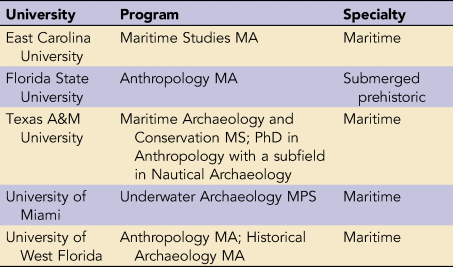
Note: There are underwater archaeologists at several US institutions not listed here that offer undergraduate coursework and research experience in underwater archaeology. For research experience outside of and/or in addition to academic programs, readers are urged to look up the Nautical Archaeology Society (NAS, nauticalarchaeologicalsociety.org), a UK-based organization that offers e-learning classes and has international training partners that offer NAS programs all over the world, including the United States.
The growing need for underwater archaeologists—particularly in cultural resource management, with increasing emphasis on offshore wind and energy development—paired with the lack of educational programs, is a serious issue in the United States. These issues have recently been outlined and discussed in a 2016 forum titled “Issues in Submerged Prehistoric Archaeology in the Americas” at the Society for American Archaeology annual meeting and at a panel at the 2018 Society for Historical and Underwater Archaeology Annual Conference titled “Underwater Archaeology Skills, Training, and Opportunities in U.S. Colleges: The 2017 ACUA University Benchmarking Survey” (Marionneaux Reference Marionneaux2018; O'Shea and Faught Reference O'Shea and Faught2016). These panels identified the concern that, within the United States, training opportunities in submerged landscape archaeology are few and far between, requiring students to essentially create their own degree plans, often at significant personal and financial costs. Although the lack of educational programs in broader underwater archaeology is a general problem, it is also telling that none of the universities offering this focus are Minority or Hispanic-Serving Institutions,Footnote 1 Historically Black Colleges and Universities, or Tribal Colleges and Universities.
Ultimately, limitations at every level of education in the United States constrain opportunities and knowledge for students to be interested and successful in underwater archaeology. These knowledge-based hurdles are significant barriers for underrepresented communities, which often do not have access to educators or mentors to help guide them. Support systems are critical components that may be missing and need to be established. Mentorship and peer-to-peer engagement can serve as both recruitment and retention tools, even in the absence of a formal curriculum (see below).
Skills-Based Barriers
There are significant knowledge-based hurdles to promoting diversity in underwater archaeology. But beyond these, even if individuals get their foot in the door and gain access to knowledge concerning underwater archaeology as an educational path and career opportunity, they still need to “get their feet wet” and acquire the skills necessary for underwater research and scholarship. Although there is specialized training for terrestrial archaeologists that involves continuing education, field schools, travel, and equipment purchases (e.g., remote sensing, GIS, zooarchaeology, etc.), learning scuba and other underwater techniques are additional steps. Indeed, underwater archaeology has been accused of “technophilia” due to the sheer number of skills required for submerged research (Gately and Benjamin Reference Gately and Benjamin2018; see also Flatman Reference Flatman2008:121).
Scuba Diving
Skills-based barriers are those concerning actual training and hands-on experience. Required skills for each discipline also present the most obvious differences between terrestrial and underwater archaeology. While one of the most important skills for an underwater archaeologist is scuba diving, and diving is often thought to be a prerequisite, this article argues that it does not have to be, and it questions the primacy of diving in underwater archaeology (see below).
First, diving itself can be a multifaceted barrier—scuba requires a significant financial and personal investment from those who may be interested in pursuing underwater archaeology as a career or an avocation. Initial scuba certification can be expensive. Among the four major scuba certifying agencies (Professional Association of Diving Instructors, National Association of Underwater Instructors, Scuba School International, and Scuba Diving International), the average cost for entry-level scuba certification ranges from $750 to $800. Typically, initial open-water scuba certification provides training to a depth of 18 m (60 ft.) and is a three-step process. This process starts with knowledge development. Students are taught a basic understanding of the physics and physiology of the underwater environment, which is commonly done online, necessitating internet access. The next step toward certification is skills development in a pool or confined water setting. The final step is to demonstrate scuba skills in an open-water environment, such as a quarry, lake, or ocean. Importantly, beyond the individual cost of scuba diving, there are necessary infrastructure requirements for scuba training that are not equally distributed across communities. For example, there may be a lack of swimming pools and scuba programs in underrepresented communities.
In addition to training fees, some level of investment in personal equipment is expected, and that can range widely—from basic equipment (mask/fins/snorkel) to a full set of personal dive gear that includes a dive computer, wet suit, buoyancy control device, regulator, tank, and other items. Beyond this, there are costs associated with increasing and maintaining scuba diving proficiency, which includes additional classes, equipment, and travel. Furthermore, depending on the depth and environment of underwater sites, there are additional certifications and equipment needed, such as those for advanced open water, rescue, dry suit, enriched air/mixed gas, and other types of diving. Overall, the economic barriers to scuba are significant and exponential, including the cost of basic dive certification(s) and equipment.
Beyond initial scuba certification for underwater archaeologists in training, costs can also include field schools, which in general are expensive. The global average cost for a four-week, for-credit terrestrial field school is $4,065. The cost of field schools alone promotes exclusivity (Heath-Stout and Hannigan Reference Heath-Stout and Hannigan2020), and the costs for underwater field schools—especially those that include diving—are often equally or more expensive. Overall, scuba diving is a costly pursuit, and it is even more so for individuals who are conducting scientific or technical diving and require additional certifications or equipment. Not only is scuba a significant barrier for individuals seeking to gain experience in underwater archaeology, but it can also be a barrier for getting stakeholders interested.
Underwater Remote Sensing and Other Technologies
Although scuba diving is essential for documenting, excavating, and sampling underwater archaeological sites, there is a broad range of technologies involved in underwater survey and documentation. Underwater surveys to discover shipwrecks, submerged cities/structures, or submerged landscapes often involve at least one or more of the following: side-scan sonar, multibeam sonar, scanning sonar, sub-bottom profiler, and magnetometer. To both collect and process the data using these underwater remote sensing instruments requires training, in the same way that users of terrestrial remote sensing techniques such as ground-penetrating radar do. Acquiring training for and access to these instruments can be additional barriers, in terms of both time and money.
In addition to survey equipment, there is a broad range of other techniques for documenting and mapping underwater sites, including (but not limited to) remote operated vehicles, photogrammetry, and coring. Furthermore, due to their unique underwater contexts, most artifacts from submerged archaeological sites require special conservation techniques. Although students of underwater archaeology may take a course in archaeological materials conservation during their degree programs, the conservation of submerged/waterlogged materials is so specialized that it can be better classified as its own field, related to but distinct from underwater archaeology. Several institutions and agencies have dedicated conservation laboratories, technicians, and staff, including the Conservation Research Laboratory at Texas A&M University and the Maryland Archaeological Conservation Laboratory.
As is evident in this discussion, underwater archaeology is an equipment- and skills-intensive endeavor. The associated financial costs, lack of mentors, amorphous pipeline to careers, and unequal access to facilities, training, and equipment create significant barriers to inclusion. Schools, researchers, projects, and training facilities are not equally distributed across the country—or across communities—and there are financial constraints on travel and training. The rest of this article will outline some solutions to many of these challenges, specifically by providing case study examples.
SOLUTIONS AND CASE STUDIES
Although the previous sections have outlined programmatic barriers to increasing inclusivity in underwater archaeology, it is important to note that just because these issues exist does not mean there are not adequate solutions for them. This section will pair major programmatic barriers to solutions, including specific case studies that have proven effective at building awareness, supporting education, and easing the financial burden of participation.
Building Awareness
As has been suggested above, one of the greatest challenges for broad inclusion in underwater archaeology has been the lack of awareness about maritime heritage and archaeological resources at the local level. More specifically, underwater archaeology suffers from the fact that it is often “out of sight and out of mind.” Without visibility on the landscape of everyday life, submerged archaeological resources can become forgotten or neglected (Scott-Ireton Reference Scott-Ireton, Derry and Malloy2003a, Reference Scott-Ireton, Spirek and Scott-Ireton2003b, Reference Scott-Ireton, Pydyn and Flatman2008, Reference Scott-Ireton2011, Reference Scott-Ireton and Scott-Ireton2014). In recent years, one of FPAN's biggest efforts for promoting the incorporation of underwater archaeology in community heritage has been to seek out established or popular neighborhood meeting spaces. In many cases, this means setting aside more familiar venues for educational talks and outreach programs and, instead, trying to coordinate with community centers, civic organizations, social clubs, churches, and recreation areas. For many communities, including those historically underrepresented in archaeology, these are places where socializing, meeting, and celebration happen. Reaching out to local leaders to discuss appropriate or interesting formats for outreach activities also has the dual benefit of attaining buy-in and creating more impactful programs.
Although many one-off presentations or hour-long children's programs do not necessarily involve hands-on exposure (such as through diving), the relatively simple act of building awareness about underwater archaeology and related fields is crucial for several reasons. First, it reinvigorates underwater archaeological resources as a component of local heritage. By keeping local sites near the forefront of daily life, educators and stewards can help ensure their long-term protection and preservation. Second, exposure to these subjects may encourage people to entertain underwater archaeology as a career possibility. In this sense, archaeology educators and public archaeologists can lay the groundwork for broadening the pipeline for greater representation at the career level and serve as future mentors. Finally, for those looking to act but not to necessarily pursue a career in maritime archaeology, introductory presentations or programs can provide inspiration to become involved. Many of the volunteers in FPAN's Public Archaeology Lab and in its community science engagement programs first become interested after public talks by FPAN staff. Although a number of these volunteers are not certified divers, they are stakeholders in the management of underwater archaeological resources in their communities, and they have been provided with the opportunity to participate directly without the need for scuba diving. Their participation in laboratory activities, resource monitoring via snorkel and shoreline survey (a good example of nonscuba participation; see below and Figure 1), and data-collection analysis from fieldwork provides very real benefit to the work of archaeologists (Miller and Murray Reference Miller and Murray2018).

Figure 1. Sites along coastlines provide unique opportunities to engage volunteers and community members with maritime heritage resources and to train students in documentation methods, without requiring scuba certifications: (a) Florida Public Archaeology Network's (FPAN) Heritage Monitoring Scouts Florida community science program; the monitoring mission featured in this photo, organized by the Florida Bureau of Archaeological Research, enlisted nondivers to record a potential shipwreck in Florida's intertidal zone (photo courtesy of FPAN); (b) undergraduate students from the University of Texas at Arlington map a shallow-water/beached shipwreck in Thunder Bay National Marine Sanctuary, Lake Huron, using standard terrestrial techniques—including a total data station—during their summer field school (photo by Ashley Lemke).
DWP has also made significant strides in engaging community stakeholders with underwater archaeology. Approximately 90% of the 500 DWP advocates are African Americans, Hispanics, and Africans from underrepresented communities. Within the past eight years, DWP participants have conducted over 150 in-person presentations in community settings in 25 states and in Washington, DC. DWP youths, in partnership with NOAA, conducted an educational broadcast live from the surface of the Montana shipwreck in Thunder Bay, Michigan. In many cases, these peer-to-peer interactions provide the first opportunity for audiences to see a person of color who is a scuba diver and involved in underwater archaeology. DWP has also been the subject of nationally and regionally broadcasted documentaries that highlight the search conducted by African Americans for ships that were involved in the trans-Atlantic slave trade of the sixteenth, seventeenth, and eighteenth centuries.Footnote 2 These multimedia presentations have been instrumental in increasing awareness of underwater archaeology in underserved communities.
Supporting Education
Complementary to the need for awareness building is the acknowledged deficit of anthropological and archaeological education in grade-school curricula, particularly for those schools that do not have resources to supplement daily lesson plans with field trips or guest speakers. Many of these schools are also within the public realm, subject to the demands of standardized testing and ensuring student achievement on those tests. Advancing the visibility of underwater heritage and archaeology in schools will likely require a multifaceted approach.
Archaeologists participating in community and public archaeology must first be willing to invest the time to engage with underrepresented communities creatively and meaningfully in schools. This entails the production of appealing programs that touch on the breadth of lived experiences and provide local relevance. In addition to drawing connections to the past at the community level, FPAN has found success in moving beyond the traditional “presentation” format in schools. Programs may include elements of formal presentations, but they should consider emphasizing discussion and hands-on activities to support program themes and educational goals. For example, in the “Shipwreck on a Tarp”' underwater archaeology program, students are invited as a group to decipher the meaning of artifact clusters on a shipwreck and to map them using basic grid techniques. Given the opportunity for multiday access to a classroom, one of FPAN's most successful activities has been the guided creation of an exhibit on local heritage on display for the larger school community. Using archaeological reports, local histories, oral histories, printed graphics, and other resources, students determine the focus of the exhibit, what to display, and how to interpret those materials for a public audience. These kinds of exhibits can be displayed in places such as school hallways or libraries, or even in local school district buildings.
DWP and UAS, along with their strategic partners, have also created and executed teacher training, mentoring, networking, and community capacity-building programs that increase awareness and diversity by integrating maritime archaeology into STEAM (Science, Technology, Engineering, Arts, and Mathematics) and social studies curricula. From 2017 through 2019, DWP, UAS, NOAA's Office of National Marine Sanctuaries, and the National Marine Sanctuary Foundation created a program entitled “Diving With a Purpose: Using Underwater Technologies to Expose Underrepresented Youth to the Science and History of the Potomac River Shipwrecks.” This program combined classroom, in-water pool scuba equipment and instruction, and a field visit to the Mallows Bay–Potomac River National Marine Sanctuary to introduce underrepresented youth to marine-related experiences, STEAM curricula, and technology-based career opportunities. This effort introduced 120–140 tenth-grade students from Henry E. Lackey and North Point High Schools in Charles County, Maryland (Charles County Public Schools), to the science and history of scuba diving and marine archaeology and biology (Figure 2). Demographically, students participating in the program were African American (59%), White (30.9%), Multiracial (4.2%), Hispanic (2.8%), Asian (1.6%), American Indian (1.1%), and Native Hawaiian (0.1%).
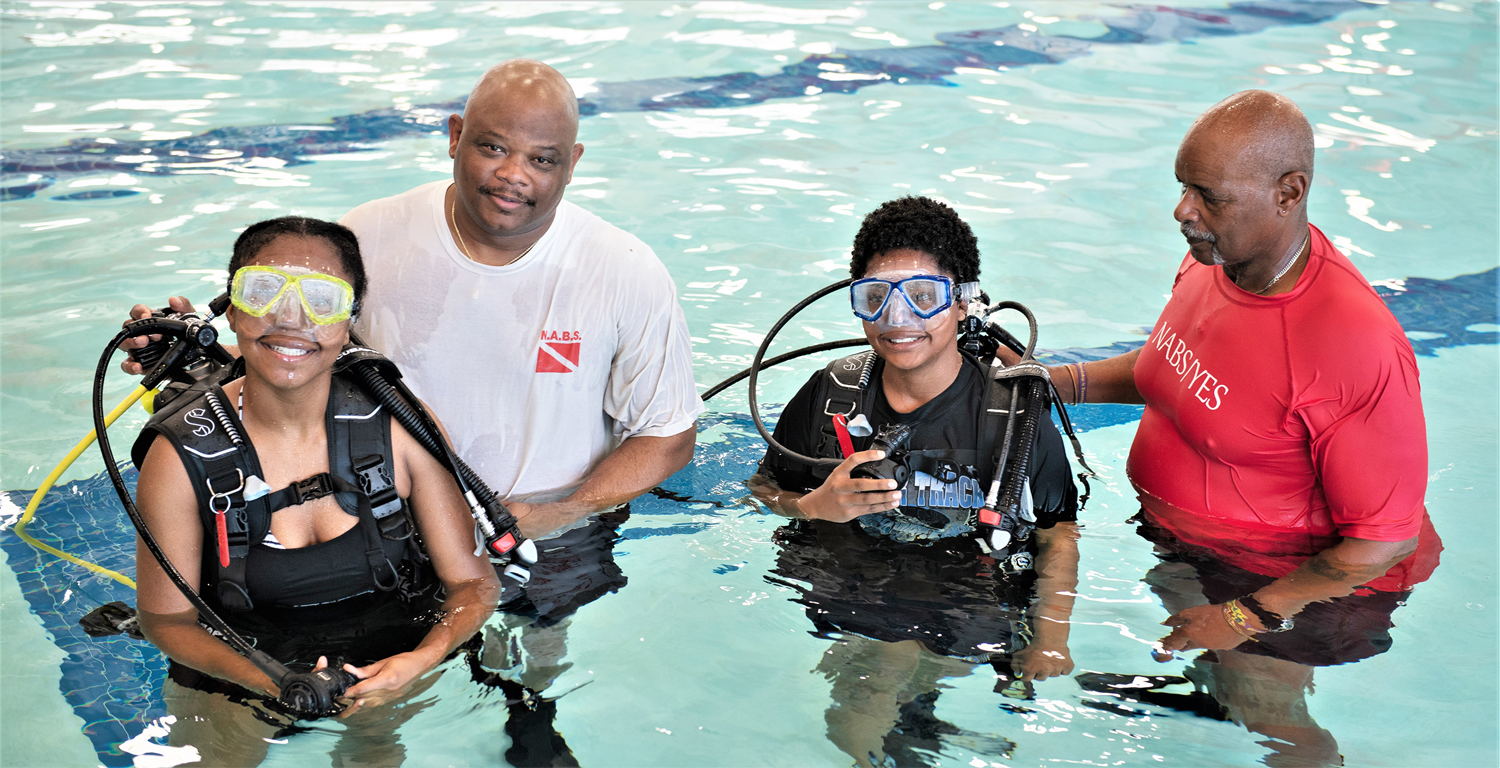
Figure 2. Accessible dive training and education as well as outreach are essential at public schools. Underwater Adventure Seekers (UAS) and Diving With a Purpose (DWP) members Donald Strong Jr. and Addeliar Guy conduct an introduction to scuba diving session at Henry E. Lackey High School in Charles County, Maryland (photo courtesy of DWP).
In addition to working at the classroom level, archaeologists should also work to get themselves a “seat at the table” in the implementation of district-level lessons in archaeology/anthropology and in the formation of state-level education standards. Although practitioners of archaeology and anthropology are aware of its applicability to learning across many disciplines—including language arts, math, and civics—many K–12 educators are not. Teachers can find it overwhelming to add more to their already crowded and laser-focused curricula. As a result, FPAN has found it more useful to work with a top-down approach. District social studies coordinators can help provide archaeology educators with streamlined access to K–12 teachers, disseminate program information more broadly, and set up workshops during which teachers can receive continuing education credit. Archaeology educators can also strive to be involved with the creation and updating of state public school standards when those opportunities arise.
Apart from working with public school districts, additional support for reaching students can come from outside collaboration. DWP intentionally focuses on building and maintaining strategic partnerships. This strategy has proven effective to fill the acknowledged gaps in school curricula as it relates to underwater archaeology. Not only has DWP built relationships with universities, but it has also worked with nongovernmental organizations, government or federal institutions such as the NOAA Ocean Guardian program, and NPS. These partners can help develop lesson plans and add to preexisting educational components. Significantly, the four major scuba certifying agencies—Professional Association of Diving Instructors, National Association of Underwater Instructors, Scuba School International, and Scuba Diving International—offer a specialty certification in underwater/maritime archaeology.Footnote 3 DWP offers the Professional Association of Diving Instructors (PADI) Archaeology Survey Diver specialty certification through its maritime archaeology field school. Scuba shops and operators throughout the country offer this specialty certification through the certifying agencies.
If archaeologists and archaeology educators can show the cultural value of underwater heritage and archaeology in their communities, then the work of getting these subjects into schools will be far less challenging. We suggest that the few examples of solutions offered here can work together to diminish pervasive knowledge-based barriers to a more inclusive and well-represented discipline. Ultimately, efforts to bring underwater archaeology education into classrooms and into the everyday orbit of students can highlight the discipline's cultural relevance and increase the likelihood of sparking lifelong interest. In this way, we can better establish a pipeline for both fostering new professionals and creating stewards of community heritage resources.
Easing Financial Burdens of Participation
Although the costs of scuba are real and substantial, there are various solutions that can help ease the burden of investment for those interested in getting involved with underwater archaeology at either the professional or avocational level. The Underwater Adventure Seekers (UAS) has invested in a dive locker, offering shared equipment for members and mitigating the cost to individuals. For entry-level scuba certifications, UAS only requires students to purchase masks, fins, and snorkels. Other programs or organizations should consider a similar approach. Arrangements can be made with manufacturers or local dive shops to negotiate lower prices for large group purchases, resulting in 15%–30% discounts on these basic materials. Written materials can also be bought in bulk, subsidizing the cost per student. Even though e-learning is common in scuba certifications today, instructors cannot presume everyone has internet or computer access. Course materials should therefore be offered both in printed form and online. The Los Angeles Black Underwater Explorers, a sister scuba diving club to UAS, has similarly created a dive locker where its members can borrow or purchase new and used scuba equipment to continue diving after initial certification. Beyond equipment, DWP created and continues to manage maritime archaeology field schools for youth, and the University of Texas at Arlington offers a nondiving underwater archaeology field school for undergraduate students. Costs of the field schools (including transportation, lodging, meals, dive equipment, and materials) are subsidized by grants, and program instructors volunteer most of their time. Through federal, state, and local governmental partnerships, charter boat services and access to submerged archaeological sites are provided.
Although there is no substitute for a scuba-trained underwater archaeologist on a project that requires dive operations (Figures 3a and 3b), there are nondiving opportunities available for students and the public to get involved in underwater archaeology. For example, remote sensing techniques offer a pathway to work “topside” on the boat without getting into the water. Likewise, volunteering at a laboratory processing artifacts or interning at a conservation laboratory does not require scuba but still provides access to underwater materials. Shallow-water shipwreck site monitoring via waders, snorkeling, or mapping activities is a wonderful training exercise that also provides important data (Miller and Murray Reference Miller and Murray2018). Undergraduate students at the University of Texas at Arlington participated in a nondiving underwater archaeology field school and documented a shipwreck using a total data station (Figure 1b). Nondiving contributions are just as critical as those collected via scuba diving and provide a more accessible route to gaining experience as an underwater archaeologist and getting individuals to engage with underwater cultural heritage.
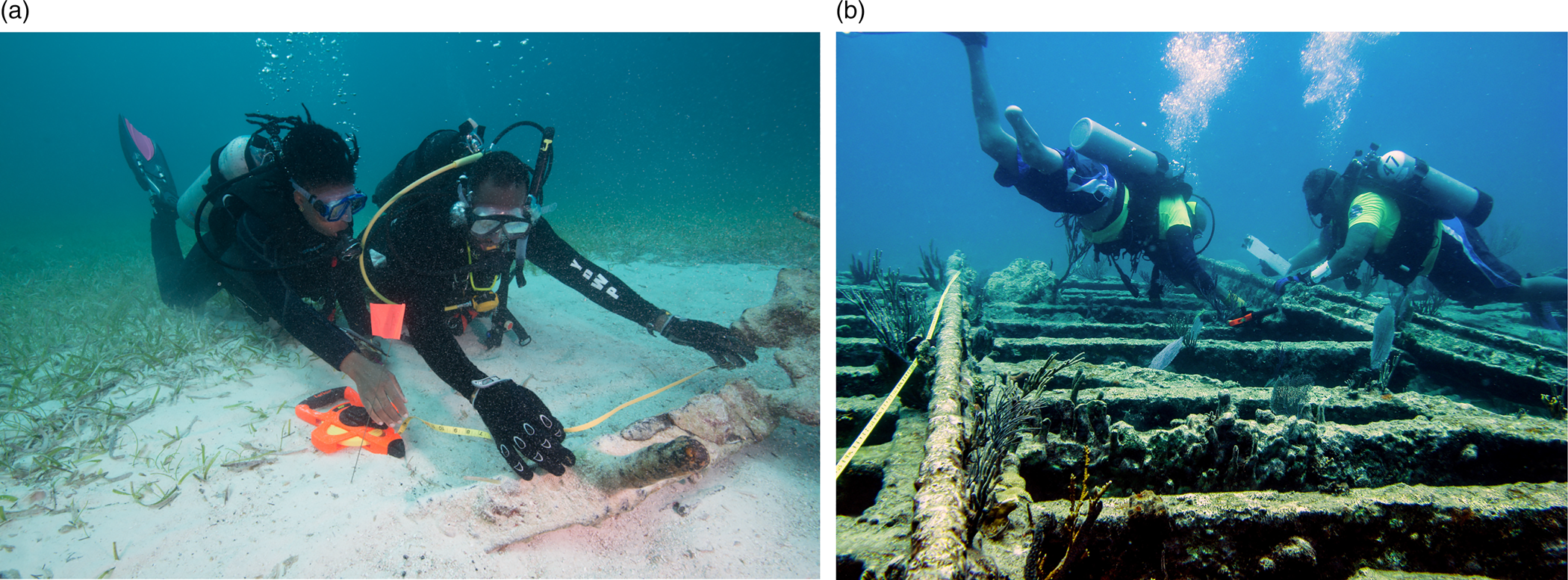
Figure 3. The cost and accessibility issues of scuba can be offset by field schools providing basic equipment and adaptive scuba rigs: (a) Diving With a Purpose (DWP) field school lead instructor Jay Haigler teaching a student how to measure a submerged artifact in situ in Biscayne National Park, Florida (photo courtesy of DWP); (b) a dive team of military veterans learns the baseline offset method of recording underwater archaeological sites during an FPAN Submerged Sites Education and Archaeological Stewardship course in partnership with Biscayne National Park and Aquanauts Adaptive Aquatics (photo courtesy of FPAN).
In addition to cost-mitigating practices and nondiving options, there are also emerging scholarship programs designed to address the financial needs of underrepresented communities. The American Academy of Underwater Sciences's Diversity Scholarship is one example of a new funding source to help mitigate the high cost of initial scuba certification. This scholarship is geared to individuals from underrepresented groups in diving and is awarded based on a variety of factors, including but not limited to educational experience, socioeconomic background, cultural heritage, race and ethnicity, and geographic region. The NOAA Dr. Nancy Foster Scholarship is an existing program that provides maritime archaeology and marine education for women and members of minority groups. Every year, the Women Divers Hall of Fame awards scholarships and training grants that provide financial and educational support for women who are preparing for professional careers that involve scuba diving.
There are also several awards and scholarships for those students and young professionals in underwater archaeology and related fields. The ACUA offers a Diversity, Equity, and Inclusion Student Travel Award that supports students presenting their work on topics in underwater and maritime archaeology at the annual Society for Historical Archaeology conference. For this award, diversity is a self-identified characteristic that can include race, ethnicity, gender, sexual orientation, abilities, and socioeconomic background. The Society for Historical Archaeology also offers its Harriet Tubman Student Travel Awards—although these are not specific to underwater archaeology—to students with diverse backgrounds who also wish to attend and present at its annual conference. The Society for American Archaeology (SAA) also has a suite of Historically Underrepresented Groups Scholarships geared to undergraduates, graduates, and those needing radiocarbon dating for their research. The undergraduate and graduate scholarships provide support for training and participation in research, which can include tuition, travel, food, housing, supplies, equipment, and other potential expenses. A similar suite of SAA Native American Scholarships offers support for Native American students at various stages in their academic programs. Those interested in receiving financial support for continuing education or conference travel can also look to local or regional archaeology organizations such as the Southeastern Archaeological Conference and the Texas Archeological Society.
Moving forward, it is important to focus on sustainability and capacity building rather than only short/near-term outcomes. Although increasing diversity and equity for a single field season is important, creating networks, peer groups, role models, sustained research initiatives, and ongoing programs will ensure that inclusion is a growth area over time. The first step is identifying the problem so clearly articulated by Franklin (Reference Franklin1997). But how do we actualize change? The case studies and solutions provided here are the first steps in outlining programmatic barriers to inclusivity in underwater archaeology and how we can work to break them.
CONCLUSION
Despite its focus on knowledge- and skills-based barriers in the United States, we hope this article provides clear takeaways for archaeologists working in, on, or under water all over the globe. In both archaeology generally and underwater archaeology specifically, work is needed to increase inclusion and representation. Throughout its history, archaeology has been used to justify imperialism, the displacement of Native Americans and Indigenous peoples from their lands, scientific racism, ethnocentrism, and xenophobic nationalism (Diaz-Andreu Reference Díaz-Andreu2007; Hamilakis and Duke Reference Hamilakis and Duke2007; Shackle Reference Shackle2001; Shepherd Reference Shepherd2002; Trigger Reference Trigger2006). Within archaeology, underwater archaeology is arguably the most colonial of all the sub-specialties, largely due to the dominance of research focusing on warships and colonial vessels, as well as those vessels that were involved in international human trafficking (i.e., the slave trade; see also Ford Reference Ford, Orser, Zarankin, Funari, Lawrence and Symonds2020).
Within the past year, the convergence of the two pandemics—COVID-19 and long-term systemic racial inequity in the United States—has provided an opportunity for universal structural change. This change has implications for archaeology (Franklin et al. Reference Franklin, Dunnavant, Flewellen, Jones and Odelwale2020). Acknowledging the importance of diversifying the field of underwater archaeology by issuing broad statements of support is simply not enough. As outlined above, there are very real barriers to inclusivity in underwater archaeology. The means to break those barriers also exist. Education of and outreach to local communities should be reimagined by contacting organizations that are not often considered, such as church groups, social clubs, fraternities, sororities, and recreational organizations. Professional archaeologists and archaeology advocates should be vocal in supporting the inclusion of anthropological/archaeological concepts in K–12 curricula at the local and state levels. Opportunities for both stakeholders and students to “get their feet wet” should involve nondiving approaches that are more accessible and should focus on a wider range of career opportunities. For those individuals who decide to take the plunge and pursue scuba diving as a means to practicing underwater archaeology, partnerships, mentoring, and scholarships provide both human and financial resources to help them become the next generation of underwater archaeologists.
Acknowledgments
The authors wish to thank ACUA, DWP, UAS, and FPAN for their ongoing commitment to equity, diversity, and inclusion in the field of underwater archaeology. We also thank five anonymous reviewers, who provided insightful comments for improvement and clarity in the manuscript; and Alanis Ramos Berrios for the Spanish translation of the abstract. No permits were required for the work presented in this article.
Data Availability Statement
The data presented in this manuscript are largely from cited, published sources. Any information concerning the specific cases studies will be provided on request from the authors.


 Open access

