

Earth architecture, widely practiced today, has also been constructed for millennia (e.g., Belarte Franco Reference Belarte and Carme2002; De Chazelles Gazzal Reference De Chazelles Gazzal1997; Knoll and Klamm Reference Knoll and Klamm2015; Pastor Quiles Reference Pastor Quiles2021a). Its adequate properties and availability in most natural environments are conducive to it being used by a wide array of human communities. Numerous instances of historical, ethnohistorical, and archaeological documentation show that, in a very important part of past buildings and built structures, earth was used as a construction material arranged in different construction techniques (Houben and Guillaud Reference Houben and Guillaud1994; Knoll et al. Reference Knoll, Quiles, De Chazelles Gazzal and Cooke2019), usually in combination with other resources and answering a wide range of human needs.
Studying past architecture brings us closer to the communities that built, inhabited, maintained, and even destroyed these structures. Addressing the remains of these structures found in archaeological contexts is basic to a more complete knowledge of them, and in some cases, it can be the only way to know them. Given the long history of earth construction, the study of its building remains is essential to writing the history of human building techniques and practices in a much more complete way, including their changes through time and space. The macroscopic analysis of these materials allows us to put forward hypotheses about the construction of the original buildings, and the organization and distribution of space in a settlement. It also allows examination of the management of natural and anthropic resources, the material choices and the activities involved in building processes, the technological innovations applied to architecture, the building traditions and their continuity, and transformations linked to social changes.
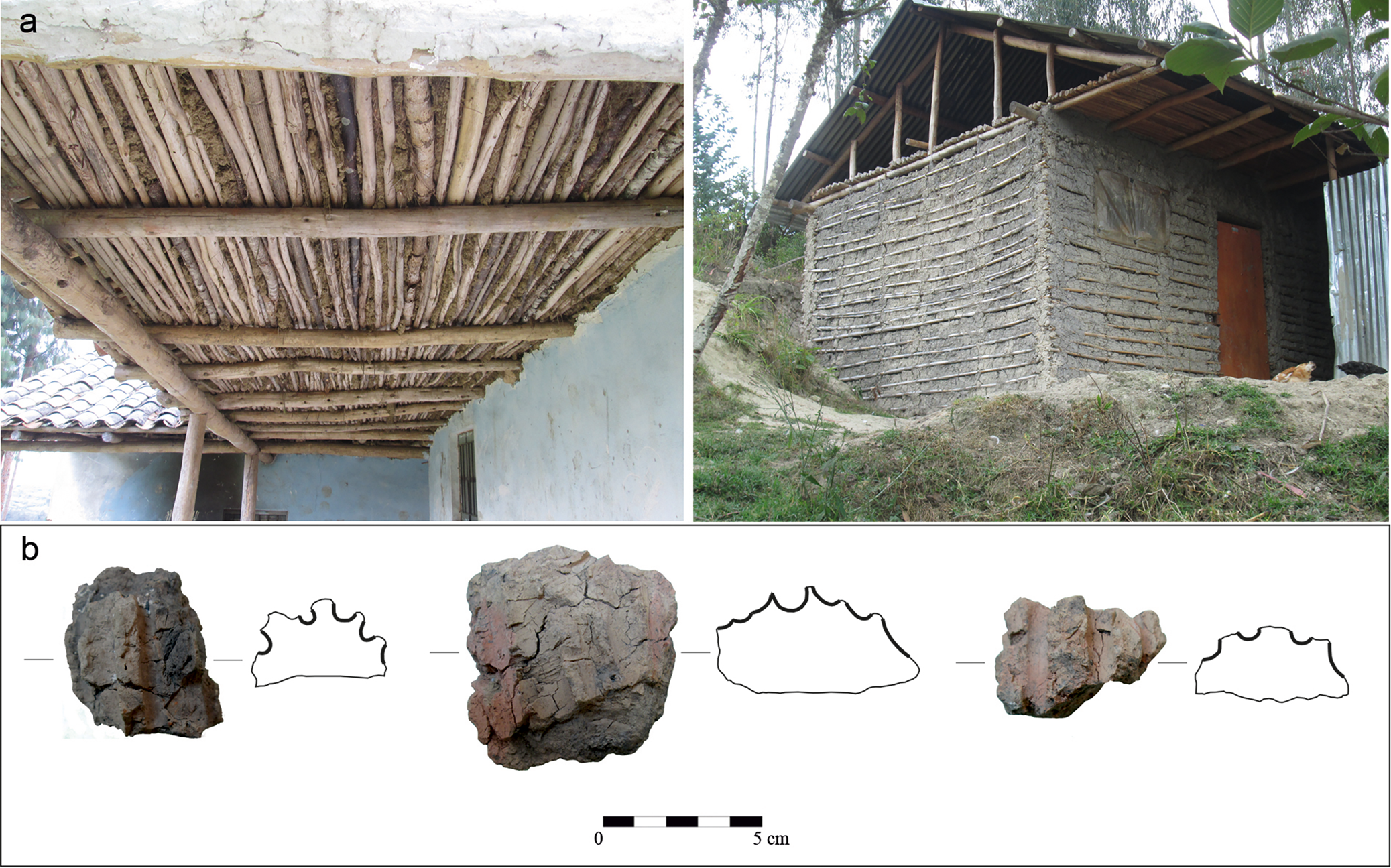
The practice of building with earth in the past can be approached through different sources, from the written testimonies of classical antiquity—mainly, Vitruvius's De Architectura—to iconography, or the more recent photographic documentation of traditional architecture. To study these buildings through their material remains, archaeology focuses on the vestiges that have been preserved in vertical stratigraphy or, more frequently, that have collapsed and are often poorly preserved. In this way, the traces of earthen structures are usually reflected in the archaeological record in the form of strata, of better or more poorly preserved in situ remains, or from fragments that have been able to be preserved, mostly when they are hardened (Figure 1). These archaeological earthen materials, also known as daub fragments, are the focus of this article.
Structures built with a structure of vegetal elements covered with mud and their remains in archaeological contexts: (a) roof and walls built with wattle and daub (Cruzpata and Luya, Peru); (b) hardened mud remains of the same building technique. Bronze Age settlement of Cabezo Pardo (San Isidro/Granja de Rocamora, Alicante, Spain).
These elements are sometimes so ubiquitous in fieldwork as to be disregarded, which has been pointed out for decades (e.g., Amicone et al. Reference Amicone, Croce, Castellano and Vezzoli2020:522; De Chazelles Gazzal and Poupet Reference De Chazelles Gazzal and Poupet1984; Sánchez García Reference Sánchez García1996). The main reason for the lack of attention is their association with “perishable,” nonmonumental architecture and the difficulties in their preservation and identification as fragile nonfired earthen elements.
Past research on daub fragments has not yet covered the wide variety of historical periods in which they may be available. As an example, in the case of the Iberian Peninsula, these studies have addressed fragments from the so-called prehistoric contexts (e.g., García López and Lara Astiz Reference García López, Astiz, Marcén, Colliga and Torcal1999; Gómez Puche et al. Reference Gómez Puche, Castillo, Köhler, Pascual Benito, López Gila, Marco, Cebrián, Borja, Puchol and McClure2004; Jover Maestre Reference Maestre, Javier and Jover Maestre2010; Miret i Mestre Reference Miret i Mestre1992; Pastor Quiles Reference Pastor Quiles2017), as well as protohistoric (Belarte Franco Reference Belarte and Carme1999–2000; Mateu Sagués Reference Mateu Sagués2011; Moralejo Ordax et al. Reference Moralejo Ordax, De Prado and Sanz2015; Ortiz Villarejo et al. Reference Ortiz, Jesús, Soler and Armijo2020; Rodríguez del Cueto Reference Rodríguez del Cueto2012; Ruano Posada Reference Ruano Posada2021), dating from the Neolithic to the Iron Age (sixth to first millennium BC). These materials are not the object of study in the same way as in research on, for instance, ancient Roman settlements, even though earth construction techniques such as wattle and daub were also practiced in that and many other periods of history, resulting in incomplete images of the architecture of certain periods, and gaps in the history of human building.
Globally, it is common for approaches to these remains to be carried out through micromorphological or petrographic analysis (e.g., Cammas Reference Cammas, Chazelles and Klein2003; Melis and Albero Santacreu Reference Melis and Santacreu2017; Nodarou et al. Reference Nodarou, Frederick and Hein2008; Rivera Groennou Reference Rivera and Miguel2009; Wattez Reference Wattez, Chazelles and Klein2003) as well as various physical chemical analyses (Amicone et al. Reference Amicone, Croce, Castellano and Vezzoli2020; John and Majer Reference John and Majer2010; Jover Maestre et al. Reference Jover, Javier, Quiles, Mira and Ortego2016; Mateu Sagués et al. Reference Mateu Sagués, Bergadà Zapata and Garcia i Rubert2013; Shaffer Reference Shaffer1993; Spengler et al. Reference Spengler, Campo, Ratto, Bertolino, Cattáneo and Izeta2020). Other works have approached these materials with experimental archaeology (Cavulli and Gheorghiu Reference Cavulli and Gheorghiu2008; Knoll Reference Knoll2018; Peinetti Reference Peinetti2013; Peinetti et al. Reference Peinetti, Aprile, Caruso, Speciale, Alonso, Baena and Canales2017; Staeves Reference Staeves2017; Stevanović Reference Stevanović1997) and ethnoarchaeology (Carneiro and Mateiciucová Reference Carneiro, Mateiciucová and Whittle2007; Kruger Reference Kruger2015; Pastor Quiles Reference Pastor Quiles2019; Peinetti Reference Peinetti, Biagetti and Lugli2016). A combination of these approaches is key for a better study of these testimonies of the human past, in aspects such as the origin and choice of raw materials, the technical gestures and know-how, or the reconstruction of the original building forms.
Most of the published research addressing the study of earth remains in archaeology has focused on specific assemblages from a certain settlement. In addition, a good number of these studies carried out from a macroscopic approach have not published the methodology used.
This article intends to address a broad audience to try to help researchers with how to carry out a basic macroscopic analysis of these building fragments and motivate future research. I provide a transversal step-by-step guide (Figure 2) with which to obtain and interpret various data on the activities and constructive forms of the human groups that produced the structures to which they belonged. The macroscopic analysis of earth construction fragments is a task primarily conducted in the laboratory. For their study, a proper methodology must be followed, according to some simple but crucial guidelines, many of which are common to the study of other archaeological materials. However, these guidelines must take the fragments’ particularities into account, such as the fragility they may present or the ways they should be cleaned or labeled.
Steps to follow in the macroscopic study of earth construction remains.

A STEP-BY-STEP GUIDE TO MACROSCOPIC ANALYSIS OF EARTHEN STRUCTURAL REMAINS
Life before the Study: Some Considerations on Provenance and State of Preservation
The study of earthen architectural remains typically starts during fieldwork, with their stratigraphic position and spatial distribution fundamental to the interpretation of their original position and function (Bánffy and Höhler-Brockmann Reference Bánffy and Höhler-Brockmann2020; Kruger Reference Kruger2015; Shaffer Reference Shaffer1993). In some cases, for practical reasons, it may seem necessary to develop a sampling strategy in the field or in the lab if materials are found in large quantities. It is worth remembering that it is not until their study has been carried out that we can better determine the nature of these findings and evaluate both their interest and informative potential.
Earth construction elements recovered during an excavation can arrive at the laboratory in conditions that stem from the way they were manipulated. In this sense, they should be left to dry out if still moist and packed in such a way that they will be dry when stored and studied. A soft geotextile works well to protect the less hardened fragments.
In some circumstances, these fragments could have been on the ground surface for decades, centuries, or more, exposed to natural and anthropic agents and therefore showing alterations such as the presence of lichens and faunal residues. They could also have been stored for a very long period and in various preservation conditions (for example, with a high degree of humidity), which can also affect materials.
For decades, research focused on the study of nonfired earth remains in archaeology has highlighted that their conservation is possible mainly due to the contact between them and a heat source (Bankoff and Winter Reference Bankoff and Winter1979; Sherard Reference Sherard2009). The earth used for building purposes contains clay that, when drying, hardens increasingly in contact with high temperatures. In most cases, it is considered that the fundamental cause of the contact between a structural part made of mud and the high temperatures would have been a damaging fire, although the possibility that the mud could be hardened by fire as part of the building process has also been raised (Miret i Mestre Reference Miret i Mestre1992:69; Ottomano Reference Ottomano and Frontini2001; Shaffer Reference Shaffer1993:62). At a temperature around 350°C–450°C, the clay remains would harden and preserve (Berna et al. Reference Berna, Behar, Shahack-Gross, Berg, Boaretto, Gilboa and Sharon2007:360), and at temperatures higher than 700°C–800°C, clay materials would begin to vitrify, through the formation of crystals in the clay particles (Courty et al. Reference Courty, Goldberg and Macphail1989:109). Furthermore, the deposition of mud fragments in negative structures or their rapid introduction into a sedimentary matrix also favor their conservation (Miret i Mestre Reference Miret i Mestre2005:319).
Cleaning
The first task in the study of earth building remains is that they must be cleaned, not only so that they can be better handled during the study but also so that their characteristics can be fully evaluated. Although the risk of breakage can be significant during cleaning, this is essential in order to examine them visually. The most widespread and recommended cleaning method for these materials is dry cleaning with a soft brush, taking care not to leave additional marks on their surfaces. Cleaning them with water can affect them, for example, by acting on certain components and inclusions they may contain.
Cleaning not only involves removing the dust that covers the surfaces but often constitutes a true reexcavation of these pieces in the laboratory. Removing the sediment compacted against the fragment implies gradually differentiating it from the daub itself and bringing to light features that could not be observed before, such as imprints and other forms that will allow characterizing and interpreting them. In fragments with a lower degree of hardening, the manipulation necessary already during this first phase of the macrovisual study can cause the element to fracture and even be destroyed to a lesser or greater extent. For this reason, it is advisable to take photographs before starting this first manipulation of the materials.
Labeling
Direct marking on the fragments, which implies an obvious alteration to them, can be avoided with the use of a label included in the packaging. Paper labels and aluminum foil in contact with the fragment could adhere to the mud surface and significantly contaminate the samples (see Figure 6f). Paper labels do not always last over time, so their use can cause the loss of contextual information of the remains. To avoid this, it is always recommended to duplicate the labels too. With wooden labels, something similar can occur—although to a lesser extent—because they are also affected by humidity. Consequently, these problems can be avoided with labels made of more durable materials, such as plastic, and placing them in a small plastic bag to avoid contact with the earthen remains.
Collection of Data: The Way to Their Interpretation
Once the pieces have been cleaned and the question of their identification and protection is resolved, the study itself can be carried out through direct observation with data collection for their characterization. For this, a sheet or template (Figure 3) can act as a guide, facilitating a systematized data collection (see also Knoll and Klamm Reference Knoll and Klamm2015:164; Labille et al. Reference Labille, Gilabert, Onfray, Sénépart, Billard, Bostyn, Praud and Thirault2014:308). The information that needs to be collected is contextual, morphological, compositional, and interpretive.
Sheet model for data collection during the macroscopic analysis of earth construction elements.
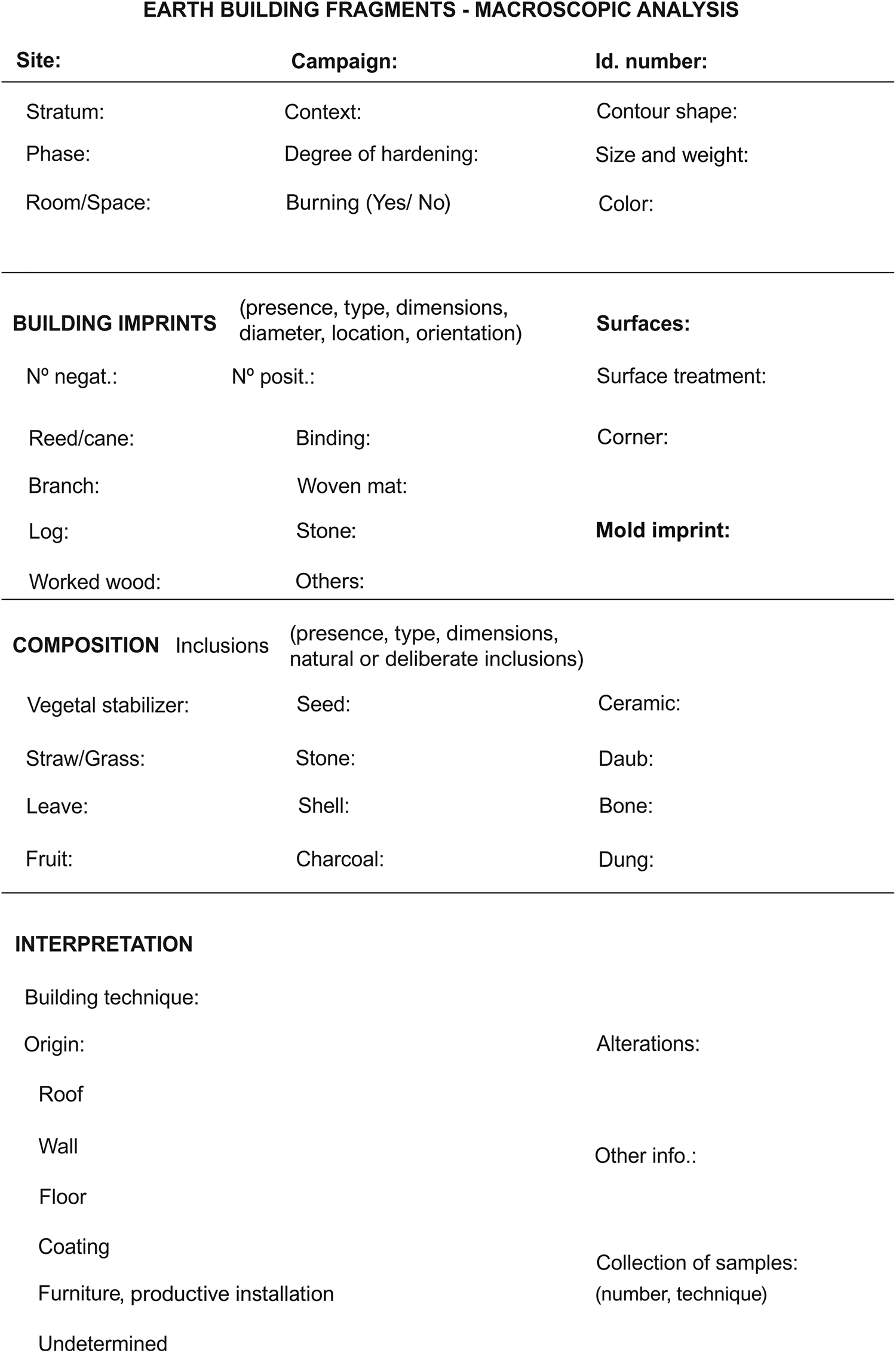
Together with the individualized identification of the pieces, information on their context of recovery must be collected, as well as other general data (see Figure 3, upper section), such as an evaluation of their lower or higher degree of hardness—possibly the most determining characteristic when it comes to enabling the study of this type of remains—their contour shape, and dimensions (at least their length, width, and height). Many of the studies on these materials also take weight into account (e.g., Carta Reference Carta2017; Diachenko et al. Reference Diachenko, Stróżyk, Szmyt and Żurkiewicz2021; Gómez Puche Reference Gómez Puche and Soler Díaz2006:273; Jaeger and Stróżyk Reference Jaeger, Stróżyk, Czebreszuk and Müller2015:289; Stevanović Reference Stevanović1997:351–352).
Morphology. The approximate shape of the contour, as well as the size, can be related to the degree of fragmentation of the structures to which they belonged. In addition, the circumstances in which they have been deposited—whether they were quickly buried or instead remained on the surface—can be associated with angular contours or, conversely, eroded and rounded ones. Taking into account these aspects can help us consider taphonomical and postdepositional issues that may affect the characteristics of these materials and therefore their interpretation.
In some cases, there is a relationship between a larger fragment size and greater informational potential (Jongsma Reference Jongsma1997:127), although this is not always the case. In the same way that a large earthen block may have an indeterminate morphology, which makes it very difficult to attribute it to a specific part of the structure or to a certain technique, a small fragment can contain—even in a few millimeters—features that inform about various aspects of the constructed forms or building processes.
Color. Colors are influenced by various factors such as the different types of soil used as raw material (Volhard Reference Volhard2010:88), substances present in the mixture, different postdepositional processes, and above all, the action of fire (Gómez Puche Reference Gómez Puche and Soler Díaz2006:274). This means that behind the color observed, there can be the availability and choice of raw materials; past practices such as intentionally firing the structural parts, as mentioned above; and, frequently, the circumstances of an accidental fire. The blackish or blackened tones, as well as the reddish ones, are normally related to combustion processes in reducing or oxidizing atmospheres (Courty et al. Reference Courty, Goldberg and Macphail1989:120), considering the reactions that occur between the minerals that make up the main components of clays: iron, calcium, and silica (Gómez Puche Reference Gómez Puche and Soler Díaz2006:274). On the one hand, blackened colorations are related to reducing combustion conditions, at temperatures below 600°C and a fairly short exposure to fire, given that, with this, the blackened interior disappears, and brown tones are adopted. In less than half an hour and at only 600°C, this transformation can be made (Forget et al. Reference Forget, Regev, Friesem and Shahack-Gross2015:86–91, Figure 11). On the other hand, around 500°C, the iron particles present in the mud mixture will begin to oxidize and take on a reddish or orange color (Stevanović Reference Stevanović1997:366). Dark red colorations are related to combustion under oxidizing conditions from 800°C (Forget et al. Reference Forget, Regev, Friesem and Shahack-Gross2015:Figures 9–10). Bad practices, such as packaging the earthen materials too quickly when humid in a closed environment, can strongly transform them and, for instance, turn them white.
Therefore, this analysis also must pay attention to the colors shown by the remains, on their different sides and interior, which can be registered using tools such as the Munsell Chart, while also being aware of the subjectivities present in color determinations (Bloch et al. Reference Bloch, Hosen, Kracht, LeFebvre, Lopez, Woodcock and Keegan2021).
Building Imprints and Surfaces. The core element of the macrovisual analysis of earth construction remains is their morphological features—their macromorphology. It is necessary to differentiate (see Figure 3, second section), on the one hand, between the impressions that respond to integral parts of a structure or building material—building imprints and surfaces, which can allow us infer building materials, techniques, and practices—and on the other, those characteristics that are related to the composition of the mixtures and caused by inclusions. With the complete set of observed features, one can try to determine aspects as varied as their structural origin, the construction technique used, or practices such as resource and residue management.
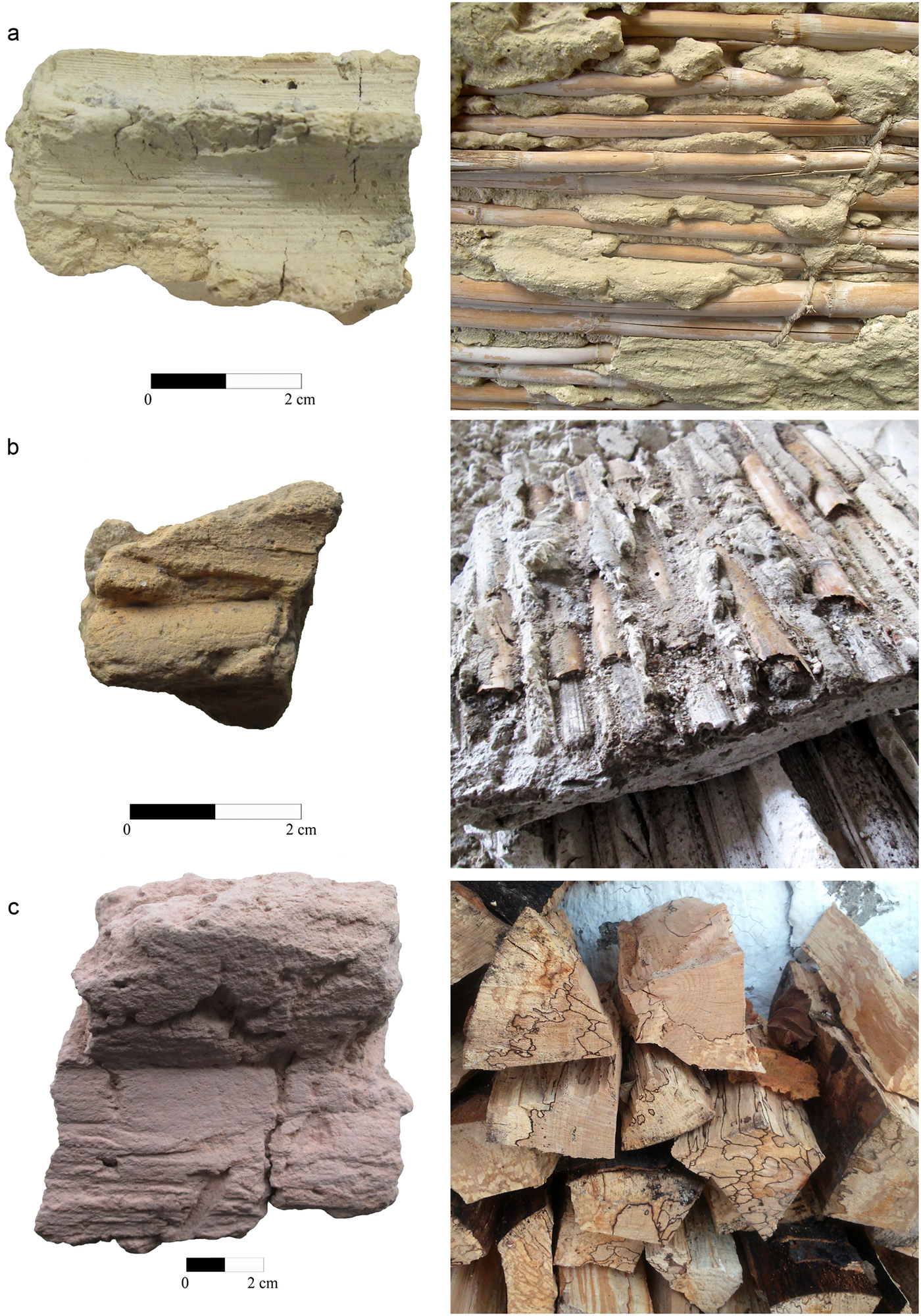
Features that correspond to parts of a structure or building material—or to the way the building material was produced, such as mold imprints (as in the case of adobes)—are apparent in the presence of certain shapes, identifiable internal or external surfaces, and even decorative elements. Probably the most common of these morphological characteristics are building imprints. These are impressions—commonly negatives (Figure 4a), but that could also be of positive shape (Figure 4b)—of elements that performed constructive functions or were part of a built structure but that have not been preserved. On many occasions, this is due to its organic nature, which facilitates its decomposition. This occurs with wooden and vegetal construction material: smaller plant material as well as canes or reeds and branches and logs. They can present a circular section, but this is not always the case, because they could have been sectioned and worked before being used in the construction. Worked wood imprints of sectioned logs and boards are common in hardened mud remains (Carneiro and Mateiciucová Reference Carneiro, Mateiciucová and Whittle2007:262; De Chazelles Gazzal Reference De Chazelles Gazzal and Carozza2005; Knoll and Klamm Reference Knoll and Klamm2015:108; Pastor Quiles Reference Pastor Quiles2019:57, 202; Figure 4c). Combinations of different types of vegetal and wooden imprints are frequent in the same fragment. In the imprints of wood surfaces, as well as in coatings and adobes, the negatives of marks that were made on them to favor the adhesion of mortar or other elements could also be identified (e.g., Knoll et al. Reference Knoll, Quiles, De Chazelles Gazzal and Cooke2019:36, 37). Therefore, macroscopic analysis of these materials can bring to light productive activities of the past and building procedures such as woodworking.
Building imprints in daub next to a current example of the element to which they correspond: (a) negative imprints from reeds, Bronze Age site of Laderas del Castillo (San Isidro/Granja de Rocamora, Alicante, Spain); (b) positive reed imprint, Chalcolithic settlement of Les Moreres (Crevillente, Alicante, Spain); (c) imprint of worked wood, Chalcolithic settlement of Les Moreres (Crevillente, Alicante, Spain).
Imprints of this kind should be documented by measuring their preserved length and diameter—preferably with a rim chart, although it can be done directly with a ruler or measuring tape when at least half of the section is preserved—and characterizing their surface (smooth, grooved, which may be characteristic of certain species) and position in the fragment regarding other shapes and imprints. Traces of the action of xylophages can appear in the imprints of these vegetal and wooden elements (Figure 5b), which can be indicators of the use of dead wood, of reuse, or storage practices (Pastor Quiles et al. Reference Pastor Quiles, Martín-Seijo and Toriti2022). These help us to better understand the conditions in which these structures were built and the social groups that erected them. That is why it is key to record all these characteristics so that they can be interpreted later. Impressions of vegetal building materials include those left by binding elements made with different techniques—such as individual strings or plaited (Figure 5a) or twisted ropes, which can be used in combination; or even by woven mats (see Figure 6a), which could also have been used as a construction material. This is a building practice known archaeologically and ethnographically in diverse regions but often not considered (Pastor Quiles Reference Pastor Quiles2021b), and one that can be brought to light thanks to the macroscopic analysis of earthen remains. In other cases, the elements to which the imprints correspond would have been inorganic and nonperishable, such as stones.
Features in daub next to a current example of the element to which they correspond: (a) impression of plaited ropes in a log imprint, Chalcolithic settlement of Les Moreres (Crevillente, Alicante, Spain); (b) positive impression of xylophagous tunnels in a log imprint, Chalcolithic settlement of Les Moreres (Crevillente, Alicante, Spain); (c) coated surface, Chalcolithic site of La Torreta-El Monastil (Elda, Alicante, Spain).

Features of diverse kinds that can be observed in daub: (a) imprint of a woven mat; (b) smoothed surface; (c) negative mark of a stone; (d) negatives of plant material added as a stabilizer; (e) tool mark generated during excavation; (f) paper label adhered to an earthen fragment. Provenance: (a, e) Neolithic site of Los Limoneros II (Elche, Alicante, Spain); (b) Chalcolithic site of La Torreta-El Monastil (Elda, Alicante, Spain); (c, d, f) Chalcolithic site of Les Moreres (Crevillente, Alicante, Spain).

In this way, it is important to determine if the surfaces correspond to fractures that show internal structural parts that would not originally have been visible, or if they were destined to be in plain sight. External surfaces would have been regularized, with marks as a result of its application. They might be smoothed (see Figure 6b) by means of an instrument or using the hands; plastered (Figure 5c), evidencing, for instance, technological innovations applied to architecture, such as pyrotechnological lime, with several layers of coatings; applied as part of the same construction process or as successive repair; and decorated, for example, with painted motifs or graffiti. A careful analysis of these external surfaces can therefore give us valuable information also about maintenance activities carried out by the communities under study and about diverse sociocultural features reflected in decorations. Generally, plastered fragments can be associated with and therefore interpreted as wall surfaces—although this does not have to be the case, given that they can also correspond to domestic furniture, benches, shelves, or other building parts, or even to portable elements (see Figure 3, lower section).
Compositional Aspects and Inclusions. Besides texture, particle size, and distribution, nonstructural elements or traces thereof can be identified, which can provide important construction information. The elements and residues contained in the mud mixture and of which its traces or remains can be observed macroscopically are very diverse. They could be organic or inorganic (Figure 6c), natural or anthropic—ranging from fruits and seeds, malacofauna, and dung or ash aggregates to ceramics or bones and even reused earth building fragments. All of these make it possible to put forward a hypothesis about the origin of the sediments used to build and about social practices such as reutilization, which is very common in social contexts where the people who build are also the ones who will use or inhabit the construction.
These inclusions would have been part of the mixtures either because they were accidentally contained or introduced in the sediment used as a building material—prior to or during mixing—or because they are components added on purpose, generally as stabilizers (Houben and Guillaud Reference Houben and Guillaud1994:73; Figure 6d). Stabilizers are intended to improve the constructive behavior of the soil, giving it, for instance, greater resistance to the appearance of cracks, in the same way that in ceramic production tempers are added to clay for different purposes—such as favoring manipulation, drying, or making the material more heat resistant (Roux Reference Roux2019:36). During macroscopic analysis, among stabilizers that can be more easily observed, we can highlight plant materials, whose negative traces can be present not only in the interior matrix of the pieces (not to be mistaken for voids left by air during the mixture) but also in coatings and in decorated surfaces.
Some Notes on Interpretation. Basic theoretical and practical notions on earthen architecture—the different building systems and their history—can allow for the linking of these studied remains to certain building techniques and practices. Nevertheless, it is necessary to be aware that the classifications on which we lean may be imperfect and risky. One fragment may have different types of imprints and features on each of its surfaces, which could be associated even with different construction techniques, which are frequently combined in the same building. For example, cob balls (Houben and Guillaud Reference Houben and Guillaud1994:178; Pastor Quiles et al. Reference Pastor Quiles, Jover Maestre, Monleón and López Padilla2018) can be applied on cane panels or wooden elements (Mileto et al. Reference Mileto, López-Manzanares, Cristini, Soriano, Correia, Dipasquale and Mecca2011:198; Pastor Quiles Reference Pastor Quiles2019:329, 526), which will leave their imprint on them, indicative of the wattle and daub technique, but in earthen units applied as cob.
In-field spatial distribution is crucial, as well as contextual data and the rest of the information about the built spaces, because it is often very difficult to interpret to which part of a structure the daub fragments belonged. Clear classifications can be difficult to establish in relation to these materials, especially when not knowing their exact original context and due to the frequent fragmentation and scarcity of the evidence. For instance, imprints of cane panels or branches, or a fragment identified as part of a masonry structure, may also come from intramural features, which may be built with the same materials and techniques as walls. When it is known that the walls (or part of them) were constructed with a certain and different building technique, inferring the original position of the earthen remains can be easier.
On the other hand, some features observed in the building remains are not related to construction activities, but rather to deterioration processes—generally postdepositional alterations. Among them is the presence of roots, introduced in the matrix of the material as well as in imprints. Likewise, the erosion of the surfaces or the presence of calcareous aggregations is also frequent. Some postdepositional alterations are of anthropic origin, such as tool marks that can occur during excavation processes (see Figure 6e).
Finally, once the macroscopic observations have been completed, one should provide a descriptor visible in the package, although with awareness of the terminological problems that affect research on earth construction, such as the improper use of the terms “adobe” and “rammed earth,” as has been already pointed out by research (e.g., Belarte Franco Reference Belarte, Carme, Chazelles, Klein and Pousthomis2011:166; Pastor Quiles Reference Pastor Quiles2017; Sánchez García Reference Sánchez García1996).
Graphic Documentation
Documenting these elements as part of their macroscopic analysis requires photography and technical illustration. Photographic documentation comprises at least one photograph of each surface, in addition to all those characteristics and details considered significant and potentially informative. If necessary, the pieces can also be drawn, which provides information especially regarding the section of the fragments. In macroscopic studies of earth remains, drawings are sometimes included not only of the sections but also of the whole fragment (Diachenko and Harat-Strotsen Reference Diachenko, Harat-Strotsen and Szmyt2016:88; Gómez Puche Reference Gómez Puche and Soler Díaz2006:273; Wallace and Ciaccio Reference Wallace, Ciaccio and Wallace2012:743). These studies are also usually accompanied by schematic representations of the building parts addressed (Carneiro and Mateiciucová Reference Carneiro, Mateiciucová and Whittle2007; De Chazelles Gazzal Reference De Chazelles Gazzal and Carozza2005:253) and more recently even 3D reconstructions (Bánffy and Höhler-Brockmann Reference Bánffy and Höhler-Brockmann2020).
Sample Collection for Microscopical Analyses
Once the macrovisual study of the pieces has been carried out, a series of samples can be selected for later microscopical or compositional analysis to be carried out by specialists. The characteristics of the samples and the procedure to obtain them can be different depending on what is required by the technique that needs to be applied, whether it is the methodology for micromorphology (e.g., Mateu Sagués Reference Mateu Sagués2011) or chromatography (e.g., Pecci Reference Pecci and López Varela2018), for instance. Diverse analytical techniques can be useful to deepen the knowledge of these earthen materials: composition can be determined through micromorphology, scanning electron microscopy (SEM), energy-dispersive X-ray spectroscopy (SEM-EDX), Fourier transform infrared spectroscopy (FTIR), X-ray fluorescence (XRF), or X-ray diffraction (XRD). Which one to choose will depend on the research objectives and questions, taking into account the macroscopical study.
Packaging and Storage
Individual packaging favors good preservation conditions and prevents deterioration caused by the rubbing of the pieces against each other. Protection can be reinforced by using materials such as geotextile to wrap the most fragile and disintegrable elements. Preferable, the individual label, made of a resistant material, should not be in direct contact with the earthen fragment, as previously pointed out. These considerations, added to the general storage guidelines applicable to most archaeological materials, should provide good preservation conditions for the earthen materials.
FINAL REMARKS
Unlike other sources of information on the history of human architecture, technology, and production processes—such as texts or photographs—earth building remains are available in an enormous number of sites, going back in time to several thousand years ago. Just as these materials are present in contexts of very different chronologies and territories, their study can be based on transversal methodological principles, such as the ones shown, that are applicable to a whole range of historic contexts. The procedures proposed for their study may be common to building materials made not only of hardened mud or daub but also of other types of mixtures—such as gypsum mortar or even cementitious ones—and they can be used in diverse investigations carried out around the world.
Earthen structural remains are valuable sources of information about building forms, materials, and techniques, as well as the different steps followed in the construction process. Research on this sort of structural remains can be an important window of historical and anthropological knowledge about human communities and their social dynamics. For it to be possible, however, it must be based on its identification, documentation, and recovery during fieldwork, followed by an informed and individualized study. If we aspire for research on earth construction fragments to become normalized, we need greater attention to be paid to their importance and to how to better carry out their treatment and study. This article aspires to be a small step toward this by focusing on these elements and on the procedures that make up their fundamental analysis from a macroscopic approximation, highlighting the variety of aspects that can be known from them, expecting to help the studies that address them today and to promote them in the future.
Acknowledgments
Permits were not required for this research. This article was developed during a postdoctoral Juan de la Cierva-formación contract (FJC2019-039469-I) from the Spanish Ministerio de Ciencia e Innovación, at the Institut Català d'Arqueologia Clàssica (ICAC, Tarragona). We thank Carme Belarte for her assessment of this article, and we are very grateful to the excavation directors of the sites where the earthen fragments displayed in this text come from for facilitating their study. Special thanks to F. Javier Jover and Daniel Mateo for their valuable comments, support, and help during this research. We also thank the reviewers for their detailed observations and meaningful comments, which have helped to improve this contribution. All photos are by the author.
Data Availability Statement
This article contains no original data.
Competing Interests
The author declares none.


 Open access

