





Introduction
Creativity can be regarded as the ability to imagine or invent something valuable and novel (Veryzer Jr, Reference Veryzer1998; Sarkar and Chakrabarti, Reference Sarkar and Chakrabarti2011; Yin et al., Reference Yin, Han, Huang, Zuo and Childs2021). Applying neuroscience technology to study cognitive processes of creativity has become increasingly popular. With the help of functional magnetic resonance imaging (fMRI), researchers have found that creative generation was associated with temporal lobe regions while creative evaluations were associated with executive and default networks (Ellamil et al., Reference Ellamil, Dobson, Beeman and Christoff2012). The cognitive process represents a significant cognitive workload that occurs in the brain and allows people to take in, transform, store, recover, and use information (Hollan et al., Reference Hollan, Hutchins and Kirsh2000). Creativity is related to neural activities and can be considered as a kind of cognitive process (Ellamil et al., Reference Ellamil, Dobson, Beeman and Christoff2012). Some researchers have suggested that the cognitive process of creativity is related to creative output quality levels (Beaty, Reference Beaty2012; Abraham, Reference Abraham2013; Benedek et al., Reference Benedek, Schickel, Jauk, Fink and Neubauer2014). The cognitive process is related to cognitive factors, defined as the characteristics of the person that affect performance (Danili and Reid, Reference Danili and Reid2006). Cognitive factors such as memory, association, and combination have all been proposed as having relevance to creativity.
Memory
As one of the creativity-related cognitive factors, memory is a fundamental element of creativity (Sternberg and Davidson, Reference Sternberg and Davidson1995; Kohler, Reference Kohler and Kohler2015; Beaty et al., Reference Beaty, Christensen, Benedek, Silvia and Schacter2017; Benedek and Fink, Reference Benedek and Fink2019). In a divergent thinking (DT) process, people tend to recall information related to the target design task before generating new ideas (Beaty et al., Reference Beaty, Christensen, Benedek, Silvia and Schacter2017). Long-term memory (LTM) is information that is stored in the brain for a long time (or even a whole life; Norris, Reference Norris2017). Some research has determined the neurobiology structure of LTM and implicated a parahippocampal contribution to LTM. LTM has been associated with creativity because LTM includes information about previous knowledge. This knowledge can be used to create ideas that are related to creativity tasks (Goldschmidt, Reference Goldschmidt1995). Two forms of LTM are semantic memory and episodic memory (Tulving, Reference Tulving and Tulving1972). Semantic memory is the memory of the fact that will not be changed or limited by time and space, for example, “the capital of China is Beijing” (Beaty et al., Reference Beaty, Chen, Christensen, Kenett, Silvia, Benedek and Schacter2020). Episodic memory is the memory that the individual experiences at a specific time and location, for example, “today, I drank milk at night” (Beaty et al., Reference Beaty, Chen, Christensen, Kenett, Silvia, Benedek and Schacter2020). Creativity has a strong relationship with semantic and episodic memory (Beaty et al., Reference Beaty, Chen, Christensen, Kenett, Silvia, Benedek and Schacter2020; Benedek et al., Reference Benedek, Jurisch, Koschutnig, Fink and Beaty2020)
Semantic memory can provide facts and concepts to support creativity. This information and concept can be combined to generate new ideas (Kenett and Faust, Reference Kenett and Faust2019). Therefore, people who have better semantic memory may have more creativity (Beaty et al., Reference Beaty, Chen, Christensen, Kenett, Silvia, Benedek and Schacter2020). In addition, semantic memory will support the association of weakly related concepts (Volle, Reference Volle2018). Therefore, semantic memory is considered as a justification for why people have different creativity levels (Huang et al., Reference Huang, Fan and Luo2015). Episodic memory can support the generation of creative ideas (Madore et al., Reference Madore, Szpunar, Addis and Schacter2016). On one hand, episodic memory relates to the quantity of ideas and the flexibility of ideas (Madore et al., Reference Madore, Addis and Schacter2015, Reference Madore, Szpunar, Addis and Schacter2016). On the other hand, the episodic memory process concerns both stimulating the previous memory and reconstructing the details of the previous event processes (Benedek and Fink, Reference Benedek and Fink2019). These retrieving and combining previous memory processes can stimulate imagination (Beaty et al., Reference Beaty, Chen, Christensen, Kenett, Silvia, Benedek and Schacter2020).
Research has begun to focus on the neural structure of semantic and episodic memory. When conducting a creativity process, the default mode network (DMN), which is related to semantic and episodic memory, will be activated (Benedek and Fink, Reference Benedek and Fink2019). However, since semantic memory and episodic memory are shown in the same area, it is not clear when DMN is activated or if it is semantic or episodic memory that is working (Beaty et al., Reference Beaty, Chen, Christensen, Kenett, Silvia, Benedek and Schacter2020). Beaty et al. (Reference Beaty, Chen, Christensen, Kenett, Silvia, Benedek and Schacter2020) found evidence for dissociable contributions of episodic and semantic memory processes to creative cognition and suggest that distinct regions within the default network support specific memory-related processes during DT. In their study, fMRI was used to collect data from the “episodic induction” (EI), “semantic induction” (SI), and an alternate uses test (AUT). The results indicated that in creative processes, semantic memory and episodic memory can be neurally distinguished. Semantic memory is related to the left angular gyrus, left inferior parietal lobule, and posterior cingulate cortex, while episodic memory is related to the left parahippocampal gyrus and right inferior parietal lobule. Other researchers have also identified that the frontopolar cortex relates to semantic memory (Green, Reference Green2016). To simplify the expression, this paper uses the term “retrieval” to represent episodic memory while “recall” is used to represent semantic memory.
Association
Association is an important cognitive factor in the creativity process (Guilford, Reference Guilford1956; Finke et al., Reference Finke, Ward and Smith1992; Nijstad et al., Reference Nijstad, De Dreu, Rietzschel and Baas2010). Association can be divided into remote and common associations (Benedek et al., Reference Benedek, Jurisch, Koschutnig, Fink and Beaty2020). The ability to associate irrelevant concepts is considered as remote association. The ability to associate relevant concepts is considered as common association. Some researchers have suggested that remote association plays an important role in creativity (Liu, Reference Liu2016; Benedek et al., Reference Benedek, Jurisch, Koschutnig, Fink and Beaty2020). People with a high creativity quality level are more likely to have a remote association in the creativity process (Fink et al., Reference Fink, Barbara and Aljoscha2009).
Common association is sometimes considered as a barrier to being creative (Benedek and Fink, Reference Benedek and Fink2019). However, this does not mean that common associations are not needed in the creativity process. Instead, researchers have demonstrated that creative people make more common and remote associations compared with those who have less creativity (Merten and Fischer, Reference Merten and Fischer1999). This finding is still under discussion because whether common or remote association will contribute to creativity should be considered throughout the creative process which may also include other cognitive factors, such as recall, retrieval, and combination (Goldschmidt, Reference Goldschmidt1995).
Researchers have demonstrated that alpha waves are related to remote association through electroencephalography (EEG) and fMRI studies (Fink et al., Reference Fink, Barbara and Aljoscha2009). However, researchers do not agree on which part of the brain is related to remote association. There are a few possible brain areas that have been suggested, such as the left frontal lobe (Purcell and Gero, Reference Purcell and Gero1998; Fink et al., Reference Fink, Barbara and Aljoscha2009), the left temporal lobe (Stevens Jr and Zabelina, Reference Stevens and Zabelina2019), and the right temporal lobe (Jung-Beeman, Reference Jung-Beeman2005). A possible explanation for these different areas is that the active brain area results may be affected by different neurophysiological measurements such as fMRI and EEG. To be specific, Fink et al. (Reference Fink, Barbara and Aljoscha2009) applied fMRI and showed that remote association is related to the left frontal lobe, while Stevens Jr and Zabelina (Reference Stevens and Zabelina2020) applied EEG and showed that the remote association is related to the left temporal lobe.
Combination
Combination is considered as another cognitive factor of creativity. Combination is a cognitive process where two or more concepts are mentally synthesized into a new concept. The combination provides new chances for a limitless quantity of creativity (Mumford, Reference Mumford2000). To detect if combination ability will increase creativity, Wan and Chiu (Reference Wan and Chiu2002) conducted research to determine if DT creativity increases after training for combination ability. A total of 44 participants were randomly assigned 9 novel conceptual combination problems (the output concepts are incompatible and empty in life) or 9 ordinary conceptual combination problems (the output concepts are not incompatible). Torrance Tests of Creative Thinking (TTCT) were conducted before and after this training. The results showed that creativity scores increased from 40.14 to 53.55 in the novel conceptual combination group (F(1,21) = 27.92, p < 0.001), which is more significant than that of the original conceptual combination groups. However, it is unclear if the creativity increase is because of the familiarity with the creative tasks.
Combination ability is related to attention and LTM. When people have broad attention, they have a better chance to combine relative information with new concepts (Carson et al., Reference Carson, Peterson and Higgins2005). Additionally, combining concepts is one of the operations controlled by LTM (Simon and Simon, Reference Simon and Simon1978), especially episodic memory (Kenett and Faust, Reference Kenett and Faust2019), because they are the source from which a combination can lead to a concept. However, there are few studies that support this understanding at the neuroscience level. Furthermore, little research has focused on identifying EEG activities in the combination sub-process.
Design neurocognition studies
Design is one application of creativity. Alpha and beta bands have been identified to be related to design processes, especially DT processes (Liu et al., Reference Liu, Li, Xiong, Cao and Yuan2018; Vieira et al., Reference Vieira, Benedek, Gero, Li and Cascini2022b). Liu et al. (Reference Liu, Li, Xiong, Cao and Yuan2018) asked 19 participants to finish open-ended, decision-making, and constrained statement design tasks. The design processes were recorded using EEG. The results indicated that alpha power in the temporal and occipital regions was active in an open-ended statement design task (DT) while centroparietal and occipital regions were related to constrained statement design tasks (convergent thinking). Research has not been consistent on which band wave and brain areas are related to design processes. Apart from alpha power, some research has indicated that theta (Nguyen et al., Reference Nguyen, Nguyen and Zeng2018), gamma (Guo et al., Reference Guo, Li, Hu, Li and Lin2019; Liang et al., Reference Liang, Chang and Liu2019), and delta (Khushaba et al., Reference Khushaba, Wise, Kodagoda, Louviere, Kahn and Townsend2013) band waves are related to design processes. The different results may be because the influence of gender was ignored in the study. The performance of female and male participants in the design task was different (Vieira et al., Reference Vieira, Benedek, Gero, Li and Cascini2022a). Vieira et al. (Reference Vieira, Benedek, Gero, Li and Cascini2022a) recruited 38 female and 46 male designs to finish open-ended and constrained design tasks. From the EEG results, it can be found that in the constrained design, females exhibited higher beta band levels in areas of the left prefrontal cortex; while in the open-ended design, females exhibited higher theta, alpha, and beta levels in the left prefrontal cortex and visual cortex.
Study aims
Existing studies have identified the different neurophysiological characteristics of cognitive factors (recall, retrieval, association, and combination) in creativity and how cognitive factors affect the creative process (Liu, Reference Liu2016; Benedek et al., Reference Benedek, Jurisch, Koschutnig, Fink and Beaty2020). However, previous studies were limited and mainly identified the relationship between a specific cognitive factor and creativity, which part of the brain has been active in this process, and which type of wave band is related to this process. Also, although existing EEG studies showed that cognitive factors may affect creative output quality levels (Benedek and Fink, Reference Benedek and Fink2019), the results were often from a specific cognitive-factor induction task instead of a real creative design process. This limitation arises because in EEG studies, there are limited analysis methods that have been promoted to decode cognitive-factor sub-processes in creativity. Existing methods to understand which cognitive factors occurred were mainly from think aloud, interview, or some other qualitative methods.
Therefore, this study aimed to quantitatively and objectively identify how the creativity-related cognitive factors (recall, retrieval, association, and combination) contribute to a specific creativity process. To achieve the results goals, this study taking the creative design process as an example attempted to use an EEG-based decoding method to objectively identify which cognitive factors occurred in a creative (design) process and the importance level of the cognitive factor occurring. A total of 30 participants were involved in a practical study to verify the reliability of the proposed decoding method and how the importance levels of creativity-related cognitive factors affect creative output quality levels. Notably, this study takes the creative design process as comparable to creative processes. The sub-processes of each factor (recall, retrieval, association, and combination) in a creative (design) process are referred to as recall sub-processes, retrieval sub-processes, association sub-processes, and combination sub-processes.
Research relevance
This study is an attempt to understand cognitive processes in creativity using neurotechnologies. The proposed decoding method can significantly improve the understanding of cognitive factors’ performance in a creative process from an objective and quantitative aspect. The results of this study can stimulate designers and researchers to think about how to improve creative output quality levels by further understanding the performance of creative processes. Considering design as a kind of creative process, this study can also be used to help researchers in design understand the cognitive process involved in designing, especially creative design ideation processes. Also, the decoding method promoted in this study can be used to help design educators understand the relative importance levels of different cognitive factors in a creative design process.
Theory of the EEG-based decoding method
To identify which creativity-related cognitive factors (recall, retrieval, association, and combination) occurred in a specific creativity (design) process from EEG characteristics, the study promoted an EEG-based decoding method. In this section, the theory of this method is explained.
Step 1: EEG induction data collection
Four EEG induction tasks that can test participants’ association, combination, retrieval, and recall abilities were first conducted. Then, participants were asked to wear EEG to finish a creative design task.
Step 2: Raw data preprocessing
A 50 Hz notch filter has been applied to remove electrical mains contamination. Then, the signals were passed through a band-pass filter with a pass-band of 0.1–100 Hz (Zarjam et al., Reference Zarjam, Epps and Chen2011; Schwab et al., Reference Schwab, Benedek, Papousek, Weiss and Fink2014). The reference electrodes were placed on the left and right mastoid processes.
Step 3: Independent component analysis
The EEG activities of the creative process are different for each participant. Thus, the analysis was based on a single participant's EEG characteristics. Since association includes both remote association and common association, to collect participants’ association in a comprehensive way, the induction studies of association included both remote association and common association. However, the trial numbers and time for the EEG study limited the separation of the remote and common association in data analysis. The average EEG results of remote association and common association were used to represent the EEG characteristics of association sub-processes. Similarly, since combination included both novel and ordinary combination, to collect participants’ combination data in a comprehensive way, the induction studies of combination included both novel and ordinary combination. However, the trial numbers and time for the EEG study limited the separation of the remote and common association in data analysis. The average EEG results of novel combination and ordinary combination were used to represent the EEG characteristics of combination sub-processes.
The independent component analysis (ICA) was first conducted before extracting the events. In this way, the ICA results for each cognitive-factor event are identical after extraction. The ICA is an embedded function in EEGLAB. ICA is the maximal degree of statistical independence among outcomes which can be achieved using approximated contrast functions with the Edgeworth expansion of the Kullback–Leibler divergence (Sun et al., Reference Sun, Liu and Beadle2005). The artifact components (such as blink artifacts) can be marked automatically with the embedded automated artifact rejection function in EEGLAB. This automated artifact rejection function is achieved through the subspace reconstruction (ASR) algorithm (Bailey et al., Reference Bailey, Biabani, Hill, Miljevic, Rogasch, McQueen, Murphy and Fitzgerald2022). Then, the generation-stage EEG characteristics of the four cognitive-factor tasks (association, retrieval, combination, and recall tasks) were marked and extracted from EEG signals. The average results of each cognitive-factor task (association, retrieval, combination, or recall task) were used to represent the EEG characteristics of this cognitive factor (association, retrieval, combination, or recall). Also, the thinking-stage EEG characteristics of the creative design process were marked and extracted from EEG signals. In other words, in this step, five-event sets of EEG data were marked and extracted, which were association event, retrieval event, combination event, recall event, and creative design event.
Step 4: Spectral analysis
Spectral analysis for each event was then conducted. The Component X (1-N) percent relative variances were thus obtained. N was affected by how many EEG channels were used to collect brain activities. Percent relative variance can be used to define the effect of a particular variable on the whole condition (Hermance, Reference Hermance2013). In this study, the component percent relative variance was used to represent the contribution of a specific Component X to a particular cognitive-factor-related event (Delorme and Makeig, Reference Delorme and Makeig2004). Concerning the component which has been removed as artifacts in Step 3, the percent relative variances were zero.
Step 5: A formula to represent the constitution of each event based on ICA and spectral analysis
F (Event) = (Component 1 percent relative variance)*Component 1 + (Component 2 percent relative variance)*Component 2 + …… + (Component N percent relative variance)*Component N
Formula 1. Use of the component and percent relative variance results of EEG to represent the event. The event represents the association event, retrieval event, combination event, recall event, or creative design event.
Component X (1–N) from the ICA is the same as that from the spectra analysis. The relative variance represents how much effect the specific component has on the specific event. Therefore, a formula (Formula 1) can be developed to represent the constitution of each event based on the component and percent relative variance results of EEG. The event represents the association event, retrieval event, combination event, recall event, or creative design event. Component 1 to Component N was the results from ICA. Since the results among each cognitive-factor event are the same, Component X (1–N) was considered as an unknown fixed constant. Component X (1–N) percent relative variance can be calculated by spectra analysis and the results are in the form of a percentage. Therefore, the Component X (1–N) percent relative variance was the known coefficient.
Step 6: A formula to represent the relations between four cognitive-factor events (recall, association, combination, and retrieval) and creative design event
The constitution of five events has been generated from Formula 1. F(Association) represents the constitution of the association event. F(Combination) represents the constitution of the combination event. F(Recall) represents the constitution of the recall event. F(Retrieval) represents the constitution of the retrieval event. F(Creative_design) represents the constitution of the creative design event.
In a creative process, to obtain creative output, a participant may go through four cognitive-factor (association, retrieval, combination, and recall) sub-processes. To build up a formula to represent the relations between four cognitive-factor events and the creative design event, the study first hypothesized that the four cognitive factors (recall, association, combination, and retrieval) events were all involved in the creative design events (Lorch and Myers, Reference Lorch and Myers1990). The proportion of each cognitive factor in a creative process is represented by coefficients a, b, c, and d respectively. Some factors may be ignored in this study and the unknown part was considered as constant e. Therefore, the formula (Formula 2) to represent the relations between four cognitive-factor events and the creative design event was developed. It is notable that for different participants, their F(Association), F(Combination), F(Recall), F(Retrieval), and F(Creative_design) were different. Thus, the coefficients a, b, c, and d, and constant e were different for each participant. This means this formula is specific for a given participant.
a* F (Recall) + b* F (Association) + c* F (Combination) + d* F (Retrieval) + e = F (Creative_design)
Formula 2. A formula to represent the relations between four cognitive-factor events and a creative design event
Step 7: Coefficient calculation
Linear regression was used to calculate the coefficients a, b, c, d and the constant e. Theoretically, when applying a linear regression method, multicollinearity may exist. Existing research has not identified whether multicollinearity exists among the four cognitive factors (recall, retrieval, association, and combination) in a real creative process. To avoid this bias, the “four cognitive factors” were transformed to “EEG characteristics of four cognitive factors” for this study. The EEG characteristics of a cognitive factors sub-process will not be affected by the EEG characteristics of other sub-processes. The principle behind Formula 2 thus is that the study identified the EEG characteristics of association, combination, retrieval, and recall sub-processes. Then, whether the EEG characteristics of association, combination, retrieval, and recall sub-process exist in the EEG characteristics of creative (design) process can be determined. This process was achieved by using SPSS. The following analysis was conducted:
Step 7-1: Identify which cognitive-factor events occurs in a specific creative design event
Formula 2 is built up based on the hypothesis that the four cognitive factors (recall, association, combination, and retrieval) events were all involved in the creative design events. However, whether the four cognitive factors events were really involved in a specific creative design event was uncertain. Therefore, which cognitive-factor events occur in a specific creative design event need to be identified first. Then, the coefficients a, b, c, and d of cognitive factors that existed in the specific creative process can be calculated. For the cognitive-factor events which were identified as less likely to exist in this specific creative design process, their related coefficient was zero.
“Which cognitive-factor events occurring in a specific creative design event” can be reported from the t-value of the cognitive-factor-related coefficient, which is one of the SPSS results of the linear regression function. If the t-value of the cognitive-factor-related coefficient is not significant (p ≥ 0.05), it means the cognitive-factor-related coefficient is not statistically significant. These coefficient-related cognitive factors events cannot significantly associate with the creative design event. In other words, these cognitive factors are less likely to affect the specific creative design process and were considered as not occurring in the specific creative design process (Peterson and Brown, Reference Peterson and Brown2005). If the t-value of the cognitive-factor-related coefficient is significant (p < 0.05), this means the coefficients related cognitive factors events significantly associate with the creative design event. In other words, these cognitive factors are more likely to affect the specific creative design process and were considered as occurring in the specific creative design process.
Step 7-2: Calculating the coefficients a, b, c, and d
The coefficient (a, b, c, and d) of the cognitive factors can be reflected by beta coefficient results of the SPSS linear regression function. The value of the coefficient is the value of beta coefficients. Since the beta coefficients were calculated to represent the degree of change in a 1-unit change of the outcome variable (Creative design event) in the predictor variable (Association, Combination, Recall, or Retrieval event), the higher the absolute beta coefficient is, the more effect that the predictor variable (Association, Combination, Recall, or Retrieval event) has on the outcome variable (Creative design event). The constant e was also calculated in the Beta coefficients process automatically. After the seven steps, which cognitive-factor events occurred in a specific creative design event can be identified.
Experiment implementation
The study attempted to identify how the creativity-related cognitive factors (recall, retrieval, association, and combination) consist of a specific creativity process practically and how the importance levels of cognitive factors affect creative output quality levels.
Participants
The study recruited 30 Chinese participants (15 female, 15 male; aged 20–25) (Stevens Jr and Zabelina, Reference Stevens and Zabelina2020). All participants were professional people with industrial design or product design backgrounds. They all had experience in designing products in the past year and using hand-drawing techniques to express their ideas. All participants self-reported that they were right-handed, were not diagnosed with any psychiatric disorders or color blindness, had a normal or corrected-to-normal vision, and had no barriers to using computers, watching computer screens, or reading. They were fluent Chinese speakers and did not partake of any caffeine, unprescribed medication, or alcohol in the last 3 days before taking part in this study. After the study, all participants self-reported that they had not seen the design tasks finished in this study before and had expressed their ideas clearly. Approval for this study was authorized by the first author institute (SETREC reference: 20IC6227).
EEG induction tasks and protocols
Association task: alternate uses task
To collect association-related EEG data, alternate uses task (AUT) was conducted (Wilson et al., Reference Wilson, Guilford and Christensen1953; Purcell and Gero, Reference Purcell and Gero1998; Fink et al., Reference Fink, Benedek, Grabner, Staudt and Neubauer2007; Schwab et al., Reference Schwab, Benedek, Papousek, Weiss and Fink2014; Stevens Jr and Zabelina, Reference Stevens and Zabelina2020). In this task, participants were presented with 30 trials (15 trials in words and 15 trials in graphics). To report their remote association ability, participants were asked to “think of a concept that few people would think of but not verbalise based on the word” (for example, Umbrella – boat for animals). All words are listed in Appendix A. Each word was presented once in this task. In essence, the task included 30 trials. The order of the trials was random. The words were collected from Stevens Jr and Zabelina (Reference Stevens and Zabelina2020).
Then, to report participants’ common association ability, participants were presented with another 30 trials (15 trials in words and 15 trials in graphics) and were asked to “base on the word, report the first characteristic that comes to mind and most people will think of, but not verbalize it” (for example, Shoes – paired). All words are listed in Appendix B. Each word was presented once in the task. The order of the 30 trials was random. The word descriptions were collected from Purcell and Gero (Reference Purcell and Gero1998).
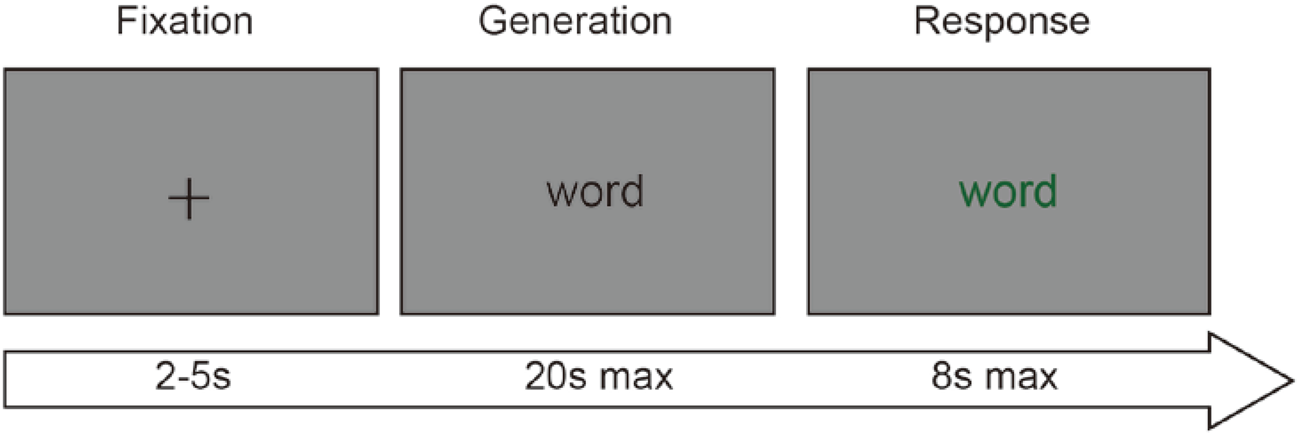
Each task commenced with an introduction phase. Then, each of the 60 trials began with a fixation period, presenting a black fixation cross on a light gray background jittering between 2 and 5 s. Then, the word was displayed and remained on the screen for up to 20 s. During this generation stage, the first 30 trials asked participants to “think of a concept that few people would think of but not verbalise based on the word” while the last 30 trials asked participants “base on the word, report the first characteristic that comes to mind that most people will think of but not verbalize it”. If they found a solution before timeout, they could hit the “Space” key on the computer keyboard to the next response interface. If the 20 s ran out, the interface would jump to the response interface automatically. In the response stage, green text, which reminded the participants vocalize their response in 8 s, was displayed. The protocol for the first-part task is displayed in Figure 1. This task took about 15 min to complete.
Association task procedure.
Combination task: combination task with its two conditions
Combination ability was tested by adjusting the protocol from Wan and Chiu (Reference Wan and Chiu2002). In this task, participants were asked to complete nine ordinary conceptual combination trials (five trials displayed in words and four trials displayed in graphics) and nine novel combination trials (five trials displayed in words and four trials displayed in graphics). All tasks are listed in Appendix C. Each trial was presented once in the task. In other words, this task included 18 trials. The order of the presentation was random.
In each novel conceptual combination trial, participants were asked to combine a pair of object concepts whose attributes were incompatible. The results of each combination trial should be an object that satisfies the trial description. Since the two concepts were incompatible, the intersection of the two concepts does not exist in real life. The result generated by participants was something not existing in real life. Therefore, the result could be considered a novel combination result at some levels.
In each ordinary conceptual combination trial, participants were asked to combine a pair of object concepts whose attributes were compatible. The results of each combination trial should be an object that satisfies the trial description. Since the two concepts were compatible, the intersection of the two concepts exists in real life. The result generated by participants was something that existed in real life. Therefore, the result could be considered an ordinary combination at some levels.
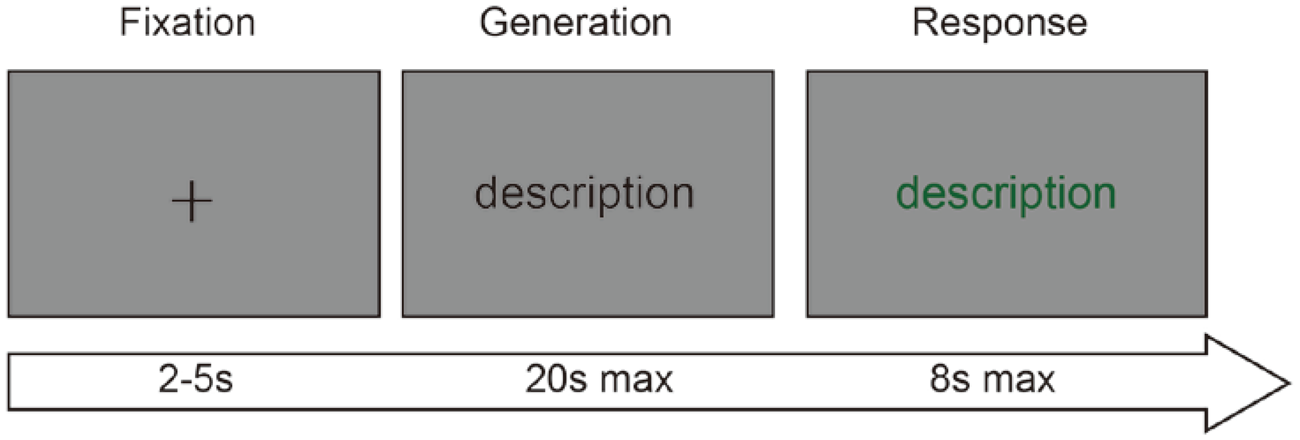
Each task commenced with an introduction phase. Each of the 18 trials began with a fixation period, presenting a black fixation cross on a light gray background jittering between 2 and 5 s. Then, the 18 trials were displayed and remained on the screen for up to 30 s. During this period, participants were asked to “think of an object that satisfies the trial description but not verbalize it”. If they found a solution before timeout, they could hit the “Space” key on the computer keyboard to the response interface. If the 20 s ran out, the interface would jump to the response interface automatically. In the response interface, the text will change to green, which reminded participants to vocalize their response in 8 s. The protocol for this task is shown in Figure 2. This task took about 10 min to complete.
Combination task procedure.
Retrieval task: cued autobiographic retrieval task
Retrieval ability was tested by adjusting Beaty et al.'s (Reference Beaty, Chen, Christensen, Kenett, Silvia, Benedek and Schacter2020) research protocol. In this task, participants were asked to creatively retrieve related stored information based on the given words. Considering the participants may not know the meaning of “creatively retrieval”, the task was replaced by “retrieve a past experience that few people may retrieve based on the given word”. The tasks were obtained from Beaty et al. (Reference Beaty, Chen, Christensen, Kenett, Silvia, Benedek and Schacter2020). All tasks can be seen in Appendix D. There were 30 trials (15 trials in words and 15 trials in graphics) and each task was presented once in this task.
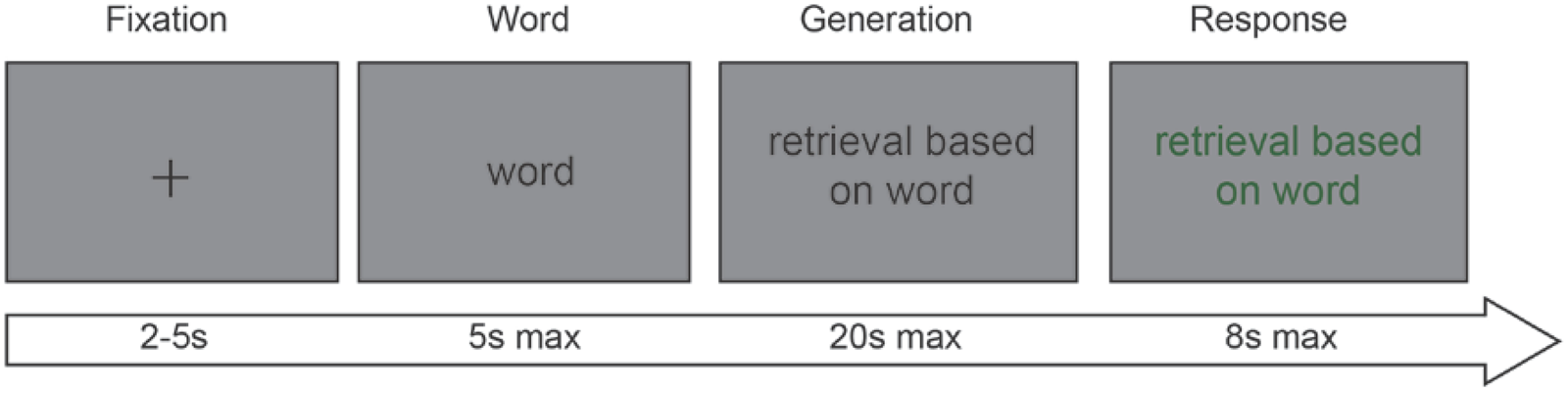
Each task commenced with an introduction phase. Each of the 30 trials began with a fixation period, presenting a black fixation cross on a light gray background jittering between 2 and 5 s. Then, participants saw a word and they needed to identify this word in 5 s but not verbalize it. If they recognize the words before 5 s, they could hit the “Space” key on the computer keyboard to the next interface. If the 5 s ran out, the interface would jump to the next interface automatically.
In the next interface, participants needed to “retrieve a past experience that few people may retrieve based on the given word but not verbalize it”. If they found a solution before time ran out, they could hit the “Space” key on the computer keyboard to the response interface. If the 20 s ran out, the interface would jump to the response interface automatically. In the response interface, the text would change to green, which reminded that participants could vocalize their response in 8 s. The protocol for this task is displayed in Figure 3. This task took about 10 min to complete.
Retrieval task procedure.
Recall task: cued sentence construction task
Recall ability was tested by adjusting Beaty et al.'s (Reference Beaty, Chen, Christensen, Kenett, Silvia, Benedek and Schacter2020) research protocol. In this task, participants were asked to construct a creative sentence based on the given word. The tasks were obtained from Beaty et al. (Reference Beaty, Chen, Christensen, Kenett, Silvia, Benedek and Schacter2020). Considering the participants may not know the meaning of “creative sentence”, the task was replaced by “construct a sentence that few people may think of based on the given word”. All tasks can be seen in Appendix E. There were 30 trials (15 trials in words and 15 trials in graphics) and each task was presented once in this task.
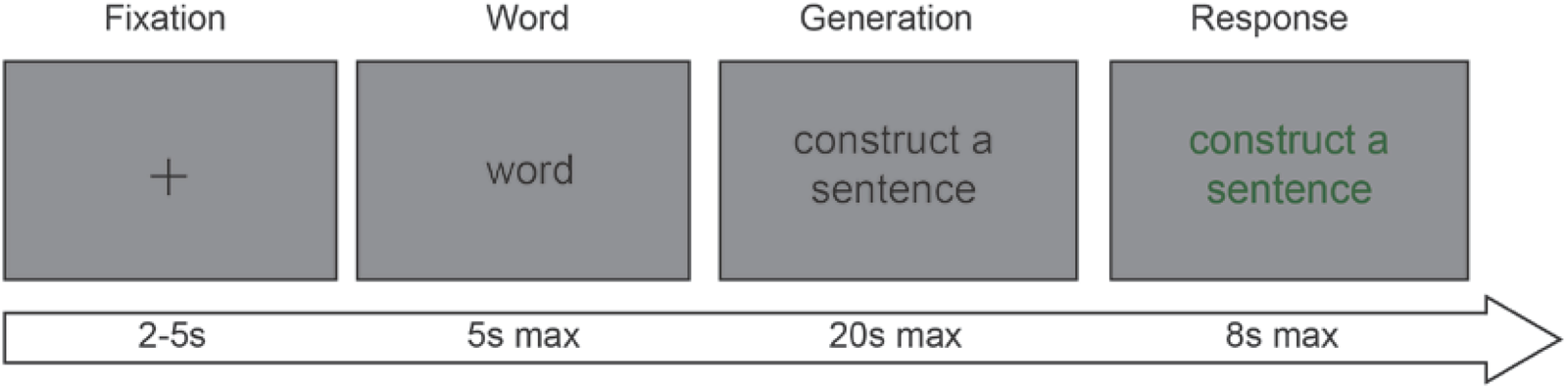
Each task commenced with an introduction phase. Each of the 30 trials began with a fixation period, presenting a black fixation cross on a light gray background jittering between 2 and 5 s. Then, participants saw a word and they needed to identify this word in 5 s but not verbalized it. If they recognize the words before 5 s, they could hit the “Space” key on the computer keyboard to the next interface. If the 5 s ran out, the interface would jump to the next interface automatically.
In the next interface, participants needed to “construct a sentence that few people may think of based on the given word but not verbalize it”. If they found a solution before time ran out, they could hit the “Space” key on the computer keyboard to the next response interface. If the 20 s ran out, the interface would jump to the response interface automatically. In the response interface, the text would change to green, which reminded that participants could vocalize their response in 8 s. The protocol for this task is displayed in Figure 4. This task took about 10 min to complete.
Recall task procedure.
Creative design task
The study used the creative design task process to represent the specific creative process of this participant. To be specific, participants were asked to wear the EEG device and completed a design task inspired by the topic “Fish” in 1 h. The design task was selected from the China Product-design Graduate Student Entrance Examination. Considering that the EEG signal may be affected by movement, the participants need to think about what they want to design first without moving. During this thinking process, participants were asked to wear the EEG to collect data during their thinking processes. After thinking, they can remove the EEG device and draw their ideas on paper with a pen. The total two processes were limited to 1 h. All participants finish the design task in the given time.
Verification experiment
The robustness of the linear regression results is identified by verifying whether the EEG-based decoding method can report which cognitive factors occurred in a specific creative process, after the EEG experiment, participants were asked to self-report whether they have had the association, combination, recall, and retrieval sub-processes in this creative design process.
Protocol
Before the EEG study, participants received an information sheet and a consent form. They could ask any questions for clarification. If there were no questions, they could sign the consent form. Then, participants were instructed on how to perform the association, combination, retrieval, and recall tasks. After they understood what was expected in each task, participants wore the EEG device with the help of the researchers. Before the EEG study started, participants were told that they could rest when a task was finished or that they could take off the EEG device to rest. Also, they were told that they can move their eyes freely while speaking, but they need to keep themselves still once the next fixation cross appeared (Stevens Jr and Zabelina, Reference Stevens and Zabelina2020).
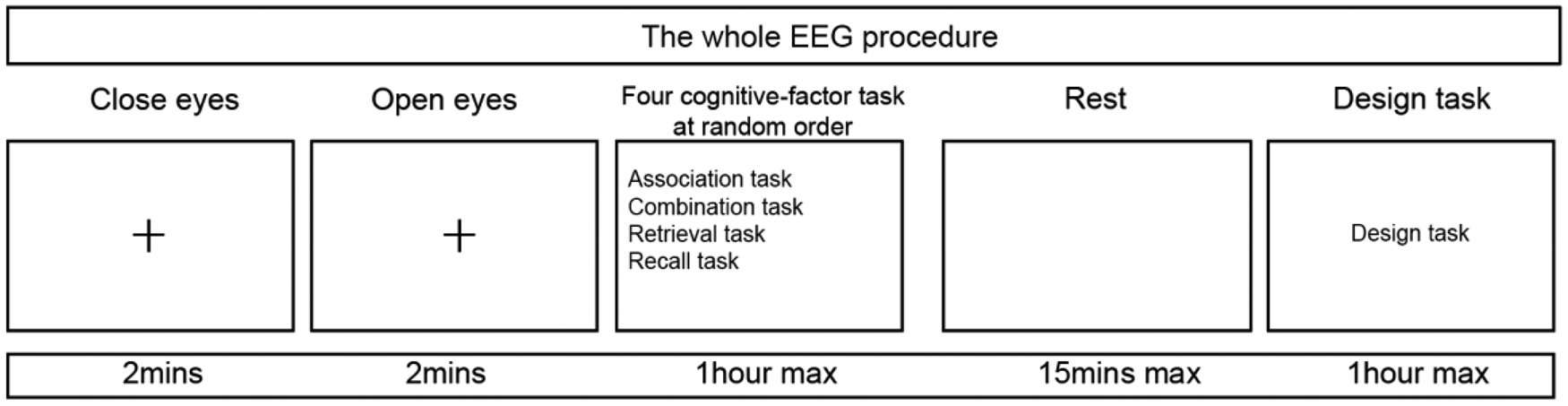
At the beginning of the EEG study, participants were asked to maintain a resting state. In the first 2 min, participants need to close their eyes, and in the second 2 min, they were asked to open their eyes. Then, the cognitive-factor tasks (the association, combination, retrieval, and recall tasks) were displayed in random order. The procedure of each cognitive factor task was outlined previously. The procedure of association, combination, retrieval, and recall can be seen in EEG induction tasks and protocols.
After these tasks, participants could take a 15-min break. Then, participants were asked to complete the creative design task “design a creative product inspired by the topic ‘Fish’ in one hour”. In this creative design process, participants need to think about what they want to design first without moving. After thinking, they can remove the EEG device and draw their ideas on paper with a pen. The EEG study procedure is shown in Figure 5. After the creative design task, participants were asked to report which cognitive factors (association, combination, retrieval, and recall) they have experienced in this creative design process. The entire study lasted around 2 h.
Overall EEG procedure.
EEG recording and equipment
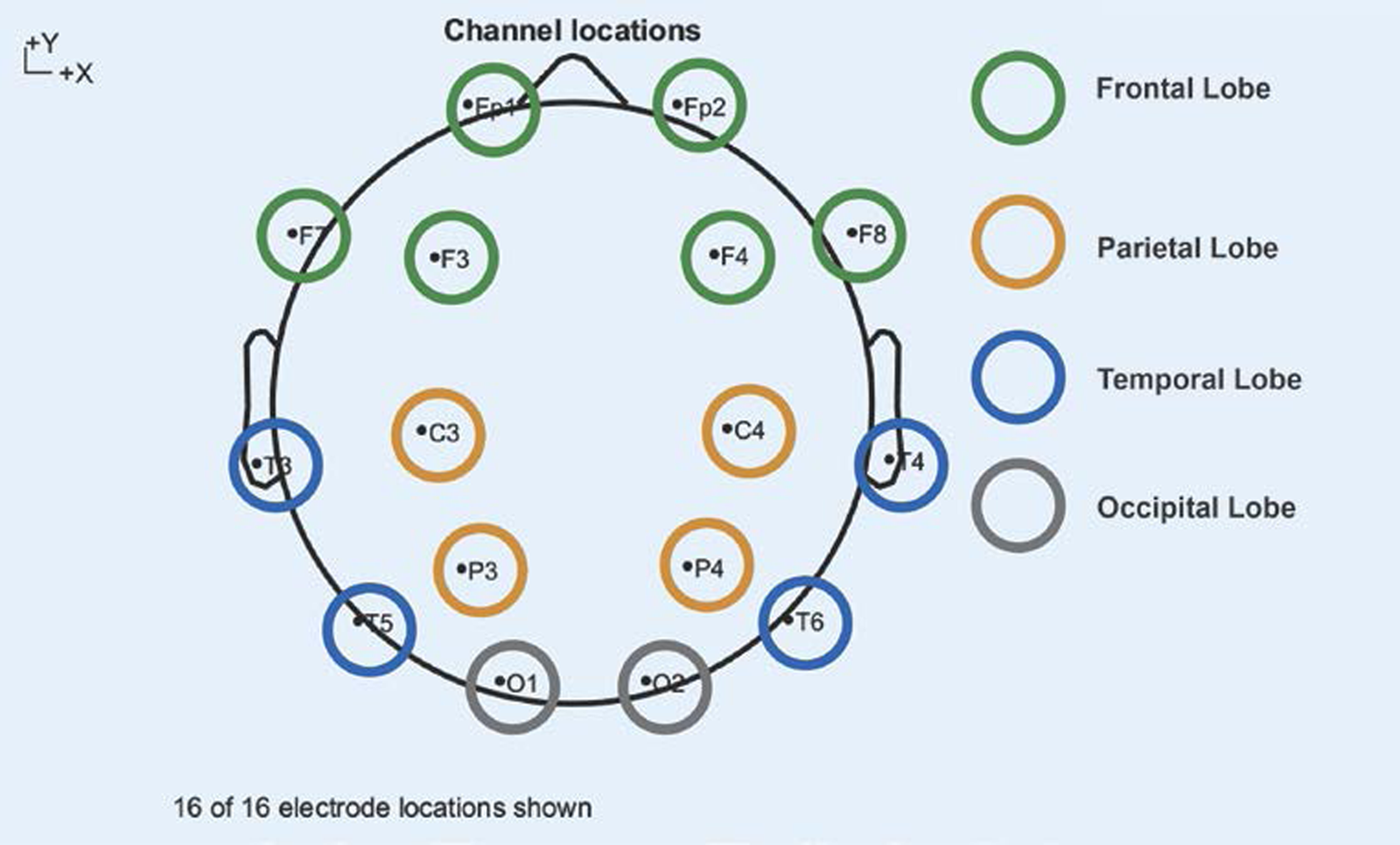
EEG signals were collected using the Neurofax EEG-9200 system (https://eu.nihonkohden.com/en/products/neurology/neurofax.html) with 16 scalp and 2 mastoid Ag/AgCl electrodes mounted according to the 10/20 system (Fig. 6). It is notable that the Neurofax EEG-9200 system is at a medical-diagnose level. EEG measurement system, Amplifier, and EEG results view software are all included in the system. Impedances of all EEG channels were below 5 kΩ. The data were sampled at 1000 Hz.
Neurofax EEG-9200 system with 16 scalp and 2 mastoid Ag/AgCl electrodes mounted according to the 10/20 system, and the relations between 16 channels and brain area.
The EEG tasks were generated with the help of E-Prime 3.0. All tasks were presented on a computer screen (35.89 × 24.71 cm with a resolution of 2560 × 1600). The data were collected and stored in the Neurofax EEG-9200 system.
A practical analysis example
Once each participant's EEG data on recall, retrieval, association, or combination tasks has been collected, the data were used to extract each participant's EEG characteristics of recall, retrieval, association, or combination in creativity. Also, each participant's EEG data on thinking a creative design inspired by the topic ‘Fish’ in 1 h data was used as the EEG characteristics source of a specific participant's creative process. The study then followed the promoted EEG-based decoding method to identify how the creativity-related cognitive factors (recall, retrieval, association, and combination) consist of a specific creativity process.
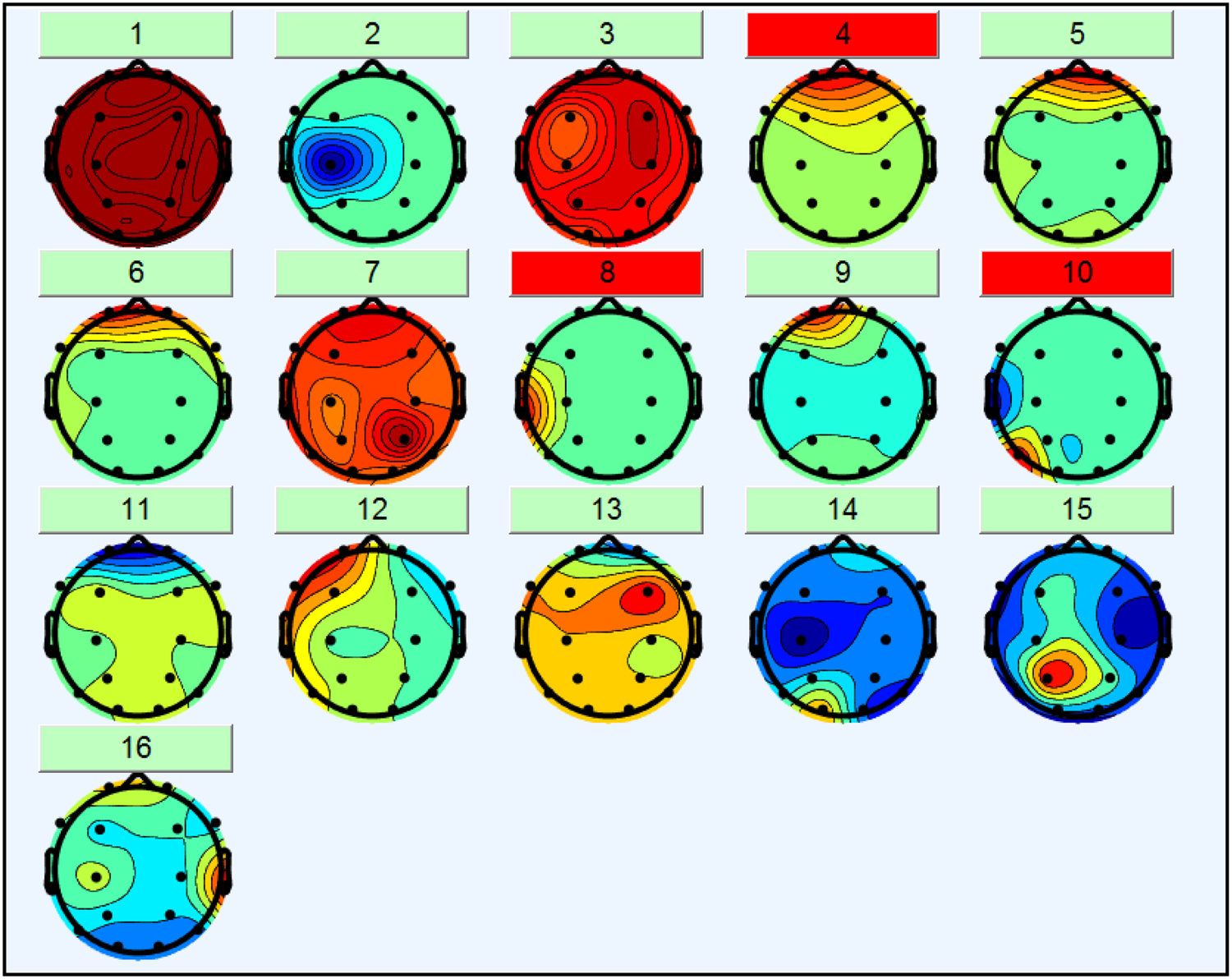
For a better understanding of the decoding method, this study took the analysis process of Participant 1 (P1) as a practical analysis example. Step 1 has been done in Section “EEG induction tasks and protocols” and Section “Protocol” and the related EEG characteristics of recall, retrieval, association, combination, and creative design have been collected. After preprocessing the EEG data (Step 2), the ICA was conducted (Step 3). The results of ICA are shown in Figure 7. For P1, Components 4, 8, and 10 were marked as artifact components automatically with the automated artifact rejection function.
ICA results of P1. Components 4, 8, and 10 were marked as artifact components automatically with the automated artifact rejection function.
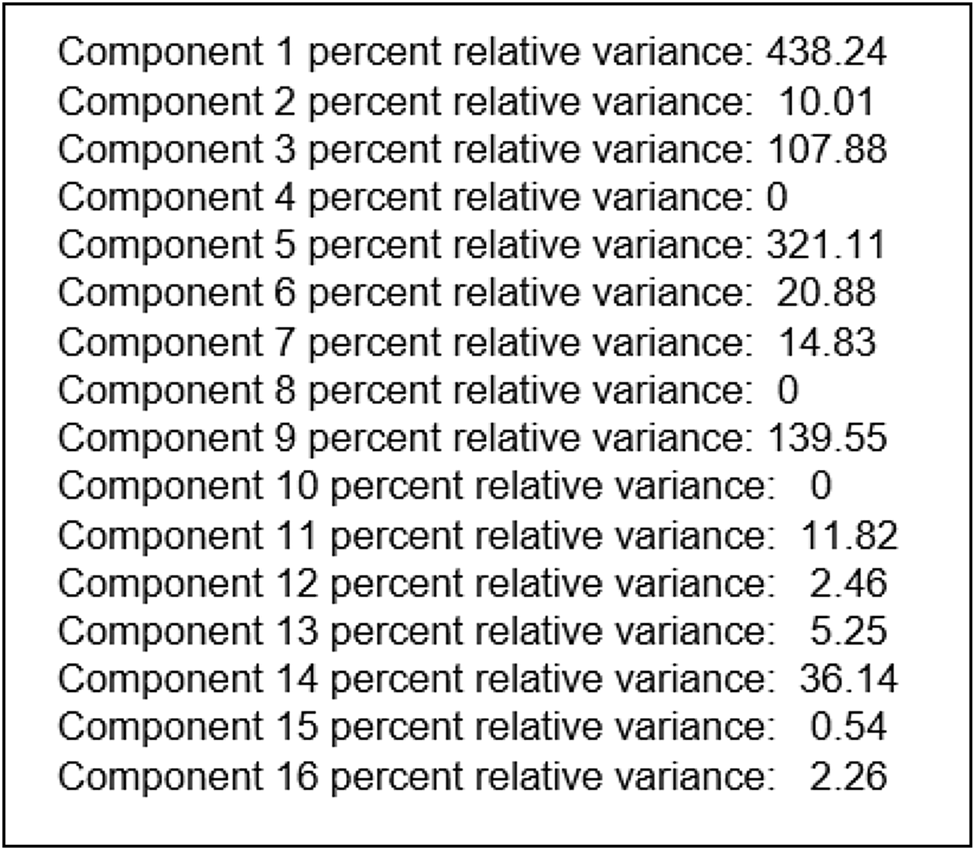
After removing the artifacts component (Components 4, 8, and 10), the association, recall, combination, retrieval, and creative process events were marked and extracted. Then the spectra analysis was conducted (Step 4). The creative-design-event spectra analysis results of P1 are shown in Figure 8 as an example.
The creative-design-event spectra analysis results of P1. The reason why the percent relative variances of Components 4, 8, and 10 were zero is that these components have been removed in the ICA process as the artifact components. (Percent relative variance was used to represent the contribution of a specific Component X to a particular cognitive-factor-related event).
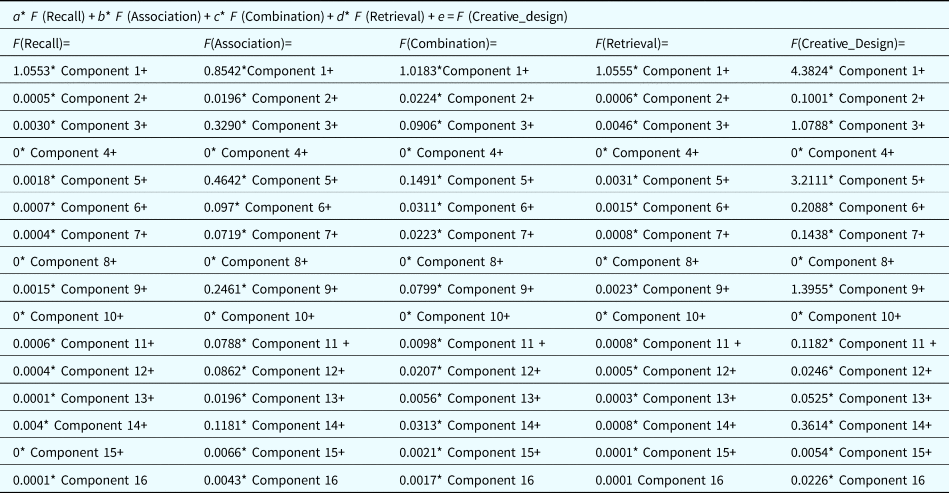
Then, based on Formula 1, the formulas to represent the constitution of each event based on ICA and spectral analysis were generated (Step 5). The formulas that can reflect the constitution of Association, Combination, Recall, Retrieval, and Creative design events of P1 are included in Table 1. The original formula to represent the relations between four cognitive-factor events (recall, association, combination, and retrieval) and creative design event was then generated which is Formula 2 (Step 6). Coefficients a, b, c, d and the constant e were then calculated with the help of SPSS (Step 7). The results of SPSS are shown in Table 2. To be specific, Table 2a displays the R-square results. Table 2b is used to display whether Formula 3 is statistically significant. Table 2c is used to display the coefficients a, b, c, and d, and the constant e. Table 2d is used to display the excluded variable results.
Formula that can reflect the constitution of association, combination, recall, retrieval, and creative design events
The SPSS results of P1 (The data which related to the formula buding has been marked as bold font)
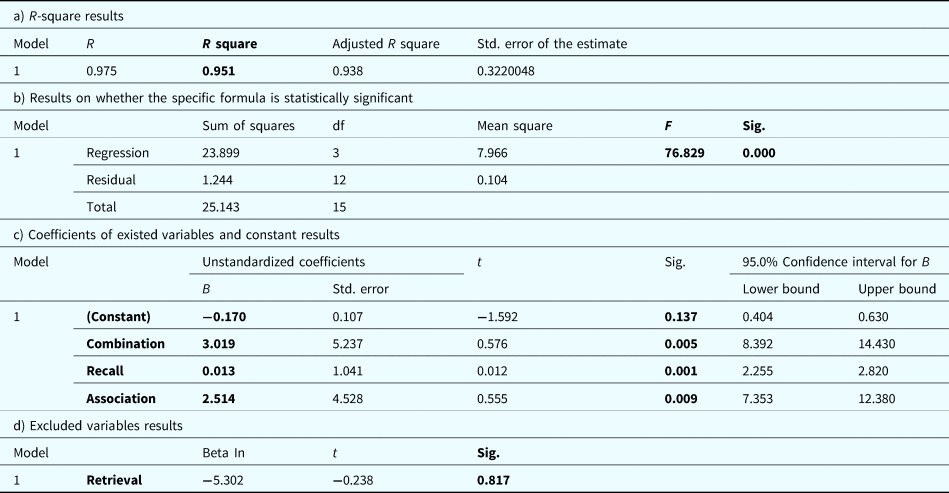
The combination (beta coefficient = 3.019, p = 0.005 < 0.05), recall (Beta coefficient = 0.013, p = 0.001 < 0.05), association (Beta coefficient = 2.514, p = 0.009 < 0.05) events were statistically significant to the creative design event (Table 2c). The combination, recall, and association can explain 95.1% of changes in the creative design process (R-square = 0.951) (Table 2a). The retrieval (beta coefficient = −5.302, p = 0.817 > 0.05) was not statistically significant to the creative design event (Table 2d). In other words, the combination, recall, and association sub-processes occurred in the creative design process of P1. In the creative design process of P1, the effect of combination is higher than association, than recall. Based on the results, the formula that can represent the relations between four cognitive-factor events and the P1 creative design event is shown in Formula 3. The specific formula is statistically significant (F = 76.829, P = 0.000 < 0.01) (Table 2b).
F(Creative_design) = 3.019 F(Combination) + 0.013F(Recall) + 2.514 F(Association)−0.170
Formula 3. The formula that can represent the relations between four cognitive-factor events and the P1 creative design event
Based on Step 7–2, Formula 3 of P1 can be explained. Retrieval is identified as an exclusive variable because it was not statistically significant to the creative design event. This means for P1, the participant's creative design process may not include a retrieval sub-process and thus the F(Retrieval) was not included in Formula 3. As for F(Combination), F(Recall), and F(Association), they were identified as statistically significant to the creative design event and thus were included in Formula 3. The coefficient of F(Combination), F(Recall), and F(Association) can be used to represent the degree of change in a 1-unit change of F(Creative_design) in the F(Combination), F(Recall), or F(Association). The higher the absolute coefficient is, the more effect that the F(Combination), F(Recall), and F(Association) have on F(Creative_design). Therefore, it can be seen for P1, the combination sub-processes have a higher effect on the creative design process, than association sub-process, than recall sub-process. The constant e was used to represent the undefined influence effect, which is worth further detecting in the future.
It is notable that, in this example, there is an inconsistency between coefficient value B and 95% confidence interval. This may be because of the limited trials number. The analysis was based on a single participant. In other words, the combination EEG data included 18 trials; Recall EEG data included 30 trials; Retrieval EEG data included 30 trials; Association EEG data included 60 trials; The creative process EEG data only included one trial. This limited trial number may lead to the inconsistency between coefficient value B and 95% confidence interval. However, considering the ethic risk of using EEG, a single participant may not be able to conduct too many EEG tasks and trials. If the trials are expected to be increased, the EEG study needs to be separated from a single experiment to more-than-once experiments. For a single experiment, the participant's personal condition can be controlled. If the data are collected based on multiple experiments, the experiments will occur over a few days and the personal condition of participants may change and make the results less reliable. Therefore, this limitation on sample numbers is inevitable at some levels. In the future, research which includes more EEG trials may be conducted to see what will happen to the coefficient value B and 95% confidence interval.
Results
Identification ability results
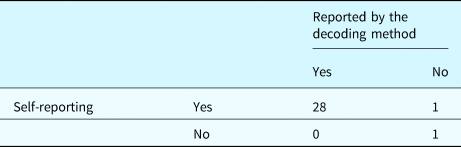
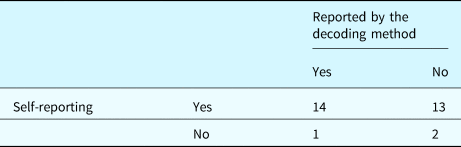
All EEG signals were processed using MATLAB R2018b with EEGLAB plus. Statistical analyses were carried out using SPSS. The formulas that can represent the relations between four cognitive-factor events and each participant's creative design event were built up. The method has been outlined in Sections “Theory of the EEG-based decoding method and Experiment implementation”. Based on the formulas, which cognitive factors have occurred in a specific cognitive process can be identified. To verify the efficiency of the decoding method, the study involved asking participants to self-report which cognitive factors they experienced. By comparing the cognitive factors which have been identified as occurring in a specific cognitive process and the self-report results, the reliability of the decoding method can be identified. The results showed that among the 29 participants who mentioned they have the recall cognitive process, 96.55% of them were identified by the decoding method (Table 3). Among the 27 participants who mentioned they have the combination cognitive process, 51.85% of them were identified by the EEG method (Table 4). Among the 28 participants who mentioned they have the association cognitive process, 85.71% of them were identified by the EEG method (Table 5). These results can support that the EEG method can report the participants’ cognitive process. Among the 11 participants who mentioned they have the retrieval cognitive process, 27.27% of them were identified by the EEG method (Table 6).
The different reported recall sub-processes results between self-reporting and the decoding method
The different reported combination sub-processes results between self-reporting and the decoding method
The different reported association sub-processes results between self-reporting and the decoding method
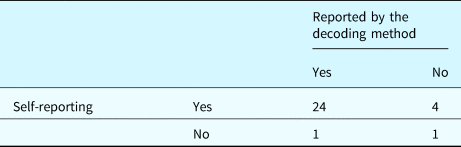
The different reported retrieval sub-processes results between self-reporting and the decoding method
Brain regions and cognitive factors
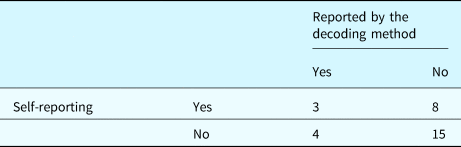
Which part of the brain is active in a specific cognitive factor sub-process can be identified with the help of ICA and spectra analysis results. The component number mentioned in spectral analysis was consistent with the component number mentioned in ICA results. Since percent relative variance was used to represent the contribution of a specific Component X to a particular cognitive factor (or creative process), the higher percent relative variance means the corresponding component has a higher contribution. Therefore, the highest component percent relative variance means the corresponding components have the highest contribution to the particular cognitive factor (or creative process). Therefore, the ICA and spectra analysis were conducted for each cognitive factor (recall, retrieval, association, and combination) sub-process and creative design process respectively for each participant. The results were shown in Table 7. From the results, it can be found that among the 30 participants, most of their recall sub-processes were related to the whole brain areas (12) and frontal lobes (11). Retrieval sub-processes were mainly related to the frontal lobe (10), temporal lobe (9), and the whole brain (7). Association and combination sub-processes were mainly related to the frontal lobe (15 and 17, respectively). Creative processes were mainly related to the whole brain areas.
The brain regions and cognitive factors for each participant (The results indicating the main relations between cognitive factors and brain areas are in bold)

How important are levels of cognitive factors related to creative output quality levels
One aim of this study is to identify the relations between important levels of cognitive factors and creative output quality levels. To identify the creative output quality levels, the study recruited five experts in creativity to use Cognitive Processes Associated with Creativity (CPSS) and a six-level grading method to assess the 30 creative outputs generated from this study. Each expert's assessment results were normalized to reduce the bias caused by some experts may mean to give a higher score or too general to give a high score. Then, the average normalized score of the five experts was calculated to represent the creative score of the particular output. The creative scores ranging 0.7 -1 were considered as the high creativity quality level. The creative scores ranging 0.5–0.7 were considered as the middle creativity quality level. The creative scores which were less than 0.5–0.7 were considered as the low creativity quality level.
By using the decoding method, cognitive factors that occurred during each participant's creative process and the important levels of these cognitive factors in the creative process were identified. The important level of a particular cognitive factor was represented by the Beta coefficient of this particular cognitive factor. The countable results for the important level conditions of each cognitive factor and creative output quality levels were shown in Table 8. For simple expression, “the most important cognitive factor” is expressed as “the dominant cognitive factor”; “The second important level cognitive factor” is expressed as “the second dominant cognitive factor”; “The third important level cognitive factor” is expressed as “the third dominant cognitive factor”; “The fourth important level cognitive factor” is expressed as “the fourth dominant cognitive factor”.
Countable results for the weight of each cognitive factor and creativity quality level*“/” means there is no data (The results which indicating the main relations between dominant cognitive factors and creativity quality levels are in bold)
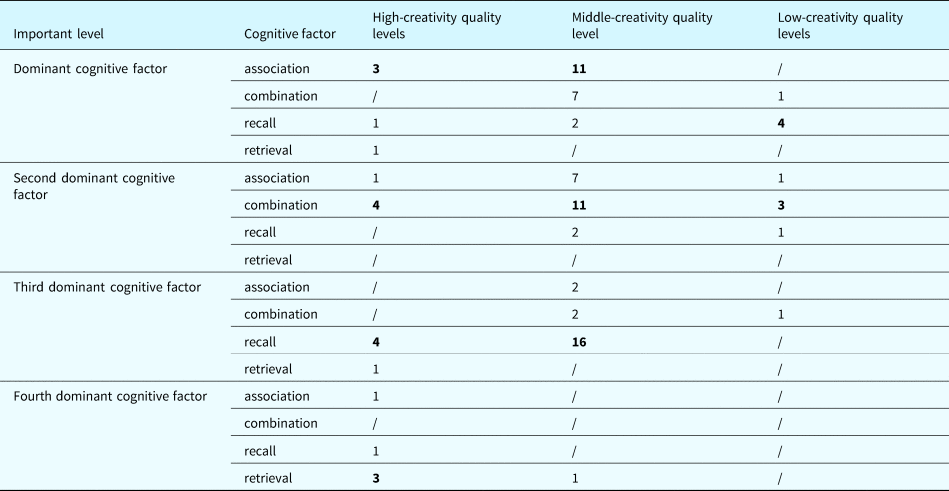
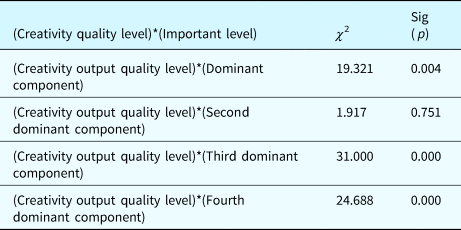
The Cross Tab method, which is a statistical analysis method to show the relationship between two or more variables, was used for analysis via SPSS. The results (Table 9) reveal that the dominant cognitive component (χ 2 = 19.321, p = 0.004 < 0.05), the third dominant cognitive component (χ 2 = 31.000, p = 0.000 < 0.05), and the fourth dominant cognitive component (χ 2 = 24.688, p = 0.000 < 0.05) in a creative design process are statistically significantly related to the creative output quality levels. To be specific, association is the dominant cognitive component for the highest and middle levels of creative outcome. Recall is the dominant cognitive component for the lowest level of creative outcome. Recall is the third dominant cognitive component for the highest and middle levels of creative outcome. In the highest level of creative outcome, the dominance effect of retrieval is the weakest.
Results of cross tab
Brain wave results
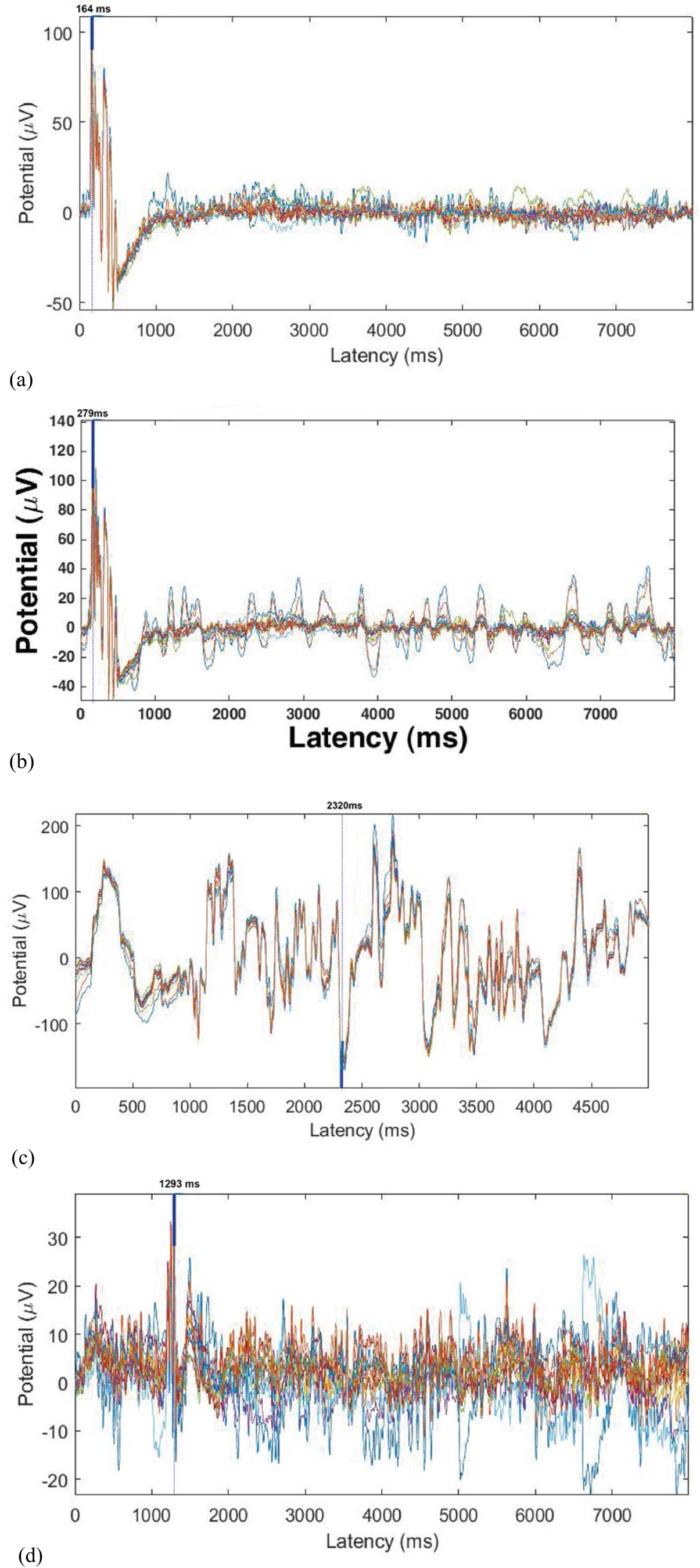
The brain wave results were represented by event-related potentials (ERPs) results based on scalp maps. ERPs can be used to represent the brain response to a specific cognitive event. A generation result was shown in Figure 9. From the results, it could find that the ERPs of recall sub-processes were 164 ms. The ERPs of association sub-processes were 297 ms. The ERPs of combination sub-processes were 1293 ms. The ERPs of retrieval sub-processes were 2320 ms.
Relations between ERPS results and recall (or association, or retrieval, or combination) sub-processes EEG wave. (a) Relations between ERPS results and recall sub-processes. (b) Relations between ERPS results and association sub-processes. (c) Relations between ERPS results and retrieval sub-processes. (d) Relations between ERPS results and combination sub-processes.
Discussion
To understand creative processes objectively, this study promoted a decoding method that can be used to identify which cognitive factors occurred in a creative process and the important levels of the occurred cognitive factors with the help of EEG. The identification ability of the promoted decoding method has been verified.
Principal findings and contribution
The relations between cognitive factors sub-processes in a creative process and brain areas have been identified. The study indicates that creative (design) processes are mainly related to the frontal lobe brain areas. In addition, previous studies have mainly identified which cognitive factors happen in a creative process through qualitative methods such as think aloud and interview. This study proposed a decoding method using EEG data to identify which cognitive factors occur in a creative design process objectively. This can help researchers and designers to further understand creative processes. Thirdly, because the important levels of cognitive factors cannot be reported in a proper way, existing research has not fully detected how the important levels of cognitive factors affect the creative output quality levels. With the help of the promoted decoding method, the study explores how the important levels of cognitive factors affect the creative output quality levels. The results revealed that association sub-processes are the dominant cognitive component for higher creative outcome quality levels; while recall sub-processes are the dominant cognitive component for lower creative outcome quality levels.
Comparison with existing research
Existing research has reported that recall was related to the activation of parietal lobe (Green, Reference Green2016), which is different from the active brain areas that this study identified. From this study, recall was more likely to be related to the frontal lobe and the whole brain areas (Beaty et al., Reference Beaty, Chen, Christensen, Kenett, Silvia, Benedek and Schacter2020). This difference may be because the tasks that were used to collect the EEG characteristics of recall sub-processes were different. Existing research has mainly explored the recall sub-process by asking participants to recognize a word and construct a sentence based on the given word. However, this recognition did not involve recall sub-processes in a creative (design) process. This study asked participants to construct a creative sentence based on the given word. This difference in creative context may be also one of the reasons why existing research has reported that the retrieval sub-processes were related to parietal lobe (Green, Reference Green2016) while this study showed the retrieval sub-processes are more likely to be related to the frontal lobe. Existing research has also identified that the association sub-processes may be related to various areas, such as frontal lobe (Purcell and Gero, Reference Purcell and Gero1998; Fink et al., Reference Fink, Barbara and Aljoscha2009) and temporal lobe (Jung-Beeman, Reference Jung-Beeman2005; Stevens Jr and Zabelina, Reference Stevens and Zabelina2019). This study supported that the association sub-processes are related to frontal lobe areas. The differences may be because association can be divided into common association and remote association. This study combined the two association conditions while the other studies may separate the two association conditions. Moreover, this study is the first attempt to detect which part of the brain is related to combination sub-processes. The results revealed that combination is related to frontal lobe areas. This study thus has supplemented the detection on combination sub-processes using EEG methods.
Identification ability of the decoding method
Recall sub-process identification ability
The verification results supported that if participants have a recall cognitive process in their creative designs, most of these recall sub-process can be reported by the decoding method (96.55%). This supports that with the help of the decoding method, whether the participants have a recall sub-process in their creative design processes can be reported to a highly reliable level. Notably, recall may be a preprocess of retrieval, association, and combination. However, this decoding method cannot identify whether the identified recall sub-process came from retrieval, association, combination, or simply a recall sub-process and is not related to the other sub-process. This limitation was generated from the design of the EEG induction tasks. In the EEG induction task, the EEG characteristics of recall in retrieval, association, and combination tasks were not specifically collected and distinguished. In addition, this study used constructing a creative sentence as the EEG characteristics of recall sub-process. However, in a recall sub-process in creative design, the designers may have some other recall forms such as constructing a creative word. Since the study has not collected all EEG characteristics of recall sub-process, this may make some recall sub-processes in a specific creative design process cannot be identified. This, on the one hand, may affect the coefficient of the recall event and further affect the important levels of the recall factor in a creative design process. On the other hand, if a participant's recall sub-process is coincidentally not included in the form of constructing a creative sentence. The decoding method will suggest that the recall sub-process did not exist in the creative design process, which makes the decoding method less reliable.
Association sub-process identification ability
Among the participants who self-reported that they have an association sub-process in creative design, 85.71% of their association sub-process was identified by the EEG method. This indicated that the decoding method has high reliability in reporting whether association has happened in a creative design process.
Combination sub-process identification ability
Among the participants who self-reported that they have a combination sub-process in creative design, only 51.85% of their combination sub-process was identified by the EEG method. Compared with the identification ability of association and recall, the identification ability of combination is low. There are a few explanations for this low identification ability. This first may be because participants, who have self-reported that they have a combination sub-process in creative design, may not really have a combination sub-process. In addition, this may be because the EEG induction study on collecting combination EEG characteristics is not in a high quality. There are few studies applying EEG methods in testing combination sub-processes in creative design. The EEG induction task that was used to report the combination sub-processes is adjusted by a non-EEG study which aimed to identify the differences between novel combination and original combination abilities in creative design. The reliability of this induction method is worth further detecting. Finally, the EEG characteristics of combination are average results of novel combination and original combination. Therefore, the identification is rough and could not distinguish the novel combination and original combination.
Retrieval sub-process identification ability
Among the participants who self-reported that they have a retrieval sub-process in creative design, only 27.27% of their retrieval sub-process was identified by the EEG method. This is the lowest identification ability score among the four cognitive-factor sub-processes. However, although the identification percentage of retrieval sub-processes is low, this does not mean the decoding method performed poorly in identifying retrieval sub-processes in creativity. Instead, it may be because participants did not have retrieval sub-processes in creativity in their creative processes but still reported it. This can be supported from the data that most of the retrieval sub-processes happened in high creativity quality level outputs processes. Eleven participants self-reported that they have a retrieval sub-process, while only two of their creative outputs were assessed as high creativity quality level.
Identification ability
Collectively, the results suggested that cognitive processes in creativity can be decoded with the help of EEG measurement. Whether a cognitive factor (recall, association, combination, or retrieval), especially the recall or association sub-process, has happened in a creative design process can be identified by the promoted decoding method. The verification results further indicated that the recall and association sub-process can be reported in a high-reliability level.
How important levels of cognitive factors affect creative output quality levels
The results indicated that association is mainly related to high creative output quality levels. This is consistent with the existing creativity process models. In the creativity process models, association is one of the cognitive factors that have been promoted frequently, such as Structure of Intellect Model (Guilford, Reference Guilford1956), Genoplore model (Finke et al., Reference Finke, Ward and Smith1992), Gabora's Theory (Gabora, Reference Gabora2010), Nijstad et al.'s model (Nijstad et al., Reference Nijstad, De Dreu, Rietzschel and Baas2010). The result also indicates the importance of recall in a creative design process. However, it mainly works for low creative output quality levels. This may be because recall is the fundamental cognitive process for creative design.
From the results, recall and association are the two cognitive factors that are the dominant cognitive component in different creative output quality levels. This can also be explained by ERPs results (Section “Brain wave results”). ERPs can be used to represent the brain's response to a specific cognitive event. The higher ERPs meant the more time that this cognitive factor needed to be evoked. From the results, recall sub-processes can be evoked in a swifter speed (164 ms), than association sub-processes (297 ms), than combination sub-processes (1293 ms), than retrieval sub-processes (2320 ms). Thus, people may have more association and recall sub-processes in mind and the weights of the two cognitive factors are high.
The result on retrieval indicates that although it is the fourth dominant cognitive component, retrieval is related to the High creativity quality. This can also be explained from the ERPs results. Retrieval involves more workload and requires the longest time to be evoked than other cognitive factors. Therefore, although retrieval may be helpful for high creativity quality, this high workload halts people from using it in mind in a high volume.
Notably, in this section, the important levels of cognitive factors are summarized from the decoding methods presented in Section “Theory of the EEG-based decoding method”. This means the reliability of the promoted decoding method may affect the accuracy of this section's analysis. From the discussion on the identification ability of the decoding method (Section “Identification ability of the decoding method”), the identification performance of combination and retrieval sub-processes of this decoding method is relatively low. This study hypothesis the relatively low identification ability of combination and retrieval sub-processes was because the participants cannot self-report their combination and retrieval sub-processes accurately. Therefore, the combination and retrieval sub-processes can be identified by the decoding method reliably. However, the identification ability of the decoding methods, especially the identification ability of combination and retrieval sub-processes needs to be improved in the future.
Limitations and future research
This study has a few limitations. Firstly, this study only recruited 30 Chinese participants. The participants’ culture and ages may also affect the EEG results. Therefore, in the future, more participants from different ages and cultures should be incorporated. Secondly, it is possible that the previous tasks and trials may affect the latter ones. What the study can do is to limit the spillover effects by presenting the inducted tasks in random order and presenting the trials in each task in random order. In other words, although attempts were made to conduct the study without any external interference (such as motion and noise), the possibility of spillover effects cannot be ruled out completely.
Thirdly, the study assumed that participants can follow the instructions completely. Also, the study assumed that the EEG recorded in each cognitive-factor task can represent participants’ cognitive-factor ability completely. Also, the study hypothesized that participants did not think of anything which was not related to the cognitive-factor tasks and their thinking processes relied on their cognitive-factor-related ability. However, there was no method enabling researchers to objectively check whether participants did not have thoughts unrelated to the cognitive-factor tasks or whether their thought processes solely relied on their cognitive-factor-related abilities. Therefore, whether the identified EEG signals were completely the actual cognitive-factor-related EEG signals cannot be ensured. This makes the results less reliable. Even if the study assessed the cognitive-factor-task results, it would only reflect the creativity levels. The researchers would still be unsure whether the results were generated from the cognitive-factor-task-related abilities. Therefore, future studies should add a checking mechanism to increase the accuracy of the EEG quality.
Furthermore, the creative (design) process is complex which includes recursive and restructuring processes. The cognitive factors (recall, retrieval, association, and combination) involved in this study can only represent a small part of this process. In the future, more research can be done to detect more cognitive processes behind creativity to supplement the existing study. Moreover, the accuracy, precision, and recall rate of the prediction based on the decoding method were not identified. This is out of the consideration that the promoted decoding method did not have a prediction function practically. To be specific, the formula that the study promoted is used to identify the important levels of cognitive factors in a creative process. This process will change among designers and among creative tasks. Therefore, the promoted decoding method does not have a prediction function.
In addition, the identification ability of the decoding method is verified through comparing the self-report results and the results from the decoding method. However, the self-reporting happens after the EEG study and may be subjective. Considering self-reporting can provide complementary information on which cognitive factors have been involved in a specific creative process, the self-reporting method was applied in this study. However, in the future, more methods to detect which cognitive factors happened are expected, such as think aloud. In addition, more methods can be used to justify the reliability of the self-reported results. For example, participants can be asked to report the confidence levels of their self-reporting results on reporting each cognitive factor and possible combinations. Also, pre-introduction, training, and tasks can be conducted to train and identify whether participants can recognize the different kinds of cognitive factors.
Moreover, this research hypothesized that the ideas (or concepts) generated from the neural activity in induction processes would be identical to those from the creative design process. In other words, the study cannot ensure whether participants’ thinking mechanism in induction tasks was the same as that in a real creative design process. Whether the collected EEG signals in induction tasks can be used as a cue to identify the occurring condition of cognitive factors in creative processes is worth further study.
Conclusion
This study proposes and promotes an objective method to decode which cognitive factors (association, combination, recall, and retrieval) occurred in a specific creative process through EEG data. To be specific, designers need to wear the EEG devices to finish four cognitive-factor induction EEG tasks and a creative design task. After preprocessing the EEG data, and conducting the ICA and spectral analysis, the formula to represent each cognitive-factor (association, combination, recall, or retrieval) event and creative design event was generated. Based on these formulas, equality can be generated to represent the relations between four cognitive-factor events and the creative design event. Regression analysis was applied to identify which cognitive factors occurred during the specific creative design process can be identified and the important levels of these occurred cognitive factors.
Thirty participants were recruited to conduct the EEG-inducted study and complete a design task, followed by self-reporting which cognitive factors they have had in the creative design process. The identified cognitive factors result from the decoding method and that from the self-reported method were compared. The results supported that the cognitive process in creativity can be decoded with the help of EEG measurement. Whether a cognitive factor (recall, association, combination, or retrieval) has happened in a creative design process can be identified. The recall and association sub-process can be reported in a high-reliability level. Then, how the relative importance levels of cognitive factors affected the creative output quality levels were identified. By applying the decoding method, the study found that association is the dominant cognitive component for higher levels of creative outcome. Recall is the dominant cognitive component for lower level of creative outcome.
The core contributions of this study include: (i) this study proposes and promotes an objective method to decode which cognitive factors(association, combination, recall, and retrieval) occur in a specific creative process through EEG data. This is a starting point for more sophistication in quantifying other human cognitive processes with neurocognition methods. (ii) This study can be helpful in understanding the cognitive process in creativity from a more objective and quantitative method. (iii) With the help of the promoted decoding method, the study explores how the important levels of cognitive factors affect the creative output quality levels. This triggers designers and researchers to think about how to improve creativity quality levels by further understanding the performance of creative processes and cognitive factors sub-processes.
Acknowledgements
This project would not have been possible without Dr Haibo Lan, Mr Weija Yin, and Dr Ning. The authors are extremely grateful to their support and help for the project.
Conflict of interest
The author(s) declare none.
Data availability statement
Considering the EEG data includes sensitive information and may trigger bias, the EEG data that support the findings of this study are available from the corresponding author upon reasonable request. The other data generated or analyzed during this study are included in this published article. The materials used for this study are available in Appendix.
Financial support
This work received no specific grant from any funding agency, commercial or not-for-profit sectors.
Yuan Yin is currently a PhD student at the Dyson school of Design Engineering at Imperial College London. Her research interests focus on creativity and design, cognitive creativity, neurocognition in design, and AI in creativity. Her current research project is concerned with investigating the cognitive process of creativity using EEG methods. She obtained her MSc in Human-computer interaction from the University College London, and BEng in Industrial design from Beijing Institute of Technology.
Haoyu Zuo is currently a Ph.D student at the Dyson school of Design Engineering at Imperial College London. His general research interests include: design-related knowledge graph, data-driven-design, natural language processing, AI in design, AIGC in design.
Professor Peter Childs is Professorial Lead in Engineering Design at Imperial College London. His professional interests include: creativity tools and innovation; robotics, machine learning and sustainable energy. Former roles include director of the Rolls-Royce University Technology Centre for Aero-Thermal Systems, director of InQbate and professor at Sussex University. He is Founder Director and Chair at Q-Bot Ltd and Director and Chair at BladeBUG Ltd. He is a fellow of the Royal Academy of Engineering.
Appendix A: the first-part material of association
1. Bowl
2. Safety vest
3. Key chain
4. Book
5. Cork
6. Bell
7. Bobby pin
8. Ice pack
9. Paint can
10. Spring
11. Vacuum
12. Cane
13. Chopstick
14. Wheel
15. Spoon
16. Coaster
17. Marker
18. Yarn
19. Bullet
20. Drumstick
21. Water bottle
22. Paper clip
23. Dress
24. Seat belt
25. Lipstick
26. Magnet
27. Thermometer
28. Bowling pin
29. Shaving cream
30. Popsicle stick
Appendix B: the second part material of association
1. Brick
2. Plate
3. Rope
4. Toothbrush
5. Broom
6. Fork
7. Flowerpot
8. Tire
9. Shovel
10. Coffee Cup
11. Chair
12. Book
13. Doormat
14. Ruler
15. Belt
16. Garbage Can
17. Rake
18. Curtain
19. Spoon
20. Comb
21. Garden Hose
22. Pillow
23. Umbrella
24. Boots
25. Magazine
26. Dustpan
27. Purse
28. Hammer
29. Pencil
30. Scissors
Appendix C: the material for combination
-
Ordinary conceptual
1. A piece of coat that is also a kind of animal skin
2. A vehicle that is also a kind of fish
3. A food that is also a kind of rock
4. A fruit that is also a kind of human dwelling
5. A bird that is also a kind of kitchen utensil
6. A food flavoring that is also a kind of tool
7. A food flavoring that is also a kind of mineral
8. A computer that is also a kind of teacup
9. A cooking stove that is also a kind of bicycle
Novel conceptual
1. A piece of furniture that is also a kind of fruit
2. A weapon that is also a kind of utensil
3. A timer that is also a kind of ornament
4. A food that is also a kind of animal
5. A plant that is also a kind of fuel
6. A vehicle that is also a kind of machine
7. A bird that is also a kind of pet
8. An electronic product that is also a kind of book
9. A lampshade that is also a kind of game
Appendix D: the material for retrieval
1. Tape
2. Seashell
3. Picture frame
4. Saw
5. Shoelaces
6. Flagpole
7. Bobby pin
8. Paint brush
9. Stapler
10. Necktie
11. Vacuum
12. Cane
13. Chopstick
14. Golf ball
15. Spoon
16. Coaster
17. Notebook
18. Tile
19. Wind chime
20. Pen
21. Glue
22. Lollipop stick
23. Pizza cutter
24. Coin
25. Mouse pad
26. Eyeglasses
27. Feather
28. Toilet paper
29. Cotton
30. Wine glass
Appendix E: the material for recall
1. Thumb tack
2. Floss
3. Key chain
4. Book
5. Diaper
6. Bell
7. Carpet
8. Dart
9. Magazine
10. Paper clip
11. Dress
12. Seat belt
13. Eraser
14. Magnet
15. Thermometer
16. Chair
17. Shaving cream
18. Apron
19. Milk carton
20. Light bulb
21. Rubber band
22. Bed sheet
23. Button
24. Padlock
25. Sponge
26. Matches
27. Toothbrush
28. Watch
29. License plate
30. White board


 Open access

